Volume 3 / Part 4 — Justice. Being Part IV of the Principles of Ethics. By Herbert Spencer. New York: D. Appleton & Co., 1891.
Reading edition
Among Mr. Spencer’s most important books are those entitled Justice and Social Statics. The latter, which first appeared in 1850, has just been republished in about one-half of the original size, some parts having been transferred to the book on Justice, and others omitted altogether. “One difference,” as he says, “is that what there was in my first book of supernaturalistic interpretation has disappeared, and the interpretation has become exclusively naturalistic—that is, evolutionary.” Another change is that a demonstration of the injustice of socialism is substituted for his former arguments, plainly repudiated in Justice, against private ownership of land. Equally important is the omission of the chapter asserting “The Right to Ignore the State.”
The demand for Woman Suffrage has also been withdrawn from the new edition of Social Statics, though it retains the original protest against “the reign of man over woman,” and asserts an “equality of rights in the married state.” Here again, Spencer’s final position must be sought in his Justice where it is urged that women cannot justly have equal powers with men unless they have equal responsibilities. They cannot serve their country as men do; and if they take an equal share in the government, “their position is not one of equality but one of supremacy.” Even in time of peace, they are, he thinks, too impulsive to vote judiciously, too sympathetic to oppose “fostering the worse at the expense of the better,” and too fond of “a worship of power under all its forms” to protect individual liberty against the encroachment of authority. This objection seems particularly strong, because there is still great danger of the growth of state despotism at the expense of personal freedom, even in republics. Many recent instances are given by Spencer in “The Man versus the State,” now reprinted in the same volume with Social Statics; and it is urged in Justice, that even in the United States “universal suffrage does not prevent an enormous majority of consumers from being heavily taxed by a protective tariff for the benefit of a small minority of manufacturers and artisans.”
Our voters are much too ready to follow hasty impulses and unscrupulous leaders; and both faults are most common among the most ignorant. How strongly education encourages independence was acknowledged by those slave-holders who said, “Our negroes shall not learn to read, for that makes them run away.” Public schools have found their worst enemies among Popes and Czars, and their best friends in the statesmen most honored by republics. There is no other institution for whose advantages Americans are practically unanimous. The necessity of popular education at the public cost is acknowledged by Huxley, Mill, and other advanced thinkers so generally, that Spencer’s exceptionally hostile opinion ought not to be taken as a self-evident truth.
Mr. Spencer’s examination of this subject does not appear to have been so thorough as the occasion demands. In denying that education prevents crime, he relies mainly on Joseph Fletcher, who, as stated in both editions of Social Statics, “has entered more elaborately into this question than perhaps any other writer of the day,” and who admits that there is a “superficial evidence against instruction.” Spencer takes no notice of Fletcher’s having succeeded completely in breaking down this superficial evidence. In elaborate papers, published in the tenth, eleventh, and twelfth volumes of The Journal of the London Statistical Society, and illustrated by many tables and maps, Fletcher shows that the proportion to the population, in various parts of England, of people unable to sign their names, corresponded everywhere to the proportion of illegitimate births as well as of commitments for crime. Separating these latter into classes according to degree of guilt, he proves that the worst crimes are most common where there is the most ignorance. Thus he is enabled to say, “The conclusion is therefore irresistible that education is essential to the security of modern society.” That this testimony of Spencer’s principal witness is really the truth can be further proved by the statistics in the Encyclopædia Britannica, showing that between 1841 and 1876, while the percentage of illiterates to population in England and Wales was reduced one-half, that of criminals was reduced to one-third of what it was originally. (Vol. VIII, pp. 221 and 249-251.)
Spencer also refers to the fact that schools have sometimes been carried on in the interest of despotism; but most kinds of food are easily adulterated; and education is valuable, notwithstanding, as food for liberty. This last consideration disposes completely of his comparison of state-churches with state-schools; and the fact, mentioned in the revised but not in the original edition of Social Statics, that opinions differ about the best methods of education, is really an additional instance of the encouragement given by our system of public schools to independence of thought.
Spencer’s chief objection to this system is that it does not fit his theory that “the liberty of each, limited by the like liberties of all, is the rule in conformity with which society must be organised,” (p. 45). Such a “law of right social relationships,” (p. 55) would, he admits, require us to repeal our laws against indecency, abolish our Boards of Health, and close our poorhouses, postoffices, banks, and lighthouses, except in so far as these institutions, like our streets and roads, might be cared for by benevolent individuals. He does not tell us how a government, thus limited to managing the police, army, and navy, could keep up a fire-department, nor how new streets, roads, railways, or canals could be opened, in case the owners of land put their prices too high for the projectors; but the most unfortunate application of his theory would be to close our public schools.
There is no danger of this, however; and the principal evil likely to result from his pushing his theory so far, is that he prevents people from seeing its real value, as indicating the direction in which our race has advanced and must make all further progress. We shall keep on diminishing the power of the state over the man, as well as that of the man over the child, but neither authority will ever be abolished entirely. We shall dispense, sooner or later, with some of the public institutions which Spencer condemns; but our common schools will, I think, last as long as government itself. The abolitionists helped the slave to freedom by pointing out the North Star; but they did not advise him to quit solid earth. This mistake, although we grant that Spencer shows us our North Star, is sometimes made in Social Statics.
Timely help, too, is given by him, in a thoroughly practical way, to those reformers who are passing out from under the cloud with a silver lining into a Cleveland summer and a fair prospect of a Harrison fall. Among the words best worth putting into actions at once, are these: “The right of exchange is as sacred as any other right, and exists as much between members of different nations as between members of the same nation. Morality knows nothing of geographical boundaries.” ... “Hence, in putting a veto upon the commercial intercourse of two nations, or in putting obstacles in the way of that intercourse, a government trenches upon men’s liberties of action, and by so doing directly reverses its function. To secure for each man the fullest freedom to exercise his faculties, compatible with the like freedom of all others, we find to be the state’s duty. Now trade prohibitions and trade restrictions not only do not secure this freedom, but they take it away. So that in enforcing them the state is transformed from a maintainer of rights into a violator of rights.” ... “Whether it kills, or robs, or enslaves, or shackles by trade regulations, its guilt is alike in kind, and differs only in degree.” (Social Statics, ed. of 1850, pp. 326, 327; ed. of 1892, p. 137).
F. M. H.
An Essay on Reasoning. By Edward T. Dixon. Cambridge (Eng): Deighton, Bell, & Co. 1891. Pp. 88.
Some years ago the author of this essay made public certain views of his, on “Geometry of Four Dimensions.” He was surprised to find that though his arguments were received with incredulity they were not refuted. This result appeared to him to be due to the fact that he was not understood, that his views on geometry of even two and three dimensions being different from those commonly entertained, he had failed of being understood, because he had not begun his explanation at the beginning.
He therefore set to work to analyse those views and ultimately published a book on the subject. This book, The Foundations of Geometry, was reviewed by us in The Monist of October, 1891. But now again the author regards himself as not understood. He rested the positions and arguments of his book upon certain views of logic and especially of definition, which depart from the orthodox views, and he misjudged the fullness of explanation that would therefore become needful. Hence this little essay.
The proper approach to the views of the author is through his doctrine of definition. Usually definition is regarded as finding its main motive and utility in the convenience of social converse. The meaning of any term is regarded as resting not in the choice of him who utters it, but in the suppositions of those who are addressed. It is true that a license is accorded to any one upon a sufficient occasion to give a special intent to some word, but only upon condition that that intent shall be made sufficiently express, in other words well understood by those addressed. Hence definition is usually taken to mean the recital or the precision of the meaning of a term by means of language naturally apt for that end. There is no good sense in pretending to effect either one of these ends by language that lacks natural ability on that behalf.
Now Mr. Dixon holds, if we understand him, that conventional usage is of very subordinate consequence in this matter, that it pertains to the prerogative of an author to throw upon those whom he addresses the task of gathering his meanings as best they can; that even when he professes to explain his meanings he need not seek and employ any plain, direct speech, but may supply his instruction indirectly: may ask his audience to solve a problem, or to rightly guess what certain hints mean; may require them to extract the meaning in question out of a set of assertions that involve the same in a collateral way only. This he calls “implicit definition.” It is analogous, he tells us, to an unsolved equation or set of equations in algebra. So far as we are aware no one can claim priority of the author in respect to this expedient. He seems to regard it as of great importance, and proposes by its aid to overcome the difficulties that environ the fundamentals of geometry.
We think that the author is led to put undue confidence in his implicit definition, by his peculiar views upon propositions. He holds that all propositions can, without loss or gain in the meanings as originally stated, be reduced to statements of strict identity. This done, propositions can, as he thinks, be operated upon after the fashion usual with equations. But we submit that between a logical proposition and an algebraic equation there is a difference that is in general irreducible. For example take this proposition, Every parent loves children. To alter this to, Every parent is identical with some [or every] person that loves children, as is, we think, the prescription of Mr. Dixon, will not serve; for by reading our identity in the reverse order we have: Some [or every] person that loves children is identical with every parent.
Mr. Dixon’s views in respect to terms and to the doctrine of denotation and connotation depart as widely from the suppositions usually held, as do his views regarding propositions and definition. To follow out the consequences of his proposed innovations in any adequate fulness is forbidden to us by lack of space. We feel sure that further reflection will lead him to much modification of his doctrines.
ρσλ.
Outlines of a Philosophy of Religion. By Hermann Lotze. Edited by E. C. Conybeare, M.A. London: Swan, Sonnenschein, & Co. New York: Macmillan & Co. 1892. Pp. 176.
This book is an excellent translation of one of the most important works of a prominent philosopher, who made an unusually strong impression upon the minds of his contemporaries. Almost every line of this clean, accurate, and charming translation betrays the translator’s devotion to the subject, for he has taken the utmost care to bring out the ideas of the author in the same brilliant style for which Professor Lotze is justly famous.
The translator says in the preface: “I have completed and venture to publish the following translation of Hermann Lotze’s Lectures upon the Philosophy of Religion in the same hope in which it was undertaken by my late wife, that it may be of use to some who cannot read the German original, and yet desire a concise statement of the form in which one of the clearest-minded of our later thinkers put to himself those great questions—as to the origin and destiny of the spirit of man, as to life in general, and the meaning of the material universe—which occupy us all at some time or another, many of us as soon as we have won food and shelter for our bodies.”
We do not share Mr. Conybeare’s and his deceased wife’s enthusiasm for the author. Although we are not blind to the great deserts of Professor Lotze, his amiable personality, the depth of his religious and emotional nature, the breadth of his scholarly erudition, and the brilliancy of his ingenious, not to say poetical, presentation of philosophical subjects, we cannot conceive that his work is come to abide. On the contrary, we consider his philosophy as antiquated in many respects. He considers problems that originate from a mere confusion of ideas, as being insolvable in their nature, and attempts the solution of other problems with inadequate methods. His thoughts still remind us of the ontological spirit of past philosophies, and his principles are not in agreement with positivism and the methods of scientific research.
As an instance, we quote the following passage: “We must ever set aside any attempt to describe in positive terms, or to construct in thought, the process by which this absolute being came to be not only one, and that unconditionally, but at the same time a many of things which condition one another reciprocally.”
Lotze still believes in an “absolute unity” as something prior to the world of reality, and he declares that “We cannot Know or Explain how this Absolute Unity is also Many” (Sec. XXI); and even if an unconscious being could be a Many-in-One, yet it could not, according to Lotze, generate consciousness (Sec. XXV). We do not believe that this problem is insolvable, and do not, as does Lotze, feel constrained to fall back on idealism. In fact, our position is so different from Lotze’s that in spite of the full recognition of his genius, we feel as much severed from him as if he belonged to ages long gone by.
Mr. Conybeare’s translation is most certainly an invaluable work and is indispensable for any English student of Lotze’s philosophy.
κρς.
On the Perception of Small Differences, With Special Reference to the Extent, Force, and Time of Movement. By George Stuart Fullerton and James McKeen Cattell. Philadelphia: University of Pennsylvania Press. 1892. Pp. 159.
This volume of the Philosophical Series of Publications of the University of Pennsylvania gives an account of a large number of experiments made for the purpose of testing the perception of small differences of movement, of weight, and of light. The most noticeable conclusion arrived at by the authors, is that they cannot accept any of the received explanations of Weber’s law. They found from their experiments, by the method of estimated amount of difference, that “we tend to estimate the intensity of sensation as directly proportional to the intensity of the stimulus; consequently, in so far as any deduction concerning quantitative relations in sensation can be made from such estimation, the sensation increases as the stimulus and not as its logarithm,” thus invalidating Fechner’s law. The authors believe also that Weber’s law does not hold for the perception of movement, as they find that the error of observation usually increases “as the stimulus is taken greater but more slowly,” and that it is proportional to the square root of the stimulus. Accordingly, they substitute for Weber’s law the following: “The error of observation tends to increase as the square root of the magnitude, the increase being subject to variation, whose amount and cause must be determined for each special case.” It is proper to add, that Professor Fullerton gives only a qualified assent to these conclusions, on the grounds that mathematicians are not agreed as to the soundness of the theory upon which the law is based, and that the errors in question may not be independent errors. He considers, however, the results obtained by the authors “as sufficiently in accord with the laws to justify them in holding it tentatively, and subject to criticism.”
As Fechner’s law rests on that of Weber, and on assumptions which appear to be incorrect, it also fails, and it follows that the psycho-physical, physiological, and psychological theories put forward to account for the supposed logarithmic relation between mental and physical processes are superfluous. From these conclusions we may judge of the importance of the experiments made by Professors Fullerton and Cattell, whose work requires to be carefully studied by all those interested in the special questions to which it relates.
Ω.
Psychologie du Peintre. By Lucien Arréat. Paris: Félix Alcan. 1892. Pp. lix, 264. Price, 5 fr.
The author of this interesting work informs us that it does not aim at being a natural history of society, nor is it even a study in professional psychology. This is hardly correct, however, as such a study must be based on that of individuals, and a writer of M. Arréat’s reputation cannot treat of a large group of individuals without throwing light on the psychology of the whole class to which they belong. He very aptly likens artists as a whole to a large family, the artist in design to a genus of this family, and painters to a species. This has its varieties, and it is by the study of these that the author seeks to arrive at a knowledge of the psychology of the painter.
Believing that there exists a relation between the temperament and the qualities of the mind and that this is influenced by heredity, he devotes the first part of the work to questions of physiology and heredity. The second part deals with the painter’s vocation, his æsthetic sentiments, his professional memory, and, as the evolution of art is connected with the progress of visual analysis, with his sense of sight. Then comes an examination of the general mental qualities of the painter, his intellectual character, his various phases of memory and aptitudes, and the influences which affect his work. The fourth part of the book treats of the painter’s character, his egoistic and sympathetic traits, his will, and his moral and social traits. And finally reference is made to questions of pathology, particularly defects of vision, and to “the miseries of genius.”
On all these subjects M. Arréat has many acute remarks supported by numerous facts, often derived from painters themselves, who thus, says the author, will be found “living and speaking on each page, just as they are, and making themselves known by their works, sympathetic or disagreeable, indifferent or superior, but always interesting.” It is noticeable, in connection with the important subject of heredity, that in a list of about three hundred painters almost two-thirds are sons of painters or of workers in art, and M. Arréat thinks that if more complete information were obtainable the proportion would be increased.
In the chapter on the miseries of genius, the author takes exception to the view expressed by M. Lombroso that the creative inspiration of genius is, at least in some cases, the equivalent of epileptic convulsion. That genius may lead to insanity is true; and M. Arréat admits that remarkable aptitudes have often appeared in a family at the beginning of its degeneracy. But he adds that painters are for the most part healthy, and they show hardly any more singularity than other men may have. He concludes his work with the following words: “Genius makes use of, as we have sufficiently shown, faculties which are common to nearly all men, if they are unequally strong and variously distributed with each. Genius, moreover, in the most elevated sense that it can be understood, is an exception among artists themselves, and even in genius, the meeting together of several happy gifts is exceptional. But it is willingly attributed to all those, whatever may be their art, whose works are able to touch the human cords that vibrate the most profoundly. Painters appear to us to compose a well-marked type among such. The reader has seen the characters of it brought together and discussed in this volume: he will preserve its living image after having closed the book.” This in itself furnishes a sufficient recommendation for the perusal of M. Arréat’s work, which apart from its psychological value, is a perfect mine of gracefully written information about painters and their peculiarities.
Ω.
Physiologie de l’Art. By Georges Hirth. Traduit de l’Allemand et précédé d’une Introduction par Lucien Arréat. Paris: Félix Alcan. 1892. Pp. 247.
We have now occasion to review a work on a subject much akin to the preceding—a work which has been translated from the German by the same author, M. Lucien Arréat, and supplied by him with a very interesting introduction. This Introduction is in reality a résumé by M. Arréat of a series of studies by M. Hirth on physiological optics. These studies are of great importance and are classed by the French editor under the three heads of Form, Illumination, and Movement. The first of these comprises the subjects of monocular and binocular vision, the depth and the bilateral enlargement of the visual field, perspective and identical points. Under the head of illumination the effect of the “double bath of light” through the two eyes, the “luminous equation,” and the problems connected with optical measurement are considered.
We have not space to exhibit fully the author’s ideas on these topics, but we can state what are regarded by M. Arréat as the two principle propositions which give to them their life and unity. One of these propositions is, that the first function of our dioptric apparatus consists in furnishing to our central visual organ, which M. Hirth terms the internal eye, material which the latter has to interpret. The other is that it is necessary to get rid of mathematical concepts, which are much too rigid to be applied to the delicate problems of vision, and to fall back on visual sensation such as it is. These propositions imply, moreover, the admission of an electro chemical process, “without which the properties of the eye and the marvels of vision remain inexplicable.” This last conclusion has a bearing on the nature of memory, or the recollection of the impressions received by the nerves and brain after the original excitation has disappeared. Thus, M. Hirth suggests that when we know the physiological procedure in the impregnation of cerebral molecules, or in their electric charging, memory will be found to be only the prolongation of the duration of consecutive images.
The inquiries of M. Hirth throw great light on the difference between monocular and binocular vision, for information as to which and other details of his optical theory we must refer our readers to M. Arréat’s Introduction. This concludes with a consideration of the perception of light-movement, the reproduction of which is said to require a special exercise of attention, direct or indirect. Here we have the third degree of attention, according to the views of M. Hirth, who regards it as artistic apperception, having its end in itself and capable of being reproduced through co-ordination of the movements perceived.
A considerable portion of the second and principal part of this work is occupied with the psychology of attention and of the related subject memory. The latter is defined by M. Hirth as “a sum of states of perception gradually accumulated by the various organs of sense,” and it is thus not a special faculty of the mind. The mental condition which results from the action of memory is what is known as disposition. This disposition is transmitted from one generation to another, and becomes innate as the memory of the species. But it is intimately connected with the nervous system, and with the brain regarded as the electric storehouse of memories. It is in accordance with these ideas that the author explains the transmission of hereditary qualities, the problem which is at present engaging so much attention. The innate organisation is a conservation of nervous quality or temperaments associated with the anatomical disposition of the nervous system, and a certain condition of electrical tension among the cerebral molecules. The transmission of ancestral qualities depends, however, on the vigor and good condition of the germ, and as the organisation received from our earliest ancestors is the most persistent, the primitive “disposition” will subsist even without exercise whilst nutrition and circulation assure the continuance of molecular growth.
It is with the visual memory that the author is chiefly concerned, and he affirms that the optical phenomena referred to in the Introduction compel us to admit the existence in the brain of a central organ, which he terms the internal eye. In order to determine the position of this organ, which is the real seat of visual perception, to the exclusion of the retina, whose function has been overestimated, M. Hirth considers the anatomical and physiological aspects of the question, and he accepts the conclusion arrived at by H. Munk in his Functions de l’écorce cerebrale, that perception is the function of a particular portion of the cerebral cortex. There thus exist two visual centres or “internal eyes,” one in each convexity of the occipital lobes, as shown in Plate V. of the present work. Munk’s researches would seem to prove, moreover, that not only is there a general localisation of visual memories, but that each memory is fixed in a precise and determined place. The centres of memory and the centres of perception, which M. Hirth supposes to be simply a phase of memory, are the same. Moreover attention is connected with perception, but it is an imperfect state of memory. Attention requires the expenditure of force, while perfect memory acts spontaneously; and it is only in this form, “exempt from fatigue, that it becomes the passive servant of our instincts and sensations, of our voluntary acts, of our labor.” Memory when perfect is automatic, and according to the theory of M. Hirth, who does not accept M. Ribot’s monoideistic theory, it is accompanied with automatic attention, which is the result of a gradual transformation of “energetic” attention, and attains in a normal adult an incredible development both in quantity and quality. This latent attention is required by the existence of latent memory, which is properly spoken of by M. Hirth as an organic attribute of the highest moment, seeing that it forms the basis of all individual acquirements. It would seem to answer, however, to what is often spoken of as the subconsciousness.
We can understand how this doctrine of latent memory and latent attention can have an important bearing on the question of the origin of the artistic sense, especially as each brain centre may be supposed to have its own memory, and each fundamental memory its special temperament. The activity of such centres is due in great measure, as pointed out by M. Ribot, to nutrition and blood-circulation but M. Hirth adds a third factor, electrical tension. According to his theory, cerebral activity rests ultimately on electricity, the invisible currents of which, maintaining the whole system in a state of tension, are “the inferior currents of the latent memory,” the brain centres being electrical accumulators. This idea, which the author applies also to the explanation of colored visual memories, is open to strong critical objections. In relation to the particular subject of art, the author shows that the hereditary transmission of talent depends on the active maintenance of the special temperament of certain fundamental memories and their associations, and talent itself therefore depends on the existence of such a temperament. We here come in contact with M. Lombroso’s theory of the physiological degeneracy of genius, which M. Hirth opposes with much force, and we think on the whole with success. This discussion occupies the last chapter of a work that, as our readers will be able to judge from the glance given here at some of its leading topics, has a scientific value quite apart from the special subject of art which it is intended to illustrate, and which it goes far towards establishing on a physiological basis.
Ω.
Les Altérations de la Personnalité. By Alfred Binet. Paris: Félix Alcan 1892. Pp. 323. Price, 6 fr.
In the present work, the accomplished director of the laboratory of physiological psychology at the Sorbonne has brought together and systematised all the most reliable phenomena bearing on one of the most curious subjects of inquiry now engaging attention. Notwithstanding the disagreement between different experimenters as to particular facts, all have arrived at the conclusion that, under special conditions, the normal unity of consciousness may be broken, and that then there is the production of several distinct consciousnesses “each of which can have its perceptions, its memory, and even its moral character.” No one is better fitted than M. Binet to perform the eclectic work he has undertaken of discussing the recent researches on the alteration of personality, without regard to the special views of particular schools.
The subject is considered by him under the three heads of Successive Personalities, Coexisting Personalities, and The Alterations of Personality in the Experiences of Suggestion. The two first parts deal chiefly with phenomena presented by somnambulic and hysteric subjects. In the third part M. Binet applies the fact of the duplication of personality to the explanation of the phenomena of spiritism, the term he very properly gives to so-called spiritualism. He regards the supposed spirit agent as the subconscious personality of the medium acting under the influence of suggestion, a view which undoubtedly meets most of the actual facts of spiritism.
Notwithstanding the divisibility of the ego, there can be no doubt of the unity of the personality under normal conditions. The question is as to the nature of this unity, and the author follows M. Ribot in affirming that it consists in the coördination of the elements which compose it. He repudiates the idea that memory is the sole foundation of consciousness, as not only may one memory embrace different states, but the same individual may have several memories, several consciousnesses, and several personalities. For the opinion of M. Binet on other points we must refer our readers to the work itself, which forms an important addition to the International Scientific Library.
Ω.
L’Homme dans la Nature. By Paul Topinard. With 101 Illustrations in the text. Paris: Félix Alcan. 1891. Pp. 350. Price, 6 fr.
The present is the third work in which Dr. Paul Topinard, the well-known pupil and successor of M. Broca, the founder of French Anthropology, has given to the public his general ideas in relation to the science of which he has made so profound a study. In 1876 he published his Anthropologie, which reflected in great measure the teaching of his master, Broca. Ten years later, in 1886, appeared his larger and more important work, Eléments d’anthropologie générale, which treated of the history and methods of anthropology, with various other subjects. Now Dr. Topinard gives us his matured ideas on “Man in Nature,” by which is meant physical nature, the object of the present work being to show the place that man occupies physically among animals, and his probable origin or descent. It is not surprising that a writer who was the pupil of Professor de Quatrefages as well as of Professor Broca should declare himself a supporter of the principle of unity of composition, formulated by M. Etienne Geoffroy Saint-Hilaire, from which flows that of evolution, that is the natural derivation of beings from one another. As to the means by which this is brought about, the author reserves his opinion until the publication of a further work which he has in preparation.
Dr. Topinard devotes the second chapter of the present work to a consideration of the position to be accorded to anthropology in relation to the other sciences. He declares it to be a pure, concrete science, essentially anatomical and observatory, and thus distinguishes it from ethnography, which has to do with peoples under all their aspects. Both alike are branches of the science of man in its broadest sense. If anything can be added to the author’s explanation, it is that anthropology has to do with mankind as a series of individuals, while ethnography is concerned with the groups into which such individuals are collected. This is not inconsistent with Dr. Topinard’s definition of anthropology as the science “which studies human races, the human species, and the place of man in the classification of animals.” For all the facts on which it is based are derived from the observation of individuals, and when races are compared with each other, they are compared as ideal individuals, formed by a generalisation of certain prevailing qualities, just as mankind by a similar process becomes an ideal individual, a scientific Adam, who is compared with other animals. There is an apparent difficulty in relation to psychology which Dr. Topinard claims entirely for anthropology, but it disappears when we see how closely he associates psychology with physiology. He says, and we quite agree with him, that “characters of a psychological nature, reduced to their most simple expression, whether attributed to human races, or to the general human type, belong to ordinary physiological characters; the corresponding anatomical part takes its place by the side of other physical characters; the theory and explanation of intellectual operations, of feelings and volitions, belong to the special physiology of man and to the application of the ideas of general physiology.”
While accepting as correct the division of anthropology, in its restricted sense into general and special, as proposed by Broca and Bertillon, the author thinks it does not conform to the plan which should be adopted if it is desired to proceed, by the method of analysis and synthesis, from the known to the unknown. The plan adopted by Dr. Topinard is, by analogy with the procedures of general zoölogy, to begin by recalling the general notions applicable to his subject as to the distribution of animals by groups of varying values, the choice of characters on which they repose, and the differences between the race, the species, the family, and the order, these last forming the pivoting point of his views as to the place of man in classification. Then commences the study of characteristics, the mode of ascertaining them, of putting them to use and of appreciating their value, accompanied by examples, drawn from special anthropology, proper to illustrate the methods employed. Finally, a parallel is drawn between man and animals, that a conclusion may be arrived at as to the place of man in the series of beings, and his probable genealogy.
All these points are carefully considered by the author, who has framed a canon of the medium adult man of the European type, a figure based on which forms the frontispiece to the work. The proportions of this figure are derived from a comparison of all the most authentic published measurements, and the canon framed from them conforms closely to that recognised in artists’ studios, except that in the latter the arm is too short and the neck too long.
The most generally interesting subjects discussed by the author are those connected with the relationship of man to other animals, and particularly the structure of the brain. Dr. Topinard makes a careful comparison of the cerebral convolutions of various animals and man, with numerous illustrations, and he arrives at the conclusion that none of the characters said to distinguish man from the anthropoid apes are absolute; all are reducible to a question of degree of evolution, the superior degree being sometimes found among the anthropoids, and the inferior degree with man. The cerebral type of the anthropoids is a human type not completely developed, or the cerebral type of man is a developed simian type. Man thus undoubtedly belongs to the order of the Primates. After considering the form and volume of the simian and human brains, the author remarks that “man alone has a frontal lobe developed in all its parts, and filling up a large, concave, and deep frontal shell which externally gives place to the forehead, one of the characteristics of man.”
Connected with the form and volume of the brain is the transformation of the animal skull into the human skull, and the relation of this transformation to the facial characteristics of man. These points, and also various questions connected with the bipedal or quadrupedal attitude, and with the attitude and function of prehension, are treated in detail, as are certain other distinctive simian and human characters. A chapter is devoted to a consideration of the important subject of retrogressive anomalies and rudimentary organs. In his concluding chapter Dr. Topinard points out the place of man in animal classification, and refers to the questions of his single or multiple origin, his genealogy and his future. In connection with the subject of classification, the author dwells on the fact that man is not the only relatively perfect animal, and yet that none of the mammalia, which we admire for their beauty or for their usefulness, equal the monkeys in the possession of a brain approaching the human type. The brain, the hand, and the attitude are the three characteristics which especially connect man with the monkey, and particularly with the anthropoids, and the question has long been agitated whether in these particulars the last named is allied more closely to man or to the other monkeys. Dr. Topinard affirms that in all these particulars the anthropoids should be classed with the other monkeys, and therefore that man stands alone.
As to the descent of man, the French anthropologist would seem to agree with M. Vogt that the type from which man has developed was also the source of the monkey and anthropoid types, and that it first appeared at the commencement of the Miocene period, when the earliest monkeys succeeded to the Lemurian of the preceding Eocene epoch. Dr. Topinard remarks that this conclusion is agreeable to that of the eminent American palæontologist, Professor Cope, who makes man descend directly from the Lemurian without passing through the monkeys and the anthropoids, basing his opinion chiefly on dentition. The question of the descent of man is connected with that of the singleness or multiplicity of his origin, and on this point the author does not express a decided opinion. He says that all existing types of humanity could be reduced to three, the Europo-Semitic, the Asiatico-American, and the Negro; if not to two, the White and the Negro. He adds that, nevertheless, “in losing oneself in the depths of time, we can conceive the Negro, born the first, giving birth successively to the Australoid with frizzled hair, to one of the forms of the Brown stock with straight or wavy hair, and finally to the white European.” Probably his actual opinion is to be gathered from his final statement when comparing the order of the Primates to a tree, that the Lemurians are its roots giving birth to several stems, of which one is that of the monkey, from which branched the anthropoids, and another, whose point of contact with the first is unknown, gives the actual human branch, which runs parallel to that of the anthropoids without being connected with it, and goes beyond it.
As to the future of the human race, Dr. Topinard affirms that the volume of the brain will notably increase, that dolichocephaly will give place to a universal brachycephaly, and that the cellules of the brain will be perfected in quality. As the human brain is being thus perfected, the animals nearest to the human type will disappear, and then man will really think himself the centre round which the universe gravitates, the sovereign for whom nature has been created. But even then the anatomist will bring him to himself by uttering the words of Broca, “Memento te animalium esse.” This work, which forms volume seventy-three of the International Scientific Library, is sure to be widely read, and it will be indispensable to the student of anthropology, who will find in it all the information he requires on the methods of the science.
Ω.
Die Urheimath der Indogermanen und das europäische Zahlsystem. By Johannes Schmidt. Berlin, 1890. Pp. 56.
This essay is an important contribution to the problem of the place of origin of the Indo-Germanic languages. The author is confident that while nothing certain was known before, he has established at least one fact which will give us a clue to the solution of the problem. This fact is the interference of the duodecimal system with the decimal system. The former is of Babylonian origin, but its effects are noticeable upon almost all the Aryan tongues. The duodecimal system is not original with the Goths or with any of the Teutons, which can be proved by the fact that 60 or a Schock was a round number, but not twelve, the etymology of twelve (twa-lif) being two above a lif, which latter means a certain set. Thus when the Gothic hundred as a rule meant 120, when for a long time they distinguished between great hundreds (i. e. 120) and small hundreds (i. e. 100), this was due to foreign influence. For if twelve had been the basis of their number system, a lif would have meant twelve and the numerical arrangement would have progressed not in 10 × 12 but consistently in 12 × 12 or 144. Everything points to the supposition that the Babylonian sossos is still preserved in the German Schock (60). Accordingly, says Schmidt, the Europeans must have been exposed to a strong influence of the sexagesimal system; they must have been nearer to the centre of Babylonian civilisation than are the valleys of the Indus and the Eastern Iran. Professor Schmidt considers Penka as refuted and also all those who regard Europe as the home of Indo-Germans.
We have to add that the eminent philologist when, discussing the problem of the cradle of the Indo-Germanic languages does not touch upon the other problem of the home of the Aryans, the latter being mainly an anthropological question. Schmidt says (p. 13): “I do not intend to enter into the problematic domain of anthropology. The original race-characters of the Indo-Germanic nations, their causes and the home in which they were moulded, also the physical conditions and mixtures of the races which speak our languages, undoubtedly can be treated with success only by the representatives of physical anthropology. But exactly so the problem of the cradle of the original Indo-Germanic speech and the evolution of its several languages, as they are known in history, can be solved only by philologists.”
This is very true. Perhaps we shall approach the subject with better success if we learn to distinguish between the anthropological problem of the origin of the Aryan race and the philological one of the origin of the Aryan languages. A European origin of the one might not exclude an Asiatic origin of the other, and it still remains possible, that European Aryans when migrating south and east developed through their intercourse with semitic and other races the beginning of a civilisation which powerfully affected all the Aryans, since there is ample evidence that even in olden times a lively commerce took place between them. When Prussian amber is found in Pelasgian graves, why should not the sexagesimal system of the wealthy nations of the south have spread over northern countries?
κρς.
Lehrbuch der historisch-kritischen Einleitung in das neue Testament. By Heinrich Julius Holtzmann. Dritte verbesserte und vermehrte Auflage. Freiburg, i. B.: J. C. B. Mohr. 1892. Pp. 508. Price, 9 M.
It has been said that the scientific purpose of an academical text-book should be to educate the student to scientific independence, and its practical purpose to make it available for the adherents of all parties and denominations; and these two purposes are the surer attained the less the author represents his own conception as that which alone can be justified. This is the principle according to which Professor Holtzmann’s Lehrbuch has been written. That he has fully attained his aim, will not be doubted by those who know his previous and painstaking labors, in which he proves himself as a theologian fully imbued with the spirit of science and scientific critique.
The first edition of this work appeared in 1885, the second in 1886, and the present and third edition can make the just claim of being carefully revised and perfected in every respect, so that it is to be regarded as a comprehensive, concise, and clear review of the critical materials of the New Testament. There is no doubt that the work as it now stands will remain the best book for reference of its kind.
Professor Holtzmann in a brief introduction of seventeen pages sketches the history and literature of New Testament criticism. The book is divided into two parts, the first treating the subject in a general way, the second entering into its several details. In the first part the author presents us with a history of the text and of its traditions, explaining the causes of the alterations that were introduced either unintentionally or by mistake; he reviews the critical apparatus for text-revision and also the history of the printed and revised editions up to the present attempt at emendation. Then a history of the canon is given, from the oldest Christian literature down to the radical criticisms of the present time. In the second and special part we find a careful compilation of all the criticisms concerning the single books and epistles of the New Testament. The first chapter treats of St. Paul’s epistles to the Thessalonians, Galatians, Corinthians, Romans, to Philemon, the Colossians, Ephesians, Philippians, the pastoral epistles; further, the epistle to the Hebrews, which is non-Paulinian, the two epistles of St. Peter, the epistle of St. Jude, and that of St. James. The second chapter introduces us into the historical books of the synoptic gospels and the Acts, where, in a brief review of fifty-seven pages, we find the same data presented which are more fully explained in another publication of our author, reviewed in The Monist, Vol II, No. 2.
A new period in the development of Christian literature begins with all those writings which go under the name of St. John. A discussion of these books is contained in the third chapter, which treats of the apocalypse, the fourth gospel, and St. John’s epistles. Not the least interest attaches to the fourth chapter, the subject of which is the vast domain of the apocryphal books of the New Testament, the number of which has, of late, been greatly increased by several new discoveries. The subject divides itself naturally into apocryphal gospels (Chap. II), apocryphical stories about the lives and deeds of the apostles (Chap. III), apocryphical epistles (Chap. IV), and apocryphical apocalypses (Chap. V).
κρς.
Sammlung von populär-wissenschaftlichen Vorträgen über den Bau und die Leistungen des Gehirns. By Professor Theodor Meynert. Vienna and Leipsic: Wilhelm Braumüller. 1892. Pp. 253.
This latest publication of Professor Meynert’s was mentioned in the last number of The Monist by Mr. Christian Ufer, in the department “Literary Correspondence.” Since its appearance Professor Meynert has died. His name has stood foremost for a great number of years in the ranks of psychiatrical investigators, and his contributions to the science to which he was devoted, have, perhaps more than those of any other, tended to its permanent advancement. The activity of his life has extended over a great number of years, and his labors have not only been applied to the theoretical interests of his science alone, but have also been directed—and this is the most important part of every scientist’s work—to bringing the results of his investigations into connection with the great body of knowledge at large, and especially to putting in popular form, and bringing within the reach of the general reader, the facts of the science which he contributed so much to establish.
The present lectures date from the year 1868. They owe their origin to the identification in later years of the interests of medicine with the interests which every human being has at heart, of resolving the mysteries of mental operations generally. Their main subject is the description and investigation of the structure of the cerebral organs; and the elucidation in the light of such description of the psychical operations of the brain. The fundamental facts of this province are not difficult. The main thing required is to free ourselves from the impediments which artificial thought on this subject has at all times imported into the consideration of intellectual facts. Our knowledge in this domain is founded on observation and introspection; not upon dialectics. Phenomena, simply, are presented to observation, and not the ultimate essences of forces. So, too, the apparatus of observation and introspection give only their own phenomena. Their contents are the animated external world as it affects conscious beings, and involves, besides intuition, the facts of memory. Unpersonal inherited memories, which take the form of instinct, are not forthcoming. The present lectures do not pretend to give instruction in the anatomy of the brain per se, but simply in so far as it is necessary to the understanding of the brain’s mechanism. All things viewed, all things intuited are contents of consciousness, which in its limitations to the sense-impressions of the individual being, we term the ego, or I. In so far as the external world is the intuited contents of consciousness, the extent of the latter is increased, the ego, the I, expands into the secondary ego, or I. In this doctrine of a secondary ego the problems which grow out of the behavior of individuals towards the external world are resolved in the single explanation that the ego of each particular group of things seeks to preserve itself by internal and external motions. The ego is simply in the possession of itself in every extension which it acquires; if such extension consists of a common possession, its desire and tendency to preserve such is simply explained by the fact that such possession is the ego itself. Amongst the intuited objects of the ego are to be classed also as component parts of the secondary ego of every individual, the other living individualities of the world. From the point of view of this fact, the ego appears in its social rôle. The present lectures consequently extend to the consideration of the interactions of brains in society, to culture and civilisation, and seek to establish the phenomena of these domains as facts of physical knowledge. The method of physical inquiry is that of comparison by the alteration of the attendant circumstances in which the psychical mechanism acts. Physiology bases it on experiment. Nature also supplies experiments with the results that also embrace phenomena of culture. In the directions indicated here, the diseases of the mind afford a comparative means for the investigation of the phenomena of consciousness, a doctrine of natural cerebral experiments, and a foundation for a knowledge of the phenomena of mind.
μκρκ.
PERIODICALS.
ZEITSCHRIFT FÜR PSYCHOLOGIE UND PHYSIOLOGIE DER SINNESORGANE.
CONTENTS: Vol. III. No. 5.
Ueber ein optisches Paradoxon. By Franz Brentano.
“Flatternde Herzen.” By Adolf Szili.
Ueber Begründung einer Blindenpsychologie von einem Blinden. By Friedrich Hitschmann.
Bemerkungen über die von Lipps und Cornelius besprochene Nachbilderscheinung. By Otto Schwarz.
CONTENTS: Vol. III. No. 6.
Beiträge zur Dioptrik des Auges. By M. Tscherning.
Optische Streitfragen. By Th. Lipps.
CONTENTS: Vol. IV. Nos. 1 and 2.
Ueber die Schätzung kleiner Zeitgrössen. By E Schumann.
Zum Begriff der Lokalzeichen. By C. Stumpf.
Zur Kenntniss des successiven Kontrastes. By Richard Hilbert.
Litteraturbericht.
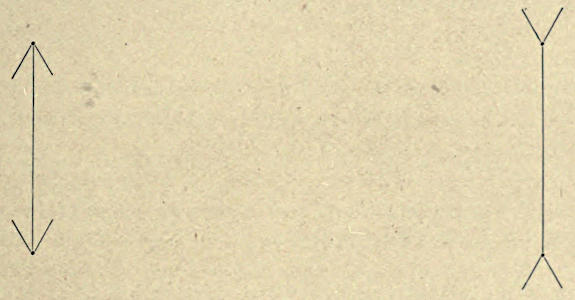
The first article is on an optical paradox. Let two equal parallel lines be drawn, as in the cut below; then let two small straight lines be drawn from the extremities of these in such a way that in the first they form acute angles with the line and in the second, obtuse angles. The first, it will be seen, appears shorter than the second. What is the explanation of this phenomenon?
Cut 1.
Cut 2.
Cut 3.
Cut 4.
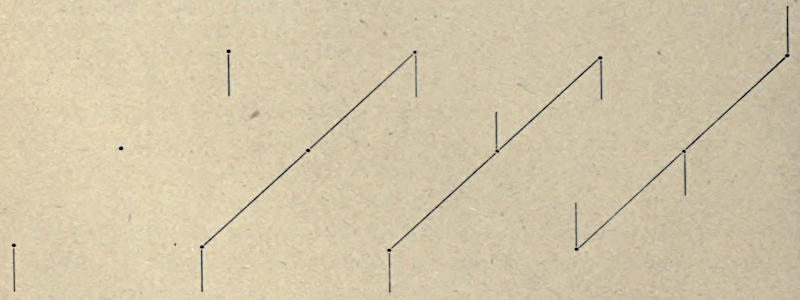
Cut 5.
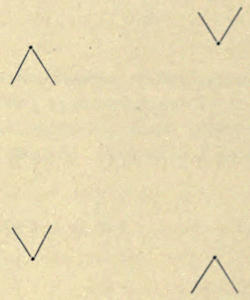
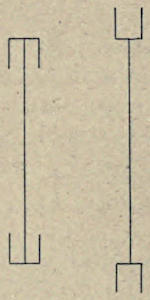
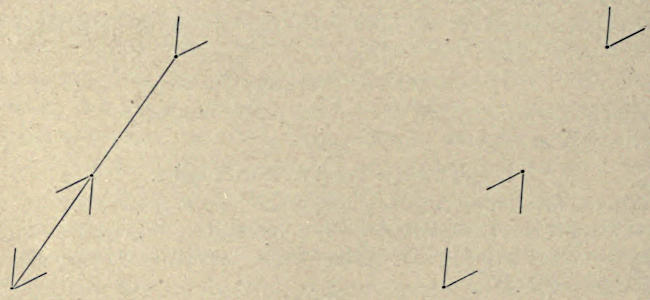
The author’s answer is, that this phenomenon is a consequence of the well-known fact that we overestimate small angles, and underestimate large ones. The presence of the lines has nothing to do with the optical illusion, as the inserted cut, in which the lines are omitted, shows. (Cut 2.) The optical illusion is also not present when the lines are rectangularly attached, as is Cut 3. These facts prove that angular inclination is the decisive factor. The following cuts show this, the first in a more and the second in a less marked degree. (Cuts 4, 5.) The simplest case in which the explanatory factor of this phenomenon is involved, is that of the estimation of the distance of an isolated point from the extremities of a short straight line. The estimation of this distance is dependent upon our estimation of the angle made by lines drawn from the point to the extremities of a short line. If this estimation is false, it produces by an exact trigonometrical law, an error in the estimation of the corresponding distance. This explains all. In our first figure the factor of illusion is eight times presented: hence its marked character.
The second article consists of a rather long series of experiments on the so-called “flatternde Herzen” by Adolph Szili.
The third article is on the foundations of a psychology of the blind, by a blind man, Friedrich Hitschmann, of Vienna. This article contains a number of interesting facts concerning the sensory, intellectual, and emotional life of blind people, and affords a great many valuable hints for the development of the special psychology which the author has in view.
The first article of No. 6 of the Zeitschrift is a very exhaustive one, some sixty pages in length, filled with special and technical investigations concerning the dioptrics of the eye. When light passes from one refracting medium into another it is partially reflected at the dividing surface, and transmits by reflection the objects from which it has proceeded. This is also the case with the human eye, which is itself a lens. The refracted pictures are the only pictures of importance to the possessor of the eye; but just as in the construction of optical instruments, the reflected or “lost” images are of supreme importance to the optician in the determination of the properties of his productions, so these same pictures in the human eye are of supreme importance to the physiologist and the psychologist. This is the subject of Dr. Tscherning’s researches.
In the second article Dr. Th. Lipps discusses some mooted questions of optics. The first part of the article is a reply to Schwarz’s criticism in the preceding number of the Zeitschrift. The second part is a review of Franz Brentano’s explanation of the optical paradox, discussed in the second paragraph of this notice. Lipps declares, that, though there is some truth in Brentano’s explanation, it is nevertheless an error to believe that acute angles, as such, are overestimated, and obtuse angles, as such, are underestimated. On the contrary, every time such errors in estimation occur, there exist particular reasons for it, the character of which renders the attempt impossible to derive the estimation of distance directly from the estimation of angles. Lipps supports his position by actual facts. His chief and most philosophical remark is, that it is a perilous and improper thing to do to explain isolated optical illusions by isolated and independent hypotheses; optical illusions are not exceptions: they constitute a class of phenomena in themselves, and they should be considered in their natural and logical connection. (Hamburg and Leipsic: Leopold Voss.).
μκρκ.
VIERTELJAHRSSCHRIFT FÜR WISSENSCHAFTLICHE PHILOSOPHIE. Vol. XVI. No. 3.
Ueber Real- und Beziehungs-Urtheile. By J. v. Kries.
Was ist Logik? By A. Voigt.
Zur Psychologie der Landschaft. By R. Wlassak.
Des Nic. Tetens Stellung in der Geschichte der Philosophie. By M. Dessoir.
The articles of this magazine are usually very rigorous and learned; and the contents of the present number are in keeping with its reputation. Prof. J. v. Kries discusses in an essay, evoked by the recent articles of Riehl, the subject of “real and relational judgments”; his object is to establish a classification, and display the logical connection, of judgments generally. Real judgments are predications concerning reality or actual facts; relational judgments predicate simple relations of concepts, etc. The first requisite of a scientific exactness of thought, says Kries, is the distinction and determination in any given case of judgments which are real and judgments which are relational. In the second article, which is long and exhaustive, Dr. Voigt endeavors to determine the characters and functions of the different kinds of logic. In view of the great prominence into which algebraical logic of late years has come, this article is one of considerable interest. Voigt defines the pretensions and powers of the two opposing systems of philosophical and algebraical logic, and attempts to set forth the justification of each. Voigt, as opposed to Husserl, cordially recommends the study of algebraical logic to philosophers, that both disciplines may profit by the intercourse. (Leipsic: O. R. Reisland.)
μκρκ.
PHILOSOPHISCHE MONATSHEFTE. Vol. XXVIII. Nos. 5 to 8.
CONTENTS: Nos. 5 and 6.
Die Wirklichkeit als Phänomen des Geistes. (Concluded.) By A. Rosinski.
Wesen und Bedeutung der Impersonalien. By R. F. Kaindl.
Zur Geschichte und zum Problem der Aesthetik. By E. Kühnemann.
CONTENTS: Nos. 7 and 8.
Ueber die Grundformen der Vorstellungsverbindung. Psychologische Studie. By M Offner.
Zur Geschichte und zum Problem der Aesthetik. (Concluded) By E. Kühnemann.
Werke zur Philosophie der Geschichte und des socialen Lebens (Second Article: G. de Greef, Introduction à la sociologie). By F. Tönnies.
Recensionen.
Litteraturbericht.
A. Rosinski’s contribution is a metaphysical essay on reality viewed as a phenomenon of the mind. The results of his discussion are these: that the world of experience, with all its laws and phenomena, and all we assume to exist per se, is referable wholly to ourselves; that the primal source and cause of all reality is not a something which lies absolutely outside us, but is simply our own self, or ego. In what sense reality is reality, the author proposes to discuss in future articles.
Dr. Raimund Friedrich Kaindl discusses, in the second article, the character and meaning of the impersonal verbs. The discussion is made both from the psychologico-logical point of view, and from the point of view of comparative philology.
The Philosophische Monatshefte contain, in each issue, a very exhaustive bibliography of all the works which have appeared during the month in the provinces connected with philosophy. This department is conducted by Dr. Ascherson, the librarian of the Berlin University library, and forms a very important and valuable feature of this magazine. (Berlin: Dr. R. Salinger.)
μκρκ.
ZEITSCHRIFT FÜR PHILOSOPHIE UND PHILOSOPHISCHE KRITIK. Vol. 100. Nos. 1 and 2.
This well-known magazine, formerly edited by Dr. J. D. Fichte and Dr. Ulrici, is now presided over by Dr. Richard Falckenberg, of Erlangen. It has reached its hundredth volume, and with the present two numbers begins a new series. Its reviews and lists of newly published works are comparatively complete. Its articles, though generally tinged with scholasticism and chiefly treating of philosophico-historical subjects, deal, nevertheless, with some modern and living questions; for example, Dr. Max Schasler’s discussion of the proceedings on the recent Prussian school law; Dr. Eugene Dreher’s consideration of the law of the conservation of force; and Dr. Nikolaus von Seeland’s discussion of the deficiencies of the current theory of force. The other articles are contributed by A. Wreschner, G. Frege, J. Zahlfleisch, and Robert Schellwien. (Leipsic: C. E. M. Pfeffer.)
μκρκ.
THE AMERICAN JOURNAL OF PSYCHOLOGY. August, 1892. Vol. IV. No. 4.
CONTENTS:
The Extent of the Cortex in Man, as Deduced from the Study of Laura Bridgman’s Brain. By Henry H. Donaldson.
Some Influences which Affect the Rapidity of Voluntary Movements. By F. B. Dresslar.
Experimental Research Upon the Phenomena of Attention. By James R. Angell and Arthur H. Pierce.
Some Effects of Contrast. By A. Kirschmann.
Report on an Experimental Test of Musical Expressiveness. By Benjamin Ives Gilman.
Psychological Literature. (Worcester, Mass.: Clark University.)
MIND. New Series. No. 3. July, 1892.
CONTENTS:
Lotze’s Antithesis between Thought and Things. (I.) By A. Eastwood.
The Festal Origin of Human Speech. By J. Donovan.
The Logical Calculus. (III.) By W. E. Johnson.
The Field of Æesthetics Psychologically Considered. (I.) By H. R. Marshall.
Discussions: The Influence of Muscular States on Consciousness. By Edmund B. Delabarre; Dr. Münsterberg and his Critics. By E. B. Titchener. The Definition of Desire. By Henry Rutgers Marshall. Feeling, Belief, and Judgment. By J. Mark Baldwin.
Critical Notices. (London: Williams & Norgate.)
INTERNATIONAL JOURNAL OF ETHICS. July, 1892. Vol. II. No. 4.
CONTENTS:
Natural Selection in Morals. By S. Alexander.
What should be the Attitude of the Pulpit to the Labor Problem? By W. L. Sheldon.
Ethics of the Jewish Question. By Charles Zeublin.
Machiavelli’s Prince. By W. R. Thayer.
On the Founding of a New Religion. By B. Carneri.
An Analysis of the Idea of Obligation. By Frank Chapman Sharp.
Reviews.
Prof. S. Alexander, in his lecture delivered before the Ethical Societies of Cambridge and London, here reproduced, points out that the growth and change of moral and social ideals are the result of a process of mental conflict. Professor Sheldon thinks only a partial solution of the labor problem is possible until the second coming of men somewhat of the type of St. Francis of Assisi, “who will sacrifice their personal opportunities, abandon their station in the world, and go down to apply their gifts and acquirements to the cause of the lower stratum of society.” The religious as well as economic opposition to Judaism, according to Mr. Charles Zeublin, is caused by the exclusiveness of the Jew, and his ultimate welfare and that of his neighbors requires a humanitarian treatment within and without Judaism. Mr. William R. Thayer shows that Machiavelli merely described things as they were in his time, and deduced the laws which actually controlled the public deeds of rulers; and that it is now “the duty of all men to sweep away the old falsehood that rulers and governments are absolved from paying heed to those ethical principles to which every individual is bound.” According to Mr. B. Carneri, the living at peace with oneself and one’s fellow-men is possible only without religion, “because there is no morality without contentment, and it is the highest degree of discontent to strive for something beyond this world.” Mr. Frank Chapman Sharp concludes that when the element of the good is taken out of the conception of obligation, this degenerates into mere submission to an arbitrary imperative; the foundation for the distinction between right and wrong must be sought in something that appeals to us as good, and its ultimate criterion can be given only by our chosen ideal. (Philadelphia: International Journal of Ethics, 118 S. Twelfth Street.)
Ω.
THE PHILOSOPHICAL REVIEW. July, 1892. Vol. I. No. 4.
Inhibition and Freedom of the Will. By Dr. James H. Hyslop.
A Classification of Cases of Association. By Mary W. Calkins.
The Origin of Pleasure and Pain. By Dr. Herbert Nichols.
On Primitive Consciousness. By Hiram M. Stanley.
Reviews of Books.
Summaries of Articles.
The confusion incident to the old controversy about freedom is due, says Dr. James H. Hyslop, to a failure to distinguish between the proof of freedom and the conditions of it, that is, “the circumstances that are necessary to it, or the characteristics that constitute it.” Freedom consists in “self-initiative and independence of external causes, whether there be any choice between alternatives or not,” and inhibition and deliberation bring about both of these circumstances. Miss Mary W. Calkins rejects the ordinary division into association by contiguity and association by similarity, and gives detailed summaries of the fundamental characteristics of consciousness on which association depends and of the characteristics of association proper; the ultimate fact of association, whether it be psychical or physical or both, we do not understand. Dr. Herbert Nichols, in the first part of his article on the “Origin of Pleasure and Pain,” considers the phenomena of pleasure and pain associated with the action of the senses, and concludes that there is no “tangible evidence indicating that pleasures and pains are inseparable attributes of other senses or polar complements of each other,” and that separate sensations of pain and of pleasure are probable. Mr. Hiram M. Stanley regards pure pain as primitive mind, and pleasure as the polar opposite to it, although they are neither absolutely essential one to the other, pleasure being traced to “an intermediary feeling between pain as produced by excess, and pain from lack as differentiated form.” Consciousness is fundamentally pain and pleasure as serving the organism in the struggle for existence. (Boston, New York, Chicago: Ginn & Company.)
Ω.
THE NEW WORLD.
CONTENTS: Vol. I. No. 2.
The Social Plaint. By E. Benjamin Andrews.
Religious Evolution. By Minot J. Savage.
The Origin and Meaning of the Story of Sodom. By T. K. Cheyne.
The Foundation of Buddhism. By Maurice Bloomfield.
Imagination in Religion. By Francis Tiffany.
The next Step in Christianity. By S. D. McConnell.
The Implications of Self-Consciousness. By Josiah Royce.
How I came into Christianity. By Nobuta Kishimoto.
New Forms of Christian Education. By Mrs. Humphry Ward.
CONTENTS: Vol. I. No. 3.
The Essence of Christianity. By Otto Pfleiderer.
Ecclesiastical Impedimenta. By J. Macbride Sterrett.
New Testament Criticism and Religious Belief. By Orello Cone.
Thomas Paine. By John W. Chadwick.
Social Betterment. By Nicholas P. Gilman.
The Rôle of the History of Religions in Modern Religious Education. By Jean Réville.
A Poet of His Century. By E. Cavazza.
Divine Love and Intelligence. By James C. Parsons.
Book Reviews.
Summaries of Articles. (Boston: Houghton, Mifflin, & Company.)
REVUE PHILOSOPHIQUE.
CONTENTS: June, 1892. No. 198.
Existence et développement de la Volonté. I. Existence de la Volonté. By A. Fouillée.
Sur quelques Idées du Baron d’Holbach. By A. Lalande.
Essai sur la Philosophie de Proudhon. By G. Sorel.
Travaux du Laboratoire de Psychologie Physiologique.
CONTENTS: July, 1892. No. 199.
L’inconnaissable dans la philosophie moderne. By G. Fonsegrive.
La musique d’après Herbert Spencer. By J. Combarieu.
Essai sur la philosophie de Proudhon (concluded). By G. Sorel.
CONTENTS: August, 1892. No. 200.
Étude critique sur le mysticisme Moderne. By Rosenbach.
Le développement de la volonté. By A. Fouillée.
La beauté organique: étude d’analyse esthétique. By A. Naville.
Analyses et Comptes Rendus.
According to M. Fouillée, the principle which tends to dominate psychology and physiology is the ubiquity of will and of feeling, and consequently of consciousness. Psychology will end by recognising the continuity and the transformation of modes of psychical energy, as physics recognises the continuity and the transformation of modes of physical energy, and philosophy will see in physical energy the external expression of will.
M. Fonsegrive maintains that the rejection of metaphysics as science, which marks the modern theory of the unknowable, is the consequence of Kant’s a priori theory as to the origin of our knowledge. The laws of the mind have no real existence prior to experience, and universal and necessary notions can be discovered only by mental analysis. In this manner the existence, and even the essence, of metaphysical beings may be known, but only of such as experience puts in communication with ourselves. Thus we know God as the necessary first cause, although our notion of God is one of negation, of experimental notions.
After showing that Spencer’s theory of music had numerous antecedents, and that its conclusions are unacceptable on various grounds, M. Combarieu affirms that the secret of the musical art is the identity of the musical idea with the imitation or expression of the real world. All music contains a double verity; it is the meeting place of the senses and of the rational world confounded in a unity which is the work of art, as man is the combination of a soul and a body confounded in the real unity of life. Spencer is an excessive simplifier, and does not see the complexity of certain questions, which he seeks to resolve by undervaluing them. But he has thrown light on one of the aspects of the musical problem.
In this final essay on the philosophy of Proudhon, M. Sorel considers the theory of justice by the light of the notion of free will. He differs somewhat from Proudhon, and affirms that “the just man is the upright man such as our ideal conception of antiquity represents him to us, but transformed by our consciousness as refined by the influence of Christianity.” In dealing with the real organisation of societies it is necessary to distinguish between matters of justice and those of right, which includes that of force, of which war is an application. After showing the connection of the economic contradictions of Proudhon with the state of war, and the value of education for the realisation of equilibrium in the state. M. Sorel affirms that education ought to be based on manual labor, for the explanation of which science should be taught; and that instruction should endure throughout life, so that men can elevate themselves and that an equilibrium may be obtained between knowledge and industrial needs. (Paris: Félix Alcan.)
Ω.
APPENDIX. PLATES BELONGING TO THE ARTICLE “THE NERVOUS GANGLIA OF INSECTS.”
KEY TO THE PLATES.
col. ven.—ventral column.
lob. dors.—dorsal lobe.
lob. ven.—ventral lobe.
lob. v. inf.—inferior or lower ventral lobule.
lob. cr.—crural lobule.
con. dors. sup—superior (or upper) dorsal connective filaments.
con. dors. moy.—medial dorsal connective filaments.
con. dors. inf.—inferior (or lower) dorsal connective filaments.
con. v.—ventral connective filaments.
n. cr.—crural nerve.
n. al.—alary nerve.
lob. al.—alary lobule.
rac. sup—upper (or superior) root.
rac. moy.—medial root.
rac. inf.—lower (or inferior) root.
fa. as.—ascending fasciculus.
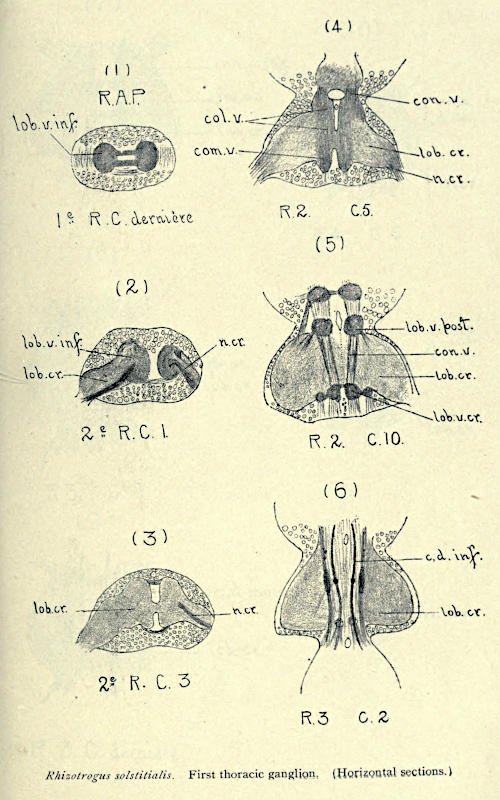
PLATE I.
Rhizotrogus solstitialis. First thoracic ganglion. (Horizontal sections.)
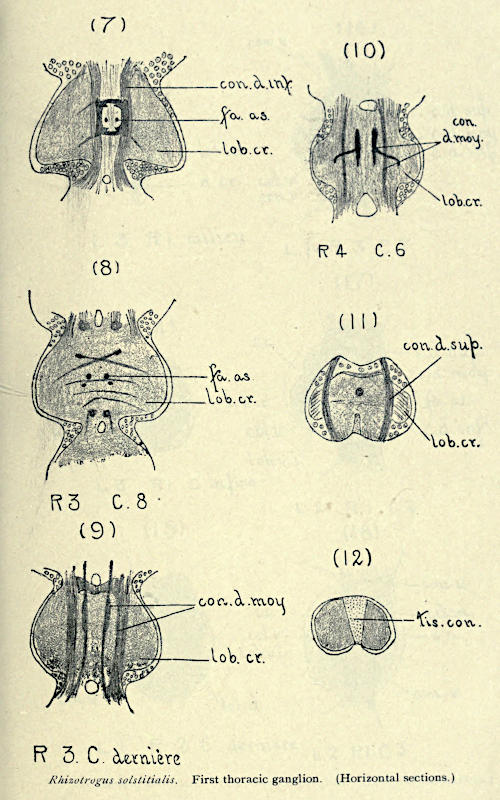
PLATE II.
Rhizotrogus solstitialis. First thoracic ganglion. (Horizontal sections.)
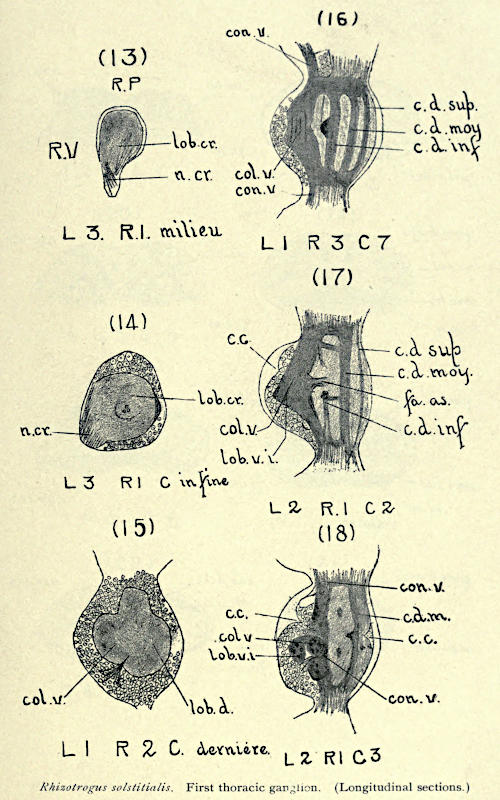
PLATE III.
Rhizotrogus solstitialis. First thoracic ganglion. (Longitudinal sections.)
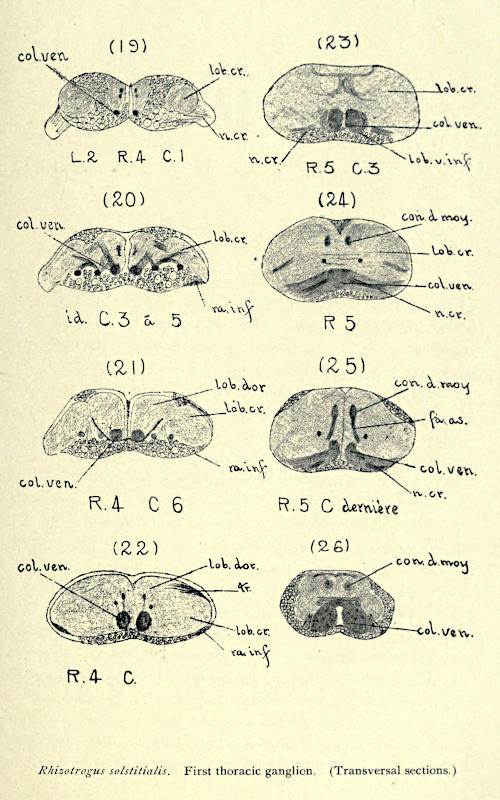
PLATE IV.
Rhizotrogus solstitialis. First thoracic ganglion. (Transversal sections.)
Vol. III. January, 1893. No. 2.