Volume 1 — THE MONIST. (continued 2)
Reading edition
x² - 23x + 132¼ = 0

determines x to be either 11·477 or 11·523. In this sense, x has necessarily one value or the other. The equation
x² - 12x + 6 = 0

determines x to be either 11·477 or 0·523. Together, the two equations uniquely determine x to be 11·477. This shows how much that argument amounts to.
§ 11. By “sameness,” Dr. Carus means equivalence for a given purpose. (¶¶ 102, 106.) By the “idea of sameness,” he means (¶¶ 77, 96) the principle that things having a common character are for some purpose equivalent. This, he says, “has a solid basis in the facts of experience.” By a “world of sameness” (¶ 113), he seems to mean one in which any two given concrete things are in some respect equivalent. He argues (¶ 122) that a “world of sameness is a world in which necessity rules.” I do not see this. It seems to me so bald a non sequitur, that I cannot but suppose the thought escapes my apprehension. If there were anything in the argument, it would seem to be a marvellously expeditious way of settling the whole dispute; and therefore it would have been worth the trouble of stating, so as to bring it within the purview of minds like mine.
§ 12. My candid opponent sometimes endorses emphatically the Leibnizian principle. “Necessitarianism must be founded on something other than observation. Observation is a posteriori; it has reference to single facts, to particulars; yet the doctrine of necessity ... is of universal application. The doctrine of necessity ... is of an a priori nature.” (¶ 11.) “Millions of single experiences ... cannot establish a solid belief in necessity.” (¶ 14.) “No amount of experience is sufficient to constitute causation by a mere synthesis of sequences.” (¶ 22.) “Millions of millions of cases” constitute “no proof” that a proposition “is always so.” (¶ 29.)
Nevertheless, he holds that the law of “the conservation of matter and energy” so conclusively proves necessary causation, that the obstinacy of Hume, himself, could not have withstood the argument. (¶ 23.) One wonders, then, what is supposed to prove this “law of the conservation of matter and energy,” if no amount of experience can prove it.
But the a priori itself can “be based on the firm ground of experience.” (¶ 14.) In that case, it is not prior to experience, after all! “The idea of necessity is based upon the conception of sameness, and ... the existence of sameness is a fact of experience.” (¶ 87.) If absolute necessity can be irrefragably demonstrated from the fact that two things are alike, it is a pity Dr. Carus should not state this demonstration in a form, that I, and men like me, can understand. That would be more to the purpose than merely saying it can be proved. Absolute chance is rejected as “involving a violation of laws well established by positive evidence.” (¶ 149.)
All these denials that absolute necessity can be established and absolute chance refuted by experiential evidence, mixed with as clear assertions of the same things, when taken together, have the appearance of an attempt, as the politicians say, to “straddle” the question.
§13. But the ingenious Doctor seeks to bolster up necessity by introducing the confused notion of “causation.”
I do not know where the idea originated that a cause is an instantaneous state of things, perfectly determinative of every subsequent state. It seems to be at the bottom of Kant’s discourse on the subject; yet it accords neither with the original conception of a cause, nor with the principles of mechanics. The original idea of an efficient cause is that of an agent, more or less like a man. It is prior to the effect, in the sense of having come into being before the latter; but it is not transformed into the effect. In this sense, it may happen that an event is a cause of a subsequent event; seldom, however, is it the principal cause. Far less are events the only causes. The modern mechanical conception, on the other hand, is that the relative positions of particles determine their accelerations at the instants when they occupy those positions. In other words, if the positions of all the particles are given at two instants (together with the law of force), then the positions at all other instants may be deduced.[109] This doctrine conflicts with Kant’s second analogy of experience, as interpreted by him, in no less than four essential particulars. In the first place, far from involving any principle that could properly be termed generation, or Erzeugung, which is Kant’s word for the sequence of effect from cause, the modern mechanical doctrine is a doctrine of persistence, and, as I have repeatedly explained, positively prohibits any real growth. In the second place, one state of things (i. e. one configuration of the system) is not sufficient to determine a second, it is two that determine a third. To whomsoever may think that this is an inconsiderable divergence of opinions, let me say, study the logic of relatives, and you will think so no longer. In the third place, the two determining configurations, according to mechanics, may be taken at almost any two instants, and the determined configuration be taken at any third instant we like. There is no mechanical truth in saying that the past determines the future, rather than the future the past. We habitually follow tradition in continuing to use that form of expression, but every mathematician knows that it is nothing but a form of expression. We continue, for convenience, to talk of mechanical phenomena as if they were regulated, in the same manner in which our intentions regulate our actions (which is essentially a determination of the future by the past), although we are quite aware that it is not really so. Remark how Kant reasons:
“If it is a necessary law of our sensibility, and consequently a formal condition of all perceptions, that the preceding time determines the following, (since I can only come to the following through the preceding,) then is it also an indispensable law of the empirical representation of the time-series that the appearances of the preceding time determine every occurrence in the following.”
What this leads to is a causality like that of mental phenomena, where it is the past which determines the future, and not (in the same sense) the reverse; but the doctrine of the conservation of energy consists precisely in the denial that anything like this occurs in the domain of physics. Had Kant studied the psychological phenomena more attentively and generalised them more broadly, he would have seen that in the mind causation is not absolute, but follows such a curve as is traced in my essay towards “The Law of Mind” (The Monist, Vol. II, 550). Does our judicious editor deem it ungracious to find fault with Kant for not doing so much more than he did, considering what that hero-like achievement was? We must seem to carp, as long as thinkers can hold that achievement for sufficient. In the fourth place, Kant’s “Analogy” ignores that continuity which is the life-blood of mathematical thought. He deals with those awkward chunks of phenomenon, called “events.” He represents one such “event” as determined by certain others, definitely, while the rest have nothing to do with it. It is impossible to cement such thought as this into hermetic continuity with the refined conceptions of modern dynamics. The statement that every instantaneous state of things determines precisely all subsequent states, and not at all any previous states, could, I rather think, be shown to involve a contradiction.
The notion which Dr. Carus holds of a cause seems to be that it is a state, embracing all the positions and velocities of all the masses at one instant, the effect being a similar state for any subsequent instant. (¶¶ 21, 24.) This breaks at once with common parlance, with dynamics, and with philosophical logic. In common parlance, we do not say that the position and upward velocity of a missile is the cause of its being at a subsequent instant lower down and moving with a greater downward velocity.[110] In dynamics, it is the fixed force, gravitation, or whatever else, together with those relative positions of the bodies that determine the intensity and direction of the forces, that is regarded as the cause. But these causes are not previous to, but simultaneous with, their effects, which are the instantaneous accelerations. Finally, logic opposes our calling one of two states which equally determine one another (as any two states of a system do, if the velocities are taken to be included in these states) the determinator, or cause, simply because of the circumstance that it precedes the other in time,—a circumstance that is upon the principles of dynamics plainly insignificant and irrelevant.
Everybody will make slips in the use of words that have been on his lips from before the time when he learned to think; but the practice which I endeavor to follow in regard to the word cause, is to use it in the Aristotelian sense of an efficient cause, in all its crudeness. In short, I refuse to use it at all as a philosophical word. When my conception is of a dynamical character, I endeavor to employ the accepted terminology of dynamics;[111] and when my idea is a more general and logical one, I prefer to speak of the explanation.
§ 14. Dr. Carus thinks the element of necessity in causation can be demonstrated by considering the process as a transformation. “It is a sequence of two states which belong together as an initial and final aspect of one and the same event.” (¶ 21. Compare ¶¶ 20, 24.) He neglects to explain how he brings under this formula the inward causation of the will and character, as set forth by him in ¶¶ 163-167.
It is unnecessary for me to reply, at length, to an argument so manifestly inconclusive. On the one hand, it conflicts with the principle that absolute necessity cannot be proved from experience; and on the other hand, it leaves room for an imperfect necessity.
Professor Tait has done an ill office to thought in countenancing the idea that the conservation of energy is of the same nature as the “conservation,” or rather perduration, of matter. Dr. Carus says (¶ 121) that
“The law of the conservation of matter and energy rests upon the experience (corroborated by experiments) that causation is transformation. It states that the total amount of matter and the total amount of energy remain constant. There is no creation out of nothing and no conversion of something into nothing.”
The historical part of this statement contains only a small grain of truth; but that I will not stop to criticise. The point I wish to make is that the law of the conservation of energy is here represented under a false aspect. The true substance of the law is that the accelerations, or rates of change, of the motions of the particles at any instant depend solely on their relative positions at those instants. The equation which expresses the law under this form is a differential equation of the second order; that is, it involves the rates of change of the rates of change of positions, together with the positions themselves. Now, because of the purely analytic proposition of the differential calculus that
Dₜ²s = ½Dₛ(Dₜs)²,

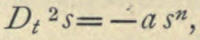
the first integral of the differential equation of the second order, that is, the differential equation of the first order which expresses the same state of things, equates half the sum of the masses, each multiplied by the square of its velocity, to a function of the relative positions of the particles plus an arbitrary constant.[112] In order to fix our ideas, let us take a very simple example, that of a single particle accelerated towards an infinite plane, at a rate proportional to the nᵗʰ power of its distance from the plane. In this case, if s be the distance, the second differential equation will be
Dₜ²s = -asⁿ,
and the first integral of it will be
(Dₜs)² = -(²ᵃ⁄ₙ₊₁)sⁿ⁺¹ + C.

By the first law of motion, and the Pythagorean proposition, the part of the velocity-square depending on the horizontal component is also constant.
The arbitrary constant, C, plainly has its genesis in the fact that forces do not determine velocities, but only accelerations. Its value will be fixed as soon as the velocity at any instant is known. This quantity would exist, just the same, and be independent of the time, and would therefore be “conserved” whether the forces were “conservative,” that is, simply positional, or not. Now, this constant is the energy; or rather, the energy is composed of this constant increased by another which is absolutely indeterminable, being merely supposed large enough to make the sum positive.
Thus, the law of energy does not prescribe that the total amount of energy shall remain constant; for this would be so in any case by virtue of the second law of motion; but what it prescribes is that the total energy diminished by the living force shall give a remainder which depends upon the relative positions of the particles and not upon the time or the velocities. It is also to be noticed that the energy has no particular magnitude, or quantity. Furthermore, in transformations of kinetical energy into positional energy, and the reverse, the different portions of energy do not retain their identity, any more than, in book-keeping, the identity of the amounts of different items is preserved. In short, the conservation of energy, (I do not mean the law of conservation,) is a mere result of algebra. Very different is it with the “conservation” of matter. For, in the first place, the total mass is a perfectly definite quantity; and, in the second place, in all its transformations, not only is the total amount constant, but all the different parts preserve their identity. To speak, therefore, of “the conservation of matter and energy,” is to assimilate facts of essentially contrary natures; and to say that the law of the conservation of energy makes the total amount of energy constant is to attribute to this law a phenomenon really due to another law, and to overlook what this law really does determine, namely, that the total energy less the kinetic energy gives a remainder which is exclusively positional.
§ 15. Dr. Carus does not make it clear what he means by chance. He does, indeed, say (¶¶ 145, 146):
“What is chance?
“Chance is any event not especially intended, either not calculated, or, with a given and limited stock of knowledge, incalculable.”
This defines what he means by a chance event, in the concrete; what he understands by probability, we are left to conjecture. But from what he says in ¶ 147, I infer that he regards it as dependent upon the state of our ignorance, and therefore nothing real.
I am, therefore, much puzzled when I find him expressing a conviction (¶¶ 88, 156) that chance plays an important part in the real world. He explains very distinctly that “when we call a throw of the dice pure chance, we mean that the incidents which condition the turning up of these or those special faces of the dice have not been, or cannot be, calculated.” (¶ 147.) This is the commonest, because the shallowest, philosophy of chance. Even Venn might teach him better than that. However, according to that view, when he writes of “the important part that chance plays in the world,—not absolute chance ... but that same chance of which the throw of the die is a typical instance” (¶ 88), he can be understood to mean no more than that many things happen which we are not in condition to calculate or predict. This is not playing a part in the world, one would say—at least, not in the natural world; it is only playing a part in our ignorance.
Dr. Carus frequently uses phrases which make us suspect he penetrates deeper. Thus, he says, “we do not believe in absolute chance, but we believe in chance” (¶ 144); and again, “Every man is the architect of his own fortune—but not entirely. There are sometimes coincidences determining the fates of men.” (¶ 161.) But when we remark the consecution of ¶¶ 137-162, we feel pretty sure he really sees no further. To do so would have been to perceive that indefinitely varied specificalness is chance.
For a long time, I myself strove to make chance that diversity in the universe which laws leave room for, instead of a violation of law, or lawlessness. That was truly believing in chance that was not absolute chance. It was recognising that chance does play a part in the real world, apart from what we may know or be ignorant of. But it was a transitional belief which I have passed through, while Dr. Carus seems not to have reached it.
As for absolute chance, Dr. Carus makes the momentous admission that it is “not unimaginable” (¶ 150). If so, its negation, or absolute necessity, cannot be a formal principle.
§ 16. But it is time for me to leave the consideration of Dr. Carus’s system and to take up his strictures upon mine. His philosophy is one eminently enlightened by modern ideas, which it synthetises to an unusual extent. It is distinguished for its freedom from the vice of one-sidedness, and displays every facet of the gem of philosophical inquiry, except the one on which it rests, the question of absolute law. Its prominent faults, which I feel sure must have struck every competent reader, are that it shows little trace of meditation upon the thoughts of the great idealists, and that there is a certain want of congruity between different elements of it. How strangely it sounds, for instance, to find an apriorian, and one who is dinging “formal laws” so perpetually into our ears, one who holds that “in order to weave the woof of the a posteriori elements into coherent cloth, we want the warp of the a priori” (¶ 15), to find this man declaring for a positivism “which accepts no doctrine, theory, or law, unless it be a formulation of facts,” and proclaiming that “the whole business of science is to systematise the samenesses of experience, and to present them in convenient formulas” (¶ 120). Now there is just one way of bringing such warring elements into harmony, and curing the greatest defect of the system,—and it is a way which would also bring the whole into far better concordance with natural science. It is to lop off the heads of all absolute propositions Whose subject is not the Absolute, and reduce them to the level of probable and approximate statements. Were that defalcation performed, Dr. Carus’s philosophy would, in its general features, offer no violent opposition to my opinions. Moreover, the Doctor has at heart the conciliation of religion and science. I confess such serious concern makes me smile; for I think the atonement he desires is a thing which will come to pass of itself when time is ripe, and that our efforts to hasten it have just that slight effect that our efforts to hasten the ripening of apples on a tree may have. Besides, natural ripening is the best. Let science and religion each have stout faith in itself, and refuse to compromise with alien and secondary purposes, but push the development of its own thought on its own line; and then, when reconcilement comes,—as come it surely will,—it will have a positive value, and be an unmixed good. But since our accomplished editor thinks himself called upon to assist in this birth of time, let me ask him whether of all the conditions of such peace, the first is not that religious thought should abandon that extravagant absoluteness of assertion which is proper to the state of intellectual infancy, but which it has so long been too timid to let go? This pragmatical and unneeded absoluteness it is which is most deeply contrary to the method, the results, and the whole spirit of science; and no error can be greater than to fancy that science, or scientific men, rest upon it or readily tolerate it.
§ 17. Dr. Carus (¶¶ 56-64) condemns my method of investigation as contrary to that by which science has been advanced; and holds that a radically different, and thoroughly positivistic method is requisite,—a method so intensely positivistic as to exclude all originality. I suppose he will not object to my forming an opinion concerning the methods of science. I was brought up in an atmosphere of scientific inquiry, and have all my life chiefly lived among scientific men. For the last thirty years, the study which has constantly been before my mind has been upon the nature, strength, and history of methods of scientific thought. I have no space here to argue the question. In its logical aspect, I have partly considered it in various publications; and in its historical aspect, I have long been engaged upon a treatise about it. My critic says (¶ 57) that 1 am “very positivistic in my logic of science.” This is a singular misapprehension. Few of the great scientific minds with whom I have come into personal contact, and from whom I endeavored to learn were disposed to contemn originality or the ideal part of the mind’s work in investigation; and those few, it was easy to see, really breathed an atmosphere of ideas which were so incessantly present that they were unconscious of them. Were I to name those of my teachers who were most positivistic in theory, a smile would be excited. My own historical studies, which have been somewhat minutely critical, have, on the whole confirmed the views of Whewell, the only man of philosophical power conjoined with scientific training who had made a comprehensive survey of the whole course of science, that progress in science depends upon the observation of the right facts by minds furnished with appropriate ideas. Finally, my long investigation of the logical process, of scientific reasoning led me many years ago to the conclusion that science is nothing but a development of our natural instincts. So much for my theory of scientific logic. It is as totally opposed as anything can be to Dr. Carus’s theory (¶ 69, note; and “Ursache, Grund und Zweck,” p. 2) that originality is out of place in science.
But in my practice of scientific reasoning, Dr. Carus accuses me of being what he calls a “constructionist”; that is, a theoriser unguided by indications from observation or accepted facts. To a mind upon whom that celebrated and splendid chapter of Kant upon the architectonical method failed to make a deep impression, I may appear so; but travesty is in truth hardly too strong a word to describe the account of my method by Dr. Carus.
Perhaps exaggeration is not without its value. If so, let me sum up the method Dr. Carus recommends. Eschew originality, is its pious formula; do not think for yourself, nor countenance results obtained by original minds. Distrust them; they are not safe men. Leave originality to mathematicians and their breed, to poets, and to all those who seek the sad notoriety of having unsettled belief.[113] Flee all philosophies which smack of this aberrant nineteenth century.[114] This theory of Dr. Carus condemns itself; for it is highly original, and soars into the free ether untrammelled by historic facts.
Keppler comes very close to realising my ideal of the scientific method; and he is one of the few thinkers who have taken their readers fully into their confidence as to what their method really has been.[115] I should not feel justified in inflicting upon mine an autobiographical account of my own course of thought; but some things Dr. Carus’s accusation forces me to mention. My method of attacking all problems has ever been to begin with an historical and rational inquiry into the special method adapted to the special problem. This is the essence of my architectonical proceeding upon which Dr. Carus has commented very severely. To look an inch before one’s nose involves originality: therefore, it is wrong to have a conscious method. But further, in regard to philosophy, not only the methods, but the elementary ideas which are to enter into those methods, should be subjected to careful preliminary examination. This, especially, Dr. Carus finds very unscientific. (¶ 64, and elsewhere.) It is, undoubtedly, the most characteristic feature of my procedure. Certainly it was not a notion hastily or irreflectively caught up; but is the maturest fruit of a lifetime of reflection upon the methods of science, including those of philosophy; and if it shall be found that one contribution to thought on my part has proved of permanent service, that, I expect, will be the one. This method in no wise teaches that the method and materials for thought are not to be modified in the course of the study of the subject-matter. But instead of taking ideas at haphazard, or being satisfied with those that have been handed down from the good old times, as a mind keenly alive to the dangers of originality would have done, I have undertaken to make a systematic survey of human knowledge (a very slight sketch of which composed the substance of my paper on the “Architecture of Theories,”) in order to find what ideas have, as a fact, proved most fruitful, and to observe the special utilities they have severally fulfilled. A subsidiary object of this survey was to note what the great obstacles are to-day in the way of the further advance of the different branches of science. In my “Architecture of Theories,” I never professed to do more than make a slight sketch of a small portion of my preliminary studies, devoting thirteen lines to some hints as to the nature of the results. In the four following papers I have given a selection of a few of these results. Among those which remain to be reported are some of much more immediate importance than any of those hitherto set forth. If anybody has been surprised to find my subsequent papers developing thoughts which they were unable to foresee from my first, it is only what I warned people from the outset that they would find to happen. Nor have the greatest of these surprises yet been reached.[116]
The next series of facts reviewed was that of the history of philosophy. I waded right into this fearful slough of “originality,” in order to gather what seemed to throw a light upon the subject. Finally, I reviewed the general facts of the universe.
I now found myself forced by a great many different indications to the conclusion that an evolutionary philosophy of some kind must be accepted,—including among such philosophies systems like those of Aristotle and of Hegel. From this point the reasoning was more rapid. Evolution had been a prominent study for half a generation; and much light had been thrown upon the conditions for a fruitful evolutionary philosophy. The first question was, how far shall this evolution go back? What shall we suppose not to be a product of growth? I fancy it is this cautious reflectiveness of my procedure which especially displeases Dr. Carus. It is not positivistic: it is architectonic. But the answer to the question was not far to seek. If an evolutionary explanation is to be adopted, philosophy, logic, and the economy of research all dictate that in the first essay, at least, that style of explanation be carried as far back as explanation is called for. What elements of the universe require no explanation? This was a simple question, capable of being decided by logic with as much facility and certainty as a suitable problem is solved by differential calculus. Being, and the uniformity in which being consists, require to be explained. The only thing that does not require it is non-existent spontaneity. This was soon seen to mean absolute chance. The conclusion so reached was clinched by a careful reëxamination of the office of chance in science generally, and especially in the doctrines of evolution. Arrived at this point, the next question was, what is the principle by which the development is to proceed? It was a difficult inquiry, and involved researches from different points of view.
But I will not trouble the reader with further autobiographical details. I have given enough to show that my method has neither been in theory purely empirical, nor in practice mere brain-spinning; and that, in short, my friend Dr. Carus’s account of it has been as incorrect as can be.
§ 18. The learned doctor (¶¶ 6, 7, 8) pronounces me to be an imitator of David Hume, or, at least, classes my opinions as closely allied to his. Yet be it known that never, during the thirty years in which I have been writing on philosophical questions, have I failed in my allegiance to realistic opinions and to certain Scotistic ideas; while all that Hume has to say is said at the instance and in the interest of the extremest nominalism. Moreover, instead of being a purely negative critic, like Hume, seeking to annul a fundamental conception generally admitted, I am a positive critic, pleading for the admission to a place in our scheme of the universe for an idea generally rejected. In the first paper of this series, in which I gave a preliminary sketch of such of my ideas as could be so presented, I carefully recorded my opposition to all philosophies which deny the reality of the Absolute, and asserted that “the one intelligible theory of the universe is that of objective idealism, that matter is effete mind.” This is as much as to say that I am a Schellingian, of some stripe; so that, on the whole, I do not think Dr. Carus has made a very happy hit in likening me to Hume, to whose whole method and style of philosophising I have always been perhaps too intensely averse. Yet, notwithstanding my present disclaimer, I have little doubt apriorians will continue to describe me as belonging to the sceptical school. They have their wonderful ways of arriving at truth, without stooping to confront their conclusions with facts; and it is amusing to see how sincerely they are convinced that nobody can have science at heart, without denying all they uphold.[117]
My opponent has a habit of throwing out surprising opinions without the least attempt to illuminate them with the effulgence of reason. Thus he says (¶ 8): “If Kant’s answer to Hume had been satisfactory, Mr. Peirce would probably not have renewed the attack.” What attack? All that Hume attacked I defend, namely, law as a reality. How could a defence of that which I defend as essential to my position, cause me to surrender that position, namely, that real regularity is imperfect? In any sense in which Hume could have admitted the possibility of law, it must be precisely followed; since its existence could consist only in the conformity of facts unto it. But perhaps Dr. Carus means that if one question had been completely settled, I should probably have confined myself to talking about that, instead of broaching a new one.
§ 19. Another misunderstanding of my position on the part of Dr. Carus (¶¶ 12, 13) is simply due to “boldly” having been twice printed where the reading should have been “baldly,” in my paper on “The Doctrine of Necessity.” (The Monist, Vol. II, p. 336, lines 20 and 25.) I wish printers would learn that I never use the word bold. I have so little of the quality, that I don’t know what it means. As I read the “revise,” as usual, it was presumably my fault that the erratum occurred. At any rate, had my meaning been clearly expressed, the proof-reader would not have been misled by my defective chirography. What I was trying to say was, in substance, this: Absolute chance is a hypothesis; and, like every hypothesis, can only be defended as explaining certain phenomena.[118] Yet to suppose that an event is brought about by absolute chance is utterly illogical, since as a hypothesis it could only be admitted on the ground of its explaining observed facts; now from mere non-law nothing necessarily follows, and therefore nothing can be explained; for to explain a fact is to show that it is a necessary, or, at least, a probable, result from another fact, known or supposed. Why is not this a complete refutation of the theory of absolute chance? Answer: because the existence of absolute chance, as well as many of its characters, are not themselves absolute chances, or sporadic events, unsubject to general law. On the contrary, these things are general laws. Everybody is familiar with the fact that chance has laws, and that statistical results follow therefrom. Very well: I do not propose to explain anything as due to the action of chance, that is, as being lawless. I do not countenance the idea that Bible stories, for instance, show that nature’s laws were violated;—though they may help to show that nature’s laws are not so mechanical as we are accustomed to think. But I only propose to explain the regularities of nature as consequences of the only uniformity, or general fact, there was in the chaos, namely, the general absence of any, determinate law.[119] In fact, after the first step is taken, I only use chance to give room for the development of law by means of the law of habits.
§ 20. In ¶ 28, I read: “Mr. Peirce does not object to necessity in certain cases; he objects to necessity being a universal feature of the world.” This is correctly stated, and so it is in ¶ 203. I object to necessity being universal, as well as to its ever being exact. In short, I object to absolute universality, absolute exactitude, absolute necessity, being attributed to any proposition that does not deal with the Α and the Ω, in the which I do not include any object of ordinary knowledge. But it is careless to write (¶ 193) that I “describe the domain of mind as the absence of law.” Is not one of my papers entitled “The Law of Mind”? It is true that I make the law of mind essentially different in its mode of action from the law of mechanics, inasmuch as it requires its own violation; but it is law, not chance uncontrolled. That it is not “an undetermined and indeterminable sporting” should have been obvious from my expressly stating that its ultimate result must be the entire elimination of chance from the universe. That directly negatives the adjective “indeterminable,” and hence also the adjective “undetermined.” Still more unwarranted is the statement (¶ 205) that I deny “that there are samenesses in this world.” If the slightest excuse for such an accusation can be found in all my writings I shall be mightily surprised.
§ 21. Dr. Carus fully admits (¶ 9) the justice of my first reply to the argument that necessity is postulated in all scientific reasoning, which reply is that to postulate necessity does not make it true. As this reply, if correct is complete, Dr. Carus was bound after that admission to drop the postulate-argument in favor of necessity.[120] But he takes no notice, at all, of my four-page argument to show that scientific reasoning does not postulate absolute universality, exactitude, or necessity (The Monist, Vol. II, pp. 324-327); but calmly asserts, four or five times over (¶¶ 5, 11, 16, 62, 79), without one scintilla of argumentation, that that postulate is made, and uses this as an argument in favor of necessity.
§ 22. He also fully admits (¶¶ 11, 14, 22) the justice of my argument that the absoluteness of universality, exactitude, and necessity, cannot be proved, nor rendered probable, by arguments from observation. That argument consisted in assuming that all arguments from observation are probable arguments, and in showing that probable inferences are always affected with probable errors.
Had I deemed it requisite, I might easily have fortified that argument by a more profound analysis of scientific reasoning. Such an analysis I had formerly given in my “Theory of Probable Inference” (in “Studies in Logic,” Boston: Little and Brown).
But, notwithstanding his admissions, Dr. Carus sets up his ipse dixit against my argumentation. “We deny most positively,” says the editorial Elohim, “that the calculus of probabilities is applicable to the order of the world, as to whether it may or may not be universal.” (¶¶ 27, 31.)
To support this, he cites (¶¶ 31-34) four passages from articles written by me sixteen years ago. I hope my mind has not been stationary during all these years; yet there is little in those old articles which I now think positively erroneous, and nothing in the passages cited. My present views had, at that time, already begun to urge themselves on my mind; but they were not ripe for public avowal. In the first of the passages cited, I express the opinion, which I first uttered in my earlier lectures before the Lowell Institute, in 1866, afterwards in the Popular Science Monthly in 1877, in still fuller elaboration in my “Theory of Probable Inference” in 1882, and maintain now as strongly as ever, that no definite probability can be assigned to any general arrangement of nature. To speak of an antecedent probability would imply that there was a statistical science of different universes; and a deduced probability requires an antecedent probability for one of its data.[121] This consideration only goes to fortify my present position, that we cannot conclude from observed facts with any degree of probability, and therefore a fortiori not with certainty, that any proposition is absolutely universal, exact, or necessary. In the absence of any weight of probability in favor of any particular exact statement, the formal presumption is altogether against any one out of innumerable possible statements of that kind.
The second passage cited is one in which I argue that the universe is not a chaos, or chance-medley. Now Dr. Carus admits (¶ 28) that I do not to-day maintain that it is a chance-medley.
The third passage cited is this: “A contradiction is involved in the very idea of a chance-world.” This is in entire harmony with my present position that “a chaos ... being without connection or regularity would properly be without existence.” (“Architecture of Theories,” The Monist, Vol. I, p. 176.)
The fourth passage is to the effect that “the interest which the uniformities of nature have for an animal measures his place in the scale of intelligence.” This I still believe.
So much for my supposed contradictions. If I am not mistaken, our amiable editor, whose admirable editorship springs so largely out of his amiability, in copying out these passages was really not half so much intent on showing me to be wrong at present, as on showing me to have been right formerly. However hard he hits, he contrives to honey his sockdologers, and sincerely cares more to make the reader admire his antagonist when he is right than to condemn him when he is wrong. There is a touch of art in this that proclaims the born editor, and which I can hardly hope to imitate.
Though Dr. Carus admits over and over again that necessity cannot be based on observation, he often slips back to the idea that it can be so based. He says, (¶ 30) that “form is a quality of this world, not of some samples of it, but throughout, so far as we know of existence in even the most superficial way.” But does he not see that all we do know, and all we shall to-morrow, or at any date know, is nothing but a sample of our possible experience,—nay, is but a sample of what we are in the future to have already experienced? I have characterised inductive inference as reasoning from samples; but the most usual way of sampling a class is by examining all the instances of it that have come under our observation, or which we can at once collect.
§ 23. Dr. Carus (¶¶ 44, 46) holds that from my social theory of reality, namely, that the real is the idea in which the community ultimately settles down, the existence of something inevitable is to be inferred. I confess I never anticipated that anybody would urge that. I thought just the reverse might be objected, namely, that all absoluteness was removed from reality by that theory, and it was many years ago that, in my “Theory of Probable Inference,” I admitted the obvious justice, as it seemed to me, of that objection. We cannot be quite sure that the community ever will settle down to an unalterable conclusion upon any given question. Even if they do so for the most part, we have no reason to think the unanimity will be quite complete, nor can we rationally presume any overwhelming consensus of opinion will be reached upon every question. All that we are entitled to assume is in the form of a hope that such conclusion may be substantially reached concerning the particular questions with which our inquiries are busied.
Such, at least, are the results to which the consideration of the doctrine of probability brings my mind irresistibly. So that, the social theory of reality, far from being incompatible with tychism, inevitably leads up to that form of philosophy. Socialistic, or as I prefer to term it, agapastic ontology seems to me likely to find favor with many minds at an early day, because it is a natural path by which the nominalist may be led into the realistic ways of thought, ways toward which many facts and inward forces impel him. It is well, therefore, to call attention to the circumstances that the realism to which it leads is a doctrine which declares general truths to be real,—independent of the opinions of any particular collection of minds,—but not to be destined, in a strictly universal, exact, and sure acceptation, to be so settled, and established. Now to assert that general truths are objectively real, but to deny that they are strictly universal, exact, and certain, is to embrace the doctrine of absolute chance. Thus it is that the agapastic ontologist who endeavors to escape tychism will find himself “led into” that “inextricable confusion” which Dr. Carus (¶ 4) has taken a contract to show that I am led into.
§ 24. Conservatism is wholesome and necessary; the most convinced radical must admit the wisdom of it, in the abstract; and a conservative will be in no haste to espouse the doctrine of absolute chance. I, myself, pondered over it for long years before doing so. But I am persuaded, at length, that mankind will before very long take up with it; and I do not believe philosophers will be found tagging on to the tail of the general procession.
My little dialogue between the tychist and the necessitarian (The Monist, Vol. II, pp. 331-333) seems to have represented pretty fairly the views of the latter; for Dr. Carus, in ¶¶ 151-155, does little more than reiterate them, without much, if at all, reinforcing them. His ¶¶ 158-160 merely work out, in a form perhaps not quite clear, what is manifest from the elementary principles of dynamics, and was considered in my dialogue.
His arguments in this connection, apart from those already noticed, are that absolute chance is something which if it existed would require explanation, that the manifold specificalness of nature is explained by law without any aid from chance, and that absolute chance if it existed, in the sense in which it is supposed to exist in my chaos, could not possibly breed law as supposed by me. To the consideration of these arguments I proceed to apply myself.
§ 25. One of the architectonic—and, therefore, I suppose, by Dr. Carus considered as highly reprehensible—features of my theory, is that, instead of saying off-hand what elements strike me as requiring explanation and what as not doing so, which seems to be his way, I have devoted a long time to the study of the whole logical doctrine of explanation, and of the history of explanations, and have based upon the general principles so ascertained my conclusions as to what things do and what do not require to be explained.
Dr. Carus (¶ 67) defines explanation as a description of a special process of nature in such a way that the process is recognised as a transformation. This I cannot quite grant. First, I cannot admit that “special processes of nature” are the only things to be explained. For instance, if I were to meet a gentleman who seemed to conform scrupulously to all the usages of good society, except that he wore to an evening party an emerald satin vest, that would be a fact calling for explanation, although it would not be a “special process of nature.” Second, I cannot admit that an explanation is a description of the fact explained. It is true that in the setting forth of some explanations, it is convenient to restate the fact explained, so as to set it under another aspect; but even in these cases, the statement of other facts is essential. In all cases, it is other facts, usually hypothetical, which constitute the explanation; and the process of explaining is a process by which from those other facts the fact to be explained is shown to follow as a consequence, by virtue of a general principle, or otherwise. Thus, a “special process of nature” calling for explanation is the circumstance that the planet Mars, while moving in a general way from west to east among the fixed stars, yet retrogrades a part of the time, so as to describe loops in the heavens. The explanation is that Mars revolves in one approximate circle and we in another. Again, it has been stated that a warm spring in Europe is usually followed by a cool autumn, and the explanation has been offered that so many more icebergs than usual are liberated during a warm spring, that they subsequently lower sensibly the temperature of Europe. I care little whether the fact and the explanation are correct or no. The case illustrates, at any rate, my point that an explanation is a special fact, supposed or known, from which the fact to be explained follows as a consequence. Third, I cannot admit that every description which recognises the fact described as a transformation is an explanation; far less that “it is complete and exhaustive” (¶ 67). A magician transforms a watch into a dove. Recognise it as a transformation and the trick is explained, is it? This is delightfully facile. Describe the change from a caterpillar to a butterfly as a transformation, and does that explain it? Fourth, I cannot admit that every explanation recognises the fact explained as a transformation. The explanation of the loops in the motion of Mars is not of that nature. But I willingly recognise in Dr. Carus’s definition an attempt,—more or less successful,—to formulate one of the great offices of scientific inquiry, that of bridging over the gap between the familiar and the unfamiliar.
Explanation, however, properly speaking, is the replacement of a complex predicate, or one which seems improbable or extraordinary, by a simple predicate from which the complex predicate follows on known principles. In like manner, a reason, in one sense, is the replacement of a multiple subject of an observational proposition by a general subject, which by the very conditions of the special experience is predicable of the multiple subject.[122] Such a reason may be called an explanation in a loose sense.
Accordingly, that which alone requires an explanation is a coincidence.
Hence, I say that a uniformity, or law, is par excellence, the thing that requires explanation. And Dr. Carus (¶ 51) admits that this “is perfectly true.”
But I cannot imagine anything further from the truth than his statement (¶ 66) that “the only thing in the world of which we cannot and need not give account is the existence of facts itself.” I should say, on the contrary, that the existence of facts is the only thing of which we need give account. Forms may indulge in whatever eccentricities they please in the world of dreams, without responsibility; but when they attempt that kind of thing in the world of real existence, they must expect to have their conduct inquired into. But should Dr. Carus reply that I mistake his meaning, that it is only “being in general” (¶ 66) that he holds unaccountable, I reply that this is simply expressing scepticism as to the possibility and need of philosophy. In a certain sense, my theory of reality, namely that reality is the dynamical reaction of certain forms upon the mind of the community, is a proposed explanation of being in general; and be it remarked that the mind of the community, itself, is the thing the nature of whose being this explanation first of all puts upon an idealistic footing.
Chance, according to me, or irregularity,—that is, the absence of any coincidence,—calls for no explanation. If law calls for a particular explanation, as Dr. Carus admits it does, surely the mere absence of law calls for no further explanation than is afforded by the mere absence of any particular circumstance necessitating the result. An explanation is the conception of a fact as a necessary result, thereby accounting for the coincidence it presents. It would be highly absurd to say that the absence of any definite character, must be accounted for, as if it were a peculiar phenomenon, simply because the imperfection of language leads us so to talk of it. Quite unfounded, therefore, is Dr. Carus’s opinion that “chance needs exactly as much explanation as anything else” (¶ 53);—an opinion which, so far as I can see, rests on no defensible principle.
Equally hasty is his oft repeated objection (¶ 55, 58, 61) that my absolute chance is something ultimate and inexplicable. I go back to a chaos so irregular that in strictness the word existence is not applicable to its merely germinal state of being; and here I reach a region in which the objection to ultimate causes loses its force. But I do not stop there. Even this nothingness, though it antecedes the infinitely distant absolute beginning of time, is traced back to a nothingness more rudimentary still, in which there is no variety, but only an indefinite specificability, which is nothing but a tendency to the diversification of the nothing, while leaving it as nothing as it was before. What objectionable ultimacy is here? The objection to an ultimate consists in its raising a barrier across the path of inquiry, in its specifying a phenomenon at which questions must stop, contrary to the postulate, or hope, of logic. But what question to which any meaning can be attached am I forbidding by my absolute chance? If what is demanded is a theological backing, or rational antecedent, to the chaos, that my theory fully supplies. The chaos is a state of intensest feeling, although, memory and habit being totally absent, it is sheer nothing still. Feeling has existence only so far as it is welded into feeling. Now the welding of this feeling to the great whole of feeling is accomplished only by the reflection of a later date. In itself, therefore, it is nothing; but in its relation to the end, it is everything.
More unreasonable yet is Dr. Carus’s pretension, that the manifold specificalness, which is what I mean by chance, is capable of explanation (¶¶ 142, 143) by his own philosophic method. He may explain one particularity by another, of course; but to explain specificalness itself, would be to show that a specific predicate is a necessary consequence of a generic one, or that a whole is without ambiguity a part of its part. Remark, reader, at this point, that chance, whether it be absolute or not, is not the mere creature of our ignorance. It is that diversity and variety of things and events which law does not prevent. Such is that real chance upon which the kinetical theory of gases, and the doctrines of political economy, depend. To say that it is not absolute is to say that it,—this diversity, this specificalness,—can be explained as a consequence of law. But this, as we have seen, is logically absurd.
Dr. Carus admits that absolute chance is “not unimaginable” (¶ 150). Chance itself pours in at every avenue of sense: it is of all, things the most obtrusive. That it is absolute, is the most manifest of all intellectual perceptions. That it is a being, living and conscious, is what all the dullness that belongs to ratiocination’s self can scarce muster hardihood to deny.
Almost as unthinking is the objection (¶ 61) that absolute chance could never beget order. I have noticed elsewhere the historic oblivescence of this objection. Must I once again repeat that the tendency to take habits, being itself a habit, has eo ipso a tendency to grow; so that only a slightest germ is needed? A realist, such as I am, can find no difficulty in the production of that first infinitesimal germ of habit-taking by chance, provided he thinks chance could act at all. This seems, at first blush, to be explaining something as a chance-result. But exact analysis will show it is not so.
In like manner, when the eminent thinker who does me the honor to notice my speculation, objects that I do not, after all, escape making law absolute, since the tendency to take habits which I propose to make universal is itself a law, I confess I can find only words without ideas in the objection. Law is a word found convenient, I grant, in describing that tendency; but is there no difference between a law the essence of which is to be inviolable (which is the nominalistic conception of mechanical law, whose being, they say, lies in its action) and that mental law the violation of which is so included in its essence that unless it were violated it would cease to exist? In my essay, “The Law of Mind,” I have so described that law. In so describing it, I make it a law, but not an absolute law; and thus I clearly escape the contradiction attributed to me.
§ 26. In my attack on “The Doctrine of Necessity,” I offered four positive arguments for believing in real chance. They were as follows:
1. The general prevalence of growth, which seems to be opposed to the conservation of energy.
2. The variety of the universe, which is chance, and is manifestly inexplicable.
3. Law, which requires to be explained, and like everything which is to be explained must be explained by something else, that is, by non-law or real chance.
4. Feeling, for which room cannot be found if the conservation of energy is maintained.
In a brief conversation I had with him, my friend remarked (and it was an inconsiderate concession, I certainly do not wish to hold him to it) that while the theory of tychism had some attractive features, its weakness consisted in the absence of any positive reasons in its favor. I infer from this that I did not properly state the above four arguments. I therefore desire once more to call attention to them, especially in their relations to one another.
Mathematicians are familiar with the theorem that if a system of particles is subject only to positional forces, it is such that if at any instant the velocities were all suddenly reversed, without being altered in quantity, the whole previous history of the system would be repeated in inverse succession. Hence, when physicists find themselves confronted with a phenomenon which takes place only in one order of succession and never in the reverse order,—of which no better illustration could be found than the phenomena of growth, for nobody ever heard of an animal growing back into an egg,—they always take refuge in the laws of probability as preventive of the velocities ever getting so reversed. To understand my argument number 1, it is necessary to make this method of escape from apparent violations of the law of energy quite familiar to oneself. For example, according to the law of energy, it seems to follow (and by the aid of the accepted theory of light it does follow) that if a prism, or a grating, disperses white light into a spectrum, then the colors of the spectrum falling upon the prism or grating at the same angles, and in the same proportions, will be recombined into white light; and, everybody knows that this does in fact happen. Nevertheless, the usual and prevalent effect of prisms and gratings is to produce colored spectra. Why? Evidently, because, by the principles of probability, it will rarely happen that colored lights converging from different directions will fall at just the right angles and in just the right proportions to be recombined into white light. So, when physicists meet with the phenomena of frictional and viscous resistance to a body in motion, although, according to their doctrine, if the molecules were to move with the same velocities in opposite directions the moving body would be accelerated, yet they say that the laws of probability, applied to the trillions of molecules concerned, render this practically certain not to occur. I do no more, then, than follow the usual method of the physicists, in calling in chance to explain the apparent violation of the law of energy which is presented by the phenomena of growth: only instead of chance as they understand it, I call in absolute chance. For many months, I endeavored to satisfy the data of the case with ordinary quasi chance; but it would not do. I believe that in a broad view of the universe, a simulation of a given elementary mode of action can hardly be explained except by supposing the genuine mode of action somewhere has place. If it is improbable that colored lights should fall together in just such a way as to give a white ray, is it not an equally extraordinary thing that they should all be generated in such a way as to produce a white ray? If it is incredible that trillions of molecules in a fluid should strike a solid body moving through it so as to accelerate it, is it not marvellous that trillions of trillions of molecules all alike should ever have got so segregated as to create a state of things in which they should be practically certain to retard the body? It is far from easy to understand how mere positional forces could ever have brought about those vast congregations of similar atoms which we suppose to exist in every mass of gas, and by which we account for the apparent violations of the law of energy in the phenomena of the viscosity of the gas. There is no difficulty in seeing how sulphuric acid acting on marble may produce an aggregation of molecules of carbonic anhydride, because there are similar aggregations in the acid and in the marble, but how were such aggregations brought about in the first place? I will not go so far as to say that such a result is manifestly impossible with positional forces alone; but I do say that we cannot help suspecting that the simulated violation of the law of energy has a real violation of the same law as its ultimate explanation. Now, growth appears to violate the law of energy. To explain it, we must, at least, suppose a simulated, or quasi, chance, such as Darwin calls in to produce his fortuitous variations from strict heredity. It may be there is no real violation of the law, and no real chance; but even if there be nothing of the sort in the immediate phenomenon, can the conditions upon which the phenomenon depends have been brought about except by real chance? It is conceivable, again, that the law of the conservation of forces is not strictly accurate, and that, nevertheless, there is no absolute chance. But I think so much has been done to put the law of the conservation of forces upon the level of the other mechanical laws, that when one is led to entertain a serious doubt of the exactitude of that, one will be inclined to question the others.
Besides, few psychologists will deny the very intimate connection which seems to subsist between the law, or quasi-law, of growth and the law of habit, which is the principal, if not (as I hold it to be) the sole, law of mental action. Now, this law of habit seems to be quite radically different in its general form from mechanical law, inasmuch as it would at once cease to operate if it were rigidly obeyed; since in that case all habits would at once become so fixed as to give room for no further formation of habits. In this point of view, then, growth seems to indicate a positive violation of law.
Let us now consider argument number 3: and remark how it fortifies number 1. Physical laws that appear to be radically different yet present some striking analogies. Electrical force appears to be polar. Its polarity is explained away by Franklin’s one-fluid theory, but in that view the force is a repulsion. Now, gravitation is an attraction, and is, therefore, essentially different from electricity. Yet both vary inversely as the square of this distance. Radiation, likewise follows the same formula. In this last case, the formula, in one aspect of it, follows from the conservation of energy. In another aspect of it, it results from the principle of probability, and does not hold good, in a certain sense, when the light is concentrated by a lens free from spherical aberration. But neither the conservation of energy nor the principle of probability seems to afford any possible explanation of the application of this theory to gravitation nor to electricity. How, then, are such analogies to be explained? The law of the conservation of energy and that of the perduration of matter present so striking an analogy that it has blinded some powerful intellects to their radically different nature. The law of action and reaction, again, has often been stated as the law of the conservation of momentum. Yet it is not only an independent law, but is even of a contrary nature, inasmuch as it is only the algebraical sum of opposite momenta that is “conserved.”[123] How is this striking analogy between three fundamental laws to be explained? Consider the still more obvious analogy between space and time. Newton argues that the laws of mechanics prove space and time to be absolute entities. Leibniz, on the other hand, takes them as laws of nature. Either view calls for an explanation of the analogy between them, which no such reflection as the impossibility of motion without that analogy can supply. Kant’s theory seems to hint at the possibility of an explanation from both being derived from the nature of the same mind. Any three orthogonal directions[124] in space are exactly alike, yet are dynamically independent.
These things call for explanation; yet no explanation of them can be given, if the laws are fundamentally original and absolute.
Moreover, law itself calls for explanation. But how is it to be explained if it is as fundamentally original and absolute as it is commonly supposed to be? Yet if it is not so absolute, there is such a phenomenon as absolute chance.
Thus, the chance which growth calls for is now seen to be absolute, not quasi chance.
Now consider argument number 2. The variety of the universe so far as it consists of unlikenesses between things calls for no explanation. But so far as it is a general character, it ought to be explained. The manifold diversity or specificalness, in general, which we see whenever and wherever we open our eyes, constitutes its liveliness, or vivacity. The perception of it is a direct, though darkling, perception of God. Further explanation in that direction is uncalled for. But the question is, whether this manifold specificalness was put into the universe at the outset, whether God created the universe in the infinitely distant past and has left it to its own machinery ever since, or whether there is an incessant influx of specificalness. Some of us are evolutionists; that is, we are so impressed with the pervasiveness of growth, whose course seems only here and there to be interrupted, that it seems to us that the universe as a whole, so far as anything can possibly be conceived or logically opined of the whole, should be conceived as growing. But others say, though parts of the universe simulate growth at intervals, yet there really is no growth on the whole,—no passage from a simpler to a more complex state of things, no increasing diversity.
Now, my argument is that, according to the principles of logic, we never have a right to conclude that anything is absolutely inexplicable or unaccountable. For such a conclusion goes beyond what can be directly observed, and we have no right to conclude what goes beyond what we observe, except so far as it explains or accounts for what we observe. But it is no explanation or account of a fact to pronounce it inexplicable or unaccountable, or to pronounce any other fact so. Now, to say no process of diversification takes place in nature leaves the infinite diversity of nature unaccounted for; while to say the diversity is the result of a general tendency to diversification is a perfectly logical probable inference. Suppose there be a general tendency to diversification; what would be the consequence? Evidently, a high degree of diversity. But this is just what we find in nature. It does not answer the purpose to say there is diversity because God made it so, for we cannot tell what God would do, nor penetrate his counsels. We see what He does do, and nothing more. For the same reason one cannot logically infer the existence of God; one can only know Him by direct perception.
It is to be noted that a general tendency to diversification does not explain diversity in its specific characters; nor is this called for. Neither can such a tendency explain any specific fact. Any attempt to make use of the principle in that manner would be utterly illogical. But it can be used to explain universal facts, just as quasi-chance is used to explain statistical facts. Now, the diversity of nature is a universal fact.
To explain diversity is to go behind the chaos, to the original undiversified nothing. Diversificacity was the first germ.
Argument No. 4 was, upon its negative side, sufficiently well presented in my “Doctrine of Necessity Examined.” Mechanical causation, if absolute, leaves nothing for consciousness to do in the world of matter; and if the world of mind is merely a transcript of that of matter, there is nothing for consciousness to do even in the mental realm. The account of matters would be better, if it could be left out of account. But the positive part of the argument, showing what can be done to reinstate consciousness as a factor of the universe when once tychism is admitted, is reinforced in the later papers. This ought to commend itself to Dr. Carus, who shows himself fully alive to the importance of that part of the task of science which consists in bridging gaps. But consciousness, for the reason just stated, is not to be so reinstated without tychism; nor can the work be accomplished by assigning to the mind an occult power, as in two theories to be considered in the section following this. As might be anticipated, (and a presumption of this kind is rarely falsified in metaphysics,) to bridge the gap synechism is required. Supposing matter to be but mind under the slavery of inveterate habit, the law of mind still applies to it. According to that law, consciousness subsides as habit becomes established, and is excited again at the breaking up of habit. But the highest quality of mind involves a great readiness to take habits, and a great readiness to lose them; and this implies a degree of feeling neither very intense nor very feeble.
I have noticed above (§ 7) Dr. Carus’s dubious attitude toward the first argument. I considered in the last section his attempted reply to the second. To the third argument, he replies (¶ 65) that law ought to be accounted for by the principle of sufficient reason. But, of course, that principle cannot recommend itself to me, a realist; for it is nothing but the lame attempt of a nominalist to wriggle out of his difficulties. Reasons explain nothing, except upon some theistic hypothesis which may be pardoned to the yearning heart of man, but which must appear doubtful in the eyes of philosophy, since it comes to this, that Tom, Dick, and Harry are competent to pry into the counsels of the Most High, and can invite in their cousins and sweethearts and sweethearts’ cousins to look over the original designs of the Ancient of Days.
§ 27. My fourth argument it is which seems to have made most impression upon Dr. Carus’s mind (¶ 85), and his reply is rather elaborate.
While embracing unequivocally the necessitarian dogma, equally for mind and for matter (¶ 193), Dr. Carus wishes utterly to repudiate materialism and the mechanical philosophy (¶ 133). To facilitate his, thus, walking the slack-rope, he makes (¶ 168) a division of events into “(1) mechanical, (2) physical, (3) chemical, (4) physiological, and (5) psychical events.” The first three (¶¶ 169-171) are merely distinguished by the magnitude of the moving masses, so that, for philosophical purposes, they do not differ at all. As for physiological events, though he devotes a paragraph (¶ 172) to their definition, he utterly fails to distinguish them from the mechanical (including the physical and chemical) on the one hand, or from the psychical on the other. Dr. Carus seems to think (¶ 176) that by this division he has separated himself entirely from the materialists; but this is an illusion, for nobody denies the existence of feelings.
The truth is, he distinctly enrolls himself in the mechanical army when he asserts that mental laws are of the same necessitarian character as mechanical laws (¶ 193). The only question that remains as to his position is whether he is a materialist or not. He instances (¶ 185) the case of a general receiving a written dispatch and being stimulated into great activity by its perusal, and causing great motions to be made and missiles to be sped in consequence. Now, the dilemma is this. Will Dr. Carus, on the one hand, say that the motion of those missiles was determined by mechanical laws alone, in which case, it would only be necessary to state all the positions and velocities of particles concerned, a hundred years before, to determine just how those bullets would move and, consequently, whether the guns were to be fired or not, and this would constitute him a materialist, or will he say that the laws of motion do not suffice to determine motions of matter, in which case, since they formally certainly do so suffice, they must be violated, and he will be giving to mind a direct dynamical power which is open to every objection that can be urged against tychism?
Now admire the decision with which he cuts the Gordian knot!
“There are no purely mechanical phenomena.” (¶ 175.)
That is,
“The laws of motion are applicable to and will explain all motions.” (¶ 177.)
But hold!
“The mechanical philosopher ... feels warranted in the hope that ... the actions of man ... can be explained by the laws of motion .... We may anticipate that this conclusion will prove erroneous. And so it is.” (¶ 176.)
At the same time,
“No objection can be made to the possibility of explaining the delicate motions in the nervous substance of the brain by the laws of molar or molecular mechanics.” (¶ 178.)
Yet,
“The simplest psychical reflexes, including those physiological reflexes which we must suppose to have originated by conscious adaptation ... cannot be explained from mechanical or physical laws alone.” (¶ 186.)
However,
“We do not say that there are motions ... in the brain ... which form exceptions to the laws of mechanics.” (¶ 187.)
Nevertheless,
“The brain-atoms are possessed of the same spontaneity as the atoms of a gravitating stone. Yet there is present an additional feature; there are present states of awareness.... Neither states of awareness nor their meanings can be weighed on any scales, be they ever so delicate, nor are they determinable in foot-pounds.” (¶ 192.)
Clearness is the first merit of a philosopher; and what ¶ 192 comes to is crystal-clear. Dr. Carus wants to have the three laws of motion always obeyed; but he wishes the forces between the molecules to be varied according to the momentary states of awareness. All right: he is entitled to suppose whatever he likes, so long as the supposition is self-consistent, as this supposition is. It conflicts with the law of energy, it is true; for that law is that the forces depend on the situations of the particles alone, and not on the time. It is liable to give rise to perpetual motion. It was intended, no doubt, to be an improvement on my molecular theory of protoplasm, earlier in the same number. It escapes materialism. It supposes a direct dynamical action between mind and matter, such as has not been supposed by any eminent philosopher that I know of for centuries. I am sorry to say that it shows a dangerous leaning toward originality. The argument for thus rejecting the law of the conservation of energy, I leave to others to be weighed. It seems to suppose a much larger falsification of that law than my doctrine; but it is a pretty clever attempt to escape my conclusions. It rejects what has to be rejected, the law of the conservation of energy; and is far more intelligent than the theory of those (like Oliver and Lodge) who wish to give to mind a power of deflecting atoms, which would satisfy the conservation of energy while violating the law of action and reaction. If it can have due consideration, I doubt not it will accelerate the acceptance of my views. Meantime, I do not see where that “inextricable confusion” into which I was to be led is to come in. (¶ 4.)
§ 28. Little more requires to be noticed in Dr. Carus’s articles. He admits (¶ 2) that indeterminism is the more natural belief, which is no slight argument in its favor.
§ 29. The remarks upon the theological bearings of the theories, if they are found somewhat wide of the mark, are explained by the haste of the editor to show just what all the affiliations of my views were, before I had had time to explain what those views are. The remarks to which I refer will be found in ¶¶ 3, 36, 81, 82, 83, 128, 203, 204. They are worth putting together.
§ 30. The doctrine of symbolism, to which Dr. Carus has recourse, seems to be similar to that of my essay “Some Consequences of Four Incapacities” (Journal of Speculative Philosophy, II.) (¶¶ 180, 183, 199.) On this head, I can only approve of his ideas.
§ 31. It is true that I wrote many definitions for one of the “encyclopedic lexicons.” But they were necessarily rather vaguely expressed, in order to include the popular use of terms, and in some cases were modified by proof-readers or editors; and for reasons not needful here to explain, they are hardly such as I should give in a Philosophical Dictionary proper.
C. S. Peirce.
FOOTNOTES:
THE FOUNDER OF TYCHISM, HIS METHODS, PHILOSOPHY, AND CRITICISMS. IN REPLY TO MR. CHARLES S. PEIRCE.
INTRODUCTORY AND PERSONAL.
Soon after I had received Mr. Peirce’s manuscript he wrote me in a private letter as follows:
“You have not found, I trust, that in my rejoinder I have anywhere overstepped the limit of amiable disputation. If anything of that kind did, unconsciously to me, in the heat of composition, slip from my pen, I am most anxious to have it pointed out to me, so that there may be no feeling in the matter of a disagreeable kind. For if you should not mention it, I should at some future time discover it, and it would be a source of real unhappiness to me.”
This is a very amiable disposition of mind. Mr. Peirce presses me very hard in the struggle for truth: he does not hesitate to take advantage of even the smallest weak point which he espies or rather which he believes he espies. He does not shrink from using plain terms, such as “absurd,” “unthinking,” “weak,” “hasty,” “irrational.” Yet he preserves in the heat of the controversy a friendly spirit towards his antagonist, which I cannot but appreciate and wish publicly to acknowledge. But I would not have him change a word or soften the language of his article in the least, for my sake. If Mr. Peirce is wrong, I will take care of myself; if he is right, let the truth come out.
We are both, as it were, by profession champions of truth; so we need not mind an occasional fling if in the end the cause of truth be promoted. Especially, in the present case, I need not mind the hard blows which Mr. Peirce deals with such assurance, for all the points at which he strikes are well protected. The fiercer the onslaught, the better the test. I feel satisfied that his severe scrutiny only serves to prove the strength of the position which I defend.
I shall speak my mind as freely and unreservedly as does Mr. Peirce, and hope he in his turn will resent plain words as little as I do. As offense is not intended, so offense should not be taken.
Let me add here in these introductory remarks that I am always open to conviction. The views which I uphold have been well considered and thought out in their most important consequences. They are consistent and well guarded in spite of Mr. Peirce’s thinking the contrary, so that I feel no need of changing them. But should some unforeseen difficulty arise which would oblige me to revise the whole system of my ideas, I shall not hesitate publicly to confess it and allow myself to be lead by truth whithersoever it be.
The issue of our controversy is the problem of chance—not of chance as it occurs, for instance, in the throw of dice, but of “absolute chance,” or perfect lawlessness. Mr. Peirce makes absolute chance the corner-stone of his philosophy; he propounds a radical and sweeping indeterminism, while I reject the idea, not of chance, but of absolute chance as incompatible with the philosophy of science.
I. DIFFERENCES OF METHOD.
Mr. Peirce calls himself a Scotist and professes to represent mediæval Realism, speaking at the same time of me as a Nominalist. We find, however, that the inverse statement would be nearer the truth.
Before discussing Mr. Peirce’s philosophy itself, we must examine his methods. Difference of method will produce important divergencies of opinion.
1. ATTENTION TO DETAIL.
Mr. Peirce takes up in his rejoinder many incidental points, which have little or no bearing upon the main issues between us. On the one hand, things of no consequence, such as my granting that “absolute chance” like the impossibilities of fairy tales, is not unimaginable, and my saying that tychism is attractive but weak for lack of arguments, are adduced as “momentous admissions,” and “inconsiderate concessions.” On the other hand, Mr. Peirce catches at straws to prove a lack of information on my part. He cannot forbear calling attention to the little breach of etiquette committed in not giving an English baronet his proper title.
Mr. Peirce shows on all these and other occasions a love of the incidental, and if I were to allow myself to follow his example the battle would soon be broken up into innumerable skirmishes.
It is noteworthy that Mr. Peirce’s procedure appears to be a nominalistic tradition. Nominalists, regarding universals as mere names of many particular things, have always showed a great preference for the single, the incidental, the scattered; while realists viewing universals as real things were in the habit of laying perhaps too much stress upon universalities and generalities to the neglect of the particular and individual.
Indeed, Mr. Peirce’s favorite idea, which is a belief in absolute chance, is in my opinion the most nominalistic and anti-realistic proposition I have ever met with. Regularity, or natural law, is to him the product of evolution. Thus he demolishes the eternity of the universal, and eternity is only universality in time. Now suppose that eternity (i. e. universality in time) could be proved an error; then, the universality of the universal in space also will become illusory. If those abiding features of nature which we call natural laws have indeed originated from a general sporting, from chance, from a chaotic lawlessness, by a gradual habit taking, who can assure us that nature has not taken different habits in other parts of the universe?
I look upon Mr. Peirce as an extreme nominalist, or, if he prefers it, as a nominal realist soaked with nominalistic opinions. He professes to be a realist, but he rescinds the foundation of realism.
Like the bear of the hermit Mr. Peirce throws the stone at the fly of necessary connection, and in doing so kills the philosophy of realism itself.
2. ORIGINALITY.
Originality, wherever we find it, is pleasing; but a hankering after originality is dangerous. Experience teaches us to regard a thinker’s love of originality as one of the main causes of his going astray. Let the poet be original, but not the scientist, not the philosopher, not the searcher for truth. The conceit of being original flatters our vanity, and original ideas in philosophy are tantamount to original errors.
I do not deny the value of originality, but I do deny that it is a criterion of truth.
Originality consists in the free exercise of our imagination, and a vivid imagination is very valuable to the thinker. But it so happens that every dreamer cherishes with a mother’s love the children of his fancy. And it is, therefore, necessary to be especially critical with the offspring of one’s own brain.
Kepler (“who,” Mr. Peirce says, “comes very close to realising my ideal of the scientific method”) was endowed with an extraordinarily vivid imagination. He invented an extremely original scheme of explanation for the solar system, and expounded it with great poetical fervor in his “Mysterium Cosmographicum.”[125]
Kepler at once became famous by his “Mysterium Cosmographicum” and was generally admired for his originality. But his bent for hatching original ideas did not alone make Kepler what he is to us now in the history of science. A greater quality than his poetical fervor and original imagination was his rigorous self-criticism. He took notice of every little fact that did not agree with his theories, and for the sake of truth, of objectively provable truth, that is, the agreement of his views with positive facts, he sternly slew all those creatures of his fancy which he foresaw could not survive.
Having myself a good deal of imagination, and having tried myself many original ideas, I can appreciate the self-denial and discipline of Kepler. I have come to the conclusion that originality is only an important means of attaining truth. Our ways of reaching the truth, our methods of finding it, may deserve the praise of originality, but truth itself is never original; for truth is the faithfulness of a copy which in our representations we make of reality, and to praise ideas as original is certainly no argument that they are true.
There is no need of showing that Mr. Peirce is not just in his statement of my view of originality, by maintaining that I have advised people “think not for yourself.” Confessedly he exaggerates, but in truth he misrepresents.
Mr. Peirce does not relish what I have to say on the subject, and, to pacify his mind, he does not tire of praising originality as the high-water mark of genius.
Mr. Peirce’s love of originality is a nominalistic feature of his mind. A nominalist who denies the existence of universals cannot understand that everything in science must be sacrificed to truthfulness. The question, Does this idea correctly represent its respective reality? has no sense to a nominalist. The nominalist is only interested in what a thinker makes of things. The subjective conception, in his opinion, exhausts the subject. I can understand that a nominalist should be greatly pleased with originality, but a realist should not allow himself to be seduced by its charms.
Mr. Peirce’s penchant for, and my distrust of, originality, have a direct influence upon our respective methods of thought. It naturally makes him bolder and me more cautious.[126]
3. A MODERN PROCRUSTES.
There was a man in ancient Greece named Procrustes, who had two beds; one long, the other short. He used to lay his tall guests upon the short bed, and his short guests upon the long bed, cutting off the limbs of the former and stretching out the bodies of the latter, until they fitted the size of their unpleasant resting places. In the same way Mr. Peirce treats philosophical views.
There is the bed of the materialist and, as all processes to the materialist are purely mechanical, necessitarianism is stretched in the materialist’s bed to mechanicalism. I plead, since ideas and feelings are not motions, that mental processes cannot be explained by the laws of motion, but can, for that reason, be none the less determined; but I plead in vain. That view of necessitarianism does not suit the bed upon which my Procrustes places me. Other views, however, are cut down without further ado because they are said to be nominalistic. Anything that does not appeal to Mr. Peirce’s realistic mind is dismissed with a shrug.
I am neither a realist nor a nominalist, or rather, I am both realist and nominalist. I am convinced that to some extent both sides were right and both sides were wrong, and regard it as our duty to sift their propositions and accept the truth whether it be nominalistic or realistic.
We must follow the principle of hearing both sides, and not consider at all whether a statement agrees or disagrees with certain party principles.[127]
4. OCCAM’S RAZOR.
The most brilliant disciple of Duns Scotus was William of Occam, whose fame almost rivalled that of his master. Occam became an adversary of realism; he became a nominalist, and after him was named a method known as Occam’s razor, especially useful to nominalists in their warfare against realists.
Occam’s razor is expressed in the sentence: “Entia non sunt multiplicanda præter necessitatem,” which means: Only in cases of extremest necessity are we allowed to assume the existence of hypothetical facts. If assumed facts are not absolutely indispensable, cut them off!
Occam’s razor was invented for a special purpose, that of cutting off the realistic hypostatisation of abstract ideas.
I do not know which is more startling, that a realist in name, such as Mr. Peirce, should use a weapon forged by nominalists against realism, or that he whom in other respects we found in such a close contact with nominalistic methods, should not understand how to handle a nominalistic weapon.
Mr. Peirce censures me for making the statement that the formal is subjective as well as objective. This, he says, is cut off by Occam’s razor.
The formal is subjective, for our sensation is possessed of form and our mind is in possession of formal thought. It is objective, for reality is not void of form and the things are such as they are by virtue of their peculiar shape.
The proposition that the formal is objective and subjective at the same time is as little cut off by Occam’s razor as, for instance, the proposition that there is air inside and outside of us, viz. in our lungs and in the surrounding atmosphere.
Mr. Peirce’s usage of the beds of Procrustes is cruel, but his usage of Occam’s razor is inconsiderate. He should be careful in handling such a sharp knife, lest he do himself harm.
Mr. Peirce uses Occam’s razor to cut off statements and facts which make his pet theories dispensable; but he forgets that Occam’s razor cuts off ideas only, and when it comes in contact with facts its edge is turned.
Occam’s razor is an excellent instrument to dispose of such hypotheses as absolute chance, for it declares that if their assumption is not quite indispensable, we must cut them off.
Now it either is or is not a fact that the formal is objective and subjective at once. It cannot be untrue in my philosophy while it is true in Mr. Peirce’s system. My proposition of the formal being at once objective and subjective is, according to Mr. Peirce, “cut off by Occam’s razor.” “But,” adds he, “when synechism has united the two worlds this view gains new life.” So long as I say so, it is wrong; but should I adopt Mr. Peirce’s system, it will pass as right.
5. THE APPLICATION OF LEARNING.
Philosophers should make it a rule not to encumber their thoughts unnecessarily with learning. The great problems of philosophy are, in my opinion, much simpler than they are generally supposed to be. The art mainly consists in stating them in the simplest possible manner.
It is indispensable for a philosopher to be familiar, at least in a general way, with all the most important sciences, especially with psychology, physiology, logic, physics, mathematics, and mechanics. But he should not for that reason introduce any more than he can help their complicated details into his expositions.
Every specialist is inclined to look at things through the spectacles of his own speciality. But the philosopher who takes a higher standpoint should be on his guard. He should always endeavor to simplify matters and avoid introducing into philosophy issues which belong to a special field, and derive their peculiarities from special conditions. To confound the methods of the various sciences, or to generalise without sufficient discrimination, will throw everything into confusion.
Mr. Peirce, as we well know, has greatly distinguished himself in logic by valuable discoveries and independent investigations. We have repeatedly taken occasion to pronounce unreservedly our admiration of his achievements in this field. But we cannot approve of his application of certain methods of his speciality to philosophy in general. Mr. Peirce is inclined to look at the world through the spectacles of that new and extremely specialised branch of logic which he is at present about to invent.
One hindrance to properly appreciating his doctrines, says Mr. Peirce, lies in my “laboring under the great disadvantage of not understanding the logic of relatives,” which, he adds (p. 533):
“Is a subject I have been studying for a great many years, and I feel and know that I have an important report that I ought to make upon it. This branch of logic is, however, so abstruse that I have never been able to find the leisure to translate my conclusions into a form in which their significance would be manifest even to powerful thinkers, whose thoughts had not long been turned in that direction.”
I shall be glad to sit at Mr. Peirce’s feet as an attentive student, as soon as he has worked out his logic of relatives, or any other subject. But I cannot now accept any of his theories on the credit of some half-developed science, be it ever so profound or intricate, until I see plainly its connection with the present issues.
Mr. Peirce trusts that his favorite ideas will find support in his peculiar conception of the logic of relatives. Judging from the quiddities which he now so confidently propounds as weighty arguments, we cannot share his sanguine hopes. His arguments, to be derived from the logic of relatives, are like promises to pay out of the returns of a gold-mine, just discovered and boomed by the owners. There may be gold in the mine, but I do not as yet take any stock in it.
Mr. Peirce promises to prove by the logic of relatives what, if it were true, he should be able to demonstrate in plain language.
I have an idea that the logic of relatives can be worked out into as clear a science as is mathematics or algebra. But what shall we say when told that the logic of relatives is really abstruse, and that he who labors under the disadvantage of not understanding this abstruse science is not prepared to grasp Mr. Peirce’s philosophy? The abstrusity, in my mind, counts against Mr. Peirce’s philosophy, as much as against his logic of relatives.
In my childhood I was much plagued with Latin, but as soon as I had acquired a smattering of it, I began to talk Latin to the servants, and when they did not understand me I thought that they were “laboring under the great disadvantage” of not speaking Latin. Since then I have learned to translate my Latin into the language of the people with whom I have to deal.
Mr. Peirce seems to rely on his learning in proportion to its abstrusity; he likes to walk on stilts.
Mr. Peirce is scholarly to excess. He has a special talent of rendering issues involved. Not even his references to my articles in The Monist are made directly by quoting the pages on which they appear. That method would be too common. He invents a ponderous system, necessitating the reader to look twice when he wishes to find a passage,—a scheme which is original and very dignified in appearance, but makes quotation unnecessarily complicated.
Learning is a virtue, but even virtues should be used with discretion.
6. THE PRINCIPLE OF POSITIVISM.
Says Mr. Peirce in confirmation of Whewell (p. 546):
“Progress in science depends upon the observation of the right facts by minds furnished with appropriate ideas.”
To rely on the observation of facts is, in my opinion, a principle of positivism. That facts must be observed “by minds furnished with appropriate ideas” is undeniable, but ideas, in order to be appropriate, must be true; they must be representations of facts.
Because he relies on facts I have characterised Mr. Peirce’s method as positivistic. But he indignantly repudiates “the charge” as “totally unfounded.”
Positivism (which I have always carefully distinguished from Comtism, the latter being a special kind of positivism[128]) is not a peculiar philosophy, but a most important principle of science.
Mr. Peirce seems to use the term positivism in a different sense from that in which I use it. Be it so. I shall not nominalistically quarrel about words so long as there are more urgent subjects under discussion. Noticing that Mr. Peirce does not state that all ideas should be ultimately reducible to facts, he is to be acquitted.