Volume 3 — THE MONIST.
Reading edition
MAN’S GLASSY ESSENCE.
In The Monist for January, 1891, I tried to show what conceptions ought to form the brick and mortar of a philosophical system. Chief among these was that of absolute chance for which I argued again in last April’s number.[1] In July, I applied another fundamental idea, that of continuity, to the law of mind. Next in order, I have to elucidate, from the point of view chosen, the relation between the psychical and physical aspects of a substance.
The first step towards this ought, I think, to be the framing of a molecular theory of protoplasm. But before doing that, it seems indispensable to glance at the constitution of matter, in general. We shall, thus, unavoidably make a long detour; but, after all, our pains will not be wasted, for the problems of the papers that are to follow in the series will call for the consideration of the same question.
All physicists are rightly agreed the evidence is overwhelming which shows all sensible matter is composed of molecules in swift motion and exerting enormous mutual attractions, and perhaps repulsions, too. Even Sir William Thomson, Lord Kelvin, who wishes to explode action at a distance and return to the doctrine of a plenum, not only speaks of molecules, but undertakes to assign definite magnitudes to them. The brilliant Judge Stallo, a man who did not always rightly estimate his own qualities in accepting tasks for himself, declared war upon the atomic theory in a book well worth careful perusal. To the old arguments in favor of atoms which he found in Fechner’s monograph, he was able to make replies of considerable force, though they were not sufficient to destroy those arguments. But against modern proofs he made no headway at all. These set out from the mechanical theory of heat. Rumford’s experiments showed that heat is not a substance. Joule demonstrated that it was a form of energy. The heating of gases under constant volume, and other facts instanced by Rankine, proved that it could not be an energy of strain. This drove physicists to the conclusion that it was a mode of motion. Then it was remembered that John Bernoulli had shown that the pressure of gases could be accounted for by assuming their molecules to be moving uniformly in rectilinear paths. The same hypothesis was now seen to account for Avogadro’s law, that in equal volumes of different kinds of gases exposed to the same pressure and temperature are contained equal numbers of molecules. Shortly after, it was found to account for the laws of diffusion and viscosity of gases, and for the numerical relation between these properties. Finally, Crookes’s radiometer furnished the last link in the strongest chain of evidence which supports any physical hypothesis.
Such being the constitution of gases, liquids must clearly be bodies in which the molecules wander in curvilinear paths, while in solids they move in orbits or quasi-orbits. (See my definition solid II, 1, in the “Century Dictionary.”)
We see that the resistance to compression and to interpenetration between sensible bodies is, by one of the prime propositions of the molecular theory, due in large measure to the kinetical energy of the particles, which must be supposed to be quite remote from one another, on the average, even in solids. This resistance is no doubt influenced by finite attractions and repulsions between the molecules. All the impenetrability of bodies which we can observe is, therefore, a limited impenetrability due to kinetic and positional energy. This being the case, we have no logical right to suppose that absolute impenetrability, or the exclusive occupancy of space, belongs to molecules or to atoms. It is an unwarranted hypothesis, not a vera causa.[2] Unless we are to give up the theory of energy, finite positional attractions and repulsions between molecules must be admitted. Absolute impenetrability would amount to an infinite repulsion at a certain distance. No analogy of known phenomena exists to excuse such a wanton violation of the principle of continuity as such a hypothesis is. In short, we are logically bound to adopt the Boscovichian idea that an atom is simply a distribution of component potential energy throughout space, (this distribution being absolutely rigid,) combined with inertia. The potential energy belongs to two molecules, and is to be conceived as different between molecules A and B from what it is between molecules A and C. The distribution of energy is not necessarily spherical. Nay, a molecule may conceivably have more than one centre; it may even have a central curve, returning into itself. But I do not think there are any observed facts pointing to such multiple or linear centres. On the other hand, many facts relating to crystals, especially those observed by Voigt,[3] go to show that the distribution of energy is harmonical but not concentric. We can easily calculate the forces which such atoms must exert upon one another by considering[4] that they are equivalent to aggregations of pairs of electrically positive and negative points infinitely near to one another. About such an atom there would be regions of positive and of negative potential, and the number and distribution of such regions would determine the valency of the atom, a number which it is easy to see would in many cases be somewhat indeterminate. I must not dwell further upon this hypothesis, at present. In another paper, its consequences will be further considered.
I cannot assume that the students of philosophy who read this magazine are thoroughly versed in modern molecular physics, and therefore it is proper to mention that the governing principle in this branch of science is Clausius’s law of the virial. I will first state the law, and then explain the peculiar terms of the statement. This statement is that the total kinetic energy of the particles of a system in stationary motion is equal to the total virial. By a system is here meant a number of particles acting upon one another.[5] Stationary motion is a quasi-orbital motion among a system of particles so that none of them are removed to indefinitely great distances nor acquire indefinitely great velocities. The kinetic energy of a particle is the work which would be required to bring it to rest, independently of any forces which may be acting upon it. The virial of a pair of particles is half the work which the force which actually operates between them would do if, being independent of the distance, it were to bring them together. The equation of the virial is
½Σmv² = ½ΣΣRr.

Here m is the mass of a particle, v its velocity, R is the attraction between two particles, and r is the distance between them. The sign Σ on the left hand side signifies that the values of mv² are to be summed for all the particles, and ΣΣ on the right hand side signifies that the values of Rr are to be summed for all the pairs of particles. If there is an external pressure P (as from the atmosphere) upon the system, and the volume of vacant space within the boundary of that pressure is V, then the virial must be understood as including ³⁄₂PV, so that the equation is
½Σmv² = ³⁄₂PV + ½ΣΣRr.

There is strong (if not demonstrative) reason for thinking that the temperature of any body above the absolute zero (-273° C.), is proportional to the average kinetic energy of its molecules, or say aθ, where a is a constant and θ is the absolute temperature. Hence, we may write the equation
aθ = ½m̅v̅²̅ = ³⁄₂PV̅ + ½ΣR̅r̅

where the heavy lines above the different expressions signify that the average values for single molecules are to be taken. In 1872, a student in the University of Leyden, Van der Waals, propounded in his thesis for the doctorate a specialisation of the equation of the virial which has since attracted great attention. Namely, he writes it
aθ = (P + (c⁄V²))(V-b).

The quantity b is the volume of a molecule, which he supposes to be an impenetrable body, and all the virtue of the equation lies in this term which makes the equation a cubic in V, which is required to account for the shape of certain isothermal curves.[6] But if the idea of an impenetrable atom is illogical, that of an impenetrable molecule is almost absurd. For the kinetical theory of matter teaches us that a molecule is like a solar system or star-cluster in miniature. Unless we suppose that in all heating of gases and vapors internal work is performed upon the molecules, implying that their atoms are at considerable distances, the whole kinetical theory of gases falls to the ground. As for the term added to P, there is no more than a partial and roughly approximative justification for it. Namely, let us imagine two spheres described round a particle as their centre, the radius of the larger being so great as to include all the particles whose action upon the centre is sensible, while the radius of the smaller is so large that a good many molecules are included within it. The possibility of describing such a sphere as the outer one implies that the attraction of the particles varies at some distances inversely as some higher power of the distance than the cube, or, to speak more clearly, that the attraction multiplied by the cube of the distance diminishes as the distance increases; for the number of particles at a given distance from any one particle is proportionate to the square of that distance and each of these gives a term of the virial which is the product of the attraction into the distance. Consequently unless the attraction multiplied by the cube of the distance diminished so rapidly with the distance as soon to become insensible, no such outer sphere as is supposed could be described. However, ordinary experience shows that such a sphere is possible; and consequently there must be distances at which the attraction does thus rapidly diminish as the distance increases. The two spheres, then, being so drawn, consider the virial of the central particle due to the particles between them. Let the density of the substance be increased, say, N times. Then, for every term, Rr, of the virial before the condensation, there will be N terms of the same magnitude after the condensation. Hence, the virial of each particle will be proportional to the density, and the equation of the virial becomes
aθ = PV̅ + c⁄V̅.
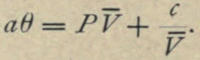
This omits the virial within the inner sphere, the radius of which is so taken that within that distance the number of particles is not proportional to the number in a large sphere. For Van der Waals this radius is the diameter of his hard molecules, which assumption gives his equation. But it is plain that the attraction between the molecules must to a certain extent modify their distribution, unless some peculiar conditions are fulfilled. The equation of Van der Waals can be approximately true therefore only for a gas. In a solid or liquid condition, in which the removal of a small amount of pressure has little effect on the volume, and where consequently the virial must be much greater than PV̅, the virial must increase with the volume. For suppose we had a substance in a critical condition in which an increase of the volume would diminish the virial more than it would increase ³⁄₂PV̅. If we were forcibly to diminish the volume of such a substance, when the temperature became equalised, the pressure which it could withstand would be less than before, and it would be still further condensed, and this would go on indefinitely until a condition were reached in which an increase of volume would increase ³⁄₂PV̅ more than it would decrease the virial. In the case of solids, at least, P may be zero; so that the state reached would be one in which the virial increases with the volume, or the attraction between the particles does not increase so fast with a diminution of their distance as it would if the attraction were inversely as the distance.
Almost contemporaneously with Van der Waals’s paper, another remarkable thesis for the doctorate was presented at Paris by Amagat. It related to the elasticity and expansion of gases, and to this subject the superb experimenter, its author, has devoted his whole subsequent life. Especially interesting are his observations of the volumes of ethylene and of carbonic acid at temperatures from 20° to 100° and at pressures ranging from an ounce to 5000 pounds to the square inch. As soon as Amagat had obtained these results, he remarked that the “coefficient of expansion at constant volume,” as it is absurdly called, that is, the rate of variation of the pressure with the temperature, was very nearly constant for each volume. This accords with the equation of the virial, which gives
dp⁄dθ = a⁄V̅ - dΣR̅r̅⁄dθ.
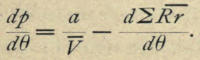
Now, the virial must be nearly independent of the temperature, and therefore the last term almost disappears. The virial would not be quite independent of the temperature, because if the temperature (i. e. the square of the velocity of the molecules) is lowered, and the pressure correspondingly lowered, so as to make the volume the same, the attractions of the molecules will have more time to produce their effects, and consequently, the pairs of molecules the closest together will be held together longer and closer; so that the virial will generally be increased by a decrease of temperature. Now, Amagat’s experiments do show an excessively minute effect of this sort, at least, when the volumes are not too small. However, the observations are well enough satisfied by assuming the “coefficient of expansion at constant volume” to consist wholly of the first term, a/(V). Thus, Amagat’s experiments enable us to determine the values of a and thence to calculate the virial; and this we find varies for carbonic acid gas nearly inversely to (V)⁰˙⁹. There is, thus, a rough approximation to satisfying Van der Waals’s equation. But the most interesting result of Amagat’s experiments, for our purpose at any rate, is that the quantity a, though nearly constant for any one volume, differs considerably with the volume, nearly doubling when the volume is reduced fivefold. This can only indicate that the mean kinetic energy of a given mass of the gas for a given temperature is greater the more the gas is compressed. But the laws of mechanics appear to enjoin that the mean kinetic energy of a moving particle shall be constant at any given temperature. The only escape from contradiction, then, is to suppose that the mean mass of a moving particle diminishes upon the condensation of the gas. In other words, many of the molecules are dissociated, or broken up into atoms or sub-molecules. The idea that dissociation should be favored by diminishing the volume will be pronounced by physicists, at first blush, as contrary to all our experience. But it must be remembered that the circumstances we are speaking of, that of a gas under fifty or more atmospheres pressure, are also unusual. That the “coefficient of expansion under constant volume” when multiplied by the volumes should increase with a decrement of the volume is also quite contrary to ordinary experience; yet it undoubtedly takes place in all gases under great pressure. Again, the doctrine of Arrhenius[7] is now generally accepted, that the molecular conductivity of an electrolyte is proportional to the dissociation of ions. Now the molecular conductivity of a fused electrolyte is usually superior to that of a solution. Here is a case, then, in which diminution of volume is accompanied by increased dissociation.
The truth is that several different kinds of dissociation have to be distinguished. In the first place, there is the dissociation of a chemical molecule to form chemical molecules under the regular action of chemical laws. This may be a double decomposition, as when iodhydric acid is dissociated, according to the formula
HI + HI = HH + II;

or, it may be a simple decomposition, as when pentachloride of phosphorus is dissociated according to the formula
PCl₅ = PCl₃ + ClCl.

All these dissociations require, according to the laws of thermochemistry, an elevated temperature. In the second place, there is the dissociation of a physically polymerous molecule, that is, of several chemical molecules joined by physical attractions. This I am inclined to suppose is a common concomitant of the heating of solids and liquids; for in these bodies there is no increase of compressibility with the temperature at all comparable with the increase of the expansibility. But, in the third place, there is the dissociation with which we are now concerned, which must be supposed to be a throwing off of unsaturated sub-molecules or atoms from the molecule. The molecule may, as I have said, be roughly likened to a solar system. As such, molecules are able to produce perturbations of one another’s internal motions; and in this way a planet, i. e. a sub-molecule, will occasionally get thrown off and wander about by itself, till it finds another unsaturated sub-molecule with which it can unite. Such dissociation by perturbation will naturally be favored by the proximity of the molecules to one another.
Let us now pass to the consideration of that special substance, or rather class of substances, whose properties form the chief subject of botany and of zoölogy, as truly as those of the silicates form the chief subject of mineralogy: I mean the life-slimes, or protoplasm. Let us begin by cataloguing the general characters of these slimes. They one and all exist in two states of aggregation, a solid or nearly solid state and a liquid or nearly liquid state; but they do not pass from the former to the latter by ordinary fusion. They are readily decomposed by heat, especially in the liquid state; nor will they bear any considerable degree of cold. All their vital actions take place at temperatures very little below the point of decomposition. This extreme instability is one of numerous facts which demonstrate the chemical complexity of protoplasm. Every chemist will agree that they are far more complicated than the albumens. Now, albumen is estimated to contain in each molecule about a thousand atoms; so that it is natural to suppose that the protoplasms contain several thousands. We know that while they are chiefly composed of oxygen, hydrogen, carbon, and nitrogen, a large number of other elements enter into living bodies in small proportions; and it is likely that most of these enter into the composition of protoplasms. Now, since the numbers of chemical varieties increase at an enormous rate with the number of atoms per molecule, so that there are certainly hundreds of thousands of substances whose molecules contain twenty atoms or fewer, we may well suppose that the number of protoplasmic substances runs into the billions or trillions. Professor Cayley has given a mathematical theory of “trees,” with a view of throwing a light upon such questions; and in that light the estimate of trillions (in the English sense) seems immoderately moderate. It is true that an opinion has been emitted, and defended among biologists, that there is but one kind of protoplasm; but the observations of biologists, themselves, have almost exploded that hypothesis, which from a chemical standpoint appears utterly incredible. The anticipation of the chemist would decidedly be that enough different chemical substances having protoplasmic characters might be formed to account, not only for the differences between nerve-slime and muscle-slime, between whale-slime and lion-slime, but also for those minuter pervasive variations which characterise different breeds and single individuals.
Protoplasm, when quiescent, is, broadly speaking, solid; but when it is disturbed in an appropriate way, or sometimes even spontaneously without external disturbance, it becomes, broadly speaking, liquid. A moner in this state is seen under the microscope to have streams within its matter; a slime-mould slowly flows by force of gravity. The liquefaction starts from the point of disturbance and spreads through the mass. This spreading, however, is not uniform in all directions; on the contrary it takes at one time one course, at another another, through the homogeneous mass, in a manner that seems a little mysterious. The cause of disturbance being removed, these motions gradually (with higher kinds of protoplasm, quickly) cease, and the slime returns to its solid condition.
The liquefaction of protoplasm is accompanied by a mechanical phenomenon. Namely, some kinds exhibit a tendency to draw themselves up into a globular form. This happens particularly with the contents of muscle-cells. The prevalent opinion, founded on some of the most exquisite experimental investigations that the history of science can show, is undoubtedly that the contraction of muscle-cells is due to osmotic pressure; and it must be allowed that that is a factor in producing the effect. But it does not seem to me that it satisfactorily accounts even for the phenomena of muscular contraction; and besides, even naked slimes often draw up in the same way. In this case, we seem to recognise an increase of the surface-tension. In some cases, too, the reverse action takes place, extraordinary pseudopodia being put forth, as if the surface-tension were diminished in spots. Indeed, such a slime always has a sort of skin, due no doubt to surface-tension, and this seems to give way at the point where a pseudopodium is put forth.
Long-continued or frequently repeated liquefaction of the protoplasm results in an obstinate retention of the solid state, which we call fatigue. On the other hand repose in this state, if not too much prolonged, restores the liquefiability. These are both important functions.
The life-slimes have, further, the peculiar property of growing. Crystals also grow; their growth, however, consists merely in attracting matter like their own from the circumambient fluid. To suppose the growth of protoplasm of the same nature, would be to suppose this substance to be spontaneously generated in copious supplies wherever food is in solution. Certainly, it must be granted that protoplasm is but a chemical substance, and that there is no reason why it should not be formed synthetically like any other chemical substance. Indeed, Clifford has clearly shown that we have overwhelming evidence that it is so formed. But to say that such formation is as regular and frequent as the assimilation of food is quite another matter. It is more consonant with the facts of observation to suppose that assimilated protoplasm is formed at the instant of assimilation, under the influence of the protoplasm already present. For each slime in its growth preserves its distinctive characters with wonderful truth, nerve-slime growing nerve-slime and muscle-slime muscle-slime, lion-slime growing lion-slime, and all the varieties of breeds and even individual characters being preserved in the growth. Now it is too much to suppose there are billions of different kinds of protoplasm floating about wherever there is food.
The frequent liquefaction of protoplasm increases its power of assimilating food; so much so, indeed, that it is questionable whether in the solid form it possesses this power.
The life-slime wastes as well as grows; and this too takes place chiefly if not exclusively in its liquid phases.
Closely connected with growth is reproduction; and though in higher forms this is a specialised function, it is universally true that wherever there is protoplasm, there is, will be, or has been a power of reproducing that same kind of protoplasm in a separated organism. Reproduction seems to involve the union of two sexes; though it is not demonstrable that this is always requisite.
Another physical property of protoplasm is that of taking habits. The course which the spread of liquefaction has taken in the past is rendered thereby more likely to be taken in the future; although there is no absolute certainty that the same path will be followed again.
Very extraordinary, certainly, are all these properties of protoplasm; as extraordinary as indubitable. But the one which has next to be mentioned, while equally undeniable, is infinitely more wonderful. It is that protoplasm feels. We have no direct evidence that this is true of protoplasm universally, and certainly some kinds feel far more than others. But there is a fair analogical inference that all protoplasm feels. It not only feels but exercises all the functions of mind.
Such are the properties of protoplasm. The problem is to find a hypothesis of the molecular constitution of this compound which will account for these properties, one and all.
Some of them are obvious results of the excessively complicated constitution of the protoplasm molecule. All very complicated substances are unstable; and plainly a molecule of several thousand atoms may be separated in many ways into two parts in each of which the polar chemical forces are very nearly saturated. In the solid protoplasm, as in other solids, the molecules must be supposed to be moving as it were in orbits, or, at least, so as not to wander indefinitely. But this solid cannot be melted, for the same reason that starch cannot be melted; because an amount of heat insufficient to make the entire molecules wander is sufficient to break them up completely and cause them to form new and simpler molecules. But when one of the molecules is disturbed, even if it be not quite thrown out of its orbit at first, sub-molecules of perhaps several hundred atoms each are thrown off from it. These will soon acquire the same mean kinetic energy as the others, and therefore velocities several times as great. They will naturally begin to wander, and in wandering will perturb a great many other molecules and cause them in their turn to behave like the one originally deranged. So many molecules will thus be broken up, that even those that are intact will no longer be restrained within orbits, but will wander about freely. This is the usual condition of a liquid, as modern chemists understand it; for in all electrolytic liquids there is considerable dissociation.
But this process necessarily chills the substance, not merely on account of the heat of chemical combination, but still more because the number of separate particles being greatly increased, the mean kinetic energy must be less. The substance being a bad conductor, this heat is not at once restored. Now the particles moving more slowly, the attractions between them have time to take effect, and they approach the condition of equilibrium. But their dynamic equilibrium is found in the restoration of the solid condition, which therefore takes place, if the disturbance is not kept up.
When a body is in the solid condition, most of its molecules must be moving at the same rate, or, at least, at certain regular sets of rates; otherwise the orbital motion would not be preserved. The distances of neighboring molecules must always be kept between a certain maximum and a certain minimum value. But if, without absorption of heat, the body be thrown into a liquid condition, the distances of neighboring molecules will be far more unequally distributed, and an effect upon the virial will result. The chilling of protoplasm upon its liquefaction must also be taken into account. The ordinary effect will no doubt be to increase the cohesion and with that the surface-tension, so that the mass will tend to draw itself up. But in special cases, the virial will be increased so much that the surface-tension will be diminished at points where the temperature is first restored. In that case, the outer film will give way and the tension at other places will aid in causing the general fluid to be poured out at those points, forming pseudopodia.
When the protoplasm is in a liquid state, and then only, a solution of food is able to penetrate its mass by diffusion. The protoplasm is then considerably dissociated; and so is the food, like all dissolved matter. If then the separated and unsaturated sub-molecules of the food happen to be of the same chemical species as sub-molecules of the protoplasm, they may unite with other sub-molecules of the protoplasm to form new molecules, in such a fashion that when the solid state is resumed, there may be more molecules of protoplasm than there were at the beginning. It is like the jack-knife whose blade and handle, after having been severally lost and replaced, were found and put together to make a new knife.
We have seen that protoplasm is chilled by liquefaction, and that this brings it back to the solid state, when the heat is recovered. This series of operations must be very rapid in the case of nerve-slime and even of muscle-slime, and may account for the unsteady or vibratory character of their action. Of course, if assimilation takes place, the heat of combination, which is probably trifling, is gained. On the other hand, if work is done, whether by nerve or by muscle, loss of energy must take place. In the case of the muscle, the mode by which the instantaneous part of the fatigue is brought about is easily traced out. If when the muscle contracts it be under stress, it will contract less than it otherwise would do, and there will be a loss of heat. It is like an engine which should work by dissolving salt in water and using the contraction during the solution to lift a weight, the salt being recovered afterwards by distillation. But the major part of fatigue has nothing to do with the correlation of forces. A man must labor hard to do in a quarter of an hour the work which draws from him enough heat to cool his body by a single degree. Meantime, he will be getting heated, he will be pouring out extra products of combustion, perspiration, etc., and he will be driving the blood at an accelerated rate through minute tubes at great expense. Yet all this will have little to do with his fatigue. He may sit quietly at his table writing, doing practically no physical work at all, and yet in a few hours be terribly fagged. This seems to be owing to the deranged sub-molecules of the nerve-slime not having had time to settle back into their proper combinations. When such sub-molecules are thrown out, as they must be from time to time, there is so much waste of material.
In order that a sub-molecule of food may be thoroughly and firmly assimilated into a broken molecule of protoplasm, it is necessary not only that it should have precisely the right chemical composition, but also that it should be at precisely the right spot at the right time and should be moving in precisely the right direction with precisely the right velocity. If all these conditions are not fulfilled, it will be more loosely retained than the other parts of the molecule; and every time it comes round into the situation in which it was drawn in, relatively to the other parts of that molecule and to such others as were near enough to be factors in the action, it will be in special danger of being thrown out again. Thus, when a partial liquefaction of the protoplasm takes place many times to about the same extent, it will, each time, be pretty nearly the same molecules that were last drawn in that are now thrown out. They will be thrown out, too, in about the same way, as to position, direction of motion, and velocity, in which they were drawn in; and this will be in about the same course that the ones last before them were thrown out. Not exactly, however; for the very cause of their being thrown off so easily is their not having fulfilled precisely the conditions of stable retention. Thus, the law of habit is accounted for, and with it its peculiar characteristic of not acting with exactitude.
It seems to me that this explanation of habit, aside from the question of its truth or falsity, has a certain value as an addition to our little store of mechanical examples of actions analogous to habit. All the others, so far as I know, are either statical or else involve forces which, taking only the sensible motions into account, violate the law of energy. It is so with the stream that wears its own bed. Here, the sand is carried to its most stable situation and left there. The law of energy forbids this; for when anything reaches a position of stable equilibrium, its momentum will be at a maximum, so that it can according to this law only be left at rest in an unstable situation. In all the statical illustrations, too, things are brought into certain states and left there. A garment receives folds and keeps them; that is, its limit of elasticity is exceeded. This failure to spring back is again an apparent violation of the law of energy; for the substance will not only not spring back of itself (which might be due to an unstable equilibrium being reached) but will not even do so when an impulse that way is applied to it. Accordingly, Professor James says “the phenomena of habit ... are due to the plasticity of the ... materials.” Now, plasticity of materials means the having of a low limit of elasticity. (See the “Century Dictionary,” under solid.) But the hypothetical constitution of protoplasm here proposed involves no forces but attractions and repulsions strictly following the law of energy. The action here, that is, the throwing of an atom out of its orbit in a molecule, and the entering of a new atom into nearly, but not quite the same orbit, is somewhat similar to the molecular actions which may be supposed to take place in a solid strained beyond its limit of elasticity. Namely, in that case certain molecules must be thrown out of their orbits, to settle down again shortly after into new orbits. In short, the plastic solid resembles protoplasm in being partially and temporarily liquefied by a slight mechanical force. But the taking of a set by a solid body has but a moderate resemblance to the taking of a habit, inasmuch as the characteristic feature of the latter, its inexactitude and want of complete determinacy, is not so marked in the former, if it can be said to be present there, at all.
The truth is that though the molecular explanation of habit is pretty vague on the mathematical side, there can be no doubt that systems of atoms having polar forces would act substantially in that manner, and the explanation is even too satisfactory to suit the convenience of an advocate of tychism. For it may fairly be urged that since the phenomena of habit may thus result from a purely mechanical arrangement, it is unnecessary to suppose that habit-taking is a primordial principle of the universe. But one fact remains unexplained mechanically, which concerns not only the facts of habit, but all cases of actions apparently violating the law of energy; it is that all these phenomena depend upon aggregations of trillions of molecules in one and the same condition and neighborhood; and it is by no means clear how they could have all been brought and left in the same place and state by any conservative forces. But let the mechanical explanation be as perfect as it may, the state of things which it supposes presents evidence of a primordial habit-taking tendency. For it shows us like things acting in like ways because they are alike. Now, those who insist on the doctrine of necessity will for the most part insist that the physical world is entirely individual. Yet law involves an element of generality. Now to say that generality is primordial, but generalisation not, is like saying that diversity is primordial but diversification not. It turns logic upside down. At any rate, it is clear that nothing but a principle of habit, itself due to the growth by habit of an infinitesimal chance tendency toward habit-taking, is the only bridge that can span the chasm between the chance-medley of chaos and the cosmos of order and law.
I shall not attempt a molecular explanation of the phenomena of reproduction, because that would require a subsidiary hypothesis, and carry me away from my main object. Such phenomena, universally diffused though they be, appear to depend upon special conditions; and we do not find that all protoplasm has reproductive powers.
But what is to be said of the property of feeling? If consciousness belongs to all protoplasm, by what mechanical constitution is this to be accounted for? The slime is nothing but a chemical compound. There is no inherent impossibility in its being formed synthetically in the laboratory, out of its chemical elements; and if it were so made, it would present all the characters of natural protoplasm. No doubt, then, it would feel. To hesitate to admit this would be puerile and ultra-puerile. By what element of the molecular arrangement, then, would that feeling be caused? This question cannot be evaded or pooh-poohed. Protoplasm certainly does feel; and unless we are to accept a weak dualism, the property must be shown to arise from some peculiarity of the mechanical system. Yet the attempt to deduce it from the three laws of mechanics, applied to never so ingenious a mechanical contrivance, would obviously be futile. It can never be explained, unless we admit that physical events are but degraded or undeveloped forms of psychical events. But once grant that the phenomena of matter are but the result of the sensibly complete sway of habits upon mind, and it only remains to explain why in the protoplasm these habits are to some slight extent broken up, so that according to the law of mind, in that special clause of it sometimes called the principle of accommodation,[8] feeling becomes intensified. Now the manner in which habits generally get broken up is this. Reactions usually terminate in the removal of a stimulus; for the excitation continues as long as the stimulus is present. Accordingly, habits are general ways of behavior which are associated with the removal of stimuli. But when the expected removal of the stimulus fails to occur, the excitation continues and increases, and non-habitual reactions take place; and these tend to weaken the habit. If, then, we suppose that matter never does obey its ideal laws with absolute precision, but that there are almost insensible fortuitous departures from regularity, these will produce, in general, equally minute effects. But protoplasm is in an excessively unstable condition; and it is the characteristic of unstable equilibrium, that near that point excessively minute causes may produce startlingly large effects. Here then, the usual departures from regularity will be followed by others that are very great; and the large fortuitous departures from law so produced, will tend still further to break up the laws, supposing that these are of the nature of habits. Now, this breaking up of habit and renewed fortuitous spontaneity will, according to the law of mind, be accompanied by an intensification of feeling. The nerve-protoplasm is, without doubt, in the most unstable condition of any kind of matter; and consequently, there the resulting feeling is the most manifest.
Thus we see that the idealist has no need to dread a mechanical theory of life. On the contrary, such a theory, fully developed, is bound to call in a tychistic idealism as its indispensable adjunct. Wherever chance-spontaneity is found, there, in the same proportion, feeling exists. In fact, chance is but the outward aspect of that which within itself is feeling. I long ago showed that real existence, or thing-ness, consists in regularities. So, that primeval chaos in which there was no regularity was mere nothing, from a physical aspect. Yet it was not a blank zero; for there was an intensity of consciousness there in comparison with which all that we ever feel is but as the struggling of a molecule or two to throw off a little of the force of law to an endless and innumerable diversity of chance utterly unlimited.
But after some atoms of the protoplasm have thus become partially emancipated from law, what happens next to them? To understand this, we have to remember that no mental tendency is so easily strengthened by the action of habit as is the tendency to take habits. Now, in the higher kinds of protoplasm, especially, the atoms in question have not only long belonged to one molecule or another of the particular mass of slime of which they are parts; but before that, they were constituents of food of a protoplasmic constitution. During all this time, they have been liable to lose habits and to recover them again; so that now, when the stimulus is removed, and the foregone habits tend to reassert themselves, they do so in the case of such atoms with great promptness. Indeed, the return is so prompt that there is nothing but the feeling to show conclusively that the bonds of law have ever been relaxed.
In short, diversification is the vestige of chance-spontaneity; and wherever diversity is increasing, there chance must be operative. On the other hand, wherever uniformity is increasing, habit must be operative. But wherever actions take place under an established uniformity, there so much feeling as there may be takes the mode of a sense of reaction. That is the manner in which I am led to define the relation between the fundamental elements of consciousness and their physical equivalents.
It remains to consider the physical relations of general ideas. It may be well here to reflect that if matter has no existence except as a specialisation of mind, it follows that whatever affects matter according to regular laws is itself matter. But all mind is directly or indirectly connected with all matter, and acts in a more or less regular way; so that all mind more or less partakes of the nature of matter. Hence, it would be a mistake to conceive of the psychical and the physical aspects of matter as two aspects absolutely distinct. Viewing a thing from the outside, considering its relations of action and reaction with other things, it appears as matter. Viewing it from the inside, looking at its immediate character as feeling, it appears as consciousness. These two views are combined when we remember that mechanical laws are nothing but acquired habits, like all the regularities of mind, including the tendency to take habits, itself; and that this action of habit is nothing but generalisation, and generalisation is nothing but the spreading of feelings. But the question is, how do general ideas appear in the molecular theory of protoplasm?
The consciousness of a habit involves a general idea. In each action of that habit certain atoms get thrown out of their orbit, and replaced by others. Upon all the different occasions it is different atoms that are thrown off, but they are analogous from a physical point of view, and there is an inward sense of their being analogous. Every time one of the associated feelings recurs, there is a more or less vague sense that there are others, that it has a general character, and of about what this general character is. We ought not, I think, to hold that in protoplasm habit never acts in any other than the particular way suggested above. On the contrary, if habit be a primary property of mind, it must be equally so of matter, as a kind of mind. We can hardly refuse to admit that wherever chance motions have general characters, there is a tendency for this generality to spread and to perfect itself. In that case, a general idea is a certain modification of consciousness which accompanies any regularity or general relation between chance actions.
The consciousness of a general idea has a certain “unity of the ego,” in it, which is identical when it passes from one mind to another. It is, therefore, quite analogous to a person; and, indeed, a person is only a particular kind of general idea. Long ago, in the Journal of Speculative Philosophy (Vol. III, p. 156), I pointed out that a person is nothing but a symbol involving a general idea; but my views were, then, too nominalistic to enable me to see that every general idea has the unified living feeling of a person.
All that is necessary, upon this theory, to the existence of a person is that the feelings out of which he is constructed should be in close enough connection to influence one another. Here we can draw a consequence which it may be possible to submit to experimental test. Namely, if this be the case, there should be something like personal consciousness in bodies of men who are in intimate and intensely sympathetic communion. It is true that when the generalisation of feeling has been carried so far as to include all within a person, a stopping-place, in a certain sense, has been attained; and further generalisation will have a less lively character. But we must not think it will cease. Esprit de corps, national sentiment, sympathy, are no mere metaphors. None of us can fully realise what the minds of corporations are, any more than one of my brain-cells can know what the whole brain is thinking. But the law of mind clearly points to the existence of such personalities, and there are many ordinary observations which, if they were critically examined and supplemented by special experiments, might, as first appearances promise, give evidence of the influence of such greater persons upon individuals. It is often remarked that on one day half a dozen people, strangers to one another, will take it into their heads to do one and the same strange deed, whether it be a physical experiment, a crime, or an act of virtue. When the thirty thousand young people of the society for Christian Endeavor were in New York, there seemed to me to be some mysterious diffusion of sweetness and light. If such a fact is capable of being made out anywhere, it should be in the church. The Christians have always been ready to risk their lives for the sake of having prayers in common, of getting together and praying simultaneously with great energy, and especially for their common body, for “the whole state of Christ’s church militant here in earth,” as one of the missals has it. This practice they have been keeping up everywhere, weekly, for many centuries. Surely, a personality ought to have developed in that church, in that “bride of Christ,” as they call it, or else there is a strange break in the action of mind, and I shall have to acknowledge my views are much mistaken. Would not the societies for psychical research be more likely to break through the clouds, in seeking evidences of such corporate personality, than in seeking evidences of telepathy, which, upon the same theory, should be a far weaker phenomenon?
C. S. Peirce.
FOOTNOTES:
THE FUTURE OF THOUGHT IN AMERICA.
History teaches us the nature of the degenerative and destructive agencies in national life. These are of various kinds, but they may be generally included under the heads of Physical Vices, Superstitions, and Selfish Ambitions. These have become possible through excess of emotional, and deficiency of rational states of the mind. When a large part of a population is influenced by emotional rather than by rational modes of thought, unethical conduct has full opportunity, and suffering and destruction are sure to follow. All races and nations are subject to such disorders, if only in some cases during their periods of infancy and of degeneracy.
The peoples of Europe have difficulties and dangers which are due to their own peculiar situation. The people of North America have to meet certain risks of a somewhat different character, owing to our peculiar position. In Europe we see an accumulation of many races who reached their Ultima Thule at the coast of the Atlantic, and who have had to accommodate themselves to each other as best they could. Speaking different languages and having different political organisations, they have consolidated into separate nations. This result has only been reached after many conflicts, and the result has been the combination and absorption of smaller states into greater, such as we find them to-day. This result has not terminated conflicts; it has reduced their frequency but has increased their scope and importance. To-day the antagonisms of these nations impose great burdens upon them, but they are at the same time productive of great good.
With men as with other animals excellence is the result of use and exercise. With animals this exercise has been compulsory, and has been due largely to the pressure of hunger. Among men intellectual and ethical excellence may be due to compulsion, or it may result from the capacity to develop lofty ideals. In the former case man is driven; in the latter case he is led. Now the organisation of human society is such, that if man will not be led, he is driven. The “mills of the Gods” are ever ready for those who lag behind in the progress of the race. But there are mills and mills, and no mill has yet appeared in human history better calculated to grind out a good grist from an intellectual point of view, than western Eurasia, or Europe. The emulations and antagonisms of so many nations have stimulated men to do their best, and have stimulated governments to aid them in doing it, for several centuries. The result has been modern art, modern science pure and applied, and modern philosophy. To produce all this however, Europe has been under pressure, and the pressure has been in some, if not all of its countries, more or less galling.
The European, in order to escape local tyranny, political, social, or theological, or to better his chances of physical living, has come to America. He has taken possession, and has bettered his condition from a physical point of view, most successfully. The question that interests us now, is whether he has bettered himself in any other way, and whether he is going to continue the mental progress which has so distinguished his history in Europe. Population is rapidly increasing, and the increasing severity of the “struggle for existence” which will follow, will stimulate men to increased excellence in their methods of obtaining a livelihood, but will it develop the mind in any other direction? We have before us in the case of China, the effect of close industrial competition in a dense population, without corresponding intellectual development. What is the outlook for the American? Will the process of natural selection only, the “devil-take-the-hindmost” doctrine of Darwin, be sufficient to develop the higher mental faculties, or having developed them, to enable them to survive and to become general, or not?
In the first place we lack in America the great stimulus to mental progress already referred to, international jealousy and emulation. In this respect we are situated very much like the Chinese, but if anything less favorably. We practically own the continent. We have no fear of Tartar invasions from the west nor Japanese from the north east. The Canadians are of identical race with ourselves, and are almost certain to become identical in nationality with us. We are accustomed to boast ourselves of this, and to look with great satisfaction on our isolated position among nations. But our self-gratulation must be greatly tempered by the reflection that such isolation is only beneficial so long as we can maintain our ideals without external stimulus. And this is something that few nations have so far been able to accomplish. It is true, however, that the Atlantic ocean is not so wide as it was formerly, and we are truly one of the family of the Indo-European nations. But we will miss the effect of the daily stimulus which they afford each other, and the daily contact which transmits so much from man to man.
What is our present intellectual rank among these nations to-day; meaning by this our status in actual production of intellectual work, and leaving aside history? Without any great competence to speak on many branches of such work, I may be not far from correct; if I summarise as follows: In music and sculpture unproductive; in painting and literature (as an art) good, but weak in quantity in comparison with our population. In sciences, feeble in many branches, but very productive in some others. I refer to pure science. In applied science we stand high. In philosophy as a nation, weak.
But we have the future before us. If there is a demand for the products of pure thought in this country, the supply will come. Much may be expected of our race. We will hope that the demand will grow, for at present it is not as large as it ought to be. It is of course easy for thought to “run in accustomed channels,” and many people there are in this as in all other countries, who believe that sufficient is already known, and that he who would disturb current opinions is a “disturber of the peace.” Strange as it may seem, in this comparatively new country we have one special inducement to this habit of mind. This is to be found in our political system, which requires an unhesitating submission to the will of the majority.
Here is our second danger. We are apt to confuse mental submission with physical submission. Physical submission to the will of the majority is generally necessary for physical reasons, with which we are all familiar. Ballots are simply a peaceful representation of bullets, and we anticipate the submission to the latter by submission to the former. But the mind should be free. Current or popular opinions are not always correct. In fact if they were, reform or progress would be unnecessary. A proposal for change always begins with a minority, and much time may often elapse before such change becomes acceptable to the majority. Before the majority accepts a new step of progress the progressive idea cannot govern physically. It must be content to be unpopular for a greater or less time. Now the politician naturally dreads unpopularity, for it is political death. And just in proportion as we are politicians do we share in this unfortunate mental attitude. And how many Americans are not politicians? It is the prevalent ethical disease of Americans. If it becomes general, the progress of this country is ended, and her fate among nations is sealed. Her manhood is gone, and woman may well feel her hand itch to
“Defeat their dirty tricks Confound their politics.”
The prevalence of the habit of submission to what we know to be wrong in this country is simply detestable. Herbert Spencer has given us some excellent advice on this subject, and we will do well to heed it. The habit extends all the way through political, scientific, and domestic economy. The unpopularity of the reformer is expressed in the term “kicker,” which is applied to him among the lower classes in this country. As one of its advocates once said to me, it is the “American System,” and there was a strong element of truth in his assertion. With such people, criticism is identical with quarrelling, for they cannot conceive of any motive for endeavoring to reform some abuse or correct some error, but personal rancor. Such an attitude is a sure mark of intellectual mediocrity and ethical incapacity, and it infinitely increases the pains of the reformer, and readily converts him into a martyr. However, there are a good many men left in this country, and there are agencies at work which will probably keep up the supply.
In the absence of compulsion in the form of external or civil wars and other disasters, the churches are doing a good work in keeping ideals before the people, and in inviting corresponding practical life. It is true that their efforts are more or less retarded by the insistence on erroneous and even absurd opinions about some things, but they do infinite service in teaching that “man shall not live by bread alone,” nor by the mere display of physical possessions. They teach that there are ideals of truth and beauty better worth living for, and that the mind is the greater part of man. It is the churches which make the majority of scientists and philosophers, as they formerly did of painters. Then let the churches flourish. Like the nations of Europe, their emulations and antagonisms bring out the truth. The Presbyterians have to solve the knotty questions of biblical inspiration and divine order. The Methodists will have to study the nature and value of human emotions. The Friends will know what is to be known of immediate divine influence. The Catholics have learned how to restrain in some measure the most thoughtless of mankind. The Unitarians and Ethical Culturists are proving that man may retain and live up to high ideals without much or any theology. So long as there is no philosophy or none to speak of in America, the evolution of thought will come from the conflicts of the theologies; a peaceful war which is far less wasteful than physical wars. Theology has been generally in Europe the parent of philosophy, and so it will be here. From the various stages and conditions of the agitation will spring science and art. By this method man is led into progress by measures which involve the best attributes of his nature, instead of being driven by appeals to his lower motives, or by physical force. In this progress moral courage is not lost, but it is developed; and criticism is truth’s best weapon, and is not a cause of offense. That this progress in the churches is real, is proven by our Woodrow, McQueary, Briggs, and others, and it will go on as long as the love of truth and moral courage exist in those organisations.
It is interesting to remember that this struggle of opinions has passed through the same stages in Europe wherever the love of truth has had an abiding place. This is especially true of Germany, where also philosophy has had so large a development in relatively modern times. But we need something more than opinions to counteract the dangers which threaten earnestness of character in this country, which I have pointed out. Active organisations are necessary, which shall resist tendencies to crystallisation from both sides. Non-theological people must be stimulated to maintain ethical ideals; and theological people must be restrained from smothering them under useless and obstructive dogmas and practices. It is too true that while some theological dogmas include high ethical ideals, other dogmas discredit them by deriving them from incredible sources, and seeking to sustain them by incredible sanctions. Where such dogmas are sincerely held, true thought is suppressed, knowledge makes slow progress, and ethical life is more difficult.
As already remarked, we cannot yet claim to be, as a nation, distinguished for profound thinking on the subjects of highest human interest; nor yet are we the most thoughtless. Ignorance of the possibilities of mind is not so general as in some parts of Europe, but it is greater than in others. Material objects and interests occupy almost as exclusively the minds of the majority of our citizens whom we are accustomed to consider “intelligent,” as among the unintelligent. Hence our proneness to boast of our material greatness, instead of our intellectual conquests. Hence that weakest of all forms of self-praise, the publication of the dimensions of our country and its rapid growth, as though these were indications of our superiority as a people or as a race. This is repeated ad nauseam, while our real merits, our contributions to the stock of the world’s progress in thought, knowledge, and mental power, are passed by in silence. Our newspaper press reflects this state of affairs, since they generally think it their best policy to follow rather than lead public opinion. There are, however, noteworthy exceptions to this character of the press both in the east and the west, which we owe to the superiority of the men who edit and direct them.
In the conduct of our schools and of our scientific organisations, we have a corresponding exhibition of mediocrity or worse, with a few noble and distinguished exceptions. A mere interest in education and research does not confer competency to direct and sustain them; yet an interest in such matters is generally the only qualification demanded of the directors of such institutions, provided they understand how to buy, sell, and invest money. It is to be hoped that this state of affairs will some day pass away, and that men who are influential in such matters will some time know enough themselves to distinguish between the false and the true, and between men of ability and adventurers who are after the money and position with which our institutions of learning and our scientific enterprises can endow them. This reform will progress exactly in proportion as it is understood how much human happiness depends on true research and on correct thinking, and how little on revelation and on ancient dogma.
It is not, I repeat, sufficiently understood, how much human conduct depends on correct thinking. How much financial dishonesty would be averted by a rational thought as to the inevitable consequences? How much social irregularity would be prevented by a similar treatment of the subject? How much hatred and wasteful antagonism would the world lack, if the ordinary conditions of living were understood and acted on! So the cultivation of the rational mind is of incalculable importance, and if we wish to prosper as a nation we must bend our energies to the pleasant task this problem presents to us. Neglect of our mental powers means degeneracy and decay; while their cultivation means power and happiness. Wealth, except as a means of attaining this end, after physical necessities are supplied, is simply useless.
E. D. Cope.
MENTAL MUMMIES.
If we should name the most important factor in the changes which have gradually widened the contrast between modern science and the scholasticism of the Middle Ages, we might define it as a “progressive recognition of hereditary influences.”
There was a time when each individual of the human race was considered a separate accident, called into existence by an act of unlimited, arbitrary power, and apt to be as suddenly changed, even unto a complete inversion of his former moral being, by a merciful, or revengeful, caprice of the same power.
Biology has since taught us to apply the doctrine of evolution to the problems of our own moral and physical nature, to trace the tendencies of bygone times to their effects in the present age, to consider individuals the outcome of a long series of precedent influences, and to recognise the truth that the length of those influences is proportioned to the persistence of the result.
Intelligent statesmen were the first to appreciate the practical value of those facts. The advisers of Alexander II. did not waste their time in a hopeless attempt to convert the freedom-worshipping natives of the Caucasus into devotees of Muscovite despotism, but at once confronted them with the alternative of exile or death. Our Indian commissioners early realised the impossibility of turning the descendants of a long ancestry of deer-hunters into tillers of the soil, and transferred the survivors of the long race-war to a territory where they could for better or worse, indulge their incurable penchant. The Groot Fontein penitentiary of the Transvaal Republic became the grave of so many Caffirs that the managers at last abandoned the plan of inuring nomads to the restraints of sedentary occupation, and saved the lives, if not the souls of their convicts by sending them about in chain-gangs to mend the irrigation ditches of the border settlements.
Hereditary influences cannot be obliterated by force of rhetoric or of government edicts and it would solve many riddles if we would apply that principle to phenomena of ethical and religious evolution. How else shall we explain the fact that in less than sixty years the doctrine of Protestantism spread from central Germany to the highland hamlets of Scotland and Scandinavia, while in Spain, Portugal, and Italy a very decided progress in general intelligence has failed to lead to a similar result? How shall we account for the success of Christian missionaries in Tasmania and Otaheiti and their utter failure in Burmah and Hindostan? How for the persecution-proof vitality of Judaism, the ready collapse of Mormonism, or the revival of crass mystic delusions in the midst of our realistic civilisation?
There is no doubt that the average Spanish sailor, or village-shopkeeper of to-day possesses a larger stock of general information than the average Brunswick school-teacher of the sixteenth century. Yet one of the least learned of those school-teachers could, by instinct, sufficiently appreciate the significance of the Protestant revolt to celebrate its triumph by a big bonfire and what our western friends would, call a “grand war-dance,” on a height near the little town of Wolfenbüttel. Why does Pedro Gonzales still cross himself at the mention of a heretic, while Peter Jansen would as soon return to the pig-sty hovels of the mediæval serfs as crawl back under the yoke of Jesuitry? How could the bogs of foggy Ireland and the vegas of sunny Spain nourish equally imperishable roots of a plant that failed to get a firm foot-hold in the sands of Brandenburgh?
The solution of those enigmas can be found in the circumstance that the doctrine of anti-naturalism had extended its influence to the character of many European nations, and that the character-traits of a race are less amenable to rapid changes than its intellectual standards. On the soul-organism of the Latin races the thousand years influence of monastic tyranny has left traces which the light of science will fail to efface for centuries to come. The propaganda of a manlier creed has thus been defeated, not only by their ignorance, but by their aversion to mental efforts, by their habitual reliance on miracles, by their incurable indifference to the claims of truth and the merits of intellectual independence, by their hereditary mistrust in the competence of their natural instinct. To their moral palate a doctrine which nauseates their northern neighbors has become a pleasant narcotic; they have been forced to swallow the opium of pessimism till a craving for the repetition of the mind-enervating dose has become a second nature; they hug the cross that has proved a symbol of death to their noblest reformers.
Against that influence of perverted instincts the logic of mental revelations avails but little. “Propositions which would appear self-evident to certain mental constitutions,” says Dr. Carpenter, “are apt to be very differently received by others, according to their conformity or discordance with that aggregate of preformed opinion which has grown up in the minds of each. For just as we try whether a new piece of furniture which is offered us does or does not fit into a certain recess in our apartment, and accept or decline it accordingly, so we try a new proposition which is offered to our mental acceptance. If it either at once fits in or can by argument or discussion be brought to fit in to some recess in our fabrics of thought, we give our assent to it by admitting it to its appropriate place. But if it neither fits in the first instance nor can by any means be brought to fit, the mind automatically rejects it.”
It is true that logical demonstrations may become complete enough to defy dissent, but even from facts which force themselves upon the acceptance of every rational human being, different individuals will draw widely different inferences. That the mind of man may become a receptacle for irreconcilable doctrines is strikingly illustrated, by the simultaneous acceptance of the Old and New Testament of our heterogeneous scripture, and in the same way obstinate bigots manage to associate scientific truth and dogmatic absurdities. Darwin and Moses may occupy adjoining quarters in the fabric of the same cosmogony; the rule of three may become a passive concomitant of Trinitarian dogmas. The torch of truth may be permitted to flicker in a secluded recess of souls which refuse it the privilege of throwing its rays in certain directions. Education may fail to reclaim hereditary bigotry. In the winter of 1559 the rabble of Madrid assembled to witness the death of Don Carlos de Seso, a Spanish nobleman whose ancestors had fought at Granada and Toledo. His brother had been the favorite hunting-companion of Charles V.; one of his uncles had sacrificed his life in deciding the victory of Pavia; Don Carlos himself had acquired renown both as a soldier and a scholar, but in the latter capacity he had confessed his sympathy with certain doctrines of Martin Luther, and the Holy Inquisition had sentenced him to anticipate his doom in the flames of the stake. King Philip II. honored the auto da fé with his presence, and frowned in a way which the condemned freethinker mistook for a disapproval of his sentence. “O King! can you thus witness the torture of your subjects?” exclaimed De Seso. “Deliver us from so cruel a death which even our enemies admit we have not deserved.” “I would help carrying faggots to burn my own son,” replied the King, “if he had incurred your unspeakable guilt.” Yet Philip the Second was one of the best-educated princes of his century. In mathematics, astronomy, ancient and modern languages, geography, and history, he was far better informed than Landgraf Philip of Hessen, who would have risked his own life to save that of a loyal cavalier.
There are mental mummies who cannot be revived by removing their grave-shrouds and clothing them in modern drapery; the principle of conservatism has penetrated their very veins and the marrow of their bones. It is by no means unconceivable that a popular leader like Garibaldi or Porfirio Diaz should succeed in persuading a million of his countrymen to renounce the yoke of Rome and build Protestant chapels, but the result would be largely limited to a change of nomenclature. Before long the dissenters would march in procession with a wonder-working tooth of John Wesley or kiss a shred from the petticoat of the Holy Maid of Kent. They would groan at the mention of Rome, but exorcise spooks with the initials of Ulric Zwingli, and abstain from work on the anniversary of every Protestant martyr. They would try to redeem drunkards by sprinkling them with consecrated water from the holy rivers of Kansas, and celebrate Arbor Day only by invoking the spirit of Prof. G. P. Marsh, as a patron-saint of climate-improving forests. Under the stimulus of industrial influences, they might transfer the cross from way-side shrines to telegraph-poles, but they would persist in the worship of sorrow.
The creed which has turned the happiest countries of our globe into a grave of their former prosperity, is a medley of miraculism and anti-naturalism, and the experience of the last century has proved that both can survive the repudiation of Rome and even of Galilee. The mania of renunciation, after the abolishment of monasteries and nunneries, continued its dismal rites in Quaker-garb and Shaker temples of celibacy. The miracle-hunger of millions who have learned to scorn the clumsy tricks of the cowled exorcist, gratifies its appetite in the mystic gloom of the dark cabinet. Rustic supernaturalists, deprived of such luxuries, indemnify themselves by retailing the marvels of the serpent-charm and joint-snake superstition.
A curious psychological problem suggests itself in the question how far the charm of the “sour-grape philosophy” may contribute to the persistence of certain forms of moral nihilism. Condemned criminals almost invariably “renounce the vanities” of a life which the Court of Appeals has refused to save, and in a scaffold-speech, quoted in Galignani’s Messenger of May 6th, 1837, the English murderer Joseph Greenacre expressed his conviction that his crime had been the means of saving his soul, because “death on the gibbet was one of the surest passports to heaven.”
For similar reasons degenerate nations, after realising the doom of their national welfare, are apt to renounce the glory of a forfeited world, and to consider misery, poverty, and shame so many stepping-stones to the bliss of a better life beyond the grave. After habitual sins against the health-laws of nature have avenged themselves in cureless diseases, decrepit bigots may find solace even in that most insane tenet of their dualistic creed which teaches them to despise the body as the enemy of the soul.
A natural effect of pessimism may thus, in course of time, become one of its perpetuating causes.
Felix L. Oswald.
THE NERVOUS GANGLIA OF INSECTS.
I.
Although the internal structure of the brain of insects has been the object of numerous and important investigations, among which we must place those of Dietl, Flögel, Bellonci, and Viallanes (who have applied the method of sections to the study of this organ), no attention has as yet been paid to the other nerve-centres of insects, and in particular to the ganglia of the ventral chain. Writers have contented themselves with describing the external form of these ganglia, and their anatomical relations to the other organic parts; but nothing has been done to throw light upon their inward structure. All the knowledge which we have on this subject is very meagre and dates far back to the works of the old writers, who, like Newport, had at their disposal no other means of study than the microscopic examination of organs viewed either transparently or in dilacerated preparations. A method so defective could render but incomplete results, and indeed in many cases erroneous ones.
We have sought to supply this much to be regretted lack of entomological knowledge, by applying to the ventral ganglia of insects the admirable method of sectional cutting, which has brought about such marked advances in contemporaneous zoölogy.
I need hardly insist on the interest of this research. We shall only remark that all anatomical study bears an unfinished aspect, up to the moment at which we grasp the meaning of the organs which we describe; physiology is a necessary complement of anatomy, it is that which gives to it a meaning. Therefore, when we dissect an organ, which, as in the case of an insect’s brain, is endowed with the most complex psychical properties of which these animals are capable, we find ourselves in the presence of parts whose functions almost entirely escape us. What is, for example, that peculiar organ to which we have given the name of the “pedunculate” body? Anatomists have described with the greatest care its connections and portrayed its external contour; but we cannot discover, or even conjecture its uses. It would be necessary to understand the habits of thought and the feelings of an insect, to be able to assign a rôle to parts so complex and so delicate as those contained within its brain.
The study of the ventral ganglia seems to us to be capable of conducting us to a better result, for in everything that concerns these nerve-masses, physiology is more advanced, and, in all cases, clearer. The ganglia of the thorax, for example, are in the main motory centres; the principal nerves that are sent out from them are to be found in the wings and in the feet; the study of the terrestrial, aquatic, and aerial locomotion of insects has already formed the subject of quite a number of important scientific works; we are now upon well-known ground, and we may hope that it will be possible to establish some connection between the anatomical structure of ventral ganglia and the functions which these ganglia control.
This hope appears to us to be the more legitimate, because we can make use of all the resources of comparative anatomy to work out the problem. If we consider any particular function, for example, that of flying, we notice that in species which resemble each other this function is exercised under totally different conditions; the same organ acquires different uses, and these variations become singularly instructive when we can trace their relationship to the particular structure of a nerve-ganglion. Thus, one of the large wings of the dragon-fly, which is almost like a bird in the range and power of its flight, becomes the elytrum of the beetle; the elytrum is a stiff wing covered by chitinised matter and serving as a protection to a part of the thorax and abdomen. Sometimes the elytrum is used in flying, as in the case of the cockchafer. In other lamellicorn insects, in the Cetonia for instance, the elytrum is not used in flight; it merely moves aside so as to allow the second pair of wings to unfold. Its rôle becomes still less active in the golden carabus, in Procrustes, in Blaps, and many other Coleoptera, whose two elytra are found on one vertical line, and form but one single and immovable portion; then the second pair of wings disappear; from the physiological point of view, the animal becomes apterous. In another and different order, the order Diptera, it is the second pair of wings that undergo an important modification; they cease to be used in flying, and are transformed into an organ of equipoise: they are used for maintaining equilibrium.
All these physiological variations, taking place in the self-same organ, must in all probability have their counterpart in the internal anatomy of the ganglion that governs the organ, and the comparative study of this ganglion in different species will enable us perhaps to discover the functions of some of its parts. Thus, if we consider by hypothesis, as the nerve-centre of flight, some small lobe which is found occupying this or that place in a thoracic ganglion, the disappearance or modification of this lobe in species not possessing the faculty of flying, might serve to throw additional light upon such an interpretation.
What we have just said with regard to flight is equally applicable to terrestrial locomotion, which also represents in itself many varieties. The typal insect possesses three pairs of feet, whence the name of hexapods, but there are particular species which drop a pair of feet, for instance, the Lepidoptera of the genus Vanessa; in others, the physiological function of the foot varies; in the case of the carrion-beetle (a necrophagus coleopter) it serves as an instrument of tillage, to dig with; for the cricket, the third pair of feet are used for the purpose of leaping; for the Dytiscus, it serves as an oar, and so on. We must also bear in mind the curious fact that there exists in the larvæ of certain insects what are called supplementary feet, having only a transient existence and disappearing at maturity; the caterpillar, the larva of the butterfly, has five pairs of supplementary feet. These notable facts demonstrated by comparative anatomy, cannot fail to furnish us with valuable information concerning the functions of the complex organs found in the ganglia of the thorax.
But this is not all. We have not enumerated all the contributions of comparative anatomy to the problem which we are now about to consider; we may make use of the method of comparison without bringing the different types into juxtaposition, but by viewing the nervous system of only a single animal in its entirety. We know in fact that the body of an insect is formed by a definite number of segments, all constructed on the same fundamental plan and arranged in a linear series. Each one of these segments is joined to a nerve-ganglion, which is all its own and supplies it with sensibility and motility, the two elementary properties of nervous activity. In the course of development, these ganglia have the power of changing their positions; and it is not uncommon to find that the greater number of the abdominal ganglia move up into the thorax; each one, nevertheless, retaining its nerve-relationship to its own segment. Now all the segments of an insect’s body are not called upon to play the same rôle; a division of labor has been effected among them with regard to the functions which they are found to exercise: as we have already seen, the ganglia of the thorax are essentially centres of locomotion; in the head, one of the ganglia, the sub-œsophageal, furnishes the nerves of the buccal portions; the other one, the brain, is connected with particular nerves and becomes the centre of the highest form of psychical activity of which the creature is capable. We have here a number of modifications superadded to the original plan. Yet the original plan should again be met with in the ganglia that have been least differentiated, such as those in the abdominal region; and the comparison between an abdominal and a thoracic ganglion, for instance, is well calculated to show what are the primal and fundamental structures, and what are the secondary ones which have been superadded and have become necessary for the execution of the more complex functions. The study of embryonic and larval forms so easily observed in insects, will most probably conduct us to the same result. And thus perhaps by continuous efforts, all guided by the same governing idea, we shall ultimately arrive at the analogies that exist between the cerebroid ganglia and the humblest ganglia belonging to the ventral chain, and thus finally be able to understand the action of the nerve-substance.
The importance of this object, which, be it clearly understood, can never be attained except by the united effort of many workers, is well calculated to command our strenuous exertions and to encourage us in surmounting the difficulties of a study which is as yet almost entirely new.
II.
We shall restrict ourselves in this article to the consideration of one particular case; we shall describe a single ganglion of the insect. The type we have chosen, for reasons too lengthy to enumerate, is a Coleopter of the family of Melolonthidæ; the Rhizotrogus solstitialis, a small beetle very commonly found in the southwest of France. We will now proceed to the consideration of the first thoracic ganglion.
The prothoracic ganglion in the rhizotrogus is joined by very short connective filaments to the second thoracic ganglion, and also to the sub-œsophageal ganglion; this latter ganglion, we must note en passant, being situated in the thorax. If with a pair of scissors we sever the head of the rhizotrogus, we find that the remainder of the body contains not only the thoracic ganglia, but also the sub-œsophageal; a peculiarity which, from a physiological point of view, is very interesting.
The ganglion of the pro-thorax, which is greater in width than it is in length, bears a vague resemblance to a cone the base of which is turned towards the sub-œsophageal ganglion, whilst the apex points towards the second ganglion of the thorax. From the lower part spring two large nerves, their starting-point being nearer the ventral than the dorsal surface, a fact clearly comprehended when we find that the fibres of these nerves extend for the most part into the first pair of feet, that is to say, into those organs that lie underneath the horizontal plane of the ganglion. The connective filaments which penetrate the ganglion anteriorly enter it nearer the dorsal surface than the ventral, this last being extremely convex. Dissection throws no additional light upon the anatomy of the ganglion. But by means of a series of sections, we find that it is composed of a mass of fibrillar substance which occupies its centre portion and of a layer of nerve-cells surrounding the fibrillar substance. This fibrillar mass is, owing to its great volume, far the most important, and constitutes in itself alone about four-fifths of the organ. The fibrillary structure can only be satisfactorily analysed by using on it osmic acid, or other equivalent reagents which dissociate it and admit of its being reduced to a certain number of clearly differentiated elements. Whenever osmic acid or a similar reagent has not been employed, or has not sufficiently penetrated the ganglion, owing to the obstacle presented by a thick conjunctival covering or envelope, the fibrillar substance takes on a homogeneous aspect that effectually renders all analysis of it impossible. Everything depends on the employment of a good method of preparation.
When the ganglion has been properly prepared, we perceive a very material difference in the appearance of the fibrillar substance when we compare the dorsal with the ventral region of the ganglion. We can do this very satisfactorily by a longitudinal section, extending through both regions. In such a section close to the median line but not confounded with it (see Cut 16)[9] we perceive that the ventral region is occupied by a cord or string of substance which owing to the action of the osmic acid has become very black, and which is formed of so dense a tissue, that we can with difficulty separate it into fibres and fibrillæ. This cord, which, by reason of its position and shape, I propose naming the ventral column, extends over the ventral surface of the ganglion in a longitudinal direction; at both its anterior and posterior extremities it is carried on by fibres extending into the ventral columns of the other ganglia, in such a manner that the entire series of ganglia are united by one continuous ventral cord.
If we look at a transverse section (see Cut 26), the cord, which is recognised by its dark color and by its position near the ventral surface of the fibrillar substance, will be seen to have the form of two almost perfect circles. The ventral column thus presents a circular section, is duplex and symmetrical: there exist two separate and distinct ventral columns, separate at least for a certain length; a fact which must be considered in connection with the primitive duality of the ganglion.
In every section where the columns remain distinct from each other, they are separated either by fibres and conjunctival cells, or by nerve-fibres emanating from the cells of the ventral region and proceeding in an upward direction between the two columns. At the other points, the two columns join on the median line. This union is effected in different ways, either by the two columns coming directly together, thus merging into a single mass, or by a commissure which describes the arc of a circle underneath the two columns, or else by the inferior ventral lobule.
We give the name of inferior ventral lobule to a small lobule of fibrillar substance, situated beneath the ventral column. When looked at in a horizontal section not passing through the median line (see Cut 17), this lobule presents the appearance of a rounded protuberance, breaking the almost rectilinear contour of the ventral column. As this characteristic peculiarity is repeated in the internal structure of all the ganglia, we may use it to ascertain the number of the ganglia, whenever these present the appearance of being fused into one compact mass; we may see the practical application of this remark by observing the sub-œsophageal ganglion.
In a succession of horizontal sections, the starting point of which is the ventral region, the first mass of fibrillar substance met with by the knife is the inferior ventral lobule, which is formed (see Cut 1) by two rounded fasciculi, placed symmetrically on either side of the median line and joined together by a transverse commissure.
In these sections, we also perceive fibres of the crural nerve, which, after having extended over a certain length of the ganglion, penetrate into the substance of the inferior ventral lobule (Cut 2). In transverse sections (Cut 23) we find the two ventral lobules placed beneath the two columns which they help to support, and into which they gradually merge; and we also perceive the transverse commissure which joins the two. We shall call this the transverse commissure of the inferior ventral lobule.
Let us now pass on to the examination of the upper surface of the ventral column. This surface is covered by a cluster of very fine fibrils rather sparsely disposed; we can clearly follow their course by means of a longitudinal section (Cut 17); we see them again in a horizontal section (Cut 5). To continue the general description of the ganglion we must now consider the dorsal region. It is, as we have previously stated, occupied by a fibrillar substance not so dense as that which composes the ventral column, and we will give the general name of dorsal lobe to this region, reserving the name ventral lobe for the region which embraces the ventral column and its adjoining parts. The dorsal lobe presents as its distinctive characteristic the feature that it is crossed longitudinally by a succession of connective filaments clearly seen in the longitudinal section of Cut 16.
We have already stated that the ventral column receives fibres issuing from the ganglion in front and sends out others to the ganglia in the rear. We shall call the totality of these fibres the connective ventral filaments, and shall call the totality of those that traverse the dorsal lobe the dorsal connective filaments.
The connective filaments which join the sub-œsophageal to the first thoracic ganglion, and which, between these two ganglia, are composed of a dense fasciculus of fibres, distribute these fibres, at the point at which they enter the prothoracic ganglia, in different directions; one set of fibres proceeds towards the ventral column, these are the ventral connective filaments; a second set traverses the dorsal lobe, and are the dorsal connective filaments.
Whilst the ventral connective filaments soon merge into the very dense substance of the ventral column, the dorsal connective filaments, on the contrary, remain distinct from the organs which they traverse, and preserve their individuality throughout. They take directions in three different planes (see Cut 16), consequently they can be subdivided into superior, medial, and inferior dorsal connective filaments.
Newport seems to have observed this distinction of fibres; and he has given the name of sensory column to this first division, and that of motor column to the second. Unfortunately the drawings and figures he has published, though schematically correct, are not clear. We do not adopt his terminology, in the first place because he designates the organs after their supposed functions, and we have made it a rule never to use controvertible physiological suppositions to designate anatomical organs; and besides, though the name of column is applicable to the connective ventral filaments, we cannot apply it to the connective dorsal filaments, which are subdivided into three pairs of fibrous fasciculi and do not in the least resemble a column.
In the study of Melolontha vulgaris, we have been able to establish in the most absolute manner that there exists a considerable histological difference between the connective filaments of the ventral region and those of the dorsal. Though we have not yet noticed this difference in Rhizotrogus in any marked degree, nevertheless it has seemed to us needful to point it out here, because the fact is of such vast importance that it cannot fail to be general. The dorsal connective filaments, whilst they preserve their individuality in their passage across the dorsal lobe of the ganglion, penetrate nevertheless into some small masses of dotted substance which are found in the path of their entrance into the ganglion. The mass annexed to the inferior dorsal connective filament, is above all very important and is directly connected with the ventral column. As the connective filaments are in pairs, each of these possesses a distinct mass of fibrillar substance and both the masses attached to the same pair of connective filaments are joined by a commissure.
Let us now say a few words about the nerves which proceed toward the prothoracic ganglion. There exists here but one single pair of nerves, extremely important and very extensive. This is the crural nerve. To this nerve are attached the organs which are superadded to the primary structure of the ganglion, such as we have described it, and which in consequence renders the primitive structure more complex. We shall perceive the importance attached to the idea of a superadded organ, when we study the abdominal ganglia, where the organs we are about to describe are either completely wanting or are but imperfectly developed.
If now we examine a transversal section taken a little in front of the place from whence the crural nerves emerge (Cut 19), we shall notice that the central part of the ganglion is occupied by the ventral column and the upper part by the dorsal lobe. In addition to this, in the lateral regions of the ganglion we find two important masses of fibrillar substance. At this point these two masses remain distinct from the parts we have just mentioned, and on the other hand they are in connection with the crural nerves. The latter send a part, and unquestionably the greater part, of their fibres into the lateral lobes. In a section slightly posterior to the preceding one, also transversal, a very important change has taken place; the two lateral lobules, always connected with the crural nerves, have also established connections with the centre of the ganglion, and in the sections further on the fusion is complete. As these lateral lobules possess the characteristics mentioned, only at the point at which the crural nerves emerge, we shall call them the crural lobes. Thus we find in the prothoracic ganglion three principal lobes: (1) the crural lobe, which is double, symmetrical, and lateral, (2) the dorsal lobe, (3) the ventral lobe. These two last, in contradistinction to the crural lobe, will be classed together under the common term central lobe.
And now to finish this summary description of the prothoracic ganglion, we will point out an important disposition of the connective tissue which divides the ganglion into two halves, one anterior, the other posterior. We can easily understand this disposition by looking at a longitudinal section passing exactly through the median line. From the dorsal surface of the ganglion, may be seen descending a bundle of cells and connective fibres, which, in the form of a column, are directed toward the centre of the ganglion; these cells and fibres do not meet any important organ on their way, the dorsal connective filaments always taking a lateral course. A fasciculus, similarly composed of cells and conjunctival fibres, starting from the ventral surface of the ganglion, appears to meet this conjunctival column (Cut 18). This curious disposition appears to be, as M. Henneguy has ingeniously suggested to me, a trace of the anterior development of the ganglion which had been formed of two distinct portions that have been naturally welded together along the median line; the connective fasciculi corresponding to the point where the welding has been incomplete, and representing the survival of a portion of the walls of the two ganglia.
III.
As the ganglion which we have just described contains some structural difficulties not easy of comprehension, let us proceed with our description under another form, following the order of our illustrations.
Figure 1 is the first horizontal section, cut through the ventral region of the ganglion; the knife has here met the lower ventral lobule, which at this point shows itself double; the two halves being joined by a double transversal commissure. Section 2, made at a point a little higher than the preceding one, shows us at the centre the lower ventral lobule as increased in size; and in the lateral part of the figure appears a new organ, the crural lobule, which is here entirely merged into the lower ventral lobule. The crural lobule is traversed by fibres from the crural nerve, which instead of being entirely lost in its substance, proceed still further, passing into the lower ventral lobule. Section 3 merely brings into prominence an important transversal commissure. In Section 4, the inferior ventral lobule is replaced by the ventral column, which appears double, is symmetrical, and united by a transversal commissure; this commissure being formed of fibrillar substance. The ventral column is closely connected on each side with the crural lobule; it is besides crossed by the ventral connective fibres, which can be seen emerging from its anterior and posterior extremities. Section 5 allows us to examine thoroughly the disposition of those ventral connective fibres; we see that while they penetrate the ganglion, they also pass through two symmetrical masses of fibrillar substance; these two masses, which we name the anterior ventral lobules, are joined together by a transversal commissure. After having traversed the anterior ventral lobules, to which it appears they give a portion of their fibres, the ventral connective filaments pass through the ganglion in an antero-posterior direction, and we see them penetrating the two posterior ventral lobules. The last named lobules, which remind us by their position and appearance of the anterior lobules, receive in addition fibres issuing from the crural lobules; but they do not receive them all, because we notice quite a number of these fibres advancing directly into the second thoracic ganglion. After emerging from the posterior ventral lobules, the ventral connective filaments pass into the second thoracic ganglion, where we see them penetrate into the anterior ventral lobules.