Volume 3 / Part 4 — THE MONIST. (continued 3)
Reading edition
But the introduction of such an operation of the fourth degree has proved itself to be of no especial value to mathematics. And the reason is that in the operation of involution the law of commutation does not hold good. In addition, the numbers to be added may be interchanged and the introduction of multiplication is therefore of great value. So, also, in multiplication the numbers which are combined, that is, the factors, may be changed about in any way, and thus the introduction of involution is of value. But in involution the base and the exponent cannot be interchanged, and consequently the introduction of any higher operation is almost valueless.
But with the introduction of the idea of point-aggregates of multiple dimensions the case is wholly different. The innovation in question has proved itself to be not only of great importance to research, but the progress of science has irresistibly forced investigators to the introduction of this idea, as we shall now set forth in detail.
In the first place, algebra, especially the algebraical theory of systems of equations, derives much advantage from the notion of multiple dimensioned spaces. If we have only three unknown quantities, x, y, z, the algebraical questions which arise from the possible problems of this class admit, as we have above seen, of geometrical representation to the eye. Owing to this possibility of geometrical representation, some certain simple geometrical ideas like “moving,” “lying in,” “intersecting,” and so forth, may be translated into algebraical events. Now, no reason exists why algebra should stop at three variable quantities; it must in fact take into consideration any number of variable quantities.
For purposes of brevity and greater evidentness, therefore, it is quite natural to employ geometrical forms of speech in the consideration of more than three variables. But when we do this, we assume, perhaps without really intending to do so, the idea of a space of more than three dimensions. If we have four variable quantities, x, y, z, u, we arrive, by conceiving attributed to each of these four quantities every possible numerical magnitude, at a four-dimensioned manifoldness of numerical quantities, which we may just as well regard as a four-dimensioned aggregate of points. Two equations which exist on this supposition between x, y, z, and u, define two three-dimensioned aggregates of points, which intersect, as we may briefly say, in a two-dimensioned aggregate of points, that is, in a surface; and so on. In a somewhat different manner the determination of the contents of a square or a cube by the involution of a number which stands for the length of its sides, leads to the notion of four-dimensioned structures, and, consequently, to the notion of a four-dimensioned point-space. When we note that a² stands for the contents of a square, and a³ for the contents of a cube, we naturally inquire after the contents of a structure which is produced from the cube as the cube is produced from the square and which also will have the contents a⁴. We cannot, it is true, clearly picture to ourselves a structure of this description, but we can, nevertheless, establish its properties with mathematical exactness.[80] It is bounded by 8 cubes just as the cube is bounded by 6 squares; it has 16 corners, 24 squares, and 32 edges, so that from every corner 4 edges, 6 squares, and 4 cubes proceed, and from every edge 3 squares and 3 cubes.
Yet despite the great service to algebra of this idea of multiple-dimensioned space, it must be conceded that the conception although convenient is yet not indispensable. It is true, algebra is in need of the idea of multiple dimensions, but it is not so absolutely in need of the idea of point-aggregates of multiple dimensions.
This notion is, however, necessary and serviceable for a profound comprehension of geometry. The system of geometrical knowledge which Euclid of Alexandria created about three hundred years before Christ, supplied during a period of more than two thousand years a brilliant example of a body of conclusions and truths which were mutually consistent and logical. Up to the present century the idea of elementary geometry was indissolubly bound up with the name of Euclid, so that in England where people adhered longest to the rigid deductive system of the Grecian mathematician, the task of “learning geometry” and “reading Euclid” were until a few years ago identical. Every proposition of this Euclidian system rests on other propositions, as one building-stone in a house rests upon another. Only the very lowest stones, the foundations, were without supports. These are the axioms or fundamental propositions, truths on which all other truths are, directly or indirectly, founded, but which themselves are assumed without demonstration as self-evident.
But the spirit of mathematical research grew in time more and more critical, and finally asked, whether these axioms might not possibly admit of demonstration. Especially was a rigid proof sought for the eleventh axiom of Euclid, which treats of parallels.
After centuries of fruitless attempts to prove Euclid’s eleventh axiom, Gauss, and with him Bolyai and Lobatschewsky, Riemann and Helmholtz, finally stated the decisive reasons why any attempt to prove the axiom of the parallels must necessarily be futile. These reasons consist of the fact that though this axiom holds good enough in the world-space such as we do and can conceive it, yet three-dimensioned spaces are ideally conceivable though not capable of mental representation, where the axiom does not hold good. The axiom was thus shown to be a mere fact of observation, and from that time on there could no longer be any thought of a deductive demonstration of it. In view of the intimate connection, which both in an historical and epistemological point of view exists between the extension of the concept of space and the critical examination of the axioms of Euclid, we must enter at somewhat greater length into the discussion of the last mentioned propositions.
Of the axioms which Euclid premises to his geometry, only the following three are really geometrical axioms:
Eighth axiom: Magnitudes which coincide with one another are equal to one another.
Eleventh axiom: If a straight line meet two straight lines so as to make the two interior angles on the same side of it taken together less than two right angles, these straight lines, being continually produced, shall at length meet on that side on which are the angles which are less than two right angles.
Twelfth axiom: Two straight lines cannot inclose a [finite] space.
The numerous proofs which in the course of time were adduced in demonstration of these axioms, especially of the eleventh, all turn out on close examination to be pseudo-proofs. Legendre drew attention to the fact that either of the following axioms might be substituted for the eleventh:
a) Through a point there can be drawn to a straight line, within the plane which joins the point with the line, one and one line only which shall not intersect the first (parallels) however far the two lines may be produced;
b) If two parallel lines are cut by a third straight line, the interior alternate angles will be equal.
c) The sum of the angles of a triangle is equal to two right angles, that is, to the angle of a straight line or 180°.
By the aid of any one of these three assertions, the eleventh axiom of Euclid may be proved, and, vice versa, by the aid of the latter each of the three assertions may be proved, of course with the help of the other two axioms, eight and twelve. The perception that the eleventh axiom does not admit of demonstration without the employment of one of the foregoing substitutes may best be gained from the consideration of congruent figures. Every reader will remember from his first instruction in geometry that the congruence of two triangles is demonstrated by the superposition of one triangle on the other and by then ascertaining whether the two completely coincide, no assumptions being made in the determination except those above mentioned.

Fig. 1.
In the case of triangles which are congruent as are I and II in the preceding cut, this coincidence may be effected by the simple displacement of one of the triangles; so that even a two-dimensional being, supposed to be endowed with powers of reasoning, but only capable of picturing to itself motions within a plane, also might convince itself that the two triangles I and II could be made to coincide. But a being of this description could not convince itself in like manner of the congruence of triangles I and III. It would discover the equality of the three sides and the three angles, but it could never succeed in so superposing the two triangles on each other as to make them coincide. A three-dimensioned being, however, can do this very easily. It has simply to turn triangle I about one of its sides and to shove the triangle, thus brought into the position of its reflection in a mirror, into the position of triangle III. Similarly, triangles II and III may be made to coincide by moving either out of the plane of the paper around one of its sides as axis and turning it until it again falls in the plane of the paper. The triangle thus turned over can then be brought into the position of the other.
Later on we shall revert to these two kinds of congruence: “congruence by displacement” and “congruence by circumversion.” For the present we will start from the fact that it is always possible within the limits of a plane to take a triangle out of one position and bring it into another without altering its sides and angles. The question is, whether this is only possible in the plane, or whether it can also be done on other surfaces.
We find that there are certain surfaces in which this is possible, and certain others in which it is not. For instance, it is impossible to move the triangle drawn on the surface of an egg into some other position on the egg’s surface without a distension or contraction of some of the triangle’s parts. On the other hand, it is quite possible to move the triangle drawn on the surface of a sphere into any other position on the sphere’s surface without a distension or contraction of its parts. The mathematical reason of this fact is, that the surface of a sphere, like the plane, has everywhere the same curvature, but that the surface of an egg at different places has different curvatures. Of a plane we say that it has everywhere the curvature zero; of the surface of a sphere we say it has everywhere a positive curvature, which is greater in proportion as the radius is smaller. There are surfaces also which have a constant negative curvature; these surfaces exhibit at every point in directions proceeding from the same side a partly concave and a partly convex structure, somewhat like the centre of a saddle. There is no necessity of our entering in any detail into the character and structure of the last-mentioned surfaces.
Intimately related with the plane, however, are all those surfaces, which, like the plane, have the curvature zero; in this category belong especially cylindrical surfaces and conical surfaces. A sheet of paper of the form of the sector of a circle may, for example, be readily bent into the shape of a conical surface. If two congruent triangles, now, be drawn on the sheet of paper, which may by displacement be translated the one into the other, these triangles will, it is plain, also remain congruent on the conical surface; that is, on the conical surface also we may displace the one into the other; for though a bending of the figures will take place, there will be no distension or contraction. Similarly, there are surfaces which, like the sphere, have everywhere a constant positive curvature. On such surfaces also every figure can be transferred into some other position without distension or contraction of its parts. Accordingly, on all surfaces thus related to the plane or sphere, the assumption which underlies the eighth axiom of Euclid, that it is possible to transfer into any new position any figure drawn on such surfaces without distortion, holds good.
The eleventh axiom in its turn also holds good on all surfaces of constant curvature, whether the curvature be zero or positive; only in such instances instead of “straight” line we must say “shortest” line. On the surface of a sphere, namely, two shortest lines, that is, arcs of two great circles, always intersect, no matter whether they are produced in the direction of the side at which the third arc of a great circle makes with them angles less than two right angles, or, in the direction of the other side, where this arc makes with them angles of more than two right angles. On the plane, however, two straight lines intersect only on the side where a third straight line that meets them makes with them interior angles less than two right angles.
The twelfth axiom of Euclid, finally, only holds good on the plane and on the surfaces related to it, but not on the sphere or other surfaces which, like the sphere, have a constant positive curvature. This also accounts for the fact that one of the three postulates which we regarded as substitutes for the eleventh axiom, though valid for the plane, is not true for the surface of a sphere; namely, the postulate that defines the sum of the angles of a triangle. This sum in a plane triangle is two right angles; in a spherical triangle it is more than two right angles, the spherical triangle being greater, the greater the excess the sum of its angles is above two right angles. It will be seen, from these considerations, that in geometries in which curved surfaces and not fixed planes are studied, the axioms of Euclid are either all or partially false.
The axioms of geometry thus having been revealed as facts of experience, the question suggested itself whether in the same way in which it was shown that different two-dimensional geometries were possible, also different three-dimensional systems of geometry might not be developed; and consequently what the relations were in which these might stand to the geometry of the space given by our senses and representable to our mind. As a fact, a three-dimensional geometry can be developed, which like the geometry of the surface of an egg will exclude the axiom that a figure or body can be transferred from any one part of space to any other and yet remain congruent to itself. Of a three-dimensional space in which such a geometry can be developed we say, that it has no constant measure of curvature.
The space which is representable to us, and which we shall henceforth call the space of experience, possesses, as our experiences without exception confirm, the especial property that every bodily thing can be transferred from any one part of it to any other without suffering in the transference any distension or any contraction. The space of experience, therefore, has a constant measure of curvature. The question, however, whether this measure of curvature is zero or positive, that is, whether the space of experience possesses the properties which in two-dimensioned structures a plane possesses, or whether it is the three-dimensioned analogon of the surface of a sphere is one which future experience alone can answer. If the space of experience has a constant positive measure of curvature which is different from zero, be the difference ever so slight, a point which should move forever onward in a straight line, or, more accurately expressed, in a shortest line, would sometime, though perhaps after having traversed a distance which to us is inconceivable, ultimately have to arrive from the opposite direction at the place from which it set out, just as a point which moves forever onward in the same direction on the surface of a sphere must ultimately arrive at its starting point, the distance it traverses being longer the greater the radius of the sphere or the smaller its curvature.
It will seem, at first blush, almost incredible, that the space of experience even can have this property. But an example, which is the historical analogon of this modern transformation of our conceptions, will render the idea less marvellous. Let us transport ourselves back to the age of Homer. At that time people believed that the earth was a great disc surrounded on all sides by oceans which were conceived to be in all directions infinitely great. Indeed, for the primitive man, who has never journeyed far from the place of his birth, this is the most natural conception. But imagine now that some scholar had come, and had informed the Homeric hero Ulysses that if he would travel forever on the earth in the same direction he would ultimately come back to the point from which he started; surely Ulysses would have gazed with as much astonishment upon this scholar as we now look upon the mathematician who tells us that it is possible that a point which moves forever onward in space in the same direction may ultimately arrive at the place from which it started. But despite the fact that Ulysses would have regarded the assertion of the scholar as false because contradictory to his familiar conceptions, that scholar, nevertheless, would have been right; for the earth is not a plane but a spherical surface. So also the mathematician might be right who bases this more recent strange view on the possible fact that the space of experience may have a measure of curvature which is not exactly zero but slightly greater than zero. If this were really the case, the volume of the space of experience, though very large, would, nevertheless, be finite; just as the real spherical surface of the earth as contrasted with the Homeric plane surface is finite, having so and so many square miles. When the objection is here made that a finiteness of space is totally at variance with our modes of thought and conceptions, two ideas, “infinitely great” and “unlimited,” are confounded. All that is at variance with our practical conceptions is that space can anywhere have a limit; not that it may possibly be of tremendous but finite magnitude.
It will now be asked if we cannot determine by actual observation whether the measure of curvature of experiential space is exactly zero or slightly different therefrom. The theorem of the sum of the angles of a triangle and the conclusions which follow from this theorem do indeed supply us with a means of ascertaining this fact. And the results of observation have been, that the measure of curvature of space is in all probability exactly equal to zero or if it is slightly different from zero it is so little so that the technical means of observation at our command and especially our telescopes are not competent to determine the amount of the deviation. More, we cannot with any certainty say.
All these reflections, to which the criticism of the hypotheses that underlie geometry long ago led investigators, compel us to institute a comparison between the space of experience and other three-dimensioned aggregates of points (spaces), which we cannot mentally represent but can in thought and word accurately define and investigate. As soon, however, as we are fully involved in the task of accurately investigating the properties of three-dimensional aggregates of points, we similarly find ourselves forced to regard such aggregates as the component elements of a manifoldness of more than three dimensions. In this way the exact criticism of even ordinary geometry leads us to the abstract assumption of a space of more than three dimensions. And as the extension of every idea gives a clearer and more translucent form to the idea as it originally stood, here too the idea of multiple-dimensioned aggregates of points and the investigation of their properties has thrown a new light on the truths of ordinary geometry and placed its properties in clearer relief. Amid the numerous examples which show how the notion of a space of multiple-dimensions has been of great service to science in the investigation of three-dimensioned space, we shall give one a place here which is within the comprehension of non-mathematicians.
Imagine in a plane two triangles whose angles are denoted by pairs of numbers—namely, by 1-2, 1-3, 1-4, and 2-5, 3-5, 4-5. (See Fig. 2.) Let the two triangles so lie that the three lines which join the angles 1-2 and 2-5, 1-3 and 3-5, and 1-4 and 4-5 intersect at a point, which we will call 1-5. If now we cause the sides of the triangles which are opposite to these angles to intersect, it will be found that the points of intersection so obtained possess the peculiar property of lying all in one and the same straight line. The point of intersection of the connection 1-3 and 1-4 with the connection 4-5 and 3-5 may appropriately be called 3-4. Similarly, the point of intersection 2-4 is produced by the meeting of 4-5, 2-5 and 1-2, 1-4; and the point of intersection 2-3, by the meeting of 1-3, 1-2 and 3-5, 2-5. The statement, that the three points of intersection 3-4, 2-4, 2-3, thus obtained, lie in one straight line, can be proved by the principles of plane geometry only with difficulty and great circumstantiality. But by resorting to the three-dimensional space of experience, in which the plane of the drawing lies, the proposition may be rendered almost self-evident.
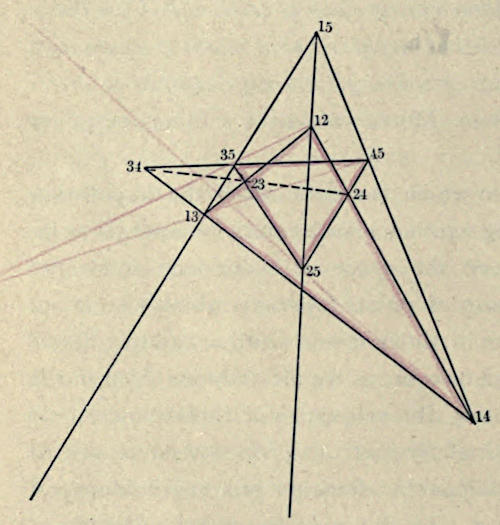
Fig. 2.
To begin with, imagine any five points in space which may be denoted by the numbers 1, 2, 3, 4, 5; then imagine all the possible ten straight lines of junction drawn between each two of these points, namely, 1-2, 1-3 ... 4-5; and finally, also, all the ten planes of junction of every three points described, namely, the plane 1-2-3, 1-2-4, ... 3-4-5. A spatial figure will thus be obtained, whose ten straight lines will meet some interposed plane in ten points whose relative positions are exactly those of the ten points above described. Thus, for example, on this plane the points 1-2, 1-3, and 2-3 will lie in a straight line, for through the three spatial points 1, 2, 3, a plane can be drawn which will cut the plane of a drawing in a straight line. The reason, therefore, that the three points 3-4, 2-4, 2-3, also must ultimately lie in a straight line, consists in the simple fact that the plane of the three points 2, 3, 4, must cut the plane of the drawing in a straight line. The figure here considered consists of ten points of which sets of three so lie ten times in a straight line that conversely from every point also three straight lines proceed.
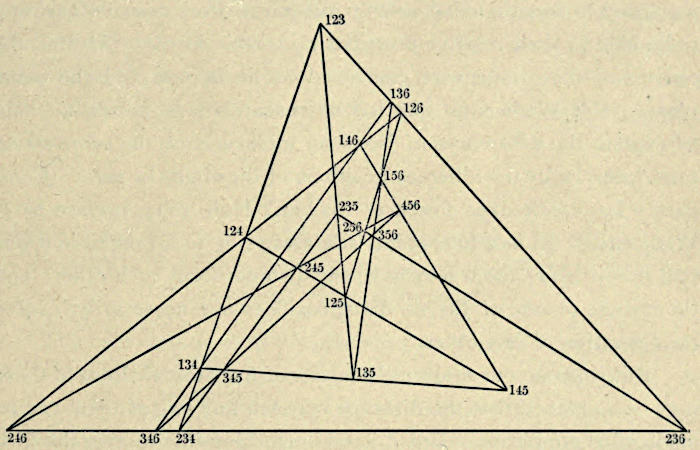
Fig. 3.
Now, just as this figure is a section of a complete three-dimensional pentagon, so another remarkable figure, of similar properties, may be obtained by the section of a figure of four-dimensioned space. Imagine, namely, six points, 1, 2, 3, 4, 5, 6, situated in this four-dimensioned space, and every three of them connected by a plane, and every four of them by a three-dimensioned space. We shall obtain thus twenty planes and fifteen three-dimensioned spaces which will cut the plane in which the figure is to be produced in twenty points and fifteen rays which so lie that each point sends out three rays and every ray contains four points. (See Fig. 3.) Figures of this description, which are so composed of points and rays that an equal number of rays proceed from every point and an equal number of points lie in every ray, are called configurations. Other configurations may, of course, be produced, by taking a different number of points and by assuming that the points taken lie in a space of different or even higher dimensions. The author of this article was the first to draw attention to configurations derived from spaces of higher dimensions. As we see, then, the notion of a space of more than three dimensions has performed important work in the investigations of common plane geometry.
In conclusion, I should like to add a remark which Cranz makes regarding the application of the idea of multiple-dimensioned space to theoretical chemistry. (See the treatise before cited.) In chemistry, the molecules of a compound body are said to consist of the atoms of the elements which are contained in the body, and these are supposed to be situated at certain distances from one another, and to be held in their relative positions by certain forces. At first, the centres of the atoms were conceived to lie in one and the same plane. But Wislicenus was led by researches in paralactic acid to explain the differences of isomeric molecules of the same structural formulæ by the different positions of the atoms in space. (Compare “La chimie dans l’espace” by van’t Hoff, 1875, preface by J. Wislicenus). In fact four points can always be so arranged in space that every two of them may have any distance from each other; and the change of one of the six distances does not necessarily involve the alteration of any other.
But suppose our molecule consists of five atoms? Four of these may be so placed that the distance between any two of them can be made what we please. But it is no longer possible to give the fifth atom a position such that each of the four distances by which it is separated from the other atoms may be what we please. Quite the contrary, the fourth distance is dependent on the three remaining distances; for the space of experience has only three dimensions. If, therefore, I have a molecule which consists of five atoms I cannot alter the distance between two of them without at least altering some second distance. But if we imagine the centres of the atoms placed in a four-dimensioned space, this can be done; all the ten distances which may be conceived to exist between the five points will then be independent of one another. To reach the same result in the case of six atoms we must assume a five-dimensional space; and so on.
Now, if the independence of all the possible distances between the atoms of a molecule is absolutely required by theoretical chemical research, the science is really compelled, if it deals with molecules of more than four atoms, to make use of the idea of a space of more than three dimensions. This idea is, in this case, simply an instrument of research, just as are, also, the ideas of molecules and atoms—means designed to embrace in an obvious and systematic form the phenomena of chemistry and to discover the conditions under which new phenomena can be evoked. Whether a four-dimensioned space really exists is a question whose insolubility cannot prevent research from making use of the idea, exactly as chemistry has not been prevented from making use of the notion of atom, although no one really knows whether the things we call atoms exist or not.
IV. REFUTATION OF THE ARGUMENTS ADDUCED TO PROVE THE EXISTENCE OF A FOUR-DIMENSIONED SPACE INCLUSIVE OF THE VISIBLE WORLD.
The considerations of the preceding section will have convinced the cultured non-mathematician of the service which the theory of multiple-dimensioned spaces has done, and bids fair to do, for geometrical research. In addition thereto is the consideration that every extension of one branch of mathematical science is a constant source of beneficial and helpful influence to the other branches. The knowledge, however, that mathematicians can employ the notion of four-dimensioned space with good results in their researches, would never have been sufficient to procure it its present popularity; for every man of intelligence has now heard of it, and, in jest or in earnest, often speaks of it. The knowledge of a four-dimensioned space did not reach the ears of cultured non-mathematicians until the consequences which the spiritualists fancied it was permissible to draw from this mathematical notion were publicly known. But it is a tremendous step from the four-dimensioned space of the mathematicians to the space from which the spirit-friends of the spiritualistic mediums entertain us with rappings, knockings, and bad English. Before taking this step we will first discuss the question of the real existence of a four-dimensional space, not judging the question whether this space, if it really does exist, is inhabited by reasonable beings who consciously act upon the world in which we exist.
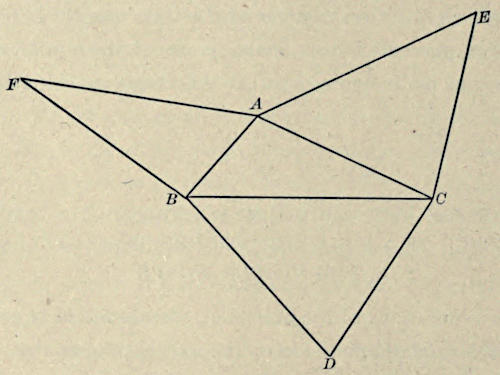
Fig. 4.
Among the reasons which are put forward to prove the existence of a four-dimensional space containing the world, the least reprehensible are those which are based on the existence of symmetry. We spoke above of two triangles in the same plane which have all their sides and angles congruent, but which cannot be made to coincide by simple displacement within the plane; but we saw that this coincidence could be effected by holding fast one side of one triangle and moving it out of its plane until it had been so far turned round that it fell back into its plane. Now something similar to this exists in space. Cut two figures, exactly like that of Fig. 4., out of a piece of paper, and turn the triangle ABF about the side AB, ACE about the side AC, BCD about the side BC, and in one figure above and in the other below; then in both cases the points D, E, F will meet at a point, because AE is equal to AF, BF is equal to BD, CD is equal to CE. In this manner we obtain two pyramids which in all lengths and all angles are congruent, yet which cannot, no matter how we try, be made to coincide, that is, be so fitted the one into the other that they shall both stand as one pyramid. But the reflected image of the one could be brought into coincidence with the other. Two spatial structures whose sides and angles are thus equal to each other, and of which each may be viewed as the reflected image of the other, are called symmetrical. For instance, the right and the left hand are symmetrical; or, a right and a left glove. Now just as in two dimensions it is impossible by simple displacement to bring into congruence triangles which like those above mentioned can only be made to coincide by circumversion, so also in three dimensions it is impossible to bring into congruence two symmetrical pyramids. Careful mathematical reflection, however, declares, that this could be effected if it were possible, while holding one of the surfaces, to move the pyramid out of the space of experience, and to turn it round through a four-dimensioned space until it reached a point at which it would return again into our experiential space. This process would simply be the four-dimensional analogon of the three-dimensional circumversion in the above-mentioned case of the two triangles. Further, the interior surfaces in this process would be converted into exterior surfaces, and vice versa, exactly as in the circumversion of a triangle the anterior and posterior sides are interchanged. If the structure which is to be converted into its symmetrical counterpart is made of a flexible material, the interchange mentioned of the interior and exterior surfaces may be effected by simply turning the structure inside out; for example, a right glove may thus be converted into a left glove.
Now from this truth, that every structure can be converted by means of a four-dimensional space inclusive of the world, into a structure symmetrical with it, it has been sought to establish the probability of the real existence of a four-dimensioned space. Yet it will be evident, from the discussions of the preceding section, that the only inference which we can here make is, that the idea of a four-dimensioned space is competent, from a mathematical point of view, to throw some light upon the phenomena of symmetry. To conclude from these facts that a space of this kind really exists, would be as daring as to conclude from the fact that the uniform angular velocity of the apparent motions of the fixed stars is explicable from the assumption of an axial motion of the firmament, that the fixed stars are really rigidly placed in a celestial sphere rotating about its axis. It must not be forgotten that our comprehension of the phenomena of the real world consists of two elements: first, of that which the things really are; and, second, of that by which we rationally apprehend the things. This latter element is partly dependent on the sum of the experiences which we have before acquired, and partly on the necessity, due to the imperfection of reason, of our embracing the multitudinous isolated phenomena of the world into categories which we ourselves have formed, and which, therefore, are not wholly derived from the phenomena themselves, but to a great extent are dependent on us.
Besides geometrical reasons, Zöllner has also adduced cosmological reasons to prove the existence of a four-dimensional space. To these reasons belong especially the questions whether the number of the fixed stars is infinitely great, whether the world is finite or infinite in extension, whether the world had a beginning or will have an end, whether the world is not hastening towards a condition of equilibrium or dead level by the universal distribution of its matter and energy; the problems, also, of gravitation and action at a distance; and finally, the questions concerning the relations between the phenomena in the world of sense-perception to the unknown things-in-themselves. All these questions which can be decided in no definite sense, led Zöllner and his followers to the assumption that a four-dimensioned space inclusive of the space of experience must really exist. But more careful reflection will show that this assumption does not dispose of the difficulties but simply displaces them into another realm. Furthermore, even if four-dimensioned space did unravel and make clear all the cosmological problems which have bothered the human mind, still, its existence would not be proved thereby; it would yet remain a mere hypothesis, designed to render more intelligible to a being who can only make experiences in a three-dimensional space, the phenomena therein which are full of mystery to it. A four-dimensioned space would in such case possess for the metaphysician a value similar to that which the ether possesses for the physicist. Still more convincing than these cosmological reasons to the majority of men is the physio-psychological reason drawn from the phenomena of vision which Zöllner adduces. Into this main argument we will enter in more detail.
When we “see” an object, as we all know, the light which proceeds or is reflected therefrom produces an image on the retina of our eye; this image is conducted to our consciousness by means of the optical nerve, and our reason draws therefrom an inference respecting the object. When, now, we look at a square whose sides are a decimetre in length, and whose centre is situated at the distance of a metre from the pupil of our eye, an image is produced on the retina. But exactly the same image will be produced there if we look at a square whose sides are parallel to the sides of the first square but two decimetres in length, and whose centre is situated at a distance of two metres from the pupil of the eye. Proceeding thus further, we readily discover that an eye can perceive in any length or line only the ratio of its magnitude to the distance at which it is situated from it, and that generally a three-dimensional world must appear to the eye two-dimensional, because all points which lie behind each other in the direction outwards from the eye produce on the retina only one image. This is due to the fact that the retinal images are themselves two-dimensional; for which reason, Zöllner says, the world must appear to a child as two-dimensional, if it be supposed to live in a primitive condition of unconscious mental activity. To such a child two objects which are moving the one behind the other, must appear as suffering displacement on a surface, which we conceive behind the objects, and on which the latter are projected. In all these apparent displacements, coincidences and changes of form also are effected. All these things must appear puzzling to a human being in the first stages of its development, and the mind thus finds itself, as Zöllner further argues, in the first years of childhood forced to adopt a hypothesis concerning the constitution of space and to assume that the world is three-dimensional, although the eye can really perceive it as only two-dimensional. Zöllner then further says, that in the explanation of the effects of the external world, man constantly finds this hypothesis of his childish years confirmed, and that in this way it has become in his mind so profound a conviction that it is no longer possible for him to think it away. Consonant with this argumentation, also, is Zöllner’s remark, that the same phenomenon has presented itself in astronomical methods of knowledge. To explain the movements of the planets, which appear to describe regular paths on the surface of a celestial sphere, we were compelled in the solution of the riddles which these motions presented, to assume in the structure of the heavens a dimension of “depth,” and the complicated motions in the two-dimensioned firmament were converted into very simple motions in three-dimensioned space. Zöllner also contends that our conception of the entire visible world as possessed of three dimensions is a product of our reason, which the mind was driven to form by the contradictions which would be presented to it on the assumption of only two dimensions by the perspective distortions, coincidences, and changes of magnitude of objects. When a child moves its hand before its eyes, turns it, brings it nearer, or pushes it farther away, this child successively receives the most various impressions on the surface of its retina of one and the same object of whose identity and constancy its feelings offer it a perfect assurance. If the child regarded the changeable projection of the hand on the surface of the retina as the real object, and not the hand which lies beyond it, the child would constantly be met with contradictions in its experience, and to avoid this it makes the hypothesis that the space of experience is three-dimensional. Zöllner’s contention is, therefore, that man originally had only a two-dimensional intuition of space, but was forced by experience to represent to himself the objects which on the retinal surface appeared two-dimensional, as three-dimensional, and thus to transform his two-dimensional space-intuition into a three-dimensional one. Now, in exactly the same way, according to Zöllner’s notion, will man, by the advancement and increasing exactness of his knowledge of the phenomena of the outer world, also be compelled to conceive of the material world as a “shadow cast by a more real four-dimensional world,” so that these conceptions will be just as trivial for the people of the twentieth century as since Copernicus’s time the explanation of the motions of the heavenly bodies by means of a three-dimensional motion has been.
Zöllner’s arguments from the phenomena of vision may be refuted as follows: In the first place it is incorrect to say that we see the things of the external world by means of two-dimensional retinal images. The light which penetrates the eye causes an irritation of the optical nerves, and any such effect which, though it be not powerful, is, nevertheless, a mechanical one, can only take place on things which are material. But material things are always three-dimensional. The effect of light on the sensitive plates of photography can with just as little justice be regarded as two-dimensional. Our senses can have perception of nothing but three-dimensional things, and this perception is effected by forces which in their turn act on three-dimensional things, namely, our sensory nerves. It is wrong to call an image two-dimensional, for it is only by abstraction that we can conceive of a thickness so growing constantly smaller and smaller as to admit of our regarding a three-dimensional picture as two-dimensional, by giving it in mind a vanishingly small thickness. It is also wrong to say, as Zöllner says, that when we see the shadow of a hand which is cast upon a wall we see something two-dimensional. What we really perceive is that no light falls upon our eye from the region included by the shadow, while from the entire surrounding region light does fall on our eye. But this light is reflected from the material particles which form the surface of the wall, that is, from three-dimensional particles of matter. We must always remember that our eye communicates to us only three-dimensional knowledge, and that for the comprehension of anything which has two, one, or no dimensions, a purely intellectual act of abstraction must be added to the act of perception. When we imagine we have made a lead-pencil mark on paper, we have, exactly viewed, simply heaped along side of each other little particles of graphite in such a manner that there are by far fewer graphite particles in the lateral and upward directions than there are in the longitudinal direction, and thus our reason arrives by abstraction at the notion of a straight line. When we look at an object, say a cube of wood, we recognise the object as three-dimensional, and it is only by abstraction that we can conceive of its two-dimensional surfaces, of its twelve one-dimensional edges, and of its eight no-dimensional corners. For we reach the perception of its surface, for example, solely by reason of the fact that the material particles which form the cube prevent the transmission of light, and reflect it, whereby a part of the light reflected from every material particle strikes our eye. Now, by thinking exclusively of those material particles which are reflected, in contrariety to the empty space without and the hidden and therefore non-reflected particles within, we form the notion of a surface.
It is evident from this, that all that we perceive is three-dimensional, that we cannot come at anything two-dimensional without an intellectual abstraction, and that, therefore, we cannot conceive of anything two-dimensional exerting effects upon material things. But this fact is a refutation of the retinal argument of Zöllner. If vision consisted wholly and exclusively in the creation of a two-dimensioned image, the things which take place in the world could never come into our consciousness. The child, therefore, does not originally apprehend the world, as Zöllner says, as two-dimensional; on the contrary, it apprehends it either not at all, or it apprehends it as three-dimensional. Of course the child must first “learn how” to see. It is found from the observation of children during the first months of their lives, and of the congenitally blind, who have suddenly acquired the power of vision by some successful operation, that seeing does not consist alone in the irritations which arise in the optic nerves, but also in the correct interpretation of these irritations by reason. This correct interpretation, however, can be accomplished only by the accumulation of a considerable stock of experience. Especially must the recognition of the distance of the object seen, be gradually learned. In this, two things are especially helpful; first, the fact that we have two eyes and, consequently, that we must feel two irritations of the optic nerves which are not wholly alike; and secondly, the fact that we are enabled by our power of motion and our sense of touch to convince ourselves of the distance and form of the bodies seen. The question now arises, what sort of an intuition of space would a creature have that had only one eye, that could neither move itself nor its eye, and also possessed no peripheral nerves. According to Zöllner’s view, this creature could, owing to its two-dimensional retinal images, only have a two-dimensional intuition of space. The author’s opinion, however, is, that such a creature could not see at all, as it has no possibility of collecting experiences which are adapted in any way to interpreting the effects of things on its retina. The light which proceeded from the objects roundabout and fell on the retina could produce no other effect on the being than that of a wholly intelligible irritation, or, perhaps, even pain.
The reflections presented sufficiently show that neither the phenomena of symmetry nor the retinal images of the objects of vision necessarily force upon us the assumption of a four-dimensioned space. If the material world should ever present problems which could not in the progress of knowledge be solved in a natural way, the assumption that a four-dimensional space containing the world exists would also be incompetent to resolve the difficulties presented; it would simply convert these difficulties into others, and not dispose of the problems but simply displace them to another world. Yet the question might be asked, Is the existence of a four-dimensional space really impossible? To answer this question, we must first clearly know what we mean by “exist.” If existence means that the intellectual idea of a thing can be formed and that this idea shall not lead to contradictions with other well-established ideas and with experience, we have only to say that four-dimensioned space does exist, as the arguments adduced in sections II and III have rendered plain. If, namely, the space of four dimensions did not exist as a clear idea in the minds of mathematicians, mathematicians could certainly not have been led by this idea to results which are recognised by the senses as true, and which really take place in our own representable space. But if existence means “material actuality” we must say that we neither now nor in the future can know anything about it. For we know material actuality only as three-dimensional, our senses can only make three-dimensional experiences, and the inferences of our reason, although they can well abstract from material things, can never ascend to the point of explaining a four-dimensional materiality. Just as little, therefore, as we can locally fix the idea of a two-dimensional material world, as little can we substantiate the notion of a four-dimensioned material existence.
V. EXAMINATION OF THE HYPOTHESIS CONCERNING THE EXISTENCE OF FOUR-DIMENSIONAL SPIRITS.
In connection with the belief that the visible world is contained in a four-dimensioned space, Zöllner and his adherents further hold that this higher space is inhabited by intelligent beings who can act consciously and at will on the human beings who live in experiential space. To invest this opinion with greater strength Zöllner appealed to the fact that the greatest thinkers of antiquity and of modern times were either wholly of this opinion or at least held views from which his contentions might be immediately derived. Plato’s dialogue between Socrates and Glaukon in the seventh book of the Republic, is evidence, says Zöllner, that this greatest philosopher of antiquity possessed some presentiment of this extension of the notion of space. Yet any one who has connectedly studied and understood Plato’s system of philosophy must concede that the so-called “ideas” of the Platonic system denote something wholly different from what Zöllner sees in them or pretends to see. Zöllner says that these Platonic ideas are spatial objects of more than three dimensions and represent “real existence” in the same sense that the material world, as contrasted with the images on the retina, represents it. Zöllner similarly deals with the Kantian “thing-in-itself,” which is also regarded as an object of higher dimensions.
To show Kant in the light of a predecessor, Zöllner quotes the following passage from the former’s “Träume eines Geistersehers, erläutert durch Träume der Metaphysik” (1766, Collected Works, Vol. VII, page 32 et seqq.): “I confess that I am very much inclined to assert the existence of immaterial beings in the world, and to rank my own soul as one of such a class. It appears, there is a spiritual essence existent which is intimately bound up with matter but which does not act on those forces of the elements by which the latter are connected, but upon some internal principle of its own condition. It will, in the time to come—I know not when or where—be proved, that the human soul, even in this life, exists in a state of uninterrupted connection with all the immaterial natures of the spiritual world; that it alternately acts on them and receives impressions from them, of which, as a human soul, it is not, in the normal state of things, conscious. It would be a great thing, if some such systematic constitution of the spiritual world, as we conceive it, could be deduced, not exclusively from our general notion of spiritual nature, which is altogether too hypothetical, but from some real and universally admitted observations,—or, for that matter, if it could even be shown to be probable.”
What Kant really asserts here is, first, the partly independent and partly dependent existence of the soul, and of spiritual beings generally, on matter, and, second, that spiritual beings have some common connection with and mutually influence one another. This contention, which is that of very many thinkers, does not, however, entail the consequence that the “transcendental subject of Kant” must be four-dimensional, as Zöllner asserts it does. Kant never even hinted at the theory that the psychical features of the world owe their connection with the material features to the fact that they are four-dimensional and, therefore, include the three-dimensional. Is it a necessary conclusion that if a thing exists and is not three-dimensional, as is the case with the soul, that it is therefore four-dimensional? Can it not in fact be so constituted that it is wholly meaningless to speak of dimensions at all in connection with it?
Yet still more strongly than the words of Plato and Kant do certain utterances of the mathematicians Gauss and Riemann speak in favor of Zöllner’s hypothesis. S. v. Waltershausen relates of Gauss in his “Gruss zum Gedächtnis,” (Leipsic, 1856,) that Gauss had often remarked that the three dimensions of space were only a specific peculiarity of the human mind. We can think ourselves, he said, into beings who are only conscious of two dimensions; similarly, perhaps, beings who are above and outside our world may look down upon us; and there were, he continued, in a jesting tone, a number of problems which he had here indefinitely laid aside, but hoped to treat in a superior state by superior geometrical methods. Leaving aside this jest, which quite naturally suggested itself, the remarks of Gauss are quite correct. We possess the power to abstract and can think, therefore, what kind of geometry a being that is only acquainted with a two-dimensional world would have; for instance, we can imagine that such a being could not conceive of the possibility of making two triangles coincide which were congruent in the sense above explained, and so on. So, also, we can understand that a being who has control of four dimensions can only conceive of a geometry of four-dimensional space, yet may have the capacity of thinking itself into spaces of other dimensions. But it does not follow from this that a four-dimensional space exists, let alone that it is inhabited by reasonable beings.
Riemann, on the other hand, speaks directly of a world of spirits. In his “Neue mathematische Principien der Naturphilosophie” he puts forth the hypothesis that the space of the world is filled with a material that is constantly pouring into the ponderable atoms, there to disappear from the phenomenal world. In every ponderable atom, he says, at every moment of time, there enters and appears a determinate amount of matter, proportional to the force of gravitation. The ponderable bodies, according to this theory, are the place at which the spiritual world enters and acts on the material world. Riemann’s world of spirits, the sole office of which is to explain the phenomenon of gravitation as a force governing matter, is, though, essentially different from the spiritual world of Zöllner, the function of which is to explain supposed supersensuous phenomena which stand in the most glaring contradiction with the established known laws of the material world.
Besides this appeal to the testimony of eminent men like Plato, Kant, Gauss, and Riemann, the scientific prophet of modern spiritualism also bases his theory on the belief, which has obtained at all times and appeared in various forms among all peoples, that there exist in the world forces which at times are competent to evoke phenomena that are exempt from the ordinary laws of nature. We have but to think of the phenomena of table-turning which once excited the Chinese as much as it has aroused, during the last few decades, the European and American worlds; or of the divining-rod, by whose help our forefathers sought for water, in fact, as we do now in parts of Europe and America.
Cranz, in his essay on the subject, divides spiritualistic phenomena into physical and intellectual. Of the first class he enumerates the following: the moving of chairs and tables; the animation of walking-sticks, slippers, and broomsticks; the miraculous throwing of objects; spirit-rappings (Luther heard a sound in the Wartburg, “as if three score casks were hurled down the stairs”); the ecstatic suspension of persons above the floor; the diminution of the forces of gravity; the ordeals of witches; the fetching of wished-for objects; the declination of the magnetic needle by persons at a distance; the untying of knots in a closed string; insensibility to injury and exemption therefrom when tortured, as in handling red-hot coals, carrying hot irons, etc.; the music of invisible spirits; the materialisations of spirits or of individual parts of spirits (the footprints in the experiments of Slade, photographed by Zöllner); the double appearance of the same person; the penetration of matter (of closed doors, windows, and so forth). As numerous also is the selection presented by Cranz of intellectual phenomena, namely: spirit-writing (Have’s instrument for the facilitation of intercourse with spirits), the clairvoyance and divination of somnambulists, of visionary, ecstatic, and hypnotised persons, prompted or controlled by narcotic medicines, by sleeping in temples, by music and dancing, by ascetic modes of life and residence in barren localities, by the exudations of the soil and of water, by the contemplation of jewels, mirrors, and crystal-pure water, and by anointing the finger-nails with consecrated oil. Also the following additional intellectual phenomena are cited: increased eloquence or suddenly acquired power of speaking in foreign languages; spirit-effects at a distance; inability to move, transferences of the will, and so forth.
All these phenomena, presented with the aspect of truth, and associated more or less with trickery, self-deception, and humbug, are adduced by the spiritualists to substantiate the belief in a world of spirits which consciously and purposely take part in the events of the material world, and that these phenomena may be sufficiently and consistently explained by the effects of the activity of such a world. It is impossible for us to discuss and put to the test here the explanations of all these supersensuous phenomena. Anything and everything can be explained by spirits who act at will upon the world. There are only a few of these phenomena, namely, clairvoyance and Slade’s experiments, whose explanations are so intimately connected with our main theme, the so-called fourth dimension, that they cannot be passed over.
First, with respect to clairvoyance, the American visionary Davis describes the experiences which he claims to have made in this condition, induced by “magnetic sleep,” as follows:[81] “The sphere of my vision now began to expand. At first, I could only clearly discern the walls of the house. At the start they seemed to me dark and gloomy; but they soon became brighter and finally transparent. I could now see the objects, the utensils, and the persons in the adjoining house as easily as those in the room in which I sat. But my perceptions extended further still; before my wandering glance, which seemed to control a great semi-circle, the broad surface of the earth, for hundreds of miles about me, grew as transparent as water, and I saw the brains, the entrails, and the entire anatomy of the beasts that wandered about in the forests of the eastern hemisphere, hundreds and thousands of miles from the room in which I sat.” The belief in the possibility of such states of clairvoyance is by no means new. Alexander Dumas made use of it, for example, in his “Mémoires d’un médicin,” in which Count Balsamo, afterwards called Cagliostro, is said to possess the power of transforming suitable persons into this wonderful condition and thus to find out what other persons at distant places are doing. Zöllner explains clairvoyance by means of the fourth dimension thus:
A man who is accustomed to viewing things on a plain is supposed to ascend to a considerable height in a balloon. He will there enjoy a much more extended prospect than if he had remained on the plain below, and will also be able to signal to greater distances. The plain, that is, the two-dimensioned space, is accordingly viewed by him from points outside of the plain as “open” in all directions. Exactly so, in Zöllner’s theory, must three-dimensioned spaces appear, when viewed from points in four-dimensioned space, namely, as “open”; and the more so in proportion as the point in question is situated at a greater distance from the place of our body, or in proportion as the soul ascends to a greater height in this fourth dimension. Zöllner thus explains clairvoyance as a condition in which the soul has displaced itself out of its three-dimensioned space and reached a point which with respect to this space is four-dimensionally situated and whence it is able to contemplate the three-dimensional world without the interference of intervening obstacles.
The following remark is to be made to this explanation. The reason why we have a better and more extended view from a balloon than from places on the earth is simply this, that between the suspended balloon and the objects seen at a distance nothing intervenes but the air, and air allows the transmission of light, whereas, at the places below on the earth there are all kinds of material things about the observer which prevent the transmission of light and either render difficult or absolutely impossible the sight of things which lie far away. In the same way, also, from a point in four-dimensioned space, a three-dimensional object will be visible only provided there are no obstacles intervening. If, therefore, this awareness of a distant object is a real, actual vision by means of a luminous ray which strikes the eye, there is contained in the explanation of Zöllner the tacit assumption that the medium with which the four-dimensional world is filled is also pervious to light exactly as the atmosphere is.
The theory that there are four-dimensional spirits who produce the phenomena cited by the spiritualists received special support from the experiments which the prestidigitateur Slade, who claimed he was a spiritualistic medium, performed before Zöllner. Of these experiments we will speak of the two most important, the experiment with the glass sphere and the experiment with the knots. To explain the connection of the glass sphere experiment with the fourth dimension, we must first conceive of two-dimensional reasoning beings, or, let us say, two-dimensional worms, living and moving in a plane. For a creature of this kind it will be self-evident that there are no other paths between two points of its plane than such as lie within the plane. It must, accordingly, be beyond the range of conception of this worm, how any two-dimensional object which lies within a circle in its space can be brought to any other position in its space outside the circle without the object passing through the barriers formed by the circle’s circumference. But if this worm could procure the services of a three-dimensional being, the transportation of the object from a position within the circle to any position outside it could be effected by the three-dimensional being simply taking the object out of the plane and placing it at the desired point. This object, therefore, would, in an inexplicable manner, suddenly disappear before the eyes of the worms who were assembled as spectators, and after the lapse of an interval of time would again appear outside the circle without having passed at any point through the circle’s circumference. If now we add another dimension, we shall derive from this trick, which is wholly removed from the sense-perception of the flattened worms, the following experiment, which is wholly beyond the perception of us human beings. Inside a glass sphere, which is closed all around, a grain of corn is placed; the problem is to transport the corn to some place outside the sphere without passing through the glass surface. Now we should be able to perform this trick if some four-dimensional being would render us the same aid that we before rendered the two-dimensional worm. For the four-dimensional being could take the grain of corn into his four-dimensional space and then replace it in our space in the desired spot outside of the glass sphere. Slade performed this trick before Zöllner. Its mere performance sufficed to convince this latter investigator that Slade had here made use of a four-dimensional agent, who, in respect of power of motion, controlled his four-dimensional space as we do our three-dimensional space. It never occurred to Zöllner that this experiment was the cleverly executed trick of a prestidigitateur, or, as it would at once occur to us, that the whole thing was a sensory illusion. The fact that we cannot explain a trick easily and naturally does not irrevocably prove that it is accomplished by other means than those which the world of matter presents.
Still better known than this last performance is Slade’s experiments with knots. To explain this in connection with the fourth dimension, we must resort again to the plane and the flat worm inhabiting it. To two parallel lines in a plane let the two ends of a third line, which has a double point, that is, intersects itself once, be attached. Our flat worm would not be able to untie the loop formed by the doubled third line, which we will call a string, because it cannot execute motions in three dimensions. If, therefore, a two-dimensional prestidigitateur should appear and accomplish the trick of untying this loop without removing the two ends of the string from the parallel lines, he will have accomplished for our flat worm a supersensuous experiment. A human being engaged in the service of the prestidigitateur could execute for him the experiment by simply lifting the string a little out of the plane, pulling it taut, and placing it back again. This suggests the following analogous experiment for three-dimensional beings. The two ends of a string in which a common knot has been made are sealed to the opposite walls of a room. The problem is to untie this knot without breaking the seals at the two ends of the string. Everybody knows that this problem is not soluble, but it may be calculated mathematically that the knot in the string can be untied as easily by motions in a fourth dimension of space as in the experiment above described the knot in the two-dimensional string was untied by a three-dimensional motion. Now as Slade untied the knot before Zöllner’s eyes without apparently making any use of the ends fastened in the walls, Zöllner was still more strongly confirmed in the view that Slade had power over spirits who performed the experiments for him.
Still more far-reaching is the theory of Carl du Prel concerning the relations of the material and the four-dimensional world. (Compare his numerous essays in the spiritualistic magazine Sphinx.) Just as the shadows of three-dimensional objects cast on a wall are controlled in their movements by the things whose projections they are, in the same way it is claimed does there exist back of everything of this sense-perceptible world a real transcendental and four-dimensional “thing-in itself” whose projection in the space of experience is what we falsely regard as the independent thing. Thus every man besides existing in his terrestrial self also exists in a spiritual or astral self which constantly accompanies him in his walks through life and whose existence is especially proclaimed in states of profound sleep, of somnambulism, and in the conditions of mediums. In this way Du Prel explains the wonderful feats of somnambulists, and the aerial journeys of sorcerers and witches. Whereas, ordinarily the separation of the material body from the astral body is only effected at the moment of death; in the case of somnambulists this separation may take place at any time, or, as Du Prel says: “the threshold of feeling may be permanently displaced.”
In view of the natural relations of such theories to the dogmas of Christianity it is explainable that theologians also have raised their voices for or against spiritualism. While the Protestant Church Times beheld in the “repulsive thaumaturgic performances which these coryphæi of modern science offer, a lack of comprehension of real philosophy,” the magazine The Proof of Faith, expresses its delight at the discovery of spiritualism in the following manner: “Every Christian will surely rejoice at the deep and perhaps mortal wound which these new discoveries have in all probability administered to modern materialism.”
We shall pass by the childish opinion that the Bible also speaks of four dimensions, as both in Job (xi, 8-9) and in the Epistle to the Ephesians (iii, 18) only breadth, length, depth, and height, that is, four directions of extension, are mentioned. Yet we will still add, as Cranz has done, the reflections which Zöllner, as the most prominent representative of modern spiritualism, has put forward respecting its relation to the doctrines of Christianity (Wissensch. Abhandl., Vol. III). By the foundation of transcendental physics on the basis of spiritualistic phenomena, the “new light” has arisen which is spoken of in the New Testament. The rending of the veil of the Temple on the crucifixion of Christ, the resurrection, the ascension, the transfiguration, the speaking with many tongues on the giving out of the Holy Ghost, all these are in Zöllner’s view spiritualistic phenomena. Similarly, he sees a reference to the four-dimensional world of spirits in all those sayings of Christ in which the latter speaks to his Apostles of the impossibility of their having any image or notion of the place to which when he disappeared he would go and whence he would return. (Gospel of St. John, xiii, 33, 36; xiv, 2, 3, 28; xvi, 5, 13).
Ulrici, however, goes furthest in the mingling of spiritualistic and Christian beliefs; for he sees in the doctrine of spiritualism a means of strengthening belief in a supreme moral world-order and in the immortality of the soul. In answer to Ulrici’s tract “Spiritualism So-called, a Question of Science” (1889) Wundt wrote an annihilating reply bearing the title “Spiritualism, a Question of Science So-called.” Wundt criticises the future condition of our souls according to spiritualistic hypotheses in the following sarcastic yet pertinent words, which Cranz also quotes: “(1) Physically, the souls of the dead come into the thraldom of certain living beings who are called mediums. These mediums are, for the present, at least, a not widely diffused class and they appear to be almost exclusively Americans. At the command of these mediums, departed souls perform mechanical feats which possess throughout the character of absolute aimlessness. They rap, they lift tables and chairs, they move beds, they play on the harmonica, and do other similar things. (2) Intellectually, the souls of the dead enter a condition which, if we are to judge from the productions which they deposit on the slates of the mediums, must be termed a very lamentable one. These slate-writings belong throughout in the category of imbecility; they are totally bereft of any contents. (3) The most favored, apparently, is the moral condition of the soul. According to the testimony which we have, its character cannot be said to be anything else than that of utter harmlessness. From brutal performances, such, for instance, as the destruction of bed-canopies, the spirits most politely refrain.” Wundt then laments the demoralising effect which spiritualism exercises on people who have hitherto devoted their powers to some serious pursuit or even to the service of science. In fact it is a presumptuous and flagrant procedure to forsake the path of exact research, which slow as it is, yet always leads to a sure extension of knowledge, in the hope that some aimless, foolhardy venture into the realm of uncertainty will carry us further than the path of slow toil, and that we can ever thus easily lift the veil which hides from man the problems of the world that are yet unsolved.
Now that we have presented the opinions of others respecting the existence of a four-dimensional world of spirits, the author would like to develop one or two ideas of his own on the subject. In the preceding section it was stated that everything that we perceive by our senses is three-dimensional and that everything that possesses four or more dimensions can only be regarded as abstractions or fictions which our reason forms in its constant efforts after an extension and generalisation of knowledge. To speak of a two-dimensional matter is as self-contradictory as the notion of four-dimensional matter. But a two or a four-dimensional world might exist in some other manner than a material manner, and for all we know in one which to us does not admit of representation. But in such a case, if it were without the power of affecting the material world, we should never be able to acquire any knowledge concerning its existence, and it would be totally indifferent to the people of the three-dimensional world, whether such a world existed or not. Just as an artist during his lifetime produces a number of different works of art, so also the Creator might have created a number of different-dimensioned worlds which in no wise interfere with one another. In such a case, any one world would not be able to know anything of any other, and we must consequently regard the question whether a four-dimensional world exists which is incapable of affecting ours, as insoluble. We have only to examine, therefore, the question whether the phenomenal world perhaps is a single individual in a great layer of worlds of which every successive one has one more dimension than the preceding and which are so connected with one another that each successive world contains and includes the preceding world, and, therefore, can produce effects in it. For our reason, which draws its inferences from the phenomena of this world, tells us, that if outside the three-dimensional world there exists a second four-dimensional world, containing ours, there is no reason why worlds of more or less dimensions should not, with the same right, also exist. But if now, as Zöllner and his adherents maintain, four-dimensional spirits exist which can act by the mere efforts of their own wills on our world, there is surely no reason why we three-dimensional beings should not also be able to produce effects on some two-dimensional animated world. Whether we have, generally, any such influence we do not know, but we certainly do know that we do not act purposely and consciously on a two-dimensional world. If, therefore, Zöllner were right, the plan of creation would possess the wonderful feature that four-dimensional beings are capable of arbitrarily affecting the three-dimensional world, but that three-dimensional beings have no right in their turn consciously to affect a two dimensional world.
The supporters of Zöllner’s hypothesis will perhaps reply to the objection just made, that the plan of creation might, after all, possibly possess this wonderful peculiarity, that we human beings perhaps, in some higher condition of culture, will be able to act consciously on two-dimensional worlds, and that at any rate it is simply an inference by analogy to conclude from the non-existence of a relation between three and two dimensions that the same relation is also wanting in the case of four and three dimensions. As a matter of fact, the objection above made is not intended to refute Zöllner’s hypothesis, but only to stamp it as very improbable. But despite this improbability Zöllner would still be right if the phenomena of the material world actually made his hypothesis necessary. That, however, is by no means the case. Although most of the phenomena to which the spiritualists appeal are probably founded on sense-illusions, humbug, and self-deception, it cannot be denied that there possibly do exist phenomena which cannot be brought into harmony with the natural laws now known. There always have been mysterious phenomena, and there always will be. Yet, as we have often seen that the progress of science has again and again revealed as natural what former generations held to be supernatural, it is certainly wholly wrong to bring in for the explanation of phenomena which now seem mysterious an hypothesis like that of Zöllner’s, by which everything in the world can be explained. If we adopt a point of view which regards it as natural for spirits arbitrarily to interfere in the workings of the world, all scientific investigation will cease, for we could never more trust or rely upon any chemical or physical experiment, or any botanical or zoölogical culture. If the spirits are the authors of the phenomena that are mysterious to us, why should they also not have control of the phenomena which are not mysterious? The existence of mysterious phenomena justifies in no manner or form the assumption that spirits exist which produce them. Would it not be much simpler, if we must have supernatural influences, to adopt the naïve religious point of view, according to which everything that happens is traceable to the direct, actual, and personal interference of a single being which we call God? Things which formerly stood beyond the sphere of our knowledge and were regarded as marvellous events, as a storm, for example, now stand in the most intimate connection with known natural laws. Things that formerly were mysterious are so no longer. If one hundred and fifty years ago some scientists were in the possession of our present knowledge of inductional electricity and had connected Paris and Berlin with a wire by whose aid one could clearly interpret in Berlin what another person had at that very moment said in Paris, people would have regarded this phenomenon as supernatural and assumed that the originator of this long-distance speaking was in league with spirits.
We recognise, thus, that the things which are termed supernatural depend to a great extent on the stage of culture which humanity has reached. Things which now appear to us mysterious, may, in a very few decades, be recognised as quite natural. This knowledge, however, is not to be obtained by the lazy assumption of bands of spirits as the authors of mysterious phenomena, but by performing what in physics and chemistry is called experiment. But the first and essential condition of all scientific experimenting is that the experimenter shall be absolutely master of the conditions under which the experiment is or is not to succeed. Now, this criterion of scientific experimenting is totally lacking in all spiritualistic experiments. We can never assign in their case the conditions under which they will or will not succeed. When all the preparations in a spiritualistic séance have been properly made, but nothing takes place, the beautiful excuse is always forthcoming that the “spirits were not willing,” that there were “too many incredulous persons present,” and so forth. Fortunately, in physical experiments these pretexts are not necessary. By the path of experiment, and not by that of transcendental speculation, physics has thus made incredible progress and has piled new knowledge strata on strata upon the old. Accordingly, the prospect is left that the mysteries which the conditions and properties of the human soul still present can be solved more and more by the methods of scientific experiment. To this end, however, it is especially necessary that the physio-psychological experiments in question should only be performed by men who possess the critical eye of inquiry, who are free from the dangers of self-illusion, and who are competent to keep apart from their experiments all superstition and deception. The history of natural science clearly teaches that it is only by this road that man can arrive at certain and well-established knowledge. If, therefore, there really is behind such phenomena as mind-reading, telepathy, and similar psychical phenomena something besides humbug and self-illusion, what we have to do is to study privately and carefully by serious experiments the success or non-success of such phenomena, and not allow ourselves to be influenced by the public and dramatic performances of psychical artists, like Cumberland and his ilk.
The high eminence on which the knowledge and civilisation of humanity now stands was not reached by the thoughtless employment of fanciful ideas, nor by recourse to four-dimensional worlds, but by hard, serious labor and slow, unceasing research. Let all men of science, therefore, band themselves together and oppose a solid front to methods that explain everything that is now mysterious to us by the interference of independent spirits. For these methods, owing to the fact that they can explain everything, explain nothing, and thus oppose dangerous obstacles to the progress of real research, to which we owe the beautiful temple of modern knowledge.
Hermann Schubert.
FOOTNOTES:
CORRESPONDENCE.
I. THE RELIGIOUS OUTLOOK IN FRANCE.
The return of Mme. Hyacinthe Loyson to France after her American tour, undertaken, I understand, in order to obtain new support for the Gallican church, suggests the writing of this article, which will be a brief survey, from the point of view of an American layman, of the present religious situation in France.
As Père Hyacinthe’s reform has been made the peg on which to hang this article, perhaps I cannot do better than begin by an examination of the noble but fruitless labors of the eloquent ex-Carmelite. While one cannot help being carried away by the oratory of Hyacinthe Loyson and charmed with his personality, so full of wit, kindliness, and gentility; while one must admire the devotedness and earnestness of Mme. Loyson and feel much sympathy for their studious and promising son Paul, one is convinced in spite of one’s self that this latter-day Gallicanism is doomed to failure if indeed it has not already failed. You have simply to visit the poor little church in the Rue d’Arras, in this city, to see what a mere handful of followers Père Hyacinthe has been able to collect in this great centre of two million people, after years of work and after preaching hundreds of magnificent sermons that would fill to overflowing the largest edifice in America, Sunday after Sunday, if delivered with similar eloquence by a divine of no matter what denomination or of no denomination at all. To the practical layman of this practical age no further demonstration is necessary in order to prove that Père Hyacinthe’s mission is, as the French say, un coup dans l’eau, that is, an effort which produces no result. Whenever I leave this humble church and am well out in the narrow, shabby street in which it is situated and am away from the influence of the preacher’s fascination, I cannot help exclaiming, What a waste of power, What a casting of pearls before swine! And all of Mme. Loyson’s enthusiastic conversation in private, her accounts of the encouraging letters received by the Père, furtively of course, from discontented priests, and her statements concerning the warm words of sympathy and support from the churchmen of foreign lands, cannot remove that abiding feeling that this rejuvenated Gallican church movement is other than a dismal failure; more than ever one exclaims: C’est un coup dans l’eau.
Père Hyacinthe has always received, in France as abroad, his greatest support from the Protestants. But Protestantism here in France is a sickly growth when compared, for instance, with its rich and sturdy brother in the United States. It has, at most, only a small band of followers, nearly lost to view in the vast army of Catholicism and Freethought. Furthermore, the Liberal wing is losing ground and the Orthodox wing gaining slightly, not an encouraging sign in these days to those who hope for the final triumph of faith over the growing tendency towards infidelity. The real truth is that about the only strength left in French Protestantism to-day lies in the fact that there is a certain éclat associated, in the eyes of the upper classes, with the being a Protestant, much as is the case in America and England, in the same rank, about being a Roman Catholic. It distinguishes you from the multitude, and in these democratic times human nature, especially when it is that of the “upper ten,” is very keen for elimination from “the vulgar throng.” It is difficult for an American to comprehend this peculiar little streak of innocent vanity running through certain French circles which shows itself in this wish to be known as Protestants. It is not too much to say that to the impartial outside observer this phase of the French Protestantism of to-day is the one that first strikes the eye; which goes to prove in a peculiar but significant manner the weak hold, on the one hand, which the doctrine of Luther and Calvin now has on the French nation, and, on the other hand, how universal must be scepticism, freethought, and utter indifference to church and religion of every kind.
If native French Protestantism exerts so little influence on the nation, it is easy to imagine the excessive futility of the work of the foreign missionary. There is a great deal said in American and religious circles about the labors in France of the Salvation Army, the McAll Mission, the Young Men’s Christian Association, etc. I have received more than one letter from would-be subscribers in the United States asking me if these and other similar organisations were really accomplishing all that they pretend. My reply is invariably that if you regard their labors as charity work some good is being done, but if money is asked for because of the religious results which have been accomplished, the demand should be considered to be arrant humbug. If Père Hyacinthe, a Frenchman and a Catholic, after forty years of labor, has accomplished next to nothing, it is easy to imagine how this nation, so reserved in its relations with the foreigner when he attempts to penetrate into its inner life, would treat Scotch and Yankee missionaries. From a religious standpoint, therefore, American money and sympathy is absolutely thrown away when it is sent to France. If it be answered that much misery and physical suffering is relieved by these foreign missions, the French might well ask if charity does not begin at home. The French are a peculiarly thrifty people. Few are poor, beggars are scarce and charitable institutions are rich and numerous. Hence devoting American dollars to the relief of French distress is much like sending coals to Newcastle, if it is not a piece of sheer impertinence, like our protesting to the Czar against his Siberian convict system when we have one quite as cruel in full swing in some of our Southern states.
And now, finally, a few paragraphs about the great Roman Catholic church of France, the only religious institution of any real first-rate importance in this country.
While it is true that the Catholic Church, at least as a church, still has a strong hold on the French nation, it is also quite true that indifference, infidelity, free thought, and atheism are on the increase. Matthew Arnold says, in his essay on Tolstoi, written in 1887: “Between the age of twenty and that of thirty-five he [Tolstoi] had lost, he tells us, the Christian belief in which he had been brought up, a loss of which examples nowadays abound certainly everywhere, but which in Russia, as in France, is among all young men of the upper and cultivated classes more a matter of course, perhaps, more universal, more avowed, than it is with us.” Arnold might have enlarged, at least in the case of France, his limits and stated that in the cities the middle and lower classes, too, particularly the male portion, have abandoned Rome. One has only to visit a Paris church to be convinced of the contempt which men feel for the priesthood and religion: you can count ten female devotees for one of the masculine gender. In the village church, far away from the great centres, the priest may still have the large majority of the population, men and women alike, as faithful attendants upon service. But even here, for one man who confesses, a dozen or score of women will kneel at the chair. Then again, this more general participation in religious ceremonies by the rural population is due in a large measure to the fact that these Sunday masses and vespers are almost the only break and variety in a very dead and monotonous existence. The church is a sort of meeting place, where whole families, babies, children, and adults, congregate. The hum of idle conversation, the crying of infants, and the ardent exhortations of the priest are often mingled in a manner that would astonish and shock a pious Protestant, accustomed to the highly proper atmosphere of an Episcopalian or Presbyterian Church in the United States.
Another sign of the disfavor in which French Catholicism finds itself to-day is seen in the quality of its future priests. You have simply to look into the faces of the seminarists as they pass by you in procession in the streets of Paris to be convinced of the well-known fact that these young men are, for the most part, the faint-hearted and dull-headed sons of the peasantry, eager to escape the drudgery of farm life and not intelligent enough for business or the petty employments offered by the State.
“Anybody can make a priest,” is often heard in France. The result is that just as the English army is the receptacle for the riff-raff—the Tommy Atkinses of Rudyard Kipling’s “Barrack-room Ballads”—of the cities, so the French priesthood draws most of its recruits from the scum of the farming districts. This fact contrasts strongly, by the way, with the manner in which the Protestants fill their pulpits. The young man who becomes a pastor is not looked upon by his friends and companions as a failure and a numskull. Quite the contrary; he is immediately classed among those taking a high moral stand. Some of the best families of France are descended from, or have relatives who are, clergymen, and they are quite proud of the fact; another example of that sentiment of halo surrounding French Protestantism to which reference has already been made.
Another cause of this boycotting of the cloth as a profession by the youth of the élite is due to the Church having got on the wrong side during the struggle for the foundation of the present Republic. The Catholics supported the Monarchists and Bonapartists and took an active part in the attempt to prevent the advent of republican institutions and to overthrow these institutions when they had been accepted by a majority of the nation. This unpatriotic course brought the Church into bad odor among republicans, so that the having a son in orders, for example, would be apt to be an impediment to a father aspiring to political preferment, especially if the latter belonged to the Radical or Socialist wing of the Republican army. The result is that a whole great political party is, in its general tendency, opposed to the Catholic Church.
Nor is the harm occasioned thereby limited to lowering the quality of the seminarists. It makes a vast number of intelligent and influential citizens sworn enemies of religion. Thus, when Gambetta attended funerals, he would not enter the church, but wait outside in the porch. When Louis Blanc was buried neither church nor priest participated in the pageant. On the death of Henri Martin, a free-thinking Protestant clergyman officiated at the burial service. Hundreds of other prominent Republicans, who have died or been buried since 1870, never entered a church, perhaps, except when their bodies were borne there by their families, acting under the influence of its female members, or out of respect for public sentiment.
One of the shrewdest acts of Leo XIII. is his recent declaration in favor of the French Republic. He not only accepts the situation, but has ordered the faithful, both ecclesiastical and lay, in France to do likewise. But this demand has not been complied with without a murmur. More than one priest and noble has shown himself more ultramontane than the Pope. The important fact remains true, however, that officially the Vatican recognises the political change in France, and, though the Republicans, particularly those of the Radical camp, are wary of these new converts and still believe with Gambetta, that “le clericalisme, voilà l’ennemi,” yet the mere fact that the Vatican lays down its arms means a great deal, even if the hatchet may not be definitively buried. Moderate Republicans, those who go to church even if they do not believe what is said there, think they see in this action of the Holy Father a new source of strength for the Republic. And it seems to me that they are right, and that this view is the soundest. If the priesthood ceases its attacks on the political powers that be, and if these latter keep a sharp watch, which will be done while the Radical and Socialist elements are so strong in Chamber and Senate, the clerical party can be held in check, and the Republic will have so many less enemies, even if these quondam enemies are but lukewarm friends.
Theodore Stanton.
II. NEW FRENCH BOOKS.
I am happy to have the opportunity in my present letter to speak of a book of real importance, La pathologie des emotions, Études physiologiques et cliniques, by M. Ch. Féré. The name of this learned physician of the Bicêtre is sufficiently well known to dispense me from the necessity of speaking of his personality, so that I can devote all that I have to say to his work. Its great merit is not so much the novelty of the psychological theory which is laid at its foundation, as the wealth of facts presented and the sureness of the methods pursued. M. Féré’s mind is of a distinctly positive cast, and he possesses in a high degree the ability to draw from the thesis which he illustrates and confirms, the various consequences which from a medical and social point of view this thesis involves.
States of intellectual consciousness, he writes, citing Spencer, cannot be dissociated from emotional states. The emotions are the products of our mental representations of agreeable states or painful states, and are the stronger according as they contain a greater number of present or nascent sensations competent to recall these states. The emotions, accordingly, being simply representations of states of consciousness provoked by external excitations, it is to be presumed that the physiological conditions of emotions (of central or cerebral origin) present a striking analogy, if not an absolute resemblance, to the physiological conditions of sensations (of peripheral origin, either internal or external); and this relation should be as prominently marked in pathological as in normal states. The upshot of all this is, continues M. Féré, that physical agents capable of modifying a state of consciousness of peripheral origin (sensations), are also capable of modifying states of consciousness of central origin (emotions). “The external signs of these different states of consciousness can be studied by the same methods. Psychology is only specialised physiology; mental medicine only a specialisation of general medicine, from which it must borrow its methods of research and action—all purely physical. The demonstration of these relations is the object of the present work.”
The work, which contains almost six hundred pages, presents no divisions but that of chapters. But it would not be difficult to group its contents under the four general titles: (1) physiological and pathological effects of physical agents on man; (2) physiological conditions and pathological and curative effects of emotions; (3) psychopathy and morbid emotivity; (4) the consequences to individuals and society of morbid emotivity, its medical treatment, prophylaxis and legislation. The entire demonstration of M. Féré, I might add, is essentially aimed at the two following propositions: the first, that all the symptoms of emotions possess a certain resemblance to those of fatigue or physical pain; the other, that the original source of morbid emotivities and their resultant disorders is a state of depression congenital or acquired.
M. Féré reverts constantly to these fundamental ideas. After having exhibited, for example, the reciprocal influences of the emotions, or disorders of the imagination, and of disorders which are of physical origin, he concludes that “physical disease and moral disease have the same basis.” It is thus only in appearance, he writes, that the mind has any influence on the functions of the body; the phenomena of mind are, quite the reverse, the necessary effect of certain modifications of the body, and it is by the intermediary action of the manifestations of the body that the representations of the mind act. It is found convenient to regard the gray matter of the brain as the central organ of the emotions, and the great sympathetic as the peripheral organ that presides over their “exteriorisation”; but we have no right to think of the emotions without their external signs, and we are thus led to the conclusion that “emotion is essentially a generalised reflex phenomenon the centrifugal path of which is principally the great sympathetic system.”
A psychological question much debated since M. Ribot took it up, the question of attention, is also treated here, in an incidental yet very interesting manner (Chapter III). M. Féré connects attention with the study of the physiological conditions of physical action, and thus takes sides, it will be seen, with the motory theory of attention. James Sully, and others, have denied the existence of muscular phenomena accompanying attention. But physiology is in a position to disclose the existence of these movements; it can study their qualities, their energy, their form, their precision, and their rapidity. We will find in M. Féré’s book a number of new experimental facts establishing the thesis that “muscular tension constitutes the physiological condition of attention.” “The mistake of many psychologists (M. Hirth, for example) has been, that they have confounded rest with willed immobility, which from a mechanical point of view is very far removed from the former; for immobility of will is precisely the result of very intense muscular activities, and can only be produced by a general tension of the muscular system, which throws the subject in a state such that it can react the most quickly and most energetically on any excitation, whencesoever it may proceed.” Willed, or voluntary, immobility is attention itself; to produce this state, well-enervated and well-nourished muscles are necessary. “We may say,” declares M. Féré, “that the practice of immobility is the most favorable exercise for the development of the mind: a system of education which should neglect this exercise would suppress attention, it would be a regressive education.”