Volume 1 — THE MONIST. (continued 4)
Reading edition
It is, in this connection, of great interest to recall the diverse effects on our mental history of sense-impressions, as compared with the effect of thought. Sense-impressions are not remembered in the proper sense of the term. The repetition in memory is always vastly more indistinct than the original state of consciousness; so much so as to be a very different thing. Thought, on the contrary, when remembered at all, is an exact repetition in quality of its first presence. The presentative consciousness has one quality; the representative and re-representative have another quality. This shows us that the structural arrangement of brain substance concerned in the latter forms of consciousness have a far more permanent quality than that due to the former. They thus constitute more permanent acquisitions, and this being the case, must have a most important bearing on evolution.[140] This is because it is a representative state which determines action. The process of determination may become so rapid as to be almost instantaneous; but it had to be learned and the representation was what gave the act its character and which organised the machinery of the automatic or reflex act.
I here refer to the low degrees of consciousness sometimes called subconsciousness, and the expression, “the subliminal consciousness,” introduced by F. Meyer. All shades of consciousness intervene between the most distinct forms and the unconsciousness of the reflex state. Intelligent subconsciousness is a low stage in this evanescent series. Stages on the passage to and from sleep, and other forms of unconsciousness due to physical causes, are properly termed subconscious. There are reflexes which are due to mechanisms which we inherit from our animal and human ancestors, which are sometimes accompanied by consciousness. The amount of intelligence displayed will depend on the function involved. Experiments on vertebrate animals show that intelligent adaptation of the movements of the body have been transferred forwards in the brain during the course of evolution. Thus, a fish which retains the medulla only, will guide itself through the water so as to avoid danger. If the cerebellum and thalami are left to a reptile, it will avoid destructive acts. But if a mammal is deprived of its hemispheres, its actions are without design, and it is incapable of self-preservation.
It may be that in the temporary absence of the higher consciousness, the lower forms which once existed in our ancestors may be revived, as in some of the elements of our dreams, and in some forms of cerebral disease, when much of the blood is withdrawn from the cortex or parts of it. The amount of consciousness necessary to the performance of intelligent acts depends on the novelty of the situation. Many of the theories on this subject, however, take it for granted that intelligent acts arise in primarily unconscious states. This is only credible on the supposition that such acts have arisen by natural selection only, a view which I have combated on a previous page. Some authors use expressions which can only imply unconscious consciousness. This is of course absurd and self-contradictory. No source but sensation can be found for intelligent acts.
It is true that there are some movements of organic bodies which have an intelligent appearance, to which we cannot ascribe consciousness. Such are those of the spermatozoöids and of the leucocytes. Some of the lowest animals and plants cannot be yet proved to be conscious. We cannot now explain the nature of the movements which these forms exhibit, but they will probably yield to research. Enough it is for our present purpose to know that the majority of animals are conscious for a large part of their lives. And we have abundant evidence to show that movements inaugurated in conscious states may be performed, so soon as learned, in unconsciousness, and become part of the mental furniture of the animal.
It seems, then, that the control of ponderable matter by mental states is not the exclusive prerogative of man, but is a phenomenon of common observation in the animal kingdom. The facts indicate that it is characteristic of mind to move resistant and tri-dimensional matter under suitable conditions. These conditions are rigid, but within the limits which they define, the sequence is definite. It is difficult to believe in anything which is in direct violation of mechanical necessity, and a mere hypothesis to that effect would not deserve a moment’s consideration. But the belief that the body, or parts of it, are moved in direct obedience to mental states is founded on more numerous observations than are most of those beliefs which we hold to be true. In fact there is no scientific doctrine better supported by observation and experience than this one. On this ground alone, then, we are compelled to believe in something in the universe which is supermechanical, or extramechanical. We may call this supernaturalism, or occultism, or what we like, but the fact remains. We have in it the germ of theism, anthropomorphic, if you will, but one which grows in importance as we come to examine further into the characteristics of mental action.
Before going into this part of the subject, I will refer to the part played by mind in evolution. From what has gone before, it is evident that this part has been an important one. If structures are produced by motions, it is clear that habits produce structures, and vice versa; and that under the law of natural selection only the useful and harmless ones have survived. It follows, then, that progressive evolution of form is secured by the presence of consciousness, and must, sooner or later, fail without it. With development of intelligence the progress must become more continuous and rapid. The facts of paleontology confirm such a hypothesis; since the more intelligent animals (Mammalia) have generally supplanted the less intelligent, (Reptilia and Batrachia), whenever brought into conflict with them. The supremacy of the intelligent over the unintelligent Mammalia is also clearly shown by research into their past history. The modification of type, or evolution, has also become more and more rapid as time has advanced and intelligence developed.
There is another reason why the intervention of supermechanics into the process has been necessary to secure such results as we observe in the evolution of life. The law of inorganic evolution is, as Spencer epitomises it, “the integration of matter and the dissipation of energy.” Natural chemical reactions when not interfered with by human intelligence, produce solids and give out heat. In other words, they result in death and not in life. To produce life something different from chemical energy has been necessary. And as the case is a parallel one to the evolution of the types of life, we may suspect that the agency at work has been a related one. It is some form of energy of the vital class which is able to overcome the bonds which hold dead matter in their adamantine grasp; and it is evident that such an energy could have been organised only in some region where mechanics of a superchemical order prevail. If we take a large view of the universe the alternatives of life and death present themselves clearly before us. The law of the latter is the integration of matter and dissipation of energy. The law of the former is the converse; the loosing of the bonds of matter, and the production of mechanism for the raising of the type of energy. The first is catagenesis, the latter is anagenesis. The end of catagenesis is the extinction of all mind and all life. Anagenesis sustains both. The best foundation for our belief in anagenesis is that it exists. Catagenesis has not destroyed it, and this fact must lead us to suspect that it is the product of an agency which is superchemical; and the only such that we know is consciousness.
In the presence of such a far-reaching hypothesis we are called upon to consider more particularly the relations of mind to its physical basis. The essential condition of the existence of mind as we know it, is metabolism. The substance[141] of the nervous cells must be in a state of decomposition and recomposition; old material loosing its chemical bonds and giving forth energy, and new material arriving to undergo the same process. The energy thus produced displays the phenomena of mind, and as such differs widely from the inorganic energies of heat, light, etc. The extent to which it displays habits depends on the part of the nervous structure where it is produced. In the spinal cord it is strictly automatic, and as we approach the hemispheres the so-called voluntary element becomes more apparent, until a region is reached where conception, deliberation, and judgment have their seat. In this region energy is purely mental in its attributes, and it unlocks the executive mechanism of the body, and puts it in action in accordance with the needs of consciousness. So far, mechanical laws explain the order of events. The supermechanical resides in the mental content and its effects on the outgoing energy. No quantitative relation can be shown to exist between the results of the mental processes of classification, conception, judgment, etc, and the amount of incoming or outgoing energy. Indeed it is plain that none can exist, if the statement already made be true, viz., that thoughts are without weight. This part of the subject requires critical treatment, but the general result is included in the above statement, which is sufficient for our present purpose.
Since consciousness possesses such extraordinary relations to matter we may well suspect that it has a wider distribution than comes within the purview of our present limited ken. Why should it not protect and nourish itself under conditions different from those which prevail in our planet? The one condition necessary to it is metabolism—which means free energy. The kind of physical basis cannot be important, provided it be capable of exhibiting this kind of non-automatic energy. Automatism and all its reflex consequences are the death of consciousness, as every one knows. From such a type of energy all the fixed types of energy must have been derived, and with them the types of both mental and physical structures. In its freest form it should have as a physical basis a form of matter which should be without habits, but always ready to undergo a catagenetic change into routine energy and ultimate unconsciousness. Such a medium should be unspecialised matter, and the consciousness inhabiting it would be a creator. Such consciousness would be readily transmitted wherever the physical basis should be suitable, and one such substance is our protoplasm. The probable inferiority of protoplasm as a physical basis is indicated by the long and tedious education which has been necessary to enable beings made of it to attain a high order of intelligence. In such a basis anagenesis is slow, and catagenesis is easy. Other bases might be imagined where the reverse would be the case. No assumption can be made as to a constant and limited amount of consciousness in the universe. That such is the case is supposable; but it is also supposable that the amount of suitable physical basis may be increased by a process of assimilation of non-conscious matter, as is done by animals in digestion and reproduction. This process might continue until all matter should be brought into that generalised condition which is necessary to the continuance of consciousness. The entire universe would then be conscious, and a maximum limit would be reached. In the primitive consciousness, whatever its extent in space in the Universe, we have the Supreme Being or Person.
II. THE IDEALISM OF THEISM.
What I mean by the above expression is the theism which is supposed to be demonstrated by idealistic metaphysics. There are two forms of this alleged demonstration, both of which have for their starting-point the basis of the idealistic philosophy. This basis is the fact that we know nothing of matter excepting as sense-impressions. From this it is inferred that were conscious beings to become extinct, matter would no longer exist. It is also a consequence of this belief that what we observe of the conduct of matter, which we call by the name of natural law, is of purely mental origin.
If now the universe consist wholly of mind, the totality of it, either as reduced to a body of general laws, or to a single comprehensive generalisation, or concept, is one form of idealistic God. The other demonstration is as follows. Since matter exists as mental states, and since these mental states are common to mankind, who are mortal; since these mental states reproduce themselves from generation to generation, it is inferred that a permanent mental state exists, which possesses the permanent sensations we call matter. And this common mind of humanity is God.
The difference between these deities is this. In the first case he is an abstraction of the human mind and therefore not a person apart from such men as are capable of the generalisations of which he consists. In the second case he is a person apart from humanity. The validity of either demonstration to the thinker depends on his point of view. To every one but the idealist, the first proposition is atheism. The evidence for the second is metaphysical anthropomorphism, and would be a demonstration, were the theory of idealism well founded.
The fact that we only know matter as sense-impressions does not, in the opinion of realists, prove that it does not exist as the resistant and extended. Resistance of each part to the movements of other parts (energy), and extension in space, are conditions about which we have a great deal of information. Our lives are spent in overcoming the one, and in getting round the other. Our methods of dealing with it represent the antithesis of those employed in thought-processes. The latter are best performed in the absence of the muscular exertion which is so necessary in dealing with the former. I have referred to the well-known difference in consciousness between sense-impressions and the representation and re-representation of them. The difference certainly implies a difference in the immediate sources of the respective kinds of consciousness. The one is produced by something different from that which produces the other. In short, the one is produced by the contact of matter external to our physical basis, and the other is produced by a modification of brain-structure; and in the first place by that simplest form of it which is the cause of memory. The effect of such observation is the conviction that matter exists as something outside of consciousness or mind, in spite of the fact that we only know it in consciousness. In a word, consciousness and knowledge imply the existence rather than the non-existence of something which is known.
The fundamental actualities are, then, subject and object; or, in popular language, mind and matter. Philosophy includes the sciences which embrace the knowledge of both subject and object; but the practical philosophy is the science of the mutual relations of the two. It may be said that subject and object are opposite sides of the same reality, but this form of expression appears to me to be no more accurate than the statement that energy and matter are opposite sides of the same thing. As energy is the motion of matter, mind is the intelligence of matter; and both may be called properties of matter with equal propriety, since both are impossible without a physical basis. Mind, however, differs from energy in possessing some intrinsic qualities which are in essence independent of the qualities of the physical basis; and these intrinsic qualities are the forms of logic. These are, however, but a part of the totality of mind, although they underlie or penetrate all its representative activities.
While mind then cannot exist without a physical basis, it remains to be considered whether any other objective world is necessary to its existence. It is sometimes alleged that consciousness could not exist without an objective, exterior to its physical basis. If, however, consciousness is a necessary attribute of free energy, the latter purely metaphysical speculation has no foundation. The “intuition of Being” (Rosmini) would exist, albeit not much specialised, in the absence of multifarious objects; but the forms of logic would characterise it nevertheless.
It is alleged that we can never know matter as it is, because our observation is restricted to the mutual relations of its component parts. In this assertion our intelligence necessarily concurs, but this need not cause us to relax our exertions in the pursuit of knowledge. The practical philosophy is, as already remarked, the knowledge of the relations subsisting between mind and matter, so that our most valuable acquisition will be in the end the laws of a relation. We may well postpone our endeavors after the absolute, even if we can ever attain a knowledge of it. The realist is content to believe that if we do not know “things as they are in themselves,” it is because, of the imperfection of our senses. But we are constantly discovering new aids to research, and we can put no limit to our power in this direction.
The research into the relations of subject and object, means to theology, an investigation as to the existence and nature of Deity, and as to an existence for conscious beings in other than terrestrial life. The pure idealist reaches an affirmative answer to these problems by a short and easy route, based on a study of the intrinsic nature of mind alone. The pure realist reaches a negative conclusion by an equally short cut, by considering the properties of matter alone. Not a few thinkers entertain both doctrines at one and the same time, although they are mutually exclusive and contradictory. No wonder that they reach what Montgomery well terms “the puzzle of puzzles.” But the rational conclusion from this deadlock must be, that there is something wrong with the methods of both sides. To the practical mind it seems that the vice in both methods is the failure to harmonise properly with their own, the facts adduced by the opposite side in the discussion. And it is indeed evident that that cannot be the final philosophy which restricts itself to a consideration of mind alone; or that which restricts itself to a consideration of matter alone. That men should pursue different lines of research is natural. Those whose minds are capable in the fields of conception naturally prefer idealistic studies; while those whose especial genius lies in the direction of mechanics, easily pursue-materialistic research. What is needed is a combination of the two fields of ability in the same mind.
A considerable class of serious people, observing the diversities between the schools of philosophy, regard such studies as useless. Since they have not the disposition or ability to solve the question for themselves, they find it best to rest in uncertainty, which has optimistic or pessimistic tendencies according to temperament and education. The optimist has faith that all is, and all will be, well; while the pessimist takes the opposite view. Both are sustained in their position by those teachers who teach the impotence of our faculties and the uselessness of knowledge. Such appeal in support of their position to the facts already cited; the imperfection of our senses; the relativity of knowledge; the inscrutable nature of mind and matter, etc. This position is, however, a plea of avoidance, and it will be time enough to listen to it when the avenues of the increase of human knowledge are permanently closed. This they are not at present.
The key to the position is the doctrine of evolution. Here we behold the interaction of subject and object, both in our own persons and in the inferior beings which are with us, and which have preceded us on earth. That mind has not sprung full-fledged upon this planet, is clear; and that it has made wonderful progress in power, is equally clear. Why did it not appear with all its powers “in the beginning”? The answer obviously is, “the intractability of matter.” Why has it progressed in face of this obstacle? The answer is, the tractability of matter. Mind, through its intrinsic quality, has coërced matter, in ever increasing degree, and the limit of its capacity in this direction plainly has not yet been reached. Its most important conquest has been that of its own physical basis, and next to it is the conquest of the world of objects by which it is surrounded. Its last conquest will be the knowledge of its destiny, as a projection of its known past. To this end the knowledge of its own constitution is essential, but this is not all, as the pure idealist would have us believe. The knowledge of external relations is also essential, for we can in no state of being escape them. Psychic life is an “internal adjustment to external relations,” quite as much as is the physical life, as it is defined by Spencer in the phrase just quoted.
The Deity of evolution indicated in the first section of this paper, will not satisfy the pure idealist. He is not an absolute, since He is compelled to respect relations. But we find Him to be just, which he evidently is not if absolute. He is anthropomorphic, and not an abstraction of the human mind. And yet as the seat of rationality, and as the director of free energy, He possesses the function of creator of whatever is possible. The evolution of independent human minds has been only possible through education, and here as elsewhere, teachable students have met with greater success than the stolid.
It has been already pointed out that the process of evolution may be either progressive (Anagenesis) or retrogressive (Catagenesis). This is well known to be the case with organic types, where degenerate phyla are common. It seems, indeed, that in the order of things degeneracy has occurred wherever it has been possible; that is, under circumstances which permitted vegetative life through lack of stimuli to energetic motion. There has always been “room at the top”; but only when all the lower fields of existence have been for the time being filled, has there been room at the top only. The history of mental evolution has accompanied that of general structural evolution, and for similar reasons. It is well illustrated in human society to-day. These facts suggest that this has been the history of all evolution, since they harmonise with the order of evolution observed in our solar system, in which the inorganic has preceded the organic, or Catagenesis has preceded Anagenesis. If the forms of non-vital energy represent a result of Catagenesis, we are not bound to look on minerals as in any sense living, as has been suggested by Haeckel and others. Most, if not all, forms of chemical energy have sunk below the vital level, and certainly far below the possibility of displaying consciousness. We are here looking over unexplored territory, and one whose elucidation is entirely in the future, but we may put our ideas in order, if we do nothing more.
Besides his relations to the impersonal materials that surround him, man has essential relations to his fellow-man. The laws of these relations are ethics. Much is written and spoken against the utilitarian or evolutionary theory of ethics. I cannot, however, escape the conviction that this theory offers the true explanation of the rise of the ethical sentiment in mankind. But to understand it aright, we must include the growth of the social sentiment, as well as that of the rational element, in the evolution of justice or right. The opponents of this view sometimes commit the error common to all those who do not understand the nature of mental evolution. Some of them imagine that it is necessary to suppose that, in harmony with this theory, every man decides his every act solely in accordance with what appears to him at the time to subserve the lowest form of selfishness of which he is capable. The doctrine, on the contrary, maintains that habits of honesty and justice are the result of the education of the ages, and that men obey such motives according to their developmental status; that is, in accordance with the evolution of the habit of preferring the higher to the lower forms of utility. The further question of what it is that has raised the standard of utility, is answered by what we see going on around us. The fear of the law; the love of the approbation of our fellows; the sympathy with our fellow-men; the fear of their indignation; all these are educators of great potency, which have always been active. These motives, organised as character, are compulsory, and it would be strange if they have not been effective in producing results.
Practical ethics has to do with material beings and their material possessions, i. e. with person and property. Without the objective, the content of ethics is purely ideal, consisting of love and hate, and the justice and injustice of opinion which might be the outcome of those sentiments. These sentiments are realities of the subjective, representing the affections, as the form of thought constitutes the rational faculties. But if we endeavor in thought to deprive love and hate, justice and injustice, of all material consequences and implications, we deprive those sentiments of much of their value if we do not abolish their occasions altogether. It appears to me at least doubtful whether hate and injustice could exist in a society consisting of disembodied minds, if such beings could be imagined; a supposition which I cannot entertain.
If ethics cannot exist without material expression, it is clear that, on the other hand, they cannot exist without a subjective foundation. Thus ethics is the highest expression of the relation between mind and matter. Ethics is the practical application of the mental powers to human relations, and the more complete the evolution of mind, the more perfect is the ethical practice. Thus the evolution of the mind is the guarantee of ethical progress, and the more intelligent the mind, the more easy will the evolution be. As in all education, the laggards experience the severities of compulsion, while pains and penalties are avoided by those who perceive their approach and do not await their arrival. Here we have the utilitarian ground of our numerous ethical and religious organisations. They invite men to a priori subjective theory, and objective practice, so as to preserve society from the evils of inferior and painful methods of compulsion, which lie at the basis of ethical evolution. It is the dread of this method which rouses a natural repugnance in the minds of many men to the doctrine which teaches of it. But it must be remembered that the instruments of evolution change with the thing that is evolving, and the conditions of progressive ethics are the stages of progress of the mind. What is necessary for the education of the lower mind is no longer necessary for the higher. This is not only a truth of philosophy, but the fact may be discerned in the religions which men have made for themselves. They describe the ethical state of their authors, and prescribe the treatment appropriate to it.
Our knowledge of some parts of evolutionary history is meagre, and on some of its chapters we are absolutely in the dark. This is especially true of the causes of the appearance of life and consciousness on the earth. Spontaneous generation has not been proven, and the immediate source of sensation is unknown. The conclusions enumerated in the preceding pages are derived from evidence presented in more or less complete fragments. But the thesis remains true that mind possesses a limited control over its physical basis, but one which is sufficient to account for the main direction of the evolution of those organic forms which possess it. And it is also true that the essential forms of the rational mind are not due to corresponding qualities of the physical basis. These forms are: the principles of identity, of abstraction, and of generalisation or conception. These characteristics constitute the idealistic essence of Theism. But we look to the realistic element of Theism for the demonstration of the distinct personality of God.
E. D. Cope.
FOOTNOTES:
LITERARY CORRESPONDENCE.
GERMANY.
The name of Cesare Lombroso is now more and more mentioned in Germany, not only in psychiatrical, juridical, and sociological works, written for the learned public, but also in the newspapers and magazines. By the side of occasional recognition of his doctrine of the born criminal and genius, we meet—and these are the majority of the cases—with violent attacks on it, which not seldom exhibit real ignorance of the views of the celebrated Italian investigator. Lombroso himself is partly to blame for this unfortunate circumstance, for his writings, with their mountains of undigested material, are so lacking in unity and perspicuity that misconceptions are very apt to arise.
The German translator of Lombroso, Dr. H. Kurella, psychiatrist in Kreuzburg, in Silesia, has recently given to the world a synoptical exposition of Lombroso’s theory of the born criminal, under the title Cesare Lombroso und die Naturgeschichte des Verbrechers, Hamburg, 1892, Richter. The author not only expounds the doctrines of Lombroso, but also deals critically with them, and, although upon the whole his sympathies are with the views of the Italian scientist, he nevertheless believes that the existence of a fixed type of the delinquente nato, embracing all special forms of criminality, is yet a question of doubt. On the other hand, Max Nordau, a widely-read author of ours, gives unqualified recognition to the theories of Lombroso, fully accepting the idea of “degeneration,” first introduced by Morel into science and further developed by Lombroso, and, in completion of the work of his master, extending this idea to art and literature. In his work, Entartung, the first volume of which was recently published by Carl Duncker, of Berlin, and is dedicated to Lombroso, “his dear, admired master,” he says: “Degenerate types are not always criminals, prostitutes, anarchists, and idiots. They are often writers and artists, and these exhibit the same mental, and frequently also the same physical, traits as those members of the same anthropological family that satisfy their diseased instincts by means of the murderer’s knife or the cartridge of the dynamitard, instead of with pen and pencil.”
People who are acquainted with Nordau’s previous works will perhaps imagine that this latest book of his is simply a mass of journalistic ebullitions which can lay no claim to scientific value. This, however, is wrong. Nordau is not only well acquainted with the patho-psychological literature of this province—especially with the French—but he also turns his knowledge to scientific account, which psychiatrists like Pelman and others have publicly admitted. Taking it as a whole, Nordau has presented in this first volume of his work a good psychology of mysticism—good, that is, for all who accept the association psychology. Nordau’s expositions embrace all the psychological theories which belong in this province, with their applications to individuals and to the tendencies of modern literature and art. With respect to the first point, the author is right in saying that he does not offer here anything new to the professional psychologist, but he is wrong in his theory that psychologists will read this chapter with impatience, for his exposition is unquestioniably elegantly written. Of much greater interest is the second part, in which a diagnosis of imbecility is rendered upon the English pre-Raphaelites, the French symbolists, the Tolstois, and Richard Wagners. The chapter on Richard Wagner will especially attract attention for its severity. Nordau closes it with the words, “of all the aberrations of the present time, Wagnerism is the most widely diffused and the most important. The playhouse at Bayreuth, the Bayreuther Blätter, the Parisian Revue Wagnerienne, are lasting monuments by which the future will measure in wonderment the dimensions of this degeneration and hysteria of our day.”
Nordau throws light upon numerous mooted phenomena of modern art and literature, pointing out their diseased features. One is really surprised at the extent of his work. All in all, it may be foreseen that Koch’s doctrine of the “psychopathical minor factors”—or those psychical factors which constitute the border-line between mental health and disease—will clear up much more extensive fields than they have, when applied in the direction indicated by Nordau. Koch has now published the third part of his work, (which I have repeatedly mentioned in The Monist) and thus completed it. He concludes his last volume with these words: “The domain of the ‘psychopathical minor factors’ is a wide and very interesting one. Whosoever enters profoundly into it will learn to look at much in life with different eyes from those with which he began, will understand many men and many human acts, which before he did not understand. There are yet many scientific treasures to be unearthed in this field, and I hope that I shall win many a coadjutor. I hope, also, that qualified men will make this theory of the psychopathical minor factors fruitful in wider fields and for greater problems.”
It is a common belief that it is pre-eminently in our time that psychical disorders and psychical minor factors play so great a rôle. But that in the sense of Nordau they are not of so recent origin a careful reader will learn from a new work of Ludwig Geiger, the well-known historian of literature and civilisation (Paetel, Berlin). Its title is: Berlin, 1688-1840: Geschichte des geistigen Lebens der preussischen Hauptstadt. As yet, only the first volume has appeared, which extends to the death of Frederick the Great. The reader, however, would obtain an entirely wrong impression of the work if he were to believe that psychiatrical points of view are expressly dwelt upon in this book. To find them he must read between the lines. The book is an extraordinarily painstaking history of the civilisation of Berlin, taken from the sources, and giving especial prominence to intellectual factors. We shall reserve the detailed discussion of this important work for another occasion, perhaps until it is fully completed.
Christian Ufer.
BOOK REVIEWS.
Hand-Commentar zum neuen Testament. iv. Evangelium, Briefl und Offenbarung des Johannes. Bearbeitet von H. J. Holtzmann. Zweite verbesserte und vermehrte Auflage. (Freiburg I. B. and Leipsic: 1893. J. C. B. Mohr.)
The fourth gospel, of all the sacred writings of the New Testament, has always been the reviewer’s favorite book. Its profundity, its wealth of philosophical ideas, the fervor of its author’s religious sentiment, and the spiritual grace that pervades the whole book, exercised an unspeakable charm on my mind. This gospel was the first to rouse my doubts in the belief of literal inspiration, and it was again the one, which, after the severest storms of infidelity had blown over, reconciled me to the spirit of Christianity. Thus the perusal of Professor Holtzmann’s commentary again arouses the recollections of former struggles, and I find that even to-day the first chapter of the fourth gospel has lost none of its fascination. It is a wonderful book, and its author is a man whom I always longed to meet and shake hands with, over a span of almost two millenniums and a world-wide abyss of difference of opinion.
Only those who are familiar with the difficulties of the St. John literature of the New Testament can really appreciate this latest work of Prof. H. J. Holtzmann. He presents in a most clear and concise manner the problems involved, together with their various solutions, critically arranged. He carefully avoids obtruding on the reader his own views. He stands before us as a faithful compiler only. I say “only,” but this “only” means a great deal. It does not mean that he suppresses or conceals his own views, it means that he states the facts with scrupulous impartiality. If there is any partiality apparent in his treatment of the sacred writings, it is the reverent attitude he preserves whenever love of truth obliges him to accept the negative result of critical investigations. And where is there a theological scholar to-day, who is orthodox enough to dare to accept the theory that the gospel of St. John was written by the apostle? Holtzmann carries his impartiality to the extent of not rejecting this old traditional idea, concerning the authorship of the fourth gospel, but the evidence against it is overwhelmingly sufficient to satisfy the most narrowminded believer. Holtzmann teaches us at the same time to understand the spirit of the first and second century of our era, and thus excludes from the beginning the old prejudice, that if the author were not the man whom he impersonated his work must be regarded as a fraud. The historical value of the book lies in the revelations it gives us concerning the religious demands of the times in which it was written. The fourth gospel originated when the Jewish religiosity of growing Christianity began to expand into cosmic universality. The author was undoubtedly a Jew-Christian, whose home most likely was Ephesus. Ephesus was the place where we find the first beginnings of Christian Alexandrianism. Here the Logos-idea was introduced into Christian thought. Philo, the Alexandrian Jew, had already represented Moses as the incarnation of the divine Logos. Should not now a Christian familiar with Philo’s philosophy apply the same method to Jesus of Nazareth? Some work adapted to satisfy the wants of the time and especially the religious yearnings for knowledge as a means of edification was needed. The Christ-idea had taken a definite shape in the imagination of the Christian congregations of Asia Minor, consisting of diaspora Jews and Gentiles, and their Christ-idea found a worthy expression in the picture of Jesus of Nazareth as we have it in the fourth gospel.
The fact that the author of the fourth gospel was a Jew-Christian, appears from his readiness to explain Jewish customs. He knows Judaism, and is familiar with Jerusalem as it appeared after the destruction of the temple. The probability is that he wrote his gospel between 120 and 140. He is comparable to Matthew in so far as both are greatly interested in the controversy between Gentiles versus Jews, yet Matthew’s Israel has grown into the world-wide cosmos. The frequent occurrence of the very word “cosmos” in the fourth gospel is remarkable. In the same way the Greek term γιγνώσκειν (to know) appears besides the older term πιστεύειν (to believe), which latter is a translation of a Jewish conception, still employed so vigorously by St. Paul. The author of the fourth gospel is not familiar with Galilee and does not seem to care for consistency in the details of his accounts, for he frequently contradicts his own statements. The most important differences between his and the three synoptic gospels are the accounts as to the main field of Jesus’s activity, which according to St. John was Judea, according to the synoptic gospels Galilee, and the day of Jesus’s death, which according to St. John is the 14th of Nisan, according to the synoptic gospels the 15th of Nisan, so that if we follow the latter, Jesus would have been tried and condemned, against all Jewish customs, on one of the greatest festival days. Holtzmann rightly warns the reader, that whatever may speak in favor of the synoptic gospels as being, in general, historically more correct, the author of the fourth gospel might have had some special source for this particular fact.—
The Revelation of St. John has given more trouble to the Christian exegesis than any other book, and light was not shed upon its plan and construction, until it was found to be one instance only of a whole class of literary productions. When we consider the Revelation of St. John in the same line with other apocalyptic works, and when we understand the mental disposition of the pious Jews shortly before and after Christ, we have a clew to the enigmatic visions which are unrolled before our eyes.
The expectations of the Jews in the times of the Maccabees were disappointed again and again. The great events of the world did not justify the national hopes, and God did not seem to care about fulfilling his promises. The last prophet, who called himself Malachi, or “the messenger of God,” proclaimed the message of the Lord, “Yet I loved Jacob,” and he comforts the faithful who still endure in all their tribulations, that “a book of remembrance is written before him for them that feared the Lord and that thought upon His name.” After Malachi, a number of revelations appeared, which, to the satisfaction of the Messianic expectations, explained the events of the world, and prophesied that those only who should persevere until the end would be called upon to rule, together with the “Son of Man,” who is to come to smite the heathens and to rule them with an iron rod. The first apocalyptic author, who wrote in 164 B. C., impersonated Daniel, the prophet, who had lived about 400 B. C. The powerful nations of the world are represented as beasts, the fourth and last beast being the Macedonian empire. It has ten horns, that is, rulers, the last one being Antiochus Epiphanes. As soon as his power is broken, the power over the earth will be given to Israel, which is called the Son of Man. The power of the tenth horn was broken, indeed, yet the Messianic hopes remained unfulfilled, and thus new prophecies were wanted, which should again explain the plans of the Almighty, so that the faithful would still endure and hope. Thus, Henoch was written, and after Henoch the Assumption of Moses, the book of Baruch, and other revelations.
The apocalyptic literature is characterised by Messianic expectations and eschatological reflections. The end of the present course of affairs is said to be near at hand and a new order will be established in which the faithful shall rule for a whole millennium and the wicked be tormented.
The Revelation of St. John represents this spirit of apocalyptic hopes among the early Christians of Asia Minor. It throws much light upon the conditions and the conceptions of a period concerning which we have very little information. We here see Christianity in its beginnings. The coloring of the Revelation is still Jewish. Its author stands in a conscious contrast to the Greek spirit which is about to change the properly Jewish character of the new doctrine. The author of the St. John revelation is a Jew to the backbone still; he denounces the antinomistic Christianity of the Gentiles as represented by Nocolaitanes whom, we are told, God hateth. He does not directly mention the apostle St. Paul, but there is little doubt that he is alluded to in Chap. II, 2, as one of them “which say they are apostles and are not.”
The more powerful the Greek spirit grew in the church, the weaker became these original features inherited from the diaspora Jews until they were dropped forever through the efforts of Origenes who made a decided and successful opposition to the belief in the millennium. Yet it took some time for the traditional view of the Messiah to change into the purer and more spiritual Christ-ideal There were two parties in the early church who spoke two radically different idioms; the one still cherished the old chiliasm, dreaming of the establishment of a millennium on earth. Their terminology moved always in the same allegories: they spoke of green and fat fields and of sulphurous abysses, of white horses and terrible beasts, of trees of life, of golden cities and of war and bloodshed, while the other party spoke of Logos, of the eternal Son through whom the world had been made, of “the dispensation of the fulness of the times in which God might gather together in one all things in Christ, both which are in heaven and which are on earth,” of the pleroma and of aeons.
The Revelation of St. John is an expression of the former party and it was natural that after a complete victory of the latter party, Christian teachers knew not what to make of this book which shows Christian views by the side of an irreconcilable Judaism, and a worldly empire in Jerusalem, the beloved city with twenty-four Jewish elders representing the twelve tribes of Israel. The rest of Jerusalem is to be finally converted while there is no hope for paganism. The difference between Israelites and Gentiles remains a radical one even in the Holy City when the new heaven and the new earth has been created. The Gentile-Christians appear as citizens of a lower order. The Israelites alone live in the city while the Gentiles only walk in the light thereof, and they shall bring the glory and honor of the nations into it.
We have given a few glimpses of the problems of the St. John literature only. It is impossible to go over the whole field. Nor is it necessary to do so. Professor Holtzmann has given us so complete a presentation that we need but refer to his work which is indispensable to all interested in the literature of the New Testament. It will be the more valuable and welcome as it is furnished with an index, a feature rarely found in German books.
P. C.
Die Willensfreiheit und ihre Gegner. By Dr. Constantin Gutberlet. Fulda: Fuldaer Actiendruckerei. 1893.
Dr. Constantin Gutberlet regards the doctrine of free-will as a cardinal doctrine of Christianity. In the present booklet he endeavors to show that all attacks made upon it by unchristian savants have failed. He criticises Höffding, Lombroso, Wundt, Münsterberg, Lotze, P. Ree, and Schopenhauer, and establishes as his own view a theory of free-will which he calls “freedom of choice.” He says: “There is no decision without sufficient reason, but there may be without rational reason. The sufficient reason is that a greater good may be recognised as possessing ‘blind’ sides, that we can do without it and even reject it for the sake of these ‘blind’ sides. On the other hand, a lesser good may be given as an object of willing, and our willing by its own energy conditions the free decision of the will” (p. 25). Freedom of will is not a reversal of causation, which latter, according to Gutberlet, is “an absolutely necessary law” (p. 8 and passim).
It is difficult to understand how Gutberlet, taking this view, can class himself among the indeterminists. From his premises, we should expect him to take the view which we have defended, that freedom of will is not contradictory to determinism. If freedom of will means freedom of choice, in which “we ourselves, as the contents of our ideas, feelings, and dispositions, are the cause not only of our activities, but also of our free decision” (p. 19), then our decisions are most certainly determined by our character. Gutberlet’s criticism of Wundt (pp. 167-171), who defends freedom of will and determinism, is wide of the mark, and it seems that Gutberlet is either not clear on this point himself or he does not draw the consequences of his own standpoint. Says Gutberlet: “Only on the supposition that there is no other than ‘mechanical’ causation of natural forces, can the determinist maintain that freedom abolishes the principle of causation. In the application of the principle of Causation ‘what happens has a cause’ to natural forces, the principle can be inverted thus: ‘when all sufficient causes are given, the effect follows with necessity.’ Yet if there are spiritual agents which stand above the mechanical causation of nature and natural forces, we cannot a priori declare that their effects follow with the same necessity from their character as is the case with nature. Accordingly, unless we assume the questionable theory that free causation is impossible, we cannot invert here the principle of causation and use it against free decision” (p. 168).
How does this sentence agree with Mr. Gutberlet’s statements that causation is an absolutely necessary law and that “we ourselves ... are the cause of our free decision.” Our decisions are determined by “our ideas, feelings, and dispositions,” and yet a sufficient cause determines its effect only if the causation is mechanical, not if it is spiritual. Gutberlet explains the difficulty as follows: “Certainly, if we did not reduce the free decision once made (die eingetretene freie Entscheidung), to an adequate cause, we should sin against logic and psychology. But we understand by ‘adequate cause of a decision’ not only the influence of motives, but also the energy of a free will.” Very well then, Mr. Gutberlet would be a determinist as much as Wundt. Decisions are determined by two factors: (1) by the motives (i. e. the objects which act as stimuli upon the will) and (2) by the character of the agent. Not everybody is affected by the same stimulus in the same way. One chooses this and another that motive, and his character determines the choice; and a man of a certain character, under definitely given conditions, will freely and yet necessarily choose a certain motive. Dr. Gutberlet, it appears to us, says yes and no in one breath.
Dr. Gutberlet is the editor of the Philosophisches Jahrbuch, a Roman Catholic periodical. He belongs to that class of men who by partisans of free thought are regarded as especially dangerous. He is not as narrow as the common type of defensores fidei. He studies the works of modern savants “whose intellectual superiority,” as he confesses, he “admires in many respects.” He is broader than most of his confreres, and thus he makes the creed of his church appear broader than it practically is. We can see no danger in the appearance of such men. It is true, he will make converts among the educated, or at least, he will keep some wavering elements within the pale of the church; for the Roman church is, upon the whole, still very hostile to progress. But, on the other hand, such a man is in his circles a missionary of science; he will help to broaden the views of his brethren. He is learning, and they will learn from him.
P. C.
Grundzüge der physiologischen Psychologie. By Wilhelm Wundt. Leipsic: Wilhelm Engelmann. 1893.
Wundt’s “Physiological Psychology” is perhaps justly regarded as his best and most valuable work. We have just received the first part of the fourth edition and may expect that the second part will soon appear. We intend to review the whole work as soon as completed, and will state here only that this new edition contains, among many emendations and additions, an explicit account of the modern methods of psychological investigations, with descriptions and illustrations of the most important instruments invented for that purpose.
κρς.
Vergleichend-entwickelungsgeschichtliche und anatomische Studien im Bereiche der Hirnanatomie. 3. Riechapparat und Ammonshorn. Abdruck aus Anatomischer Anzeiger. By Dr. L. Edinger. (Jena: 1893. Gustav Fischer.)
Dr. Edinger proves in this essay that in the cerebral evolution of animals the cortex makes its first appearance in the formation of the cornu ammonis. This convolution being the centre of smell, it is more than merely probable that smell sensations, or something analogous to smell sensations, were phylogenetically the first psychical functions.
κρς.
État mental des hystériques les stigmates mentaux. By Pierre Janet. Paris: Rueff & Co. 1892.
M. Pierre Janet, one of the most prominent disciples of Professor Charcot, presents in this little volume of two hundred and thirty-three pages a summary of the results of modern psychical research as it is understood at the Salpétrière. Charcot himself recommends the book to the medical profession. Janet investigates anæsthesia (Chap. I), amnesia, abulia, the diseases of motion, and the modifications of character. The author proposes to “describe the phenomena and endeavors to establish a rigorous determinism of their relations. The moral view of a diseased person,” he says, “ought to constitute a part of the clinical diagnosis while the psychical state must be closely investigated in its connection with physiological facts. This is the only way in which the physician can gain a knowledge of the entire man and understand the diseases which affect his organism.”
Professor Charcot states that Professor Janet’s researches on the mental state of hysterical persons were begun long ago and completed under his supervision; that they were expounded by M. Janet in the Spring of 1892 in a few lectures at the Salpétrière; that they tend to confirm the idea, often expressed in his own teachings, that hysteria is upon the whole a mental disease.
Hypnotism has long enough been regarded not only as harmless but even as a panacea for almost all the ailments of mankind. It would be well to heed Charcot’s warning, as hysterical diseases may be treated with better success, if the mystery that still surrounds them disappears before calm and scientific investigation.
ς.
L’école d’anthropologie criminelle. By l’Abbé Maurice de Baets. Gand: P. van Fleteren. 1893.
Dr. de Baets, Professor of Philosophy of the Gregorian University of Rome, Italy, and Secretary to the Bishop of Ghent, criticises in this elegantly printed little volume the modern school of criminal anthropology. He believes with Herbert Spencer that, if a great number of people accept certain errors, these errors must contain a kernel of truth. Professor de Baets says that he does not deny crime to be an outgrowth of the organism, to be inherited, to be closely connected with insanity, etc., but he cannot approve of criminal unaccountableness. The denial of responsibility, he says, is the denial of the wrong, and the denial of the wrong is the denial of morality. He sums up his view in italics on page 48: “Man is responsible for his acts in the measure that his acts depend on a free will.”
κρς.
Against Dogma and Free-Will. By H. Croft Hiller. London: Williams and Norgate. 1892.
The author has much to say against ecclesiasticism and sacerdotalism, and while he repudiates such men as Wundt and Ribot, he “begs to thank Drs. Weismann, Luys, and Ferrier from whose labors the views expressed in this treatise derive that scientific authentication without which they would be worthless.” The book is apparently a first venture into the stormy ocean of literary pursuits.
ς.
The Philosophy of Individuality, or the One and the Many. By Antoinette Brown Blackwell. New York and London: G. P. Putnam’s Sons. 1893.
The author trusts that she has “demonstrated a conscious immortality.” In a former book of hers entitled “The Physical Basis of Immortality,” 1876, she propounded “the theory of persistent mind-matter individuals” which are to be conceived as ultimate atoms. The present volume of five hundred and nineteen pages is written to show that “this conception of the ultimate atoms could consistently explain and harmonise mental and material phenomena and by coördinated interpretations of the most diverse processes simplify and unify nature and her manifestations.” The theory of the correlation of matter and mind is accepted; “Nature,” the author says, “is nothing if not mathematical,” and there are many passages to which no monistic thinker would take exception. Along with them we find statements, e. g. on the rhythmic motion of atoms, etc., which it will be difficult to prove. Her peculiar view is characterised in the following sentence: “All ultimate individualities may be identical in kind, but no obvious necessity decides that they must be, and in an order of things where other varieties are prevalent, the weight of evidence for the present is on the side of varieties, even in the ultimate units.” The author’s theory (if we rightly understand her) has been tried before. Some suggestions of Goethe’s seem to indicate that he believed in soul-monads, and the German psychologist Herbart erected on the assumption of material soul-atoms his system of a mathematical psychology in which sound science was curiously mingled with improbable vagaries. The author of “The Philosophy of Individuality,” although apparently quite well informed otherwise, has, strange enough, not taken notice either of Goethe or of Herbart. Perhaps she would have abandoned her theory if she had been fully familiar with Herbartism and the critique which it has received; for Herbart’s soul-atoms are to-day regarded as a thing of the past.
κρς.
Die Grundbegriffe der Gegenwart. By Prof. Rudolf Eucken. Leipsic: Veit & Co. 1893.
Prof. Rudolf Eucken discusses in this volume such topics as “Subjective—Objective”; “A priori—A posteriori”; “Monism—Dualism”; “Idealism, Realism, and Naturalism”; “Theoretical—Practical,” and so forth. It seems to us that Eucken has not yet fully succeeded in reconciling his philosophy with natural science. We are glad to notice that he has a critical eye for the shortcomings of naturalists under whose methods of classification and mechanical conceptions the properly spiritual of man would be eliminated. He is judicious in his exposition of the various problems, but we miss a final solution, such as would clearly state and recognise the truth in both. Nevertheless the book is sound, full of valuable information, and its perusal is to be recommended to every student of philosophy.
κρς.
The Æsthetic Element in Morality. By Frank Chapman Sharp, Ph.D. New York: Macmillan & Co. 1893.
The book contains chapters on: (1) the theory of altruism; (2) the intrinsic worth of character; (3) an analysis of moral beauty; (4) an examination of the æsthetic method of ethics; and (5) the idea of obligation in æsthetics and ethics. The author’s knowledge of ethical theories appears to be limited. Duns Scotus, the Realist, is called a thoroughgoing Nominalist. In spite of such defects, we find much that is good in the book. In the end of his discussion the author says with truth: “When the element of the good, or that which is capable of clothing itself in the form of an ideal, is taken out of the conception of obligation, this latter degenerates into what is nothing more than mere submission to an arbitrary imperative....Prometheus, chained to the rocks for bringing the gift of fire to the wretched barbarous inhabitants of the earth, in defiance of the will of the ‘Father of gods and men,’ is one of the grandest productions of the human imagination, and were the Supreme Being such a one as Augustine and Calvin imagined him, we should despise the wretched slaves that licked the dust at his feet.”
κρς.
PERIODICALS.
ZEITSCHRIFT FÜR PSYCHOLOGIE UND PHYSIOLOGIE DER SINNESORGANE.
CONTENTS: Vol. V. Nos. 1 and 2.
Die Stabilität der Raumwerte auf der Netzhaut. By Franz Hillebrand.
Ueber ein optisches Paradoxon. (Second Article.) By Franz Brentano.
Litteraturbericht. (Hamburg and Leipsic: Leopold Voss.)
This second article, “On an Optical Paradox,” is a rejoinder of Franz Brentano of Vienna to Th. Lipps. We gave an account of this interesting discussion in The Monist, Vol. III, No. 1, p. 153 et seqq. Professor Brentano insists on explaining the optical illusion concerning distances between two points, as seen in Fig. 1-3, by an overestimation of small and an underestimation of large angles. He complains of being misunderstood by Professor Lipps who substitutes “acute” for “small” and “obtuse” for “large”; for, says he, in comparisons both angles may be obtuse or both may be acute. Professor Brentano adds some more puzzling figures to prove his case; and, as in his first article, his propositions are ingenious and thought-stimulating; but his arguments do not suffice to convince us of the validity of his theory. We do not exactly intend to deny the general rule as to the overestimation of large and underestimation of small angles, but are inclined to believe that it will not serve as a sufficient explanation. We reproduce the most important figures devised by Brentano, and take the liberty of adding a few remarks and additional figures of our own.
Fig. 1. Fig. 2.
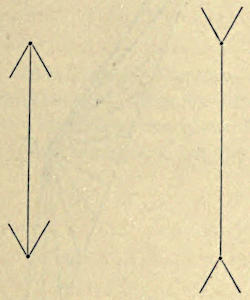
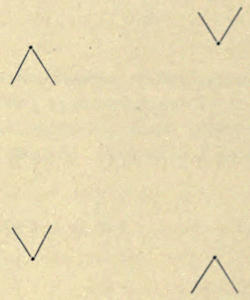
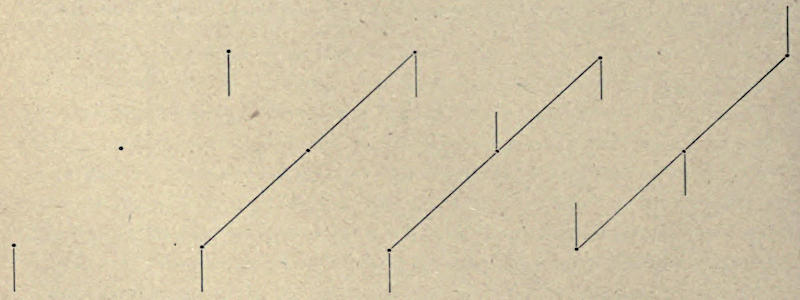
Fig. 3.
Fig. 4 represents two right angles, one of which is divided into nine angles of 10° each. Brentano claims that we so overestimate the nine small angles as to take the undivided right angle as an acute one. I can only say that however much I have tried, I am not subject to the illusion.
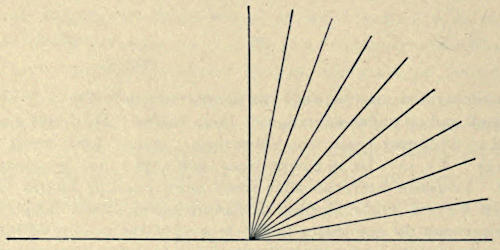
Fig. 4.
In Fig. 5 we have on the straight line AB a series of stations which are connected with a common centre. The line AB is not a curve, but this figure reminds us of a perspective view of the sector of a circle. The drawing appears as the diagrammatic picture of a shield, the buckle of which is in C. Thus AB is conceived as representing a curve. It does not seem that a comparison of the angles has anything to do with the illusion.
How much perspective interferes with the optical illusions under discussion, impresses itself upon my mind, when I think of figure 5 as the diagram of a mountain, rising above the plane AB. If I imagine I stand below the plane, which may be a high table-land, the line AB appears to my eye straight. But when I imagine I am looking down upon the plane, the curvature of AB becomes very strongly marked.
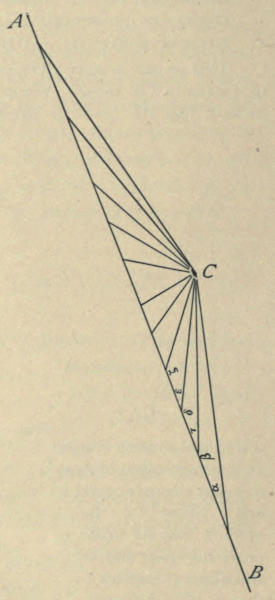
Fig. 5.
In Fig. 6 we can detect no optical illusion. The line AB appears straight to us. The drawing reminds us of a sunrise on the ocean.
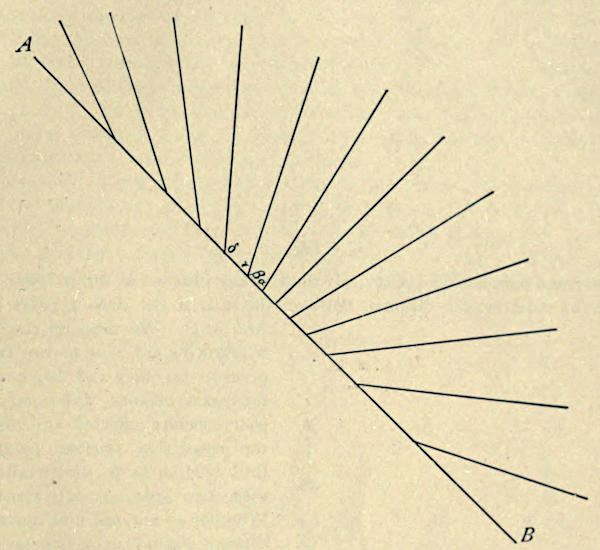
Fig. 6.
The same must be said about Figure 7. Brentano, in agreement with Lipps, claims that we are inclined to regard the distance between the ends of the two lines as larger than between the points. If there is any illusion at all, it seems to me, that on the contrary, the distance between the ends of the lines appears shorter. And why? We measure the distance by allowing our eyes to run from one point to the other and then comparing the measurements. This comparison is geometrically effected by combining the respective starting points, and thus judging as to the parallelism of these two lines mentally constructed. Whether or not the dots appear equidistant, depends upon the execution of all these operations. While directly measuring the distances between the points, we have an easier measurement where the lines are attached. The lines give to the points a certain vim; they almost appear to move with a velocity indicated by the length of the little lines, while the isolated dots present a very phlegmatic appearance.
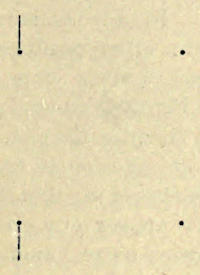
Fig. 7.
In order to see what effects other positions of the lines produce, let us compare in Fig. 9 the several relations by covering the rest. If there is any illusion as to a and b, we should say that the points of a appear at a greater distance; as to b and c, we see the greater distance in c, as to c and d, we feel doubtful, while any comparison with e, tends strongly to convince us of their equal distance. The reason is obvious. The lines in e assist us in drawing the parallels, which we consciously or unconsciously construct in order to compare the distances.
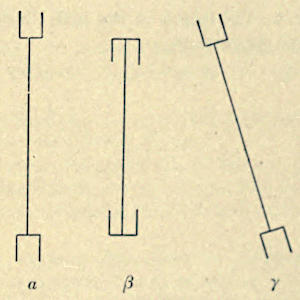
Fig. 8.
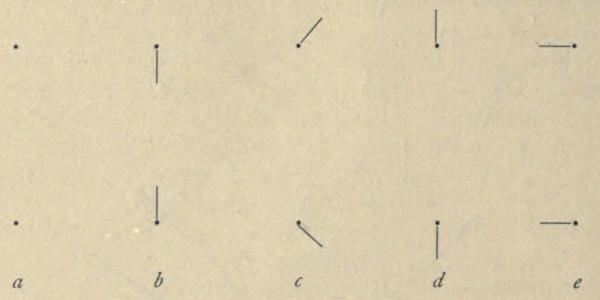
Fig. 9.
A comparison like that of α and β in Fig. 8, where the equal length of the combining lines is very apparent, induced Brentano to regard the illusion which is observed in Figures 1-3 as due to the angles. In our opinion he is mistaken. For the illusion actually takes place in α and β; only it is quickly corrected with the help of the parallels, which, as in ε, assist the imagination in making an exact comparison. When we place α and β either at a sufficient distance, or are somehow prevented from making use of the parallel lines, we shall have the same illusion as appears in Figures 1, 2, 3. To prove this, we have but to bring the figure α in a slanting position, as is shown in λ, and the illusion is so strong that many will find it difficult to believe that λ is an electrotyped duplicate of α.
The mooted illusions are not sense-illusions, but illusions of judgment; and we believe that the explanation of these curious phenomena must be sought in the elements which unconsciously enter into the make-up of our judgments.
Lipps says that lines are felt to be movements. If a line is continued, albeit with a slight declination, the motion appears “free and victorious,” aspiring beyond itself; while, if confined in the corner of an acute angle, it seems cut off and impeded. The victoriously progressive motion is overestimated; the checked motion is underestimated.
Brentano, in order to meet Lipps’s objections, proposes a few additional figures, of which we reproduce the most important ones in Fig. 10-14.
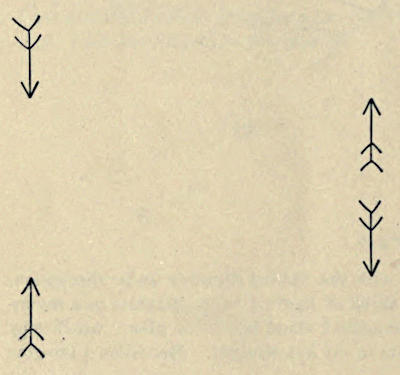
Fig. 10.
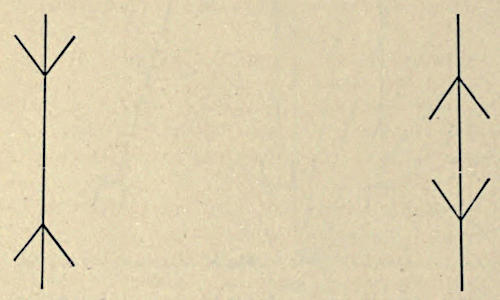
Fig. 11.
Fig. 12. Fig. 13. Fig. 14.
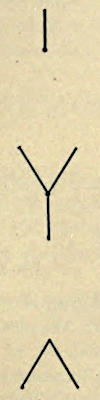
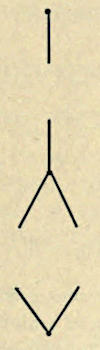
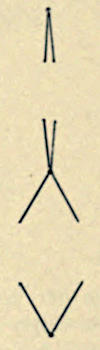
It seems to us that the main part which the angles play in these or any other similar figures, consists in leading our imagination astray. The parallel lines which we attempt to construct for our comparison, switch slightly off with an inclination toward the angles.
But that is not all; there are other elements that affect our judgment at the very outset. In measuring a distance we do something, and in looking at a diagram we think something. The diagram is suggestive of some reality to which we compare it. All these ideas, be they conscious, subconscious, or even unconscious, affect our judgment and are sometimes apt to lead it astray.
In addition we have to mention two things, the influence of which upon our verdict cannot be doubted; the one is the size of the entire figure, the other the vacuity of the distance to be measured: both tend to make the distance appear longer than it really is. To illustrate this, we add the three Figures 15, 16, 17 which contain no angles and yet show the same illusions.
Fig. 15. Fig. 16. Fig. 17.
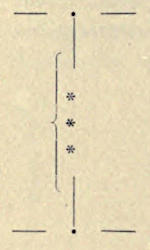
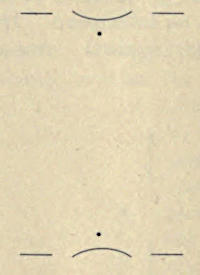
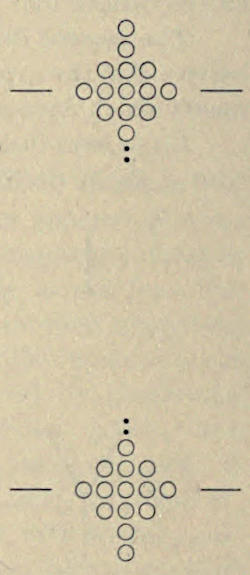
The distance between the points in Figure 17 appears longer than in Figure 16, and in Figure 16 again longer than in Figure 15. The fact is, that before starting on our measurement-journey, we have in Figure 17 already traversed a good distance after having noted the extraordinarily lengthened boundary marks. The town A may be exactly as far as the town B, yet the journey to A will appear longer, if I have to ride an hour before I reach the station, while I may live opposite the terminus of the railroad to B.
When our eyes glide down from one point to the other, we pass in one case through an empty desert the dreariness of which is not interrupted. We almost lose our way and become lonesome in its monotony. If our way, however, is full of variations, we are pleasantly entertained and regard our journey as so much shorter. The contrast is most obvious in figure 10. The time-illusions as to the swiftness of hours of work or amusement and the slowness of moments of ennui have become proverbial among all nations. The more dreariness, the more marked is the lengthening of the distance, while even a partial accompaniment shortens the traversed road.
κρς.
CONTENTS: Vol. V. Nos. 3 and 4.
Theorie des Farbensehens. By H. Ebbinghaus.
Ueber den Muskelsinn bei Blinden. By Paul Hocheisen.
Litteraturbericht. (Hamburg and Leipsic: Leopold Voss.)
VIERTELJAHRSSCHRIFT FÜR WISSENSCHAFTLICHE PHILOSOPHIE.
CONTENTS: Vol. XVII. No. 2.
Einiges zur Grundlegung der Sittenlehre. (First Article.) By J. Petzoldt.
Kritik der Grundanschauungen der Sociologie H. Spencer’s. By P. Barth.
Werththeorie und Ethik. (Second Article.) By Chr. Ehrenfels. (Leipsic: O. R. Reisland.)
THE AMERICAN JOURNAL OF PSYCHOLOGY.
CONTENTS: Vol. V. No. 3.
On Errors of Observation. By Prof. James McKeen Cattell.
Minor Studies from the Psychological Laboratory of Clark University.
On the Discrimination of Groups of Rapid Clicks. By Thaddeus L. Bolton.
Statistics of Dreams. By Mary Whiton Calkins.
On the Pressure Sense of the Drum of the Ear and “Facial Vision.” By F. B. Dresslar.
On Reaction-Times When the Stimulus Is Applied to the Reacting Hand. By J. F. Reigart and Edmund C. Sanford.
Experiments upon Physiological Memory by Means of the Interference of Associations. By John A. Bergström.
A New Instrument for Weber’s Law; With Indications of a Law of Sense Memory. By James H. Leuba.
A New Pendulum Chronograph. By Edmund C. Sanford, Ph. D.
Laboratory Course in Physiological Psychology. (Fourth Paper.) By Edmund C. Sanford, Ph. D. (Worcester, Mass.: J. H. Orpha.)
THE PHILOSOPHICAL REVIEW.
CONTENTS: Vol. II. No. 3.
German Kantian Bibliography. By Dr. Erich Adickes.
The Epistemology of Neo-Kantism. By Prof. Andrew Seth.
Mental Measurement. By Prof. J. McK. Cattell.
Book Reviews. (Boston, New York, Chicago: Ginn & CO.)
REVUE PHILOSOPHIQUE.
CONTENTS: Vol. XVIII. No. 5.
Psychologie du musicien. 1. L’evolution des aptitudes musicales. By L. Dauriac.
La sociabilité et la morale chez les animaux. By Houssay.
Sur les idées générales. By Marchesini.
Questionnaire sur l’audition colorée, figurée et illuminée. By Gruber.
L’attention et les images. By F. Paulhan.
Une illusion d’optique. By B. Bourdon.
Science et socialisme. G. Sorel.
Analyses et comptes rendus. (Paris: Félix Alcan.)
CONTENTS: Vol. XVIII. No. 6.
La nouvelle théorie de l’hérédité de Weismann. By Y. Delage.
Un calculateur du type visuel. By J.-M. Charcot and A. Binet.
Psychologie du musicien.—II. L’oreille musicale. By L. Dauriac.
REVUE DE MÉTAPHYSIQUE ET DE MORALE.
CONTENTS: Vol. I. No. 2.
Le mouvement et les arguments de Zénon d’Élée. By G. Noël.
Le problème moral dans la philosophie de Spinoza. By V. Delbos.
Le concept du nombre chez les Pythagoriciens. By G. Milhaud.
Le dialogue dans l’enseignement de la philosophie. By C. Mélinand. (Paris: Librairie Hachette et Cie.)
CONTENTS: Vol. I. No. 3.
Les prétendus sophismes de zénon d’élée. By V. Brochard.
Spir et sa doctrine. By A. Penjon.
Essai sur le caractère général de la connaissance. By G. Remacle.
PHILOSOPHISCHES JAHRBUCH.
CONTENTS: Vol. VI. No. 2.
Begriff der Philosophie. By Uebinger.
Die Objectivität und die Sicherheit des Erkennens. By Isenkrahe.
Der Begriff des “Warren.” (Concluded.) By Franz Schmid.
Der Grundplan der menschlichen Wissenschaft. By Bahlmann, S. J.
Handschriftliches zu den Werken des Alanus. By Bäumker. (Fulda, 1893.)