Volume 3 / Part 4 — THE MONIST. (continued 3)
Reading edition
Mr. Edison’s explanation of the soul, applied to this example of a mosaic picture, would be as follows: Every little stone is in itself a little mosaic picture. The whole picture of the mosaic is the sum of the little pictures of the stones of which it is composed.
The intelligence of the soul, however, is not even as yet the form in which feeling structures combine; it originates with the representative faculty of the feeling structures. The soul is the organised totality of a set of images and abstract mental symbols representing the qualities, the influences, and the interactions of the different objects of the surrounding world, the thinking subject included.
Says Mr. Edison:
“Every atom has an intelligent power of selection, and is always striving to get into harmonious relation with other atoms.”
The latter is true; the former is an error. Every atom “is always striving to get into harmonious relation with other atoms”; this is its nature; and its nature being stable, consisting of certain inalienable and intrinsic qualities, the atom acts with consistency. Certain atoms, say atoms of hydrogen, are of such a nature as to combine with certain other atoms, say atoms of oxygen, into molecules that form a certain substance of peculiar properties, which, if each atom of oxygen combines with two atoms of hydrogen, would be H₂O, or water. This substance again, having certain definite qualities, will in a temperature below freezing point crystallise at a definite angle. The angle of crystallisation being the same for all molecules H₂O, the result will necessarily be one of most marvellous regularity. And not being able to observe the atoms in their secret activity, not knowing all the details of nature’s marvellous laboratory, we are astonished to find such a wonderfully harmonious relation. And yet, considering the nature of things, we are urged to confess that it is the result of an inevitable necessity, which takes place according to strict mathematical laws.
Although every atom strives, according to its nature, to get into harmonious relation with other atoms, we do not see any “intelligent power of selection” in the province of inorganic nature. Every atom of inorganic substances acts according to its nature in one and the same way throughout. There is no choice, no selection, allowed. Choice and selection are faculties that are reserved for the higher domains of psychical life, which originates in the domain of animal existence when meaning, conditioned by the presence of sentiency, rises into being and creates the soul.
Supposing that through some combination of atoms their subjectivity be combined in such a form as to produce sentiency or feeling, we can very easily understand how this feeling will in time become representative of the conditions by which it is affected. The soul does not consist of the atoms of its organism, nor of the sum of the qualities of the atoms. The soul consists of something more subtle than matter: the soul consists of the meaning that is attached to the different forms of the feelings which obtain in living organisms.
THE PROBLEM OF THEISM.
The problem as to whether or not there is an element of feeling present in the unorganised realm of nature, is connected also with the problem of theism. The monistic view of the world, which considers nature as alive throughout, can neither accept the old supernaturalism, nor the materialistic theory of atheism. Theism, as it is usually conceived, believes in a personal creator and ruler of the world. Materialism denies the existence of any God; it regards matter and its actions as the only reality.
Monism does not regard mental phenomena as an incidental by-play of blindly operating forces. It regards mind as a necessary product of reality. Mind and the peculiar qualities of mind are characteristic of the world-tree, of which it is the highest efflorescence we know. From the fruit we can know the root, from the product we can judge of the factors, in the creature we see the creator.
That great something which has produced us, the All-power in which we live and move and have our being, and obedience to the laws of which are the conditions of life, of welfare, and of an advance to higher life, is called with a popular religious name “God.”
Let us comprise under the name “theism” all those views which recognise any conception of God, and reserve the term anthropotheism for that view which regards God as a person, a mind, a conscious being, or a world-ego. Atheism in that case will be a negation of the existence of God in any form, a negation of the All-power of which we are parts and to which we have to conform; and accordingly atheism will be also a negation of any authority of moral conduct.
We call attention to the fact that many who call themselves atheists, simply because they do not believe in anthropotheism, are according to this definition not to be classed among the atheists.
What has monism to say, on the problem of the existence of God?
Prof. George J. Romanes, in an article which appeared some time ago in the Contemporary Review under the title “The World as an Eject,” declares that monism has left the problem of theism in the same state it was in before. He says:
“The views of the late Professor Clifford concerning the influence of monism on theism, are unsound. I am in full agreement with him in believing that monism is destined to become the generally accepted theory of things, seeing that it is the only theory of things which can receive the sanction of science on the one hand, and of feeling on the other. But I disagree with him in holding that this theory is fraught with implications of an anti-theistic kind. In my opinion, this theory leaves the question of theism very much where it was before.[44] That is to say, while not furnishing any independent proof of theism, it likewise fails to furnish any independent disproof.
“As a matter of methodical reasoning it appears to me that monism alone can only lead to agnosticism. That is to say, it leaves a clear field of choice as between theism and atheism.”[45]
Clifford says in the passage referred to by Professor Romanes:
“Reason, intelligence, and volition are properties of a complex which is made up of elements themselves not rational, not intelligent, not conscious.”
Rational, intelligent, conscious beings, so far as their material existence is concerned, are made up of elements not rational, not intelligent, not conscious. But mind, reason, intelligence are not at all made up of material elements; they are neither latent nor germinal and least of all fully developed properties of the single atoms. Reason can in our conception never be explained as a complex result of the interaction of absolutely irrational elements. The material elements of the world, it is true, are not intelligent, not conscious; but the world as a whole (although not conscious and not endowed with purposive volition) is at least not irrational and not void of determination. On the contrary the world as a whole is the prototype of all rationality, and human reason is a mere image of the world-order. What is the reason of a rational being but an incarnation of this world-order?
Reason is not a thing of matter; exactly so the world-order is not a thing of matter. But it exists none the less; it is a reality. On the other hand, the world-order need neither be a personal being nor the work of a personal being. The order that prevails in the real world and in the laws of nature appears also in the ideal world, in the laws of formal thought, in mathematics, and its kindred sciences; and the same rationality that obtains in the ideal domain permeates the realms of reality, the universe of objective existence.
The idea that God created the world-order and dictated its laws is a fanciful and poetical allegory; it is as such a pagan notion which belongs in the same category with Hesiod’s Cosmology, but it is scientifically and philosophically unthinkable. For God is eternal and God’s being is eternal. God has not created his own attributes and the world-order is simply an attribute of God; it is part and parcel of his nature. Or can you think of God without that attribute of irrefragable order that appears to science as necessity, to religion as holiness, to ethics as justice, to art as the law of beauty, to the mystic as the key to all the wonders of existence which though solving all the problems remains most wonderful itself?
The world as a whole, the cosmos, God, or whatever we call the One and All, is the prototype of all reason, but he is not a mind; he is not a system of sentient symbols; he is not a soul. Minds are a special kind of God’s creatures; but God is not a creature: he is the condition of the existence of creatures, he is the creator.
The objection is made from materialistic quarters: “What is the world as a whole but the sum of all atoms!” This is an error. The world is not merely the sum of all its atoms; the universe does not consist of innumerable little particles which in their combination form the All. On the contrary: the world as a whole, existence in its oneness, or speaking religiously God, is alone the only true reality; all other things and beings are parts of him. Atoms are abstract concepts; the existence of an atom and of its actions presupposes the existence of the great whole of which it is a part, and without which it would have no reality. There are no atoms in themselves. Atoms regarded as things in themselves are a scientific superstition.
Professor Romanes advances the proposition, that cosmical events, being as highly complex as nervous phenomena, might be possessed of a similar subjectivity. The nervous phenomena which constitute the physiological action of mind in the province of objectivity are, it is true, very complex, but complexity does not constitute that characteristic feature on the presence of which depends the origin of mind.
Professor Romanes says:
“Both mind and matter in motion admit of degrees: first as to quantity, next as to velocity, and lastly as to complexity. But the degrees of matter in motion are found, in point of observable fact, not to correspond with those of mind, save in the last particular of complexity, where there is unquestionably an evident correspondence.
“Now, if we fix our attention merely on this subject-matter of complexity, and refuse to be led astray by obviously false analogies of a more special kind, I think that there can be no question that the macrocosm does furnish amply sufficient opportunity, as it were, for the presence of subjectivity, even if it be assumed that subjectivity can only be yielded by an order of complexity analogous to that of a nervous system. For, considering the natural and dynamical system of the universe as a whole, it is obvious that the complexity presented is greater than any of its parts. Not only is it true that all these parts are included in the whole, and that even the visible sidereal system alone presents movements of enormous intricacy, but we find, for instance, that even within the limits of this small planet there is presented to actual observation a peculiar form of circumscribed complex, fully comparable to that of the individual brain, and yet external to each individual brain. For the so-called ‘social organism,’ although composed of innumerable individual personalities, is, with regard to each of its constituent units, a part of the objective world—just as the human brain would be, were each of its constituent cells of a construction sufficiently complex to yield a separate personality.”
The so-called social organism which is composed of innumerable personalities undoubtedly yields a peculiar spiritual existence, which cannot be explained solely as the sum of the parts and actions of its constituent individuals. The relations in which the members of society stand to each other are of an analogous importance to the relations of the cells and organs in an organism. It is the form that constitutes this or that kind of an organism, not the sum of atoms, nor the intricacy or complexity of their combinations. Different forms of perhaps the same material amount, and of the same intricacy of combination, yield quite distinct types of individuality, and every state, every nation, every society possesses, as it were a personality of its own.
Mind is not constituted by complexity. Mind is a system of sentient symbols. Wherever we find organisms acting in such a way that their actions depend upon the meanings of certain stimuli, we have to attribute to them that characteristic feature which we call mind, or soul. The action of a falling stone is explainable without attributing to it any mentality. There is no representative value, no meaning in that quality of the stone which, under certain conditions, makes the stone fall. However, if a man acts, the motive of his action does not consist in the gravity of certain material particles of his brain. It consists in the meaning that resides in certain feelings. Without taking into consideration the meaning that dominates the man’s motives, we cannot explain his action, and it is the meaning of feelings that the soul consists of. Only where and when we can discern the presence of meaning as the raison d’être of actions, are we justified in calling phenomena mental. When the action that takes place in response to a stimulus depends solely upon the significance of a symbol, the inference is legitimate, nay, it is inevitable and conclusive, that we have to deal with a mind. The motion of a comet, which depends perhaps not only upon the gravity of its mass, but also upon the chemical actions and explosions of its constituent elements during its approach to the sun, may be ever so intricate; but this does not in the least justify the assumption of the presence of mind in the comet.
The assumption of mind in inorganic nature is not only fantastical, it is also needless. Facts are better explained without this speculation.
The world as a whole is not bare of subjectivity. In this we agree with both Clifford and Romanes. But we do not identify subjectivity and mind, the latter being a special and indeed a very complex form of subjectivity. We suppose that subjectivity pervades also all the processes of unorganised nature, and no less the cosmic events; but be they ever so much more complex than nervous phenomena, there is present only a non-mental subjectivity.
Yet although the phenomena of so-called inanimate nature, be they motions of celestial bodies or physical and chemical processes, are non-mental, there is in every one of them present that grand feature which is as it were the breath of God. This feature appears in all the phenomena of nature, but in none of them more gloriously than in the soul of man. Even the cosmical events of marvellous sublimity appear as a mere prelude to the appearance of soul-life, for in soul-life is focused all the divinity of nature. Reason is the reflex of the world-order and thus a rational being is made in the likeness of God.
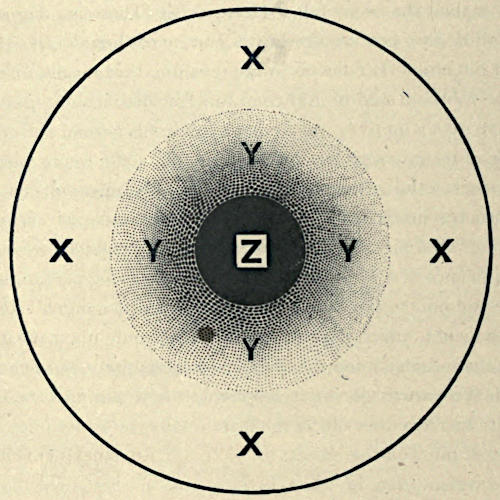
Professor Romanes presents the problem of the subjectivity of existence by the adjoined diagram, which he explains as follows:
“Following Clifford, I will call these inferred subjectivities by the name of ‘ejects,’ and assign to them the symbol Y. Thus in the following discussion X = the objective world, Y, the ejective world, and Z, the subjective world. Now, the theory of monism supposes that X, Y and Z are all alike in kind, but presents no definite teaching as to how far they may differ in degree. We may, however, at once allow that between the psychological value of Z and that of X, there is a wide difference of degree, and also that while the value of Z is a fixed quantity, that of Y varies greatly in the different parts of the area Y.”
The deep shading of Z indicates consciousness, and consciousness is that form of subjectivity which constitutes our mind. Z is not, as Professor Romanes asserts that it is, a fixed quantity; it varies greatly, as every one knows from his own experience. It is lowest in trance or swoon or profound sleep. It is highest in the state of concentrated attention. The ejective element, which we assume to be present as a correlative concomitant in the objective world, we assume, with Professor Romanes, varies greatly in the different parts of the area Y. Like Professor Romanes, we also do not assume the existence of any unshaded X. There is no objectivity without its subjective correlate. But, according to the theory of monism, the nature of the concomitant subjectivity is not unknowable: it can be inferred from the nature of objective existence. The subjectivity of the falling stone is most elementary, and not mental; its action is not prompted by meaning. That something which impels the stone to fall, and which science calls gravity, does not possess any representative element. There is no symbolism involved in gravity. There is no soul in the stone. The stone is not incited to falling by any purpose; it has no end in view. Purpose originates with and through the presence of representative symbols. According to the theory of monism the shading of the surrounding zones is not a matter concerning which we have to suspend our judgment. If monism is true, we know very well how deeply we have to shade the different phenomena of objective nature.
Taking this view, we object to Professor Romanes’s conclusion when he says:
“Without in any way straining the theory of monism, we may provisionally shade X more deeply than Z, and this in some immeasurable degree.
“Monism sanctions the shading of X as deeply as we choose; but the shading which it sanctions is only provisional.”
While the presence of mind in the phenomena of the stellar universe and of inorganic nature must decidedly be denied, I would not, for that reason, declare that monism is atheistic.
Monism is decidedly theistic although not anthropotheistic. It is monotheistic in so far as it recognises that the all-existence in which we live and move and have our being is the ἙΝ ΚΑΙ ΠΑΝ, the One and All. But there is not the slightest reason for the theory, and there are sufficient reasons against it, that the universe is possessed of a huge world-ego, that it is a person or a mind.
We maintain on the one hand that the laws of nature are not designs arranged With consciously preconceived purposes. Yet on the other hand, we do not forget, that the world-order possesses quite definite features and that the course of evolution runs in a very unmistakable direction. We can plainly decipher its character, and the great religious teachers of mankind have with a truly prophetic instinct proclaimed the ethical injunctions to be derived therefrom—injunctions which, millenniums after them, science has discovered to be founded in the nature of things.
God is no mind, yet God is mentality, the source of all mind: God is not a spirit, but he is spirituality. The subjectivity of the universe from which all consciousness rises is part of his being, and whatever that subjectivity, considered as a whole, be or be not, that much is certain, that in grandeur it corresponds to the objectivity of the world. It does not think in symbols as a man does; it is not a mind: but it exists nevertheless. Whatever it is like we learn from the revelation of its appearance in objective existence, from the cosmic order, the laws of nature, and the moral ideas of mankind.
Knowledge of nature means knowledge of God, for nature is God as he appears and the objectivity of being is the revelation of God.
We would not limit God to the subjectivity of nature: God is both subjectivity and objectivity combined. He is that All-power that is, was, and will be, thus being the ultimate authority of conduct.
God is not a mind, he is more than a mind; God is not a system of symbols, he is the reality symbolised in mind. He is not a person, he is super-personal.
He who does not see that the God of monism is greater than the God of anthropotheism, had better believe in a personal God, until he appreciates the truth that God is not personal but super-personal. For after all anthropotheism is nearer the truth than atheism, for atheism (well understood, the atheism of our definition above) is a moral nihilism devised to shake off all ethical obligation so as to make the lust of the moment and the pleasure of the individual the supreme rule of action.
Monism, accordingly, does not leave the problem of theism where it was before. Monism proves that God is not to be conceived in the likeness of man, but the reverse: man, being a system of symbols representing the world, is to be conceived as having been made or rather as having originated in the likeness of God. God is the original, man is the copy. God is the whole, man is the part, in which the whole finds a more or less correct representation. The picture is not perfect, but the grandest duty a man has is the constant approach to a greater perfection. Man is the temporal, God is the eternal. Man is limited, God is the infinite.
Editor.
FOOTNOTES:
LITERARY CORRESPONDENCE.
I. FRANCE.
Dr. Paul Sollier has just published, in the Bibliothéque Charcot-Debove,[46] a new and excellent work, Les troubles de la memoire. This work is not identical in its purpose with that of M. Ribot; it corrects the latter in certain points, completes and corroborates it in others. M. Sollier set out to discuss this question solely from a medical standpoint, which was intentionally passed over by M. Ribot, but he has also necessarily touched upon its psychological aspects, and, as he informs us himself, he was obliged on the whole to make a medico-psychological study of the question.
The subject is a vast one; one could include in it aphasia and all the weaknesses resulting from the destruction of the brain-centres, whether those of motion or of sensation. M. Sollier has taken the pains to reduce it, however, to definite limits. He studies especially the subject of acquired amnesia (diminutive changes and disaggregations of the memory). He does not consider the subject of congenital amnesia, which is an absence and not a loss of memory. Strictly considered, the only cases of true amnesia, or organic amnesia, are those which result from the destruction of the nerve-centres, since in this case there is an absolute loss of the power of forming mental images, and not simply an enfeebling or forgetting of them, which is characteristic of functional amnesia. From a clinical standpoint amnesia exists only in the last case. Though the effect may be the same in both cases, the causes are not identical.
Clinical investigation cannot, however, overlook the diminutive changes which take place in the memory and which, as early as 1817, were called by Louyer-Villermay dysmnesia, and which are always closely allied to organic modifications of the brain. As regards amnesia itself, it is important to distinguish simple amnesia from retrogressive and progressive amnesia. M. Sollier explains the motive causes of these different conditions with great lucidity, and renders them easy of comprehension by means of ingenious illustrations.
I call attention to the information he gives us as to the conditions under which a revival of mental images takes place, p. 30; to his criticism of Ribot’s opinion, according to which the power of correctly locating events in the scale of time is the true characteristic of psychical memory: it is quite enough if it reproduces events as in the past, that is to say if there exists a conscious knowledge which shows that the mental conception belongs to the past, or is, simply, a remembrance, p. 35 and 40; to his remarks on the strengthening of mental images due to the repetition of remembrances, the necessary sequence of which is that a weakening of old memories follows the destruction of accumulated mental images, p. 48; to his explanation of the processes of retrogressive amnesia (coming suddenly after an attack of vertigo, a blow, etc.) which he bases upon a supposition of a group of mental conceptions in touch with one another, in such a way that the loss of one leading conception in a group deprives this group of sufficient consistency to form a conscious synthesis, p. 70.
As regards the classifications of amnesia M. Sollier censures that of M. Ribot as being neither openly psychological nor openly clinical, and of taking successively as bases the extent of an observed phenomenon, its evolution, its location in time. Moreover, from a clinical standpoint it has led to a joining together of totally incongruous disorders. M. Sollier therefore rejects it, and contents himself with adopting first of all, with M. Falret, the natural classification of general amnesia and of partial amnesia. Moreover, in taking account of the systematising of lost remembrances, he proposes to make a distinction as to the two varieties of systematised (functional) and of non-systematised (organic) amnesia, considered from the purely psychological standpoint, p. 59. We should thus have, firstly, the classification of general amnesia, including (A) true organic amnesia (destruction of the centre of mental images), and, under the classification of the systematised, (B) functional, or apparent, amnesia (imperfect performance of the functions of the centres): this latter subdividing into two groups, (a) amnesia with its varieties (a´) simple, (b´) retrogressive, (c´) progressive, and (b) paramnesia: (a´) that of locality, (b´) that of exactness; to which it is proper to add (c) dysmnesia, which is organic-functional. Secondly, the classification of partial amnesia whether systematised or not, which may be either organic or functional. M. Sollier abandons, moreover, every pathological or etiological classification as being exceedingly unsatisfactory. In the presence of a patient, he justly remarks, the physician can only employ semiology.—I will not enter here into the details of the inquisitor-like investigation entered upon by the author. I must even proceed without stopping through the observations intended for medical men, which form the second part of the work, but I judge that every reader will also find therein many facts which may prove of interest. After having read it, one is more impressed than ever with the importance and delicacy of the motive forces of the memory, in noting the frequency and the varieties even of its sources of weakness. M. Sollier has the credit of pointing them out—in the shape of “defects in synthetical power” and in “will power”—in the sources of weakness where one had not been accustomed to look for them. It would be interesting, he thinks, to find out what part amnesia may perhaps take in the pathogeny of certain nervous disorders, and the influence which it has on their evolution. Specialists for the insane might find therein a new subject of study, and psychology will profit, on the other hand, by that which clinical experience offers it. Is not its main object to learn to understand life as a unit at the same time that it analyses it as a diversity?
When one passes from a book like that of M. Sollier to the work of M. l’Abbé Maurice de Baets, Les bases de la morale et du droit,[47] one is impressed by the change of method. It has become impossible for us to consider pathology as unallied to questions of morality; and we have accomplished this great object of studying matters pertaining to the moral world, the evolution of law, without seeking our base of support in a religious faith or in a metaphysical affirmation. Even M. l’Abbé de Baets himself declares emphatically that he desires to adopt only one starting point from among those we are acquainted with,—the verification of facts,—and truly he shows a good will and knowledge; nevertheless the ground which he considers so firm has, as we believe, no stability. All seems strange to us, if I may so speak, in books of this description. The tone which is peculiar to them, the nature of the facts cited, the progress of the reasoning, impeach them just as surely as the blue color of his costume reveals afar off an inhabitant of the Celestial Empire. I am not an impassioned adversary of the clergy; far from it. I appreciate their intentions and esteem their persons as one should, but I am unable to share their opinions, and I consider indeed that they deceive themselves when they think that faith has ever given to the world an absolute assurance. It has not given it because it has not proved sufficient. Mankind, variable and vacillating though it may be, does not change its beliefs because of fickleness of heart: its mental evolution takes place too slowly for that, and is also too painful. The Catholic church of to-day has adopted as its watch-word the return to St. Thomas of Aquinas; it will gain by this unity of effort, without succeeding however in leading back the minds of men to its point of view. The diverse ways we follow tend doubtless as a matter of fact toward the same objective point, and run more or less in the same direction; but humanity scarcely ever passes back again over the paths which it has once traversed.
We have another little volume by M. Lombroso, Les applications de l’anthropologie criminelle; a sequel to Nouvelles recherches, which I have mentioned before. We find here interesting pages in regard to transportation and reform schools, and a criticism of the new theories of the penal code (Garofalo, Tarde, Sighele, Onanoff and Blorg, Ferri)—a part of the question considered in the Congress. A chapter indeed is devoted to the subject of criminal anthropology in modern literature, in regard to which it seems to me M. Lombroso always makes more of a question than is desirable, but which he well understands how to criticise. Then follow several pages on the criminal type in art, after a work of Dr. Edward Lefort; then comes a description of anthropological instruments and methods. I will not affirm that this last work brings us much of novelty; it is chiefly a new and energetic presentation of his views, and M. Lombroso has no doubt whatever that by dint of striking the nail upon the head he will succeed in driving it into the wall of his adversaries.
The work of M. B. Bourdon, L’expression des emotions et des tendances dans le langage, is certainly one of the most curious books one can read. He treats in an original manner of phonetical questions, which are less rife in France than in England and Germany, as to what sounds signify, or speech; what is their worth in intensity, elevation, form or quality, duration; what phenomena are shown by successions of intensity, of elevation, of elementary articulation, of syllables, of words, etc., of duration; what are the relations of these phenomena to versification and what comparison one can make between writing and speech: such are the problems particularly studied, at times with the aid of very simple but instructive facts culled from experience.
These studies—I need scarcely add that they are comparative ones—are of interest for various reasons. They lead up to new ideas of grammar and of language, and furnish arguments for a reform in orthography of which M. Bourdon is a very warm partisan. His readers will not be slow to notice for the matter of that, that he is in regard to this frankly revolutionary; and it may seem paradoxical to say to them, for example, that “the distinction between analytical and synthetical languages is absolutely artificial, and could only be produced through our bad systems of writing.” Writing, M. Bourdon indeed remarks, introduces separations in places where spoken language makes no pause. The English write I will go, they pronounce it Iwillgo. The analysis which pertains to writing masks the true cohesion of the spoken language, and “if in the past all series of articulations had been written as a single word which were in fact pronounced as a single word, we should not have known the error which consists in opposing certain languages classed as synthetical to others which we class as analytical.” The argument is perhaps not a decisive one, and in the neo-Latin languages, for example, one can scarcely deny that the analysis of the written language has conformed to the work of decomposition of the antique forms, so as to adapt itself to the new groupings of their essential elements, groupings wherein these elements remain variable because speech separates them effectively, in many cases by interpolating governing words or others.
But it is not my intention to enter into these detailed discussions. I leave M. Bourdon in further calling attention to his last chapter, Ecriture. Persons curious as to graphology will find in it some good ideas concerning this method of “character reading.” The author does not tell everything, and I have a suspicion that he greatly despises certain signs valued by the graphologists, and arrived at empirically, but we should note what he has actually said.
Under the title, Le monde physique, Essai de conception expérimentale, M. Dr. Julien Pioger offers to the public a sketch of a world-system. This system is summed up in the expression of “Universal Solidarity,” and is based on the idea of infinitely minute matter-particles, or “infinitesimals,” the mutual relations of which, and their equilibrium, constitute the machinery of the universe. The atomic-mechanical hypothesis, says M. Pioger, is wrong in resolving matter into perfected differential particles and in assigning to its atoms qualities which make of them either true material corpuscules or a real entity, “a thing in itself.” On the contrary, far from intending to assign a limit to materiality, the hypothesis of infinitesimals confines itself to limiting the conception which we may have of it. The infinitesimal corresponds to the infinitely small, that is to say to the non-perfected, to the non-differentiable, beyond our cognisance and our perceptivity; it expresses the most reduced condition of the affinities which constitute matter; it is the expression of the infinitesimal existence of that which we call motion, extension, ponderability, under the general name of matter. Now the most simple thing which can be conceived of in the physical world, is the couple formed by the essential equipoise of two infinitesimals. In developing the couple it becomes possible to form the universe in all its great variety. The solidarity of the parts in the whole appears as the essential condition of existence of all that which Is—the necessary condition of all individuality.
In conclusion I call attention to two new editions, one the well-known work of M. Bernard Pérez, Les trois premières années de l’enfant, fifth edition, revised and supplied with an introduction by Mr. James Sully; the other Les functions du cerveau, by M. Jules Soury, a work highly esteemed, embodying the most recent researches.
Lucien Arréat.
FOOTNOTES:
II. GERMANY.
One of our foremost psychiatrists, Professor v. Krafft-Ebing of Vienna, says in his celebrated text-book on psychiatry: “If Pedagogy made a more serious study of the character of man in his psychopathological relations, many of the mistakes and severities of our system of education would be removed, many an unsuitable choice of vocation would be left unmade, and thus many a psychical existence rescued.”
Any one who is at all familiar with the most important doctrines of the diseased phenomena of mental life, and who knows how frequently psychical disturbances of a more or less serious nature occur during childhood, will fully agree with Krafft-Ebing, and will only regret that pedagogy, in this important direction, has completely neglected its task.
Although lately the necessity of psychiatric knowledge for the pedagogue has been insisted upon in professional circles, for instance, by Professor Struempell in his Pedagogic Pathology (comp. The Monist II, 106), yet instruction in this department occupies a wholly subsidiary place in pedagogic education, and has not been made as it should have been, an organic part of the same. The writer of these lines has accordingly discussed this subject in a special treatise, maintaining that the most important diseased phenomena of mental life might be treated as a part of pedagogic psychology (comp. The Monist I, 619).
The demands made were met in different ways. While the English and American press accepted these demands without reserve (for instance, in Hall’s Pedagogical Seminary, I, 297), in Germany there has been more caution displayed, inasmuch as the opposing difficulties were regarded as greater than they probably were (Professor Rein’s Pädagogische Studien, 1892, Heft I).
We have, however, simply to call to mind the doctrine which more than twenty years ago Maudsley in his “Physiology and Pathology of the Mind” laid such special emphasis upon, that psychic laws are the same in healthy and diseased phenomena, only that they do not operate under the same conditions and therefore produce different symptoms. Far from its being true, therefore, that the introduction of psychopathology into psychology can be opposed by any especially well-founded objections, such a procedure will, on the contrary, be found to be, just as Maudsley said, an appropriate and absolutely indispensable auxiliary of the study of this science. And that which was emphasised by Maudsley, and lately also by Muensterberg in the treatise already discussed in The Monist (II, 289), On the Problems and Methods of Psychology (Leipsic, 1891, Abel), Ziehen has done in his “Outlines of Physiological Psychology” in a manner which will be full of suggestions for the pedagogue (comp. The Monist I, 598).
To be sure, the work of Ziehen is very far from supplying all that the pedagogue needs. We have in this work a vast mass of valuable observations, which will have to be elaborated in a manner that accords with the needs of pedagogy, if this science is to derive any material profit from psychiatry. For the bibliography of this subject we shall refer the reader to a former correspondence of ours (The Monist II, 103), and select at present for examination one province only,—a province which is deserving of especial consideration, inasmuch as the phenomena which occur in it are phenomena which most frequently confront the pedagogist, and are most likely to be overlooked by the untrained eye. We refer to the psychopathic subsidiary phenomena of Dr. Koch, by which expression this author comprises all the psychical irregularities, be they natural or acquired, affecting the life of the human personality, which, though not even in the severest cases amounting to actual mental disorders, yet in the most favorable instances so affect the persons afflicted that they appear as lacking the full possession of mental normality and capacity. The second part of Koch’s work, mentioned in The Monist in the place above cited, has just now appeared. (Ratisbon, 1892, Otto Maier). Having discussed in the first part of his work inherited and chronic psychopathic subsidiary phenomena, the author now proceeds to discuss acquired subsidiary factors, and holds out the prospect of a third part, on the appearance of which we shall have occasion again to discuss the entire work from a different point of view. For the present, only the pedagogic aspect of the question interests us. On many readers, Koch’s book must have made the impression,—to judge from his concluding remarks,—that the author shares Lombroso’s point of view, and to very many pedagogues such a position would be, from the very outset, a bad recommendation, for it would necessarily, in the very nature of the case, involve the pedagogue in great embarrassment, in the same way as it has involved the philosophical jurist. But embarrassment is no reason why we should close our ears to the truth, and if Lombroso should be right in all his teachings, pedagogy would also be obliged to accommodate its doctrines to his. Upon the whole, however, Koch is opposed to him. Thus when he says: “What I commend Lombroso for is that he has observed much, has collected rich materials, and has been the source of great incentives in many directions, and has worked suggestively in many ways; what I reproach him with is that he has confounded the healthy with the diseased, and has brought under one and the same category without sufficient and appropriate tests, psychotic phenomena and phenomena which are psychopathically merely of a subsidiary order; what I reject is his theory of degeneration and his peculiar views of philosophy.”
Material, such as Koch and others offer, must first be elaborated into a pedagogic psychopathology—or better still into a pedagogic pathopsychology—before pedagogy, as a whole, can assume in this direction the proper form. Though we consider, now, this preparatory work as indispensable, we can, nevertheless, not think of denying the value of works which, without any profession of far-reaching psychological analysis, put in effective and available form for pedagogy the diseased phenomena of the mental life of children. The first German work of this kind, so far as we know, is from the pen of a Leipsic teacher, Gustav Siegert, and bears the title Problematische Kindesnaturen.[48] This little work is now followed by a more comprehensive treatise, published by a Bremen alienist, Dr. Scholz, already known to the readers of The Monist (II, 104), and bearing the title Die Characterfehler des Kindes, eine Erziehungslehre für Schule und Haus.[49] Such books are valuable not only for the observations they offer and the isolated explanations and pedagogic advice they present, but also for the suggestions which the attentive and psychologically cultivated reader can always receive from them.
Like Siegert, Scholz principally shows us isolated child-types wherein diseased qualities play a more or less pronounced rôle. But while the former’s presentation is somewhat journalistic in style, that of the latter is more didactic; although this tendency is not an absolutely rigid one, as the author counts mothers as readers of his book. But if the form of presentation leads one to infer greater profundity in Scholz than in Siegert, this is in still higher degree the case with the arrangement of the material. While Siegert strings his child-pictures loosely together, Scholz arranges them according to real psychological points of view, so that (remarkable to say) the faults of children are discussed, first, in the province of feeling and sentiment, then in that of representation, and finally in that of volition and action. The introductory and concluding chapters show, also, that Scholz attempts to enter more profoundly into the subject than Siegert proposes, and we cherish the hope that, now that this popular work has appeared, Scholz will very soon present us with a strictly scientific book, in which he shall have occasion to deal with some particular points, such as, for instance, falsehood and unchastity, more comprehensively than was perhaps possible in a book intended for his present circle of readers.
With respect, now, to all systematic presentations of pedagogy, psychopathology can, as we have before indicated, never attain in them its proper position, until the above-mentioned preparatory work has been completed. But this fact should not preclude one’s calling especial attention to the importance of this province, at least in some incidental manner.
In such a work as the Allgemeine Pädagogik of Ziller,[50] for instance, the third edition of which has just been published by F. Mattes of Leipsic, there surely was abundant opportunity to do this—an opportunity which one might say almost amounted to obligation. For Ziller treats hereditary and acquired characteristics in great detail, and such treatment remains necessarily a one-sided one, if abnormal traits are not considered in it. Ziller, with Herbart, demands that individuality always be taken as the starting-point. But how many child-individualities are there, which, in the different periods of their development, may be regarded as fully normal!
The reason of this omission must be looked for partly in the circumstance, that Ziller, as well as the new editor of this otherwise valuable work, belongs to the Herbartian school. If, namely, we compare the psychological literature of the Herbartian school with the publications of French, English, and American writers, or even with the works which in recent times have issued from other philosophical quarters of Germany, it will be unmistakably seen that the pathological conditions of the mind have been little considered by the followers of Herbart. Nor have voices been wanting, that would make Herbart himself responsible for this error. He did not, they say, sufficiently appreciate the importance of the pathological phenomena of mind, and his pupils were in this respect influenced by him. But this reproach will be found, on close examination, to be untenable. Herbart, it is true, did express himself repeatedly against the overestimation of “rare and curious phenomena,” unusual mental states and such things,[51] and his warning is applicable also to our epoch, which produces many psychological works in which remarkable things are to be read but which contribute nothing worth mentioning towards the explanation of even comparatively simple events. Herbart holds, that the psychology of the normal and ordinary states should be the first and principal object of scientific attention; the explanation of much that is extraordinary will then follow. With regard to this latter point, he remarks very positively: “I do not, however, wish by this, to gainsay the value of any real psychological observation. There must be a welcome place in science for every experience.” It will be seen, therefore, that Herbart is not at all far from the point of view of Maudsley and other investigators. We find, in fact, that he mentions repeatedly abnormal mental conditions, and also systematically treats them, even quoting such celebrated alienists as Reil and Pinel (Text-book of Psychology, §§ 142-149). The probability is, therefore, that psychopathology would have been properly employed in Herbart’s psychology, if it had been at all elaborated in his day, and its influence would through Herbart have been directly felt in pedagogy, as no pedagogist has made better or more careful use of psychology than he.
But Herbart’s pupils have done no further work in the province pointed out by him. It is true, his psychology has been made use of by physicians like Griesinger and Spielmann, and recently also to some extent by Krafft-Ebing, but the works of these men have had no influence on the psychological text-books of the Herbartian school, and consequently the science has up to the present day exerted no noticeable influence on pedagogy, either in Waitz, in Stoy, or in Ziller. In other pedagogic schools, this has, it is true, also been the case; but in these, who make no pretensions of relying on the teachings of psychology, the sin is more easily pardoned. But this is not the only respect in which Ziller’s Pedagogy is not up to the times. Ziller defined pedagogy as the influences, formed according to ethical points of view, which are brought to bear on the mind of the pupil, and would not admit influences brought to bear on the body, in so far as such should enter into the pedagogic system. This misconception also springs from Ziller’s adherence to the Herbartian school, which represents, as we well know, a metaphysical pluralism; but it is in a still higher degree due to the fact, that in Ziller’s day both the intimate relation between physiological and psychological processes had not been satisfactorily established, and also were not sufficiently known to him. If it were otherwise, his pluralism need by no means have necessarily led him into such one-sidedness, for this metaphysical pluralism does not exclude a monistic conception of phenomena; even assuming this doctrine, one may say that motion and feeling are two different but inseparable sides of the same phenomenon. The “real things” produce by their interaction, simultaneously and of necessity, both an inner side and an outer; for which reason one of our foremost psychologists, Volkmann of Volkmar, explicitly terms Herbart’s psychology monistic (Text-book of Psychology, second edition, I, 63).
A psychologico-physiological work, from which the new editor of Ziller’s Pedagogy might have extracted many valuable things, is the book of the Italian Mosso, On Fatigue, which has just been translated into German,[52] and which will excite much attention owing to the present active discussion of the question of overwork.
Supplementary to this work I will also mention a little tract by Dr. Burgerstein of Vienna, entitled Die Arbeitskurve einer Schulstunde.[53] This tract is a lecture, which the author gave at the Seventh International Congress for Hygiene and Demography at London, and in which he seeks to find by statistical methods, the duration of a “school-period”—a very laboriously composed treatise and one difficult to read, but possessed of high interest in psychological and pedagogic respects.
From pedagogy to evolution is but a step, at least it is in Ziller’s development of Herbart’s ideas. It is true, Ziller has taken a decided stand against Darwinism, for Ziller works with two contradictory ideas; but his theory of education possesses points of resemblance and analogy to the Darwin-Haeckel theory of development. According to Ziller, each individual passes, also intellectually, through all the stages of development that mankind at large has passed through, only in a shorter time; and it is in conformity with such succession that the order of the various courses of a pedagogical system is to be arranged. Following Ziller’s precedent, Professor Vaihinger, of Halle, in his treatise Naturforschung und Schule (Science and the Schools), has taken up the school-reform initiated by Professor Preyer, and has expressly transferred the fundamental law of biogenesis to pedagogy. How instruction is to be arranged under this point of view, cannot be explained in this letter, which is already long enough. We shall simply remark that the idea has found in Germany a large number of both friends and opponents.
The opponents have recently been joined by a natural scientist, Dr. Hamann, professor of zoology in Göttingen, who has just published a book under the title Entwicklungslehre und Darwinismus (Evolution and Darwinism),[54] in which he does not combat the theory of evolution itself, but simply the Darwin-Haeckelian form of that theory, placing himself in the ranks of His and Hensen. The book appeared almost simultaneously with the fourth edition of Haeckel’s Anthropogeny,[55] but the author, nevertheless, in his supplementary remarks, discusses the “apology” which Haeckel subjoined to his work. Haeckel’s book needs no recommendation in scientific circles; it will be sufficient to state that the work has been subjected to essential alterations, but that its fundamental features have remained the same.
A new psychology, on the Darwinian basis, by Prof. Fritz Schultze of Dresden, is now in course of publication, entitled Vergleichende Seelenkunde (Comparative Psychology[56]). The first part, which treats of the fundamental principles of physiological psychology, has already appeared. On the completion of the work we shall have occasion to return to it.
Chr. Ufer.
FOOTNOTES:
CRITICISMS AND DISCUSSIONS.
A LETTER FROM MR. HERBERT SPENCER.
To the Editor of The Monist:
As I feel it a duty to reserve, for other purposes, the very small power of work now left to me, I am obliged to decline entering upon a controversy. I must leave readers to examine for themselves—little hoping, however, that they will do so.
One point only I wish to note. The use of the expression “forms of thought,” instead of “forms of intuition,” was simply an inadvertence; as will be manifest on observing that though I have used the wrong expression in the note, I have used the right expression in the text (p. 203), as also throughout my criticism of Kant’s doctrine in The Principles of Psychology, Part VII, Chapter IV, “The Reasonings of Metaphysicians,” § 399.
Herbert Spencer.
LOGIC AS RELATION-LORE.
In the French Revue Philosophique, in the August and September 1891 numbers of the same, M. George Mouret has an essay entitled “Mathematical Equality” in the course of which and as though subsidiary to his ostensible purpose he discourses upon the topics of relations and concepts and upon the fundamental elements of logic in general. His essay is really more important as a contribution to logical doctrine than as a treatment of mathematical equality.
The scope of his discourse will be seen by reference to his closing paragraphs in which he sums up what he considers to be the results achieved by him in his essay. Therein, he says that he has “treated of the general theory of the composition of concepts and relations and set the foundations of the logic of analysis and the logic of definition.”
I. THE SPENCERIAN AXIOM.
The determining factor of every philosophical dissertation is of course some very general supposition which is taken as established and which exercises a controlling influence over all the observations of its author.
In this case this determining supposition is found in what M. Mouret calls his “axiom of symmetry.” The same is thus stated by him “Two things which have the same symmetrical relations to a third thing have between them that same relation.”
M. Mouret is not one of those scholars that lack hospitality for other writings than those of their own nationality. From this fault so noticeable in the work of so many of the French scholars M. Mouret himself seems to be free. Indeed so far as regards the previous work done in the domain he sets himself to examine, he accords almost exclusive esteem to the writings of English thinkers. In fact he declares himself so far as regards his present topic a disciple of Mr. Herbert Spencer and puts his “axiom of symmetry” as an adaptation of that maxim of his said master which is of the tenor as follows, viz: “Things which have a definite relation to the same thing have a definite relation to one another.” This maxim, as Mr. Spencer tells us, was suggested to him by a remark of the late eminent author who is known to the world under the pseudonym of George Eliot, who herself stated it under the form “Things that have a constant relation to the same thing have a constant relation to each other.”
Those who are well acquainted with the psychology of Mr. Spencer will recognise that this maxim of his is made by him the very backbone of all his observations upon reasoning. If it has the validity which he imputes to it, it has an importance which it will be hard to overestimate, but if on the contrary, and as we shall submit, it is in every form in which it has been stated, certainly unsound and misleading, it is high time that its virtue should be brought into question.
The dicta of the masters whether they first enounce the same or whether they only give currency thereto by their ratification are always proper subjects for special scrutiny. There is always found a disposition to accept them on their mere ipse dixit without any attempt at criticism or independent observation. This is decisively not the scientific mood or mode. The spirit of that modern leaven that is currently referred to under the name of Science is characteristically a critical one, and one that is considerably irreverent in regard to the authority of mere personality. In this it is happily distinguished from the spirit that has marked the past history of what may be called the “regular” schools of philosophy.
M. Mouret is not alone in his inadvertent esteem for the maxim in question. In the issue of Mind for October 1891 Mr. L. T. Hobhouse publishes an article entitled “Induction and Deduction,” in which he gives an undue appraisal to the worth of the maxim under consideration, even though the author of the article seems to be well aware that said maxim stands in much need of qualification.
We venture to say that this maxim in all its forms has gained whatever currency it has enjoyed in virtue alone of the incompetent comprehension that too generally prevails in regard to the nature and characteristics of that sort of things that are relations.
A notable example of this lack of comprehension is supplied in the logical treatise of Mr. Carveth Read, a work ostensibly founded upon the significance of the category of relation and yet in which at the very start the author tells us that a relation is something which is indefinable.
II. IMPORTANCE OF RELATION-LORE.
This topic of relations is one that is neglected in a degree that reflects no credit upon the pretensions of those who undertake to instruct others in matters logical and philosophical. The thing itself is in the thinking of every one and the term and its derivations are in universal use. They are used as though they imported an idea that no one was liable to misapply or to misunderstand. The truth, however, is that of all the stock terms in our graver discourse this very word “relation” and its derivatives are the ones that are oftenest heard and read without any lucidity of mind concerning their proper intent as a part of their context. They are used with an assortment of meanings and non-meanings that are quite distracting to try to follow and quite vain to try and reconcile. In particular the difference between relationship and relation, between the ground or foundation of the relation and the relation itself, between the plural fact, whether of tendency, interaction, transition, or status, that is a co-condition with the relations, and the relations that co-condition that same plural fact, is constantly ignored in thinking and in the expression thereof, to the more or less confusion in, and inconsequence of, the whole discourse delivered.
It is no slight commendation of the perspicacity of M. Mouret to observe that he has discovered that the way towards a resolution of the problems he sets himself to work out lies through what to him appears the altogether unexplored regions of relation-lore, for it is evident that he regards himself as a pioneer in this field.
III. WORKS ON RELATION-LORE IN THE ENGLISH LANGUAGE.
In observing this we cannot but hold M. Mouret unfortunate in not having been put upon better lines of inquiry. He seems to have been wholly unaware of the treasures of investigation in this domain that exist in the English language and that for many years have been available for the student. His case in this respect is seen in the exaltation which he gives to the semi-popular discourses of Mr. Spencer and Mr. Read, as contrasted with the profound researches of DeMorgan and Boole and their disciples. It is evident that he has judged concerning the comparative quality of the various lines of English research not after an examination of his own, but after the current popular renown. For example, he speaks of the work of DeMorgan and Boole as presenting “only a simple mode of representing some of the logical laws” and as being “surrounded with a formidable and complicated apparel which disguises the value of their tentatives.”
Since M. Mouret is manifestly an earnest student of the topic of relation-lore this language shows that he has at best only a second or third-hand knowledge of what DeMorgan and Boole really did. He ought to have known that in the recondite field of research in question all really competent treatment of the same would be very far from having any “popular” quality. For a man to discourse of relation-lore in ignorance of what DeMorgan, the very father of the “Logic of Relatives,” accomplished is like discoursing of Darwinism in ignorance of “The Origin of Species.”
We opine that when M. Mouret shall have consulted the great memoir of DeMorgan in the tenth volume of the “Cambridge Philosophical Transactions” or better, when he shall have become acquainted with the more developed work of Mr. C. S. Peirce, to whom beyond question relation-lore is most indebted for its present state of progress, he will have a better esteem for the value of the “tentatives” of DeMorgan and Boole and their disciples. Mr. Peirce has published three principal papers on the subject in question. The first of these was published in 1870 in the ninth volume of the “Memoirs of the American Academy of Arts and Sciences.” Then in 1880 and in 1884, while Mr. Peirce was lecturer on logic at Johns Hopkins University, he published in the American Journal of Mathematics two papers dealing more or less extensively with relation-lore. One of these his “Hauptwerk” as it is called by Professor Schroeder of Carlsruhe, appears in the third volume of the journal mentioned and the other in the seventh volume of the same. Mr. Peirce was one of the contributors to our new American “Century Dictionary,” and in that work under the definitions of Relation and Relativity there appears a summary treatment of the subject which is as we take it the work of Mr. Peirce and which might have given to M. Mouret hints which he would have appreciated. Also the editor of this magazine in his article “Are there Things in Themselves?” in the January 1892 number thereof incidentally touches upon the topic under consideration in such a way as to correct some of the more inveterate misconceptions.
IV. M. MOURET’S THEORY OF RELATIONS.
The article of M. Mouret is in so many points so excellent a discourse that the chief reflection one is inclined to make is that upon its own principles it ought to have been better. He seems to have been widely awake to the primordial nature of relations as philosophical data. He says: “Every notion or relation is a function of relations more directly known and enters as a relational element into other relations less proximate to the common sources,” and also that “every concept or notion ought to resolve into a group of relations.”
By such tokens as these we naturally look to see M. Mouret making it his very first concern to explain fully the nature of those primordial data that are relations. Indeed he seems himself to be fully aware of this natural expectation for he says: “What then is a relation; what is a concept or notion? To this double question an answer is necessary and a precise answer not consisting in the substitution of one form of words for another form of words bearing the same meaning or no meaning at all.”
We cannot however find that he has done this. Instead of it and almost while saying that every concept and notion ought to resolve in a group of relations he announces, “What I have to examine is the constitution, the structure of these relation-generating groups.” Thus he starts with a synthesis when what is needed is analysis. He starts with supposing a group of relational elements indeterminate in number and proceeds to inquire as to the conditions that must subsist with regard to them, respectively and in combination, in order that a definite relation may subsist as to a pair of the relational elements. These conditions he finds to be four in number. First, he finds that—
“It is necessary that every one of the terms of the group should be connected one to the other by definite relations; that between any two terms there must always be intermediate terms that connect them in a continuous way.” This he calls the condition of “Solidarity.” Secondly, he finds that there must obtain the condition of Co-Existence. By co-existence he intends—
“Not a definite co-existence in time, that is to say, a relation of simultaneity or concomitance, nor yet that established co-existence which constitutes the causal relation, but an indefinite co-existence independent of the order of its terms and of all consideration of time or duration.”
Having thus supposed his group all well stocked with relations, he proceeds to relegate most of them to the limbo of inconsequence by invoking a principle which he calls the principle of indetermination. By virtue of this principle in every particular case the particular determinations of all the terms become indeterminate and those of the intermediate terms doubly so. Thus the supposed facts of the case become fit for the existence of the Third condition, that of Abstraction, and for the arising of a general concept or notion.
But corresponding to every concept or notion is its negative or opposite concept or notion. As this negative depends necessarily upon certain particular determinations of the same terms that bear the particular determinations and which being singly indeterminate admit of the positive concept or notion, there necessarily must obtain two systems of singly indeterminate particular determinations relative to but incompatible with one another, and so relative that the negation of one set entails the obtaining of the other set, or in other words either set being negated entails the obtaining of the other set. These facts constitute what M. Mouret calls the principle of incompatibility and involve his Fourth condition of Relativity stated by him as follows:
“All the particular determinations of the extreme terms must not be compatible with the system and the negation of certain relations of the system must entail the negation of the relation which they make between the extreme terms.”
V. REFLECTIONS ON M. MOURET’S THEORY.
Now we cannot regard this as a successful attempt to explain the nature and characteristics of relations, or to unfold the involutions of relation-lore.
We fully realise that if every concept or relation resolves into a group of relations we must in some form or other take what are relations in reality as data to begin with, but this does not prevent us from taking our datum terms for our turn of explanation as not requiring at present any recognition other than as relational elements. What is needful as a prime requisite on the very start of any research in relation-lore is to obtain a clear idea of what is meant by a relation. Meanings are primarily matters of mental status. We have to determine the relation that subsists between the mind and the object through the mediating interpretation of a word, and the mental affection lies nearest and logically comes first. It may very well be that the mental affection requires correction, but this cannot take place until its faults are observed, and these cannot become evident until the mental affection is itself duly understood.
The disciples of that school of logic in which DeMorgan and Boole, both eminent mathematicians, hold so exalted a rank as discoverers, regard cognition as arising in consequence of brain functioning or mental operation and study the results of this operation as yielding their import in dependence upon and only in dependence upon the proper operation in virtue of which they arise.
Now no cognition whatever, even of the most elementary sort, arises except in connection with and in consequence of that operation of the sensibility which is distinction. Distinction is of multitudinous and manifold aspects. In all its phases whether it be passive or active it is naught else than the arising or the assigning of relations. The attempt to posit an unqualifiedly absolute—that is, an unqualifiedly unrelated—universe of discourse must be futile and blank, necessarily and insuperably. Any form of notation that pretends to express such a universe of discourse, is only saved, if at all, from being unqualifiedly nonsensical, by standing as antithetical—that is, by being related to forms of notation that express relation and nothing else than relation. This rigorously prime operation of distinction is not only pure relation-ing but it is of that sort of relation-ing that is at once a distinguishing and a conjoining. The “One and the Many” are insuperably implicit therein. Distinction having operated to various extents, and thereby various relations having come into view, we become aware of those items of experience that are objects or facts. Each and every one of these objects or facts are in truth distinguished and are therefore in no strict sense indiscernible from each other, but since no science can possibly obtain in relation to mere particulars we find it useful to disregard various points of distinction that obtain in respect to various objects and facts and to converge our regard upon the points wherein distinction, not absolutely vanishes, but tends to vanish.
By this operation, which is abstraction, various objects and facts become in mental regard fit and useful to be taken as copies of one another and as indifferent for use in most of the turns of mental life.
There are indeed various relations, objects, and facts, with respect to which no further operation or operations of distinction than the mere distinctions of the time, the place, or the occasion of their various manifestations have been applied nor can without great difficulty be applied. But we are therefore by no means entitled to say that such are in truth irresolvable. Contrarily, and reasoning inductively we are justified in concluding that every relation, object, and fact will under analysis of adequate power resolve without limit into other relations, objects, and facts.
We are not yet prepared to see that the ultimate components of relations, objects, and facts resolve into relations, and nothing but relations, because we are not yet prepared with an explicit idea of the nature and characteristics of these elementary objects.
The study of M. Mouret since it starts with relations combining them under the conditions of Solidarity Co-Existence, Abstraction and Relativity, (which are nothing else than other relations or compounds of relations,) does not seem to us to advance us at all in the most fundamental requisite. He says no more than to say that in order for the groups of relations to generate further definite relations the relations thus grouped together must be related to one another and then that most of these relations must be disregarded.
M. Mouret distinguishes, with respect to a relation three factors, the Matter, or the relational elements grouped together, the Form, or the order in which the relational elements are arrayed, and the Foundation.
As his study of the topic of relations is professedly for the purpose of enabling him the better to solve the nature of the relation of mathematical equality, his success may be estimated by reference to his conclusions in regard to that relation. These are as follows: “The relation of equality is formed of undetermined matter, it possesses a binary form, and has for a condition a relation of indiscernibility between the two elements.”
Such conclusions appear to us to be impotent not to say erroneous. If two things obtain at all, they obtain as two and not one, in very virtue of being distinguished the one from the other. Except with regard to some more or less arbitrary distinctions, like the distinction between coincident points, all distinctions obtain only in virtue of some relation that can be nothing else than a point of discernibility. Numbers and other mathematical things are taken as not-different not because they are in truth indiscernible but because for the turn in hand their points of difference are irrelevant.
Concerning the much mooted question of the proper field of logic as a science M. Mouret holds it to be the “science of relations and general concepts.” Although we hold that logic is particularly concerned with the lore that is more directly related to the phenomena of erroneous thinking and its correction, the view of M. Mouret is not unacceptable. “Reasoning consists in the observation that where certain relations subsist certain others are found,” as Mr. Peirce has remarked.
VI. CONCERNING MEANINGS AND EXPLANATIONS.
As preliminary to our account of relations we will make an observation which seems to us of considerable use in connection therewith. It is not without its bearing on the theory of definition or rather upon the broader theory of explanation. With M. Mouret we hold that every concept and relation resolves into a compound of relations. Since relations are data that are absolutely elementary at least so far as we are at present instructed they are of course not subsumable under any other sort of data that are better known. Moreover, whatever explanation we here make must needs be made by means of written words. Thus an important question arises as to what method is to be pursued in this special exigency. The theory of definition leads us to the same difficulty, for although the meanings of many words can be defined in terms that are more proximate to the elementary relations, we will always come at last to terms that admit of no improved explanation by such a method. There is no device of words that can evade or supersede the ultimate recourse to things. Now the significations of words are learned in most cases not so much by definitions and verbal descriptions as by the observation of the various applications of the words. Indeed this is the primitive way in which the meanings of words are found out. The child knows nothing of what, say, the word horse means until some one shows it an actual horse and may be pointing to it says repeatedly, horse, in such a way as to excite the observation of the child to the intended application of the word to the thing. This is because the relation of every general sign to its object subsists only in consequence of a mental association, and until this mental association is created the sign has no meaning. The methods of evoking these mental associations are at present quite unmethodical and do not receive the attention which their importance merits. One feasible method is to present or to state a number of scenes that shall present the object in various ways in connection with the sign thereof, and thus to excite attention to the proper application of the sign. The geometer does this by means of his diagrams without which or their mental counterparts all his mere words would be in vain.
Mr. Edward T. Dixon has lately published a work on the “Foundations of Geometry” in which he would introduce as a fundamental datum what is really an altogether new and exceedingly abstract conception which he calls by an old name, that of direction. The old term has never been as yet taken in any abstract universal sense because apart from definite right lines showing it as an attribute any abstract universal meaning is wholly unassignable. But the conception that Mr. Dixon would instal is removed in abstractness from such a universal yet one more step in universality. A three-fold infinity of right lines differing in direction can be drawn in ordinary space to each of which pertain two corresponding universals of direction, one converse to the other. Now the conception of direction that Mr. Dixon proposes for service as an elementary geometrical datum is the universal that subsumes all these lower ranking universals as particulars. Of course he has difficulty in even trying to explain what he means. Realising the impossibility of subsuming it in any way he takes a method which if it were more thoroughly applied, and wholly emancipated from the lingering notion of definition, might have been more successful. As he actually left the matter his real meaning can only be drawn from close study of the way in which he applies the term in his discourse in general.
Owing to its excessive abstractness his conception is wholly unfit for service in elementary geometry. One has to become a good geometer before the conception can even be approached.
VII. ANOTHER THEORY OF RELATIONS.
We shall proceed to explain what we regard as a true and adequate notion of a relation by stating some scenes that display the same. We do not regard it as needful to state many of them and we take for our first one, the common transaction of making a donation. We have here for relational elements or terms as they are usually called a set of three. Separately, or as not yet brought into relation in virtue of the giving, there may be, say G an owner of W a watch and R the intended beneficiary. The plural fact of the giving is the relationship or the foundation of the relations that arise in virtue of said giving. This foundation becomes to be in virtue of the creation of such relations by the giving. Either one of the set of three may be taken as the datum of reference and according to the election in this respect, the relations may differ and the technical names we are about to give will vary in their application. Since simplicity will be gained thereby and also our present turn fully subserved we will take G as the datum term of reference. So taking it G is called the relate and both W and R are called the correlates. For this present turn and in very virtue of the giving and only in virtue thereof G becomes related to W and R in a certain relation one of the names of which is giver. When W or R are taken as relates certain other relations appear, some of the names of which are respectively present and recipient. In relation to the relation of giver the relations of present and recipient are named converse relations, as are likewise the relations of present and giver to the relation of recipient and the relations of giver and recipient to the relation of present. Here are three distinct relations growing out of the same relationship or foundation. As each relational element has its corresponding negation, the true logical system of a set of three terms involves not less than eight relations.
We take for our second scene the case of a boundary. This might be a surface or a point but we will take the special case of a line on a surface. Here we have again a set of three, the spread on one side, A, the opposite spread, B, and the line L. A has a certain relation, say above, to L and B, B has the certain relation, below, to A and L, which relation is converse to the relation above: and L has the certain relation, boundary, to A and B which relation is converse to the relations above and below.
The two examples now given are cases of the conjugative kind. The relationship is a conjugative one and the relations are conjugative relations. The distinguishing characteristic of a conjugative case is the fact essentially involved of the mediation between relational elements by another certain element, or in other words the bringing of diverse relational elements into relation by the function of another relational element. Without the mediation or function of this conjugating element neither the relationship nor the conjugative relations can exist. There is reason to believe that all conjugative cases can be certified as cases of three relational elements or as compounds of a number of such sets of three. To ordinary uncritical thought which is largely constrained by the trammels of ordinary language the most abundant sort of relations appears to be of that sort that are taken to involve only two relational elements. These are cases of what are called dual relationships and the relations that arise out of them are called dual relations. Such are those like father, son, husband, wife, etc. Strictly viewed they ought to be regarded as degenerate relationships and relations just as a pair of lines is regarded as a degenerate conic.
VIII. CAUTIONS AND APPLICATIONS.
Now besides the error of confounding relations with relationship, it is a very common fault to think and speak of a relation as being between two or more terms. This imports into thought the thoroughly misleading idea of an intervening independent existence for relations. Relations are attributive predicates of terms and each one of them pertains strictly to its proper term or combination of terms, in the same sense for this turn (pro hac vice) that qualities are held to pertain to their so-called substances. And yet relations so pertain to their proper terms not in virtue of such terms separately but in virtue of their membership in the plural fact which obtains as the relationship or foundation. The notion of a relation as a “betweenness” has perhaps been fostered by the exact coincidence of relations pertaining to the several members of the same relationship. When on contemplating the connection, say of two points, we observe that the distance of one from the other is apparently indistinguishable from the distance of the other from the one, we naturally overlook the fact that we are truly to regard the connection as the coincidence of two really distinct relations, and regarding the pair of relations as one thing and finding it not attributable to one point more than to the other we dissociate it from both. But when we consider a pair of relations that are converse to one another and that arise out of a dual relationship like that of husband and wife we may see that there is no betweenness, no single relation that interlies, but two relations, one the relation of husband and the other the converse relation of wife.
An interaction, say like that of approach under the influence of gravitation, is a relationship. Each body stands in the relation of a puller of the other and the mediating term which we find impossible to argue out of the account we call the attraction of gravitation. In this case the relation of action of the one body is not usually distinguished from the relation of action of the other one. Indeed this is the case in all cases of mechanical action and we lay it down as a maxim that action and reaction are equal but they are not alike since their directions are opposite. Sensation is a relationship, since it is our interaction. The object interacts with the brain. As to the conjugating term we are as yet in the dark and so we are in the habit of regarding this case as a dual relation. The relation of the brain to the object is that of a knower and that of the object to the brain that of a stimulater. Each character or mark of the object that becomes apparent gives rise to relations and their respective converses each correlative pair of which are respectively so many distinct interactions of detail in the entire interaction. Whatever an object as known to us is, it is in virtue of those relations of brain action and detailed object stimulation, which are relations and always relations. Since consciousness exists only by the arising of relations of distinction, supposably in consequence of internal brain interaction, is it presumptuous to allege that consciousness consists of relations or a complex of relations?
IX. NATURE OF OBJECTS.
With regard to the object no one can prevent whoever may be so disposed, from imputing to it various points of possession that do not and cannot interact with the brain. So far as such imputed points are regarded as merely not yet interacting but possible to interact with knowing substance such points in no wise differ in essential nature from the known attributes. They are potential relations and nothing else. But in so far as they are regarded as essentially impossible of ever interacting with knowing substance in any possible stage of its development such regard is pure nonsense and utterly without any assignable meaning. There is no occasion whatever for such an imputation, for the existence of interaction actual or potential is fully adequate to explain all that will ever present itself to be explained.
At this point let us instruct ourselves with an example of the reasonings of a much and deservedly honored philosopher. He says:
“In the most general predicate which is determined Being or existence—for all things in the universe are determined beings—we have an evident two-foldness (a composite nature) which allows of a further analysis into pure Being and determination.”
We will parallel this analysis. For the sake of simplicity we will take a limited right line. It has the determinations straight and long, not length in the sense of measure, for length is ambiguous in its intent, but length in its qualitative sense—its linearity so to speak. Now separate from it first its straightness without however giving to it any other determination, and then its quality of longness. We have then a pure line, that is neither straight, nor long, nor anything else. Such is an example of “Pure Being.” We say however that its very being as a line is absolutely dependent on its determination as a long line; that such a determination alone constitutes it a line, is at once its determination and its being, that there is no two-foldness at all but only two names, and that as one-fold its determination as long and its being vanish together. What is true of a line is true of all relations and compounds of relations whatever.
Thus not only all knowledge but all existence so far as that term can ever have any meaning is relative; relative to all intents and for every possible turn.
To those who accept the essentials of this account of relations it will be easy to see what is the nature of an object and that of a concept or notion. An object is a relation or some congeries of relations that usually present themselves as a coherent whole to our sensibility or to consciousness. This is primarily effected in virtue of some efficacy which we cannot appropriate to ourselves, and so we distinguish our own personality from that manifold that we call the objective world. It is pure self-stultification after having made this most useful distinction to try and abolish it. Nothing but an utter abolition of all useful thought can result from so taking the data of experience.
X. NATURE OF A CONCEPT.
But objects are individual and generally found with various points of distinction some of which are irrelevant to most of the turns of mental life. We therefore neglect the irrelevant points and take many objects as copies of one another. This process is not the formation of the concept or notion but it suggests and prompts that formation. We cannot but regard it as an error to take a conception as a sum of individuals. It seems to us to be rather in the nature of a locus. A curve contains an infinity of points and yet the curve is not any sum of points even though it is often allowable to speak of it as the sum of all its points. So any concept, say, man, is not all the men that now live nor yet all the men that eternity both backwards and forwards has contained and will contain. A concept is a manifold and strictly universal and infinite in respect to the particulars it subsumes. We speak of the infinitive mood of a verb because the meaning of the word as thus taken is not put under any modification. In like manner the meaning of any concept though subject to various limitations in its applications is as a concept merely to be regarded as obtaining in a purely infinitive sense. Professor Jevons found a difficulty in classifying what he called material terms, such as stone, sand, water, etc. Other logicians have put such terms as singular terms, while still others have classed them as general terms. There is a great variety of such terms. Potatoes, wheat, butter, ice, cattle, water, hydrogen, the names of all the elements, ether, electricity, time, space, love, virtue, etc., are instances. It seems to us that such terms are the normal types of general terms and that the canonical forms of our universal propositions ought to be unquantified not only as regards the predicates but also as regards the subjects. Why not “man is animal” just as “lard is grease” or “man is mortal” just as “butter is cheap”?
Moreover the distinction between a general concept and one that is called singular is only one of degree and not of kind. Every so-called singular term is potentially at least only an individual instance under a possible general or universal concept. A striking example of this potentiality is furnished by the modern generalisations of that formerly singular term, space. If these observations are well founded, the universals of thought even though arising out of the facts of experience and rigidly beholden to experience for every last element out of which they are constructed, form nevertheless a Formal-Thought-World, and the mind of man in virtue of its powers of imaginative construction and generalisation has a constitution that enables it to subsume the actual objective universe as only one particular of a universality of a higher rank.
Under such a conception of the objective world and the world of thought and their relations the old dispute of realism versus nominalism would take a new aspect. Universals in re even though they were admitted to exist would become universals no longer in the higher universe of thought. True universals would only subsist as universals of the world of mind. The laws of Form and Formal Thought would thus become of chief moment in philosophy and no one could be recognised as properly laying claim to the title of philosopher without proficiency therein.
XI. FALLACY OF THE SPENCERIAN AXIOM.
Concerning the “axiom of symmetry” only a few examples of its fallacy are needful. Mutual friendship is certainly a “symmetrical” relation, but A and C may be mutual friends and B and C mutual friends also, but it in no wise follows that A and B are friends. They may be decidedly unfriendly as we often see the case. Take a case of equilibrium the cases of which seem to be favorite ones with M. Mouret. We suppose that planets may be regarded as in a relation of equilibrium with the sun and yet these mere equilibrations with the sun do not make any equilibrium between them. They do not knock together it is true but this is due to their own direct relations and not their relations of equilibrium with the sun.
The distances of points from each other is a “symmetrical” relation and yet point A may be from point C the very same distance that point B is from C, but the distance of points A and B from one another may vary from coincidence to double the distance A C-B C.
XII. NATURE OF ARITHMETICAL EQUALITY.
Concerning the relation of “mathematical equality” there is no single relation that obtains throughout mathematics as such. There is numerical equality upon which the equality in service in numeric algebra is founded, and there is geometric equality, the equality of vectors, etc., all different from one another. M. Mouret seems to have only numeric equality in view. He claims this relation to be not only of a very simple nature but that it is the very foundation of the notions of magnitude and quantity. He even declares that mathematics could not exist without this relation. Did he lose sight of the usual proof of Fourier’s celebrated theorem?
As we have explained, things that are distinguished are not really alike but only for certain turns taken to be so. This assimilation of things is of various grades. In arithmetic, meaning arithmetic in its most general sense, the only logical comprehension that the various numbers possess is respectively their greater or less partitionability; m is the same as n means in arithmetic that whatever has the numerical rank of m has also precisely the numerical rank of n no matter what summations or other numerical operations m or n may represent. Identity of this sort is arithmetical equality. It seems a simple relation for the reason that its intervention very decisively simplifies our arithmetical comprehensions. It is however a coincidence of two relations that are converse to one another. These relations are “not less than” and “not greater than.” It is universally admitted that the more inclusive a notion or concept is in extension, the more simple and primary it is than any other notion or concept included as an instance under it. Now all equality is “not less than” but not all “not less than” is necessarily equality; hence, “not less than” is a wider and more primary notion than equality. On the same considerations “not more than” is in the same case. Equality is the limiting case between the variable and logically more simple cases of “not less than” and “not more than.” The notion of quantity emerges on comparison however vague between any two objects that have size, independently of the notion of equality. If this were not true how could we have the notions of infinitely large and infinitely small.
It is indeed true that without the notion of equality the theory of numbers and the mathematical analysis could subsist in a rudimentary state only, but to say that they would not exist at all is rash and not maintainable. The relations “not less than” “not more than” would still allow of some truly mathematical propositions, operations, and calculations. In that essentially qualitative notation that is ordinary language the relation that corresponds to equality is of very limited range but a relation that is analogous to “not less than,” viz., supersumption, is very efficient.
With a theory of numbers and a mathematical analysis using only the relations “not less than” “not more than” in lieu of the relation of equality the fundamental operations, addition and substitution, would find some scope of application and hence the derivative operations, multiplication, powering, etc., and their inversions, subtraction, division, etc., would obtain in some fashion and to some extent. This can readily be seen by any one who is familiar with the way in which expressions of inequality are used in modern mathematical analysis.
Francis C. Russell.
OBSERVATIONS ON SOME POINTS IN JAMES’S PSYCHOLOGY.
II. EMOTION.
Nothing in Professor James’s work will be likely to strike the average reader as more paradoxical than his views on the subject of Emotion, which he must be allowed to state in his own words. After premising that he will limit his discussion, in the first instance, to what may be called the coarser emotions, as fear, grief, rage, love, in which every one recognises a strong organic reverberation, he goes on to say:
“Our natural way of thinking about these coarser emotions is that the mental perception of some fact excites the mental affection called the emotion, and that this latter state of mind gives rise to the bodily expression. My theory, on the contrary, is that the bodily changes follow directly the perception of the existing fact, and that our feeling of the same changes, as they occur, is the emotion. Common sense says, we lose our fortune, are sorry and weep; we meet a bear, are frightened and run; we are insulted by a rival, are angry and strike. The hypothesis here to be defended says that this order of sequence is incorrect, that the one mental state is not immediately induced by the other, that the bodily manifestations must first be interposed between, and that the more rational statement is that we feel sorry because we cry, angry because we strike, afraid because we tremble, and not that we strike, cry, or tremble, because we are sorry, angry or fearful, as the case may be. Without the bodily state following on the perception, the latter would be purely cognitive in form, pale, colorless, destitute of emotional warmth. We might then see the bear and judge it best to run, receive the insult and deem it right to strike, but we should not actually feel afraid or angry.