Volume 1 — CHAPTER IX. EDUCATION AND LITERARY EXAMINATIONS.
Reading edition
Among the points relating to the Chinese people which have attracted the attention of students in the history of intellectual development, their long duration and literary institutions have probably taken precedence. To estimate the causes of the first requires much knowledge of the second, and from them one is gradually led onward to an examination of the government, religion, and social life of this people in the succeeding epochs of their existence. The inquiry will reveal much that is instructive, and show us that, if they have not equalled many other nations in the arts and adornments of life, they have attained a high degree of comfort and developed much that is creditable in education, the science of rule, and security of life and property.
Although the powers of mind exhibited by the greatest writers in China are confessedly inferior to those of Greece and Rome for genius and original conceptions, the good influence exerted by them over their countrymen is far greater, even at this day, than was ever obtained by western sages, as Plato, Aristotle, or Seneca. The thoroughness of Chinese education, the purity and effectiveness of the examinations, or the accuracy and excellency of the literature must not be compared with those of modern Christian countries, for there is really no common measure between the two; they must be taken with other parts of Chinese character, and comparisons drawn, if necessary, with nations possessing similar opportunities. The importance of generally instructing the people was acknowledged even before the time of Confucius, and practised to a good degree at an age when other nations in the world had no such system; and although in his day feudal institutions prevailed, and offices and rank were not attainable in the same manner as at present, on the other hand magistrates and noblemen deemed it necessary to be well acquainted with their ancient writings. It is said in the Book of Rites (B.C. 1200), “that for the purposes of education among the ancients, villages had their schools, districts their academies, departments their colleges, and principalities their universities.” This, so far as we know, was altogether superior to what obtained among the Jews, Persians, and Syrians of the same period.
STIMULUS TO LITERARY PURSUITS.
The great stimulus to literary pursuits is the hope thereby of obtaining office and honor, and the only course of education followed is the classical and historical one prescribed by law. Owing to this undue attention to the classics, the minds of the scholars are not symmetrically trained, and they disparage other branches of literature which do not directly advance this great end. Every department of letters, except jurisprudence, history, and official statistics, is disesteemed in comparison; and the literary graduate of fourscore will be found deficient in most branches of general learning, ignorant of hundreds of common things and events in his national history, which the merest schoolboy in the western world would be ashamed not to know in his. This course of instruction does not form well-balanced minds, but it imbues the future rulers of the land with a full understanding of the principles on which they are to govern, and the policy of the supreme power in using those principles to consolidate its own authority.
Centralization and conservatism were the leading features of the teachings of Confucius which first recommended them to the rulers, and have decided the course of public examinations in selecting officers who would readily uphold these principles. The effect has been that the literary class in China holds the functions of both nobles and priests, a perpetual association, gens æterna in qua memo nascitur, holding in its hands public opinion and legal power to maintain it. The geographical isolation of the people, the nature of the language, and the absence of a landed aristocracy, combine to add efficiency to this system; and when the peculiarities of Chinese character, and the nature of the class-books which do so much to mould that character, are considered, it is impossible to devise a better plan for insuring the perpetuity of the government, or the contentment of the people under that government.
It was about A.D. 600, that Taitsung, of the Tang dynasty, instituted the present plan of preparing and selecting civilians by means of study and degrees, founding his system on the facts that education had always been esteemed, and that the ancient writings were accepted by all as the best instructors of the manners and tastes of the people. According to native historians, the rulers of ancient times made ample provision for the cultivation of literature and promotion of education in all its branches. They supply some details to enable us to understand the mode and the materials of this instruction, and glorify it as they do everything ancient, but probably from the want of authentic accounts in their own hands, they do not clearly describe it. The essays of M. Édouard Biot on the History of Public Instruction in China, contains well-nigh all the information extant on this interesting subject, digested in a very lucid manner. Education is probably as good now as it ever was, and its ability to maintain and develop the character of the people as great as at any time; it is remarkable how much it really has done to form, elevate, and consolidate their national institutions. The Manchu monarchs were not at first favorably disposed to the system of examinations, and frowned upon the literary hierarchy who claimed all honors as their right; but the next generation saw the advantages and necessity of the concours, in preserving its own power.
METHODS AND PURPOSE OF EDUCATION IN CHINA.
Boys commence their studies at the age of seven with a teacher; for, even if the father be a literary man he seldom instructs his sons, and very few mothers are able to teach their offspring to read. Maternal training is supposed to consist in giving a right direction to the morals, and enforcing the obedience of the child; but as there are few mothers who do more than compel obedience by commands, or by the rod, so there are none who can teach the infantile mind to look up to its God in prayer and praise.
Among the many treatises for the guidance of teachers, the Siao Hioh, or ‘Juvenile Instructor,’ is regarded as most authoritative. When establishing the elements of education, this book advises fathers to “choose from among their concubines those who are fit for nurses, seeking such as are mild, indulgent, affectionate, benevolent, cheerful, kind, dignified, respectful, and reserved and careful in their conversation, whom they will make governesses over their children. When able to talk, lads must be instructed to answer in a quick, bold tone, and girls in a slow and gentle one. At the age of seven, they should be taught to count and name the cardinal points; but at this age the sexes should not be allowed to sit on the same mat nor eat from the same table. At eight, they must be taught to wait for their superiors, and prefer others to themselves. At ten, the boys must be sent abroad to private tutors, and there remain day and night, studying writing and arithmetic, wearing plain apparel, learning to demean themselves in a manner becoming their age, and acting with sincerity of purpose. At thirteen, they must attend to music and poetry; at fifteen, they must practise archery and charioteering. At the age of twenty, they are in due form to be admitted to the rank of manhood, and learn additional rules of propriety, be faithful in the performance of filial and fraternal duties, and though they possess extensive knowledge, must not affect to teach others. At thirty, they may marry and commence the management of business. At forty, they may enter the service of the state; and if their prince maintains the reign of reason, they must serve him, but otherwise not. At fifty, they may be promoted to the rank of ministers; and at seventy, they must retire from public life.”
Another injunction is, “Let children always be taught to speak the simple truth; to stand erect and in their proper places, and listen with respectful attention.” The way to become a student, “is, with gentleness and self-abasement, to receive implicitly every word the master utters. The pupil, when he sees virtuous people, must follow them, when he hears good maxims, conform to them. He must cherish no wicked designs, but always act uprightly; whether at home or abroad, he must have a fixed residence, and associate with the benevolent, carefully regulating his personal deportment, and controlling the feelings of his heart. He must keep his clothes in order. Every morning he must learn something new, and rehearse the same every evening.” The great end of education, therefore, among the ancient Chinese, was not so much to fill the head with knowledge, as to discipline the heart and purify the affections. One of their writers says, “Those who respect the virtuous and put away unlawful pleasures, serve their parents and prince to the utmost of their ability, and are faithful to their word; these, though they should be considered unlearned, we must pronounce to be educated men.” Although such terms as purity, filial affection, learning, and truth, have higher meanings in a Christian education than are given them by Chinese masters, the inculcation of them in any degree and so decided a manner does great credit to the people, and will never need to be superseded—only raised to a higher grade.[269]
In intercourse with their relatives, children are taught to attend to the minutest points of good breeding; and are instructed in everything relating to their personal appearance, making their toilet, saluting their parents, eating, visiting, and other acts of life. Many of these directions are trivial even to puerility, but they are none too minute in the ideas of the Chinese, and still form the basis of good manners, as much as they did a score of centuries ago; and it can hardly be supposed that Confucius would have risked his influence upon the grave publication of trifles, if he had not been well acquainted with the character of his countrymen. Yet nothing is trifling which conduces to the growth of good manners among a people, though it may not have done all that was wished.[270]
Rules are laid down for students to observe in the prosecution of their studies, which reflect credit on those who set so high a standard for themselves. Dr. Morrison has given a synopsis of a treatise of this sort, called the ‘Complete Collection of Family Jewels,’ and containing a minute specification of duties to be performed by all who would be thorough students. The author directs the tyro to form a fixed resolution to press forward in his studies, setting his mark as high as possible, and thoroughly understanding everything as he goes along. “I have always seen that a man who covets much and devotes himself to universal knowledge, when he reads he presumes on the quickness and celerity of his genius and perceptions, and chapters and volumes pass before his eyes, and issue from his mouth as fluently as water rolls away; but when does he ever apply his mind to rub and educe the essence of a subject? In this manner, although much be read, what is the use of it? Better little and fine, than much and coarse.” He also advises persons to have two or three good volumes lying on their tables, which they can take up at odd moments, and to keep commonplace books in which they can jot down such things as occur to them. They should get rid of distracting thoughts if they wish to advance in their studies; as “if a man’s stomach has been filled by eating greens and other vegetables, although the most precious dainties with exquisite tastes should be given him, he cannot swallow them, he must first get rid of a few portions of the greens; so in reading, the same is true of the mixed thoughts which distract the mind, which are about the dusty affairs of a vulgar world.” The rules given by these writers correspond to those laid down among ourselves, in such books as Todd’s Manual for Students, and reveal the steps which have given the Chinese their intellectual position.[271]
ARRANGEMENT AND RÉGIME OF BOYS’ SCHOOLS.
For all grades of scholars, there is but one mode of study; the imitative nature of the Chinese mind is strikingly exhibited in the few attempts on the part of teachers to improve upon the stereotyped practice of their predecessors, although persons of as original minds as the country affords are constantly engaged in education. When the lad commences his studies, an impressive ceremony takes place—or did formerly, for it seems to have fallen into desuetude: the father leads his son to the teacher, who kneels down before the name of some one or other of the ancient sages, and supplicates their blessing upon his pupil; after which, seating himself, he receives the homage and petition of the lad to guide him in his lessons.[272] As is the case in Moslem countries, a present is expected to accompany this initiation into literary pursuits. In all cases this event is further marked by giving the lad his shu ming or ‘book name,’ by which he is called during his future life. The furniture of the school merely consists of a desk and a stool for each pupil, and an elevated seat for the master, for maps, globes, black-boards, diagrams, etc., are yet to come in among its articles of furniture. In one corner is placed a tablet or an inscription on the wall, dedicated to Confucius and the god of Letters; the sage is styled the ‘Teacher and Pattern for All Ages,’ and incense is constantly burned in honor of them both.
The location of school-rooms is usually such as would be considered bad elsewhere, but by comparison with other things in China, is not so. A mat shed which barely protects from the weather, a low, hot upper attic of a shop, a back room in a temple, or rarely a house specially built for the purpose, such are the school-houses in China. The chamber is hired by the master, who regulates his expenses and furnishes his apartment according to the number and condition of his pupils; their average number is about twenty, ranging between ten and forty in day schools, and in private schools seldom exceeding ten. The most thorough course of education is probably pursued in the latter, where a well-qualified teacher is hired by four or five persons living in the same street, or mutually related by birth or marriage, to teach their children at a stipulated salary. In such cases the lads are placed in bright, well-aired apartments, superior to the common school-room. The majority of teachers have been unsuccessful candidates for literary degrees, who having spent the prime of their days in fruitless attempts to attain office, are unfit for manual labor, and unable to enter on mercantile life. In Canton, a teacher of twenty boys receives from half a dollar to a dollar per month from each pupil; in country villages, three, four or five dollars a year are given, with the addition, in most cases, of a small present of eatables from each scholar three or four times a year. Private tutors receive from $150 to $350 or more per annum, according to particular engagement. There are no boarding-schools, nor anything answering to infant schools; nor are public or charity schools established by government, or by private benevolence for the education of the poor.
ELEMENTARY INSTRUCTION.
The first hours of study are from sunrise till ten A.M., when the boys go to breakfast; they reassemble in an hour or more, and continue at their books till about five P.M., when they disperse for the day. In summer, they have no lessons after dinner, but an evening session is often held in the winter, and evening schools are occasionally opened for mechanics and others who are occupied during the day. When a boy comes into school in the morning, he bows reverentially before the tablet of Confucius, salutes his teacher, and then takes his seat. The vacations during the year are few; the longest is before new year, at which time the engagement is completed, and the school closes, to be reöpened after the teacher and parents have made a new arrangement. The common festivals, of which there are a dozen or more, are regarded as holydays, and form very necessary relaxations in a country destitute of the rest of the Sabbath. The requisite qualifications of a teacher are gravity, severity, and patience, and acquaintance with the classics; he has only to teach the same series of books in the same fashion in which he learned them himself and keep a good watch over his charge.
THE TRIMETRICAL CLASSIC.
When the lads come together at the opening of the school, their attainments are ascertained; the teacher endeavors to have his pupils nearly equal in this respect, but inasmuch as they are all put to precisely the same tasks, a difference is not material. If the boys are beginners, they are brought up in a line before the desk, holding the San-tsz’ King, or ‘Trimetrical Classic,’ in their hands, and taught to read off the first lines after the teacher until they can repeat them without help. He calls off the first four lines as follows:
Jin chí tsu, sing pun shen; Sing siang kin, sih siang yuen;
when his pupils simultaneously cry out:
Jin chí tsu, sing pun shen; Sing siang kin, sih siang yuen.
Mispronunciations are corrected until each can read the lesson accurately; they are then sent to their seats to commit the sounds to memory. As the sounds are all entire words (not letters, nor syllables, of which they have no idea), the boys are not perplexed, as ours are, with symbols which have no meaning. All the children study aloud, and when one is able to recite the task, he is required to back it—come up to the master’s desk, and stand with his back toward him while rehearsing it.
The San-tsz’ King was compiled by Wang Pih-hao of the Sung dynasty (A.D. 1050) for his private school. It contains ten hundred and sixty-eight words, and half that number of different characters, arranged in one hundred and seventy-eight double lines. It has been commented upon by several persons, one of whom calls it “a ford which the youthful inquirer may readily pass, and thereby reach the fountain-head of the higher courses of learning, or a passport into the regions of classical and historical literature.” This hornbook begins with the nature of man, and the necessity and modes of education, and it is noticeable that the first sentence, the one quoted above, which a Chinese learns at school, contains one of the most disputed doctrines in the ancient heathen world:
“Men at their birth, are by nature radically good; Though alike in this, in practice they widely diverge. If not educated, the natural character grows worse; A course of education is made valuable by close attention. Of old, Mencius’ mother selected a residence, And when her son did not learn, cut out the [half-wove] web. To nurture and not educate is a father’s error; To educate without rigor shows a teacher’s indolence. That boys should not learn is an unjust thing; For if they do not learn in youth, what will they do when old? As gems unwrought serve no useful end, So men untaught will never know what right conduct is.”
The importance of filial and fraternal duties are then inculcated by precept and example, to which succeeds a synopsis of the various branches of learning in an ascending series, under several heads of numbers; the three great powers, the four seasons and four cardinal points, the five elements and five constant virtues, the six kinds of grain and six domestic animals, the seven passions, the eight materials for music, nine degrees of kindred, and ten social duties. A few extracts will exhibit the mode in which these subjects are treated.
“There are three powers,—heaven, earth, and man. There are three lights,—the sun, moon, and stars. There are three bonds,—between prince and minister, justice; Between father and son, affection; between man and wife, concord. Humanity, justice, propriety, wisdom, and truth,— These five cardinal virtues are not to be confused. Rice, millet, pulse, wheat, sorghum, millet grass, Are six kinds of grain on which men subsist. Mutual affection of father and son, concord of man and wife; The older brother’s kindness, the younger one’s respect; Order between seniors and juniors, friendship among associates; On the prince’s part regard, on the minister’s true loyalty;— These ten moral duties are ever binding among men.”
To this technical summary succeed rules for a course of academical studies, with a list of the books to be learned, and the order of their use, followed by a synopsis of the general history of China, in an enumeration of the successive dynasties. The work concludes with incidents and motives to learning drawn from the conduct of ancient sages and statesmen, and from considerations of interest and glory. The examples cited are curious instances of pursuit of knowledge under difficulties, and form an inviting part of the treatise.
“Formerly Confucius had young Hiang Toh for his teacher; Even the sages of antiquity studied with diligence. Chau, a minister of state, read the Confucian Dialogues, And he too, though high in office, studied assiduously. One copied lessons on reeds, another on slips of bamboo; These, though without books, eagerly sought knowledge. [To vanquish sleep] one tied his head [by the hair] to a beam, and another pierced his thigh with an awl; Though destitute of instructors, these were laborious in study. One read by the glowworm’s light, another by reflection from snow; These, though their families were poor, did not omit to study. One carried faggots, and another tied his books to a cow’s horn, And while thus engaged in labor, studied with intensity. Su Lau-tsiuen, when he was twenty-seven years old Commenced close study, and applied his mind to books; This man, when old, grieved that he commenced so late; You who are young must early think of these things. Behold Liang Hau, at the ripe age of eighty-two, In the imperial hall, amongst many scholars, gains the first rank; This he accomplished, and all regarded him a prodigy; You, my young readers, should now resolve to be diligent. Yung, when only eight years old, could recite the Odes; And Pí, at the age of seven, understood the game of chess; These displayed ability, and all deemed them to be rare men; And you, my hopeful scholars, ought to imitate them. Tsai Wăn-kí could play upon stringed instruments; Sié Tau-wăn, likewise, could sing and chant; These two, though girls, were bright and well informed; You, then, my lads, should surely rouse to diligence. Liu Ngan of Tang, when only seven years old, Proving himself a noble lad, was able to correct writing: He, though very young, was thus highly promoted. You, young learners, strive to follow his example, For he who does so, will acquire like honors. “Dogs watch by night; the cock announces the morning; If any refuse to learn, how can they be esteemed men? The silkworm spins silk, the bee gathers honey; If men neglect to learn, they are below the brutes. He who learns in youth, to act wisely in mature age, Extends his influence to the prince, benefits the people, Makes his name renowned, renders his parents honorable; Reflects glory on his ancestors, and enriches his posterity. Some for their offspring, leave coffers filled with gold; While I to teach children, leave this one little book. Diligence has merit; play yields no profit; Be ever on your guard! Rouse all your energies!”
These quotations illustrate the character of the Trimetrical Classic, and show its imperfections as a book for young minds. It is a syllabus of studies rather than a book to be learned, and ill suited to entice the boy on in his tasks by giving him mental food in an attractive form. Yet its influence has been perhaps as great as the classics during the last four dynasties, from its general use in primary schools, where myriads of lads have “backed” it who have had no leisure to study much more, and when they had crossed this ford could travel no farther. The boy commences his education by learning these maxims; and by the time he has got his degree—and long before, too—the highest truths and examples known in the land are more deeply impressed on his mind than are ever Biblical truths and examples on graduates of Yale, Oxford, Heidelberg or the Sorbonne. Well was it for them that they had learned nothing in it which they had better forget, for its deficiencies, pointed out by Bridgman in his translation, should not lead us to overlook its suggestive synopsis of principles and examples. The commentary explains them very fully, and it is often learned as thoroughly as the text. Many thousands of tracts containing Christian truths written in the same style and with the same title, have been taught with good effect in the mission schools in China.[273]
The next hornbook put into the boy’s hands is the Pih Kia Sing, or ‘Century of Surnames.’ It is a list of the family or clan names commonly in use. Its acquisition also gives him familiarity with four hundred and fifty-four common words employed as names, a knowledge, too, of great importance lest mistakes be made in choosing a wrong character among the scores of homophonous characters in the language. For instance, out of eighty-three common words pronounced kí, six only are clan names, and it is necessary to have these very familiar in the daily intercourse of life. The nature of the work forbids its being studied, but the usefulness of its contents probably explains its position in this series.[274]
THE THOUSAND-CHARACTER CLASSIC.
The third in the list is the Tsien Tsz’ Wăn, or ‘Millenary Classic,’ unique among all books in the Chinese language, and whose like could not be produced in any other, in that it consists of just a thousand characters, no two of which are alike in form or meaning. The author, Chau Hing-tsz’, flourished about A.D. 550, and according to an account given in the history of the Liang dynasty, wrote it at the Emperor’s request, who had ordered his minister Wang Hí-chí to write out a thousand characters, and give them to him, to see if he could make a connected ode with them. This he did, and presented his performance to his majesty, who rewarded him with rich presents in token of his approval. Some accounts (in order that so singular a work might not want for corresponding wonders) add that he did the task in a single night, under the fear of condign punishment if he failed, and the mental exertion was so great as to turn his hair white. It consists of two hundred and fifty lines, in which rhyme and rhythm are both carefully observed, though there is no more poetry in it than in a multiplication table. The contents of the book are similar but more discursive than those of the Trimetrical Classic. Up to the one hundred and second line, the productions of nature and virtues of the early monarchs, the power and capacities of man, his social duties and mode of conduct, with instructions as to the manner of living, are summarily treated. Thence to the one hundred and sixty-second line, the splendor of the palace, and its high dignitaries, with other illustrious persons and places, are referred to. The last part of the work treats of private and literary life, the pursuits of agriculture, household government, and education, interspersed with some exhortations, and a few illustrations. A few disconnected extracts from Dr. Bridgman’s translation[275] will show the mode in which these subjects are handled. The opening lines are,
“The heavens are sombre; the earth is yellow; The whole universe [at the creation] was one wide waste;”
after which it takes a survey of the world and its products, and Chinese history, in a very sententious manner, down to the thirty-seventh line, which opens a new subject.
“Now this our human body is endowed With four great powers and five cardinal virtues: Preserve with reverence what your parents nourished,— How dare you destroy or injure it? Let females guard their chastity and purity, And let men imitate the talented and virtuous. When you know your own errors then reform; And when you have made acquisitions do not lose them. Forbear to complain of the defects of other people, And cease to brag of your own superiority. Let your truth be such as may be verified, Your capacities, as to be measured with difficulty. “Observe and imitate the conduct of the virtuous, And command your thoughts that you may be wise. Your virtue once fixed, your reputation will be established; Your habits once rectified, your example will be correct. Sounds are reverberated in the deep valleys, And the vacant hall reëchoes all it hears; So misery is the penalty of accumulated vice, And happiness the reward of illustrious virtue. “A cubit of jade stone is not to be valued, But an inch of time you ought to contend for. “Mencius esteemed plainness and simplicity; And Yu the historian held firmly to rectitude. These nearly approached the golden medium, Being laborious, humble, diligent, and moderate. Listen to what is said, and investigate the principles explained: Watch men’s demeanor, that you may distinguish their characters. Leave behind you none but purposes of good; And strive to act in such a manner as to command respect. When satirized and admonished examine yourself, And do this more thoroughly when favors increase. “Years fly away like arrows, one pushing on the other; The sun shines brightly through his whole course. The planetarium keeps on revolving where it hangs; And the bright moon repeats her revolutions. To support fire, add fuel; so cultivate the root of happiness, And you will obtain eternal peace and endless felicity.”
The commentary on the Thousand Character Classic contains many just observations and curious anecdotes to explain this book, whose text is so familiar to the people at large that its lines or characters are used as labels instead of figures, as they take up less room. If Western scholars were as familiar with the acts and sayings of King Wăn, of Su Tsin, or of Kwan Chung, as they are with those of Sesostris, Pericles, or Horace, these incidents and places would naturally enough be deemed more interesting than they now are. But where the power of genius, or the vivid pictures of a brilliant imagination, are wanting to illustrate or beautify a subject, there is comparatively little to interest Europeans in the authors and statesmen of such a distant country and remote period.[276]
THE ODES FOR CHILDREN.
The fourth in this series, called Yin Hioh Shí-tieh, or ‘Odes for Children,’ is written in rhymed pentameters, and contains only thirty-four stanzas of four lines. A single extract will show its character, which is, in general, a brief description and praise of literary life, and allusion to the changes of the season, and the beauties of nature.
It is of the utmost importance to educate children; Do not say that your families are poor, For those who can handle well the pencil, Go where they will, need never ask for favors. One at the age of seven, showed himself a divinely endowed youth, ‘Heaven,’ said he, ‘gave me my intelligence: Men of talent appear in the courts of the holy monarch, Nor need they wait in attendance on lords and nobles. ‘In the morning I was an humble cottager, In the evening I entered the court of the Son of Heaven: Civil and military offices are not hereditary, Men must, therefore, rely on their own efforts. ‘A passage for the sea has been cut through mountains, And stones have been melted to repair the heavens; In all the world there is nothing that is impossible; It is the heart of man alone that is wanting resolution. ‘Once I myself was a poor indigent scholar, Now I ride mounted in my four-horse chariot, And all my fellow-villagers exclaim with surprise.’ Let those who have children thoroughly educate them.
THE STORY OF CONFUCIUS AND HIANG TOH.
The examples of intelligent youth rising to the highest offices of state are numerous in all the works designed for beginners, and stories illustrative of their precocity are sometimes given in toy-books and novels. One of the most common instances is here quoted, that of Confucius and Hiang Toh, which is as well known to every Chinese as is the story of George Washington barking the cherry-tree with his hatchet to American youth.
“The name of Confucius was Yu, and his style Chungní; he established himself as an instructor in the western part of the kingdom of Lu. One day, followed by all his disciples, riding in a carriage, he went out to ramble, and on the road, came across several children at their sports; among them was one who did not join in them. Confucius, stopping his carriage, asked him, saying, ‘Why is it that you alone do not play?’ The lad replied, ‘All play is without any profit; one’s clothes get torn, and they are not easily mended; above me, I disgrace my father and mother; below me, even to the lowest, there is fighting and altercation; so much toil and no reward, how can it be a good business? It is for these reasons that I do not play.’ Then dropping his head, he began making a city out of pieces of tile.
“Confucius, reproving him, said, ‘Why do you not turn out for the carriage?’ The boy replied, ‘From ancient times till now it has always been considered proper for a carriage to turn out for a city, and not for a city to turn out for a carriage.’ Confucius then stopped his vehicle in order to discourse of reason. He got out of the carriage, and asked him, ‘You are still young in years, how is it that you are so quick?’ The boy replied, saying, ‘A human being, at the age of three years, discriminates between his father and his mother; a hare, three days after it is born, runs over the ground and furrows of the fields; fish, three days after their birth, wander in rivers and lakes; what heaven thus produces naturally, how can it be called brisk?’
“Confucius added, ‘In what village and neighborhood do you reside, what is your surname and name, and what your style?’ The boy answered, ‘I live in a mean village and in an insignificant land; my surname is Hiang, my name is Toh, and I have yet no style.’
“Confucius rejoined, ‘I wish to have you come and ramble with me; what do you think of it?’ The youth replied, ‘A stern father is at home, whom I am bound to serve; an affectionate mother is there, whom it is my duty to cherish; a worthy elder brother is at home, whom it is proper for me to obey, with a tender younger brother whom I must teach; and an intelligent teacher is there from whom I am required to learn. How have I leisure to go a rambling with you?’
“Confucius said, ‘I have in my carriage thirty-two chessmen; what do you say to having a game together?’ The lad answered, ‘If the Emperor love gaming, the Empire will not be governed; if the nobles love play, the government will be impeded; if scholars love it, learning and investigation will be lost and thrown by; if the lower classes are fond of gambling, they will utterly lose the support of their families; if servants and slaves love to game, they will get a cudgelling; if farmers love it, they miss the time for ploughing and sowing; for these reasons I shall not play with you.’
“Confucius rejoined, ‘I wish to have you go with me, and fully equalize the Empire; what do you think of this?’ The lad replied, ‘The Empire cannot be equalized; here are high hills, there are lakes and rivers; either there are princes and nobles, or there are slaves and servants. If the high hills be levelled, the birds and beasts will have no resort; if the rivers and lakes be filled up, the fishes and the turtles will have nowhere to go; do away with kings and nobles, and the common people will have much dispute about right and wrong; obliterate slaves and servants, and who will there be to serve the prince! If the Empire be so vast and unsettled, how can it be equalized?’
“Confucius again asked, ‘Can you tell, under the whole sky, what fire has no smoke, what water no fish; what hill has no stones, what tree no branches; what man has no wife, what woman no husband; what cow has no calf, what mare no colt; what cock has no hen, what hen no cock; what constitutes an excellent man, and what an inferior man; what is that which has not enough, and what which has an overplus; what city is without a market, and who is the man without a style?’
“The boy replied, ‘A glowworm’s fire has no smoke, and well-water no fish; a mound of earth has no stones, and a rotten tree no branches; genii have no wives, and fairies no husbands; earthen cows have no calves, nor wooden mares any colts; lonely cocks have no hens, and widowed hens no cocks; he who is worthy is an excellent man, and a fool is an inferior man; a winter’s day is not long enough, and a summer’s day is too long; the imperial city has no market, and little folks have no style.’
“Confucius inquiring said, ‘Do you know what are the connecting bonds between heaven and earth, and what is the beginning and ending of the dual powers? What is left, and what is right; what is out, and what is in; who is father, and who is mother; who is husband, and who is wife. [Do you know] where the wind comes from, and from whence the rain? From whence the clouds issue, and the dew arises? And for how many tens of thousands of miles the sky and earth go parallel?’
“The youth answering said, ‘Nine multiplied nine times make eighty-one, which is the controlling bond of heaven and earth; eight multiplied by nine makes seventy-two, the beginning and end of the dual powers. Heaven is father, and earth is mother; the sun is husband, and the moon is wife; east is left, and west is right; without is out, and inside is in; the winds come from Tsang-wu, and the rains proceed from wastes and wilds; the clouds issue from the hills, and the dew rises from the ground. Sky and earth go parallel for ten thousand times ten thousand miles, and the four points of the compass have each their station.’
“Confucius asking, said, ‘Which do you say is the nearest relation, father and mother, or husband and wife?’ The boy responded, ‘One’s parents are near; husband and wife are not [so] near.’
“Confucius rejoined, ‘While husband and wive are alive, they sleep under the same coverlet; when they are dead they lie in the same grave; how then can you say that they are not near?’ The boy replied, ‘A man without a wife is like a carriage without a wheel; if there be no wheel, another one is made, for he can doubtless get a new one; so, if one’s wife die, he seeks again, for he also can obtain a new one. The daughter of a worthy family must certainly marry an honorable husband; a house having ten rooms always has a plate and a ridgepole; three windows and six lattices do not give the light of a single door; the whole host of stars with all their sparkling brilliancy do not equal the splendor of the solitary moon: the affection of a father and mother—alas, if it be once lost!’
“Confucius sighing, said, ‘How clever! how worthy!’ The boy asking the sage said, ‘You have just been giving me questions, which I have answered one by one; I now wish to seek information; will the teacher in one sentence afford me some plain instruction? I shall be much gratified if my request be not rejected.’ He then said, ‘Why is it that mallards and ducks are able to swim; how is it that wild geese and cranes sing; and why are firs and pines green through the winter?’ Confucius replied, ‘Mallards and ducks can swim because their feet are broad; wild geese and cranes can sing because they have long necks; firs and pines remain green throughout the winter because they have strong hearts.’ The youth rejoined, ‘Not so; fishes and turtles can swim, is it because they all have broad feet? Frogs and toads can sing, is it because their necks are long? The green bamboo keeps fresh in winter, is it on account of its strong heart?’
“Again interrogating, he said, ‘How many stars are there altogether in the sky?’ Confucius replied, ‘At this time inquire about the earth; how can we converse about the sky with certainty?’ The boy said, ‘Then how many houses in all are there on the earth?’ The sage answered, ‘Come now, speak about something that’s before our eyes; why must you converse about heaven and earth?’ The lad resumed, ‘Well, speak about what’s before our eyes—how many hairs are there in your eyebrows?’
“Confucius smiled, but did not answer, and turning round to his disciples called them and said, ‘This boy is to be feared; for it is easy to see that the subsequent man will not be like the child.’ He then got into his carriage and rode off.”[277]
THE HIAO KING, OR CANONS OF FILIAL DUTY.
Next in course to this rather trifling primer comes the Hiao King, or ‘Canons of Filial Duty,’ a short tractate of only 1,903 characters, which purports to be the record of a conversation held between Confucius and his disciple Tsăng Tsan on the principles of filial piety. Its authenticity has been disputed by critics, but their doubts are not shared by their countrymen, who commit it to memory as the words of the sage. The legend is that a copy was discovered in the wall of his dwelling, and compared with another secreted by Yen Chí at the burning of the books; from the two Liu Hiang chose eighteen of the chapters contained in it as alone genuine, and in this shape it has since remained. The sixth section of the Imperial Catalogue is entirely devoted to writers on the Hiao King, one of whom was Yuentsung, an emperor of the Tang dynasty (A.D. 733). Another comment was published in 32 volumes in Kanghí’s reign, discussing the whole subject in one hundred chapters. Though it does not share in critical eyes the confidence accorded to the nine classics, the brevity and subject matter of this work have commended it to teachers as one of the best books in the language to be placed in the hands of their scholars; thus its influence has been great and enduring. It has been translated by Bridgman, who regards the first six sections as the words of Confucius, while the other twelve contain his ideas. Two quotations are all that need be here given to show its character.
Section I.—On the origin and nature of filial duty.—Filial duty is the root of virtue, and the stem from which instruction in the moral principle springs. Sit down, and I will explain this to you. The first thing which filial duty requires of us is, that we carefully preserve from all injury, and in a perfect state, the bodies which we have received from our parents. And when we acquire for ourselves a station in the world, we should regulate our conduct by correct principles, so as to transmit our names to future generations, and reflect glory on our parents. This is the ultimate aim of filial duty. Thus it commences in attention to parents, is continued through a course of services rendered to the prince, and is completed by the elevation of ourselves. It is said in the Book of Odes,
Ever think of your ancestors; Reproducing their virtue.
Section V.—On the attention of scholars to filial duty.—With the same love that they serve their fathers, they should serve their mothers; and with the same respect that they serve their fathers, they should serve their prince; unmixed love, then, will be the offering they make to their mothers; unfeigned respect the tribute they bring to their prince; while toward their fathers both these will be combined. Therefore they serve their prince with filial duty and are faithful to him; they serve their superiors with respect and are obedient to them. By constant obedience and faithfulness toward those who are above them, they are enabled to preserve their stations and emoluments, and to offer the sacrifices which are due to their deceased ancestors and parents. Such is the influence of filial piety when performed by scholars. It is said in the Book of Odes,
When the dawn is breaking, and I cannot sleep, The thoughts in my breast are of our parents.[278]
The highest place in the list of virtues and obligations is accorded to filial duty, not only in this, but in other writings of Confucius and those of his school. “There are,” to quote from another section, “three thousand crimes to which one or the other of the five kinds of punishment is attached as a penalty; and of these no one is greater than disobedience to parents. When ministers exercise control over the monarch, then there is no supremacy; when the maxims of the sages are set aside, then the law is abrogated; and so those who disregard filial duty are as though they had no parents. These three evils prepare the way for universal rebellion.”
This social virtue has been highly lauded by all Chinese writers, and its observance inculcated upon youth and children by precept and example. Stories are written to show the good effects of obedience, and the bad results of its contrary sin, which are put into their hands, and form also subjects for pictorial illustration, stanzas for poetry, and materials for conversation. The following examples are taken from a toy-book of this sort, called the Twenty-four Filials, one of the most popular collections on the subject.
EXTRACTS FROM THE TWENTY-FOUR FILIALS.
“During the Chau dynasty there lived a lad named Tsăng Tsan (also Tsz’-yu), who served his mother very dutifully. Tsăng was in the habit of going to the hills to collect fagots; and once, while he was thus absent, many guests came to his house, toward whom his mother was at a loss how to act. She, while expecting her son, who delayed his return, began to gnaw her fingers. Tsăng suddenly felt a pain in his heart, and took up his bundle of fagots in order to return home; and when he saw his mother, he kneeled and begged to know what was the cause of her anxiety. She replied, ‘there have been some guests here, who came from a great distance, and I bit my finger in order to arouse you to return to me.’
“In the Chau dynasty lived Chung Yu, named also Tsz’-lu, who, because his family was poor, usually ate herbs and coarse pulse; and he also went more than a hundred lí to procure rice for his parents. Afterward, when they were dead, he went south to the country of Tsu, where he was made commander of a hundred companies of chariots; there he became rich, storing up grain in myriads of measures, reclining upon cushions, and eating food served to him in numerous dishes; but sighing, he said, ‘Although I should now desire to eat coarse herbs and bring rice for my parents, it cannot be!’
“In the Chau dynasty there flourished the venerable Lai, who was very obedient and reverential toward his parents, manifesting his dutifulness by exerting himself to provide them with every delicacy. Although upward of seventy years of age, he declared that he was not yet old; and usually dressed himself in parti-colored embroidered garments, and like a child would playfully stand by the side of his parents. He would also take up buckets of water, and try to carry them into the house; but feigning to slip, would fall to the ground, wailing and crying like a child: and all these things he did in order to divert his parents.
“During the Han dynasty lived Tung Yung, whose family was so very poor that when his father died he was obliged to sell himself in order to procure money to bury his remains. After this he went to another place to gain the means of redeeming himself; and on his way he met a lady who desired to become his wife, and go with him to his master’s residence. She went with him, and wove three hundred pieces of silk, which being completed in two months, they returned home; on the way, having reached the shade of the cassia tree where they before met, the lady bowed and ascending, vanished from his sight.
“During the Han dynasty lived Ting Lan, whose parents both died when he was young, before he could obey and support them; and he reflected that for all the trouble and anxiety he had caused them, no recompense had yet been given. He then carved wooden images of his parents, and served them as if they had been alive. For a long time his wife would not reverence them; but one day, taking a bodkin, she in derision pricked their fingers. Blood immediately flowed from the wound; and seeing Ting coming, the images wept. He examined into the circumstances, and forthwith divorced his wife.
“In the days of the Han dynasty lived Koh Kü, who was very poor. He had one child three years old; and such was his poverty that his mother usually divided her portion of food with this little one. Koh says to his wife, ‘We are so poor that our mother cannot be supported, for the child divides with her the portion of food that belongs to her. Why not bury this child? Another child may be born to us, but a mother once gone will never return.’ His wife did not venture to object to the proposal; and Koh immediately dug a hole of about three cubits deep, when suddenly he lighted upon a pot of gold, and on the metal read the following inscription: ‘Heaven bestows this treasure upon Koh Kü, the dutiful son; the magistrate may not seize it, nor shall the neighbors take it from him.’
“Măng Tsung, who lived in the Tsin dynasty, when young lost his father. His mother was very sick; and one winter’s day she longed to taste a soup made of bamboo sprouts, but Măng could not procure any. At last he went into the grove of bamboos, clasped the trees with his hands, and wept bitterly. His filial affection moved nature, and the ground slowly opened, sending forth several shoots, which he gathered and carried home. He made a soup with them, of which his mother ate and immediately recovered from her malady.
“Wu Măng, a lad eight years of age, who lived under the Tsin dynasty, was very dutiful to his parents. They were so poor that they could not afford to furnish their bed with mosquito-curtains; and every summer’s night, myriads of mosquitos attacked them unrestrainedly, feasting upon their flesh and blood. Although there were so many, yet Wu would not drive them away, lest they should go to his parents, and annoy them. Such was his affection.”[279]
THE SIAO HIOH, OR JUVENILE INSTRUCTOR.
The last book learned before entering on the classics has had almost as great an influence as any of them, and none of the works of later scholars are so well calculated to show the ideas of the Chinese in all ages upon the principles of education, intercourse of life, and rules of conduct as this; precepts are illustrated by examples, and the examples referred back to precepts for their moving cause. This is the Siao Hioh, or “Juvenile Instructor,” and was intended by Chu Hí, its author, as a counterpart of the Ta Hiao, on which he had written a commentary. It has had more than fifty commentators, one of whom says, “We confide in the Siao Hioh as we do in the gods, and revere it as we do our parents.” It is divided into two books, the “fountain of learning,” and “the stream flowing from it,” arranged in 20 chapters and 385 short sections. The first book has four parts and treats of the first principles of education; of the duties we owe our kindred, rulers, and fellow-men, of those we owe ourselves in regard to study, demeanor, food, and dress; and lastly gives numerous examples from ancient history, beginning with very early times down to the end of the Chau dynasty, B.C. 249, confirmatory of the maxims inculcated, and the good effects resulting from their observance. The second book contains, in its first part, a collection of wise sayings of eminent men who flourished after B.C. 200, succeeded by a series of examples of distinguished persons calculated to show the effects of good principles; both designed to establish the truth of the teachings of the first book. One or two quotations, themselves extracted from other works, will suffice to show something of its contents.
“Confucius said, ‘Friends must sharply and frankly admonish each other, and brothers must be gentle toward one another.’”
“Tsz’-kung, asking about friendship, Confucius said, ‘Faithfully to inform and kindly to instruct another is the duty of a friend; if he is not tractable, desist; do not disgrace yourself.’”
“Whoever enters with his guests, yields precedence to them at every door; when they reach the innermost one, he begs leave to go in and arrange the seats, and then returns to receive the guests; and after they have repeatedly declined he bows to them and enters. He passes through the right door, they through the left. He ascends the eastern, they the western steps. If a guest be of a lower grade, he must approach the steps of the host, while the latter must repeatedly decline this attention; then the guest may return to the western steps, he ascending, both host and guest must mutually yield precedence: then the host must ascend first, and the guests follow. From step to step they must bring their feet together, gradually ascending—those on the east moving the right foot first, those on the west the left.”
The great influence which these six school-books have had is owing to their formative power on youthful minds, a large proportion of whom never go beyond them (either from want of time, means, or desire), but are really here furnished with the kernel of their best literature.
HABITS OF STUDY—SCHOOLS AND COLLEGES.
The tedium of memorizing these unmeaning sounds is relieved by writing the characters on thin paper placed over copy slips. The writing and the reading lessons are the same, and both are continued for a year or two until the forms and sounds of a few thousand characters are made familiar, but no particular effort is taken to teach their meanings. It is after this that the teacher goes over the same ground, and with the help of the commentary, explains the meaning of the words and phrases one by one, until they are all understood. It is not usual for the beginner to attend much to the meaning of what he is learning to read and write, and where the labor of committing arbitrary characters is so great and irksome, experience has probably shown that it is not wise to attempt too many things at once. The boy has been familiarizing himself with their shapes as he sees them all the time around him, and he learns what they mean in a measure before he comes to school. The association of form with ideas, as he cons his lesson and writes their words, gradually strengthens, and results in that singular interdependence of the eye and ear so observable among the scholars of the far East. They trust to what is read to help in understanding what is heard much more than is the case in phonetic languages. No effort is made to facilitate the acquisition of the characters by the boys in school by arranging them according to their component parts; they are learned one by one, as boys are taught the names and appearance of minerals in a cabinet. The effects of a course of study like this, in which the powers of the tender mind are not developed by proper nourishment of truthful knowledge, can hardly be otherwise than to stunt the genius, and drill the faculties of the mind into a slavish adherence to venerated usage and dictation, making the intellects of Chinese students like the trees which their gardeners so toilsomely dwarf into pots and jars—plants, whose unnaturalness is congruous to the insipidity of their fruit.
The number of years spent at school depends upon the means of the parents. Tradesmen, mechanics, and country gentlemen endeavor to give their sons a competent knowledge of the usual series of books, so that they can creditably manage the common affairs of life. No other branches of study are pursued than the classics and histories, and what will illustrate them, meanwhile giving much care and practice to composition. No arithmetic or any department of mathematics, nothing of the geography of their own or other countries, of natural philosophy, natural history, or scientific arts, nor the study of other languages, are attended to. Persons in these classes of society put their sons into shops or counting-houses to learn the routine of business with a knowledge of figures and the style of letter-writing; they are not kept at school more than three or four years, unless they mean to compete at the examinations. Working men, desirous of giving their sons a smattering, try to keep them at their books a year or two, but millions must of course grow up in utter ignorance. It is, however, an excellent policy for a state to keep up this universal honor paid to education where the labor is so great and the return so doubtful, for it is really the homage paid to the principles taught.
Besides the common schools, there are grammar or high schools and colleges, but they are far less effective. In Canton, there are fourteen grammar schools and thirty colleges, some of which are quite ancient, but most of them are neglected. Three of the largest contain each about two hundred students and two or three professors. The chief object of these institutions is to instruct advanced scholars in composition and elegant writing; the tutors do a little to turn attention to general literature, but have neither the genius nor the means to make many advances. In rural districts students are encouraged to meet at stated times in the town-house, where the headman, or deputy of the sz’ or township, examines them on themes previously proposed by him.[280] In large towns, the local officers, assisted by the gentry and graduates, hold annual examinations of students, at which premiums are given to the best essayists. At such an examination in Amoy in March, 1845, there were about a thousand candidates, forty of whom received sums varying from sixty to sixteen cents.
One of the most notable, as well as the most ancient of collegiate institutions, is the Kwoh-tsz’ Kien, or ‘School for the Sons of the State,’ whose extensive buildings in Peking, now empty and dilapidated, show how much easier it is to found and plan a good thing than to maintain its efficiency. This state school originated as early as the Chau dynasty, and the course of study as given in the Ritual of Chau was much the same three thousand years ago as at present. Its officers consisted of a rector, usually a high minister of state, aided by five councillors, two directors, two proctors, two secretaries, a librarian, two professors in each of the six halls, and latterly five others for each of the colleges for Bannermen. These halls are named Hall of the Pursuit of Wisdom, the Sincere of Heart, of True Virtue, of Noble Aspiration, of Broad Acquirements, and the Guidance of Nature. The curriculum was not intended to go beyond the classics and the six liberal arts of music, charioteering, archery, etiquette, writing, and mathematics; but as if to encourage the professors to “seek out by wisdom concerning all things that are done under heaven,” as Solomon advises, they were told to take their students to the original sources of strategy, astronomy, engineering, music, law, and the like, and point out the defects and merits of each author. The Kwoh-tsz’ Kien possesses now only the husk of its ancient goodness; and if its professors were not honored, and made eligible to be distinct magistrates after three years’ term, the buildings would soon be left altogether empty. Instead of reviving and rearranging it, the Chinese Government has wisely supplanted it by a new college with its new professors and new course of studies—the Tung-wăn Kwan mentioned on p. 436. Native free schools, established by benevolent persons in city or country, are not uncommon, and serve to maintain the literary spirit; some may not be very long-lived, but others take their place. In Peking, each of the Banners has its school, and so has the Imperial Clan; retired officials contribute to schools opened for boys connected with their native districts living in the capital. Such efforts to promote education are expected from those who have obtained its high prizes.
PROPORTION OF THOSE WHO CAN READ IN CHINA.
How great a proportion of the people in China can read, is a difficult question to answer, for foreigners have had no means of learning the facts in the case, and the natives never go into such inquiries. More of the men in cities can read than in the country, and more in some provinces than in others. In the district of Nanhai, which forms part of the city of Canton, an imperfect examination led to the belief that nearly all the men are able to read, except fishermen, agriculturists, coolies, boat-people, and fuelers, and that two or three in ten devote their lives to literary pursuits. In less thickly settled districts, not more than four- or five-tenths, and even less, can read. In Macao, perhaps half of the men can read. From an examination of the hospital patients at Ningpo, one of the missionaries estimated the readers to form not more than five per cent. of the men; while another missionary at the same place, who made inquiry in a higher grade of society, reckoned them at twenty per cent. The villagers about Amoy are deplorably ignorant; one lady who had lived there over twenty years, writes that she had never found a woman who could read, but these were doubtless from among the poorer classes. It appears that as one goes north, the extent and thoroughness of education diminishes. Throughout the Empire the ability to understand books is not commensurate with the ability to read the characters, and both have been somewhat exaggerated. Owing to the manner in which education is commenced—learning the forms and sounds of characters before their meanings are understood—it comes to pass that many persons can call over the names of the characters while they do not comprehend in the least the sense of what they read. They can pick out a word here and there, it may be a phrase or a sentence, but they derive no clearer meaning from the text before them than a lad, who has just learned to scan, and has proceeded half through the Latin Reader, does from reading Virgil; while in both cases an intelligent audience, unacquainted with the facts, might justly infer that the reader understood what he was reading as well as his hearers did. Moreover, in the Chinese language, different subjects demand different characters; and although a man may be well versed in the classics or in fiction, he may be easily posed by being asked to explain a simple treatise in medicine or in mathematics, in consequence of the many new or unfamiliar words on every page. This is a serious obstacle in the way of obtaining a general acquaintance with books. The mind becomes weary with the labor of study where its toil is neither rewarded by knowledge nor beguiled by wit; consequently, few Chinese are well read in their natural literature. The study of books being regarded solely as the means wherewith to attain a definite end, it follows naturally that when a cultivated man has reached his goal he should feel little disposed to turn to these implements of his profession for either instruction or pleasure.
Wealthy or official parents, who wish their sons to compete for literary honors, give them the advantages of a full course in reading and rhetoric under the best masters. Composition is the most difficult part of the training of a Chinese student, and requires unwearied application and a retentive memory. He who can most readily quote the classics, and approach the nearest to their terse, comprehensive, energetic diction and style, is, cæteris paribus, most likely to succeed; while the man who can most quickly throw off well rhythmed verses takes the palm from all competitors. In novels, the ability to compose elegant verses as fast as the pencil can fly is usually ascribed to the hero of the plot. How many of those who intend to compete for degrees attend at the district colleges or high schools is not known, but they are resorted to by students about the time of the examinations in order to make the acquaintance of those who are to compete with them. No public examinations take place in either day or private schools, nor do parents often visit them, but rewards for remarkable proficiency are occasionally conferred. There is little gradation of studies, nor are any diplomas conferred on students to show that they have gone through a certain course. Punishments are severe, and the rattan or bamboo hangs conspicuously near the master, and its liberal use is considered necessary: “To educate without rigor, shows the teacher’s indolence,” is the doctrine, and by scolding, starving, castigation, and detention, the master tries to instil habits of obedience and compel his scholars to learn their task.
Notwithstanding the high opinion in which education is held, the general diffusion of knowledge, and the respect paid to learning in comparison with mere title and wealth, the defects of the tuition here briefly described, in extent, means, purposes, and results, are very great. Such, too, must necessarily be the case until new principles and new information are infused into it. Considered in its best point of view, this system has effected all that it can in enlarging the understanding, purifying the heart, and strengthening the minds of the people; but in none of these, nor in any of the essential points at which a sound education aims (as we understand the matter), has it accomplished half that is needed. The stream never rises even as high as its source, and the teachings of Confucius and Mencius have done all that is possible to make their countrymen thinking, useful, and intelligent men.
MODE OF EXAMINATION AND CONFERRING DEGREES.
Turn we now from this brief sketch of primary education among the Chinese, to a description of the mode of examining students and conferring the degrees which have been made the passport to office, and learn what are the real merits of the system. Persons from almost every class of society may become candidates for degrees under the certificates of securities, but none are eligible for the second diploma who have not already received the first. It therefore happens that the republican license apparently allowed to well-nigh every subject, in reality reserves the prizes for the few most talented or wealthy persons in the community. A majority of the clever, learned, ambitious, and intelligent spirits in the land look forward to these examinations as the only field worthy of their efforts, and where they are most likely to find their equals and friends. How much better for the good of society, too, is this arena than the camp or the feudal court, the tournament or the monastery!
EXAMINATION FOR THE DEGREE OF SIU-TSAI.
There are four regular literary degrees, with some intermediate steps of a titular sort. The first is called siu-tsai, meaning ‘flowering talent,’ because of the promise held out of the future success of the scholar; it has often been rendered ‘bachelor of arts’ as its nearest equivalent. The examinations to obtain it are held under the supervision of the chíhien in a public building belonging to the district situated near his yamun; and the chief literary officer, called hioh-ching, ‘corrector of learning,’ or kiao-yu, ‘teacher of the commands,’ has the immediate control. When assembled at the hall of examination, the district magistrate, the deputy chancellor, and prefect, having prepared the lists of the undergraduates and selected the themes, allow only one day for writing the essays. The number of candidates depends upon the population and literary spirit of the district; in the districts of Nanhai and Pwanyu, upward of two thousand persons competed for the prize in 1832, while in Hiangshan not half so many came together. The rule for apportioning them was at first according to the annual revenue. When the essays are handed in, they are looked over by the board of examiners, and the names of the successful students entered on a roll, and pasted upon the walls of the magistrate’s hall; this honor is called hien ming, i.e., ‘having a name in the village.’ Out of the four thousand candidates referred to above, only thirteen in one district, and fourteen in the other, obtained a name in the village; the entire population of these two districts is not much under a million and a half. Many of the competitors at this primary tripos are unable to finish their essays in the day, others make errors in writing, and others show gross ignorance, all of which so greatly diminish their numbers, that only those who stand near the head of the list of hien ming do really or usually enter on the next trial before the prefect. But all have had an equal chance, and few complain that their performances were disregarded, for they can try as often as they please.
Those who pass the first examination are entered as candidates for the second, which takes place in the chief town of the department before the literary chancellor and the prefect, assisted by a literary magistrate called kiao-shao, ‘giver of instructions;’ it is more rigorous than that held before the chíhien, though similar to it in nature. The prefect arranges the candidates from each district by themselves according to their standing on their several lists, and it is this vantage ground which makes the first trial in one’s native place so important to the ambitious scholar. The themes on which they have tested their scholarship are published for the information of friends and the other examiners. If the proportion given above of successful candidates at the district examinations hold for each district, there would not be more than two hundred students assembled at the prefect’s hall, but the number is somewhat increased by persons who have purchased the privilege; still the second trial is made among a small number in proportion to the first, and yet more trifling when compared with the amount of population. The names of the successful students at the second trial are exposed on the walls of the office, which is called fu ming, i.e., ‘having a name in the department,’ and these only are eligible as candidates for the third trial. In addition to their knowledge of the classics, the candidates at this trial are often required to write off the text of the Shing Yu, or ‘Sacred Edict,’ from memory, as this work consists of maxims for the guidance of officers. The literary chancellor exercises a superintendence over the previous examinations, and makes the circuit of the province to attend them in each department, twice in three years. There are various ranks among these educational officials, corresponding to the civilians in the province; transfers are occasionally made from one service to the other, and the oversight of the latter is always given at the examinations wherever they are held. Most of the literary officers, however, remain in their own line, as it is highly honorable and more permanent. At the third trial in the provincial capital, he confers the first degree of siu-tsai upon those who are chosen out of the whole list as the best scholars.
There are several classes of bachelors, depending somewhat on the manner in which they obtained their degree; those who get it in the manner here described take the precedence. The possession of this degree protects the person from corporeal punishment, raises him above the common people, renders him a conspicuous man in his native place, and eligible to enter the triennial examination for the second degree. Those who have more money than learning, purchase this degree for sums varying from $200 up to $1,000, and even higher; in later years, according to the necessities of the government, diplomas have been sold as low as $25 to $50, but such men seldom rise. They are called kien-săng, and, as might be supposed, are looked upon somewhat contemptuously by those who have passed through the regular examinations, and “won the battle with their own lance.” A degree called kung-săng is purchased by or bestowed upon the siu-tsai, but is so generally recognized that it has almost become a fifth degree, which does not entitle them to the full honors of a kü-jin. What proportion of scholars are rewarded by degrees is not known, but it is a small number compared with the candidates. A graduate of considerable intelligence at Ningpo estimated the number of siu-tsai in that city at four hundred, and in the department at nearly a thousand. In Canton City, the number of shin-kin, or gentry, who are allowed to wear the sash of honor, and have obtained literary degrees, is not over three hundred; but in the whole province there are about twelve thousand bachelors in a population of nineteen millions. Those who have not become siu-tsai are still regarded as under the oversight of the kiao-yu and others of his class, who still receive their essays; but the body of provincial siu-tsai are obliged to report themselves and attend the prefectural tripos before the chancellor, under penalty of losing all the privileges and rank obtained. This law brings them before those who may take cognizance of misdeeds, for these men are often very oppressive and troublesome to their countrymen. The graduates in each district are placed under the control of a chief, whose power is almost equal to the deputy chancellor’s; from them are taken the two securities required by each applicant to enter the tripos.
The candidates for siu-tsai are narrowly examined when they enter the hall, their pockets, shoes, wadded robes, and ink-stones, all being searched, lest precomposed essays or other aids to composition be smuggled in. When they are all seated in the hall in their proper places, the wickets, doors, windows, and other entrances are all guarded, and pasted over with strips of paper. The room is filled with anxious competitors arranged in long seats, pencil in hand, and ready to begin. The theme is given out, and every one immediately writes off his essay, carefully noting how many characters he erases in composing it, and hands it up to the board of examiners; the whole day is allotted to the task, and a signal-gun announces the hour when the doors are thrown open, and the students can disperse. A man is liable to lose his acquired honor of siu-tsai if at a subsequent inspection he is found to have discarded his studies, and he is therefore impelled to pursue them in order to maintain his influence, even if he does not reach the next degree.[281]
EXAMINATION FOR THE SECOND DEGREE.
Since the first degree is sometimes procured by influence and money, it is the examination for the second, called kü-jin, or ‘promoted men,’ held triennially in the provincial capitals before two imperial commissioners, that separates the candidates into students and officers, though all the students who receive a diploma by no means become officers. This examination is held at the same time in all the eighteen provincial capitals, viz., on the 9th, 12th, and 15th days of the eighth moon, or about the middle of September; while it is going on, the city appears exceedingly animated, in consequence of the great number of relatives and friends assembled with the students. The persons who preside at the examination, besides the imperial commissioners, are ten provincial officers, with the futai at their head, who jointly form a board of examiners, and decide upon the merits of the essays. The number of candidates who entered the lists at Canton in the years 1828 and 1831 was 4,800; in 1832 there were 6,000, which is nearer the usual number. In the largest provinces it reaches as many as 7,000, 8,000, and upward.
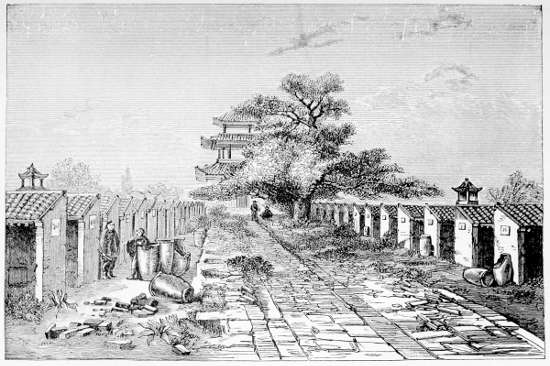
INTERIOR OF KUNG YUEN, OR ‘EXAMINATION HALL,’ PEKING.
Previous to entering the Kung Yuen, each candidate has given in all the necessary proofs and particulars, which entitle him to a cell, and receives the ticket which designates the one he is to occupy. He enters the night before, and is searched to see that no manuscript essay, “skinning paper,” or miniature edition of the classics, is secreted on his person. If anything of the sort is discovered, he is punished with the cangue, degraded from his first degree, and forbidden again to compete at the examination; his father and tutor are likewise punished. Some of the pieces written for this purpose are marvels of penmanship, and the most finished compositions; one set contained an essay on every sentence in the Four Books, each of the sheets covered with hundreds of characters, and the paper so thin that they could be easily read through it. The practice is, however, quite common, notwithstanding the penalties, and one censor requested a law to be passed forbidding small editions to be printed, and booksellers’ shops to be searched for them.
METHOD OF CONDUCTING THE EXAMINATION.
The general arrangement of the examination halls in all the provincial capitals is alike. A description of that at Canton, given on page 166, is typical of them all.
The Hall at Peking, situated on the eastern side, not far from the observatory, contains ten thousand cells, and these do not always suffice for the host which assembles. The Hall at Fuhchau is equally large; each cell is a little higher than a man’s head, and is open on but one side—letting in more rain and wind during inclement days than is comfortable. Confinement in these cramped cells is so irksome as to frequently cause the death of aged students, who are unable to sustain the fatigue, but who still enter the arena in hopes of at last succeeding. Cases have occurred where father, son, and grandson, appeared at the same time to compete for the same prize. Dr. Martin[282] found that out of a list of ninety-nine successful competitors for the second degree, sixteen were over forty years of age, one sixty-two, and one eighty-three. The average age of the whole number was over thirty—while in comparison with like statistics for the third degree, a proportionate increase might be looked for. The unpleasantness of the strait cell is much increased by the smoke arising from the cooking, and by the heat of the weather. All servants are provided by government, but each candidate takes in the rice and fuel which he needs, together with cakes, tea, candles, bedding, etc., as he can afford; no one can go in with him. The enclosure presents a bustling scene during the examination, and its interest intensifies until the names of the successful scholars are published. Should a student die in his cell, the body is pulled through a hole made in the wall of the enclosure, and left there for his friends to carry away. Whenever a candidate breaks any of the prescribed regulations of the contest, his name and offence are reported, and his name is “pasted out” by placarding it on the outer door of the hall, after which he is not allowed to enter until another examination comes around. More than a hundred persons are thus “pasted out” each season, but no heavy disgrace seems to attach to them in consequence.
On the first day after the doors have been sealed up, four themes are selected by the examiners from the Four Books, one of which subjects must be discussed in a poetical essay. The minimum length of the compositions is a hundred characters, and they must be written plainly and elegantly, and sent in without any names attached. In 1828, the acumen of four thousand eight hundred candidates was exercised during the first day on these themes: “Tsăng-tsz’ said, ‘To possess ability, and yet ask of those who do not; to know much, and yet inquire of those who know little; to possess, and yet appear not to possess; to be full, and yet appear empty.’”—“He took hold of things by the two extremes, and in his treatment of the people maintained the golden medium.”—“A man from his youth studies eight principles, and when he arrives at manhood, he wishes to reduce them to practice.”—The fourth essay, to be written in pentameters, had for its subject, “The sound of the oar, and the green of the hills and water.” Among the themes given out in 1843, were these: “He who is sincere will be intelligent, and the intelligent man will be faithful.”—“In carrying out benevolence, there are no rules.” In 1835, one was, “He acts as he ought, both to the common people and official men, receives his revenue from Heaven, and by it is protected and highly esteemed.” Among other more practical texts are the following: “Fire-arms began with the use of rockets in the Chau dynasty; in what book do we first meet with the word for cannon? Is the defence of Kaifung fu its first recorded use? Kublai khan, it is said, obtained cannon of a new kind; from whom did he obtain them? When the Ming Emperors, in the reign of Yungloh, invaded Cochinchina, they obtained a kind of cannon called the weapons of the gods; can you give an account of their origin?”
The three or five themes (for the number seems to be optional) selected from the Five Classics are similar to these, but as those works are regarded as more recondite than the Four Books, so must the essayists try to take a higher style. An officer goes around to gather in the papers, which are first handed to a body of scholars in waiting, who look them over to see if the prescribed rules have all been observed, and reject those which infringe them. The rest are then copied in red ink, to prevent recognition of the handwriting, and the original manuscripts given to the governor. The copies are submitted to another class of old scholars for their criticism, each of whom marks the essays he deems best with a red circle, and these only are placed in the hands of the chancellors sent from Peking for their decision. The examining board are aided by twelve scholars of repute, to each of whom forty or fifty essays are given to read. The students are dismissed during the night of the ninth day, and reassemble before sunrise of the eleventh; all whose essays were rejected on the first review are refused entrance to their cells. At the second tripos, five themes are given out from the Five Classics, and everything proceeds as before in respect to the disposal of the manuscripts. The students are liberated early on the thirteenth as before by companies, under a salute and music as they leave the great door; their number has been much reduced by this time. On the next morning the roll is called, and those who answer to their names for the last struggle are furnished with five themes for essays, one for poetry, taken from the classics or histories, upon doubtful matters of government, or such problems as might arise in law and finance. These questions take even a more extended range, including topics relating to the laws, history, geography, and customs of the Empire in former times, doubtful points touching the classical works, and the interpretation of obscure passages, and biographical notices of statesmen. It is forbidden, however, to discuss any points relating to the policy of the present family, or the character and learning of living statesmen; but the conduct of their rulers is now and then alluded to by the candidates. Manuals of questions on such subjects as candidates are examined in, are commonly exposed for sale in shops about the time of these examinations.[283] By noon of the sixteenth day of the eighth moon, all the candidates throughout the Empire have left their halls, and the examination is over.
EXAMPLE OF AN ESSAY.
The manner in which subjects are handled may be readily illustrated by introducing an essay upon this theme: “When persons in high stations are sincere in the performance of relative and domestic duties, the people generally will be stimulated to the practice of virtue.” It is a fair specimen of the jejune style of Chinese essayists, and the mode of reasoning in a circle which pervades their writings.
“When the upper classes are really virtuous, the common people will inevitably become so. For, though the sincere performance of relative duties by superiors does not originate in a wish to stimulate the people, yet the people do become virtuous, which is a proof of the effect of sincerity. As benevolence is the radical principle of all good government in the world, so also benevolence is the radical principle of relative duties amongst the people. Traced back to its source, benevolent feeling refers to a first progenitor; traced forward, it branches out to a hundred generations yet to come. The source of personal existence is one’s parents, the relations which originate from Heaven are most intimate; and that in which natural feeling blends is felt most deeply. That which is given by Heaven and by natural feeling to all, is done without any distinction between noble or ignoble. One feeling pervades all. My thoughts now refer to him who is placed in a station of eminence, and who may be called a good man. The good man who is placed in an eminent station, ought to lead forward the practice of virtue; but the way to do so is to begin with his own relations, and perform his duties to them.
“In the middle ages of antiquity, the minds of the people were not yet dissipated—how came it that they were not humble and observant of relative duties, when they were taught the principles of the five social relations? This having been the case, makes it evident that the enlightening of the people must depend entirely on the cordial performance of immediate relative duties. The person in an eminent station who may be called a good man, is he who appears at the head of all others in illustrating by his practice the relative duties. To ages nearer to our own, the manners of the people were not far removed from the dutiful; how came it that any were disobedient to parents, and without brotherly affection, and that it was yet necessary to restrain men by inflicting the eight forms of punishment? This having been the case, shows that in the various modes of obtaining promotion in the state, there is nothing regarded of more importance than filial and fraternal duties. The person in an eminent station who may be called a good man, is he who stands forth as an example of the performance of relative duties.
“The difference between a person filling a high station and one of the common people, consists in the department assigned them, not in their relation to Heaven; it consists in a difference of rank, not in a difference of natural feeling; but the common people constantly observe the sincere performance of relative duties in people of high stations. In being at the head of a family and preserving order amongst the persons of which it is composed, there should be sincere attention to politeness and decorum. A good man placed in a high station says, ‘Who of all these are not related to me, and shall I receive them with mere external forms?’ The elegant entertainment, the neatly arranged tables, and the exhilarating song, some men esteem mere forms, but the good man esteems that which dictates them as a divinely instilled feeling, and attends to it with a truly benevolent heart. And who of the common people does not feel a share of the delight arising from fathers, and brothers, and kindred? Is this joy resigned entirely to princes and kings?
“In favors conferred to display the benignity of a sovereign, there should be sincerity in the kindness done. The good man says, ‘Are not all these persons whom I love, and shall I merely enrich them by largesses?’ He gives a branch as the sceptre of authority to a delicate younger brother, and to another he gives a kingdom with his best instructions. Some men deem this as merely extraordinary good fortune, but the good man esteems it the exercise of a virtue of the first order, and the effort of inexpressible benevolence. But have the common people no regard for the spring whence the water flows, nor for the root which gives life to the tree and its branches? Have they no regard for their kindred? It is necessary both to reprehend and to urge them to exercise these feelings. The good man in a high station is sincere in the performance of relative duties, because to do so is virtuous, and not on account of the common people. But the people, without knowing whence the impulse comes, with joy and delight are influenced to act with zeal in this career of virtue; the moral distillation proceeds with rapidity, and a vast change is effected.
“The rank of men is exceedingly different; some fill the imperial throne, but every one equally wishes to do his utmost to accomplish his duty; and success depends on every individual himself. The upper classes begin and pour the wine into the rich goblet; the poor man sows his grain to maintain his parents; the men in high stations grasp the silver bowl, the poor present a pigeon; they arouse each other to unwearied cheerful efforts, and the principles implanted by Heaven are moved to action. Some things are difficult to be done, except by those who possess the glory of national rule; but the kind feeling is what I myself possess, and may increase to an unlimited degree. The prince may write verses appropriate to his vine bower; the poor man can think of his gourd shelter; the prince may sing his classic odes on fraternal regards; the poor man can muse on his more simple allusions to the same subject, and asleep or awake indulge his recollections; for the feeling is instilled into his nature. When the people are aroused to relative virtues, they will be sincere; for where are there any of the common people that do not desire to perform relative duties? But without the upper classes performing relative duties, this virtuous desire would have no point from which to originate, and therefore it is said, ‘Good men in high stations, as a general at the head of his armies, will lead forward the world to the practice of social virtues.’”
The discipline of mind and memory which these examinations draw out furnishes a grade of intellect which only needs the friction and experience of public life to make statesmen out of scholars, and goes far to account for the influence of Chinese in Asia. The books studied in preparation for such trials must be remembered with extraordinary accuracy, though we may wish they contained more truth and better science. The following are among the questions proposed in 1853, and must be taken as an average: “In the Han dynasty, there were three commentators on the Yih King, whose explanations, and divisions into chapters and sentences were all different: can you give an account of them?”—“Sz’ma Tsien took the classics and ancient records in arranging his history according to their facts; some have accused him of unduly exalting the Taoists and thinking too highly of wealth and power. Pan Ku is clear and comprehensive, but on Astronomy and the Five Elements, he has written more than enough. Give examples and proof of these two statements.”—“Chin Shao had admirable abilities for historical writings. In his San Kwoh Chí he has depreciated Chu-koh Liang, and made very light of Í and Í, two other celebrated characters. What does he say of them?” This kind of question involves a wide range of reading within the native literature, though it of course contracts the mind to look upon that literature as containing all that is worth anything in the world.
ARDUOUS LABORS OF THE EXAMINERS.
Twenty-five days are allowed for the examining board to decide on the essays; and few tasks can be instanced more irksome to a board of honest examiners than the perusal of between fifty and seventy-five thousand papers on a dozen subjects, through which the most monotonous uniformity must necessarily run, and out of which they have to choose the seventy or eighty best—for the number of successful candidates cannot vary far from this, according to the size of the province. The examiners, as has already been described, are aided by literary men in sifting this mass of papers, which relieves them of most of the labor, and secures a better decision. If the number of students be five thousand, and each writes thirteen essays, there will be sixty-five thousand papers, which allots two hundred and sixty essays for each of the ten examiners. With the help of the assistants who are intrusted with their examination, most of the essays obtain a reading, no doubt, by some qualified scholar. There is, therefore, no little sifting and selection, so that when at the last the commissioners choose three rolls of essays and poems from each of the sessions belonging to the same scholar, to pass their final judgment, the company of candidates likely to succeed has been reduced as small in proportion as those in Gideon’s host who lapped water. One of the examining committee, in 1832, who sought to invigorate his nerves or clear his intellect for the task by a pipe of opium, fell asleep in consequence, and on awaking, found that many of the essays had caught fire and been consumed. It is generally supposed that hundreds of them are unread, but the excitement of the occasion, and the dread on the part of the examining board to irritate the body of students, act as checks against gross omissions. Very trivial errors are enough to condemn an essay, especially if the examiners have not been gained to look upon it kindly. Section LII. of the code regulates the conduct of the examiners, but the punishments are slight. One candidate, whose essay had been condemned without being read, printed it, which led to the punishment of the examiner, degradation of the graduate, and promulgation of a law forbidding this mode of appealing to the public. Another essay was rejected because the writer had abbreviated a single character.