Volume 1 — CHAPTER VI. NATURAL HISTORY OF CHINA. (continued 2)
Reading edition
BEALE’S AVIARY.
The aviary here mentioned was for many years, up to 1838, one of the principal attractions of Macao. Its owner, Mr. Thomas Beale, had erected a wire cage on one side of his house, having two apartments, each of them about fifty feet high, and containing several large trees; small cages and roosts were placed on the side of the house under shelter, and in one corner a pool afforded bathing conveniences to the water-fowl. The genial climate obviated the necessity of any covering, and only those species which would agree to live quietly together were allowed the free range of the two apartments. The great attraction of the collection was a living bird of paradise, which, at the period of the owner’s death, in 1840, had been in his possession eighteen years, and enjoyed good health at that time. The collection during one season contained nearly thirty specimens of pheasants, and besides these splendid birds, there were upward of one hundred and fifty others, of different sorts, some in cages, some on perches, and others going loose in the aviary. In one corner a large cat had a hole, where she reared her young; her business was to guard the whole from the depredations of rats. A magnificent peacock from Damaun, a large assortment of macaws and cockatoos, a pair of magpies, another of the superb crowned pigeons (Goura coronata), one of whom moaned itself to death on the decease of its mate, and several Nicobar ground pigeons, were also among the attractions of this curious and valuable collection.
Four or five kinds of grebe and loon frequent the coast, of which the Podiceps cristatus, called shui nu, or ‘water slave,’ is common around Macao. The same region affords sustenance to the pelican, which is seen standing motionless for hours on the rocks, or sailing on easy wing over the shallows in search of food. Its plumage is nearly a pure white, except the black tips of the wings; its height is about four feet, and the expanse of the wings more than eight feet. The bill is flexible like whalebone, and the pouch susceptible of great dilatation. Gulls abound on the northeast coasts, and no one who has seen it can forget the beautiful sight on the marshes at the entrance of the Pei ho, where myriads of white gulls assemble to feed, to preen, and to quarrel or scream—the bright sun rendering their plumage like snow. The albatross, black tern, petrel, and noddy increase the list of denizens in Chinese waters, but offer nothing of particular interest.[198]
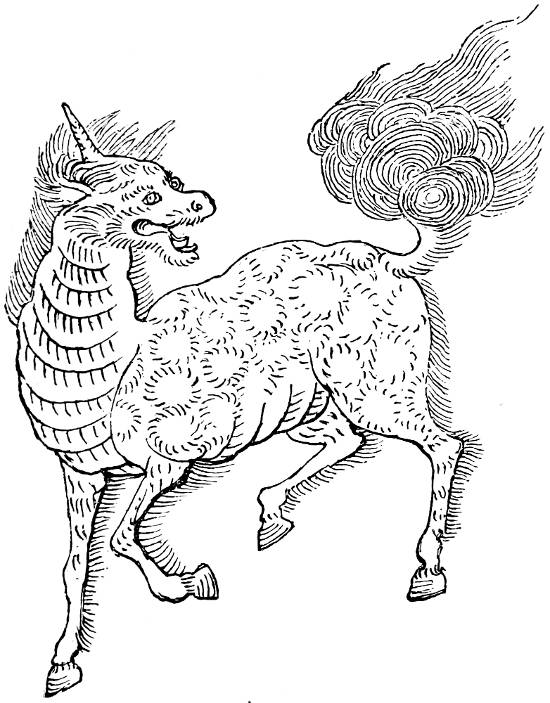
The Kí-lin, or Unicorn.
THE KÍ-LIN AND FUNG-HWANG.
There are four fabulous animals which are so often referred to by the Chinese as to demand a notice. The kí-lin is one of these and is placed at the head of all hairy animals; as the fung-hwang is pre-eminent among feathered races; the dragon and tortoise among the scaly and shelly tribes; and man among naked animals! The naked, hairy, feathered, shelly, and scaly tribes constitute the quinary system of ancient Chinese naturalists. The kí-lin is pictured as resembling a stag in its body and a horse in its hoofs, but possessing the tail of an ox and a parti-colored or scaly skin. A single horn having a fleshy tip proceeds out of the forehead. Besides these external marks to identify it, the kí-lin exhibits great benevolence of disposition toward other living animals, and appears only when wise and just kings, like Yau and Shun, or sages like Confucius, are born, to govern and teach mankind. The Chinese description presents many resemblances to the popular notices of the unicorn, and the independent origin of their account adds something to the probability that a single-horned equine or cervine animal has once existed.[199]
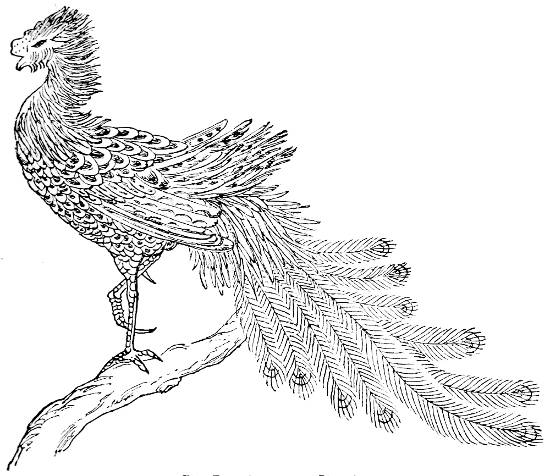
The Fung-hwang, or Phœnix.
Cuvier expresses the opinion that Pliny’s description of the Arabian phœnix was derived from the golden pheasant, though others think the Egyptian plover is the original type. From his likening it to an eagle for size, having a yellow neck with purple, a blue tail varied with red feathers, and a richly feathered tufted head, it is more probable that the Impeyan pheasant was Pliny’s type. The Chinese fung-hwang, or phœnix, is probably based on the Argus pheasant. It is described as adorned with every color, and combines in its form and motions whatever is elegant and graceful, while it possesses such a benevolent disposition that it will not peck or injure living insects, nor tread on growing herbs. Like the kí-lin, it has not been seen since the halcyon days of Confucius, and, from the account given of it, seems to have been entirely fabulous. The etymology of the characters implies that it is the emperor of all birds. One Chinese author describes it “as resembling a wild swan before and a unicorn behind; it has the throat of a swallow, the bill of a cock, the neck of a snake, the tail of a fish, the forehead of a crane, the crown of a mandarin drake, the stripes of a dragon, and the vaulted back of a tortoise. The feathers have five colors, which are named after the five cardinal virtues, and it is five cubits in height; the tail is graduated like Pandean pipes, and its song resembles the music of that instrument, having five modulations.” A beautiful ornament for a lady’s head-dress is sometimes made in the shape of the fung-hwang, and somewhat resembles a similar ornament, imitating the vulture, worn by the ladies of ancient Egypt.
THE LUNG, OR DRAGON.
The lung, or dragon, is a familiar object on articles from China. It furnishes a comparison among them for everything terrible, imposing, and powerful; and being taken as the imperial coat of arms, consequently imparts these ideas to his person and state. The type of the dragon is probably the boa-constrictor or sea-serpent, or other similar monster, though the researches of geology have brought to light such a near counterpart of the lung in the iguanadon as to tempt one to believe that this has been the prototype. There are three dragons, the lung in the sky, the lí in the sea, and the kiao in the marshes. The first is the only authentic species, according to the Chinese; it has the head of a camel, the horns of a deer, eyes of a rabbit, ears of a cow, neck of a snake, belly of a frog, scales of a carp, claws of a hawk, and palm of a tiger. On each side of the mouth are whiskers, and its beard contains a bright pearl; the breath is sometimes changed into water and sometimes into fire, and its voice is like the jingling of copper pans. The dragon of the sea occasionally ascends to heaven in water-spouts, and is the ruler of all oceanic phenomena.[200] The dragon is worshipped and feared by Chinese fishermen, and their lung-wang, or ‘dragon king,’ answers to Neptune in western mythology; perhaps the ideas of all classes toward it is a modified relic of the widespread serpent worship of ancient times. The Chinese suppose that elfs, demons, and other supernatural beings often transform themselves into snakes; and M. Julien has translated a fairy story of this sort, called Blanche et Bleue. The kwei, or tortoise, has so few fabulous qualities attributed to it that it hardly comes into the list; it was, according to the story, an attendant on Pwanku when he chiselled out the world. A semi-classical work, the Shan-hai King, or ‘Memoirs upon the Mountains and Seas,’ contains pictures and descriptions of these and kindred monsters, from which the people now derive strange notions respecting them, the book having served to embody and fix for the whole nation what the writer anciently found floating about in the popular legends of particular localities.
A species of alligator (A. sinensis) has been described by Dr. A. Fauvel in the N. C. Br. R. A. Soc. Journal, No. XIII., 1879, in which he gives many historical and other notices of its existence. Crocodiles are recorded as having been seen in the rivers of Kwangtung and Kwangsí, but none of this family attain a large size.
Marco Polo’s account of the huge serpent of Yunnan,[201] having two forelegs near the head, and one claw like that of a lion or hawk on each, and a mouth big enough to swallow a man whole, referring no doubt to the crocodile, is a good instance of the way in which truth and fable were mingled in the accounts of those times. The flesh is still eaten by the Anamese, as he says it was in his day. A gigantic salamander, analogous to the one found in Japan (the Sieboldia), has suggested it as the type of the dragon which figures on the Chinese national flag. Small lizards abound in the southern parts, and the variety and numbers of serpents, both land and water, found in the maritime provinces, are hardly exceeded in any country in the world; they are seldom poisonous. A species of naja is the only venomous snake yet observed at Chusan, and the hooded cobra is one of the few yet found around Canton. Another species frequents the banks, and is driven out of the drains and creeks by high water into the houses. A case is mentioned by Bennet of a Chinese who was bitten, and to whose wound the mashed head of the reptile had been applied as a poultice, a mode of treatment which probably accelerated his death by mixing more of the poison diluted in the animal’s blood with the man’s own blood. It is, however, rare to hear of casualties from this source. This snake is called ‘black and white,’ from being marked in alternate bands of those two colors. A species of acrochordon, remarkable for its abrupt, short tail, has been noticed near Macao.
It is considered felicitous by the Buddhist priests to harbor snakes around their temples; and though the natives do not play with poisonous serpents like the Hindoos, they often handle or teach them simple tricks. The common frog is taken in great numbers for food. Tortoises and turtles from fresh and salt water are plenty along the coast, while both the emys and trionyx are kept in tubs in the streets, where they grow to a large size. An enormous carnivorous tortoise inhabits the waters of Chehkiang near the ocean. The natives have strange ideas concerning the hairy turtle of Sz’chuen, and regard it as excellent medicine; it is now known that the supposed hair consists of confervæ, whose spores, lodged on the shell, have grown far beyond the animal’s body.
ICHTHYOLOGY OF CHINA.
The ichthyology of China is one of the richest in the world, though it may be so more from the greater proportion of food furnished by the waters than from any real superabundance of the finny tribes. The offal thrown from boats near cities attracts some kinds to those places, and gives food and employment to multitudes. Several large collections of fishes have been made in Canton, and Mr. Reeves deposited one of the richest in the British Museum, together with a series of drawings made by native artists from living specimens; they have been described by Sir John Richardson in the Report of the British Association for the Advancement of Science, for 1845. In this paper he enumerates one hundred and ninety genera and six hundred and seventy-one species, nearly all of which are marine or come out to sea at certain times. Since it was prepared great accessions to this branch have been made from the inland waters, so that probably a thousand sorts in all have been observed. The salmon and cod families are comparatively scarce, but the mackerel, goby, and herring families are very abundant. The variety of fish is so great in Macao, that if one is willing to eat all that are brought to market, as the Chinese do (including the sharks, torpedoes, gudgeons, etc.), one can have a different species every day in the year. It may with truth be said that the Chinese eat nearly every living thing found in the water, some of the hideous fishing frogs or gurnards alone excepted.
The cartilaginous fishes, sharks, rays, and saw-fish, are abundant on the sea-coast. The sturgeon is not common at the south, but in the winter it is brought from the Songari and other rivers to Peking for the imperial table, being highly prized by Chinese epicures. There is found in the Yangtsz’ a singular species of sturgeon, the yiu yü, which lies under the banks in still water and sucks its prey into a sac-like mouth projecting like a cusp under the long snout; it has no scales, and is four feet long. Common sturgeon, weighing a thousand pounds, are caught in this river. The hammer-headed and zebra shark (Cestracion zebra) are seen in the markets at Macao; also huge skates, some of them measuring five feet across; the young of all these species are regarded as particularly good eating. A kind of torpedo (Narcine lingula) is not uncommon on the southern coast, but the natives do not seem to be aware of any electrical properties. It is said that the fishermen sometimes destroy the shark by boiling a melon and throwing it out as a bait; when swallowed, the heat kills the fish. The true cod has not been observed on the Chinese coast, but several species of serrani (as Plectropoma susuki, Serranus shihpan, Megachir, etc.), generally called shih-pan by the natives, and garoupa by foreigners, are common off Canton, and considered to be most delicate fare. Another fine fish is the Polynemus tetradactylus, or bynni-carp, often called salmon by foreigners; isinglass is prepared from its skin. The pomfret, or tsang yü (Stromateus argenteus), is a good pan-fish, but hardly so delicate as the sole, many fine species of which abound along the whole coast. Besides these, two or three species of mackerel, the Sciœna lucida, an ophicephalus, the mullet, and the ‘white rice fish’ occur. The shad is abundant off the Yangtsz’, and is superior to the American species; Chinese epicures will sometimes pay fifty dollars for the first one of the season.
The carp family (Cyprinidæ) is very abundant in the rivers and lakes of China, and some species are reared in fish-pools and tubs to a monstrous size; fifty-two species are mentioned in Richardson’s list. The gold-fish is the most celebrated, and has been introduced into Europe, where it was first seen toward the end of the seventeenth century. The Chinese say that its native place is Lake Tsau, in the province of Nganhwui. The effects of domestication in changing the natural form of this fish are great; specimens are often seen without any dorsal fin, and the tail and other fins tufted and lobed to such a degree as to resemble artificial appendages or wings rather than natural organs. The eyes are developed till the globe projects beyond the socket like goggles, presenting an extraordinary appearance. Some of them are so fantastic, indeed, that they would be regarded as lusus naturæ were they not so common. The usual color is a ruddy golden hue, but both sexes exhibit a silvery or blackish tint at certain stages of their growth; and one variety, called the silver-fish, retains this shade all its life. The Chinese keep it in their garden ponds, or in earthern jars, in which are placed rocks covered with moss, and overgrown with tufts of ferns, to afford them a retreat from the light. When the females spawn, the eggs must be removed to a shallow vessel, lest the males devour them, where the heat of the sun hatches them; the young are nearly black, but gradually become whitish or reddish, and at last assume a golden or silvery hue. Specimens upward of two feet long have been noticed, and those who rear them emulate each other in producing new varieties.
METHODS OF REARING FISH.
The rearing of fish is an important pursuit, the spawn being collected with the greatest care and placed in favorable positions for hatching. The Bulletin Universel for 1829 asserts that in some part of China the spawn so taken is carefully placed in an empty egg-shell and the hole closed; the egg is then replaced in the nest, and, after the hen has sat a few days upon it, reopened, and the spawn placed in vessels of water warmed by the sun, where it soon hatches.
The immense fleets of fishing boats on the Yangtsz’ and its tributaries indicate the finny supplies its waters afford. A species of pipe-fish (Fistularia immaculata), of a red color, and the gar-pike, with green bones, are found about Canton; as are also numerous beautiful parrot-fish and sun-fish (Chætodon). An ingenious mode of taking its prey is practised by a sort of chætodon, or chelmon; it darts a drop of water at the flies or other insects lighting on the bank near the edge, in such a manner as to knock them off, when they are devoured. All the species of ophicephalus, or săng yü, so remarkable for their tenacity of life, are reared in tanks and pools, and are hawked alive through the streets.
Eels, mullets, alewives or file-fish, breams, gudgeons, and many other kinds, are seen in the markets. Few things eaten by the Chinese look more repulsive than the gobies as they lie wriggling in the slime which keeps them alive; one species (Trypauchen vagina), called chu pih yü, or ‘vermilion pencil-fish,’ is a cylindrical fish, six or eight inches long, of a dark red color; its eyes protrude so that it can see behind, like a giraffe. Some kinds of gobies construct little hillocks in the ooze, with a depression on the top, in which their spawn is hatched by the sun; at low tide they skip about on the banks like young frogs, and are easily captured with the hand. A delicious species of Saurus (Leucosoma Chinensis), called pih fan yü, or ‘white rice fish,’ and yin yü, or silver-fish, ranges from Hakodate to Canton. It is six or eight inches long, the body scaleless and transparent, so that the muscles, intestines, and spinal column can be seen without dissection; the bones of the head are thin, flexible, and diaphanous. Many species of file-fish, sole-fish, anchovy, and eels, are captured on the coast. Vast quantities of dried fish, like the stock fish in Sweden, are sent inland to sell in regions where fish are rare. The most common sorts are the perch, sun-fish, gurnard, and hair-tail (Trichinrus).
SHELL-FISH AND INSECTS OF CHINA.
Shell-fish and mollusks, both fresh and salt, are abundant in the market. Oysters of a good quality are common along the coast, and a species of mactra, or sand-clam, is fished up near Macao. The Pearl River affords two or three kinds of fresh-water shell-fish (Mytilus), and snails (Voluta) are plenty in all pools. The crangons, prawns, shrimps, crabs, and other kinds of crustacea met with, are not less abundant than palatable; one species of craw-fish, as large as (but not taking the place of) the lobster, called lung hai, or ‘dragon crab,’ together with cuttle-fish of three or four kinds, and the king-crab (Polyphemus), are all eaten. The inland waters produce many species of shells, and the new genus theliderma, allied to the unio, was formed by Mr. Benson, of Calcutta, from specimens obtained of a shopkeeper at Canton. The land shells are abundant, especially various kinds of snails (Helix, Lymnea, etc.); twenty-two species of helix alone were contained in a small collection sent from Peking, in which region all this kind of food is well known. A catalogue of nearly sixty shells obtained in Canton is given in Murray’s China,[202] but it is doubtful whether even half of them are found in the country, as the shops there are supplied in a great degree from the Archipelago. Dr. Cantor[203] mentions eighty-eight genera of shells occurring between Canton and Chusan. Pearls are found in China, and Marco Polo speaks of a salt lake, supposed now to be in Yunnan, which produced them in such quantity that the fishery in his day was farmed out and restricted lest they should become too cheap and common. In Chehkiang the natives take a large kind of clam (Alasmodonta) and gently attach leaden images of Buddha under the fish, after which it is thrown back into the water. Nacre is deposited over the lead, and after a few months the shells are retaken, cleaned, and then sent abroad to sell as proofs of the power and presence of Buddha. The Quarterly Review speaks of a mode practised by the Chinese of making pearls by dropping a string of small mother-of-pearl beads into the shell, which in a year are covered with the pearly crust. Leeches are much used by native physicians; the hammer-headed leech has been noticed at Chusan.
The insects of China are almost unknown to the naturalist. In Dr. Cantor’s collection, from Chusan, there are fifty-nine genera mentioned, among which tropical forms prevail; there are also six genera of arachnidæ, and the list of spiders could easily be multiplied to hundreds; among them are many showing most splendid coloring. One large and strong species is affirmed to capture small birds on the trees. Locusts sometimes commit extensive ravages, and no part of the land is free from their presence, though their depredations do not usually reach over a great extent of country, or often for two successive years. They are, however, sufficiently troublesome to attract the notice of the government, as the edict against them, inserted in another chapter, proves. Centipedes, scorpions, and some other species in the same order are known, the former being most abundant in the central and western regions, where scorpions are rare.
The most valuable insect is the silkworm, which is reared in nearly every province, and the silk from other wild worms found on the oak and ailantus in Shantung, Sz’chuen, and elsewhere also gathered; the proper silkworm itself has been met with to some extent in northern Shansí and Mongolia. Many other insects of the same order (Lepidopteræ) exist, but those sent abroad have been mostly from the province of Kwangtung. Eastward of the city of Canton, on a range of hills called Lofau shan, large butterflies and night moths of immense size and brilliant coloring are captured. One of these insects (Bombyx atlas) measures about nine inches across; the ground color is a rich and varied orange brown, and in the centre of each wing there is a triangular transparent spot, resembling a piece of mica. Sphinxes of great beauty and size are common, and in their splendid coloring, rapid noiseless flight from flower to flower, at the close of the day, remind one of the humming-bird. Some families are more abundant than others; the coleopterous exceed the lepidopterous, and the range of particular tribes in each of these is often very limited. The humid regions of Sz’chuen furnished a great harvest of beautiful butterflies to M. David, while the lamellicorn beetles and cerambycidæ are the most common in the north and central parts.
COLEOPTERÆ AND THE WAX WORM.
Many tribes of coleopterous insects are abundant, but the number of species yet identified is trifling. Several water beetles, and others included under the same general designation, have been found in collections sold at Canton, but owing to the careless manner in which those boxes are filled, very few specimens are perfect, the antennæ or tarsi being broken. The mole-cricket occurs everywhere. The common cricket is caught and sold in the markets for gambling; persons of all ranks amuse themselves by irritating two of these insects in a bowl, and betting upon the prowess of their favorites. The cicada, or broad locust, is abundant, and its stridulous sound is heard from trees and groves with deafening loudness. Boys tie a straw around the abdomen of the male, so as to irritate the sounding apparatus, and carry it through the streets in this predicament, to the great annoyance of every one. This insect was well known to the Greeks; the ancient distich—
“Happy the cicadas’ lives, For they all have voiceless wives,”
hints at their knowledge of this sexual difference, as well as intimates their opinion of domestic quiet. Again it forms the subject of Meleager’s invocation:
“O shrill-voiced insect! that with dew-drops meet, Inebriate, dost in desert woodlands sing; Perch’d on the spray top with indented feet, Thy dusky body’s echoings harp-like ring.”
The lantern-fly (Fulgora) is less common than the cicada. It is easily recognized by its long cylindrical snout, arched in an upward direction, its greenish reticulated elytra, and orange-yellow wings with black extremities; but its appearance in the evening is far from being as luminous as are the fire-fly and glow-worm of South America. The Peh lah shu, or ‘white wax tree’ (Fraxinus chinensis), affords nourishment to an insect of this order called Coccus pela. The larvæ alone furnish the wax, the secretion being the result of disease. Sir Geo. L. Staunton first described the fly from specimens seen in Annam in 1795, where the natives collected a white powder from the bark of the tree on which it occurs. Daniel Hanbury figured the insect and tree with the deposit of crude wax on the limbs, all obtained in Chekhiang province.[204] Baron Richthofen speaks of this industry in Sz’chuen as one furnishing employment to great multitudes. The department of Kia-ting furnishes the best wax, as its climate is warmer than Chingtu. The eggs of the insect are gathered in Kien-chang and Ning-yuen, where the tree flourishes on which it deposits them, and its culture is carefully attended to. The insect lives and breeds on this evergreen, and in April the eggs are collected and carried up to Kia-ting by porters. This journey is mostly performed by night so as to avoid the risk of hatching their loads; 300 eggs weigh one tael. They are instantly placed on the same kind of tree, six or seven balls of eggs done up in palm-leaf bags and hung on the twigs. In a few days the larvæ begin to spread over the branches, but do not touch the leaves; the bark soon becomes incrusted with a white powder, and is not disturbed till August. The loaded branches are then cut off and boiled, when the wax collects on the surface of the water, is skimmed off, and melted again to be poured into pans for sale. A tael’s weight of eggs will produce two or three catties of the translucent, highly crystalline wax; it sells there for five mace a tael and upward. The annual income is reckoned at Tls. 2,000,000.[205] The purposes to which this singular product are applied include all those of beeswax. Pills are ingeniously enclosed in small globes of it, and candles of every size made. Wax is also gathered from wild and domestic bees, but honey is not much used; a casing of wax, colored with vermilion, is used to inclose the tallow of great painted candles set before the idols and tablets.
The Chinese Herbal contains a singular notion, prevalent also in India, concerning the generation of the sphex, or solitary wasp. When the female lays her eggs in the clayey nidus she makes in houses, she encloses the dead body of a caterpillar in it for the subsistence of the worms when they hatch. Those who observed her entombing the caterpillar did not look for the eggs, and immediately concluded that the sphex took the worm for her progeny, and say that as she plastered up the hole of the nest, she hummed a constant song over it, saying, “Class with me! Class with me!”—and the transformation gradually took place, and was perfected in its silent grave by the next spring, when a winged wasp emerged to continue its posterity in the same mysterious way.[206]
White ants are troublesome in the warmer parts, and annoy the people there by eating up the coffins in the graves. They form passages under ground, and penetrate upward into the woodwork of houses, and the whole building may become infested with them almost before their existence is suspected. They will even eat their way into fruit trees, cabbages, and other plants, destroying them while in full vigor. Many of the internal arrangements of the nests of bees and ants, and their peculiar instincts, have been described by Chinese writers with considerable accuracy. The composition of the characters for the bee, ant, and mosquito, respectively, denote the awl insect, the righteous insect, and the lettered insect; referring thereby to the sting of the first, the orderly working and subordination of the second, and the letter-like markings on the wings of the latter. Mosquitoes are plenty, and gauze curtains are considered to be a more necessary part of bed furniture than a mattress.
RESEARCHES IN THE BOTANY OF CHINA.
The botany of China is rather better known than its zoölogy, though vast and unexplored fields, like that reaching from Canton to Silhet and Assam, still invite the diligent collector to gather, examine, and make known their treasures. One of the earliest authors in this branch was Père Loureiro, a Portuguese for thirty-six years missionary in Cochinchina, and professor of mathematics and physic in the royal palace. He gathered a large herbarium there and in southern Kwangtung, and published his Flora Cochinchinensis in 1790, in which he described one hundred and eighty-four genera and more than three hundred new species. The only other work specially devoted to Chinese botany is Bentham’s Flora Hongkongensis, published in 1861. The materials for it were collected by Drs. Hinds, Hance and Harland, Col. Champion, and others, during the previous twenty years, and amounted in all to upward of five thousand specimens, gathered exclusively on the island. Since its publication, Dr. Hance has added to our accurate knowledge of the Chinese flora many new specimens growing in other parts of the Empire, whose descriptions are scattered through various publications. Père David, during his extensive travels in northern China, gathered thousands of specimens which have yet to be carefully described. The Russian naturalists Maximowitch, Bunge, Tatarinov, Bretschneider, Prejevalsky, and others have largely increased our knowledge of the plants of Mongolia, the Amur basin, and the region about Peking. The first named has issued a separate work on the Amur flora, but most of the papers of these scientists are to be found in periodicals. In very early days, China was celebrated for the camphor, varnish, tallow, oil, tea, cassia, dyes, etc., obtained from its plants; and the later monographs of professed botanists, issued since Linneus looked over the two hundred and sixty-four species brought by his pupil Osbeck in 1750, down to the present day, have altogether given immense assistance to a thorough understanding of their nature and value.
Mr. Bentham’s observations on the range of the plants collected in the island of Hongkong represent its flora, in general character, as most like that of tropical Asia, of which it offers, in numerous instances, the northern limit. The damp, wooded ravines on the north and west furnish plants closely allied to those of Assam and Sikkim; while other species, in considerable numbers, have a much more tropical character, extending with little variation over the Archipelago, Malaysia, Ceylon, and even to tropical Africa, but not into India. Within two degrees north of the island these tropical features (so far as is known) almost entirely cease, and out of the one thousand and fifty-six species described in the Flora Hongkongensis, only about eighty have been found in Japan; thus indicating that very few of the plants known to range across from the Himalaya to Japan grow south of Amoy. On the twenty-nine square miles forming the area of Hongkong there exists, Mr. Bentham says, a greater number of monotypic genera than in any other flora from an equal area in the world; he gives a comparative table of the floras of Hongkong, Aden and Ischia islands, about equal in extent, showing one thousand and three species growing on the first, ninety-five on the second, and seven hundred and ninety-two on the third. The proportion of woody to herbaceous species in Hongkong is nearly one-half, while in Ischia it is one to eleven; yet Hongkong has actually fewer trees than Ischia. Out of the one thousand and three species of wild plants there, three hundred and ninety-eight also occur in the tropical Asiatic flora, while one hundred and eighty-seven others have been found as well on the mainland; one hundred and fifty-nine are peculiar to the island.
CONIFERÆ AND GRASSES.
Many species of coniferæ are floated down to Canton, taken from the Mei ling, or brought from Kwangsí; the timber is used for fuel, but more for rafters and pillars in buildings. The wood of the pride of India is employed for cabinet work; there are also many kinds of fancy wood, some of which are imported, and more are indigenous. The nan muh, or southern wood, a magnificent species of laurus common in Sz’chuen, which resists time and insects, is peculiarly valuable, and reserved for imperial use. The cœsalpinia, rose wood, aigle wood, and the camphor, elm, willow, and aspen, are also serviceable in carpentry.
The people collect seaweed to a great extent, using it in the arts and also for food; among these the Gigartina tenax affords an excellent material for glues and varnishes. It is boiled, and the transparent glue obtained is brushed upon very coarse silk or mulberry paper, filling up their substance, and making a transparent covering for lanterns; it is also used as a size for stiffening silks and gauze. This and other kinds of fuci are boiled to a jelly and used for food; it is known in commerce under the name of agar-agar. The thick fronds of the laminaria are gathered on the northern coasts and imported from Japan. Among other cryptogams, the Tartarian lamb (Aspidium barometz), so graphically described by Darwin in his Botanic Garden, has long been celebrated; it is partly an artificial production of the ingenuity of Chinese gardeners taking advantage of the natural habits of the plant to form it into a shape resembling a sheep or other object.
Among remarkable grasses the zak or saxaul (Haloxylon) and the sulhir (Agriophyllum), which grow in the sandy parts of the desert of Gobi, should be mentioned. The first is found across the whole length of this arid region, growing on the bare sand, furnishing to the traveller a dry and ready fuel in its brittle twigs, while his camels greedily browse on its leafless but juicy and prickly branches. The Mongols pitch their tents beneath its shelter, seeking for some covert from the wintry winds, and encouraged to dig at its roots for water which has been detained by their succulent nature, a wonderful provision furnished by God in the bleakest desert. The sulhir is even more important, and is the “gift of the desert.” It grows on bare sand, is about two feet high, a prickly saline plant, producing many seeds in September, of a nutritious, agreeable nature, food for man and beast.
The list of gramineous plants cultivated for food is large; the common sorts include rice, wheat, barley, oats, maize, sugar-cane, panic, sorghum, spiked and panicled millet, of each kind several varieties. The grass (Phragmites) raised along the river banks is carefully cut and dried, to be woven into floor-matting; a coarser sort, called atap, is made of bamboo splints for roofs of huts, awnings, and sheds. In the milder climes of the southern coasts, cheap houses are constructed of these materials. The coarse grass and shrubbery on the hills is cut in the autumn for fuel by the poor; and when the hills are well sheared of their grassy covering, the stubble is set on fire, in order to supply ashes for manuring the next crop—an operation which tends to keep the hills bare of all shrubbery and trees.
THE BAMBOO—ITS BEAUTY AND USEFULNESS.
Few persons who have not seen the bamboo growing in its native climes get a full idea from pictures of its grace and beauty. A clump of this magnificent grass will gradually develop by new shoots into a grove, if care be taken to cut down the older stems as they reach full maturity, and not let them flower and go to seed; for as soon as they have perfected the seed, they die down to the root, like other grasses. The stalks usually attain the height of fifty feet, and in the Indian islands often reach seventy feet and upward, with a diameter of ten or twelve inches at the bottom. A road lined with them, with their feathery sprays meeting overhead, presents one of the most beautiful avenues possible to a warm climate.
In China the industry and skill of the people have multiplied and perpetuated a number of varieties (one author contents himself with describing sixty of them), among which are the yellow, the black, the green, the slender sort for pipes, and a slenderer one for writing-pencils, the big-leaved, etc. Its uses are so various that it is not easy to enumerate them all. The shoots come out of the ground nearly full-sized, four to six inches in diameter, and are cut like asparagus to eat as a pickle or a comfit, or by boiling or stewing. Sedentary Buddhist priests raise this lenten fare for themselves or to sell, and extract the tabasheer from the joints of the old culms, to sell as a precious medicine for almost anything which ails you. The roots are carved into fantastic and ingenious images and stands, or divided into egg-shaped divining-blocks to ascertain the will of the gods, or trimmed into lantern handles, canes, and umbrella-sticks.
The tapering culms are used for all purposes that poles can be applied to in carrying, propelling, supporting, and measuring, for which their light, elastic, tubular structure, guarded by a coating of silicious skin, and strengthened by a thick septum at each joint, most admirably fits them. The pillars and props of houses, the framework of awnings, the ribs of mat-sails, and the shafts of rakes are each furnished by these culms. So, also, are fences and all kinds of frames, coops, and cages, the wattles of abatis, and the ribs of umbrellas and fans. The leaves are sewed into rain-cloaks for farmers and sailors, and thatches for covering their huts and boats, pinned into linings for tea-boxes, plaited into immense umbrellas to screen the huckster and his stall from the sun and rain, or into coverings for theatres and sheds. Even the whole lot where a two-story house is building is usually covered in by a framework of bamboo-poles and attap—as this leaf covering is called, from its Malay name—all tied together by rattan, and protecting the workmen and their work from sun and rain.
The wood, cut into splints of proper sizes and forms, is woven into baskets of every shape and fancy, sewed into window-curtains and door-screens, plaited into awnings and coverings for tea-chests or sugar-cones, and twisted into cables. The shavings and curled threads aid softer things in stuffing pillows; while other parts supply the bed for sleeping, the chopsticks for eating, the pipe for smoking, and the broom for sweeping. The mattress to lie upon, the chair to sit upon, the table to eat on, the food to eat, and the fuel to cook it with, are also derivable from bamboo. The master makes his ferule from it, the carpenter his foot-measure, the farmer his water-pipes, irrigating wheels, and straw-rakes, the grocer his gill and pint cups, and the mandarin his dreaded instrument of punishment. This last use is so common that the name of the plant itself has come in our language to denote this application, and the poor wretch who is bambooed for his crimes is thus taught that laws cannot be violated with impunity.
The paper to write on, the book to study from, the pencil to write with, the cup to hold the pencils, and the covering of the lattice-window instead of glass are all indebted to this grass in their manufacture. The shaft of the soldier’s spear, and oftentimes the spear altogether, the plectrum for playing the lute, the reed in the native organ, the skewer to fasten the hair, the undershirt to protect the body, the hat to screen the head, the bucket to draw the water, and the easy-chair to lounge on, besides cages for birds, fish, bees, grasshoppers, shrimps, and cockroaches, crab-nets, fishing-poles, sumpitans or shooting-tubes, flutes, fifes, fire-holders, etc., etc., are among the things furnished from this plant, whose beauty when growing is commensurate to its usefulness when cut down. A score or two of bamboo-poles for joists and rafters, fifty fathoms of rattan ropes, with plenty of palm-leaves and bamboo-matting for roof and sides, supply material for a common dwelling in the south of China. Its cost is about five dollars. Those houses built over creeks, or along the low banks of rivers and sea-beaches, are elevated a few feet, and their floors are neatly made of split bamboos, which allow the water to be seen through. The decks, masts, yards, and framework of the mat-sails of the small boats of the islanders in the Archipelago are all more or less made of this useful plant. Throughout the south of Asia it enters into the daily life of the people in their domestic economy more than anything else, or than any other one thing does in any part of the world. The Japanese supply us with fans neatly formed, ribs and handle, from a single branch of bamboo, and covered with paper made from mulberry bark, while their skill is shown also in the exquisite covering of fine bamboo threads woven around cups and saucers.[207]
PALMS, YAMS, PLANTAINS, ETC.
In ancient times the date palm was cultivated in China, but is now unknown. The cocoanut flourishes in Hainan and the adjacent coasts, where its fruit, leaves, and timber are much used. A great variety of utensils are carved from the nut-case, and ropes spun from the coir, while the cultivators drink the toddy made from the juice. The fan palm (Chamærops) is the common palm of the country, two species being cultivated for the wiry fibres in the leaf-sheaths, and for their broad leaves. This fibre is far more useful than that from cocoanut husks, as it is longer and smoother, and is woven into ropes, mats, cloaks, and brushes. The tree is spread over the greater part of the provinces, one of their most ornamental and useful trees. Another sort (Caryota) also furnishes a fibre employed in the same way, but its timber is more valuable; sedan thills are made of its wood. Still another is the talipot palm (Borassus), from whose leaves a material for writing books upon was once produced, as is the case now in Siam.[208]
Several species of Aroideæ are cultivated, among which the Caladium cuculatum, Arum esculentum, and Indicum are common. The tuberous farinaceous roots of the Sagittaria sinensis are esteemed; the roots of these plants, and of the water-chestnut, are manufactured into a powder resembling arrow-root. The sweet flag (Calamus) is used in medicine for its spicy warmth. The stems of a species of Juncus are collected and the pith carefully taken out and dried for the wicks of water-lamps, and the inner layers of the pith hats so generally worn in southern China.
The extensive group of lillies contains many splendid ornaments of the conservatory and garden, natives of China; some are articles of food. The Agapanthus, or blue African lily, four species of Hemerocallis, or day lily, and the fragrant tuberose, are all common about Canton; the latter is widely cultivated for its blossoms to scent fancy teas. Eight or ten species of Lilium (among which the speckled tiger lily and the unsullied white are conspicuous) also add their gay beauties to the gardens; while the modest Commelina, with its delicate blue blossoms, ornaments the hedges and walks. Many alliaceous plants, the onion, cives, garlic, etc., belong to this group; and the Chinese relish them for the table as much as they admire the flowers of their beauteous and fragrant congeners for bouquets. The singular red-leaved iron-wood (Dracæna) forms a common ornament of gardens.
The yam, or ta-shu (i.e., ‘great tuber’), is not much raised, though its wholesome qualities as an article of food are well understood. The same group (Musales) to which the yam belongs furnishes the custard-apple, one of the few fruits which have been introduced from abroad. The Amaryllidæ are represented by many pretty species of Crinum, Nerine, and Amaryllis. Their unprofitable beauty is compensated by the plain but useful plantain, said to stand before the potato and sago palm as producing the greatest amount of wholesome food, in proportion to its size, of any cultivated plant.[209] There are many varieties of this fruit, some of them so acid as to require cooking before eating.
That pleasant stomachic, ginger, is cultivated through all the country, and exposed for sale as a green vegetable, to spice dishes, and largely made into a preserve. The Alpinia and Canna, or Indian shot, are common garden flowers. The large group of Orchideæ has nineteen genera known to be natives of China, among which the air plants (Vanda and Ærides) are great favorites. They are suspended in baskets under the trees, and continue to unfold their blossoms in gradual succession for many weeks, all the care necessary being to sprinkle them daily. The true species of Ærides are among the most beautiful productions of the vegetable world, their flowers being arrayed in long racemes of delicate colors and delicious fragrance. The beautiful Bletia, Arundina, Spathoglottis, and Cymbidium are common in damp and elevated places about the islands near Macao and Hongkong.
FOREST TREES, HEMP, ETC.
Many species of the pine, cypress, and yew, forming the three subdivisions of cone-bearing plants, furnish a large proportion of the timber and fuel. The larch is not rare, and the Pinus massoniana and Cunninghamia furnish most of the common pine timber. The finest member of this order in China is the white pine (Pinus bungiana), peculiar to Chihlí; its trunk is a clear white, and as it annually sheds the bark it always looks as if whitewashed. Some specimens near Peking are said to be a thousand years old. Two members of the genus Sequoia, of a moderate size, occur near Tibet. The juniper and thuja are often selected by gardeners to try their skill in forcing them to grow into rude representations of birds and animals, the price of these curiosities being proportioned to their grotesqueness and difficulty. The nuts of the maiden-hair tree (Salisburia adiantifolia) are eaten, and the leaves are sometimes put into books as a preservative against insects.
The willow is a favorite plant and grows to a great size, Staunton mentioning some which were fifteen feet in girth; they shade the roads near the capital, and one of them is the true Babylonian willow; the trees are grown for timber and for burning into charcoal. Their leaves, shape, and habits afford many metaphors to poets and writers, much more use being made of the tree in this way, it might almost be said, than any other. The oak is less patronized by fine writers, but the value of its wood and bark is well understood; the country affords several species, one of which, the chestnut oak, is cultivated for the cupules, to be used in dyeing. The galls are used for dyeing and in medicine, and the acorns of some kinds are ground in mills, and the flour soaked in water and made into a farinaceous paste. Some of the missionaries speak of oaks a hundred feet high, but such giants in this family are rare. “One of the largest and most interesting of these trees, which,” writes Abel, “I have called Quercus densifolia, resembled a laurel in its shining green foliage. It bore branches and leaves in a thick head, crowning a naked and straight stem; its fruit grew along upright spikes terminating the branches. Another species, growing to the height of fifty feet, bore them in long, pendulous spikes.”
The chestnut, walnut, and hazelnut together furnish a large supply of food. The queer-shaped ovens fashioned in imitation of a raging lion, in which chestnuts are roasted in the streets of Peking, attract the eye of the visitor. The Jack-fruit (Artocarpus) is not unknown in Canton, but it is not much used. There are many species of the banian, but none of them produce fruit worth plucking; the Portuguese have introduced the common fig, but it does not flourish. The bastard banian is a magnificent shade tree, its branches sometimes overspreading an area a hundred or more feet across. The walls of cities and dwellings are soon covered with the Ficus repens, and if left unmolested its roots gradually demolish them. The paper mulberry (Broussonetia) is largely cultivated in the northern provinces, and serves the poor with their chief material for windows. The leaf of the common mulberry is the principal object of its culture, but the fruit is eaten and the wood burned for lampblack to make India-ink.
Hemp (Cannabis) is cultivated for its fibres, and the seeds furnish an oil used for household purposes and medicinal preparations; the intoxicating substance called bang, made in India, is unknown in China. The family Proteaceæ contains the Eleococca cordata, or wu-tung, a favorite tree of the Chinese for its beauty, the hard wood it furnishes, and the oil extracted from its seeds. The Stillingia belongs to the same family; this symmetrical tree is a native of all the eastern provinces, where it is raised for its tallow; it resembles the aspen in the form and color of the leaf and in its general contour. The castor-oil is cultivated as a hedge plant, and the seeds are used both in the kitchen and apothecaries’ shop.
The order Hippurinæ furnishes the water caltrops (Trapa), the seeds of which are vended in the streets as a fruit after boiling; one native name is ‘buffalo-head fruit,’ which the unopened nuts strikingly resemble. Black pepper is imported, not so much as a spice as for its infusion, to be administered in fevers. The betel pepper is cultivated for its leaves, which are chewed with the betel-nut. The pitcher plant (Nepenthes), called pig-basket plant, is not unfrequent near Canton; the leaves, or ascidia, bear no small resemblance to the open baskets employed for carrying hogs.
RHUBARB, LEGUMINOSÆ, ETC.
Many species of the tribe Rumicinæ are cultivated as esculent vegetables, among which may be enumerated spinach, green basil, beet, amaranthus, cockscomb, broom-weed (Kochia), buckwheat, etc. Two species of Polygonum are raised for the blue dye furnished by the leaves, which is extracted, like indigo, by maceration. Buckwheat is prepared for food by boiling it like millet; one native name means ‘triangular wheat.’ The flour is also employed in pastry. The cockscomb is much admired by the Chinese, whose gardens furnish several splendid varieties. The rhubarb is a member of this useful tribe, and large quantities are brought from Kansuh and Koko-nor, where its habits have lately been observed by Prejevalsky. The root is dug by Chinese and Tanguts during September and October, dried in the shade, and transported by the Yellow River to the coast towns, where Europeans pay from six to ten times its rate among the mountain markets.[210] The Chinese consider the rest of the world dependent on them for tea and rhubarb, whose inhabitants are therefore forced to resort thither to procure means to relieve themselves of an otherwise irremediable costiveness. This argument was made use of by Commissioner Lin in 1840, when recommending certain restrictive regulations to be imposed upon foreign trade, because he supposed merchants from abroad would be compelled to purchase them at any price.
The order Ilicinæ, or holly, furnishes several genera of Rhamneæ, whose fruits are often seen on tables. The Zizyphus furnishes the so-called Chinese dates[211] in immense quantities throughout the northern provinces. The fleshy peduncles of the Hovenia are eaten; they are common in the southeastern provinces. The leaves of the Rhamnus theezans are among the many plants collected by the poor as a make-shift for the true tea. The fruit called the Chinese olive, obtained from the Pimela, is totally different from and is a poor substitute for the rich olive of the Mediterranean countries.[212]
The Leguminosæ hold an important place in Chinese botany, affording many esculent vegetables and valuable products. Peas and beans are probably eaten more in China than any other country, and soy is prepared chiefly from the Soja or Dolichos. One of the modes of making this condiment is to skin the beans and grind them to flour, which is mixed with water and powdered gypsum, or turmeric. It is eaten as a jelly or curd, or in cakes, and a meal is seldom spread without it in some form. One genus of this tribe affords indigo, and from the buds and leaves of a species of Colutea a kind of green dye is said to be obtained. Liquorice is esteemed in medicine; and the red seeds of the Abrus precatorius are gathered for ornaments. The Poinciana and Bauhinia are cultivated for their flowers, and the Erythrina and Cassia are among the most magnificent flowering trees in the south.
FRUIT TREES AND FLOWERING PLANTS.
The fruits are, on the whole, inferior in flavor and size to those of the same names at the west. Several varieties of pears, plums, peaches, and apricots are known; it is probable that China is the native country of each of these fruits, and some of the varieties equal those found anywhere. Erman[213] mentions an apple or haw which grows in “long bunches and is round, about the size of a cherry, of a red color, and very sweet taste,” found in abundance near Kiakhta. There are numerous species of Amygdalus cultivated for their flowers; and at new year the budding stems of the flowering almond, narcissus, plum, peach, and bell-flower (Enkianthus reticulatus) are forced into blossom for exhibition, as indicating good luck the coming year. The apples and quinces are generally destitute of that flavor looked for in them elsewhere, but the lu-kuh, or loquat, is a pleasant acid spring fruit. The pomegranate is chiefly cultivated for its beauty as a flowering plant; but the guava and Eugenia, or rose-apple, are sold in the market or made into jellies. The rose is a favorite among the Chinese and extensively cultivated; twenty species are mentioned, together with many varieties, as natives of the country; the Banks rose is developed and trained with great skill. The Spiræa or privet, myrtle, Quisqualis, Lawsonia or henna, white, purple, and red varieties of crape-myrtle or Lagerstrœmia, Hydrangea, the passion-flower, and the house-leek are also among the ornamental plants found in gardens. Few trees in any country present a more elegant appearance, when in full flower, than the Lagerstrœmias. The Pride of India and Chinese tamarix are also beautiful flowering trees. Specimens of the Cactus and Cereus, containing fifty or more splendid flowers in full bloom, are not unusual at Macao in August.
The watermelon, cucumber, squash, tomato, brinjal or egg-plant, and other garden vegetables are abundant; the tallow-gourd (Benincasa cerifera) is remarkable for having its surface covered with a waxy exudation which smells like rosin. The dried bottle-gourd (Cucurbita lagenaria) is tied to the backs of children on the boats to assist them in floating if they should unluckily fall overboard. The fruit and leaves of the papaw, or muh kwa, ‘tree melon,’ are eaten after being cooked; the Chinese are aware of the intenerating property of the exhalations from the leaves of this tree, and make use of them sometimes to soften the flesh of ancient hens and cocks, by hanging the newly killed birds in the tree or by feeding them upon the fruit beforehand. The carambola (Averrhoa) or tree gooseberry is much eaten by the Chinese, but is not relished by foreigners; the tree itself is also an ornament to any pleasure grounds.
Ginseng is found wild in the forests of Manchuria, where it is collected by detachments of soldiers detailed for this purpose; these regions are regarded as imperial preserves, and the medicine is held as a governmental monopoly. The importation of the American root does not interfere to a very serious degree with the imperial sales, as the Chinese are fully convinced that their own plant is far superior. Among numerous plants of the malvaceous and pink tribes (Dianthaceæ) remarkable for their beauty or use, the Lychnis coronata, five sorts of pink, the Althæa Chinensis, eight species of Hibiscus, and other malvaceous flowers may be mentioned; the cotton tree (Salmalia) is common at Canton; the fleshy petals are sometimes prepared as food, and the silky stamens dried to stuff cushions. The Gossypium herbaceum and Pachyrrhizus afford the materials for cotton and grasscloth; both of them are cultivated in most parts of China. The latter is a twining, leguminous plant, cultivated from remote antiquity, and still grown for its fibres, which are woven into linen. The petals of the Hibiscus rosa-sinensis furnish a black liquid to dye the eyebrows, and at Batavia they are employed to polish shoes. The fruits of the Hibiscus ochra, or okers, are prepared for the table in a variety of ways.
The Camellia Japonica is allied to the same great tribe as the Hibiscus, and its elegant flowers are as much admired by the people of its native country as by florists abroad; thirty or forty varieties are enumerated, many of them unknown out of China, while Chinese gardeners are likewise ignorant of a large proportion of those found in our conservatories. This flower is cultivated solely for its beauty, but other species of Camellia are raised for their seeds, the oil expressed from them being serviceable for many household and mechanical purposes. From the fibres of a species of Waltheria, a plant of the same tribe, a fine cloth is made; and the Pentapetes Phœnicia, or ‘noon flower,’ is a common ornament of gardens.
The widely diffused tribe Ranunculiaceæ has many representatives, some of them profitable for their timber, others sought after for their fruit or admired for their beauty, and a few prized for their healing properties. There are eight species of Magnolia, all of them splendid flowering plants; the bark of the Magnolia yulan is employed as a febrifuge. The seed vessels of the Ilicium anisatum, or star-aniseed, are gathered on account of their spicy warmth and fragrance. The Artabotrys odoratissimus and Unona odorata are cultivated for their perfume. Another favorite is the mowtan, or tree pæony, reared for its large and variegated flowers; its name of hwa wang, or ‘king of flowers,’ indicates the estimation in which it is held. The skill of native gardeners has made many varieties, and their patience is rewarded by the high prices which fine specimens command. Good imitations of full-grown plants in flower are sometimes made of pith paper. The Clematis, the foxglove, the Berberis Chinensis, and the magnificent lotus, all belong to this tribe; the latter, one of the most celebrated plants in Asia, is more esteemed by the Chinese for its edible roots than reverenced for its religious associations. The Actæa aspera is sometimes collected, as is the scouring rush, for cleaning pewter vessels, for which its hispid leaves are well fitted.
The groups which include the poppy, mustard, cabbage, cress, and many ornamental species, form an important portion of native agriculture. The poppy has become a common crop in all the provinces, driving out the useful cereals by its greater value and profit. The leaves of many cruciferous plants are eaten, whether cultivated or wild; and one kind (Isates) yields a fine blue dye in the eastern provinces; the variety and amount of such food consumed by the Chinese probably exceeds that of any other people. Another tribe, Rutaceæ, contains the oranges and shaddocks, and some very fragrant shrubs, as the Murraya exotica and paniculata, and the Aglaia odorata; while the bladder-tree (Koelreuteria) is a great attraction when its whole surface is brilliant with golden flowers. The whampe, i.e., yellow skin (Cookia punctata), is a common and superior fruit. The seeds of the Gleditschia, besides their value in cleansing, are worn as beads, “because,” say the Buddhists, “all demons are afraid of the wood;” one name means ‘preventive of evil.’ Two native fruits, the líchí and lungan, are allied to the Sapindus in their affinities; while the fung shu, or Liquidambar, and many sorts of maple, with the Pittosporum tobira, an ornamental shrub, may be mentioned among plants used for food or sought after for timber.
ORNAMENTAL PLANTS, ETC.
These brief notices of Chinese plants may be concluded by mentioning some of the most ornamental not before spoken of; but all the beautiful sorts are soon introduced into western conservatories by enterprising florists. In the extensive tribe of Rubiacinæ are several species of honeysuckle, and a fragrant Viburnum resembling the snowball. The Serissa is cultivated around beds like the box; the Ixora coccinea, and other species of that genus, are among common garden shrubs. The seeds of two or three species of Artemisia are collected, dried, and reduced to a down, to be burned as an actual cautery. The dried twigs are frequently woven into a rope to slowly consume as a means of driving away mosquitoes. From the Carthamus tinctoirus a fine red dye is prepared. The succory, lettuce, dandelion, and other cichoraceous plants, either wild or cultivated, furnish food; while innumerable varieties of Chrysanthemums and Asters are reared for their beauty.
The Labiatæ afford many genera, some of them cultivated; and the Solanaceæ, or nightshades, contain the tomato, potato, tobacco, stramony, and several species of Capsicum, or red pepper. It has been disputed whether tobacco is native or foreign, but the philological argument and historical notices prove that both this plant and maize were introduced within half a century after the discovery of America, or about the year 1530. The Chinese dry the leaves and cut them into shreds for smoking; the snuff is coarser and less pungent than the Scotch; it is said that powdered cinnabar is sometimes mixed with it.
Among the Convolvulaceæ are many beautiful species of Ipomea, especially the cypress vine, or quamoclit, trained about the houses even of the poorest. The Ipomea maritima occurs, trailing over the sandy beaches along the coast from Hainan to Chusan and Lewchew. The Convolvulus reptans is planted around the edges of pools on the confines of villages and fields, for the sake of its succulent leaves. The narcotic family of Apocyneæ contains the oleander and Plumeria, prized for their fragrance; while the yellow milkweed (Asclepias curassavica) and the Vinca rosea, or red periwinkle, are less conspicuous, but not unattractive, members of the same group. The jasmine is a deserved favorite, its clusters of flowers being often wound by women in their hair, and planted in pots in their houses. The Olea fragrans, or kwei hwa, is cultivated for scenting tea.
In the eastern provinces the hills are adorned with yellow and red azaleas of gorgeous hue, especially around Ningpo and in Chusan. “Few,” says Mr. Fortune, “can form any idea of the gorgeous beauty of these azalea-clad hills, where, on every side, the eye rests on masses of flowers of dazzling brightness and surpassing beauty. Nor is it the azalea alone which claims our admiration; clematises, wild roses, honeysuckles, and a hundred others, mingle their flowers with them, and make us confess that China is indeed the ‘central flowery land.’”[214]
THE PUN TSAO, OR CHINESE HERBAL.
A few notices of the advance made by the Chinese themselves in the study of natural history, taken from their great work on materia medica, the Pun tsao, or ‘Herbal,’ will form an appropriate conclusion to this chapter. This work is usually bound in forty octavo volumes, divided into fifty-two chapters, and contains many observations of value mixed up with a deal of incorrect and useless matter; and as those who read the book have not sufficient knowledge to discriminate between what is true and what is partly or wholly wrong, its reputation tends greatly to perpetuate the errors. The compiler of the Pun tsao, Lí Shí-chin, spent thirty years in collecting all the information on these subjects extant in his time, arranged it in a methodical manner for popular use, adding his own observations, and published it about 1590. He consulted some eight hundred preceding authors, from whom he selected one thousand five hundred and eighteen prescriptions, and added three hundred and seventy-four new ones, arranging his materials in fifty-two books in a methodical and (for his day) scientific manner. But how far behind the writings of Pliny and Dioscorides! The nucleus of Lí’s production is a small work which tradition ascribes to Shinnung, the God of Agriculture, and is doubtless anterior to the Han dynasty. His composition was well received, and attracted the notice of the Emperor, who ordered several succeeding editions to be published at the expense of the state. It was, in fact, so great an advance on all previous books, that it checked future writers in that branch, and Lí is likely now to be the first and last purely native critical writer on natural science in his mother tongue.
The first two volumes contain a collection of prefaces and indices, together with many notices of the theory of anatomy and medicine, and three books of pictorial illustrations of the rudest sort. Chapters I. and II. consist of introductory observations upon the practice of medicine, and an index of the recipes contained in the work, called the Sure Guide to a Myriad of Recipes; the whole filling the first seven volumes. Chapters III. and IV. contain lists of medicines for the cure of all diseases, occupying three volumes and a half, and comprising the therapeutical portion of the work, except a treatise on the pulse in the last volume.
In the subsequent chapters the author carefully goes over the entire range of nature, first giving the correct name and its explanation; then comes descriptive remarks, solutions of doubts and corrections of errors being interspersed, closing with notes on the savor, taste, and application of the recipes in which it is used. Chapters V. and VI. treat of inorganic substances under water and fire, and minerals under Chapters VII. to XI., as earth, metals, gems, and stones. Water is divided into aerial and terrestrial, i.e., from the clouds, and from springs, the ocean, etc. Fire is considered under eleven species, among which are the flames of coal, bamboo, moxa, etc. The chapter on earth comprises the secretions from various animals, as well as soot, ink, etc.; that on metals includes metallic substances and their common oxides; and gems are spoken of in the next division. The eleventh chapter, in true Chinese style, groups together what could not be placed in the preceding sections, including salts, minerals, etc. In looking at this arrangement one detects the similarity between it and the classification of characters in the language itself, showing the influence this has had upon it; thus ho, shui, tu, kin, yuh, shih, and lu, or fire, water, earth, metals, gems, stones, and salts, are the seven radicals under which the names of inorganic substances are classified in the imperial dictionary. A like similarity runs through other parts of the Herbal.
BOTANY OF THE HERBAL.
Chapters XII. to XXXVII., inclusive, treat of the vegetable kingdom, under five pu, or ‘divisions,’ viz.: herbs, grains, vegetables, fruits, and trees; which are again subdivided into lui, or ‘families,’ though the members of these families have no more relationship to each other than the heterogeneous family of an Egyptian slave dealer. The lowest term in the Chinese scientific scale is chung, which sometimes includes a genus, but quite as often corresponds to a species or even a variety, as Linneus understood those terms.
The first division of herbs contains nine families, viz.: hill plants, odoriferous, marshy, noxious, scandent or climbing, aquatic, stony, and mossy plants, and a ninth of one hundred and sixty-two miscellaneous plants not used in medicine, making six hundred and seventy-eight species in all. In this classification the habitat is the most influential principle of arrangement for the families, while the term tsao, or ‘herb,’ denotes whatever is not eaten or used in the arts, or which does not attain to the magnitude of a tree.
The second division of grains contains four families, viz.: 1, that of hemp, sesamum, buckwheat, wheat, rice, etc.; 2, the family of millet, maize, opium, etc.; 3, leguminous plants, pulse, peas, vetches, etc.; and 4, fermentable things, as bean curd, boiled rice, wine, yeast, congee, bread, etc., which, as they are used in medicine, and produced from vegetables, seem most naturally to come in this place. The first three families embrace thirty-nine species, and the last twenty-nine articles.
The third division of kitchen herbs contains five families: 1, offensive pungent plants, as leeks, mustard, ginger; 2, soft and mucilaginous plants, as dandelions, lilies, bamboo sprouts; 3, vegetables producing fruit on the ground, as tomatoes, egg-plants, melons; 4, aquatic vegetables; and 5, mushrooms and fungi. The number of species is one hundred and thirty-three, and some part of each of them is eaten.
The fourth division of fruits contains seven families: 1, the five fruits, the plum, peach, apricot, chestnut, and date (Rhamnus); 2, hill fruits, as the orange, pear, citron, persimmon; 3, foreign fruits, as the cocoanut, líchí, carambola; 4, aromatic fruits, as pepper, cubebs, tea; 5, trailing fruits, as melons, grape, sugar-cane; 6, aquatic fruits, as water caltrops, water lily, water chestnuts, etc.; and 7, fruits not used in medicine, as whampe. In all, one hundred and forty-seven species.
The fifth division of trees has six families: 1, odoriferous trees, as pine, cassia, aloes, camphor; 2, stately trees, as the willow, tamarix, elm, soapberry, palm, poplar, julibrissin or silk tree; 3, luxuriant growing trees, as mulberry, cotton, Cercis, Gardenia, Bombax, Hibiscus; 4, parasites or things attached to trees, as the mistletoe, pachyma, and amber; 5, flexible plants, as bamboo; this family has only four species; 6, includes what the other five exclude, though it might have been thought that the second and third families were sufficiently comprehensive to contain almost all miscellaneous plants. The number of species is one hundred and ninety-eight. All botanical subjects are classified in this manner under five divisions, thirty-one families, and one thousand one hundred and ninety-five species, excluding all fermentable things.
The arrangement of the botanical characters in the language does not correspond so well to this as does that of inorganic substances. The largest group in the language system is tsao, which comprises in general such herbaceous plants as are not used for food. The second, muh, includes all trees or shrubs; and the bamboo, on account of its great usefulness, stands by itself, though the characters mostly denote names of articles made of bamboo. No less than four radicals, viz., rice, wheat, millet, and grain, serve as the heads under which the esculent grasses are arranged; there are consequently many synonymes and superfluous distinctions. One family includes beans, and another legumes; one comprises cucurbitaceous plants, another the alliaceous, and a fourth the hempen; the importance of these plants as articles of food or manufacture no doubt suggested their adoption. Thus all vegetable substances are distributed in the language under eleven different heads.
ITS ZOÖLOGY AND OBSERVATIONS ON THE HORSE.
The zoölogical grouping in the Pun tsao is as rude and unscientific as that of plants. There are five pu, or divisions, namely: insect, scaly, shelly, feathered, and hairy animals. The first division contains four families: 1 and 2, insects born from eggs, as bees and silkworms, butterflies and spiders; 3, insects produced by metamorphosis, as glow-worms, mole-crickets, bugs; and 4, water insects, as toads, centipedes, etc. The second division has four families: 1, the dragons, including the manis, “the only fish that has legs;” 2, snakes; 3, fishes having scales; and 4, scaleless fishes, as the eel, cuttle-fish, prawn. The third division is classified under the two heads of tortoises or turtles and mollusks, including the starfish, echinus, hermit-crab, etc. The fourth division contains birds arranged under four families: 1, water-fowl, as herons, king-fishers, etc.; 2, heath-fowl, sparrows, and pheasants; 3, forest birds, as magpies, crows; and 4, wild birds, as eagles and hawks. Beasts form the fifth division, which likewise contains four families: 1, the nine domesticated animals and their products; 2, wild animals, as lions, deers, otters; 3, rodentia, as the squirrel, hedgehog, rat; and 4, monkeys and fairies. The number of species in these five divisions is three hundred and ninety-one, but there are only three hundred and twenty different objects described, as the roe, fat, hair, exuviæ, etc., of animals are separately noticed.
The sixteen zoölogical characters in the language are not quite so far astray from being types of classes as the eleven botanical ones. Nine of them are mammiferous, viz.: the tiger, dog, and leopard, which stand for the carnivora; the rat for rodentia; the ox, sheep, and deer for ruminants; and the horse and hog for pachydermatous. Birds are chiefly comprised under one radical niao, but there is a sub-family of short-tailed gallinaceous fowls, though much confusion exists in the division. Fishes form one group, and improperly include crabs, lizards, whales, and snakes, though most of the latter are placed along with insects, or else under the dragons. The tortoise, toad, and dragon are the types of three small collections, and insects are comprised in the sixteenth and last. These groups, although they contain many anomalies, as might be expected, are still sufficiently natural to teach those who write the language something of the world around them. Thus, when one sees that a new character contains the radical dog in composition, he will be sure that it is neither fowl, fish, nor bug, nor any animal of the pachydermatous, cervine, or ruminant tribes, although he may have never seen the animal nor heard its name. This peculiarity runs through the whole language, indeed, but in other groups, as for instance those under the radicals man, woman, and child, or heart, hand, leg, etc., the characters include mental and passionate emotions, as well as actions and names, so that the type is not sufficiently indicative to convey a definite idea of the words included under it; the names of natural objects being most easily arranged in this manner.
Between the account of plants and animals the Herbal has one chapter on garments and domestic utensils, for such things “are used in medicine and are made out of plants.” The remaining chapters, XXXIX.-LII., treat of animals, as noticed above. The properties of the objects spoken of are discussed in a very methodical manner, so that a student can immediately turn to a plant or mineral and ascertain its virtue. For instance, the information relative to the history and uses of the horse is contained in twenty-four sections. The first explains the character, ma, which was originally intended to represent the outline of the animal. The second describes the varieties of horses, the best kinds for medical use, and gives brief descriptions of them, for the guidance of the practitioner. “The pure white are the best for medicine. Those found in the south and east are small and weak. The age is known by the teeth. The eye reflects the full image of a man. If he eats rice his feet will become heavy; if rat’s dung, his belly will grow long; if his teeth be rubbed with dead silkworms, or black plums, he will not eat, nor if the skin of a rat or wolf be hung in his manger. He should not be allowed to eat from a hog’s trough, lest he contract disease; and if a monkey is kept in the stable he will not fall sick.”
The third section goes on to speak of the flesh, which is an article of food; that of a pure white stallion is the most wholesome. One author recommends “eating almonds, and taking a rush broth, if the person feel uncomfortable after a meal of horse-flesh. It should be roasted and eaten with ginger and pork; and to eat the flesh of a black horse, and not drink wine with it, will surely produce death.” The fourth describes the crown of the horse, the “fat of which is sweet, and good to make the hair grow and the face to shine.” The fifth and succeeding sections to the twenty-fourth treat of the sanative properties and mode of exhibiting the milk, heart, lungs, liver, kidneys, placenta, teeth, bones, skin, mane, tail, brains, blood, perspiration, and excrements.
Some of the directions are dietetic, and others are prescriptive. “When eating horse-flesh do not eat the liver,” is one of the former, given because of the absence of a gall-bladder in the liver, which imports its poisonous qualities. “The heart of a white horse, or that of a hog, cow, or hen, when dried and rasped into spirit and so taken, cures forgetfulness; if the patient hears one thing he knows ten.” “Above the knees the horse has night-eyes (warts), which enable him to go in the night; they are useful in the toothache;” these sections partake both of the descriptive and prescriptive. Another medical one is: “If a man be restless and hysterical when he wishes to sleep, and it is requisite to put him to rest, let the ashes of a skull be mingled with water and given him, and let him have a skull for a pillow, and it will cure him.” The same preservative virtues appear to be ascribed to a horse’s hoof hung in a house as are supposed, by some who should know better, to belong to a horseshoe when nailed upon the door.[215] The whole of this extensive work is liberally sprinkled with such whimsies, but the practice of medicine among the Chinese is vastly better than their theories; for as Rémusat justly observes, “To see well and reason falsely are not wholly incompatible, and the naturalists of China, as well as the chemists and physicians of our ancient schools, have sometimes tried to reconcile them.”
NATURAL SCIENCES IN CHINA.
Another work on botany besides the Herbal, issued in 1848, deserves notice for its research and the excellence of its drawings. It is the Chih Wuh Ming-shih Tu-kao, or Researches into the Names and Virtues of Plants, with plates, in sixty volumes. There are one thousand seven hundred and fifteen drawings of plants, with descriptions of each, arranged in eleven books, followed by medical and agricultural observations on the most important in four books. One of its valuable points to the foreigner is the terminology furnished by the two authors for describing the parts and uses of plants. Rémusat read a paper in 1828, ‘On the State of the Natural Sciences among the Orientals,’ in which he indicates the position attained by Chinese in their researches into the nature and uses of objects around them. After speaking of the adaptation the language possesses, from its construction, to impart some general notions of animated and vegetable nature, he goes on to remark upon the theorizing propensities of their writers, instead of contenting themselves with examining and recording facts. “In place of studying the organization of bodies, they undertake to determine by reasoning how it should be, an aim which has not seldom led them far from the end they proposed. One of the strangest errors among them relates to the transformation of beings into each other, which has arisen from popular stories or badly conducted observations on the metamorphoses of insects. Learned absurdities have been added to puerile prejudices; that which the vulgar have believed the philosophers have attempted to explain, and nothing can be easier, according to the oriental systems of cosmogony, in which a simple matter, infinitely diversified, shows itself in all beings. Changes affect only the apparent properties of bodies, or rather the bodies themselves have only appearances; according to these principles, they are not astonished at seeing the electric fluid or even the stars converted into stones, as happens when aerolites fall. That animated beings become inanimate is proven by fossils and petrifactions. Ice enclosed in the earth for a millennium becomes rock crystal; and it is only necessary that lead, the father of all metals (as Saturn, its alchemistic type, was of gods), pass through four periods of two centuries each to become successively cinnabar, tin, and silver. In spring the rat changes into a quail, and quails into rats again during the eighth month.
“The style in which these marvels is related is now and then a little equivocal; but if they believe part of them proved, they can see nothing really impossible in the others. One naturalist, less credulous than his fellows, rather smiles at another author who reported the metamorphosis of an oriole into a mole, and of rice into a carp; ‘it is a ridiculous story,’ says he; ‘there is proof only of the change of rats into quails, which is reported in the almanac, and which I have often seen myself, for there is an unvaried progression, as well of transformations as of generations.’ Animals, according to the Chinese, are viviparous as quadrupeds, or oviparous as birds; they grow by transformations, as insects, or by the effect of humidity, as snails, slugs, and centipedes.... The success of such systems is almost always sure, not in China alone either, because it is easier to put words in place of things, to stop at nothing, and to have formulas ready for solving all questions. It is thus that they have formed a scientific jargon, which one might almost think had been borrowed from our dark ages, and which has powerfully contributed to retain knowledge in China in the swaddling-clothes we now find it. Experience teaches that when the human mind is once drawn into a false way, the lapse of ages and the help of a man of genius are necessary to draw it out. Ages have not been wanting in China, but the man whose superior enlightenment might dissipate these deceitful glimmerings, would find it very difficult to exercise this happy influence as long as their political institutions attract all their inquiring minds or vigorous intellects far away from scientific researches into the literary examinations, or put before them the honors and employments which the functions and details of magisterial appointments bring with them.”[216]
CONSERVATISM OF NATIVE RESEARCH.
This last observation indicates the reason, to a great degree, for the fixedness of the Chinese in all departments of learned inquiry; hard labor employs the energy and time of the ignorant mass, and emulation in the strife to reach official dignities consumes and perverts the talents of the learned. Then their language itself disheartens the most enthusiastic students in this branch of study, on account of its vagueness and want of established terms. When the vivifying and strengthening truths of revelation shall be taught to the Chinese, and its principles acted upon among them, we may expect more vigor in their minds and more profit in their investigations into the wonders of nature.