Volume 1 — CHAPTER II. GEOGRAPHICAL DESCRIPTION OF THE EASTERN PROVINCES.
Reading edition
The provinces of China Proper are politically subdivided in a scientific manner, but in the regions beyond them, these divisions are considerably modified. Manchuria is regarded as belonging to the reigning family, somewhat as Hanover once pertained to the kings of England, and its scanty population is ruled by a simple military organization, the higher officials being appointed by his majesty himself. The khans of the Mongols in Mongolia and Ílí, the Mohammedan begs in Turkestan, and the lamas in Tibet, are assisted in their rule by Chinese residents and generals who direct and uphold the government.
The geography of foreign countries has not been studied by the Chinese; and so few educated men have travelled even into the islands of the Indian Archipelago, or the kingdoms of Siam, Corea, or Burmah, that the people have had no opportunity to become acquainted with the countries lying on their borders, much less with those in remoter parts, whose names, even, they hardly know. A few native works exist on foreign geography, among which four may be here noticed. “1. Researches in the East and West, 6 vols. 8vo. It was written about two centuries ago; the first volume contains some rude charts intended to show the situation and form of foreign countries. 2. Notices of the Seas, 1 vol. Its author, Yang Ping-nan, obtained his information from a townsman, who, being wrecked at sea, was picked up by a foreign ship, and travelled abroad for fourteen years; on his return to China he became blind, and was engaged as an interpreter in Macao. 3. Notices of Things heard and seen in Foreign Countries, 2 vols. 12mo; written about a century ago, containing among other things a chart of the whole Chinese coast. 4. The Memoranda of Foreign Tribes, 4 vols. 8vo, published in the reign of Kienlung.”[24] A more methodical work is that of Lí Tsing-lai, called ‘Plates Illustrative of the Heavens,’ being an astronomical and geographical work, much of whose contents were obtained from Europeans residing in the country. But even if the Chinese had better treatises on these subjects, the information contained in them would be of little use until it was taught in their schools. The high officers in the government begin now to see the importance of a better acquaintance with general geography. Commissioner Lin, in 1841, published a partial translation of Murray’s Cyclopædia of Geography, in 20 volumes; Gov. Seu Ki-yu, in 1850, issued a compend of geographical notices with maps, and many others, more accurate and extensive, are now extant.
However scarce their geographical works upon foreign countries may be, those delineating the topography of their own are hardly equalled in number and minuteness in any language: every district and town of importance in the empire, as well as every department and province, has a local geography of its own. It may be said that the topographical and statistical works form, after the ethical, the most valuable portion of Chinese literature. It would not be difficult to collect a library of 10,000 volumes of such treatises alone; the topography of the city of Suchau, and of the province of Chehkiang, are each in 40 vols., while the Kwangtung Tung Chí, an ‘Historical and Statistical Account of Kwangtung,’ is in 182 volumes. None of these works, however, would bear to be translated entire, such is the amount of legendary and unimportant matter contained in them; but they contain many data not to be overlooked by one who undertakes to write a geography of China.
CLIMATE OF THE PROVINCES.
The Climate of the Eighteen Provinces has been represented in meteorological tables sufficiently well to ascertain its general salubrity. Pestilences do not frequently visit the land, nor, as in Southern India, is it deluged with rain during one monsoon, and parched with drought during the other. The average temperature of the whole empire is lower than that of any other country on the same latitude, and the coast is subject to the same extremes as that of the Atlantic States in America. The isothermal line of 70° F. as the average for the year, which passes south of Canton, runs by Cairo and New Orleans, eight degrees north of it; the line of 60° F. average passes from Shanghai to Marseilles, Raleigh, St. Louis, and north of San Francisco; and the line of 50° F. average goes near Peking, thence on to Vienna, Dublin, Philadelphia, and Puget’s Sound, in lat. 52°. These various lines show that while Shanghai and Peking have temperatures similar to Raleigh and Philadelphia, nearly on their own parallels, Canton is the coldest place on the globe in its latitude, and the only place within the tropics where snow falls near the sea-shore. One result of this projection of the temperate zone into the tropical is seen in the greater vigor and size of the people of the three southern provinces over any races on the same parallel elsewhere; and the productions are not so strictly tropical. The isothermal lines for the year, as given above, are not so irregular as those for winter. The line of 60° F. runs by the south of Formosa and Hongkong, to Cairo and St. Augustine, a range of nine degrees; but the winter line of 40° F. passes from Shanghai to Constantinople, Milan, Dublin, and Raleigh, ending at Puget’s Sound, a range of twenty degrees. A third line of 32° for winter passes through Shantung to N. Tibet and the Black Sea, Norway, New York, and Sitka—a range of twenty-five degrees.
Peking (lat. 39° 55′ N.) exhibits a fair average of the climate in that part of the Plain. The extremes range from 104° to zero F., but the mean annual temperature is 52.3° F., or more than 9° lower than Naples; the mean winter range is 12° below freezing, or about 18° lower than that of Paris (lat. 48° 50′), and 15° lower than Copenhagen. The rainfall seldom reaches sixteen inches in a year, most of it coming in July and August; the little snow that descends remains only two or three days on the ground, and is blown away rather than melted; no one associates white with winter, but snow is earnestly prayed for as a purifier of the air against diphtheria and fevers. The winds from the Plateau cause the barometer and thermometer to fall, but the sky is clear. In the spring, as the heat increases, the winds raise the dust and sand over the country; some of these sand-storms extend even to Shanghai, carrying millions of tons of soil from its original place. The dryness of the region has apparently increased during the last century, and constant droughts destroy the trees, which by their absence increase the desiccation now going on. Frost closes the rivers for three months, and ice is cheap. After the second crops fully start in August, the autumns become mild, and till the 10th of December are calm and genial.[25]
The climate of the Plain is generally good, but near the rivers and marshy grounds along the Grand Canal, agues and bowel complaints prevail. A resident speaks of the temperature of Nanking and the region around it: “This vast Plain being only a marsh half drained, the moisture is excessive, giving rise to many strange diseases, all of them serious, and not unfrequently mortal. The climate affects the natives from other provinces, and Europeans. I have not known one of the latter who was not sick for six months or a year after his arrival. Every one who comes here must prepare himself for a tertian or quotidian. For myself, after suffering two months from a malignant fever, I had ten attacks of a malady the Chinese here call the sand, from the skin being covered with little blackish pimples, resembling grains of dust. It is prompt and violent in its progress, and corrupts the blood so rapidly that in a few minutes it stagnates and coagulates in the veins. The best remedy the people have is to cicatrize the least fleshy parts of the body with a copper cash. The first attack I experienced rendered all my limbs insensible in two minutes, and I expected to die before I could receive extreme unction. After recovering a little, great lassitude succeeded.”[26] The monsoons form an important element in the seaside climate as far north as latitude 31°. The dry and wet seasons correspond to the north-east and south-west monsoons, assuaging the heats of summer by their cooling showers, and making the winters bracing and healthy. Above the Formosa Channel they are less regular in the summer than in winter.
CLIMATE OF THE COAST TOWNS.
The inhabitants of Shanghai suffer from rapid changes in the autumn and spring months, and pulmonary and rheumatic complaints are common. The maximum of heat is 100° F., and the minimum 24°, but ice is not common, nor does snow remain long on the ground. The average temperature of the summer is from 80° to 93° by day, and from 60° to 75° by night; the thermometer in winter ranges from 45° to 60° by day, and from 36° to 45° by night.
Owing in some degree to the hills, the extremes are rather greater at Ningpo than Shanghai. The thermometer ranges from 24° to 107° during the twelvemonth, and changes of 20° in the course of two hours are not unusual, rendering it the most unhealthy station along the coast. There is a hot and cold season of three months each at this place. The cold is very piercing when the north-east winds set in, and fires are needed, but natives content themselves with additional clothing. The large brick beds (kang) common in Chihlí are not often seen. Ice forms in pools, and is gathered to preserve fish. Snow frequently falls, but does not remain long. Occasionally it covers the hills in Chehkiang for several weeks to the depth of six inches. Fuhchau and Canton lie at the base of hills, within a hundred miles of the sea-coast, and their climates exhibit greater extremes than Amoy and Hongkong. Frost and ice are common every winter at each of the former, and fires are therefore pleasant in the house. The extremes at Fuhchau are from 38° to 95°, with an average of 56° during December and 82° for August. Along this whole coast the most refreshing monsoon makes the summers very agreeable. The climate of Amoy is delightful, but its insular position renders a residence somewhat less agreeable than on the main. Here the thermometer ranges from 40° to 96° during the year, without the rapid changes of Ningpo. The heat continues longer, though assuaged by breezes from the sea.
Meteorology at Canton and its vicinity has been carefully studied; on the whole, its climate, and especially that of Macao, may be considered more salubrious than in most other places situated between the tropics. The thermometer at Canton in July and August stands on an average at 80° to 88°, and in January and February at 50° to 60°. The highest recorded observation in 1831 was 94°, in July; and the lowest, 29° in January. Ice sometimes forms in shallow vessels a line or two in thickness, but no use is made of it. A fall of snow nearly two inches deep occurred there in February, 1835, which remained on the ground three hours. Having never seen any before, the citizens hardly knew what was its proper name, some calling it falling cotton, and every one endeavoring to preserve a little for a febrifuge. Another similar fall occurred in the winter of 1861. Fogs are common during February and March, and the heat sometimes renders them very disagreeable, it being necessary to keep up a little fire to dry the house. Most of the rain falls in May and June, but there is nothing like the rainy season at Calcutta and Manilla in July, August, and September. The regular monsoon comes from the south-west, with frequent showers to allay the heat. In the succeeding months, northerly winds commence, but from October to January the temperature is agreeable, the sky clear, and the air invigorating. Few large cities are more healthy than Canton; no epidemics nor malaria prevail, notwithstanding the fact that much of the town is built upon piles.
The climate of Macao and Hongkong has not so great a range as Canton, from their proximity to the sea. Few cities in Asia are more salutiferous than Macao, though it has been remarked that few of the natives there attain a great age. The maximum is 90°, with an average summer heat of 84°. The minimum is 50°, and average winter weather 68°, with almost uninterrupted sunshine. Fogs are not often seen here, but on the river they prevail, being frequent at Whampoa. North-easterly gales are common in the spring and autumn, and have a noticeable periodicity of three days. The vegetation does not change its general aspect during the winter, the trees cease to grow, and the grass becomes brownish; but the stimulus of the warm moisture in March soon makes a sensible difference in the appearance of the landscape, and bright green leaves rapidly replace the old. The reputed insalubrity of Hongkong, in early days, was owing to other causes than climate, and when it became a well-built and well-drained town, its unwholesomeness disappeared. The rain-fall is greater than in Macao, owing to the attraction of the high peaks. During the rainy weather the walls of houses become damp, and if newly plastered, drip with moisture.
The Chinese consider the provinces of Kwangtung, Kwangsí, and Yunnan to be the most unhealthy of the eighteen, and for this reason employ them as places of banishment for criminals from the north-eastern districts. The central portions of the country are on some accounts the most bracing, not so liable to sudden changes as the coast, nor so cold as the western and northern districts. Sz’chuen and Kweichau are cooler than Fuhkien and Chehkiang, owing to the mountains in and upon their borders.
RAIN-FALL ON CHINESE AND AMERICAN COASTS.
The marked contrast between the Chinese and American coasts in regard to rain is doubtless owing, in a great degree, to the outlying islands from Formosa to Sagalien on the former, whose high mountains arrest the clouds in their progress inland. The Kuro-siwo, being outside of them, allows a far greater mass of cold water between it and the shore on the Chinese, than is the case on the Atlantic coast, and renders it the colder of the two by nearly eight degrees of latitude, if isothermal lines alone are regarded. This mass of cold water, having less evaporation, deprives the maritime provinces of rain in diminishing supply as one goes north along the skirts of the Plain, until the Chang-peh shan are reached. The rains which fall in the western provinces and the slopes of the Bayan kara Mountains, coming up from the Indian Ocean during the south-west monsoon, fall in decreasing quantities as the clouds are driven north-east across the basins of the Yangtsz’ and Yellow rivers. In the western part of Kansuh the humidity covers the mountains with more vegetation than further east, toward the ocean. Snow falls as late as June, and frosts occur in every month of the year. The enormous elevation of the western side of China near Tibet, the absence of an expanse of water like the great lakes, and the bareness of the mountains north of the Mei ling, account for much of this difference between the United States and China; but more extended data are needed for accurate deductions.
The fall of rain at Canton is 70 inches annually, which is the mean of sixteen years’ observation. Ninety inches was registered during one of these years. Nearly one-half of the whole falls during May, June, and September. The average at Shanghai for four years was 36 inches. No observations are recorded for the valley of the Yangtsz’. Near the edge of the Plateau the rainfall averages 16 inches in the province of Chihlí, and rather more in Shansí and Shantung, where moisture is attracted by the mountains. More than three-fourths of the rain falls during the ten weeks ending August 31st. Snow seldom remains on the level over a fortnight.
TYFOONS.
The increased temperature on the southern coast during the months of June and July operates, with other causes, to produce violent storms along the seaboard, called tyfoons, a word derived from the Chinese ta-fung, or ‘great wind.’ These destructive tornadoes occur from Hainan to Chusan, between July and October, gradually progressing northward as the season advances, and diminishing in fury in the higher latitudes. They annually occasion great losses to the native and foreign shipping in Chinese waters, more than half the sailing ships lost on that coast having suffered in them. Happily, their fury is oftenest spent at sea, but when they occur inland, the loss of life is fearful. In August, 1862, and September 21, 1874, the deaths reported in two such storms near Canton, Hongkong, and their vicinity, were upward of 30,000 each. In the latter instance the American steamer Alaska, of 3,500 tons, was lifted from her anchorage and quietly put down in five feet of water near the shore, from whence she was safely floated some months afterward.
Tyfoons exhaust their force within a narrow track, which, in such cases as have been registered, lies in no uniform direction, other than from south to north, at a greater or less angle, along the coast. The principal phenomena indicating their approach are the direction of the wind, which commences to blow in soft zephyrs from the north, without, however, assuaging the heat or disturbing the stifling calm, and the falling barometer. The glass usually begins to fall several hours before the storm commences, and the rarefaction of the air is further shown by the heavy swell rolling in upon the beach, though the sea remains unruffled. The wind increases as it veers to the north-east, and from that point to south-east blows with the greatest force in fitful gusts. The rain falls heaviest toward the close of the gale, when the glass begins to rise. The barometer not unfrequently falls below 28 in. Capt. Krusenstern in 1804 records his surprise at seeing the mercury sink out of sight.
The Chinese have erected temples in Hainan to the Tyfoon Mother, a goddess whom they supplicate for protection against these hurricanes. They say “that a few days before a tyfoon comes on, a slight noise is heard at intervals, whirling round and then stopping, sometimes impetuous and sometimes slow. This is a ‘tyfoon brewing.’ Then fiery clouds collect in thick masses; the thunder sounds deep and heavy. Rainbows appear, now forming an unbroken curve and again separating, and the ends of the bow dip into the sea. The sea sends back a bellowing sound, and boils with angry surges; the loose rocks dash against each other, and detached sea-weed covers the water; there is a thick, murky atmosphere; the water-fowl fly about affrighted; the trees and leaves bend to the south—the tyfoon has commenced. When to it is superadded a violent rain and a frightful surf, the force of the tempest is let loose, and away fly the houses up to the hills, and the ships and boats are removed to the dry land; horses and cattle are turned heels over head, trees are torn up by the roots, and the sea boils up twenty or thirty feet, inundating the fields and destroying vegetation. This is called tieh kü, or an iron whirlwind.”[27] Those remarkable gusts which annually occur in the Atlantic States, called tornadoes, defined as local storms affecting a thread of surface a few miles long, are unknown in China. The healthy climate of China has had much to do with the civilization of its inhabitants. No similar area in the world exceeds it for general salubrity.
FU, TING, CHAU, AND HIEN.
The Chinese are the only people who have, by means of a term added to the name of a place, endeavored to designate its relative rank. Three of the words used for this purpose, viz., fu, chau, and hien, have been translated as ‘first,’ ‘second,’ and ‘third’ rank; but this gradation is not quite correct, for the terms do not apply to the city or town alone, but to the portions of country of which it is the capital. The nature of these and other terms, and the divisions intended by them, are thus explained:
“The Eighteen Provinces are divided into fu, ting, chau, and hien. A fu is a large portion or department of a province, under the general control of one civil officer immediately subordinate to the heads of the provincial government. A ting is a division of a province smaller than a fu, and either like it governed by an officer immediately subject to the heads of the provincial government, or else forming a subordinate part of a fu. In the former case it is called chih-lí, i.e. under the ‘direct rule’ of the provincial government; in the latter case it is simply called ting. A chau is a division similar to a ting, and like it either independent of any other division, or forming part of a fu. The difference between the two consists in the government of a ting resembling that of a fu more nearly than that of a chau does: that of the chau is less expensive. The ting and chau of the class to which the term chih-lí is attached, may be denominated in common with the fu, departments or prefectures; and the term chih-lí may be rendered by the word independent. The subordinate ting and chau may both be called districts. A hien, which is also a district, is a small division or subordinate part of a department, whether of a fu, or of an independent chau or ting.
“Each fu, ting, chau, and hien, possesses at least one walled town, the seat of its government, which bears the same name as the department or district to which it pertains. Thus Hiangshan is the chief town of the district Hiangshan hien; and Shauking, that of the department Shauking fu. By European writers, the chief towns of the fu or departments have been called cities of the first order; those of the chau, cities of the second order; and those of the hien, cities of the third order. The division called ting, being rarely met with, has been left out of the arrangement—an arrangement not recognized in China. It must be observed that the chief town of a fu is always also the chief town of a hien district; and sometimes, when of considerable size and importance, it and the country around are divided into two hien districts, both of which have the seat of their government within the same walls: but this is not the case with the ting and chau departments. A district is not always subdivided; instances may occur of a whole district possessing but one important town. But as there are often large and even walled towns not included in the number of chief or of district towns, consequently not the seat of a regular chau or hien magistracy, a subdivision of a district is therefore frequently rendered necessary; and for the better government of such towns and the towns surrounding them, magistrates are appointed to them, secondary to the magistrates of the departments or the districts in which they are comprised. Thus Fuhshan is a very large commercial town or mart called a chin, situated in the district of Nanhai, of the department of Kwangchau, about twelve miles distant from Canton. The chief officer of the department has therefore an assistant residing there, and the town is partly under his government and partly under that of the Nanhai magistrate, within whose district it is included, but who resides at Canton. There are several of these chin in the provinces, as Kingteh in Kiangsí, Siangtan in Hunan, etc.; they are not inclosed by walls. Macao affords another instance: being a place of some importance, both from its size and as the residence of foreigners, an assistant to the Hiangshan hien magistrate is placed over it, and it is also under the control of an assistant to the chief magistrate of the fu. Of these assistant magistrates, there are two ranks secondary to the chief magistrate of a fu, two secondary to the magistrate of a chau, and two also secondary to the magistrate of a hien. The places under the rule of these assistant magistrates are called by various names, most frequently chin and so, and sometimes also chai and wei. These names do not appear to have reference to any particular form of municipal government existing in them; but the chai and the wei are often military posts; and sometimes a place is, with respect to its civil government, the chief city of a fu, while with respect to its military position it is called wei. There are other towns of still smaller importance; these are under the government of inferior magistrates who are called siun kien: a division of country under such a magistrate is called a sz’, which is best represented by the term township or commune. The town of Whampoa and country around it form one such division, called Kiautang sz’, belonging to the district of Pwanyu, in the department of Kwangchau.
“In the mountainous districts of Kwangsí, Yunnan, Kweichau, and Sz’chuen, and in some other places, there are districts called tu sz’. Among these, the same distinctions of fu, chau, and hien exist, together with the minor division sz’. The magistrates of these departments and districts are hereditary in their succession, being the only hereditary local officers acknowledged by the supreme government.
“There is a larger division than any of the above, but as it does not prevail universally, it was not mentioned in the first instance. It is called tau, a course or circuit, and comprises two or more departments of a province, whether fu, or independent ting or chau. These circuits are subject to the government of officers called tau-tai or intendants of circuit, who often combine with political and judicial powers a military authority and various duties relating to the territory or to the revenue.”[28]
The eighteen provinces received their present boundaries and divisions in the reign of Kienlung; and the little advance which has been made abroad in the geography of China is shown by the fact, that although these divisions were established a hundred years ago, the old demarkations, existing at the time of the survey in 1710, are still found in many modern European geographies and maps. The following table shows their present divisions and government. The three columns under the head of Departments contain the fu, chihlí ting, and chihlí chau, all of which are properly prefectures; the three columns under the head of Districts contain the ting, chau, and hien.
TOPOGRAPHICAL DIVISIONS OF CHINA PROPER.
PROVINCES.AREA IN ENGLISH SQ. MLS.DEPARTMENTS.DISTRICTS.CAPITAL.GOVERNMENT.
Fu.Ting.Chau.Ting.Chau.Hien.
Northern Provinces.
Chihlí58,94911..6317124Pauting fu.Ruled by a governor-general or tsungtuh.
Shantung65,10410..2..996Tsínan fu.Each separately ruled by a lieutenant-governor or fuyuen.
Shansí55,2689..103685Taiyuen fu.
Honan65,1049..4..697Kaifung fu.
Eastern Provinces.
Kiangsu92,9618132362Kiangning fu.Each under a lieutenant-governor, subordinate to one governor-general, called Liang Kiang tsungtuh.
Nganhwui8..5..450Nganking fu.
Kiangsí72,17613..12175Nanchang fu.
Chehkiang39,15011....1176Hangchau fu.Each under a lieutenant-governor, subordinate to a governor-general, called Min Cheh tsungtuh.
Fuhkien53,48010..23..62Fuhchau fu.
Central Provinces.
Hupeh144,77010..1..760Wuchang fu.Each under a lieutenant-governor, subordinate to a governor-general, called Liang Hu tsungtuh.
Hunan934..364Changsha fu.
Southern Provinces.
Kwangtung79,4569243779Kwangchau fu, or Canton.Two lieutenant-governors, subordinate to a governor-general, called Liang Kwang tsungtuh.
Kwangsí78,25011..131647Kweilin fu.
Yunnan107,969143452739Yunnan fu.Two lieutenant-governors, subordinate to a governor-general, called Yun Kwei tsungtuh.
Kweichau64,554123151334Kweiyang fu.
Western Provinces.
Shensí154,0087..55573Síngan fu.Under a governor-general, called Shen Kan tsungtuh, and one lieutenant-governor over Shensí.
Kansuh9..67751Lanchau fu.
Sz’chuen166,8001268911111Chingtu fu.Ruled by a governor-general.
The province of Chihlí is the most important of the whole. On foreign maps it is sometimes written Pechele (i.e., North Chihlí), a name formerly given it in order to distinguish it from Kiangnan, or Nan-chihlí, in which the seat of government was once located. This name is descriptive, rather than technical, and means ‘Direct rule,’ denoting that from this province the supreme power which governs the empire proceeds; any province, in which the Emperor and court should be fixed, would therefore be termed Chihlí, and its chief city King, ‘capital,’ or King-tu or King-sz’, ‘court of the capital.’ The surface of this province lying south of the Great Wall is level, excepting a few ridges of hills in the west and north, while the eastern parts, and those south to the Gulf, are among the flattest portions of the Great Plain.
It is bounded on the north-east by Liautung, where for a short distance the Great Wall is the frontier line; on the east by the Gulf of Pechele; on the south-east and south by Shantung; on the south-west by Honan; on the west by Shansí; and north by Inner Mongolia, where the river Liau forms the boundary. The extensive region beyond the Wall, occupied mostly by the Tsakhar Mongols, is now included within the jurisdiction, and placed under the administration of officers residing at one of the garrisoned gates of the Great Wall; the area of this part is about half that of the whole province. The chief department in the province, that of Shuntien, being both large and important, as containing the metropolis, is divided into four lu or circuits, each under the rule of a sub-prefect, who is subordinate to the prefect living at Peking.
Peking[29] (i.e., Northern Capital) is situated upon a sandy plain, about twelve miles south-west of the Pei ho, and more than a hundred miles west-north-west of its mouth, in lat. 39° 54′ 36″ N., and long. 116° 27′ E., or nearly on the parallel of Samarkand, Naples, and Philadelphia. It is a city worthy of note on many accounts. Its ancient history as the capital of the Yen Kwoh (the ‘Land of Swallows’) during the feudal times, and its later position as the metropolis of the empire for many centuries, give it historical importance; while its imperial buildings, its broad avenues with their imposing gates and towers, its regular arrangement, extent, populousness, and diversity of costume and equipage, combine to render it to a traveller the most interesting and unique city in Asia. It is now ruinous and poor, but the remains of its former grandeur under Kienlung’s prosperous reign indicate the justness of the comparisons made by the Catholic writers with western cities one hundred and eighty years ago. The entire circuit of the walls and suburbs is reckoned by Hyacinthe at twenty-five miles, and its area at twenty-seven square miles, but more accurate measurements of the walls alone give forty-one li, or 14.25 miles (or 23.55 kilometres) for the Manchu city, including the cross-wall, and twenty-eight li, or ten miles, for the Chinese city on its south; not counting the cross-wall, the circuit measures almost twenty-one miles. The suburbs near the thirteen outer gates altogether form a small proportion to the whole; the area within them is nearly twenty-six square miles. Those residents who have had the best opportunities estimate the entire population at a million or somewhat less; no census returns are available to prove this figure, nor can it be stated what is the proportion of Manchus, Mongols, and Chinese, except that the latter outnumber all others. Du Halde reckoned it to be about three millions, and Klaproth one million three hundred thousand; and each was probably true at some period, for the number has diminished with the poverty of the Government.
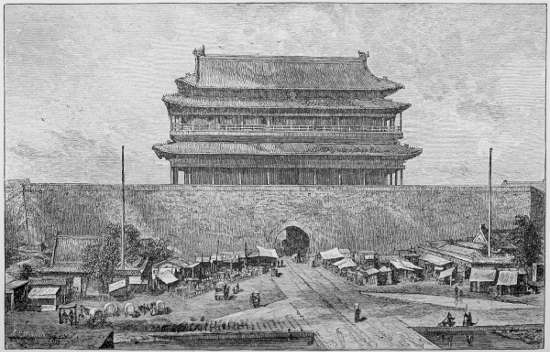
THE AN-TING GATE, WALL OF PEKING.
POSITION AND HISTORY OF PEKING.
Peking is regarded by the Chinese as one of their ancient cities, but it was not made the capital of the whole empire until Kublai established his court at this spot in 1264. The Ming emperors who succeeded the Mongols held their court at Nanking until Yungloh transferred the seat of government to Peking in 1411, where it has since remained. Under the Mongols, the city was called Khan-baligh (i.e., city of the Khan), changed into Cambalu in the accounts of those times; on Chinese maps it is usually called King-sz’.
Peking has, during its history, existed under many different names; after each disaster her walls have been changed and her houses rebuilt, so that to-day she stands, like the capitals of the ancient Roman and Byzantine empires, upon the débris of centuries of buildings. The most important renovations have been those by the Liao dynasty, in 937 A.D., who entirely rebuilt the city, and by the Kin rulers in 1151.
It was at first surrounded by a single wall pierced by nine gates, whence it is sometimes called the City of Nine Gates. The southern suburbs were inclosed by Kiatsing in 1543, and the city now consists of two portions, the northern or inner city (Nui ching), containing about fifteen square miles, where are the palace, government buildings, and barracks for troops; and the southern or Outer city (Wai ching), where the Chinese live. The wall of the Manchu city averages fifty feet high, forty wide at top, and about sixty at bottom, most of the slope being on the inner face. That around the Outer city is no more than thirty in height, twenty-five thick at bottom, and about fifteen at top. The terre-plein throughout is paved with bricks weighing sixty pounds each; a crenellated parapet runs around the entire town, intended only for archers or musketeers, as no port-holes for cannon exist. It is undoubtedly the finest wall surrounding any city now extant. Near the gates, of which there are sixteen in all, the walls are faced with stone, but in other places with these large bricks, laid in a concrete of lime and clay, which in process of time becomes almost as durable as stone. The intermediate space between facings is filled up with the earth taken from the ditch which surrounds the city. Square buttresses occur at intervals of sixty yards on the outer face, each projecting fifty feet, and every sixth one being twice the size of the others; their tops furnish room for the troops posted there to resist side attacks. Each gate is surmounted with a brick tower of many stories, over a hundred feet high, built in galleries with port-holes, and giving a very imposing appearance to the city as one approaches it from the wide plain. The gates of the Manchu city have a double entrance formed by joining their supporting bastions with a circular wall in which are side entrances, thus making an enceinte of several acres, in which the yellow-tiled temple to the tutelary God of War is conspicuous. The arches of all the gates are built solidly of granite; the massive doors are closed and barred every night soon after dark.
GENERAL ASPECT OF THE CAPITAL.
At the sides of the gates, and also between them, are esplanades for mounting to the top; this is shut to the common people, and the guards are not allowed to bring their women upon the wall, which would be deemed an affront to Kwantí. The moat around the city is fed from the Tunghwui River, which also supplies all the other canals leading across or through the city. The approach to Peking from Tung chau is by an elevated stone road, but nothing of the buildings inside the walls is seen; and were it not for the lofty towers over the gates, it would more resemble an encampment inclosed by a massive wall than a large metropolis. No spires or towers of churches, no pillars or monuments, no domes or minarets, nor even many dwellings of superior elevation, break the dull uniformity of this or any Chinese city. In Peking, the different colored yellow or green tiles on official buildings,[30] mixed with the brown roofs of common houses, impart a variety to the scene, but the chief objects to relieve the monotony are the large clumps of trees, and the flag-staffs in pairs near the temples. The view from the walls impresses one with the grand ideas of the founders of the city; and the palaces in the Forbidden City, towering above everything else, worthily exhibit their notions of what was befitting the sovereigns of the Middle Kingdom. The Bell and Clock Towers, the Prospect Hill, the dagobas, pagodas, and gate towers, and lastly the Temple of Heaven, are all likewise visible from this point, and render the scene picturesque and peculiar.[31]
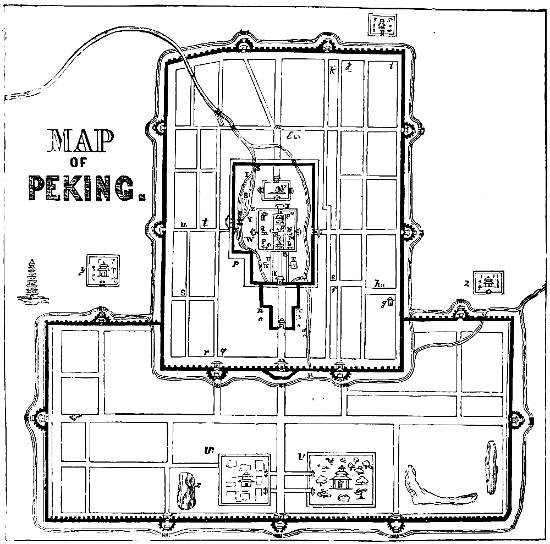
MAP OF PEKING.
REFERENCES.
A. The Meridian Gate.
B. Gate of Extensive Peace.
C. Hall of Perfect Peace.
D. Hall of Secure Peace.
E. Palace of Heaven—the Emperor’s.
F. Palace of Earth’s Repose—the Empress’.
G. Gate to Earth’s Repose, leads to a Garden.
H. Ching-hwang miao.
I. Temple of Great Happiness.
J. Northern gate of Forbidden City.
K. Nui Koh, or Privy Council Chamber, lies within the wall.
K. Gate of Heavenly Rest.
L. Hall of Intense Mental Exercises.
M. Library, or Hall of Literary Abyss.
N. Imperial Ancestral Hall.
O. Hall of National Portraits.
P. Printing Office.
Q. Court of Controllers of Imperial Clan.
R. Marble Isle: a marble bridge leads to it.
S. Five Dragon Pavilion.
T. Great Ancestral Temple.
U. Altar to the Gods of Land and Grain.
V. Artificial Mountain. The Russian school lies just north of the Eastern gate near N.
W. A summer-house.
X. Military Examination Hall.
Y. Plantain Garden, or Conservatory.
Z. A Pavilion.
a. Medical College.
b. Astronomical Board.
c. Five of the Six Boards. The Hanlin Yuen lies just above them.
d. House of the Russian Mission.
e. Colonial Office.
f. Temple for Imperial worship.
g. Imperial Observatory, partly on the wall.
h. Hall of Literary Examination.
i. Russian Church of the Assumption.
j. Temple of Eternal Peace of the lamas.
k. Kwoh Tsz’ Kien, a Manchu College.
l. Temple of the God of the North Star.
m. High Watch-tower and Police Office.
n. Board of Punishments.
o. Censorate.
p. Mohammedan Mosque.
q. Portuguese Church.
r. Elephant’s Inclosure.
s. Principal Ching-hwang miau.
t. Temple of Deceased Emperors of all ages.
u. Obelisk covering a scab of Buddha.
v. Altar to Heaven.—Altar to Earth is on the north of the city.
w. Altar to Agriculture.
x. Black Dragon Pool, and Temple of God of Rain.
y. Altar to the Moon.
z. Altar to the Sun.
The plan of the city here given is reduced from a large Chinese map, but is not very exact. The northern portion occupies for the most part the same area as the Cambaluc of Marco Polo, which, however, extended about two miles north, where the remains of the old north wall of the Mongols still exist. On their expulsion Hungwu erected the present northern wall, and his son Yungloh rebuilt the other three sides in 1419 on a rather larger scale; but the arrangement of the streets and gates is due to the Great Khan. When taken possession of by the Manchus in 1644, they found a magnificent city ready for them, uninjured and strong, which they apportioned among their officers and bannermen; but necessity soon obliged these men, less frugal and thrifty than the natives, to sell them, and content themselves with humbler abodes; consequently, the greater part of the northern city is now tenanted by Chinese. The innermost inclosure in the Nui Ching contains the palace and its surrounding buildings; the second is occupied by barracks and public offices, and by many private residences; the outer one, for the most part, consists of dwelling-houses, with shops in the large avenues. The inner inclosure measures 6.3 li, or 2.23 miles, in circuit, and is called Tsz’ Kin Ching, or ‘Carnation Prohibited City;’ the wall is less solid and high than the city wall; it is covered with bright yellow tiles, guarded by numerous stations of bannermen and gendarmerie, and surrounded by a deep, wide moat. Two gates, the Tung-hwa and Sí-hwa, on the east and west, afford access to the interior of this habitation of the Emperor, as well as the space and rooms appertaining, which furnish lodgment to the guard defending the approach to the Dragon’s Throne; a tower at each corner, and one over each gateway, also give accommodation to other troops. The interior of this inclosure is divided into three parts by two walls running from south to north, and the whole is occupied by a suite of court-yards and halls, which, in their arrangement and architecture, far exceed any other specimens of the kind in China. According to the notions of a common Chinese, all here is gold and silver; “he will tell you of gold and silver pillars, gold and silver roofs, and gold and silver vases, in which swim gold and silver fishes.”
PALACES OF THE PROHIBITED CITY.
The southern gate, called the Wu Măn, or ‘Meridian Gate,’ is the fourth in going north from the entrance opposite the Tsien Măn, and this distance of nearly half a mile is occupied by troops. The Wu Măn leads into the middle division, in which are the imperial buildings; it is especially appropriated to the Emperor, and whenever he passes through it, a bell placed in the tower above is struck; when his troops return in triumph, a drum is beaten, and the prisoners are here presented to him; here, too, the presents he confers on vassals and ambassadors are pompously bestowed. Passing through this gate into a large court, over a small creek spanned by five marble bridges, ornamented with sculptures, the visitor is led through the Tai-ho Măn into a second court paved with marble, and terminated on the sides by gates, porticos, and pillared corridors. The next building, at the head of this court, called the Tai-ho tien, or ‘Hall of Highest Peace,’ is a superb marble structure, one hundred and ten feet high, standing on a terrace that raises it twenty feet above the ground; five flights of stairs, decorated with balustrades and sculptures, lead up to it, and five doors open through it into the next court-yard. It is a great hall of seventy-two pillars, measuring about two hundred feet by ninety broad, with a throne in the midst. Here the Emperor holds his levees on New Year’s Day, his birthdays, and other state occasions; a cortége of about fifty household courtiers stand near him, while those of noble and inferior dignity and rank stand in the court below in regular grades, and, when called upon, fall prostrate as they all make the fixed obeisances. It was in this hall that Titsingh and Van Braam were banqueted by Kienlung, January 20, 1795, of which interesting ceremony the Dutch embassador gives an account, and since which event no European has entered the building. The three Tien in this inclosure are the audience halls, and the side buildings contain stores and treasures under the charge of the Household Board, with minor bureaus.
Beyond it are two halls; the first, the Chung-ho tien, or ‘Hall of Central Peace,’ having a circular roof, that rests on columns arranged nearly four-square. Here the Emperor comes to examine the written prayers provided to be offered at the state worship. The second is the Pao-ho tien, or ‘Hall of Secure Peace,’ elevated on a high marble terrace, and containing nine rows of pillars. The highest degrees for literary merit are here conferred triennially by the Emperor upon one hundred and fifty or more scholars; here, also, he banquets his foreign guests and other distinguished persons the day before New Year’s Day. After ascending a stairway, and passing the Kien Tsing Măn, the visitor reaches the Kien Tsing Kung, or ‘Palace of Heavenly Purity,’ into which no one can enter without special license. In it is the council-chamber, where the Emperor usually sits at morning audience up to eight o’clock, to transact business with his ministers, and see those appointed to office. The building is the most important as it is described to be the loftiest and most magnificent of all the palaces. In the court before it is a small tower of gilt copper, adorned with a great number of figures, and on each side are large incense vases, the uses of which are no doubt religious. It was in this palace that Kanghí celebrated a singular and unique festival, in 1722, for all the men in the empire over sixty years of age, that being the sixtieth year of his reign. His grandson Kienlung, in 1785, in the fiftieth year of his reign, repeated the ceremony, on which occasion the number of guests was about three thousand.[32] Beyond it stands the ‘Palace of Earth’s Repose,’ where ‘Heaven’s consort’ rules her miniature court in the imperial harem; there are numerous buildings of lesser size in this part of the inclosure, and adjoining the northern wall of the Forbidden City is the imperial Flower Garden, designed for the use of its inmates. The gardens are adorned with elegant pavilions, temples, and groves, and interspersed with canals, fountains, pools, and flower-beds. Two groves rising from the bosoms of small lakes, and another crowning the summit of an artificial mountain, add to the beauty of the scene, and afford the inmates of the palace an agreeable variety.
In the eastern division of the Prohibited City are the offices of the Cabinet, where its members hold their sessions, and the treasury of the palace. North of it lies the ‘Hall of Intense Thought,’ where sacrifices are presented to Confucius and other sages. Not far from this hall stands the Wăn-yuen koh, or the Library, the catalogue of whose contents is published from time to time, forming an admirable synopsis of Chinese literature. At the northern end of the eastern division are numerous palaces and buildings occupied by princes of the blood, and those connected with them; and in this quarter is placed the Fung Sien tien, a small temple where the Emperor comes to ‘bless his ancestors.’ Here the Emperor and his family perform their devotions before the tablets of their departed progenitors; whenever he leaves or returns to his palace, the first day of a season, and on other occasions, the monarch goes through his devotions in this hall.
The western division contains a great variety of edifices devoted to public and private purposes, among which may be mentioned the hall of distinguished sovereigns, statesmen, and literati, the printing-office, the Court of Controllers for the regulation of the receipts and disbursements of the court, and the Ching-hwang Miao, or ‘Guardian Temple’ of the city. The number of people residing within the Prohibited City cannot be stated, but probably is not large; most of them are Manchus.
IMPERIAL CITY.
The second inclosure, which surrounds the imperial palaces, is called Hwang Ching, or ‘Imperial City,’ and is an oblong rectangle about six miles in circuit, encompassed by a wall twenty feet high, and having a gate in each face. From the southern gate, called the Tien-an Măn, or ‘Heavenly Rest,’ a broad avenue leads up to the Kin Ching; and before it, outside of the wall, is an extensive space walled in, and having one entrance on the south, called the gate of Great Purity, which no one is allowed to enter except on foot, unless by special permission. On the right of the avenue within the wall is a gateway leading to the Tai Miao, or ‘Great Temple’ of the imperial ancestors, a large collection of buildings inclosed by a wall 3,000 feet in circuit. It is the most honored of religious structures next to the Temple of Heaven, and contains tablets to princes and meritorious officers. Here offerings are presented before the tablets of deceased emperors and empresses, and worship performed at the end of the year by the members of the imperial family and clan to their departed forefathers. Across the avenue from this temple is a gateway leading to the Shié-Tsih tan, or altar of the gods of Land and Grain. These were originally Kau-lung, a Minister of Works, B.C. 2500, and Hau-tsih, a remote ancestor of Chau Kung; here the Emperor sacrifices in spring and autumn. This altar consists of two stories, each five feet high, the upper one being fifty-eight feet square; no other altar of the kind is found in the empire, and it would be tantamount to high treason to erect one and worship upon it. The north, east, south, and west altar are respectively black, green, red, and white, and the top yellow; the ceremonies connected with the worship held here are among the most ancient practised among the Chinese.
PUBLIC BUILDINGS AND PARKS.
On the north of the palace, separated by a moat, and surrounded by a wall more than a mile in circuit, is the King Shan, or ‘Prospect Hill,’ an artificial mound, nearly one hundred and fifty feet high, and having five summits, crowned with as many temples; many of these show the neglect in which public edifices soon fall. Trees of various kinds border its base, and line the paths leading to the tops. Its height allows the spectator to overlook the whole city, while, too, it is itself a conspicuous object from every direction. The earth and stone in it were taken from the ditches and pools dug in and around the city, and near its base are many tanks of picturesque shape and appearance; so that altogether it forms a great ornament to the city. Another name for it is Mei Shan, or ‘Coal Hill,’ from a tradition that a quantity of coal was placed there, as a supply in case of siege. The western part of this inclosure is chiefly occupied by the Sí Yuen, or ‘Western Park,’ in and around which are found some of the most beautiful objects and spots in the metropolis. An artificial lake, more than a mile long, and averaging a furlong in breadth, occupies the centre; it is supplied from the Western Hills, and its waters are adorned with the splendid lotus. A marble bridge of nine arches crosses it, and its banks are shaded by groves of trees, under which are well-paved walks. On its south-eastern side is a large summer-house, consisting of several edifices partly in or over the water, and inclosing a number of gardens and walks, in and around which are artificial hills of rock-work beautifully alternating or supporting groves of trees and parterres of flowers.
On the western side is the hall for examining military candidates, where his majesty in person sees them exhibit their prowess in equestrian archery. At the north end of the lake is a bridge leading to an islet, which presents the aspect of a hill of gentle ascent covered with groves, temples, and summer-houses, and surmounted with a tower, from which an extensive view can be enjoyed. On the north of the bridge is a hill on an island called Kiung-hwa tan, capped by a white dagoba. Near by is an altar forty feet in circuit, and four feet high, inclosed by a wall, and a temple dedicated to Yuenfí, the reputed discoverer of the silk-worm, where the Empress annually offers sacrifices to her; in the vicinity a plantation of mulberry trees and a cocoonery are maintained. Near the temple of ‘Great Happiness,’ not far distant from the preceding, on the northern borders of the lake, is a gilded copper statue of Maitreya, or the coming Buddha, sixty feet high, with a hundred arms; the temple is one of the greatest ornaments of the Park. Across the lake on its western bank, and entered through the first gate on the south side of the street, is the Tsz’-kwang Koh, where foreign ministers are received by the Emperor; the inclosure is kept with great care, and numerous halls and temples are seen amidst groves of firs. The object kept in view in the arrangement of these gardens and grounds has been to make them an epitome of nature, and then furnish every part with commodious buildings. But however elegant the palaces and grounds may have appeared when new, it is to be feared that his majesty has no higher ideas of cleanliness and order than his subjects, and that the various public and private edifices and gardens in these two inclosures are despoiled of half their beauty by dirt and neglect. The number of the palaces in them both is estimated to be over two hundred, “each of which,” says Attinet, in vague terms, “is sufficiently large to accommodate the greatest of European noblemen, with all his retinue.”
Along the avenue leading south from the Imperial City to the division wall, are found the principal government offices. Five of the Six Boards have their bureaus on the east side, the Board of Punishments with its subordinate departments being situated with its courts on the west side; immediately south of this is the Censorate. The office attached to the Board of Rites, for the preparation of the Calendar, commonly called the Astronomical Board, stands directly east of this; and the Medical College has its hall not far off. The Hanlin Yuen, or National Academy, and the Li-fan Yuen, or Colonial Office, are also near the south-eastern corner of the Imperial City. Opposite to the Colonial Office is the Tang Tsz’, where the remote ancestors of the reigning family are worshipped by his majesty together with the princes of his family; when they come in procession to this temple in their state dresses, the Emperor, as high-priest of the family, performs the highest religious ceremony before his deified ancestors, viz., three kneelings and nine knockings. After he has completed his devotions, the attendant grandees go through the same ceremonies. The temple itself is pleasantly situated in the midst of a grove of fir and other trees, and the large inclosure around it is prettily laid out.
BUDDHIST AND CONFUCIAN TEMPLES.
In the south-eastern part of the city, built partly upon the wall, is the Observatory, which was placed under the superintendence of the Romish missionaries by Kanghí, but is now confided to the care of Chinese astronomers. The instruments are arranged on a terrace higher than the city wall, and are beautiful pieces of bronze art, though now antiquated and useless for practical observations. Nearly opposite to the Observatory stands the Hall for Literary Examinations, where the candidates of the province assemble to write their essays. In the north-eastern corner of the city is the Russian Mission and Astronomical Office, inclosed in a large compound; near it live the converts. About half a mile west is the Yung-ho Kung, or ‘Lamasary of Eternal Peace,’ wherein about 1,500 Mongol and Tibetan priests study the dogmas of Buddhism, or spend their days in idleness, under the control of a Gegen or living Buddha. Their course of study comprises instruction in metaphysics, ascetic duties, astrology, and medicine; their daily ritual is performed in several courts, and the rehearsal of prayers and chants by so many men strikes the hearer as very impressive. The rear building contains a wooden image, 70 feet in height, of Maitreya, the coming Buddha; the whole establishment exhibits in its buildings, pictures, images, cells, and internal arrangements for study, living, and worship, one of the most complete in the empire. Several smaller lamasaries occur in other parts of the city.
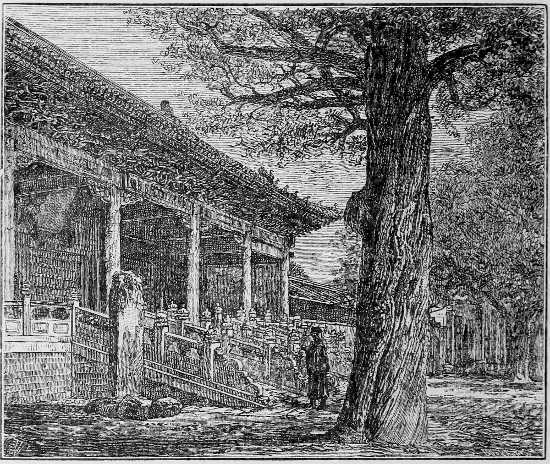
Portal of Confucian Temple, Peking.
Directly west of the Yung-ho Kung, and presenting the greatest contrast to its life and activity, lies the Confucian Temple, where embowered in a grove of ancient cypresses stands the imposing Wăn Miao, or ‘Literary Temple,’ in which the Example and Teacher of all Ages and ten of his great disciples are worshipped. The hall is 84 feet in front, and the lofty roof is supported on wooden pillars over 40 feet high, covering the single room in which their tablets are placed in separate niches, he in the high seat of honor. All is simple, quiet, and cheerless; the scene here presents an impressive instance of merited honors paid to the moral teachers of the people. Opposite and across the court are ten granite stones shaped like drums, which are believed to have been made about the eighth century B.C., and contain stanzas recording King Süen’s hunting expeditions. In another court are many stone tablets containing the lists of Tsin-sz’ graduates since the Mongol dynasty, many thousands of names with places of residence. Contiguous to this temple is the Pih-yung Kung, or ‘Classic Hall,’ where the Emperor meets the graduates and literati. It is a beautiful specimen of Chinese architectural taste. Near it are 300 stone tablets on which the authorized texts of the classics are engraved.[33]
North of the Imperial City lies the extensive yamun of the Ti-tuh, who has the police and garrison of the city under his control, and exercises great authority in its civil administration. The Drum and Bell Towers stand north of the Ti-ngan Măn in the street leading to the city wall, each of them over a hundred feet high, and forming conspicuous objects; the drum and bell are sounded at night watches, and can be heard throughout the city; a clepsydra is still maintained to mark time—a good instance of Chinese conservatism, for clocks are now in general use, and correct the errors of the clepsydra itself.
SHRINES OF ALL RELIGIONS.
Outside of the south-western angle of the Imperial City stands the Mohammedan mosque, and a large number of Turks whose ancestors were brought from Turkestan about a century ago live in its vicinity; this quarter is consequently the chief resort of Moslems who come to the capital. South-west of the mosque, near the cross-wall, stands the Nan Tang, or old Portuguese church, and just west of the Forbidden City, inside of the Hwang Ching, is the Peh Tang, or Cathedral; both are imposing edifices, and near them are large schools and seminaries for the education of children and neophytes. There are religious edifices in the Chinese metropolis appropriated to many forms of religion, viz., the Greek, Latin, and Protestant churches, Islamism, Buddhism in its two principal forms, Rationalism, ancestral worship, state worship, and temples dedicated to Confucius and other deified mortals, besides a great number in which the popular idols of the country are adored. One of the most worthy of notice is the Tí-Wang Miao, lying on the avenue leading to the west gate, a large collection of halls wherein all the tablets of former monarchs of China from remote ages are worshipped. The rule for admission into this Walhalla is to accept all save the vicious and oppressive, those who were assassinated and those who lost their kingdoms. This memorial temple was opened in 1522; the Manchus have even admitted some of the Tartar rulers of the Kin and Liao dynasties, raising the total number of tablets to nearly three hundred. It is an impressive sight, these simple tablets of men who once ruled the Middle Kingdom, standing here side by side, worshipped by their successors that their spirits may bless the state. This selection of the good sovereigns alone recalls to mind the custom in ancient Jerusalem of allowing wicked princes no place in the sepulchres of the kings. Distinguished statesmen of all ages, called by the Chinese kwoh chu, or ‘pillars of state,’ are associated with their masters in this temple, as not unworthy to receive equal honors.
A little west of this remarkable temple is the Peh-ta sz’, or ‘White Pagoda Temple,’ so called from a costly dagoba near it erected about A.D. 1100, renovated by Kublai in the thirteenth century, and rebuilt in 1819. Its most conspicuous feature is the great copper umbrella on the top. When finished, the dagoba was described as covered with jasper, and the projecting parts of the roof with ornaments of exquisite workmanship tastefully arranged. Around this edifice, which contains twenty beads or relics of Buddha, two thousand clay pagodas and five books of charms, are also one hundred and eight small pillars on which lamps are burned. The portion of the city lying south of the cross-wall is inhabited mostly by Chinese, and contains hundreds of hwui-kwan, or club-houses, erected by the gentry of cities and districts in all parts of the empire to accommodate their citizens resorting to the capital. Its streets are narrow and the whole aspect of its buildings and markets indicates the life and industry of the people. Hundreds of inns accommodate travellers who find no lodging-places in the Nui Ching, and storehouses, theatres, granaries and markets attract or supply their customers from all parts. There is more dissipation and freedom from etiquette here, and the Chinese officials feel freer from their Manchu colleagues.
THE TEMPLE OF HEAVEN.
Three miles south of the Palace, in the Chinese City, is situated the Tien Tan, or ‘Altar to Heaven,’ so placed because it was anciently customary to perform sacrifices to Heaven in the outskirts of the Emperor’s residence city. The compound is inclosed by more than three miles of wall, within which is planted a thick grove of locust (Sophora), pine and fir trees, interspaced with stretches of grass. Within a second wall, which surrounds the sacred buildings, rises a copse of splendid and thickly growing cypress trees, reminding one of the solemn shade in the vicinity of famous temples in Ancient Greece, or of those celebrated shrines described in Western Asia. The great South Altar, the most important of Chinese religious structures, is a beautiful triple circular terrace of white marble, whose base is 210, middle stage 150, and top 90 feet in width, each terrace encompassed by a richly carved balustrade. A curious symbolism of the number three and its multiples may be noticed in the measurements of this pile. The uppermost terrace, whose height above the ground is about eighteen feet, is paved with marble slabs, forming nine concentric circles—the inner of nine stones inclosing a central piece, and around this each receding layer consisting of a successive multiple of nine until the square of nine (a favorite number of Chinese philosophy) is reached in the outermost row. It is upon the single round stone in the centre of the upper plateau that the Emperor kneels when worshipping Heaven and his ancestors at the winter solstice.
Four flights of nine steps each lead from this elevation to the next lower stage, where are placed tablets to the spirits of the sun, the moon, the stars, and the Year God. On the ground at the end of the four stairways stand vessels of bronze in which are placed the bundles of cloth and sundry animals constituting part of the sacrificial offerings. But of vastly greater importance than these in the matter of burnt-offering is the great furnace, nine feet high, faced with green porcelain, and ascended on three of its sides by porcelain staircases. In this receptacle, erected some hundred feet to the south-east of the altar, is consumed a burnt-offering of a bullock—entire and without blemish—at the yearly ceremony. The slaughter-house of the sacrificial bullock stands east of the North Altar, at the end of an elaborate winding passage, or cloister of 72 compartments, each 10 feet in length.
Separated from the Altar to Heaven by a low wall, is a smaller though more conspicuous construction called Ki-kuh Tan, or ‘Altar of Prayer for Grain.’ Its proportions and arrangement are somewhat similar to those of the South Altar, but upon its upper terrace rises a magnificent triple-roofed, circular building known to foreigners as the ‘Temple of Heaven.’ This elaborate house of worship, whose surmounting gilded ball rests 100 feet above the platform, was originally roofed with blue, yellow and green tiles, but by Kienlung these colors were changed to blue. When, added to these brilliant hues, we consider the richly carved and painted eaves, the windows shaded by venetians of blue-glass rods strung together, and the rare symmetry of its proportions, it is no exaggeration to call this temple the most remarkable edifice in the capital—or indeed in the empire. The native name is Ki-kien Tien, or ‘Temple of Prayer for the Year.’ In the interior, the large shrines of carved wood for the tablets correspond to the movable blue wooden huts which on days of sacrifice are put up on the Southern Altar. Here, upon some day following the first of spring (Feb. 6), the Emperor offers his supplications to Heaven for a blessing upon the year. In times of drought, prayer for rain is also made at this altar, the Emperor being obliged to proceed on foot, as a repentant suppliant, to the ‘Hall of Penitent Fasting,’ a distance of three miles. A green furnace for burnt-offerings lies to the south-east of this, as of the North Altar; while in the open park not far from the two and seventy cloisters are seven great stones, said to have fallen from heaven and to secure good luck to the country.
Across the avenue upon which is situated this great inclosure of the Tien Tan, is the Sien Nung Tan, or ‘Altar dedicated to Shinnung,’ the supposed inventor of agriculture. These precincts are about two miles in circumference, and contain four separate altars: to the gods of the heavens, of the earth, of the planet Jupiter, and to Shinnung. The worship here is performed at the vernal equinox, at which time the ceremony of ploughing a part of the inclosed park is performed by the Emperor, assisted by various officials and members of the Board of Rites. The district magistrates and prefect also plough their plats; but no one touches the imperial portion save the monarch himself. The first two altars are rectangular; that to the gods of heaven, on the east, is 50 feet long and 4½ feet high: four marble tablets on it contain the names of the gods of the clouds, rain, wind, and thunder. That to the gods of earth is 100 feet long by 60 wide; here the five marble tablets contain the names of celebrated mountains, seas, and lakes in China. Sacrifices are offered to these divinities at various times, and, with the prayers presented, are burned in the furnaces, thus to come before them in the unseen world; the idea which runs through them partakes of the nature of homage, not of atonement.
Nearly one-half of the Chinese City is empty of dwellings, much of the open land being cultivated; a large pond for rearing gold-fish near the Tien Tan is an attractive place. West of this city wall is an old and conspicuous dagoba in the Tien-ning sz’, nearly 200 feet high, and a landmark for the city gate. This part of Peking was much the best built when the Liao and Kin dynasties occupied it. West of the main city is the Temple of the Moon, and on the east side, directly opposite, stands the Temple to the Sun; the Tí Tan, or ‘Altar to Earth,’ is on the north over against the Altar to Heaven, just described. At all these the Emperor performs religious rites during the twelve months.
The inclosure of the Altar to Earth is smaller, and everything connected with the sacrifices is on an inferior scale to those conducted in the Altar to Heaven. The main altar has two terraces, each 6 feet high, and respectively 106 feet and 60 feet square; the tablet to Imperial Earth is placed on the upper with those to the Imperial Ancestors, and all are adored at the summer solstice. The bullock for sacrifice is afterwards buried and not burned. Adjoining the terraced altar on the south is a small tank for water.
THE BELL TEMPLE AND HWANG SZ’.
About two miles from the Tí Tan, in a northerly direction, passing through one of the ruined gates of the Peking of Marco Polo’s time on the way, is found the Ta-chung sz’, or ‘Bell Temple,’ in which is hung the great bell of Peking. It was cast about 1406, in the reign of Yungloh, and was covered over in 1578 by a small temple. It is 14 feet high, including the umbones, 34 feet in circumference at the rim, and 9 inches thick; the weight is 120,000 lbs. av.; it is struck by a heavy beam swung on the outside. The Emperor cast five bells in all, but this one alone was hung. It is covered with myriads of Chinese characters, both inside and out, consisting of extracts from the Fah-hwa King and Ling-yen King, two Buddhist classics. In some respects this may be called the most remarkable work of art now in China; it is the largest suspended bell in the world. A square hole in the top prevents its fracture under the heaviest ringing.[34]
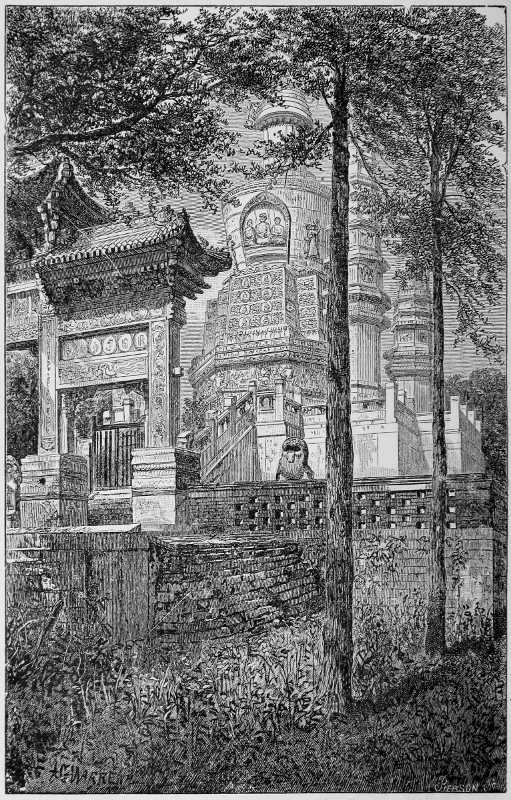
MONUMENT, OR TOPE, OF A LAMA. HWANG SZ’, PEKING.
A short distance outside the northern gate, Tah-shing Măn, is an open ground for military reviews, and near it a Buddhist temple of some note, called Hwang sz’, containing in its enceinte a remarkable monument erected by Kienlung. In 1779 the Teshu Lama started for Peking with an escort of 1,500 men; he was met by the Emperor near the city of Sí-ning in Kansuh, conducted to Peking with great honor, and lodged in this temple for several months. He died here of small-pox, November 12, 1780, and this cenotaph of white marble was erected to his memory; the body was inclosed in a gold coffin and sent to the Dalai Lama at Lhassa in 1781. The plinth of this beautiful work contains scenes in the prelate’s life carved on the panels, one of which represents a lion rubbing his eyes with his paw as the tears fall for grief at the Lama’s death.
SUMMER PALACE AT YUEN-MING YUEN.
The Summer Palace at Yuen-ming Yuen lies about seven miles from the north-west corner of Peking, and its entire circuit is reckoned to contain twelve square miles. The country in this direction rises into gentle hills, and advantage has been taken of the original surface in the arrangement of the different parts of the ground, so that the whole presents a great variety of hill and dale, woodlands and lawns, interspersed with pools, lakes, caverns, and islets joined by bridges and walks, their banks thrown up or diversified like the free hand of nature. Some parts are tilled, groves or tangled thickets occur here and there, and places are purposely left wild to contrast the better with the cultivated precincts of a palace, or to form a rural pathway to a retired temple or arbor. Here were formerly no less than thirty distinct places of residence for various palace officials, around which were houses occupied by eunuchs and servants, each constituting a little village.
But all was swept away by the British and French troops in 1860, and their ruins still remain to irritate the officials and people of Peking against all foreigners. Near the Summer Palace is the great cantonment of Hai-tien, where the Manchu garrison is stationed to defend the capital, and whose troops did their best in the vain effort to stay the attack in 1860. As a contrast to the proceedings connected with this approach of the British, an extract from Sir John Davis’s Chinese (chap. x.) will furnish an index of the changed condition of things.
“It was at a place called Hai-tien, in the immediate vicinity of these gardens, that the strange scene occurred which terminated in the dismissal of the embassy of 1816. On his arrival there, about daylight in the morning, with the commissioners and a few other gentlemen, the ambassador was drawn to one of the Emperor’s temporary residences by an invitation from Duke Ho, as he was called, the imperial relative charged with the conduct of the negotiations. After passing through an open court, where were assembled a vast number of grandees in their dresses of ceremony, they were shown into a wretched room, and soon encompassed by a well-dressed crowd, among whom were princes of the blood by dozens, wearing yellow girdles. With a childish and unmannerly curiosity, consistent enough with the idle and disorderly life which many of them are said to lead, they examined the persons and dress of the gentlemen without ceremony; while these, tired with their sleepless journey, and disgusted at the behavior of the celestials, turned their backs upon them, and laid themselves down to rest. Duke Ho soon appeared, and surprised the ambassador by urging him to proceed directly to an audience of the Emperor, who was waiting for him. His lordship in vain remonstrated that to-morrow had been fixed for the first audience, and that tired and dusty as they all were at present, it would be worthy neither of the Emperor nor of himself to wait on his majesty in a manner so unprepared. He urged, too, that he was unwell, and required immediate rest. Duke Ho became more and more pressing, and at length forgot himself so far as to grasp the ambassador’s arm violently, and one of the others stepped up at the same time. His lordship immediately shook them off, and the gentlemen crowded about him; while the highest indignation was expressed at such treatment, and a determined resolution to proceed to no audience this morning. The ambassador at length retired, with the appearance of satisfaction on the part of Duke Ho, that the audience should take place to-morrow. There is every reason, however, to suppose that this person had been largely bribed by the heads of the Canton local government to frustrate the views of the embassy, and prevent an audience of the Emperor. The mission, at least, was on its way back in the afternoon of the same day.”
The principal part of the provisions required for the supply of this immense city comes from the southern provinces, and from flocks reared beyond the wall. It has no important manufactures, horn lanterns, wall papers, stone snuff-bottles, and pipe mouth-pieces, being the principal. Trade in silks, foreign fabrics, and food is limited to supplying the local demand, inasmuch as a heavy octroi duty at the gates restrains all enterprise. No foreign merchants are allowed to carry on business here. The government of Peking differs from that of other cities in the empire, the affairs of the department being separated from it, and administered by officers residing in the four circuits into which it is divided. “A minister of one of the Boards is appointed superintendent of the city, and subordinate to him is a fuyin, or mayor. Their duties consist in having charge of the metropolitan domain, for the purpose of extending good government to its four divisions. They have under them two district magistrates, each of whom rules half the city; none of these officers are subordinate to the provincial governor, but carry affairs which they cannot determine to the Emperor. They preside or assist at many of the festivals observed in the capital, superintend the military police, and hold the courts which take cognizance of the offences committed there.”[35]
STREET SCENES AND FEATURES OF PEKING.
The thoroughfares leading across Peking, from one gate to the other, are broad, unpaved avenues, more than a hundred feet wide, which appear still wider owing to the lowness of the buildings; the centre is about two feet higher than the sides. The cross-streets in the main city are generally at right angles with them, not over forty feet wide, and for the most part occupied with dwellings. The inhabitants of the avenues are required to keep them well sprinkled in summer; but in rainy weather they are almost impassable from the mud and deep puddles, the level surface of the ground, and obstructed, neglected drains, preventing rapid drainage. The crowds which throng these avenues, some engaged in various callings, along the sides or in the middle of the way, and others busily passing and repassing, together with the gay appearance of the sign-boards, and an air of business in the shops, render the great streets of the Chinese metropolis very bustling, and to a foreigner a most interesting scene. Shop-fronts can be entirely opened when necessary; they are constructed of panels or shutters fitting into grooves, and secured to a row of strong posts which set into mortises. At night, when the shop is closed, nothing of it is seen from without; but in the daytime, when the goods are exposed, the scene becomes more animated.
The sign-boards are often broad planks, fixed in stone bases on each side of the shop-front, and reaching to the eaves, or above them; the characters are large and of different colors, and in order to attract more notice, the signs are often hung with various colored flags, bearing inscriptions setting forth the excellence of the goods. The shops in the outer city are frequently constructed in this manner, others are made more compact for warmth in winter, but as a whole they are not brilliant in their fittings. Their signs are, when possible, images of the articles sold and always have a red pennon attached; the finer shop-fronts are covered with gold-leaf, brilliant when new, but shabby enough when faded, as it soon does. The appearance of the main streets exhibits therefore a curious mixture of decay and renovation, which is not lessened by the dilapidated temples and governmental buildings everywhere seen, all indicating the impoverished state of the exchequer. In many parts of the city are placed pai-lau, or honorary gateways, erected to mark the approach to the palace, and worthy, by their size and ornamental entablatures, to adorn the avenues and impress the traveller, if they were kept in good condition.
The police of the city is connected with the Bannermen, and is, on the whole, efficient and successful in preserving the peace. During the night the thoroughfares are quiet; they are lighted a little by lanterns hanging before the houses, but generally are dark and cheerless. In the metropolis, as in all Chinese cities, the air is constantly polluted by the stench arising from private vessels and public reservoirs for urine and every kind of offal, which is all carefully collected by scavengers. By this means, although the streets are kept clean, they are never sweet; but habit renders the people almost insensible to this as well as other nuisances. Carts, mules, donkeys and horses are to be hired in all the thoroughfares. The Manchu women ride astride; their number in the streets, both riding and walking, imparts a pleasant feature to the crowd, which is not seen in cities further south. The extraordinary length and elaborateness of marriage and funeral processions daily passing through the avenues, adds a pretty feature to them, which other cities with narrow streets cannot emulate.
The environs beyond the suburbs are occupied with mausolea, temples, private mansions, hamlets, and cultivated fields, in or near which are trees, so that the city, viewed from a distance, appears as if situated in a thick forest. Many interesting points for the antiquarian and scientist are to be found in and around this old city, which annually attracts more and more the attention of other nations. Its population has decreased regularly since the death of Kienlung in 1797, and is now probably rather less than one million, including the immediate suburbs. The climate is healthy, but subject to extremes from zero to 104°; the dryness during ten months of the year is, moreover, extremely irritating. The poor, who resort thither from other parts, form a needy and troublesome ingredient of the population, sometimes rising in large mobs and pillaging the granaries to supply themselves with food, but more commonly perishing in great numbers from cold and hunger. Its peace is always an object of considerable solicitude with the imperial government, not only as it may involve the personal safety of the Emperor, but still more from the disquieting effect it may have upon the administration of the empire. The possession of this capital by an invading force is more nearly equivalent to the control of the country than might be the case in most European kingdoms, but not as much as it might be in Siam, Burmah, or Japan. The good influences which may be exerted upon the nation from the metropolis are likewise correspondingly great, while the purification of this source of contamination, and the liberalizing of this centre of power, now well begun in various ways, will confer a vast benefit upon the Chinese people.[36]
Chihlí contains several other large cities, among which Pauting, the former residence of the governor-general, and Tientsin, are the most important. The former lies about eighty miles south-west of the capital, on the Yungting River and the great road leading to Shansí. The whole department is described as a thoroughly cultivated, populous region; it is well watered, and possesses two or three small lakes.
TIENTSIN AND THE RIVER.
Tientsin is the largest port on the coast above Shanghai. Owing, however, to the shallowness of the gulf and the bar at the mouth of the Pei ho, over which at neap tide only three or four feet of water flow, the port is rendered inaccessible to large foreign vessels. Its size and importance were formerly chiefly owing to its being the terminus of the Grand Canal, where the produce and taxes for the use of the capital were brought. Mr. Gutzlaff, who visited Tientsin in 1831, described it as a bustling place, comparing the stirring life and crowds on the water and shores outside of the walls of the city with those of Liverpool. The enormous fleet of grain junks carrying rice to the capital is supplemented by a still greater number of vessels which take the food up to Tung chau. Formerly the coast trade increased the shipping at Tientsin to thousands of junks, including all which lined the river for about sixty miles. This native trade has diminished since 1861, inasmuch as steamers are gradually ousting the native vessels, no one caring to risk insurance on freight in junks. The country is not very fertile between the city and the sea, owing to the soda and nitre in the soil; but scanty crops are brought forth, and these only after much labor; one is a species of grass (Phragmites) much used in making floor-mats. Sometimes the rains cause the Pei ho and its affluents to break over their banks, at which periods their waters deposit fertilizing matter over large areas.
The approach to Tientsin from the eastward indicates its importance, and the change from the sparsely populated country lying along the banks of the Pei ho, to the dense crowds on shore and the fleets of boats, adds greatly to the vivacity of its aspect. “If fine buildings and striking localities are required to give interest to a scene,” remarks Mr. Ellis, “this has no claims; but, on the other hand, if the gradual crowding of junks till they become innumerable, a vast population, buildings, though not elegant, yet regular and peculiar, careful and successful cultivation, can supply these deficiencies, the entrance to Tientsin will not be without attractions to the traveller.”[37] The stacks of salt along the river arrest the attention of the voyager; the immense quantity of this article collected at this city is only a small portion of the amount consumed in the interior. Tientsin will gradually increase in wealth, and now perhaps contains half a million of inhabitants. Its position renders it one of the most important cities in the empire, and the key of the capital.
Near the embouchure of the river is Ta-ku, with its forts and garrison, a small town noticeable as the spot where the first interview between the Chinese and English plenipotentiaries was held, in August, 1840; and for three engagements between the British and Chinese forces in 1858, 1859, and 1860. The general aspect of the province is flat and cheerless, the soil near the coast unproductive, but, as a whole, rich and well cultivated, though the harvests are jeopardized by frequent droughts.
The port of Peking is Tung chau on the Pei ho, twelve miles from the east gate, and joined to it by an elevated stone causeway. All boats here unload their passengers and freight, which are transported in carts, wheelbarrows, or on mules and donkeys. The city of Tung chau presents a dilapidated appearance amidst all its business and trade, and its population depends on the transit of goods for their chief support. The streets are paved, the largest of them having raised footpaths on their sides. The houses indicate a prosperous community. A single pagoda towers nearly 200 feet above them, and forms a waymark for miles across the country. Tung chau is only 100 feet above the sea, from which it is distant 120 miles in a direct line; consequently, its liability to floods is a serious drawback to its permanent prosperity.
Another city of note is Siuenhwa fu, finely situated between the branches of the Great Wall. Timkowski remarks, “the crenated wall which surrounds it is thirty feet high, and puts one in mind of that of the Kremlin, and resembles those of several towns in Russia; it consists of two thin parallel brick walls, the intermediate space being filled with clay and sand. The wall is flanked with towers. We passed through three gates to enter the city: the first is covered with iron nails; at the second is the guard-house; we thence proceeded along a broad street, bordered with shops of hardware; we went through several large and small streets, which are broad and clean; but, considering its extent, the city is thinly peopled.”[38]
The department of Chahar, or Tsakhar, lies beyond the Great Wall, north and west of the province, a mountainous and thinly settled country, chiefly inhabited by Mongol shepherds who keep the flocks and herds of the Emperor.[39]
DOLON-NOR AND TOWNS IN THE NORTH.
In the north-east of their grounds lies the thriving town of Dolon-nor (i.e., Seven Lakes), or Lama-miao, of about 20,000 Chinese, founded by Kanghí. The Buddhist temples and manufactories of bells, idols, praying machines, and other religious articles found here, give it its name, and attract the Mongols, whose women array themselves in the jewelry made here. It is in latitude 42° 16′ N., about ten miles from the Shangtu River, a large branch of the river Liao, on a sandy plain, and is approached by a road winding among several lakes. North-west of Dolon-nor are the ruins of the ancient Mongolian capital of Shangtu, rendered more famous among English reading people by Coleridge’s exquisite poem—
In Xanadu did Kubla Khan A stately pleasure-dome decree: Where Alph, the sacred river, ran Through caverns measureless to man Down to a sunless sea. So twice five miles of fertile ground With walls and towers were girdled round—
than by Marco Polo’s relation, which moved the poet to pen the lines. It was planned as Mukden now is, an outer and inner wall inclosing separate peoples, and its tumuli will probably furnish many tablets and relics of the Mongol emperors, when carefully dug over. It was too far from Peking for the Manchu monarchs to rebuild, and the Ming emperors had no power there. It was visited in 1872 by Messrs. Grosvenor and Bushell of the British Legation; Dr. Bushell’s description corroborates Polo’s account and Gerbillon’s later notices of its size.[40]
There are several lakes, the largest of which, the Peh hu, in the south-western part, connects with the Pei ho through the river Hü-to. The various branches of the five rivers, whose united waters disembogue at Ta-ku, afford a precarious water communication through the southern half of Chihlí. Their headwaters rise in Shansí and beyond the Great Wall, bringing down much silt, which their lower currents only partially take out into the gulf; this sediment soon destroys the usefulness of the channels by raising them dangerously near the level of the banks. The utilization of their streams is a difficult problem in civil engineering, not only here but throughout the Great Plain.
Near the banks of the Lan ho, a large stream flowing south from the eastern slopes of the Chahar Hills, past Yungping fu into the gulf, and about one hundred and seventy-four miles north of Ta-ku, lies Chingpeh, or Jeh-ho, the Emperor’s country palace. The approach to it is through a pass cut out of the rock, and resembles that leading to Damascus. The imperial grounds are embraced by a high range of hills forming a grand amphitheatre, which at this point is extremely fine. This descent to the city presents new and captivating views at every turn of the road. The hunting grounds are inclosed by a high wall stretching twenty miles over the hills, and stocked with deer, elks, and other game. The Buddhist temples form the chief attraction to a visitor. The largest one is square and castellated, eleven stories high, and about two hundred feet on each of its sides; the stories are painted red, yellow and green alternating. There are several similar but smaller structures below this one, and on each of the first two or three series is a row of small chinaware pagodas of a blue color; their tiles are likewise blue. In the bright sunlight the effect of these brilliant bands is very good, and the general neatness adds to the pleasing result of the gay coloring. Nearly a thousand lamas live about these shrines. The town of Jeh-ho (i.e., Hot River) consists mostly of one street coiling around the hills near the palace; its inhabitants are of a higher grade than usual in Chinese cities, the greater part being connected with the government. The road through Ku-peh kau in the Great Wall from Peking to Jeh-ho is one of the best in the province, and the journey presents a variety of charming scenery; its chief interest to foreigners is connected with the visit there of Lord Macartney, in 1793.[41] This fertile prefecture is rapidly settling by Chinese, whose numbers are now not far from two millions.
The principal productions of Chihlí are millet and wheat, sorghum, maize, oats, and many kinds of pulse and fruits, among which are pears, dried and fresh dates (Rhamnus), apples and grapes; all these are exported. Coal, both bituminous and anthracite, exists in great abundance; one mode of using hard coal is to mix its dust with powdered clay and work them into balls and cakes for cooking and fuel. The province also furnishes good marble, granite, lime, and iron, some kinds of precious stones, and clay for bricks and pottery.
SHANTUNG PROVINCE.
The province of Shantung (i.e., East of the Hills) has a long coast-line, its maritime border being more than half its whole circuit. It lies south of the Gulf of Pechele, south-east of Chihlí, north of Kiangsu, and borders on Honan, where the Yellow River divides the two. Most of its area is level, the hilly part is the peninsula portion, where the highest points rise too high to admit of cultivation. The Grand Canal enters the province on its course from Tientsin at Lintsing chau in the north-west, passing in a south-easterly direction to the old Yellow River, and adds greatly to its importance. The shores of the promontory are generally bold, and full of indentations, presenting several excellent harbors; no important river disembogues within the province, and on each side of the peninsula the waters are shallow. Chifu, in the prefecture of Tăngchau, has the best harbor, and its trade will gradually draw toward it a large population. The hills along the shore have a remarkably uniform, conical shape, resembling the bonnets worn by officers. The hilly regions are arranged in a series of chains running across the promontory, the longest and highest of which runs with the general trend of the coast in Tai-ngan fu, some peaks reaching over five thousand feet, but most of them being under three thousand feet high. Their intervales are highly cultivated. The soil is generally productive, except near the shores of the gulf, where it is nitrous. Two crops are annually produced here as elsewhere in Northern China. The willow, aspen, ailantus, locust (Sophora), oak, mulberry, and conifera, are common trees; silk-worms fed on oak leaves furnish silk.
This province is one of the most celebrated in Chinese history, partly from its having been the scene of many remarkable events in the early history of the people up to B.C. 200, but more particularly from its containing the birthplaces of Confucius and Mencius, whose fame has gone over the earth. The inhabitants of the province are proud of their nativity on this score, much as the woman of Samaria was because Jacob’s cattle had drunk water at the well of Sychar.
TAI SHAN, THE ‘GREAT MOUNT.’
The high mountain called Tai shan, or ‘Great mount,’ is situated near Tai-ngan fu in this province. This peak is mentioned in the Shu King as that where Shun sacrificed to Heaven (B.C. 2254); it is accordingly celebrated for its historical as well as religious associations. It towers high above all other peaks in the range, as if keeping solitary watch over the country round-about, and is the great rendezvous of devotees; every sect has there its temples and idols, scattered up and down its sides, in which priests chant their prayers, and practise a thousand superstitions to attract pilgrims to their shrines. During the spring, the roads leading to the Tai shan are obstructed with long caravans of people coming to accomplish their vows, to supplicate the deities for health or riches, or to solicit the joys of heaven in exchange for the woes of earth. A French missionary mentions having met with pilgrims going to it, one party of whom consisted of old dames, who had with infinite fatigue and discomfort come from the south of Honan, about three hundred miles, to “remind their god of the long abstinence from flesh and fish they had observed during the course of their lives, and solicit, as a recompense, a happy transmigration for their souls.” The youngest of this party was 78, and the oldest 90 years.[42] Another traveller says that the pilgrims resort there during the spring, when there are fairs to attract them; high and low, official and commoner, men and women, old and young, all sorts gather to worship and traffic. A great temple lies outside the town, whose grounds furnish a large and secure area for the tents where the devotees amuse themselves, after they have finished their devotions. The road to the summit is about five miles, well paved and furnished with rest-houses, tea-stalls, and stairways for the convenience of the pilgrims, and shaded with cypresses. It is beset with beggars, men and women with all kinds of sores and diseases, crippled and injured, besieging travellers with cries and self-imposed sufferings, frequently lying across the path so as to be stepped upon. A vast number of them live on alms thus collected, and have scooped themselves holes in the side of the way, where they live; their numbers indicate the great crowds whose offerings support such a wretched throng on the hill.
CITIES AND CHARACTERISTICS OF SHANTUNG.
The capital of the province is Tsínan, a well-built city of about 100,000 inhabitants. It was an important town in ancient times as the capital of Tsí, one of the influential feudal States, from B.C. 1100 to its conquest by Chí Hwangtí about 230; the present town lies not far east of the Ta-tsing ho, or new Yellow River, and is accessible by small steamers from sea. It has hills around it, and is protected by three lines of defence, composed of mud, granite, and brick. Three copious springs near the western gate furnish pure water, which is tepid and so abundant as to fill the city moat and form a lake for the solace of the citizens whether in boats upon its bosom or from temples around its shores. Its manufactures are strong fabrics of wild silk, and ornaments of liu-lí, a vitreous substance like strass, of which snuff-bottles, bangles, cups, etc., are made in great variety, to resemble serpentine, jade, ice, and other things. East of Tsínan is the prefect city of Tsíning chau, once the provincial capital, and the centre of a populous and fertile region. Tsíning chau is an opulent and flourishing place, judging from the gilded and carved shops, temples, and public offices in the suburbs, which stretch along the eastern banks of the Canal; just beyond the town, the Canal is only a little raised above the level of the extensive marshes on each side, and further south the swamps increase rapidly: when Amherst’s embassy passed, the whole country, as far as the eye could reach, displayed the effects of a most extensive recent inundation. Davis adds, “The waters were on a level with those of the Canal, and there was no need of dams, which were themselves nearly under water, and sluices for discharging the superfluous water were occasionally observed. Clumps of large trees, cottages, and towers, were to be seen on all sides, half under water, and deserted by the inhabitants; the number of the latter led to the inference that they were provided as places of refuge in case of inundation, which must be here very frequent. Wretched villages occurred frequently on the right-hand bank, along which the tracking path was in some places so completely undermined as to give way at every step, obliging them to lay down hurdles of reeds to afford a passage.”[43]