Volume 1 — CHAPTER X. STRUCTURE OF THE CHINESE LANGUAGE.
Reading edition
It might reasonably be inferred, judging from the attention paid to learning, and the honors conferred upon its successful votaries, that the literature of the Chinese would contain much to repay investigation. Such is not the case, however, to one already acquainted with the treasures of Western science, and, in fairness, such a comparison is not quite just. Yet it has claims to the regard of the general student, from its being the literature of so vast a portion of the human species, and the result of the labors of its wisest and worthiest minds during many successive ages. The fact that it has been developed under a peculiar civilization, and breathes a spirit so totally different from the writings of Western sages and philosophers, perhaps increases the curiosity to learn what are its excellences and defects, and obtain some criteria by which to compare it with the literature of other Asiatic or even European nations. The language in which it is written—one peculiarly mystical and diverse from all other media of thought—has also added to its singular reputation, for it has been surmised that what is “wrapped up” in such complex characters must be pre-eminently valuable for matter or elegant for manner, and not less curious than profound. Although a candid examination of this literature will disclose its real mediocrity in points of research, learning, and genius, there yet remains enough to render it worthy the attention of the oriental or general student.
INFLUENCE OF THE LANGUAGE UPON LITERATURE.
Some of its peculiarities are owing to the nature of the language, and the mode of instruction, both of which have affected the style and thoughts of writers: for, having, when young, been taught to form their sentences upon the models of antiquity, their efforts to do so have moulded their thoughts in the same channel. Imitation, from being a duty, soon became a necessity. The Chinese scholar, forsaking the leadings of his own genius, soon learned to regard his models as not only being all truth themselves, but as containing the sum total of all things valuable. The intractable nature of the language, making it impossible to study other tongues through the medium of his own, moreover tended to repress all desire in the scholar to become acquainted with foreign books; and as he knew nothing of them or their authors, it was easy to conclude that there was nothing worth knowing in them, nothing to repay the toil of study, or make amends for the condescension of ascertaining. The neighbors of the Chinese have unquestionably been their inferiors in civilization, good government, learning, and wealth; and this fact has nourished their conceit, and repressed the wish to travel, and ascertain what there was in remoter regions. In judging of the character of Chinese literature, therefore, these circumstances among others under which it has risen to its present bulk, must not be overlooked; we shall conclude that the uniformity running through it is perhaps owing as much to the isolation of the people and servile imitation of their models, as to their genius: each has, in fact, mutually acted upon and influenced the other.
The “homoglot” character of the Chinese people has arisen more from the high standard of their literature, and the political institutions growing out of its canonical books (which have impelled and rewarded the efforts of students to master the language), than from any one other cause. This feature offers a great contrast to the polyglot character which the Romans possessed even to the last, and suggests the cause and results as interesting topics of inquiry. The Egyptian, Jewish, Syriac, Greek, and Latin languages had each its own national literature, and its power was enough to retain these several nations attached to their own mother tongue, while the Gauls, Iberians, and other subject peoples, having no books, took the language and literature of their rulers and conquerors. Thus the kingdom, “part iron and part clay,” fell apart as soon as the grasp of Rome was weakened; while the tendency in China always has been to reunite and homologate.
In this short account of the Chinese tongue, it will be sufficient to give such notices of the origin and construction of the characters, and of the idioms and sounds of the written and spoken language, as shall convey a general notion of all its parts, and to show the distinction between the spoken and written media, and their mutual action. They are both archaic, because the symbols prevented all inflexion and agglutination in the sounds, and all signs to indicate what part of speech each belonged to. They are like the ten digits, containing no vocable and imparting their meaning more to the eye than the ear.
Chinese writers, unable to trace the gradual formation of their characters (for, of course, there could be no intelligible historical data until long after their formation), have ascribed them to Hwangtí, one of their primeval monarchs, or even earlier, to Fuh-hí, some thirty centuries before Christ; as if they deemed writing to be as needful to man as clothes or marriage, all of which came from Fuh-hí. A mythical personage, Tsang-kieh, who flourished about B.C. 2700, is credited with the invention of symbols to represent ideas, from noticing the marking on tortoise-shell, and thence imitating common objects in nature.
The Japanese have tried to attach their kana to the Chinese characters to indicate the case or tense, but the combination looks incongruous to an educated Chinese. We might express, though somewhat crudely, analogous combinations in English by endeavoring to write 1-ty, 1-ness, 1-ted, for unity, oneness, united, or 3-1 God for triune God.
At this crisis, when a medium for conveying and giving permanency to ideas was formed, Chinese historians say: “The heavens, the earth, and the gods, were all agitated. The inhabitants of hades wept at night; and the heavens, as an expression of joy, rained down ripe grain. From the invention of writing, the machinations of the human heart began to operate; stories false and erroneous daily increased, litigations and imprisonments sprang up; hence, also, specious and artful language, which causes so much confusion in the world. It was for these reasons that the shades of the departed wept at night. But from the invention of writing, polite intercourse and music proceeded; reason and justice were made manifest; the relations of social life were illustrated, and laws became fixed. Governors had laws to which they might refer; scholars had authorities to venerate; and hence, the heavens, delighted, rained down ripe grain. The classical scholar, the historian, the mathematician, and the astronomer can none of them do without writing; were there no written language to afford proof of passing events, the shades might weep at noonday, and the heavens rain down blood.”[290] This singular myth may, perhaps, cover a genuine fact worthy of more than passing notice—indicating a consentaneous effort of the early settlers on the Yellow River to substitute for the purpose of recording laws and events something more intelligible than the knotted cords previously in use. Its form presents a curious contrast to the personality of the fable of Cadmus and his invention of the Greek letters.
ORIGIN OF THE LANGUAGE.
The date of the origin of this language, like that of the letters of Western alphabets, is lost in the earliest periods of post-diluvian history, but there can be no doubt that it is the most ancient language now spoken, and along with the Egyptian and cuneiform, among the oldest written languages used by man. The Ethiopic and Coptic, the Sanscrit and Pali, the Syriac, Aramaic, and Pehlvic, have all become dead languages; and the Greek, Latin, and Persian, now spoken, differ so much from the ancient style, as to require special study to understand the books in them: while during successive eras, the written and spoken language of the Chinese has undergone few alterations, and done much to deepen the broad line of demarkation between them and other branches of the human race. The fact, then, that this is the only living language which has survived the lapse of ages is, doubtless, owing to its ideographic character and its entire absence of sound as an integral factor of any symbol. Their form and meaning were, therefore, only the more strongly united because each reader was at liberty to sound them as he pleased or had been taught by local instructors. He was not hindered, on account of his local brogue, from communicating ideas with those who employed the same signs in writing. Upon the subsequent rise of a great and valuable literature, the maintenance of the written language was the chief element of national life and integrity among those peoples who read and admired the books. Nor has this language, like those of the Hebrews, the Assyrians, and others already mentioned, ever fallen into disuse and been supplanted by the sudden rise and physical or intellectual vigor of some neighboring community speaking a patois. For we find that alphabetic languages, whose words represent at once meaning and sound, are as dependent upon local dialects as is the Chinese tongue upon its symbols; consequently, when in the former case the sounds had so altered that the meanings were obscured, the mode of writing was likely to be changed. The extent of its literature and uses made of it were then the only safeguard of the written forms; while as men learned to read books they became more and more prone to associate sense and form, regarding the sound as traditionary. We have, in illustration of this, to look no further than to our own language, whose cumbersome spelling is in a great measure resulting from a dislike of changing old associations of sense and form which would be involved in the adoption of a phonetic system.
The Chinese have had no inducement, at any stage of their existence, to alter the forms of their symbols, inasmuch as no nation in Asia contiguous to their own has ever achieved a literature which could rival theirs; no conqueror came to impose his tongue upon them; their language completely isolated them from intellectual intercourse with others. This isolation, fraught with many disadvantages in the contracted nature of their literature, and the reflux, narrowing influence on their minds, has not been without its compensations. A national life of a unique sort has resulted, and to this self-nurtured language may be traced the origin of much of the peace, industry, population, and healthy pride of the Chinese people.
IDEOGRAPHIC NATURE OF THE SYMBOLS.
The Chinese have paid great and praiseworthy attention to their language, and furnished us with all needed books to its study. Premising that the original symbols were ideographic, the necessities of the case compelled their contraction as much as possible, and soon resulted in arbitrary signs for all common uses. Their symbols varied, indeed, at different times and in different States; it was not until a genuine literature appeared and its readers multiplied that the variants were dropped and uniformity sought. The original characters of this language are derived from natural or artificial objects, of which they were at first the rude outlines. Most of the forms are preserved in the treatises of native philologists, where the changes they have gradually undergone are shown. The number of objects chosen at first was not great; among them were symbols for the sun, moon, hills, animals, parts of the body, etc.; and in drawing them the limners seem to have proposed nothing further than an outline sketch, which, by the aid of a little explanation, would be intelligible. Thus the picture would probably be recognized by all who saw it as representing the moon; that of as a fish; and so of others. It is apparent that the number of pictures which could be made in this manner would hear no proportion to the wants and uses of a language, and therefore recourse must soon be had to more complicated symbols, to combining those already understood, or to the adoption of arbitrary or phonetic signs. All these modes have been more or less employed.


SIX CLASSES OF CHARACTERS.
Chinese philologists arrange all the characters in their language into six classes, called luh shu, or ‘six writings.’ The first, called siang hing, morphographs, or ‘imitative symbols,’ are those in which a plain resemblance can be traced between the original form and the object represented; they are among the first characters invented, although the six hundred and eight placed in this class do not include all the original symbols. These pristine forms have since been modified so much that the resemblance has disappeared in most of them, caused chiefly by the use of paper, ink, and pencils, instead of the iron style and bamboo tablets formerly in use for writing; circular strokes being more distinctly made with an iron point upon the hard wood than with a hair pencil upon thin paper; angular strokes and square forms, therefore, gradually took the place of round or curved ones, and contracted characters came into use in place of the original imitative symbols. In this class such characters as the following are given:


tortoise,chariot,child,elephant,deer,vase,hill,eye.
altered to
龜車子象鹿壺山目
kwei,chí,tsz’,siang,luh,hu,shan,muh.
The second class, only one hundred and seven in number, is called chí sz’, i.e., ‘symbols indicating thought.’ They differ from the preceding chiefly in that the characters are formed by combining previously formed symbols in such a way as to indicate some idea easily deducible from their position or combination, and pointing out some property or relative circumstance belonging to them. Chinese philologists consider these two classes as comprising all the symbols in the language, which depict objects either in whole or in part, and whose meaning is apparent from the resemblance to the object, or from the position of the parts. Among those placed in this class are,
moon half appearing, signifies evening; now written 夕 sun above the horizon, denotes morning; now written 旦 something in the mouth, meaning sweet; now written 甘


The third class, amounting to seven hundred and forty characters, is called hwui í, i.e., ‘combined ideas,’ or ideographs, and comprises characters made up of two or three symbols to form a single idea, whose meanings are deducible either from their position, or supposed relative influence upon each other. Thus the union of the sun and moon, ming, expresses brightness; kien, a piece of wood in a doorway, denotes obstruction; two trees stand for a forest, as lin; and three for a thicket, as săn; two men upon the ground conveys the idea of sitting; a mouth in a door signifies to ask; man and words means truth and to believe; heart and death imports forgetfulness; dog and mouth means to bark; woman and broom denotes a wife, referring to her household duties; pencil and to speak is a book, or to write. But in none of these compounded characters is there anything like that perfection of picture writing stated by some writers to belong to the language, which will enable one unacquainted with the meaning of the separate symbols to decide upon the signification of the combined group. On the contrary it is in most cases certain that the third idea made by combining two already known symbols, usually required more or less explanation to fix its precise meaning, and remove the doubt which would otherwise arise. For instance, the combination of the sun and moon might as readily mean a solar or lunar eclipse, or denote the idea of time, as brightness. A piece of wood in a doorway would almost as naturally suggest a threshold as an obstruction; and so of others. A straight line in a doorway would more readily suggest a closed or bolted door, which is the signification of 閂 shan, anciently written ; but the idea intended to be conveyed by these combinations would need prior explanation as much as the primitive symbol, though it would thenceforth readily recur to mind when noticing the construction.


It is somewhat singular that the opinion should have obtained so much credence, that their meanings were easily deducible from their shape and construction. It might almost be said, that not a single character can be accurately defined from a mere inspection of its parts; and the meanings now given of some of those which come under this class are so arbitrary and far-fetched, as to show that Chinese characters have not been formed by rule and plummet more than words in other languages. The mistake which Du Ponceau so learnedly combats arose, probably, from confounding sound with construction, and inferring that, because persons of different nations, who used this as their written language, could understand it when written, though mutually unintelligible when speaking, that it addressed itself so entirely to the eye, as to need no previous explanation.
The fourth class, called chuen chu, ‘inverted significations,’ includes three hundred and seventy-two characters, being such as by some inversion, contraction, or alteration of their parts, acquire different meanings. This class is not large, but these and other modifications of the original symbols to express abstract and new ideas show that those who used the language either saw at once how cumbrous it would become if they went on forming imitative signs, or else that their invention failed, and they resorted to changes more or less arbitrary in characters already known to furnish distinctive signs for different ideas. Thus yu the hand, turning toward the right means the right; inclined in the other direction, as tso it means the left. The heart placed beneath slave, 怒 signifies anger; threads obstructed, as , means to sunder; but turned the other way, as , signifies continuous.


METHOD OF FORMING PHONETIC CHARACTERS.
The fifth class, called kiai shing, i.e., ‘uniting sound symbols,’ or phonogram, contains twenty-one thousand eight hundred and ten characters, or nearly all in the language. They are formed of an imitative symbol united to one which merely imparts its sound to the compound; the former usually partakes more or less of the new idea, while the latter loses its own meaning, and gives only its name. In this respect, Chinese characters are superior to the Arabic numerals, inasmuch as combinations like 25, 101, etc., although conveying the same meaning to all nations using them, can never indicate sound. This plan of forming new combinations by the union of symbols expressing idea and sound, enables the Chinese to increase the number of characters without multiplying the original symbols; but these compounds, or lexigraphs, as Du Ponceau calls them, do not increase very rapidly. In Annam they have become so numerous in the course of years that the Chinese books made in that country are hard to read. The probable mode in which this arose can best be explained by a case which occurred at Canton in 1832. Immature locusts were to be described in a proclamation, but the word nan, by which they were called, was not contained in any dictionary. It would be sufficient to designate this insect to all persons living where it was found by selecting a well-understood character, like 南 south, having the exact sound nan, by which the insect itself was called, and joining it to the determinative symbol chung 虫 insect. It would then signify, to every one who knew the sound and meaning of the component parts, the insect nan; and be read nan, 蝻 meaning this very insect to the people in Kwangtung. If this new combination was carried to a distant part of the country, where the insect itself was unknown, it would convey no more information to the Chinese who saw the united symbol, than the sounds insect nan would to an Englishman who heard them; to both persons a meaning must be given by describing the insect. If, however, the people living in this distant region called the phonetic part of the new character by another sound, as nam, nem, or lam, they would attach another name to the new compound, but the people on the spot would, perhaps, not understand them when they spoke it by that name. If they wrote it, however, both would give it the same signification, but a different sound.
In this way, the thousands of characters under this class have probably originated. But this rule of sounding them according to the phonetic part is not in all cases certain; for in the lapse of time, the sounds of many characters have changed, while those of the parts themselves have not altered; in other cases, the parts have altered, and the sounds remained; so that now only a great degree of probability as to the correct sound can be obtained by inspecting the component parts. The similarity in sound between most of the characters having the same phonetic part is a great assistance in reading Chinese, though very little in understanding it, and has had much influence in keeping the sounds unchanged.
There are a few instances of an almost inadvertent arrival at a true syllabic system, by which the initial consonant of one part, when joined to the final vowel of the other, gives the sound of the character; as ma and fí, in the character 靡, when united in this way, make mí. The meanings of the components are hemp and not, that of the compound is extravagant, wasteful, etc., showing no relation to the primary signification. The number of such characters is very small, and the syllabic composition here noticed is probably fortuitous, and not intentional.
The sixth class, called kia tsié, i.e., ‘borrowed uses,’ includes metaphoric symbols and combinations, in which the meaning is deduced by a somewhat fanciful accommodation; their number is five hundred and ninety-eight. They differ but little from the second class of indicative symbols. For instance, the symbol 字 or , meaning a written character, is composed of a child under a shelter—characters being considered as the well-nurtured offspring of hieroglyphics. The character for hall means also mother, because she constantly abides there. The word for mind or heart is sin , originally intended to represent that organ, but now used chiefly in a metaphorical sense. Chinese grammarians find abundant scope for the display of their fancy in explaining the etymology and origin of the characters, but the aid which their researches give toward understanding the language as at present used is small. This classification under six heads is modern, and was devised as a means of arranging what existed already, for they confess that their characters were not formed according to fixed rules, and have gradually undergone many changes.


The total number in the six classes is twenty-four thousand two hundred and thirty-five, being many less than are found in Kanghí’s Dictionary, which amount to forty-four thousand four hundred and forty-nine; but in the larger sum are included the obsolete and synonymous characters, which, if deducted, would reduce it to nearly the same number. It is probable that the total of really different characters in the language sanctioned by good usage, does not vary greatly from twenty-five thousand, though authors have stated them at from fifty-four thousand four hundred and nine, as Magaillans does, up to two hundred and sixty thousand eight hundred and ninety-nine, as Montucci. The Chinese editor of the large lexicon on which Dr. Morrison founded his Dictionary, gives it as his opinion that there are fifty thousand characters, including synonyms and different forms; and taking in every variety of tones given to the words, and sounds for which no characters exist, that there are five thousand different words. But even the sum of twenty-five thousand different characters contains thousands of unusual ones which are seldom met with, and which, as is the case with old words in English, are not often learned.
The burden of remembering so many complicated symbols, whose form, sound, and meanings are all necessary to enable the student to read and write intelligibly, is so great that the result has been to diminish those in common use, and increase their meanings. This course of procedure really occurs in most languages, and in the Chinese greatly reduces the labor of acquiring it. It may be safely said, that a good knowledge of ten thousand characters will enable one to read any work in Chinese, and write intelligibly on any subject; and Prémare says a good knowledge of four or five thousand characters is sufficient for all common purposes, while two-thirds of that number might in fact suffice. The troublesome ones are either proper names or technics peculiar to a particular science. The nine canonical works contain altogether only four thousand six hundred and one different characters, while in the Five Classics alone there are over two hundred thousand words. The entire number of different characters in the code of laws translated by Staunton is under two thousand.
MODES OF ARRANGING CHARACTERS.
The invention of printing and the compilation of dictionaries have given to the form of modern characters a greater degree of certainty than they had in ancient times. The variants of some of the most common ones were exceedingly numerous before this period; Callery gives forty-two different modes of writing pao, ‘precious;’ and forty-one for writing tsun, ‘honorable;’ showing the absence of an acknowledged standard, and the slight intercourse between learned men. The best mode of arranging the characters so as to find them easily, has been a subject of considerable trouble to Chinese lexicographers, and the various methods they have adopted renders it difficult to consult their dictionaries without considerable previous knowledge of the language. In some, those having the same sound are grouped together, so that it is necessary to know what a character is called before it can be found; and this arrangement has been followed in vocabularies designed principally for the use of the common people. One well-known vocabulary used at Canton, called the Făn Yun, or ‘Divider of Sounds,’ is arranged on this plan, the words being placed under thirty-three orders, according to their terminations. Each order is subdivided into three or four classes according to the tones, and all the characters having the same tone and termination are placed together, as kam, lam, tam, nam, etc. As might be supposed, it requires considerable time to find a character whose tone is not exactly known; and even with the tone once mastered, the uncertainty is equally troublesome if the termination is not familiar: for singular as it may seem to those who are acquainted only with phonetic languages, a Chinese can, if anything, more readily distinguish between two words ♯ming and ♭ming, whose tones are unlike, than he can between ♯ming and ♯meng, ♯ming or ♯bing, where the initial or final differs a little, and the tones are the same.
An improvement on this plan of arrangement was made by adopting a mode of expressing the sounds of Chinese characters introduced by the Buddhists, in the Yuh Pien, published A.D. 543, and ever since used in all dictionaries. This takes the initial of the sound of one character and the final of another, and combines them to indicate the sound of the given character; as from li-en and y-ing to form ling. There are thirty-six characters chosen for the initial consonants, and thirty-eight for the final sounds, but the student is perplexed by the different characters chosen in different works to represent them.[291] The inhabitants of Amoy use a small lexicon called the Shih-wu Yin, or ‘Fifteen Sounds,’ in which the characters are classified on this principle, by first arranging them all under fifty finals, and then placing all those having the same termination in a regular series under fifteen initials. Supposing a new character, chien, is seen, whose sound is given, or the word is heard in conversation and its meanings are wanted, the person turns to the part of the book containing the final ien, which is designated perhaps by the character kien, and looks along the initials until he comes to ch, which is indicated by the character chang. In this column, all the words in the book read or spoken chien, of whatever tone they may be, are placed together according to their tones; and a little practice readily enables a person speaking the dialect to use this manual. It is, however, of little or no avail to persons speaking other dialects, or to those whose vernacular differs much from that of the compiler, whose own ear was his only guide. Complete dictionaries have been published on the phonetic plan, the largest of which, the Wu Ché Yun Fu, is arranged with so much minuteness of intonation as to puzzle even the best educated natives, and consequently abridge its usefulness as an expounder of words.
CLASSIFICATION ACCORDING TO COMPOSITION.
The unfitness of either of these modes of arrangement to find an unknown character, led to another classification according to their composition, by selecting the most prominent parts of each character as its key, or radical, and grouping those together in which the same key occurred. This plan was adopted subsequently to that of arranging the characters according to the sounds, about A.D. 543, when their number was put at five hundred and forty-two; they were afterward reduced to three hundred and sixty, and toward the close of the Ming dynasty finally fixed at two hundred and fourteen in the Tsz’ Lui. It is now in general use from the adoption of the abridged dictionary, the Kanghí Tsz’ Tien; though this number could have been advantageously reduced, as has been shown by Gonçalves, its universal adoption, more than anything else, renders it the best system. All characters found under the same radical are placed consecutively, according to the number of strokes necessary to write them, but no regularity is observed in placing those having the same number of strokes. The term primitive has been technically applied to the remaining part of the character, which, though perhaps no older than the radical, is conveniently denoted by this word. The characters selected for the radicals are all common ones, and among the most ancient in the language; they are here grouped according to their meanings in order to show something of the leading ideas followed in combination.
RADICALS AND PRIMITIVES.
Corporal.—Body, corpse, head, hair, down, whiskers, face, eye, ear, nose, mouth, teeth, tusk, tongue, hand, heart, foot, hide, leather, skin, wings, feathers, blood, flesh, talons, horn, bones.
Biological.—Man, woman, child; horse, sheep, tiger, dog, ox, hog, hog’s head, deer; tortoise, dragon, reptile, mouse, toad; bird, gallinaceous fowls; fish; insect.
Botanical.—Herb, grain, rice, wheat, millet, hemp, leeks, melon, pulse, bamboo, sacrificial herb; wood, branch, sprout, petal.
Mineral.—Metal, stone, gems, salt, earth.
Meteorological.—Rain, wind, fire, water, icicle, vapor, sound; sun, moon, evening; time.
Utensils.—A chest, a measure, a mortar, spoon, knife, bench, couch, crockery, clothes, tiles, dishes, napkin, net, plough, vase, tripod, boat, carriage, pencil; bow, halberd, arrow, dart, ax, musical reed, drum, seal.
Descriptives.—Black, white, yellow, azure, carnation, sombre; color; high, long, sweet, square, large, small, strong, lame, slender, old, fragrant, acrid, perverse, base, opposed.
Actions.—To enter, to follow, to walk slowly, to arrive at, to stride, to walk, to run, to reach to, to touch, to stop, to fly, to overspread, to envelop, to encircle, to establish, to overshadow, to adjust, to distinguish, to divine, to see, to eat, to speak, to kill, to fight, to oppose, to stop, to embroider, to owe, to compare, to imitate, to bring forth, to use, to promulge.
Miscellaneous.—A desert, cave, field, den, mound, hill, valley, rivulet, cliff, retreat. A city; roof, gate, door, portico. One, two, eight, ten. Demon; an inch, mile; without, not, false; a scholar, statesman, letters; art, wealth; motion; self, myself, father; a point; again; wine; silk; joined hands; a long journey; print of a bear’s foot; a surname; classifier of cloth.
The number of characters found under each of these radicals in Kanghí’s Dictionary varies from five up to one thousand three hundred and fifty-four. The radical is not uniformly placed, but its usual position is on the left of the primitive. Some occur on the top, others on the bottom; some inclose the primitive, and many have no fixed place, making it evident that no uniform plan was adopted in the original construction. They must be thoroughly learned before the dictionary can be readily used, and some practice had before a character can be quickly found.[292] The groups occurring under a majority of the radicals are more or less natural in their general meaning, a feature of the language which has already been noticed (page 375). Some of the radicals are interchanged, and characters having the same meaning sometimes occur under two or three different ones—variations which seem to have arisen from the little importance of a choice out of two or three similar radicals. Thus the same word tsien, ‘a small cup,’ is written under the three radicals gem, porcelain, and horn, originally, no doubt, referring to the material for making it. This interchange of radicals adds greatly to the number of duplicate forms, which are still further increased by a similar interchange of primitives having the same sound. These two changes very seldom occur in the same character, but there are numerous instances of synonymous forms under almost every radical, arising from an interchange of primitives, and also under analogous radicals caused by their reciprocal use. Thus, from both these causes, there are, under the radical ma, ‘a horse,’ one hundred and eighteen duplicate forms, leaving two hundred and ninety-three different words; of the two hundred and four characters under niu, ‘an ox,’ thirty-nine are synonymous forms; and so under other radicals. These characters do not differ in meaning more than favor and favour, or lady and ladye; they are mere variations in the form of writing, and though apparently adding greatly to the number of characters, do not seriously increase the difficulty of learning the language.
Variants of other descriptions frequently occur in books, which needlessly add to the labor of learning the language. Ancient forms are sometimes adopted by pedantic writers to show their learning, while ignorant and careless writers use abridged or vulgar forms, because they either do not know the correct form, or are heedless in using it. When such is the case, and the character cannot be found in the dictionary, the reader is entirely at fault, especially if he be a foreigner, though in China itself he would not experience much difficulty where the natives were at hand to refer to. Vulgar forms are very common in cheap books and letters, which are as unsanctioned by the dictionaries and good usage, as cockney phrases or miner’s slang are in pure English. They arise, either from a desire on the part of the writer to save time by making a contracted form of few strokes instead of the correct character of many strokes; or he uses common words to express an energetic vulgar phrase, for which there are no authorized characters, but which will be easily understood phonetically by his readers. These characters would perchance not be understood at all outside of the range of the author’s dialect, because the phrase itself was new; their individual meaning, indeed, has nothing to do with the interpretation of the sentence, for in this case they are merely signs of sound, like words in other languages, and lose their lexigraphic character. For instance, the words kia-fí for coffee, kap-tan for captain, mí-sz’ for Mr., etc., however they were written, would be intelligible to a native of Canton if they expressed those sounds, because he was familiar with the words themselves; but a native of Shensí would not understand them, because, not knowing the things intended, he would naturally refer to the characters themselves for the meaning of the phrase, and thus be wholly misled. In such cases, the characters become mere syllables of a phonetic word. Foreign names are often transliterated by writers on geography or history, and their recognition is no easy task to their readers.[293]
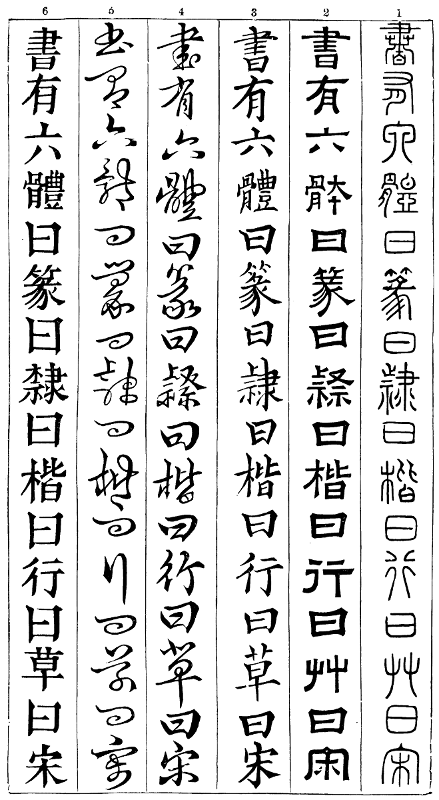
SIX STYLES OF CHINESE CHARACTERS.
In addition to the variations in the forms of characters, there are six different styles of writing them, which correspond to black-letter, script, italic, roman, etc., in English. The first is called Chuen shu (from the name of the person who invented it), which foreigners have styled the seal character, from its use in seals and ornamental inscriptions. It is next to the picture hieroglyphics, the most ancient fashion of writing, and has undergone many changes in the course of ages. It is studied by those who cut seals or inscriptions, but no books are ever printed in it.
The second is the lí shu, or style of official attendants, which was introduced about the Christian era, as an elegant style to be employed in engrossing documents. It is now seen in prefaces and formal inscriptions, and requires no special study to read it, as it differs but slightly from the following.
The third is the kiai shu, or pattern style, and has been gradually formed by the improvements in good writing. It is the usual form of Chinese characters, and no man can claim a literary name among his countrymen if he cannot write neatly and correctly in this style.
The fourth is called hing shu, or running hand, and is the common hand of a neat writer. It is frequently used in prefaces and inscriptions, scrolls and tablets, and there are books prepared in parallel columns having this and the pattern style arranged for school-boys to learn to write both at the same time. The running hand cannot be read without a special study; and although this labor is not very serious when the language of books is familiar, still to become well acquainted with both of them withdraws many days and months of the pupil from progress in acquiring knowledge to learning two modes of writing the same word.
The fifth style is called tsao tsz’, or plant character, and is a freer description of running hand than the preceding, being full of abbreviations, and the pencil runs from character to character, without taking it from the paper, almost at the writer’s fancy. It is more difficult to read than the preceding, but as the abbreviations are somewhat optional, the tsao tsz’ varies considerably, and more or less resembles the running hand according to the will of the writer. The fancy of the Chinese for a “flowing pencil,” and a mode of writing where the elegance and freedom of the caligraphy can be admired as much or more than the style or sentiment of the writing, as well as the desire to contract their multangular characters as much as possible, has contributed to introduce and perpetuate these two styles of writing. How much all these varieties of form superadd to the difficulty of learning the mere apparatus of knowledge need hardly be stated.
The sixth style is called Sung shu, and was introduced under the Sung dynasty in the tenth century, soon after printing on wooden blocks was invented. It differs from the third style, merely in a certain squareness and angularity of stroke, which transcribers for the press only are obliged to learn. Of these six forms of writing, the pattern style and running hand are the only two which the people learn to any great extent, although many acquire the knowledge of some words in the seal character, and the running hand of every person, especially those engaged in business, approaches more or less to the plant character. But foreigners will seldom find time or inclination to learn to write more than one form, to be able to read and communicate on all occasions.
Besides these styles, there are fanciful ones, called ‘tadpole characters,’ in imitation of various objects;[294] the Emperor Kienlung brought together thirty-two of them in an edition of his poem, the Elegy upon the City of Mukden.[295]
ELEMENTARY STROKES OF THE CHARACTERS.
All the strokes in the characters are reduced to eight elementary ones, which are contained in the single character 永 yung, ‘eternal.’
㇔㇐㇑㇚㇀㇁㇒㇏
A dot,a line,a perpendicular,a hook,a spike,a sweep,a stroke,a dash-line.
Each of these is subdivided into many forms in copy-books, having particular names, with directions how to write them, and numerous examples introduced under each stroke.[296]
The Chinese regard their characters as highly elegant, and take unwearied pains to learn to write them in a beautiful, uniform, well-proportioned manner. Students are provided with a painted board upon which to practise with a brush dipped in blackened water. The articles used in writing, collectively called wan fang sz’ pao, or ‘four precious things of the library,’ are the pencil, ink, paper, and ink-stone. The best pencils are made of the bristly hair of the sable and fox, and cheaper ones from the deer, cat, wolf and rabbit; camel’s hair is not used. A combination of softness and elasticity is required, and those who are skilled in their use discern a difference and an excellence altogether imperceptible to a novice. The hairs are laid in a regular manner, and when tied up are brought to a delicate tip; the handle is made of the twigs of a bamboo cultivated for the purpose. The ink, usually known as India ink, is made from the soot of burning oil, pine, fir, and other substances, mixed with glue or isinglass, and scented. It is formed into oblong cakes or cylinders, inscribed with the maker’s name, the best kinds being put up in a very tasteful manner. A singular error formerly obtained credence regarding this ink, that it was inspissated from the fluid found in the cuttle-fish. When used, the ink is rubbed with water upon argillite, marble, or other stones, some of which are cut and ground in a beautiful manner. Chinese paper is made from bamboo, by triturating the woody fibre to a pulp in mortars after the pieces have been soaked in ooze, and then taking it up in moulds; the pulp is sometimes mixed with a little cotton fibre. Inferior sorts are made entirely from cotton refuse; and in the North, where the bamboo does not grow, the bark of the Broussonetia, or paper mulberry, furnishes material for a tough paper used for windows, wrappings, and account books, etc. Bamboo paper has no sizing in it, and is a frail material for preserving valuable writings, as it is easily destroyed by insects, mildew, or handling.[297]
PAPER AND PRINTING.
In the days of Confucius, pieces of bamboo pared thin, palm leaves, and reeds, were all used for writing upon with a sharp stick or stile. About the third century before Christ, silk and cloth were employed, and hair pencils made for writing. Paper was invented about the first century, and cotton-paper may have been brought from India, where it was in use more than a hundred years before. India ink was manufactured by the seventh century; and the present mode of printing upon blocks was adopted from the discovery of Fungtau in the tenth century, of taking impressions from engraved stones. In the style of their notes and letters, the Chinese show both neatness and elegance; narrow slips of tinted paper are employed, on which various emblematic designs are stamped in water lines, and enclosed in fanciful envelopes. It is common to affix a cipher instead of the name, or to close with a periphrasis or sentence well understood by the parties, and thereby avoid any signature; this, which originated, no doubt, in a fear of interception and unpleasant consequences, has gradually become a common mode of subscribing friendly epistles.
THE MANUFACTURE OF CHINESE BOOKS.
The mode of printing is so well fitted for the language that few improvements have been made in its manipulations, while the cheapness of books brings them within reach of the poorest. Cutting the blocks, and writing the characters, form two distinct branches of the business; printing the sheets, binding the volumes, and publishing the books, also furnish employment to other craftsmen. The first step is to write the characters upon thin paper, properly ruled with lines, two pages being cut upon one block, and a heavy double line surrounding them. The title of the work, chapter, and paging are all cut in a central column, and when the leaf is printed it is folded through this column so as to bring the characters on the edge and partly on both pages. Marginal notes are placed on the top of the page; comments, when greatly extended, occupy the upper part, separated from the text by a heavy line, or when mere scholia, are interlined in the same column in characters of half the size. Sometimes two works are printed together, one running through the volume on the upper half of the leaves, and separated from that occupying the lower half by a heavy line. Illustrations usually occupy separate pages at the commencement of the book, but there are a few works with woodcuts of a wretched description, inserted in the body of the page. In books printed by government, each page is sometimes surrounded with dragons, or the title page is adorned in red by this emblem of imperial authority.
When the leaf has been written out as it is to be printed, it is turned over and pasted upon the block, face downward. The wood usually used by blockcutters is pear or plum; the boards are half or three-fourths of an inch thick, and planed for cutting on both sides. The paper, when dried upon the board, is carefully rubbed off with the wetted finger, leaving every character and stroke plainly delineated. The cutter then, with his chisels, cuts away all the blank spots in and around the characters, to the depth of a line or more, after which the block is ready for the printer, whose machinery is very simple. Seated before a bench, he lays the block on a bed of paper so that it will not move nor chafe. The pile of paper lies on one side, the pot of ink before him, and the pressing brush on the other. Taking the ink brush, he slightly rubs it across the block twice in such a way as to lay the ink equally over the surface; he then places a sheet of paper upon it, and over that another, which serves as a tympanum. The impression is taken with the fibrous bark of the gomuti palm; one or two sweeps across the block complete the impression, for only one side of the paper is printed. Another and cheaper method in common use for publishing slips of news, court circulars, etc., consists in cutting the characters in blocks of hard wax, from which as many as two hundred impressions can often be taken before they become entirely illegible. The ink is manufactured from lampblack mixed with vegetable oil; the printers grind it for themselves.
The sheets are taken by the binder, who folds them through the middle by the line around the pages, so that the columns shall register with each other, he then collates them into volumes, placing the leaves evenly by their folded edge, when the whole are arranged, and the covers pasted on each side. Two pieces of paper stitch it through the back, the book is trimmed, and sent to the bookseller. If required, it is stitched firmly with thread, but this part, as well as writing the title on the bottom edges of the volume, and making the pasteboard wrapper, are usually deferred till the taste of a purchaser is ascertained. Books made of such materials are not as durable as European volumes, and those who can afford the expense frequently have valuable works inclosed in wooden boxes. They are printed of all sizes between small sleeve editions (as the Chinese call 24 and 32 mos) up to quartos, twelve or fourteen inches square, larger than which it is difficult to get blocks.
The price varies from one cent—for a brochure of twenty-five or thirty pages—to a dollar and a half a volume. It is seldom higher save for illustrated works. A volume rarely contains more than a hundred leaves, and in fine books their thickness is increased by inserting an extra sheet inside of each leaf. At Canton or Fuhchau, the History of the Three States, bound in twenty-one volumes 12mo, printed on white paper, is usually sold for seventy-five cents or a dollar per set. Kanghí’s Dictionary, in twenty-one volumes 8vo, on yellow paper, sells for four dollars; and all the nine classics can be purchased for less than two. Books are hawked about the streets, circulating libraries are carried from house to house upon movable stands, and booksellers’ shops are frequent in large towns. No censorship, other than a prohibition to write about the present dynasty, is exercised upon the press; nor are authors protected by a copyright law. Men of wealth sometimes show their literary taste by defraying the expense of getting the blocks of extensive works cut, and publishing them. Pwan Sz’-ching, a wealthy merchant at Canton, published, in 1846, an edition of the Pei Wăn Yun Fu, in one hundred and thirty thick octavo volumes, the blocks for which must have cost him more than ten thousand dollars. The number of good impressions which can be obtained from a set of blocks is about sixteen thousand, and by retouching the characters, ten thousand more can be struck off.
The disadvantages of this mode of printing are that other languages cannot easily be introduced into the page with the Chinese characters; the blocks occupy much room, are easily spoiled or lost; and are incapable of correction without much expense. It possesses some compensatory advantages peculiar to the Chinese and its cognate languages, Manchu, Corean, Japanese, etc., all of which are written with a brush and have few or no circular strokes. Its convenience and cheapness, coupled with the low rate of wages, will no doubt make it the common mode of printing Chinese among the people for a long time.
The honor of being the first inventor of movable types undoubtedly belongs to a Chinese blacksmith named Pí Shing, who lived about A.D. 1000, and printed books with them nearly five hundred years before Gutenberg cut his matrices at Mainz. They were made of plastic clay, hardened by fire after the characters had been cut on the soft surface of a plate of clay in which they were moulded. The porcelain types were then set up in a frame of iron partitioned off by strips, and inserted in a cement of wax, resin, and lime to fasten them down. The printing was done by rubbing, and when completed the types were loosened by melting the cement, and made clean for another impression.
This invention seems never to have been developed to any practical application in superseding block-printing. The Emperor Kanghí ordered about two hundred and fifty thousand copper types to be engraved for printing publications of the government, and these works are now highly prized for their beauty. The cupidity of his successors led to melting these types into cash, but his grandson Kienlung directed the casting of a large font of lead types for government use.
MOVABLE CHINESE TYPES MADE BY FOREIGNERS.
The attention of foreigners was early called to the preparation of Chinese movable types, especially for the rapid manufacture of religious books, in connection with missionary work. The first fonts were made by P. P. Thoms, for the E. I. Company’s office at Macao in 1815, for the purpose of printing Morrison’s Dictionary. The characters were cut with chisels on blocks of type metal or tin, and though it was slow work to cut a full font, they gradually grew in numbers and variety till they served to print over twenty dictionaries and other works, designed to aid in learning Chinese, before they were destroyed by fire in 1856. A small font had been cast at Serampore in 1815, and in 1838, the Royal Printing Office at Paris had obtained a set of blocks engraved in China, from which thick castings were made and the separate types obtained by sawing the plates. M. Le Grand, a type-founder in Paris, about the year 1836, prepared an extensive font of type with comparatively few matrices, by casting the radical and primitive on separate bodies; and the plan has been found, within certain limits, to save so much expense and room that it has been adopted in other fonts.
These experiments in Europe showed the feasibility of making and using Chinese type to any extent, but their results as to elegance and accuracy of form were not satisfactory, and proved that native workmen alone could meet the native taste. Rev. Samuel Dyer of the London Mission at Singapore began in 1838, under serious disadvantages, for he was not a practical printer, to cut the matrices for two complete fonts. He continued at his self-appointed task until his death in 1844, having completed only one thousand eight hundred and forty-five punches. His work was continued by R. Cole, of the American Presbyterian Missions, a skilful mechanic in his line, and in 1851 he was able to furnish fonts of two sizes with four thousand seven hundred characters each. Their form and style met every requirement of the most fastidious taste, and they are now in constant use.
While Mr. Dyer’s fonts were suspended by his death, an attempt was made by a benevolent printer, Herr Beyerhaus of Berlin, to make one of an intermediate size on the Le Grand principle of divisible types; his proposal was taken up by the Presbyterian Board of Missions in New York, and after many delays a beautiful font was completed and in use about 1859. At this time, Mr. W. Gamble of that Mission in Shanghai, carried out his plan of making matrices by the electrotype process, and completed a large font of small pica type in about as many months as Dyer and Beyerhaus had taken years. By means of these various fonts books are now printed in many parts of China, in almost any style, and type foundries cast in whatever quantities are needed. The government has opened an extensive printing office in Peking, and its example will encourage native booksellers to unite typography with xylographic printing. More than this as conducing to the diffusion of knowledge among the people is the stimulus these cheap fonts of type have given to the circulation of newspapers in all the ports; but for their convenient and economical use Chinese newspapers could not have been printed at all. It will be quite within the reach of native workmen, who are skilled in electrotyping, stereotyping, and casting type, to make types of all sizes and styles for their own books, as the growing intelligence of the people creates a demand for illustrated and scientific publications, as well as cheap ones.[298]
PHONETIC CHARACTER OF THE LANGUAGE.
Nothing has conduced more to a misapprehension of the nature of the Chinese language than the way in which its phonetic character has been spoken of by different authors. Some, describing the primitive symbols, and the modifications they have undergone, have conveyed the impression that the whole language consisted of hieroglyphic or ideographic signs, which depicted ideas, and conveyed their meaning entirely to the eye, irrespective of the sound. For instance, Rémusat says, “The character is not the delineation of the sound, nor the sound the expression of the character;” forgetting to ask himself how or when a character in any language ever delineated a sound. Yet every Chinese character is sounded as much as the words in alphabetic languages, and some have more than one to express their different meanings; so that, although the character could not delineate the sound of the thing it denoted, the sound is the expression of the character. Others, as Mr. Lay,[299] have dissected the characters, and endeavored to trace back some analogy in the meanings of all those in which the same primitive is found, and by a sort of analysis, to find out how much of the signification of the radical was infused into the primitive to form the present meaning. His plan, in general terms, is to take all the characters containing a certain primitive, and find out how much of the meaning of that primitive is contained in each one; then he reconstructs the series by defining the primitive, incidentally showing the intention of the framers of the characters in choosing that particular one, and apportioning so much of its aggregate meaning to each character as is needed, and adding the meaning of the radical to form its whole signification. If we understand his plan, he wishes to construct a formula for each group containing the same primitive, in which the signification of the primitive is a certain function in that of all the characters containing it; to add up the total of their meanings, and divide the amount among the characters, allotting a quotient to each one. Languages are not so formed, however, and the Chinese is no exception. Some of Mr. Lay’s statements are correct, but his theory is fanciful. It is impossible to decide what proportion was made by combining a radical and a primitive with any reference to their meanings, according to Mr. Lay’s theory, and how many of them were simply phonetic combinations; probably nine-tenths of the compound characters have been constructed on the latter principle.
The fifth class of syllabic symbols were formed by combining the symbolic and syllabic systems, so as to represent sound chiefly, but bearing in the construction of each one some reference to its general signification. The original hieroglyphics contained no sound, i.e., were not formed of phonetic constituents; the object depicted had a name, but there was no clue to it. It was impossible to do both—depict the object, and give its name in the same character. At first, the number of people using these ideographic symbols being probably small, every one called them by the same name, as soon as he knew what they represented, and began to read them. But when the ideas attempted to be written far exceeded in number the symbols, or, what is more likely, the invention of the limners, recourse was had to the combination of the symbols already understood to express the new idea. This was done in several modes, as noticed above, but the syllabic system needs further explanation, from the extent to which it has been carried. The character 蝻 nan, to denote the young of the locust, has been adduced. The same principle would be applied in reading every new character, of which the phonetic primitive merely was recognized, although its meaning might not be known. Probably all the characters in the fifth class were sounded in strict accordance with their phonetic primitives when constructed, but usage has changed some of their sounds, and many characters belonging to other classes, apparently containing the same primitive, are sounded quite differently; this tends to mislead those who infer the sound from the primitive. This mode of constructing and naming the characters also explains the reason why there are so few sounds compared with the number of characters; the phonetic primitive perpetuated its name in all its progeny.
MODES OF INCORPORATING NEW WORDS.
More than seven-eighths of the characters have been formed from less than two thousand symbols, and it is difficult to imagine how it could have been used so long and widely without some such method to relieve the memory of the burden of retaining thousands of arbitrary marks. But, until the names and meanings of the original symbols are learned, neither the sound nor sense of the compound characters will be more apparent to a Chinese than they are to any one else; until those are known, their combinations cannot be understood, nor even then the meaning wholly deduced; each character must be learned by itself, just as words in other languages. The sounds given the original symbols doubtless began to vary early after coming into use. Intercommunication between different parts of the country was not so frequent as to prevent local dialects from arising; but however strong the tendency of the spoken monosyllables to coalesce into polysyllables, the intractable symbols kept them apart. It is surprising, too, what a tendency the mind has to trust to the eye rather than to the ear, in getting and retaining the sense of a book; it is shown in many ways, and arises from habit more than any real difficulty in catching the idea vivâ voce. If the characters could have coalesced, their names would soon have run together, and been modified as they are in other languages. The classics, dictionaries, and unlimited uses of a written language, maintained the same meaning; but as their sounds must be learned traditionally, endless variations and patois arose. Moreover, as new circumstances and increasing knowledge give rise to new words in all countries, so in China, new scenes and expressions arise requiring to be incorporated into the written language. Originally they were unwritten though well understood sounds; and when first written must be explained, as is the case with foreign words like tabu, ukase, vizier, etc., ad infin., when introduced into English. Different writers might, however, employ different primitives to express the sound, not aware that it had already been written, and hence would arise synonyms; they might use dissimilar radicals, and this as well would increase the modes of writing the sound. But the inconvenience of thus multiplying characters would be soon perceived in the obscurity of the sentence, for if the new character was not in the dictionary, its sound and composition were not enough to explain the meaning. When the language had attained a certain copiousness, the mode of education and the style of literary works compelled scholars to employ such characters only as were sanctioned by good use, or else run the risk of not being understood.
The unwritten sounds, however, could not wait for this slow mode of adoption, but the risk of being misunderstood by using characters phonetically led to descriptive terms, conveying the idea and not the sound. Where alphabetic languages adopt a technic for a new thing, the Chinese make a new phrase. This is illustrated by the terms Hung-mao jin, or ‘Red Bristled men,’ for Englishmen; Hwa-kí, or ‘Flowery Flag,’ for Americans; Sí-yang, or ‘Western Ocean,’ for Portuguese, etc., used at Canton, instead of the proper names of those countries. Cause and effect act reciprocally upon each other in this instance; the effect of using unsanctioned characters to express unwritten sounds, is to render a composition obscure, while the restriction to a set of characters compels their meaning to be sufficiently comprehensive to include all occasions. Local, unwritten phrases, and unauthorized characters, are so common, however, owing to the partial communication between distant parts of so great a country and mass of people, that it is evident, if this bond of union were removed by the substitution of an alphabetical language, the Chinese would soon be split into many small nations. However desirable, therefore, might be the introduction of a written language less difficult of acquisition, and more flexible, there are some reasons for wishing it to be delayed until more intelligence is diffused and juster principles of government obtain. When the people themselves feel the need of it, they will contrive some better medium for the promotion of knowledge.
“CLAM-SHELL WORDS” AND TONES.
The monosyllabic sound of the primitive once imparted to the ideophonous compound, explains the existence of so many characters having the same sound. When these various characters were presented to the eye of the scholar, no trouble was felt in recognizing their sense and sound, but confusion was experienced in speaking. This has been obviated in two ways. One is by repeating a word, or joining two of similar meanings but of different sounds, to convey a single idea; or else by adding a classifying word to express its nature. Both these modes do in fact form a real dissyllable, and it would appear so in an alphabetical language. The first sort of these hien-hioh sz’, or ‘clam-shell words,’ as they are called, are not unfrequent in books, far more common in conversation and render the spoken more diffuse than the written language—more so, perhaps, than is the case in other tongues. Similar combinations of three, four, and more characters occur, especially where a foreign article or term is translated, but the genius of the language is against the use of polysyllables. Such combinations in English as household, house-warming, housewife, house-room, houseleeks, hot-house, wood-house, household-stuff, etc., illustrate these dissyllables in Chinese; but they are not so easily understood. Such terms as understand, courtship, withdraw, upright, etc., present better analogies to the Chinese compounds. In some the real meaning is totally unlike either of the terms, as tungkia (lit. ‘east house’), for master; tungsí (lit. ‘east west’), for thing; kungchu (lit. ‘lord ruler’), for princess, etc. The classifiers partake of the nature of adjectives, and serve not only to sort different words, but the same word when used in different senses. They correspond to such words in English as herd, fleet, troop, etc. To say a fleet of cows, a troop of ships, or a herd of soldiers, would be ridiculous only in English, but a similar misapplication would confuse the sense in Chinese.
The other way of avoiding the confusion of homophonous monosyllables, which, notwithstanding the “clam-shell words,” and the extensive use of classifiers, are still liable to misapprehension, is by accurately marking its right shing or tone, but as nothing analogous to them is found in European languages, it is rather difficult to describe them. At Canton there are eight arranged in an upper and lower series of four each; at Peking there are only four, at Nanking five, and at Swatow seven. The Chinese printers sometimes mark the shing on certain ambiguous characters, by a semicircle put on one corner; but this is rarely done, as every one who can read is supposed to know how to speak, and consequently to be familiar with the right tone. These four tones are called ping, shang, kü, and jih, meaning, respectively, the even, ascending, departing, and entering tone. They are applied to every word, and have nothing to do either with accent or emphasis; in asking or answering, entreating or refusing, railing or flattering, soothing or recriminating, they remain ever the same. The unlettered natives, even children and females, who know almost nothing of the distinctions into four, five, seven, or eight shing, observe them closely in their speech, and detect a mispronunciation as soon as the learned man. A single illustration of them will suffice. The even tone is the natural expression of the voice, and native writers consider it the most important. In the sentence,
“When I asked him, ‘Will you let me see it?’ he said, ‘No, I’ll do no such thing,’”
the different cadence of the question and reply illustrate the upper and lower even tone. The ascending tone is heard in exclamatory words as ah! indeed! It is a little like the crescendo in music, while the departing tone corresponds in the same degree to the diminuendo. The drawling tone of repressed discontent, grumbling and eking out a reply, is not unlike the departing tone. The entering tone is nearly eliminated in the northern provinces, but gives a marked feature to speech in the southern; it is an abrupt ending, in the same modulation that the even tone is, but as if broken off; a man about to say lock, and taken with a hiccup in the middle so that he leaves off the last two letters, or the final consonant, pronounces the juh shing. A few characters have two tones, which give them different meanings; the ping shing often denotes the substantive, and the kü shing, the verb, but there is no regularity in this respect.
The tones are observed by natives of all ranks, speaking all patois and dialects, and on all occasions. They present a serious difficulty to the adult foreigner of preaching or speaking acceptably to the natives, for although by a proper use of classifiers, observance of idioms, and multiplication of synonyms, he may be understood, his speech will be rude and his words distasteful, if he does not learn the tones accurately. In Amoy and Fuhchau, he will also run a risk of being misunderstood. If the reader, in perusing the following sentence, will accent the italicized syllables, he will have an imperfect illustration of the confusion a wrong intonation produces: “The present of that object occasioned such a transport as to abstract my mind from all around.” In Chinese, however, it is not accent upon one of two syllables which must be learned, but the integral tone of a single sound, as much as in the musical octave.
It is unnecessary here to enter into any detailed description or enumeration of the words in the Chinese language. One remarkable feature is the frequency of the termination ng preceded by all the vowels, which imparts a peculiar singing character to Chinese speech, as Kwangtung, Yangtsz’ kiang, etc. In a list of sounds in the court dialect, about one-sixth of the syllables have this termination, but a larger proportion of characters are found under those syllables, than the mere list indicates. In Morrison’s Dictionary the number of separate words in the court dialect is 411, but if the aspirated syllables be distinguished, there are 533. In the author’s Syllabic Dictionary the number is 532; Wade reduces the Peking dialect to 397 syllables in one list, and increases it to 420 in another. In the Cantonese there are 707; in the dialect of Swatow, 674; at Amoy, about 900; at Fuhchau, 928; and 660 at Shanghai. All these lists distinguish between aspirated and unaspirated words, as ting and t’ing, pa and p’a, which to an English ear are nearly identical. The largest part of the sounds are common to the dialects, but the distinctions are such as to render it easy to detect each when spoken; the court dialect is the most mellifluous of the whole and easiest to acquire. All the consonants in English are found in one or another of the dialects, besides many not occurring in that language, as bw, chw, gw, jw, lw, mw, nw, etc. There are also several imperfect vowel sounds not known in any European language, as hm or ’m, hn or ’n, ng (a high nasal sound), sz’, ’rh, ch’, etc. The phrase ’m ’ng tăk in the Canton dialect, meaning cannot be pushed, or chainn main lang, ‘a blind man,’ in the Amoy, cannot be so accurately expressed by these or any other letters that one can learn the sound from them. If it is difficult for us to express their sounds by Roman letters, it is still stranger for the Chinese to write English words. For instance, baptize in the Canton dialect becomes pa-pí-tai-sz’; flannel becomes fat-lan-yin; stairs becomes sz’-ta-sz’; impregnable becomes ím-pí-luk-na-pu-lí; etc. Such words as Washington, midshipman, tongue, etc., can be written nearer their true sound, but the indivisible Chinese monosyllables offer a serious obstacle in the way of introducing foreign words and knowledge into the language.
The preceding observations explain how the numerous local variations from the general language found in all parts of China have arisen. Difficult as the spoken language is for a foreigner to acquire, from the brevity of the words and nicety of their tones, the variety of the local pronunciations given to the same character adds not a little to the labor, especially if he be situated where he is likely to come in contact with persons from different places. Amid such a diversity of pronunciation, and where one sound is really as correct as another, it is not easy to define what should constitute a dialect, a patois, or a corruption. A dialect in other languages is usually described as a local variation in pronunciation, or the use of peculiar words and expressions, not affecting the idiom or grammar of the tongue; but in the Chinese, where the written character unites the mass of people in one language, a dialect has been usually regarded by those who have written on the subject, as extending to variations in the idiom, and not restricted to differences in pronunciation and local expressions. According to this definition, there are only four or five dialects (which would in fact be as many languages if they were not united by the written character), but an endless variety of patois or local pronunciations. The Chinese have published books to illustrate the court, Changchau or Amoy, the Canton and Fuhchau dialects. The differences in the idioms and pronunciation are such as to render persons speaking them mutually unintelligible, but do not affect the style of writing, whose idioms are founded upon the usage of the best writers, and remain unchanged.
THE COURT, OR MANDARIN DIALECT.
The court language, the kwan hwa, or mandarin dialect, is rather the proper language of the country—the Chinese language—than a dialect. It is studied and spoken by all educated men, and no one can make any pretence to learning or accomplishments who cannot converse in it in whatever part of the Empire he may be born. It is the common language throughout the northeastern provinces, especially Honan, Shantung, and Nganhwui, though presenting more or less variations even in them from the standard of the court and capital. This speech is characterized by its soft and mellifluous tones, the absence of all harsh, consonantal endings, and the prevalence of liquids and labials. In parts of the provinces where it is spoken, as the eastern portions of Chehkiang and Kiangsu, gutturals are common, and the initials softened or changed.
This tongue is the most ancient speech now spoken, for stanzas of poetry written twenty-five centuries ago, in the times previous to Confucius, are now read with the same rhymes as when penned. The expressions of the kwan hwa, although resembling the written language more than the other dialects, are still unlike it, being more diffuse, and containing many synonyms and particles not required to make the sense clear when it is addressed to the eye. The difference is such in this respect that two well-educated Chinese speaking in the terse style of books would hardly understand each other, and be obliged to use more words to convey their meaning when speaking than they would consider elegant or necessary in an essay. This is, to be sure, more or less the case in all languages, but from the small variety of sounds and their monosyllabic brevity, it is unavoidable in Chinese, though it must not be inferred that the language cannot be written so as to be understood when read off; it can be written as diffusely as it is spoken, but such a style is not considered very elegant. There are books written in the colloquial, however, from which it is not difficult to learn the style of conversation, and such books are among the best to put into the hands of a foreigner when beginning the study.
DIALECTS OF CANTON AND AMOY.
The local patois of a place is called tu tan, or hiang tan, i.e., local or village brogue, and there is an interpreter of it attached to almost every officer’s court for the purpose of translating the peculiar phrases of witnesses and others brought before him. The term dialect cannot, strictly, in its previous definition, be applied to the tu tan, though it is usually so called; it is a patois or brogue. The Canton dialect is called by its citizens pak wa, ‘the plain speech,’ because it is more intelligible than the court dialect. It is comparatively easy of acquisition, and differs less from the kwan hwa, in its pronunciation and idioms, than that of Amoy and its vicinity; but the diversity is still enough to render it unintelligible to people from the north. A very few books have been written in it, but none which can afford assistance in learning it. A native scholar would consider his character for literary attainments almost degraded if he should write books in the provincial dialects, and forsake the style of the immortal classics. The principal feature in the pronunciation of the Canton dialect which distinguishes it from the general language, is the change of the abrupt vowel terminations, as loh, kiah, pih, into the well-defined consonants k, p, and t, as lok, kap, pít, a change that considerably facilitates the discrimination of the syllables. The idioms of the two cannot well be illustrated without the help of the written character, but the differences between the sounds of two or three sentences may be exhibited: The phrase, I do not understand what he says, is in the
Court dialect: Wo min puh tung teh ta kiang shim mo.
Canton dialect: Ngo ’m hiu kü kong măt yé.
The rice contains sand in it.
Court dialect: Na ko mí yu sha tsz’.
Canton dialect: Ko tik mai yau sha tsoi noi.
None of the provincial patois differ so much from the kwan hwa, and afford so many peculiarities, as those spoken in the province of Fuhkien and eastern portions of Kwangtung. All of them are nasal, and, compared with those spoken elsewhere, harsh and rough. They have a large number of unwritten sounds, and so supply the lack; the same character often has one sound when read and another when spoken; all of them are in common use. This curious feature obliges the foreigner to learn two parallel languages when studying this dialect, so intimate and yet so distinct are the two. The difference between them will be more apparent by quoting a sentence: “He first performed that which was difficult, and afterward imitated what was easier.” The corresponding words of the colloquial are placed underneath the reading sounds.
Sienk’ísuchísélan,jíhok’íhauchísétek.
Tai sengchó í ésuéséoh,jítui auk’wna í éhaugiem ésétit tióh.
The changes from one into the other are exceedingly various both in sound and idiom. Thus, bien chien, ‘before one’s face,’ becomes bin chan when spoken; while in the phrase cheng jit, ‘a former day,’ the same word chien becomes cheng and not chan; bòé chu, ‘pupil of the eye,’ becomes ang a; sit hwan, ‘to eat rice,’ becomes chiah puin. Their dialect, not less than their trafficking spirit, point out the Amoy people wherever they are met, and as they are usually found along the whole coast and in the Archipelago, and are not understood except by their provincial compatriots, they everywhere clan together and form separate communities. Dr. Medhurst published a dictionary of the Changchau dialect, in which the sounds of the characters are given as they are read. Dr. C. Douglas has gathered a great vocabulary of words and phrases used in the Amoy colloquial, in which he has attempted to reduce everything to the Romanized system of writing, and omitted all the characters.
The dialects of Fuhchau, Swatow, and Canton have been similarly investigated by Protestant missionaries. Messrs. Maclay and Baldwin have taken the former in hand, and their work leaves very little to be desired for the elucidation of that speech. Goddard’s vocabulary of the Swatow has no examples; and Williams’ Tonic Dictionary of the Canton dialect gave no characters with the examples. This deficiency was made up in Lobscheid’s rearrangement of it under the radicals.
The extent to which the dialects are used has not been ascertained, nor the degree of modification each undergoes in those parts where it is spoken; for villagers within a few miles, although able to understand each other perfectly, still give different sounds to a few characters, and have a few local phrases, enough to distinguish their several inhabitants, while towns one or two hundred miles apart are still more unlike. For instance, the citizen of Canton always says shui for water, and tsz’ for child, but the native of Macao says sui and chí for these two words; and if his life depended upon his uttering them as they are spoken in Canton, they would prove a shibboleth which he could not possibly enunciate. Strong peculiarities of speech also exist in the villages between Canton and Macao which are found in neither of those places. Yet whatever sound they give to a character it has the same tone, and a Chinese would be much less surprised to hear water called ♯chwui, than he would to hear it called ♭shui in the lower even tone, instead of its proper ascending tone. The tones really approach vowels in their nature more than mere musical inflections; and it is by their nice discrimination, that the people are able to understand each other with less difficulty than we might suppose amidst such a jargon of vocables.
PRONUNCIATION AND GRAMMAR.
This accurate discrimination in the vowel sounds, and comparative indifference to consonants, which characterize the Chinese spoken languages, has arisen, no doubt, from the monosyllabic nature, and the constant though slight variations the names of characters undergo from the traditionary mode in which they must be learned. There being no integral sound in any character, each and all of them are, of course, equally correct, per se; but the various general and local dictionaries have each tended somewhat to fix the pronunciation, just as books and education have fixed the spelling of English words. Nor do the Chinese more than other people learn to pronounce their mother tongue from dictionaries, and the variations are consequently but partially restrained by them. It may truly be said, that no two Chinese speak all words alike, while yet, through means of the universally understood character, the greatest mass of human beings ever collected under one government are enabled to express themselves without difficulty, and carry on all the business and concerns of life.
The grammar of the Chinese language is unique, but those writers who say it has no grammar at all must have overlooked the prime signification of the word. There are in all languages words which denote things, and others which signify qualities; words which express actions done by one or many, already done, doing or to be done; actions absolute, conditional, or ordered. The circumstances of the doer and the subject of the action, make prepositions necessary, as well as other connecting words. Thus the principles of grammar exist in all intelligible speech, though each may require different rules. These rules the Chinese language possesses, and their right application, the proper collocation of words, and use of particles, which supply the place of inflection, constitute a difficult part in its acquisition. It has no etymology, properly speaking, for neither the characters nor their names undergo any change; whether used as verbs or nouns, adjectives or particles, they remain the same. The same word may be a noun, a verb, an adverb, or any part of speech, nor can its character be certainly known till it is placed in a sentence, when its meaning becomes definite. Its grammar, therefore, is confined chiefly to its syntax and prosody. This feature of the Chinese language is paralleled in English by such words as light, used as a noun, adjective, and verb; like, used as a verb, adjective, and adverb; sheep and deer, used both in the singular and plural; read, used in the past, present, and future tenses; and in all cases without undergoing any change. But what is occasional and the exception in that tongue, becomes the rule in Chinese; nor is there any more confusion in the last than in the first.
A good summary of the principles of Chinese grammar is given by Rémusat, who says that generally,
“In every Chinese sentence, in which nothing is understood, the elements of which it is composed are arranged in the following order: the subject, the verb, the complement direct, and the complement indirect.
“Modifying expressions precede those to which they belong: thus, the adjective is placed before the substantive, subject, or complement; the substantive governed before the verb that governs it; the adverb before the verb, the proposition incidental, circumstantial, or hypothetical, before the principal proposition, to which it attaches itself by a conjunction expressed or understood.
“The relative position of words and phrases thus determined, supplies the place often of every other mark intended to denote their mutual dependence, their character whether adjective or adverbial, positive, conditional, or circumstantial.
“If the subject be understood, it is because it is a personal pronoun, or that it is expressed above, and that the same substantive that is omitted is found in the preceding sentence, and in the same quality of subject, and not in any other.
“If the verb be wanting, it is because it is the substantive verb, or some other easily supplied, or one which has already found place in the preceding sentences, with a subject or complement not the same.
“If several substantives follow each other, either they are in construction with each other, or they form an enumeration, or they are synonyms which explain and determine each other.
“If several verbs succeed each other, which are not synonyms and are not employed as auxiliaries, the first ones should be taken as adverbs or verbal nouns, the subjects of those which follow; or these latter as verbal nouns, the complements of those which precede.”
PARTS OF SPEECH.
Chinese grammarians divide all words into shih tsz’ and hü tsz’, i.e., essential words and particles. The former are subdivided into sz’ tsz’ and hwoh tsz’, i.e., nouns and verbs; the latter into initials or introductory words, conjunctions, exclamations, finals, transitive particles, etc. They furnish examples under each, and assist the student, with model books, in which the principles of the language and all rhetorical terms are explained. The number and variety of grammatical and philological works prove that they have not neglected the elucidation and arrangement of their mother tongue. The rules above cited are applicable to the written language, and these treatises refer entirely to that; the changes in the phraseology of the colloquial do not affect its grammar, however, which is formed upon the same rules.
Although the characters are, when isolated, somewhat indefinite, there are many ways of limiting their meaning in sentences. Nouns are often made by suffixing formative particles, as nu kí, ‘angry spirit,’ merely means anger; í kí, ‘righteous spirit,’ is rectitude; chin ’rh, ‘needle child,’ is a needle, etc.; the suffix, in these cases, simply materializing the word. Gender is formed by distinctive particles, prefixed or suffixed by appropriate words for each gender, or by denoting one gender always by a dissyllabic compound; as male-being, for the masculine; horse-sire, or horse-mother, for stallion or dam; hero, heroine, emperor, empress, etc.; and lastly as wang-hau, i.e., king-queen, for queen, while wang alone means king. Number is formed by prefixing a numeral, as Yung, Tsin, two men; by suffixing a formative, mun, tăng, and others, as jin-tăng, man-sort, or men; ta-mun, he-s or they; by repeating the word, as jin-jin, man-man or men; chu-chu, place-place, or places, i.e., everywhere; and lastly, by the scope of the passage. The nominative, accusative, and vocative cases are commonly known by their position; the genitive, dative, and ablative are formed by appropriate prepositions, expressed or understood. The vocative is common in light reading and historical studies.
Adjectives precede nouns, by which position they are usually determined. Comparisons are made in many ways. Hau is good, kăng hau is better, and chí hau is best; shih făn hau hau is very good; hau hau tih is pretty good, etc. The position of an adjective determines its comparison, as chang yih chih means longer by one cubit; yih chih chang is a cubit long. The comparison of ideas is made by placing the two sentences parallel to each other; for instance, “Entering the hills and seizing a tiger is easy, opening the mouth and getting men to lean to is difficult,” is the way of expressing the comparison, “It is easier to seize a tiger in the hills, than to obtain the good offices of men.” The proper use of antithesis and parallelism is considered one of the highest attainments in composition. The numerals are thirteen in number, with the addition of the character 零 ling to denote a cipher. All amounts are written just as they are to be read, as yih peh sz’ shih san, 一百四十三 i.e., ‘one hundred four tens three.’ They are here introduced, with their pronunciation in three dialects.
123456789101001,00010,000
一二三四五六七八九十百千萬
Court Dialect.yih’rhsansz’wuluhtsihpahkiushihpehtsienwan.
Canton Dialect.yatísamsz’’ngluktsatpatkaushappaktsínman.
Fuhkien Dialect.itjísamsungouliokchitpatkiusippekchienban.
The Chinese, like the ancient Greeks, enumerate only up to a myriad, expressing sums higher than that by stating how many myriads there are; the notation of 362,447,180 is three myriads, six thousand, two hundred and forty-four myriads, seven thousand, one hundred, and eighty. Pronouns are few in number, and their use is avoided whenever the sense is clear without them. The personal pronouns are three, wo, ní, and ta, but other pronouns can all be readily expressed by adjectives, by collocation, and by participial phrases. The classifiers sometimes partake of the nature of adjective pronouns, but usually are mere distributive or numerical adjectives.
Verbs, or “living characters,” constitute the most important part of speech in the estimation of Chinese grammarians, and the shun tuh, or easy flow of expression, in their use, is carefully studied. The dissyllabic compounds, called clam-shell words, are usually verbs, and are made in many ways; by uniting two similar words, as kwei-kien (lit. peep-look), ‘to spy;’ by doubling the verb, as kien-kien, meaning to look earnestly; by prefixing a formative denoting action, as ta shwui (lit. strike sleep), ‘to sleep;’ by suffixing a modifying word, as grasp-halt, to grasp firmly; think-arise, to cogitate, etc. No part of the study requires more attention than the right selection of these formatives in both nouns and verbs; perfection in the shun tuh and use of antitheses is the result only of years of study.
The various accidents of voice, mood, tense, number, and person, can all be expressed by corresponding particles, but the genius of the language disfavors their frequent use. The passive voice is formed by prefixing particles indicative of agency before the active verb, as “The villain received my sword’s cutting,” for “The villain was wounded by my sword.” The imperative, potential, and subjunctive moods are formed by particles or adjuncts, but the indicative and infinitive are not designated, nor are the number and person of verbs usually distinguished. The number of auxiliaries, particles, adjuncts, and suffixes of various kinds, employed to express what in other languages is denoted by inflections, is really very moderate; and a nice discrimination exhibited in their use indicates the finished scholar.[300]
DEFECTS IN THE CHINESE LANGUAGE.
The greatest defect in the Chinese language is the indistinct manner in which time is expressed; not that there is any want of terms to denote its varieties, but the terseness of expression admired by Chinese writers leads them to discard every unessential word, and especially those relating to time. This defect is more noticed by the foreigner than the native, who has no knowledge of the precision of time expressed by inflection in other languages. Adverbs, prepositions, conjunctions, and interjections are not distinguished by native grammarians; the former are classed with adjectives, and the others are collectively called hü tsz’—‘empty words.’
No distinction is made between proper and common names, and as every word can be employed as a name it becomes a source of confusion to the translator; in some books a single line drawn on the side of characters denotes the names of persons, and a double line the names of places; important words are denoted by commencing a new line with them, raised one or two characters above the other columns, which answers to capitalizing them. In most books an entire absence of all marks of punctuation, and divisions into sentences and paragraphs, causes needless doubt in the mind of the reader. The great convenience experienced in European languages from the use of capital letters, marks of punctuation, separation into sentences and paragraphs, and the distinction of time, is more plainly seen when a translation is to be made from languages like the Chinese and Japanese, in which they are disregarded. A false taste prevents them from using them; they admire a page of plain characters so much that a student who should punctuate his essay would run a risk of being ridiculed.
It is not easy yet to decide on the best way to adapt the technical words in western science to the genius of this language. The vast terminology in natural history, with the still greater array of scientific names, need not be introduced into it, but can remain in their original Latin and Greek, where Chinese scientists can consult them. New compounds have already been proposed for gases, metals, earths, acids, and other elementary substances, in which the radical and primitive are chosen with reference to their meanings, the latter being more complicated than usual for this purpose. These will gradually get into use as the sciences are studied, and their number will not be troublesomely large.
There are several distinct styles of composition recognized. The ku wăn, or the terse antithetic style of the ancient classics, is considered as inimitable and unimprovable, and really possesses the qualities of energy, vivacity, and brevity in a superior degree; the wăn chang, or style of elevated composition, adopted in essays, histories, and grave works; and the siao shwoh, or colloquial style, used in stories.
If there are serious defects, this language also possesses some striking beauties. The expressive nature of the characters, after their component parts have become familiar, causes much of the meaning of a sentence to pass instantly before the eye, while the energy arising from the brevity attainable by the absence of all inflections and partial use of particles, add a vigor to the style that is hardly reached by any alphabetic language. Dr. Morrison observes that “Chinese fine writing darts upon the mind with a vivid flash, a force and a beauty, of which alphabetic language is incapable.” It is also better fitted than any other for becoming a universal medium of communication, and has actually become so to a much greater extent than any other; but the history of its diffusion, and the modifications it has undergone among the five nations who use it, though presenting a curious topic for philological inquiry, is one far too extensive to be discussed here. So general a use of one written language, however, affords some peculiar facilities for the diffusion of knowledge by means of books as introductory to the general elevation of the people using it, and their preparation for substituting an alphabetic language for so laborious and unwieldy a vehicle of thought, which it seems impossible to avoid as Christian civilization and knowledge extend.
It is often asked, is the Chinese language hard to learn? The preceding account of it shows that to become familiar with its numerous characters, to be able to speak the delicately marked tones of its short monosyllables, and to compose in it with perspicuity and elegance, is the labor of years of close application. To do so in Greek, Latin, English, or any settled tongue, is also a toilsome task, and excepting the barren labor of remembering so many different characters, it is not more so in Chinese than in others. But knowledge sufficient to talk intelligibly, to write perspicuously, and read with considerable ease, is not so herculean a task as some suppose, though this degree is not to be attained without much hard study. Moreover, dictionaries, manuals, and translations are now available which materially diminish the labor, and their number is constantly increasing.