Volume 1 — CHAPTER VI. NATURAL HISTORY OF CHINA.
Reading edition
The succinct account of the natural history of China given by Sir John Davis in 1836, contained nearly all the popular notices of much value then known, and need not be repeated, while summarizing the items derived from other and later sources. Malte-Brun observed long ago, “That of even the more general, and, according to the usual estimate, the more important features of that vast sovereignty, we owe whatever knowledge we have obtained to some ambassadors who have seen the courts and the great roads—to certain merchants who have inhabited a suburb of a frontier town—and to several missionaries who, generally more credulous than discriminating, have contrived to penetrate in various directions into the interior.” The volumes upon China in the Edinburgh Cabinet Library contain the best digest of what was known forty years since on this subject. The botanical collections of Robert Fortune in 1844-1849, and those of Col. Champion at Hongkong, have been studied by Bentham, while the later researches of Hance, Bunge and Maximowitch have brought many new forms to notice. In geology, Pumpelly, Kingsmill, Bickmore, and Baron Richthofen have greatly enlarged and certified our knowledge by their travels and memoirs; while Père David, Col. Prejevalsky, Swinhoe, Stimpson, and Sir John Richardson have added hundreds of new species to the scientific fauna of the Empire.
GEOLOGICAL FORMATIONS.
Personal investigation is particularly necessary in all that relates to the geology and fossils of a country, and the knowledge possessed on these heads is, it must be conceded, still meagre, though now sufficient to convey a general idea of the formations, deposits, and contents of the mountains and mines, as well as the agencies at work in modifying the surface of this land. The descriptions and observed facts recorded in native books may furnish valuable hints when they can be compared with the places and productions, for at present the difficulty of explaining terms used, and understanding the processes described, render these treatises hard to translate. The empirical character of Chinese science compels a careful sifting of all its facts and speculations by comparisons with nature, while the amount of real information contained in medical, topographical, and itinerant works render them always worth examining. Large regions still await careful examination in every part of the Empire; and it will be well for the Chinese Government if no tempting metallic deposits are found to test its strength to protect and work them for its own benefit. But in mere science it cannot be doubted that so peculiar a part of the world as the plateau of Central Asia will, when thoroughly examined, solve many problems relating to geology, and disclose many important facts to illustrate the obscure phenomena of other parts of the world.
A few notices of geological formations furnished in the writings of travellers, have already been given in the geographical account of the provinces. The summary published by Davis is a well digested survey of the observations collected by the gentlemen attached to the embassies.[167]
LOESS-BEDS OF NORTHERN CHINA.
The loess-beds, covering a great portion of Northern China, are among the most peculiar natural phenomena and interesting fields for geological investigation on the world’s surface. Since attention was first directed to this deposit by Pumpelly, in 1864, its formation and extent have been more carefully examined by other geologists, whose hypotheses are now pretty generally discarded for that of Baron von Richthofen. The loess territory begins, at its eastern limit, with the foot hills of the great alluvial plane. From this rises a terrace of from 90 to 250 feet in height, consisting entirely of loess, and westward of it, in a nearly north and south line, stretches the Tai-hang shan, or dividing range between the alluvial land and the hill country of Shansí. An almost uninterrupted loess-covered country extends west of this line to the Koko-nor and head-waters of the Yellow River. On the north the formation can be traced from the vicinity of Kalgan, along the water-shed of the Mongolian steppes, and into the desert beyond the Ala shan. Toward the south its limits are less sharply defined; though covering all the country of the Wei basin (in Shensí), none is found in Sz’chuen, due south of this valley, but it appears in parts of Honan and Eastern Shantung. Excepting occasional spurs and isolated spots—as at Nanking and the Lakes Poyang and Tungting—loess may be considered as ending everywhere on the north side of the Yangtsz’ valley, and, roughly speaking, to cover the parallelogram between longs. 99° and 115°, and lats. 33° and 41°. The district within China Proper represents a territory half as large again as that of the German Empire, while outside of the Provinces there is reason to believe that loess spreads far toward the east and north. In the Wu-tai shan (Shansí), Richthofen observed this deposit to a height of 7,200 feet above the sea, and supposes that it may occur at higher levels.
The term loess, now generally accepted, has been used to designate a tertiary deposit appearing in the Rhine valley and several isolated sections of Europe; its formation has heretofore been ascribed to glaciers, but its enormous extent and thickness in China demand some other origin. The substance is a brownish colored earth, extremely porous, and when dry easily powdered between the fingers, when it becomes an impalpable dust that may be rubbed into the pores of the skin. Its particles are somewhat angular in shape, the lumps varying from the size of a peanut to a foot in length, whose appearance warrants the peculiarly appropriate Chinese name meaning ‘ginger stones.’ After washing, the stuff is readily disintegrated, and spread far and wide by rivers during their freshets; Kingsmill[168] states that a number of specimens which crumbled in the moist air of a Shanghai summer, rearranged themselves afterward in the bottom of a drawer in which they had been placed. Every atom of loess is perforated by small tubes, usually very minute, circulating after the manner of root-fibres, and lined with a thin coating of carbonate of lime. The direction of these little canals being always from above downward, cleavage in the loess mass, irrespective of its size, is invariably vertical, while from the same cause surface water never collects in the form of rain puddles or lakes, but sinks at once to the local water level.
One of the most striking, as well as important phenomena of this formation is the perpendicular splitting of its mass into sudden and multitudinous clefts that cut up the country in every direction, and render observation, as well as travel, often exceedingly difficult. The cliffs, caused by erosion, vary from cracks measured by inches to cañons half a mile wide and hundreds of feet deep; they branch out in every direction, ramifying through the country after the manner of tree-roots in the soil—from each root a rootlet, and from these other small fibres—until the system of passages develops into a labyrinth of far-reaching and intermingling lanes. Were the loess throughout of the uniform structure seen in single clefts, such a region would indeed be absolutely impassable, the vertical banks becoming precipices of often more than a thousand feet. The fact, however, that loess exhibits all over a terrace formation, renders its surface not only habitable, but highly convenient for agricultural purposes; it has given rise, moreover, to the theory advanced by Kingsmill and some others, of its stratification, and from this a proof of its origin as a marine deposit. Richthofen argues that these apparent layers of loess are due to external conditions, as of rocks and débris sliding from surrounding hillsides upon the loess as it sifted into the basin or valley, thus interrupting the homogeneity of the gradually rising deposit. In the sides of gorges near the mountains are seen layers of coarse débris which, in going toward the valley, become finer, while the layers themselves are thinner and separated by an increasing vertical distance; along these rubble beds are numerous calcareous concretions which stand upright. These are then the terrace-forming layers which, by their resistance to the action of water, cause the broken chasms and step-like contour of the loess regions. Each bank does indeed cleave vertically, sometimes—since the erosion works from below—leaving an overhanging bank; but meeting with this horizontal layer of marl stones, the abrasion is interrupted, and a ledge is made. Falling clods upon such spaces are gradually spread over their surfaces by natural action, converting them into rich fields. When seen from a height in good seasons, these systems of terraces present an endless succession of green fields and growing crops; viewed from the deep cut of a road below, the traveller sees nothing but yellow walls of loam and dusty tiers of loess ridges. As may be readily imagined, a country of this nature exhibits many landscapes of unrivalled picturesqueness, especially when lofty crags, which some variation in the water-course has left as giant guardsmen in fertile river valleys, stand out in bold relief against the green background of neighboring hills and a fruitful alluvial bottom, or when an opening of some ascending pass allows the eye to range over leagues of sharp-cut ridges and teaming crops, the work of the careful cultivator.
UTILITY AND FRUITFULNESS OF THE LOESS.
The extreme ease with which loess is cut away tends at times to seriously embarrass traffic. Dust made by the cart-wheels on a highway is taken up by strong winds during the dry season and blown over the surrounding lands, much after the manner in which it was originally deposited here. This action continued over centuries, and assisted by occasional deluges of rain, which find a ready channel in the road-bed, has hollowed the country routes into depressions of often 50 or 100 feet, where the passenger may ride for miles without obtaining a glimpse of the surrounding scenery. Lieutenant Kreitner, of the Széchenyí exploring expedition, illustrates,[169] in a personal experience in Shansí, the difficulty and danger of leaving these deep cuts; after scrambling for miles along the broken loess above the road, he only regained it when a further passage was cut off by a precipice on the one side, while a jump of some 30 feet into the beaten track below awaited him on the other. Difficult as may be such a territory for roads and the purposes of trade, the advantages to a farmer are manifold. Wherever this deposit extends, there the husbandman has an assured harvest, two and even three times in a year. It is easily worked, exceedingly fertile, and submits to constant tillage, with no other manure than a sprinkling of its own loam dug from the nearest bank. But loess performs still another service to its inhabitants. Caves made at the base of its straight clefts afford homes to millions of people in the northern provinces. Choosing an escarpment where the consistency of the earth is greatest, the natives cut for themselves rooms and houses, whose partition walls, cement, bed and furniture are made from the same loess. Whole villages cluster together in a series of adjoining or superimposed chambers, some of which pierce the soil to a depth of often more than 200 feet. In more costly dwellings the terrace or succession of terraces thus perforated are faced with brick, as well as the arching of rooms within. The advantages of such habitations consist as well in imperviousness to changes of temperature without, as in their durability when constructed in properly selected places, many loess dwellings outlasting six or seven generations. The capabilities of defence in a country such as this, where an invading army must inevitably become lost in the tangle of interlacing ways, and where the defenders may always remain concealed, is very suggestive.
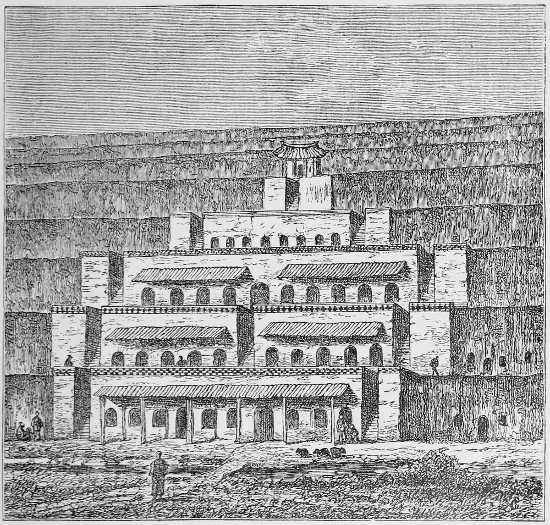
Facade of Dwelling in Loess Cliffs, Ling-shí hien. (From Richthofen.)
There remains, lastly, a peculiar property of loess which is perhaps more important than all other features when measured by its man-serving efficiency. This is the manner in which it brings forth crops without the aid of manure. From a period more than 2,000 years before Christ, to the present day, the province of Shansí has borne the name of Grainery of the Empire, while its fertile soil, hwang-tu, or ‘yellow earth,’ is the origin of the imperial color. Spite of this productiveness, which, in the fourteenth century, caused the Friar Odoric to class it as the second country in the world, its present capacity for raising crops seems to be as great as ever. In the nature of this substance lies the reason for this apparently inexhaustible fecundity. Its remarkably porous structure must indeed cause it to absorb the gases necessary to plant life to a much greater degree than other soils, but the stable production of those mineral substances needful to the yearly succession of crops is in the ground itself. The salts contained more or less in solution at the water level of the region are freed by the capillary action of the loess when rain-water sinks through the spongy mass from above. Surface moisture following the downward direction of the tiny loess tubes establishes a connection with the waters compressed below, when, owing to the law of diffusion, the ingredients, being released, mix with the moisture of the little canals, and are taken from the lowest to the topmost levels, permeating the ground and furnishing nourishment to the plant roots at the surface. It is on account of this curious action of loess that a copious rain-fall is more necessary in North China than elsewhere, for with a dearth of rain the capillary communication from above, below, and vice versa, is interrupted, and vegetation loses both its manure and moisture. Drought and famine are consequently synonymous terms here.
RICHTHOFEN’S THEORY OF ITS ORIGIN.
As to the formation and origin of loess, Richthofen’s theory is substantially as follows:[170] The uniform composition of this material over extended areas, coupled with the absence of stratification and of marine or fresh-water organic remains, renders impossible the hypothesis that it is a water deposit. On the other hand, it contains vast quantities of land-shells and the vestiges of animals (mammalia) at every level, both in remarkably perfect condition. Concluding, also, that from the conformation of the neighboring mountain chains and their peculiar weathering, the glacial theory is inadmissible, he advances the supposition that loess is a sub-aërial deposit, and that its fields are the drained analogues of the steppe-basins of Central Asia. They date from a geological era of great dryness, before the existence of the Yellow and other rivers of the northern provinces. As the rocks and hills of the highlands disintegrated, the sand was removed, not by water-courses seaward, but by the high winds ranging over a treeless desert landward, until the dust settled in the grass-covered districts of what is at present China Proper. New vegetation was at once nourished, while its roots were raised by the constantly arriving deposit; the decay of old roots produced the lime-lined canals which impart to this material its peculiar characteristics. Any one who has observed the terrible dust-storms of North China, when the air is filled with an impalpable yellow powder, which leaves its coating upon everything, and often extends, in a fog-like cloud, hundreds of miles to sea, will understand the power of this action during many thousand years. This deposition received the shells and bones of innumerable animals, while the dissolved solutions contained in its bulk stayed therein, or saturated the water of small lakes. By the sinking of mountain chains in the south, rain-clouds emptied themselves over this region with much greater frequency, and gradually the system became drained, the erosion working backward from the coast, slowly cutting into one basin after another. With the sinking of its salts to lower levels, unexampled richness was added to the wonderful topography of this peculiar formation.[171]
Pumpelly, while accepting this ingenious theory in place of his own (that of a fresh-water lake deposit), adds that the supply of loess might have been materially increased by the vast mers-de-glace of High Asia and the Tien shan, whose streams have for ages transported the products of glacial attrition into Central Asia and Northwest China. Again, he insists that Richthofen has not given importance enough to the parting planes, wrongly considered by his predecessors as planes of stratification. “These,” he says, “account for the marginal layers of débris brought down from the mountains. And the continuous and more abundant growth of grasses at one plane would produce a modification of the soil structurally and chemically, which superincumbent accumulations could never efface. It should seem probable that we have herein, also, the explanation of the calcareous concretions which abound along these planes; for the greater amount of carbonic acid generated by the slow decay of this vegetation would, by forming a bicarbonate, give to the lime the mobility necessary to produce the concretions.”
METHODS OF WORKING COAL.
The metallic and mineral productions used in the arts comprise nearly everything found in other countries, and the common ones are furnished in such abundance, and at such rates, as conclusively prove them to be plenty and easily worked. The careful digest of observations published by Pumpelly through the Smithsonian Institution, carries out this remark, and indicates the vast field still to be explored. Coal exists in every province in China, and Pumpelly enumerates seventy-four localities which have been ascertained. Marco Polo’s well-known notice of its use shows that the people had long employed it: “It is a fact that all over the country of Cathay there is a kind of black stone existing in beds in the mountains, which they dig out and burn like firewood. It is true that they have plenty of wood also, but they do not burn it, because those stones burn better and cost less.”[172] This mineral seems to have been unknown in Europe till after the return of the Venetian to his native land, while it was employed before the Christian era in China, and probably in very ancient times, if the accessible deposits in Shensí then cropped out in its eroded gorges, as represented by Richthofen. The few fossil plants hitherto examined indicate that the mass of these deposits are of the Mesozoic age. The mode of working the coal mines is described by Pumpelly,[173] and was probably no worse two thousand five hundred years ago. Want of machinery for draining them prevents the miners from going much below the water-level, and a rain-storm will sometimes flood and ruin a shaft. An inclined plane seldom takes the workmen more than a hundred feet below the level of the mouth, and then a horizontal gallery conducts him to the end of the mine. Some water is bailed out by buckets handed from one level up to another at the top, and the coal is carried out in baskets on the miners’ backs, or dragged in sleds over smooth, round sticks along passages too low for the coolies to do better than crawl as they work. Mr. Pumpelly found the gallery of one mine near Peking so low that he had to crawl the whole distance (six thousand feet) to see its construction, and when he emerged into daylight, with his knees nearly skinned, ascertained that the workmen padded theirs. The timbering is very expensive, yet, with all drawbacks, the coal sells, at the pit’s mouth, for $2.00 down to 50 cents a ton. The mines, lying on the slopes of the plateau reaching from near Corea to the Yellow River, supply the plain with cheap and excellent fuel.
Blakiston gives an account of the manner in which coal is worked on the Upper Yangtsz’, near the town of Süchau: “Having to be got out at a great height up in the cliff, very thick hawsers, made of plaited bamboo, are tightly stretched from the mouth, or near the mouth, of the working gallery, to a space near the water where the coal can be deposited. These ropes are in pairs, and large pannier-shaped baskets are made to traverse on them, a rope passing from one over a large wheel at the upper landing, and down again to the other, so that the full basket going down pulls the empty one up, the velocity being regulated by a kind of brake on the wheel at the top. At some places the height at which the coal is worked is so great that two or more of these contrivances are used, one taking to a landing half way down, and another from thence to the river. The hawsers are kept taut by a windlass for that purpose at the bottom.”[174] This useful mineral appears to be abundant throughout Sz’chuen Province, and is used here much less sparingly than in the east. With such inexpensive methods of getting coal to the water-courses, foreign machinery can hardly be expected to reduce its price very materially.
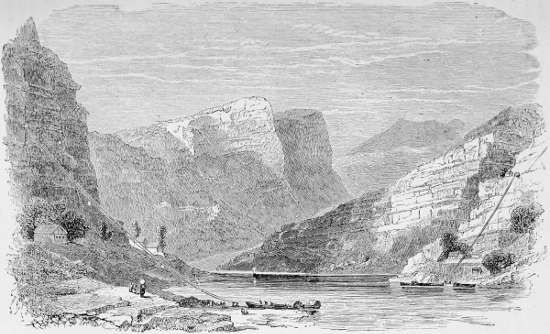
COAL GORGE ON THE YANGTSZ’. (FROM BLAKISTON.)
The economical use of coal in the household and the arts has been carried to great perfection. Anthracite is powdered and mixed with wet clay, earth, sawdust or dung, according to the exigencies of the case, in the proportion of about seven to one; the balls thus made are dried in the sun. The brick-beds (kang) are effective means of warming the house, and the hand furnaces enable the poor to cook with these balls—aided by a little charcoal or kindlings—at a trifling expense. This form of consumption is common north of the Yellow River, and brings coal within reach of multitudes who otherwise would suffer and starve. Bituminous, brown, and other varieties of coal occur in the same abundance and extent as in other great areas, giving promise of adequate supplies for future ages. The coal worked on the Peh kiang, in Kwangtung, contains sulphur, and is employed in the manufacture of copperas.[175]
BUILDING STONES AND MINERALS.
Crystallized gypsum is brought from the northwest of the province to Canton, and is ground to powder in mills; plaster of Paris and other forms of this sulphate are common all over China. It is not used as a manure, but the flour is mixed with wood-oil to form a cement for paying the seams of boats after they have been caulked. The powder is employed as a dentifrice, a cosmetic, and a medicine, and sometimes, also, is boiled to make a gruel in fevers, under the idea that it is cooling. The bakers who supplied the English troops at Amoy, in 1843, occasionally put it into the bread to make it heavier, but not, as was erroneously charged upon them, with any design of poisoning their customers, for they do not think it noxious; its employment in coloring green tea, and adulterating powdered sugar, is also explainable by other motives than a wish to injure the consumers.
Limestone is abundant at Canton, both common clouded marble and blue limestone; the last is extensively used in the artificial rockwork of gardens. Even if the Cantonese knew of the existence of lime in limestone, which they generally do not, the expense of fuel for calcining it would prevent their burning it while oyster-shells are so abundant in that region. In other provinces stone-lime is burned, by the aid of coal, in small kilns. The fine marble quarried near Peking is regarded as fit alone for imperial uses, and is seen only in such places as the Altar of Heaven and palace grounds. The marble used for floors is a fissile crystallized limestone, unsusceptible of polish; no statues or ornaments are sculptured from this mineral, but slabs are sometimes wrought out, and the surfaces curiously stained and corroded with acids, forming rude representations of animals or other figures, so as to convey the appearance of natural markings. Some of these simulated petrifactions are exceedingly well done. Slabs of argillaceous slate are also chosen with reference to their layers, and treated in the same manner. An excellent granite is used about Canton and Amoy for building, and no people exceed the Chinese in cutting it. Large slabs are split out by wooden wedges, cut for basements and foundations, and laid in a beautiful manner; pillars are also hewn from single stones of different shapes, though of no extraordinary dimensions, and their shafts embellished with inscriptions. Ornamental walls are frequently formed of large slabs set in posts, like panels, the outer faces of which are beautifully carved with figures representing a landscape or procession. Red and gray sandstone, gneiss, mica slate, and other species of rock, are also worked for pavements and walls.
Nitre is cheap and common enough in the northern provinces to obviate any fear of its being smuggled into the country from abroad; it is obtained in Chihlí by lixiviating the soil, and furnishes material for the manufacture of gunpowder. A lye is obtained from ashes, which partially serves the purposes of soap; but the people are still ignorant of the processes necessary for manufacturing it. Fourteen localities of alum are given in Pumpelly’s list, but the greatest supply for the eastern provinces comes from deposits of shale, in Ping-yang hien, in Chehkiang, which produces about six thousand tons annually. It is used mostly by the dyers, also to purify turbid water, and whiten paper. Other earthy salts are known and used, as borax, sal-ammoniac (which is collected in Mongolia and Ílí from lakes and the vicinity of extinct volcanoes), and blue and white vitriol, obtained by roasting pyrites. Common salt is procured along the eastern and southern coasts by evaporating sea-water, rock-salt not having been noticed; in the western provinces and Shansí, it is obtained from artesian wells and lakes as cheaply as from the ocean; in Tsing-yen hien, in Central Sz’chuen, two hundred and thirty-seven wells are worked. At Chusan the sea-water is so turbid that the inhabitants filter it through clay, afterward evaporating the water.
JADE STONE, OR YUH.
The minerals heretofore found in China have, for the most part, been such as have attracted the attention of the natives, and collected by them for curiosity or sale. The skilful manner in which their lapidaries cut crystal, agate, and other quartzose minerals, is well known.[176] The corundum used for polishing and finishing these carvings occurs in China, but a good deal of emery in powder is obtained from Borneo. A composition of granular corundum and gum-lac is usually employed by workmen in order to produce the highest lustre of which the stones are capable. The three varieties of the silicate of alumina, called jade, nephrite, and jadeite by mineralogists, are all named yuh by the Chinese, a word which is applied to a vast variety of stones—white marble, ruby, and cornelian all coming under it—and therefore not easy to define. Jade has long been known in Europe as a variety of jasper, its separation from that stone into a species by itself being of comparatively recent origin. Since the third edition of Boetius, in 1647, the two minerals have been regarded as entirely distinct. Its value in the eyes of the Chinese depends chiefly upon its sonorousness and color. The costliest specimens are brought from Yunnan and Khoten; a greenish-white color is the most highly prized, a plain color of any shade being of less value. A cargo of this mineral was once imported into Canton from New Holland, but the Chinese would not purchase it, owing to a fancy taken against its origin and color. The patient toil of the workers in this hard mineral is only equalled by the prodigious admiration with which it is regarded; both fairly exhibit the singular taste and skill of the Chinese. Its color is usually a greenish-white, or grayish-green and dark grass-green; internally it is scarcely glimmering. Its fracture is splintery; splinters white; mass semi-transparent and cloudy; it scratches glass strongly, and can itself generally be scratched by flint or quartz, but while not excessively hard it is remarkable for toughness. The stone when freshly broken is less hard than after a short exposure. Specific gravity from 2.9 to 3.1.[177] Fischer (pp. 314-318) gives some one hundred and fifty names as occurring in various authors—ancient and modern—for jade or nephrite.[178] An interesting testimony to the esteem in which this stone was held in China during the middle ages comes from Benedict Goës (1602), who says: “There is no article of traffic more valuable than lumps of a certain transparent kind of marble, which we, from poverty of language, usually call jasper.... Out of this marble they fashion a variety of articles, such as vases, brooches for mantles and girdles, which, when artistically sculptured in flowers and foliage, certainly have an effect of no small magnificence. These marbles (with which the Empire is now overflowing) are called by the Chinese Iusce. There are two kinds of it; the first and more valuable is got out of the river at Cotan, almost in the same way in which divers fish for gems, and this is usually extracted in pieces about as big as large flints. The other and inferior kind is excavated from the mountains.” The ruby, diamond, amethyst, sapphire, topaz, pink tourmaline, lapis-lazuli,[179] turquoises, beryl, garnet, opal, agate, and other stones, are known and most of them used in jewelry. A ruby brought from Peking is noticed by Bell as having been valued in Europe at $50,000. The seals of the Boards are in many instances cut on valuable stones, and private persons take great pride in quartz or jade seals, with their names carved on them; lignite and jet are likewise employed for cheaper ornaments, of which all classes are fond.
METALS AND THEIR PRODUCTION.
All the common metals, except platina, are found in China, and the supply would be sufficient for all the purposes of the inhabitants, if they could avail themselves of the improvements adopted in other countries in blasting, mining, etc. The importations of iron, lead, tin, and quicksilver, are gradually increasing, but they form only a small proportion of the amount used throughout the Empire, especially of the two first named; iron finds its way in because of its convenient forms more than its cheapness. The careful examination of Chinese topographical works by Pumpelly,[180] records the leading localities of iron in every province, and where copper, tin, lead, silver, and quicksilver have been observed; he also mentions fifty-two places producing gold in various forms, most of them in Sz’chuen. The rumor of gold-washings occurring not far from Chifu, in Shantung, caused much excitement in 1868, but they were soon found to be not worth the labor. Gold has never been used as coin in China, but is wrought into jewelry; most of it is consumed in gilding and exported to India as bullion, in the shape of small bars or coarse leaves.
Silver is mentioned in sixty-three localities by the same author; large amounts are brought from Yunnan, and the mines in that region must be both extensive and easily worked to afford such large quantities as have been exported. The working of both gold and silver mines has been said to be prohibited, but this interdiction is rather a government monopoly of the mines than an injunction upon working those which are known. The importation of gold into China during the two centuries the trade has been opened, does not probably equal the exportation which has taken place since the commencement of the opium trade. It is altogether improbable that the Chinese are acquainted with the properties of quicksilver in separating these two metals from their ores, though its consumption in making vermilion and looking-glasses calls for over two thousand flasks yearly at Canton. Cinnabar occurs in Kweichau and Shensí and furnishes most of the “water silver,” as the Chinese call it, by a rude process of burning brushwood in the wells, and collecting the metal after condensation.
Copper is used for manufacturing coin, bells, bronze articles, domestic and cooking utensils, cannon, gongs, and brass-foil. It is found pure in some instances, and the sulphuret, the blue and green carbonates, pyrities, and other ores are worked; malachite is ground for a paint. It occurs in every province, and is specially rich in Shansí and Kweichau. The ores of zinc and copper in Yunnan and Sz’chuen furnish spelter, and the peculiar alloy known as white copper or argentan, containing in addition tin, iron, nickel, and lead. So much use indicates large deposits of the ores. Tin is rather abundant, but lead is more common; thirty-nine localities of the first are mentioned, some of which are probably zinc ores, as the Chinese confound tin and zinc under one generic name. Lead occurs with silver in many places; twenty-four mines are mentioned in Pumpelly’s list, and those in Fuhkien are rich; but the extensive importations prove that its reduction is too expensive to compete with the foreign.
Realgar is quite common, this and orpiment being used as paints; statuettes and other articles are carved from the former, while arsenic is used in agriculture to quicken grain and preserve it from insects. Amber and fossilized copal are collected in several localities; the first is much employed in the making of court necklaces and hair ornaments. The fei-tsui or jadeite is the most prized of the semi-precious stones; it is cut into ear-rings, finger-rings, necklaces, etc. Pumpelly mentions pieces of this mineral set in relics obtained from tombs in Mexico, though no locality where it abounds has yet been found in America. Lapis-lazuli is employed in painting upon copper and porcelain ware; this mineral is obtained in Chehkiang and Kansuh; jadeite, topaz, and other fine stones are most plenty in Yunnan. A few minerals and fossils have been noticed in the vicinity and shops at Canton, but China thus far has furnished very few petrifactions in any strata. Coarse epidote occurs at Macao, and tungstate of iron has been noticed in the quartz rocks at Hongkong. Petrified crabs (macrophthalmus) have been brought to Canton from Hainan, which are prized by the natives for their supposed medicinal qualities. Scientists have hitherto described a score or more species of Devonian shells, and recognized fragments of the hyena, tapir, rhinoceros, and stegedon, among some other doubtful vertebratæ in the “dragon’s bones” sold in medicine shops; but further examinations will doubtless increase the list. Orthoceratites and bivalve shells of various kinds are noticed in Chinese books as being found in rocks, and fossil bones of huge size in caves and river banks.
There are many hot springs and other indications of volcanic action along the southern acclivities of the table land in the provinces of Shensí and Sz’chuen; and at Jeh-ho, in Chihlí, there are thermal springs to which invalids resort. The Ho tsing, or Fire wells, in Sz’chuen are apertures resembling artesian springs, sunk in the rock to a depth of one thousand five hundred or one thousand eight hundred feet, whilst their breadth does not exceed five or six inches. This is a work of great difficulty, and requires in some cases the labor of two or three years. The water procured from them contains a fifth part of salt, which is very acrid, and mixed with much nitre. When a lighted torch is applied to the mouth of some of those which have no water, fire is produced with great violence and a noise like thunder, bursting out into a flame twenty or thirty feet high, and which cannot be extinguished without great danger and expense. The gas has a bituminous smell, and burns with a bluish flame and a quantity of thick, black smoke. It is conducted under boilers in bamboos, and employed in evaporating the salt-water from the other springs.[181] Besides the gaseous and aqueous springs in these provinces, there are others possessing different qualities, some sulphurous and others chalybeate, found in Shansí and along the banks of the Yellow River. Sulphur occurs, as has been noted, in great abundance in Formosa, and is purified for powder manufacturers.
The animal and vegetable productions of the extensive regions under the sway of the Emperor of China include a great variety of types of different families. On the south the islands of Hainan and Formosa, and parts of the adjacent coasts, slightly partake of a tropical character, exhibiting in the cocoanuts, plantains, and peppers, the parrots, lemurs, and monkeys, decided indications of an equatorial climate. From the eastern coast across through the country to the northwest provinces occur mountain ranges of gradually increasing elevation, interspersed with intervales and alluvial plateaus and bottoms, lakes and rivers, plains and hills, each presenting its peculiar productions, both wild and cultivated, in great variety and abundance. The southern ascent of the high land of Mongolia, the uncultivated wilds of Manchuria, the barren wastes of the desert of Gobi, with its salt lakes, glaciers, extinct volcanoes, and isolated mountain ranges; and lastly the stupendous chains and valleys of Tibet, Koko-nor, and Kwănlun all differ from each other in the character of their productions. In one or the other division, every variety of soil, position, and temperature occur which are known on the globe; and what has been ascertained within the past fifteen years by enterprising naturalists is an earnest of future greater discoveries.
QUADRUMANOUS ANIMALS OF CHINA.
Of the quadrumanous order of animals, there are several species. The Chinese are skilful in teaching the smaller kinds of monkeys various tricks, but M. Breton’s picture of their adroitness and usefulness in picking tea in Shantung from plants growing on otherwise inaccessible acclivities, is a fair instance of one of the odd stories furnished by travellers about China, inasmuch as no tea grows in Shantung, and monkeys are taught more profitable tricks.[182] One of the most remarkable animals of this tribe is the douc, or Cochinchinese monkey (Semnopithecus nemæus). It is a large species of great rarity, and remarkable for the variety of colors with which it is adorned. Its body is about two feet long, and when standing in an upright position its height is considerably greater. The face is of an orange color, and flattened in its form. A dark band runs across the front of the forehead, and the sides of the countenance are bounded by long spreading yellowish tufts of hair. The body and upper parts of the forearms are brownish gray, the lower portions of the arms, from the elbows to the wrists, being white; its hands and thighs are black, and the legs of a bright red color, while the tail and a large triangular spot above it are pure white. Such a creature matches well, for its grotesque and variegated appearance, with the mandarin duck and gold fish, also peculiar to China.
THE FÍ-FÍ AND HAI-TUH.
Chinese books speak of several species of this family, and small kinds occur in all the provinces. M. David has recently added two novelties to the list from his acquisitions in Eastern Koko-nor, well fitted for that cold region by their abundant hair. The Rhinopithecus roxellanæ inhabits the alpine forests, nearly two miles high, where it subsists on the buds of plants and bamboo shoots laid up for winter supply; its face is greenish, the nose remarkably rétroussé, and its strong, brawny limbs well fitted for the arboreal life it leads; the hair is thick and like a mane on the back, shaded with yellow and white tints. In this respect it is like the Gelada monkey of Abyssinia, and a few others protected in this part of the body from cold. This is no doubt the kind called fí-fí in native books, and once found in flocks along many portions of western China, as these authors declare. Their notices are rather tantalizing, but, now that we have found the animal, are worth quoting: “The fí-fí resembles a man; it is clothed with its hair, runs quick and eats men; it has a human face, long lips, black, hairy body, and turns its heels. It laughs on seeing a man and covers its eyes with its lips; it can talk and its voice resembles a bird. It occurs in Sz’chuen, where it is called jin hiung, or ‘human bear;’ its palms are good eating, and its skin is used; its habit is to turn over stones, seeking for crabs as its food. Its form is like that of the men who live in the Kwănlun Mountains.”
Another large simia (Macacus thibetanus) comes from the same region; it lives in bands like the preceding, but lower down the mountains. A third species of great size was reported to occur in the southwestern part of Sz’chuen, and described as greenish like the Macacus tcheliensis from the hills northwest of Peking—the most northern species of monkey known. The former of these two may possibly be the sing-sing of the Chinese books, though its characteristics involve some confusion of the Macacus and baboon on the part of those writers. Two other species of Macacus, and as many of the gibbons, have been noticed in Hainan, Formosa, and elsewhere in the south.
The singular proboscis monkey (Nasalis laivalus), called khi-doc in Cochinchina and hai-tuh by the Chinese, exhibits a strange profile, part man and part beast, reminding one of the combinations in Da Vinci’s caricatures. It is a large animal, covered with soft yellowish hair tinted with red; the long nose projects in the form of a sloping spatula. The Chinese account says: “Its nose is turned upward, and the tail very long and forked at the end, and that whenever it rains, the animal thrusts the forks into its nose. It goes in herds, and lives in friendship; when one dies, the rest accompany it to burial. Its activity is so great that it runs its head against the trees; its fur is soft and gray, and the face black.”[183]
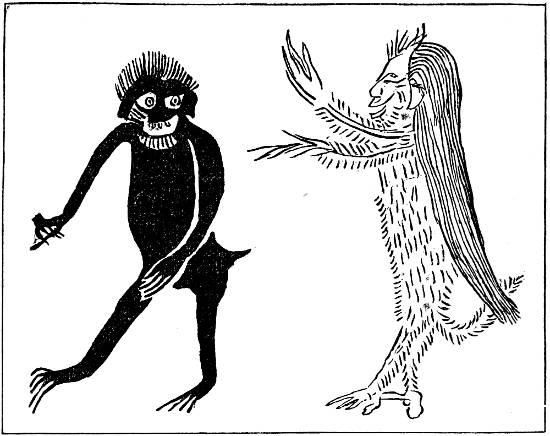
Fí-fí and Hai-tuh. (From a Chinese cut.)
The Chinese Herbal, from which the preceding extract is taken, describes the bat under various names, such as ‘heavenly rat,’ ‘fairy rat,’ ‘flying rat,’ ‘night swallow,’ and ‘belly wings;’ it also details the various uses made of the animal in medicine, and the extraordinary longevity attained by some of the white species. The bat is in form like a mouse; its body is of an ashy black color; and it has thin fleshy wings, which join the four legs and tail into one. It appears in the summer, but becomes torpid in the winter; on which account, as it eats nothing during that season, and because it has a habit of swallowing its breath, it attains a great age. It has the character of a night rover, not on account of any inability to fly in the day, but it dares not go abroad at that time because it fears a kind of hawk. It subsists on mosquitoes and gnats. It flies with its head downward, because the brain is heavy.[184] This quotation is among the best Chinese descriptions of animals, and shows how little there is to depend upon in them, though not without interest in their notices of habits. Bats are common everywhere, and seem to be regarded with less aversion than in certain other countries. Twenty species belonging to nine genera are given in one list, most of them found in southern China; the wings of some of these measure two feet across; a large sort in Sz’chuen is eaten.
WILD ANIMALS.
The brown bear is known, and its paws are regarded as a delicacy; trained animals are frequently brought into cities by showmen, who have taught them tricks. The discovery by David of a large species (Ailuropus melanoleurus) allied to the Himalayan panda (Ailurus fulgens), also found on the Sz’chuen Mountains, adds another instance of the strange markings common in Tibetan fauna. This beast feeds on flesh and vegetables; its body is white, but the ears, eyes, legs, and tip of the tail are quite black; the fur is thick and coarse. It is called peh hiung, or white bear, by the hunters, but is no doubt the animal called pi in the classics, common in early times over western China, and now rare even in Koko-nor. The Tibetan black bear occurs in Formosa, Shantung, and Hainan, showing a wide range. The badger is quite as widespread, and the two species have the same general appearance as their European congeners.
Carnivorous animals still exist, even in thickly settled districts. The lion may once have roamed over the southwestern Manji kingdom, but the name and drawings both indicate a foreign origin. It has much connection with Buddhism, and grotesque sculptures of rampant lions stand in pairs in front of temples, palaces, and graves, as a mark of honor and symbol of protection. The last instance of a live lion brought as tribute was to Hientsung in A.D. 1470, from India or Ceylon. Many other species of felis are known, some of them peculiar to particular regions. The royal tiger has been killed near Amoy, and in Manchuria the panther, leopard, and tiger-cat all occur in the northern and southern provinces, making altogether a list of twelve species ranging from Formosa to Sagalien. Mr. Swinhoe’s[185] account of his rencounter with a tiger near Amoy in 1858 explains how such large animals still remain in thickly settled regions where food is abundant and the people are timid and unarmed. In thinly peopled parts they become a terror to the peasants. M. David enumerates six kinds, including a lynx, in Monpin alone, one of which (Felis scripta) is among the most prettily marked of the whole family. Hunting-leopards and tigers were used in the days of Marco Polo by Kublai, but the manly pastime of the chase, on the magnificent scale then practised, has fallen into disuse with the present princes. A small and fierce species of wild-cat (Felis chinensis), two feet long, of a brownish-gray color, and handsomely marked with chestnut spots and black streaks, is still common in the southwestern portions of Fuhkien. Civet cats of two or three kinds, tree-civets (Helictes), and a fine species of marten (Martes), with yellow neck and purplish-brown body, from Formosa, are among the smaller carnivora in the southern provinces.
CATS AND DOGS.
The domestic animals offer few peculiarities. The cat, kia lí, or ‘household fox,’ is a favorite inmate of families, and the ladies of Peking are fond of a variety of the Angora cat, having long silky hair and hanging ears. The common species is variously marked, and in the south often destitute of a tail; when reared for food it is fed on rice and vegetables, but is not much eaten. Popular superstition has clustered many omens of good and bad luck about cats; it is considered, for example, the prognostic of certain misfortune when a cat is stolen from a house—much as, in some countries of the western world, it is unlucky when a black cat crosses one’s pathway.
The dog differs but little from that reared among the Esquimaux, and is perhaps the original of the species. There is little variation in their size, which is about a foot high and two feet in length; the color is a pale yellow or black, and always uniform, with coarse bristling hair, and tails curling up high over the back, and rising so abruptly from the insertion that it has been humorously remarked they almost assist in lifting the legs from the ground. The hind legs are unusually straight, which gives them an awkward look, and perhaps prevents them running very rapidly. The black eyes are small and piercing, and the insides of the lips and mouths, and the tongue, are of the same color, or a blue black. The bitch has a dew-claw on each hind leg, but the dog has none. The ears are sharp and upright, the head peaked, and the bark a short, thick snap, very unlike the deep, sonorous baying of our mastiffs. In Nganhwui a peculiar variety has pendant ears of great length, and thin, wirey tails. One item in the Chinese description of the dog is that it ‘can go on three legs’—a gait that is often exhibited by them. They are used to watch houses and flocks; the Mongolian breed is fierce and powerful. The dogs of Peking are very clannish, and each set jealously guards its own street or yard; they are fed by the butchers in the streets, and serve as scavengers there and in all large towns. They are often mangey, presenting hideous spectacles, and instances of plica polonica are not uncommon, but, as among the celebrated street dogs of Constantinople, hydrophobia is almost unheard of among them. Dog markets are seen in every city where this meat is sold; the animals are reared expressly for the table, but their flesh is expensive.
One writer remarks on their habits, when describing the worship offered at the tombs: “Hardly had the hillock been abandoned by the worshippers, when packs of hungry dogs came running up to devour the part of the offerings left for the dead, or to lick up the grease on the ground. Those who came first held up their heads, bristled their hair, and showed a proud and satisfied demeanor, curling and wagging their tails with selfish delight; while the late-comers, tails between their legs, held their heads and ears down. There was one of them, however, which, grudging the fare, held his nose to the wind as if sniffing for better luck; but one lean, old, and ugly beast, with a flayed back and hairless tail, was seen gradually separating himself from the band, though without seeming to hurry himself, making a thousand doublings and windings, all the while looking back to see if he was noticed. But the old sharper knew what he was about, and as soon as he thought himself at a safe distance, away he went like an arrow, the whole pack after him, to some other feast and some other tomb.”[186]
Wolves, raccoon-dogs, and foxes are everywhere common, in some places proving to be real pests in the sheepfold and farmyard. In the vicinity of Peking, it is customary to draw large white rings on the plastered walls, in order to terrify the wolves, as these beasts, it is thought, will flee on observing such traps. The Chinese regard the fox as the animal into which human spirits enter in preference to any other, and are therefore afraid to destroy or displease it. The elevated steppes are the abodes of three or four kinds, which find food without difficulty. The Tibetan wolf (Canis chanco) has a warm, yellowish-white covering, and ranges the wilds of Tsaidam and Koko-nor in packs. The fox (Canis cossac) spreads over a wide range, and is famed for its sagacity in avoiding enemies.
CATTLE, SHEEP, AND DEER.
The breed of cattle and horses is dwarfish, and nothing is done to improve them. The oxen are sometimes not larger than an ass; some of them have a small hump, showing their affinity to the zebu; the dewlap is large, and the contour neat and symmetrical. The forehead is round, the horns small and irregularly curved, and the general color dun red. The buffalo (shui niu), or ‘water ox,’ is the largest beast used in agriculture. It is very docile and unwieldy, larger than an English ox, and its hairless hide is a light black color; it seeks coolness and refuge from the gnat in muddy pools dug for its convenience, where it wallows with its nose just above the surface. Each horn is nearly semi-circular, and bends downward, while the head is turned back so as almost to bring the nose horizontal. The herd-boys usually ride it, and the metaphor of a lad astride a buffalo’s back, blowing the flute, frequently enters into Chinese descriptions of rural life. The yak of Tibet is employed as a beast of burden, and to furnish food and raiment. It is covered with a mantle of hair reaching nearly to the ground, and the soft pelage is used for making standards among the Persians, and its tail as fly-flaps or chowries in India; the hair is woven into carpets. The wild yak (Poephagus grunniens) has already been described. Great herds of these huge bovines roam over the wastes of Koko-nor, where their dried droppings furnish the only fuel for the nomads crossing those barren wilds.
The domestic sheep is the broad-tailed species, and furnishes excellent mutton. The tail is sometimes ten inches long and three or four thick; and the size of this fatty member is not affected by the temperature. The sheep are reared in the north by Mohammedans, who prepare the fleeces for garments by careful tanning; the animal is white, with a black head. Goats are raised in all parts, but not in large numbers. The argali and wild sheep of the Ala shan Mountains (Ovis Burrhel) furnish exciting sport in chasing them over their native cliffs, which they clamber with wonderful agility. Another denizen of those dreary wilds is the Antilope picticauda, a small and tiny species, weighing about forty pounds, of a dusky gray color, with a narrow yellow stripe on the flanks. Its range is about the head-waters of the Yangtsz’ River; its swiftness is amazing; it seems absolutely to fly. It scrapes for itself trenches in which to lie secure from the cold.
Many genera of ruminants are represented in China and the outlying regions; twenty-seven rare species are enumerated in Swinhoe’s and David’s lists, of which eleven are antelopes and deer. The range of some of them is limited to a narrow region, and most of them are peculiar to the country. The wealthy often keep deer in their grounds, especially the spotted deer (Cervus pseudaxis), from Formosa, whose coat is found to vary greatly according to sex and age; its name, kintsien luh, or ‘money deer,’ indicates its markings. Mouse-deer are also reared as pets in the southern provinces.
One common species is the dzeren or hwang yang (Antilope gutturosa), which roams over the Mongolian wilds in large herds, and furnishes excellent venison. It is heavy in comparison to the gazelle; horns thick, about nine inches long, annulated to the tips, lyrated, and their points turned inward. The goitre, which gives it its name, is a movable protuberance occasioned by the dilatation of the larynx; in the old males it is much enlarged. The animal takes surprising bounds when running. Great numbers are killed in the autumn, and their flesh, skins, and horns are all of service for food, leather, and medicine.
Several kinds of hornless (or nearly hornless) deer, allied to the musk-deer, exist. One is the river-deer (Hydropotes), common near the Yangtsz’ River, which resembles the pudu of Chili; it is very prolific on the bottoms and in the islands. Another sort in the northwest (Elaphodus) is intermediary between the muntjacs and deer, having long, trenchant, canine upper teeth, and a deep chocolate-colored fur. Three varieties of the musk-deer (Moschus) have been observed, differing a little in their colors, all called shié or hiang chang by the Chinese, and all eagerly hunted for their musk. This perfume was once deemed to be useful in medicine, and is cited in a Greek prescription of the sixth century; the abundance of the animal in the Himalayan regions may be inferred from Tavernier’s statement that he bought 7673 bags or pods at Patna in one of his journeys over two hundred years ago. This animal roams over a vast extent of alpine territory, from Tibet and Shensí to Lake Baikal, and inhabits the loftiest cliffs and defiles, and makes its way over rugged mountains with great rapidity. It is not unlike the roe in general appearance, though the projecting teeth makes the upper lip to look broad. Its color is grayish-brown and its limbs slight; the hair is coarse and brittle, almost like spines. The musk is contained in a pouch beneath the tail on the male, and is most abundant during the rutting season. He is taken in nets or shot, and the hunters are said to allure him to destruction by secreting themselves and playing the flute, though some would say the animal showed very little taste in listening to such sounds as Chinese flutes usually produce. The musk is often adulterated with clay or mixed with other substances to moderate its powerful odor. A singular and interesting member of this family is reared in the great park south of Peking—a kind of elk with short horns. This large animal (Elaphurus Davidianus), of a gentle disposition, equals in size the largest deer; its native name, sz’-puh siang, indicates that it is neither a horse, a deer, a camel, nor an ox, but partakes in some respects of the characteristics of each of them. Its gentle croaking voice seems to be unworthy of so huge a body; the color is a uniform fawn or light gray.
HORSES, ASSES, AND ELEPHANTS.
The horse is not much larger than the Shetland pony; it is bony and strong, but kept with little care, and presents the worst possible appearance in its usual condition of untrimmed coat and mane, bedraggled fetlocks, and twisted tail. The Chinese language possesses a great variety of terms to designate the horse; the difference of age, sex, color, and disposition, all being denoted by particular characters. Piebald and mottled, white and bay horses are common; but the improvement of this noble animal is neglected, and he looks sorry enough compared with the coursers of India. He is principally used for carrying the post, or for military services; asses and mules being more employed for draught. He is hardy, feeds on coarse food, and admirably serves his owners. The mule is well-shaped, and those raised for the gentry are among the very best in the world for endurance and strength; dignitaries are usually drawn by sumpter mules. Donkeys are also carefully raised. Chinese books speak of a mule of a cow and horse, as well as from the ass and horse, though, of course, no such hybrid as the former ever existed.
The wild ass, or onager (under the several names by which it is known in different lands, kyang, djang, kulan, djiggetai, ghor-khar, and yé-lu), still roams free and untameable. It is abundant in Koko-nor, gathering in troops of ten to fifty, each under the lead of a stallion to defend the mares. The flesh is highly prized, and the difficulty of procuring it adds to the delicacy of the dish; the color is light chestnut, with white belly.
THE WILD BOAR AND DOMESTIC HOG.
Elephants are kept at Peking for show, and are used to draw the state chariot when the Emperor goes to worship at the Altars of Heaven and Earth, but the sixty animals seen in the days of Kienlung, by Bell, have since dwindled to one or two. Van Braam met six going into Peking, sent thither from Yunnan. The deep forests of that province also harbor the rhinoceros and tapir. The horn of the former is sought after as medicine, and the best pieces are carved most beautifully into ornaments or into drinking cups, which are supposed to sweat whenever any poisonous liquid is put into them. The tapir is the white and brown animal found in the Malacca peninsula, and strange stories are recorded of its eating stones and copper. The wild boar grows to weigh over four hundred pounds and nearly six feet long. In cold weather its frozen carcass is brought to Peking, and sold at a high price. A new species of hog has been found in Formosa, about three feet long, twenty-one inches high, and showing a dorsal row of large bristles; a third variety occurs among the novelties discovered in Sz’chuen (Sus moupinensis), having short ears. Wild boars are met with even in the hills of Chehkiang, and seriously annoy the husbandmen in the lowlands by their depredations. Deep pits are dug near the base of the hills, and covered with a bait of fresh grass, and many are annually captured or drowned in them. They are fond of the bamboo shoots, and persons are stationed near the groves to frighten them away by striking pieces of wood together.
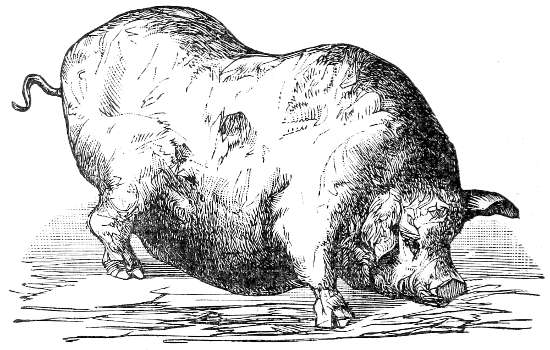
The Chinese Pig.
The Chinese hollow-backed pig is known for its short legs, round body, crooked back, and abundance of fat; the flesh is the common meat of the people south of the Yangtsz’ River. The black Chinese breed, as it is called in England, is considered the best pork raised in that country. The hog in the northern provinces is a gaunt animal, uniformly black, and not so well cared for as its southern rival. Piebald pigs are common in Formosa, resulting from crossing; sometimes animals of this kind are quite woolly. The Chinese in the south, well aware of the perverse disposition of the hog, find it much more expeditious to carry instead of drive him through their narrow streets. For this purpose cylindrical baskets, open at both ends, are made; and in order to capture the obstinate brute, it is secured just outside the half-opened gate of the pen. The men seize him by the tail and pull it lustily; his rage is roused by the pain, and he struggles; they let go their hold, whereupon he darts out of the gate to escape, and finds himself snugly caught. He is lifted up and unresistingly carried off.
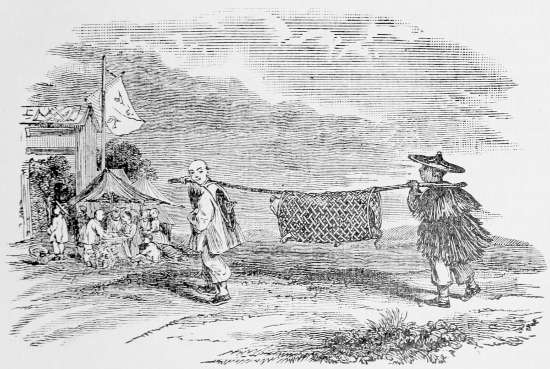
Mode of Carrying Pigs.
The camel is employed in the trade carried on across the desert, and throughout Mongolia, Manchuria, and northern China near the plateau; without his aid those regions would be impassible; the passes across the ranges near Koko-nor, sixteen thousand feet high, are traversed by his help, though amid suffering and danger. In the summer season it sheds all its hair, which is gathered for weaving into ropes and rugs; at this period, large herds pasture on the plateau to recuperate. The humps at this season hang down the back like empty bags, and the poor animal presents a distressed appearance during the hot weather. In its prime condition it carries about six hundred pounds weight, but is not used to ride upon as is the Arabian species. The two kinds serve man in one continuous kafilah from the Sea of Tartary across two continents to Timbuctoo. The Chinese have employed the camel in war, and trained it to carry small gingalls so that the riders could fire them while resting on its head, but this antique kind of cavalry has disappeared with the introduction of better weapons.
SMALLER ANIMALS AND RODENTS.
Among the various tribes of smaller animals, the Chinese Empire furnishes many interesting peculiarities, and few families are unrepresented. No marsupials have yet been met, and the order of edentata is still restricted to one instance. Several families in other orders are rare or wanting, as baboons, spider-monkeys, skunks, and ichneumons. In the weasel tribe, some new species have been added to the already long list of valuable fur-bearing animals found in the mountains—the sable ermine, marten, pole-cat, stoat, etc., whose skins still repay the hunters. The weasel is common, but not troublesome. The otter is trained in Sz’chuen to catch fish in the mountain streams with the docility of a spaniel; another species (Lutia swinhosi) occurs along the islands on the southern coast, while in Hainan Island appears a kind of clawless otter of a rich brown color above and white beneath; each of these is about twenty inches long. The furs of all these, and also the sea-otter, are prepared for garments, especially collars and neck-wraps.
A kind of mole exists in Sz’chuen, having a muzzle of extreme length, while the scent of another variety near Peking is so musky as to suggest its name (Scaptochirus moschatus). Muskrats and shrew-mice are found both north and south; and one western species has only a rudimentary tail; while another, the Scaptonyx, forms an intermediate species between a mole and a shrew, having a blunt muzzle, strong fore feet and a long tail; and lastly, a sort fitted for aquatic habits, with broad hind feet and flattened tail. Tiny hedgehogs are common even in the streets and by-lanes of Peking, where they find food and refuge in the alluvial earth. Two or three kinds of marmots and mole-rats are found in the north and west (Siphucus Arctomys), all specifically unlike their congeners elsewhere. The Chinese have a curious fancy in respect to one beast, one bird, and one fish, each of which, they say, requires that two come together to make one complete animal, viz., the jerboa, the spoonbill and sole-fish; the first (Dipus annulatus) occurs in the sands of northern China, the second in Formosa, and the third along the coasts.
Many kinds of rodents have been described. The alpine hare (Lagomys ogotona) resembles a marmot in its habits and is met with throughout the grassy parts of the steppes; its burrows riddle the earth wherever the little thing gathers, and endangers the hunters riding over it. It is about the size of a rat, and by its wonderful fecundity furnishes food to a great number of its enemies—man, beasts, and birds; it is not dormant, but gathers dry grass for food and warmth during cold weather; this winter store is, however, often consumed by cattle before it is stored away. Hares and rabbits are well known. Two species of the former are plenty on the Mongolian grass-lands, one of which has very long feet; in winter their frozen bodies are brought to market. One species is restricted to Hainan Island. Ten or twelve kinds of squirrels have been described, red, gray, striped, and buff; one with fringed ears. Their skins are prepared for the furriers, and women wear winter robes lined with them. Two genera of flying-squirrel (Pteromys and Sciuropterus) have been noticed, the latter in Formosa and the former mostly in the western provinces. Chinese writers have been puzzled to class the flying-squirrel; they place it among birds, and assure their readers that it is the only kind which suckles its young when it flies, and that “the skin held in the hand during parturition renders delivery easier, because the animal has a remarkably lively disposition.” The long, dense fur of the P. alborufous makes beautiful dresses, the white tips of the hair contrasting prettily with the red ground.
Of the proper rats and mice, more than twenty-five species have been already described. Some of them are partially arboreal, others have remarkably long tails, and all but three are peculiar to the country. A Formosan species, called by Swinhoe the spinous country rat, had been dedicated to Koxinga, the conqueror of that island; while another common in Sz’chuen bears the name of Mus Confucianus. The extent to which the Chinese eat rats has been greatly exaggerated by travellers, for the flesh is too expensive for general use.
One species of porcupine (Hystrix subcristata) inhabits the southern provinces, wearing on its head a purplish-black crest of stout spines one to five inches long; the bristles are short, but increase in size and length to eight or nine inches toward the rump; the entire length is thirty-three inches. The popular notion that the porcupine darts its quills at its enemies as an effectual weapon is common among the Chinese.
No animal has puzzled the Chinese more than the scaly ant-eater or pangolin (Manis dalmanni), which is logically considered as a certain and useful remedy by them, simply because of its oddity. It is regarded as a fish out of water, and therefore named ling-lí, or ‘hill carp,’ also dragon carp, but the most common designation is chuen shan kiah, or the ‘scaly hill borer.’ One author says: “Its shape resembles a crocodile; it can go in dry paths as well as in the water; it has four legs. In the daytime it ascends the banks of streams, and lying down opens its scales wide, putting on the appearance of death, which induces the ants to enter between them. As soon as they are in, the animal closes its scales and returns to the water to open them; the ants float out dead, and he devours them at leisure.” A more accurate observer says: “It continually protrudes its tongue to entice the ants on which it feeds;” and true to Chinese physiological deductions, similia similibus curantur, he recommends the scales as a cure for all antish swellings. He also remarks that the scales are not bony, and consist of the agglutinated hairs of the body. The adult specimens measure thirty-three inches. It walks on the sides of the hind feet and tips of the claws of the fore feet, and can stand upright for a minute or two. The large scales are held to the skin by a fleshy nipple-like pimple, which adheres to the base.
PORPOISES AND WHALES.
Among the cetaceous inhabitants of the Chinese waters, one of the most noticeable is the great white porpoise (Delphinus chinensis), whose uncouth tumbles attract the traveller’s notice as he sails into the estuary of the Pearl River on his way to Hongkong, and again as he steams up the Yangtsz’ to Hankow. The Chinese fishermen are shy of even holding it in their nets, setting it free at once, and never pursuing it; they call it peh-kí and deem its presence favorable to their success. A species of fin-whale (Balænoptera) has been described by Swinhoe, which ranges the southern coast from the shores of Formosa to Hainan. Its presence between Hongkong and Amoy induced some foreigners to attempt a fishery in those waters, but the yield of oil and bone was too small for their outlay. The native fishermen join their efforts in the winter, when it resorts to the seas near Hainan, going out in fleets of small boats from three to twenty-five tons burden each, fifty boats going together. The line is about three hundred and fifty feet long, made of native hemp, and fastened to the mast, the end leading over the bow. The harpoon has one barb, and is attached to a wooden handle; through an eye near the socket, the line is so fastened along the handle, that when the whale begins to strain upon it, the handle draws out upon the line, leaving only the barb buried in the skin. The boat is sailed directly upon the fish, and the harpooner strikes from the bow just behind the blow-hole. As soon as the fish is struck the sail is lowered, the rudder unshipped, and the boat allowed to drag stern foremost until the prey is exhausted. Other boats come up to assist, and half a dozen harpoons soon dispatch it. The species most common there yield about fifty barrels each; the oil, flesh, and bone are all used for food or in manufactures. The fish resort to the shallow waters in those seas for food, and to roll and rub on the banks and reefs, thus ridding themselves of the barnacles and insects which torment them; they are often seen leaping entirely out of water, and falling back perpendicularly against the hard bottom.[187]
The Yellow Sea affords a species of cow-fish, or round-headed cachalot (Globicephalus Rissii), which the Japanese capture.[188] Seals have been observed on the coast of Liautung, but nothing is known of their species or habits; the skins are common and cheap in the Peking market. Native books speak of a marine animal in Koko-nor, from which a rare medicine is obtained, that probably belongs to this family.
This imperfect account of the mammalia known to exist in China has been drawn from the lists and descriptions inserted in the zoölogical periodicals of Europe, and may serve to indicate the extent and richness of the field yet to be investigated. The lists of Swinhoe and David alone contain nearly two hundred species, and within the past ten years scores more have been added, but have not exhausted the new and unexplored zoölogical regions. The emperors of the Mongol dynasty were very fond of the chase, and famous for their love of the noble amusement of falconry; Marco Polo says that Kublai employed no less than seventy thousand attendants in his hawking excursions. Falcons, kites, and other birds were taught to pursue their quarry, and the Venetian speaks of eagles trained to stoop at wolves, and of such size and strength that none could escape their talons.[189] Ranking has collected[190] a number of notices of the mode and sumptuousness of the field sports of the Mongols in China and India, but they convey little more information to the naturalist, than that the game was abundant and comprised a vast variety. Many species of accipitrine birds are described in Chinese books, but they are spoken of so vaguely that nothing definite can be learned from the notices. Few of them are now trained for sport by the Chinese, except a kind of sparrow-hawk to amuse dilettanti hunters in showing their skill in catching small birds. The fondness for sport in the wilds of Manchuria which the old emperors encouraged two centuries ago has all died out among their descendants.
Within the last fifteen years a greater advance has been made in the knowledge of the birds of China than in any other branch of its natural history, perhaps owing somewhat to their presenting themselves for capture to the careful observer. The list of described species already numbers over seven hundred, of which the careful paper of the lamented Swinhoe, in the Proceedings of the Zoölogical Society for May, 1871, gives the names of six hundred and seventy-five species, and M. David’s list, in the Nouvelles Archives for 1871, gives four hundred and seventy as the number observed north of the River Yangtsz’. The present sketch must confine itself to selecting a few of the characteristic birds of the country, for this part of its fauna is as interesting and peculiar as the mammalia.
BIRDS OF PREY.
Among birds of prey are vultures, eagles, and ernes, all of them widespread and well known. One of the fishing-eagles (Haliætus macei) lives along the banks of the bend of the Yellow River in the Ortous country. The golden eagle is still trained for the chase by Mongols; Atkinson accompanied a party on a hunt. “We had not gone far,” he says, “when several large deer rushed past, bounding over the plain about three hundred yards from us. In an instant the barkut was unhooded and his shackles removed, when he sprung from his perch and soared on high. He rose to a considerable height, and seemed to poise for a minute, gave two or three flaps with his wings, and swooped off in a straight line for the prey. I could not see his wings move, but he went at a fearful rate, and all of us after the deer; when we were about two hundred yards off, the bird struck the deer, and it gave one bound and fell. The barkut had struck one talon in his neck, the other into his back, and was tearing out his liver. The Kirghis sprung from his horse, slipped the hood over the eagle’s head and the shackles on his legs, and easily took him off, remounting and getting ready for another flight.”[191] Other smaller species are trained to capture or worry hares, foxes, and lesser game.
The falcons which inhabit the gate-towers and trees in Peking form a peculiar feature of the place, from their impudence in foraging in the streets and markets, snatching things out of the hands of people, and startling one by their responsive screams. Much quarrelling goes on between them and the crows and magpies for the possession of old nests as the spring comes on. Their services as scavengers insures them a quiet residence in their eyries on the gate-towers. Six sorts of harriers (Circus), with various species of falcons, bustards, gledes, and sparrow-hawks, are enumerated. The family of owls is well represented, and live ones are often exposed for sale in the markets; its native name of ‘cat-headed hawk’ (mao-’rh-tao ying) suggests the likeness of the two. Out of the fifty-six species of accipitrine birds, the hawks are much the most numerous.
SWALLOWS, THRUSHES, LARKS, ETC.
The great order of Passerinæ has its full share of beautiful and peculiar representatives, and over four hundred species have been catalogued. The night-hawks have only three members, but the swallows count up to fifteen species. Around Peking they gather in vast numbers, year after year, in the gate-towers, and that whole region was early known by the name of Yen Kwoh, or ‘Land of Swallows.’ The immunity granted by the natives to this twittering, bustling inmate of their houses has made it a synonym for domestic life; the phrase yin yen (lit. to ‘drink swallows’) means to give a feast. The family of king-fishers contains several most exquisitely colored birds, and multitudes of the handsome ones, like the turquoise king-fisher (Halcyon smyrnensis), are killed by the Chinese for the sake of the plumage. Beautiful feather-work ornaments are made from this at Canton. The hoopoe, bee-eater, and cuckoo are not uncommon; the first goes by the name of the shan ho-shang, or ‘country priest,’ from its color. Six species of the last have been recognized, and its peculiar habits of driving other birds from their nests has made it well known to the people, who call it ku-ku for the same reason as do the English. On the upper Yangtsz’ the short-tailed species makes its noisy agitated flight in order to draw off attention from its nest. The Chinese say it weeps blood as it bewails its mate all night long. The Cucutus striatus varies so greatly in different provinces that it has much perplexed naturalists; all of them are only summer visitants.
The habit of the shrike of impaling its prey on thorns and elsewhere before devouring it has been noticed by native writers; no less than eleven species have been observed to cross the country in their migrations from Siberia to the Archipelago. Of the nuthatches, tree and wall creepers, wrens, and chats, there is a large variety, and one species of willow-wren (Sylvia borealis) has been detected over the entire eastern hemisphere; six sorts of redstarts (Ruticilla) are spread over the provinces.
Among the common song birds reared for the household, the thrush and lark take precedence; their fondness for birds and flowers is one of the pleasant features of Chinese national character. A kind of grayish-yellow thrush (Garrulax perspicilatus), called hwa-mí, or ‘painted eyebrows,’ is common about Canton, where a well-trained bird is worth several dollars. This genus furnishes six species, but they are not all equally musical; another kind (Suthoria webbiana) is kept for its fighting qualities, as it will die before it yields. These and other allied birds furnish the people with much amusement, by teaching them to catch seeds thrown into the air, jump from perches held in the hand, and perform tricks of various kinds. A party of gentlemen will often be seen on the outskirts of a town in mild weather, each one holding his pet bird, and all busily engaged in catching grasshoppers to feed them. The spectacle thrush (Leucodioptrum) has its eyes surrounded by a black circle bearing a fancied resemblance to a pair of spectacles; it is not a very sweet songster, but a graceful, lively fellow. The species of wagtail and lark known amount to about a score altogether, but not all of them are equally good singers. The southern Chinese prefer the lark which comes from Chihlí, and large numbers are annually carried south. The shrill notes of the field lark (Alauda cælivox and arvensis) are heard in the shops and streets in emulous concert with other kinds—these larks becoming at times well-nigh frantic with excitement in their struggles for victory. The Chinese name of peh-ling, or ‘hundred spirits,’ given to the Mongolian lark, indicates the reputation it has earned as an active songster; and twenty-five dollars is not an uncommon price for a good one.[192]
MAGPIES AND PIGEONS.
The tits (Parus) and reedlings (Emberiza), together with kindred genera, are among the most common small birds, fifteen or twenty species of each having been noticed. In the proper season the latter are killed for market in such numbers as to excite surprise that they do not become extinct. In taking many of the warblers, orioles, and jays, for rearing or sale as fancy birds, the Chinese are very expert in the use of birdlime. In all parts of the land, the pie family are deemed so useful as scavengers that they are never molested, and in consequence become very common. The magpie is a favorite bird, as its name, hí tsioh, or ‘joyous bird,’ indicates, and occurs all over the land. Ravens, choughs, crows, and blackbirds keep down the insects and vermin and consume offal. The palace grounds and inclosures of the nobility in Peking are common resorts for these crows, where they are safe from harm in the great trees. Every morning myriads of them leave town with the dawn, returning at evening with increased cawing and clamor, at times actually darkening the sky with their flocks. A pretty sight is occasionally seen when two or three thousand young crows assemble just at sunset in mid-air to chase and play with each other. The crow is regarded as somewhat of a sacred bird, either from a service said to have been rendered by one of his race to an ancestor of the present dynasty, or because he is an emblem of filial duty, from a notion that the young assist their parents when disabled. The owl, on the other hand, has an odious name because it is stigmatized as the bird which eats its dam. One member of the pie family deserving mention is the long-tailed blue jay of Formosa (Urocissa), remarkable for its brilliant plumage. Another, akin to the sun birds (Æthopyga dabryi), comes from Sz’chuen, a recent discovery. The body is red, the head, throat, and each side of the neck a brilliant violet, belly yellow, wings black with the primaries tinted green along the edge, and the feathers long, tapering, of a black or steel blue.
The Mainah, or Indian mino (Acridotheus), known by its yellow carbuncles, which extend like ears from behind the eye, is reared, as are also three species of Munia, at Canton. Sparrows abound in every province around houses, driving away other birds, and entertaining the observer by their quarrels and activity. Robins, ouzels, and tailor-birds are not abundant. None of the humming-birds or birds of paradise occur, and only one species has hitherto been seen of the parrot group. Woodpeckers (Picus) are of a dozen species, and the wryneck occasionally attracts the eye of a sportsman. The canary is reared in great numbers, being known under the names of ‘white swallow’ and ‘time sparrow;’ the chattering Java sparrow and tiny avedavat are also taught little tricks by their fanciers, in compensation for their lack of song. The two or three proper parrots are natives of Formosa.
The family of pigeons (Columbidæ) is abundantly represented in fourteen species, and doves form a common household bird; their eggs are regarded as proper food to prevent small-pox, and sold in the markets, being also cooked in birdnest and other kinds of soups. The Chinese regard the dove as eminently stupid and lascivious, but grant it the qualities of faithfulness, impartiality, and filial duty. The cock is said to send away its mate on the approach of rain, and let her return to the nest with fine weather. They have an idea that it undergoes periodic metamorphoses, but disagree as to the form it takes, though the sparrow-hawk has the preference.[193] The bird is most famed, however, for its filial duty, arising very probably from imperfect observations of the custom of feeding its young with the macerated contents of its crop; the wood pigeon is said to feed her seven young ones in one order in the morning, and reversing it in the evening. Its note tells the husbandman when to begin his labors, and the decorum observed in the nests and cotes of all the species teach men how to govern a family and a state. The visitor to Peking is soon attracted by the æolian notes proceeding from doves which circle around their homes for a short time (forty or fifty or less in a flock), and then settle. These birds are called pan-tien kiao-jin, or ‘mid-sky houris,’ and their weird music is caused by ingenious wooden whistles tied on the rumps of two or three of the flock, which lead the others and delight themselves. Carrier pigeons are used to some extent, and training them is a special mystery. One of the prettiest sort is the rose pigeon, and half a dozen kinds of turtles enliven the village groves with their gentle notes and peculiar plumage.
No tribe of birds in China, however, equals the Gallinaceous for its beauty, size, and novelty, furnishing some of the most elegant and graceful birds in the world, and yet none of them have become domesticated for food. As a connecting link between this tribe and the last is the sand-grouse of the desert (Syrrhaptis paradoxus), whose singular combination attracted Marco Polo’s eye. “This bird, the barguerlac, on which the falcons feed,” says he, “is as big as a partridge, has feet like a parrot’s, tail like a swallow’s, and is strong in flight.”[194] Abbé Huc speaks of the immense flocks which scour the plateau.
VARIETIES OF PHEASANTS.
The gold and silver pheasants are reared without trouble in all the provinces, and have so long been identified with the ornithology of China as to be regarded as typical of its grotesque and brilliant fauna. Among other pheasants may be mentioned the Impeyan, Reeves, Argus, Medallion, Amherst, l’Huys, and Pallas, each one vieing with the other for some peculiarly graceful feature of color and shape, so that it is hard to decide which is the finest. The Amherst pheasant has the bearing, the elegance, and the details of form like the gold pheasant, but the neck, shoulders, back and wing covers are of a sparkling metallic green, and each feather ends in a belt of velvet black. A little red crest allies it to the gold pheasant, and a pretty silvery ruff with a black band, a white breast and belly, and a tail barred with brown, green, white, and red bands, complete the picturesque dress. Hidden away in these Tibetan wilds are other pheasants that dispute the palm for beauty, among which four species of the eared pheasant (Crossoptilon) attract notice. One is of a pure white, with a black tail curled up and spread out like a plume, and is well called the snow pheasant. Another is the better known Pallas pheasant, nearly as large as a turkey, distinguished by ear-like appendages or wattles behind the head, and a red neck above a white body, whence its native name of ho-kí, or ‘fire hen.’ Another genus (Lophophorus) contains some elegant kinds, of which the l’Huys pheasant is new, and noted for a coppery-green tail bespangled with white. The longer known Reeves pheasant is sought for by the natives for the sake of its white and yellow-barred tail feathers, which are used by play actors to complete a warrior’s dress; Col. Yule proves a reference to it in Marco Polo from this part of its plumage, which the Venetian states to be ten palms in length—not far beyond the truth, as they have been seen seven feet long.[195] It is a long time for a bird of so much beauty to have been unknown, from 1350 to 1808, when Mr. Thomas Beale procured a specimen in Canton, and sent others to England in 1832; Mr. Reeves took it thither, and science has recorded it in her annals. As New Guinea is the home of the birds of paradise, so do the Himalayas contain most of these superb pheasants and francolins, each tribe serving as a foil and comparison with the Creator’s handiwork in the other.
The island of Formosa has furnished a second species, Swinhoe’s pheasant, of the same genus as the silver pheasant (Euplocamus), and another smaller kind (Phasianus formosanus); the list is also increased by fresh acquisitions from Yunnan and Cochinchina through Dr. Anderson. This is not, however, the place where we may indulge in details respecting all of these gorgeous birds; we conclude, then, with the Medallion, or horned pheasant. It has a “beautiful membrane of resplendent colors on the neck, which is displayed or contracted according as the cock is more or less roused. The hues are chiefly purple, with bright red and green spots, which vary in intensity according to the degree of excitement.”
The peacock, though not a native, is reared in all parts; it bears the name of kung tsioh, sometimes rendered ‘Confucius’ bird,’ though it is more probable that the name means the great or magnificent bird. The use of the tail feathers to designate official rank, which probably causes a large consumption of them, does not date previous to the present dynasty. Poultry is reared in immense quantities, but the assortment in China does not equal in beauty, excellence, and variety the products of Japanese culture. The silken cock, the vane of whose plume is so minutely divided as to resemble curly hair, is probably the same sort with that described by some writers as having wool like sheep. The Mongols succeed very well in rearing the tall, Shanghai breed, and their uniform cold winter enables them to preserve frozen flesh without much difficulty. The smaller gallinaceous birds already described, grouse, quails, francolins, partridges, sand-snipe, etc., amount to a score or more species, ranging all over the Empire. The red partridge is sometimes tamed to keep as a house bird with the fowls. The Chinese quail (Coturnix) has a brown back, sprinkled with black spots and white lines, blackish throat and chestnut breast. It is reared for fighting in south China, and, like its bigger Gallic rival, is soon eaten if it allows itself to be beaten.
FAMILY OF WADERS IN CHINA.
The widespread family of waders sends a few of its representatives from Europe to China, but most of the members are Oriental. The marshes and salt lakes of Mongolia attract enormous numbers of migratory birds in summer to rear their young in safety, in the midst of abundant food. Col. Prejevalsky watched the arrival of vast flocks early in February, and thus describes their appearance: “For days together they sped onward, always from the W.S.W., going further east in search of open water, and at last settling down among the open pools; their favorite haunts were the flat mud banks overgrown with low saline bushes. Here every day vast flocks would congregate toward evening, crowding among the ice; the noise they made on rising was like a hurricane, and at a distance they resembled a thick cloud. Flocks of one, two, three, and even five thousand, followed one another in quick succession, hardly a minute apart. Tens and hundreds of thousands, even millions of birds appeared at Lob-nor during the fortnight ending the 21st of February, when the flight was at its height. What prodigious quantities of food must be necessary for such numbers!”[196] Wading and web-footed birds all harmlessly mix in these countless hosts, but hawks, eagles, and animals gather too, to prey on them.
Among the noticeable waders of China, the white Manchurian or Montigny crane is one of the finest and largest; it is the official insignia of the highest rank of civilians. Five species of crane (Grus) are recognized, and seven of plovers, together with as many more allied genera, including an avocet, bustard, and oyster-catcher. Curlews abound along the flat shores of the Gulf of Pechele, and are so tame that they race up and down with the naked children at low tide, hunting for shell-fish; as the boy runs his arm into the ooze the curlew pokes his long bill up to the eyes in the same hole, each of them grasping a crab. Godwits and sandpipers enliven the coasts with their cries, and seven species of gambets (Totanus) give them the largest variety of their family group, next to the snipes (Tringa), of which nine are recorded. Herons, egrets, ibis, and night-herons occur, and none of them are discarded for food. At Canton, a pure white egret is often exposed for sale in the market, standing on a shelf the livelong day, with its eyelids sewed together—a pitiable sight. Its slender, elegant shape is imitated by artists in making bronze candlesticks. The singular spoonbill (Platalea) is found in Formosa, and the jacana in southwestern China. The latter is described by Gould as “distinguished not less by the grace of its form than its adaptation to the localities which nature has allotted it. Formed for traversing the morass and lotus-covered surface of the water, it supports itself upon the floating weeds and leaves by the extraordinary span of the toes, aided by the unusual lightness of the body.”[197] Gallinules, crakes, and rails add to this list, but the flamingo has not been recorded.
In the last order, sixty-five species of web-footed birds are enumerated by naturalists as occurring in China. The fenny margins of lakes and rivers, and the seacoast marshes, afford food and shelter to flocks of water-fowl. Ten separate species of duck are known, of which four or five are peculiar. The whole coast from Hainan to Manchuria swarms with gulls, terns, and grebes, while geese, swans, and mallards resort to the inland waters and pools to rear their young. Ducks are sometimes caught by persons who first cover their heads with a gourd pierced with holes, and then wade into the water where the birds are feeding; these, previously accustomed to empty calabashes floating about on the water, allow the fowler to approach, and are pulled under without difficulty. The wild goose is a favorite bird with native poets. The reputation for conjugal fidelity has made its name and that of the mandarin duck emblems of that virtue, and a pair of one or the other usually forms part of wedding processions. The epithet mandarin is applied to this beautiful fowl, and also to a species of orange, simply because of their excellence over other varieties of the same genus, and not, as some writers have inferred, because they are appropriated to officers of government.
The yuen-yang, as the Chinese call this duck, is a native of the central provinces. It is one of the most variegated birds known, vieing with the humming-birds and parrots in the diversified tints of its plumage, if it does not equal them for brilliancy. The drake is the object of admiration, his partner being remarkably plain, but during the summer season he also loses much of his gay vesture. Mr. Bennet tells a pleasant story in proof of the conjugal fidelity of these birds, the incidents of which occurred in Mr. Beale’s aviary at Macao. A drake was stolen one night, and the duck displayed the strongest marks of despair at her loss, retiring into a corner and refusing all nourishment, as if determined to starve herself to death from grief. Another drake undertook to comfort the disconsolate widow, but she declined his attentions, and was fast becoming a martyr to her attachment, when her mate was recovered and restored to her. Their reunion was celebrated by the noisiest demonstrations of joy, and the duck soon informed her lord of the gallant proposals made to her during his absence; in high dudgeon, he instantly attacked the luckless bird which would have supplanted him, and so maltreated him as to cause his death.