VI SOUTH LONDON GROUP
Reading edition
BERMONDSEY SPA GARDENS
The Bermondsey Spa Gardens owe such celebrity as they attained to the enterprise of their founder and proprietor, Thomas Keyse, a self-taught artist, born in 1722, who painted skilful imitations of still life and exhibited pictures at the Royal Academy. About 1765 he purchased the Waterman’s Arms, a tavern in Bermondsey, together with some waste ground adjoining, and opened the place as a tea-garden, exhibiting there a collection of his own pictures. At that time, and for several years in the present century, Bermondsey was surrounded by open country.
About 1770 a chalybeate spring was discovered in the grounds, and Keyse’s establishment thereupon acquired the name of the Bermondsey Spa Gardens. Keyse was a cheery, ingenious landlord, remarkable among other things for his preparation of cherry-brandy. In 1784 he obtained a license for music from the Surrey magistrates, and spent £4,000 in improvements. The gardens (covering not less than four acres) were opened during the summer months on week-day evenings and Sundays, and the price of admission on week-days was a shilling. Each visitor was, however, given on entering a metal check,[253] which was exchanged for refreshments to the extent of sixpence. On special occasions the admission was half-a-crown or three shillings.
In the gardens were the usual arbours and benches for tea-drinking. The space before the orchestra was about a quarter of the size of that at Vauxhall, and on the north-east of the garden was a lawn of about three acres. A row of trees leading from the entrance to the picture gallery was hung at night with lamps of red, blue, green, and white, in humble imitation of the Grand Walk at Vauxhall.[254]
Jonas Blewitt, one of the most distinguished organists of the latter half of the eighteenth century, composed the music of many songs for the entertainments at the Spa.[255] The Spa poets were Mr. J. Oakman and Mr. Harriss. Songs of hunting, drinking, and seafaring took their turn with ditties full of what may be described as sprightly sentiment. The other music[256] consisted of burlettas, duets, and interludes, performed by vocalists of only local fame. In a burletta called the ‘Friars,’ certain nuns who had been forced by wicked guardians to take the veil, make their escape with the assistance of two friars. These reverend men, after singing an anacreontic song, divide the gold which the ladies have given them as their reward, and the whole concludes with a chorus. The words of the burlettas and songs were printed in little books, sold for sixpence at the bar and in the exhibition room.[257]
An occasional display of fireworks took place, and the gardens and a cascade (introduced about 1792) were illuminated.[258] From time to time there was a representation of the Siege of Gibraltar by means of fireworks, transparencies and bomb shells.[259] The apparatus for the Siege, which was designed by Keyse himself, was set up in a field divided from the lawn by a sunk fence, the rock being fifty feet high and two hundred feet long. The blowing up of the floating batteries and the sinking of boats in ‘fictitious water’ were (we are assured) ‘so truly represented as to give a very strong idea of the real Siege.’
A permanent attraction was the Gallery of Paintings, an oblong room described as being about the same size as W. M. Turner’s studio in Queen Anne’s Street. Here were exhibited Keyse’s pictorial reproductions of a Butcher’s Shop and a Greengrocer’s Stall and many other paintings, including a Vesuvius, and a candle that looked as if it were really lighted.
On the whole, the Bermondsey Spa appears to have been a respectable, though hardly fashionable, resort, which brought its proprietor a moderate income and supplied harmless, if not very exalted, means of recreation.
It being not unnecessary to provide for the safe convoy of the visitors after nightfall, Keyse inserted the following advertisement in the newspapers:—“The Spa Gardens, in Grange Road, Bermondsey, one mile [the distance is rather understated] from London Bridge; for the security of the public the road is lighted and watched by patroles every night, at the sole expense of the proprietor.” The lighting and patrolling were probably somewhat mythical, but no doubt the announcement served to reassure the timid.
J. T. Smith, the author of A Book for a Rainy Day, has left a graphic description of a visit that he paid on a bright July evening of 1795. The popularity of the gardens was then waning, and on entering he found no one there but three idle waiters. A board with a ruffled hand within a sky-blue painted sleeve directed him to the staircase which led “To the Gallery of Paintings,” and he made a solitary tour of the room.
The rest of the visit may be described in Smith’s own words. “Stepping back to study the picture of the ‘Greenstall,’ I ask your pardon,’ said I, for I had trodden upon some one’s toes. ‘Sir, it is granted,’ replied a little, thick-set man, with a round face, arch look, and closely-curled wig, surmounted by a small three-cornered hat put very knowingly on one side, not unlike Hogarth’s head in his print of the ‘Gates of Calais.’ ‘You are an artist, I presume; I noticed you from the end of the gallery, when you first stepped back to look at my best picture. I painted all the objects in this room from nature and still life.’ ‘Your Greengrocer’s Shop,’ said I, ‘is inimitable; the drops of water on that savoy appear as if they had just fallen from the element. Van Huysum could not have pencilled them with greater delicacy.’ ‘What do you think,’ said he, ‘of my Butcher’s Shop?’ ‘Your pluck is bleeding fresh, and your sweetbread is in a clean plate.’ ‘How do you like my bull’s eye?’ ‘Why, it would be a most excellent one for Adams or Dollond to lecture upon. Your knuckle of veal is the finest I ever saw.’ ‘It’s young meat,’ replied he; ‘anyone who is a judge of meat can tell that from the blueness of its bone.’ ‘What a beautiful white you have used on the fat of that Southdown leg! or is it Bagshot?’ ‘Yes,’ said he, ‘my solitary visitor, it is Bagshot: and as for my white, that is the best Nottingham, which you or any artist can procure at Stone & Puncheon’s, in Bishopsgate Street Within.’ ‘Sir Joshua Reynolds,’ continued Mr. Keyse, ‘paid me two visits. On the second, he asked me what white I had used; and when I told him, he observed, ‘It’s very extraordinary, sir, how it keeps so bright. I use the same.’ ‘Not at all, sir,’ I rejoined: ‘the doors of this gallery are open day and night; and the admission of fresh air, together with the great expansion of light from the sashes above, will never suffer the white to turn yellow. Have you not observed, Sir Joshua, how white the posts and rails on the public roads are, though they have not been repainted for years; that arises from constant air and bleaching.’ ‘Come,’ said Mr. Keyse, putting his hand upon my shoulder, ‘the bell rings, not for prayers, nor for dinner, but for the song.’
“As soon as we had reached the orchestra, the singer curtsied to us, for we were the only persons in the gardens. ‘This is sad work,’ said he, ‘but the woman must sing, according to our contract.’ I recollect that the singer was handsome, most dashingly dressed, immensely plumed, and villainously rouged; she smiled as she sang, but it was not the bewitching smile of Mrs. Wrighten, then applauded by thousands at Vauxhall Gardens. As soon as the Spa lady had ended her song, Keyse, after joining me in applause, apologised for doing so, by observing that as he never suffered his servants to applaud, and as the people in the road (whose ears were close to the cracks in the paling to hear the song) would make a bad report if they had not heard more than the clapping of one pair of hands, he had in this instance expressed his reluctant feelings. As the lady retired from the front of the orchestra, she, to keep herself in practice, curtsied to me with as much respect as she would had Colonel Topham been the patron of a gala-night. ‘This is too bad,’ again observed Mr. Keyse, ‘and I am sure you cannot expect fireworks!’ However, he politely asked me to partake of a bottle of Lisbon, which upon my refusing, he pressed me to accept of a catalogue of his pictures.”
Keyse died in his house at the Gardens on 8 February, 1800[260] and his pictures were subsequently sold by auction. His successors in the management of the Bermondsey Spa failed to make it pay,[261] and it was closed about 1804.[262] The Site, now in Spa Road, was afterwards built upon.
[Lysons’s Environs, vol. i. (1792), p. 558; Smith’s Book for a Rainy Day, p. 135, ff. under “1795”; G. W. Phillips’s History and Antiquities of Bermondsey, 1841, pp. 84, 85; Dict. Nat. Biog. art. “Keyse”; Walford, vi. 128, 129; Histories of Surrey; E. L. Blanchard in the Era Almanack for 1870, p. 18; Rendle and Norman’s Inns of Old Southwark, pp. 394–396; A Modern Sabbath (1797), chap. ix.; Kearsley’s Strangers’ Guide to London (1793?); Fores’s New Guide (1789), preface, p. vi.; Picture of London, 1802, p. 370, where “the pictures of the late Mr. Keys” are mentioned; “Public Gardens” Coll. in Guildhall Library, London; Description of some of the Paintings in the Perpetual Exhibition at Bermondsey Spa, Horselydown (circ. 1785?) 8vo. (W. Coll.). Song-books (words only) of Bermondsey Spa, W. Coll.]
VIEWS.
A pen and ink sketch of Bermondsey Spa and a portrait of Keyse were in J. H. Burn’s Collection, and at his sale at Puttick’s were bought by Mr. Gardner (Notes and Queries, 6th ser. i. 506).
ST. HELENA GARDENS, ROTHERHITHE
These gardens were opened in 1770, and in May 1776 music and dancing were advertised to take place there in the evenings. Towards the close of the century the Prince of Wales (George IV.) and various fashionable people are said to have occasionally visited the place. St. Helena’s was a good deal frequented as a tea-garden during the first thirty years of the nineteenth century,[263] chiefly by the dockyard population of the neighbourhood. In 1831 fireworks and other entertainments were introduced on the week-day evenings and the place was for some years styled the Eastern Vauxhall. In 1832 the gardens occupied about five acres and a half, and in this year the performers advertised included Mr. G. R. Chapman “from the Adelphi and Astley’s” as organist and musical director, Mrs. Venning, “from the Nobility’s Concerts,” Miss Wood, “the Infant Prodigy, only six years of age,” and Miss Taylor who performed “many difficult airs on that delightful instrument, the Musical Glasses.” Concerts, dancing and other amusements continued till about 1869 when the gardens appear to have been closed.
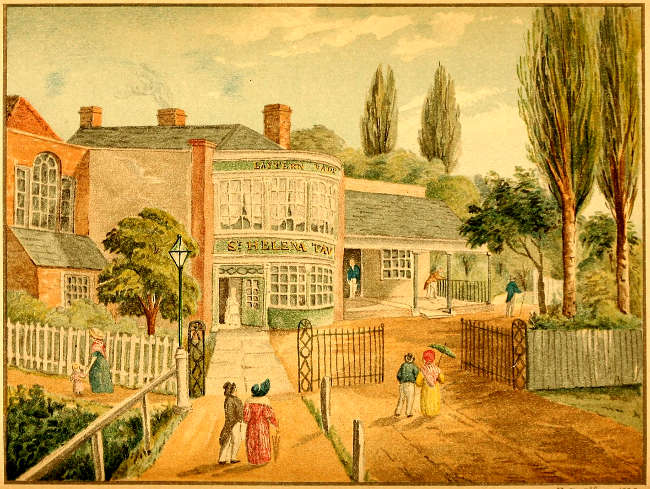
St. Helena Tavern and Tea Gardens.
Rotherhithe.
In 1874, the gardens passed into the hands of Messrs. W. H. and J. R. Carter who erected an orchestra and a dancing platform, and provided music and fireworks for an admission of sixpence. The gardens had fallen into a neglected state, but the walks were once more well laid out, and the old chestnut trees, the elms and planes were still standing.
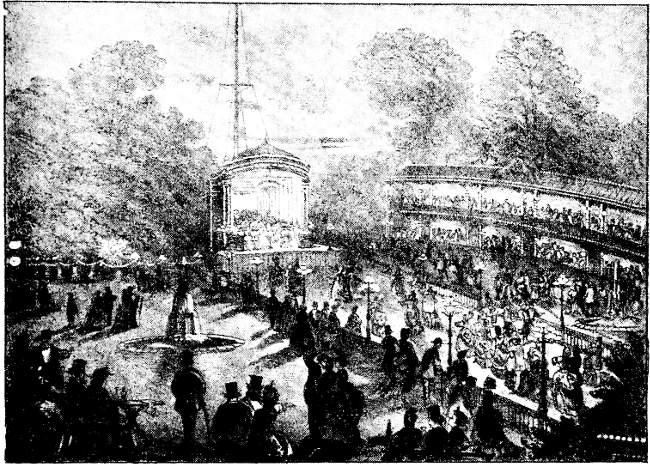
ORCHESTRA AND DANCING-PLATFORM, ST. HELENA GARDENS, circ. 1875.
The gardens ceased to exist in 1881 and were eventually built over.[264] The site was to the west of Deptford Lower Road, and just south of Corbett’s Lane and the present St. Helena Road. St. Katharine’s Church (consecrated 18 October, 1884) in Eugenia Road (south of St. Helena Road) stands on part of the site.
[Newspaper cuttings, W. Coll.; and see notes.]
VIEWS.
1. The entrance to the St. Helena Tavern and tea-garden, water-colour drawing, signed R. B. 7 June, 1839 (W. Coll.).
2. Admission ticket in white metal. Size 1·5 inch. Nineteenth century, circ. 1839? (British Museum). Obverse: View of the entrance to the tavern and gardens (similar to No. 1); in foreground, two posts supporting semi-circular board inscribed “St. Helena Tavern and Tea Gardens. Dinners dress’d”: in exergue, “Rotherhithe.” Reverse: “Refreshment to the value of sixpence” within floral wreath.
3. Lithographed poster of the St. Helena Gardens, circ. 1875, showing the orchestra, dancing-platform, and gardens illuminated at night (W. Coll.).
FINCH’S GROTTO GARDENS
Finch’s Grotto Gardens situated on the western side of St. George’s Street, Southwark, near St. George’s Fields,[265] derived their name from Thomas Finch, a Herald Painter, who, having inherited from a relation a house and garden, opened both for the entertainment of the public in the spring of 1760. The garden possessed some lofty trees, and was planted with evergreens and shrubs. In the centre was a medicinal spring over which Finch constructed a grotto, wherein a fountain played over artificial embankments and formed “a natural and beautiful cascade.” The spring enjoyed some local celebrity, and was recommended to his patients by a doctor named Townshend, who resided in the Haymarket and afterwards in St. George’s Fields. In our own time Dr. Rendle has described the water as “merely the filtered soakage of a supersaturated soil,” which could be obtained almost anywhere in Southwark.
A subscription ticket of a guinea entitled the holder to such benefits, as Finch’s spring conferred and gave admission to the evening entertainments that were introduced from about 1764. The ordinary admission was a shilling, raised on special nights to two shillings. The gardens were open on Sunday when sixpence was charged, though the visitor was entitled for his money to tea, half a pint of wine, cakes, jelly or cyder.

ADMISSION TICKET, FINCH’S GROTTO.
An orchestra containing an organ by Pike, of Bloomsbury, stood in the garden, and there was another orchestra attached to a large octagonal music-room decorated with paintings and festoons of flowers. This Octagon Room was used for occasional balls and for the promenade and concert on wet evenings.
The place appears to have been respectably conducted, but there is little evidence that it was ever a modish resort, in spite of the assertion of the country-bred Mrs. Hardcastle[266] that no one could “have a manner that has never seen the Pantheon, the Grotto Gardens, the Borough and such places where the nobility chiefly resort.”[267]
The vocal and instrumental concerts which took place every evening in the season (May-September) were of a creditable though not very ambitious character. About fifteen hundred persons are said to have been present on some of the Freemasons’ nights and on the benefit nights of the performers.
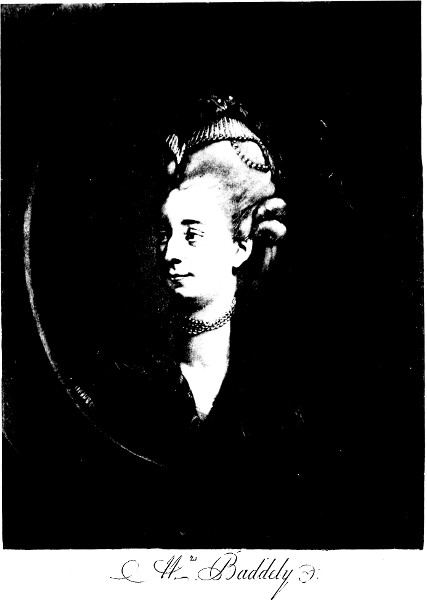
Mrs. Baddely.
Numerous singers and instrumentalists were engaged,[268] of whom the best known are Robert Hudson the organist, Miss Snow and Thomas Lowe. Sophia Snow, the daughter of Valentine Snow, sergeant trumpeter to the King, married Robert Baddeley the comedian, who introduced her to the stage at Drury Lane in 1765. As Mrs. Baddeley, she became notorious for her beauty and intrigues. She had some powers as an actress in genteel comedy and her melodious voice made her popular at Ranelagh (from 1770) and Vauxhall.
Lowe was the well-known tenor singer of Vauxhall and lessee of Marylebone Gardens from 1763 to 1768. Becoming bankrupt in 1768, he was glad to accept engagements at the humbler Finch’s Grotto. He was announced to sing in August 1769, and appeared under the designation of Brother Lowe at one of the Freemasons’ Concerts at the Grotto.
Finch died on October 23, 1770, and his successor, a Mr. Williams, advertised the place as Williams’s Grotto Gardens. The concerts were continued and among the musical entertainments were Bates’s “The Gamester” (1771) and Barnshaw’s “Linco’s Travels.”[269]
The programmes of entertainments under Finch and Williams included concertos on the organ, pieces for horns and clarionets, Handel’s Coronation Anthem, an Ode to Summer with music by Brewster, and songs, such as “Thro’ the Wood, Laddie”; “Water parted from the Sea”; “Oh what a charming thing is a Battle”; “British Wives”; “O’er Mountains and Moorlands”; “Cupid’s Recruiting Sergeant” (with drum and fife accompaniment); “Swift Wing’d Vengeance,” from Bates’s Pharnaces; “Shepherds cease your soft complainings;” a satirical song on Garrick’s Stratford Jubilee; “Hark, hark, the joy inspiring horn”; “The Season of Love,” sung by Mr. Dearle, (1765):—
Bright Sol is return’d and the Winter is o’er, O come then, Philander, with Sylvia away.[270]
Fireworks were occasionally displayed, and when a ball was given, the place was illuminated at a cost of about five pounds, and horns and clarionets played till twelve in the garden. In 1771 and 1772 a grand transparent painting forty feet wide and thirty high, with illuminations, was displayed. Over the centre arch of this masterpiece was a medallion of Neptune supported by Tritons: on each side were two fountains “with serpents jetting water, representing different coloured crystal.” On one wing was Neptune drawn by sea-horses; on the other, Venus rising from the sea; and the back arches showed a distant prospect of the sea. In June 1771 a representation was given “of the famous Fall of Water call’d Pystill Rhiader near the seat of Sir Watkin Williams Wynne, Bart., in Denbighshire.”
Apparently these entertainments failed to pay the proprietor and in 1773 (?) he pulled down the grotto over the spring and rooted up the shrubs to form a skittle ground in connection with the tavern, which still continued to be carried on.
About 1777 the “messuages and lands known as the Grotto Gardens” were purchased for the parish of St. Saviour’s, Southwark, part of the ground being used for the erection of a workhouse and part for a Burial Ground (consecrated in 1780). In 1799 the Workhouse was sold to Mr. John Harris, hat manufacturer, and M.P. for Southwark in 1830, who used it as his manufactory and residence. Some relics of the old Grotto were to be found many years after the closing of the Gardens, notably the Octagon Room, which was converted into a mill and at one time used as the armoury of the Southwark Volunteers.
In 1824 “a very large and old mulberry tree” was standing at the end of a long range of wooden tea-rooms formerly belonging to the gardens and converted into inferior cottages. Behind the cottages was a water-course derived from Loman’s Pond dividing them from a field, once part of the gardens, though only occupied at that time by dust and rubbish.
The tavern attached to the Gardens continued to be carried on under the sign of the Grotto till 28 May, 1795, when it was destroyed by fire. The new tavern erected in its place bore the sign of The Goldsmith’s Arms, and afterwards of the “Old Grotto new reviv’d.”
In the front of this house was inserted a stone bearing the inscription:—
Here Herbs did grow And Flowers sweet, But now ’tis call’d Saint George’s Street.[271]
This building was removed for the formation of the present Southwark Bridge Road in 1825 and a public house named The Goldsmith’s Arms—still standing—was built on the western side of the new road, more upon the site of the old Grotto Gardens. The main site of the gardens is now occupied by the large red-brick building, which forms the headquarters of the Metropolitan Fire Brigade.
[Wilkinson’s Londina Illustrata, vol. ii., “Finch’s Grotto Gardens”; Manning and Bray’s Surrey, iii. 591; Brayley and Mantell’s Surrey, v. 371; Rendle and Norman’s Inns of Old Southwark, 360–364; Walford, vi. 64; newspaper cuttings, W. Coll.]
VIEWS.
The only view is one of the second tavern published in Wilkinson’s Londina Illustrata, 1825:—
“South-east view of the Grotto, now the Goldsmith’s Arms in the Parish of St. George’s, Southwark.” This shows the inscription: “Here Herbs did grow.”
CUPER’S GARDENS
Cuper’s Gardens, a notable resort during the first half of the last century, owe their name and origin to Boyder Cuper, who rented, in the parish of Lambeth on the south side of the Thames opposite Somerset House, a narrow strip of meadow land surrounded by water-courses.
About 1691 or earlier he opened the place as a pleasure garden with agreeable walks and arbours and some good bowling-greens. As an old servant of the Howard family he obtained the gift of some of the statues that had been removed when Arundel House in the Strand was pulled down. These, though mutilated and headless, appeared to the proprietor to give classic distinction to his garden, and they remained there till 1717, when his successor, a John Cuper, sold these ‘Arundel Marbles’ for £75.[272]
During the first twenty or thirty years of the last century, Cuper’s was a good deal frequented in the summer-time. A tavern by the waterside, called The Feathers, was connected with the grounds.
It is not certain that music and dancing were provided at this period, and the company appears to have consisted chiefly of young attorneys’ clerks and Fleet Street sempstresses, with a few City dames, escorted by their husbands’ ’prentices, who (perhaps after paying a visit to the floating ‘Folly’) sat in the arbours singing, laughing, and regaling themselves with bottle-ale.[273]
The place was popularly known as Cupid’s Gardens, and is even thus denominated in maps of the last century. This name is preserved in the traditional song, once very popular, “’Twas down in Cupid’s Garden”:—
’Twas down in Cupid’s Garden For pleasure I did go, To see the fairest flowers That in that garden grow: The first it was the jessamine, The lily, pink and rose, And surely they’re the fairest flowers That in that garden grows.[274]
In 1738 the tavern and gardens were taken by Ephraim Evans, a publican who had kept the Hercules Pillars opposite St. Dunstan’s Church, Fleet Street. During his tenancy (1738–1740) he improved the gardens and erected an orchestra in which was set up an organ by Bridge. A band played from six till ten and Jones, the blind Welsh harper, was engaged to perform selections from Handel and Corelli. The admission was then and thenceforward one shilling, and the gardens were opened on Sunday free of charge.[275] It was announced that care would be taken to keep out bad company and that no servant in livery would be admitted to walk in the garden.
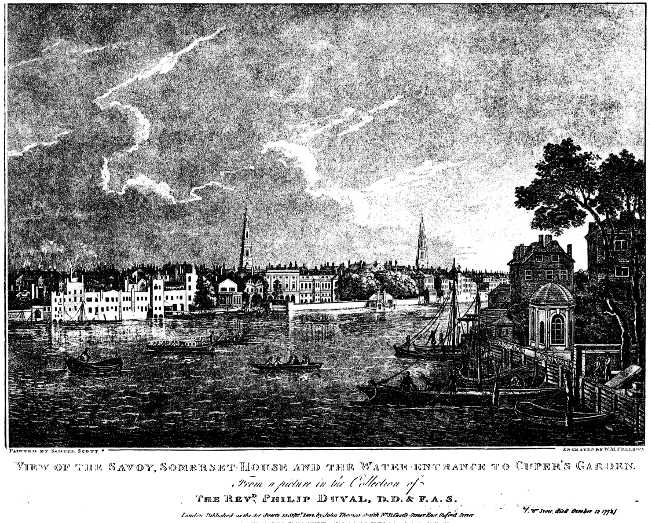
View of the Savoy, Somerset House and the Water entrance to Cuper’s Garden.
From a picture in the Collection of
The Revd. Philip Duval, D.D. & F.A.S.
There was a back way to the gardens leading from St. George’s Fields, and watchmen were appointed “to guard those who go over the fields late at night.” The favourite approach, however, was by water, and the visitors landed at Cuper’s Stairs, a few yards east of the present Waterloo Bridge. The season lasted from April or May till the beginning of September.
Evans died on 14 October, 1740,[276] but the tavern and gardens were carried on by his widow. It was under the spirited management of the widow Evans that Cuper’s Gardens especially flourished, and her advertisements figure frequently in the newspapers (1741–1759). ‘The Widow,’ as she was called, presided at the bar during the evening and complimentary visitors described her as “a woman of discretion” and “a well-looking comely person.” By providing good music and elaborate fireworks, she attracted a good deal of fashionable patronage. The Prince and Princess of Wales visited the place and some of Horace Walpole’s friends,[277] Lord Bath and Lord Sandys, for instance, both of whom had their pockets picked there. The well-dressed sharper was, in fact, by no means unknown at Cuper’s. One night in 1743 a man was caught stealing from a young lady a purse containing four guineas, and while being taken by a constable to Lambeth was rescued by a gang of thieves in St. George’s Fields. On the whole, Cuper’s was looked upon as a decidedly rakish place at which a prudent young lady was not to be seen alone with a gentleman.[278]
For the evening concert of 16 June, 1741, Mrs. Evans announced “a new grand concerto for the organ by the author, Mr. Henry Burgess, junior, of whom it may be said without ostentation that he is of as promising a genius and as neat a performer as any of the age.” Composers better known to fame than Mr. Henry Burgess, junior, were also represented. The programme, for instance, of one July evening in 1741 consisted of “The Overture in Saul, with several grand choruses composed by Mr. Handel”; the eighth concerto of Corelli; a hautboy concerto by Sig. Hasse; “Blow, blow thou wintry wind,” and other favourite songs composed by the ingenious Mr. Arne, and the whole concluded with a new grand piece of music, an original composition by Handel, called ‘Portobello,’ in honour of the popular hero, Admiral Vernon, “who took Portobello with six ships only.” On other occasions there were vocal performances (1748–1750) by Signora Sibilla and by Master Mattocks. The Signora was Sibilla Gronamann, daughter of a German pastor and the first wife of Thomas Pinto, the violinist. She died in or before 1766. Mattocks, who had “a sweet and soft voice,” was afterwards an operatic actor at Covent Garden. Mrs. Mattocks sang at the gardens in 1750.
After the concert, at half-past nine or ten, a gun gave the signal for the fireworks for which the place was renowned.
On 18 July, 1741, the Fire Music from Handel’s opera, “Atalanta,” was given, the fireworks consisting of wheels, fountains, large sky-rockets, “with an addition of the fire-pump, &c., made by the ingenious Mr. Worman, who originally projected it for the opera” when performed in 1736. The Daily Advertiser for 28 June, 1743, announced that “this night will be burnt the Gorgon’s head ... in history said to have snakes on her hair and to kill men by her looks, such a thing as was never known to be done in England before.” For another night (4 September, 1749) the entertainment was announced to conclude with “a curious and magnificent firework, which has given great satisfaction to the nobility, wherein Neptune will be drawn on the canal by sea-horses and set fire to an Archimedan (sic) worm and return to the Grotto.”
In 1746 (August 14) there was a special display to celebrate “the glorious victory obtained over the rebels” by the Duke of Cumberland, consisting of emblematic figures and magnificent fireworks, with “triumphant arches burning in various colours.” In 1749 (May) there was a miniature reproduction with transparencies and fireworks of the Allegorical Temple that had been displayed in the Green Park on 27 April, 1749, to commemorate the peace of Aix-la-Chapelle. At the opening of the gardens on April 30 for the season of 1750, the edifice from which the fireworks were displayed was altered “into an exact model of that at the Hague, made on account of the General Peace.”
The season of 1752, practically the last at Cuper’s, lasted from May till near the end of September. The principal vocalist was Miss Maria Bennett.[279] The fireworks and scenic effects were novel and elaborate. A song commemorating the Prince of Wales’s birthday was “shown curiously in fireworks in the front of the machine.” The fireworks building, when the curtain was withdrawn, disclosed a perspective view of the city of Rhodes—sea, buildings, and landscape, with a model of the Colossus, from under which Neptune issued forth and set fire to a grand pyramid in the middle of the canal. Dolphins spouted water; water-wheels and rockets threw up air-balloons and suns blazed on the summit of the building.
On one occasion the crowd near the fireworks was so great that a gentleman took up his position in a tree, and when St. George and the Dragon came to a close engagement and the clockwork began to move the arms of St. George to pierce the Dragon, he let go his hands to clap like the rest and fell headlong upon the bystanders.[280]
The ‘Inspector’ of the London Daily Advertiser took his friend the old Major, to Cupid’s Gardens (as they were still called) on a pleasant August evening in this year. The Major was delighted with all he saw. “Now I like this. I am always pleased when I see other people happy: the folks that are rambling about among the trees there; the jovial countenances of them delight me ... here’s all the festivity and all the harmless indulgence of a country wake.”[281]
The country wake element was in evidence late in the evening, and constables stationed at the gate had occasionally to interfere. One night, for instance, a pretty young woman, accompanied by a friend, promenaded the gardens dressed as a man wearing a long sword. No small sensation was caused in the miscellaneous company, which included a physician, a templar, a berouged old lady and her granddaughter, and the sedate wife of a Cheapside fur-seller. “A spirited young thing with a lively air and smart cock of her hat” passed by. “Gad,” said she, as she tripped along, “I don’t see there’s anything in it; give us their cloathes and we shall look as sharp and as rakish as they do.” “What an air! what a gate! what a tread the baggage has!” exclaimed another.
But the days of Cuper’s were numbered. In the early part of 1752 the statute-book had been dignified by the addition of 25 George II., cap. 36, entitled, “An Act for the better preventing thefts and robberies and for regulating places of public entertainment and punishing persons keeping disorderly houses.” By section 2 of this enactment it was required that every house, room, garden, or other place kept for public dancing or music, &c., within the cities of London and Westminster, or twenty miles thereof, should be under a licence. The Act took effect from December 1, 1752, and the necessary licence for the season of 1753 was refused to the management of Cuper’s Gardens. The widow Evans complained bitterly that she was denied the liberty of opening her gardens, a misfortune attributed by her to the malicious representations of ill-meaning persons, but which was really owing, no doubt, to the circumstance that Cuper’s was degenerating into the place which Pennant says he remembered as the scene of low dissipation. Meanwhile Mrs. Evans threw open the grounds (June 1753) as a tea-garden in connection with the Feathers, and the walks were “kept in pleasant order.”
In the summer of 1755 entertainments of the old character were revived, but they were advertised as fifteen private evening concerts and fireworks, open only to subscribers, a one guinea ticket admitting two persons. It is to be suspected that the subscription was mythical, and was a mere device to evade the Act. However, a band was engaged, and on June 23 loyal visitors to Cuper’s commemorated the accession of King George to the throne by a concert and fireworks. Clitherow, who had been the engineer of Cuper’s fireworks from 1750 (or earlier), was again employed, but had to publish in the newspapers a lame apology for the failure of the Engagement on the Water on the night of August 2 (1755), a failure which he explained was not due to his want of skill but “owing to part of the machinery for moving the shipping being clogg’d by some unaccountable accident, and the powder in the ships having unfortunately got a little damp.”
From 1756–1759 Cuper’s Gardens were again used as the tea-garden of the Feathers. There was no longer a Band of Musick but (as the advertisements express it) “there still remains some harmony from the sweet enchanting sounds of rural warblers.”
The last recorded entertainment at the place was a special concert given on August 30, 1759 by “a select number of gentlemen for their own private diversion,” who had “composed an ode alluding to the late decisive action of Prince Ferdinand.” Any lady or gentleman inspired by Prussian glory was admitted to this entertainment on payment of a shilling.
For several years the gardens remained unoccupied, but from about 1768 three acres of them were leased to the firm of Beaufoy, the producers of British wines and vinegar. The orchestra, or rather the edifice used from 1750 for the fireworks, was utilised for the distillery. Dr. Johnson once passed by the gardens: “Beauclerk, I, and Langton, and Lady Sydney Beauclerk, mother to our friend, were one day driving in a coach by Cuper’s Gardens which were then unoccupied. I, in sport, proposed that Beauclerk, and Langton, and myself, should take them, and we amused ourselves with scheming how we should all do our parts. Lady Sydney grew angry and said, ‘An old man should not put such things in young people’s heads.’ She had no notion of a joke, sir; had come late into life, and had a mighty unpliable understanding.”[282]
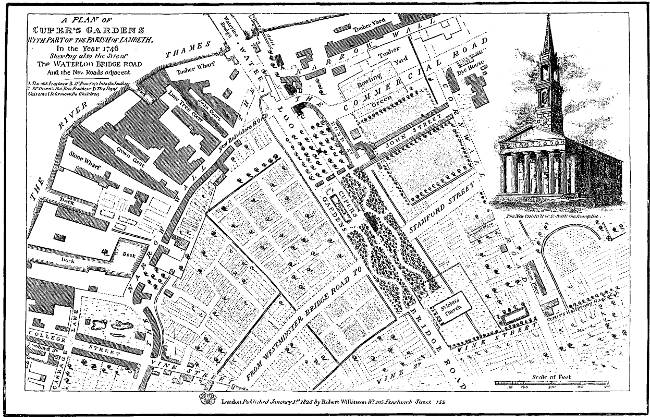
PLAN OF CUPER’S GARDENS.
J. T. Smith[283] tells us that he walked over the place when occupied by the Beaufoys, and saw many of the old lamp-irons along the paling of the gardens, humble reminders of the days when the walks of Cuper’s Gardens were “beautifully illuminated with lamp-trees in a grand taste, disposed in proper order.” In 1814 part of the ground was required for making the south approach to Waterloo Bridge. The “fireworks” building and the rest of Messrs. Beaufoys’ works were then taken down and the Waterloo Road, sixty feet in width, was cut through the three acres, thus passing through the centre of Cuper’s Gardens which had extended up to the site of the present St. John’s Church (built in 1823) opposite Waterloo Station.
The Royal Infirmary for Children and Women erected in 1823 on the eastern side of the Waterloo Road stands on (or rather over) the centre of the site of the gardens. The Feathers was used during the building of the bridge for the pay-table of the labourers, and when it was taken down (about 1818?) its site was occupied by a timber-yard, close to the eastern side of the first land-arch of the Waterloo Bridge.
The public-house now called the Feathers, standing near the Bridge and rising two stories above the level of the Waterloo Road was built by the proprietor of the old Feathers in 1818.
[Wilkinson’s Londina Illustrata, vol. ii. “Cuper’s Gardens,” Public Gardens Coll. in Guildhall Library, London (newspaper cuttings, &c.); Charles Howard’s Historical Anecdotes of the Howard Family (1769), 98, ff.; Pennant’s Account of London, 3rd ed. 1793, 32–34; Musical Times, February 1894, 84, ff.; Hone’s Every Day Book, i. 603; E. Hatton’s New View of London, 1708, ii. 785; Lysons’s Environs, 1792, i. 319, 320; Walford, vi. 388, 389; The Observator, March 10, 1702-3; newspaper cuttings, W. Coll.]
VIEWS.
1. View of the Savoy, Somerset House, and the water entrance to Cuper’s Gardens, engraved by W. M. Fellows, 1808, in J. T. Smith’s Antiquities of Westminster, from a painting (done in 1770, according to Crace, Cat. 188, No. 219) by Samuel Scott.
2. Woodcuts in Walford, vi. 391, showing entrance to the gardens (the back entrance) and the “orchestra” during the demolition of the buildings; cp. ib. 390. Walford also mentions, ib. p. 388, a view showing the grove, statues, and alcoves, of the gardens.
3. Water-colour drawings of Beaufoys’ and Cuper’s in 1798 and in 1809 (Crace, Cat. 648, Nos. 49, 50).
4. Wilkinson, Lond. Illust. (1825), vol. ii. gives three views, Pl. 155, view of the Great Room as occupied for Beaufoys’ manufactory, with a plan of the gardens; Pl. 156, another similar view; Pl. 157, view of the old Feathers Tavern.
“THE FOLLY” ON THE THAMES
Close by Cuper’s Stairs (where the visitors to Cuper’s Gardens landed) and opposite Somerset House, there was generally moored during the summer months a sort of castellated house-boat, notorious as The Folly.[284]
It consisted of a strong barge on which was a deck platform, surrounded by a balustrade, and contained a saloon provided with large windows and divided into boxes and compartments. At each of the four angles of the deck was a turret, giving the whole something of the appearance of a floating castle.
This “whimsical piece of architecture” (as Thomas Brown calls it)[285] was in existence soon after the Restoration, and in 1668 was visited by Pepys.[286] It was intended, says Brown, “as a musical summer-house for the entertainment of quality where they might meet and ogle one another ... but the ladies of the town finding it as convenient a rendezvous for their purpose ... dash’d the female quality out of countenance and made them seek a more retired conveniency” for their “amorous intrigues.” Queen Mary (II.) once paid it a visit, and the proprietor endeavoured to re-christen it The Royal Diversion. It continued, however, to be popularly known as The Folly, and already in 1700 had ceased to have any quality to boast of, at least among its female frequenters.
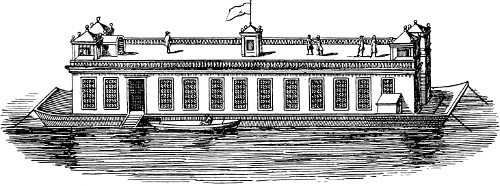
“THE FOLLY,” BEFORE circ. 1720.
Thomas Brown describes a visit that he made about 1700. Rowing up to the side in a boat he found himself scrutinised by a crowd of women both young and old, and (as he puts it) “of all sorts and sizes.” Some of these ladies were dancing and tripping airily about the deck, and some tattling to their beaux; but many of the company, including certain long-sworded bullies, were crowded into the boxes in the saloon where they sat, smoking, and drinking burnt brandy. “In short, it was such a confused scene of folly, madness and debauchery” that Thomas Brown, by no means a squeamish person, stepped again into his boat “without drinking.”
The Folly in its later days was occasionally visited by people who at least worked honestly for their living, and the draper’s apprentice, when his shop was shut, would row up with his sweetheart for an evening’s amusement at this curious haunt.[287]
The Folly was in existence till 1720, and perhaps for more than thirty years later, but the character of its frequenters, and the gambling that took place at what was known as its Golden Gaming Table, at last led to its suppression as a public resort. It was suffered to fall into such decay that its material was burnt for fire-wood.
Near that part of the river where the Folly was usually moored the famous Chinese junk was anchored about 1848, and visited by thousands of sight-seers.[288]
[Thomas Brown’s Amusements Serious and Comical, Part ii. “The Thames”; Wheatley’s London Past and Present, “Folly”; E. Hatton’s New View of London, 1708, ii. 785; Wilkinson’s Londina, vol. i. No. 88; also vol. ii. “Cuper’s Gardens”; Walford, iii. 290; Larwood and Hotten, History of Signboards, 509; manuscript notes, &c. in “Public Gardens” collection in Guildhall Library, London.]
VIEWS.
1. A view of Whitehall from the water, showing the Folly Musick House on the Thames. Engraved in Wilkinson’s Londina Illustrata, vol. i. No. 88, from a drawing taken about the time of James II. “in the possession of Thomas Griffiths, Esq.”
2. The Southern Front of Somerset House with its extensive Gardens, &c., showing the Folly. A drawing by L. Knyff, about 1720, engraved by Sawyer Junior, and published (1808) in J. T. Smith’s sixty additional plates to his Antiquities of Westminster. This is copied, with a short account of the Folly, in E. W. Brayley’s Londiniana (1829), vol. iii. 130, 300. It is substantially the same as the view on a larger scale engraved by Kip in Strype’s Stow, 1720, ii. bk. 4, p. 105. Cp. also an engraving (W. Coll.) “Somerset House, La Maison de Somerset.” L. Knyff del. I. Kip sc. undated, before 1720?
BELVEDERE HOUSE AND GARDENS, LAMBETH
Belvedere House and Gardens were near Cuper’s Gardens,[289] but a little higher up the river (south side). They were opposite York Buildings in the Strand, and extended from the present Belvedere Road (then called Narrow Wall) to the water’s edge. Some modern writers speak of the gardens as a place of public entertainment in the reign of Queen Anne, but there seems no evidence of this, and in 1719 or 1720 the premises were in the possession of a Mr. English (or England), who at that time sold them to the Theobald family. In 1757, Belvedere House was the private residence of Mr. James Theobald.
In the early part of 1781, “the house called Belvedere” was taken by one Charles Bascom, who opened it as an inn, with the added attractions of “pleasant gardens and variety of fish-ponds.” He professed in his advertisements, to accommodate his guests with choice wines and with eating of every kind in season, after the best manner, especially with “the choicest river-fish which they may have the delight to see taken.”
The gardens could not have been open later than 1785, for in that year part of the ground was turned into the Belvedere (timber) Wharf, and part was occupied by the machinery of the Lambeth water-works.
[Advertisement in The Freethinker for April 28, 1781, quoted in Wilkinson’s Londina, vol. ii. “Cuper’s Gardens,” notes, and in Nichols’s Lambeth, Nichols’s Bibl. Top. Brit. ii. Appendix, 158; map in Strype’s Stow (1720), vol. ii. book 6, p. 83, Appendix; Manning and Bray, Surrey, iii. 467; Brayley and Mantell, Surrey, iii. 393; Howard’s Historical Anecdotes of some of the Howard Family, 106; Wheatley’s London P. and P. s.v. “Belvedere Road.”]
RESTORATION SPRING GARDENS, ST. GEORGE’S FIELDS
The Restoration Tavern was in existence in the early part of the reign of Charles II.[290] In 1714 there was a new cock-pit in its grounds and a great match of cock fighting was announced to take place there; “two guineas a battle, and twenty guineas the odd battle” all the week, beginning at four o’clock. The races and popular sports then frequent in St. George’s Fields probably brought additional custom to the house.
In the gardens of the tavern was a purging spring which was advertised[291] in 1733 as already well-known for the cure of all cancerous and scorbutic humours. About the same year a second spring was discovered, a chalybeate “of the nature of Piermont Water but superior.” The water was obtainable every day at the gardens,[292] and was declared to “far exceed” the water at the neighbouring Dog and Duck. Dr. Rendle says that it must have been the mere soakage of a swamp, but whatever may have been the virtues of the spring it was probably before long eclipsed by its rival at the Dog and Duck, though the Restoration was in existence in 1755 and perhaps for some years later.
In 1771 the garden, or at any rate about an acre of it, was taken by William Curtis,[293] the author of Flora Londinensis, who formed a Botanical Garden there which was afterwards open to subscribers until 1789, when the botanist removed to another garden in the more salubrious air of Brompton.
Restoration Garden is marked in the map in Stow’s Survey, 1755, as abutting on the western side of Angel Street (a continuation of the Broad Wall), southern end. In a map of the Surrey side of the Thames showing the proposed roads from Blackfriars Bridge (circ. 1768) the ground is marked as “Public House Gardens” and “Gardens.” The Half-way House from the Borough to Westminster Bridge is marked immediately south of the gardens; and still further south is the Westminster Bridge Road, the end east of the Asylum. St. Saviour’s Union, Marlborough Street (near the New Cut), is now near the site.
[Rendle and Norman, Inns of Old Southwark (1888), pp. 367, 368; and see Notes.]
THE FLORA TEA GARDENS (OR MOUNT GARDENS), WESTMINSTER BRIDGE ROAD
The Flora Tea Gardens (or Mount Gardens), were on the right hand side of the Westminster Bridge Road going towards the Obelisk, and opposite the Temple of Flora. They were in existence about 1796–7. The gardens were well kept and contained “genteel paintings.” They were open on week-days and on Sundays till about 11 p.m., and the admission was sixpence.
Among the frequenters were democratic shopmen, who might be heard railing against King and Church, and a good many ladies respectable and the reverse. The “Sunday Rambler” (1796–7) describes the company as very orderly, but at some time before 1800 the place was suppressed on account of dissolute persons frequenting it.
Some small cottages were then built in the middle of the garden, which retained a rural appearance till shortly before 1827, when several rows of houses, “Mount Gardens,” were erected on the site.
[The Flora Tea Gardens described in A Modern Sabbath (1797), chap. viii., are evidently identical with the Mount Gardens mentioned by Allen (Lambeth, 335), though he does not mention their alternative name (cp. Walford, vi. 389). Allen (loc. cit.) is the authority for the suppression of the gardens.]
THE TEMPLE OF FLORA
The Temple of Flora stood hard by the Temple of Apollo, in the middle of Mount Row on the left hand side of Westminster Bridge Road, going towards the Obelisk, and was separated by Oakley Street from the Apollo Gardens (Temple of Apollo). Concerts were given every evening in the season, and the place is described as “beautifully fitted up with alcoves and exotics.”
In the hot house was “an elegant statue of Pomona,” a transparency of Flora, and at the lower end of the garden, a natural cascade and fountain. “The entrance and the gardens,” were advertised in July 1789 as being formed by the proprietor into an exact imitation of the admired Temple of Flora, which he had constructed at the Grand Gala at Ranelagh.
Some special entertainments were given in June and July in honour of the King’s recovery, and the Grand Temple of Flora, an “elegant and ingenious imitation of Nature in her floral attire,” was then illuminated with nearly a thousand variegated lamps amid wreaths of flowers twining round pillars “made in imitation of Sienna marble.” Fireworks and water-works were also displayed; a large star of lamps was suspended above the cascade, and (in the absence of nightingales) “a variety of singing birds” were imitated. The admission for these special entertainments was one shilling, and the gardens were illuminated from eight till the closing time at eleven. Light refreshments were served consisting of orgeat, lemonade, “confectionary,” strawberries and cream.
There is evidence[294] that in the first few years of its existence (1788–1791) the place was visited by some people of good position, but it afterwards became the haunt of dissolute characters and of young apprentices.[295] The author of A Modern Sabbath describes (circ. 1796) the boxes in the gardens as “neatly painted” like most of the company who were to be seen there about ten in the evening. The admission appears to have been now reduced to sixpence.
In 1796 the proprietor, a man named Grist, was indicted for keeping the place as a disorderly house, and was ordered (May 30) to be confined for six months in the King’s Bench Prison,[296] and in all probability the Temple of Flora was then finally closed.
Mme. Lamotte, the heroine of the famous Diamond Necklace affair, ended her strange career (23 August, 1791) in her house near the Temple of Flora, a place of amusement that, it is likely enough, she frequented.[297]
[A Modern Sabbath (1797), chap. viii.; Public Advertiser, 2 July, 1789 (fêtes of June and July); Brayley and Mantell, Surrey, iii. 399; Allen’s Lambeth, 321.]
APOLLO GARDENS (OR TEMPLE OF APOLLO)
These gardens were on the left hand side of the Westminster Bridge Road going from Westminster to the Obelisk, and were situated nearly where the engineering factory of Messrs. Maudslay, Sons and Field now stands and opposite the present Christ Church Congregational Chapel.[298]
Walter Claggett, the proprietor (at one time a lessee of the Pantheon[299] in Oxford Street) opened the place in October 1788 with an entertainment given in the concert room, which is described as a fine building with “a kind of orrery in the dome, displaying a pallid moon between two brilliant transparencies.” In this building was an orchestra containing a fine-toned organ, and in the opening concert, given before nearly one thousand three hundred people, a band of about seventy instrumental and vocal performers took part, the organist being Jonathan Battishill.
Previous to the opening for the season in April 1790, the gardens were much altered and a room was arranged for large dinner parties. In the gardens were a number of “elegant pavilions or alcoves” ornamented with the adventures of Don Quixote and other paintings.
In 1792 (May-July) there was music every evening and fantoccini were exhibited. In this year the concerts took place in a covered promenade described as the Grand Apollonian Promenade. Mr. Flack, junior, was the leader of the band; Mr. Costelow the organist, and the vocalists were Mr. Binley, Miss Wingfield, Mrs. Leaver, and Mrs. Iliff, the last-named one of the Vauxhall singers in 1787. New overtures, &c., “composed by Messrs. Haydn and Pleyel since their arrival in this Kingdom” were advertised for performance.
The season began in April or May, and the visitor on entering at five o’clock or later, paid a shilling or sixpence (1792) receiving in exchange a metal check entitling him to refreshments. No charge was made for the concert. At about nine o’clock many persons who had “come on” from other public places visited the Apollo for hot suppers, and the gardens and promenade were illuminated, sometimes with two thousand lamps. The proprietor prided himself on “the superior excellence of the Music and Wines.” He boasted, moreover, of the patronage of the nobility and gentry, and vaunted the “chastity and dignity” of the place, though it was probably owing to the presence of some of these late arriving visitors that the Apollo Gardens speedily acquired an unenviable reputation.
In 1792 the place was known to be a resort of cheats and pickpockets. We hear of one Elizabeth Smith, a smartly dressed young woman, about eighteen, being charged in 1792 at the Guildhall with “trepanning a Miss Ridley,” a beautiful girl ten years of age, whom she had taken with her to the Apollo and the Dog and Duck, and left crying on Blackfriars Bridge, after stealing her fine sash.
The Apollo was suppressed by the magistrates, probably about 1793.[300] The proprietor himself became bankrupt; the orchestra was removed to Sydney Gardens, Bath;[301] and the Temple of Apollo fell into a ruinous state and its site was eventually built upon.
[A collection of newspaper cuttings relating to London, &c. (section, Apollo Gardens) in Guildhall Library, London (Catal. ii. 546); “Public Gardens” collection (newspaper cuttings, &c.) in Guildhall Library (Catal. ii. 761); Brayley and Mantell, Surrey, iii. 399; Allen’s Lambeth, 319; Walford, vi. 343, 389; A Modern Sabbath, chap. viii.]
VIEWS.
There appear to be no extant views. The site may be ascertained from Horwood’s Plan, 1799; and from Willis’s Plan, 1808. In the Crace Coll. (Cat. p. 122, No. 69) are “Two drawn plans of a plot of land called the Apollo Gardens, lying next the Westminster Bridge Road to the Obelisk,” by T. Chawner.
DOG AND DUCK, ST. GEORGE’S FIELDS (St. George’s Spa)
The Dog and Duck was in existence as a small inn as early as 1642.[302] In its vicinity were three or four ponds in which, no doubt, the brutal sport of hunting ducks with spaniels was at one time practised,[303] and near the place were mineral springs whose properties were known as early as 1695, though the water does not appear to have been advertised for sale till about 1731,[304] when the Dog and Duck had taken to itself the imposing sub-title of St. George’s Spaw. At this time the water was sold at the pump for fourpence a gallon, and was stated to be recommended by eminent physicians for gout, stone, king’s evil, sore eyes, and inveterate cancers. A dozen bottles could be had at the Spa (circ. 1733–1736) for a shilling.
From about 1754 till 1770 the water was in considerable repute, and new buildings appear to have been erected for the accommodation of visitors. There was a long room for breakfasting (1754), a bowling-green, and a swimming-bath (1769) two hundred feet long and nearly one hundred feet broad. Tea and coffee were to be had in the afternoon. At this period people of good position seem to have frequented the Spa or to have sent for the water. We find Miss Talbot writing about the place to Mrs. Carter, and Dr. Johnson suggested the use of the water to Mrs. Thrale.[305]
The proprietors issued (1760) to subscribers an admission ticket handsomely struck in silver with a portrait of Lazare Rivière, the famous Professor of Medicine, on its obverse.[306]
The St. James’s Chronicle ranked the water with that of Tunbridge, Cheltenham, and Buxton.
Physicians of repute described its curative properties, and affirmed it to be excellent for cutaneous afflictions and for cancer which it would certainly arrest, even if it did not cure. This water, which was advertised as an aperient (Epsom Salts being also kept on the premises), came at a much later date—1856—under the observation of Dr. Rendle, the historian, and, as it happened, the Officer of Health in that year for the Parish of St. George’s, Southwark. Rendle procured an analysis of water from the superficial well, formerly the spring, on the site of the old Dog and Duck and was forced to describe it as “a decidedly unsafe water” containing impurities, eighty grains per gallon, chiefly alkaline chlorides, sulphates and nitrates, gypsum and carbonate of lime, with a little phosphoric acid.
But we return to the year 1770, about which time the Dog and Duck took a new lease of life. A temporary circus established in St. George’s Fields by Sampson, of The Three Hats, Islington, was the cause of much additional custom being brought to the tavern, and Mrs. Hedger who kept the house was obliged to send for her son who was then a youth in a stable-yard at Epsom. Young Hedger soon saw the possibilities of the place. He gradually improved the premises and in a few years was making a large income from the tavern and its tea-garden, which was much frequented, especially on Sundays.[307] The garden was well laid out and contained “a pretty piece of water” doubtless one of the old ducking ponds, and at one time a band played in the garden for the delectation of the week-day visitors. At night, the long room was brilliantly lighted for the company who assembled to dance, drink, and listen to the strains of the organ. Under Hedger, however, the character of the company went from bad to worse. The “rowdy” delights of the Dog and Duck are indicated, though probably with an exaggerated coarseness, in Garrick’s Prologue to “The Maid of the Oaks” acted at Drury Lane in 1775:—
St. George’s Fields, with taste and fashion struck, Display Arcadia at the Dog and Duck, And Drury misses here in tawdry pride, Are there “Pastoras” by the fountain side; To frowsy bowers they reel through midnight damps, With Fauns half drunk, and Dryads breaking lamps.[308]
In about ten years the Dog and Duck had become a place of assignation and the haunt of “the riff-raff and scum of the town.” One of its frequenters, Charlotte Shaftoe, is said to have betrayed seven of her intimates to the gallows. At last, on September 11, 1787, the Surrey magistrates refused to renew the license. Hedger, like the Music Hall managers of our own time, was not easily beaten. He appealed to the City of London, and two City justices claiming to act as justices in Southwark, renewed the license seven days after its refusal by the County magistrates. The legality of the civic jurisdiction in Surrey was tried in 1792 before Lord Kenyon and other judges, who decided against it. The license of the Dog and Duck was then made conditional on its being entirely closed on Sundays.[309]
In 1795 the bath and the bowling-green were advertised as attractions and the water might be drunk on the usual terms of threepence each person. About 1796 the place was again open on Sundays, but the license was lost. This difficulty the proprietor surmounted by engaging a Freeman of the Vintners Company, who required no license, to draw the wine that was sold on the premises. The “Sunday Rambler” who visited the place (circ. 1796) one evening about ten o’clock found a dubious company assembled. He recognised a bankrupt banker and his mistress; a notorious lady named Nan Sheldon; and another lady attired in extreme fashion and known as “Tippy Molly,” though once she had been a modest Mary Johnson. De Castro (Memoirs), with a certain touch of pathos, describes the votaries of the Dog and Duck in its later days as “the children of poverty, irregularity and distress.”[310] It would, indeed, be easy to moralise on the circumstance that the place was soon to become the inheritance of the blind and the lunatic. In or before 1799 the Dog and Duck was suppressed, and the premises, after having been used as a public soup-kitchen, became in that year the establishment of the School for the Indigent Blind, an institution which remained there till 1811.
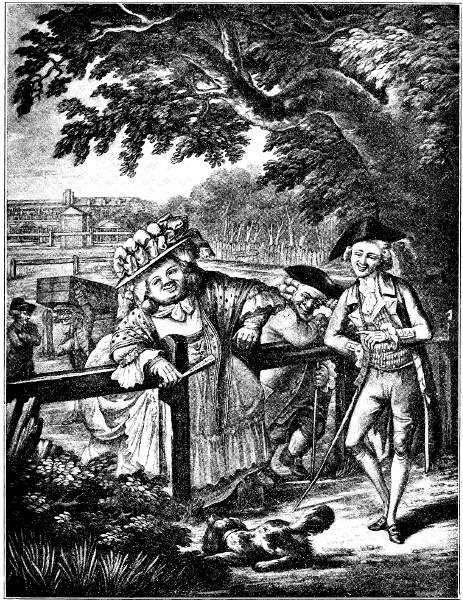
“LABOUR IN VAIN” (ST. GEORGE’S SPA IN BACKGROUND, 1782.)
Meanwhile, the enterprising Hedger, had made a good use of his profits by renting (from about the year 1789) a large tract of land in St. George’s Fields at low rates from the managers of the Bridge House Estate. The fine for building was £500, but Hedger immediately paid this penalty, and while sub-letting a portion of the ground, ran up on the rest a number of wretched houses which hardly stood the term of his twenty-one years’ lease. From this source he is said to have derived £7,000 a year. He died in the early part of the present century,[311] having obtained the title of The King of the Fields, and the reputation of a “worthy private character.” He left his riches to his eldest son, whom the people called the Squire.
The Dog and Duck was pulled down in 1811 for the building of the present Bethlehem Hospital, the first stone of which was laid on 18 April, 1812. The old stone sign of the tavern, dated 1716, and representing a spaniel holding a duck in its mouth, and the Arms of the Bridge House Estate, was built into the brick garden-wall of the Hospital where it may still be seen close to the actual site of the once notorious Dog and Duck.
[Trusler’s London Adviser (1786), pp. 124, 164; Fores’s New Guide (1789), preface, p. vi; Allen’s London, iv. 470, 482, 485; A Modern Sabbath, 1797, chap. viii.; Wheatley’s London P. and P. s.v. “St. George’s Fields” and “Dog and Duck”; Humphreys’s Memoirs of De Castro (1824), 126, ff.; Manning and Bray, Surrey, iii. 468, 554, 632, 701; Allen’s Lambeth, p. 7, 347; Gent. Mag. 1813, pt. 2, 556; Rendle and Norman, Inns of Old Southwark, p. 368, ff.; Walford, vi. 343, 344, 350–352, 364; Larwood and Hotten, Signboards, 196, 197; Notes and Queries, 1st ser. iv. 37; newspaper cuttings in W. Coll.]
VIEWS.
1. The old Dog and Duck Tavern, copied from an old drawing 1646, water-colour drawing by T. H. Shepherd, Crace, Cat. p. 646. No. 27.
2. The Dog and Duck in 1772. A print published 1772. Crace, Cat. p. 646, No. 28.
3. Woodcut of exterior, 1780, in Chambers’s Book of Days, ii. 74.
4. “Labour in Vain, or Fatty in Distress” (St. George’s Spa in the background), print published by C. Bowles, 1782, Crace, Cat. p. 647, No. 35, and W. Coll.
5. Engraving of the exterior, 1788 (W. Coll.).
6. Interior of the Assembly Room. A stipple engraving, 1789, reproduced in Rendle and Norman, Inns of Old Southwark, 373.
7. Sign of Dog and Duck, engraved in Walford, vi. 344; cp. Crace, Cat. p. 646, No. 32, and Rendle and Norman, Inns of Old Southwark, p. 369.
THE BLACK PRINCE, NEWINGTON BUTTS
The Black Prince at Newington Butts possessed, about 1788, a pleasant garden frequented for trap-ball playing. There is a view (W. Coll.) of the tavern and garden printed for C. Bowles, 22 Sept., 1788.
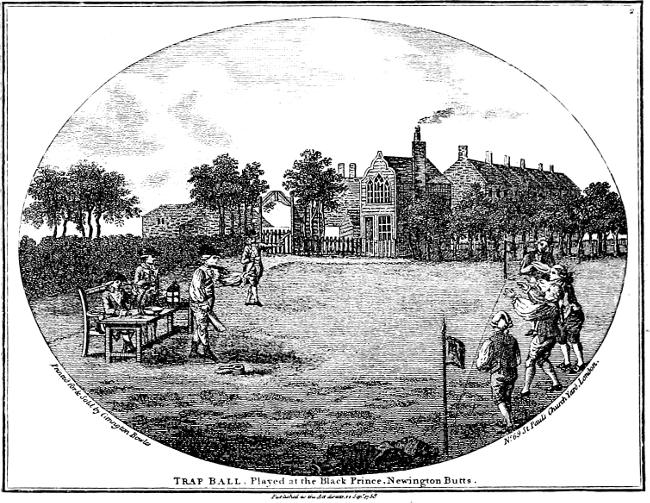
THE BLACK PRINCE, NEWINGTON BUTTS, 1788.
LAMBETH WELLS
In the last century Lambeth Marsh and the fields in the neighbourhood were a favourite resort of Londoners for running-matches and outdoor sports, and the Lambeth Wells offered the special attractions of music and mineral water-drinking. The Wells (opened to the public before 1697) were situated in Three Coney Walk, now called Lambeth Walk, and consisted of two springs, distinguished as the Nearer and Farther Well. The water was sent out to St. Thomas’s Hospital and elsewhere at a penny a quart, and the poor had it free.
The usual charge for admission for drinking the waters was threepence, including the music, which, about 1700, began at seven in the morning, and was continued on three days of the week till sunset, and on other days till two. The season began in the spring, usually on Easter Monday.
Attached to the Wells was a Great Room, in which concerts and dancing took place. During the season of 1697 there was a “consort” every Wednesday of “vocal and instrumental musick, consisting of about thirty instruments and voices, after the manner of the musick-meeting in York Buildings, the price only excepted,” each person to pay for coming in but one shilling. These concerts began originally at 2.30 p.m., but afterwards at six, when no person was admitted in a mask.
About 1700 these shilling concerts seem to have been discontinued, but the Wells remained in some repute till about 1736, when they found a rival in the spring of the Dog and Duck, and the attendance fell off.
In 1740 the owner was named Keefe. About 1750, under his successor Ireland, a musical society under the direction of Sterling Goodwin, organist of St. Saviour’s, Southwark, gave a monthly concert there. At the same period Erasmus King, once coachman to Dr. Desaguliers, read lectures there and exhibited experiments in natural philosophy (admission sixpence). There were gala dancing-days in 1747, and in 1752 (June 27), when a “penny wedding in the Scotch manner was celebrated for the benefit of a young couple.”
At a later date (after 1755?[312]) the place was condemned as a nuisance, and the magistrates refused the dancing licence. The Great Room was then used for Methodist services, and the music-gallery for the pulpit, but the preacher (we are told) being disturbed greatly in his enthusiastic harangues was obliged to quit, and the premises were afterwards built on, or devoted to various purposes, with the exception of the dwelling-house, which (before 1786) was turned into a tavern, under the sign of the Fountain. The present Fountain public-house, erected on the site of the older Fountain in 1829, is No. 105 Lambeth Walk, nearly opposite Old Paradise Street (formerly Paradise Row). The Wells themselves, though long closed, were still in existence in 1829, but a house was subsequently built over them.
Brayley and Mantell (Surrey, iii. 400) writing about 1841, say that part of the grounds continued “long within memory” to be used as a tea-garden.
[Nichols’s Parish of Lambeth (1786), p. 65, ff.; Gent. Mag. 1813, pt. 2, p. 556; Manning and Bray, Surrey, iii. 468; Brayley and Mantell, Surrey, iii. 399, ff.; Allen’s Lambeth, p. 346, ff.; Walford, vi. 389].
MARBLE HALL, VAUXHALL
Marble Hall was situated on the Thames, at the spot afterwards occupied by the southern abutment of Vauxhall Bridge. Part of the road to the bridge now occupies the site.
Joseph Crosier, the proprietor in 1740, “enlarged, beautified and illuminated” the gardens,[313] and built a Long Room facing the river, which was opened in May 1740, and used for dancing during the spring and summer.
From circ. 1752–1756 the proprietor was Naphthali Hart,[314] teacher of music and dancing, who held assemblies at Marble Hall in the season, devoting his energies in the winter to Hart’s Academy, Essex House, Essex Street, Strand, where (as his advertisements state) “grown gentlemen are taught to dance a minuet and country dances in the modern taste, and in a short time.” “Likewise gentlemen are taught to play on any instrument, the use of the small Sword and Spedroon.” “At the same place is taught musick, fencing, French, Italian, Spanish, Portuguese, High German, Low Dutch, Navigation, or any other part of the Mathematicks.” “A sprightly youth is wanted as an apprentice.”
In the spring of 1756 Marble Hall was opened as a coffee house and tavern, but little appears to be known of it after this date, though it was in existence till about August 1813, when the abutment of Vauxhall Bridge on the Surrey side was begun.
[Advertisements in “Public Gardens” collection in Guildhall Library, London; Manning and Bray, Surrey, iii. 484, and map, p. 526; Allen’s Lambeth, 368; Walford, vi. 339.]
THE CUMBERLAND TEA-GARDENS AND TAVERN, VAUXHALL Originally Smith’s Tea-Gardens
These small gardens, about one acre and a half in extent, were pleasantly situated on the south bank of the Thames, immediately to the south of Vauxhall Bridge (built 1811–1816). Under the name of Smith’s Tea-Gardens they were probably in existence some years previous to 1779. “A Fête Champêtre, or Grand Rural Masked Ball,” with illuminations in the garden and the rooms, was advertised to take place on 22 May, 1779, at 10 P.M., the subscription tickets being one guinea.
About May 1784 the gardens were taken by Luke Reilly, landlord of the Freemasons’ Tavern in Great Queen Street, who changed the name to the Cumberland (or Royal Cumberland) Gardens.[315] At this time they were open in the afternoon and evening, and visitors to Vauxhall Gardens sometimes had refreshments there in the arbours and tea-room while waiting for Vauxhall to open; or adjourned thither for supper when tired of the larger garden.
In August 1796 a silver cup given by the proprietor was competed for on the river by sailing boats. In 1797 a ten years’ lease of the gardens and tavern was advertised to be sold for £1,000.
From 1800 to 1825 the gardens were much frequented by dwellers in the south of London. Between three and four o’clock in the morning of May 25, 1825, the tavern was discovered to be on fire. The engines of Vauxhall Gardens and of the various Insurance Offices came on the scene, but the fire raged for more than an hour, and the tavern and the ball-room adjoining were completely destroyed and the plantation and garden greatly injured. In October of the same year the property on the premises was sold by the lessors under an execution and at that time the gardens were, it would seem, finally closed.[316]
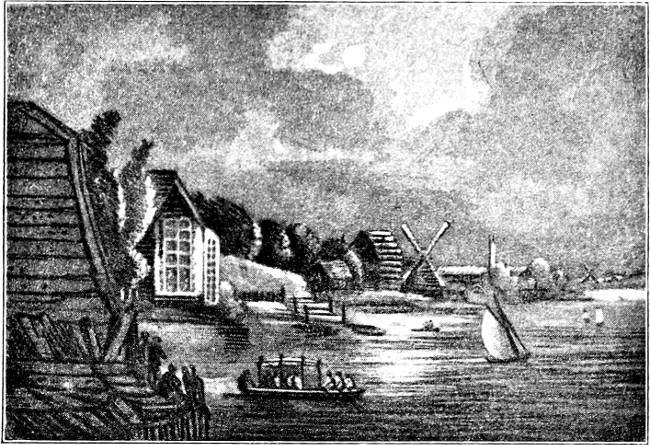
WATERSIDE ENTRANCE TO CUMBERLAND GARDENS.
The South Lambeth Water Works occupied the site for many years and the Phœnix Works of the South Metropolitan Gas Company are now on the spot.[317]
[Newspaper cuttings in W. Coll.; Walford, vi. 389, 449; Timbs, Curiosities of London (1868), p. 18, and Club Life, ii. 261; Picture of London, 1802, 1823 and 1829; the Courier for 25 and 26 May, 1825; Allen, Lambeth, p. 379.]
VIEWS.
“Cumberland Gardens, &c.” A view by moonlight of the waterside entrance to the gardens. Undated (circ. 1800?). W. Coll.
The gardens are well marked in Horwood’s Plan, D. 1799.
VAUXHALL GARDENS
§ 1. 1661–1728
These, the most famous of all the London pleasure gardens, were known in their earliest days as the New Spring Garden at Vauxhall, and continued till late in the eighteenth century to be advertised as Spring Gardens.[318]
The Spring Garden was opened to the public shortly after the Restoration, probably in 1661.[319] It was a prettily contrived plantation, laid out with walks and arbours: the nightingale sang in the trees; wild roses could be gathered in the hedges, and cherries in the orchard. The Rotunda, the Orchestra, and the Triumphal Arches, distinctive features of the later Vauxhall, were then non-existent, and the proprietor’s house from which refreshments were supplied was probably the only building that broke the charm of its rural isolation. It was a pleasant place to walk in, and the visitor might spend what he pleased, for nothing was charged for admission. It soon became one of the favourite haunts of Pepys, who first visited it on 29 May 1662. On hot summer days, he would take water to Foxhall with Deb and Mercer and his wife, to stroll in the garden alleys, and eat a lobster or a syllabub. On one day in May (29, 1666) he found two handsome ladies calling on Mrs. Pepys. He was burdened with Admiralty business—“but, Lord! to see how my nature could not refrain from the temptation, but I must invite them to go to Foxhall, to Spring Gardens.”
In a few years the Spring Garden became well known. Fine people came thither to divert themselves and the citizen also spent his holiday there, “pulling off cherries [says Pepys] and God knows what.” The song of the birds was charming, but from about 1667 more sophisticated harmony was furnished by a harp, some fiddles, and a Jew’s trump. About this time the rude behaviour of the gallants of the town began to be noted at the Spring Garden. Gentlemen like “young Newport” and Harry Killigrew, “a rogue newly come back out of France, but still in disgrace at our Court,” would thrust themselves into the supper-arbours and almost seize on the ladies, “perhaps civil ladies,” as Pepys conjectures. “Their mad talk [he adds] did make my heart ake,” though he himself, at a later time, was found at the gardens eating and drinking with Mrs. Knipp, “it being darkish.”
During the last thirty years of the seventeenth century, the Spring Garden, if less perturbed by the Killigrews and Newports, was not a little notorious as a rendezvous for fashionable gallantry and intrigue. “’Tis infallibly some intrigue that brings them to Spring Garden” says Lady Fancyful in ‘The Provoked Wife’ (1697), and Tom Brown (Amusements, 1700, p. 54) declares that in the close walks of the gardens “both sexes meet, and mutually serve one another as guides to lose their way, and the windings and turnings in the little Wildernesses are so intricate, that the most experienced mothers have often lost themselves in looking for their daughters.” It is not hard to picture Mrs. Frail “with a man alone” at Spring Garden; Hippolita eating a cheese-cake or a syllabub “with cousin,” and the gallant of Sedley’s ‘Bellamira’ (1687) passing off on Thisbe the fine compliments that he had already tried on “the flame-coloured Petticoat in New Spring Garden.”
On the evening of 17 May, 1711, Swift (it is interesting to note) visited the gardens with Lady Kerry and Miss Pratt, “to hear the nightingales.”[320] The visit of Addison’s Sir Roger in the spring of 1712 is classical.[321] “We were now arrived at Spring Garden, which is exquisitely pleasant at this time of year. When I considered the fragrancy of the walks and bowers, with the choirs of birds that sung upon the trees, and the loose tribe of people that walked under their shades, I could not but look upon the place as a kind of Mahometan Paradise.” You must understand, says the Knight, there is nothing in the world that pleases a man in love so much as your nightingale. “He here fetched a deep sigh, and was falling into a fit of musing, when a mask, who came behind him, gave him a gentle tap upon the shoulder, and asked him if he would drink a bottle of mead with her.” The old Knight bid the baggage begone, and retired with his friend for a glass of Burton and a slice of hung beef. He told the waiter to carry the remainder to the one-legged waterman who had rowed him to Foxhall, and, as he left the garden animadverted upon the morals of the place in his famous utterance on the paucity of nightingales.
In 1726 the Spring Garden is singled out as one of the London sights,[322] but it would seem that it had fallen into disrepute, and that fresh attractions and a management less lax were now demanded.[323]
§ 2. 1732–1767.
In 1728 Mr. Jonathan Tyers, the true founder of Vauxhall Gardens, obtained from Elizabeth Masters a lease of the Spring Gardens for thirty years at an annual rent of £250, and by subsequent purchases (in 1752 and 1758) became the actual owner of the estate. He greatly altered and improved the gardens, and on Wednesday 7 June 1732 opened Vauxhall with a Ridotto al fresco. The visitors came between nine and eleven in the evening, most of them wearing dominoes and lawyers’ gowns, and the company did not separate till three or four the next morning. The later Vauxhall numbered its visitors by thousands, but at this fête only about four hundred people were present, and the guard of a hundred soldiers stationed in the gardens, with bayonets fixed, was an unnecessary precaution. Good order prevailed, though a tipsy waiter put on a masquerading dress, and a pickpocket stole fifty guineas from a visitor, “but the rogue was taken in the fact.” A guinea ticket gave admission to this entertainment, which was repeated several times during the summer.
From about 1737 the Spring Gardens began to present certain features that long remained characteristic. The admission at the gate was one shilling, the regular charge till 1792, and silver tickets were issued admitting two persons for the season, which began in April or May.[324]
An orchestra containing an organ was erected in the garden, and the concert about this time lasted from five or six till nine. About 1758 this orchestra was replaced by a more elaborate ‘Gothic’ structure “painted white and bloom colour” and having a dome surmounted by a plume of feathers. The concert was at first instrumental, but in 1745 Tyers added vocal music, and engaged Mrs. Arne, the elder Reinhold, and the famous tenor, Thomas Lowe, who remained the principal singer at Vauxhall till about 1763.
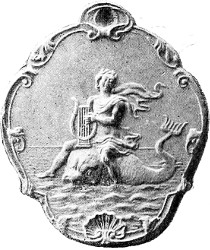
VAUXHALL TICKET BY HOGARTH (AMPHION ON DOLPHIN).
On the opening day of the season of 1737 “there was (we read) a prodigious deal of good company present,” and by the end of the season Pinchbeck was advertising his New Vauxhall Fan with a view of the walks, the orchestra, the grand pavilion, and the organ.
The proprietor was fortunate in the patronage of Frederick Prince of Wales, who had attended the opening Ridotto and often visited Vauxhall till his death in 1751.[325] On 6 July, 1737, for instance, His Royal Highness with several ladies of distinction and noblemen of his household came from Kew by water to the Gardens, with music attending. The Prince walked in the Grove, commanded several airs and retired after supping in the Great Room.
Of fashionable patronage Vauxhall had, indeed, no lack till a very late period of its existence; but the place was never exclusive or select, and at no other London resort could the humours of every class of the community be watched with greater interest or amusement. “Even Bishops (we are assured) have been seen in this Recess without injuring their Character.” To us, some of its entertainments seem insipid and the manners and morals of its frequenters occasionally questionable, but the charm of the place for our forefathers must have been real, or Vauxhall would hardly have found a place in our literature and social history. The old accounts speak of Spring Gardens not only with naïve astonishment, but with positive affection. “The whole place” (to borrow the remark, and the spelling, of a last century writer) “is a realisation of Elizium.” One of the paintings in the gardens represented “Two Mahometans gazing in wonder at the beauties of the place.” Farmer Colin, after his week’s trip in town (1741) returned to his wife full of the wonderful Spring Gardens:—
Oh, Mary! soft in feature, I’ve been at dear Vauxhall; No paradise is sweeter, Not that they Eden call. Methought, when first I entered, Such splendours round me shone, Into a world I ventured, Where rose another sun: While music, never cloying, As skylarks sweet, I hear: The sounds I’m still enjoying, They’ll always soothe my ear.
The account of England’s Gazetteer of 1751 is naturally more prosaic, but takes the exalted tone that characterises the old descriptions of the gardens:—“This (Foxhall) is the place where are those called Spring Gardens, laid out in so grand a taste that they are frequented in the three summer months by most of the nobility and gentry then in and near London; and are often honoured with some of the royal family, who are here entertained, with the sweet song of numbers of nightingales, in concert with the best band of musick in England. Here are fine pavilions, shady groves, and most delightful walks, illuminated by above one thousand lamps, so disposed that they all take fire together, almost as quick as lightning, and dart such a sudden blaze as is perfectly surprising. Here are among others, two curious statues of Apollo the god, and Mr. Handel the master of musick; and in the centre of the area, where the walks terminate, is erected the temple for the musicians, which is encompassed all round with handsome seats, decorated with pleasant paintings, on subjects most happily adapted to the season, place and company.”
The usual approach to the gardens until about 1750, when it became possible to go by coach, was by water. At Westminster and Whitehall Stairs barges and boats were always in waiting during the evening. Sir John, from Fenchurch Street, with his lady and large family, came on board attended by a footman bearing provisions for the voyage. The girls chatter about the last city-ball, and Miss Kitty, by her mamma’s command, sings the new song her master has taught her. Presently, “my lady grows sick” and has recourse to the citron wine and the drops. At the Temple Stairs a number of young fellows, Templars and others, hurry into the boats, and Mr. William, the prentice, takes the water with Miss Suckey, his master’s daughter. The deepness of their design is an inexhaustible fount of merriment, for she is supposed to be gone next door to drink tea, and he to meet an uncle coming from the country.[326]
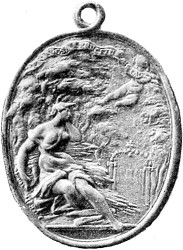
VAUXHALL TICKET BY HOGARTH (“SUMMER”).
More refined would be the party of Mr. Horatio Walpole, in a barge, “with a boat of French horns attending,” or (at a later date) of Miss Lydia Melford, who describes how “at nine o’clock in a charming moonlight evening we embarked at Ranelagh for Vauxhall, in a wherry so light and slender that we looked like so many fairies sailing in a nutshell.” The pleasure of the voyage was marred by the scene on landing, for, although the worthy beadles of the gardens were present at the waterside to preserve order, there was at all periods on landing at Vauxhall Stairs “a terrible confusion of wherries,” “a crowd of people bawling, and swearing, and quarrelling,” and a parcel of ugly fellows running out into the water to pull you violently ashore. But you paid your shilling at the gate, or showed your silver ticket, and then passed down a dark passage into the full blaze of the gardens, lit with their thousand lamps.[327] This was the great moment, as every Vauxhall visitor from first to last, has testified. An impressionable young lady[328] found herself dazzled and confounded by the variety of the scene:—“Image to yourself ... a spacious garden, part laid out in delightful walks, bounded with high hedges and trees, and paved with gravel; part exhibiting a wonderful assemblage of the most picturesque and striking objects, pavilions, lodges, groves, grottos, lawns, temples, and cascades; porticos, colonnades, and rotundas; adorned with pillars, statues, and paintings; the whole illuminated with an infinite number of lamps, disposed in different figures of suns, stars and constellations; the place crowded with the gayest company, ranging through those blissful shades, or supping in different lodges on cold collations, enlivened with mirth, freedom and good humour, and animated by an excellent band of music.” Among the vocal performers you might perhaps have the happiness to hear the celebrated Mrs.—— whose voice was so loud and shrill that it would make your head ache “through excess of pleasure.”
Goldsmith’s Chinese Philosopher[329]—for foreigners always visited Vauxhall and even imitated it in Paris and at the Hague—received a similar impression on entering the gardens with Mr. Tibbs, the second-rate beau, and the pawnbroker’s widow. “The lights everywhere glimmering through the scarcely moving trees; the full-bodied concert bursting on the stillness of the night; the natural concert of the birds in the more retired part of the grove vying with that which was formed by art; the company gaily dressed, looking satisfaction, and the tables spread with various delicacies.”
For an hour or two the promenade and the concert were sufficiently amusing, and the crowd gathered before the orchestra, when Lowe or Miss Stevenson came forward with a new song. Music is the food of love, and the Vauxhall songs were (as Mr. Dobson has remarked) “abjectly sentimental.” Incidents like the following described by an amorous advertiser in the London Chronicle for 5 August, 1758, must have been not uncommon at the gardens:—“A young lady who was at Vauxhall on Thursday night last in company with two gentlemen, could not but observe a young gentleman in blue and a gold laced hat, who being near her by the orchestra during the performance, especially the last song, gazed upon her with the utmost attention. He earnestly hopes (if unmarried) she will favour him with a line directed to A. D. at the bar of the Temple Exchange Coffee-house, Temple Bar, to inform him whether fortune, family and character may not entitle him upon a further knowledge, to hope an interest in her heart.”
At nine o’clock a bell rang, and the company hurried to the north side of the gardens to get a view of the Cascade. A curtain being drawn aside disclosed a landscape scene illuminated by concealed lights. In the foreground was a miller’s house and a waterfall. “The exact appearance of water” was seen flowing down a declivity and turning the wheel of a mill: the water rose up in foam at the bottom, and then glided away. This simple exhibition was a favourite at Vauxhall, though it lasted but a few minutes and was spoken of contemptuously in The Connoisseur and other journals as the “tin cascade.”[330]
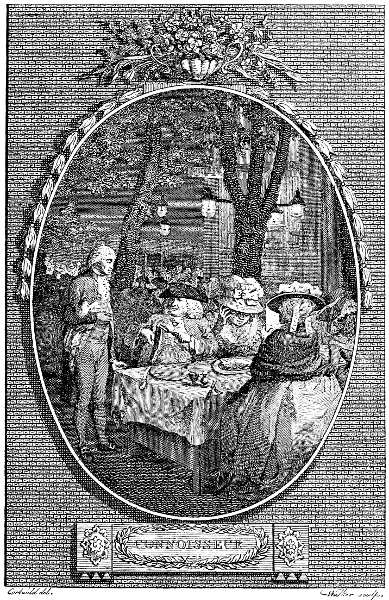
THE CITIZEN AT VAUXHALL, 1755.
The concert was then resumed, and some hungry citizens and their families had already taken their seats in the supper boxes. During supper the citizen[331] expressed his wonder at the number of the lamps, and said that it must cost a great deal of money every night to light them all. The eldest Miss declared that for her part she liked the dark walk best of all because it was solentary. Little Miss thought the last song pretty, and said she would buy it if she could but remember the tune: and the old lady observed that there was a great deal of good company indeed, but the gentlemen were so rude that they perfectly put her out of countenance by staring at her through their spy-glasses. The more fashionable visitors arrived later and had their supper after the concert, often hiring a little band of French horns to play to them. An interesting supper-party might have been seen at the gardens on a June night in 1750, Horace Walpole, Lady Caroline Petersham and “the little Ashe, or the Pollard Ashe as they call her.” In the front of their box—one of the best boxes, of course, near the orchestra and in full view of the company—sat Lady Caroline “with the vizor of her hat erect, and looking gloriously jolly and handsome.” “She had fetched (says Walpole) my brother Orford from the next box, where he was enjoying himself with his petite partie, to help us to mince chickens. We minced seven chickens into a china dish, which Lady Caroline stewed over a lamp, with three pats of butter and a flagon of water, stirring and rattling and laughing, and we every minute expecting the dish to fly about our ears. She had brought Betty, the fruit girl, with hampers of strawberries and cherries from Rogers’s, and made her wait upon us, and then made her sup by us at a little table.... In short the whole air of our party was sufficient, as you will easily imagine, to take up the whole attention of the Gardens; so much so, that from eleven o’clock till half an hour after one we had the whole concourse round our booth; at last, they came into the little gardens of each booth on the side of ours, till Harry Vane took up a bumper and drank their healths, and was proceeding to treat them with still greater freedoms. It was three o’clock before we got home” (Walpole to Montague, 23 June, 1750).
At this point it seems appropriate to furnish some details of the Vauxhall commissariat, and we cannot do better than transcribe an actual Bill of Provisions sold in the gardens about the year 1762.[332]
s. d.
Burgundy, a bottle 6 0
Champagne 8 0
Frontiniac 6 0
Claret 5 0
Old hock, with or without sugar 5 0
Two pound of ice 6
Rhenish and sugar 2 6
Mountain 2 6
Red port 2 0
Sherry 2 0
Cyder 1 0
Table beer, a quart mug 4
A chicken 2 6
A dish of ham 1 0
A dish of beef 1 0
Salad 6
A cruet of oil 4
Orange or lemon 3
Sugar for a bottle 6
Ditto for a pint 3
A slice of bread 1
Ditto of butter 2
Ditto of cheese 2
A tart 1 0
A custard 4
A cheese cake 4
A heart cake 2
A Shrewsbury cake 2
A quart of Arrack 8 0
When Tyers leased the gardens in 1728 there was in the dwelling-house a “Ham Room,” so that this famous Vauxhall viand must have been already in request. The thinness of the slices was proverbial. A journal of 1762, for instance, complains that you could read the newspaper through a slice of Tyers’s ham or beef. A certain carver, hardly perhaps mythical, readily obtained employment from the proprietor when he promised to cut a ham so thin that the slices would cover the whole garden like a carpet of red and white.
The chickens were of diminutive size. Mr. Rose, the old citizen in The Connoisseur (15 May, 1755), found them no bigger than a sparrow and exclaimed at every mouthful: “There goes twopence—there goes threepence—there goes a groat ... why it would not have cost me above fourpence halfpenny to have spent my evening at Sot’s Hole.”
Chicken, ham and beef remained the staple of Vauxhall fare, but from about 1822 onwards the chicken cost four shillings instead of the half-crown, at which the old citizen had grumbled. Ham remained steady at one shilling a plate, and was cut no thicker. Thackeray speaks of “the twinkling boxes in which the happy feasters made believe to eat slices of almost invisible ham.”
In 1774 the same liquors were in demand, at the same prices as in 1762. In 1822 the claret sold was half a guinea a bottle and Frontiniac had risen from six shillings to ten shillings and sixpence a bottle. By this time, arrack—the famous rack punch that Jos. Sedley drank so freely—had risen from eight to twelve shillings a quart. In 1859 it was ten shillings a bowl, and rum and whisky, and of course, Guinness and Bass had taken their places in the bill. About 1802 Vauxhall Nectar was a common summer beverage. It was “a mixture of rum and syrup with an addition of benzoic acid or flowers of benjamin” and was taken with water.
Having thus given a general sketch of the company and amusements at Vauxhall, we must say something of the gardens themselves and of the character of the musical entertainments.
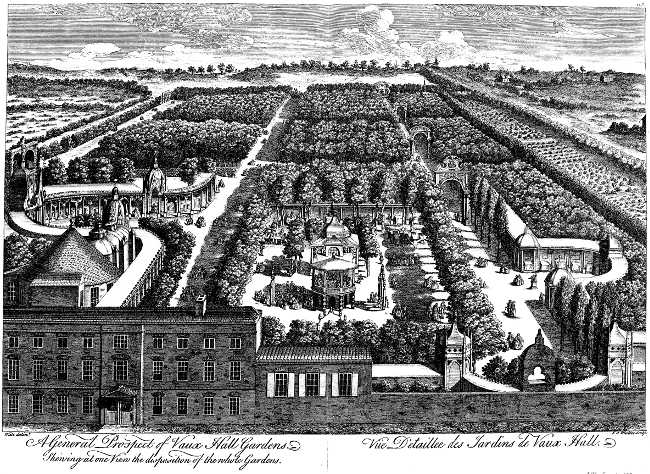
A General Prospect of Vaux Hall Gardens.
Shewing at one View the disposition of the whole Gardens.
Vue Detaillee des Jardins de Vaux Hall.
GENERAL PROSPECT OF VAUXHALL GARDENS, 1751.
The gardens[333] occupied about twelve acres and were laid out in gravel walks flanked by a number of fine trees. On passing through the principal entrance, that connected with the manager’s house[334] at the western end of the gardens, the visitor beheld the Grand (or Great) Walk, planted on each side with elms and extending about nine hundred feet, the whole length of the garden, to the eastern boundary fence, beyond which could be seen pleasant meadows with the hay-makers at their task. At the eastern end of this walk there was a gilded statue of Aurora, afterwards (before 1762) replaced by a Grand Gothic Obelisk bearing the inscription Spectator fastidiosus sibi molestus. This latter erection would hardly have borne inspection by daylight, for, like much of the ‘architecture’ of Vauxhall, it consisted merely of a number of boards covered with painted canvas.
Parallel to the Grand Walk was the South Walk with its three triumphal arches through which could be seen a painting of the ruins of Palmyra.
A third avenue, the Grand Cross Walk, also containing a painted representation of ruins, passed through the garden from side to side, intersecting the Grand Walk at right angles. This cross walk was terminated on the right by the Lovers’ (or Druid’s) Walk, and to the left were the Wildernesses and the Rural Downs.
The lofty trees of the Lovers’ Walk formed a verdant canopy in which the nightingales of Spring Gardens, the blackbirds, and the thrushes were wont to build. This was the principal of the Dark Walks so often mentioned in the annals of Vauxhall. In 1759 complaints were made of the loose characters who frequented these walks, and in 1763 Tyers was compelled to rail them off. When Vauxhall opened for the season in 1764 some young fellows, about fifty in number, tore up the railings in order to lay the walks open.
The Rural Downs, at least in the earlier days of Vauxhall, were covered with turf and interspersed with firs, cypresses and cedars. On one of the little eminences was a leaden statue of Milton[335] seated, listening to music, and at night-time the great Bard was illuminated by lamps. Here were also the Musical Bushes where a subterraneous band used to play fairy music till about the middle of the eighteenth century when this romantic entertainment ceased, “the natural damp of the earth being found prejudicial to the instruments.”
The Wildernesses were formed by lofty trees and were (about 1753) the verdant abode of various “feathered minstrels, who in the most delightful season of the year ravish the ears of the company with their harmony.”
The orchestra, open in the front, stood, facing the west, in the centre of what was called The Grove, a quadrangle of about five acres formed by the Grand, Cross, and South Walks and by the remaining side of the garden.
On each side of this quadrangle were the supper-boxes and pavilions, placed in long rows or arranged in a semi-circular sweep. These were decorated, about 1742, with paintings chiefly by Francis Hayman. Hogarth allowed his “Four Times of the Day” to be copied by Hayman for the boxes, and is said to have given Tyers the idea of brightening Vauxhall with paintings. It is doubtful if any of the pictures in the boxes can be traced directly to his hand, though an undoubted Hogarth, “Henry VIII. and Anne Boleyn” was presented by the artist to Tyers and hung in the Rotunda. The pictures in the boxes chiefly represented scenes in popular comedies and a number of common sports and pastimes such as the play of seesaw, the play of cricket, the humorous diversion of sliding on the ice, leap-frog, and the country dance round the maypole. Some of the larger boxes, denominated temples and pavilions, were more elaborately designed and decorated. Such were the Temple of Comus (in the semi-circle of boxes on the left of the garden) and the Turkish Tent behind the orchestra.
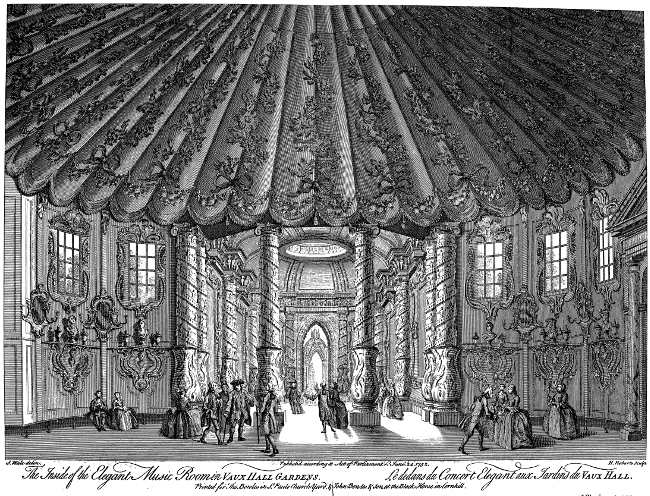
The Inside of the Elegant Music Room in Vaux Hall Gardens.
Le dedans du Concert Elegant aux Jardins du Vaux Hall.
THE ROTUNDA (MUSIC ROOM), VAUXHALL, 1752.
Roubillac’s celebrated marble statue of Handel, as Orpheus, stood in various positions in the gardens (sometimes under cover) from 1738 to 1818.[336]
The principal structure was the Rotunda, entered through a colonnade to the left of the Grand Walk. It was a circular building, seventy feet in diameter, elegantly fitted up and containing an orchestra in which the band performed on wet evenings. When first opened it was known as the New Music Room or the Great Room, and in early days was nicknamed the Umbrella from the shape of the roof. With the Rotunda was connected a long room, known as the Saloon, or the Picture Room. This projected into the gardens, parallel to the Grove.
Under Tyers’s management the concert began at five or six and lasted till nine or ten. It consisted of sixteen pieces, songs alternating with sonatas and concertos. An overture on the organ, always formed part of the entertainment. Not much is known of the instrumental music, for the Vauxhall advertisements, until late in the eighteenth century, never gave the details of the programme. Arne, and Dr. John Worgan, (the Vauxhall organist) were the composers during this period. Valentine Snow, serjeant-trumpeter to the king, was a favourite about 1745, and Burney remarks that “his silver sounds in the open air, by having room to expand, never arrived at the ears of the audience in a manner too powerful or piercing.”
The songs consisted chiefly of sentimental ballads, and of a few more sprightly ditties, such as Miss Stevenson’s song “You tell me I’m handsome”:—
All this has been told me by twenty before, But he that would win me must flatter me more.
The verse is highly conventional, but sometimes shows a glimmering of poetic form that raises it somewhat above the level of our own drawing-room ballads. The average Vauxhall song seems to our ears sufficiently thin and trivial, but on the lips of Lowe or Mrs. Weichsell, may easily have been successful. Of the popularity of the songs at the time, there can be no question. The magazines, especially The London Magazine, regularly published the words, and often the music, of “A new song sung at Vauxhall,” and the contemporary collections of Vauxhall songs, such as The Warbler published at a shilling in 1756, were numerous.
In the period 1745–1767, when the singers were few in number, the chief male vocalist was Thomas Lowe, who possessed an inexhaustible répertoire of Delias and Strephons which he sang with great applause from 1745 till about 1763, when he entered on the management of the Marylebone Gardens.[337] Mrs. Arne sang for a few years from 1745, and Miss Stevenson frequently circ. 1748–1758. Miss Isabella Burchell, better known as the Mrs. Vincent of Marylebone Gardens, sang at Vauxhall from 1751 to 1760. She was originally a milk-girl employed on Tyers’s estate in Surrey, and it was through his instrumentality that she obtained instruction in music.
In 1764, the chief singers were Vernon and Miss Brent, who belong rather to our next period. Miss Wright’s “Thro’ the wood, laddie,” was popular in 1765.
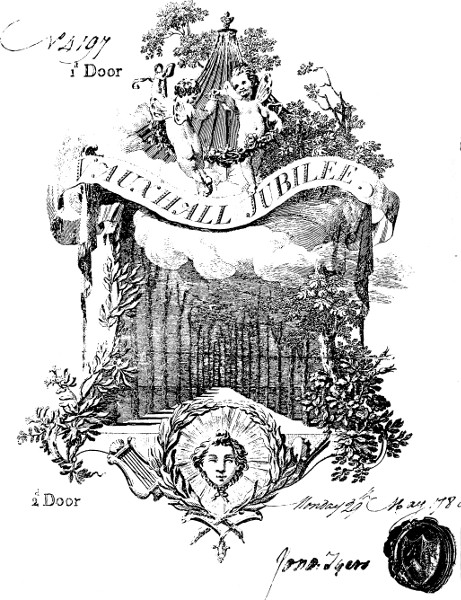
Jonathan Tyers died on 1 July, 1767. He had amassed a large fortune and owned the estate of Denbies at Dorking, where he laid out a curious garden containing a hermitage, called the Temple of Death, and a gloomy valley of the Shadow of Death. In spite of these lugubrious surroundings this “Master-builder of Delight” retained his love for Vauxhall till the last, and shortly before his death had himself carried into the Grove to take a parting look at the Spring Gardens.