VI SOUTH LONDON GROUP (continued 2)
Reading edition
He was succeeded at Vauxhall by his two sons, Thomas and Jonathan. ‘Tom’ Tyers, as he was called by Dr. Johnson, with whom he was a favourite, had been bred to the law, but he was too eccentric and vivacious to confine himself to practice. “He, therefore (says Boswell), ran about the world with a pleasant carelessness,” amusing everybody by his desultory talk and abundance of anecdote. He furnished many songs for the gardens, but in 1785, sold his interest to his brother Jonathan’s family. Jonathan was manager of Vauxhall from 1785 till his death in 1792.
§ 3. 1768–1790.
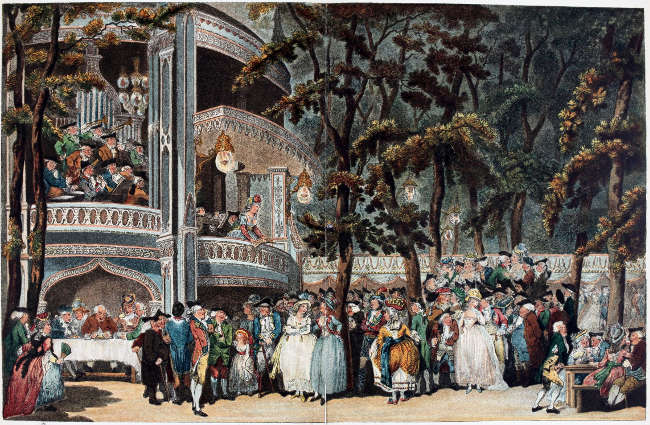
During this period the character of the entertainments of Vauxhall and the arrangement of the gardens themselves, underwent no very material changes,[338] and people of all ranks frequented the place as of old. The singers, however, were more numerous, and there seems to have been a general tendency to stay late. In 1783, the concert began at eight and ended at eleven, and a London guide-book of 1786,[339] states that the company at that time seldom left the garden till two in the morning, if the weather was fine.
From about 1772–1778, a good deal of rowdyism appears to have disturbed the harmony of Vauxhall, though it must be said that the company under old Tyers had not always been distinguished for urbanity. The rude treatment to which Fielding’s Amelia was subjected at the gardens (circ. 1752), can hardly have been an isolated occurrence, and in the summer of 1748 a party of ladies, apparently of good position, used to crow like cocks when visiting Vauxhall, while their friends of the male sex responded with an ass’s bray. One Mrs. Woolaston, attained special proficiency in her imitations.[340]
At this time (1772–1778), it was the custom to violently emphasize the importance of the last night of the season. Young Branghton, in Evelina (circ. 1778), declares that the last night at Vauxhall is the best of any; “there’s always a riot—and there the folks run about—and then there’s such squealing and squalling! and there all the lamps are broke, and the women run skimper scamper.”[341]
From the newspapers we learn that on the 4th of September, 1774, “upwards of fifteen foolish Bucks who had amused themselves by breaking the lamps at Vauxhall, were put into the cage there by the proprietors, to answer for the damage done. They broke almost every lamp about the orchestra, and pulled the door leading up to it off the hinges.”
Vauxhall
The Dark Walk and Long Alleys were also not without their terrors. Evelina, who had unwittingly strayed thither, was surrounded by a circle of impudent young men, and the Branghton girls were also detained, though they had gone more with their eyes open. “Lord, Polly,” says the eldest, “suppose we were to take a turn in the Dark Walks?” “Ay, do,” answered she, “and then we’ll hide ourselves, and then Mr. Brown will think we are lost.” A quarrel in public between two angry gentlemen was also a not uncommon incident, and the affair sometimes assumed the heroic proportions of a Vauxhall “Affray.” For example, one day in June 1772 two gentlemen, Captain Allen and Mr. Kelly, created a scene. The words “scoundrel” and “rascal” were heard, and Allen who had a sword would have overpowered Kelly who had only his cane, if the bystanders had not interposed.[342] But the Vauxhall Affray par excellence, was the affair of Bate, “the fighting parson,” and Mr. Fitzgerald.[343] The Rev. Sir Henry Bate Dudley, Bart. (as he afterwards was) was at Vauxhall on the evening of 23 July, 1773, in company with Mrs. Hartley and some friends. A party of gentlemen sat down near them, and made a deliberate attempt to stare the beautiful actress out of countenance. Captain Crofts and Mr. George Robert Fitzgerald were among the offenders, or at any rate took their part. Bate expostulated loudly with Crofts, and a crowd gathered round. The next day Bate and Crofts met at the Turk’s Head Coffee House in the Strand, where matters were being peaceably adjusted, when Fitzgerald appeared on the scene insisting on satisfaction for his friend Captain Miles, who wanted to box the parson. Bate declared that he had offered no insult to Miles, but ultimately the party adjourned to the front dining-room of the Spread Eagle Tavern close by, and there in fifteen minutes Bate had completely beaten Miles. A few days afterwards Bate discovered that the supposed Captain Miles was Fitzgerald’s footman, esteemed an expert bruiser. Bate published an account of the affair in the papers, and Fitzgerald’s conduct was generally condemned, though he tried to make out that the footman had only pretended to be beaten. A further quarrel arising out of this incident led to a meeting between Fitzgerald and a Captain Scawen in Flanders. As a finishing touch to our picture of the Vauxhall manners of the period, we must recall an evening in August 1782, when the Prince of Wales and a party of gay friends visited the gardens. When the music was over the Prince was recognised by the company, and being surrounded, crushed, and pursued, had to beat a hasty retreat. The ladies followed the Prince, the gentlemen pursued the ladies; the curious and the mischievous increased the tumult, and in a few minutes the boxes were deserted, the lame overthrown, and the well-dressed demolished.[344]
On May 10, 1769, a Ridotto al fresco was given at which not less than ten thousand people are said to have been present. The Rotunda was lit with nearly five thousand glass lamps, and a platform under an awning was laid down in the gardens for dancing. The fancy dresses were not numerous, and Walpole, who was there with his friend Conway, only walked twice round, and was glad to get out of the mob and go home. Some years later, on 29 May, 1786, there was another Ridotto to celebrate (approximately) the Jubilee of Vauxhall Gardens. Fourteen thousand additional lamps were displayed, and most of the company appeared in dominoes, as at the original Ridotto of 1732.
A Collection of Favorite SONGS
During this period (1768–1790) the principal tenor was Vernon, who had taken Lowe’s place in 1764. His répertoire appears to have been somewhat less conventional than that of his predecessor, and his gay and energetic manner rendered him popular in such songs as the “English Padlock,” the “Crying and Laughing” Song, and “Cupid’s recruiting Sergeant.” He was a constant singer at Vauxhall till the end of the season of 1781. In 1783 Arrowsmith, a young tenor, pupil of Michael Arne, aspired with some success to take Vernon’s place. He sang till 1785, but in the summer of next year (1786) a more celebrated tenor, Charles Incledon, then only twenty-two, made his appearance, and sang till 1790.
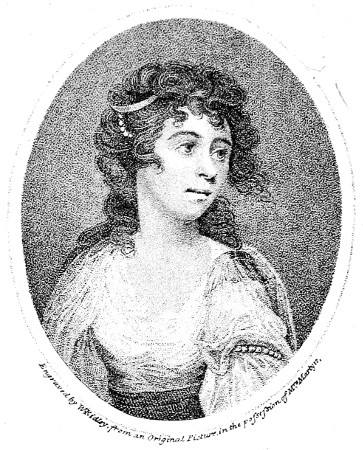
The principal female singers were Mrs. Baddeley (about 1768); Mrs. Weichsell (1769–1784); Miss Jameson (1770–1774); Miss Wewitzer (circ. 1773); Mrs. Hudson (1773–1776); Mrs. Wrighten (1773–1786); Mrs. Kennedy (1782–1785); Miss Leary (1786–1789); Mrs. Martyr, the actress (1786–1789). Of these vocalists, Mrs. Baddeley and Mrs. Kennedy were the well-known actresses. The latter possessed a powerful voice, and often assumed male parts at Covent Garden. Mrs. Wrighten had a vivacious manner and a bewitching smile, and her “Hunting Song” was popular. Mrs. Weichsell, the mother of Mrs. Billington the actress, was an especial favourite at the gardens. A magazine poet of 1775[345] celebrates her among the best Vauxhall singers.—
Sweet Weichsell who warbles her wood-note so wild, That the birds are all hushed as they sit on each spray, And the trees nod applause as she chaunts the sweet lay.
In 1774 James Hook was appointed organist and composer, and remained at Vauxhall Gardens till 1820, exerting his facile, if not very distinguished powers, as a music-writer. In 1775 Catches and Glees were for the first time introduced into the concert. On an evening of July of this year Lord Sandwich and a party of friends amused themselves by starting some Catches and Glees of their own, which they sang from their box near the orchestra. General Haile, who sat in the next box, then requested a young lady who was with him to sing a song, which the band obligingly accompanied, to the great delight of the audience.[346] A favourite catch, “They say there is an echo here,” was performed in 1780, by two sets of singers and musicians, the stanzas of the principal band being answered by an invisible band of voices and wind instruments stationed over the Prince’s box at the bottom of the garden.
Vauxhall on a Gala Night
In 1783 Barthelemon led the orchestra, and a band of drums and fifes, horns and clarionets, was introduced to perambulate the gardens after the regular concert. These supplementary bands generally formed part of the later Vauxhall entertainments.
§ 4. 1791–1821.
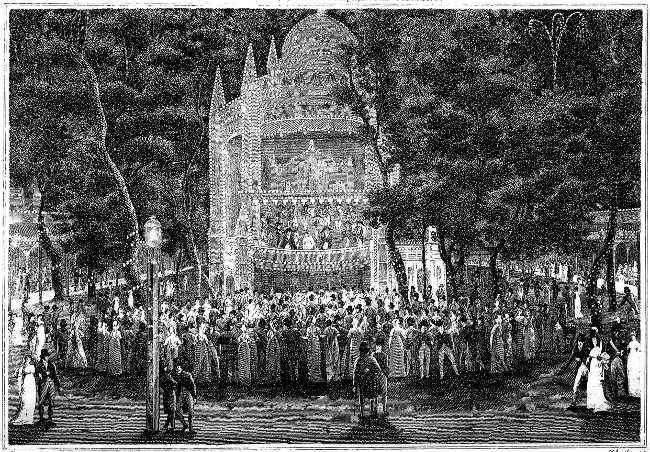
In 1792 the ordinary admission was raised from one shilling to two shillings, and Grand Galas and Masquerades became features of Vauxhall.[347] On 31 May, 1792, there was a successful masked ball, and the gardens were a blaze of light. Amid a crowd of Haymakers, Punches, Chimney Sweeps, and Sailors, Munden, the actor, attracted attention in the character of a deaf old man.
People of all classes took part in these masqueradings. Deputy Gubbins went as a very fat Apollo, and his spouse, a portly matron, as Diana with a huge quiver. Master Gubbins was Cupid. But these characters were misunderstood by the newspaper-reporter, who described the Deputy as the Fat Knight, accompanied by his lady as Mother Quickly, and by the hope of all the Gubbinses as an awkward Toxophilite.[348]
The “Dashalls” and “Tallyhos” sometimes caused trouble, and a newspaper of 1812, describes how at a ball of this year, a crowd of masks followed “Mr. Cockadoodle Coates” with crowing and exclamations of “Romeo, Romeo, wherefore art thou, Romeo.”
An imposing festival took place on 20 June, 1813, to celebrate the Battle of Vittoria and Wellington’s victories. The Prince of Wales, and all the Royal Dukes were present at the banquet.
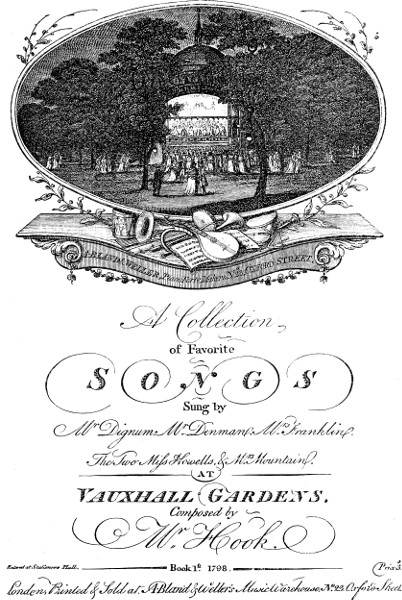
During this period (1791–1821) some capable vocalists made their appearance at Vauxhall; Darley (who had already sung at the gardens in 1789); Mrs. Franklin (who had previously appeared as Miss Leary); Mrs. Mountain,[349] the actress (1793); the well-known Charles Dignum (1794) and Mrs. Bland[350] the popular ballad-singer (1802). Dignum and Mrs. Bland remained Vauxhall favourites for some years.[351]
Mrs. Martyr.
Fireworks, which had long before been usual at Cuper’s Gardens, Marylebone Gardens, and Ranelagh, were not introduced at Vauxhall till 1798. From about 1813, they became a permanent institution. In 1816, Mme. Saqui of Paris appeared at Vauxhall, and was the principal attraction for several seasons. A mast about sixty feet high was erected on the firework platform at the eastern end of the gardens, and from its top depended an inclined rope 350 feet long. At twelve o’clock a lady of muscular and masculine appearance, bedecked with spangles and waving plumes, might be seen ascending this rope to the platform, amid a glare of blue flame. Her appearance was almost supernatural:—
Amid the blaze of meteors seen on high, Etherial Saqui seems to tread the sky;[352]
Having now reached the highest point, she made her descent in a shower of Chinese Fire, and “in the face of a tempest of fireworks.” This exciting performance became a necessity at Vauxhall, and Saqui’s feats were afterwards reproduced by Longuemare and Blackmore.
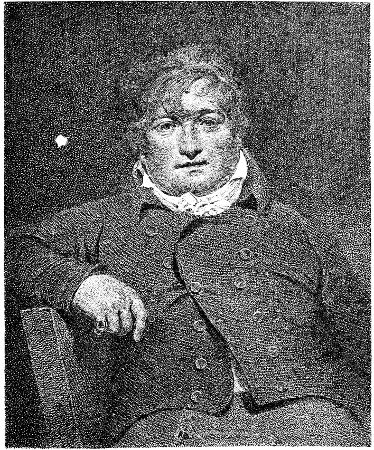
CHARLES DIGNUM.
At this period (circ. 1817) the newspapers describe the orchestra as a “pagoda of lustre,” and the covered walks as arches of fire. The songs, and the music, and the fireworks were the attractions till about one o’clock, when the ordinary visitors withdrew. But the noisy and the dissipated sometimes kept up the fun with reels and waltzes till nearly four in the morning.[353]
We have now wandered far from the old Spring Garden of Jonathan Tyers and the later history of Vauxhall must, in the present volume, be very briefly summarised.
In the gardens themselves, some important changes had already been effected. In 1786, a Supper Room had been added to the left of the Rotunda, and in 1810–11 many of the trees in the Grove were cut down, and part of the Grand Walk and two sides of the Grove were covered in by a vaulted colonnade supported by cast-iron pillars. This colonnade was brilliantly lit with lamps, and was convenient in the wet weather that was proverbial at Vauxhall, but it greatly tended to destroy what Walpole calls, “the gardenhood” of the place.[354] The last of the old trees of Tyers’s period is said to have survived till 1805.
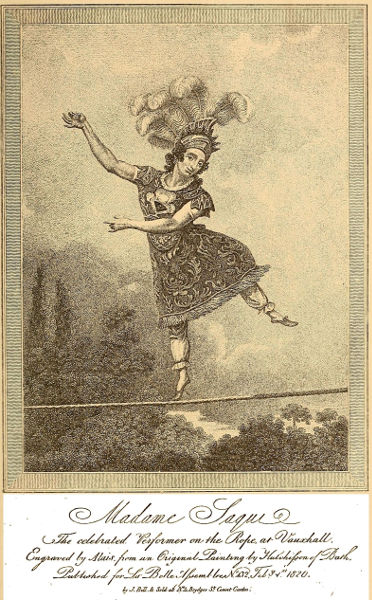
Madame Saqui
The celebrated Performer on the Rope at Vauxhall.
In 1821 Vauxhall Gardens passed out of the possession of the Tyers family. After the death of Jonathan Tyers the younger in 1792, his place was taken as proprietor and manager by his son-in-law Bryan Barrett, who died in 1809. Barrett’s son, George Rogers Barrett then acted as manager of the gardens for many years. In 1821, the property was purchased from the Barrett family for £30,000[355] by T. Bish (the lottery-office keeper), F. Gye, and R. Hughes.
§ 5. 1822–1859.
The gardens opened[356] for the season of 1822 on June 3rd, and for the first time received the appellation of The Royal Gardens, Vauxhall. This change in the name was made with the approval of George IV. who as Prince of Wales had been a regular frequenter of the gardens and had received from a grateful management public recognition of his patronage. In 1791, a gallery had been constructed in the gardens and named after him.[357] This was the shrine of an allegorical transparency portraying him leaning against a horse held by Britannia. Minerva bore his helmet; Providence fixed his spurs, and Fame blew a trumpet and crowned him with laurel. The good-natured Darley came to the front of the orchestra (August 1792) and sang in his best manner, “The Prince of the People”:—
Endow’d with each virtue, the dignified Youth, Ere Reason enlighten’d his mind, Burst forth on the world in example and truth, The boast and delight of Mankind.
The gardens had now (1822) completely assumed their nineteenth-century aspect and Vauxhall, lit with “20,000 additional lamps,” began to supply a constant succession of variety entertainments.
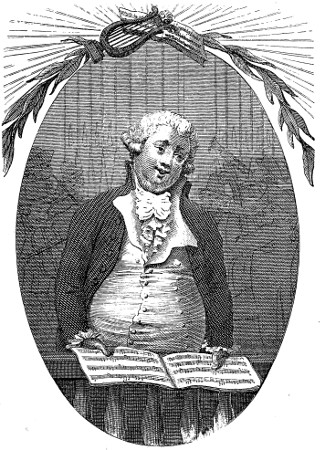
DARLEY IN THE ORCHESTRA AT VAUXHALL.
The Rotunda was decorated as an Indian Garden Room, and at a later date was fitted up with seats and boxes and used for the equestrian performances. In the Saloon (or Picture Room) adjoining, where historical pictures by Hayman were still hanging, was an exhibition called by the erudite managers Heptaplasiesoptron. On plates of glass ingeniously distributed manifold reflections were produced of revolving pillars, palm-trees, twining serpents, coloured lamps and a fountain.
The old Cascade had been abolished about 1816, and a stage for rope-dancing occupied its site (1822). A Submarine Cavern and a new exhibition of Waterworks appear to have covered the Rural Downs.
At the eastern end of the garden was a building of wood and canvas representing a Hermit’s Cottage, wherein might be seen—all in transparency—the Hermit himself pursuing his studies by the aid of a lamp, a blazing fire and a brightly-shining moon. At this end of the gardens was the Firework Tower, where the fireworkers Hengler, Mortram and Southby were now (1822) at work, preparing for the ascent of Longuemare, which was to take place at twelve o’clock à la Saqui.
The South Walk (so much of it at least as remained uncovered) was now known as the Firework Walk, and the three Triumphal Arches had disappeared.
The Dark Walk of Vauxhall now began at the Submarine Cavern, passed along the left hand and eastern boundaries of the garden and terminated at the right hand end of the Grand Cross Walk, the last branch of it being thus identical with the Lovers’ Walk of old days. The Cross Walk was now usually denominated the Chinese Walk from its being lit with Chinese lanterns. Four cosmoramas had taken the place of its Ruins.
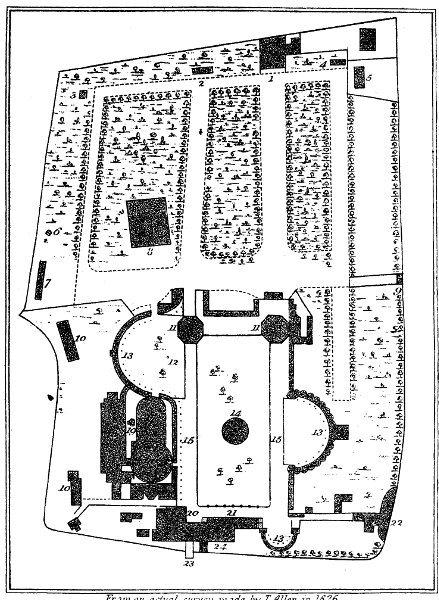
From an actual survey made by T. Allen, in 1826.
VAUXHALL GARDENS.
1 Fire work Tower
2 Evening Star
3 Hermitage
4 Smugglers Cave
5 House in which Mr Barrett died
6 Statue of Milton
7 Transparency
8 Theatre
9 Chinese entrance
10 Artificers work shops
11 Octagon temples
12 Fountain
13 Circles of Boxes
14 Orchestra
15 Collonade
16 Rotunda
17 Picture Room
18 Supper Room
19 Ice House
20 Bar
21 Princes Pavilion
22 Entrance
23 Water Gate
24 House
The boxes and pavilions containing Hayman’s paintings remained much as of old. Among other noteworthy features of the later Vauxhall was the gilded cockle-shell sounding-board over the orchestra (from 1824); a new avenue called the Italian Walk (from about 1836), and the Neptune Fountain.
In 1822 Ramo Samee, the Indian juggler and sword-swallower, made his appearance, and next year a Shadow Pantomime and Grey’s Fantoccini were introduced. From this period, Vauxhall was enlivened or vulgarised by the performance of comic songs. Mallinson (circ. 1823), W. H. Williams (from 1824), and J. W. Sharp (from 1846) being some of the best-known singers.
In 1826 the admission was raised to four shillings, on account of the engagement of Braham and Miss Stephens and of Mme. Vestris, whose “Cherry Ripe” was popular. In 1827 the space in front of the firework tower was cleared of shrubs, and a representation of the Battle of Waterloo took place there. Cooke’s stud and a thousand horse and foot soldiers engaged in this action. The “Waterloo” ground afterwards (1834) became the Polar Regions, and subsequently the space was covered by other scenic displays, including (1847) a view of Venice with “imitation water.”
In 1828 Ducrow’s stud was engaged, and in the next year ballets became a feature.
In 1830–1832 the musical director was Sir Henry Bishop, who composed operettas for the gardens, such as “The Sedan Chair,” “The Bottle of Champagne,” and the “Magic Fan.” In the last-named Mrs. Waylett and Paul Bedford took part. George Robinson, the alto, made Bishop’s “My Pretty Jane” popular. On August 2, 1833, when a one shilling night was tried, upwards of 27,000 people paid for admission.
The 19th of August, 1833, is notable in the Vauxhall annals as the benefit night of old Simpson, for more than thirty-six years Master of the Ceremonies at the gardens, and himself one of the sights and institutions. He was a man of short stature and his plain face was pitted with the smallpox, but his manner and dress made ample amends. He wore a shirt with an enormous frill, a coat of antique cut, and black silk knee-breeches and hose. In his uplifted left hand he carried his tasselled and silver-headed cane, and with his right raised his hat to every one he met, as a welcome to the Royal Property. His habitual attitude has been immortalised by Cruikshank and he was exhibited (from 1833) in the gardens in coloured lamps—an immense effigy, forty-five feet high. Simpson’s Vauxhall Addresses and his letters to newspaper editors were masterpieces of florid humility. To the editor of The Times he wrote to say that he had given directions that the illustrious editor’s “much-beloved family” were to be admitted “to any number” at the Vauxhall Juvenile Fêtes—a communication which amused Thomas Barnes who had no children. Simpson died, almost in office, on 25 December, 1835, after expressing a wish that the managers of the Royal Gardens would dispose as they deemed fit of his “humble body.” Thackeray calls him “the gentle Simpson, that kind, smiling idiot.”[358]
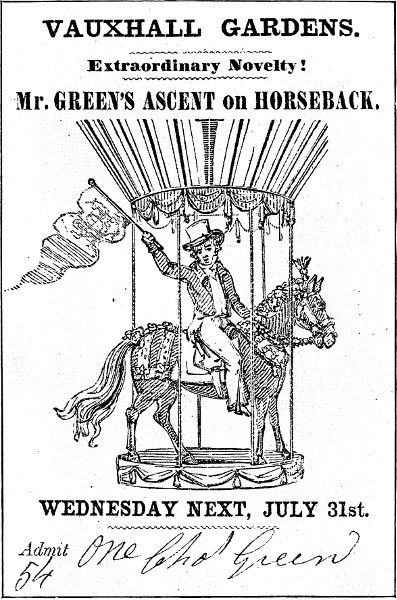
ADMISSION TICKET FOR GREEN’S BALLOON ASCENT, 31 JULY, 1850.
In 1836 the gardens were open in the day-time, but Vauxhall by daylight, as “Boz” observed, is “a porter-pot without porter; the House of Commons without the Speaker; a gas-lamp without gas.” Ballooning was the chief feature of these afternoon fêtes.[359] On 7 November, 1836, Charles Green, accompanied by Monck Mason and Robert Hollond, M.P., ascended from the gardens at 1.30 P.M. in the balloon, afterwards named “the Nassau,” and descended next morning near Weilburg in the Duchy of Nassau after a voyage occupying eighteen hours.[360] On 24 July, 1837, Green, Edward Spencer, and Robert Cocking ascended in a balloon with a parachute attached, and Cocking in descending in the parachute was killed.
In 1839 the proprietorship of Gye and Hughes came to an end, and Vauxhall was closed in 1840. The gardens were again open in July 1841 with Alfred Bunn as stage-manager. During this season Bunn and “Alfred Crowquill” published at the gardens their amusing series of Vauxhall Papers, “a daily journal published nightly, every other evening, three times a week.”[361] The Ravel Family and Ducrow’s horsemanship were among the attractions of this season, which came to an end on 8 September, when the announcement was made that Vauxhall would “positively close its doors for ever.”
On 9 September (1841) the gardens were offered for sale by auction, but were bought in at 20,000 pounds. The furniture and fittings were, however, disposed of at this time, notably, twenty-four of the paintings by Hayman, which realised sums from £1 10s. to £9 15s. Four busts of the celebrated Simpson were sold for half-a-crown apiece.
From 1842 till the final closing of the gardens, galas, masquerades, and a great variety of entertainments were advertised in bold letters of many colours, but Vauxhall was now rapidly declining. In 1845, Musard conducted Promenade Concerts, and in that year and during most of the years following, Mr. Robert Wardell was the lessee. In 1846, gas lamps took the place of the oil lamps, and about this time the musicians in the orchestra ceased to wear the cocked hats that had long been their characteristic head-dress. In 1849, there was a Grand Venetian Carnival, and 60,000 lamps were advertised.
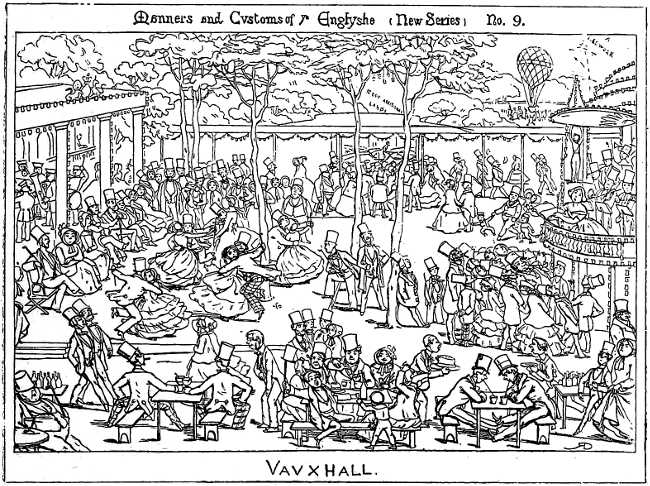
VAUXHALL IN 1850, DOYLE’S VIEW FROM Punch.
In October 1853, when the annual license for the Royal Gardens was applied for, great complaints were made of the nuisance caused by the bals masqués which lasted from 11 P.M. till 5 or 6 A.M., and were frequented by many disreputable characters. The license was renewed on the somewhat easy conditions that the fireworks should not be let off after eleven, and that the gardens should close at three in the morning. In 1858, Mr. R. Duffell was the director. Monster galas were announced, and the gardens were opened on Sundays for a promenade.
Monday, 25 July, 1859, witnessed the last entertainment at Vauxhall Gardens. One of the vocalists at the concert then given was Mr. Russell Grover, who died lately, in April 1896. After the concert and the equestrian performances in the Rotunda, dancing was continued till past midnight: the fireworks displayed the device Farewell for Ever, and Vauxhall was closed.
On 22 August following, the auctioneer ascended his rostrum in the gardens at noon and announced that the site had been let for building, and that all the property on the premises must be sold. Three “deal painted tables with turned legs,” made for the gardens in 1754, went for nine shillings each. The dancing platform realised fifty guineas, the ballet theatre seventeen guineas, and the orchestra ninety-nine pounds. The pictures that still remained in the supper boxes were purchased by Edward Tyrrell Smith, who placed them in the Banqueting Hall at Cremorne. The whole sale realised about £800.
The builders soon went to work upon the twelve acres of Vauxhall Gardens, and in 1864 the church of St. Peter, Vauxhall, erected on part of the site, was consecrated. Numerous streets of small houses have for many years completely obliterated all traces of the gardens, the boundaries of which, it is, however, interesting to trace. The western boundary is marked by the present Goding Street, and the eastern by St. Oswald’s Place. Leopold Street and a small portion of Vauxhall Walk define their northern limit, and Upper Kennington Lane marks their southern extent. The space within these boundaries is occupied by Gye Street, Italian Walk, Burnett Street, Auckland Street, Glynn Street, and part of Tyers Street,[362] and also by St. Peter’s Church and the Lambeth District School of Art.
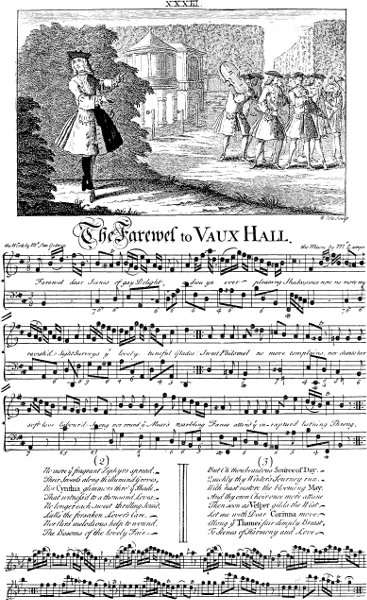
The Farewel to Vaux Hall.]
[Audio content is not currently supported on your device.
[Audio content is not currently supported on your device.
As late as 1869 “the Supper Colonnade of Vauxhall” was advertised to be sold cheap,[363] and with this prosaic detail of our own time, we must perforce take leave of the pleasure gardens of a past century.
AUTHORITIES AND VIEWS.
The literary and pictorial matter available for a history of Vauxhall Gardens is almost inexhaustible and, except in a monograph, it would be impossible to set forth a detailed list of authorities and views. The present sketch is primarily based on the materials furnished by an extensive collection in the writer’s possession, consisting of views, portraits, songs, bills, and cuttings from newspapers and magazines, and covering the period 1732–1859. Among many other authorities that have been consulted, the following may be mentioned:—Pepys’s Diary: A Sketch of the Spring Garden, Vauxhall (by John Lockman, 1753?); A Description of Vauxhall Gardens, London, S. Hooper, 1762 (Guildhall Library, London); Kearsley’s Stranger’s Guide (1793?); Sale Catalogues of Vauxhall Gardens, 1818 (Brit. Mus.) and 1841 (W. Coll.); A Brief Historical and Descriptive Account of the Royal Gardens, Vauxhall, 1822; The Vauxhall Papers, 1841; the histories of Lambeth and Surrey; W. H. Husk in Grove’s Dict. of Music, art. “Vauxhall Gardens”; Austin Dobson’s Eighteenth Century Vignettes, 1st ser. p. 230, ff.; Cunningham’s Handbook of London; Wheatley’s London Past and Present; Walford, vi. 447, ff.; Blanchard in Era Almanack for 1870, p. 9, ff.