II MARYLEBONE GROUP
Reading edition
MARYLEBONE GARDENS
§ 1. Origin of Marylebone Gardens.
The principal entrance[91] to these well-known gardens was through The Rose (or Rose of Normandy), a tavern situated on the east side of the High Street, Marylebone, opposite (old) Marylebone Church. The gardens extended as far east as the present Harley Street; and Beaumont Street, part of Devonshire Street, part of Devonshire Place, and Upper Wimpole Street now occupy their site. When enlarged (in 1753) to their fullest extent they comprised about eight acres, and were bounded on the south by Weymouth Street, formerly called Bowling Green Lane or Bowling Street.
As a place of amusement of the Vauxhall type, the gardens date, practically, from 1738, but the Marylebone garden and bowling-green came into existence at a much earlier period.
The gardens were originally those belonging to the old Marylebone Manor House,[92] and were detached from it in 1650. There were several bowling-greens in the immediate vicinity, the principal of which was a green appurtenant to the Rose, and situated in the gardens behind this tavern. In 1659 the gardens of the Rose, the nucleus of the later Marylebone Gardens, consisted of gravel walks, a circular walk, and the bowling-green which formed the central square. The walks at that time were “double-set with quick-set hedges, full grown and indented like townwalls.” On the outside of the whole was a brick wall, with fruit trees.
Pepys records a visit in 1668 (7 May):—“Then we abroad to Marrowbone, and there walked in the garden: the first time I ever was there, and a pretty place it is.”
In 1691 the place was known as Long’s Bowling Green at the Rose, and for several years (circ. 1679–1736) persons of quality might be seen bowling there during the summer time:—
At the Groom Porter’s batter’d bullies play; Some Dukes at Marybone bowl time away.[93]
Less innocent amusement was afforded by the tavern, which, at the end of the seventeenth and in the early part of the eighteenth century, was notorious as a gaming-house. Sheffield, Duke of Buckingham (d. 1712) was wont at the end of the season to give a dinner at the Rose to its chief frequenters, proposing as the toast, “May as many of us as remain unhanged next spring meet here again.” “There will be deep play to-night (says Macheath in the Beggar’s Opera), and consequently money may be pick’d up on the road. Meet me there, and I’ll give you the hint who is worth setting.”
Some special attractions were occasionally offered to the quality who frequented the Bowling Green; thus, in 1718 there were illuminations there, and a consort of musick to celebrate the King’s birthday. In 1736 we hear of scaffolding, 135 feet high, that was erected in the gardens for the Flying Man who was to fly down it by a rope with a wheelbarrow before him.
§ 2. Marylebone Gardens under Gough and Trusler. 1738–1763.
Daniel Gough, who was proprietor of the Rose and its gardens in 1737, first made a regular charge for admission,[94] and in the summer of 1738 (July 12) advertised and opened “Marybone[95] Gardens” as a place of evening entertainment. He selected a band from the Opera and the Theatres to play, from six to ten, eighteen of the best concertos, overtures and airs; erected a substantial garden-orchestra, in which was placed (1740) an organ by Bridge; and built (1739–1740) the House or Great Room for balls and suppers. Gough was succeeded as manager (in 1751?) by John Trusler,[96] who being by profession a cook paid attention to the commissariat of the Gardens. The rich seed and plum cakes, and the almond cheese-cakes made by his daughter, Miss Trusler, became a spécialité of the place. Sir John Fielding, the magistrate, was of opinion that Londoners should not want Mrs. Cornelys’s entertainments in Soho, when they had Ranelagh with its music and fireworks and Marybone Gardens with their music, wine and plum-cakes.
During this period (1738–1763) Marybone Gardens were opened in the morning for public breakfasting in the Great Room, and for a concert, beginning at twelve, to which the admission was two shillings, or one shilling. The admission for the evening entertainment was the same, but was raised on exceptional nights to three shillings.
In August 1738, there were introduced “two Grand or Double Bassoons, made by Mr. Stanesby, junior, the greatness of whose sound surpass that of any other bass instrument whatsoever.” In 1741 a grand martial composition was performed by Mr. Lampe in honour of Admiral Vernon. In 1744 Knerler, the violinist, was the principal executant; and Mr. Ferrand performed on “the Pariton, an instrument never played on in publick before.”
In 1747 Miss Falkner made her appearance and remained the principal female singer[97] till about 1752.
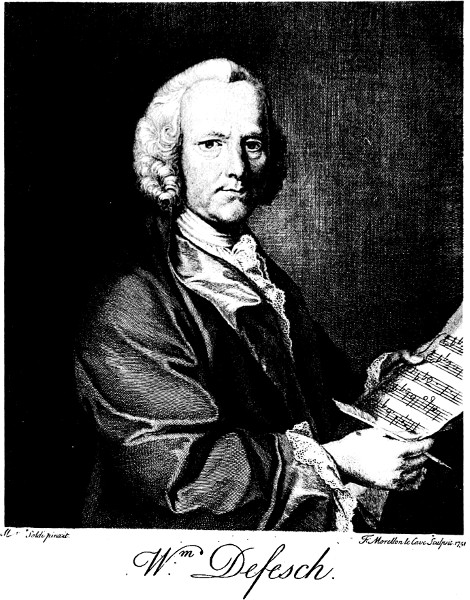
Wm. Defesch.
Mary Ann Falkner (or Faulkner),[98] was the niece of George Faulkner, the Dublin printer, and was a vocalist of celebrity in her day, though she never aspired beyond such songs as “Amoret and Phillis,” “The Happy Couple,” “Fair Bellinda,” “Delia,” and “The Faithful Lover.” She had many admirers, among whom were the Earl of Halifax (the second Earl), Lord Vane, and Sir George Saville; but she behaved circumspectly, and bestowed her hand upon a young man named Donaldson, the son of a linendraper. Unfortunately, her husband, who had been brought up in what Dr. Trusler calls “the line of a gentleman,” was extravagant and idle, and consented (about 1753) to a base arrangement by which his wife was taken under the protection of Lord Halifax.
The Earl built a house for Mrs. Donaldson at Hampton Court Green, where she seems to have lived quietly. At a later time when Halifax was contemplating marriage with the wealthy daughter of General Drury, she surprised him one evening in the walks at Vauxhall Gardens, and so exerted her influence that the Earl not only left his Vauxhall friends without an apology, but broke off his engagement with Miss Drury.[99]
Other vocalists of this period were Thomas Lowe (from 1750); Mr. Baker (1750); Master Michael Arne (1751); Madame Ramelio (1752–1753); Mrs. Chambers (1753); Champness (1757); Kear (1757); Thomas Glanville (1757); and Reinhold (from 1757). Defesch, the well-known musician, was engaged as first violin in 1748.
In 1758 “La Serva Padrona, or the Servant Mistress,”[100] the first Burletta ever given in the gardens, was performed and was often afterwards repeated. It was an adaptation of Pergolesi’s composition by the elder Storace, and by Dr. Trusler, the proprietor’s son. The younger Trusler subsequently became a clergyman and finally a bookseller. He distinguished himself by selling to his clerical brethren original sermons printed in script characters, and made in this way, as he told his Bishop, an income of £150 a year.
During this period of the Gardens’ history the evening entertainments were usually confined to concerts, though balls were given from time to time in the Great Room. Fireworks were not often displayed, but on 26 September, 1751, after a masquerade, they were introduced with a kind of apology:—“the playing-off the fireworks (which will begin at eleven o’clock) will not incommode the ladies.” “A large collection” of fireworks was announced for display on the June evenings of 1753.
A view of Marybone Gardens in 1755 shows smartly-dressed people promenading in the Grand Walk, with the Orchestra and the Great Room on either hand. At this period families of good position had country houses in the High Street, Marylebone, and they probably availed themselves of the subscription tickets for the balls and concerts in the Gardens. Old Dr. John Fountayne, for instance, would stroll in from the Manor House School with his friend Mr. Handel. On one occasion the great composer begged for Fountayne’s opinion on a new composition that the band was performing. They sat down together, and after a time the clergyman proposed that they should move. “It is not worth listening to—it’s very poor stuff.” “You are right, Mr. Fountayne,” said Handel, “it is very poor stuff. I thought so myself when I had finished it.”[101]
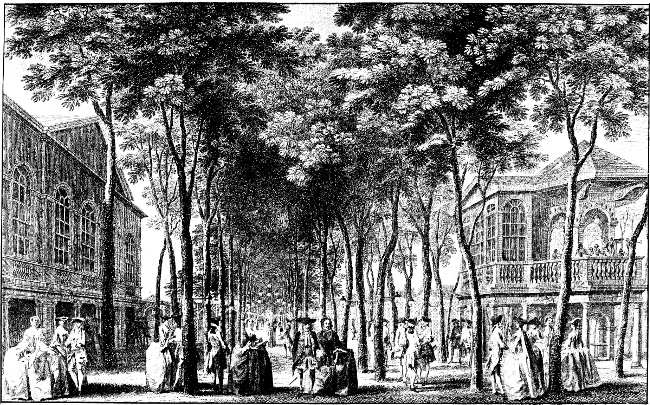
MARYBONE GARDENS, 1755–1761.
The Gardens appear to have been generally conducted in a respectable way, though the Duke of Cumberland, if Dr. Trusler[102] has not maligned him, used to behave in a scandalous manner when he visited the place. Probably, gentlemen did not always accede to the proprietor’s humble request that they should not “smoak on the walks”; and a scene occasionally occurred. One Saturday night in August 1751, an angry gentleman drew upon another who was unarmed, but had his sword struck out of his hand by a “nobleman” standing by, so that the disputants were reduced (we are told) to the use of cane and fist. But on the whole, Marybone Gardens was a decent and social place of amusement, and little parties were to be seen chatting and laughing in its latticed alcoves. In May 1753 when the Gardens had been extended and improved, the place could boast (according to a contemporary account) of the largest and politest assembly ever seen there.
A guard of soldiers and peace-officers conducted the company (circ. 1741) to and from the Gardens, and at eleven and twelve o’clock a special guard set off to take people along the fields as far as the Foundling Hospital. (circ. 1743). The neighbourhood of the Gardens was, in fact, by no means safe. On a June night of 1751 when the entertainment was in full swing, some thieves entered the house of Mr. William Coombs, a wine merchant residing at the Gardens, and carried off his plate and china. About three weeks later a gentleman who was in the fields at the back of the Gardens, listening to the strains of the band, had a pistol pointed at him by a man who demanded his money and his watch. On June 30, 1752, a servant going to the Gardens was attacked in the fields and robbed by two footpads.[103] At a later date (1764) the proprietor felt it necessary to offer “a premium of ten guineas” for the apprehension of any highwayman or footpad found on the road to the Gardens, and a horse-patrol to and from the City was provided at that time. It is said that Dick Turpin once publicly kissed in the Gardens a beauty of the time related to Dr. Fountayne. The lady expostulated, but Turpin exclaimed “Be not alarmed, Madam, you can now boast that you have been kissed by Dick Turpin. Good morning!”
§3. The Gardens under Thomas Lowe. 1763–1768.
In 1763 the Gardens and adjoining premises were taken at a yearly rent of £170[104] by Thomas (“Tommy”) Lowe, the favourite tenor of Vauxhall Gardens, who had already appeared at Marybone Gardens in 1750. He engaged, among other singers, Mrs. Vincent, Mrs. Lampe, and the beautiful Nan Catley, then only eighteen. Lowe opened in May (1763) with a “Musical address to the Town,” in which the singers (Lowe, Miss Catley and Miss Smith) apologised for the absence of some of the attractions of Ranelagh and Vauxhall:—
Yet Nature some blessings has scatter’d around; And means to improve may hereafter be found.
The entertainments under Lowe’s management consisted principally of concerts in which he himself took a prominent part.[105] The Gardens were opened at 5 p.m.: the concert began at 6.30, and the admission was one shilling. In 1765 the concerts included songs from Dr. Boyce’s “Solomon,” and Mrs. Vincent sang “Let the merry bells go round” by Handel, accompanied by a new instrument called the Tintinnabula. There was a new Ode (August 31), called “The Soldier,” “wrote and set to music by a person of distinction.” In 1767 (August 28), Catches and Glees were performed.
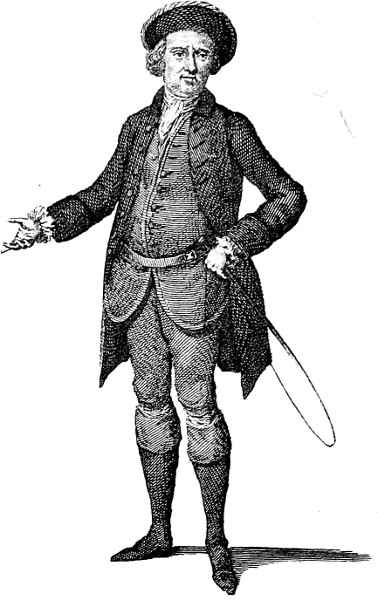
THOMAS LOWE.
A wet season, combined, as would appear, with insufficient enterprise, involved the manager in difficulties, and by a Deed of 15 January, 1768, he assigned to his creditors all the receipts and profits arising from the Gardens. He retired in 1769, and was glad to accept an engagement at Finch’s Grotto, though at one period he had been making, it is said, £1,000 a year. He died 2 March, 1783. Dibdin says that Lowe’s voice was more mellow and even than that of Beard, but that “Lowe lost himself beyond the namby-pamby of Vauxhall”; while “Beard was at home everywhere.”
§4. Later History of the Gardens. 1768–1778.
During 1768,[106] the Gardens were carried on by Lowe’s creditors. The receipts for the season from season-tickets (£1 11s. 6d. each) and money at the doors and bars, were £2,085 1s. 7½d., but the result was a deficit of £263 10s. 3d., though the salaries do not appear to have been excessive. Miss Davis for six nights got three guineas; Mr. Phillips three guineas; Master Brown four guineas; Werner, harpist for six nights, two guineas. The Band cost £27 13s. a week.
Dr. Samuel Arnold, the musician, became proprietor of the Gardens in 1769; and though he eventually retired (in 1773?) a loser, the Gardens probably offered more attractions under his management than at any other period. The weather being wet and cold, the opening of the season of 1769 was postponed till after the middle of May. The proprietor sedulously advertised the “very effectual drains” that had been made in the Gardens, “so that they become very dry and pleasant in a short time after heavy rains.” A few light showers, moreover, would not hinder the performances, and when dancing took place there was a covered platform in the Garden.
The seasons of 1769[107] and 1770 were sufficiently gay. The ordinary admission at this time, and until the final closing of the gardens was one shilling, raised to half-a-crown, three shillings or three shillings and sixpence on the best nights, when the performers had their benefits. On such nights there were fireworks by Rossi and Clanfield; the transparent Temple of Apollo was illuminated, and a ball concluded the entertainment. In 1769 nearly the whole staff took a benefit, in their turn. Mrs. Forbes, Mr. Hook, Mr. Pinto, Piquenit the treasurer, the doorkeepers, and finally the waiters. Thomas Pinto was engaged as leader, James Hook, father of Theodore Hook, as organist (1769–1772), Mrs. Forbes and Miss Brent (afterwards Mrs. Pinto) as singers. Hook’s “Love and Innocence,” a pastoral serenata, was performed for the first time on 10 August (1769), and there were Odes by Christopher Smart, set to music by Arnold, and an “Ode to the Haymakers,” by Dr. Arne.
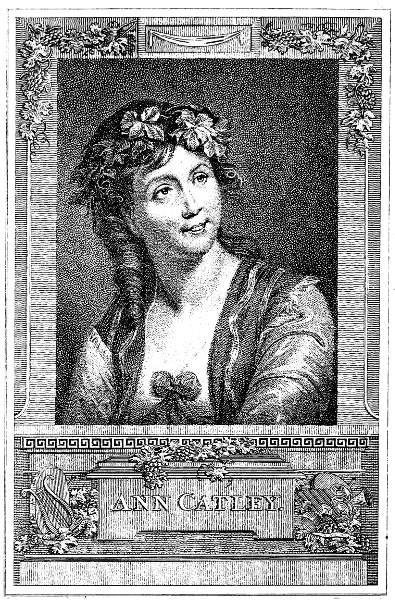
Lawrenson pinxt.
Evans sculp.
Published July 1807, by Matthews & Leigh.
In 1770[108] the leader was F. H. Barthelemon, one of the best known violinists of his time, and distinguished for his firmness of hand, and purity of tone. His burletta, “The Noble Pedlar,” was successfully produced this year. “The Magic Girdle,” and “The Madman,” were also produced; and the “Serva Padrona,” was revived. On 4 September the Fourth Concerto of Corelli, with the additional parts for trumpets, French horns and kettledrums, was performed. In 1771[109] “The Magnet” was performed (first time, 27 June) and Miss Catley, now principal singer at Covent Garden, made her re-appearance.
From 1772 to 1774 the productions of Torré[110] the fireworker made the gardens very popular. Residents in the neighbourhood thought the fireworks a nuisance, and attacked Torré in the newspapers. Mrs. Fountayne produced a rocket-case found in her own garden, and in 1772 Arnold, as proprietor, was summoned at Bow Street. He pleaded, however, a license from the Board of Ordnance, and the fires of Torré continued to burn bright. Torré’s masterpiece, often repeated at the Gardens, was called the Forge of Vulcan. After the fireworks were over, a curtain rose, and discovered Vulcan and the “Cyclops” at the forge behind Mount Etna. The fire blazed, and Venus entered with Cupid, and begged them to make arrows for her son. On their assenting, the mountain appeared in eruption, and a stream of lava poured down its sides.
Numerous singers were engaged for 1772,[111] Charles Bannister, Reinhold, Mrs. Calvert and others, and the musical entertainments were “The Divorce,” by Hook; “The Coquet,” by Storace; “The Magnet,” and “La Serva Padrona.” Bannister gave his clever musical imitations of well-known singers and of “the Italian, French and German manner of singing.” At Hook’s Annual Festival on 28 August (1772) “Il Dilettanti” (by Hook) was given for the first time with choruses by “the young gentlemen from St. Paul’s Choir.” The pyrotechnic entertainments included a representation of Cox’s Museum, and a magnificent temple consisting of “upwards of 10,000 cases of different fires all ... lighted at the same time.” During the fireworks, martial music was performed under Hook’s direction in the Temple of Apollo.[112]
In 1773[113] the Gardens were open for three evenings in the week. Handel’s “Acis and Galatea” was performed (27 May), and Barthelemon’s “The Wedding Day,” in which “Thyrsis, a gay young swain, is beloved by Daphne, an antiquated damsel.” Arne conducted his catches and glees at a concert on 15 September.[114]
In 1774[115] there was music every week-day evening. Several novelties were introduced, but the fortunes of the Gardens appear to have been waning. Dr. Arnold’s “Don Quixote” was performed for the first time on 30 June. The first Fête Champêtre took place in July, but the newspapers attacked the management for charging five shillings for an entertainment which consisted of a few tawdry festoons and extra lamps. Some of the visitors, we are told, “injured the stage and broke its brittle wares.” One cannot help suspecting that Dr. Johnson was at the bottom of this outrage: at any rate during a visit of his to the Gardens at some time between 1772–1774 a similar incident occurred.
Johnson, who had heard of the fame of Torré’s fireworks, went to the Gardens one evening, accompanied by his friend George Steevens. It was showery, and notice was given to the few visitors present, that the fireworks were water-soaked and could not be displayed. “This” (said Johnson) “is a mere excuse to save their crackers for a more profitable company. Let us both hold up our sticks and threaten to break those coloured lamps, ... and we shall soon have our wishes gratified. The core of the fireworks cannot be injured: let the different pieces be touched in their respective centres, and they will do their offices as well as ever.” Some young men standing by indulged in the violence suggested, but failed to ignite the fireworks. “The author of The Rambler,” as Mr. Steevens judiciously observes, “may be considered, on this occasion as the ringleader of a successful riot, though not as a skilful pyrotechnist.” A second Fête Champêtre succeeded better, and the company did not leave till six in the morning.
During this year (1774), and in 1775 and 1776 the Gardens were open on Sunday, after five p.m., for a promenade (without music); and sixpence, returned in tea, coffee, and Ranelagh rolls, was charged for admission. As far back as 1760 the Gardens had been opened on Sunday, and “genteel persons were admitted to walk gratis,” and to drink tea there. But this tea-drinking had been prohibited in 1764. The “Sunday Rambler,” who visited Marybone Gardens about this time, speaks of them with profound contempt as a place of tea-table recreation. Nobody was there, the tablecloths were dirty, and the rubbish for Signor Torré’s fireworks was left lying about. The Gardens, he adds, were “nothing more than two or three gravel roads, and a few shapeless trees.”
In the same year (1774) the managers of the Gardens advertised and opened (6 June) the Marybone Spa. In the winter of 1773 the City Surveyor, while searching for the City Wells in Marybone, had discovered in the Gardens a mineral spring. The public were now admitted to drink this water from six o’clock in the morning. It was suggested that the waters might be useful for nervous and scorbutic disorders, but, in any case, “they strengthen the stomach, and promote a good appetite and a good digestion.”
But the end of Marybone Gardens, as an open-air resort, was rapidly approaching. In 1775 no concerts appear to have been advertised, though there were several displays of fireworks by Caillot in June, July, and August. Already in 1774, one of those profaners of the “cheerful uses” of the playhouse and the public garden—a lecturer and reciter—had appeared in the person of Dr. Kenrick (on Shakespeare). The management had now (June 1775) to rely for the evening’s entertainment on “The Modern Magic Lantern,” consisting of whimsical sketches of character, by R. Baddeley the comedian, and on a “Lecture upon mimicry,” by George Saville Carey. In July, a conjurer was introduced.
In 1776 there was a flicker of the old gaiety. The Forge of Vulcan was revived in May, and there were fireworks by Caillot. A representation of the Boulevards of Paris was prettily contrived, the boxes fronting the ball-room being converted into the shops of Newfangle, the milliner; Trinket, the toyman; and Crotchet, the music-seller.[116]
The Gardens closed on 23 September, 1776, and were never afterwards regularly opened. Henry Angelo (Reminiscences), referring to the Marybone Gardens in their later days, says they were “adapted to the gentry rather than the haut ton.” Whatever this distinction may be worth, it is clear from the comparative paucity of the contemporary notices that the Marybone Gardens, though a well-known resort, at no period attained the vogue of Ranelagh, or the universal popularity of Vauxhall.
About 1778 the site of the Gardens was let to the builders, and the formation of streets (see § 1) begun. J. T. Smith[117] states that the orchestra, before which he had often stood when a boy, was erected on the space occupied by the house in Devonshire Place, numbered (in 1828) “17.” According to Malcolm, a few of the old trees of the Gardens were still standing in 1810 at the north end of Harley Street.
The old Rose of Normandy (with a skittle alley at the back) existed, little altered, till 1848–1850, when a new tavern was built on its site. The tavern (still bearing the old name) was subsequently taken by Sam Collins (Samuel Vagg), the popular Irish vocalist, who converted its concert-room into a regular music hall, The Marylebone, which he carried on till 1861, when he parted with his interest to Mr. W. Botting. The present Marylebone Music Hall (with the public bar attached to it) fronts the High Street, and standing on the site of the old Rose of Normandy, from which the Marybone Gardens were entered, may claim, in a measure, to be evolved from that once famous pleasure resort.[118]
[Sainthill’s Memoirs, 1659 [Gent. Mag. vol. 83; p. 524); advertisements, songs, &c., relating to Marybone Gardens (1763–1775), Brit. Mus. (840, m. 29); Newspaper advertisements, songs, &c., in W. Coll. Newspaper cuttings, &c., relating to London Public Gardens in the Guildhall Library, London; Smith’s Book for a Rainy Day, p. 40, ff.; Thomas Smith’s Marylebone; Blanchard, in Era Almanack, 1869, p. 32, ff.; Grove’s Dict. of Music (1880), art. “Marylebone Gardens,” by W. H. Husk. Angelo’s Reminiscences, ii. p. 3; Timbs’s Romance of London; Walford, iv. 431, ff.; Thomas Harris’s Historical and Descriptive Sketch of Marylebone Gardens, London, 1887.]
VIEWS.
1. A view of Marybone Gardens and orchestra, J. Donnowell del. 1755; published by J. Tinney. Crace, Cat. p. 566, No. 74.
2. Modifications of 1, published by R. Sayer, 1755, and by Bowles and Carver. Crace, Cat. p. 566, Nos. 75, 76. Also 1761, published by J. Ryall [W. Coll.].
3. Views of Rose of Normandy. Crace, Cat. p. 566, Nos. 79–81; p. 567, No. 82.
THE QUEEN’S HEAD AND ARTICHOKE
In the neighbourhood of the Marylebone Gardens were a few much humbler places of entertainment, standing in what in the last century was a rural district; the Queen’s Head and Artichoke, the Jew’s Harp house and, farther west, the Yorkshire Stingo.
The Queen’s Head and Artichoke was in Marylebone Park, nearly opposite Portland Road, and about five hundred yards from the north side of the New Road (Marylebone Road). It was a small and picturesque old inn, standing in a meadow to which a footpath led, and displaying a portrait of Queen Elizabeth as its sign. Tradition attributed the building of the house to a gardener of the Queen, and the curious combination of the sign was believed to have something to do with this. The inn is marked in Rocque’s map of 1745, and it probably then possessed, as it did at the beginning of the present century, a ground for skittles and “bumble-puppy,” and shady bowers, in which cream, tea and cakes were served.
It was pulled down about 1811, and the Colosseum afterwards occupied part of the site. A new tavern was then built near the site of the old inn, and this is probably identical with the public-house called the Queen’s Head and Artichoke, which is now No. 30 Albany Street, east side.
[Gent. Mag. 1819, pt. 2, p. 401; Larwood and Hotten, Hist. of Signboards, pp. 311, 312; Walford, v. p. 255; Smith, Book for a
Rainy Day; Wheatley, London P. and P., s.v. “Jew’s Harp,” and “Albany Street”; Hone’s Year Book, p. 318; Clinch’s Marylebone, pp. 40 and 45.]
VIEWS.
1. A water-colour drawing by Findlay, 1796. Crace, Cat. p. 569, No. 104; cp. an engraving of the inn in Walford, v. p. 258, and a small sketch in Clinch’s Marylebone, p. 45 (dated 1796).
2. An engraving published in Gent. Mag. 1819, pt. 2, p. 401; reproduced in Clinch’s Marylebone, facing p. 40.
THE JEW’S HARP HOUSE AND TEA GARDENS
The Jew’s Harp House was in Marylebone Park, a little to the north-west of the Queen’s Head and Artichoke, from which it was separated by fields. It is marked in Rocque’s map of 1745, and while still a quiet inn, is said to have been a favourite haunt of Arthur Onslow, the famous Speaker (b. 1691, d. 1768), who used to take his pipe and glass in the chimney corner. One day when driving to the House of Commons in his coach, he was recognised by the landlord, and on his next visit to the inn was welcomed by the family as befitted Mr. Speaker. His incognito was thus betrayed, and he returned no more.
By 1772 it had become a recognised place of amusement provided with “bowery tea-gardens,” skittle-grounds,[119] a trap-ball ground and a tennis court. A large upper room, reached by a staircase from the outside, was used as a dining-room for large parties and occasionally for evening dances. Facing the south of the premises was a semi-circular enclosure with boxes for ale and tea drinking, guarded by painted deal-board soldiers.
The place was in existence till about 1812, when it was removed for the formation of Regent’s Park. It stood between the present Broad Walk of the Park, and the north-east corner of the Botanic Gardens.
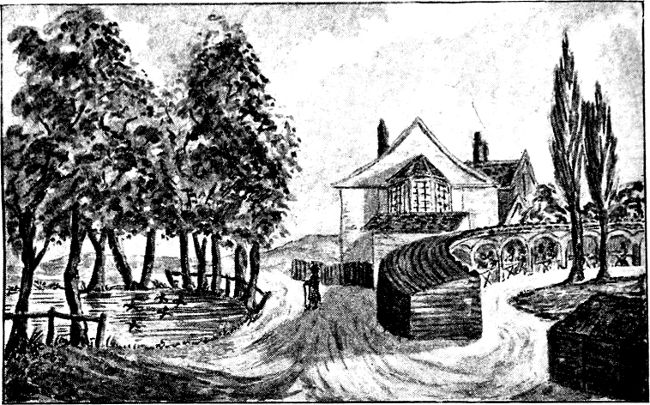
JEW’S HARP HOUSE, 1794.
[J. T. Smith’s Book for a Rainy Day, pp. 17, 18 (ed. 1833); Hone’s Year Book, p. 318; Larwood and Hotten, Signboards, pp. 340, 341, where J. T. Smith’s description of the Jew’s Harp, Marylebone, is wrongly referred to the Jew’s Harp, Islington; Timbs’s Club Life (1866), ii. p. 236; Chambers’s Book of Days, ii. p. 74; Wheatley’s London, s.v. “Jew’s Harp”; Walford, v. p. 255; Clinch’s Marylebone and St. Pancras, p. 48; Picture of London, 1802, p. 370.]
VIEWS.
The Jew’s Harp public-house in Marylebone Park. A water-colour drawing by Bigot, 1794. Crace, Cat. p. 569, No. 106; cp. a sketch in Clinch’s Marylebone, p. 48.
THE YORKSHIRE STINGO
The Yorkshire Stingo, a public-house on the south side of the Marylebone Road, nearly opposite Chapel Street and the entrance to Lisson Grove, is the modern representative of a rural inn of the same name that was in existence at least as early as 1733.
From 1770 (or earlier) extensive tea gardens and a bowling green were attached to the place.[120]
During the first forty years of the present century the gardens were much frequented by the middle classes, especially on Sundays, when admittance was by a six-penny ticket including refreshments. For several years, from about 1790, a fair was held on the first of May at or near the Yorkshire Stingo, and the May-dance with Jack-in-the-Green took place.[121] This fair was suppressed as a nuisance in the early part of the present century.
In 1836 and for a few years following, the Yorkshire Stingo had its Apollo, or Royal Apollo, Saloon, in which concerts, vaudevilles and comic burlettas were given every evening.[122] On gala nights, balloon ascents, fireworks and other entertainments took place in the grounds. The admission was one shilling.
The tea-gardens and bowling green were closed about 1848, and the present County Court and the Marylebone Baths and Wash-Houses,[123] nearly adjoining the present Yorkshire Stingo on the east were built on their site.
[Thomas Smith’s Marylebone, p. 185; Walford, iv. 410; v. 256; Larwood and Hotten, Signboards, p. 384; Picture of London, 1802 and 1829; Wheatley’s London P. and P. “Yorkshire Stingo.”]
VIEWS.
1. “The Yorkshire Stingo in 1770,” a small sketch in Clinch’s Marylebone, p. 46, showing the tavern and the entrance to the tea-gardens.
2. View of the new County Court and the Baths and the Wash-Houses, built upon the ground of the late tea-gardens, &c., of the Yorkshire Stingo Tavern. A woodcut, 1849. Crace, Cat. p. 567, No. 89.
BAYSWATER TEA GARDENS
The Bayswater Tea Gardens, situated in a region once noted for its springs and salubrious air, were originally the Physic Garden of “Sir” John Hill, botanist, playwright, and quack doctor:—
“His farces are physic, his physic a farce is,”
and in this garden he grew the plants for his wonderful Water Dock Essence and Balm of Honey.
Hill died in 1775, and his garden was (some years before 1795) turned into a place of amusement, known as the Bayswater Tea Gardens, and much frequented by the denizens of Oxford Street and neighbourhood.[124] Views of 1796 show the boxes and arbours, and a family party, more plebeian than that in George Morland’s “Tea Garden,” in full enjoyment of their tea. Waiters are bustling about with huge kettles crying “’Ware kettle, scaldings!”
The Bayswater Tea Gardens are mentioned in the Picture of London, 1823–1829, among those frequented by Londoners of the middle classes. From about 1836 they appear to have been called the Flora Tea Gardens, Bayswater.
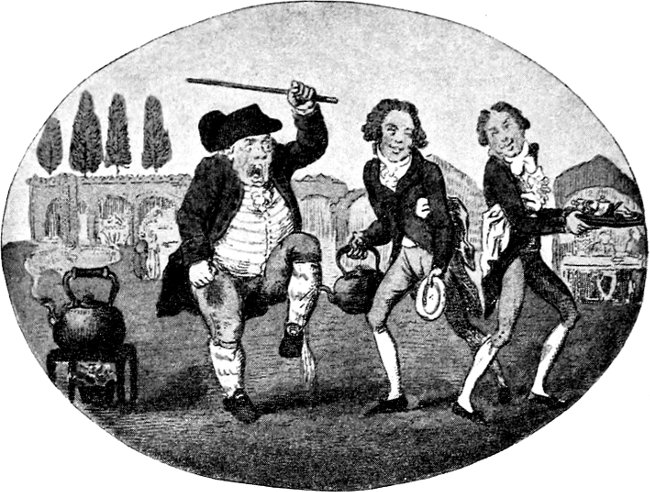
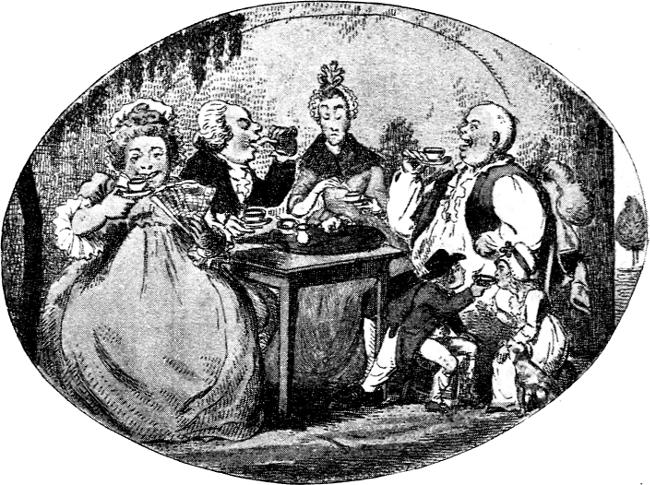
THE BAYSWATER TEA GARDENS, 1796.
For the 27th June, 1836, Mrs. Graham was announced to make her ascent from the gardens at five o’clock, in her silk balloon. In the evening were fireworks, the admission being one shilling. In August 1839, Hampton, the aëronaut, made an ascent about seven in the evening in his Albion balloon from these gardens, which were crowded by “a fashionable and respectable company.” The balloon moved over the Kensington Gardens, and Hampton then descended in his safety parachute, this descent being the feature of the performance. The parachute struck against a tree and fell. Hampton was extracted from the tackle in a shaken condition, but was borne on the shoulders of four men into the Flora Gardens amid loud applause, and a grand display of fireworks concluded the entertainment.
At a later date the place was called the Victoria Tea Gardens, and became well known for running matches and other sporting meetings. The gardens continued open till 1854, but their site, together with that of Hopwood’s Nursery Grounds, was afterwards (from about 1860) covered by the houses of Lancaster Gate.
[Art. “Hill John, M.D.” in Dict. of Nat. Biog.; Lysons’s Environs, iii. p. 331; Era Almanack, 1871; Faulkner, Kensington, p. 420; Wheatley, London P. and P. s.v. “Bayswater” and “Lancaster Gate”; Walford, v. pp. 183, 185, 188; newspaper cuttings, W. Coll.]
VIEWS.
“View of the Tea Gardens at Bayswater,” two oval prints in Woodward’s Eccentric Excursions, plate v. Woodward del., J. C. sculp. London, published 1796 by Allen and West.