III NORTH LONDON GROUP
Reading edition
PANCRAS WELLS
These Wells were situated close to old St. Pancras Church on its south side. In connection with them was a tavern originally called the Horns, and its proprietor, Edward Martin, issued in 1697 a handbill setting forth the virtues of the water, which he declares to have been found “by long experience” a powerful antidote against rising of the vapours, also against the stone and gravel. It likewise cleanses the body and sweetens the blood, and is a general and sovereign help to nature. For the summer season of this year (beginning on Whit-Monday) Martin promised to provide dancing every Tuesday and Thursday. The charge for the “watering” and such other diversions as were obtainable was threepence.
In 1722 a proprietor of the Wells laments that the credit of the place had suffered for many years “by encouraging of scandalous company” (probably some of “the pretty nymphs” mentioned[125] by Thomas Brown) and by making the Long Room a common dancing room. He promises to prevent this in the future, and to exclude undesirable characters from the garden walks.
About 1730 Pancras Wells seem to have regained their reputation; at any rate they were industriously advertised, and the London print-dealers sold views of the gardens and the rooms. The water could be obtained at the pump-room, or a dozen bottles of it might be purchased for six shillings of Mr. Richard Bristow, goldsmith.[126] At this time, and for forty or fifty years later, the surroundings of the Wells were completely rural, and visitors might be seen coming across the fields by the foot-paths leading from Tottenham Court, Gray’s Inn, and Islington. The gardens and premises had now (1730) reached their full extent. Facing the church was the House of Entertainment, and behind this was the Long Room (sixty feet by eighteen) with the Pump Room at its west end. The gardens lay further south, in the rear of these and other buildings. A pleasant stroll might be taken in the New Plantation or in the shaded, but formal, garden known as the Old Walk. Little is heard of the Wells during the next thirty or forty years. But in June 1769 the proprietor, John Armstrong, advertised the water as being in the greatest perfection. The place, however, was probably now chiefly frequented as a “genteel and rural” tea garden, with its hot loaves, syllabubs, and milk from the cow. Dinners were also obtainable, and the powerful refreshments of “neat wines, curious punch, Dorchester, Marlborough, and Ringwood beers.”
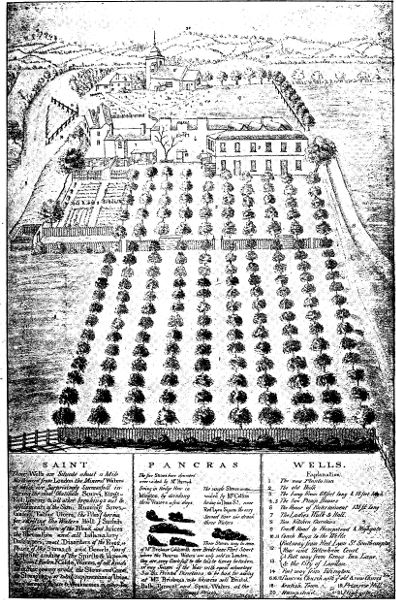
BILL OF PANCRAS WELLS, circ. 1730, SHOWING THE WELLS, AND THE ADAM AND EVE TAVERN NEAR ST. PANCRAS CHURCH.
According to Lysons, the Pancras water continued in esteem till some years before 1795, but when he wrote (1795–1811) the Well appears to have been enclosed in the garden of a private house. Part of the site of the old Wells and walks was formerly occupied by the houses in Church Row, but these have been swept away for the premises of the Midland Railway connected with the St. Pancras Terminus.[127]
[T. Brown’s Letters from the Dead to the Living, part ii. first published 1702, “Moll Quarles to Mother Creswell”; Dodsley’s London, 1761, s.v. “Pancras”; Lysons’s Environs, iii. (1795), p. 381; Supplement (1811), p. 283; Gent. Mag. 1813, pt. 2, p. 556; Beauties of England and Wales, x. part iv. (1816), p. 175; Clinch’s Marylebone and St. Pancras; Palmer’s St. Pancras; Miller’s St. Pancras; Roffe’s St. Pancras (1865), p. 10; Lewis’s Islington, p. 37, note; Walford, v. 339.]
VIEWS.
1. A bird’s-eye view of St. Pancras Wells, showing the garden, house, &c., the old church, &c., with a description of the mineral waters. A tinted drawing, 1751, Crace, Cat. p. 580, No. 57. The original engraving is of circ. 1730; see Palmer’s St. Pancras, p. 246, ff.; Clinch’s Marylebone, p. 156; Walford, v. 336.
2. “The south-west view of Pancras Church and Wells.” Chatelain del., J. Roberts sc., 1750. Crace, Cat. p. 579, No. 45; W. Coll. (Pl. 30 in Chatelain’s Fifty Views); also the south-east view, Chatelain’s Fifty Views, pl. 29, with “Adam and Eve.”
3. Pancras Wells. A north view of the garden, house, &c. Copy of an old drawing, 1775, Crace, Cat. p. 580, No. 58.
4. A view of the Long Room at St. Pancras, and the Trap-Ball Ground. Copy of an old drawing, 1775. Crace, Cat. p. 580, No. 59.
5. Colonel Jack robbing Mrs. Smith going to Kentish Town (near the Wells). W. Jett del., J. Basire sc., 1762. Crace, Cat. p. 580, No. 60.
ADAM AND EVE TEA GARDENS, ST. PANCRAS
The Adam and Eve Tavern, situated near the west end of old Saint Pancras Church, was in existence at least as early as 1730[128], and is mentioned in 1754[129] as a resort of the London “cit.” In 1778 it could boast of a long room adorned with gilt-framed oval pier-glasses;[130] and in 1786 the landlord, Charles Eaton, advertised[131] the attractions of his gardens and pleasure grounds.
About the beginning of the present century it could still be described as an agreeable retreat “with enchanting prospects,” and the gardens were well laid out with arbours, flowers and shrubs. Cows were kept for making syllabubs, and on summer afternoons a regular company met to play bowls and trap-ball in an adjacent field. One proprietor fitted out a mimic squadron of frigates in the garden, and the long room was a good deal used for bean-feasts, and tea-drinking parties.[132]
In 1803, about three and a half acres of the Adam and Eve tea-gardens were taken to form the St. Giles-in-the-Fields Cemetery (adjoining the old St. Pancras Churchyard), though the tavern still lingered on. In later years (circ. 1865–1874) the Adam and Eve was an ordinary public-house. It still retained (1874) a portion of its old grounds, which were used by its frequenters for bowl-playing. This ground, however, was enclosed by a high wall, and was overlooked by the mean houses that formed Eve Place. The building has since been taken down.
[F. Miller’s St. Pancras, pp. 45 and 49; Palmer’s St. Pancras, pp. 244, 245; Roffe’s St. Pancras, p. 3; Picture of London, ed. 1802, p. 370; Wheatley’s London, III., 20, 22, 23; see also notes.]
VIEWS.
The Adam and Eve is shown in the 1730 view of Pancras Wells, and in the views of old St. Pancras Church, e.g., in the “South view of the Church of St. Pancras,” printed for Bowles and Carver (W. Coll.).
THE ASSEMBLY HOUSE, KENTISH TOWN
The Assembly House was in existence in 1725[133] or earlier, and consisted of a large inn, partly built of wood, with a Long Room on the south, entered from outside by a covered staircase. This room for many years continued to be used for dancing by the élite of the neighbourhood.
By about 1776 the village of Kentish Town had become a somewhat populous place, and in the summer-time was much resorted to by Londoners, who took lodgings there, or made brief excursions thither. In 1788 the Assembly House was taken by a Mr. Thomas Wood, who specially advertised his trap-ball and skittle-ground, pleasant summer-house, and extensive garden.
The house was pulled down in 1853, and its site and that of the garden covered by houses. The Assembly House tavern (No. 298 Kentish Town Road) and a police station have been built on the baiting ground and yard that were formerly in front of the old house.
[Miller’s St. Pancras, p. 294, ff.; Roffe’s St. Pancras, pp. 10, 11; Walford, v. p. 320; Palmer’s St. Pancras, p. 62, ff.]
VIEWS.
1. “The Assembly Rooms, Kentish Town, 1750,” Walford, v. p. 313.
2. “The Old Assembly House, Kentish Town,” May 1853; drawn and etched by W. B. Rye, Etchings, London, 1857.
WHITE CONDUIT HOUSE
White Conduit House was originally a small ale-house of the seventeenth century, and, according to tradition, the workmen who built it were carousing there to celebrate its completion on the day of the execution of Charles I.
It derived its name from the water-conduit, faced with white stone, which stood in a field nearly opposite. In 1731 White Conduit House was still a one-storied building, but between that date and about 1745 it was pulled down, or altered,[134] and a Long Room added.
From about 1745 the garden was well laid out, and possessed a circular fish-pond and a number of pleasant arbours. Robert Bartholomew, the proprietor in 1754, added a long walk, and, to prevent his visitors being in the “least incommoded from people in the fields,” constructed a fence some seven feet in height. Hot loaves, tea, coffee and liquors ‘in the greatest perfection’ were the refreshments offered, and he assured those who drank his milk, procured directly from the cow, that his animals “eat no grains.” Cricket was played at this time (1754) in a meadow adjoining the house; bats and balls being provided by the proprietor.[135]
The house contained rooms for tea-drinking, and also the Long Room, from whence “is the most copious prospects and airy situation of any now in vogue,” a description ungrammatical but correct, for White Conduit House at this time, and until about 1775, was picturesquely situated. Standing on rising ground, and environed by pleasant country lanes and pastures, it commanded towards the north fine views of Hampstead and Highgate.
In 1774 the gardens at the back of the house were described as being laid out with several pleasing walks, prettily disposed, with the pond in the centre, and an avenue of trees. For the accommodation of the tea-drinkers, there were “genteel boxes” let into the hedges, and decorated with Flemish paintings. A large painting was placed at the far end of the avenue, and seemed to increase its length.
Under Robert Bartholomew (who was probably proprietor until his death in 1766) White Conduit had become a popular tea-garden, and till about the end of the eighteenth century, its visitors, though never in the least people of fashion, were on the whole of a respectable class. The favourite day was Sunday in the spring and summer-time, when large numbers of holiday-folk crowded the house and gardens. The ‘City prig,’ in white satin waistcoat and scratch wig; the graver man of business, clad in brown, his wife and family, were persons of consequence here; while their dependants also spent their holiday at the same place:—
Wish’d Sunday’s come, mirth brightens ev’ry face, And paints the rose upon the housemaid’s cheek, Harriot, or Mol, more ruddy. Now the heart Of ’prentice, resident in ample street, Or alley, kennel-wash’d, Cheapside, Cornhill, Or Cranbourne, thee for calcuments renown’d, With joy distends. His meal meridian o’er With switch in hand, he to White Conduit House Hies merry-hearted. Human beings here In couples multitudinous assemble, Forming the drollest group that ever trod Fair Islingtonian plains. Male after male, Dog after dog succeeding, husbands, wives, Fathers and mothers, brothers, sisters, friends, And pretty little boys and girls. Around, Across, along the gardens’ shrubby maze They walk, they sit, they stand. What crowds press on, Eager to mount the stairs, eager to catch First vacant bench, or chair in long room plac’d. Here prig with prig holds conference polite, And indiscriminate the gaudy beau And sloven mix. Here he who all the week Took bearded mortals by the nose, or sat Weaving dead hairs, and whistling wretched strain, And eke the sturdy youth, whose trade it is Stout oxen to contund, with gold-bound hat And silken stocking strut. The red-arm’d belle Here shows her tasty gown, proud to be thought The butterfly of fashion.[136]
Curtseys, bows and compliments were the order of the day. A White Conduit method of effecting an introduction was for the gallant ’prentice to tread on the lady’s train, to apologise profusely, and finally to suggest an adjournment for tea in one of the arbours. By five o’clock on a fine Sunday afternoon a seat was hardly procurable; for the tea-drinking was then in full vigour, and the famous White Conduit loaves[137] in great request.
Among its frequenters White Conduit House could number Oliver Goldsmith, who was wont (circ. 1768) to call there at tea-time on his “shoemaker’s holidays.”[138] (cp. Highbury Barn, infra). On one occasion, meeting in the gardens the wife and daughters of a tradesman to whom he was under some obligation, he treated the ladies handsomely to refreshments; only to find when the reckoning came, that his purse was empty.[139] Abraham Newland, the famous cashier of the Bank of England, was also a visitor at White Conduit, and, at a later time George Cruikshank[140] made many of his character sketches there. The visitors came to dread his sketchbook, and children who made faces were set on their good behaviour by the threat that Mr. Cruikshank would put them in his book.
In 1794, or earlier, the owner of White Conduit was Mr. Christopher Bartholomew,[141] a man of considerable means, who did much to improve the grounds. At one time he owned the freeholds of both the Angel Inn, Islington, and White Conduit House, and was said to be worth £50,000. Having won a lottery prize, he gave a public breakfast in the Conduit gardens “to commemorate the smiles of fortune,” as the invitation tickets expressed it. Unfortunately his taste for gambling in the Lottery increased, and soon his entire fortune was squandered, and he ultimately died in poverty at a mean lodging in March, 1809, at the age of sixty-eight.
The surroundings of White Conduit House were still agreeable, and in 1803 we find references to the fine prospect, and the mild refreshing breezes from the abundant hay crops for which the district was noted. By about 1833, however, brickfields and rows of houses had destroyed its rural aspect.
Until about the beginning of the present century, White Conduit House appears to have had no entertainments apart from its tea-gardens, and from the organ performances[142] in the house. But under the proprietorship of Sharpe and Warren (from about 1811, or earlier, till 1828) several changes took place. The pond was filled in and planted over, and a new tea and dancing saloon, dignified by the name of the Apollo Room, and subsequently converted into a billiard-room, was erected in the north-west angle of the gardens. The tea-boxes were enlarged, and the old paintings removed or defaced. A pretty miniature steeple, set up in the last century, and a maze were still to be seen in the garden. From about 1825 White Conduit House possessed a band-stand, and a small stage erected at the north-east end of the grounds, which were further embellished with fountains and statuary.
Bowls and dutch-pins were played, and archery (in 1827) was a popular amusement. Balloon-ascents were also a feature; the most important being those made by Graham (1823–1825); Mrs. Graham (1826); Charles Green (1828); and John Hampton in 1842, and on 19 August 1844 when Hampton was accompanied by “Mr. Wells” (Henry Coxwell). In 1824 (September) at a Benefit and Gala Fête thirty kinds of fireworks were displayed: fiery pigeons flew across the gardens, and two immense snakes went in pursuit of one another.
In 1825 the place was advertised as “the New Vauxhall: White Conduit Gardens,” and evening concerts, variety entertainments and firework displays were given in the grounds. On 21 June of this year, in commemoration of the Battle of Waterloo, a grand Gala and Rural Fête took place in the evening, with a concert and fireworks. There was music in the Quadrille Room and the Country Dance Room; and for dancing in the Grand Walk, the Pandean band The gardens were illuminated by variegated lamps; “vigilant officers” were in attendance, and no person was admitted “in dishabille.” The admission was two shillings.
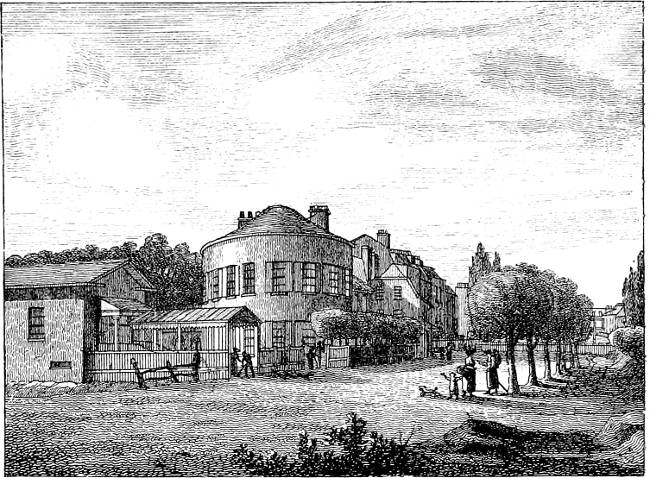
WHITE CONDUIT HOUSE.
Chabert,[143] the fire-eater, was here in 1826 (June). After swallowing arsenic, oxalic acid, boiling oil and molten lead, without, it is said, feeling any inconvenience, he entered a large heated oven, supported by four pillars, and there cooked a leg of lamb and a rump steak, which he proceeded to divide among the spectators. The admission was half a crown and eighteenpence. In July of this year, Mrs. Bland here made her last public appearance. This singer,[144] well-known for the sweet quality of her mezzo-soprano voice and unaffected rendering of English ballads, was long attached to Drury Lane Theatre, and for several years appeared at Vauxhall. About 1824 her mind became affected, and on her recovery she was glad to accept an engagement at an inferior place of entertainment.
In October 1826 the magistrates in granting the license stipulated that the music should cease at 11.30 P.M., and that the gardens should close at 11.45. Masquerades and fireworks were prohibited. These restrictions, however, appear to have been subsequently withdrawn or disregarded.
About this period (1826) part of the south side of the gardens was cut off by the formation of Warren Street; and a few years later (before 1833) a gasometer and a tall chimney disfigured the north-east corner of the grounds.
The accommodation of White Conduit House having now become insufficient, a new hotel was contemplated. The first stone was laid on 2 February 1829, Messrs. Bowles and Monkhouse being then the proprietors. About the middle of June 1829[145] the new building, referred to in the bills as “New Minor Vauxhall: White Conduit House, Hotel and Tavern,” was opened with a concert and ball. It was a tall, plain structure. Its chief room, a large hall about eighty feet by sixty, was much used for dances, dinners, and political meetings.
From many of the laudatory press notices, from about 1826 onwards, it might appear that White Conduit House was a crowded and even fashionable resort. But this was by no means the case. Surrounding buildings had spoilt the place, and at this period “Vite Cundick Couse,” as its Cockney visitors called it, was comparatively neglected: the chimes of the miniature steeple were silent, and the gardens had lost their rural charm.
Hone[146] severely describes it as a “starveling show of odd company and coloured lamps” possessing a mock orchestra with mock singing, and a dancing room, in which no respectable person would care to be seen. In 1832 (November) the magistrates refused to grant the license, and in 1834 (15 February) the proprietor was fined £5 for the “rowdy” conduct of some of the audience. A satirical visitor in 1838[147] ridicules the vocal attainments of the singers, and the gaudy dresses of the female performers, whose heads were decorated with blue roses and adorned with corkscrew curls. The audiences were now composed of the artisan class, the small shop-keeper, the apprentice and shop lad; with a sprinkling of lawyers’ clerks recognisable by their long hair, worn-out “four and ninepenny gossamers,” short trousers, and blucher boots, and by their conversation, which is described as no less objectionable than their cabbage-leaf cigars.
From 1830 till the close of the place in 1849 the entertainments, beginning about 7.30, were of a very varied character; concerts, juggling, farces and ballets. The admission, occasionally sixpence, was usually one shilling; half of which was sometimes returned in refreshments. Ladies and children generally came in half price. A diorama, and moonlight view of Holyrood were exhibited in 1830; and about the same time Miss Clarke made one of her ascents upon an inclined rope attached to a platform above the highest trees in the garden, reaching this eminence “amidst a blaze of light.” Here, too, in 1831 (August), and also in 1836 and 1837, Blackmore of Vauxhall made some of his “terrific ascents.” A play of T. Dibdin’s entitled the ‘Hog in Armour’ was performed in 1831 (April), and Charles Sloman, the clever impromptu versifier, appeared in August and September 1836.
In 1839 Breach the proprietor, who exerted himself in popularising the house, placed its amusements under the management of John Dunn,[148] styled the English Jim Crow on account of his imitations of T. D. Rice in “Jump Jim Crow.” In 1841 a large painting of Windsor Castle and the park-troops was placed at the end of the centre (then denominated the Chinese) walk; and in 1842 (July and August), a Mr. Bryant being the landlord, Batty’s Circus was engaged.
In 1843 R. Rouse was the proprietor, and in these later years the amusements of White Conduit House gradually deteriorated, until they were terminated on 22 January, 1849, by a Ball given for the benefit of the check-takers. Three days afterwards the demolition of the house was begun, and it was soon levelled for a new line of streets, the present White Conduit public-house being erected on part of the site.
The gardens had extended from Penton Street, in an easterly direction, to White Conduit Street, now called Cloudesley Road. Albert Street now approximately marks their southern boundary; and Denmark Road the northern limit.
[Fillinham’s collection relating to White Conduit House in Brit. Mus.; Pinks’s Clerkenwell; Walford’s Old and New London; Wheatley’s London P. & P.; Lewis’s Islington; Tomlins’s Peramb. of Islington; Cromwell’s Islington; Hone’s Every Day Book, vol. ii. p. 1201, ff.; Mirror, 1833, vol. xxi. p. 426; Nelson’s Islington; Brayley’s Londiniana; Era Almanack, 1871; newspaper cuttings in W. Coll.]
VIEWS.
The Crace, Fillinham, and other collections contain numerous views, from which the following may be selected:—
1. South view of White Conduit House in Lempriere’s Set of Views, 1731; reproduced in Lewis’s Islington and Pinks’s Clerkenwell.
2. White Conduit House, 1749. Engraving in Knight’s Old England, vol. ii. fig. 2,402.
3. White Conduit House near Islington (circa 1771). A print, Crace, Cat. No. 200.
4. White Conduit House in the last century (circa 1780). A woodcut, Crace, Cat. No. 201.
5. The Old White Conduit Tea Gardens, Islington. Coloured view, 1822 (W. Coll.).
6. Old White Conduit House Tea Gardens. Sepia drawing, signed C. H. M. Fillinham Coll. p. 46.
7. White Conduit House Tavern and Tea Gardens, 1828. Engraved heading of a White Conduit bill. Fillinham Coll.
8. General View of the Gardens, White Conduit House. Fillinham Coll. p. 46.
9. White Conduit House. Engraving in Cromwell’s Clerkenwell, p. 216.
10. White Conduit Gardens from Islington Terrace. Sepia drawing, signed C. H. M. 1829. Fillinham Coll. p. 46.
11. Old White Conduit House. P. H. D. 1831, engraved in Rogers’s Views of Pleasure Gardens of London, p. 53 (showing balloon and old conduit).
12. The White Conduit Gardens, north view. Sepia drawing by C. H. Matthews, 1832. Crace, Cat. No. 204.
13. View in Gardens showing stage, &c. Water-colour drawing, signed I. F., June 2, 1832. Fillinham Coll. p. 48.
14. A view in the Gardens of White Conduit House with the rope-dancing and fireworks. Sepia drawing, 1848. Crace, Cat. No. 207; cp. Ashton’s The Fleet.
15. White Conduit House, Hotel and Tavern. North-west view of front. A water-colour drawing by Matthews, 1849. Crace, Cat. No. 208.
16. Bird’s-eye view of the gardens of White Conduit House, taken from the balcony. A coloured drawing by Mr. Crace, 1849. Crace, Cat. No. 209.
DOBNEY’S BOWLING GREEN, OR PROSPECT HOUSE
Dobney’s Bowling Green, or, as it was originally called, Prospect House, stood on a portion of the site of Winchester Place (now part of Pentonville Road) near to the south-east corner of Penton Street, and opposite the New River Reservoir. It was in existence as early as the seventeenth century, a Mr. Ireland being rated in 1669[149] for “the Prospect.”
Prospect House, standing on Islington Hill, derived its name from the fine views that it commanded, and in the seventeenth and eighteenth centuries was a vantage-ground from which artists often sketched St. Paul’s and the Metropolis. It possessed good bowling greens probably as early as 1633, and in the spring of 1718 these were advertised as open for the accommodation of all gentlemen bowlers.
Later on, the place was called Dobney’s (or D’Aubigney’s) Bowling Green House, from the name of its proprietor, whose widow, Mrs. Ann Dobney, also kept the place for many years.[150] She was succeeded by a Mr. Johnson, who called the place Johnson’s Prospect and Bowling Green House. He converted the bowling green, which was near the corner of Penton Street, into an al fresco amphitheatre, and in 1767 engaged the equestrian Price[151] who drew large audiences by his performances, which lasted during the spring and summer season, beginning at six o’clock. Price is said to have made, by his exhibitions at Dobney’s and elsewhere, a fortune of £14,000.
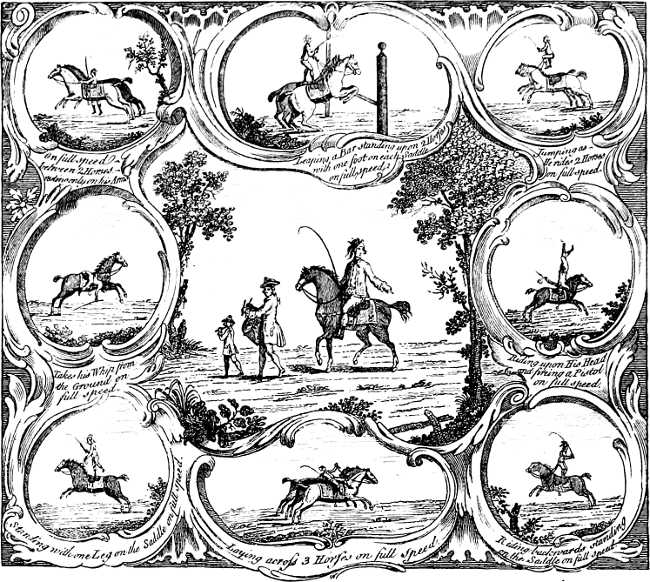
“A REPRESENTATION OF THE SURPRISING PERFORMANCES OF MR. PRICE” AT DOBNEY’S. Circ. 1767.
In 1769 Philip Jonas performed there feats of manual dexterity, and the exhibition of the skeleton of a whale, three score feet long, was reckoned an attraction. In 1770, the house was occupied as a boarding-school by the Rev. John Davis, but the place was soon again re-opened as the Jubilee Gardens, in allusion to the Stratford Jubilee of Shakespeare.
In 1772, Daniel Wildman, an expert in bee-keeping, gave on summer evenings a curious performance called “Bees on horse-back,” described as follows:—
“Daniel Wildman rides standing upright, one foot on the saddle, and the other on the horse’s neck, with a curious mask of bees on his face. He also rides standing upright on the saddle with the bridle in his mouth, and by firing a pistol makes one part of the bees march over a table, and the other part swarm in the air, and return to their places again.” This performance, together with other entertainments, began at a quarter before seven, and the admission was one shilling, or two shillings to the boxes and gallery.
In 1774, the gardens were still open, but in a much neglected condition, as the walks were not kept in order nor the hedges properly cut. There were, however, at this time several good apartments in the house and two tea-rooms on the north side of the bowling green, built one above the other, and Dobney’s (as it was still popularly called) was a favourite Sunday resort of the London apprentice:—
On Sabbath day who has not seen In colours of the rainbow dizened, The ’prentice beaux and belles, I ween, Fatigued with heat, with dust half-poisoned, To Dobney’s strolling, or Pantheon, Their tea to sip or else regale, As on their way they shall agree on, With syllabubs or bottled ale.[152]
In 1780, we hear of lectures and debates taking place in the house; but in 1781 “the lease and trade of the Shakespeare Tavern and Jubilee Gardens, formerly called Dobney’s Bowling Green,” were offered for sale by auction. At that time, according to the auctioneer’s advertisement, Dobney’s consisted of a dwelling house, a building containing a bake-house, kitchens, &c., with an adjoining erection comprising two spacious rooms, capable of dining near two hundred people each, a trap-ball ground, bowling green and “extensive gardens properly laid out.”
The place, however, ceasing to be frequented, the ground was, about 1790, partly built over with the houses forming Winchester Place. The gardens, or a part of them, remained until 1810, when they disappeared.[153] Dobney’s Court, an alley on the east side of Penton Street, now occupies a small part of the original site.
[Pinks’s Clerkenwell; Nelson’s Islington; Lewis’s Islington; Sunday Ramble; Tomlins’s Perambulation of Islington, pp. 160, 187; Memoirs of De Castro, p. 29.]
VIEWS.
1. A drawing of Prospect House taken about 1780 was at one time in the possession of Mr. Upcott (Notes and Queries, 1st series, ix. 1854, p. 572).
2. “A representation of the surprising performances of Mr. Price,” engraved for the Universal Museum and Comp. Mag. (circ. 1767), W. Coll.
BELVIDERE TEA GARDENS, PENTONVILLE ROAD
The Belvidere tavern and tea gardens in the Pentonville Road, at the south-west corner of Penton Street, occupied the site of Busby’s Folly, itself a house of entertainment with a bowling green attached to it. Busby’s Folly, which was in existence at least as early as 1664,[154] afterwards (between 1731 and 1745) acquired the name of Penny’s Folly.
In August 1769, Penny’s Folly was taken by a German named Zucker, who exhibited there his Learned Little Horse, while Mrs. Zucker played favourite airs on the musical glasses, and “the so-much admired and unparalleled Mr. Jonas” displayed his “matchless and curious deceptions.” The entertainment began at 6.30, and took place in a large room commanding a “delightful prospect” from its fourteen windows. The admission was one shilling, and it was announced that “The Little Horse will be looking out of the windows up two pair of stairs every evening before the performances begin.”
The performances of Zucker had already been for some years in repute with holiday folk, and in 1762 he had received honourable mention in a prologue spoken at the Haymarket Theatre:—
How dull, methinks, look Robin, Sue and Nancy At Greenwich Park did nothing strike your fancy; Had you no cheese-cakes, cyder, shrimps or bun, Saw no wild beastis, or no jack-ass run? Blest Conduit House! what raptures does it yield; And hail, thou wonder of a Chelsea field! Yet Zucker still amazingly surpasses Your Conduit-house, your pigmy, and your asses.[155]
Penny’s Folly was afterwards pulled down and the Belvidere tavern came into existence about 1780.
In the early part of the present century, and probably twenty years earlier, the Belvidere possessed a bowling green, and a large garden, with many trees and plenty of accommodation for tea-drinking parties. The chief attraction was a large racket-court. The garden and racket-court continued to be frequented till 1860 or later. In 1876, the Belvidere was rebuilt and is now used as a public-house, the garden, or part of it, being occupied by the pianoforte works of Messrs. Yates.
[Pinks’s Clerkenwell, 531–533; Tomlins’s Perambulation of Islington, 40, 41, 163, 164; Picture of London, 1802, p. 370.]
VIEWS.
1. South front of Busby’s Folly, one of C. Lempriere’s Set of Views, 1731 (woodcut in Pinks, p. 530); cp. woodcut in Tomlins’s Perambulation of Islington, p. 164, and a water-colour drawing by C. H. Matthews in Crace, Cat. p. 606, No. 212.
2. The Belvidere Gardens, early in the present century, woodcut in Cromwell’s Clerkenwell (1828), p. 414, J. and H. S. Storer del. et sculp. (copied in Pinks, p. 531).
3. The “Belvidere Gardens at the present time” (circ. 1860?), Pinks, p. 532.
THE CASTLE INN AND TEA-GARDENS, COLEBROOKE ROW, ISLINGTON
The Castle Inn is mentioned in 1754 as a Sunday resort of the London “cit.,” who frequented it in the evening to smoke his pipe and obtain the light refreshment of cyder and heart-cakes. The house must have stood nearly alone till 1768, when the oldest portion of the street called Colebrooke Row was built. The Castle Inn, with its tea gardens, was then the last house but one at the northern end of the Row.[156] A pleasant nursery garden occupied, till about 1822, six acres of the ground in the rear of Colebrooke Row.
The inn and tea gardens were still in existence about 1772, but the house had ceased to be a place of public entertainment at the time when Nelson published his Islington, i.e. 1811.
[The Connoisseur, No. 26 (1754); Nelson’s Islington (1811), p. 385; Lewis’s Islington (1842), pp. 351, 352.]
THREE HATS, ISLINGTON
The Three Hats was a picturesque old inn standing in the Upper Street, Islington, a few doors from the corner of the Liverpool Road and on the site of the present Islington branch of the London and County Bank.
It first became known as a place of amusement in 1758, when, in the field adjoining, Thomas Johnson, “the Irish Tartar,” one of the earliest equestrian performers in England, made his début. He galloped round the field standing first on one horse, then on a pair, then on three horses. At one time he rode the single horse standing on his head, but as this posture “gave pain to the spectators” he discontinued it. His feats seem to have been of a simpler kind than those afterwards performed by the rider Price at Dobney’s in 1767. One of Johnson’s performances at the Three Hats (17 July, 1766) took place in the presence of the Duke of York and of about five hundred spectators.
In the spring of 1767 Johnson was succeeded by the equestrian Sampson, who announced his appearance at five o’clock at a commodious place built in a field adjoining the Three Hats. “A proper band of music” was engaged for this entertainment. In the summer of this year Sampson introduced his wife into his entertainment, and inserted the following advertisement in the Public Advertiser for 23 July: “Horsemanship at Dingley’s, Three Hats, Islington. Mr. Sampson begs to inform the public that besides the usual feats which he exhibits, Mrs. Sampson, to diversify the entertainment and prove that the fair sex are by no means inferior to the male, either in courage or agility, will this and every evening during the summer season perform various exercises in the same art, in which she hopes to acquit herself to the universal approbation of those ladies and gentlemen whose curiosity may induce them to honour her attempt with their company.”
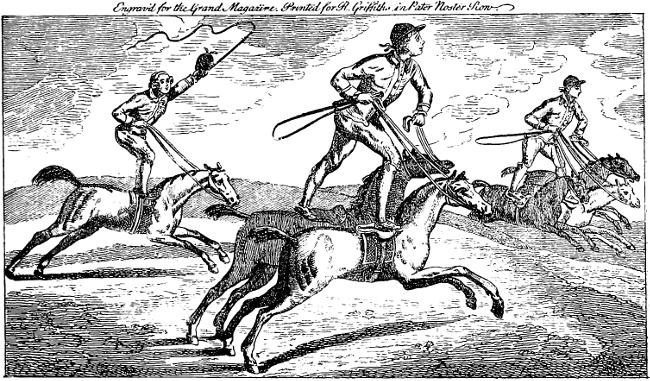
JOHNSON AT THE THREE HATS, 1758.
The Three Hats had other attractions besides the horsemanship and at least as early as 1768 had become a favourite Sunday resort. In Bickerstaffe’s comedy the “Hypocrite,” published in 1768, Mawworm says: “Till I went after him (Dr. Cantwell) I was little better than the devil. My conscience was tanned with sin like a piece of neat’s leather, and had no more feeling than the sole of my shoe, always aroving after fantastical delights. I used to go every Sunday evening to the Three Hats at Islington—mayhap your ladyship may know it. I was a great lover of skittles, but now I can’t bear them.”
Sampson’s performances still continued in 1770 and additional diversions were occasionally provided: “At the Three Hats, Islington, this day, the 1st of May (1770) will be played a grand match at that ancient and much renowned manly diversion called Double Stick by a sett of chosen young men at that exercise from different parts of the West country, for two guineas given free; those who brake the most heads to bear away the prize.” “To begin precisely at four.” “Before the above mentioned diversion begins, Mr. Sampson and his young German will display alternately on one, two, and three horses, various surprising and curious feats of famous horsemanship in like manner as at the Grand Jubilee at Stratford-upon-Avon. Admittance one shilling each person.”
In 1771 Sampson was under a cloud—he is said to have been ensnared “into gay company” by Price, his rival at Dobney’s—and sold his horses to Coningham, who performed in the evening at the Three Hats (1771 and 1772), and was announced as follows:—“First: He rides a gallop, standing upright on a single horse, three times round the room without holding. Second: He rides a single horse on full speed, dismounts, fires a pistol, and performs the boasted feat of Hughes’s leaping over him backwards and forwards for forty times without ceasing; also flies over three horses on full speed, leaps over one and two horses on full speed as they leap the bar, plays a march on the flute, without holding, upon two horses, standing upright.” It was also announced that “Mr. and Mrs. Sampson, Mr. Brown, &c., will perform to make these nights the completest in the kingdom. The Tailor and Sailor upon the drollest horses in the kingdom. The doors to be opened exactly at five, and to mount at a quarter to five. Admittance in the front seats two shillings, and the back seats one. Mr. Coningham will engage to fly through a hogshead of fire upon two horses’ backs, without touching them, and, for a single person, will perform activity with any man in the world.”
In 1772 Sampson resumed his performances at the Riding School of the Three Hats and gave lessons there. On Whit Monday some other curious attractions were advertised in the Gazetteer (June 6, 1772): “A young gentleman will undertake to walk and pick up one hundred eggs (each egg to be the distance of one yard apart) and put them in a basket within an hour and fifteen minutes; if any egg breaks he puts down one in its place, for a wager of ten guineas. And on Whitsun Tuesday will be run for an holland shift by a number of smart girls, six times round the School.”
About this period the riding seems to have come to an end,[157] though the Three Hats continued for many years to be a favourite tea-garden until the ground at the back of the house was built over. The Morning Chronicle gives us a glimpse of the place in 1779 (21 July): “Yesterday morning upwards of twenty fellows who were dancing with their ladies at the Three Hats, Islington, were taken by the constables as fit persons to serve his Majesty, and lodged in Clerkenwell Bridewell, in order to be carried before the commissioners.”
On 6 January, 1839, a fire (which destroyed two neighbouring houses) so damaged the roof of the Three Hats, then a mere public-house, that in April of the same year the whole place was demolished, and the present branch office of the London and County Bank was erected on the site.
[Lewis’s Islington; Pinks’s Clerkenwell.]
VIEWS.
1. Engraving of Three Hats and other old houses adjacent, in Gent. Mag. 1823, pt. 2, frontispiece; cp. p. 113.
2. A sepia drawing by C. H. Matthews, 1839. Crace, Cat. p. 596, No. 110.
3. Engraving in the Grand Magazine, showing Johnson’s equestrian feats, 1758, W. Coll.; cp. Crace, Cat. p. 596, No. 108.
BARLEY MOW TEA HOUSE AND GARDENS, ISLINGTON
The Barley Mow Tea House and Gardens were on the west side of Frog Lane, now Popham Road, Islington. They are first mentioned in 1786.[158] About 1799, the Barley Mow was kept as a public-house by a man named Tate, and George Morland lived there for several months, indulging in drinking and low company, but finding time to paint some good pictures which he generally sold for small sums. He often borrowed for sketching purposes old harness and saddles from a farm-house opposite, and was wont “to send after any rustic-looking character” to obtain a sitting. The Barley Mow has been used as a public-house to the present time, and is now No. 31, Popham Road, but it has been modernised, or rebuilt, and the garden has disappeared.
[Nelson’s Islington, 128, 197; Cromwell’s Islington, p. 194, ff.; Lewis’s Islington, 154, ff.; Walford, ii. 262; Morning Herald, 22 April, 1786.]
CANONBURY HOUSE TEA GARDENS
The Canonbury House tea-gardens, a quiet and unpretending resort of Londoners, derive a certain antiquarian interest from their situation within the ancient park attached to Canonbury House, the mansion built by the Priors of St. Bartholomew’s, Smithfield, for their summer residence. Houses in Canonbury Place, first erected about 1770, occupy the site of the old mansion, though a substantial relic still exists in Canonbury Tower, built in the sixteenth century, and during the last century let out for summer lodgings to various tenants, the best known of whom was Oliver Goldsmith.
About 1754 a small ale-house was built by a Mr. Benjamin Collins on the eastern side of the mansion. This afterwards came into the possession of James Lane, who made additions to the premises, utilising, it would seem, a range of tiled outhouses on the east of the house which were supposed to have originally been its stables.
The place had a good reputation and became much frequented as a tea-garden under the name of Canonbury House. Lane died in 1783, and about 1785 the tavern was taken by a Mr. Sutton, who died soon after, leaving the premises to his wife.
The “Widow Sutton” enlarged the tavern, which was then known as Canonbury House Tavern (or Canonbury Tavern), laid out a bowling green and improved the tea-gardens. The house was much used for the dinners of Societies.
The gardens, which at this time occupied about four acres, were almost entirely situated within the old park wall of the Priors of St. Bartholomew’s, and the wall on the east divided them from the open fields. The old fish-pond of the Priors was also connected.
The Sunday Ramble describes Canonbury House in 1797 as “a place of decent retreat for tea and sober treatment.” In 1810 an Assembly was established at the tavern, and about 1811 the grounds consisted of a shrubbery and bowling green with Dutch-pin and trap-ball grounds and butts for ball-firing used by the Volunteers. The old tiled outhouses were used as a bake-house for the pastry and rolls till 1840, when they were pulled down.
About 1823 the builders had invaded the rural neighbourhood of Canonbury, but the tea-gardens continued to be frequented as a pleasant resort till 1843, or later.
At sometime between 1843 and 1866 the Canonbury Tavern was rebuilt. It now stands on the north side of Canonbury Place, a little to the east of Canonbury Tower and on the opposite side of the road.
A garden, though not of the old dimensions, is still attached to the tavern and open to the public during the summer.
[Nichols’s Canonbury, 1788, 33; The Ambulator, 1st ed. 1774, s.v. “Canonbury House”; Kearsley’s Strangers’ Guide (1793?), s.v. “Canonbury or Cambray House”; A Modern Sabbath, 1797, chap. vii.; Nelson’s Islington, 252; Brayley’s Londiniana, iii. 269, ff.; Picture of London, eds. 1802 and 1829; Lewis’s Islington, p. 310; Timbs’s Club Life, 1866, ii. 228.]
VIEWS.
Exterior of Canonbury Tavern (north view), a small engraving published in 1819 by R. Ackermann (W. Coll.); Crace, Cat. p. 602, No. 174.
COPENHAGEN HOUSE
Copenhagen House stood alone on an eminence in the fields, on the right-hand side of Maiden Lane, the old way leading from Battle Bridge to Highgate, being about midway between those places.[159]
It is known to have been a house of public entertainment in 1725[160] and was probably one much earlier, seeing that the oldest part of the building was in the style of the seventeenth century. “Coopen-hagen” is marked in a map of 1695.[161]
There are various accounts of the origin of the the name. A Danish Prince or a Danish Ambassador is said to have resided in the house during the Great Plague. Or, again, an enterprising Dane is said to have built the inn for the accommodation of his countrymen who had come to London in the train of the King of Denmark on his visit to James I. in 1606.[162] In the early part of the eighteenth century Copenhagen House is not often mentioned, though the curious Highbury Society[163] used to assemble here previous to the year 1740, when it began to meet at Highbury.
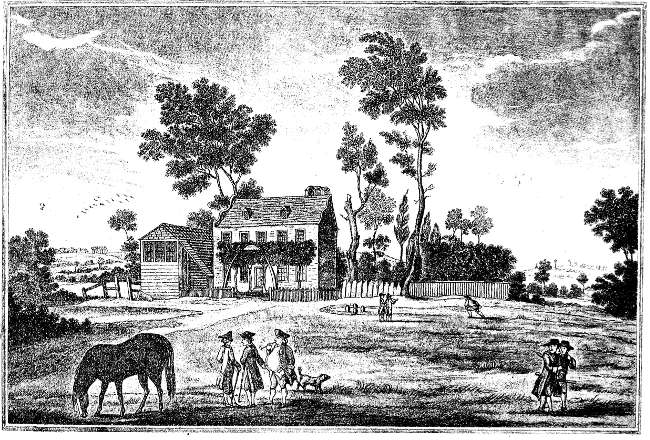
South East View of Copenhagen House.
London: Printed for R. Sayer and J. Bennett, Map and Printsellers, No. 53 Fleet Street, as the Act directs, 20th March, 1783
In 1780 a brutal robbery[164] of which the landlady, Mrs. Harrington, was the victim, attracted attention to the place. A subscription was opened for her benefit, and visitors came in such numbers that Mr. Leader, the owner of the House, pulled down the old wooden building attached to its western end, and built in its stead a long room for tea-drinking parties, with a large parlour below for drinking and smoking. There were gardens attached, with the usual accommodation for skittles and Dutch-pin playing.
Under Mrs. Harrington’s management, Copenhagen House first became celebrated for its Fives Courts. A young Shropshire woman (afterwards Mrs. Tomes) who assisted Mrs. Harrington, gave Hone an interesting little account of the introduction of the game:—“I made the first fives ball (she said) that was ever thrown up against Copenhagen House. One Hickman, a butcher at Highgate, a countryman of mine, used the house, and seeing me ‘country,’ we talked about our country sports, and amongst the rest, fives: I told him we’d have a game some day. I laid down the stone in the ground myself, and against he came again, made a ball. I struck the ball the first blow, and he gave it the second, and so we played; and as there was company they liked the sport, and it got talked of. This was the beginning of the fives-play, which has since become so famous at Copenhagen House.”
John Cavanagh (d. 1819), the famous Irish fives player, had many matches at Copenhagen House for wagers and dinners. The wall against which the combatants played was (says Hone) the same that supported the kitchen chimney, and when the wall resounded louder than usual, the cook exclaimed, “Those are the Irishman’s balls,” and the joints trembled on the spit. Hazlitt, in a pleasant memoir of Cavanagh,[165] says that he had no equal in the game or second. He had no affectation in his playing. He was the best up-hill player in the world, and never gave away a game through laziness or conceit. His “service” was tremendous, but a peculiarity of his play was that he never volleyed, though if the ball rose but an inch from the ground he never missed it. “His eye,” adds Hazlitt, “was certain, his hand fatal, his presence of mind complete.”
In 1795 the house was kept by Robert Orchard, notorious for his connexion with the London Corresponding Society, which at that time held tumultuous meetings in the adjoining Copenhagen Fields. Orchard was succeeded by a man named Tooth, who gained custom by encouraging brutal sports. At this time, “on a Sunday morning, the fives ground was filled by bull-dogs and ruffians, who lounged and drank to intoxication: so many as fifty or sixty bull-dogs have been seen tied up to the benches at once, while their masters boozed and made match after match, and went out and fought their dogs before the house, amid the uproar of idlers attracted to the ‘bad eminence’ by its infamy.”
There was also a common field, east of the house, wherein bulls were baited, and this was called the bull-field. At last the magistrates interfered, and in 1816 Tooth lost his license. The next landlord, a Mr. Bath, conducted the house respectably, and refused admittance to the bull-dogs. The bull-field was afterwards used for the harmless purpose of cow-keeping.
From about this period (1816–1830) Copenhagen House was a favourite Sunday tea-garden with the middle-classes[166] who flocked there, especially in the summer-time during the hay harvest in the fields around.[167] Although the builders were making their way up to Copenhagen House from London on the south, it still commanded an extensive view of the metropolis and western suburbs, with the heights of Hampstead and Highgate, “and the rich intervening meadows.” In 1841[168] the tavern and tea-gardens were still in existence, and the space between them and Highgate was still open fields. Attached to the house at that time was a well known cricket ground.[169]
About 1852 the Corporation of London purchased Copenhagen House with its grounds and adjacent fields to the extent of about seventy-five acres, and began to build there the present Metropolitan Cattle Market, between the York and Caledonian Roads, which was opened in 1855. The old tavern (pulled down in 1853[170]) and tea-gardens were thus swept away, and their site is approximately marked by the Great Clock Tower in the market.[171]
[Hone’s Every Day Book, i. 858, ff.; Nelson’s Islington; Lewis’s Islington; Larwood and Hotten, Signboards, 435, 436; Walford, ii. 275, 276, 283; v. 374; Tomlins’s Perambulation of Islington, 204, 205.]
VIEWS.
1. Copenhagen House, Islington, as it appeared in 1737, sepia drawing by Bernard Lens. Crace, Cat. p. 604, No. 191.
2. South-east view of Copenhagen House, printed for R. Sayer and J. Bennett, 20 March, 1783 (W. Coll.); the woodcut in Lewis’s Islington, p. 283, is derived from this.
3. Copenhagen House, Islington. J. Swaine del. 1793; J. Swaine, sculp. 1854. Woodcut (W. Coll.).
4. There are several views of Copenhagen House in the nineteenth century, see e.g. Hone’s Every Day Book, i. 858; Cromwell’s Islington, p. 204; Crace, Cat. p. 605, Nos. 194, 196 (views of 1853).
5. “The Grand Meeting of the Metropolitan Trades’ Unions in the Copenhagen Fields on Monday, April 21, 1834.” Coloured engraving by Geo. Dorrington (W. Coll.). This shows Copenhagen House and an enormous concourse in the fields.
HIGHBURY BARN
Highbury Barn Tavern with its gardens is, like the Canonbury House Tavern and gardens, rooted in a respectable antiquity, for it stood on the site of Highbury Barn[172] which formed part of the farm attached to the old country seat[173] of the Prior of the Knights of St. John of Jerusalem.
Highbury Barn (the tavern) was originally a small cake and ale house which was in existence at least as early as 1740[174]. It was occasionally (about 1768) honoured by a visit from Oliver Goldsmith on one of his Shoemaker’s holidays. Goldsmith and three or four of his friends would leave his Temple chambers in the morning and proceed by the City Road and through the fields to Highbury Barn, where at one o’clock they enjoyed a dinner of two courses and pastry, at the cost of tenpence a head including the waiter’s penny. The company then to be met with at the inn consisted of Templars and literary men, and a citizen or two retired from business. At about six, Goldsmith and his party adjourned to the White Conduit House for tea, and ended the day with supper at the Globe or Grecian.
The trade of the place greatly increased under the management of Mr. Willoughby, who, dying in December 1785, was succeeded by his son. The younger Willoughby (landlord 1785–1818?)[175] laid out the gardens, bowling green and trap-ball ground.[176] A large barn belonging to the neighbouring Highbury Farm (or Grange) was incorporated with the premises and fitted up suitably for a Great Room. Here a monthly assembly subscribed to in the neighbourhood was held in the spring and winter and monster dinner-parties of clubs and societies were accommodated. In 1800 a company of eight hundred persons sat down to dinner, and seventy geese were to be seen roasting on the fire. Three thousand people were accommodated at the Licensed Victuallers’ Dinner in 1841.
About 1793 the garden commanded an extensive prospect, and as late as 1842 Highbury could be described as “a beautifully situated hamlet.”
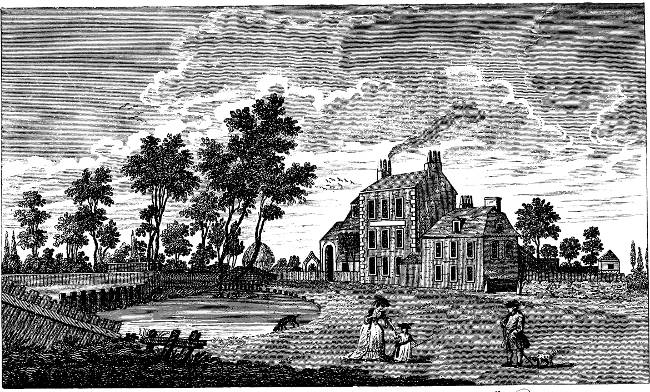
HIGHBURY BARN IN 1792.
In 1818 the property was purchased by the former proprietor of the Grove House, Camberwell, and Highbury Barn was much resorted to as a Sunday tea-garden (circ. 1823–1830). The place then passed (before 1835) into the hands of John Hinton (previously landlord of the Eyre Arms, St. John’s Wood) who with his son Archibald Hinton, ultimately the sole proprietor, gave new life to the place and made Highbury Barn a kind of North London Cremorne. By about 1854 the number of monster dinner-parties and bean-feasts had much fallen off, and on Whit-Monday of that year Hinton opened his establishment for musical entertainments with a performance by the band of the Grenadier Guards.
A license for dancing was granted in October 1856, and in July 1858 a Leviathan dancing platform, with an orchestra at one end, was erected in the grounds. It was open to the sky with the exception of one side, which consisted of a roofed structure of ornamental ironwork. The whole platform occupied four thousand feet. A standard of gas lamps in the centre of the platform and lamps placed round its railing lit up the place in the evening, when the gardens were frequented by large masses of people. In a more secluded part of the gardens was an avenue of trees, flanked by female statues, each holding a globular gas lamp. About 1858 the admission was sixpence, and at this time Highbury Barn was much frequented on Sunday evenings, when little parties might be seen on the lawn before the Barn or in the bowers and alcoves by its side. The gardens occupied five acres.
Archibald Hinton gave up possession in 1860; and in 1861 Edward Giovanelli opened Highbury Barn, after having improved the grounds and erected a spacious hall for a ball and supper room. In 1862 Miss Rebecca Isaacs and Vernon Rigby were the principal singers, and Leotard the gymnast was engaged for the summer season. On 20 May 1865 the Alexandra Theatre was opened in the grounds, but the entertainments in the gardens were also continued. “The splendid Illuminations” were boldly advertised, and Blondin (1868), Natator the man-frog, and the Siamese Twins were engaged (1869). The riotous behaviour, late at night, of many frequenters of the gardens caused annoyance to the neighbours, who regularly opposed the renewal of the license. In October 1870 the dancing license was refused, and next season Mr. E. T. Smith took the place of Giovanelli as manager, but the license being again refused in October 1871, Highbury Barn was finally closed. The flowerbeds became choked with grass and weeds, and nightshade luxuriated around the dismantled orchestra. By the spring of 1883 the place had been covered with buildings, and a large public-house, the Highbury Tavern (No. 26, Highbury Park N.), on part of the old site, alone commemorates this once popular resort.
[Nelson’s Islington; Cromwell’s Islington; Lewis’s Islington; Tomlins’s Perambulation of Islington; Kearsley’s Strangers’ Guide; Walford, ii. 273. ff.; Forster’s Life of Goldsmith, bk. iv. chap. 2; Picture of London, 1802, 1823 and 1829; Ritchie’s Night-side of London (1858); Era Almanack, 1871, pp. 3, 4; M. Williams’s Some London Theatres, 1883, p. 33, ff.; newspaper cuttings and bills, W. Coll.]
VIEWS.
1. Highbury Barn (gabled buildings), an etching from a drawing by B. Green, 1775 (W. Coll.).
2. Highbury Assembly House, near Islington, kept by Mr. Willoughby, 1792, print published in 1792 by Sayer (W. Coll.; also Crace. Cat. p. 603, No. 182).
3. “Highbury Barn, Islington,” engraving published May 1, 1819, for R. Ackermann.
4. Highbury Barn (exterior) (circ. 1835), engraving in Cromwell’s Islington, p. 247, J. and H. S. Storer, del. et. sc.
5. “The Leviathan Platform, Highbury Barn,” woodcut in Illustrated London News, July 1858.
6. Two views of “The Gardens, Highbury Barn Tavern” (circ. 1851), in Tallis’s Illustrated London, ed. Gaspey.
THE DEVIL’S HOUSE, HOLLOWAY.
This place, in spite of its unpromising name, deserves a brief notice as a quiet summer resort of Londoners.
The Devil’s House was a moated timber building which originally formed the manor-house of Tolentone (afterwards Highbury) Manor. It stood on the east of Devil’s Lane, previously (before 1735) called Tallington or Tollington Lane, and now known as the Hornsey Road. It was within two fields of Holloway Turnpike.[177]
There was a tradition that the house was a retreat of Claude Duval’s, and the house and Lane were sometimes known as “Duval’s.” There is, however, no direct evidence to connect the famous highwayman with the house, and Duval’s House may be considered as a popular corruption of Devil’s House. In a survey of Highbury Manor made in 1611, this house already bears the name of “Devil’s House in Devil’s Lane” and is described as being at that date an old building “with a mote, and a little orchard within.” In the Islington Survey of 1735, it appears as “Devol’s House,” an apparent compromise between the fiend and the highwayman.
It is not known to have been a place of entertainment till 1767 when the landlord,[178] who attempted to change the name to the Summer House, offered to London anglers and pedestrians the attraction of “tea and hot loaves, ready at a moment’s notice, and new milk from the cows grazing in the pleasant meadows adjoining.” The house was still encompassed with a wide moat crossed by a bridge, and there was an orchard with a canal. The garden which surrounded the house was well laid out, and the water was stocked with abundance of tench and carp. The place was still occupied and used as an inn in 1811,[179] though about that time the landlord nearly filled up the moat with earth.
The house was in existence in 1849 (or later),[180] being on the east of the Hornsey Road near the junction with the Seven Sisters’ Road.
[Lysons’s Environs (1795), “Islington,” p. 127, note; Nelson’s Islington, 133, 173; Lewis’s Islington, pp. 67, 279, 280; Larwood and Hotten, Signboards, 294, 295, quoting a letter signed H. G., 25 May, 1767, in the Public Advertiser, which describes the place at that period; Walford, ii. 275; Tomlins’s Perambulation of Islington, pp. 31, 32.]
VIEWS.
1. A view of the house, gardens and bridge appears in Walford, v. 378, “Claude Duval’s House in 1825.”
2. Devil’s or Du Val’s House, Holloway, a sepia drawing by C. H. Matthews (1840); Crace, Cat. p. 604, No. 190.
HORNSEY WOOD HOUSE.
Hornsey Wood House was situated on the summit of rising ground on the east of Hornsey and at the entrance to Hornsey Wood. It began to be frequented about the middle of the last century,[181] and in the earlier years of its existence aspired to be “a genteel tea-house,” though unpretending in appearance. On popular holidays, such as Whit-Sunday, its long room might be seen crowded as early as nine or ten in the morning with a motley assemblage of “men, women and children eating rolls and butter and drinking of tea at an extravagant price.”[182]
The pleasures of Hornsey Wood House were of an unsophisticated kind—unlimited tea-drinking, a ramble in the wood, and a delightful view of the surrounding country. An excursion to Little Hornsey to drink tea was a favourite with London citizens’ wives and daughters.[183] Hone remembered the old Hornsey Wood House, as it stood (apparently before 1800), “embowered and seeming a part of the Wood.” It was at that time kept by two sisters, Mrs. Lloyd and Mrs. Collier, and these aged dames were usually to be found before their door on a seat between two venerable oaks, wherein swarms of bees hived themselves.
Soon after their death (before 1800?) the house was pulled down and the proprietor expended £10,000 in improvements and in erecting the roomy brick building known as Hornsey Wood Tavern. The tea-gardens were enlarged and a lake formed, for the benefit of those who wished for a little angling or boating. To effect these improvements, a romantic part of the wood was destroyed, but the remaining portion still continued an attraction. About 1835 the “lower order of citizens” as T. Cromwell (Islington, p. 138) calls them, used to go “palming” to the wood on Palm Sunday. All through the present century Hornsey Wood House (or Tavern) was a favourite Sunday resort of Londoners.
In 1866 at the time of the formation of Finsbury Park, the house was pulled down and its site and that of the gardens and the Wood must be looked for in the Park, which was opened as a public recreation ground in 1869.
[The Idler, No. 15, July 1758; Dodsley’s London, 1761; Low Life (1764), p. 46; Sunday Ramble, 1776 and 1797; Kearsley’s Strangers’ Guide; Lambert’s London, iv. 274; Picture of London, eds. 1802, 1823 and 1829; Hone’s Every Day Book, i. 759, ff.; Lewis’s Islington, pp. 190, 282; J. F. Murray’s World of London, 1845, ii. p. 82, ff.; Walford, v. 430, ff.; Illustrated London News, 14 August, 1869; J. H. Lloyd’s Highgate, 1888.]
VIEWS.
1. An engraving of old Hornsey Wood House &c., in Lewis’s Islington, p. 282.
2. There are many views of the later Hornsey Wood House (or Tavern), e.g. one engraved in Walford, v. 426, and there assigned to the year 1800. This is substantially the same as one (undated) in Hone’s Every Day Book, i. 759. Hone, ib. 761, also gives a woodcut of the Lake. There is an engraving of the house of 1809, published by J. Cundee (W. Coll.), and there are views of it of a later date; e.g. an engraving in Cromwell’s Islington, p. 138.
THE SPRING GARDEN, STOKE NEWINGTON.
This Spring Garden is marked in Warner’s Survey of Islington, 1735, rather to the south of Newington Green. About 1753 the tavern connected with the garden was taken by W. Bristow, who advertised the place as an afternoon tea-garden, appending to his advertisement the note “beans in perfection for any companies.”[184]
It is mentioned in Low Life, 1764 as resorted to on Whit-Sunday evening by Londoners of the lower classes. Cromwell in his Islington (p. 199) published in 1835, speaks of the tavern and tea-gardens as existing “within memory.”
THE BLACK QUEEN COFFEE-HOUSE AND TEA-GARDENS, SHACKLEWELL.
The Black Queen Coffee-house situated on Shacklewell Green had attached to it a bowling green and tea-gardens planted with fruit trees, yews, limes, and poplars. It is said to have been resorted to by “genteel company,” but little is known of it, except that in 1793 (when in possession of a Mr. Moore) the lease was advertised to be sold by auction (13th September, 1793).
[The Daily Advertiser for 3 September, 1793.]