I CLERKENWELL AND CENTRAL GROUP
Reading edition
ISLINGTON SPA, OR NEW TUNBRIDGE WELLS
A poetical advertisement of the year 1684[7] refers to “the sweet gardens and arbours of pleasure” at this once famous resort, situated opposite the New River Head, Clerkenwell. The chalybeate spring in its grounds was discovered at or shortly before that date, and the proprietor in 1685 is described in the London Gazette[8] as “Mr. John Langley, of London, merchant, who bought the rhinoceros and Islington Wells.”
The original name of the Spa was Islington Wells, but it soon acquired (at least as early as 1690) the additional title of New Tunbridge, or New Tunbridge Wells, by which it was generally known until about 1754, when the name of Islington Spa came into use, though the old title, New Tunbridge, was never quite abandoned.[9]
Although the place could not at any period boast of the musical and “variety” entertainments of its neighbour Sadler’s Wells, it soon acquired greater celebrity as a Spa, and from about 1690 to 1700 was much frequented. The gardens at this period[10] were shaded with limes and provided with arbours; and, in addition to its coffee-house, the Spa possessed a dancing-room and a raffling shop.[11] The charge for drinking the water was threepence, and the garden was open on two or three days in the week from April or May till August.
As early as seven o’clock in the morning a few valetudinarians might be found at the Well, but most of the visitors did not arrive till two or three hours later. Between ten and eleven the garden was filled with a gay and, in outward seeming, fashionable throng. The company, however, was extraordinarily mixed. Virtue and Vice; Fashion and the negation of Fashion had all their representatives. Sir Courtly Nice drove up to the gate in his gilt coach, and old Sir Fumble brought his lady and daughter. Modish sparks and fashionable ladies, good wives and their children, mingled with low women and sempstresses in tawdry finery; with lawyers’ clerks, and pert shopmen; with sharpers, bullies, and decoys. A doctor attended at the Well to give advice to the drinkers, not a few of whom came for the serious purpose of benefiting their health.
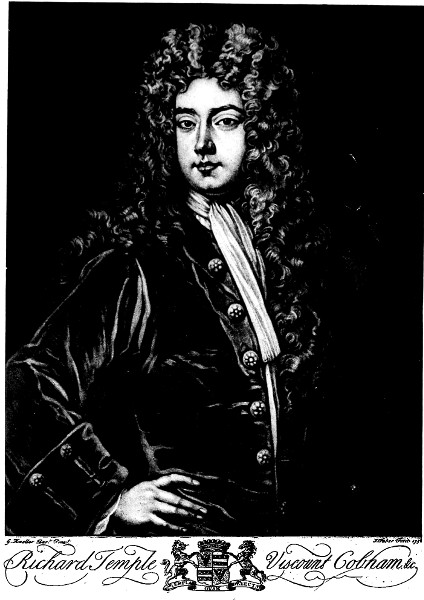
Richard Temple
Viscount Cobham, &c.
Walker & Equtall Ph Sc
But the chief attraction was the Walks; the promenade where the beau strutted with his long sword beribboned with scarlet, and ladies fragrant with Powder of Orange and Jessamine discussed one another and the fashions:—
Lord! madam, did you e’er behold (Says one) a dress so very old? Sure that commode was made, i’ faith, In days of Queen Elizabeth; Or else it was esteemed the fashion At Charles the Second’s coronation: The lady, by her mantua’s forebody, Sure takes a pride to dress like nobody.[12]
Others of more plebeian estate preferred the seclusion of an arbour shaded with climbing shrubs and sycamore, where sweethearts could chat, or, if so minded, enjoy a late breakfast of plum-cake and ale. Older people retired to the coffee-house to smoke and talk politics over their coffee, but the man about town and his female friends were to be found deep at play in the raffling shop, or speculating in the Royal Oak Lottery.[13] Again and again it was the Board that won, while the projector and the man with cogged dice in his pocket looked cynically on. At about eleven a.m. the dancing began. Music for dancing all day long was advertised in 1700 for every Monday and Thursday of the summer season. But the music of that period seems to have been only the harmony of three or four by no means accomplished fiddlers, and it is doubtful if the dancing ever continued beyond the morning and afternoon.
In the early years of the eighteenth century the Spa seems to have gone out of fashion,[14] and in 1714 The Field Spy speaks of it as a deserted place:—
The ancient drooping trees unprun’d appear’d; No ladies to be seen; no fiddles heard.
The patronage of royal personages at last revived its fortunes. In the months of May and June 1733, the Princess Amelia, daughter of George II., and her sister Caroline came regularly to drink the waters. On some occasions the princesses were saluted by a discharge of twenty-one guns, and the gardens were thronged. On one morning the proprietor took £30, and sixteen hundred people are said to have been present. New Tunbridge Wells once more, for a few years, became the vogue. Pinchbeck, the toyman, prepared a view of the gardens which he sold as a mount for his fans. A song of the time, The Charms of Dishabille, which George Bickham illustrated with another view of the gardens, gives a picture of the scene (1733–1738):—
Behold the Walks, a chequer’d shade, In the gay pride of green array’d; How bright the sun! the air how still! In wild confusion there we view Red ribbons grouped with aprons blue; Scrapes, curtsies, nods, winks, smiles and frowns, Lords, milkmaids, duchesses and clowns, In their all-various dishabille.
The same mixed company thus frequented the Spa as of old, and when my Lord Cobham honoured the garden with a visit, there were light-fingered knaves at hand to relieve him of his gold repeater. The physician who at this time attended at the Well was “Dr.” Misaubin, famous for his pills, and for his design to ruin the University of Cambridge (which had refused him a doctor’s degree) by sending his son to the University of Oxford. Among the habitués of the garden was an eccentric person named Martin, known as the Tunbridge Knight. He wore a yellow cockade and carried a hawk on his fist, which he named Royal Jack, out of respect to the Royal Family.
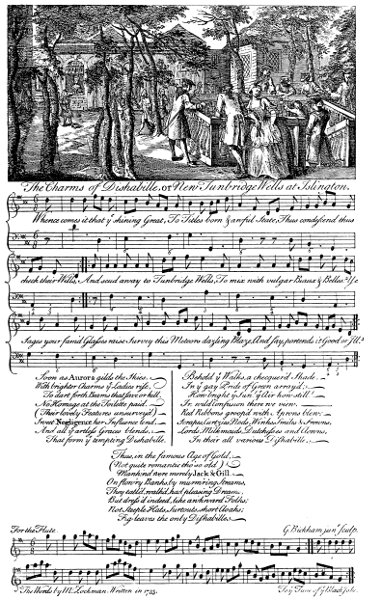
ISLINGTON SPA IN 1733. BY GEORGE BICKHAM.
[Audio content is not currently supported on your device.
[Audio content is not currently supported on your device.
Fashion probably soon again deserted the Spa; but from about 1750 to 1770 it was a good deal frequented by water-drinkers and visitors who lodged for a time at the Wells. One young lady of good family, who was on a visit to London in June 1753, wrote home to her friends[15] that New Tunbridge Wells was “a very pretty Romantick place,” and the water “very much like Bath water, but makes one vastly cold and Hungary.” A ticket costing eighteenpence gave admission to the public breakfasting[16] and to the dancing from eleven to three. It was endeavoured to preserve the most perfect decorum, and no person of exceptionable character was to be admitted to the ball-room.[17] This invitation to the dance reads oddly at a time when the Spa was being industriously recommended to the gouty, the nervous, the weak-kneed, and the stiff-jointed.[18]
In 1770 the Spa was taken by Mr. John Holland, and from that year, or somewhat earlier, the place was popular as an afternoon tea-garden. The “Sunday Rambler” describes it as genteel, but judging from George Colman’s farce, The Spleen; or Islington Spa (first acted in 1776), its gentility was that of publicans and tradesmen. “The Spa (says Mrs. Rubrick) grows as genteel as Tunbridge, Brighthelmstone, Southampton or Margate. Live in the most social way upon earth: all the company acquainted with each other. Walks, balls, raffles and subscriptions. Mrs. Jenkins of the Three Blue Balls, Mrs. Rummer and family from the King’s Arms; and several other people of condition, to be there this season! And then Eliza’s wedding, you know, was owing to the Spa. Oh, the watering-places are the only places to get young women lovers and husbands!”
In 1777, Holland became bankrupt, and next year a Mr. John Howard opened the gardens in the morning and afternoon, charging the water-drinkers sixpence or threepence, or a guinea subscription. He enriched the place with a bowling-green[19] and with a series of “astronomical lectures in Lent, accompanied by an orrery.” A band played in the morning, and the afternoon tea-drinking sometimes (1784) took place to the accompaniment of French horns.[20] Sir John Hawkins, the author of The History of Music, frequented the Spa for his health in 1789. On returning home after drinking the water one day in May (Wednesday 20th, 1789) he complained of a pain in his head and died the next morning of a fever in the brain. “Whether (as a journalist of the time observes) it was owing to the mineral spring being taken when the blood was in an improper state to receive its salubrious effect, or whether it was the sudden visitation of Providence, the sight of the human mind is incompetent to discover.”
The Spa continued to be resorted to till the beginning of the present century when the water and tea-drinking began to lose their attractions. The author of Londinium redivivum, writing about 1803,[21] speaks, however, of the gardens with enthusiasm as “really very beautiful, particularly at the entrance. Pedestals and vases are grouped with taste under some extremely picturesque trees, whose foliage (is) seen to much advantage from the neighbouring fields.” At last, about 1810, the proprietor, Howard, pulled down the greater part of the old coffee-house,[22] and the gardens were curtailed by the formation of Charlotte Street (now Thomas Street). At the same time the old entrance to the gardens, facing the New River Head, was removed for the building of Eliza Place.[23] A new entrance was then made in Lloyd’s Row, and the proprietor lived in a house adjoining. A later proprietor, named Hardy, opened the gardens in 1826 as a Spa only. The old Well was enclosed, as formerly, by grotto work and the garden walks were still pleasant. Finally in 1840, the two rows of houses called Spa Cottages were built upon the site of the gardens.
A surgeon named Molloy, who resided about 1840–1842 in the proprietor’s house in Lloyd’s Row, preserved the Well, and by printed circulars invited invalids to drink the water for an annual subscription of one guinea, or for sixpence each visit. In Molloy’s time the Well was contained in an outbuilding attached to the east side of his house. The water was not advertised after his tenancy, though it continued to flow as late as 1860. In the autumn of 1894, the writers of this volume visited the house and found the outbuilding occupied as a dwelling-room of a very humble description. Standing in this place it was impossible to realise that we were within a few feet of the famous Well. A door, which we had imagined on entering to be the door of a cupboard, proved to be the entrance to a small cellar two or three steps below the level of the room. Here, indeed, we found the remains of the grotto that had once adorned the Well, but the healing spring no longer flowed.[24]
Eliza Place was swept away for the formation of Rosebery Avenue, and the two northernmost plots of the three little public gardens, opened by the London County Council on 31 July, 1895,[25] as Spa Green, are now on part of the site of the old Spa. The Spa Cottages still remain, as well as the proprietor’s house in Lloyd’s Row, and beneath the coping-stone of the last-named the passer-by may read the inscription cut in bold letters: Islington Spa or New Tunbridge Wells.
[Besides the authorities cited in the text and notes and in the account in Pinks’s Clerkenwell, p. 398, ff., the following may be mentioned:—Experimental observations on the water of the mineral spring near Islington commonly called New Tunbridge Wells. London, 1751, 8vo; another ed., 1773, 8vo (the Brit. Mus. copy of the latter contains some newspaper cuttings); Dodsley’s London, 1761, s.v. “Islington”; Kearsley’s Strangers’ Guide, s.v. “Islington”; Lewis’s Islington; Gent. Mag. 1813, pt. 2, p. 554, ff.; advertisements, &c., in Percival’s Sadler’s Wells Collection and in W. Coll.; Wheatley’s London, ii. 268, and iii. p. 199.]
VIEWS.
1. View of the gardens, coffee-house, &c., engraved frontispiece to Lockman’s poem, The Humours of New Tunbridge Wells at Islington, London, 1734, 8vo (cp. Pinks, 401, note, and 402).
2. View of the gardens, well, coffee-house, &c., engraved by G. Bickham, jun., as the headpiece of “The Charms of Dishabille or New Tunbridge Wells” (Bickham’s Musical Entertainer, 1733, &c., vol. i. No. 42).
3. Engravings of the proprietor’s house in Lloyd’s Row; Cromwell’s Clerkenwell, 352; Pinks, 405. The house is still as there represented.
THE PANTHEON, SPA FIELDS
The Spa Fields Pantheon stood on the south side of the present Exmouth Street, and occupied the site of the Ducking Pond House,[26] a wayside inn, with a pond in the rear used for the sport of duck-hunting.
The Ducking Pond premises having been acquired by Rosoman of Sadler’s Wells, were by him sub-let to William Craven, a publican, who, at a cost of £6,000, laid out a garden and erected on the site of the old inn a great tea-house called the Pantheon, or sometimes the Little Pantheon, when it was necessary to distinguish it from “the stately Pantheon” in Oxford Street, built in 1770–1771, and first opened in January 1772.[27]
The Spa Fields Pantheon was opened to the public early in 1770, and consisted of a large Rotunda, with two galleries running round the whole of the interior, and a large stove in the centre.
The place was principally resorted to by apprentices and small tradesmen, and on the afternoon and evening of Sunday, the day when it was chiefly frequented, hundreds of gaily-dressed people were to be found in the Rotunda, listening to the organ,[28] and regaling themselves with tea, coffee and negus, or with supplies of punch and red port. A nearer examination of this crowded assembly showed that it consisted of journeymen tailors, hairdressers, milliners and servant maids, whose behaviour, though boisterous, may have been sufficiently harmless.
The proprietor endeavoured to secure the strict maintenance of order by selling nothing after ten o’clock in the evening. But his efforts, it would seem, were not entirely successful. “Speculator,” a correspondent of the St. James’s Chronicle, who visited the place in May 1772, “after coming from church,” looked down from his vantage-ground in one of the galleries upon what he describes as a dissipated scene. To his observation the ladies constituted by far the greater part of the assembly, and he was shocked more than once by the request, “Pray, Sir, will you treat me with a dish of tea?”
A tavern with tea-rooms for more select parties stood on the east of the Rotunda. Behind the buildings was a pretty garden, with walks, shrubs and fruit trees. There was a pond or canal stocked with fish, and near it neat boxes and alcoves for the tea-drinkers. Seats were dispersed about the garden, the attractions of which were completed by a summer-house up a handsome flight of stone steps, and a statue of Hercules, with his club, on a high pedestal. The extent of the garden was about four acres.
A writer in the Town and Country Magazine for April 1770 (p. 195), speaks contemptuously of the canal “as about the size of a butcher’s tray, where citizens of quality and their spouses come on Sunday to view the amorous flutterings of a duck and drake.” This, however, is the opinion of a fashionable gentleman who goes alternately to Almack’s and Cornelys’s, while Ranelagh (he says) “affords me great relief.”
The career of the Pantheon was brief; for in March 1774 the building and its grounds were announced for sale on account of Craven’s bankruptcy. According to the statement of the auctioneer the place was then in full trade, and the returns almost incredible, upwards of one thousand persons having sometimes been accommodated in the Rotunda. It is uncertain if another proprietor tried his hand, if so he was probably unsuccessful, for the Pantheon was certainly closed as a place of amusement in 1776.
In July 1777 the Rotunda, after having been used for a time as a depot for the sale of carriages, was opened for services of the Church of England under the name of Northampton Chapel. One of the preachers, moralising on the profane antecedents of the place, adopted the text, “And he called the name of that place Bethel, but the name of that city was called Luz at the first.”
The building was afterwards purchased by the Countess of Huntingdon, and opened in March 1779 under the name of Spa Fields Chapel as a place of worship in her connexion. Various alterations were at that time, and subsequently, made in the building, and a statue of Fame, sounding a trumpet, which had stood outside the Pantheon on the lantern surmounting the cupola was removed. The tavern belonging to the Pantheon, on the east side of the Rotunda, was occupied by Lady Huntingdon as her residence. It was a large house partly covered by branches of jessamine.
The gardens, in the rear of the Rotunda, were converted in 1777 into the Spa Fields burial-ground, which became notorious in 1843 for its over-crowded and pestilential condition, and for some repulsive disclosures as to the systematic exhumation of bodies in order to make room for fresh interments.
Spa Fields Chapel was pulled down in the beginning of 1887, and the present church of the Holy Redeemer was erected on its site, and consecrated for services of the Church of England on 13 October, 1888. Such have been the strange vicissitudes of the Pantheon tea-house and its gardens.
[Pinks’s Clerkenwell; Walford, O. and N. London; The Sunday Ramble; Tomlins’s Perambulation of Islington, p. 158; Notes and Queries, 1st ser. ii. p. 404; Spa Fields Chapel and its Associations, London, 1884.]
VIEWS.
1. View of Northampton or Spa Fields Chapel, with the Countess of Huntingdon’s house adjoining. Hamilton, del., Thornton sculp., 1783. Crace, Cat. p. 589, No. 43.
2. Exterior of Chapel and Lady Huntingdon’s house, engraving in Britton’s Picture of London, 1829, p. 120.
3. Later views of the Chapel (interior and exterior) engraved in Pinks’s Clerkenwell, pp. 146, 147.
THE LONDON SPA
The London Spa public-house, standing at the corner of Rosoman Street and Exmouth Street, marks the site of a seventeenth-century inn called The Fountain.
A spring of chalybeate water was discovered on the premises of this inn about 1685, and was a special inducement held out to the public by the proprietor, John Halhed, vintner, to visit his house. In August 1685, Halhed, in advertising the virtues of the water, stated that no less an authority than Robert Boyle, the chemist, had adjudged and openly declared it to be the strongest and very best of these late found out medicinal waters. The honest vintner, in giving other local wells their due, maintained that his was equivalent, if not better, in virtue, goodness, and operation, to that of Tunbridge (so mightily cry’d up) or any other water yet known. On 14 July, 1685, the house was solemnly nominated and called the London Spaw, by Robert Boyle, in the presence of “an eminent, knowing, and more than ordinary ingenious apothecary ... besides the said John Halhed and other sufficient men.” The name of the Fountain seems thenceforth to have been superseded by that of the London Spa. In inviting persons of quality to make a trial of the spring, Halhed expressed the wish that the greatness of his accommodation were suitable to the goodness of his waters, although he was not without convenient apartments and walks for both sexes. The poor were to be supplied with the water gratis.
For a few years subsequent to 1714 the place appears to have fallen into neglect; but it afterwards was once more frequented, and in 1720 the author of May Day[29] writes:—
Now nine-pin alleys, and now skettles grace, The late forlorn, sad, desolated place; Arbours of jasmine fragrant shades compose And numerous blended companies enclose.
On May-day the milkmaids and their swains danced in the gardens to the music of the fiddler. Holiday folk flocked to test the virtues of the spring, and from this time onwards, the London Spa enjoyed some degree of popularity. In the summer of 1733, Poor Robin’s Almanack records how—
Sweethearts with their sweethearts go To Islington or London Spaw; Some go but just to drink the water, Some for the ale which they like better.
The annual Welsh fair, held in the Spa Field hard by, must have brought additional custom to the tavern, and in 1754 the proprietor, George Dodswell, informed the public that they would meet with the most inviting usage at his hands, and that during the fair there would be the “usual entertainment of roast pork with the oft-famed flavoured Spaw ale.” From this date onwards the London Spa would appear to have been merely frequented as a tavern.[30] The present public-house was built on the old site in 1835.
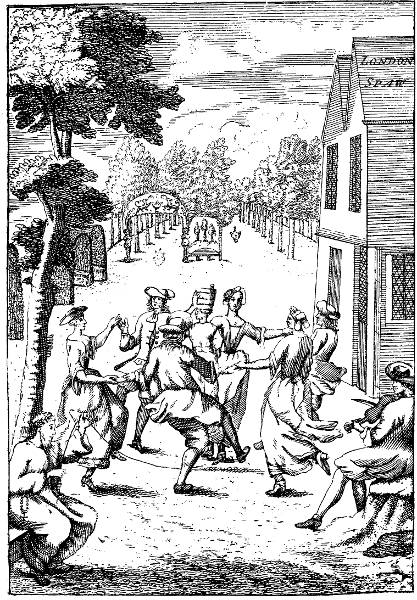
MAY DAY AT THE LONDON SPA. 1720.
[The London Spaw, an advertisement, August 1685, folio sheet in British Museum; Pinks’s Clerkenwell.]
VIEWS.
1. A view of the London Spa in Lempriere’s set of views, 1731; Crace, Cat. p. 588, No. 41. Cp. Pinks’s Clerkenwell, p. 168.
2. Engraving of the Spa garden, T. Badeslade, inv.; S. Parker, sculp.; frontispiece to May Day, or the Origin of Garlands, 1720.
THE NEW WELLS, NEAR THE LONDON SPA
Houses in Lower Rosoman Street,[31] Clerkenwell, west side, about one hundred yards from the London Spaw public-house, now occupy the site of this place of amusement.
The New Wells commanded a pleasant prospect of the fields and country beyond; but nothing is known of the medicinal waters, and the prominent feature of the place was a theatre, probably intended to rival Sadler’s Wells, in which entertainments, consisting of dancing, tumbling, music and pantomime were given from 1737 (or earlier[32]) till 1750. The purchase of a pint of wine or punch was generally the passport necessary for admission, and the gardens were open on Sunday as well as on week-day evenings. The entertainments usually began at five o’clock, and concluded about ten. In 1738, there were comic songs and dancing, an exhibition of views of Vauxhall, and a whimsical, chymical and pantomimical entertainment called the Sequel.
During the next year (1739) similar entertainments were given, and Mr. Blogg sang the “Early Horn,” and “Mad Tom” with a preamble on the kettledrums by Mr. Baker. At this time the place possessed a kind of Zoological Gardens, for there was then to be seen a fine collection of large rattlesnakes, one having nineteen rattles and “seven young ones,” a young crocodile imported from Georgia, American darting and flying squirrels, “which may be handled as any of our own,” and a cat between the tiger and leopard, perfectly tame, and one of the most beautiful creatures that ever was in England. This show could be seen for a shilling.
In 1740 a Merlin’s Cave was added to the attractions of the gardens (cp. “Merlin’s Cave,” infra), and there was displayed a firework representation of the siege of Portobello by Admiral Vernon. On 3 July, 1742,[33] Monsieur and Madame Brila from Paris and their little son, three years old, exhibited several curiosities of balancing, and the two Miss Rayners, rope-dancing. There were songs and dancing; a hornpipe by Mr. Jones of Bath, who played the fiddle as he danced, and an exhibition of views of the newly opened Rotunda at Ranelagh. In June 1744 there was a pantomime, The Sorceress, or Harlequin Savoyard; the part of Harlequin being sustained by Mr. Rosoman. A dance of Indians in character concluded an entertainment witnessed by a crowded and “polite” audience of over seven hundred persons. In August of the same year a Mr. Dominique jumped over the heads of twenty-four men with drawn swords; Madam Kerman performed on the tight-rope, danced on stilts, and (according to the advertisements) jumped over a garter ten feet high.
Next came to the Wells (1745) a youthful giant seven feet four inches high, though under sixteen years of age, who occasionally exhibited his proportions on the rope. In 1746 there appeared a Saxon Lady Giantess seven feet high, and the wonderful little Polander, a dwarf two feet ten inches in height, of the mature age of sixty, “in every way proportionable, and wears his beard after his own country’s fashion.” During this year Miss Rayner performed the feat of walking up an inclined rope, one hundred yards long, extending from the stage to the upper gallery, having two lighted flambeaux in her hands.
The same year (1746) witnessed the celebration at Sadler’s Wells and other places of entertainment in London of the victory of the Duke of Cumberland at Culloden. At the New Wells were given representations of the battle, and the storming of Culloden House. Mr. Yeates[34] (or Yates), the manager at this time, in acknowledging his gratification at the applause manifested, regretted that on the appearance of Courage (the character symbolising the Duke of Cumberland) several hearty Britons exerted their canes in such a torrent of satisfaction as to cause considerable damage to his benches. About this period Mrs. Charlotte Charke (the youngest daughter of Colley Cibber the dramatist) appeared at the Wells as Mercury in the play of Jupiter and Alcmena.
From 1747 to 1750 the theatre and gardens remained closed, but after having been considerably improved they were re-opened on 16 April, 1750. Towards the close of this year, Hannah Snell made her appearance and went through a number of military exercises in her regimentals. This warlike lady, who had served under the name of James Gray as a marine at the siege of Pondicherry, and who had been several times wounded in action, was one of the first party that forded the river, breast high, under the enemy’s fire. She worked laboriously in the trenches, and performed picket duty for seven nights in succession.
The entertainments at the New Wells appear to have ceased about 1750. In 1752 the proprietor, Yeates, let the theatre to the Rev. John Wesley, and in May of that year, it was converted into a Methodist tabernacle. A few years later the theatre was removed, probably in 1756, when Rosoman Row (now Rosoman Street) was formed.
[Cromwell’s Clerkenwell, p. 254; Pinks’s Clerkenwell; newspaper advertisements, W. Coll.].
THE ENGLISH GROTTO, OR GROTTO GARDEN, ROSOMAN STREET
The English Grotto was in existence in 1760, and is described as standing in the fields, near the New River Head. A view of that date[35] represents it as a small wooden building resembling the London Spa. A flag is flying from the roof, and some well-dressed people are seen walking near it. A garden, with a curious grotto and water-works, were probably its only attractions.
It may be conjectured that this English Grotto is identical with the Grotto Garden in Rosoman Street, which was kept in (or before) 1769[36] by a man named Jackson, a successful constructor of grottoes, and contrivances of water-works. In 1769 he advertised the place as his Grand Grotto Garden, and gold and silver fish Repository. In the garden was a wonderful grotto; an enchanted fountain; and a water-mill, invented by the proprietor, which when set to work represented fireworks, and formed a beautiful rainbow. A variety of gold and silver fish, “which afford pleasing ideas to every spectator” might be purchased at this repository. Sixpence was sometimes charged for admission, and a number of people are said to have resorted there daily. The place was still in Jackson’s possession in 1780.
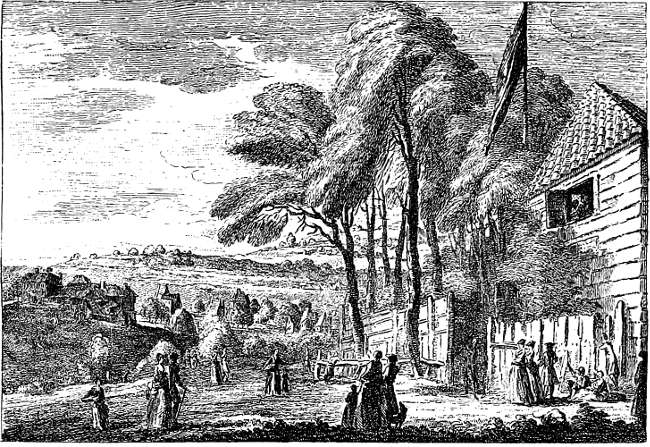
A VIEW OF THE ENGLISH GROTTO NEAR THE NEW RIVER HEAD.
Circ. 1760.
The house and Grotto Garden were at the north-east corner of Lower Rosoman Street (originally Rosoman Row), almost facing the London Spa. About 1800 the house, or its later representative, was No. 35, Lower Rosoman Street, and in its garden were some remains of the wonderful grotto. From the windows there was still a pleasing prospect of the country for many miles. In this house Mr. Pickburn, the printer, first published The Clerkenwell News in 1855, and continued to print the newspaper there until 1862.
[For authorities and views, see notes.]
THE MULBERRY GARDEN, CLERKENWELL
The Mulberry Garden in Clerkenwell, the site of which was afterwards occupied by the House of Detention, was open in 1742, but contrary to the usual practice, the proprietor (W. Body) made no charge for admission, relying for profit on the sale of refreshments.
It was a somewhat extensive garden with a large pond, gravelled walks, and avenues of trees. From the seats placed beneath the shade of a great mulberry tree, probably one of those introduced into England in the reign of James I., the players in the skittle-alley might often be watched at their game. The garden was open from 6 p.m. in the spring and summer, and, especially between 1742 and 1745, was advertised in the newspapers with extravagant eulogy. “Rockhoutt[37] (the proprietor declared) has found one day and night’s Al Fresco in the week to be inconvenient; Ranelagh House, supported by a giant whose legs will scarcely support him[38]; Mary le Bon Gardens, down on their marrow-bones; New wells[39] at low water; at Cuper’s[40] the fire almost out.” The attractions offered were a band of wind and string instruments in an orchestra in the garden and occasional displays of fireworks and illuminations. The proprietor professed (6 April, 1743) to engage British musicians only, maintaining that “the manly vigour of our own native music is more suitable to the ear and heart of a Briton than the effeminate softness of the Italian.” On cold evenings the band performed in the long room. On 2 September, 1742, the proprietor excused himself from a pyrotechnic display on the ground that it was the doleful commemoration of the Fire of London. On 9 August, 1744, there was a special display of fireworks helped out by the instrumental music of the “celebrated Mr. Bennet.” At this fête “honest Jo Baker” beat a Trevally on his side drum as he did before the great Duke of Marlborough when he defeated the French at the Battle of Malplaquet. This entertainment must have been popular, for beyond the sixteen hundred visitors who were able to gain admission, some five hundred others are said to have been turned away. On 25 August, in the same year, another firework display was given, and on this occasion the proprietor condescended to make a charge of twopence per head for admission.
The gardens do not appear to have been advertised between 1745 and 1752, during which period they were probably kept by a Mrs. Bray, who died on 1 March, 1752, “with an excellent good character.” Beyond this, her obituary only records that she “is thought to have been one of the fattest women in London.” In 1752 the gardens were in the hands of Clanfield, the firework engineer of Cuper’s Gardens, who every summer evening provided vocal and instrumental music, from six o’clock, and fireworks at nine.[41] The admission was sixpence with a return of threepence in refreshments.
Fashionable gentlemen appear to have played an occasional game of ninepins or skittles in the Mulberry Garden, but on the whole the place enjoyed only a local celebrity among tradesmen and artisans, and its proprietor, in elegant language,[42] made his appeal to “the honest Sons of trade and industry after the fatigues of a well-spent day,” and invited the Lover and the jolly Bacchanalian to sit beneath the verdant branches in his garden.
Nothing is known of the garden subsequent to 1752. The site was used about 1797 as the exercising ground of the Clerkenwell Association of Volunteers, and the House of Detention (now replaced by a Board School) was subsequently built on it.
[Pinks’s Clerkenwell.]
VIEWS.
Two engravings, probably contemporary, showing well-dressed gentlemen playing at ninepins near the mulberry tree: Guildhall Library, London (Catal. p. 210). One of these views is engraved in Pinks, p. 128.
SADLER’S WELLS
Towards the close of the seventeenth century there stood on the site of the present Sadler’s Wells Theatre (Rosebery Avenue, Clerkenwell), a wooden building of a single story erected by Sadler, a surveyor of the highways, as a Music House. The house stood in its own grounds, and the New River flowed past its southern side.
It was in the garden of this house that in 1683 some workmen in Sadler’s employ accidentally unearthed an ancient well, arched over and curiously carved. Sadler, suspecting the water to have medicinal properties, submitted it for analysis to a doctor, who advised him to brew ale with it. This he did with such excellent results that the ale of Sadler’s Wells became, and long remained, famous. In 1684, Dr. Thomas Guidot issued a pamphlet setting forth the virtues of the water which he described as a ferruginous chalybeate, akin to the waters of Tunbridge Wells, though not tasting so strongly of steel and having more of a nitrous sulphur about it. Being neither offensive nor unpleasant to taste, a man was able to drink more of it than of any other liquor. It might be taken with a few carraway comfits, some elecampane, or a little preserved angelica to comfort the stomach. A glass of Rhenish or white wine might also accompany the tonic, and habitual smokers would find it very convenient to take a pipe after drinking.
Sadler lost no time in advertising his Wells,[43] and in preparing for the reception of the water-drinkers. He laid out his garden with flowers and shrubs, and constructed in the centre a marble basin to receive the medicinal water. Posturers, tumblers and rope-dancers, performing at first in the open-air, were engaged. A Mrs. Pearson played on the dulcimer on summer evenings at the end of the Long Walk, and visitors danced to the strains of a band stationed on a rock of shellwork construction. The place soon became popular, and hundreds of people came daily to drink the water.
Epsom and Tunbridge Wells (in Kent) saw in Sadler’s Wells a serious rival to their own spas, and in 1684 a tract was issued protesting against this “horrid plot” laid to persuade people that “Sadler’s Musick House is South-Borrow and Clarkenwell Green Caverley Plain.” Was it possible for water from such a source to “bee effectual as our wonder-working fountains that tast of cold iron, and breathe pure nitre and sulphur”? Audacious and unconscionable Islington should surely be content with its monopoly from time immemorial of the sale of cakes, milk, custards, stewed prunes, and bottled ale. But even if the waters “could be conceited somewhat comparable, where is the air? Where the diversions? Where the conveniences?”
Possibly this tirade was not ineffectual; at any rate, about 1687 the place was comparatively deserted and the well fell into disuse. “Sadler’s excellent steel waters” were, however, again advertised in 1697 as being as full of vigour, strength and virtue as ever they were and very effectual for curing all hectic and hypochondriacal heat, for beginning consumptions and for melancholy distempers. The water-drinking appears to have finally ceased early in the eighteenth century;[44] though the place, surrounded by fields till quite late in the century, remained a pleasant resort for Londoners.
There you may sit under the shady trees And drink and smoke fann’d by a gentle breeze.[45] There pleasant streams of Middleton In gentle murmurs glide along In which the sporting fishes play To close each wearied Summer’s day. And Musick’s charms in lulling sounds Of mirth and harmony abounds; While nymphs and swains with beaux and belles All praise the joys of Sadler’s Wells. The herds around o’er herbage green And bleating flocks are sporting seen While Phœbus with its brightest rays The fertile soil doth seem to praise.[46]
As late as 1803 mention is made of the tall poplars, graceful willows, sloping banks and flowers of Sadler’s Wells; and the patient London fisherman, like his brethren of the angle of the eighteenth century, still stood by the stream.[47]
From about 1698 the gardens ceased to be a prominent feature of Sadler’s Wells, and the fortunes of the place from that time to the present day mainly concern the historian of the Theatre and the Variety Stage, and can only be dealt with briefly in the present work.
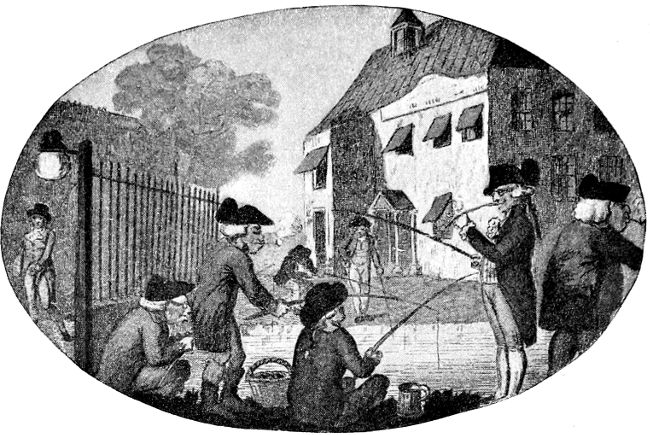
SADLER’S WELLS ANGLERS. 1796.
In 1698 (23 May) a vocal and instrumental concert was given, and the company enjoyed such harmony as can be produced by an orchestra composed of violins, hautboys, trumpets and kettledrums. This was one of the concerts given in the Music House twice a week throughout the season and lasting from ten o’clock to one. In 1699 James Miles and Francis Forcer (d. 1705?), a musician, appear to have been joint proprietors of Sadler’s Wells, which was for some years styled Miles’s Music House. In this year (1699) there was an exhibition of an “ingurgitating monster,” a man, who, for a stake of five guineas, performed the hardly credible feat of eating a live cock. This disgusting scene was witnessed by a very rough audience, including however some beaux from the Inns of Court. A brightly painted gallery in the saloon used for the entertainments appears to have been occupied by the quieter portion of the audience, who were able from thence to survey the pit below, which was filled, according to Ned Ward (circ. 1699), with butchers, bailiffs, prize-fighters, and housebreakers. The audience smoked and regaled themselves with ale and cheese-cakes; while the organ played, a scarlet-clad fiddler performed, and a girl of eleven gave a sword dance.
In 1712, Miles’s Music House was the scene of a fatal brawl in which Waite, a lieutenant in the Navy, was killed by a lawyer named French, “near the organloft.” In 1718 it is mentioned as the resort of “strolling damsels, half-pay officers, peripatetic tradesmen, tars, butchers and others musically inclined.”
Miles died in 1724 and probably about that time Forcer’s son, Francis Forcer, junior (d. 1743), an educated man of good presence, became proprietor and improved the entertainments of rope-dancing and tumbling. The neighbourhood of Sadler’s Wells about this period was infested by footpads. It was consequently a common sight to see link-boys with their flaming torches standing outside the theatre, and horse patrols were often advertised (circ. 1733–1783) as escorts to the City and the West End. Occasionally the play-bills announced:—“It will be moonlight.”
In 1746 Rosoman was proprietor, and introduced the system of admitting the pit and gallery free, on the purchase of a pint of wine. A charge of half-a-crown was made for the boxes. The audience smoked and toasted one another. The man-servant by day became a beau at night; and with the lady’s-maid, decked out in colours filched from her mistress, gazed open-mouthed at the wonderful sights. Winifred Jenkins describes her experiences, in Humphry Clinker (1771):—“I was afterwards of a party at Sadler’s Well, where I saw such tumbling and dancing on ropes and wires that I was frightened and ready to go into a fit. I tho’t it was all enchantment, and believing myself bewitched, began for to cry. You knows as how the witches in Wales fly on broom-sticks; but here was flying without any broomstick or thing in the varsal world, and firing of pistols in the air and blowing of trumpets and singing, and rolling of wheelbarrows on a wire (God bliss us!) no thicker than a sewing thread; that to be sure they must deal with the Devil. A fine gentleman with a pig’s tail and a golden sord by his side, came to comfit me and offered for to treat me with a pint of wind; but I would not stay; and so in going through the dark passage he began to show his cloven futt and went for to be rude; my fellow sarvant Umphry Klinker bid him be sivil, and he gave the young man a dous in the chops; but i’ fackins Mr. Klinker warn’t long in his debt; with a good oaken sapling he dusted his doublet, for all his golden cheese-toaster; and fipping me under his arm carried me huom, I nose not how, being I was in such a flustration.”
Between 1752 and 1757 Michael Maddox exhibited his wire-dancing and his tricks with a long straw, which he manipulated while keeping his balance on the wire. In 1755 (and for many years afterwards) Miss Wilkinson, the graceful wire-dancer and player of the musical glasses, was a principal performer.
Giuseppe Grimaldi (“Iron Legs”) the father of the famous clown, was the ballet-master and chief dancer in 1763 and 1764; and remained at the Wells till 1767. Harlequinades and similar entertainments were from this time added to the ordinary amusements of tumbling and rope-dancing.
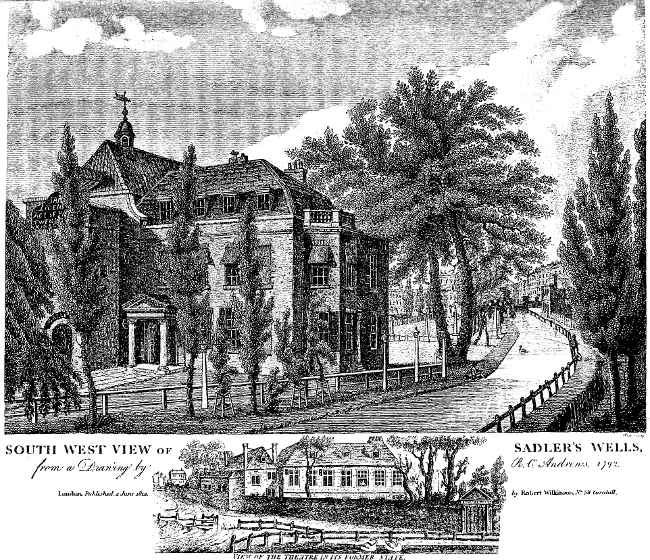
SADLER’S WELLS IN 1792, AND AS IT WAS BEFORE 1765.
In 1765 Rosoman pulled down the old wooden house and erected in its place a new theatre which in part survives in the building of the present day. The seats now had backs with ledges, as in our music-halls, to hold the bottles and glasses of the audience. About this time, or a few years later, the charge for a box was three shillings including a pint of wine (port, Mountain, Lisbon or punch), and eighteen pence and one shilling for the pit and gallery; an extra sixpence entitling the ticket-holder to a pint of the wine allowed to the box-holders. Angelo, at a later time, refers in his Reminiscences to the Cream of Tartar Punch and the wine of the Sloe Vintage usually drunk at Sadler’s Wells.
Among the vocalists were Mrs. Lampe (1766–1767) and the famous Thomas Lowe (1771 and later). In 1768 Spinacuti exhibited his wonderful monkey which performed on the tight-rope feats resembling Blondin’s. Jemmy Warner, the clown, appeared in 1769, and Richer, the wire and ladder dancer, in 1773; and the years 1775 and 1776 were noticeable for the appearance of James Byrne, the harlequin, father of Oscar Byrne. In 1778 the interior of the theatre was entirely altered and the roof considerably raised. The audience now often included people of rank, such as the Duke and Duchess of York and the Duke and Duchess of Gloucester.
In 1781 Joseph Grimaldi (b. 1779, d. 1837) made his first appearance at Sadler’s in the guise of a monkey, and appeared there year by year till within a few years of his retirement. On 17 March, 1828, he took a farewell benefit there, playing “Hock,” the drunken prisoner in “Sixes, or the Fiend.” His final appearance was at Drury Lane on 27 June, 1828, when, prematurely broken down in health, he sang, seated, his last song, and made his farewell speech.
The Dibdins, Charles the elder in 1772 and Charles the younger, 1801 to 1814, wrote many plays and songs for Sadler’s Wells. Charles the younger and Thomas Dibdin were also proprietors and managers.
Among the performers who appeared between the years 1780 and 1801 were Miss Romanzini, the ballad-vocalist, afterwards Mrs. Bland. Braham (then Master Abrahams) the singer; Paul Redigé the clever tumbler, called “the little Devil”; La Belle Espagnole, his wife; Dighton and “Jew” Davis, pantomimists; Bologna and his sons in their exhibitions of postures and feats of strength; Placido the tumbler, Dubois the clown, and Costello (1783), whose wonderful dogs enacted a play called The Deserter. Edmund Kean, the tragedian, appeared in June 1801 as “Master Carey, the pupil of Nature,” and recited Rollo’s address from Pizarro.
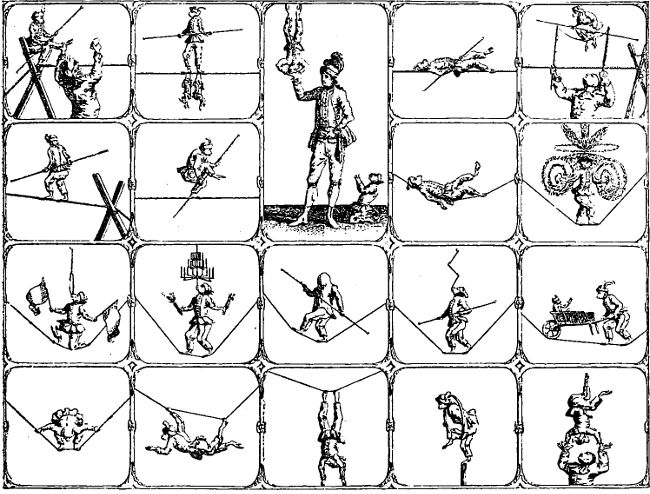
SPINACUTI’S MONKEY AT SADLER’S WELLS, 1768.
Among the varied entertainments at Sadler’s may be mentioned the pony-races in 1802 (July) and 1822 (April and June). A course was formed by means of a platform carried from the stage round the back of the pit. In 1806 and 1826 a racecourse was formed outside in the ground to the east of the theatre; booths, stands, and a judge’s box were erected, and many of the most celebrated full-sized ponies with a number of jockeys of “great celebrity” and lightweight were, at least according to the bills, engaged. In 1826 (June) a balloon ascent from the grounds was made by Mrs. Graham, and in 1838 her husband also ascended. Belzoni, the famous excavator, exhibited his feats of strength in 1803. In 1804 Sadler’s Wells was known as the “Aquatic Theatre.” A large tank filled with water from the New River occupied nearly the whole of the stage, and plays were produced with cascades and other “real water” effects.
Our rapid survey, omitting many years, now passes on to 1844, when Samuel Phelps became one of the proprietors of Sadler’s Wells. During Phelps’s memorable management (1844–1862) there were produced some thirty of Shakespeare’s plays, occupying about four thousand nights—Hamlet being played four hundred times.
In 1879 Sadler’s Wells was taken by Mrs. Bateman (from the Lyceum Theatre), and under her management the whole of the interior was reconstructed. At the present time it is a music-hall with two houses nightly. It is curious to note that Macklin, describing Sadler’s Wells as he remembered it some years before Rosoman’s time, says that several entertainments of unequal duration took place throughout the day, and were terminated by the door-keeper calling out “Is Hiram Fisteman here?” Fisteman being a mythical personage whose name signified to the performers that another audience was waiting outside. The price of admission at that time was threepence and sixpence; to-day the charge is twopence, a box being procurable for a shilling.
[The authorities are numerous. The Percival collection relating to Sadler’s Wells (in Brit. Mus.) contains a great mass of material bound in fourteen volumes. Useful summaries are given in Pinks’s Clerkenwell, 409, ff; in the Era Almanack, 1872, p. 1, ff; in M. Williams’s Some London Theatres; and in H. Barton Baker’s London Stage, ii. p. 187, ff]
VIEWS.
The views, especially those of the 19th century, are abundant. The following are of the 18th century:—
1. A view of Sadler’s Wells. C. Lempriere, sculp., 1731. Crace, Cat., p. 593, No. 77; cp. ib. p. 592, No. 76.
2. Hogarth’s Evening, showing old Sadler’s Wells and the Sir Hugh Middleton tavern.
3. South-west view of Sadler’s Wells, from a drawing by R. C. Andrews, 1792; with a smaller view of the same in its former state. Wise, sc., published in Wilkinson’s Londina Illustrata.
Many others may be seen in the Percival and Crace collections.
MERLIN’S CAVE
The Merlin’s Cave, a tavern standing in the fields near the New River Head, close to the present Merlin’s Place, possessed extensive gardens and a skittle-ground, which were frequented by Londoners especially on Sundays.
It was probably built in 1735 or not long afterwards[48] and derived its name from the Merlin’s Cave constructed in 1735 by Queen Charlotte in the Royal Gardens at Richmond. The Richmond Cave was adorned by astrological symbols, and contained waxwork figures, of which the wizard Merlin was the chief. By the end of 1735 humble imitations of the Cave were established in various parts of the Kingdom, and it is highly probable that the Merlin’s Cave tavern had an exhibition of this kind. The New Wells in Lower Rosoman Street, Clerkenwell, possessed a Merlin’s Cave in 1740.[49]
About 1833 the gardens of the Merlin’s Cave were built over. The New Merlin’s Cave, a public-house now numbered 131 Rosoman Street, stands a little north of the old site.
[Pinks’s Clerkenwell, 580, 581; Wheatley’s London, s.v.]
VIEWS.
1. A view of the skittle-ground, Merlin’s Cave, New River Head, with rules and instructions for playing. A print published by G. Kearsley, 1786. Crace, Cat. p. 592, No. 71.
2. Old Merlin’s Cave near the New River Head, Rosoman Street. A drawing by C. H. Matthews, 1833. Crace, Cat. p. 592, No. 70.
BAGNIGGE WELLS
A modern public-house, “Ye olde Bagnigge Wells,” standing on the west side of the King’s Cross Road (formerly Bagnigge Wells Road), and the building yard of Messrs. Cubitt, behind it, now occupy part of the site of these famous Wells.
Bagnigge House, the building which formed the nucleus of the place of entertainment called Bagnigge Wells, is believed to have been a summer residence of Nell Gwynne. It fronted Bagnigge Wells Road, and was pleasantly situated, lying in a hollow called Bagnigge Wash (or Vale); and being well sheltered on all sides, except the south, by the rising grounds of Primrose Hill, Hampstead and Islington.[50]
In 1757 a Mr. Hughes, described as a man curious in gardening, and apparently the tenant of Bagnigge House, found that the more he watered his plants with the water drawn from a well in the garden, the less they seemed to thrive. He asked the opinion of a doctor, John Bevis, who analysed the water, and pronounced it a valuable chalybeate. At the same time the water of another well, sunk in the ground adjoining Bagnigge House, was discovered to possess cathartic properties. Hughes, realising the commercial possibilities of these wells, opened the house and gardens to the public, at least as early as April 1759. The place was open daily, including Sundays, and in 1760 Bevis published a pamphlet, setting forth the virtues of the waters.
The chalybeate well was situated just behind the house, and the cathartic well about forty yards north of the chalybeate. The water of the two wells, which were each some twenty feet in depth, was, however, brought to one point, and thence drawn from a double pump placed within a small circular edifice consisting of pillars supporting a dome, erected behind the house. This was commonly called the Temple. The chalybeate was of a ferruginous character having “an agreeable and sprightly sub-acid tartness,” and was, according to Bevis, “apt to communicate a kind of giddiness with an amazing flow of spirits and afterwards a propensity to sleep if exercise be not interposed.” The purging water left a “distinguishable brackish bitterness on the palate,” and three half-pints were “sufficient for most people,” without the addition of salts to quicken their virtue.
The charge for drinking the water at the pump was threepence: half a guinea entitled the visitor to its use throughout the season. At a later date when Bagnigge Wells was mainly frequented for its tea-gardens, a general charge of sixpence was made for admission.
The Long Room,[51] the old banqueting hall of Bagnigge House, was about seventy-eight feet by twenty-eight feet with a rather low ceiling and panelled walls. At one end of the room was a distorting mirror, a source of considerable amusement, which, for instance, revealed to Captain Tommy Slender of the Middlesex Militia, so odd a figure, that he was almost “hyp’d to death.” Filled with apprehension he consulted a physician, who understanding the use of the concave and convex mirror made his patient take copious draughts of the water, and, after pocketing his fee, led him to another panel of the glass, where the Captain beheld a portly well-conditioned man. Vastly pleased he went home convinced of the virtues of the wells. At the other end of the room was a good organ[52] which provided music for the company. A water organ was also to be heard in the grounds. The organ performances were prohibited on Sundays by the magistrates from about 1772, apparently with the idea of rendering the attractions of Bagnigge Wells less dangerously seductive. The organ was, however, played regularly on the week-day afternoons.[53]
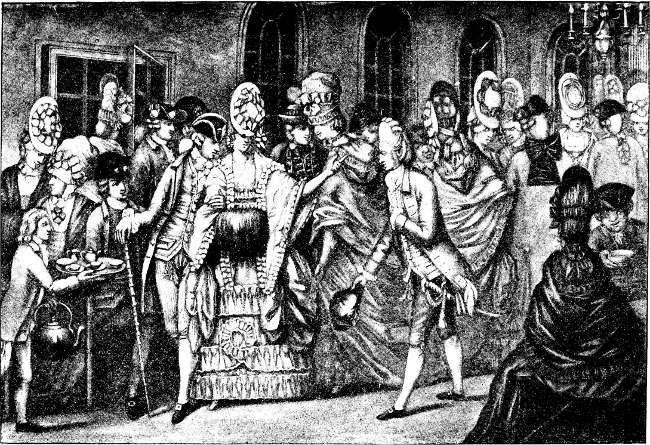
“THE BREAD AND BUTTER MANUFACTORY, OR THE HUMORS OF BAGNIGGE WELLS,” 1772.
(INTERIOR OF LONG ROOM.)
From about 1760 till near the end of the eighteenth century Bagnigge Wells was a popular resort. Some hundreds of visitors were sometimes to be found in the morning for the water-drinking, and early breakfasts were provided. In the afternoon the Long Room and the gardens were thronged by tea-drinkers, especially on Sundays. Stronger beverages were not unknown, and a bowl of good negus was a feature here. The lawyer, the man about town, and the active city merchant, no less than the gouty, and the hypochondriac, came to while away an hour or two:—
Ye gouty old souls and rheumaticks crawl on, Here taste these blest springs, and your tortures are gone; Ye wretches asthmatick, who pant for your breath, Come drink your relief, and think not of death. Obey the glad summons, to Bagnigge repair, Drink deep of its streams, and forget all your care. The distemper’d shall drink and forget all his pain, When his blood flows more briskly through every vein; The headache shall vanish, the heartache shall cease, And your lives be enjoyed in more pleasure and peace. Obey then the summons, to Bagnigge repair, And drink an oblivion to pain and to care.[54]
The city matron deemed it the very home of fashion:—
Bon Ton’s the space ’twixt Saturday and Monday, And riding in a one-horse chair on Sunday: ’Tis drinking tea on summer afternoons At Bagnigge Wells with china and gilt spoons.[55]
With “genteel females” there mingled others of decidedly bad reputation.[56] Even a feminine pickpocket[57] was not unknown. The notorious John Rann,[58] who, as Dr. Johnson observed, towered above the common mark as a highwayman, was a visitor at Bagnigge Wells, and a favourite with some of the ladies there. On 27 July, 1774, Rann was brought before Sir John Fielding after one of his escapades, but was acquitted, the magistrate exhorting him in a pathetic manner to forsake his evil ways. On the Sunday following (31 July), he appeared at Bagnigge Wells with all his old assurance, attired in a scarlet coat, tambour waistcoat, white silk stockings, and a laced hat. On each knee he wore the bunch of eight ribbons, which had gained him his sobriquet of Sixteen Strings Jack. On this occasion his behaviour gave such offence to the company that he was thrown out of one of the windows of the Long Room. About four months later, 30 November, 1774, he was hanged at Tyburn for robbing Dr. Bell, chaplain to the Princess Amelia.
The grounds of Bagnigge Wells were behind the Long Room, and were laid out in formal walks, with hedges of box and holly. There were a number of fine trees, some curiously trimmed, and a pretty flower garden. Ponds containing gold and silver fish, at that time a novelty, were in the gardens; and the pond in the centre had a fountain in the form of a Cupid bestriding a swan from whose beak issued streams of water.
Parallel with the Long Room, and separating the eastern part of the grounds from the western (and by far the larger) portion, ran the river Fleet, with seats on its banks, for such as “chuse to smoke or drink cyder, ale, etc., which are not permitted in other parts of the garden.” Willows, large docks and coarse plants, elder bushes and other shrubs in luxurious profusion, fringed the banks; and we hear of Luke Clennell, the artist, making studies of the foliage.
Three rustic bridges spanned the stream, and amid the trees were two tall leaden figures; one a rustic with a scythe, the other a Phyllis of the hay-fields, rake in hand.
Arbours for tea-drinking, covered with honeysuckle and sweetbriar, surrounded the gardens; and there was a rustic cottage and a grotto. The last named, a small castellated building of two apartments open to the gardens, was brightly decorated in cockney fashion with shells, fossils, and fragments of broken glass. A bowling-green and skittle-alley were among the attractions of the Wells, and a bun-house or bake-house was erected (before 1791) on the south side of the house, but not immediately contiguous to it.
Hughes, the original proprietor, appears to have remained at the Wells till about 1775; and a Mr. John Davis was subsequently the lessee till his death in 1793. During the last twenty years of the eighteenth century the company, for the most part, seems to have consisted of persons of lower rank than formerly:—
Cits to Bagnigge Wells repair To swallow dust and call it air.
Prentices and their sweethearts, and city matrons with their husbands, frequented the place; while unfledged Templars paraded as fops, and young ensigns sported their new cockades. The morning water-drinking was not neglected, but the full tide of life at Bagnigge was from five to eight p.m. on Sundays, when the gardens were crowded with tea-drinkers. A prentice-song sets forth the delights of the Wells:—
Come prithee make it up, Miss, and be as lovers be We’ll go to Bagnigge Wells, Miss, and there we’ll have some tea; It’s there you’ll see the lady-birds perched on the stinging nettles, The crystal water fountain, and the copper shining kettles. It’s there you’ll see the fishes, more curious they than whales, And they’re made of gold and silver, Miss, and wags their little tails; They wags their little tails, they wags their little tails.
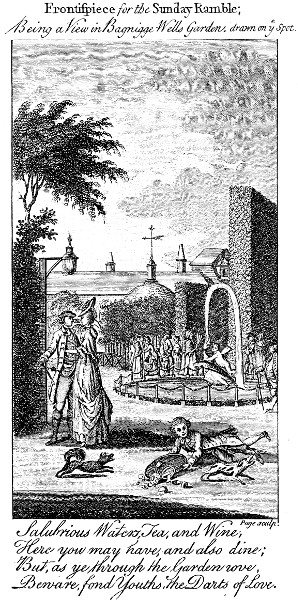
Frontispiece for the Sunday Ramble;
Being a View in Bagnigge Wells Garden, drawn on ye Spot.
Salubrious Waters, Tea, and Wine, Here you may have, and also dine; But, as ye through the Garden rove, Beware, fond Youths, the Darts of Love.
About 1810 the place became more exclusively the resort of the lower classes, though the situation was still somewhat picturesque. In 1813 Thomas Salter, the lessee, became bankrupt, and Bagnigge Wells was put up for sale by auction[59] on four days in the month of December. Not a bench or shrub was omitted: the “excellent fine-toned organ,” the water-organ, the chandeliers from the Long Room, dinner and tea services of Worcester china; the tea-boxes, two hundred drinking tables, four hundred teaboards, and some four hundred dozen of ale and stout. The various rooms and buildings were also offered for sale, including “Nell Gwyn’s house,” the summer-house, the bake-house, the grotto, temple, bridges; the two leaden rustics,[60] the fountains and all the gold and silver fish. Also the pleasure and flower gardens with their greenhouses, all the trees, including a “fine variegated holly tree,” the gooseberry and currant bushes, the hedges, shrubs and flowers.
In the year following, however, the place was re-opened under W. Stock’s management, and though the gardens[61] were now curtailed of all the ground west of the Fleet (at this time a ditch-like, and, on warm evenings, malodorous stream), an attempt was made to revive their popularity. The proprietor’s efforts were not very successful, and during the next few years the premises frequently changed hands. In 1818 the lessee of Bagnigge Wells was Mr. Thorogood, who let it to Mr. Monkhouse (from White Conduit House) about 1831. In April 1831 Monkhouse advertised the Concert Room as being open every evening for musical entertainments, which continued to be the main feature of Bagnigge Wells until its close. In, or before, 1833 Richard Chapman was the proprietor, and John Hamilton in 1834.
In 1838 (August 14th), the lessees, Mr. and Miss Foster, announced for their benefit night an array of concert-room talent:—Le Mœurs of Bagnigge Wells, Mr. Darking (of the London concerts), Miss Anderson (from the Mogul Concert Room), Messrs. Sutton and Gibson (Sadler’s Wells), Master Clifford (Yorkshire Stingo), Mr. H. Smith (Royal Union Saloon), Mr. Boyan (Queen’s Head Rooms), Mr. Roberts (White Conduit); and the songs included “Tell me, my heart,” “Billy the Snob” (in character), “Pat was a darling boy.” A scene was given from Julius Cæsar; a soliloquy from Hamlet; and one Simpson exhibited classical delineations of the Grecian statues. The concert was followed by a ball, in which were danced a Highland fling (by a Mr. McDougal), a double comic medley dance, a waterman’s hornpipe, and a hornpipe in real fetters and chains. During the evening a balloon was sent up from the grounds; and sixpence procured admission to the whole. On other concert nights the admission was as low as threepence. Among the singers in the latest days of Bagnigge Wells were the well-known Paddy O’Rourke, Alford, Ozealey, Prynn, Box, Sloman, Booth, Gibbs and Dickie. Besides the songs and duets, portions of plays were acted, though without scenery or special dresses.
The year 1841 witnessed the last entertainment at Bagnigge Wells, when on 26 March there was an evening performance (admission sixpence) of glees, farces and comic songs. The dismantling of the place was now begun. The grotto, which was already in a very dilapidated condition, was destroyed by some passers by in the early morning of 6 April, 1841.
In 1843 all that remained was the north end of the Long Room, and, according to a representative of Punch, who visited the spot in September of that year, the old well was filled up with rubbish and mosaics of oyster shells. Shortly afterwards, the present tavern was built; Mr. Negus, a name suggestive of other days, being the tenant in 1850.
[Pinks’s Clerkenwell; Walford’s O. & N. London; Palmer’s St. Pancras, p. 77, ff.; Wheatley’s London P. & P.; Kearsley’s Strangers’ Guide; Noorthouck’s London, p. 752, ff.; Clinch’s Marylebone and St. Pancras, p. 148, ff.; Malcolm’s Lond. Rediv. (1803), p. 237; Sunday Ramble (various editions); Rimbault in Notes and Queries, 1st ser. ii. 228; 4th ser. xi. 24; Era Almanack, 1871 (account of Bagnigge Wells by Blanchard).]
VIEWS.
The following views may be noted:—
1. “Ancient stone from Bagnigge Wells,” engraved in Pinks, p. 558.
2. “The Bread and Butter Manufactory, or the Humors of Bagnigge Wells,” a mezzotint published by Carrington Bowles, 1772; cp. an aquatint print from a painting by Sanders, published by J. R. Smith in 1772.
3. Mr. Deputy Dumpling and Family enjoying a summer afternoon, a print (1780) published by Carrington Bowles. Crace, Cat., p. 583, No. 84.
4. Bagnigge Wells, near Battle Bridge, a print (1777). Crace, Cat., p. 583, No. 82; engraved in Walford’s O. & N. London, ii. p. 294.
5. Bagnigge Wells Garden, frontispiece engraved for the Sunday Ramble, “drawn on ye spot,” Page sculp. (circ. 1774?) (W. Coll.); engraved in Pinks, p. 563.
6. “A Bagnigge Wells scene: or, No resisting temptation.” An engraving published by Carrington Bowles, 1780. Crace, Cat., p. 583, No. 85; a hand-coloured mezzotint in Brit. Mus. Catal. of Prints, vol. iv., No. 4,545.
7. View of the Tea-gardens and Bun-house, from a drawing, taken in 1790 (?); copy in sepia in W. Coll.; an almost identical view is reproduced in Rogers’s Views of Pleasure Gardens of London, p. 23, “from a drawing made in 1827.”
8. “The Road to Ruin” (with figure of John Rann). Crace, Cat., p. 583, No. 86.
9. A view taken from the centre bridge in the gardens of Bagnigge Wells. An example in Crosby Coll.; also reproduced in Ashton’s The Fleet.
10. The original garden entrance to Bagnigge Wells (circ. 1800?) J. T. Smith del. Etched in Rogers’s Views of Pleasure Gardens of London, p. 26.
11. View of Bagnigge Wells Gardens, 1828, engraving in Cromwell’s Clerkenwell, p. 414; reproduced in Pinks, p. 567.
12. A collection of manuscript notes, sketches and drawings, relating to Bagnigge Wells in its later days, made by Anthony Crosby. (Guildhall Library, London.)
13. “Residence of Nell Gwynne, Bagnigge Wells.” An engraving, C. J. Smith, sc. 1844; Crace, Cat., p. 583, No. 88; Pinks, p. 559.
“LORD COBHAM’S HEAD.”
The Lord Cobham’s (or Cobham’s) Head, named after Sir John Oldcastle “the good Lord Cobham,” was situated in Cold Bath Fields, and on the west side of Coppice Row, now Farringdon Road, at the point where it was joined by Cobham Row.
It was first opened in 1728 (about April), and in its garden there was then “a fine canal stocked with very good carp and tench fit to kill,” and anglers were invited to board at the house. It was advertised to be let or sold in 1729, and little is heard of it till 1742 when it possessed a large garden with a “handsome grove of trees,” and gravel walks, and claimed to sell the finest, strongest and most pleasant beer in London at threepence a tankard. Some vocal and instrumental music was at this time provided in the evening, and the walks were illuminated.
In 1744 a good organ was erected in the chief room of the inn and the landlord, Robert Leeming, for one of his concerts in 1744, announced Mr. Blogg and others to sing selections from the Oratorios of “Saul” and “Samson”; a concerto on the organ by Master Strologer and the Coronation Anthem of Mr. Handel. After the concert came a ball, the price of admission to the whole entertainment being half-a-crown. For July 20th of the same year there was announced “a concert of musick by the best Masters,” for the benefit of a reduced citizen, followed by the display of a “set of fireworks by several gentlemen lovers of that curious art—Rockets, line ditto, Katherine wheels, and many other things; likewise will be shewn the manner of Prince Charles’s distressing the French after he passed the Rhine.” The concerts do not appear to have been given after this period but the Cobham’s Head long continued to exist as a tavern, and is marked in Horwood’s Plan of 1799.
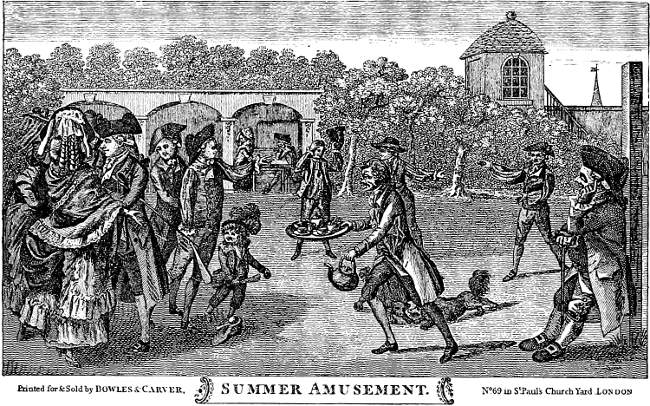
SUMMER AMUSEMENT.
In December 1811 it was sold by auction, being described at that time as a roomy brick building with a large yard behind, probably all that was left of the gardens. About 1860 during the operations for the Metropolitan Railway the Cobham’s Head was inundated by the bursting of a New River Main, and was so much injured by the undermining for the Railway that it had to be vacated.
[Pinks’s Clerkenwell; Wheatley’s London P. and P., “Coppice Row.”]
“SIR JOHN OLDCASTLE” TAVERN AND GARDENS.
The Sir John Oldcastle Tavern was situated in Cold Bath Fields on the west side of Coppice Row, and was on the same side of the road as the Lord Cobham’s Head, but rather nearer to Bagnigge Wells. It was originally a wayside inn, but during the first half of the eighteenth century became a well-known tavern. In 1707 (July 18th) the Clerkenwell Archers held their annual dinner there, and frequented it for some years.
In the rear of the house were extensive gardens, well planted with trees; and from 1744 to 1746 these were open during the summer for evening entertainments. A band “of the best Masters” played from five o’clock till nine; the walks were lit with lamps, and fireworks were displayed at the close of the evening. The admission was sixpence, including refreshments. In July 1746 concerts of vocal and instrumental music were announced, at which the chief vocalist, Mr. Blogg, sang such songs as “Come, Rosalind,” “Observe the fragrant blushing Rose” and “The Happy Pair.”[62]
In 1753 a Smallpox Hospital was erected on part of the Oldcastle estate, but the Sir John Oldcastle, immediately adjacent, was left standing till 1762 when, being in a ruinous condition, it was pulled down.
[Pinks’s Clerkenwell; Larwood and Hotten, History of Signboards, p. 97; Tomlins’s Perambulation of Islington, p. 172; Low Life (1764), p. 81; The Field Spy (London, 1714); Ashton’s The Fleet, p. 117.]
VIEWS.
South view of the Sir John Oldcastle in Lempriere’s Set of Views, 1731.
ST. CHAD’S WELL, BATTLE BRIDGE.
The site of St. Chad’s Well, a mineral spring and garden at Battle Bridge, is now partly occupied by St. Chad’s Place, a small street turning out of the Gray’s Inn Road (east side) and lying between the King’s Cross Station (Metropolitan Railway) and the Home and Colonial Schools.
About the middle of the eighteenth century the Well was in considerable repute, at least in the neighbourhood, and is said to have been visited in the morning by hundreds of people who paid threepence for the privilege of drinking. A hamper of two dozen bottles could be bought for £1. At that time the gardens attached to the Well were very extensive, and abounded with fruit trees, shrubs, and flowers.
During the last ten or twenty years of the eighteenth century few visitors frequented the Well;[63] though we hear of it again about 1809, as being much resorted to by the lower classes of tradesmen on Sundays.
In the early part of the nineteenth century it had a few visitors of note. Sir Allan Chambré, the judge, used to visit the Well, and Munden, the comedian, when living at Kentish Town, drank the water three times a week. Mr. Mensall, the master of the Gordon House Academy at Kentish Town, used to march his young gentlemen to St. Chad’s once a week in order to save in doctor’s bills. John Abernethy, the surgeon, was also a visitor. When Hone visited the place in 1825, the Spring of St. Chad was once more almost deserted. Hone found a faded inscription “St. Chad’s Well,” placed over a pair of wooden gates, one of which (to quote his description) “opens on a scene which the unaccustomed eye may take for the pleasure-ground of Giant Despair. Trees stand as if made not to vegetate, clipped hedges seem willing to decline, and nameless weeds straggle weakly upon unlimited borders.” “On pacing the garden alleys, and peeping at the places of retirement, you imagine the whole may have been improved and beautified for the last time by some countryman of William III.” “If you look upwards you perceive painted on an octagon board ‘Health Restored and Preserved.’ Further on, towards the left stands a low, old-fashioned, comfortable-looking large-windowed dwelling, and ten to one but there also stands at the open door an ancient, ailing female in a black bonnet, a clean coloured cotton gown, and a check apron; ... this is the Lady of the Well.”
In September 1837 the dwelling-house, spring and garden were put up to auction by their proprietor, a Mr. Salter. The next proprietor, William Lucas, finding that the celebrity of the waters had for a number of years past been confined chiefly to the neighbourhood, issued in 1840 a pamphlet and hand-bills in which the water was described as perfectly clear when fresh drawn, with a slightly bitter taste. It was composed of sulphate of soda and magnesia in large quantities, and of a little iron held in solution by carbonic acid. The waters were recommended as a universal medicine, being “actively purgative, mildly tonic and powerfully diuretic.” The Pump-room was opened at 5 a.m., and the price of admission was threepence, or one guinea a year. By this time the old garden had been considerably curtailed by the formation of St. Chad’s Place, and by letting out (1830) a portion as a timber yard. But it was more carefully kept, and a new and larger pump-room had been built in 1832. A fore-court adjoined the Gray’s Inn Road, and next to it were the dwelling-house and pump-room. Beyond them was the garden which on the north was joined by the backs of the houses in Cumberland Row, and on the south by the timber-yard.
The pump-room was still in existence in 1860,[64] but was removed about that time during the operations for the new Metropolitan Railway.
[Pinks’s Clerkenwell, pp. 504–506; Kearsley’s Strangers’ Guide s.v. “Battlebridge”; Lysons’s Environs, iii. (1795), p. 381; Lambert’s London, iv. 295; Hughson’s London, vi. p. 366; Gent. Mag. 1813, pt. 2, p. 557; Cromwell’s Islington, p. 156, ff.; Hone’s Every Day Book, i. 322, ff.; E. Roffe’s Perambulating Survey of St. Pancras, p. 13; Palmer’s St. Pancras, p. 75; Clinch’s Marylebone, and St. Pancras; Ashton’s The Fleet, p. 49.]
VIEWS.
1. St. Chad’s Well, a view from the garden. Water colour drawing by T. H. Shepherd, 1850. Crace, Cat. 583, No. 81.
2. Plan annexed to the auctioneer’s particulars and conditions of sale of St. Chad’s Well, 1837 (see Pinks, p. 506).
BOWLING GREEN HOUSE, NEAR THE FOUNDLING HOSPITAL
The Bowling Green House, a tavern with a large bowling green attached to it on the south, was situated at the back of the Foundling Hospital, and south of the New Road. A lane turning out of Gray’s Inn Lane led to it. It is first mentioned in 1676,[65] and it afterwards gained notoriety as a resort of gamesters. On a day in March, 1696, the house was suddenly surrounded by soldiers and constables, who seized and conveyed before a Justice of the Peace every person found on the premises. Some of the offenders had to pay a fine of forty shillings apiece.[66]
In the course of years, the character of the place changed, and in 1756 the proprietor, Joseph Barras,[67] announced that he had greatly altered and fitted up the Bowling Green House[68] in a “genteel manner.” The Bowling Green was declared to be in exceeding fine order, and coffee, tea, and hot loaves were to be had every day. J. P. Malcolm[69] says that the Bowling Green House was for many years a quiet country retreat, but shortly before 1811 it was removed, and Judd Street, Tonbridge Street, &c., began to cover the space south of New Road. Hastings Street and part of Tonbridge Street appear to be on the site.
[Authorities cited in the notes.]
ADAM AND EVE TEA GARDENS, TOTTENHAM COURT ROAD
The premises of the Adam and Eve stood at the north-west extremity of Tottenham Court Road, at the lower end of the road leading to Hampstead, and occupied the site of the manor-house of the ancient manor of Tottenhall or Tottenham.
The Adam and Eve Tavern is known to have been in existence under that sign in 1718.[70] Already in the seventeenth century Tottenham Court is mentioned as a place of popular resort, one of “the City out-leaps” (Broome, New Academy, 1658). George Wither (Britain’s Remembrancer, 1628) speaks of the London holiday-makers who frequented it:—
“And Hogsdone, Islington and Tottenham Court, For cakes and cream had then no small resort.”
In 1645 Mrs. Stacye’s maid and two others (as the Parish books of St. Giles in the Fields record) were fined one shilling apiece for the enormity of “drinking at Tottenhall Court on the Sabbath daie.”[71] In Wycherley’s Gentleman Dancing-master (1673) a ramble to Totnam Court is mentioned together with such fashionable diversions as a visit to the Park, the Mulberry Garden, and the New Spring Garden (i.e. Vauxhall).
In the succeeding century Tottenham Court Fair and the “Gooseberry Fair” doubtless brought many a customer to the Adam and Eve, and in the spring-time, as Gay expresses it, “Tottenham fields with roving beauty swarm.” The Adam and Eve then possessed a long room, with an organ, and in its spacious gardens in the rear and at the side of the house were fruit-trees and arbours for tea-drinking parties. There were grounds for skittles and Dutch-pins, and in the fore-court which was shadowed by large trees, tables and benches were placed for the visitors. At one time it could boast the possession of a monkey, a heron, some wild fowl, some parrots, and a small pond for gold fish.
Vincent Lunardi, the first man in England to make a balloon ascent,[72] made an unexpected appearance at the Adam and Eve Gardens on 13 May, 1785. He had ascended from the Artillery Ground about one o’clock, but the balloon, being overcharged with vapour, descended in about twenty minutes in the Adam and Eve Gardens. “He was immediately surrounded by great numbers of the populace, and though he proposed re-ascending, they were not to be dissuaded from bearing him in triumph on their shoulders.”[73]
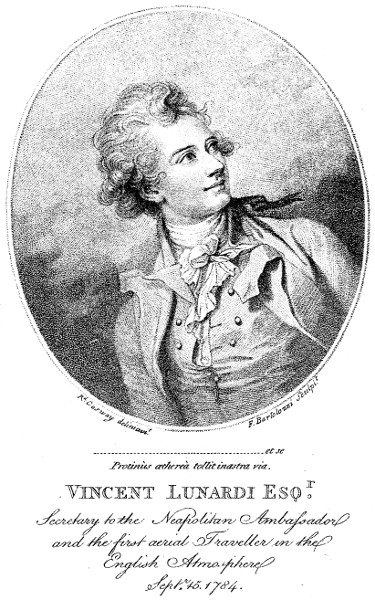
... et se Protinus æthereà tollit inastra via.
Vincent Lunardi Esqr.
Secretary to the Neapolitan Ambassador and the first aerial Traveller in the English Atmosphere Septr. 15. 1784.
Publish’d Octr 5th 1784 by John Bell British Library Strand
Towards the end of the eighteenth century[74] the Adam and Eve began to be hemmed in by buildings; by Brook Street (now Stanhope Street) on the west, and by Charles Street (now Drummond Street, western end) on the north. The gardens however appear to have retained their old dimensions,[75] and at that time extended as far north as Charles Street.[76]
The thousands of honest holiday-makers who visited the gardens had, however, towards the end of the eighteenth century, been replaced by a motley crew of highwaymen, footpads and low women,[77] and in the early years of the present century (before 1811) the magistrates interfered: “the organ was banished, the skittle grounds destroyed, and the gardens dug up for the foundation of Eden Street.”
About 1813 the Adam and Eve Tavern and Coffee House, once more respectably conducted, was a one-storied building. Part of it fronted the New (Euston) Road, while an archway in the Hampstead Road led to the other parts of the premises. A detached gabled building, originally part of the domestic offices of the old Tottenhall Manor House, was still standing at this time and was used as a drinking parlour in connection with the Adam and Eve. Six small houses and shops also adjoined the tavern and brought the proprietor about £25 each a year in rent, though they are said to have been partly constructed out of the boxes in the old tea-gardens.
The large public-house called the Adam and Eve, which now stands on the old site at the corner of the Euston and Hampstead Roads, was built in 1869.
Near the Adam and Eve was the Cold Bath in the New Road. It was in existence in 1785, when it was advertised[78] as in fine order for the reception of ladies and gentlemen. The bath was situated in the midst of a pleasant garden, and was constantly supplied by a spring running through it. The water was described as serviceable to persons suffering from nervous disorders and dejected spirits.
[Wilkinson’s Londina illust., i. “Tottenhall,” Nos. 92, 93; Hone’s Year Book, p. 47, cp. p. 317; Walford, iv. 477; v. 303 ff.; Palmer’s St. Pancras, p. 204, ff.; Larwood and Hotten, Signboards, 257, 258; Brayley’s Londiniana, ii. p. 165; Cunningham’s London (1850), “Tottenham Court Road”; F. Miller’s St. Pancras, p. 161; Wheatley’s London, “Tottenham Court Road” and “Adam and Eve.”]
VIEWS.
1. The scene of Hogarth’s March to Finchley (see Nichols’s Hogarth, i. 155, ff.) is laid at the Tottenham Court Turnpike, at the south end of the Hampstead Road. On the right is the King’s Head tavern, and on the left the Adam and Eve. The sign of Adam and Eve appears on a post in the road, and Hogarth has inscribed it “Tottenham Court Nursery,” in allusion to Broughton’s amphitheatre for boxing that existed here (see Walford, v. 304).
2. Two views in Wilkinson’s Londina, i. “Remains of the Manor House denominated the lordship of Toten-hall, now vulgarly called Tottenham Court, and occupied by the Adam and Eve Tea House and Gardens.” Shepherd del., Wise sculp. (published 1813). Beneath this is a plan of the vicinity marking Eden Street, ii. Part of the Adam and Eve coffee rooms, Hampstead Road, J. Carter del., Wise sculp. (published 1811).
3. A woodcut in Hone’s Year Book, p. 47, of the Adam and Eve (before 1825), substantially the same as Wilkinson’s second view. The views in Wilkinson and Hone show the Adam and Eve in its altered condition after the proprietor Greatorex (end of eighteenth century?) had made an addition to the tavern, fronting the New Road.
THE PEERLESS POOL
The Peerless Pool should, in strictness, be described in a history of sports and pastimes, but as a pleasant summer resort, an oasis in the regions of Old Street and the City Road, it must be allowed a place in the present volume.
In ground immediately behind St. Luke’s Hospital (built 1782–84), Old Street, was one of the ancient London springs which had formed, by its overflowings, a dangerous pond, referred to,[79] as early as 1598, as the “clear water called Perillous Pond, because divers youths by swimming therein have been drowned.”
In the seventeenth century it was apparently resorted to for the favourite amusement of duck-hunting: “Push, let your boy lead his water spaniel along, and we’ll show you the bravest sport at Parlous Pond” (Middleton’s Roaring Girl, 1611).
In 1743, William Kemp, a London jeweller, who had derived benefit from his plunges in its water, took the Parlous Pond in hand. He embanked it, raised the bottom, changed its name to Peerless Pool, and opened it to subscribers as a pleasure bath. In the adjacent ground, of which he held the lease, he introduced other attractions: in particular he constructed a fish-pond, 320 feet long, 90 feet broad, and 11 feet deep, and stocked it with carp, tench, and other fish. The high banks of this were thickly covered with shrubs, and on the top were walks shaded by lime trees. To the east of the fish-pond was a Cold Bath (distinct from the Pool) 36 feet long and 18 feet broad,[80] supplied by a spring. The Peerless Pool itself as contrived by Kemp was an open-air swimming-bath, 170 feet long, more than 100 feet broad, and from 3 to 5 feet deep. It was nearly surrounded by trees, and the descent was by marble steps to a fine gravel bottom, through which the springs that supplied the pool came bubbling up. The entrance was from a bowling-green on the south side, through a marble saloon (30 feet long) which contained a small collection of light literature for the benefit of subscribers to the Pool. Adjoining this were the dressing boxes.
The place became, from about the middle of the eighteenth century, a favourite resort of London anglers and swimmers, and many London merchants and persons of good position were among the subscribers. An annual payment of one guinea entitled subscribers to the use of the baths, and to the diversion of “angling and skating at proper seasons.” Occasional visitors paid two shillings each time of bathing.
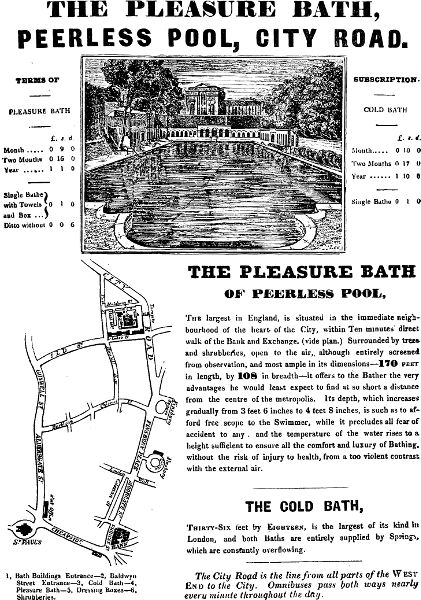
THE PLEASURE BATH, PEERLESS POOL, CITY ROAD.
TERMS OF SUBSCRIPTION.
PLEASURE BATH
£. s. d.
Month 0 9 0
Two Months 0 16 0
Year 1 1 0
Single Bathe with Towels and Box 0 1 0
Ditto without 0 0 0
COLD BATH
£. s. d.
Month 0 10 0
Two Months 0 17 0
Year 1 10 0
Single Bathe 0 1 0
THE PLEASURE BATH OF PEERLESS POOL,
The largest in England, is situated in the immediate neighbourhood of the heart of the City, within Ten minutes’ direct walk of the Bank and Exchange. (vide plan.) Surrounded by trees and shrubberies, open to the air, although entirely screened from observation, and most ample in its dimensions—170 FEET in length, by 108 in breadth—it offers to the Bather the very advantages he would least expect to find at so short a distance from the centre of the metropolis. Its depth, which increases gradually from 3 feet 6 inches to 4 feet 8 inches, is such as to afford free scope to the Swimmer, while it precludes all fear of accident to any, and the temperature of the water rises to a height sufficient to ensure all the comfort and luxury of Bathing, without the risk of injury to health, from a too violent contrast with the external air.
THE COLD BATH,
Thirty-Six feet by Eighteen, is the largest of its kind in London, and both Baths are entirely supplied by Springs, which are constantly overflowing.
The City Road is the line from all parts of the West End to the City. Omnibuses pass both ways nearly every minute throughout the day.
1, Bath Buildings Entrance—2, Baldwyn Street Entrance—3, Cold Bath—4, Pleasure Bath—5, Dressing Boxes—6, Shrubberies.
BILL OF PEERLESS POOL. Circ. 1846.
About 1805 Mr. Joseph Watts (father of Thomas Watts, the well-known Keeper of Printed Books at the British Museum) obtained a lease of the place from St. Bartholomew’s Hospital at a rental of £600 per annum, and eventually saw his way to a profit by building on part of the ground. He drained the fish-pond which lay due east and west, and built the present Baldwin Street on the site. The old-fashioned house inhabited by Kemp, which stood in a garden and orchard of apple and pear trees overlooking the west end of the fish-pond, Watts pulled down, erecting Bath Buildings on the spot.[81] The pleasure bath and the cold bath he, however, continued to open to the public at a charge of one shilling, and Hone gives a pleasant description of it as it was (still in Watts’s proprietorship) in 1826. “Its size,” he says, “is the same as in Kemp’s time, and trees enough remain to shade the visitor from the heat of the sun while on the brink.” “On a summer evening it is amusing to survey the conduct of the bathers; some boldly dive, others ‘timorous stand,’ and then descend, step by step, ‘unwilling and slow’; choice swimmers attract attention by divings and somersets, and the whole sheet of water sometimes rings with merriment. Every fine Thursday and Saturday afternoon in the summer, columns of blue-coat boys, more than three score in each, headed by their respective beadles, arrive, and some half strip themselves ere they reach their destination; the rapid plunges they make into the Pool, and their hilarity in the bath, testify their enjoyment of the tepid fluid.”
The Pool was still frequented in 1850,[82] but at a later time was built over. Its name is kept locally in remembrance by Peerless Street, the second main turning on the left of the City Road, just beyond Old Street, in coming from the City. This street was formerly called Peerless Row, and formed the northern boundary of the ground laid out by Kemp.[83]
[Maitland’s Hist. of London, i. p. 84, ff.; Dodsley’s London, “Peerless Pool”; Noorthouck’s London, p. 756, ff.; Trusler’s London Adviser (1786), p. 124; Hone’s Every Day Book, i. p. 970, ff.; Pennant’s London, p. 268; Wheatley’s London P. and P. iii. s.v.; newspaper cuttings, &c., W. Coll.]
VIEWS.
1. Two woodcuts (pleasure bath and fish-pond) from drawings, circ. 1826, by John Cleghorn in Hone’s Every Day Book (cited above).
2. View of Peerless Pool Bath and Gardens in 1848; coloured drawing by Read. Crace, Cat., p. 608, No. 9.
3. The Pleasure Bath, Peerless Pool. An advertisement bill with woodcut of the bath, surrounded by trees and shrubberies, and a plan of the vicinity (1846?), W. Coll.; cp. Crace, Cat., p. 608, No. 8.
THE SHEPHERD AND SHEPHERDESS, CITY ROAD
The Shepherd and Shepherdess ale-house stood on or near the site afterwards occupied by the well-known Eagle Tavern in the City Road and Shepherdess Walk.
It was built at some time before 1745, and its gardens were frequented in the last century by visitors, who regaled themselves with cream, cakes and furmity. Invalids sometimes stayed at the Shepherd and Shepherdess[84] to benefit by the pure air of the neighbourhood. The City Road (opened in 1761) was cut through the meadow-grounds that surrounded the inn. The place gradually lost its rural isolation, but it is found enumerated among the tea-gardens resorted to by Londoners of the “middling classes” in the first quarter of the nineteenth century.
The Shepherd and Shepherdess appears to have been pulled down about 1825, at which time Thomas Rouse built on or near its site the Eagle Tavern (rebuilt 1838) which formed the nucleus of the famous Eagle establishment with its Grecian saloon and theatre, its gardens and dancing pavilion. The tavern, grounds and theatre were purchased by “General” Booth in 1882, and have since been occupied by the Salvation Army.[85]
[Larwood and Hotten, Signboards, 352, 353; Picture of London, 1802 and 1823; Walford, ii. 227, 274.]
THE SPRING GARDEN, STEPNEY
This Spring Garden was situated a little distance to the north of the Mile End Road and its eastern side abutted on what is now Globe Road.
It was in existence at least as early as 1702, and at that period seems to have been sometimes known as the Jews’ Spring Garden,[86] probably because it was owned or frequented by some of the wealthy Jews who at that time and long afterwards resided in Goodman’s Fields and the neighbourhood. There was a tavern attached to the gardens, the keeper of which, in 1743, was a Mr. Dove Rayner,[87] described as a man of “agreeable mirth and good humour.”
The garden continued to exist till 1764 when we hear of it as a Sunday evening resort of holiday-makers,[88] but it does not appear to be mentioned at a later date.
In Horwood’s Plan (G) of 1799 the garden (or its site), together with a few buildings, is marked as Spring Garden Court. Later on, in the present century, the ground was known as Spring Grove. Nicholas Street and Willow Street, between Globe Road and St. Peter’s Road on the west, now appear to occupy part of the site.
About the middle of the last century Stepney is described as[89] a village consisting principally of houses of entertainment to which vast crowds of people of both sexes resorted on Sundays and at Easter and Whitsuntide, to eat Stepney buns and drink ale and cyder.
One of these inns was known as The Treat; and there is a print[90] of it, dated 1760, inscribed with the couplet:—
At Stepney now with cakes and ale, Our tars their mistresses regale.