IV HAMPSTEAD GROUP
Reading edition
HAMPSTEAD WELLS
The outlet of the once famous spring of Hampstead is at the present time to be found on the north side of Well Walk, and the water now trickles out slowly into a basin, which forms part of a modern fountain. The earliest mention of the spring occurs in the time of Charles II. when one Dorothy Rippin appears to have made some profit by the sale of the water, as she issued a halfpenny token which has on its obverse the words, Dorothy Rippin at the Well in Hamsted, and a representation of a well and bucket.[185] The well was in 1698 on the estate of Susanna Noel and her son Baptist, third Earl of Gainsborough, and was given by them conjointly on 20th December of that year, together with six acres of land, for the benefit of the Hampstead poor. A tablet on the present fountain records this gift.
The first to draw attention to the medicinal value of the water, was a well-known physician, Dr. Gibbons,[186] who in the early part of the eighteenth century described it as being as fully efficacious as any chalybeate water in England.
In April 1700 the water was advertised as being of the same nature and virtue as that at Tunbridge Wells, and was sold by Phelps, an apothecary, at the Eagle and Child in Fleet Street, for threepence a flask. It was also obtainable from the lessee of the Wells at the Black Posts, King Street, near the Guildhall; at Sam’s Coffee House, Ludgate Hill, and at several other places in the City.
From this time there grew up around the spring various places of entertainment—a tavern[187] and coffee room, a bowling green and raffling shops, and, as will be presently seen, a chapel.
The chief building was the Great Room situated on the south side of Well Walk, about one hundred yards from the East Heath. It was a large house lit with long windows, and within its walls took place concerts and dances for the amusement of the Wells visitors up to 1733. The first recorded entertainment was given therein 1701 (18 August), when there was a “consort” of both vocal and instrumental music by the “best masters.” The performance began at ten o’clock in the morning, and dancing took place in the afternoon. The tickets for the dancing cost sixpence, and one shilling was charged for the concert. In September of the same year, another concert was given at eleven o’clock, at which one Jemmy Bowen sang and two men performed on the violin. There was dancing in the afternoon as usual. These performances were continued every Monday during the season. “Very good music for dancing all day long” was announced for 12 May, 1707, and on 22 July, 1710, a girl of nine, a pupil of Mr. Tenoe, sang several operatic songs, and this performance began at five for the “conveniency of gentlemen’s returning.” The admission was two shillings and sixpence.
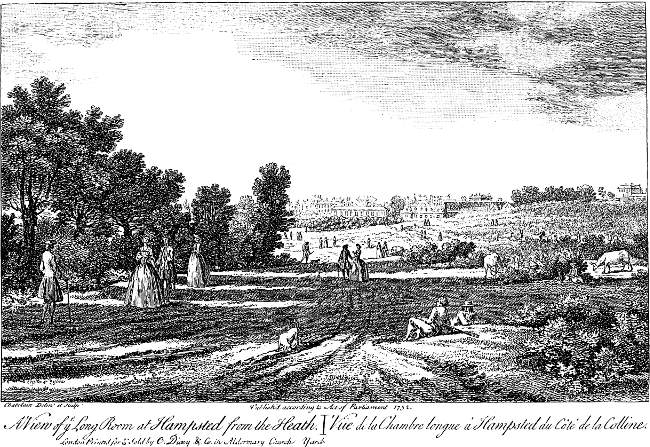
A View of ye Long Room at Hampstead from the Heath. | Vue de la Chambre longue à Hampstead du Côté de la Colline.
In the vicinity of the Great Room, stood Sion Chapel,[188] where couples on presenting a license and the sum of five shillings could be married at any time. A clergyman was always in attendance, and if the newly married would take their wedding dinner in the garden of the tavern nothing beyond the license was required. In 1716 the chapel was referred to as a “private and pleasure place” where many persons of the best fashion were married. It may be suspected, however, that the marriages were often, like those at the Fleet and Mayfair, irregular, and that the license was occasionally dispensed with.
During the first ten or twenty years of the eighteenth century, Hampstead Wells presented a gay and varied scene. When tired of the music and dancing in the Great Room, the visitor could adjourn to the bowling green, or to the raffling shops, where the cards were flying and the dice rattling, while fine gentlemen lost their money with “ease and negligence.” There was the promenade in Well Walk beneath the avenue of limes, or a stroll might be taken on the breezy Heath. Court ladies were there “all air and no dress”; city ladies all dress and no air, and country dames with “broad brown faces like a Stepney bun.” Citizens like Mr. Deputy Driver in the comedy[189] came down from town, perhaps to find their ladies coquetting with a beau, or retired to picquet with some brisk young Templar. “This Hampstead’s a charming place,” exclaims Arabella the citizen’s wife: “To dance all night at the Wells; be treated at Mother Huff’s,[190] have presents made one at the raffling shops, and then take a walk in Cane Wood with a man of wit that’s not over rude.”
With this gay and fashionable throng there mingled company of a lower class, such as the Fleet Street sempstresses who danced minuets “in their furbeloe scarfs” and ill-fitting clothes. By about 1724 the more rakish and disreputable element had become predominant.[191] Bad characters came from London in “vampt up old cloaths to catch the apprentices.” Lord Lovemore might still court his “mimic charmer”[192] there, but modest people did not care to join the company on the walks. The playing and dicing were kept up as formerly, but gentlemen no longer lost with ease and negligence, and one sharper tried to cheat another. In 1733 the Great Room was converted into an Episcopal Chapel and was used for church services until 1849. In 1869 the West Middlesex Volunteers occupied the building. About 1880 it was demolished, and to-day a modern red brick house in Well Walk (erected in 1892), and the entrance to Gainsborough Gardens occupy the site. A tablet on the house testifies that the “Old pump room” (i.e. Great Room) once stood on the spot.
In 1734 Dr. John Soame published a pamphlet in which he extolled with somewhat suspicious optimism the virtues of the neglected spring, recommending the water for cutaneous affections and nervous disorders. According to Soame, the spring[193] then threw off water at the rate of five gallons in four minutes, and could be made to throw a stream upwards to a height of at least twelve feet. “The Beautys of Hampstead,” a song of this period, extols the “Chrystal bub’ling Well,”[194] but the water-drinking does not appear again to have become the vogue, though as a place of amusement the Wells still enjoyed some degree of popularity. Another assembly-house, known as the Long Room, took the place of the old Great Room. This was a substantial red brick building of one storey. The ground floor consisted of an entire room with two small ante-rooms, one on either side of the entrance, used for tea-parties and card-playing. The floor above was divided up into rooms, where a cosy supper or a game of cards might be enjoyed. The house (probably built, in part, in the seventeenth century) still exists, and is to be found on the opposite side to the old Great Room, about a hundred yards further down Well Walk, going from the Heath. It is now a private residence called Weatherall House. It was in the Long Room that the Hampstead Balls took place of the kind described by Frances Burney. Here Evelina[195] was worried by Beau Smith, and refused the offers of “inelegant and low-bred” partners, who “begged the favour of hopping a dance” with her. Samuel Rogers (Table Talk) says that in his youth (circ. 1783) the Hampstead Assemblies were frequented by “a great deal of good company,” and that he himself danced four or five minuets there in one evening.
In 1802 a surgeon named John Bliss published a treatise, in which, without success, he endeavoured once more to awaken an interest in the medicinal properties of the Well. Mr. Keates, consulting chemist to the Metropolitan Board of Works, in recent times stated that it was a distinctly chalybeate water containing sufficient iron to render it capable of producing marked therapeutic effects. It was extremely pure, and in general character, though with a larger proportion of iron, resembled that of Tunbridge Wells.[196]
[Dodsley’s London (1761); Ambulator, 1774; Kearsley’s Strangers’ Guide (1793?); Walford, v. 467, ff.; Thorne’s Environs of London (1876), 281; Sir Gilbert Scott’s Proposed Destruction of the Well Walk (Hampstead, 1879), with plan of Well Walk; Park’s Hampstead; Baines’s Hampstead.]
VIEWS.
1. The Pump-room, Well Walk (i.e. Great Room), since, the Episcopal Chapel, in Baines’s Hampstead, from a drawing by Blanche Cowper Baines, after E. H. Dixon.
2. The old Well Walk, Hampstead, about 1750 (Walford, v. 463).
3. A view of “Ye Long Room at Hampstead from the Heath.” Chatelain del. et sculp. 1752 (W. Coll.).
4. Well Walk, engraving in Howitt’s Northern Heights, from a photograph.
5. Well Walk in 1870 in Baines’s Hampstead, from a sketch by Walter Field.
THE SPANIARDS
The old Spaniards inn, still standing on the north side of the road between the upper and lower Heath of Hampstead, deserves a brief mention, seeing that about the middle of the eighteenth century or earlier, it had attached to it a curious garden laid out by one William Staples, who was probably the keeper of the inn.[197]
A contemporary account describes how “out of a wild and thorny wood full of hills, valleys, and sandpits,” the ingenious Mr. Staples “hath now made pleasant grass and gravel walks, with a mount, from the elevation whereof the beholder hath a prospect of Hanslope steeple in Northamptonshire, within eight miles of Northampton; of Langdon hill, in Essex, full sixty miles east,” and of other eminences, the visibility of which was perhaps less mythical.
The walks and plats were ornamented with a number of curious devices picked out with pebble stones of variegated colours. There were over forty of these quaint designs, such as the sun in its glory, the twelve signs of the Zodiac, the Tower of London, the grand colossus of Rhodes, the pathway of all the planets, the spire of Salisbury, Adam and Eve, the shield of David, the Egyptian pyramids, and an Egyptian sphinx: an odd association of things earthly and celestial.
Towards the end of the eighteenth century the Spaniards was much resorted to, especially on Sundays.[198] During the Gordon Riots of 1780, its landlord, Giles Thomas, is said to have arrested the progress of the mob bent on the destruction of Caen Wood House, Lord Mansfield’s residence, hard by, through rolling out his beer barrels into the road, and setting them abroach, thus gaining time to summon the military for the defence of the house.
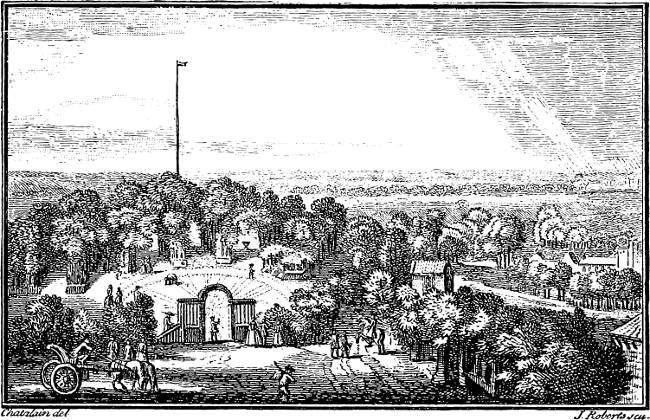
SOUTH VIEW OF THE SPANIARDS, 1750.
In the present century, though the mount and the pebbled plots had disappeared, the Spaniards gardens were rendered attractive by a bowling-green, and by pleasant arbours and parterres: it was resorted to by many a party of tea-drinkers like that of Mr. Raddle, Mrs. Bardell and her friends.[199]
[Park’s Hampstead; Baines’s Hampstead; Walford, v. 445, ff.; Thorne’s Environs of London, 1876.]
VIEWS.
1. The south view of the Spaniards (showing the garden as laid out by Staples) near Hampstead (Chatelain del., J. Roberts sculp. 1750, W. Coll., reproduced in Chambers’s Book of Days, ii. 71).
2. The Spaniards Tavern, Hampstead, Middlesex, drawn and engraved for Dugdale’s England and Wales.
3. View of the inn as at present, Walford, v. 445.
4. “View of a skittle ground at Hampstead” (either the Spaniards or Jack Straw’s Castle), Woodward’s Eccentric Excursions, coloured print, pl. iv. p. 14 (1796).
NEW GEORGIA
New Georgia was situated in Turner’s Wood to the north-east of the Spaniards tavern, Hampstead, and at the northern extremity of the road opposite the western lodge of Caen Wood. It was a wooden cottage, two storeys high, irregularly constructed, and standing in a wilderness and garden laid out “in a delightful romantic taste.” The proprietor, Robert Caston, built the cottage in 1737, and opened New Georgia to the public.
He was his own architect, builder, and gardener, and probably compared his labours to those of the founders of the American colony of Georgia established in 1733. An inscription on the cottage explained the origin of New Georgia as follows:—“I Robert Caston, begun this place in a wild wood, stubbed up the wood, digged all the ponds, cut all the walks, made all the gardens, built all the rooms, with my own hands; nobody drove a nail here, laid a brick or a tile, but myself, and thank God for giving me such strength, being sixty-four years of age when I begun it.”
Tea was supplied in the cottage or the gardens, but the chief attractions were a number of mechanical oddities set in motion in the garden and in the various little rooms into which the house was divided. London shopkeepers, like Zachary Treacle,[200] often made their way to the place on Sunday afternoons, and were diverted by reptiles that darted forth when a board or spring was trodden upon, by a chair that collapsed when sat upon, and by various contrivances of water-works.
The more boisterous, who on other Sundays delighted in a roll down the hill in Greenwich Park, found amusement in thrusting their heads into the New Georgia pillory to receive in that position the kisses of the ladies. A thickly-planted maze was another source of diversion.
The place does not appear to have been frequented after about 1758, and was subsequently (before 1795)[201] enclosed in the estate of Lord Mansfield.
[Gent. Mag. 1748, vol. 18, 109; The Connoisseur, No. 26, 25 July, 1754; The Idler, No. 15, 22 July, 1758; Lysons’s Environs, ii. 527; Lambert’s London (1806), iv. 255; Park’s Hampstead; Prickett’s Highgate, 72, ff. Walford, v. 446.]
VIEWS.
New Georgia is clearly marked in Rocque’s Survey, 1745, but there appear to be no views.
BELSIZE HOUSE
Belsize House was a large Elizabethan mansion, modified in the time of Charles II. Pepys, who visited it in 1668 (17 August) when it was the residence of Lord Wotton, describes its gardens as “wonderful fine: too good for the house the gardens are, being, indeed, the most noble that ever I saw, and brave orange and lemon trees.”[202]
The house was a private residence until 1720, when it was converted into a place of public amusement, under the management of a Welshman named Howell. At this time it was a somewhat imposing structure, with wings, and a tower in the centre. The entrance was by a door placed between the wings, and also by an external staircase at one wing.
The inaugural entertainment took place about April, 1720, and consisted of an “uncommon solemnity of music and dancing.” The place was usually open from 6 a.m. till 8 p.m., without charge for admission. The Park, Wilderness and Garden, about a mile in circumference, were advertised (about 1721?), as being wonderfully improved and filled with a variety of birds, “which compose a most melodious and delightful harmony.” Those who wished for an early stroll in the park could “breakfast on tea or coffee as cheap as at their own chambers.” As the journey from London was not unattended with risks, twelve stout fellows (afterwards increased to thirty), completely armed, were announced as “always at hand to patrol timid females or other.”
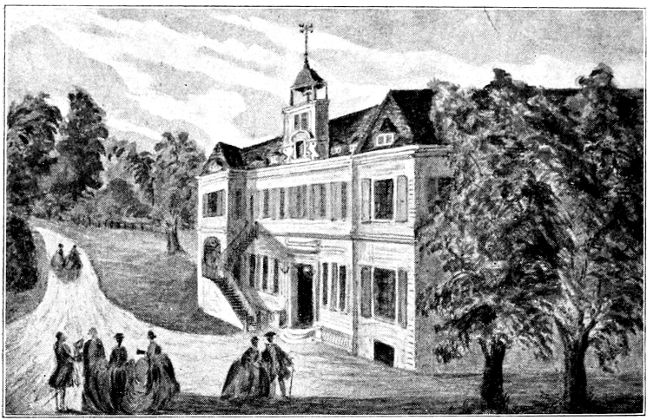
BELSIZE HOUSE AND PARK.
Belsize became a fashionable rendezvous. In July 1721 the Prince and Princess of Wales, attended by several persons of rank, dined at the house, and were entertained with hunting and other diversions. In June, 1722, on the occasion of a wild deer hunt, three or four hundred coaches brought down the “Nobility and Gentry” from town. Athletic sports were introduced, and the proprietor gave a plate of several guineas to be run for by eleven footmen (1721). Gambling and intrigue were the less wholesome results of this influx of the nobility and gentry. In May 1722 the Justices took steps to prevent the unlawful gaming, while in the same year “A serious Person of Quality” published a satire called Belsize House, in which he undertook to expose “the Fops and Beaux who daily frequent that Academy,” and also the “characters of the women who make this an exchange for assignations.”
This house, which is a nuisance to the land Doth near a park and handsome garden stand Fronting the road, betwixt a range of trees Which is perfumed with a Hampstead breeze. The Welsh Ambassador has many ways Fool’s pence, while summer season holds, to raise. For ’tis not only chocolate and tea, With ratafia, bring him company. Nor is it claret, Rhenish wine or sack The fond and rampant Lords and Ladies lack Or ven’son pasty for a certain dish With several varieties of fish; But hither they and other chubs resort To see the Welsh Ambassador make sport, Who in the art of hunting has the luck To kill in fatal corner tired buck, The which he roasts and stews and sometimes bakes, Whereby His Excellency profit makes. He also on another element Does give his choused customers content With net or angling rod, to catch a dish Of trouts or carp or other sorts of fish.
The Welsh Ambassador was the nickname of the proprietor, James Howell, an enterprising though not very reputable person, who had once been imprisoned for some offence in Newgate.
Races[203] and similar amusements continued for several years to be provided, and music was performed every day during the season. In the spring of 1733 (31 May) a race was advertised for ponies twelve hands six inches high. The length of the race was six times round the course; “Mr. Treacle’s black pony,” which distinguished itself by winning the plate at Hampstead Heath in the previous year, being excluded.
In 1736 a fat doe was advertised to be hunted to death by small beagles, beginning at nine in the morning, and sportsmen were invited to bring their own dogs, if “not too large.” In the same year (16 September) a boys’ race was run, beginning at three o’clock, six times round the course: a prize of one guinea was given to the winner, and half a guinea to the second runner. “Each person to pay sixpence coming in, and all persons sitting on the wall or getting over will be prosecuted.”
For an afternoon in August 1737, there was announced a running match six times round the park, between “the Cobler’s Boy and John Wise the Mile-End Drover,” for twenty guineas. In 1745 there were foot-races in the park, and this is the last notice we have of Belsize as a place of amusement.
The mansion falling into a ruinous state[204] was pulled down at the close of the eighteenth century (before 1798), and a large, plainly-built house was erected in its stead. From 1798–1807 this new Belsize House was tenanted by the Right Hon. Spencer Perceval and others. In the autumn of 1853 the house was pulled down (cp. The Illustrated London News for 9th September, 1854, p. 239), and the buildings of the Belsize Estate were subsequently erected on the site of the Park.
The present Belsize Avenue (on the west side of Haverstock Hill) is the representative of a beautiful avenue of elms, which originally led up to the old Belsize House, the site of which was near the present St. Peter’s Church.
[Palmer’s St. Pancras, 227, ff.; Baines’s Hampstead; Walford v. 494, ff.; Howitt’s Northern Heights; Lambert’s London, 1806, iv. 256; Thorne’s Environs of London, s.v. “Hampstead”; Park’s Hampstead; newspaper advertisements, W. Coll.]
VIEWS.
1. Old Belsize House. A view on a Belsize House advertisement, circ. 1721? and a view by Maurer, 1750; cp. Howitt’s Northern Heights and C. Knight’s Old England, ii. fig. 2404.
2. Belsize House in 1800 (Walford, v. 492).
KILBURN WELLS
The spring known as Kilburn Wells was situated in the Abbey Field near the site of the old Kilburn Priory, and in the rear of the Bell Tavern. It attracted public notice about the middle of the last century;[205] and some endeavours were made, probably by the proprietor of the Bell, to bring Kilburn Wells into vogue: at any rate, in 1752 it is referred to as a place in some respects akin to Sadler’s Wells:—
Shall you prolong the midnight ball With costly supper at Vaux Hall, And yet prohibit earlier suppers At Kilburn, Sadler’s Wells or Kupers?[206]
About 1773 Kilburn Wells began to be more widely known, and the proprietor’s advertisement of 17 July in that year announced that the water was then in the utmost perfection, the gardens enlarged and greatly improved, and the house and offices “repainted and beautified in the most elegant manner.” The Great Room was described as specially adapted for “the use and amusement of the politest companies” who might require it for music, dancing, or entertainments. “This happy spot is equally celebrated for its rural situation, extensive prospects, and the acknowledged efficacy of its waters; is most delightfully situated on the site of the once famous Abbey of Kilburn on the Edgware Road, at an easy distance, being but a morning’s walk from the metropolis, two miles from Oxford Street; the footway from Marybone across the fields still nearer. A plentiful larder is always provided, together with the best of wines and other liquors. Breakfasting and hot loaves.”
An account of the medicinal water drawn up by the usual “eminent physician” was given away to visitors, and in one of the rooms was a long list of the diseases said to have been cured. Tn 1792 Godfrey Schmeisser made a careful analysis of the water. It was a mild purgative, milky in appearance, and had a bitterish saline taste. The use of the water for curative purposes appears to have ceased in the early part of the present century (before 1814), but the Old Bell, or Kilburn Wells as the place was generally denominated, enjoyed popularity as a tea-garden as late as 1829.[207]
About 1863 the Old Bell was pulled down, and the present Bell public-house erected on the spot. A brick reservoir long enclosed the spring, but some years ago it was demolished and built over. It stood immediately behind the Bank at the corner of Belsize Road.
[Thorne’s Environs of London; Lambert’s London, iv. 288; Howitt’s Northern Heights; Baines’s Hampstead; Park’s Hampstead; Walford, v. 245, ff.]
VIEWS.
1. The Bell Inn, Kilburn, 1750 (Walford, v. 246).
2. The Bell Inn, Kilburn, from a mezzotint, 1789, reproduced in Baines’s Hampstead.
3. View of the Old Bell Inn at Kilburn on the Edgware Road. Rathbone del. Prestal sculp. 1789. Crace, Cat. p. 670, No. 76.
4. An engraved handbill, describing the waters, at the top of which is a print of the Long Room, by F. Vivares; mentioned in Park’s Hampstead, p. xxxi*, additions.