Chapter VII · LEADER AND STATESMAN.
Reading edition
As a politician, General Garfield was peculiar. In fact, he was scarcely a politician at all. The title of this chapter tells what he was. While he was in Europe the inflation cry was raised. Greenbacks were good. The Government printing-presses were idle. Why not put the presses at work making more greenbacks? There were plenty of worthy, industrious men, who were poor. Why not have money enough to place every one in comfortable circumstances? What a capital idea! Why had no one thought of it before? The West, and particularly Ohio, laughed aloud with pleasure at the new fountain of wealth which had been right under the people’s noses all the time, and no one ever suspected it. In order to make things even all around, it was the thing to do to make the bondholders take greenbacks instead of gold for their bonds. If they objected, no matter; they could stand it. Ohio Republicans took up this battle cry. General Garfield’s constituents were for inflation with all their hearts. As for himself he had, in March, 1866, declared for hard money, and for the payment of the bonds in gold. Congressmen have to go to the country every two years, so that the popular sentiment may be constantly represented in the Lower House of Congress. Garfield had been reëlected three times. To secure another election, most men would have found their political opinions, about election time, gradually coming around to those of the people. Read the following extract from a letter by General Garfield to his confidential friend, Hinsdale, written March 8, 1868:
“The State convention at Columbus has committed itself to some financial doctrines that, if I understand them, I can not and will not indorse. If my 212constituents approve them, they can not approve me. Before many weeks my immediate political future will be decided. I care less about the result than I have ever cared before.”
How is that for independence?
But the private letter was only the preface to an expression of the same thing in public. When General Garfield came home his friends found that he was immovable on the financial question. A short time before the nominating convention he was about to return to Washington. Some friends at Jefferson arranged to give him a reception on the eve of his departure. There was to be some speech-making. His friends had urged him to let the financial question alone. The welcoming address contained some broad hints. The speaker hinted at the greenback platform, and delicately intimated that General Garfield’s return was conditioned upon his indorsement of the platform. Then the thunderer let fly. Garfield took up the question of finance, and, in the boldest terms, denounced the party platform as dishonest and despicable. He declared that if a life-time of office were offered him, with the understanding that he was to support the platform, he would refuse it at once. Then he took himself off to Washington. When the time for the convention came he was renominated, and a short time later elected.
It is impossible to even sketch the varied activities of the man from this time on, in Congress. His voluminous reports, his comprehensive debates on every leading subject, his immense and varied committee work, comprise a vast field, the very outline of which would surpass the limits of this work. No subject of national importance escaped his attention. Reconstruction, pensions, navigation, tariff, internal improvements, the census, education, the Indian question, corporations, the currency, national banks, public expenditures, civil service reform, railways, civil rights, polygamy, the Chinese—these are only a few of the great subjects which he mastered. His speeches are incomparable for their profound learning, their exhaustive research, their glowing rhetoric. They might serve as text-books upon the great governmental problems of the age. In looking over the record of the proceedings 213in Congress at this period, one can but be impressed with the marked superiority of his efforts over those of the large majority of his compeers. However worthy the utterances of these latter may be viewed alone, they are dwarfed by the forced comparison with the productions of his majestic mind. These speeches mark the man as a carefully trained intellectual giant, perfectly at home and a terror in the field of debate. They are of inestimable value now, as giving his intellectual biography.
On December 14, 1868, he introduced a bill “To strengthen the public credit.” This subsequently became a part of the great bill making our bonds payable in gold. Around this fortification of the public credit, for ten years, political warfare raged the fiercest, but the rampart was never taken; and, in 1879, when resumption was accomplished, the law still remained on the statute book. Every attempt to repeal it was fought by Garfield on the principles of political science, and his name must be placed with those of Grant and Sherman on this question.
February 26, 1869, General Garfield, as Chairman of the Military Committee, made the monster report upon the reorganization of the army. It contains one hundred and thirty-seven printed pages. The stupendous problem of readjusting the armies of the republic to a peace footing, had occupied Garfield for years. His report was the result of examinations of all the leading army officers. It contained the history of each department of the army. It illuminated all the dark corners, the secret channels, the hidden chambers of corruption which had been constructed in the military policy of the country, and was the product of enormous labor.
In the spring of 1869 General Garfield introduced a resolution for the appointment of a committee to examine into the necessities for legislation upon the subject of the ninth census, to be taken the following year. He was appointed chairman. His speeches on the great subject of statistics are most characteristic. They are wholly out of the rut of Congressional speeches. They show Garfield in the light of a political scientist. Nothing could more strikingly prove the enormous reach of his mind. He showed himself 214abreast of the scientific thought of the age. Volume after volume of the Congressional Globe will be searched in vain to find speeches from any other man which even approximate these studies in the region of social science. Nowhere in or out of Congress can be found so succinct and admirable a statement of the importance of statistics. Here is an extract from his first speech, made April 6, 1869:
“This is the age of statistics, Mr. Speaker. The word ‘statistics’ itself did not exist until 1749, whence we date the beginning of a new science on which modern legislation must be based, in order to be permanent. The treatise of Achenwall, the German philosopher who originated the word, laid the foundation of many of the greatest reforms in modern legislation. Statistics are state facts, facts for the consideration of statesmen, such as they may not neglect with safety. It has been truly said that ‘statistics are history in repose; history is statistics in motion.’ If we neglect the one, we shall deserve to be neglected by the other. The legislator without statistics is like the mariner at sea without the compass. Nothing can safely be committed to his guidance. A question of fearful importance, the well-being of this Republic, has agitated this House for many weeks. It is this: Are our rich men growing richer, and our poor growing poorer? And how can this most vital question be settled, except by the most careful and honest examination of the facts? Who can doubt that the next census will reveal to us more important truths concerning the situation of our people than any census ever taken by any nation? By what standard could we measure the value of a complete, perfect record of the condition of the people of this country, and such facts as should exhibit their burdens and their strength? Who doubts that it would be a document of inestimable value to the legislator and the nation? How to achieve it, how to accomplish it, is the great question.
“We are near the end of a decade that has been full of earthquakes, and amid the tumult we have lost our reckoning. We do not yet comprehend the stupendous changes through which we have passed, nor can we until the whole field is resurveyed. If a thousand volcanoes had been bursting beneath the ocean, the mariner would need new charts before he could safely sail the seas again. We are soon to set out on our next decade with a thousand new elements thrown in upon us by the war. 215The way is trackless. Who shall pilot us? The war repealed a part of our venerable census law. One schedule was devoted to slaves. Thank God! it is useless now. Old things have passed away, and a multitude of new things are to be here recorded; and not only the things to be taken, but the manner of taking them, requires a thorough remodeling at our hands. If this Congress does not worthily meet the demands of this great occasion, every member must bear no small share of the odium that justly attaches to men who fail to discharge duties of momentous importance, which once neglected can never be performed.”
On December 16, 1867, General Garfield made a second speech on the subject, so elaborate and remarkable, so unlike any thing to be found elsewhere in all the annals of the American Congress, that we yield large space to it. The latter part of the speech relates to the defects of the old law, and the advantages of the proposed new one:
“The modern census is so closely related to the science of statistics that no general discussion of it is possible without considering the principles on which statistical science rests and the objects which it proposes to reach.
“The science of statistics is of recent date, and, like many of its sister sciences, owes its origin to the best and freest impulses of modern civilization. The enumerations of inhabitants and the appraisements of property made by some of the nations of antiquity were practical means employed sometimes to distribute political power, but more frequently to adjust the burdens of war, but no attempt was made among them to classify the facts obtained so as to make them the basis of scientific induction. The thought of studying these facts to ascertain the wants of society had not then dawned upon the human mind, and, of course, there was not a science of statistics in this modern sense.
“It is never easy to fix the precise date of the birth of any science, but we may safely say that statistics did not enter its scientific phase before 1749, when it received from Professor Achenwall, of Göttingen, not only its name, but the first comprehensive statement of its principles. Without pausing to trace the stages of its growth, some of the results of the cultivation of statistics in the spirit and methods of science may be stated as germane to this discussion:
“1. It has developed the truth that society is an organism, whose elements 216and forces conform to laws as constant and pervasive as those which govern the material universe; and that the study of these laws will enable man to ameliorate his condition, to emancipate himself from the cruel dominion of superstition, and from countless evils which were once thought beyond his control, and will make him the master rather than the slave of nature. Mankind have been slow to believe that order reigns in the universe—that the world is a cosmos and not a chaos.
“The assertion of the reign of law has been stubbornly resisted at every step. The divinities of heathen superstition still linger in one form or another in the faith of the ignorant, and even intelligent men shrink from the contemplation of one supreme will acting regularly, not fortuitously, through laws beautiful and simple rather than through a fitful and capricious system of intervention.
“Lecky tells us that in the early ages it was believed that the motion of the heavenly bodies, as well as atmospheric changes, was affected by angels. In the Talmud, a special angel was assigned to every star and every element, and similar notions were general throughout the Middle Ages.
“The scientific spirit has cast out the demons, and presented us with nature clothed and in her right mind and living under the reign of law. It has given us, for the sorceries of the alchemist, the beautiful laws of chemistry; for the dreams of the astrologer, the sublime truths of astronomy; for the wild visions of cosmogony, the monumental records of geology; for the anarchy of diabolism, the laws of God. But more stubborn still has been the resistance against every attempt to assert the reign of law in the realm of society. In that struggle, statistics has been the handmaid of science, and has poured a flood of light upon the dark questions of famine and pestilence, ignorance and crime, disease and death.
“We no longer hope to predict the career and destiny of a human being by studying the conjunction of planets that presided at his birth. We study rather the laws of life within him, and the elements and forces of nature and society around him. We no longer attribute the untimely death of infants wholly to the sin of Adam, for we know it is the result of bad nursing and ignorance. We are beginning to acknowledge that—
“‘The fault, dear Brutus, is not in our stars,
But in ourselves, that we are underlings.’
Governments are only beginning to recognize these truths.
217“In 1853 the Presbytery of Edinburgh petitioned the British ministry to appoint a day of national fasting and prayer, in order to stay the ravages of cholera in Scotland. Lord Palmerston, the Home Secretary, replied in a letter which a century before no British statesman would have dared to write. He told the clergy of Scotland that: ‘The plague being already upon them, activity was preferable to humiliation; that the causes of disease should be removed by improving the abodes of the poor, and cleansing them from those sources of contagion which would infallibly breed pestilence and be fruitful in death in spite of all the prayers and fastings of a united but inactive nation.’ Henry Thomas Buckle expressed the belief that this letter will be quoted in future ages as a striking illustration of the progress of enlightened public opinion. But that further progress is possible is seen in the fact that within the last three years an English bishop has attributed the rinderpest to the Oxford essays and the writings of Colenso.
“In these remarks I disclaim any reference to the dominion of the Creator over his spiritual universe, and the high and sacred duty of all his intelligent creatures to reverence and worship him. I speak solely of those laws that relate to the physical, intellectual, and social life of man.
“2. The development of statistics is causing history to be rewritten. Till recently the historian studied nations in the aggregate, and gave us only the story of princes, dynasties, sieges, and battles. Of the people themselves—the great social body with life, growth, sources, elements, and laws of its own—he told us nothing. Now statistical inquiry leads him into the hovels, homes, workshops, mines, fields, prisons, hospitals, and all places where human nature displays its weakness and its strength. In these explorations he discovers the seeds of national growth and decay, and thus becomes the prophet of his generation.
“Without the aid of statistics, that most masterly chapter of human history, the third of Macaulay’s first volume, could never have been written.
“3. Statistical science is indispensable to modern statesmanship. In legislation as in physical science it is beginning to be understood that we can control terrestrial forces only by obeying their laws. The legislator must formulate in his statues not only the national will, but also those great laws of social life revealed by statistics. He must study society rather than black-letter learning. He must learn the truth ‘that society usually prepares the crime, and the criminal is only the instrument that 218accomplishes it;’ that statesmanship consists rather in removing causes than in punishing or evading results.
“Light is itself a great corrective. A thousand wrongs and abuses that grow in the darkness disappear like owls and bats before the light of day. For example, who can doubt that before many months the press of this country will burn down the whipping-posts of Delaware as effectually as the mirrors of Archimedes burned the Roman ships in the harbor of Syracuse?
“I know of no writer who has exhibited the importance of this science to statesmanship so fully and so ably as Sir George Cornwall Lewis, in his treatise On the Methods of Observation and Reasoning on Politics.
“After showing that politics is now taking its place among the sciences, and as a science its superstructure rests on observed and classified facts, he says of the registration of political facts, which consists of history and statistics, that ‘it may be considered as the entrance and propylæa to politics. It furnishes the materials upon which the artificer operates, which he hews into shape and builds up into a symmetrical structure.’
“In a subsequent chapter, he portrays the importance of statistics to the practical statesman in this strong and lucid language:
“‘He can hardly take a single safe step without consulting them. Whether he be framing a plan of finance, or considering the operation of an existing tax, or following the variations of trade, or studying the public health, or examining the effects of a criminal law, his conclusions ought to be guided by statistical data.’—Vol. i, p. 134.
“Napoleon, with that wonderful vision vouchsafed to genius, saw the importance of this science when he said:
“‘Statistics is the budget of things; and without a budget there is no public safety.’
“We may not, perhaps, go as far as Goethe did, and declare that ‘figures govern the world;’ but we can fully agree with him that ‘they show how it is governed.’
“Baron Quetelet, of Belgium, one of the ripest scholars and profoundest students of statistical science, concludes his latest chapter of scientific results in these words:
“‘One of the principal results of civilization is to reduce more and more the limits within which the different elements of society fluctuate. The more intelligence increases the more these limits are reduced, and the nearer we approach the beautiful and the good. The perfectibility of the 219human species results as a necessary consequence of all our researches. Physical defects and monstrosities are gradually disappearing; the frequency and severity of diseases are resisted more successfully by the progress of medical science; the moral qualities of man are proving themselves not less capable of improvement; and the more we advance, the less we shall have need to fear those great political convulsions and wars and their attendant results, which are the scourges of mankind.’
“It should be added that the growing importance of political science, as well as its recent origin, is exhibited in the fact that nearly every modern nation has established within the last half century a bureau of general statistics for the uses of statesmanship and science. In the thirty states of Europe they are now assiduously cultivating the science. Not one of their central bureaus was fully organized before the year 1800.
“The chief instrument of American statistics is the census, which should accomplish a two-fold object. It should serve the country by making a full and accurate exhibit of the elements of national life and strength, and it should serve the science of statistics by so exhibiting general results that they may be compared with similar data obtained by other nations.
“In the light of its national uses and its relations to social science, let us consider the origin and development of the American census.
“During the colonial period, several enumerations of the inhabitants of the Colonies were made by the order of the British Board of Trade; but no general concerted attempt was made to take a census until after the opening of the Revolutionary War. As illustrating the practical difficulty of census-taking at that time, a passage in a letter, written in 1715 to the Lords of Trade, by Hunter, the colonial governor of New York, may be interesting:
“‘The superstition of this people is so unsurmountable that I believe I shall never be able to obtain a complete list of the number of inhabitants of this province.’—New York Colonial MSS., vol. v, p. 459.
“He then suggests a computation, based upon returns of militia and of freemen, afterward the women and children, and then the servants and slaves.
“William Burnet, colonial governor of New Jersey, to the Lords of Trade, June 26, 1726, after mentioning returns made in 1723, says:
“‘I would have then ordered the like accounts to be taken in New 220Jersey, but I was advised it might make the people uneasy, they being generally of a New England extraction, and thereby enthusiasts; and that they would take it for a repetition of the same sin that David committed in numbering the people, and might bring on the like judgments. This notion put me off from it at the time, but since your lordships desire it, I will give the orders to the sheriffs, that it may be done as soon as may be.’
“That this sentiment has not wholly disappeared, may be seen from the following: At a public meeting held on the evening of November 12, 1867, in this city, pending the taking of the census of the District of Columbia by the Department of Education and the municipal authorities, a speaker, whose name is given in the reported proceedings, said:
“‘I regard the whole matter as illegal. Taking the census is an important matter. In the Bible we are told David ordered Joab to take the census when he had no authority to do so, and Joab was punished for it.’ He thought these parties, the Metropolitan police, should be enjoined from asking questions, and he advised those who had not returned the blank, not to fill it up or answer a single question.
“As early as 1775 the Continental Congress resolved that certain of the burdens of the war should be distributed among the Colonies, ‘according to the number of inhabitants of all ages, including negroes and mulattoes, in each colony;’ and also recommended to the several colonial conventions, councils, or committees of safety, to ascertain the number of inhabitants in each colony, and to make returns to Congress as soon as possible. Such responses as were made to this recommendation, were probably of no great value, and are almost wholly lost.
“The Articles of Confederation, as reported by John Dickinson, in July, 1776, provided for a triennial enumeration of the inhabitants of the States, such enumeration to be the basis of adjusting the ‘charges of war and all other expenses that should be incurred for the common defense or general welfare.’ The eighth of the articles, as they were finally adopted, provided that these charges and expenses should be defrayed out of a common treasury, to be supplied by the several States in ‘proportion to the value of land within each State granted to or surveyed for any person; and such land and the buildings and improvements thereon shall be estimated according to such mode as the United States, in Congress assembled, shall from time to time direct and appoint.’
“The ninth article gave Congress the authority ‘to agree upon the 221numbers of land forces, and to make requisitions from each of its quota in proportion to the number of white inhabitants in such State.’ These articles, unquestionably contemplated a national census, to include a valuation of land and an enumeration of population, but they led to no substantial results. When the blanks in the revenue report of 1783 were filled, the committee reported that they had been compelled to estimate the population of all the States except New Hampshire, Rhode Island, Connecticut, and Maryland.
“The next step is to the Constitutional Convention of 1787. The charter of Government, framed by that body, provided for a national census to be taken decennially. Moreau de Jonnés, a distinguished French writer on statistics, in his ‘Elements de Statistique,’ refers to the constitutional provision in the following elevated language:
“‘The United States presents in its history a phenomenon which has no parallel. It is that of a people who instituted the statistics of their country on the very day when they formed their Government, and who regulated in the same instrument the census of their citizens, their civil and political rights, and the destinies of the country.’
“De Jonnés considers the American census the more remarkable because it was instituted at so early a date by a people very jealous of their liberties; and he gives emphasis to his statement by referring to the heavy penalties imposed by the first law of Congress to carry these provisions into effect.
“It must be confessed, however, that the American founders looked only to practical ends. A careful search through the ‘Madison Papers’ has failed to show that any member of the Convention considered the census in its scientific bearings. But they gave us an instrument by which those ends can be reached. ‘They builded wiser than they knew.’
“In pursuance of the requirements of the Constitution, an act providing for an enumeration of the inhabitants of the United States was passed March 1, 1790.
“As illustrating the growth of the American census, it is worth observing that the report of the first census was an octavo pamphlet of fifty-two pages, and that of 1800, a folio of seventy-eight pages.
“On the 23d of January, 1800, a memorial of the American Philosophical Society, signed by Thomas Jefferson as its President, was laid before the Senate. In this remarkable paper, written in the spirit and interest of science, the memorialists prayed that the sphere of the census might be greatly extended; but it does not appear to have made any impression on the Senate, for no trace of it is found in the annals of Congress.
222
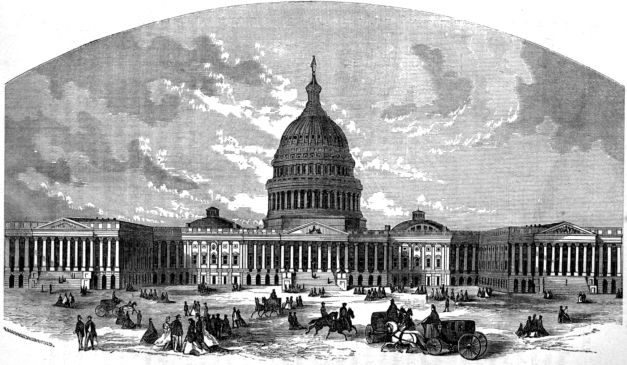
THE CAPITOL AT WASHINGTON.—THE SCENE OF GARFIELD’S LABORS FOR SIXTEEN YEARS.
223“The results attained by the first six censuses were meager for the purposes of science. That of 1790 embraced population only, its single schedule containing six inquiries. That of 1800 had only a population schedule with fourteen inquiries. In 1810, an attempt was made to superadd statistics of manufactures, but the results were of no value. In 1820 the statistics of manufactures were again worthless. In 1830 the attempt to take them was abandoned. In 1840 there were schedules of population and manufactures, and some inquiries relating to education and employment.
“The law of May 23, 1850, under which the seventh and eighth censuses were taken, marks an important era in the history of American statistics. This law owes many of its wisest provisions and much of the success of its execution to Mr. Joseph C. G. Kennedy, under whose intelligent superintendence the chief work of the last census was accomplished. This law marks the transition of the American census from the merely practical to the scientific phase. The system thus originated needs correction to make it conform to the later results of statistical science and to the wants of the American people. Nevertheless, it deserves the high commendations passed upon it by some of the most eminent statisticians and publicists of the Old World.”
In continuing his speech, General Garfield considered the defects in the method of taking the census. Among the many improvements suggested are the following:
“The war has left us so many mutilated men, that a record should be made of those who have lost a limb or have been otherwise disabled, and the committee have added an inquiry to show the state of public health and the prevalence of some of the principal diseases. Dr. Jarvis, of Massachusetts, one of the highest living authorities on vital statistics, in a masterly paper presented to the committee, urged the importance of measuring as accurately as possible the effective physical strength of the people.
“It is not generally known how large a proportion of each nation is wholly or partially unfitted by physical disability for self-support. The statistics of France show that, in 1851, in a population of less than 224thirty-six millions, the deaf, dumb, blind, deformed, idiotic, and those otherwise mutilated or disabled, amounted to almost two millions. We thus see that in a country of the highest civilization the effective strength of its population is reduced one-eighteenth by physical defects. What general would venture to conduct a campaign without ascertaining the physical qualities of his soldiers as well as the number on his rolls? In this great industrial battle, which this nation is now fighting, we ought to take every available means to ascertain the effective strength of the country.”
Farther on he says:
“An inquiry was also added in regard to dwellings, so as to exhibit the several principal materials for construction, as wood, brick, stone, etc., and the value of each. Few things indicate more fully the condition of the people than the houses they occupy. The average home is not an imperfect picture of the wealth, comfort, refinement, and civilization of the average citizen.”
The next paragraph is devoted to the question of determining the number of voters. The Fourteenth Amendment to the Constitution reduced a State’s representation in Congress to the measure of its votes. This was thought at the time to refer merely to the States where negroes were not allowed to vote, but Garfield found that in all the States, there were eighty restrictions in the right to vote, besides color and crime, ranging all the way from residence to education and character.
Under the topic of agricultural products, he said:
“It is believed that the schedule thus amended will enable us to ascertain the elements of those wonderful forces which have made our country the granary of the civilized world; will exhibit also the defects of our agricultural methods, and stimulate our farmers to adopt those means which have doubled the agricultural products of England since the days of the Stuarts, and have more than doubled the comforts of her people. The extent of that great progress can be seen in such facts as these: that ‘in the reign of Henry VII. fresh meat was never eaten even by the gentleman attendant on a great earl, except during the short interval between midsummer and Michaelmas,’ because no adequate means were 225known of fattening cattle in the winter, or even of preventing the death of one-fifth of their whole number each year; that Catharine, queen of Charles II. sent to Flanders for her salad, which the wretched gardening of England did not sufficiently provide.”
Under the head of corporation statistics, he makes the following significant statement:
“Now that the great question of human slavery is removed from the arena of American politics, I am persuaded that the next great question to be confronted, will be that of corporations, and their relation to the interests of the people and to the national life. The fear is now entertained by many of our best men, that the National and State legislatures of the Union, in creating these vast corporations, have evoked a spirit which may escape and defy their control and which may wield a power greater than legislatures themselves. The rapidity with which railroad corporations have been consolidated and placed within the power of a few men, during the past year, is not the least alarming manifestation of this power. Without here discussing the right of Congress to legislate on all the matters suggested in this direction, the committee have provided in this bill to arm the census office with the power to demand from these corporations a statement of the elements of which they are composed and an exhibit of their transactions.”
The learning, the philosophic and advanced views, the masterly grouping of social phenomena throughout this speech are absolutely novel and unique in the wilderness of Congressional oratory. After all the wealth of industry and thought expended on the subject, the bill failed to pass the Senate, so that the ninth census had to be taken under the old law. The body of the bill, however, eventually became the law under which the unequaled census of 1880 was taken.
As we advance through the multitude of General Garfield’s congressional speeches, selecting here and there some typical extract, his report on “Black Friday” attracts attention. Every one remembers the gold panic of September 24, 1869. It was the greatest financial conspiracy known to history. Wall Street, the scene of innumerable frauds, snares, conspiracies, and panics, never saw any thing to compare with the historic “Black Friday.” The House of Representatives appointed 226the Committee of Banking and Currency of which General Garfield had been made chairman at the opening of the Forty-First Congress, to investigate the causes of that financial convulsion. He went to New York, incog., managed to get into the private room of the Gold Board, where the matter was undergoing a secret investigation. Here General Garfield made notes, and got his clue. When he could stay no longer, he left a clever substitute. Each witness was attached as he left the building and hurried down to Washington before he could be primed. General Garfield’s examination of the witnesses was adroit and successful. The taciturn and self-poised Gould, the wily and exuberant Jim Fisk, alike were compelled to lay open the full details of the scheme. General Garfield’s report, made March 1,1870, goes to the bottom of this the darkest conspiracy ever planned. It reads like a novel, and contains the material for a whole library of fiction. Some idea of the foul plot may be had from the following summary and extracts:
BLACK FRIDAY.
“On the first of September, 1868, the price of gold was one hundred and forty-five. During the autumn and winter it continued to decline, interrupted only by occasional fluctuations, till in March, 1869, it touched one hundred and thirty and one-fourth (its lowest point for three years), and continued near that rate until the middle of April, the earliest period to which the evidence taken by the committee refers. At that time, Mr. Jay Gould, president of the Erie Railroad Company, bought seven millions of gold, and put up the price from one hundred and thirty-two to one hundred and forty. Other brokers followed his example, and by the twentieth of May had put up the price to one hundred and forty-four and seven-eighths, from which point, in spite of speculation, it continued to decline, and on the last day of July stood at one hundred and thirty-six.
“The first indication of a concerted movement on the part of those who were prominent in the panic of September was an effort to secure the appointment of some person who should be subservient to their schemes, as Assistant Treasurer at New York, in place of Mr. H. H. Van Dyck, who resigned in the month of June. In this effort Mr. 227Gould and Mr. A. R. Corbin, a brother-in-law of President Grant, appear to have been closely and intimately connected. If the testimony of the witnesses is to be believed, Mr. Corbin suggested the name of his stepson-in-law, Robert B. Catherwood, and Mr. Gould joined in the suggestion.
“On what grounds Mr. Catherwood declined to be a candidate does not appear. The parties next turned their attention to General Butterfield, and, both before and after his appointment, claimed to be his supporters. Gould and Catherwood testify that Corbin claimed to have secured the appointment, though Corbin swears that he made no recommendation in the case. General Butterfield was appointed Assistant Treasurer, and entered upon the duties of that office on the first of July. It is, however, proper to state that the committee has no evidence that General Butterfield was in any way cognizant of the corrupt schemes which led the conspirators to desire his appointment, nor that their recommendations had any weight in securing it. In addition to these efforts, the conspirators resolved to discover, if possible, the purposes of the President and the Secretary of the Treasury in regard to the sales of gold. The first attempt in this direction, as exhibited in the evidence, was made on the 15th of June, when the President was on board one of Messrs. Fisk and Gould’s Fall River steamers, on his way to Boston. At nine o’clock in the evening, supper was served on board, and the presence at the table of such men as Cyrus W. Field, with several leading citizens of New York and Boston, was sufficient to prevent any suspicion that this occasion was to be used for the benefit of private speculation; but the testimony of Fisk and Gould indicates clearly the purpose they had in view. Fisk says:
“‘On our passage over to Boston with General Grant, we endeavored to ascertain what his position in regard to finances was. We went down to supper about nine o’clock, intending, while we were there, to have this thing pretty thoroughly talked up, and, if possible, to relieve him from any idea of putting the price of gold down.’”
“Mr. Gould’s account is as follows:
“‘At this supper the question came up about the state of the country, the crops, prospects ahead, etc. The President was a listener; the other gentlemen were discussing; some were in favor of Boutwell’s selling gold, and some opposed to it. After they had all interchanged views, some one asked the President what his view was. He remarked that he 228thought there was a certain amount of fictitiousness about the prosperity of the country, and that the bubble might as well be tapped in one way as another. We supposed, from that conversation, that the President was a contractionist. His remark struck across us like a wet blanket.’
“It appears that these skillfully-contrived efforts elicited from the President but one remark, and this opened a gloomy prospect for the speculators. Upon their return to New York, Fisk and Gould determined to bring a great pressure upon the administration, to prevent, if possible, a further decline in gold, which would certainly interfere with their purposes of speculation. This was to be effected by facts and arguments presented in the name of the country and its business interests; and a financial theory was agreed upon, which, on its face, would appeal to the business interests of the country, and enlist in its support many patriotic citizens, but would, if adopted, incidentally enable the conspirators to make their speculations eminently successful. That theory was, that the business interests of the country required an advance in the price of gold; that, in order to move the fall crops and secure the foreign market for our grain, it was necessary that gold should be put up to 145. According to Mr. Jay Gould, this theory, for the benefit of American trade and commerce, was suggested by Mr. James McHenry, a prominent English financier, who furnished Mr. Gould the data with which to advocate it.”
This plan was tried vigorously. Hired newspapers filled their editorial pages with arguments. Every mail brought pamphlets, papers, memorials, arguments, etc., to the silent President. Wherever he turned, some one was at hand to pour into his ear a plea for the poor country. If the Government would sell no gold, the conspirators would have the market in their own hands. Men having contracts to furnish gold would have to buy of them at any price. There was no word from Grant, but the conspirators continued to buy up gold. Gould took in a partner:
“Fisk was told that Corbin had enlisted the interests of persons high in authority, that the President, Mrs. Grant, General Porter, and General Butterfield were corruptly interested in the movement, and that the Secretary of the Treasury had been forbidden to sell gold. Though these declarations were wickedly false, as the evidence abundantly shows, yet 229the compounded villainy presented by Gould and Corbin was too tempting a bait for Fisk to resist. He joined the movement at once, and brought to its aid all the force of his magnetic and infectious enthusiasm. The malign influence which Catiline wielded over the reckless and abandoned youth of Rome, finds a fitting parallel in the power which Fisk carried into Wall Street, when, followed by the thugs of Erie and the debauchees of the Opera House, he swept into the gold-room and defied both the Street and the Treasury. Indeed, the whole gold movement is not an unworthy copy of that great conspiracy to lay Rome in ashes and deluge its streets in blood, for the purpose of enriching those who were to apply the torch and wield the dagger.
“With the great revenue of the Erie Railway Company at their command, and having converted the Tenth National Bank into a manufactory of certified checks to be used as cash at their pleasure, they terrified all opponents by the gigantic power of their combination, and amazed and dazzled the dissolute gamblers of Wall Street by declaring that they had in league with them the chief officers of the National Government.
“They gradually pushed the price of gold from one hundred and thirty-five and one-half, where it stood on the morning of the thirteenth of September, until, on the evening of Wednesday, the twenty-second, they held it firm at one hundred and forty and one-half.
“The conspirators had bought sixty millions of gold up to that date. Every thing depended on Grant’s preventing the sale of gold by the Treasury. Brother-in-law Corbin was to manage that. Every cent advance in gold added $15,000 to Corbin’s profit. On the 17th, it was determined to have Corbin write a long letter to the President.
“The letter contained no reference to the private speculation of Corbin, but urged the President not to interfere in the fight then going on between the bulls and bears, nor to allow the Secretary of the Treasury to do so by any sales of gold. The letter also repeated the old arguments in regard to transportation of the crops.
“While Corbin was writing it, Gould called upon Fisk to furnish his most faithful servant to carry the letter. W. O. Chapin was designated as the messenger, and early on the following morning went to Mr. Corbin’s house and received it, together with a note to General Porter. He was instructed to proceed with all possible haste, and telegraph Fisk as soon as the letter was delivered. He reached Pittsburgh a little after midnight, and, proceeding at once by carriage to Washington, Pennsylvania, 230thirty miles distant, delivered the letter to the President, and, after waiting some time, asked if there was any answer. The President told him there was no answer, and he hurried away to the nearest telegraph office and sent to Mr. Fisk this dispatch: ‘Letters delivered all right,’ and then returned to New York. Mr. Fisk appears to have interpreted the ‘all right’ of the dispatch as an answer to the doctrine of the Corbin letter, and says he proceeded in his enormous purchases upon that supposition. This letter, which Corbin had led his co-conspirators to trust as their safeguard against interference from Mr. Boutwell, finally proved their ruin. Its effect was the very reverse of what they anticipated. The letter would have been like hundreds of other letters received by the President, if it had not been for the fact that it was sent by a special messenger from New York to Washington, Pennsylvania, the messenger having to take a carriage and ride some twenty-eight miles from Pittsburgh. This letter, sent in that way, urging a certain policy on the administration, taken in connection with some rumors that had got into the newspapers at that time as to Mr. Corbin’s having become a great bull in gold, excited the President’s suspicions, and he believed that Mr. Corbin must have a pecuniary interest in those speculations; that he was not actuated simply by a desire to see a certain policy carried out for the benefit of the administration. Feeling in that way, he suggested to Mrs. Grant to say, in a letter she was writing to Mrs. Corbin, that rumors had reached her that Mr. Corbin was connected with speculators in New York, and that she hoped that if this was so he would disengage himself from them at once; that he (the President) was very much distressed at such rumors. She wrote a letter that evening. It was received in New York on the evening of Wednesday, the twenty-second. Late that night Mr. Gould called at Corbin’s house. Corbin disclosed the contents of the letter, and they sat down to consider its significance. This letter created the utmost alarm in the minds of both of these conspirators. The picture of these two men that night, as presented in the evidence, is a remarkable one. Shut up in the library, near midnight, Corbin was bending over the table and straining with dim eyes to decipher and read the contents of a letter, written in pencil, to his wife, while the great gold gambler, looking over his shoulder, caught with his sharper vision every word.”
Corbin tried to get Gould to buy him out, so as to tell the President he had no interest in the market. Gould, too, plotted to save 231himself by ruining his co-conspirators. They held a meeting. Gould secretly sold to Fisk and his associates. The latter, of course, had no idea that it was Gould they were buying out. The meeting resolved to force gold up to 160 on the next day (“Black Friday”), publish a list of all firms who had contracts to furnish gold, offer to settle with them at the price named before three o’clock, but threatening higher prices to all who delayed:
“While this desperate work was going on in New York, its alarming and ruinous effects were reaching and paralyzing the business of the whole country, and carrying terror and ruin to thousands. Business men everywhere, from Boston to San Francisco, read disaster in every new bulletin. The price of gold fluctuated so rapidly that the telegraphic indicators could not keep pace with its movement. The complicated mechanism of these indicators is moved by the electric current carried over telegraphic wires directly from the gold-room, and it is in evidence that in many instances these wires were melted or burned off in the efforts of the operators to keep up with the news.
“The President returned from Pennsylvania to Washington on Thursday, the twenty-third, and that evening had a consultation with the Secretary of the Treasury concerning the condition of the gold market. The testimony of Mr. Boutwell shows that both the President and himself concurred in the opinion that they should, if possible, avoid any interference on the part of the Government in a contest where both parties were struggling for private gain; but both agreed that if the price of gold should be forced still higher, so as to threaten a general financial panic, it would be their duty to interfere and protect the business interests of the country. The next morning the price advanced rapidly, and telegrams poured into Washington from all parts of the country, exhibiting the general alarm, and urging the Government to interfere, and, if possible, prevent a financial crisis.”
At 11:42 A. M. came the crack of doom.
Treasury Department, September 24, 1869.
“Daniel Butterfield, Assistant Treasurer, United States, New York:
“Sell four millions (4,000,000) gold to-morrow, and buy four millions (4,000,000) bonds.
George S. Boutwell, Sec’y Treasury.
“Charge to Department. Sent 11:42 A. M.”
“Within the space of fifteen minutes the price fell from one hundred 232and sixty to one hundred and thirty-three, and in the language of one of the witnesses, half of Wall Street was involved in ruin.
“It was not without difficulty that the conspirators escaped from the fury of their victims and took refuge in their up-town stronghold—the office of the Erie Railroad Company.
“During the day and morning previous, the conspirators had succeeded in forcing many settlements at rates ruinous to their victims.”
On March 14, 1870, General Garfield spoke on the subject of the civil service. The speech abounded in details, and was pointed with references to classes of salaries which were too high. On April 1st of the same session, he delivered a great speech on the tariff question. It was characterized by its conservative avoidance of extremes, and will stand as the best expression of modern scholarship, practical statesmanship on this most important public question. It is probable that there can nowhere be found an argument on the subject of the tariff which more nearly approaches perfect legislative wisdom.
In 1870, the total amount of national bank circulation being limited by law to $300,000,000 and largely absorbed in the East, a cry arose in the South and West against this injustice. General Garfield drew up and presented a bill which became a law, increasing the limit $54,000,000, and providing for the cancellation of the surplus of notes in States having more than their quota, as fast as the Southern and Western States, having less than their quota, organized national banks and commenced to issue currency. It was a just measure, and was exactly in the line of future legislation, but the Western and Southern States had no capital to invest for banking purposes, and consequently availed themselves but slightly of the opportunity. The measure, however, was of a character to allay public clamor, demonstrate the folly of the outcry against the existing law, and facilitate the progress toward resumption. It was the forerunner of the law, removing all limit to national bank circulation, and making the volume of the currency adjustable to the demand. General Garfield’s great speech on the bill, delivered June 7, 1870, has been the inexhaustible quiver from which most of the arrows of financial discussion have since been drawn 233by all smaller marksmen. A second speech on the same subject on June 15th, was but little its inferior.
The last day of the Forty-First Congress witnessed a remarkable attempt of the Senate to encroach upon the constitutional prerogative of the House to originate all bills for raising revenues, the claim being that the measure was one to reduce revenue instead of raising it. It was a bill to abolish the income tax. Garfield favored the reduction, but an encroachment which might become a dangerous precedent had to be resisted. His argument covered the vast field of the history of the House of Commons, the debates of the Constitutional Convention, and the precedents of Congress. His conclusions were:
First.—That the exclusive right of the House of Commons of Great Britain to originate money bills, is so old that the date of its origin is unknown; it has always been regarded as one of the strongest bulwarks of British freedom against usurpation of the King and of the House of Lords, and has been guarded with the most jealous care; that in the many contests which have arisen on this subject between the Lords and Commons, during the last three hundred years, the Commons have never given way, but have rather enlarged than diminished their jurisdiction of this subject; and that since the year 1678, the Lords have conceded, with scarcely a struggle, that the Commons had the exclusive right to originate, not only bills for raising revenue, but for decreasing it; not only for imposing, but also for repealing taxes; and that the same exclusive right extended also to all general appropriations of money.
Second.—The clause of our Constitution, now under debate, was borrowed from this feature of the British Constitution, and was intended to have the same force and effect in all respects as the corresponding clause of the British Constitution, with this single exception, that our Senate is permitted to offer amendments, as the House of Lords is not.
Third.—In addition to the influence of the British example, was the further fact, that this clause was placed in our Constitution to counterbalance some special privileges granted to the Senate. It was the compensating weight thrown into the scale to make the two branches of Congress equal in authority and power. It was first put into the Constitution to compensate the large States for the advantages given to the small States in allowing them an equal representation in the Senate; 234and, when subsequently it was thrown out of the original draft, it came near unhinging the whole plan.
“It was reinserted in the last great compromise of the Constitution, to offset the exclusive right of the Senate to ratify treaties, confirm appointments, and try impeachments. The construction given to it by the members of the Constitutional Convention, is the same which this House now contends for. The same construction was asserted broadly and fully, by the First Congress, many of the members of which were framers of the Constitution. It has been asserted again and again, in the various Congresses, from the First till now; and, though the Senate has often attempted to invade this privilege of the House, yet in no instance has the House surrendered its right whenever that right has been openly challenged; and, finally, whenever a contest has arisen, many leading Senators have sustained the right of the House as now contended for.
“Again, if the Senate may throw their whole weight, political and moral, into the scale in favor of the repeal or reduction of one class of taxes, they may thereby compel the House to originate bills, to impose new taxes, or increase old ones to make up the deficiency caused by the repeal begun in the Senate, and thus accomplish by indirection, what the Constitution plainly prohibits. What Mr. Seward said in 1856, of the encroachment of the Senate, is still more strikingly true to-day.
“The tendency of the Senate is constantly to encroach,—not only upon the jurisdiction of the House, but upon the rights of the Chief Executive of the nation. The power of confirming appointments is rapidly becoming a means by which the Senate dictates appointments. The Constitution gives to the President the initiative in appointments, as it gives to the House the initiative in revenue legislation. Evidences are not wanting that both these rights are every year subjected to new invasions. If, in the past, the Executive has been compelled to give way to the pressure, and has, in some degree yielded his constitutional rights, it is all the more necessary that this House stand firm, and yield no jot or tittle of that great right intrusted to us for the protection of the people.”
This speech was absolutely conclusive on the question, and must take its place with all the immortal arguments and efforts put 235forth in the past to preserve the rights of the popular branch of national legislature. February 20, 1871, General Garfield delivered a powerful speech against the McGarraghan claim, one of the many jobs of which Congress was the victim.
General Garfield was by this time recognized as the highest authority on the intricate subjects of finance, revenue, and expenditure, in the House. It will be seen that these topics fall within the general head of political economy, “the dismal science.” Of these he was the acknowledged master. Accordingly, at the beginning of the Forty-Second Congress, in 1871, Garfield was made chairman of the Committee of Appropriations. It is probable that in this capacity he never had an equal. Something must be said of his work.
In order to master the great subject of public expenditures, he studied the history of those of European nations. He read the “budget speeches” of the English chancellors of the exchequer for a long period. He refreshed his German, and studied French, in order to read the best works in the world on the subjects, the highest authorities being in those languages. He examined the British and French appropriations for a long period. After an exhaustive study of the history of foreign nations, he commenced with our own country at the time of the Revolution. Charles Sumner was the greatest reader, and had the longest book list at the Congressional Library of any man in Washington. The library records show that General Garfield’s list was next to Sumner’s, being but slightly below it. After Sumner’s death, the man who was second became first. This gathering of facts was followed by wide inductions. National expenditures were found by him to be subject to a law as fixed as that of gravitation. There was a proportion between population, area of country, and the necessary outlay for public expenses, which was fixed. Any thing beyond this was waste. No covering could hide official robbery from the reach of such a detective as the establishment of this law. Every miscreant left a tell-tale track.
The results of his studies were embodied in an elaborate speech 236on January 22, 1872, in the introduction of his appropriation bill. The close study of political economy, however, did not divert him from other questions. He kept himself thoroughly versed on every question of public importance and was always equal to every demand.
On April 4, 1871, he delivered a speech in opposition to a Republican bill for the enforcement of the Fourteenth Amendment. At the time it brought down upon him the censure of his party. But he was firm. There could be no doubt of his loyalty to the nation, and his distrust of the malignant South. But he was too conservative for the war leaders and politicians. A compromise was effected, with which, however, his opponents were much dissatisfied.
Another notable speech was made on the bill to establish an educational fund from the proceeds of the sale of public lands. The speech abounded in citations from English, French, and German authorities on the subject of education. One doctrine enunciated was that matters of education belong to the State governments, not to the nation; that Congress made no claim to interfere in the method, but only to assist in the work.
In the summer of 1872, General Garfield undertook a delicate mission to the Flat-Head Indians. Their removal was required by the Government. But the noble red man refused to stir an inch from his ancestral hunting-grounds. Garfield’s mission was to be the last pacific effort. He was successful when the department had given up hope in any resource but war.
On his return from the West, General Garfield found the Credit Mobilier scandal looming up like a cyclone in the Congressional sky. Living a life of study, research, and thought, of spotless character and the purest intention, he was inexpressibly pained. A private letter of December 31, 1872, to his bosom friend Hinsdale, is indicative of his feelings:
“The Credit Mobilier scandal has given me much pain. As I told you last fall, I feared it would turn and that the company itself was a bad thing. So I think it will, and perhaps some members of Congress were conscientiously parties to its plans. It has been a new form of trial 237for me to see my name flying the rounds of the press in connection with the basest of crimes. It is not enough for one to know that his heart and motives have been pure and true, if he is not sure but that good men here and there, who do not know him, will set him down among the lowest men of doubtful morality. There is nothing in my relation to the case for which the tenderest conscience of the most scrupulous honor can blame me. It is fortunate that I never fully concluded to accept the offer made me; but it grieves me greatly to have been negotiating with a man who had so little sense of truth and honor as to use his proposals for a purpose in a way now apparent to me. I shall go before the committee, and in due time before the House, with a full statement of all that is essential to the case, so far as I am concerned. You and I are now nearly in middle life, and have not yet become soured and shriveled with the wear and tear of life. Let us pray to be delivered from that condition where life and nature have no fresh, sweet sensations for us.”
His correspondence at this time with President Hinsdale, in which he uncovers his secret heart, is full of expressions of disgust with politics, “where ten years of honest toil goes for naught in the face of one vote,” as he says. Once he declares: “Were it not for the Credit Mobilier, I believe I would resign.” How plainly his character appears in the following little extract:
“You know that I have always said that my whole public life was an experiment to determine whether an intelligent people would sustain a man in acting sensibly on each proposition that arose, and in doing nothing for mere show or for demagogical effect. I do not now remember that I ever cast a vote of that latter sort. Perhaps it is true that the demagogue will succeed when honorable statesmanship will fail. If so, public life is the hollowest of all shams.”
In another letter to Colonel Rockwell, he speaks from his heart:
“I think of you as away, and in an elysium of quiet and peace, where I should love to be, out of the storm and in the sunshine of love and books. Do not think from the above that I am despondent. There is life and hope and fight in your old friend yet.”
It is hardly possible to understand the tortures which his sensitive nature underwent at this time. To an honest man the worst 238pain comes from the poisoned dagger of mistrust. At a later day, General Garfield was to make his defense to his constituents.
During this plague of heart and brain, there was no remission of the enormous activity in the chosen field of finance, revenue, and expenditure. But we can only plant foot upon the mountain peaks as we pass over the Alps of General Garfield’s Congressional labors. March 5, 1874, he delivered another great speech on “Revenues and Public Expenditures.”
On April 8, 1874, the first great “inflation” bill, by which the effects of the terrible panic of 1873 were to be relieved or cured, came up for discussion. General Garfield exhausted history in his opposition to the bill. It must be remembered that his constituents were clamoring for the passage of this bill which was to make money plenty. Taking his political life in his hand, he fought it with all his power. As in 1866, 1868, 1869, 1870, and 1871, so, in 1874, he said that “next to the great achievements of the nation in putting down the rebellion, destroying its cause, and reuniting the Republic on the principle of liberty and equal rights to all, is the task of paying the fabulous expenses of the war, the funding of the debt, the maintenance of public credit, and the launching of the nation on its career of prosperity.” The speech contains citations of authority against inflation and irredeemable paper currency from John Stuart Mill, Benjamin Franklin, R. H. Lee, Washington, Adams, Peletiah Webster, Alexander Hamilton, Jefferson, Madison, Webster, Gonge, Calhoun, and Chase. The reader will remember that the measure passed the House and the Senate by overwhelming majorities, but was struck dead by the veto of President Grant.
On June 23, 1874, General Garfield spoke at length on the subject of appropriations for the year. In this address, as in all others upon this topic, he handled figures and statistics with the greatest skill and familiarity. The House had come to rely upon his annual speech on this subject for its information on the expenses of the Government.
Almost at the same time he delivered a speech on the Railway Problem. The pending question was upon making certain appropriations 239for River, Harbor, and Canal Surveys, as a preliminary to cheaper transportation. General Garfield endeavored to have a similar commission organized on the Railway question. He felt that any investigation of cheap transportation was lame which did not include “the greatest of our modern means of transportation, the Railway.” We quote a part of his discussion, which must be of interest to every reader:
THE RAILWAY PROBLEM.
“We are so involved in the events and movements of society that we do not stop to realize—what is undeniably true—that during the last forty years all modern societies have entered upon a period of change, more marked, more pervading, more radical than any that has occurred during the last three hundred years. In saying this, I do not forget our own political and military history, nor the French Revolution of 1793. The changes now taking place have been wrought, and are being wrought, mainly, almost wholly, by a single mechanical contrivance, the steam locomotive. There are many persons now living who well remember the day when Andrew Jackson, after four weeks of toilsome travel from his home in Tennessee, reached Washington and took his first oath of office as President of the United States. On that day, the railway locomotive did not exist. During that year, Henry Clay was struggling to make his name immortal by linking it with the then vast project of building a national road—a turnpike—from the national capital to the banks of the Mississippi.
“In the autumn of that very year George Stephenson ran his first experimental locomotive, the ‘Rocket,’ from Manchester to Liverpool and back. The rumble of its wheels, redoubled a million times, is echoing to-day on every continent.
“In 1870, there were about 125,000 miles of railroad on the two hemispheres, constructed at a cost of little less than $100,000 per mile, and representing nearly $12,000,000,000 of invested capital.
“A parliamentary commission found that during the year 1866 the railway cars of Great Britain carried an average of 850,000 passengers per day; and during that year the work done by their 8,125 locomotives would have required for its performance three and a half million horses and nearly two million men.
“What have our people done for the locomotive, and what has it 240done for us? To the United States, with its vast territorial area, the railroad was a vital necessity.
“Talleyrand once said to the first Napoleon that ‘the United States was a giant without bones.’ Since that time our gristle has been rapidly hardening. Sixty-seven thousand miles of iron track is a tolerable skeleton, even for a giant. When this new power appeared, our people everywhere felt the necessity of setting it to work; and individuals, cities, States, and the nation lavished their resources without stint to make a pathway for it. Fortunes were sunk under almost every mile of our earlier roads in the effort to capture and utilize this new power. If the State did not head the subscription for a new road, it usually came to the rescue before the work was completed.
“The lands given by the States and by the national Government to aid in the construction of railroads, reach an aggregate of nearly two hundred and fifty million acres—a territory equal to nine times the area of Ohio. With these vast resources we have made paths for the steam giant; and to-day nearly a quarter of a million of our business and working men are in his immediate service. Such a power naturally attracts to its enterprise the brightest and strongest intellects. It would be difficult to find in any other profession so large a proportion of men possessed of a high order of business ability as those who construct, manage, and operate our railroads.
“The American people have done much for the locomotive; and it has done much for them. We have already seen that it has greatly reduced, if not wholly destroyed, the danger that the Government will fall to pieces by its own weight. The railroad has not only brought our people and their industries together, but it has carried civilization into the wilderness, has built up States and Territories, which but for its power would have remained deserts for a century to come. ‘Abroad and at home,’ as Mr. Adams tersely declares, ‘it has equally nationalized people and cosmopolized nations.’ It has played a most important part in the recent movement for the unification and preservation of nations.
“It enabled us to do what the old military science had pronounced impossible—to conquer a revolted population of eleven millions, occupying a territory one-fifth as large as the continent of Europe. In an able essay on the railway system, Mr. Charles F. Adams, Jr., has pointed out some of the remarkable achievements of the railroad in our recent history. For example, a single railroad track enabled Sherman to maintain 241eighty thousand fighting men three hundred miles beyond his base of supplies. Another line, in a space of seven days, brought a reinforcement of two fully-equipped army corps around a circuit of thirteen hundred miles, to strengthen an army at a threatened point. He calls attention to the still more striking fact that for ten years past, with fifteen hundred millions of our indebtedness abroad, an enormous debt at home, unparalleled public expenditures, and a depreciated paper currency, in defiance of all past experience, we have been steadily conquering our difficulties, have escaped the predicted collapse, and are promptly meeting our engagements; because, through energetic railroad development, the country has been producing real wealth, as no country has produced it before. Finally, he sums up the case by declaring that the locomotive has ‘dragged the country through its difficulties in spite of itself.’
“In discussing this theme, we must not make an indiscriminate attack upon corporations. The corporation limited to its proper uses is one of the most valuable of the many useful creations of law. One class of corporations has played a most important and conspicuous part in securing the liberties of mankind. It was the municipal corporations—the free cities and chartered towns—that preserved and developed the spirit of freedom during the darkness of the Middle Ages, and powerfully aided in the overthrow of the feudal system. The charters of London and of the lesser cities and towns of England made the most effective resistance to the tyranny of Charles II. and the judicial savagery of Jeffries. The spirit of the free town and the chartered colony taught our own fathers how to win their independence. The New England township was the political unit which formed the basis of most of our states.
“This class of corporations have been most useful, and almost always safe, because they have been kept constantly within the control of the community for whose benefit they were created. The State has never surrendered the power of amending their charters.
“Under the name of private corporations organizations have grown up, not for the perpetuation of a great charity, like a college or hospital, not to enable a company of citizens more conveniently to carry on a private industry, but a class of corporations unknown to the early law writers has arisen, and to them have been committed the vast powers of the railroad and the telegraph, the great instruments by which modern communities live, move, and have their being.
242“Since the dawn of history, the great thoroughfares have belonged to the people, have been known as the king’s highways or the public highways, and have been open to the free use of all, on payment of a small uniform tax or toll to keep them in repair. But now the most perfect and by far the most important roads known to mankind are owned and managed as private property by a comparatively small number of private citizens.
“In all its uses the railroad is the most public of all our roads; and in all the objects to which its work relates, the railway corporation is as public as any organization can be. But in the start it was labeled a private corporation; and, so far as its legal status is concerned, it is now grouped with eleemosynary institutions and private charities, and enjoys similar immunities and exemptions. It remains to be seen how long the community will suffer itself to be the victim of an abstract definition.
“It will be readily conceded that a corporation is strictly and really private when it is authorized to carry on such a business as a private citizen may carry on. But when the State has delegated to a corporation the sovereign right of eminent domain, the right to take from the private citizen, without his consent, a portion of his real estate, to build its structure across farm, garden, and lawn, into and through, over or under, the blocks, squares, streets, churches, and dwellings of incorporated cities and towns, across navigable rivers, and over and along public highways, it requires a stretch of the common imagination and much refinement and subtlety of the law to maintain the old fiction that such an organization is not a public corporation.
“In view of the facts already set forth, the question returns, what is likely to be the effect of railway and other similar combinations upon our community and our political institutions? Is it true, as asserted by the British writer quoted above, that the state must soon recapture and control the railroads, or be captured and subjugated by them? Or do the phenomena we are witnessing indicate that general breaking-up of the social and political order of modern nations so confidently predicted by a class of philosophers whose opinions have hitherto made but little impression on the public mind?
“The analogy between the industrial condition of society at the present time and the feudalism of the Middle Ages is both striking and instructive.
“In the darkness and chaos of that period the feudal system was the 243first important step toward the organization of modern nations. Powerful chiefs and barons intrenched themselves in castles, and in return for submission and service gave to their vassals rude protection and ruder laws. But as the feudal chiefs grew in power and wealth they became the oppressors of their people, taxed and robbed them at will, and finally in their arrogance, defied the kings and emperors of the mediæval states. From their castles, planted on the great thoroughfares, they practiced the most capricious extortions on commerce and travel, and thus gave to modern language the phrase, ‘levy black-mail.’
“The consolidation of our great industrial and commercial companies, the power they wield and the relations they sustain to the state and to the industry of the people, do not fall far short of Fourier’s definition of commercial or industrial feudalism. The modern barons, more powerful than their military prototypes, own our greatest highways and levy tribute at will upon all our vast industries. And as the old feudalism was finally controlled and subordinated only by the combined efforts of the kings and the people of the free cities and towns, so our modern feudalism can be subordinated to the public good only by the great body of the people, acting through the government by wise and just laws.
“I shall not now enter upon the discussion of methods by which this grand work of adjustment may be accomplished. But I refuse to believe that the genius and energy which have developed these tremendous forces will fail to make them, not the masters, but the faithful servants of society.”
This chapter has so far been devoted to General Garfield’s public life during this period. One would think that what has been recounted occupied all his time and powers. Not so. With his political and financial studies he kept up his literary life. On June 29, 1869, he delivered an oration, before the Commercial College in Washington City, on the “Elements of Success.” We select a few thought-flowers from the blooming garden of the address. At the outset he said:
“I feel a profounder reverence for a boy than a man. I never meet a ragged boy on the street without feeling that I owe him a salute, for I know not what possibilities may be buttoned up under his shabby coat. When I meet you in the full flush of mature life, I see nearly all there is of you; but among these boys are the great men of the future—the 244heroes of the next generation, the philosophers, the statesmen, the philanthropists, the great reformers and molders of the next age. Therefore, I say, there is a peculiar charm to me in the exhibitions of young people engaged in the business of education.”...
Speaking of the modern college curriculum, he said:
“The prevailing system was established at a time when the learning of the world was in Latin and Greek; when, if a man would learn arithmetic, he must first learn Latin; and if he would learn the history and geography of his own country, he could acquire that knowledge only through the Latin language. Of course, in those days it was necessary to lay the foundation of learning in a knowledge of the learned languages. The universities of Europe, from which our colleges were copied, were founded before the modern languages were born. The leading languages of Europe are scarcely six hundred years old. The reasons for a course of study then are not good now. The old necessities have passed away. We now have strong and noble living languages, rich in literature, replete with high and earnest thought,—the language of science, religion, and liberty,—and yet we bid our children feed their spirits on the life of dead ages, instead of the inspiring life and vigor of our own times.
“The present Chancellor of the British Exchequer, the Right Honorable Robert Lowe, one of the brightest minds in that kingdom, said, in a recent address before the venerable University of Edinburgh: ‘I was a few months ago in Paris, and two graduates of Oxford went with me to get our dinner at a restaurant, and if the white-aproned waiter had not been better educated than all three of us, we might have starved to death. We could not ask for our dinner in his language, but fortunately he could ask us in our own language what we wanted.’ There was one test of the insufficiency of modern education....
“Let me beg you, in the outset of your career, to dismiss from your minds all idea of succeeding by luck. There is no more common thought among young people than that foolish one that by-and-by something will turn up by which they will suddenly achieve fame or fortune. No, young gentlemen; things don’t turn up in this world unless somebody turns them up. Inertia is one of the indispensable laws of matter, and things lie flat where they are until by some intelligent spirit (for nothing but spirit makes motion in this world) they are endowed with activity 245and life. Luck is an ignis fatuus. You may follow it to ruin, but not to success. The great Napoleon, who believed in his destiny, followed it until he saw his star go down in blackest night, when the Old Guard perished round him, and Waterloo was lost. A pound of pluck is worth a ton of luck....
“Poverty is uncomfortable, as I can testify; but nine times out of ten the best thing that can happen to a young man is to be tossed overboard, and compelled to sink or swim for himself. In all my acquaintance I have never known one to be drowned who was worth saving. This would not be wholly true in any country but one of political equality like ours. The editor of one of the leading magazines of England told me, not many months ago, a fact startling enough in itself, but of great significance to a poor man. He told me that he had never yet known, in all his experience, a single boy of the class of farm-laborers (not those who own farms, but mere farm-laborers) who had ever risen above his class. Boys from the manufacturing and commercial classes had risen frequently, but from the farm-labor class he had never known one.
“The reason is this: in the aristocracies of the Old World, wealth and society are built up like the strata of rock which compose the crust of the earth. If a boy be born in the lowest stratum of life, it is almost impossible for him to rise through this hard crust into the higher ranks; but in this country it is not so. The strata of our society resembles rather the ocean, where every drop, even the lowest, is free to mingle with all others, and may shine at last on the crest of the highest wave.”
His correspondence is full of glimpses of literary life. At one time he breaks into glee over a new book. At another he solemnly urges the necessity of his friend Hinsdale and himself mastering French and German. Again he sighs for more time to read, and, with the reader’s inconsistency, gives an elaborate criticism of some book he had just finished. Once he says:
“I can’t see that John Stuart Mill ever came to comprehend human life as a reality from the actual course of human affairs beginning with Greek life down to our own. Men and women were always, with him, more or less of the nature of abstractions; while, with his enormous mass of books, he learned a wonderful power of analysis, for which he was by nature surprisingly fitted. But his education was narrow just where his own mind was originally deficient. He was educated solely through 246books; for his father was never a companion. His brothers and sisters bored him. He had no playfellows, and of his mother not a word is said in his autobiography.”
The last fact mentioned must have seemed remarkable to Garfield. In another letter, he says:
“Permit me to transcribe a metrical version which I made the other day of the third ode of Horace’s first book. It is still in the rough.”
And then he actually gives a full translation of the poem: “To the Ship which carried Virgil to Athens.” At the close, he naively says: “I can better most of the verses.” Every peep of his private life has an exquisite charm. It perpetually surprises one with its frankness, its simplicity, and artless affection. In Homer’s Iliad, the great Hector, clad in dazzling armor and helmet, stoops to kiss his child before going forth to mortal combat. But the child drew back, afraid of his strange and terrible aspect. Swiftly the father removed the panoply of war, and then stooped to the child to be received with outstretched arms. In the fierce arena of debate we see Garfield clad with the stern helmet and buckler of battle. But in his private life he laid aside the armor, and stood forth in all the beauty of a grand, simple, and affectionate nature.
During the period covered by this chapter his home remained at Hiram, Ohio, where he spent his vacations from Congress. Here he lived in a very modest manner, keeping neither carriage nor horse, and borrowing or hiring when he desired to be conveyed to the railroad station, four miles off.
Mr. Frederick E. Warren, an attorney of Cincinnati, Ohio, was a student at Hiram College from 1869 to 1875. During this time he became acquainted with General Garfield. Of his impressions and acquaintance he furnishes a vivacious narrative. He says:
“General Garfield’s return home was always an event with the college boys, by whom he was greatly admired and beloved. My earliest impressions of him, as he came one morning striding up the old plank walk that stretched across the college campus, realized all that I had heard 247spoken of him as to his appearance and bearing. Even God had seemed to set his seal upon him, ‘to give the world assurance of a man.’ Subsequent acquaintance merely ripened this impression. None of us required a formal introduction to him. The boys and he instinctively knew each other. He took the stranger cordially by the hand, gave him a kindly and encouraging word, and made him feel at once that he was his friend, and you may rest assured that the boy was forever his.
“We learned much from the General’s ‘talks,’ as he styled them. Whenever at home, he regularly attended the chapel exercises each morning. As soon as the religious services were concluded, he invariably was called upon to say something; to give us a ‘talk.’ He never failed to respond. His remarks were usually brief, but delightfully instructive, and there was a freshness and novelty which characterized them that I have never met with in any other public speaker or teacher.
“On one occasion, when going to chapel, he saw a horse-shoe lying at the side of the path, which he picked up, and carried along with him. After prayer, when asked, as usual, to say something to us (I must sorrowfully confess that a majority of the boys were impatient of prayers when the General was about), he produced the horse-shoe, and proceeded to explain its history and use from the remotest period, in so entertaining a manner that I am sure that no one who was present has ever forgotten it. At another time he delivered a similar off-hand lecture upon the hammer, suggested by one he had found somewhere about the college premises. In all he said to the students he was eminently practical, and it seemed to us that he could convey more information in fifteen minutes’ talk than the combined faculty could have done in an hour.
“The general effect of these frequent brief discourses can readily be imagined. The more thoughtful vacated the playground, and gathered in groups about the boarding places, to discuss some question of interest suggested by the General, or retired to their rooms for reading and reflection upon the subject, inspired with a renewed love of knowledge, and desire for improvement.
“His application to business and study was extraordinary. It appeared to make no difference at what hour of the day or night one called upon him, he would be found in his library at work. If there was a ‘night owl’ par excellence in Hiram College from the winter of 1869 until the winter of 1875, it was myself, yet however late the hour I retired might be, I had but to look three doors westward to see the light still burning 248in General Garfield’s window, and he was nearly always up with the sun. It was often asked if he ever slept.
“Apropos of this, I am able to recall a very agreeable incident, and one highly characteristic of the man. I was reading late one night Momssen’s ‘History of Rome,’ and several times came across the word ‘symmachy,’ which I failed to find in the English dictionary. Somewhat puzzled with its frequent recurrence, and seeing that the General was still up, I decided, although it was two o’clock in the morning, to call upon him for the meaning of the word. I found him hard at work, and after excusing myself for the interruption, explained the object of my unseasonable visit. He immediately replied: ‘It is coined from the Greek, a frequent practice with Momssen;’ and taking from a book-case a Greek lexicon, he quickly furnished me with the information I was in quest of. He then insisted upon my sitting down, and for a couple of hours entertained me with an account of a recent trip to Europe.
“Leaving this topic, he returned to Momssen, whom he pronounced eccentric and tedious, and indulged in a lengthy and learned comparison between him and Niebuhr.
“I noticed upon his shelves a copy of Bryant’s translation of Homer. He complained that the book-seller had sent him an imperfect copy, there being one hundred and ninety lines at the beginning of the first volume omitted through the carelessness of the binder. He repeated some of the omitted lines, and spoke of them in terms of high critical eulogy. It was quite daylight before he allowed me to depart.
“The General was very peculiar in the discipline of his children. One evening an agent for a Babcock Fire Extinguisher was exhibiting the machine on a pile of lighted tarred boxes, on the public square, in the presence of a large crowd, among them General Garfield and his little son Jim, who is a chip off the old block, as the saying is. A gentleman accidentally stepped on the boy’s foot. He did not yell, as most boys might have done under such a pressure, but savagely sprang at the gentleman and dealt him a blow with his fist somewhere in the region of the abdomen, about as high as he could reach. The father observed it, and immediately had the crowd open and ordered the fireman to turn the hose upon Jim, which was done, and the boy was extinguished in less than a minute.
“When he was in Washington, and we wanted—as frequently happened—any public documents or any facts to aid us in our society debates, 249which were not accessible from any other source, all we had to do was to write to the General for them, and it was flattering to us how promptly he complied with these requests.
“While apparently of the most amiable temper, he taught us the duty of self-defense, and the right to resist aggression. He was not by any means a non-combatant, and when aroused must have borne some resemblance to an enraged lion. I understand he entered the war as a soldier with extraordinary zeal, and the country knows with what gallantry he fought its battles. He was naturally a belligerent, but discipline, the habitual practice of self-command, and a strong religious sense, enabled him to keep this warlike disposition under perfect control. He was an excellent boxer and fencer, a good shot with both rifle and pistol, and took a lively interest in all manly exercises. He was a skillful croquet player, and enlivened the game with constant conversation, which made it a most agreeable pastime to the other players and lookers on.”
Can biography anywhere present a more simple, manly nature? Is there a better sign of it than to be beloved by college boys?
In Washington, up to 1869, he boarded a part of the time, and lived in a rented house for the remainder. In that year he built the comfortable residence on the corner of Thirteenth and I Streets, opposite Franklin Square, which he continued to occupy till his election to the Presidency. The whole house overflowed with books, but the library was the most characteristic room. General Garfield’s reading was in special fields of investigation. At one time he explored and studied the entire subject of Goethe and his contemporaries and critics. Horace was also the subject of enormous study. Of all that he read he made elaborate notes. He made a whole library of scrap books, all perfectly indexed. The habit was begun on his first entrance into public life. These were supplemented by prodigious diaries. Probably no man ever left such a complete record of his intellectual life upon paper. In addition to all this, he kept a series of labeled drawers, in which were filed away newspaper cuttings, items, pamphlets, and documents. This collection was most carefully classified and 250indexed by subjects. It is easy to see why Garfield was known as the best posted and readiest man in Congress. His marvelous memory and splendid system enabled him, on short notice, to open the drawer containing all the material on almost any subject, and equip himself in an hour for battle. No encyclopedia could compare in value with this collection to its owner. It made Garfield absolutely terrible in debate. A charge would be made, a historical reference indicated by some poorly-posted antagonist; at the next session Garfield was on hand with the documents to overwhelm his opponent.
Among the many literary and other miscellaneous addresses delivered during this period, was one of November 25, 1870, before the Army of the Cumberland, on the “Life and Character of George H. Thomas,” and one on “The Future of the Republic,” delivered July 2d, 1873, before the students of Hudson College. From the former we give extracts, although to give any thing less than the entire address is spoliation. As an argument defending Thomas from Robert E. Lee’s charge of disloyalty, it is overwhelming. Garfield loved Thomas as a brother; and with the dead hero for a theme, the orator rose to the loftiest heights. Among his opening remarks were the following:
“There are now living not less than two hundred thousand men who served under the eye of General Thomas; who saw him in sunshine and storm—on the march, in the fight, and on the field when the victory had been won. Enshrined in the hearts of all these, are enduring images and most precious memories of their commander and friend. Who shall collect and unite into one worthy picture, the bold outlines, the innumerable lights and shadows which make up the life and character of our great leader? Who shall condense into a single hour the record of a life which forms so large a chapter of the Nation’s history, and whose fame fills and overfills a hemisphere? No line can be omitted, no false stroke made, no imperfect sketching done, which you, his soldiers, will not instantly detect and deplore. I know that each of you here present sees him in memory at this moment, as we often saw him in life; erect and strong, like a tower of solid masonry; his broad, square shoulders and massive head; his abundant hair and full beard of light brown, sprinkled with 251silver; his broad forehead, full face, and features that would appear colossal, but for their perfect harmony of proportion; his clear complexion, with just enough color to assure you of robust health and a well-regulated life; his face lighted up by an eye which was cold gray to his enemies, but warm, deep blue to his friends; not a man of iron, but of live oak. His attitude, form, and features, all assured you of inflexible firmness, of inexpugnable strength; while his welcoming smile set every feature aglow with a kindness that won your manliest affection. If thus in memory you see his form and features, even more vividly do you remember the qualities of his mind and heart. His body was the fitting type of his intellect and character; and you saw both his intellect and character tried, again and again, in the fiery furnace of war, and by other tests not less searching. Thus, comrades, you see him; and your memories supply a thousand details which complete and adorn the picture.”
In closing what might be called more particularly the biographical portion of the address he said:
“Thomas’s life is a notable illustration of the virtue and power of hard work; and in the last analysis the power to do hard work is only another name for talent. Professor Church, one of his instructors at West Point, says of his student life, that ‘he never allowed any thing to escape a thorough examination, and left nothing behind that he did not fully comprehend.’ And so it was in the army. To him a battle was neither an earthquake nor a volcano, nor a chaos of brave men and frantic horses, involved in vast explosions of gunpowder. It was rather a calm, rational concentration of force against force. It was a question of lines and positions; of weight of metal and strength of battalions. He knew that the elements and forces which bring victory are not created on the battle-field, but must be patiently elaborated in the quiet of the camp, by the perfect organization and outfit of his army. His remark to a captain of artillery, while inspecting a battery, is worth remembering, for it exhibits his theory of success: ‘Keep every thing in order, for the fate of a battle may turn on a buckle or a linch-pin.’ He understood so thoroughly the condition of his army, and its equipment, that when the hour of trial came, he knew how great a pressure it could stand, and how hard a blow it could strike.