Chapter XI · CANDIDATE FOR THE PRESIDENCY.
Reading edition
To be thus made a mark conspicuous
For Envy’s shaft and brutal prejudice—
To hear above the loud huzzas the voice
Of some Satanic fool’s malignity
Roaring along the wind, like a wild ass
Braying th’ Assyrian desert, and to doubt
The applauding throng that gathers eagerly
To share the sunshine or perchance to weave
Some subtle scheme of selfishness,—all this
Is what the orators and poets call
The crowning honor!
A candidate for public office has a difficult part to play. There is constant and imminent danger that he will commit some blunder, and thereby put himself on the defensive. The fear of doing or saying something which shall put a club into the hands of the enemy haunts both himself and his friends. He is obliged to stand for some months on a high platform in the market-place, saying to the whole world: “Now get out your microscopes and your telescopes; with the one examine me, and with the other examine the heavens of my past, and see if you can’t find something that shall make me wince—some tender spot which you may prod and make me cry out with pain.”
Notably does a candidate for the presidency suffer from exposure to this fierce light and heat. All summer long he must be scrutinized and assailed. All kinds of attack he must meet with equanimity. Every sort of missile he must face, from the keenest-barbed arrows of analysis and satire to the vulgarest discharges of mud. To be angered is a sign that he is hurt; to bear it without flinching is a sign of indifferent reprobacy; to do nothing at all is a sign of cowardice! Of a certainty the American people will see their man. They will hear him, if he can be tortured into opening his mouth. To all this we must add the diabolical ingenuity of that inquisitor-general of the ages, the “interviewer” of the public press—that wizen-faced mixture of gimlet, corkscrew, and blood-sucker, who squeezes in, and bores, and pumps, 444and then goes away with a bucket filled with the ichor of his own imagination. This he retails to the public as the very wine of truth!
All the dangers of the case considered, the candidate generally adopts the policy of mum. He becomes pro tempore a universal know-nothing. He has no ideas, no thoughts, no opinions. He has no political preferences. He has not heard the news from Europe. He does not know whether the Danubian provinces can compete with the American wheat-fields or not. He has never heard that there is an English market for American beef. He has never read a book. His family receive the newspapers; he does not read them. The grave problem as to whether the Mississippi runs by St. Louis he has not fully considered. The time of the year and the day of the week are open questions which he has not investigated. Such matters should be referred to the managers of the observatory and the bureau of statistics. Only on two things does he plant himself firmly; to wit, the Nicene Creed and the platform of his party!
How would General Garfield, now that he was nominated, bear himself before the country? Could one who had so long been accustomed to speaking out in meeting hold his peace, and assume the role of the typical know-nothing? The General seems not to have taken counsel with any body on this question, but simply to have made up his mind that the mum policy was pusillanimous, and that for himself he would continue to talk to his neighbors and friends and the general public just as usual. This was, according to the judgment of the trimmers, an alarming decision. Even thoughtful politicians were doubtful whether the outspoken, talking policy could be trusted. But General Garfield soon taught them and the country at large the useful lesson that a man can talk without being a fool. He began at once to converse freely on all proper occasions, to make little speeches to delegations of friends who came from all directions to pay their respects, and to abandon, both theoretically and practically, the monastic method of running for office.
But let us resume the narrative. In the evening after his nomination the General was called upon at the parlors of the Grand 445Pacific Hotel, and in the presence of a great company of ladies and gentlemen was formally notified of his nomination. Senator Hoar headed the committee appointed to carry the news to the nominee, and to receive, in due season, his response. The committee confronted General Garfield, and the distinguished chairman said:
“General Garfield: The gentlemen present are appointed by the National Republican Convention, representatives of every State in the Union, and have been directed to convey to you the formal ceremonial notice of your nomination as the Republican candidate for the office of President of the United States. It is known to you that the convention which has made this nomination assembled divided in opinion and in council in regard to the candidate. It may not be known to you with what unanimity of pleasure and of hopes the convention has received the result which it has reached. You represent not only the distinctive principles and opinion of the Republican party, but you represent also its unity; and in the name of every State in the Union represented on the committee, I convey to you the assurance of the cordial support of the Republican party of these States at the coming election.”
At the conclusion of Senator Hoar’s speech, General Garfield replied with great gravity and composure:
“Mr. Chairman and Gentlemen: I assure you that the information you have officially given to me brings the sense of very grave responsibility, and especially so in view of the fact that I was a member of your body, a fact that could not have existed with propriety had I had the slightest expectation that my name would be connected with the nomination for the office. I have felt, with you, great solicitude concerning the situation of our party during the struggle; but, believing that you are correct in assuring me that substantial unity has been reached in the conclusion, it gives me a gratification far greater than any personal pleasure your announcement can bring.
“I accept the trust committed to my hands. As to the work of our party, and as to the character of the campaign to be entered upon, I will take an early occasion to reply more fully than I can properly do to-night.
“I thank you for the assurances of confidence and esteem you have presented to me, and hope we shall see our future as promising as are indications to-night.”
446As soon as the morning broke, General Garfield made preparations for starting home. It seldom falls to the lot of man to return home under such circumstances. He was followed by the eyes of millions. A special car whirled him away in triumph. By his side were a multitude of distinguished friends. A candidate for the presidency of the United States is not likely to want for friends. Those who accompanied General Garfield, however, were, for the most part, the genuine article. Many of them were his old comrades in arms; others were prominent politicians, some of them, no doubt, busy in constructing the fabric of a new administration with themselves for possible corner-stones.
At La Porte, Indiana, the train made a halt. That great organ of American noise, the brass band, came down the street with a multitudinous citizenship at its heels. The huzzas called out the General. He was introduced by Governor Foster, of Ohio. Then there were more huzzas, and the train rolled away. The same happened at South Bend, at Elkhart, at Goshen, and at all the other points, great and small, between Chicago and Cleveland. At the latter city there was an immense demonstration. The spacious depot was crowded with an enthusiastic throng, that burst out with far-resounding cheers as the General’s train came in. The city was all in a flutter, and it became evident that the people were up and stirring. The great Ohioan was driven to the hotel, and, in response to a speech of welcome, said:
“Fellow-citizens of my native county and of my State: I thank you for this remarkable demonstration of your good-will and enthusiasm on this occasion. I can not at this time proceed upon any speech. All that I have to say is, that I know that all this demonstration means your gladness at the unity and harmony and good feeling of a great political party, and in part your good feeling toward a neighbor, an old friend. For all of these reasons I thank you, and bid you good night.”
The following day, the 10th of June, was passed at Cleveland, and on the morrow General Garfield visited his old school at Hiram. The commencement exercises were set for that day, and the distinguished nominee was under promise to speak. Here were gathered his old friends and neighbors. Here he had first 447met his wife. She, with the boys, was now a part of her husband’s audience. Here was the scene of his early struggles for discipline and distinction. Here he had been a bell-ringer, a student, a college professor, a president. Here he had seen the horizon of his orphanage and boyhood sink behind him, and the horizon of an auspicious future rise upon his vision. Before the vast throng of visitors and students, at the appointed hour, he rose and delivered his address as follows:
“Fellow-citizens, old neighbors and friends of many years: It has always given me pleasure to come back here and look upon these faces. It has always given me new courage and new friends, for it has brought back a large share of that richness which belongs to those things out of which come the joys of life.
“While sitting here this afternoon, watching your faces and listening to the very interesting address which has just been delivered, it has occurred to me that the least thing you have, that all men have enough of, is perhaps the thing that you care for the least, and that is your leisure—the leisure you have to think; the leisure you have to be let alone; the leisure you have to throw the plummet into your mind, and sound the depth and dive for things below; the leisure you have to walk about the towers yourself, and find how strong they are or how weak they are, to determine what needs building up; how to work, and how to know all that shall make you the final beings you are to be. Oh, these hours of building!
“If the Superior Being of the universe would look down upon the world to find the most interesting object, it would be the unfinished, unformed character of the young man or young woman. Those behind me have probably in the main settled this question. Those who have passed into middle manhood and middle womanhood are about what they shall always be, and there is but little left of interest, as their characters are all developed.
“But to your young and your yet unformed natures, no man knows the possibilities that lie before you in your hearts and intellects; and, while you are working out the possibilities with that splendid leisure that you need, you are to be most envied. I congratulate you on your leisure. I commend you to treat it as your gold, as your wealth, as your treasure, out of which you can draw all possible treasures that can be laid down 448when you have your natures unfolded and developed in the possibilities of the future.
“This place is too full of memories for me to trust myself to speak upon, and I will not. But I draw again to-day, as I have for a quarter of a century, life, evidence of strength, confidence and affection from the people who gather in this place. I thank you for the permission to see you and meet you and greet you as I have done to-day.”
After this reunion with his old friends at Hiram, General Garfield was, on the morning of the 12th of June, driven to Mentor and Painesville. At both places he was received with great enthusiasm, and at the latter place, in response to the speech of welcome, made the following characteristic address:
“Fellow-citizens and neighbors of Lake County: I am exceedingly glad to know that you care enough to come out on a hot day like this, in the midst of your busy work, to congratulate me. I know it comes from the hearts of as noble a people as lives on the earth. [Cheers.] In my somewhat long public services there never has been a time, in however great difficulties I may have been placed, that I could not feel the strength that came from resting back upon the people of the Nineteenth District. To know that they were behind me with their intelligence, their critical judgment, their confidence and their support was to make me strong in every thing I undertook that was right. I have always felt your sharp, severe, and just criticism, and my worthy, noble, supporting friends always did what they believed was right. I know you have come here to-day not altogether, indeed not nearly, for my sake, but for the sake of the relations I am placed in to the larger constituency of the people of the United States. It is not becoming in me to speak, nor shall I speak, one word touching politics. I know you are here to-day without regard to politics. I know you are all here as my neighbors and my friends, and, as such, I greet you and thank you for this candid and gracious welcome. [Cheers.] Thus far in my life I have sought to do what I could according to my light. More than that I could never hope to do. All of that I shall try to do, and if I can continue to have the good opinion of my neighbors of this district, it will be one of my greatest satisfactions. I thank you again, fellow-citizens, for this cordial and generous welcome.” [Applause and cheers.]
449After some days of rest at his home, General Garfield repaired to Washington City, where he arrived on the 15th day of June. Everywhere along the route the railway stations and towns were crowded with people, anxious to catch a glimpse and hear a word from the probable President. Arriving at the Capital, he was, on the evening of the 16th, serenaded at his hotel, and, responding to the cheers of the crowd, appeared on the balcony and made the following happy speech:
“Fellow-citizens: While I have looked upon this great array, I believe I have gotten a new idea of the majesty of the American people. When I reflect that wherever you find sovereign power, every reverent heart on this earth bows before it, and when I remember that here for a hundred years we have denied the sovereignty of any man, and in place of it we have asserted the sovereignty of all in place of one, I see before me so vast a concourse that it is easy for me to imagine that the rest of the American people are, gathered here to-night, and if they were all here, every man would stand uncovered, all in unsandaled feet in presence of the majesty of the only sovereign power in this Government under Almighty God. [Cheers.] And, therefore, to this great audience I pay the respectful homage that in part belongs to the sovereignty of the people. I thank you for this great and glorious demonstration. I am not, for one moment, misled into believing that it refers to so poor a thing as any one of our number. I know it means your reverence for your Government, your reverence for its laws, your reverence for its institutions, and your compliment to one who is placed for a moment in relations to you of peculiar importance. For all these reasons I thank you.
“I can not at this time utter a word on the subject of general politics. I would not mar the cordiality of this welcome, to which to some extent all are gathered, by any reference except to the present moment and its significance; but I wish to say that a large portion of this assemblage to-night are my comrades, late of the war for the Union. For them I can speak with entire propriety, and can say that these very streets heard the measured tread of your disciplined feet, years ago, when the imperiled Republic needed your hands and your hearts to save it, and you came back with your numbers decimated; but those you left behind were immortal and glorified heroes forever; and those you brought back came, carrying under tattered banners and in bronze hands the ark of the covenant 450of your Republic in safety out of the bloody baptism of the war [cheers], and you brought it in safety to be saved forever by your valor and the wisdom of your brethren who were at home; and by this you were again added to the great civil army of the Republic. I greet you, comrades and fellow-soldiers, and the great body of distinguished citizens who are gathered here to-night, who are the strong stay and support of the business, of the prosperity, of the peace, of the civic ardor and glory of the Republic, and I thank you for your welcome to-night. It was said in a welcome to one who came to England to be a part of her glory—and all the nation spoke when it was said:
“‘Normans and Saxons and Danes are we,
But all of us Danes in our welcome of thee.’
“And we say to-night, of all nations, of all the people, soldiers and civilians, there is one name that welds us all into one. It is the name of American citizen, under the union and under the glory of the flag that led us to victory and to peace. [Applause.] For this magnificent welcome I thank you with all there is in my heart.”
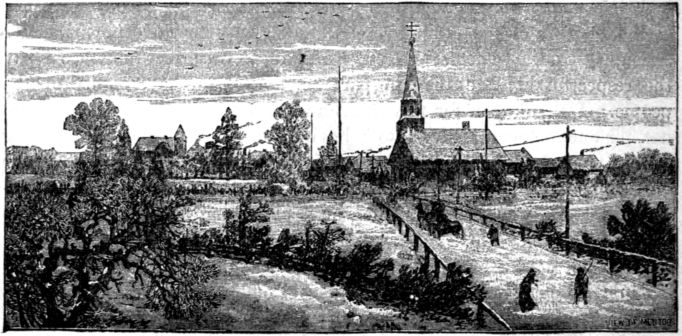
VIEW OF MENTOR.
On the next evening after this address, General Garfield was given a reception and banquet, at which were present many of the most distinguished men of the nation. Then, after a brief stay at Washington, he returned to Mentor, hoping to enjoy a respite from the excitements of the hour. But there was little hope of rest for one who by the will of the millions had thus been whirled into the blazing focus of expectation.
451On the 3d of July the Soldiers’ Monument at Painesville, Ohio, was formally dedicated. General Garfield was present on the occasion, and after the principal oration, was called upon to speak. His address created great enthusiasm, especially among the veterans, who were gathered in great numbers to hear their old leader. General Garfield said:
“Fellow-citizens: I can not fail to respond on such an occasion, in sight of such a monument to such a cause, sustained by such men. [Applause and cheers.] While I have listened to what my friend has said, two questions have been sweeping through my heart. One was, ‘What does the monument mean?’ and the other, ‘What will the monument teach?’ Let me try and ask you for a moment, to help me answer what does the monument mean. Oh! the monument means a world of memories, a world of deeds, and a world of tears, and a world of glories. You know, thousands know, what it is to offer up your life to the country, and that is no small thing, as every soldier knows. Let me put the question to you: For a moment suppose your country in the awfully embodied form of majestic law, should stand above you and say: ‘I want your life. Come up here on the platform and offer it.’ How many would walk up before that majestic presence and say, ‘Here I am, take this life and use it for your great needs.’ [Applause.] And yet almost two millions of men made that answer [applause], and a monument stands yonder to commemorate their answer. That is one of its meanings. But, my friends, let me try you a little further. To give up life is much, for it is to give up wife, and home, and child, and ambition. But let me test you this way further. Suppose this awfully majestic form should call out to you, and say, ‘I ask you to give up health and drag yourself, not dead, but half alive, through a miserable existence for long years, until you perish and die in your crippled and hopeless condition. I ask you to volunteer to do that,’ and it calls for a higher reach of patriotism and self-sacrifice; but hundreds of thousands of you soldiers did that. That is what the monument means also. But let me ask you to go one step further. Suppose your country should say, ‘Come here, on this platform, and in my name, and for my sake, consent to be idiots. [Voice—Hear, hear.] Consent that your very brain and intellect shall be broken down into hopeless idiocy for my sake.’ How many could be found to make that venture? And yet there are thousands, and that with their eyes wide open to the horrible consequences, obeyed that call.
452“And let me tell how one hundred thousand of our soldiers were prisoners of war, and to many of them when death was stalking near, when famine was climbing up into their hearts, and idiocy was threatening all that was left of their intellects, the gates of their prison stood open every day, if they would quit, desert their flag and enlist under the flag of the enemy; and out of one hundred and eighty thousand not two per cent. ever received the liberation from death, starvation and all that might come to them; but they took all these horrors and all these sufferings in preference to going back upon the flag of their country and the glory of its truth. [Applause.] Great God! was ever such measure of patriotism reached by any men on this earth before? [Applause.] That is what your monument means. By the subtle chemistry that no man knows, all the blood that was shed by our brethren, all the lives that were devoted, all the grief that was felt, at last crystallized itself into granite rendered immortal, the great truth for which they died [applause], and it stands there to-day, and that is what your monument means.
“Now, what does it teach? What will it teach? Why, I remember the story of one of the old conquerors of Greece, who, when he had traveled in his boyhood over the battle-fields where Miltiades had won victories and set up trophies, returning said: ‘These trophies of Miltiades will never let me sleep.’ Why? Something had taught him from the chiseled stone a lesson that he could never forget; and, fellow-citizens, that silent sentinel, that crowned granite column, will look down upon the boys that will walk these streets for generations to come, and will not let them sleep when their country calls them. [Applause.] More than from the bugler on the field, from his dead lips will go out a call that the children of Lake County will hear after the grave has covered us and our immediate children. That is the teaching of your monument. That is its lesson, and it is the lesson of endurance for what we believe, and it is the lesson of sacrifices for what we think—the lesson of heroism for what we mean to sustain—and that lesson can not be lost to a people like this. It is not a lesson of revenge; it is not a lesson of wrath; it is the grand, sweet, broad lesson of the immortality of the truth that we hope will soon cover, as the grand Shekinah of light and glory, all parts of this Republic, from the lakes to the gulf. [Applause.] I once entered a house in old Massachusetts, where, over its doors, were two crossed swords. One was the sword carried by the grandfather of its owner on the field of Bunker Hill, and the other was 453the sword carried by the English grandsire of the wife, on the same field, and on the other side of the conflict. Under those crossed swords, in the restored harmony of domestic peace, lived a happy, and contented, and free family, under the light of our republican liberties. [Applause.] I trust the time is not far distant when, under the crossed swords and the locked shields of Americans North and South, our people shall sleep in peace, and rise in liberty, love, and harmony under the union of our flag of the Stars and Stripes.”
The next public utterance of General Garfield had been anxiously awaited. Until now he had not found time to return a formal answer to the committee, whose chairman had, on the evening of the 8th of June, informed him of his nomination for the Presidency. On the 12th of July, the General, from his home at Mentor, issued his letter of acceptance. It was a document of considerable length, touching upon most of the political questions of the day, and gave great satisfaction to his party throughout the Union. The letter was as follows:
“Mentor, Ohio, July 10th, 1880.
“Dear Sir: On the evening of the 8th of June last I had the honor to receive from you, in the presence of the committee of which you were chairman, the official announcement that the Republican National Convention at Chicago had that day nominated me for their candidate for President of the United States. I accept the nomination with gratitude for the confidence it implies and with a deep sense of the responsibilities it imposes. I cordially indorse the principles set forth in the platform adopted by the convention. On nearly all the subjects of which it treats my opinions are on record among the published proceedings of Congress. I venture, however, to make special mention of some of the principal topics which are likely to become subjects of discussion, without reviewing the controversies which have been settled during the last twenty years, and with no purpose or wish to revive the passions of the late war.
“It should be said that while Republicans fully recognize and will strenuously defend all the rights retained by the people and all the rights reserved to the States, they reject the pernicious doctrine of State supremacy, which so long crippled the functions of the National Government and at one time brought the Union very near to destruction. They insist that the United States is a nation, with ample power of self-preservation; 454that its Constitution and the laws made in pursuance thereof are the supreme law of the land; that the right of the nation to determine the method by which its own legislature shall be created can not be surrendered without abdicating one of the fundamental powers of the Government; that the national laws relating to the election of representatives in Congress shall neither be violated nor evaded; that every elector shall be permitted freely and without intimidation to cast his lawful ballot at such election and have it honestly counted, and that the potency of his vote shall not be destroyed by the fraudulent vote of any other person. The best thoughts and energies of our people should be directed to those great questions of national well-being in which we all have a common interest. Such efforts will soonest restore perfect peace to those who were lately in arms against each other, for justice and good-will will outlast passion; but it is certain that the wounds can not be completely healed and the spirit of brotherhood can not fully pervade the whole country until every one of our citizens, rich or poor, white or black, is secure in the free and equal enjoyment of every civil and political right guaranteed by the Constitution and the laws. Wherever the enjoyment of this right is not assured, discontent will prevail, immigration will cease, and the social and industrial forces will continue to be disturbed by the migration of laborers and the consequent diminution of prosperity. The National Government should exercise all its constitutional authority to put an end to these evils, for all the people and all the States are members of one body; and no member can suffer without injury to all.
“The most serious evils which now afflict the South arise from the fact that there is not such freedom and toleration of political opinion and action that the minority party can exercise an effective and wholesome restraint upon the party in power. Without such restraint party rule becomes tyrannical and corrupt. The prosperity which is made possible in the South, by its great advantages of soil and climate, will never be realized until every voter can freely and safely support any party he pleases. Next in importance to freedom and justice is popular education, without which neither justice nor freedom can be permanently maintained. Its interests are intrusted to the States and the voluntary action of the people. Whatever help the nation can justly afford should be generously given to aid the States in supporting common schools; but it would be unjust to our people and dangerous to our institutions 455to apply any portion of the revenues of the nation or of the States to the support of sectarian schools. The separation of the Church and the State in every thing relating to taxation should be absolute.
“On the subject of national finances my views have been so frequently and fully expressed that little is needed in the way of additional statement. The public debt is now so well secured, and the rate of annual interest has been so reduced by refunding, that rigid economy in expenditures and the faithful application of our surplus revenues to the payment of the principal of the debt, will gradually but certainly free the people from its burdens, and close with honor the financial chapter of the war. At the same time the Government can provide for all its ordinary expenditures, and discharge its sacred obligations to the soldiers of the Union and to the widows and orphans of those who fell in its defense. The resumption of specie payments, which the Republican party so courageously and successfully accomplished, has removed from the field of controversy many questions that long and seriously disturbed the credit of the Government and the business of the country. Our paper currency is now as national as the flag, and resumption has not only made it everywhere equal to coin, but has brought into use our store of gold and silver. The circulating medium is more abundant than ever before, and we need only to maintain the equality of all our dollars to insure to labor and capital a measure of value from the use of which no one can suffer loss. The great prosperity which the country is now enjoying should not be endangered by any violent change or doubtful financial experiments.
“In reference to our custom laws, a policy should be pursued which will bring revenues to the Treasury, and will enable the labor and capital employed in our great industries to compete fairly in our own markets with the labor and capital of foreign producers. We legislate for the people of the United States, not for the whole world; and it is our glory that the American laborer is more intelligent and better paid than his foreign competitor. Our country can not be independent unless its people, with their abundant natural resources, possess the requisite skill at any time to clothe, arm, and equip themselves for war, and in time of peace to produce all the necessary implements of labor. It was the manifest intention of the founders of the Government to provide for the common defense, not by standing armies alone, but by raising among the people a greater army of artisans, whose intelligence and skill should powerfully contribute to the safety and glory of the nation.
456“Fortunately for the interests of commerce there is no longer any formidable opposition to appropriations for the improvement of our harbors and great navigable rivers, provided that the expenditures for that purpose are strictly limited to works of national importance. The Mississippi River, with its great tributaries, is of such vital importance to so many millions of people that the safety of its navigation requires exceptional consideration. In order to secure to the nation the control of all its waters, President Jefferson negotiated the purchase of a vast territory, extending from the Gulf of Mexico to the Pacific Ocean. The wisdom of Congress should be invoked to devise some plan by which that great river shall cease to be a terror to those who dwell upon its banks, and by which its shipping may safely carry the industrial products of twenty-five millions of people.
“The interests of agriculture, which is the basis of all our material prosperity, and in which seven-twelfths of our population are engaged, as well as the interests of manufactures and commerce, demand that the facilities for cheap transportation shall be increased by the use of all our great water courses. The material interests of this country, the traditions of its settlement and the sentiment of our people, have led the Government to offer the widest hospitality to immigrants who seek our shores for new and happier homes, willing to share the burdens as well as the benefits of our society, and intending that their posterity shall become an undistinguishable part of our population. The recent movement of the Chinese to our Pacific coast partakes but little of the qualities of such an immigration, either in its purposes or its result. It is too much like an importation to be welcomed without restriction; too much like an invasion to be looked upon without solicitude. We can not consent to allow any form of servile labor to be introduced among us under the guise of immigration. Recognizing the gravity of this subject, the present administration, supported by Congress, has sent to China a commission of distinguished citizens for the purpose of securing such a modification of the existing treaty as will prevent the evils likely to arise from the present situation. It is confidently believed that these diplomatic negotiations will be successful without the loss of that commercial intercourse between the two great powers which promises a great increase of reciprocal trade and the enlargement of our markets. Should these efforts fail, it will be the duty of Congress to mitigate the evils already felt, and prevent their increase by such restrictions as, without 457violence or injustice, will place upon a sure foundation the peace of our communities and the freedom and dignity of labor.
“The appointment of citizens to the various executive and judicial offices of the Government is, perhaps, the most difficult of all duties which the Constitution has imposed upon the Executive. The convention wisely demands that Congress shall coöperate with the Executive Department in placing the civil service on a better basis. Experience has proved that, with our frequent changes of administration, no system of reform can be made effective and permanent without the aid of legislation. Appointments to the military and naval service are so regulated by law and custom, as to leave but little ground of complaint. It may not be wise to make similar regulations by law for the civil service, but, without invading the authority or necessary discretion of the Executive, Congress should devise a method that will determine the tenure of office, and greatly reduce the uncertainty which makes that service so uncertain and unsatisfactory. Without depriving any officer of his rights as a citizen, the Government should require him to discharge all his official duties with intelligence, efficiency, and faithfulness. To select wisely from our vast population those who are best fitted for the many offices to be filled, requires an acquaintance far beyond the range of any one man. The Executive should, therefore, seek and receive the information and assistance of those whose knowledge of the communities in which the duties are to be performed, best qualifies them to aid in making the wisest choice. The doctrines announced by the Chicago Convention are not the temporary devices of a party to attract votes and carry an election. They are deliberate convictions, resulting from a careful study of the spirit of our institutions, the events of our history, and the best impulses of our people. In my judgment, these principles should control the legislation and administration of the Government. In any event, they will guide my conduct until experience points out a better way. If elected, it will be my purpose to enforce strict obedience to the Constitution and the laws, and to promote as best I may the interest and honor of the whole country, relying for support upon the wisdom of Congress, the intelligence and patriotism of the people, and the favor of God.
“With great respect, I am very truly yours,
“J. A. Garfield.
“To Hon. Geo. F. Hoar, Chairman of the Committee.”
458The battle was now fairly on. The Democracy had, on the 23d day of June, in convention at Cincinnati, nominated as their standard-bearer the distinguished and popular soldier, Major-General Winfield S. Hancock. This nomination was received by the General’s party with as much satisfaction and enthusiasm as that of General Garfield had been by the Republicans. Meanwhile, General James B. Weaver, of Iowa, had been chosen to make the race by the National party, in a convention held in Chicago, on the 9th of June. So that there were presented for the suffrages of the people three eminent soldiers—all men of large abilities, undoubted patriotism, and thorough soundness of character. It was evident, however, from the opening of the campaign, that the contest was narrowed to Generals Garfield and Hancock, with the chances in favor of the former; and as the public mind became warmed up to the pitch of battle, the chances of Garfield were augmented by almost every incident of the fight. The platforms of the two parties had both been made with a view to political advantage rather than to uphold any distinctive principles. So the fight raged backwards along the line of the history and traditions of the two parties rather than forward along the line of the living political issues of the present and the future. In a modified form the old questions of the war were revived and paraded. A delegate in the Cincinnati Convention, allowing his zeal to run away with his sense, had pledged a “Solid South” to the support of General Hancock. This sectional utterance was a spark dropped among the old war memories of the Union soldiers; and the politicians were quick to fan the flame by suggesting that “a Solid South” ought to be confronted by “a Solid North.” This line of argument, of course, meant ruin to the Democracy. The Republican leaders virtually abandoned the Southern States, and concentrated all their efforts upon the doubtful States of the Northern border. Indiana became a critical battle-field; and here the political fight was waged with the greatest spirit. Having a gubernatorial election in October, it was foreseen that to carry this doubtful State would be well nigh decisive of the contest, and to this end the best talent of both parties was hurried into her 459borders. While these great movements were taking place, General Garfield remained, for the most part, at his quiet home at Mentor. On the 3d of August he attended the dedication ceremonies of a soldiers’ monument at Geneva, Ohio. More than ten thousand people were in attendance. After the principal address of the day had been delivered, General Garfield was introduced, and spoke as follows:
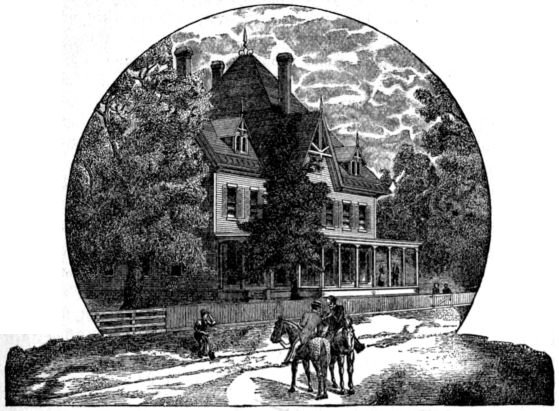
LAWNFIELD.—THE HOME OF PRESIDENT GARFIELD AT MENTOR.
“Fellow-citizens, Ladies and Gentlemen: These gentlemen had no right to print on a paper here that I was to make a speech, for the types should always tell the truth. [A voice—They did it this time.] They have not done it in this case; but I can not look out upon an audience in Ashtabula County, recognizing so many old faces and old friends, without at least making my bow to them, and saying ‘good-bye’ before I go. I can not either hear such a speech as that to which I have just listened without thanking the man who made it [applause] and the people who enabled him to make it [applause], for after all no man can make a speech alone. It is the great human power that strikes up from a thousand hearts that acts upon him and makes the speech. [Applause.] It originates with 460those outside of him, if he makes one at all, and every man that has stood on this platform to-day has had a speech made out of him by you and by what is yonder on your square. That’s the way speeches are made, and if I had time to stay long enough, these forces with you might make one out of me. [Applause.] Ideas are the only things in the universe really immortal. Some people think that soldiers are chiefly renowned for courage. That is one of the cheapest and commonest qualities; we share it with the brutes. I can find you dogs and bears and lions that will fight, and fight to the death, and will tear each other. Do you call that warfare? Let me tell you the difference. They are as courageous as any of these soldiers, if mere brute courage is what you are after. The difference between them and us is this: Tigers never hold reunions [laughter] to celebrate their victories. When they have eaten the creature they have killed, that is the only reunion they have ever held. [Laughter.] Wild beasts never build monuments over their slain comrades. Why? Because there are no ideas behind their warfares. Our race has ideas, and because ideas are immortal, if they be true, we build monuments to them. We hold reunions not for the dead, for there is nothing on all the earth that you and I can do for the dead. They are past our help and past our praise. We can not add more glory, and we can give them no immortality. They do not need us, but forever and forever more we need them. [Applause.] The glory that trails in the clouds behind them after their sun has set, falls with its benediction upon us who are left [applause], and it is to commemorate the immortality of the ideas for which they fought, that you assemble to-day and dedicate your monument, that points up toward God who leads them in the glory of the great world beyond. Around these ideas, under the leadership of these ideas, we assemble to-day, reverently to follow, reverently to acknowledge the glory they achieved and the benediction they left behind them. That is the meaning of an assembly like this, and to join in it, to meet you, my old neighbors and constituents, to share with you the memories that we have heard rehearsed and the inspiration that this day points to, that this monument celebrates, is to me a joy, and for it I am grateful to you.”
Immediately after this address at Geneva, General Garfield took his departure for New York, where it had been determined to hold a conference of the principal Republican leaders, relative to the conduct of the pending campaign. The standard-bearer participated 461in the council of his friends, adding not a little by his presence and unflagging spirits to the zeal and enthusiasm of those upon whose efforts so much depended. On the 7th he left the city for Lake Chautauqua, where he had decided to spend a day at the great Sunday-school encampment and other lakeside resorts. He was received with the greatest good-will by the thousands assembled at Jamestown and Chautauqua; and on the eve of his departure was induced, in response to salutations and cheers, to make the following brief address:
“Fellow-citizens: You have done so much to me since I arrived on this shore, that I am quite unable to tell what sort of man I am this morning. [Laughter.] I had never been here, and really did not know what you were doing. Last evening I asked Mr. Vincent, rather brusquely, to tell me what Chautauqua means—what your work here means—and he filled me so full of your ideas that I have not yet assimilated it so as to be quite sure what manner of man I am since I got hold of it. But this I see, you are struggling with one of the two great problems of civilization. The first one is a very old question—‘How shall we get leisure?’ That is the object of every hammer stroke, of every blow that labor has struck since the foundation of the world. [Applause.] The fight for bread is a great primal fight, and it is so absorbing a struggle that until one conquers to some extent he can have no leisure. We may divide the struggles of the human race into two chapters: First, the fight to get leisure, and, second, what to do with our leisure when we have won it. It looks to me that Chautauqua has solved the second problem. [Applause.] Like all blessings, leisure is a very bad thing unless it is well used. The man with a fortune ready made, and with leisure on his hands, is likely to get sick of the world, sick of himself, tired of life, and to become a useless, wasted man. What shall you do with your leisure? I understand Chautauqua is trying to develop new energies, largeness of mind and culture in a better sense, ‘with the varnish scratched off,’ as our friend, Dr. Kirkwood, says. [Applause.] We are getting over the fashion of painting and varnishing our native woods. We are getting down to the real grain, and finding whatever is best and most beautiful in it, and if Chautauqua is helping to develop in our people the native stuff that is in them rather than to give them varnish and gewgaws of culture, it is doing well. Chautauqua, therefore, 462has filled me with thought, and, in addition to that, you have filled me with gratitude for your kindness and for this great spontaneous greeting in early morning, earlier than men of leisure get up. [Laughter.] Some of these gentlemen of the press around me looked distressed at the early rising by which you have compelled our whole party to look at the early sun. [Laughter.] This greeting on the lake slope toward the sun is very precious to me, and I thank you all. This is a mixed audience of citizens, and I will not offend the proprieties of the occasion by discussing controverted questions or entering upon any political discussion. I look in the faces of men of all shades of opinion, but whatever our party affiliation, I trust there is in all this audience that love of our beneficent institutions which makes it possible for free labor to earn leisure, and for our institutions to make that leisure worth something [applause]—our Union and our institutions, under the blessing of equal laws, equal to all colors and all conditions, an open career for every man, however humble, to rise to whatever place the power of a strong arm, the strength of a clear head, and the aspirations of a pure heart can do to lift him. That prospect ought to inspire every young man in this vast audience. [Applause.] I heard yesterday and last night the songs of those who were lately redeemed from slavery, and I felt that there, too, was one of the great triumphs of the Republic. [Applause.] I believe in the efficiency of the forces that come down from the ages behind us, and I wondered if the tropical sun had not distilled its sweetness, and if the sorrow of centuries of slavery had not distilled its sadness into verses, which were touching, sweet verses, to sing the songs of liberty as they sing them wherever they go. [Applause.]
“I thank that choir for the lesson they have taught me here, and now, fellow-citizens, thanking you all, good-bye.” [Applause.]
On the 9th of the month General Garfield returned to his home, where he again sought a respite from the uproar and tumult of publicity which followed him everywhere. On the 25th of August, a reunion of his old regiment, the Forty-second Ohio, was held at Ashland, and the General could but accept an invitation to share the occasion with his former comrades in arms. The old soldiers passed a resolution, declaring it an honor that their former Colonel had become the conspicuous man of the nation, and commending 463him to the world as a model of all soldierly virtues. He was elected President of the Regimental Association for the ensuing year, and was thereupon called out for an address. The General spoke as follows:
“Fellow-citizens: This is a family gathering, a military family, for in war a regiment is to the army what a family is to the whole civilized community. [Here a portion of the platform fell.] A military reunion without some excitement and some accident would be altogether too monotonous and tame to be interesting, and in this good-natured audience we can have a good many accidents like that and still keep quiet and be happy.
“I said this is a family reunion, an assembly of the Forty-second military family, and it is well for us to meet here. Nineteen years ago I met a crowd of earnest citizens in that court-room above stairs. Your bell was rung, your people came out. The teacher of your schools was among them. The boys of the school were there, and after we had talked together a little while, about our country and its imperiled flag, the teacher of the schools offered himself to his country, and twenty of his boys with him. They never went back into the school-house again; but in the dark days of November, 1861, they and enough Ashland County boys to make one hundred went down with me to Columbus to join another one hundred that had gone before them from Ashland County, and these two hundred of your children stood in the center of our military family and bore these old banners that you see tattered before you to-day. One of them was given to our family by the ladies of Ashland, and Company C, from Ashland, carried it well. It was riddled by bullets and torn by underbrush. Flapped by the winds of rebellion, it came back tattered, as you see, but with never a stain upon its folds, and never a touch of dishonor upon it anywhere; and the other of these banners was given us by the special friends of Company A, in my old town of Hiram, the student company from the heart of the Western Reserve, and it also shared like its fellows, the fate, and came home covered with the glory of the conflict.
“We were a family, I say again, and we did not let partisan politics disturb us then, and we do not let partisanship enter our circle here to-day.
“We did not quarrel about controversies outside of our great work. We agreed to be brethren for the Union, under the flag, against all its 464enemies everywhere, and brothers to all men who stood with us under the flag to fight for the Union, whatever their color of skin, whatever their previous politics, whatever their religion. In that spirit we went out; in that spirit we returned; and we are glad to be in Ashland to-day, for it is one of the homes of our regiment, where we were welcomed in the beginning and have always been welcome since. We are grateful for the welcome tendered us to-day by this great assembly of our old neighbors and friends of Ashland County.
“Now, fellow-citizens, a regiment like a family has the right to be a little clannish and exclusive. It does not deny the right of any other family to the same privileges, but it holds the members of its own family a little nearer and a little dearer than any other family in the world. And so the Forty-second Regiment has always been a band of brothers. I do not this day know a Forty-second man in the world who hates another Forty-second man. There never was a serious quarrel inside the regiment. There was never a serious disagreement between its officers. The worst thing I have ever heard said against it is that all its three field officers came home alive. And they are all here on this stand to-day. It was, perhaps, a little against us that no one of us had the honor to get killed or seriously crippled; but we hold that it was not altogether our fault, and we trust that some day or other you will have forgiven us, if you have not to-day, for being alive and all here together.
“I want to say another thing about the soldiers’ work. I know of nothing in all the circle of human duty that so unites men as the common suffering and danger and struggle that war brings upon a regiment. You can not know a man so thoroughly and so soon as by the tremendous tests to which war subjects him. These men knew each other by sight long before they knew each other by heart; but before they got back home they knew each other, as you sometimes say you know a son, ‘by heart;’ for they had been tested by fire; they had been tested by starvation; they had been tested by the grim presence of death, and each knew that those who remained were union men; men that in all the hard, close chances of life, had the stuff in them that enabled them to stand up in the very extremes they did; and stand up ready to die. And such men, so tried and so acquainted, never got over it; and the rest of the world must permit them to be just a little clannish towards each other; the rest of the world will not think we are narrow 465when they consider this particular fault of ours; a little closer to us than any of the rest of the world in a military way.
“Now, fellow-citizens, we are here to look into your faces, to enjoy your hospitality, to revive our old memories of the place, but, for more than any thing else, to look into each other’s faces, and revive old memories of a great many places less pleasing and home-like than Ashland. We have been meeting together in this way for nearly fifteen years, and we have made a pledge to each other that as long as there are two of us left to shake hands, we will meet and greet the survivor. Some of us felt a little hurt about ten years ago when the papers spoke of us as the survivors of the Forty-second Regiment. We were survivors it was true, but we thought we were so surviving that it need not be put at us, as though we were about to die. Now, I don’t know how it is with the rest of you. Most of mankind grow old, and you can see it in their faces. I see here and there a bald head, like my own, or a white one, like Captain Gardner’s, but to me these men will be boys till they die. We call them boys; we meet and greet them as boys, even though they become very old boys, and in that spirit of young, hopeful, daring manhood we expect to meet them so long as we live. Nothing can get us a great way from each other while we live. I am glad to meet these men here to-day. [Here another portion of the platform broke down, precipitating General Garfield and two or three of the reporters to the ground.] Continuing, he said: I was glad also that there was not any body hurt when that broke, and nobody made unhappy, and I will conclude all I wanted to say, more than I intended to say, by adding this: These men went out without one single touch of revenge in their hearts. They went out to maintain this Union and make it immortal; to put their own immortal lives into it, and to make it possible that the people of Ashland should make the monogram of the United States, as you see it up there (pointing to the monogram on the building), a wreath of Union inside of a very large N, a capital N, that stands for Nation, a Nation so large that it includes the ‘U. S. A.’ all the people of the Republic, and will include it for evermore; that is what we meant then and is what we mean now.
“And now, fellow-citizens and soldiers of the Forty-second Regiment—for I have been talking mainly to you, and if any of this crowd have overheard I am not particularly to blame for it—I say, fellow-citizens and comrades, I greet you to-day with great satisfaction and bid you a cordial good-bye.”
466Two days later General Garfield was present at a reunion of an artillery company, held at Mentor, and since they had composed a part of the force with which Thomas stayed at last the furious onset at Chickamauga, their old chief of staff was all the more willing to say a few words for their edification. This he did as follows:—
“Comrades: This is really the first time I have met this battery as an organization since the Sunday evening of the terrible battle of Chickamauga, nearly seventeen years ago. I last saw you there in the most exposed angle of that unfortunate line, broken by the combined forces of Bragg and Longstreet. I then saw you gallantly fighting under the immediate direction of General Thomas, to reform that broken line, and hold the exultant rebel host in check until the gallant Steedman with reinforcements swept them back into the dark valley of the Chickamauga. I am now able to distinguish among your numbers faces which I saw there in that terrible hour. But how changed! I now see you here with your wives, children, and friends, peaceably enjoying this grand reception of your friends and neighbors here assembled to honor and entertain you.
“But nothing so attracts my attention as your young and active appearance. It is more than eighteen years since you left for the war, and yet you are not old. Indeed, many of you appear almost like boys. This I am pleased to observe; for if there be any men upon the face of the earth who deserve an extension of time, it is you who, in early manhood, so freely gave your services to your country, that it might live. Nothing can be more proper than these annual reunions. I am aware of the reputation which this organization, as well as my own regiment, always enjoyed of unity and good fellowship among its officers and men. May you, therefore, continue to enjoy and perpetuate that friendship to the very latest hour of your lives.”
General Garfield had now to learn that the people in their eagerness, and especially the politicians in their unselfish devotion, had decreed him no further rest, even at Lawnfield. Pilgrimages to Mentor became the order of the day. For meanwhile the October elections had been held, and all had gone triumphantly for the Republicans. Indiana, chief of the so-called “doubtful States,” had whirled into line with an unequivocal majority. Ohio had put a quietus on all hopes of the Democracy to carry her electoral 467votes for Hancock. The high-blown anticipations of the friends of “the superb soldier” were shockingly shattered. And so all the paths of political preferment led to Mentor; and all the paths were trodden by way-worn pilgrims, who, with sandal-shoon and scallop-shell urged their course thither to see him who was now their hope. On the 19th of October a train of these pilgrims, rather more notable than the rest, came in from Indiana. It was the Lincoln Club of Indianapolis, four hundred strong. They were uniformed, and wore grotesque cockades extemporized out of straw hats into a sort of three-cornered conspicuity. The General was, none the less, greatly pleased with his visitors, and spared no pains to make their brief stay at Mentor a pleasure, if not a profit. The club was formally introduced by Captain M. G. McLean, and in response General Garfield said:—
“Gentlemen: You come as bearers of dispatches, so your chairman tells me. I am glad to hear the news you bring, and exceedingly glad to see the bringers of the news. Your uniform, the name of your club, the place from which you come, are all full of suggestions. You recollect the verses that were often quoted about the old Continental soldiers: “The old three-cornered hat and breeches, and all that were so queer.” Your costume brings back to our memory the days of the Continentals of 1776, whose principles I hope you represent. You are called the Lincoln Club, and Lincoln was himself a revival, a restoration of the days of ’76 and their doctrines. The great Proclamation of Emancipation, which he penned, was a second Declaration of Independence—broader, fuller, the New Testament of human liberty; and then you come from Indiana, supposed to be a Western State, but yet in its traditions older than Ohio. More than one hundred years ago a gallant Virginian went far up into your wilderness, captured two or three forts, took down the British flag, and reared the Stars and Stripes. Vincennes and Cahokia, and a post in Illinois, were a part of the capture. Your native State was one of the first fruits of that splendid fighting power which gave the whole West to the United States, and now these representatives of Indiana come representing the Revolution in your hats, representing Abraham Lincoln in your badges, and representing the victory both of the Revolution and of Lincoln in the news you bring. I could not be an American and fail to welcome your costumes, your badges, your news 468and yourselves. Many Indiana men were my comrades in the days of the war. I remember a regiment of them that was under my command near Corinth, when it seemed necessary for the defense of our forces to cut down a little piece of timber—seventy-five acres. We unboxed for my brigade about four thousand new axes, and the Fifty-first Regiment of Indiana Volunteers chopped down more trees in half a day than I supposed it was possible could fall in any forest in a week. It appears that in the great political forest from which you have just come, your axes have been busy again. I especially welcome the axmen of the Fifty-first Regiment, who may happen to be here, and thank you all, gentlemen, for the compliment of your visit, and for the good news you bring. I do not prize that news half so much for its personal relations to you and to me, as I do because it is a revival of the spirit of 1776, the spirit of Abraham Lincoln, the spirit of universal liberty, and the spirit of just and equal law all over this land. That gives your news its greatest significance. Gentlemen, I thank you again, and shall be glad to take you by the hand.”
After the speeches, the members of the Lincoln Club all had the pleasure of shaking the hand of General Garfield, and of hearing an individual welcome from his lips.
Two days afterwards, the Cuyahoga Veteran Corps came on a similar pilgrimage to Lawnfield, and were similarly well received. General M. D. Leggett, commander of the corps, made the introductory address; and, in answer, General Garfield said:
“Comrades: Any man that can see twelve hundred comrades in his front-door yard has as much reason to be proud as for any thing that can well happen to him in this world. After that has happened, he need not much care what else happens, or what else don’t happen. To see twelve hundred men, from almost every regiment of the State, and from regiments and brigades and divisions of almost every other State—to see the consolidated field report of the survivors of the war, sixteen years after it is over—is a great sight for any man to look on. I greet you all with gratitude for this visit. Its personal compliment is great.
“But there is another thought in it far greater than that to me and greater to you. Just over yonder about ten miles, when I was a mere lad, I heard the first political speech of my life. It was a speech that Joshua R. Giddings was making. He had come home to appeal to his 469constituents. A Southern man drew a pistol on him while he was speaking in favor of human liberty, and marched over toward him to shoot him down, to stop his speech and quench the voice of liberty. I remember but one thing that the old hero said in the course of that speech so long ago, and it was this: ‘I knew I was speaking for liberty, and I felt that if the assassin had shot me down, my speech would still go on and triumph.’ Well, now, gentlemen, there are twelve hundred, and the hundred times twelve hundred—the million of men that went out into the field of battle to fight for our Union—felt just as that speaker felt—that if they should all be shot down the cause of liberty would still go on. You and all the Union felt that around you, and above you, and behind you, were a force and a cause and an immortal truth that would outlive your bodies and mine, and survive all our brigades and all our armies and all our battles. Here you are to-day in the same belief. We shall all die, and yet we believe that after us the immortal truths for which we fought will live in a united Nation, a united people against all factions, against all section, against all division, so long as there shall be a continent of rivers and mountains and lakes. It was that great belief that lifted you all up into the heroic height of great soldiers in the war, and it is that belief that you cherish to-day, and carry with you in all your pilgrimages and in all your reunions. In that great belief, and in that inspiring faith, I meet you and greet you to-day, and with it we will go on to whatever fate has in store for us all.
“I thank you, comrades, for this demonstration of your faith and confidence and regard for me. Why, gentlemen, this home of mine will never be the same place again. I am disposed to think that a man does not take every thing away from a place when he takes his body away. It was said that long after the death of the first Napoleon, his soldiers believed that on certain anniversary days he came out and reviewed all his dead troops, he himself being dead; that he had a midnight review of those that had fought and fallen under his leadership. That, doubtless, was a fiction of the imagination; but I shall have to believe in all time hereafter the character and spirit and impressions of my comrades live on this turf, and under these trees, and in this portal; and it will be a part of my comradeship in all days to come.”
On the 28th of the month a delegation of Portage County citizens, two hundred strong, headed by Judge Luther Day, of Ravenna, visited Mentor, and paid the customary respects to him who 470was now regarded as well nigh certain to carry away the greatest honor known to the American people. After the company was formally introduced by Judge Day, the General, in response, said:
“Judge Day, Ladies and Gentlemen: I once read of a man who tried to wear the armor and wield the sword of some ancient ancestor, but found them too large for his stature and strength. If I should try at this moment to wear and sway the memories which your presence awakens, I should be overwhelmed, and wholly unable to marshal and master the quick-coming throng of memories which this semicircle of old friends and neighbors has brought to me. Here are school-fellows of twenty-eight years ago. Here are men and women who were my pupils a quarter of a century ago. Here are venerable men who, twenty one years ago, in the town of Kent, launched me upon the stormy sea of political life. I see others who were soldiers in the old regiment which I had the honor to command, and could I listen to the teaching and thoughtful words of my friend, the venerable late Chief Justice of Ohio, who has just spoken, without remembering that evening in 1861, of which he spoke too modestly, when he and I stood together in the old church at Hiram, and called upon the young men to go forth to battle for the Union, and be enlisted before they slept, and thus laid the foundation of the Forty-second Regiment? How can I forget all these things, and all that has followed? How can I forget that twenty-five years of my life were so braided and intertwined with the lives of the people of Portage County, when I see men and women from all its townships standing at my door? I can not forget these things while life and consciousness remain. No other period of my life can be like this. The freshness of youth, the very springtide of life, the brightening on toward noonday—all were with you and of you, my neighbors, my friends, my cherished comrades, in all the relations of social, student, military and political life and friendship. You are here, so close to my heart that I can not trust myself to an attempt to marshal these memories with any thing like coherence. To know that my neighbors and friends in Portage County, since the first day of my Congressional life, have never sent to any convention a delegate who was hostile to me; that through all the storm of detraction that roared around me, the members of the old guard of Portage County have never wavered in their faith and friendship, but have stood an unbroken phalanx with their locked shields above my head, and have given me their hearts in every 471contest. If a man can carry in his memory a jewel more precious than this, I am sure Judge Day has never heard what it is.
“Well, gentlemen, on the eve of great events, closing a great campaign, I look into your faces and draw from you such consolation as even you can not understand. Whatever the event may be, our post is secure, and whatever may befall me hereafter, if I can succeed in keeping the hearts of Portage County near to me I shall know that I do not go far wrong in any thing, for they are men who love the truth for truth’s sake, far more than they love any man.
“Ladies and gentlemen, all the doors of my house are open to you. The hand of every member of my family is outstretched to you. Our hearts greet you, and we ask you to come in.”
In the meantime there had occurred the most remarkable episode of the campaign. On the 21st of October appeared in the columns of a New York newspaper called Truth, a letter purporting to have been written on the 23d of January, 1880, to one H. L. Morey, of Lynn, Massachusetts. The communication was ostensibly a reply to a letter written to General Garfield with the purpose of obtaining his views on the great question of the Chinese in the United States, and more particularly to extract his ideas on the subject of Chinese cheap labor. This previous supposititious letter of Morey was never produced, but only the alleged answer of General Garfield, which was as follows:
“House of Representatives, }
Washington, D. C., January 23, 1880. }
“Dear Sir: Yours in relation to the Chinese problem came duly to hand. I take it that the question of employes is only a question of private and corporate economy. Individuals or companies have the right to buy labor where they can get it the cheapest. We have a treaty with the Chinese Government, which should be religiously kept until its provisions are abrogated by the action of the General Government, and I am not prepared to say that it should be abrogated until our great manufacturing interests are conserved in the matter of labor.
Very truly yours,
“J. A. Garfield.
“To H. L. Morey, Employers’ Union, Lynn, Mass.”
472
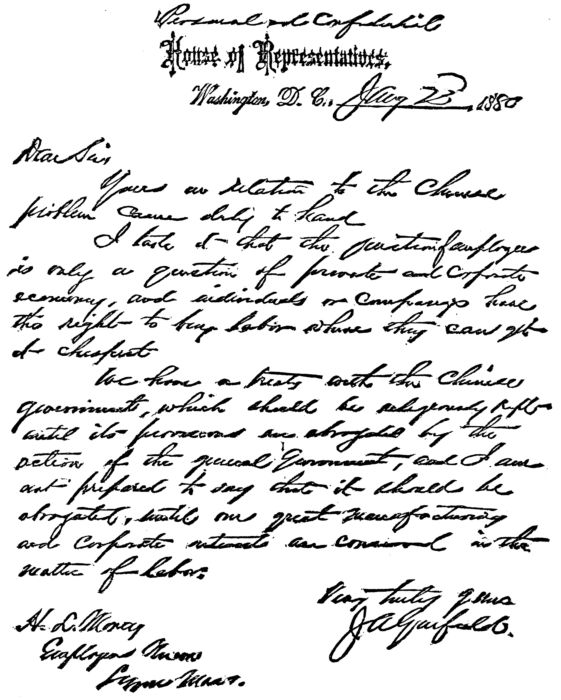
FAC-SIMILE OF THE MOREY LETTER.
473
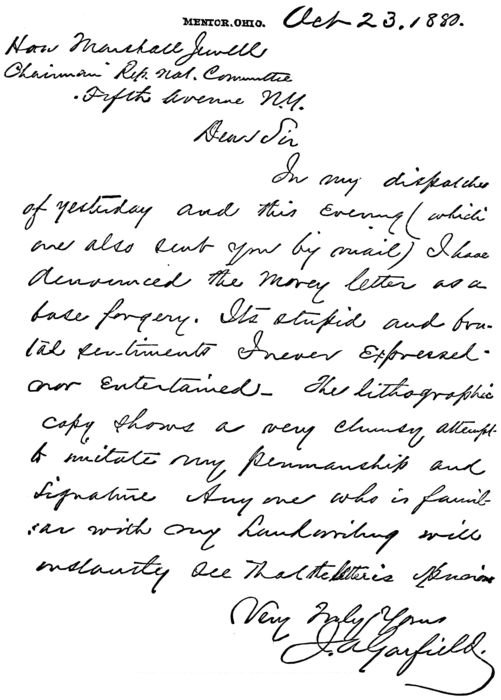
FAC-SIMILE OF GARFIELD’S LETTER OF DENIAL.
474It was instantly manifested, on the appearance of this letter, that its almost certain effect would be to lose General Garfield the electoral votes of the Pacific States; for the settled sentiment of those States against Chinese immigration and the consequent competition of that people with American free labor, was known to be so pronounced as to make it sure that no party discipline could hold them in allegiance to a candidate who squinted at favoring the Celestials. There was instant alarm among the General’s friends, but their fears were quickly quieted by the prompt action of Garfield himself, who immediately sent to Hon. Marshall Jewell, Chairman of the Republican National Committee, the following dispatch:
“Mentor, O., October 22, 1880.
“To Hon. M. Jewell and Hon. S. W. Dorsey:
“I will not break the rule I have adopted by making a public reply to campaign lies, but I authorize you to denounce the so-called Morey letter as a bold forgery, both in its language and sentiment. Until its publication I never heard of the existence of the Employers’ Union of Lynn, Massachusetts, nor of such a person as H. L. Morey.
“J. A. Garfield.”
The mails of the same day brought to General Garfield a copy of the Truth newspaper, containing a lithographic fac-simile of his alleged letter, and to this he made immediate answer as follows:
Mentor, O., October 23, 1880.
“To Hon. Marshall Jewell:
“Your telegram of this afternoon is received. Publish my dispatch of last evening, if you think best. Within the last hour the mail has brought me a lithographic copy of the forged letter. It is the work of some clumsy villain who can not spell nor write English, nor imitate my handwriting. Every honest and manly Democrat in America, who is familiar with my handwriting, will denounce the forgery at sight. Put the case in the hands of the ablest detectives at once, and hunt the rascal down.
“J. A. Garfield.”
The question of veracity was thus broadly opened between General Garfield and the mythical Morey and his backers. It did not take the American people long to decide between them. Except in the columns of extreme and reckless partisan newspapers 475and in the months of irresponsible demagogues, the matter was laid forever to rest. To convince the people that James A. Garfield was a liar was an up-hill work. The Republicans simply said that the Morey letter was an outrageous fraud, a forged expedient, a last resort to stay a lost cause.
In the investigation the following facts clearly appeared:
1. That no such person as H. L. Morey lived at or near Lynn, Massachusetts, at the time when the alleged Garfield letter was written.
2. That no such association as the supposed Morey pretended to represent, ever existed in Lynn.
3. The fac-simile of the letter printed in the columns of Truth showed, on close examination, all the internal evidences of forgery. It was a coarse and easily detected counterfeit of the General’s handwriting and signature, and contained, among other palpable absurdities, the word “companies,” spelled companys—a blunder utterly at variance with General Garfield’s scholarship and careful literary habit.
4. The fact that the sentiments of the letter were in broad and palpable contradiction of Garfield’s letter of acceptance and other public utterances on the Chinese question.
5. General Garfield’s positive and unreserved denial of authorship.
This put the abettors of the Morey business on the defensive, and they squirmed not a little. They said that Morey was dead; which was a necessary thing to say. They declared themselves innocent of all complicity. The letter had come into their hands in the regular way. They believed it to be true, etc. But all these allegations combined would not suffice to stay the inevitable reaction; for say what you will, do not the American people believe in fair play?
According to General Garfield’s expressed desire, the Morey case was carried to the courts. A certain Kenward Philp, a contributor to Truth, was charged with the forgery and arrested.
The grand jury in General Sessions presented an indictment against Joseph Hart, Louis A. Post, Kenward Philp and Charles A. 476Bryne for publishing in the newspaper Truth a criminal libel on General Garfield.
A long trial followed in the court of Oyer and Terminer, of New York. The suit was at first directed against the editors of Truth, and Philp was thus unearthed. As the trial progressed, although the evidence was inconclusive as to Philp’s authorship of the letter, yet every circumstance tended to show unmistakably that the whole affair had been a cunning conspiracy of some prodigious scoundrel to injure General Garfield’s chances for the Presidency.
The production of the letter and its envelope in Court betrayed at once the tampering to which the latter had been subjected, and settled the character of the disgraceful political maneuver which had given it birth. The alleged forger proved to be an English Bohemian, who contributed to the “story papers,” and who confessedly wrote the editorial articles defending the genuineness of the letter in the underground journal which first published it. The register of the Kirtland House, at Lynn, Massachusetts, was produced by the defense, and the name “H. L. Morey” was shown there in October, 1879, and again in February of 1880. But there was the most circumstantial evidence that the name had been recently written on each page of the register. The name had, undoubtedly, been added to the hotel register in each instance by some one who was anxious to bolster up the fraud.
The discovery was made that the envelope containing the forged letter had originally been addressed to some one else than H. L. Morey; and an enlarged photographic copy of the envelope revealed the fact that the original name was Edward or Edwin Fox or Cox, in care of some company in the city of New York. And in the next place it was shown that Edward Fox was employed upon the Truth!
The prosecution failed to convict the publishers of the Truth of criminal libel; but the country rendered again the old Scotch verdict of “Guilty—but not proven.” The Presidential election, however, was imminent, and it is not improbable that General Garfield’s vote on the Pacific Slope was injured by the base machinations of the Morey conspirators.
477On the 2d of November was held the Presidential election. The result had been foreseen. The Democracy could not stem the tide. The “Solid South,” the unfortunate plank in their platform declaring in favor of “a tariff for revenue only,” and the Morey forgery which had been charged up to their account, wrought their ruin. Garfield was overwhelmingly elected. The morning of the 3d revealed the general outline of the result. For a few days it was claimed by the Republicans that they had carried two or three of the Southern States, but this idea was soon dispelled. In a like unprofitable way the Democrats set up certain and sundry claims for some of the Northern States. One day they had carried New York; another day they had authentic information that California and Oregon were safe for Hancock. It was all in vain. The South all went Democratic, and all of the Northern States, except Nevada and one electoral vote from California, had been secured by the Republicans. The victory was unequivocal. The humble boy of Mother Garfield was elected President of the United States by 214 electoral votes against 155 for his antagonist, General Hancock. Thus, under the benign institutions of our country, was conferred upon one who began his life in a log cabin the highest civic honor known among the nations of the earth.
General Garfield spent election day at home without manifest excitement. In the evening, and later in the night, news began to arrive indicative of the result. Still no agitation. To some friends he said: “I have been busying myself with a calculation to determine the rate of voting to-day. During the hours in which the election has been in progress about 2000 ballots have dropped for every tick of the pendulum.” With the morning light there was no longer doubt. The title of General, won on the bloody field of Chickamauga, had given place to that of President-elect, won before the grandest bar of public opinion under the circle of the sun.
On the day succeeding the election, the first delegation bearing congratulations visited Mentor. It was composed of the Oberlin College faculty and students, headed by President Fairchild, and 478the occasion was one of more than usual interest. In reply to the speech of introduction, General Garfield said:
“Mr. President, Ladies and Gentlemen: This spontaneous visit is so much more agreeable than a prepared one. It comes more directly from the heart of the people who participate, and I receive it as a greater compliment for that reason. I do not wish to be unduly impressible or superstitious, but, though we have outlived the days of the augurs, I think we have a right to think of some events as omens; and I greet this as a happy and auspicious omen, that the first general greeting since the event of yesterday is tendered to me by a venerable institution of learning. The thought has been abroad in the world a good deal, and with reason, that there is a divorce between scholarship and politics. Oberlin, I believe, has never advocated that divorce. But there has been a sort of cloistered scholarship in the United States that has stood aloof from active participation in public affairs, and I am glad to be greeted here to-day by the active, live scholarship of Ohio; and I know of no place where scholarship has touched upon the nerve center of the public so effectually as Oberlin. For this reason I am specially grateful for this greeting from the Faculty and students of Oberlin College and its venerable and venerated President. I thank you, ladies and gentlemen, for this visit. Whatever the significance of yesterday’s event may be, it will be all the more significant for being immediately indorsed by the scholarship and culture of my State. I thank you, ladies and gentlemen, and thank your President for coming with you. You are cordially welcome.”
On the 6th of November the Republican Central Committee of Indiana repaired to Mentor and paid their respects to the coming Chief Magistrate; and on the 12th of the month the President, soon-to-be, was visited by the Republican Central Committee of Cuyahoga County. In answer to their salutation he said:
“Gentlemen: I have been saying a good many things during the past few weeks, and think I should be nearly through talking by this time. I should be the listener. But I can not refrain from saying that I am exceedingly glad to meet with you, a company of Republicans from my native county, and congratulate you upon what you have done. You 479have shown your strength and character in your work. You have shown that you are men of high convictions and observe them in all that you do. I have always taken pride in this county and in the city of Cleveland. The Forest City is well worthy to be the capital of the Western Reserve. It has the credit of our country at heart, never losing sight of it in the heat of political warfare. In no city in the country can be found more active and earnest men—solid business men. It is an honor to any one to have the confidence of such a people. I am glad to be here this evening to greet you and thank you for your kind invitation.” [Applause.]
Garfield had now more offices in prospect or actual possession than usually fall to the lot of one man. He was still a member of the House of Representatives in the Forty-sixth Congress; he was also United States Senator-elect for the State of Ohio; and, thirdly, he was President-elect of the United States. On the 10th of November, being perhaps content with the Presidency, he resigned his seats in the House and Senate, and thus for about four months became Citizen Garfield, of Ohio.
The 2d of December was rather a Red-letter day at Mentor. The Presidential electors for the State of Ohio, on that day called on the President-elect and tendered their best regards. In answer to their congratulations he spoke with much animation and feeling as follows:
“Gentlemen: I am deeply grateful to you for this call, and for these personal and public congratulations. If I were to look upon the late campaign and its result merely in the light of a personal struggle and a personal success, it would probably be as gratifying as any thing could be in the history of politics. If my own conduct during the campaign has been in any way a help and a strength to our cause, I am glad. It is not always an easy thing to behave well. If, under trying circumstances, my behavior as a candidate has met your approval, I am greatly gratified. But the larger subject—your congratulations to the country on the triumph of the Republican party—opens a theme too vast for me to enter upon now.
“I venture, however, to mention a reflection which has occurred to me in reference to the election of yesterday. I suppose that no political 480event has happened in all the course of the contest since the early spring, which caused so little excitement, and, indeed, so little public observation, as the Presidential election which was held yesterday at midday. The American people paid but little attention to the details of the real Presidential election, and for a very significant reason: although you and all the members of the Electoral Colleges had absolute constitutional and technical right to vote for any body you chose, and although no written law directed or suggested your choice, yet every American knew that the august sovereign of this Republic—the 9,000,000 of voters—on an early day in November had pronounced the omnipotent fiat of choice; and that sovereign, assuming as done that which he had ordered to be done, entertained no doubt but that his will would be implicitly obeyed by all the Colleges in all the States. That is the reason why the people were so serenely quiet yesterday. They had never yet found an American who failed to keep his trust as a Presidential Elector.
“From this thought I draw this lesson: that when that omnipotent sovereign, the American people, speaks to any one man and orders him to do a duty, that man is under the most solemn obligations of obedience which can be conceived, except what the God of the universe might impose upon him. Yesterday, through your votes, and the votes of others in the various States of the Union, it is probable (the returns will show) that our great political sovereign has laid his commands upon me. If he has done so, I am as bound by his will and his great inspiration and purpose as I could be bound by any consideration that this earth can impose upon any human being. In that presence, therefore, I stand and am awed by the majesty and authority of such a command.
“In so far as I can interpret the best aspirations and purposes of our august sovereign, I shall seek to realize them. You and I, and those who have acted with us in the years past, believe that our sovereign loves liberty, and desires for all inhabitants of the Republic peace and prosperity under the sway of just and equal laws. Gentlemen, I thank you for this visit; for this welcome; for the suggestions that your presence and your words bring, and for the hope that you have expressed, that in the arduous and great work before us we may maintain the standard of Nationality and promote all that is good and worthy in this country, and during the coming four years we may raise just as large a crop of peace, prosperity, justice, liberty, and culture as it is possible for forty-nine millions of people to raise.”
481At the close of the address there was a general hand-shaking à la Américaine; and then to add to the interest of the occasion the President’s aged mother, to whom more than ever of late his heart had turned with loyal devotion, was led into the apartment and presented to the distinguished guests by her more distinguished son.
Two days afterwards there was another assembly of visitors at Mentor. This time it was a delegation of colored Republicans—Black Republicans in both senses of the word—from South Carolina, headed by the negro orator, R. B. Elliott, who delivered the congratulatory address. In answer, the President-elect said:
“General Elliott and Gentlemen: I thank you for your congratulations on the successful termination of the great campaign that recently closed, and especially for your kind allusion to me personally for the part I bore in that campaign.
“What I have done, what I have said concerning your race and the great problem that your presence on this continent has raised, I have said as a matter of profound conviction, and hold to with all the meaning of the words employed in expressing it. What you have said in regard to the situation of your people, the troubles that they encountered, the evils from which they have suffered and still suffer, I listened to with deep attention, and shall give it full measure of reflection.
“This is not the time nor the place for me to indicate any thing as to what I shall have to say and do, by and by, in an official way. But this I may say: I noted as peculiarly significant one sentence in the remarks of General Elliott, to the effect that the majority of citizens, as he alleges, in some portions of the South, are oppressed by the minority. If this be so, why is it so? Because a trained man is two or three men in one, in comparison with an untrained man; and outside of politics and outside of parties, that suggestion is full, brim-full, of significance, that the way to make the majority always powerful over the minority, is to make its members as trained and intelligent as the minority itself. That brings the equality of citizenship; and no law can confer and maintain in the long run a thing that is not upheld with a reasonable degree of culture and intelligence. Legislation ought to do all it can. I have made these suggestions simply to indicate that the education of your race, in my judgment, lies at the base of the final solution of your great question; 482and that can not be altogether in the hands of the State or National Government. The Government ought to do all it properly can, but the native hungering and thirsting for knowledge that the Creator planted in every child, must be cultivated by the parents of those children to the last possible degree of their ability, so that the hands of the people shall reach out and grasp in the darkness the hand of the Government extended to help, and by that union of effort bring what mere legislation alone can not immediately bring.
“I rejoice that you have expressed so strongly and earnestly your views in regard to the necessity of your education. I have felt for years that that was the final solution.
“Those efforts that are humble and comparatively out of sight are, in the long run, the efforts that tell. I have sometimes thought that the men that sink a coffer-dam into the river, and work for months in anchoring great stones to build the solid abutments and piers, whose work is by and by hidden by the water and out of sight, do not get their share of the credit. The gaudy structure of the bridge that rests on these piers, and across which the trains thunder, is the thing that strikes the eye of the general public a great deal more than the sunken piers and hard work. The educational growth and the building up of industry, the economy and all that can help the foundations of real prosperity is the work that, in the long run, tells. Some Scotch poet said, or put it in the mouth of some prophet to say, that the time would come ‘when Bertram’s right and Bertram’s might shall meet on Ellengowan’s height,’ and it is when the might and the right of a people meet that majorities are never oppressed by minorities. Trusting, gentlemen, that you may take part in this earnest work of building up your race from the foundation into the solidity of intelligence and industry, and upon those bases at last see all your rights recognized, is my personal wish and hope for your people.”
About this time in November, the weather closed in stormy and cold, and, fortunately for Garfield, the tide of visitors ebbed, and he found a little rest. Late in the month, he made a brief visit to Washington, where he spent a few days among his friends and political advisers. After that, he returned to Mentor, and during December his life was passed in comparative quiet at his home.
483No doubt in these December days the vision of his boyhood rose many times to view. No doubt, in the silence of the winter evening, by his glowing hearth at Lawnfield, with the wife of his youth by his side and the children of their love around them, and the certain Presidency of the Republic just beyond, he realized in as full measure as falls to the lot of man that strange thing which is called success.
The New Year came in. The bleak January—bitter cold—went by. On the 16th of February, the distinguished Senator Conkling, of New York, made a visit to the President-elect. In the imagination of the political busybodies the event was fraught with great consequences. It was said that the haughty stalwart leader was on a mission looking to the construction of the new administration, to seek favor for his friends, and to pledge therefor the support—hitherto somewhat doubted—of himself and his partisans. The interview was named the “Treaty of Mentor;” but the likelihood is that the treaty consisted of no more than distinguished civilities and informal discussion of the personnel of the new Cabinet, etc. A few days later the President-elect made his departure for Washington to be inaugurated. The special train which was to bear himself and family away, left Mentor on the 28th of February. Fully three thousand people were gathered at the dépôt. Cheer after cheer was given in honor of him who had made the name of Mentor for ever famous. A farewell speech was delivered by Hon. A. L. Tinker, of Painesville, and to this the Chief Magistrate responded thus: