Chapter V · HERO AND GENERAL.
Reading edition
Hark to that roar whose swift and deafening peals
In countless echoes through the mountains ring,
Startling pale Midnight on her starry throne!
Now swells the intermingling din—the jar,
Frequent and frightful, of the bursting bomb,
The falling beam, the shriek, the groan, the shout,
The ceaseless clangor, and the rush of men!—Shelley.
On the 23d of March, 1862, orders reached General Garfield, in Eastern Kentucky, to report at once, with his command, to General Buell at Louisville. It had been determined to concentrate the Army of the Ohio under Buell, move southward to Savannah, Tennessee, there effect a junction with the Army of the Tennessee, which, under General Grant, was on its way up the Tennessee River, after the victories at Forts Donelson and Henry, and, with the united force, move forward to Corinth, Mississippi. Garfield ceased, from that time, to be a commander of an independent force, and became merged, with others of his rank, in the great Army of the Ohio. He proceeded to Louisville with all possible dispatch. But Buell was already far on the road to Savannah. Finding orders, he at once hurried southward, and overtook Buell at Columbia, where the army had to construct a bridge over Duck River. The rebels had burned the old bridge; and, at that stage of the war, pontoon bridges were not to be had. Garfield was at once assigned to the command of the Twentieth Brigade, of General Thomas J. Wood’s division. During this delay at Duck River, General Nelson, hearing that Grant had already reached Savannah, asked permission of Buell to let his division ford or swim the river and hurry on to Grant. As there was no known reason for hurrying to Grant, who sent word that he was in no danger of attack, the 116permission was coldly given. But it was this impatience of Nelson which saved Grant’s army at Shiloh. With Nelson’s division a day in advance, the remainder of the army followed at intervals—with Crittenden’s division second, McCook’s third, then Wood’s—to which Garfield belonged—and last Thomas’s. It had been intended to halt at Waynesboro for a day’s rest, but the impetuous Nelson was beyond the town before he had heard of it, and his speed had communicated itself to the succeeding divisions. In this way Nelson reached Savannah on the 5th of April. Grant’s army was at Pittsburg Landing, ten miles up the river. The world knows of the unexpected and terrific battle, beginning on the 6th and lasting two days. Nelson reached Grant at 5 P. M. of the first day’s fight, Crittenden during the night, and McCook about 9 A. M. of the next day. These reinforcements alone saved Grant’s army from destruction. Wood, impeded by the baggage trains abandoned in the road by the preceding divisions, who were straining every nerve to reach Grant in time, only reached the battle-field as the fighting closed. Garfield’s brigade and some other troops were sent in pursuit of the flying enemy; but their great fatigue from continuous marching, and the darkness of the night, soon recalled the pursuit. On the following morning, Garfield’s brigade took part in a severe fight with the enemy’s cavalry, but it was only a demonstration to cover retreat.
Halleck, Commander-in-Chief, reached Pittsburg Landing April 11th, and began a remarkably slow advance upon Corinth, the objective point of the campaign. The army was required to construct parallels of fortification to cover each day’s advance; and, in this way, it took six weeks to march the thirty miles which lay between the army and Corinth. While lying before Corinth, as throughout his career in the army, Garfield gratified, as much as possible, his love of literature. He had with him several small volumes of the classics, which he read every day. He rather preferred Horace, as being “the most philosophic of the pagans.”
During this time an incident occurred which showed well the character of Garfield. One day a Southern ruffian, a human blood-hound, came riding into camp, demanding that the soldiers hunt 117and deliver to him a wretched fugitive slave who had preceded him. The poor negro, who was badly wounded from the blows of the bully’s whip, had sought the blue-coats for protection, and had succeeded in concealing himself from his relentless pursuer among Garfield’s command. The swearing braggart, being misled and foiled by the soldiers, who not only sympathized with the slave, but enjoyed the swaggerer’s wrath, at length demanded to be shown to the head-quarters of the division commander. The latter, after hearing the complaint, wrote an order to Garfield to require his men to hunt out and surrender the trembling vagabond. Garfield took the order from the aid, read it, quietly refolded it, and indorsed on it the following reply:
“I respectfully, but positively, decline to allow my command to search for, or deliver up, any fugitive slaves. I conceive that they are here for quite another purpose. The command is open, and no obstacle will be placed in the way of the search.”
It was a courageous act, but he had never known fear. A court-martial, with a swift sentence of death, was the remedy for refusals to obey orders. When told of his danger, he said:
“The matter may as well be tested first as last. Right is right, and I do not propose to mince matters at all. My soldiers are here for far other purposes than hunting and returning fugitive slaves. My people on the Western Reserve of Ohio did not send my boys and myself down here to do that kind of business, and they will back me up in my action.”
But no court-martial was held. A short time afterwards the War Department issued a general order embodying the principle of Garfield’s refusal; and from that time it was the rule in all the armies of the Republic that no soldier should hound a human being back to fetters.
After the six weeks’ preparation for the siege of Corinth, Halleck found that only the hull of the nut was left for him. The wily enemy had evacuated the place without a struggle. The vast Union army, which had been massed for this campaign, having no foe to oppose it, was resolved into its original elements. The Army of the Ohio, under Buell, was ordered to East Tennessee, preparatory to an attack 118on Chattanooga. The advance to the east, was along the line of the Memphis and Chattanooga Railroad. This road had to be almost entirely rebuilt, as the supplies for the army were to come along its line. This work of rebuilding was assigned to Wood’s division, and Garfield’s brigade laid down the musket to handle the spade and hammer. Here, Garfield’s boyhood experience with tools, was of incalculable value. If a culvert was to be built, his head planned a swift, but substantial way, to build it. If a bridge had been burned, his eye saw quickly how to shape the spans, and secure the braces. His mind was of the rare sort which combines speculative with practical powers. His spirit electrified his men, as it had the school at Hiram; and, in the drudgery of the work, from which the inspiration of battle was wholly wanting, it was he who cheered and encouraged their unwonted toil. The work, for the time being, having been finished, Garfield’s head-quarters were established at Huntsville, Alabama, the most beautiful town in America. But the exposures of army life, the tremendous exertions put forth in rebuilding the railroad, and the fierce rays of the summer sun, in the unaccustomed climate, laid hold on his constitution, in which the old boyhood tendency to ague was all the time dormant; and in the latter part of July, 1862, he was attacked by malarial fever. In the rough surroundings of the camp, as he tossed on his feverish couch, his thoughts turned longingly to the young wife and child in that humble northern home. Procuring sick-leave, he started north about the first of August.
The War Department had an eye upon Garfield, and determined to give his abilities free scope. Five divisions of Buell’s army we have followed to Corinth, and thence, along the tedious march to Chattanooga. A sixth division had been sent on a separate expedition to Northern Mississippi, and a seventh, under General Geo. W. Morgan, to occupy East Tennessee, and, in particular, Cumberland Gap. In the early part of August, orders reached Garfield to proceed to Cumberland Gap and take command of the seventh division of the Army of the Ohio, relieving General Morgan. But when the order reached Garfield, he was already on his way north, fast held by the malignant clutch of low fever.
119While Garfield had been with the army before Corinth, and on the line of march toward Chattanooga, the general discipline was very loose. The army camp is the most demoralizing place in the world. The men lose all self-restraint, and lapse into ferocious and barbarous manners. The check for this is discipline; but the volunteer troops, in the early stages of the war, utterly scouted the idea of discipline. To render it effective, the Army of the Ohio had to be reduced to a basis of strict military order. Courts-martial were frequent. Garfield’s judicial mind and sound judgment, combined with the knowledge of discipline which his experience as a teacher had given him, caused him to be sought for eagerly, to conduct these courts-martial. He was idolized by his own men, but his ability in the drum-head courts spread his fame throughout the division. The trial of Colonel Turchin, for conduct unbecoming an officer, was the one which attracted most attention.
The report of the trial to the War Department, prepared by Garfield, had served to still further heighten the opinion of his abilities entertained there. Garfield had been at home, on his sick leave, about a month, and had begun to rally from the fever, when he received orders to report at Washington City as soon as his health would permit. Shortly after this he again bade farewell to his girlish wife, and started to the Capital. The service for which he was required there, was none other than to sit on the memorable court-martial of Fitz-John Porter, the most important military trial of the war. The charges against Porter are well known. He was accused of having disobeyed five distinct orders to bring his command to the front in time to take part in the second battle of Bull Run. The trial lasted nearly two months. Garfield was required to pass upon complicated questions, involving the rules of war, the situation and surroundings of Porter’s command previous to the battle, the duties of subordinate commanders, and the military possibilities of the situation. In such a trial, the common sense of a strong, but unprofessional mind, was more valuable than the technical training of a soldier. The question at issue was, whether Porter had kept his own opinions to himself and cheerfully obeyed his superior’s orders, even if he did 120not approve them, or whether, through anger or jealousy, he had sulked in the rear, so as to insure the defeat which he prophesied. Garfield threw all his powers into the investigation, and at last was convinced that Porter was guilty. Such was the verdict of the Court; such, the opinion of Presidents Lincoln and Grant, and such will be the opinion of posterity.
During this trial, Garfield became a warm friend of Major-General Hunter, the presiding officer of the court, and in command of our forces in South Carolina. After the adjournment, Hunter made an application to Secretary Stanton to have Garfield assigned to the Army of South Carolina. The appointment was made. It was gratifying to Garfield, because Hunter was one of the strong antislavery generals, whom, at that time, were few enough. Garfield felt that the war, though being fought on the technical question of a State’s right to secede, was really a war to destroy the hideous and bloody institution of slavery, and he wished to see it carried on with that avowed purpose. As he afterwards expressed it: “In the very crisis of our fate, God brought us face to face with the alarming truth, that we must lose our own freedom or grant it to the slave.”
In the same address from which the above is taken, which was delivered before the war had actually closed, he declared that slavery was dead, and the war had killed it:
“We shall never know why slavery dies so hard in this Republic and in this hall till we know why sin has such longevity and Satan is immortal. With marvelous tenacity of existence, it has outlived the expectations of its friends and the hopes of its enemies. It has been declared here and elsewhere to be in all the several stages of mortality, wounded, moribund, dead. The question has been raised, whether it was indeed dead, or only in a troubled sleep. I know of no better illustration of its condition than is found in Sallust’s admirable history of the great conspirator Catiline, who, when his final battle was fought and lost, his army broken and scattered, was found far in advance of his own troops, lying among the dead enemies of Rome, yet breathing a little, but exhibiting in his countenance all that ferocity of spirit which had characterized his life. So, sir, this body of slavery lies before us 121among the dead enemies of the Republic, mortally wounded, impotent in its fiendish wickedness, but with its old ferocity of look, bearing the unmistakable marks of its infernal origin.”—House of Representatives, January 13, 1865.
But in war it is always the unexpected which happens. Pending Garfield’s departure to Hunter’s command, his old army, then merged with the Army of the Cumberland, under the command of General Rosecrans, who relieved Buell, had, on the last day of the year of 1862, plunged into the battle of Stone River. During the day a cannon-ball took off the head of the beloved Garesché, chief of General Rosecrans’s staff. The place was important, and hard to fill. It required a man of high military ability to act as chief confidential adviser of the commanding general, both as to the general plan of a campaign, and the imperious exigencies of battle. Rosecrans had relied much on Garesché, and, just when so much was expected of the Army of the Cumberland, the War Department feared the testy General might become unmanageable, and, though well versed in the practice of warfare, give way just at the crisis. The chief of staff also had to be a man of pleasant social qualities to fit him for the intimate relation.
Much as the War Department at Washington thought of Rosecrans at this time, his violent temper and invincible obstinacy rendered it imperative that some one should be with him who would prevent an absolute rupture upon trifling grounds. But in addition to these things, the chief of staff had to be a man of faultless generosity and unselfishness; he had to be a man who would exert his own genius for another’s glory; he had to be willing to see the plans of brilliant campaigns, which were the product of his own mind, taken up and used by another; he had to be willing to see reports of victories, which were the results of his own military skill, sent to Washington over the name of the commanding general, in which his own name was never mentioned. He was to do the work and get no glory for it. All this he had to do cheerfully, and with a heart loyal to his superior. There must be no division of counsel, no lukewarm support, no heart-burnings 122at head-quarters. To the army and the world there was but one man—the general. In reality there were two men—the general and his chief of staff.
A prime minister sometimes succeeds in erecting for himself a fame separate, and not merged in the splendor of his sovereign. Wolsey and Richelieu and Talleyrand all did so. But the chief of staff was to know no fame, no name for himself. His light was merged and lost in the corruscations of the man above him. To find a man who united the highest military ability with a genial nature, and who was willing to go utterly without glory himself, was a difficult task. In a moment Stanton fixed his eye on Garfield. Without warning, the commission to South Carolina was revoked. Garfield was ordered to report at once to General Rosecrans, whose head-quarters were at Murfreesboro, Tennessee, as a result of the victory at Stone River.
Rosecrans has said that he was prejudiced against Garfield before his arrival. He had heard that he was a Campbellite preacher, and fond of theological debate, and a school teacher. These three things were enough to spoil any man for Rosecrans. So he gave Garfield a cool enough reception on the January morning when the latter presented himself at head-quarters. Rosecrans, of course, had the option of taking the man whom the Department had sent him, to be his confidential adviser or not. Garfield’s appearance, to be sure, was not that of the pious fraud, or the religious wrangler, or the precise pedagogue. In the book, Down in Tennessee, we find the following superb description of his appearance at this time, by one who saw him:
“In a corner by the window, seated at a small pine desk—a sort of packing-box, perched on a long-legged stool, and divided into pigeonholes, with a turn-down lid—was a tall, deep-chested, sinewy-built man, with regular, massive features, a full, clear blue eye, slightly tinged with gray, and a high, broad forehead, rising into a ridge over the eyes, as if it had been thrown up by a plow. There was something singularly engaging in his open, expressive face, and his whole appearance indicated, as the phrase goes, ‘great reserve power.’ His uniform, though cleanly brushed and sitting easily upon him, had a sort of democratic 123air, and every thing about him seemed to denote that he was ‘a man of the people,’ A rusty slouched hat, large enough to have fitted Daniel Webster, lay on the desk before him; but a glance at that was not needed to convince me that his head held more than the common share of brains. Though he is yet young—not thirty-three—the reader has heard of him, and if he lives he will make his name long remembered in our history.”
After some conversation, Rosecrans concluded to go a little slow before he rejected his services. He kept Garfield around head-quarters for a day or two, quizzing him occasionally, and trying to make up his estimate of the man. This sort of dancing attendance for a position he did not want, would have galled a man of less ability and cheaper pride than Garfield; but he had the patience of a planet. “Rosey,” as his soldiers called him, soon found himself liking this great whole-souled Ohioan, and, what was still more significant, he began to reverence the genius of the man. He was unable to sink a plumb-line to the bottom of Garfield’s mind. After each conversation, the depths of reserve power seemed deeper than before. Rosecrans decided within himself to take him, if possible. Only one thing stood in the way. If Garfield preferred to go to the field, as he had himself prophesied from his name (Guard-of-the-field) just before leaving college in 1856, Rosecrans was not the man to chain him up at head-quarters. The choice was open to Garfield to take a division or accept the position of chief of staff. The latter had fifty times the responsibility, and no opportunity whatever for fame. But without a moment’s struggle, Garfield quietly said: “If you want my services as chief of staff, you can have them.”
The opinion in the army of the selection of General Garfield to succeed the lamented Garesché, may be gathered from a volume called: “Annals of the Army of the Cumberland,” published shortly after Garfield’s appointment, and written by an officer in the army. “With the selection of General Garfield, universal satisfaction is everywhere expressed. Possessed of sound natural sense, an excellent judgment, a highly cultivated intellect, and the deserved reputation of a successful military leader, he is not only the 124Mentor of the staff, but his opinions are sought and his counsels heeded by many who are older, and not less distinguished than himself.”
An incident which occurred soon after his appointment, illustrates well the aspect of his many-sided character, as presented to the common soldier. Civilians have little idea of the gulf which military discipline and etiquette places between the regular army officer and the private soldier. Never was a Russian czar more of a despot and autocrat than a West Point graduate. It seems to be an unavoidable outgrowth of the profession of arms and military discipline that the officer should be a sultan and the private a slave. One night, at Rosecrans’s head-quarters in Murfreesboro, the officers’ council lasted till the small hours of the morning. The outer hall, into which the room used by the council opened, was occupied by a dozen orderly sergeants, who were required to be there, ready for instant service all the time. As the hours advanced, and there was no indication of an adjournment within, this outer council got sleepy, and selecting one of its number to keep watch, rolled itself up in various ragged army blankets and tumbled on the floor. It was not long till the air trembled with heavy blasts from the leaden trumpet of sleep. The unlucky fellow, who was left to guard, was envious enough of his sleeping comrades. Tilting his seat back against the wall, he sank into deep meditation upon the pleasures of sleep. A few minutes later, sundry sudden jerks of his head, from side to side, told that he, too, had found surcease from sorrow in sonorous slumber. Just at this unlucky moment the door opened, and General Garfield stepped out into the dimly-lighted passage, on his way to his quarters. The sleeper’s legs were stretched out far in front of him with lofty negligence; his arms hung by his side; his head, from which the cap was gone, hung down in an alarming manner, as if he were making a profound and attentive investigation of his boots. At this unlucky moment, Garfield stumbled over the sergeant, and fell with his full weight upon the frightened orderly. Military discipline required that Garfield should fire a volley of oaths at the poor fellow, supplemented by a heavy cannonade of 125kicks in the enemy’s rear, and the cutting down of his supplies to bread and water for a week. Orderlies at head-quarters knew this to be the plan of battle. General Garfield rose to his feet as quickly as possible, gave the unfortunate and trembling sergeant his assistance to rise, and after a kindly “excuse me, Sergeant, I did not see you. I’m afraid you did not find me very light,” passed on his way. It is easy to see why the common soldiers loved a chief of staff in whom the gentleman was stronger than the officer.
During the tedious delay at Murfreesboro, the officers and men exercised their ingenuity in inventing games to pass away the time. Phil. Sheridan, out at his quarters in the forest surrounding the town, had invented a game which he called Dutch ten-pins. Out in front of his cabin, from the limb of a lofty tree, was suspended a rope. At the end was attached a cannon-ball, small enough to be easily grasped by the hand. Underneath the rope were set the ten-pins, with sufficient spaces between them for the ball to pass without hitting. At first the fun-loving little General only tried to throw the ball between the pins without knocking any. But as his skill increased, he enlarged the opportunity for it by making the game to consist not only in avoiding the pins on the throw, but in making the ball hit them on the return. Sheridan became very fond of the exercise, and in the three throws allowed each player for a game, he could bring down twenty pins out of the thirty possible. The reputation of the novel game and Sheridan’s skill reached the commanding General’s head-quarters. One day Rosecrans, Garfield, and a few brother officers, rode out to see “little Phil,” as Sheridan was called, and take a hand in the game which had made for itself such a name. The guests were cordially received, and after a good many jokes and much bantering, Sheridan began the game. At the first throw the returning ball brought down six pins; at the second, seven; and the third the same number, making a score of twenty. Several tried with more or less success, but not approaching the host’s score. When Rosecrans took the ball, the merry company laughed at his nervous way of handling it. After a lengthy aim, he threw 126and knocked down every pin by the throw. Again he tried it, and again the ball failed even to get through the wooden line. Sheridan nearly exploded with laughter. A third time he met with the same ill-luck, failing to make a single tally. Then General Garfield stepped forward, saying: “It’s nothing but mathematics. All you need is an eye and a hand.” So saying, he carelessly threw the ball, safely clearing the pins on the forward swing, and bringing down seven on the return. Every body shouted “Luck! luck! Try that again.” The chief of staff laughed heartily, and with still greater indifference, tossed the ball, making eight; the third throw had a like result, scoring Garfield twenty-three, and giving him the game. It was no wonder that an officer said of him, “That man Garfield beats every thing. No matter what he does, he is the superior of his competitors, without half trying.”
On the 25th of April, 1863, Garfield issued a circular to the Army of the Cumberland, upon the barbarities and unspeakable outrages of the Southern prison-pens. The circular contained a verbatim statement by an escaped prisoner of his treatment by the rebels. After a few burning words, General Garfield concluded: “We can not believe that the justice of God will allow such a people to prosper. Let every soldier know that death on the battle-field is preferable to a surrender followed by such outrages as their comrades have undergone.”
Every word of the circular was true. The time may come, when the South will be forgiven for fighting for principles which it believed to be right. The time may come when the sorrows of the North and South will become alike the sorrows of each other, over the ruin wrought by human folly. The right hand of fellowship will be extended. The Southern people, as a people, may be relieved of the fearful charge of the assassination of Abraham Lincoln, and posterity may come to look at it as the infernal offspring of a few hell-born hearts. The day is upon us when much of this is already true. But the men who directly or indirectly caused or countenanced the starvation, the torture, the poisoned and rotten food, the abandonment to loathsome disease, the crowding of thousands of Union prisoners into stockades, opening only 127heavenward, and all the other unparalleled atrocities of the Southern prisons, atrocities that violated every rule of warfare; atrocities, to find the equals of which the history of barbarous and savage nations, without the light of religion, or the smile of civilization, will be ransacked in vain, shall be handed down to an eternity of infamy. They shall take rank with the Caligulas, the Neros, the inquisitors, all the historic monsters in human form, whose names and natures are the common dishonor and disgrace of mankind.
About this time there appeared in Rosecrans’s camp, with drooping feathers, but brazen face, the thing which patriotism denominated “a copperhead.” He was a northern citizen by the name of Vallandigham, from Garfield’s own State, who had been ostracised by his neighbors for his treason, and compelled to leave the community of patriots to seek congenial company within the rebel lines. He was to have an escort to the enemy’s camp. A squad waited outside to perform this touching task, under the cover of a flag of truce. Vallandigham, who had the mind, if not the heart, of a man, in forced jocularity dramatically spoke the lines from Romeo and Juliet—
“Night’s candles are burnt out, and jocund day
Stands tiptoe on the misty mountain tops.”
Quick as thought Garfield completed the quotation—
“I must begone and live, or stay and die.”
The joke was funny to every one but Vallandigham, but he was the only man in the room who laughed aloud.
A little later President Hinsdale wrote to General Garfield about the treasonable views of some copperhead students at Hiram. Above all things Garfield detested a foe in the rear. He respected a man who avouched his principles on the crimsoned field, but a traitor, a coward, was to his candid nature despicable beyond language. His letter in reply is characteristic:
“Head-Quarters Department of the Cumberland, }
Murfreesboro, May 26, 1863. }
“Tell all those copperhead students for me that, were I there in charge of the school, I would not only dishonorably dismiss them from the 128school, but, if they remained in the place and persisted in their cowardly treason, I would apply to General Burnside to enforce General Order No. 38 in their cases....
“If these young traitors are in earnest they should go to the Southern Confederacy, where they can receive full sympathy. Tell them all that I will furnish them passes through our lines, where they can join Vallandigham and their other friends till such time as they can destroy us, and come back home as conquerors of their own people, or can learn wisdom and obedience.
“I know this apparently is a small matter, but it is only apparently small. We do not know what the developments of a month may bring forth, and, if such things be permitted at Hiram, they may anywhere. The rebels catch up all such facts as sweet morsels of comfort, and every such influence lengthens the war and adds to the bloodshed.”
It was about the same time the above letter was written that a letter was brought to Rosecrans’s head-quarters, detailing an extensive plan for a universal insurrection of the slaves throughout the South. The rising was to take place August 1st. The slaves were to arm themselves with whatever they could get, and their especial work was to cut off the supplies of the rebel forces. “An army is dependent on its belly,” said Napoleon. To destroy the bridges and railroads within the Confederacy would swiftly undermine the rebel armies, whose rations and ammunition came along those routes. With the universal coöperation of the Union forces, it was thought the Rebellion might be crushed. To secure the coöperation of Rosecrans was the apparent object of the letter. General Garfield talked it over with his chief, and denounced the plan in the most unmeasured terms. He said that if the slaves wanted to revolt that was one thing. But for the Union army to violate the rules of warfare by encouraging and combining with a war upon non-combatants was not to be thought of. The colored people would have committed every excess upon the innocent women and children of the South. The unfortunate country would not only be overrun with war, but with riot. Rosecrans resolved to have nothing to do with it. But Garfield still was not satisfied. The letter said that several commanders had already given their 129assent. He sent the letter to President Lincoln with a statement of the results which would follow such irregular warfare. A letter of Garfield, written on the subject, says:
“I am clearly of opinion that the negro project is in every way bad, and should be repudiated, and, if possible, thwarted. If the slaves should, of their own accord, rise and assert their original right to themselves, and cut their way through rebeldom, that is their own affair; but the Government could have no complicity with it without outraging the sense of justice of the civilized world. We would create great sympathy for the rebels abroad, and God knows they have too much already.”
Lincoln gave the matter his attention, and the slave revolt never took place in any magnitude. It was an ambitious scheme on paper, and yet was not utterly impracticable. It was a thing to be crushed in its infancy, and Garfield’s action was the proper way to do it.
While Garfield was with Rosecrans, he was addressed by some prominent Northerners upon the subject of running Rosecrans for the Presidency. Greeley and many leading Republicans were dissatisfied with Lincoln in 1862–’63, and wanted to work up another candidate for the campaign of ’64. Attracted by Rosecrans’s successes, they put the plan on foot by opening communication with Garfield, in whom they had great confidence, upon the feasibility of defeating Mr. Lincoln in the convention, with Rosecrans. Garfield, however, put his foot on the whole ambitious scheme. He said that no man on earth could equal Lincoln in that trying hour. To take Rosecrans was to destroy both a wonderful President and an excellent soldier. So effectually did he smother the plan, that it is said Rosecrans never heard a whisper of it.
A most important work of General Garfield, as chief of staff, was his attack upon the corrupting vice of smuggling, and his defense of the army police. When an army is in an active campaign, marching, fighting, and fortifying, there is but little corruption developed. But in a large volunteer army, with its necessarily lax discipline when lying idle for a long time, its quarters become infested with all the smaller vices. The men are of every sort; 130and, as soon as they are idle, their heads get full of mischief. The Army of the Cumberland, during its long inactivity at Murfreesboro, soon began to suffer. The citizens were hostile, and had but two objects—one to serve the Confederacy, the other to make money for themselves. They thus all became spies and smugglers. Smuggling was the great army vice. The profits of cotton, smuggled contraband through the Union lines to the North, and of medicines, arms, leather, whisky, and a thousand Northern manufactures, through to the South, were simply incalculable. Bribery was the most effective, but not the only way of smuggling articles through the lines. The Southern women, famous the world over for their beauty and their captivating and passionate manners, would entangle the officers in their meshes in order to extort favors. To break up this smuggling, and get fresh information of any plots or pitfalls for the Union army, a system of army police had been organized at Nashville and Murfreesboro. This was in a fair state of efficiency when Garfield was appointed chief of staff. To improve it and make its work more available, General Garfield founded a bureau of military information, with General D. G. Swaim for its head. For efficiency, it was never again equaled or approached during the war. Shortly after the establishment of this bureau of information, a determined attack was made on the whole institution. “It marshaled its friends and enemies in almost regimental numbers. Even in the army it has been violently assailed, not only by the vicious in the ranks, but by officers whose evil deeds were not past finding out.” The accusations which were laid before Garfield were always investigated immediately, and always to the vindication of the police department. A special officer was at last detailed to investigate the entire department. His report of the wonderful achievements of the army police is monumental. Garfield was inexorable. Every officer guilty of smuggling had to come down, no matter how prominent he was. The chief of staff set his face like brass against the corruptions. The opportunities open to him for wealth were immense. All that was necessary for him to do was to wink at the smuggling. He had absolute power in the matter. 131But he fought the evil to its grave. He broke up stealing among the men. He established a system of regular reports from spies on the enemy. His police furnished him with the political status of every family in that section of the State. He knew just the temper of Bragg’s troops, and had a fair idea of their number. He knew just what corn was selling at in the enemy’s lines. Located in a hostile country, honeycombed with a system of rebel spies, he out-spied the enemy, putting spies to watch its spies. In every public capacity, civil or military, virtue is more rare and more necessary than genius. General Garfield’s incorruptible character alone saved the army police from destruction, and restored the Army of the Cumberland to order and honesty. He had, long before entering the army, shown wonderful ability for using assistants to accumulate facts for him. The police institution was an outcropping of the same thing. No commander during the war had more exact and detailed information of the enemy than Garfield had at this time.
When General Garfield reached the Army of the Cumberland, it was in a shattered and exhausted condition. It had no cavalry, the arms were inferior, and the terrible pounding at Stone River had greatly weakened it. General Rosecrans insisted on its recuperation and reinforcement before making another advance. The Department at Washington and Halleck, Commander-in-chief of the Union forces, were of the opinion that an advance should be made. Rosecrans, though possessing some high military skill, was sensitive, headstrong, absorbed in details, and violent of speech. He demanded cavalry, horses, arms, equipments. Dispatch after dispatch came insisting on an advance. Sharper and sharper became the replies. Garfield undertook to soften the venomous correspondence. Angry messages were sometimes suppressed altogether. But he could not control the wrathy commander. Rosecrans held a different, and, as it turned out, an erroneous theory of the best military policy. At first, Garfield’s views harmonized with those of his superior; but, as the month of April passed without movement, as his secret service informed him of the condition and situation of the enemy, he joined his own urgent advice 132to that of the Department for an advance. Rosecrans was immovable. The army of 60,000 men had been in quarters at Murfreesboro since January 6th without striking a blow at the rebellion. The month of May, with its opening flowers, its fragrant breezes and blue skies, came and went without a move. General Garfield was sick at heart, but he could do nothing. The more Rosecrans was talked to, the more obstinate he became. Garfield had certain information that Bragg’s army had been divided by sending reinforcements to Richmond, but nobody believed it. Besides, Rosecrans was supported in his position by all the generals of his army. Two of these were incompetent—Crittenden and McCook. They had behaved shamefully at Stone River. General Garfield urged their removal, and the substitution of McDowell and Buell. Rosecrans admitted their inefficiency, but said he hated to injure “two such good fellows.” He kept them till the “good fellows” injured him.
At last, on the 8th of June, 1863, Rosecrans, yielding somewhat to the pressure without, and still more to the persuasion of his chief of staff, laid the situation before the seventeen corps, division and cavalry generals of his army, and requested a written opinion from each one upon the advisability of an advance. It is to be remembered that among the seventeen generals were Thomas, Sheridan, Negley, Jeff. C. Davis, Hazen and Granger. Each of these studied the situation, and presented a written individual opinion. With astonishing unanimity, every one of the seventeen opposed an advance. Rosecrans read the opinions. They coincided with his own. But there was a man of genius at his side. Garfield, his confidential adviser, looked at the opinions of the generals in utter dismay. He saw that a crisis had arrived. The Department of War peremptorily demanded an advance; and to let the vast army, with its then excellent equipment, lie idle longer, meant not only the speedy removal of Rosecrans from command, but the greatest danger to the Union cause. He asked Rosecrans time to prepare a written reply to the opinions opposing an advance. Permission was given, though Rosecrans told him it would be wasted work. Collecting all his powers, he began his 133task. Four days and nights it occupied him. At the end of that time, on June 12th, he presented to Rosecrans the ablest opinion known to have been given to a commanding officer by his chief of staff during the entire war. The paper began with a statement of the questions to be discussed. Next it contained, in tabulated form, the opinions of the generals upon each question. Then followed a swift summary of the reasons presented in the seventeen opinions against the advance. Then began the answer. He presented an elaborate estimate of the strength of Bragg’s army, probably far more accurate and complete than the rebel general had himself. It was made up from the official report of Bragg after the battle of Stone River, from facts obtained from prisoners, deserters, refugees, rebel newspapers, and, above all, from the reports of his army police. The argument showed a perfect knowledge of the rules of organization of the Confederate army. The mass of proofs accompanying the opinion was overwhelming. Then followed a summary and analysis of the Army of the Cumberland. Summing up the relative strength of the two armies, he says, after leaving a strong garrison force at Murfreesboro, “there will be left sixty-five thousand one hundred and thirty-seven bayonets and sabers to throw against Bragg’s forty-one thousand six hundred and eighty.”
He concludes with the following general observations:
“1. Bragg’s army is now weaker than it has been since the battle of Stone River, or is likely to be again for the present, while our army has reached its maximum strength, and we have no right to expect reinforcements for several months, if at all.
“2. Whatever be the result at Vicksburg, the determination of its fate will give large reinforcements to Bragg. If Grant is successful, his army will require many weeks to recover from the shock and strain of his late campaign, while Johnston will send back to Bragg a force sufficient to insure the safety of Tennessee. If Grant fails, the same result will inevitably follow, so far as Bragg’s army is concerned.
“3. No man can predict with certainty the result of any battle, however great the disparity in numbers. Such results are in the hands of God. But, viewing the question in the light of human calculation, I refuse to entertain a doubt that this army, which in January last defeated 134Bragg’s superior numbers, can overwhelm his present greatly inferior forces.
“4. The most unfavorable course for us that Bragg could take would be to fall back without giving us battle; but this would be very disastrous to him. Besides, the loss of matériel of war and the abandonment of the rich and abundant harvest now nearly ripe in Middle Tennessee, he would lose heavily by desertion. It is well known that a widespread dissatisfaction exists among his Kentucky and Tennessee troops. They are already deserting in large numbers. A retreat would greatly increase both the desire and the opportunity for desertion, and would very materially reduce his physical and moral strength. While it would lengthen our communications, it would give us possession of McMinnville, and enable us to threaten Chattanooga and East Tennessee; and it would not be unreasonable to expect an early occupation of the former place.
“5. But the chances are more than even that a sudden and rapid movement would compel a general engagement, and the defeat of Bragg would be in the highest degree disastrous to the rebellion.
“6. The turbulent aspect of politics in the loyal States renders a decisive blow against the enemy at this time of the highest importance to the success of the Government at the polls, and in the enforcement of the conscription act.
“7. The Government and the War Department believe that this army ought to move upon the enemy. The army desires it, and the country is anxiously hoping for it.
“8. Our true objective point is the rebel army, whose last reserves are substantially in the field; and an effective blow will crush the shell, and soon be followed by the collapse of the rebel government.
“9. You have, in my judgment, wisely delayed a general movement hitherto, till your army could be massed and your cavalry could be mounted. Your mobile force can now be concentrated in twenty-four hours; and your cavalry, if not equal in numerical strength to that of the enemy, is greatly superior in efficiency. For these reasons I believe an immediate advance of all our available forces is advisable, and, under the providence of God, will be successful.”
Rosecrans read the opinion, examined the proofs, and was convinced. “Garfield,” said he, “you have captured me, but how shall the advance be made?”
The situation was about as follows: Imagine an isosceles triangle, 135with its apex to the north at Murfreesboro. Here the Army of the Cumberland was situated. The base of the triangle was about fifty miles long, and constituted the enemy’s front, with its right terminating at McMinnville, the south-east corner of the triangle, and its left at Columbia, the south-west corner of the figure. At the middle of the base was the village of Wartrace; and almost due west of Wartrace, but a little below the base of the triangle, was Shelbyville, where the enemy’s center was situated, behind massive fortifications. Between Shelbyville and Wartrace was massed the enemy’s infantry, the extreme wings being composed of cavalry. At a little distance north of the enemy’s front, and forming the base of the triangle, was a “range of hills, rough and rocky, through whose depressions, called gaps, the main roads to the South passed. These gaps were held by strong detachments with heavy columns within supporting distance.” Any one can see the enormous strength of the enemy’s position for defense. But it had still other sources of strength. Behind the enemy’s left and center was Duck River, a deep torrent, with tremendous banks. If they were pressed in front, the rebel army could fall back south of the river, burn the bridges, and gain ample time for retreat to the lofty range of the Cumberland Mountains, which were only a day’s march to the rear. On a direct line with Murfreesboro and Wartrace, and at the same distance south of Wartrace, as Murfreesboro was north of it, was Tullahoma, the dépôt of the enemy’s supplies, and hence the key to the situation. Posted in this almost impregnable situation, Bragg’s army was the master of Central Tennessee. It is evident that the campaign, which Garfield so powerfully urged, was a great undertaking. The narrow mountain gaps heavily fortified; behind the range of hills the great body of the rebel army intrenched in heavy fortifications; behind them the natural defense of Duck River, and still to the south, the Cumberland Mountains, formed an aggregation of obstacles almost insuperable. The plan of the campaign which followed must, in military history, be accredited to Rosecrans, because he was the General in command; but biography cares not for military custom, and names its author and originator the chief of staff. The reason Garfield 136urged the advance, was that he had a plan, the merits of which we will examine hereafter, by which he was convinced it might be successfully made.
There were substantially three ways by which the Union army might advance: one lay along the west side of the triangle to Columbia, there attacking the enemy’s left wing; another to march directly south to Shelbyville, and fall upon the enemy’s center; a third, to advance by two roads, cutting the base of the triangle about midway between the enemy’s center and extreme right. A fourth route was possible, along the eastern side of the triangle to McMinnville; but if the enemy’s right was to be attacked, the Manchester roads were every way preferable, as being more direct. General Garfield’s selection was the third route. His plan was to throw a heavy force forward on the road to Shelbyville, as if intending to attack the rebel center. Then, under cover of this feint, swiftly throw the bulk of the army upon the enemy’s right, turn the flank, cross Duck River, and march swiftly to the enemy’s rear, threatening his supplies, thus compelling Bragg to fall back from his tremendous stronghold at Shelbyville, and either give battle in the open country or abandon the entire region.
On the 23d of June the movement was begun by the advance of General Granger’s division toward Shelbyville. At the same time a demonstration was made toward the enemy’s left, to create the belief that feints were being made to distract the enemy’s attention from what would be supposed the main attack on Shelbyville. Meanwhile the bulk of the army was advanced along the two roads leading to the middle of the enemy’s right—the east road leading through Liberty Gap, and the west through Hoover’s Gap, a defile three miles long. On the twenty-fourth a terrible rain began, continuing day and night, for over a week. It rendered the wretched roads almost impassable, and terribly increased the difficulties of the army. The artillery sunk hub-deep in the almost bottomless mire. Great teams of twelve and fourteen powerful horses “stalled” with small field-pieces. Never a minute did the rain let up. The men’s clothing was so drenched that it was not dry for two weeks. The army wagons, hundreds in number, 137carrying the precious bacon and hard-tack, stuck fast on the roads. So fearful was the mire that on one day the army only advanced a mile and a-half.
But the advance was pushed as rapidly as possible. Liberty Gap and Hoover’s were both captured. The demonstrations on the enemy’s left and center were kept up with great vigor. Bragg was wholly deceived by the numerous points of attack. On the twenty-seventh the entire army was concentrated, and passed rapidly through Hoover’s Gap, and on to Manchester. While the army was concentrating at Manchester, General Thomas, on the twenty-eighth, began the final move in the game—the advance upon Tullahoma. Bragg had retreated from Shelbyville, owing to the danger which threatened his supplies. On the twenty-ninth he evacuated Tullahoma for the same reason. An attempt was made to intercept his retreat and force him to battle. But the terrible condition of the roads and rivers rendered the effort futile. Bragg crossed the Cumberland Mountains, and Central Tennessee was once more in the hands of the Union army. Had the Tullahoma campaign been begun a week earlier, before the rains set in, Bragg’s army would inevitably have been destroyed. The rebel army, of 50,000 veterans, had been driven from a natural stronghold of the most formidable character; and had lost all the fruits of a year’s victories by a single campaign of nine days, conducted in one of the most extraordinary rains ever known in Tennessee. There were 1,700 rebel prisoners taken, several parks of artillery, and an enormous amount of Confederate army stores at Tullahoma. This campaign and its victory was not the result of battle, but of pure strategy, confessedly the highest art in war.
As to whom the credit of the plan of the campaign belonged, there could be no question. As we have shown, it is impossible to separate the double star of Garfield and Rosecrans by military etiquette. But aside from the facts that the campaign was begun as a result of Garfield’s argument, in the face of unanimous opposition, the following fact is conclusive as to whom belongs the glory. On the morning of the twenty-third, when the movement was begun, General Thomas L. Crittenden, one of the corps 138commanders, went to head-quarters and said to General Garfield: “It is understood, sir, by the general officers of the army that this movement is your work. I wish you to understand that it is a rash and fatal move, for which you will be held responsible.”
The lips of an enemy are now made to bear unwilling testimony to the glory and the credit of the chief of staff. In his report to the War Department, just as this campaign was getting started, General Rosecrans says: “I hope it will not be considered invidious if I specially mention Brigadier-General James A. Garfield, an able soldier, zealous, devoted to duty, prudent and sagacious. I feel much indebted to him both for his counsel and assistance in the administration of this army. He possesses the instincts and energy of a great commander.”
Historians are unanimous in their opinion that the Tullahoma campaign was one of the most masterly exhibitions of strategic genius possible to the commander of a great army. Mahan, author of the Critical History of the Civil War, who is ever ready to attack and expose the blunders of the Union generals, declares that this Tullahoma campaign shows “as skillful combinations as the history of war presents.”
But the Tullahoma campaign was not the conclusion of the advance which General Garfield had so persistently urged, and the success of which had been so triumphantly demonstrated. An important line of defense had been broken through; an enormous piece of territory had been captured. But Bragg still held Chattanooga, which was the objective point of the Army of the Cumberland. In his argument of June 12, to induce an advance, Garfield had said: “While it would lengthen our communications, it would give us possession of McMinnville, and enable us to threaten Chattanooga and East Tennessee; and it would not be unreasonable to expect an early occupation of the former place.” It is yet to be seen what fulfillment there was of this prophecy.
After the Tullahoma victory, and Bragg’s retreat behind the Tennessee River, Rosecrans stopped. Again, the War Department ordered an advance. Again, the commander-in-chief refused. Again, Garfield urged that no delay take place. Rosecrans was 139immovable. The Department waited; the army waited; the country waited. At last the following dispatch was received:
“Washington, August 5, 1863.
“The orders for the advance of your army, and that its progress be reported daily, are peremptory.
H. W. Halleck.”
The thing required was stupendous, but the results show it was not impossible. Sixty miles from the Union army was the Tennessee River and Cumberland Mountains. Both run from north-east to south-west. There are in these lofty mountain ranges occasional gaps, through which the great east and west traffic of the country takes place. Chattanooga, in 1863 a town of fifteen hundred inhabitants, is in the most important of these gaps—the one through which passes the Tennessee River and an important net-work of railroads. The town is right in the mountains, twenty-five hundred feet above the sea-level, and was strongly fortified, and practically impregnable to assault. Along the north-west front of the town runs the river, which would have to be crossed by the Union forces. On the southern side of the river, below Chattanooga, are three parallel ranges: Sand Mountain, Lookout Mountain, and Pigeon Ridge,—the valleys between the ridges running up to the gap at Chattanooga. North-east of the town the ridges begin again, and the general configuration of the country is similar. Chattanooga was south-east from where the Union army was situated. The town was the lock, and Bragg’s army the key, to the door to Georgia, Virginia, and the Carolinas. To unlock this door was the task before the Army of the Cumberland.
But the problem of Rosecrans’s advance contained other complications beside the deep river, the lofty mountains, and the heavy fortifications. His army had to depend for its supplies upon Louisville, Kentucky, and the slender line of railway from that place. Every advance necessitated the weakening of his army by leaving strong detachments to preserve this communication; while, on the other hand, Bragg, already reinforced, would grow stronger all the time as he fell back on his reserves.
It is reasonable to suppose that the reason Garfield had urged 140the advance toward Chattanooga was that he saw a way in which it could be made. When the peremptory order came, a plan for the advance was projected, which, though vaster and more complicated than that of the Tullahoma campaign, contains the same elements, and shows itself to have been the work of the same mind. It was, indeed, a continuation of the same campaign. The plan was Rosecrans’s, because he adopted it. It was Garfield’s, because he originated it. The theory of the advance was to pass the enemy’s flank, march to his rear, threaten his line of supplies and compel him, by military strategy, to evacuate Chattanooga, as he had Shelbyville and Tullahoma. The door would thus be unlocked, and Bragg’s army driven from its last fortification to the open country. The details of the plan, as prepared by Garfield, will appear as the advance is explained. On August 16th began the movement of the army across the mountains toward the Tennessee River. The paramount effort in the manner of the advance was to deceive the enemy as to the real intention.
The army made the movement along three separate routes. Crittenden’s corps, forming the left, was to advance by a circuitous route, to a point about fifteen miles south-west of Chattanooga, and make his crossing of the Tennessee River there. Thomas, as our center, was to cross a little farther down stream, and McCook, thirty miles farther to the right. These real movements were to be made under the cover of an apparent one. About seven thousand men marched directly to the river shore, opposite Chattanooga, as if a direct attack were to be made on the place. “The extent of front presented, the show of strength, the vigorous shelling of the city by Wilder’s artillery, the bold expression of the whole movement, constituted a brilliant feint.” Bragg was deceived again. Absorbed in the operations in front of the place, he offered no resistance to the crossing of the Tennessee River by the main army.
By September 3d, the Union forces were all on the southern side of the Tennessee. Sand Mountain, the first of the ridges on that side of the river, rises abruptly from the bank. The repair and construction of roads occupied a little time; but Thomas and McCook pushed forward vigorously, and by the evening of the 6th of September 141had crossed Sand Mountain, and occupied the valley between it and the Lookout Range. Each of these corps had crossed the range at points opposite their crossings of the river, and, though in the same valley, were thirty-five miles apart. Crittenden, instead of crossing, turned to his left, and marched up the river bank toward Chattanooga, and crossed into the Lookout Valley by a pass near the town. On the 7th the next stage of the movement began, viz: the crossing of Lookout Range, in order to pass to the enemy’s rear, and, by endangering his supplies, compel him to abandon Chattanooga.
As soon as Bragg’s spy-glasses on Lookout Mountain, at Chattanooga, disclosed this movement, the order to evacuate the place was given. Shelbyville and Tullahoma were repeated, and on the morning of September 9th Crittenden marched in and took the place without the discharge of a gun. Strategy had again triumphed. The door was unlocked. The fall of Chattanooga was accomplished. The plan of the campaign had been carried out successfully. The North was electrified. The South utterly discomfited. Of the fall of Chattanooga, which, as we have shown, was but the continuation of the plan of the Tullahoma campaign, and was predicted by Garfield, even to the manner of its accomplishment, in his argument to Rosecrans in favor of an advance, Pollard, the Confederate historian, writes:
“Thus we were maneuvered out of this strategic stronghold. Two-thirds of our niter beds were in this region, and a large proportion of the coal which supplied our foundries. It abounded in the necessaries of life. It was one of the strongest mountain countries in the world; so full of lofty mountains that it has been not inaptly called the Switzerland of America. As the possession of Switzerland opened the door to the invasion of Italy, Germany, and France, so the possession of East Tennessee gave easy access to Virginia, North Carolina, Georgia, and Alabama.”
It is easy to see that behind this masterly strategy there was a masterly strategist. That man was Rosecrans’s chief of staff.
What had become of Bragg’s army of fifty thousand men? Rosecrans thought it was in full retreat. Halleck, Commander-in-chief, 142telegraphed from Washington, on the 11th, that information had been received that Bragg’s army was being used to reinforce Lee, a certain indication of retreat. The fact was that Lee was reinforcing Bragg. Halleck also telegraphed on the same day that reinforcements were coming to Rosecrans, and that it would be decided whether he should move further into Georgia and Alabama. This telegram completed the delusion of Rosecrans. He believed Bragg was many miles to the south. The campaign planned by Garfield had been completed. But Rosecrans made a fatal blunder. Instead of marching the corps of Thomas and McCook up the Lookout Valley to Chattanooga, and uniting them with Crittenden’s, he ordered the crossing of the range as a flank movement to be continued in order to intercept Bragg’s supposed retreat. Accordingly, on the 11th and 12th, Thomas recommenced to push over Lookout Mountain through a pass, twenty-five miles south-east of Chattanooga; and thirty-five miles beyond Thomas, McCook was doing the same thing.
With the Union army thus divided, Bragg was waiting his terrible opportunity. Instead of being in full retreat, many miles away, his entire army occupied Pigeon Ridge along the valley on the southern side of Lookout Range, into which Thomas and McCook must descend from the Mountain passes. Down the center of this valley runs a little river, the Chickamauga. On the southern side of this stream, just opposite the pass from which Thomas’s corps of eighteen thousand devoted men would emerge, was concentrated the entire rebel army, waiting to destroy the isolated parts of the Army of the Cumberland in detail. The region occupied by Bragg was covered with dense forests, and he was further concealed by the low heights of Pigeon Ridge. When Thomas’s corps should have debouched from the pass through Lookout Range, and crossed the Chickamauga to ascend Pigeon Ridge, it was to be overwhelmed. Then McCook and Crittenden, sixty-five miles apart, would be separately destroyed. It fortunately happened that General Negley’s division descended from the gap on the 12th, and crossed the Chickamauga several miles in advance of the main body of Thomas’s corps. Unexpectedly, 143finding the enemy in great force on the opposite ridge, he swiftly withdrew, checked Thomas from further advance, and enabled the corps to take up an impregnable position in the gap through Lookout Range.
Thus foiled, Bragg then resolved to strike Crittenden, but eventually failed in this also. These failures gave the alarm. Bragg’s army was not ready for flight but for fight. It was now a matter of life and death for Rosecrans to concentrate his army before battle. Couriers were dispatched at break-neck speed to McCook, sixty-five miles away, and to Crittenden who had pushed on twenty miles beyond Chattanooga, in imaginary pursuit of Bragg. In some absolutely inexplicable way, Bragg failed for four days to make the attack. In those precious days, from September 13th to 17th, Garfield worked night and day, as chief of staff, to reach the scattered divisions, explore the shortest roads through those lofty mountains, and hasten that combination which alone could save the army from destruction. The suspense was terrible. But Bragg lost his opportunity by delaying too long. Heavy reinforcements for him were arriving, and he thought he was growing stronger. On the 17th and 18th Bragg was found to be moving his army up the valley toward Chattanooga, thus extending his right far beyond Rosecrans’s left, with the evident object of throwing his army upon the roads between the Union army and Chattanooga. To meet this, the Union army was moved in the same direction.
These movements of both armies up the valley, Bragg being south of the Chickamauga and Rosecrans north, were continued until the position was almost south of Chattanooga, instead of south-west. Parallel with our army, and immediately in its rear, were two roads leading to Chattanooga,—the one immediately in the rear known as the Lafayette or Rossville road; the other a little further back, as the Dry Valley road. At the junction of these roads, half way to Chattanooga, itself eight miles distant, was the town of Rossville. These roads were the prizes for which was to be fought one of the most bloody and awful battles of the war. The loss of either was equally fatal, but the main Rossville road, 144being the most exposed, was the principal object of the enemy’s attacks. The efforts of the enemy at first were to overlap or turn the left flank. This would have given them the Rossville road. Failing in this they drove the center back, the center and left turning like a door upon the hinge at the extreme left, until the line of battle was formed directly across the roads instead of parallel with them. This was accomplished during the second day’s fight.
General Thomas commanded the left wing, Crittenden the center, and McCook the right. The front of the army, facing almost east, was ranged up and down the valley from north to south, with the river in front and the roads in their rear. The whole valley was covered with dense forests, except where a farm had been made, and was full of rocky hills and ridges. So much concealed was one part of the valley from another, that the rebel army of fifty thousand men was formed in line of battle within a mile of the union lines on the same side of the river, without either army suspecting the other’s presence.
Such was the situation on the morning of September 19th, 1863. The world knows of the awful conflict which followed. General Garfield was located at Widow Glenn’s house, in the rear of the right wing. This was Rosecrans’s head-quarters. General Thomas located himself at Kelley’s farm-house in the rear of the left wing. For three nights General Garfield had not slept as many hours. Every anxious order, for the concentration of the army, had come from him; every courier and aid during those days and nights of suspense reported to him in person; before him lay his maps; each moment since the thirteenth he had known the exact position of the different corps and divisions of our vast army. Looking for the attack at any moment, it was necessary to constantly know the situation of the enemy among those gloomy mountains and sunless forests. When the red tide of battle rolled through the valley, each part of the line was ignorant of all the rest of the line. The right wing could not even guess the direction of the left wing. The surrounding forests and the hills shut in the center so completely that it did not know where either of 145the wings were. Every division commander simply obeyed the orders from head-quarters, took his position, and fought. The line of battle was formed in the night. To misunderstand orders and take the wrong position was easy. But so lucid were the commands, so particular the explanations which came from the man at head-quarters, that the line of battle was perfect. Many battles of the war were fought with but few orders from head-quarters; some without any concerted plan at all. Pittsburgh Landing, of the latter sort; Gettysburg, of the former sort. At Gettysburg, the commander-in-chief, General Meade, had little to do with the battle. The country was open, the enemy’s whereabouts was visible, and each division commander placed his troops just where they could do the most good. Not so at Chickamauga. No battle of the war required so many and such incessant orders from head-quarters. The only man in the Union army who knew the whole situation of our troops was General Garfield. Amid the forests, ravines and hills along the five miles of battle front, the only possible way to maintain a unity of plan and a concert of action was for the man at head-quarters to know it all. General Garfield knew the entire situation as if it had been a chess-board, and each division of the army a man. At a touch, by the player, the various brigades and divisions assumed their positions.
Every thing thus far said has been of the combatants. But there were others on the battle-field. There were the inhabitants of this valley, non-combatants, inviolate by the rules of civilized warfare. Of this sort were the rustic people at Widow Glenn’s, where General Garfield passed the most memorable days of his life. The house was a Tennessee cabin. Around it lay a little farm with small clearings. Here the widow lived with her three children, one a young man, the others a girl and boy of tender age. As General Garfield took up his head-quarters there it is said to have reminded him powerfully of his own childhood home with his toiling mother. All the life of these children had been passed in this quiet valley. Of the outside world they knew little, and cared less. They did not know the meaning of the word war. They were ignorant and poverty-stricken, but peaceful. Shut in by the 146mountains of ignorance, as well as the lofty ranges along the valley, they had known no event more startling than the flight of birds through the air or the rustle of the wind through the forest. The soil was rocky and barren like their minds; yet, unvisited by calamity, they were happy.
But suddenly this quiet life was broken into. The forests were filled with armed men. The cabin was taken possession of by the officers. A sentinel stood at the door. Outside stood dozens of horses, saddled and bridled. Every moment some one mounted and dashed away; every moment some other dismounted from his breathless and foam-flecked steed and rushed into the cabin. The widow, stunned and frightened, sat in the corner with an arm around each of her children. The little girl cried, but the boy’s curiosity got somewhat the better of his fear. A time or two General Garfield took the little fellow on his knee, and quieted his alarm. The fences were torn down and used for camp fires. Great trees were hastily felled for barricades. In front of the house passed and repassed bodies of troops in uniform, and with deadly rifles. Now and then a body of cavalry dashed by in a whirlwind of dust. Great cannon, black and hideous, thundered down the rocky road, shaking the solid earth in their terrible race. The cabin-yard was filled with soldiers. The well was drained dry by them to fill their canteens. It was like a nightmare to the trembling inhabitants of the cabin. Their little crops were tramped into dust by the iron tread of war. On a hill in front of the cabin, where nothing more dangerous than a plow had ever been, a battery frowned. The valley which had never been disturbed by any thing more startling than the screech of an owl, or the cackle of the barn-yard, was filled with a muffled roar from the falling trees and the shouts of men.
When morning broke on the 19th of September, 1863, on this secluded spot, the clarion of the strutting cock was supplanted by the bugle-call. The moaning of the wind through the forest was drowned in the incessant roll of the drums. The movement of troops before the cabin from right to left became more rapid. The consultations within became more eager and hurried. Mysterious 147notes, on slips of white paper, were incessantly written by General Garfield and handed to orderlies, who galloped away into the forest. Spread out before him, on an improvised table, lay his maps, which he constantly consulted. At one time, after a long study of the map, he said to General Rosecrans: “Thomas will have the brunt of the battle. The Rossville road must be held at all hazards.” Rosecrans replied: “It is true. Thomas must hold it, if he has to be reinforced by the entire army.” At another time, a messenger dashed into the room, and handed the chief of staff an envelope. Quietly opening it, he calmly read aloud: “Longstreet has reinforced Bragg with seventeen thousand troops from Lee’s Virginia army.”
Toward nine o’clock in the morning, the movement of troops along the road ceased. The roar in the forest subsided. No more orders were sent by General Garfield. There was suspense. It was as if every one were waiting for something. The drums no longer throbbed; the bugle-call ceased from echoing among the mountains. A half hour passed. The silence was death-like. As the sun mounted upward it seemed to cast darker shadows than usual. The house-dog gave utterance to the most plaintive howls. The chickens were gathered anxiously together under a shed, as if it were about to rain. It was. But the rain was to be red. Passing over through the forest, one saw that the troops were drawn up in lines, all with their backs toward the road and the cabin, and facing the direction of the river. That was half a mile away, but its gurgle and plashing could be easily heard in the silence. It sent a shudder through one’s frame, as if it were the gurgle and plashing of blood. The only other sound that broke the quiet was the whinnying of cavalry horses far off to the right. The dumb brutes seemed anxious, and nervously answered each other’s eager calls.
Just as the hand of the clock reached ten there was a report from a gun. It came from the extreme left, miles away. General Garfield stepped quickly to the door, and listened. There was another gun, and another, and fifty more, swelling to a roar. Turning to Rosecrans, Garfield said: “It has begun.” To which 148the commander replied: “Then, God help us.” Heavier and heavier became the roar. The engagement on the left was evidently becoming heavier. A quarter of an hour later messengers began to arrive. The enemy was endeavoring to turn the left-flank, but was being repulsed with heavy loss. A few moments later came the word that the enemy had captured ten pieces of artillery. The order had been given for one division of the troops to fall back. It was obeyed. But the artillerymen had been unable to move the guns back in time. The heavy undergrowth in the forest, the fallen and rotting logs, had made it slow work to drag back the ponderous cannon. The red-shirted cannoneers were still bravely working to move their battery to the rear after the line had fallen back from them a long distance. Suddenly, with a fierce yell, the rebel column poured in upon them. Guns and gunners were captured.
At 11:30 came a call from General Thomas for reinforcements. General Garfield swiftly wrote an order for divisions in the center to march to the left and reinforce General Thomas. Another courier was dispatched to the right, ordering troops to take the place of those removed from the center. At half-past twelve these movements were completed. So far, the only attack had been on the left, though the tide of battle was rolling slowly down the line. General Rosecrans and General Garfield held an earnest consultation. It was decided to order an advance on the right center, in order to prevent the enemy from concentrating his whole army against our left wing.
Before long the din of conflict could be heard opposite the cabin. The advance was being fiercely contested. Messengers one after another came asking for reinforcements. General Garfield received their messages, asked each one a question or two, turned for a few moments to his map, and then issued orders for support to the right center. As the battle raged fiercer in front of the cabin, the sounds from the extreme left grew lighter. At two o’clock they ceased altogether. The battery had been recaptured, and the enemy silenced for the time being. Meanwhile, the battle at the center became more terrible. Ambulances hurried 149along. Poor fellows, pale and bleeding, staggered back to the road. Occasionally a shell dropped near the cabin, exploding with frightful force. The roar was deafening. General Garfield had to shout to General Rosecrans in order to be understood. The domestic animals around the cabin were paralyzed with fright. No thunder-storm, rattling among the mountain peaks, had ever shaken the earth like the terrific roar of the shotted guns. A half mile in front of the cabin, a dense smoke rose over the tops of the trees. All day long it poured upward in black volumes. The air became stifling with a sulphurous smell of gunpowder. The messengers hurrying to and from the cabin had changed in appearance. The bright, clean uniforms of the morning were torn and muddy. Their faces were black with smoke; their eyes bloodshot with fever. Some of them came up with bleeding wounds. When General Garfield called attention to the injury, they would say: “It is only a scratch.” In the excitement of battle men receive death wounds without being conscious that they are struck. Some of the messengers sent out came back no more forever. Their horses would gallop up the road riderless. The riders had found the serenity of death. “They were asleep in the windowless palace of rest.”
It was impossible to predict the issue of the conflict in the center. At one minute, a dispatch was handed Garfield, saying that the line was broken, and the enemy pouring through. Before he had finished the reading, another message said that our troops had rallied, and were driving the enemy. This was repeated several times.
The scene of this conflict was Vineyard’s farm. It was a clearing, surrounded on all sides by the thickest woods. The troops of each army, in the alternations of advance and retreat, found friendly cover in the woods, or fatal exposure in the clearing. It was this configuration of the battle-field which caused the fluctuations of the issue. Time after time a column of blue charged across the clearing, and was driven back to rally in the sheltering forest. Time after time did the line of gray advance from the shade into the sunlight only to retire, leaving half their number stretched 150lifeless on the field. It was a battle within a battle. The rest of the army could hear the terrific roar, but were ignorant of the whereabouts of the conflict. The farm and the surrounding woods was a distinct battle-field. The struggle upon it, though an important element in a great battle on a vast field, was, during the later hours of its continuance, a separate battle, mapped upon the open field and forest in glaring insulation by the bodies of the slain.
Meanwhile, in hurrying reinforcements to this portion of the line of battle, a chasm was opened between the center and left. Troops were thrown forward to occupy it, but the enemy had discovered the weakness, and hurled forward heavy columns against the devoted Union lines. The struggle here was the counterpart of the one at the Vineyard farm. At the latter place the line was, at one time in the afternoon, driven back to the Lafayette road; but, towards evening, the divisions which had repulsed the attack on General Thomas’s extreme left were shifted down to the scene of these other conflicts, and the enemy was finally driven back with heavy loss.
When this was accomplished, the sun had already sunk behind the western range. Night swiftly drew her mantle over the angry field, and spread above the combatants her canopy of stars. The firing became weaker; only now and then a sullen shot was fired into the night. The first day of Chickamauga was done. In a little while ten thousand camp-fires blazed up in the forest, throwing somber shadows back of every object. At every fire could be seen the frying bacon and the steaming coffee-pot, singing as merrily as if war and battle were a thousand miles away. The men had eaten nothing since five o’clock in the morning. They had the appetites of hungry giants. Many a messmate’s place was empty. Many a corpse lay in the thicket, with a ball through the heart. But in the midst of horror the men were happy. The coffee and bacon and hard-tack tasted to the heroes like a banquet of the gods. With many a song and many a jest they finished the meal, rolled up in their blankets, and, lying down on the ground, with knapsacks for pillows, were fast asleep in the darkness. The red 151embers of the camp-fires gradually went out. The darkness and the silence were unbroken, save by the gleam of a star through the overarching branches, or the tramp of the watchful sentinels among the rustling leaves.
But at Widow Glenn’s cabin there was no sleep. General Garfield dispatched messengers to the different generals of the army to assemble for a council of war. It was eleven o’clock before all were present. Long and anxious was the session. The chief of staff marked out the situation of each division of the army upon his map. The losses were estimated, and the entire ground gone over. On the whole, the issue of the day had been favorable. The army having been on the defensive, might be considered so far victorious in that it had held its own. The line of battle was now continuous, and much shorter than in the morning. The general movement of troops during the day had been from right to left. The battle front was still parallel with the Chattanooga roads. General Thomas still held his own. The losses had been heavy, but not so severe as the enemy’s. But it was evident that the battle would be renewed on the morrow. The troops, already exhausted by forced marches in the effort to concentrate before attack, had all been engaged during the day. It was tolerably certain, General Garfield thought, from the reports of his scouts, that the enemy would have fresh troops to oppose to the wearied men. This would necessitate all the army being brought into action again on the next day. In case the enemy should succeed in getting the roads to Chattanooga, there was no alternative but the entire destruction of the splendid Army of the Cumberland. Still further concentration of the forces on the left, to reinforce General Thomas, was decided on. Many of the tired troops had to be roused from their sleep for this movement. There was no rest at head-quarters. When morning dawned the light still shone from the cabin window.
On the morning of September 20, 1863, a dense fog rose from the Chickamauga River, and, mixing with the smoke from the battle of the day before, filled the valley. This fact delayed the enemy’s attack. The sun rose, looking through the fog like a vast 152disk of blood. General Garfield noticed it, and, pointing to the phenomenon, said: “It is ominous. It will indeed be a day of blood.” By nine o’clock the fog lifted sufficiently for the attack. As on the day before, it began on the left, rolling down the line. From early morning General Thomas withstood the furious assaults of the constantly reinforced enemy. The change of the line in the night had been such that it was the right wing instead of the center which was now in front of the Widow Glenn’s. The battle was fierce and more general than the day before. The demands for reinforcements on the left came faster and faster. Division after division was moved to the left. In the midst of a battle these movements are dangerous. A single order, given from head-quarters without a perfect comprehension of the situation of the troops, a single ambiguous phrase, a single erroneous punctuation mark in the hastily-written dispatch, may cost thousands of lives in a few minutes. In a battle like Chickamauga, where the only unity possible is by perfect and swift obedience to the commands from head-quarters, a single misunderstood sentence may change the destiny of empires.
The information received at Widow Glenn’s up to ten o’clock of the 20th showed that the troops, though wearied, were holding their own. Up to this time General Garfield, appreciating each emergency as it occurred, had directed every movement, and written every order during the battle. Not a blunder had occurred. His clear, unmistakable English, had not a doubtful phrase or a misplaced comma. Every officer had understood and executed just what was expected of him. The fury of the storm had so far spent itself in vain.
At half-past ten, an aid galloped up to the cabin and informed General Rosecrans that there was a chasm in the center, between the divisions of General Reynolds on the left and General Wood on the right. Unfortunate moment! Cruel fate! In a moment a blunder was committed which was almost to destroy our heroic army. In the excitement of the crisis, Rosecrans varied from his custom of consulting the chief of staff. General Garfield was deeply engaged at another matter. Rosecrans called another aid 153to write an order instantly directing Wood to close the gap by moving to his left. Here is the document as it was dashed down at that memorable and awful moment:
“Head-Quarters Department of Cumberland, }
“September 20th—10.45 A. M. }
“Brigadier-General Wood, Commanding Division:
“The general commanding directs that you close up on Reynolds as fast as possible, and support him. Respectfully, etc.,
“Frank S. Bond, Major and Aid-de-camp.”
Had General Garfield been consulted that order would never have been written. Wood was not next to Reynolds. General Brannan’s division was in the line between them. Brannan’s force stood back from the line somewhat. The aid, galloping rapidly over the field, did not know that a little farther back in the forest stood Brannan’s division. It looked to him like a break in the line. General Rosecrans was either ignorant, or forgot that Brannan was there. General Garfield alone knew the situation of every division on the battle-field. This fatal order was the only one of the entire battle which he did not write himself. On receipt of the order, General Wood was confused. He could not close up on Reynolds because Brannan was in the way. Supposing, however, from the words of the order, that Reynolds was heavily pressed, and that the intention was to reinforce him, and knowing the extreme importance of obeying orders from head-quarters, in order to prevent the army from getting inextricably tangled in the forest, he promptly marched his division backward, passed to the rear of Brannan, and thus to the rear of and support of Reynolds.
The fatal withdrawal of Wood from the line of battle was simultaneous with a Confederate advance. Failing in his desperate and bloody attacks upon the left, Bragg ordered an advance all along the line. Right opposite the chasm left by Wood was Longstreet, the most desperate fighter of the Confederacy, with seventeen thousand veteran troops from Lee’s army. Formed in solid column, three-quarters of a mile long, on they came right at the gap. Two brigades of Federal troops, under General Lytle, reached 154the space first, but were instantly ground to powder beneath this tremendous ram. Right through the gap came the wedge, splitting the Union army in two. In fifteen minutes the entire right wing was a rout. One-half the army was in a dead run toward Rossville. Guns, knapsacks, blankets, whatever could impede them, was hastily thrown away.
So sudden was the rout that the stream of fugitives, swarming back from the woods, was the first information received at Widow Glenn’s that the line had been pierced. There was no time to be lost. Behind the fleeing troops came the iron columns of the enemy. In five minutes more the cabin would be in their hands. Hastily gathering his precious maps, Garfield followed Rosecrans on horseback, over to the Dry Valley road. Here General Garfield dismounted, and exerted all his powers to stem the tide of retreat. Snatching a flag from a flying color-bearer, he shouted at the deaf ears of the mob. Seizing men by their shoulders he would turn them around, and then grasp others to try and form a nucleus to resist the flood. It was useless. The moment he took his hands off of a man he would run.
Rejoining Rosecrans, who believed that the entire army was routed, the commander said: “Garfield, what can be done?” Undismayed by the panic-stricken army crowding past him, which is said to be the most demoralizing and unnerving sight on earth, Garfield calmly said, “One of us should go to Chattanooga, secure the bridges in case of total defeat, and collect the fragments of the army on a new line. The other should make his way, if possible, to Thomas, explain the situation, and tell him to hold his ground at any cost, until the army can be rallied at Chattanooga.” “Which will you do?” asked Rosecrans. “Let me go to the front,” was General Garfield’s instant reply. “It is dangerous,” said he, “but the army and country can better afford for me to be killed than for you.” They dismounted for a hurried consultation. With ear on the ground, they anxiously listened to the sound of Thomas’s guns. “It is no use,” said Rosecrans. “The fire is broken and irregular. Thomas is driven. Let us both hurry to Chattanooga, to save what can be saved.” But General Garfield 155had a better ear. “You are mistaken. The fire is still in regular volleys. Thomas holds his own, and must be informed of the situation. Send orders to Sheridan, and the other commanders of the right wing, to collect the fragments of their commands and move them through Rossville, and back on the Lafayette road, to Thomas’s support.” There were a few more hurried words; then a grasp of the hand and the commander and his chief of staff separated, the one to go to the rear, the other to the front. Rosecrans has said that he felt Garfield would never come back again.
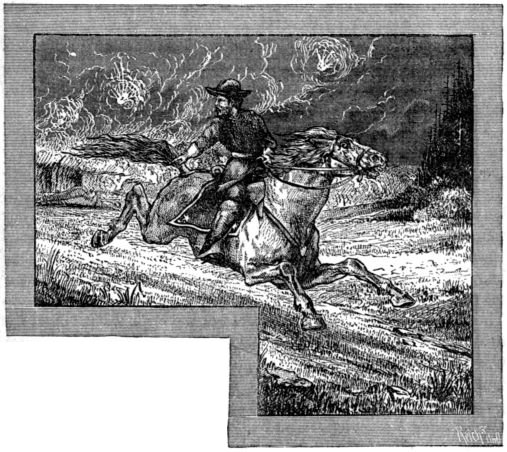
GARFIELD AT THE BATTLE OF CHICKAMAUGA.
Then began that world-famous ride. No one knew the situation of the troops, the cause of the disaster, and the way to retrieve it like the chief of staff. To convey that priceless information to Thomas, Garfield determined to do or to die. He was accompanied by Captain Gano, who had come from General Thomas before the disaster, and knew how to reach him; besides these two, each 156officer had an orderly. On they galloped up the Dry Valley road, parallel with, but two miles back of, the morning’s line of battle. After reaching a point opposite the left wing, they expected to cross to General Thomas. But Longstreet’s column, after passing the Union center, had turned to its right at Widow Glenn’s, to march to the rear of General Thomas, and thus destroy that part of the army which still stood fighting the foe in its face. The course of Longstreet was thus parallel with the road along which Garfield galloped. At every effort to cross to the front he found the enemy between him and General Thomas.
It was a race between the rebel column and the noble steed on which Garfield rode. Up and down along the stony valley road, sparks flying from the horse’s heels, two of the party hatless, and all breathless, without delay or doubt on dashed the heroes. Still the enemy was between them and Thomas. They were compelled to go almost to Rossville. At last General Garfield said: “We must try to cross now or never. In a half hour it will be too late for us to do any good.” Turning sharply to their right, they found themselves in a dark-tangled forest. They were scratched and bleeding from the brier thickets and the overhanging branches. But not a rider checked his horse. General Garfield’s horse seemed to catch the spirit of the race. Over ravines and fences, through an almost impenetrable undergrowth, sometimes through a marsh, and then over broken rocks, the smoking steed plunged without a quiver.
Suddenly they came upon a cabin, a Confederate pest-house. A crowd of unfortunates, in various stages of the small-pox, were sitting and lying about the lonely and avoided place. The other riders spurred on their way, but General Garfield reined in sharply, and, calling in a kind tone to the strongest of the wrecks, asked, “Can I do any thing for you, my poor fellow?” In an instant the man gasped out, “Do not come near. It is small-pox. But for God’s sake give us money to buy food.” Quick as thought the great-hearted chief of staff drew out his purse and tossed it to the man, and with a rapid but cheerful “good-bye” spurred after his companions. Crashing, tearing, plunging, rearing through the 157forest dashed the steed. Poet’s song could not be long to celebrate that daring deed.
Twice they stopped. They were on dangerous ground. At any moment they might come upon the enemy. They were right on the ground for which Longstreet’s column was headed. Which would get there first? A third time they stopped. The roar of battle was very near. They were in the greatest peril. Utterly ignorant of the course of events, since he had been driven from Widow Glenn’s, General Garfield did not know but what the rebel column had passed completely to Thomas’s rear and lay directly in front of them. They changed their course slightly to the left. Of his own danger Garfield never thought. The great fear in his mind was that he would fail to reach Thomas, with the order to take command of all the forces, and with the previous information of the necessity of a change of front. At last they reached a cotton field. If the enemy was near, it was almost certain death. Suddenly a rifle-ball whizzed past Garfield’s face. Turning in his saddle he saw the fence on the right glittering with murderous rifles. A second later a shower of balls rattled around the little party. Garfield shouted, “Scatter, gentlemen, scatter,” and wheeled abruptly to the left. Along that side of the field was a ridge. If it could be reached, they were safe. The two orderlies never reached it. Captain Gano’s horse was shot through the lungs, and his own leg broken by the fall. Garfield was now the single target for the enemy. His own horse received two balls, but the noble animal kept straight on at its terrific speed. General Garfield speaking of it afterwards said that his thought was divided between poor Thomas and his young wife and child in the little home at Hiram. With a few more leaps he gained the ridge, unhurt. Captain Gano painfully crawling on the ground finally gained the ridge himself.