Chapter V · HERO AND GENERAL. (continued 2)
Reading edition
General Thomas was still a mile away. In ten minutes Garfield was at his side, hurriedly explaining the catastrophe at noon. They stood on a knoll overlooking the field of battle. The horse which had borne Garfield on his memorable ride, dropped dead at his feet while the chief of staff told Thomas the situation. 158There was no time to be lost. Hurrying down to his right, General Thomas found that a considerable portion of the center had swung around like a door to oppose Longstreet’s advance. For an hour or more his columns had flung themselves with desperate fury on this line so unexpectedly opposed to them. Hour after hour these lines had held him at bay. The slaughter was terrible. But this could not last. There was no uniform plan in this accidental battle front. There were great chasms in it. The Confederate forces were diverging to their left toward the Dry Valley road, and would soon flank this line. But Thomas was a great commander. Without a moment’s delay his line of battle was withdrawn to a ridge in the form of a horse-shoe. The main front was now at right angles with that of the morning; that is, it lay across the Rossville road instead of parallel with it. Thomas’s troops were now arranged in a three-quarter circle. They scarcely numbered twenty-five thousand. Around this circle, as around a little island, like an ocean of fire, raged a Confederate army of sixty thousand troops. Overwhelmed by numbers, General Thomas still held the horse-shoe ridge, through which lay the Rossville road. The storm of battle raged with fearful power. The line of heroes seemed again and again about to be swallowed up in the encircling fire. Again and again Longstreet’s troops charged with unexampled impetuosity, and as many times were beaten back bruised and bleeding. The crisis of the battle at half past four in the afternoon, when Longstreet hurled forward his magnificent reserve corps, is said to have rivaled, in tragic importance and far-reaching consequences, the supreme moment in the battle of Gettysburg, when Pickett’s ten thousand Virginians, in solid column, charged upon Cemetery Ridge.
But all the valor and all the fury was in vain. “George A. Thomas,” in the words of Garfield, “was indeed the ‘rock of Chickamauga,’ against which the wild waves of battle dashed in vain.”
General Garfield, from the moment of his arrival, had plunged into the thickest of the fray. When at last the thinned and shattered lines of gray withdrew, leaving thousands of their dead 159upon the bloody field, smoked and powder-grimed, he was personally managing a battery of which the chief gunners had been killed at their post. Towards the close of the fight Thomas’s ammunition ran very low. His ammunition trains had become involved with the rout of the right, and were miles in the rear at Rossville. This want of ammunition created more fear than the assaults of the enemy. The last charge was repelled at portions of the line with the bayonet alone.
But the hard-earned victory was won. The Rossville road was still held. The masterly skill and coolness of Thomas, when General Garfield reached him with information as to the rest of the army, which, it must be remembered, was never visible through the dense forests and jagged ridges of the valley, had saved the Army of the Cumberland from destruction. After night the exhausted men withdrew to Rossville and subsequently to Chattanooga.
A great battle is a memorable experience to one who takes part. There is nothing like it on earth. Henceforth the participant is different from other men. All his preceding life becomes small and forgotten after such days as those of Chickamauga. From that day he feels that he began to live. When the flames of frenzy with which he was possessed subside, they have left their mark on his being. Ordinarily the flames of battle have burnt out many sympathies. His nature stands like a forest of charred and blackened trunks, once green and beautiful, waving in their leafy splendor, but through which the destroying tempest of fire has passed in its mad career of vengeance. He can neither forget nor forgive the murderous foe. Before the battle he might have exchanged tobacco plugs with the man with whom he would have, with equal readiness, exchanged shots. But after the carnage of the battle, after the day of blood and fury, all this is passed. The last gun is fired on the field of battle. The last shattered line of heroes withdraws into the night. The earth has received its last baptism of blood for the time-being. Only burial parties, with white flags, may be seen picking their way among the fallen brave. The actual battle is over forever. Not so is it with the combatant. In his mind the battle goes on and on. He is perpetually training masked batteries on the foe. 160The roar of conflict never ceases to reverberate in his brain. Throughout his life, whenever recalled to the subject of the war, his mental attitude is that of the battle-field. In his thought the columns are still charging up the hill. The earth still shakes with an artillery that is never silenced. The air is still sulphurous with gunpowder smoke. The ranks of the brave and true still fall around him. Forever is he mentally loading and firing; forever charging bayonets across the bloody field; forever burying the fallen heroes under the protection of the flag of truce.
This is the law of ordinary minds. The red panorama of the Gettysburg and the Chickamauga is forever moving before his eyes. The wrench or strain given to his mental being by those days is too terrific, too awful, for any reaction in the average mind. This fact has been abundantly proven in the history of the last twenty years. Chickamauga thus became a new birth to many a soldier. His life, henceforward, seemed to date from the 19th of September, 1863. His life was ever afterward marked off by anniversaries of that day. It is found that many soldiers die on the anniversary of some great battle in which they were participants. Such is the influence mental states bear upon the physical organism.
Chickamauga was all this to General Garfield. It was more than this to him. He was not merely a participant in the battle of bullets. He was also in the battle of brains. The field soldier certainly feels enough anxiety. His mental experience has enough of torture to gratify the monarch of hell himself. But the anxieties of the man at head-quarters are unspeakable. He sees not merely the actual horrors and the individual danger. He carries on his heart the responsibility for an army. He is responsible for the thousands of lives. A single mistake, a single blunder, a single defective plan, will forever desolate unnumbered firesides. More than this he feels. Not only the fate of the army, but the fate of the country rests in his hand. The burden is crushing. It may be said this is only upon the Commander-in-chief. But General Garfield, as chief of staff, we have seen, was no figure-head, no amanuensis. He took the responsibilities of that campaign and 161battle to his own heart. At every step his genius grappled with the situation. Rosecrans was a good soldier; but in nothing was his ability so exhibited as in selecting Garfield for his confidential adviser and trusting so fully to his genius.
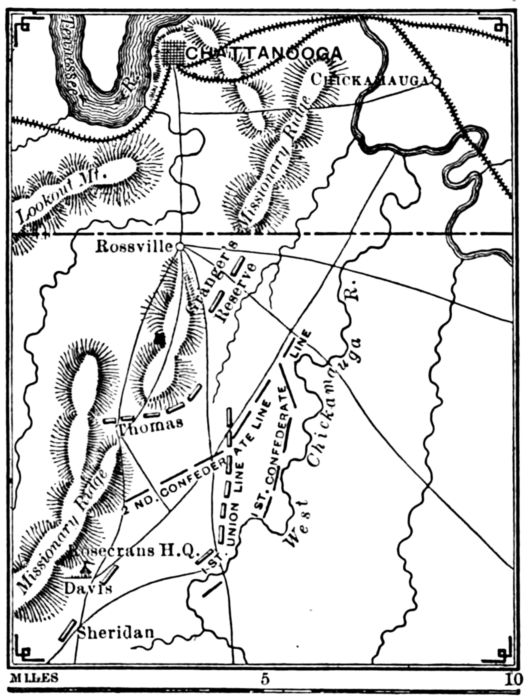
DIAGRAM OF THE BATTLE OF CHICKAMAUGA.
Thus the battle of Chickamauga entered into Garfield’s mental experience in its greatest aspects. His profoundly sympathetic nature was subjected to an incalculable strain. The struggle of the first day, the beginning of the second, the fatal order, the appalling catastrophe, the fearful ride, the invincible courage of Thomas, the costly victory, all these things were incorporated into his life. He lived years in a single hour. He was only thirty-one years old. It was only nine years since the boys at Williams College had laughed at him as a green-horn; only seven years since he had graduated. But the education of Chickamauga gave him age. The maturity of the mind is not measured by time, but by experience. Previous to the Chattanooga campaign, General Garfield was a clever man. After the battle of Chickamauga he was a great man.
Of the general results of the battle, we quote from Van Horn’s magnificent but critical History of the Army of the Cumberland: “Whatever were the immediate and more local consequences of the battle, in its remote relations and significance, it has claims to historic grandeur. The Army of the Cumberland, without support on either flank, had leaped across the Tennessee River and the 162contiguous mountains, and yet escaped destruction, though the armies of the enemy, east and west, were made tributary to a combination of forces to accomplish this end. Paroled prisoners from Vicksburg, regular troops from Mississippi and Georgia, a veteran corps from Lee’s army in Virginia, and Buckner’s corps from East Tennessee, joined Bragg on the banks of the Chickamauga, not simply to retake Chattanooga, but to annihilate the Army of the Cumberland. Nearly half of Bragg’s army consisted of recent reinforcements, sent to Northern Georgia while the authorities at Washington, perplexed with the military situation, were resting under the delusion that General Bragg was reinforcing Lee. But this heavy draft upon the resources of the Confederacy was burdened with the fatality which clung to all the grander efforts of the insurgents in the west. And General Bragg’s broken and exhausted army was a symbol of the fast-coming exhaustion of the Confederacy itself. The issue of the battle was not thus defined to the consciousness of the Southern people, but was, doubtless, one of the most emphatic disappointments of the struggle, and intensified the gloom produced by previous defeats.”
In his report of the battle to the Department of War, General Rosecrans said:
“To Brigadier-General James A. Garfield, chief of staff, I am especially indebted for the clear and ready manner in which he seized the points of action and movement, and expressed in orders the ideas of the general commanding.”
In relating the history of General Garfield’s military career, no mention has been made of a fact which was destined to affect his future. In the fall of 1862, he had been nominated and elected to Congress from his own district. The thing had been accomplished in his absence, and almost without his knowledge. His term did not begin till December, 1863, and his constituents supposed the war would be over before that time. Garfield himself looked at the thing with indifference. It did not interfere with his service in the army, could not do so for a long time, and there was nothing to hurry his decision in the matter. After the Tullahoma 163campaign, in the summer of 1863, when he had had a taste of successful military strategy, the Congressional question began to force itself to the surface of his thought. There was no prospect of peace. All his inclinations persuaded him to remain in the army. But Congress met in December, and he would have to decide.
In this frame of mind, he had a long confidential talk with Rosecrans on the subject. Rosecrans told him he ought to enter Congress.
“I am glad for your sake,” said Rosecrans, “that you have a new distinction, and I certainly think you can accept it with honor; and, what is more, I deem it your duty to do so. The war is not over yet, nor will it be for some time to come. There will be, of necessity, many questions arising in Congress which will require not alone statesman-like treatment, but the advice of men having an acquaintance with military affairs. For this, and other reasons, I believe you will be able to do equally good service to your country in Congress as in the field.”
Still General Garfield was undecided, except on one thing: that was to wait. Meantime the Chattanooga campaign came on, terminating at Chickamauga. Garfield was consumed with military zeal. He could hardly bear to think of chaining himself up to a desk for the monotonous sessions of Congress. All the military spirit which had blazed in his ancestors reasserted itself in him. His mind was absorbed with the stupendous problems of war which the Rebellion presented. Recognizing within himself an ability superior to many around and above him for grappling with questions of strategy, he was loath to abandon its exercise. It was evident, too, that in the presence of the commanding proportions of the military fame of successful Union generals, any merely Congressional reputation would be dwarfed and overshadowed.
On the other hand, his brother officers urged him to go to Congress. There was a painful need of military men there. The enormous necessities of the army seemed too great to be comprehended by civilians. All men of soldierly instincts and abilities 164were at the front, and there was danger that the fountain of supplies in the Lower House of Congress would dry up.
In the midst of these doubts, two weeks after the battle of Chickamauga, he was summoned to Washington. The War Department demanded a full explanation of the battle which had cost so many thousand lives. Garfield was known at Washington, and they determined to have from him the complete history of the campaign, and an explanation of the necessities of the situation.
On his way to the Capital he, of course, went by the vine-covered cottage at Hiram. After the carnage and havoc of war, the peaceful fireside seemed a thousand times more dear than ever, worth all the blood and all the tears that were being shed for it. During his brief stay at home, his first born, “Little Trot,” only three years of age, was seized with a fatal illness, and carried to the quiet village cemetery. Oppressed with the private as well as the public sorrow, he continued on his journey to Washington. In New York City he staid over night with an old college friend, Henry E. Knox. Again he talked over the Congressional question in all its bearings. The conversation lasted far into the night. The friend knew the feeling of the country; he knew the need for military men in Congress, and he was well acquainted with Garfield’s ability. His advice to General Garfield was to accept the Congressional seat as a public duty.
But never was a man so unwilling to accept a place in Congress. General Garfield felt that he had a career before him if he remained in the army, and he wanted to do so. At last he agreed to submit the question to Mr. Lincoln. “I will lay it before him when I reach Washington, and let his decision settle the matter,” said he. Garfield felt that his mission to the Capital was to save Rosecrans. When he called on Secretary Stanton, he was notified of his promotion to the rank of major-general, “for gallant and meritorious services at Chickamauga.” This added further complexity to the Congressional question. Every detail of the movements of the Army of the Cumberland was gone through with by him before the War Department. With the aid of maps he made 165an elaborate presentation of the facts, from the long delay at Murfreesboro clear through the Tullahoma and Chattanooga campaigns. His exposé was masterly. Every thing he could do was done to save his chief. Montgomery Blair, one of the ablest men at the Capital, after listening to General Garfield’s presentation of the facts, said to a friend, “Garfield is a great man.” President Lincoln said: “I have never understood so fully and clearly the necessities, situation, and movements of any army in the field.”
But it was in vain. Stanton was firm. Rosecrans had to go. His obstinate refusals to advance from Murfreesboro; his testy and almost insulting letters; his violent temper, and uncontrollable stubbornness had ruined him long before Chickamauga. He had broken with the Commander-in-chief as well as with Secretary Stanton. He had said that he regarded certain suggestions from the Department “as a profound, grievous, cruel, and ungenerous official and personal wrong.” The powerful enemies which he thus made only waited for an opportunity to destroy him. That opportunity came with the fatal order at Chickamauga, the rout of the right wing, the loss of presence of mind, and the ride to the rear. This last stood in painful contrast with General Garfield’s dangerous and heroic ride to the front. It was admitted that the strategy of the campaigns was splendid, Napoleonic. It could not be denied that the mistake as to the enemy’s whereabouts after the evacuation of Chattanooga originated in the dispatches from Washington. No matter. Rosecrans was relieved, and the chief of staff, whom Stanton correctly believed to have been very largely the originator of the strategic advance, was promoted.
His immediate duty at Washington being discharged, General Garfield laid the question of the seat in Congress before the man who, perhaps, felt more sympathy and appreciation for and with him than any other, because, like himself, Garfield sprang from poverty, Abraham Lincoln. The great, grave President thought it over, and finally said:
“The Republican majority in Congress is very small, and it is often doubtful whether we can carry the necessary war measures; and, besides, 166we are greatly lacking in men of military experience in the House to regulate legislation about the army. It is your duty, therefore, to enter Congress, at any rate for the present.”
This, for the time being, settled the matter. With the understanding that his rank would be restored if he desired to return to the army, General Garfield reluctantly resigned his new major-generalship, a position whose salary was double that of a Congressman, in order to enter on the following day the House of Representatives.
The greatest men seem often to have been those who were suddenly lifted out of the career of life which they had chosen, and to which they seemed to be preëminently adapted, and forced, as it were, by the exigencies of the times, into a new channel. Julius Cæsar, whose lofty character, unapproachable genius, and sorrowful death, are hardly equalled in the annals of any age or country, had chosen for himself the career of a civil and religious officer of state. His chosen field was in the stately sessions of the Roman Senate, or before the turbulent multitudes of the forum. It was said of him by his enemies, that in speaking he excelled those who practiced no other art. It was said that, had he continued in his chosen career, he would have outshone, in his eloquence, every orator whose name and fame has been transmitted by Rome to later generations. But from this career he was unexpectedly taken. The dangers to the state from the Gallic tribes, and the restless Roman appetite for conquest, required a military leader. Almost by accident Cæsar was drawn away from the senate and the forum to take up the profession of arms.
Unlike the great Roman, Garfield, under the stress of public necessity, was almost by accident withdrawn from the career of arms, in which it may be truly said of him that he, too, excelled those who practiced no other art, to enter upon the career of a legislator. Cæsar exchanged the assembly for the camp, while the great American left the camp for the assembly. Each did so at the call of the state, and each was to become, in his new field, the master spirit of his generation.
167