Chapter XIII · SHOT DOWN. (continued 2)
Reading edition
The twenty-eighth day.—On the 29th of July a Cabinet meeting, at which all the members except Attorney-General MacVeagh were present, was held at the White House. Public matters were discussed, and certain routine official business disposed of in the usual way. All this indicated a belief, on the part of the members, that the President was on the road to recovery. There was, however, no marked change in his condition or prospects. He had passed a comfortable night—so said the attendants—and the afternoon fever was less pronounced than on the previous day. The three bulletins of the surgeons contained about the only information which could be obtained of the progress of the distinguished patient. They were as follows:
“8:30 A. M.—Immediately after the evening dressing yesterday the President’s afternoon fever began gradually to subside. He slept well during the night, and this morning is free from fever, looks well, and expresses himself cheerfully. A moderate rise of temperature in the afternoon is to be anticipated for some days to come. At present his pulse is 92; temperature, 98.4; respiration, 18. 2:30 P. M.—The President bore the dressing of his wound well this morning, and exhibited very little fatigue after its completion. He rests well, and takes an adequate quantity of nourishment. At present his pulse is 98; temperature, 98.4; respiration, 19. 7 P. M.—The President has been comfortable and cheerful during the day, and has had quite a nap since the noon bulletin was issued. At present his pulse is 98; temperature, 100; respiration, 20.”
567To these reports very little can be added for the day, except the confirmation of their substance in the evening dispatch of Secretary Blaine, which was as follows:
“Lowell, Minister, London:
“The President’s afternoon fever was less to-day than yesterday, and at this hour—half-past 11 P. M.—has almost disappeared. Temperature very nearly normal. His wound is in a healthy condition, and he is doing well in all respects. His physicians are greatly encouraged.
“Blaine, Secretary.”
The twenty-ninth day.—With the morning of the 30th of July came the report of a farther—though slight—improvement in the President’s condition. He was said to have waked early in the morning after a refreshing sleep. He showed no fatigue from the dressing of the wound in the course of the forenoon, and ate with relish a moderate quantity of solid food. He was able, with the aid of a contrivance placed under the mattress, partly to sit up in bed. The afternoon rise in temperature was moderate. Several times during the President’s illness the question of malarious influences about the White House, as affecting his prospects of recovery, was discussed by the physicians and the general public. It was noticed that several of the employes had been taken sick in a way to indicate malaria in the surroundings. The condition of the Executive Mansion itself was reported as being unfavorable to health. So the question of removing the President to a more healthful place was again raised and seriously debated by the surgeons. Dr. Bliss, who was a member of the Washington Board of Health, which several years before, after a long struggle, had succeeded in having a large number of disease-breeding tenement-houses removed, was very emphatic in his condemnation of the “conveniences” of the White House, and said the family of the President should be removed while engineers should overhaul and renovate the entire plumbing arrangements of the premises.
Of course all possible means are taken to keep the unhealthy influence arising from this condition of affairs from the sick-room of the President; and the closed doors, together with the elaborate 568new ventilating apparatus, were believed to furnish ample protection.
Mr. Blaine, in his night dispatch to Minister Lowell, spoke encouragingly of the situation, and the official bulletins were pitched in the usual hopeful key:
“8:30 A. M.—The President enjoyed a refreshing sleep during the greater part of the night. A gradual improvement of his general condition in all particulars is observable, and is recognized by himself. His pulse is now 92; temperature, 98.5; respiration, 18. 12:30 P. M.—The President showed no fatigue from the dressing of his wound this morning. His general condition continues gradually to improve. A moderate quantity of solid food has been added to his nourishment, and was eaten with relish. At present his pulse is 98; temperature, 98.5; respiration, 20. 7 P. M.—The President has passed the day comfortably and without drawback or unpleasant symptoms. The afternoon rise of temperature is moderate, and did not commence until about 5 o’clock. At present his pulse is 104; temperature, 100.2; respiration, 20.”
The thirtieth day.—The physicians again found time to discuss the location of the ball in the President’s body. The majority had still held the opinion that the missile had passed through the peritoneal cavity, and was lodged in the front wall of the abdomen. In a dispatch of the day, it was even alleged that the surgeons were now agreed in this opinion.
It was believed that the black-and-blue spot, which had been visible on the right side of the abdomen for several days after the President received his injury, marked the bullet’s location, and this theory was apparently confirmed by such results as had thus far been obtained with the induction balance. However this might be, it was said by the physicians, with much confidence, that the ball was, by this stage of progress, encysted, and that not much further trouble would or could arise from its presence in the body. The bulletins of the thirtieth day were as follows:
“8:30 A. M.—The President slept well during the night, and awoke refreshed this morning. His appearance and expression this morning indicate continued improvement. At present his pulse is 94; temperature, 56998.4; respiration, 18. 12:30 P. M.—The President bore the morning dressing of the wound without fatigue. It continues to look well and discharge adequately. The quantity of nourishment now taken daily is regarded as quite sufficient to support his system and favor the gradual increase in strength, which is plainly observable. At present his pulse is 100; temperature, 98.5; respiration, 19. 7 P. M.—The President has passed an excellent day. The afternoon rise of temperature has been quite insignificant. At present his pulse is 104; temperature, 99; respiration, 20.”
On this day it was announced that Professor Bell had completed his instrument for determining the location of the ball. A description of the apparatus was given to the public, which, though couched in scientific language, may prove of interest to the general reader. The induced electrical current, and the interference therewith by the presence of a metallic body, were the fundamental facts of the invention. The instrument consisted of two circular primary coils of insulated copper three inches in diameter and half an inch in thickness, the one being constructed of No. 19 wire, and containing between seven and eight ohms of resistance, forming the primary coil, and the other of No. 28 or 30 wire, giving more than eighty ohms of resistance, forming the secondary coil, the two being connected in separate metallic circuits. In the circuit with the former there was placed an electrical battery and a spring vibrator, the latter so adjusted as to make a very rapid series of “breaks” of the circuit, sending a hundred or more electrical pulsations over the circuit and around the primary coil of wire per second. A hand telephone only was placed in the circuit with the secondary coil. The batteries being connected, and the vibrator set in motion, the secondary coil was placed so as to cover the primary, and the operator having the telephone at his ear, hears the pulsations of the primary current sent through the vibrator with each motion of its spring, an induced current being produced in the secondary coil by its contiguity with the primary.
Up to this point the ground traversed had been familiar to all electricians for many years. Professor Bell’s discovery, which made the subject of special interest, consisted in the fact that if the 570secondary coil be gradually turned to one side, so as to uncover a portion of its primary, the inductive effects and the resultant tone from the vibrator diminish until a point is reached, where only about one-third of the surface of the secondary coil remaining upon the primary coil, the sound-producing effect of the induction ceased altogether. If the secondary coil be moved beyond the point of silence the sonorous results become immediately apparent.
At the point of silence it was discovered that that portion of the secondary, which still covered an equal portion of its primary, was very sensitive to the presence of metallic substances not connected in any way with the circuits of which the two coils formed a portion, disclosing their proximity by making again audible the sounds from the vibrator. The results obtained from this instrument were equal to those given by the Hughes balance, but the latter furnishing a more convenient form for general use, it was first adopted as the basis of experiments.
Such was the instrument which the electricians completed, but would it work in practically discovering the place of the ball? It was determined that on the morrow the apparatus should be tested.
The thirty-first day.—Two things on this day occupied the public attention: First, the regular reports; and second, the experiments of Professor Bell. The bulletins were as follows:
“8:30 A. M.—The President slept well during the night, and this morning is cheerful, and expresses himself as feeling better than at any time since he was hurt. He appears stronger, and has evidently made progress toward recovery during the last few days. His pulse is now 94; temperature, 98.4; respiration, 18. 12:30 P. M.—The President’s wound continues to do well. At the morning dressing it was found to be in all respects in a satisfactory condition. At present his pulse is 100; temperature, 98.4; respiration, 19. 7 P. M.—The President has taken nourishment well and in sufficient quantity, and in all respects continues to do well. The rise of temperature this afternoon is slight. At present his pulse is 104; temperature, 99.5; respiration, 20.”
After the morning dressing of the President’s wound, it was 571decided to make a formal trial of the induction apparatus for determining, if possible, the location of the fatal bullet. Professor Bell was accordingly brought, with his instrument, to the President’s bedside, and there conducted his experiments. Later in the day he wrote out and presented to the surgeons an official report of the results, as follows:
“Volta Laboratory, 1,221, Connecticut Avenue,}
“Washington, August 1, 1881.}
“To the Surgeons in attendance upon President Garfield:
“Gentlemen—I beg to submit for your information a brief statement of the results obtained with the new form of induction balance in the experiments made this morning for the purpose of locating the bullet in the person of the President. The instrument was tested for sensitiveness several times during the course of the experiments, and it was found to respond well to the presentation of a flattened bullet at a distance of about four inches from the coils. When the exploring coils were passed over that part of the abdomen where a sonorous spot was observed in the experiments made on July 26, a feeble tone was perceived, but the effect was audible a considerable distance around this spot. The sounds were too feeble to be entirely satisfactory, as I had reason to expect, from the extreme sensitiveness of the instrument, a much more marked effect. In order to ascertain whether similar sounds might not be obtained in other localities, I explored the whole right side and back below the point of entrance of the bullet, but no part gave indications of the presence of metal, except an area of about two inches in diameter, containing within it the spot previously found to be sonorous. The experiments were repeated by Mr. Taintor, who obtained exactly corresponding results. We are therefore justified in concluding that the ball is located within the above-named area. In our preliminary experiments we found that a bullet like the one in question, when in its normal shape, produced no audible effect beyond a distance of two and a-half inches; while the same bullet, flattened and presented with its face parallel to the plane of the coils, gave indications up to a distance of five inches. The same flattened bullet, held with its face perpendicular to the plane of the coils, produced no sound beyond a distance of one inch. The facts show that in ignorance of the actual shape and mode of presentation of the bullet to the exploring instrument, the depth at which the bullet lies beneath the surface can not be determined from our experiments.
I am, gentlemen, yours truly,
“Alexander Graham Bell.”[5]
The thirty-second day.—Less space was given to-day in the public press to reports of the President’s progress than on any previous 572day since the assassination. An incident of the hour was the reception by Mrs. Garfield of a draft for a hundred pounds sterling, sent by the Disciples, of England, to aid in the reconstruction of the church in Washington where the President was in the habit of attending worship. The reports for the day were of the same general tenor which they had borne since the surgical operation of the 25th July. The bulletins were as follows:
“8:30 A. M.—The President passed a very pleasant night, and slept sweetly the greater part of the time. This morning he awoke refreshed, and appears comfortable and cheerful. Pulse, 94; temperature, 98.4; respiration, 18. 12:30 P. M.—The President is passing the day comfortably. At the morning dressing his wound was found to be doing admirably. His pulse is now 99; temperature, 98.4; respiration, 19. 7 P. M.—The President has continued to progress favorably during the day, and appears perceptibly better in his general condition than yesterday, a more natural tone of voice being especially perceptible. At present his pulse is 104; temperature, 100; respiration, 20.”
The thirty-third day.—“President Garfield continues,” says the New York Tribune, “to gain steadily. In a fortnight more, if all goes well with him, he will probably be able to sit up and give some attention to the business which awaits his action. He is still very weak, but when the healing process in his wound is well begun, he will, no doubt, gain strength rapidly.” Such was the opinion of the country. The physicians in charge, and the attendants upon the President, all seemed to believe confidently in his early convalescence. The most noticeable change in his condition was the return of his voice to its wonted fullness and resonance. His attendants said that the change in this respect had been very marked as compared with three or four days previous. The quantity of morphine given by the physicians, in order to produce sound sleep, had now been reduced to one-eighth of a grain daily, and the President was able to take more than the usual amount of nourishment, including beefsteak, milk, meat extract, toast saturated with beef juice, and a little coffee. His strength had increased, and he was able already to do more in the way of turning 573himself in bed, and helping others to raise his body, than the surgeons thought it prudent to allow.
The bulletins of the day were in every way satisfactory and encouraging:
8:30 A. M.—The President slept tranquilly the greater part of the night. This morning his temperature is normal, and his general condition is satisfactory. Another day of favorable progress is anticipated. At present his pulse is 90; temperature, 96.4; respiration, 18. 12:30 P. M.—The President continues to progress steadily toward convalescence. He has taken to-day an increased proportion of solid food. His wound is doing well, and his general condition is better than yesterday. At present his pulse is 100; temperature, 98.4; respiration, 19. 7 P. M.—The President has passed a very satisfactory day. The rise of temperature this afternoon is slight. At present his pulse is 102; temperature, 99.4; respiration, 19.
The proposed removal of the President from the White House was again under discussion. It was decided, however, to do nothing definite in regard to such removal until he could himself be taken into the counsel of the physicians, and indicate his preference. Two plans had thus far been discussed: one to take him upon a naval vessel, and depart for any point upon the coast where the surroundings seemed to promise most for his physical improvement; the other, to take him to the Soldiers’ Home, three miles from the White House, and keep him there until he should be able to make the journey by rail to Mentor, his Ohio home.
The thirty-fourth day.—No news of interest to-day. The space allotted in the newspapers to accounts of the progress and condition of the President was still further reduced. In conversation about the President’s condition, Dr. Hamilton was reported to have discussed the situation quite freely, and expressed the opinion that President Garfield was advancing toward recovery in a very satisfactory manner. In reply to the direct question: “Do you think the President will recover?” the Doctor said: “I have no doubt whatever of his ultimate recovery.” Dr. Hamilton also expressed the opinion that there was no malaria in the patient’s 574system. In response to interrogatories relative to moving the patient from the Executive Mansion, the doctor said that nothing could yet be determined, as the President was in no condition to be moved. He thought, however, when the proper time arrived, that a trip down the Potomac would be decidedly beneficial, and would hasten his recovery.
In accordance with the custom which the physicians had now adopted, only two bulletins were issued during the day, and they were of a sort to create no excitement.
“8:30 A. M.—The President continues to improve. He slept well during the night, and this morning looks and expresses himself cheerfully. Another satisfactory day is anticipated. At present his pulse is 90; temperature, 98.4; respiration, 18. 7 P. M.—As the morning bulletin indicated would probably be the case, the President has passed another good day without drawback or unpleasant symptoms of any kind. At 10:30 P. M. his pulse was 96; temperature, 98.4; respiration, 18. The afternoon rise of temperature came on late and was moderate in degree. Now his pulse is 102; temperature, 100.2; respiration, 19.”
Thus from day to day, and from week to week, the time wore on, the people regarding it merely as a matter of time when their beloved President would be restored to life and health. At this date they did not anticipate an alternative issue.
The thirty-fifth day.—In the leading papers of August 5th, no more than a quarter of a column was devoted to President Garfield. The citizens of Newport, Rhode Island, sent, through the mayor of the city, an invitation to the President to come to their famous resort as soon as his wound would permit, and to remain as their guest until complete recovery. The bulletins of the day contained the only information. They said:
“8:30 A. M.—The President slept naturally the greater part of the night, although he has taken no morphia during the last twenty-four hours. His improved condition warranted, several days ago, a diminution in the quantity of morphia administered hypodermically at bedtime, and it was reduced at first to one-twelfth and afterward to one-sixteenth of a grain in the twenty-four hours, without any consequent unpleasant result, and finally has been altogether dispensed with. His 575condition this morning exhibits continued improvement, and another good day is anticipated. At present his pulse is 88; temperature, 98.4; respiration, 18. 7 P. M.—The President has passed another good day. He has taken an adequate quantity of nourishment, and has had several pleasant naps during the day. At 12:30 P. M. his pulse was 98; temperature, 98.4; respiration, 18. After 4 P. M. his temperature began to rise as usual, but to a moderate degree and without perceptible dryness of skin. His pulse is 102; temperature, 100.4; respiration, 19.”
The thirty-sixth day.—The public had now accepted, with abiding trust, the oft-repeated assurances of the surgeons that the President was on the road to health. The White House, from being the center of interest for the people of the whole country, as it had been two weeks before, had become the dullest place in Washington. Doctors came in and went out, and casual inquirers continued their visits. The military guards patrolled the space in front of the one gate through which access was had to the grounds, but beyond this nothing in the appearance or surroundings of the place indicated that public attention was, in any marked degree, turned in that direction. Great interest in the progress of the case continued, but it was not so intense and all-absorbing as hitherto. The bulletins were again the only news:
“8:30 A. M.—The President has passed an excellent night, sleeping sweetly the greater part of the time. This morning he is cheerful, and all the indications promise another favorable day. Pulse, 92; temperature, 98.4; respiration, 18. 7 P. M.—The President passed a comfortable morning, his symptoms and general condition being quite satisfactory. At 12:30 P. M. his pulse was 100; temperature, 98.5; respiration, 19. The afternoon rise of temperature began as late as yesterday, but has been higher, though unaccompanied by dryness of skin. At 7 P. M. his pulse was 102; temperature, 101.8; respiration, 19. The appearance of the wound at the evening dressing was, however, good, and there has been no interruption to the flow of pus.”
The thirty-seventh day.—The 7th of August was probably the most quiet day since the President was wounded. There was some comment about the city regarding the information contained in the morning bulletin, the language of which was, that the President 576“this morning is in good condition, although the effects of the febrile disturbance of yesterday are still slightly perceptible in pulse and temperature.” Many persons construed this sentence as indicative of unfavorable symptoms; but the general public accepted it as reassuring, and consequently there were but few inquiries at the Mansion in the course of the day.
Within a narrower and better informed circle it was suspected that another pus sac was forming in the President’s body, but the opinion did not, for the time, obtain publicity. The two official bulletins of the day were as follows:
“8:30 A. M.—Shortly after the bulletin of last evening was issued the President fell into a pleasant sleep, during which the febrile rise subsided and was no longer perceptible when he awoke at 10 P. M. Subsequently he slept well, though with occasional breaks during the rest of the night. No morphia or other anodyne was administered. This morning he is in good condition, although the effects of the febrile disturbance of yesterday are still slightly perceptible in pulse and temperature. At present his pulse is 96; temperature, 98.7; respiration, 18. 7 P. M.—The President has been comfortable during the day, although his temperature began to rise earlier than yesterday, and rose almost as high. At 12:30 P. M. his pulse was 104; temperature, 100; respiration, 20. At this hour his pulse is 104; temperature, 101.2; respiration, 20. He has taken nourishment as usual, and has had several refreshing naps during the day.”
One of the unofficial reports of the day was to the effect that an effort was making to trace out exactly the course of the wound, and that to this end an instrument, called the electric probe, was to be inserted in the track of the ball. Professor Taintor was called to the Executive Mansion late in the afternoon to consult with the attending surgeons regarding the use of the electric probe. After the consultation, he was requested to return in the morning and to bring with him a battery of two cells. The purpose was, should it be determined to experiment with the instrument, to endeavor to ascertain the exact course of the wound from the surface of the body to the spot where the ball was lodged, and if possible to discover whether there was a pus cavity, and, if so, its exact location.
577The thirty-eighth day.—On this morning the physicians held a consultation. The question of the President’s afternoon fever was discussed, and Dr. Agnew was reported as having urged upon the surgeons the fact that the febrile rise was greater and more persistent than it should be if occasioned by the natural and inevitable processes of healing. The opinion was freely expressed that the channel of the wound was in some measure obstructed, and the propriety of a second operation to relieve the difficulty was suggested as the proper remedy. Accordingly, after the morning dressing of the wound, a second operation was performed, of which Dr. Bliss has given the following official account in the Medical Record for October 8, 1881:
“The necessity of the operation was plainly developed by passing a flexible catheter through the opening previously made, which readily coursed toward the crest of the ilium, a distance of about seven inches. This cavity was evacuated twice daily, by passing through the catheter, previously inserted in the track, an aqueous solution of permanganate of potash from a small hand-fountain, slightly elevated, the water and pus returning and escaping at the opening externally.
“The indications for making a point of exit in the dependent portion of this pus sac were urgent, and on August 8th the operation was performed by extending the incision previously made, downward and forward through the skin, subcutaneous fascia, external and internal oblique muscles, to a sinus or pus channel. The exposed muscle contained a considerable number of minute spiculæ of bone. Upon carrying a long, curved director through the opening between the fractured rib downward to the point of incision, there was a deeper channel which had not been exposed by the operation thus far, and the incision was carried through the transversalis muscle and transversalis fascia, opening into the deeper track and exposing the end of the director. A catheter was then passed into the portion of the track below the incision, a distance of three and one-half inches, and in a direction near the anterior superior spinous process of the ilium. The President was etherized during this operation.”
This description of the operation, as narrated by Dr. Bliss, may doubtless be accepted, though involving many technical expressions which, under the circumstances, are unavoidable, as in every 578way correct and adequate. The regular bulletins were issued as usual and presented the following summary of symptoms:
“8:30 A. M.—The President passed a comfortable night and slept well without an anodyne. The rise of temperature of yesterday afternoon subsided during the evening, and did not recur at any time through the night. At present he appears better than yesterday morning. Pulse, 94; temperature, 98.4; respiration, 18.
“10:30.—It having become necessary to make another opening to facilitate the escape of pus, we took advantage of the improved condition of the President this morning. Shortly after the morning bulletin was issued he was etherized. The incision tended downward and forward, and a counter-opening was made into the track of the ball below the margin of the twelfth rib, which it is believed will effect the desired object. He bore the operation well, and has now recovered from the effects of the etherization and is in excellent condition.
“7 P. M.—After the last bulletin was issued the President suffered somewhat for a time from nausea due to the ether, but this has now subsided. He has had several refreshing naps, and his general condition is even better than might have been expected after the etherization and operation. At noon his pulse was 104; temperature, 100.2; respiration, 20. At present his pulse is 108; temperature, 101.9; respiration, 19.”
The thirty-ninth day.—The effect of the surgical operation was salutary in so far as to make it practicable to dispense with the drainage-tube, to the great relief of the patient. The effects of the etherization, however, were somewhat distressing, and the shock of the operation no doubt told unfavorably on the President’s small reserve of vitality. None the less, his condition was so far from unfavorable that Dr. Agnew returned to Philadelphia and Secretary Blaine made preparations to take a brief respite from care by a visit to his own State. The ripple of anxiety, excited by the recent operation, passed away, and matters went on as before. The official reports of the day were as follows:
“8:30 A. M.—Notwithstanding the effects of yesterday’s operation, the President slept the greater part of the night without the use of morphia. This morning his pulse is 98; temperature, 99.8; respiration, 19. Since yesterday afternoon small quantities of liquid nourishment, given at short 579intervals, have been retained, and this morning larger quantities are being administered without gastric disturbance.
“12:30 P. M.—At the dressing of the President’s wound this morning, it was found that pus had been discharged spontaneously and freely through the counter-opening made yesterday. He has been quite comfortable this morning, and taken a liberal supply of liquid nourishment. His pulse is now 104; temperature, 99.7; respiration, 19. 7 P. M.—The President has been very easy during the day, and has continued to take the nourishment allowed without gastric disturbance. The degree of fever this P. M. differs little from that of yesterday. Pulse, 106; temperature, 101.9; respiration, 19.”
It was one of the incidents of the day, that the President wrote his name, with the date, August 9, 1881, in a comparatively steady hand and without a serious effort.
The fortieth day.—The morning news recited that the President’s appetite had somewhat improved, but this cheering information was coupled with the announcement that the sufferer had not recovered sufficiently to be raised, as hitherto, into the semi-recumbent position. It transpired that the writing of the President’s name on the previous day had been an official act, namely, the attestation of a paper of extradition in the case of an escaped Canadian forger, who had several years yet to serve in prison. The general indications were thought so favorable that Secretary Blaine did not longer delay his departure, but left on his contemplated visit for home. In the afternoon Mrs. Garfield sat for a long time beside her husband, talking with him, in a quiet way, of things most dear to each. The physicians’ official report closed the history of the day, as follows:
“8 A. M.—The President slept soundly during the night, and this morning his temperature is again normal, although his pulse is still frequent. At present it is 104; temperature, 98.5; respiration, 19. 12:30 P. M.—The President is getting through the day in a very satisfactory manner. He has asked for, and taken a small quantity of solid food in addition to the liquid nourishment allowed. His temperature and respiration continue within the normal range, though the debility following the operation is still shown by the frequency of pulse. At present his pulse is 110; temperature, 98.6; respiration, 19. 7 P. M.—The President has passed 580an excellent day. The drainage of the wound is now efficient, and the pus secreted by the deeper portions has been coming away spontaneously. The afternoon rise of temperature is almost a degree less than yesterday and the day before. Pulse at present 108; temperature, 101; respiration, 19.”
The forty-first day.—The passing epoch was again marked by a division of opinion among the newspapers. A series of leading articles in the New York Herald, understood to be from the pen of Dr. Hammond, were not only despondent in tone and severe upon the attending surgeons, but positively prophetic of a fatal termination of the President’s case. This view of the matter was, however, ably controverted in other leading papers, and the people were thus both led and misled. Looking to the sick room itself, there seemed to be not much cause for alarm. The President had improved somewhat in strength and appetite. He conversed freely. Especially did he surprise and gratify his attendants by calling for a writing tablet and penning a short but affectionate letter to his mother,—the last he ever wrote.
Turning to the official reports of the day, the following summary of the President’s progress was presented:
“8:30 A. M.—The President has passed an exceedingly good night; sleeping sweetly with but few short breaks, and awaking refreshed this morning at a later hour than usual. At the morning dressing, just completed, it was found that the deeper parts of the wound had been emptied spontaneously. His temperature shows an entire absence of fever this morning, and his pulse, which is less frequent than yesterday, is improving in quality. At present it is 100; temperature, 98.6; respiration, 19.
“12:30 P. M.—The President is doing well to-day. Besides a liberal supply of liquid nourishment at regular intervals, he has taken for breakfast, with evident relish, an increased quantity of solid food. He continues free from fever, his skin is moist, but without undue perspiration. Pulse, 102; temperature, 98.6; respiration, 19.
“7 P. M.—After the noon bulletin was issued, the President’s condition continued as then reported until about 4 P. M., when the commencement of the afternoon febrile rise was noted. In its degree it did not differ materially from that of yesterday. His pulse is now 108; temperature, 101.2; respiration, 19.”
581
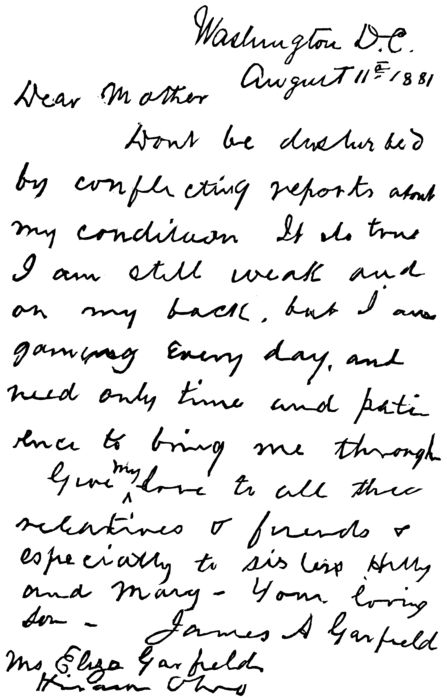
FAC-SIMILE OF THE LAST LETTER WRITTEN BY GARFIELD.
582The forty-second day.—Not much change. The President was weary and longed for a change of scene. The day when he could be safely removed from the White House was anxiously anticipated both by himself and the physicians. The United States steamer Tallapoosa, which had been undergoing repairs and fitting out for sea during the past month, was finally in complete readiness, and would be manned on the morrow. Assistant Paymaster Henry D. Smith, formerly of the Dispatch, had been transferred to the Tallapoosa. In a conversation of the morning, Mr. Smith gave a description of the manner in which the vessel had been fitted out. A suite of rooms had been prepared expressly for the use of President Garfield in the event of its being found practicable to take him out on the water, and at this time the suggestion of such a cruise seemed to please him greatly. The suite consisted of four comparatively large rooms, including a bed-chamber, reception and ante-room, and a bath-room. Paymaster Smith said further, that if it should be determined to take the President on the vessel, a swinging bed would be hung in his chamber so that the patient should not be annoyed by the motion of the vessel. Such were the plans and hopes which were never, alas, to be realized.
The surgeons’ reports for August 12th contained about all that could be said concerning the President’s condition for the day:
“8:30 A. M.—The President slept well during the greater part of the night. The fever of yesterday afternoon subsided during the evening, and has not been perceptible since 10 P. M. His general condition this morning is good. Pulse, 100; temperature, 98.6; respiration, 19.
“12:30 P. M.—The President has passed a comfortable morning. He continues to take, with repugnance, the liquid nourishment allowed, and ate with relish for breakfast, a larger quantity of solid food than he took yesterday. At present his pulse is 100; temperature, 99.3; respiration, 19.
“7 P. M.—The President has passed a comfortable day. At the evening dressing the wound was found to be doing well. The quantity of pus secreted is gradually diminishing. Its character is healthy. The rise of temperature this afternoon reached the same point as yesterday. At present the pulse is 108; temperature, 101.2; respiration, 19.”
583Thus from hour to hour, from day to day, from week to week, did the President tread the long and weary way onward and—downward.
The forty-third day.—It was about this time that the attending surgeons finally abandoned their original diagnosis of the wound; that is, in so far as it concerned the direction of the ball. For some time Dr. Hamilton had given it as his view that the bullet, instead of entering the peritoneal cavity, and perforating the liver, had been turned downward at nearly a right angle to its course, and was lodged in the region behind the ilium. This view of the case was now accepted by the physicians in charge. In a conversation of the day, Dr. Bliss said that the latest examinations of the wound had clearly shown that the ball did not go through the liver. The liver was certainly injured by the shot, either by concussion or inflammation. At the present time, however, every indication corroborated the idea that the ball was in the region of the iliac fossa, and also that it was doing no harm.
Things had not gone well during the night. The President had been restless; and, contrary to the usual history of the case, fever was reported in the morning bulletin. The foreign dispatch of Hon. R. R. Hitt, Acting Secretary of State, referred to the President’s excited condition, and could only reiterate the somewhat uncertain echo of the bulletins, that the surgeons thought him “doing well.” The official reports themselves were couched in the following language;
“8:30 A. M.—The President did not sleep as well as usual during the early part of the night. After midnight, however, his sleep was refreshing, and broken only at long intervals. This morning he has a little fever, nevertheless he expresses himself as feeling better than for several days past. Pulse, 104; temperature, 100.8; respiration, 19. 12:30 P. M.—The President has been cheerful and easy during the morning, and his temperature has fallen a little more than a degree and a half since the morning bulletin was issued. His pulse is now 102; temperature, 99.2; respiration, 18. 6:30 P. M.—Since the last bulletin the President has continued to do well. The afternoon fever has been half a degree less than yesterday. At present his pulse is 104; temperature, 100.7; respiration, 19.”
584The forty-fourth day.—One of the difficulties with which President Garfield had to contend was a certain weakness of digestion. Notwithstanding his great bodily strength and general robustness, it appears that never after the war were his assimilative powers equal to superficial indications. He had been, both by preference and necessity, a plain liver. The “eating” of the White House had not suited him. The French cookery of the establishment had proved at once distasteful and injurious to his health and spirits. After he was wounded, this weakness in his bodily functions became at once more pronounced. Great difficulty was experienced in securing an alimentation sufficient to sustain life and repair the fearful waste to which he was subjected. The sensitiveness of the digestive organs at times became critical. It was so on the 14th of August, when the physicians were almost baffled in the attempt to maintain nutrition. For the first time there was talk of the stronger stimulants. Whisky and brandy were both used, though not in large quantities. It could be plainly seen that under the outwardly confident tone of the official reports there lurked the shadow of fear. The regular bulletins of the day came out as usual, with the following account of the sufferer’s condition:
“8:30 A. M.—The President slept well during the night, and this morning expresses himself as feeling comfortable. His temperature is one degree less than at the same hour yesterday. His general condition is good. Pulse, 100; temperature, 99.8; respiration, 18. 12:30 P. M.—The President has done well this morning. His temperature has fallen one-half a degree since the last bulletin was issued. At the morning dressing the condition of the wound was found to be excellent, and the discharge of pus adequate and healthy. Pulse, 96; temperature, 99.3; respiration, 18. 6:30 P. M.—The condition of the President has not materially changed since noon. The afternoon febrile rise is about the same as yesterday. Pulse, 108; temperature, 100.8; respiration, 19.”
The forty-fifth day.—A day of great alarm; and the alarm was fully justified. There was evidence of weakening all 585around. The respiration had gone up. The temperature had gone up. So had the pulse to a fearful rate. The enfeebled stomach had broken down. That was the secret of the difficulty. Without food a well man can not live. How much less a man wounded to death and wasted by forty-five days of suffering! With every attempt to feed the President, his stomach rejected the food. If this state of things should continue, life would go out like a taper. It was to the credit of the surgeons in charge that they took the situation coolly and set about devising the best possible means of triumphing over the fearful obstacle which lay squarely across the possibility of recovery. The plan suggested and resorted to was artificial alimentation by the administration of enemata. In the after part of the day, Washington, and indeed the whole country, was filled with wild rumors which conveyed very little information and could be traced to no authentic source. The only trustworthy information was to be obtained from the official bulletins of the surgeons, which were as follows:
“8:30 A. M.—The President did not rest as well as usual last night. Until toward three o’clock his sleep was not sound, and he awoke at short intervals. His stomach was irritable and he vomited several times. About three o’clock he became composed, and slept well until after seven this morning. His stomach is still irritable, and his temperature rather higher than yesterday. At present his pulse is 108; temperature, 100.2; respiration, 20. 12:30 P. M.—Since the last bulletin, the President has not again vomited, and has been able to retain the nourishment administered. At the morning dressing, the discharge of pus was free and of good character. Since then his pulse has been more frequent; but the temperature has fallen to a little below what it was at this time yesterday. At present his pulse is 118; temperature, 99; respiration, 19. 6:30 P. M.—The irritability of the President’s stomach returned during the afternoon and he has vomited three times since one o’clock. Although the afternoon rise of temperature is less than it has been for several days, the pulse and respiration are more frequent, so that his condition is, on the whole, less satisfactory. His pulse is now 130; temperature, 99.6; respiration, 22.”
586These reports clearly indicated the most serious crisis which had yet occurred since the President was shot. Unless the functions of the stomach could be restored by rest, there could be but one issue, and that was near at hand.
The forty-sixth day.—All that could be said was that there had been slight improvement in some particulars. In the main matter—that of nourishment—the case was as bad as ever. Neither the city nor the country would have been surprised to hear that the President was dying or dead. The whole question, as matters now stood, was this: How long can he live? He himself was conscious, in good measure, of the appalling odds against him, but his calm heroism never wavered for a moment. From the first he only once—and that but for an instant—gave way to despondency, when he said to his wife that, considering the fact that he was already fifty years old, and that the brief remainder of his life would, perhaps, be weakened—possibly helpless—from his injury, it hardly appeared to be worth the struggle which his friends and himself were making to save it. This thought, however, found but a moment’s lodgment; and even now, when his vital forces seemed to be flowing out to the last ebb of despair, he stood up manfully and faced the enemy. His will remained vigorous, and he was cheerful in spirit—this, too, when the very water which was tendered him to refresh his exhausted powers was instantly rejected by the stomach. It was clear that no human vigor could long withstand so dreadful an ordeal; and the physicians recognized and acknowledged the fact that their unnatural system of alimentation was but a makeshift which would presently end in failure. Then death. The bulletins said:
“8:30 A. M.—The President was somewhat restless during the early part of the night. Since three o’clock he has slept tranquilly most of the time. Nutritious enemata are successfully employed to sustain him. Altogether the symptoms are less urgent than yesterday afternoon. At present his pulse is 110; temperature, 98.6; respiration, 18. 12:30 P. M.—The President has been tranquil since the morning bulletin, but 587has not yet rallied from the prostration of yesterday as much as was hoped. The enemata administered are still retained. At present his pulse is 114; temperature, 98.3; respiration, 18. 7 P. M.—The President’s symptoms are still grave, yet he seems to have lost no ground during the day, and his condition on the whole is rather better than yesterday. The enemata are retained. At present his pulse is 120; temperature, 98.9; respiration, 19.”
The forty-seventh day.—Notwithstanding the desperate extreme to which the poor President was reduced, the dispatches came, on the morning of August 17th, with the news that he was better. The dreadful nausea had passed, and two or three times some nutritive food had been swallowed and retained. Moreover, he had slept as much as an hour at a time. The examination of the wound, too, showed some little ground for encouragement, for the process of healing had gone on, notwithstanding the terrible exhaustion of the last three days. In the inner circle about the President’s bed there was a more hopeful feeling. “Little Crete,” the darling wife of the suffering Chief Magistrate, ventured out, with her three boys, to take a drive in the open air. Mr. Smalley, of the Tribune, thus spoke of her, as her carriage passed through the gateway:
“Her face, as she gave a nod and a smile of recognition, looked bright and hopeful. I knew that the agony of apprehension must be over and the President must be on the upward road again. The brave little woman! What a terrible strain she has endured and with what wonderful courage and patience she has met every fresh draft upon her strength and resolution, keeping always out of her face the pain and dread tugging at her heart, lest the slightest glimpse of it should discourage her husband in his long battle with death! I remember that at Elberon, just before the fatal journey to Washington, General Garfield spoke of her with tenderness and pride, as a steel-spring sort of a woman—supple, bright, enduring, and rebounding after the severest strains. If he wins his way back to health again he will owe his recovery, I firmly believe, as much to the loving and cheerful ministrations of his wife, as to the six doctors who wait upon him, skillful and devoted as they are.”
588Later in the day, Mrs. Garfield received a dispatch from the Queen—there has been only one Queen since the President was shot—which was answered by the wife in her own way. The dispatches were as follows:
“To Mrs. Garfield, Washington, D. C.:
“I am most anxious to know how the President is to-day, and to express my deep sympathy with you both.
“The Queen, Osborne.”
“Her Majesty Queen Victoria, Osborne, England:
“Your Majesty’s kind inquiry finds the President’s condition changed for the better. In the judgment of his medical advisers there is strong hope of his recovery. His mind is entirely clear, and your Majesty’s kind expressions of sympathy are most grateful to him, as they are gratefully acknowledged by me.
Lucretia R. Garfield.”
The regular bulletins gave the usual epitome of symptoms, as follows:
“8:30 A. M.—The President has passed a tranquil night, sleeping most of the time. He continues to retain the nutritive enemata, and has not vomited since the last bulletin. His general condition appears more hopeful than at this time yesterday. Pulse, 110; temperature, 98.3; respiration, 18. 12:30 P. M.—The President’s condition has not materially changed since the last bulletin. He has been tranquil and has slept some, has not vomited, and the nutritive enemata are still retained. Pulse, 112; temperature, 98.7; respiration, 18. 6:30 P. M.—The President’s condition is even better than it was this morning. The wound continues to do well. At present his pulse is 112; temperature, 98.8; respiration, 18.”
Meanwhile the trusted Secretary Blaine had reached Washington and was again at the bedside of his chief. In the evening he sent abroad two dispatches containing a brief summary of the President’s condition as determined by the official reports and by his own observation. And so the day closed in hope rather than despair.
The forty-eighth day.—The President was still further improved—so thought and said his physicians. The mutinous stomach, which 589had threatened to end his life by refusing to perform its work at a time when it was not possible for his weakened system to bear for any lengthened period the strain of the wound and the fever without sustenance, had renewed its functions, and the experiments made during the day gave reasons to hope that nourishing food might now be administered with safety. It was good news indeed, and it would have been better if it had not been coupled with the statement that the President was reduced almost to a skeleton. From 210 pounds—his weight when shot—he had wasted away till his weight was hardly 135 pounds. Yet with only this pitiful bony structure of himself left he was reported as cheerful and brave! He was able to take more nourishment than on the previous day, and it appeared that his alimentation was now likely to be sufficient; but just as this beneficial reaction became noticeable, another complication arose which threatened to overbalance all the expected good. On the 17th of August a slight inflammation was noticed in the right parotid gland. By the following morning the swelling was more pronounced, and immediately became a source of annoyance and alarm. The tumefaction assumed the appearance of a carbuncle and there were indications of approaching suppuration of the gland. The face, especially on the right side, became distorted, and the President suffered great pain from the inflamed part. It was clear that in some measure the blood of the sufferer had been poisoned by the discharges of the wound, and that nature was attempting to relieve her distress by the destruction of a gland. The official bulletins of the day, though pervaded with the same spirit of optimism which characterized them all, were not of a sort to inspire confidence. They said:
“8:30 A. M.—The President has passed a very comfortable night, sleeping well the greater part of the time. This morning his pulse is slower and his general condition better than yesterday at the same hour. Pulse, 104, temperature, 98.8; respiration, 17. 12:30 P. M.—The President is suffering some discomfort this morning from commencing inflammation of the right parotid gland. He has asked for and retained several portions of liquid nourishment, much more than he could swallow yesterday. The nutritive enemata continue to be used with success. At present his 590pulse is 108; temperature, 98.4; respiration, 18. 6:30 P. M.—The President has done well during the day. He has taken additional nourishment by the mouth this afternoon with evident relish and without subsequent nausea. His general condition is rather better than at this time yesterday. Pulse, 108; temperature, 100; respiration, 18.”
The forty-ninth day.—With the 19th of August a more hopeful feeling again predominated. It was alleged by the surgeons that the President had made some improvement. Some was better than none. His nutriment for the day amounted to nine ounces of liquid food. The physicians gave assurance to the public that the inflamed gland did not necessarily imply blood poisoning. The President slept at intervals. In his waking moments he was still cheerful, but expressed a great yearning to get away from Washington and return to his home at Lawnfield.
In these days of alternate hope and anxious alarm the question naturally arose as to what had become of the Executive Department of the Government. The President was still himself in a certain sense, but he was without doubt utterly incapacitated to perform any executive duty. There was no acting President, and to tell the truth the people did not desire one. Some leading papers advocated the assumption of certain of the duties of the President by members of the Cabinet; but this untried and—it may be added—unconstitutional measure was not attempted; and so all executive functions remained in abeyance. The acts usually performed by the President were simply omitted until he should recover. Fortunately in a time of peace and during a recess of Congress, these acts could be postponed without any great detriment to public interests. The appointing power, except in so far as it is delegated by law to the heads of Departments, was in a state of complete suspension, but this fact occasioned no trouble, except to applicants for office. Under our system, where vacancies in Presidential appointments occur, by death or resignation, there is usually a deputy or some other officer who is authorized by law to perform temporarily the duties of the office. In the cases of post-offices where there are no deputy postmasters, the Post-Office Department is authorized to send special agents to take charge until the 591vacant postmastership can be filled. If the President’s prostration should continue—so reasoned the people—until the meeting of Congress—a contingency wholly improbable—there would be no stoppage of any part of the machinery of Government. In short, the American people were taught by a practical, though painful, example the great lesson, how little need there is for a nation of freemen to be governed—how amply able such a people are to adapt themselves to any emergency. The official reports of the day gave as usual the facts on which various opinions of the President’s prospects were based:
“8 A. M.—The President slept much of the night, and this morning is more comfortable than yesterday. The swelling of the right parotid gland has not increased since yesterday. Nutritive enemata are still given with success, and liquid food has been swallowed and relished. Pulse, 100; temperature, 98.4; respiration, 17.
“12:30 P. M.—The President’s condition has perceptibly improved during the last twenty-four hours. He is taking to-day an increased quantity of liquid food by the mouth. His pulse is now 106; temperature, 98.8; respiration, 17.
“6:30 P. M.—The President has been very easy during the afternoon and the favorable conditions reported in the last bulletin continue. Pulse, 106; temperature, 100; respiration, 18.”
The fiftieth day.—There could be no denial of another rally—though slight—on the part of the President. During the day a surgical experience occurred. Dr. Bliss, in treating the wound, succeeded in passing with a flexible tube what he supposed to be an obstruction in the path of the ball. When this was done, the tube suddenly dropped, almost of its own weight, down the channel[6] to the depth of twelve and a half inches! The end of the probe was thus brought, as was confidently believed, into immediate proximity with the ball. The parotitis, from which the President was now suffering so severely, 592was reported as “about the same.” As a consequence of this inflammation, though no acknowledgment of the fact was made at the time, the patient’s face suffered a partial paralysis, which continued seriously to afflict him to the last. The summary of symptoms was published at the usual hours by the surgeons and presented the following statement of the President’s condition.
“8:30 A. M.—The President has passed a quiet night, and this morning his condition does not differ materially from what it was yesterday. The swelling of the parotid gland is unchanged and is free from pain. This morning his pulse is 98; temperature, 98.4; respiration, 18.
“12:30 P. M.—The President continues to do well. He is taking liquid food by the mouth in increased quantity and with relish. The nutritive enemata are still successfully given, but at longer intervals. His pulse is now 107; temperature, 98.4; respiration, 18.
“6:30 P. M.—The President has passed the day quietly. He has been able to take more liquid food by the mouth than yesterday, and the quantity given by enema has been proportionately diminished. The parotid swelling remains about the same. Pulse, 110; temperature, 100.4; respiration, 19.”
The fifty-first day.—It was a long and sorrowful journey. There were pitfalls in the way. That inflamed gland now became a source of profound anxiety. The salivary secretions were so augmented and at the same time vitiated as constantly to fill the patient’s throat, threatening strangulation. The tendency to nausea was thus excited, and the President’s stomach again rejected food. This fact told immediately on the modicum of strength still remaining, and as the day progressed it appeared that medical skill was about exhausted in a hopeless struggle against the inevitable. The surgeons, however, as is the wont with the profession, still renewed the battle, now with this expedient and now with that, but always with the purpose of keeping the President alive until some kind of favorable reaction could supervene. The feature of the day’s history was that the most serious alarm was spread 593abroad after the issuance of the evening bulletin. The three official reports were as follows:
“8:30 A. M.—The President awoke more frequently than usual, yet slept sufficiently during the night, and appears comfortable this morning. The parotid swelling is about the same, but is not painful. He took liquid nourishment by the mouth several times during the night as well as this morning. Pulse, 106; temperature, 98.8; respiration, 18.
“12:30 P. M.—The President’s condition continues about as at the morning bulletin, except that there is a slight rise of temperature. Pulse, 108; temperature, 99.4; respiration, 18.
“6:30 P. M.—The President has vomited three times during the afternoon; the administration of food by the mouth has, therefore, again been temporarily suspended and the nutritive enemata will be given more frequently. Pulse, 108; temperature, 99.2; respiration, 18.”
To these regular bulletins may well be added the foreign dispatch of Secretary Blaine, who, at a late hour, sent to Minister Lowell the following message:
“Lowell, Minister, London:
“The President’s sleep last night was broken and restless. His symptoms throughout the day have been less favorable, and his general condition is not encouraging. He is unable to retain food on his stomach, having vomited twice during the afternoon, the last time at 5 o’clock. This evening he has been able to drink water and retain it. The swelling of the parotid gland has not increased. Pulse and temperature about the same as yesterday. His sleep up to this hour (11 P. M.) has been somewhat disturbed. We are all deeply anxious.
“Blaine, Secretary.”
The fifty-second day.—The question was, how much longer the wheels of vexed and exhausted Nature could continue to revolve. Every power of life within the uncomplaining man was prostrated or dead. The inflammation in the gland had now progressed to a terrible extent, and an operation for its relief was already contemplated. That blood poisoning to some extent now existed, could hardly be controverted. Even the oversanguine Dr. Bliss was forced to admit it. In a conversation 594of the day, and in reply to questions with regard to the inflamed gland, he said: “The glandular swelling is still hard, and shows no signs of subsiding. The swelling of the surrounding parts has pretty much disappeared. Whether suppuration will take place or not we can not yet tell. I am inclined to think it will. I do not, however, apprehend any serious consequences even in that case, provided we can maintain the patient’s strength. The pus which forms is likely to be of a healthy character, and we shall liberate it promptly by an incision. There has been no pain in the gland this afternoon, and it has caused the patient little annoyance.”
With regard to the septic tint in the blood, which was the predisposing cause of the glandular inflammation, Dr. Bliss said: “In cases of this kind, where the patient becomes enfeebled by long-continued fever and suppuration, there is always a low and impoverished state of the blood. It is, indeed, a sort of mild blood poisoning, but it is very different from pyæmia. Pyæmia is caused by absorption into the blood of the disunited elements of broken down pus. Small fragments of fibrine are carried into the circulation, and wherever such a fragment lodges in one of the minute blood-vessels it becomes a center of suppuration. The symptoms of pyæmia, such as the disorganization and peculiar odor of the pus, the yellowish tint of the skin, the odor of the breath and the increased temperature of the body, are all marked and unmistakable, and none of them has at any time appeared in the President’s case.”
Thus with vain conjectures and provisos did the distinguished surgeon attempt to keep up his own courage and that of the public. But it was now well known that, bulletins or no bulletins, the President, unless promptly relieved either by medical skill or some unexpected revival of nature, was down to the very door of death. The official reports of the day were as follows:
“8:30 A. M.—The President has not vomited since yesterday afternoon, and this morning he has twice asked for and received a small quantity of fluid nourishment by the mouth. He slept more quietly 595during the night, and this morning his general condition is more encouraging than when the last bulletin was issued. Pulse, 104; temperature, 98.4; respiration, 18.
“12:30 P. M.—The President has continued this morning to retain liquid nourishment taken by the mouth as well as by enema. There has been no recurrence of the vomiting and no nausea. Pulse, 104; temperature, 98.4; respiration, 18.
“6:30 P. M.—The President has continued to take nourishment in small quantities at stated intervals during the entire day, and has had no return of nausea or vomiting. The nutrient enemata are also retained. Pulse, 110; temperature, 100.1; respiration, 19.”
The fifty-third day.—How is the President this morning? The President had made a gain. Of a certainty, he was not any further in the shadow of the valley than on yesterday. He had taken in all, since the morning before, about thirty ounces of liquid food without disturbing his stomach. Several times he called for food himself. One of the physicians said during the day that the President had taken more than sufficient food to repair the day’s waste. At one time his pulse was down to ninety-six—the lowest point it had reached for more than a fortnight. Secretary Blaine—in whose dispatches the people had learned to place the highest reliance—expressed himself somewhat more hopefully to Minister Lowell, in the night message, which read as follows:
“Lowell, Minister, London:
“The President’s condition is more encouraging than it was at this time last night. During the last twenty-four hours he has swallowed ten ounces of extract of beef and eighteen ounces of milk, retaining and digesting both. He has twice asked for food, which he has not done before for several days. Pulse and temperature are both somewhat lower. The swelling of the parotid gland has not specially changed. Its long continuance at the present stage increases the fear of suppuration. At this hour—11 o’clock—the physicians report that the President has rested quietly the entire evening.
Blaine, Secretary.”
Anxious concern about the President’s condition on the part of the public was tempered with so much hopefulness that the evidences 596of excitement somewhat abated. The street gatherings about the bulletin-boards in the principal cities were not so large as they had been, although the three official bulletins from the physicians and Secretary Blaine’s message to Minister Lowell were eagerly waited for and much talked of in public places. These bulletins were, in the usual form, as follows:
“8:30 A. M.—The President slept the greater part of the night, but awoke at frequent intervals. He has taken since last evening a larger quantity of liquid food by the mouth than in the corresponding hours of any day during the past week. The use of nutrient enemata is continued at longer intervals. Pulse, 100; temperature, 98.4; respiration, 18.
“12:30 P. M.—The President continues to take by the mouth and retain an increased quantity of liquid food. At the morning dressing the wound looked well and the pus was of a healthy character. The mucus accumulations in the back of the mouth are less viscid. At present his pulse is 104; temperature, 98.9; respiration, 18.
“6:30 P. M.—The President has continued to take liquid food by the mouth at regular intervals during the day, and has had no recurrence of gastric disorder. Pulse, 104; temperature, 99.2; respiration, 19.”
The fifty-fourth day.—The events of the day were two: First, the lancing of the inflamed gland—an operation but partially successful in its results; secondly, a consultation of the surgeons in regard to removing the President from the White House. Dr. Agnew was summoned to the city by telegram. He was driven at once to the Executive Mansion, where the cabinet and medical council were in consultation, and remained closeted with them until nearly midnight. The consultation lasted rather more than an hour; and, so far as could be ascertained, it resulted in a disagreement. All of the participating surgeons who could be seen refused to talk upon the subject, as did also the members of the Cabinet, most of whom were at the White House until after eleven o’clock.
A third circumstance of the day’s history was the reported delirium of the President. This was for awhile concealed, and then palliated by those nearest the bedside. Colonel Rockwell, one of 597the attendants, in conversation with a reporter, described the mental disturbance thus: “The President is sometimes a little incoherent for a moment after he awakes and before he fully gets control of his senses, just as any body would be in his weak and debilitated condition and after seven weeks of fever; but at all other times his mind is as clear as ever.”
The dispatch of Secretary Blaine was very much less hopeful than the one of the night before. It read as follows:
“Lowell, Minister, London:
“The President has not gained to-day. He has had a higher fever, which began earlier than is usual with his febrile rise. In the afternoon an incision was made in the swollen parotid gland by Dr. Hamilton. The flow of pus therefrom was small. The one favorable symptom of his swallowing liquid food with apparent relish and digestion has continued, but the general feeling up to midnight is one of increased anxiety.
“Blaine, Secretary.”
To this might well be added the additional hopeful circumstance that during the day the President’s assimilative powers appeared to be again in such condition as to warrant the physicians in dispensing with the system of artificial alimentation. The regular bulletins for the day were as follows:
“8:30 A. M.—The President has passed a very good night, awaking at longer intervals than during several nights past. He continues to take liquid food by the mouth with more relish, and in such quantity that the enemata will be suspended for the present. No change has yet been observed in the parotid swelling. The other symptoms are quite as favorable as yesterday. Pulse, 100; temperature, 98.5; respiration, 17.
“12:30 P. M.—The President continues to take liquid food by the mouth as reported in the last bulletin. His temperature has risen slightly since that time. In other respects his condition is about the same. Pulse, 104; temperature, 99.2; respiration, 17.
“6:30 P. M.—Shortly after the noon bulletin was issued an incision was made into the swelling on the right side of the President’s face for the purpose of relieving the tension of the swollen parotid gland, and of giving vent to pus, a small quantity of which was evacuated. He has taken a larger quantity of liquid food by the mouth to-day than yesterday, 598and has been entirely free from nausea. Pulse, 108; temperature, 100.7; respiration, 19.”
The fifty-fifth day.—The first report of the morning indicated that there was no more than a bare possibility of President Garfield’s recovery. His condition was such as to cause the gravest apprehensions as to the immediate result. He continued to take food, but there was no perceptible increase in strength. His condition—with his wasted form, distorted and half-paralyzed face, dreadful wound, and suppurating gland—was pitiable in the last degree. Hallucinations came on, and he talked incoherently—now of his immediate surroundings, and now of his old home at Mentor. There was little remaining for the surgeons to do. Their effort for the time was directed chiefly to the alleviation of the inflamed gland, which was now playing havoc with the few springs of vitality yet remaining as a source of hope. The whole gland was found to be infiltrated with pus, and the outlook, even for the night, was grave in the extreme. The physicians’ bulletins, four in number to-day, were published, as usual, and presented to the anxious country several points of interest:
“8:30 A. M.—The President slept most of the night. He has taken liquid food by the mouth at stated intervals and in sufficient quantity, so that the enemata have not been renewed. No modification of the parotid swelling has yet been observed. Pulse, 106; temperature, 98.5; respiration, 18.
“9:15 A. M.—The subject of the removal of the President from Washington at the present time was earnestly considered by us last night and again this morning. After mature deliberation the conclusion was arrived at by the majority that it would not be prudent, although all agree that it will be very desirable at the earliest time at which his condition may warrant it.
“12:30 P. M.—Since the issue of this morning’s bulletin a rise in the President’s temperature similar to that which occurred yesterday morning has been observed. Pulse, 112; temperature, 99.2; respiration, 19.
“6:30 P. M.—There has been little change in the President’s condition since the noon bulletin was issued. The frequency of his pulse is now the same as then. His temperature has risen somewhat, but it is 599not so high as yesterday evening. No unfavorable change has been observed in the condition of the wound. He has taken by the mouth a sufficient supply of liquid food. Pulse, 112; temperature, 99.8; respiration, 19.”
The fifty-sixth day.—The morning papers were almost exclusively devoted to the President and the prospect of death. The great New York dailies presented page after page of dispatches, interviews, and discussions. The sum of it all was this: The President was alive, but, in all probability, on the verge of death. His pulse rose to a mere flutter. The abscess in the gland burst into the cavity of the ear. His mind still wandered, but there was slightly less aberration than yesterday. Washington was a strange scene. There was suppressed excitement, but no noise. Little knots of people gathered in groups here and there before the bulletin-boards, where the latest intelligence was posted, while negro newsboys in their picturesque costumes cried their extras in the mellow Southern accent peculiar to their race. The intense August sun poured down his rays on the broad streets and asphaltum boulevards. The trees were browned with the dust and heat, and the patches of grass here and there in the yards and parks were withered into hay. Above it all, gleaming white and silent, rose the great dome of the Capitol. Alas, what was it all to him?
There was in the midst of infinite rumors and conjectures only a modicum of news. It was this: the President could still take food. His mind had cleared a little since yesterday. As for the rest, he lay helpless, ready to die. The bulletins said:
“8:30 A. M.—The President slept most of the night, awaking at intervals of half an hour to an hour. On first awaking there was, as there has been for several nights past, some mental confusion, which disappeared when he was fully roused, and occasionally he muttered in his sleep. These symptoms have abated this morning, as on previous days. His temperature is slightly above the normal and his pulse a little more frequent than yesterday morning. Pulse, 108; temperature, 99.1; respiration, 17.
“12:30 P. M.—His pulse and temperature are at present higher than 600at the corresponding hour for some days. He continues to take by the mouth the liquid food prescribed; nevertheless, we regard his condition as critical. Pulse, 118; temperature, 100; respiration, 18.”
“6:30 P. M.—The President’s condition has not changed materially since the last bulletin was issued. He continues to take, by the mouth, the liquid food prescribed, and occasionally asks for it. Since yesterday forenoon, commencing at 11:30 A. M., the enemata have again been given at regular intervals, as a means of administering stimulants, as well as nutrition. They are retained without trouble. Pulse, 116; temperature, 99.9; respiration, 18.”
The fifty-seventh day.—Another long day of suspense. It was the peculiarity of President Garfield’s illness that just as some great crisis came and his constitutional forces seemed to break hopelessly, at some other point there would be a rally. In this last case, when the distressing abscess in the parotid gland had added its aggravating horrors to horrors already accumulated, and just as tired nature seemed sinking to everlasting rest, there was a rally in the assimilative powers. Unexpectedly, the stomach began to perform its work; and thus the tree of life, shaken back and forth by conflicting forces, still rose feebly and stood. It was a melancholy sight to see this enfeebled and wasted life, so dear to the Nation, still standing, with its glorious foliage torn away—withered, blighted, dying.
The Queen on this day again expressed her great anxiety about the President. Her dispatch, and Mr. Blaine’s answer, were as follows:
“London, Aug. 27.
“Blaine, Secretary, Washington:
“I have just received from Her Majesty the Queen, at Balmoral, a telegram in these words: ‘I am most deeply grieved at the sad news of the last few days, and would wish my deep sympathy to be conveyed to Mrs. Garfield.’
Lowell, Minister.”
“Washington, Aug. 27.
“Lowell, Minister, London:
“I have submitted to Mrs. Garfield your telegram conveying the kindly message from Her Majesty the Queen. Mrs. Garfield is constantly by her husband’s bedside and does not give up all hope of his recovery. 601Her request is that you will return to the Queen her most sincere thanks, and express her heartfelt appreciation of the constant interest and tender sympathy shown by Her Majesty toward the President and his family in their deep grief and most painful suspense.
Blaine, Secretary.”
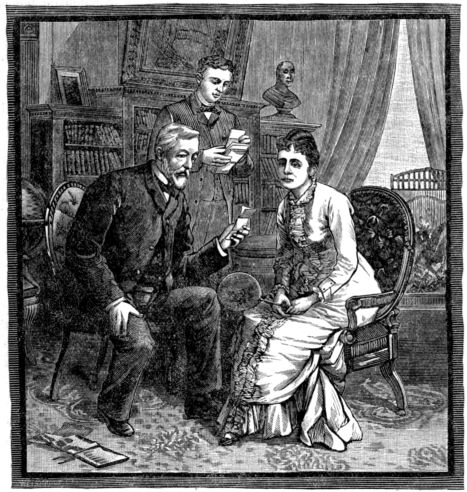
BLAINE READING LETTERS OF SYMPATHY TO MRS. GARFIELD.
The Americans, in a political point of view, do not like kings and queens; but it will be many a long year before the womanly greatness and tenderness of Victoria, manifested in our hour of sorrow, will be obliterated from the American heart. Vivat semper Regina!
602The daily bulletins of the surgeons told all that could be known of the beloved President:
“8:30 A. M.—The President slept from half an hour to an hour or more at a time throughout the night. He continues to retain the liquid food administered by the mouth and the stimulating enemata. Nevertheless, his pulse has been more frequent since midnight and he is evidently feebler this morning than yesterday. Pulse, 120; temperature, 98.4; respiration, 22.
“12:30 P. M.—There has been no improvement in the President’s condition since the last bulletin was issued. He continues to retain the liquid food administered by the mouth as well as the enemata. At present the pulse is 120; temperature, 99.6; respiration, 22.
“6:30 P. M.—The President’s symptoms show slight amelioration this afternoon. His pulse is somewhat less frequent and his temperature lower. The liquid food given by the mouth and the enemata continues to be retained. Pulse, 114; temperature, 98.9; respiration, 22.”
The fifty-eighth day.—The reports of the morning were briefer. They were also more encouraging. It was clear that the President, notwithstanding his desperate condition, had held his own for thirty-eight hours, and that there were some unmistakable signs of improvement. It could not be said with truth that the change was great or marked, but there had been some amelioration. The shadow of death was lifted, at least for a day. The people, quick to run to extremes, gave a sigh of relief at the more cheering reports of the morning, and went whither they listed. It was said that the President had had another relapse and was now better again. Even the cautious Secretary of State was impressed with the belief that the President’s improvement was more than a temporary rally. In his foreign dispatch he summed up the case thus:
“To Lowell, Minister, London:
“The condition of the President at 10 o’clock continues as favorable as could be expected. Within the past thirty hours his improvement has given great encouragement to the attending surgeons. He swallows an adequate supply of liquid food; the parotid swelling discharges freely, 603and gives promise of marked improvement. His mind is perfectly clear. He has, perhaps, a little more fever than was anticipated, and his respiration is somewhat above normal. The general feeling is one of hopefulness. Two or three days more of improvement will be needed to inspire confidence.
Blaine, Secretary.”
The monotonous official reports were telegraphed as usual, in the following messages:
“8:30 A. M.—The amelioration of the President’s symptoms announced in last evening’s bulletin continued during the night. Since midnight some further improvement has been observed, the pulse diminishing in frequency. The stomach has continued to retain liquid nourishment administered, and last evening he asked for and ate a small quantity of milk toast. Stimulating and nutrient enemata continue to be retained. Pulse, 100; temperature, 98.4; respiration, 17.
“12:30 P. M.—At the morning dressing of the President several yellowish points were observed just below the ear over the swollen parotid, and an incision being made, about a teaspoonful of healthy-looking pus escaped. Pulse, 104; temperature, 99.5; respiration, 18.
“7:30 P. M.—The improvement in the President’s condition, declared yesterday afternoon, is still maintained. He continues to take willingly the liquid food given by the mouth, and is apparently digesting it. The stimulants and nutrients given by enema are also retained. At the evening dressing an increased quantity of healthy-looking pus was discharged from the suppurating parotid. But little rise in temperature or pulse has taken place since noon. Pulse, 110; temperature, 99.7; respiration, 20.”
The fifty-ninth day.—More than eight weeks had now elapsed since the President was shot. The country had become used to alarms. It had also learned to make allowance for the shortcomings of newspaper reports, born of the heat of an oversanguine imagination. It had learned, too, the more valuable lesson that the Government of the United States is not to be shaken from its pedestal by the bullet of an assassin. Guiteau was a fool. Perhaps the despicable wretch thought the course of events, sweeping on like the planets, could be changed by the crack of a pistol. He might as well have fired 604into the air. The glorious institutions of the Republic will perish when Americans are no longer fit to be free; but until then the assassin’s rage and frenzy is the most futile folly of the world. All the officers of the United States may be murdered in a day, but the Nation will stand immovable as adamant. Let the assassin foam and gnash upon the iron bars of the cage of fate! It is only a mad-dog gnawing his chain.
The President, they said, was better. Thoughtful men doubted it. As a matter of fact, the judgment of the country had given him up to die. Sentiment still kept him alive; reason said that the time of the fatal foreclosure was near at hand. It could be said, truthfully, that the local symptoms traceable to the abscess in the President’s face had measurably abated. It could also be said that he was still able to receive food enough to sustain life—nothing more. Mr. Blaine’s dispatch for the evening was, however, rather hopeful than desponding. It said:
“Department of State, August 29, 10:30 P. M.
“Lowell, Minister, London:
“At half-past ten to-night the general condition of the President is favorable. Late in the afternoon his pulse rose to 112 and his temperature to 100, both a little higher than the surgeons expected. Pulse has now fallen to 108, and fever is subsiding. The parotid swelling is steadily improving, and is at last diminishing in size. Apprehensions of serious blood poisoning grow less every hour.
Blaine, Secretary.”
These dispatches of the Secretary were generally but the pith of what the surgeons said in their official reports. These, for August 29th, were as follows:
“8:30 A. M.—The President’s symptoms this morning are as favorable as yesterday at the same hour. He slept, awakening at intervals, the greater part of the night. At these intervals he took and retained the liquid nourishment administered. His mind continues perfectly clear. Pulse, 100; temperature, 98.5; respiration, 17. 12:30 P. M.—Nothing new has been observed in the condition of the wound. The usual daily rise of temperature has not yet occurred, and the general condition has not materially changed since morning. Pulse, 106; temperature, 60598.6; respiration, 18. 6:30 P. M.—The daily rise of the President’s temperature began later this afternoon than yesterday, but rose eight-tenths of a degree higher. The frequency of his pulse is now the same as at this hour yesterday. He has taken willingly the liquid food prescribed during the day, and had, besides, during the morning, a small piece of milk toast. At the evening dressing a pretty free discharge of healthy pus took place from the parotid swelling, which is perceptibly diminishing in size. The wound manifests no material change. Pulse, 110; temperature, 100.5; respiration, 18.”
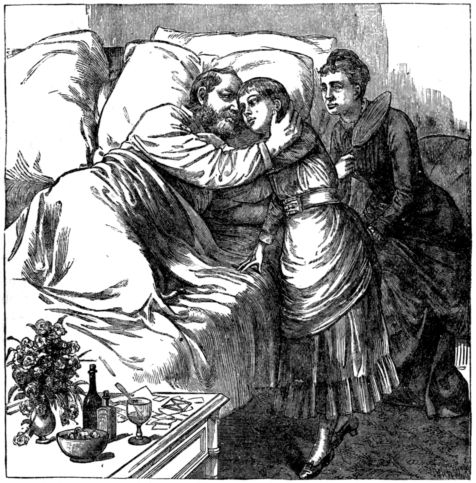
MORNING GREETING BY MRS. GARFIELD AND MOLLIE.
The sixtieth day.—The President still held out. All the world 606knows the story, how, day after day, owing to the native robustness and essential soundness of his constitution, he stood out against the death that awaited. As usual there were some who said he was better. Others said he was not. Once for all it may be said that such contradictions regarding the President’s condition can easily be accounted for when the surroundings of the White House are considered. Only a few persons knew of their own observation how he appeared from day to day. Visitors were strictly, and necessarily, excluded from the sick-room. From the Tuesday after General Garfield was shot, not more than ten persons in all, excluding the physicians, had seen him, and, of these ten, some only once or twice. Mrs. Garfield and her children, Mr. Blaine, General D. G. Swaim, Colonel A. F. Rockwell, Dr. Boynton, Dr. Susan Edson,—one of the nurses,—the President’s private secretary, Mr. J. S. Brown, and Mr. Pruden, completed the list. Mr. Blaine had seen him once, Mr. Pruden once, and Mr. Brown had been in five times, being usually called because the force of persons necessary to lift the President was a little short. Indeed, of all the strange impressions to be got from this novel event, there was none more peculiar than to stand in the private secretary’s room in the second story of the White House, and feel that only a few yards away was the sick-room on which the eyes of the world were centered, and yet that not more than three persons besides the physicians, nurses, and family, have passed the door in two months! It can thus be easily seen how correspondents and reporters were generally at sea, particularly when the physicians were reticent or out of sight. Mr. Blaine continued to express all that could be reasonably said of better prospects. His dispatch was as follows:
“To Lowell, Minister, London:
“The President, if not rapidly advancing, is at least holding his own. His fever is less than last night, and his swollen gland steadily improves. His pulse continues rather high, running this evening from 110 to 114. Perhaps the best indication in the case is, that the President himself feels better, and his mind, being now perfectly clear, he readily compares one day’s progress with another.
Blaine, Secretary.”
607The regular bulletins of the day were fuller if not more explicit:
“8:30 A. M.—The President slept the greater part of the night, awakening at intervals, and retaining the liquid nourishment administered. His general condition this morning is about the same as at the same hour yesterday. Pulse, 102; temperature, 98.5; respiration, 18. 12:30 P. M.—At the morning dressing another small incision was made in the lower part of the swelling on the right side of the President’s face, which was followed by a free discharge of healthy-looking pus. A similar discharge took place through the openings. The swelling is perceptibly smaller, and looks better. The wound remains in an unchanged condition. Pulse, 116; temperature, 98.9; respiration, 18. 6:30 P. M.—The President has passed comfortably through the day. He has taken the usual amount of nourishment by the mouth, with stimulating enemata at stated periods. Pulse, 109; temperature, 99.5; respiration, 18.”
The sixty-first day.—In these stages of the President’s illness neither the optimist nor the pessimist newspapers were to be trusted in their accounts of the sick man and his surroundings. Even the dry records of the surgeons’ reports were so many bones of contention among the wranglers, some of whom would have the President well while others would have him dead. The optimists on this last day of August head-lined their reports: “On the high road to recovery;” “Still better;” “Almost out of the woods,” etc.; while the pessimist said: “The valley and the shadow;” “The end at hand,” etc. Unfortunately the pessimist—not from any virtue in himself—was the truer prophet. It could not be denied, however, that in some material points the President had improved with some steadiness for several days. These favorable points, rather than the dark ones, were dwelt on in the official reports, which presented the summary of symptoms for the day:
“8:30 A. M.—The President has passed a tranquil night, and this morning his condition is quite as favorable as yesterday at the same hour. Pulse, 100; temperature, 98.4; respiration, 18. 12:30 P. M.—At the dressing of the President this morning the parotid swelling was found to be discharging freely. It looked well and has materially diminished in size. The wound remains in about the same state. His general condition is evidently more favorable than at this hour yesterday. Pulse, 95; 608temperature, 98.4; respiration, 17. 6:30 P. M.—The President has passed a better day than for some time past. He has taken his food with increased relish, and the usual afternoon rise of temperature did not occur. Pulse, 109; temperature, 98.6; respiration, 18.”
The sixty-second day.—The fall month dawned with little additional news. The little that was presented was not good. The luxuriance of the scribes who had written up and written down almost every circumstance and symptom were about this time clipt of some of their superfluity. The public had grown stern and angered at being trifled with on so grave a matter as the condition of a dying President. A few manufactured conversations were still published, but the amount of space so devoted in the journals of the day showed a pronounced shrinkage. Mr. Blaine’s dispatches, always honest and sincere, were more than hitherto sought after as giving the hungry and heart-sore people the most authentic information concerning their stricken Chief Magistrate. The Secretary’s telegram for the evening was as follows:
“To Lowell, Minister, London:
“The President continues to do well in his eating and digestion, and the swollen gland steadily improves, but in the past twenty-four hours he has made no substantial progress in his general condition. In the judgment of his physicians, however, he still holds the ground gained on Sunday and Monday last. His pulse and temperature to-day have shown marked increase over the record of yesterday. The weather has been exceedingly warm and sultry, and this may account in part for the adverse changes noted. Even in the September climate of Washington such an oppressive day as this has been is rare.
“Blaine, Secretary.”
The views of the surgeons were presented as usual in their official bulletins:
“8:30 A. M.—Toward nine o’clock last evening the President had some feverishness, and his pulse ranged from 108 to 116. He had on the whole a good night, and his condition is fully as favorable as yesterday at the same hour. Pulse, 100; temperature, 98.4; respiration, 60917. 12:30 P. M.—At the morning dressing of the President the abscess of the parotid was found to be discharging freely. It looks well and continues to diminish in size. The state of the wound remains the same. His general condition is not materially different from what it was at this hour yesterday. Pulse, 108; temperature, 98; respiration, 18. 6:30 P. M.—The condition of the President has not materially changed since the last bulletin, except that there has been a moderate rise of temperature this afternoon. The President has had no rigors for several weeks. Pulse, 108; temperature, 99.4; respiration, 18.”
The sixty-third day.—It was said, in the dispatches of the morning, that the President had still further improved, and that he was now better than at any time since the setting in of the parotid inflammation. Perhaps he was. There was no doubt that for some days he had held his own. The question of the day, however, was the revival of the project to remove the sufferer from Washington. This proposition had been previously voted down in a consultation of the physicians and the members of the cabinet. But since then things were changed. Doubtless the surgeons were now convinced that, remaining where he was, the President must inevitably die in a very short time. To this should also be added the persistent entreaties of General Garfield himself, who never forbore, on proper occasions, to urge upon those who were in responsible charge of his case, his earnest wish to be taken away from the scenes of his glory and grief. By the 2d of September it was understood that the minds of the physicians were about made up to attempt the hazardous enterprise. It was known also that the Pennsylvania Railway had already prepared a special train with a view to readiness in case the removal should be finally decided on. The train even now stood in readiness.
A publication in the London Lancet, for the current week, was perused with great interest by thousands of professional and unprofessional readers. Some encouragement was gleaned from the excerpt, which was as follows:
610“We do not think the healing of President Garfield’s wound will be promoted by probing to learn how far granulation has proceeded. The most favorable signs are the fall of temperature to the normal, and the frequency of the pulse. This is a thoroughly safe criterion of increased strength and the subsidence of blood poisoning; and, together with the improved power of digestion, ability to sleep soundly, mental clearness and cheerfulness, affords solid grounds for the hope of recovery.
“The case is a striking illustration of the power of a good constitution to hold up against illness that would certainly have killed a feebler person; but another failure in the President’s digestive powers, or symptoms of blood poisoning, might at any time turn the balance against him; and what we have hitherto insisted upon so often we are bound to repeat, that President Garfield will not be out of danger until the wound is healed.”
The usual bulletins, from the surgeons in charge, were published thus:
“8:30 A. M.—The President slept well during the night, and this morning his condition is in all respects as favorable as yesterday at the same hour. Pulse, 100; temperature, 98.4; respiration, 17. 12:30 P. M.—The President’s condition has not materially changed since the morning bulletin was issued. Pulse, 108; temperature, 98.4; respiration, 18. 6:30 P. M.—The President has passed a comfortable day, and this evening appears better than for some days past. This evening his pulse is 104; temperature, 99.2; respiration, 18.”
The sixty-fourth day.—The removal of the President was fully determined on. The surgeons were unanimous that it should be undertaken. Long Branch was settled upon as the resort to which the wounded man should be removed. The physicians were unanimous in their selection of this place, and all necessary precautions were taken to insure the President’s comfort during his removal. It was a perilous business, and for the remaining days of the sojourn at the White House the energies of those who were responsible for the President’s well-being were constantly engaged in making suitable arrangements for the removal. The account of the 611President’s progress for the day, notwithstanding his critical condition, was almost overlooked in the keen interest immediately excited by the project now imminent. The surgeons themselves were unusually brief in their official reports, which ran thus:
“8:30 A. M.—The President was somewhat more restless than usual during the early part of the night, but slept better after one A. M. There is a slight increase in the frequency of the pulse. Pulse, 104; temperature, 98.6; respiration, 18. 12:30 P. M.—The Presidents condition has not materially changed since the morning bulletin was issued. Pulse, 104; temperature, 98.4; respiration, 18. 6:30 P. M.—The President has done well during the day, and has taken with some relish a sufficient quantity of nutriment. Altogether, his general condition exhibits some improvement over yesterday. Pulse, 102; temperature, 99.6; respiration, 18.”
The sixty-fifth day.—The President himself was somewhat excited about his removal. In some respects this excitement was beneficial and in others hurtful to him. His spirits and hopes were in some measure aroused, and a stimulus thus afforded to his exhausted powers. But the energy thus awakened was withdrawn from the long enfeebled stomach, and twice during the day his food was rejected. Otherwise, there were no alarming symptoms for the passing hour, and so public attention was wholly turned to the preparation. President Roberts, of the Pennsylvania Railroad, commissioned George C. Wilkins, general superintendent of the Baltimore and Potomac Railroad, to take direction of the train which was to carry the President away. Mr. Wilkins was also directed to issue orders to his men, which would enable him to stop every freight and passenger train that might be on the road between Baltimore and Washington on half an hour’s notice, and to give the special train the right of way at any hour of the day or night. On the 4th of September, Mr. Wilkins accordingly issued orders to carry out the following arrangement: When the day and hour of departure of the 612train is known, he should be informed, and a message would be sent along the entire road, stopping all freight trains that might be on the road. Passenger conductors would at each station receive an order either to stop or proceed to the next station, where the subsequent movements of their trains must be governed by the orders there awaiting them. In this way, which is, in fact, the “blocking” system in force on many roads, the movements of all trains would be controlled from the Union Depot, and they would be so handled as to give the special train the right of way and at the same time prevent the “regulars” while in motion from passing the special. This was done to prevent the President being disturbed by any jarring or disagreeable noise.