Chapter XIII · SHOT DOWN. (continued 3)
Reading edition
No stops were to be made at any of the stations between Baltimore and Washington; but should it be necessary to rest the nerves of the patient, the special train was to be halted in the open country, where fresh air and the absence of noise and crowds would be insured. Immediately on hearing of the appointed hour, Mr. Wilkins was to leave Baltimore for Washington in a special car, and come over to Baltimore with the President’s train. This train was to be run around the city to Bayview, where William Crawford was to take charge of it and convey it to Philadelphia. His arrangements were like those of Mr. Wilkins. An engine of the New York division of the Pennsylvania road, and two Pullman palace cars, which were in part to compose the train, arrived at Baltimore on the 4th, and became subject to the orders of Colonel Wilkins whenever needed.
The reports of the surgeons contained about the only authentic account of the President’s condition during the day. These were as follows:
“8:30 A. M.—The President vomited once last evening and once about an hour after midnight. Notwithstanding this disturbance, he slept well most of the night, and this morning has taken food by the mouth without nausea, and has retained it. His pulse is somewhat more frequent, but in other respects his condition is about the same as at this hour yesterday. 613Pulse, 108; temperature, 98.4; respiration, 18. 12:30 P. M.—The President’s condition has not changed materially since the last bulletin was issued, and there has been no further gastric disturbance. Pulse, 106; temperature, 98.4; respiration, 18. 6:30 P. M.—The President has passed a comfortable day. He has taken his food with some relish, and had no return of the irritability of stomach reported in the morning’s bulletin. The parotid swelling continues to improve. The wound shows no material change. The rise of temperature this afternoon has been very slight, but his pulse was more frequent, and he showed more fatigue after the dressings. Pulse, 110; temperature, 99; respiration, 18.”
The sixty-sixth day.—It is the last day in Washington! Again the President is almost forgotten in the hustle of preparation. Mr. Francklyn, owner of one of the finest cottages at Elberon, Long Branch, has tendered it as a home for the wounded Chief Magistrate, and Colonel Rockwell has accepted the offer with thanks. So it is thither we are going on the last of our earthly pilgrimages. Every thing is ready for the departure, and it is set for to-morrow morning at six. A retinue of strong men has been appointed to carry the President down stairs to a wagon specially arranged to convey him to the depot. The day is hot; the air like a furnace. Down at Elberon there is a weird scene to-night. Three hundred skilled engineers and workmen—a loyal company of sturdy patriots—are laying a temporary track to connect the main line with the cottages on the beach. To perform this work laborers have been gathered together; a supply of ties and rails lie waiting the strong hands that are to fling them into place. The length of the new track is 3,200 feet. It is to be laid directly to the hotel grounds, describing a curve to the very door of Francklyn cottage, from whose windows we shall once more look upon the sea. Crowds of men and women, gathered from the various hotels, stand witnessing the scene. Anon the clouds gather. Headlights are put in place to furnish illumination. At intervals the workmen are served with refreshments from the Elberon. All night long the work goes bravely on, and ere the dawn of morning the track is completed over which the suffering President is to take his last journey in the land of the living. And now, while the shadows steal across the landscape in this sultry September evening, let us once more stand before these now familiar bulletin boards and read:
614
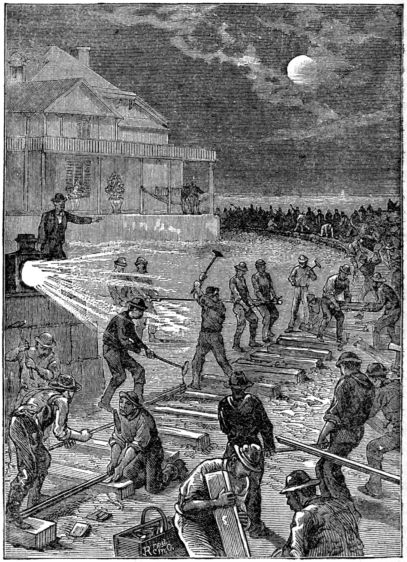
LAYING A SPECIAL RAILROAD TRACK TO FRANCKLYN COTTAGE.
615“8:30 A. M.—The President was somewhat restless during the early part of the night, but slept well after midnight. He has taken by the mouth and retained the nutriment prescribed. This morning his pulse is less frequent than yesterday. Pulse, 102; temperature, 99.5; respiration, 18. 12:30 P. M.—Pulse, 114; temperature, 99.5; respiration, 18. 6:30 P. M.—No material change has taken place in the condition of the President since morning. The parotid abscess continues to improve, and the wound remains about the same. Pulse, 108; temperature, 99.8; respiration, 18. Should no untoward symptoms prevent, it is hoped to move the President to Long Branch to-morrow.”
And here is the faithful Mr. Blaine’s dispatch to Minister Lowell, in London:
“To Lowell, Minister, London:
“This has been the hottest day of the season, and the heat has told upon the President. His pulse and temperature have been higher than for several days past. In other respects there has been no special change, either favorable or adverse. It is expected that he will be removed to Long Branch to-morrow. It is hoped that the sea air will strengthen him.
Blaine, Secretary.”
Can the journey be made with safety? The morrow will tell the tale. Here in the twilight of that last day in Washington, as the hum of preparation settles to a calm, and as our eyes turn toward him whom we have followed so long in his heroic struggle, doubting yet hoping, we may well say with the London Punch:
So fit to die! With courage calm
Armed to confront the threatening dart.
Better than skill is such high heart
And helpfuller than healing balm.
So fit to live! With power cool
Equipped to fill his function great,
To crush the knaves who shame the State,
Place-seeking pests of honest rule.
Equal to either fate he’ll prove.
May Heaven’s high will incline the scale.
The way our prayers would fain avail
To weight it—to long life and love!
616