Tying-up of Jacquard Harness for Two-ply Ingrain Carpets. With a General Description of the Working of the Loom and Construction of the Fabric.
Reading edition
Two-ply Ingrain Carpet is an article composed of two fabrics, produced on the regular double-cloth system. These two fabrics are arranged in the loom to form figures by a simple exchanging of positions. A great variety of colors may be put into each of these separate fabrics, (ground and figure), and the most elaborate designs may be used. On every part of the carpet where these two fabrics do not exchange, each works on the plain weave. The exchanging of these two fabrics binds both into one, thus forming the ingrain carpet. In the manufacture of this carpet four sets of warp-threads, and also four sets of filling-threads are generally employed; but, if occasionally more or less should be used, in warp or in filling, or in both, in the same fabric, the principle of exchanging is still observed. If employing four sets in warp and filling, two sets of each are used for forming the figure, the other two sets forming the ground, each of the figure-threads having as its mate one of the ground-threads. These threads are so arranged that when a figure-thread appears upon the face of the fabric its mate appears upon the back, and when the figure-thread appears upon the back the corresponding ground-thread appears upon the face.
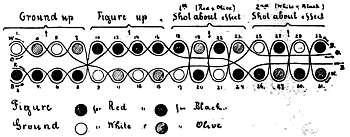
Fig. CVII.
To give a clearer understanding of the foregoing, a sectional cut of an Ingrain carpet fabric is given in Fig. CVII.
Suppose the filling-threads for the figure to be:
Red, indicated by heavy shaded circles; picks 2, 6, 10, 14, 18, 22, 26, 30. Black, indicated by full black circles; picks 4, 8, 12, 16, 20, 24, 28, 32.
And the filling-threads for the ground to be:
White, indicated by empty circles; picks 1, 5, 9, 13, 17, 21, 25, 29. Olive, indicated by light shaded circles; picks 3, 7, 11, 15, 19, 23, 27, 31.
A careful examination of the drawing shows that the white threads mate with the red, and the black threads with the olive, so that when one of these colors shows upon the face the mating color will show upon the back, and vice versa.
As a general rule, these warp-threads are of the same color as the weft-threads; hence, every filling pick, appearing either on face or back, is bound by a warp-thread of the same color. The sectional cut represents four distinct effects with 32 picks, thus allowing 8 picks for the illustration of each part.
1st effect, picks 1 to 8, is ground up (white and olive). 2d effect, picks 9 to 16, is figure up (red and black). 3d effect, picks 17 to 24, is 1st effect in "shot about" (red and olive up). 4th effect, picks 25 to 32, is 2d effect in "shot about" (white and black up).
Two methods of tying-up Jacquard harness are in use:
1st, the “straight-through” principle, (known to the trade as “cross-point”). 2d, the “point” method, (known to the trade as “centre-tie”).
I. The Straight-Through Tie-up for Ingrain Carpets.
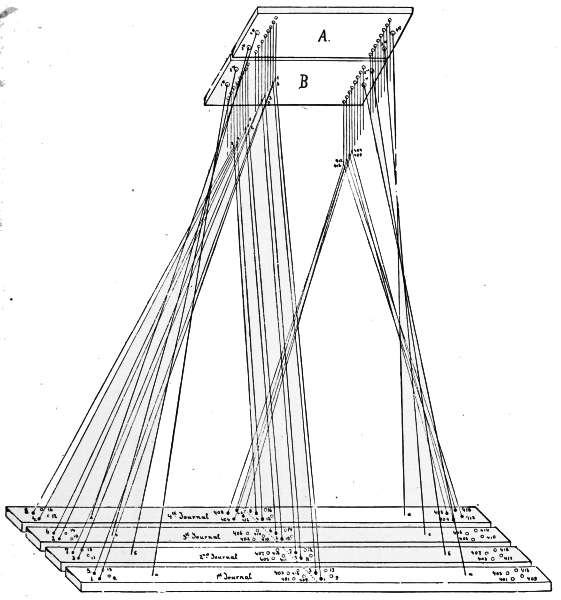
Fig. CVIII.
Fig. CVIII., p. 73, represents the arrangement of the neck-cords with the heddles (through the harness-cords). There are two separate bottom boards in the machine, marked A, B, for ground and figure; also two corresponding lifter-boards, which are illustrated separately by Fig. CIX.
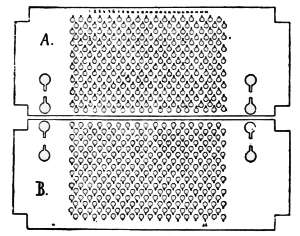
Fig. CIX.
The four journals are clearly illustrated by Fig. CX. (each journal carrying its own set of threads).
The first thread in the loom (left side) will be found on the first journal. The second thread in the loom (left side) will be found on the third journal. The third thread in the loom (left side) will be found on the second journal. The fourth thread in the loom (left side) will be found on the fourth journal.
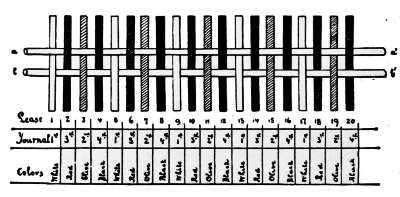
Fig. CX.
This arrangement of threads, 1, 3, 2, 4, is repeated throughout the fabric. For an example, a carpet is shown termed “extra fine,” executed on 26 “designs,” requiring 26 × 8, or 208 small squares for warp on the designing paper. Ingrain carpets are generally woven one yard wide, having in this width two repeats or divisions; hence the number of harness-cords for the present example is as follows: 26 × 8 = 208 × 2, for ground and figure; 416 × 2, for two divisions, = 832 harness-cords (or 416 leashes) required for tying-up.
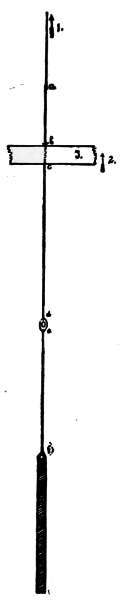
Fig. CXI.
Fig. CXI. illustrates the adjustment of heddle (mail) and lingo through the journal, J, by means of the heavy knot at b. This knot must be large enough not to pass through the hole of the journal. The average measures for the present drawing are as follows:
Lingo, f to g = 9 inches. Heddle, e to f = 8 inches. c to d = 10 inches. Mail, d to e = 6/8 inches. Height of journal, b to c = 1-1/8 inches. Connecting cord of heddle to harness-cord, a to b = 6 inches.
This drawing will explain the principle of raising the warp either by means of the harness-board, (arrow 1), or by means of the knot through raising the journal, (arrow 2). If raised by means of the harness-cord, the connecting heddle slides upwards in the hole provided for it in the journal; or the journal takes the place of a common comber-board; but if the journal be used for raising, the knot, b, will rise with it, carrying the heddle the same as before, the harness-cords becoming slack by this movement.
In Fig. CVIII., p. 73, the journals are arranged as follows:
1st journal,} for ground,{ White, 1st set of threads. } }For repeat, }— 238 times }over. }
2d journal, Olive, 3d set of threads.
3d journal,} for figure, { Red, 2d set of threads.
4th journal, Black, 4th set of threads.
In the same drawing are also represented the first eight heddles (in both divisions), as connected with harness-cords 1, 2, 3, 4, 5, 6, 7, 8; also the last four heddles of the rear journal (fourth) connected with their corresponding cords, 404, 408, 412, 416.
The first row (1 to 8) illustrates the principle of tying-up the harness and the leasing of the heddles; whereas the four heddles in the rear (404, 408, 412, and 416) show the practical commencement of the tie-up, i. e., four neck-cords in succession to four heddles of the journal.
A represents bottom-board in the machine where the neck-cords for the ground harness-cords pass through. B, the bottom-board in the machine where the neck-cords for the figure harness-cords pass through.
In Fig. CIX., showing the lifter-boards, A is also used for the ground, and B for the figure; 26 rows of the machine are shown for explaining the tie-up for a texture known as “extra fine,” or equal to 832 heddles in the width of loom (one yard).
Jacquard machines for two-ply ingrain carpets are usually constructed with 34 rows, and 33-1/2 of these are used. 33-1/2 rows have 33-1/2 × 8, or 268 needles, which carry 1072 threads, the number actually used in what is termed a full “extra super.” Should only 30 of these be used, having 30 × 8, or 240 needles, and carrying 960 threads for warp, the carpet is termed “super;” and if 25 rows, with 25 × 8 = 200 needles are used, carrying 800 threads, the product is called “fine” ingrain, and represents about the lowest grade of these carpets. It frequently happens that we find slight variations in the number of threads used in the various grades of carpet named. The pattern may require such a change, or economy in production may induce the maker to use a smaller number; or, as is done in a few instances, a manufacturer may always make his “extra super” on 32 rows; but all such changes are done by a corresponding depreciation of the value of the fabric, as compared with a full “extra super” of 33-1/2 rows.
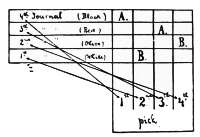
Fig. CXII.
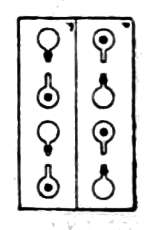
Fig. CXIV. Fig. CXIII.
Fig. CIX., p. 74, illustrates the full 34 rows, and indicates 26 rows used for illustration of tie-up (4 rows empty on each side). In power-looms the raising of the different journals is generally accomplished by an arrangement of cams, but in hand-looms it is done by the lifter-boards.
In Fig. CIX. the four large holes on each side are made for this purpose, and the wires for raising the journals are shown by heavy lines in tie-up in Fig. CVIII., p. 73. Fig. CXII. represents the process of lifting the journals, as follows:
First pick raises lifter-board A, journal 4; second pick raises lifter-board B, journal 1; third pick raises lifter-board A, journal 3; fourth pick raises lifter-board B, journal 2.
The two positions of the four “tails” in these four picks are illustrated as follows: Fig. CXIII., hole in cylinder; CXIV., no hole in cylinder. The black spots represent the knots, either as caught in the slot or passing free in the hole.
Looms tied-up on the foregoing principles have but one operation of the Jacquard needles for every two picks of the loom, there being an operation of the ground and figure lifter-boards in succession between the operations of the Jacquard needles. Each Jacquard needle controls two tails, one connected with the warp for the figure, (red and black in our example), and the other to the warp for the ground, (olive and white in our example). The drawing of the lifter-boards shows the slots for catching the tails in opposite directions from each other; hence, when the figuring tail of the needle is adjusted so as to be lifted by the figure lifter-board, the ground-tail will not be acted on by the ground lifter-board when it rises.
To give a clear understanding of the foregoing explanations, a detailed statement of the operations of the loom necessary in weaving a piece of the fabric is shown in sectional cut Fig. CVII., as follows:
Pick.Color. Lift-board for figure. Lift-board for ground. Journal lifts.Threads down.
1White.Rises, no lift.At rest.White to bind on face.Red, black, olive.
2Red.At rest.Lifts white and olive.Red.Black for binding on back.
3Olive.Rises, no lift.At rest.Olive to bind on face.Red, black, white.
4Black.At rest.Lifts white and olive.Black.Red for binding on back.
5White.Rises, no lift.At rest.White to bind on face.Red, black, olive.
6Red.At rest.Lifts white and olive.Red.Black for binding on back.
7Olive.Rises, no lift.At rest.Olive to bind on face.Red, black, white.
8Black.At rest.Lifts white and olive.Black.Red for binding on back.
9White.Lifts red and black.At rest.White.Olive for binding on back.
10Red.At rest.Rises, no lift.Red to bind on face.Black, white, olive.
11Olive.Lifts red and black.At rest.Olive.White for binding on back.
12Black.At rest.Rises, no lift.Black to bind on face.Red, white, olive.
13White.Lifts red and black.At rest.White.Olive for binding on back.
14Red.At rest.Rises, no lift.Red to bind on face.Black, white, olive.
15Olive.Lifts red and black.At rest.Olive.White for binding on back.
16Black.At rest.Rises, no lift.Black to bind on face.Red, white, olive.
17White.Lifts red and black.At rest.White.Olive to bind on back.
18Red.At rest.Rises, no lift.Red to bind on face.Black, white, olive.
19Olive.Rises, no lift.At rest.Olive to bind on face.White, red, black.
20Black.At rest.Lifts white and olive.Black.Red to bind on back.
21White.Lifts red and black.At rest.White.Olive to bind on back.
22Red.At rest.Rises, no lift.Red to bind on face.Black, white, olive.
23Olive.Rises, no lift.At restOlive to bind on face.White, red, black.
24Black.At rest.Lifts white and olive.Black.Red to bind on back.
25White.Rises, no lift.At rest.White to bind on face.Olive, red, black.
26Red.At rest.Lifts white and olive.Red.Black to bind on back.
27Olive.Lifts red and black.At rest.Olive.White to bind on back.
28Black.At rest.Rises, no lift.Black to bind on face.Red, white, olive.
29White.Rises, no lift.At rest.White to bind on face.Olive, red, black.
30Red.At rest.Lifts white and olive.Red.Black to bind on back.
31Olive.Lifts red and black.At rest.Olive.White to bind on back.
32Black.At rest.Rises,Black to bindRed, white,
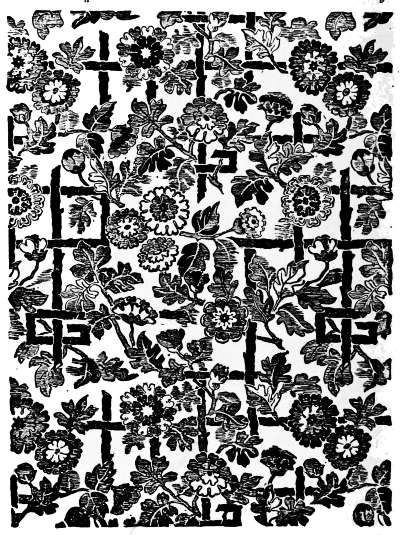
Fig. CXV.
Fig. CXV., p. 76, illustrates a fabric design for an ingrain carpet, straight-through tie-up, a and b forming one repeat, (or one division), equal to one-half yard.
II. The Point Tie-up for Ingrain Carpets.
This method of tying-up is based upon the straight-through tie-up principle, arranged as follows: The design in the fabric repeats from its centre equally towards each selvedge.
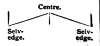
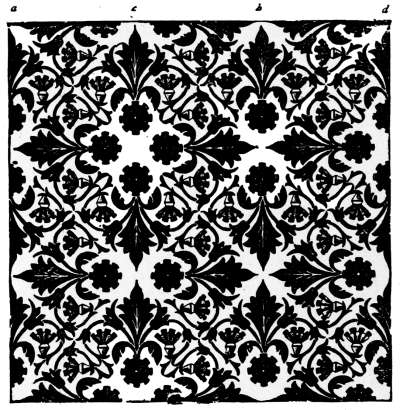
Fig. CXVI.
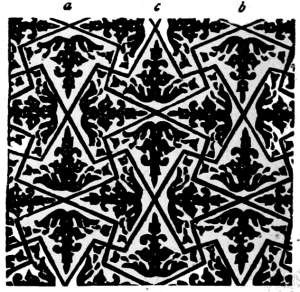
Fig. CXVII.
Figs. CXVI. and CXVII. illustrate two fabric designs, a to b, the width of the fabric or one yard on the loom; c is the centre or point of the design; b to d is the repeat of a to c, where the widths are sewed together.
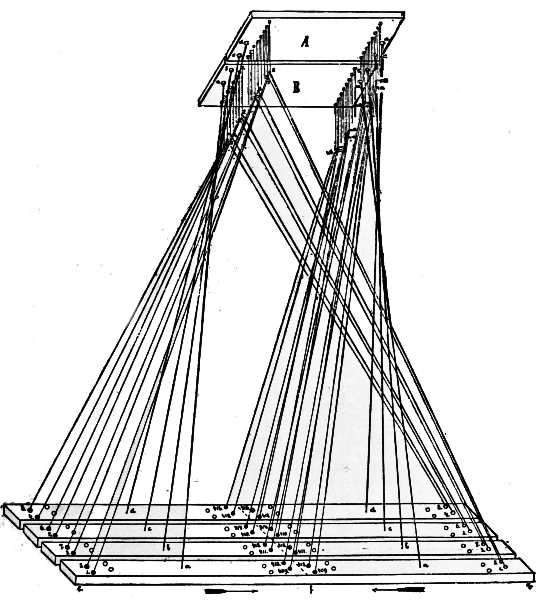
Fig. CXVIII.
Fig. CVIII., p. 73, shows the first and last rows, also the two centre rows of the journals threaded to the neck-cords (tail-cords) of the machine. Each cord is numbered to correspond. a, b, c, d, represent the cords for lifting the journals, on the same principle as in the straight-through tie-up. In power-looms this is done by a cam arrangement.
Fig. CXIX., p. 80, is designed to give a thorough understanding of the adjustment of harness-cords to heddles, as well as the leasing of the latter. The numbers selected for indicating the different cords correspond with those used in Fig. CXVIII.
Journal 1 = white, } ground. Journal 2 = olive, } Journal 3 = red, } figure. Journal 4 = black, }
Arrangement of threading; a to b, 51 times repeated, =408 cords.
The last row in the half width illustrated separately by c to d, which is the same as a to b, =8 cords.416
----
S forms the centre or point; e to f, first row of each journal, near centre, (repeat of centre-cord for ground or figure omitted; see o on journals 2 and 4), =6 cords.
g to h, 50 times repeated, =400 cords.
i to k, last row, same as g to h, =8 cords.414
----
Total number of cords used, 830
The following is the method employed in drawing for indicating the different colors of warp-threads:
Blank for white, } ground. Light shaded for olive, } Heavy shaded for red, } figure. Black for black, }
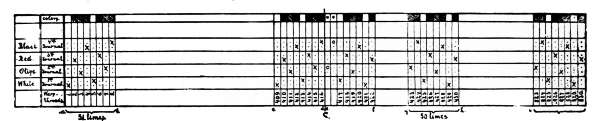
Fig. CXIX.
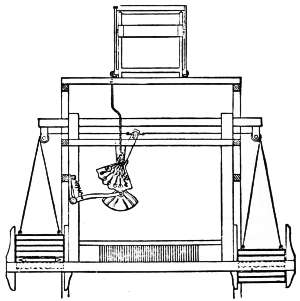
Fig. CXX.
The beauty of an ingrain carpet consists in its color combination. In hand-looms the common batten is used in connection with a shuttle which is somewhat curved, a form most suitable to being thrown by the hand. The batten naturally falls towards the weaver by its own gravity, being usually worked a little out of a vertical line for that purpose. In this method the shed forms its own shuttle-race, or bed upon which the shuttle slides. When two or more shuttles are used, they are laid on the woven piece of carpet before the weaver, and he selects them as required. If a solid shuttle-race is connected to the batten, the warp-threads are pressed down upon it and the shuttle slides upon the ridge of the warp-threads. In this case the “fly-shuttle” is used, and also the “drop-box;” the latter being operated by some of the reserve needles of the Jacquard machine.
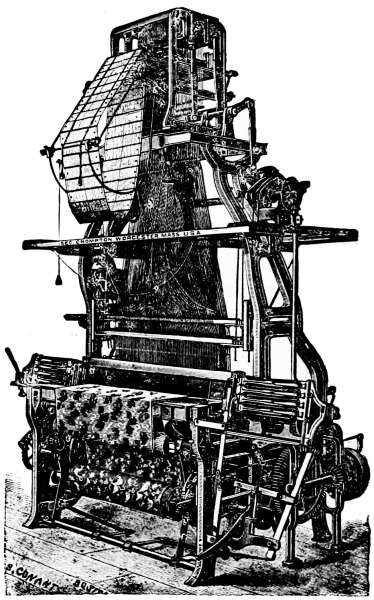
Fig. CXXI.
Fig. CXX. shows a shuttle-box mechanism for carpet hand-looms. As already stated, the four journals in power-looms are lifted by cams or similar contrivances. In Fig. CXXI. (representing the Crompton carpet loom) this cam arrangement is clearly visible; the cams are situated above the journals, the latter being lifted by means of the journal rods from above. The loom carries four shuttle-boxes at each end of the lathe; any one of the series at either end can be brought into line with the shuttle-race at any pick.
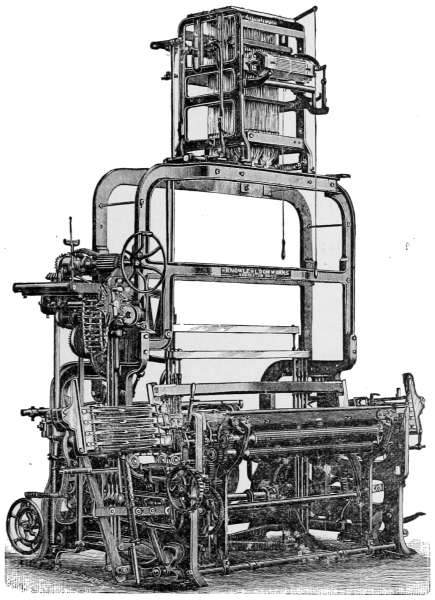
Fig. CXXII.
In some looms the journals are also lifted from below, as shown in Fig. CXXII., representing the “Knowles” carpet loom. In this the journals are controlled by a chain motion, instead of a cam, operating either journal at will, which can not be done on a loom where the journals are actuated by cams. This permits the shading of a fabric to be changed without cutting out the warp and re-drawing it. The box mechanism (four boxes on each side of the lathe) is positive, and controlled by a chain on the same shaft as the journals, and may be used with the chain alone, or with the chain in combination with the cards. The motion can be run forward or reversed at will, and any box called as desired.
Before closing this article, it is necessary to mention the method of working the loom built with a stationary “shuttle-raceway” and an independent “comb,” the latter having a reciprocating movement for beating up the filling, and a rising and falling motion for bringing the comb up into, and taking it out of the warp; it has also yielding racks and filling forks, and a cam so timed for operating the forks, that the latter will seize the filling and carry it forward in front of the range of the said comb.
Fig. CXXIII. illustrates the side view of the comb and its lay; also the parts necessary to be shown for working the same: k, the independent lay; d, the comb; c, the reed; a, its lathe; b, the shuttle-race; c, the breast beam of loom; oval ring, d, e, g, represents the motion of the comb in beating up the filling; e, r, upper shed of the warp; e, t, lower shed of the warp; x, the shed; h, stud fixed to the loom framing; h, i, to i, k, toggle connection of lay to stud, h; i, m, to m, l, crank connected at i to the toggles; l, crank shaft; p, o, lever for raising and lowering the lay, k; n, its fulcrum; s, grooved cam for working lever, p, o.
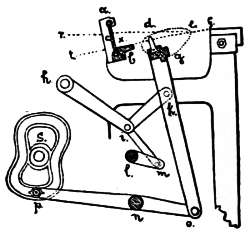
Fig. CXXIII.
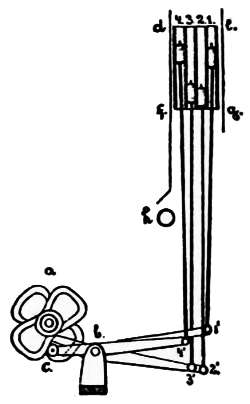
Fig. CXXIV.
The vibratory movement of the comb-lay for beating up the filling is produced by the action of the cranks upon the toggle connections; and the upward and downward movement of the lay, to produce the entrance of the comb into the warp and its withdrawal therefrom, is produced by the action of the lever upon the grooved cam. The comb, d, is constructed of teeth, which are secured together by a bolt passing through them, and which have their bases of dovetail form to enable them to be secured between a dovetail lip, on the lay, and a dovetail clamping plate, secured to the lay by bolts.
Fig. CXXIV. illustrates the method of lifting the journals from below. The journals, of which there are four, are arranged to work in upright fixed guides on the loom framing, d, e, f, g, and are operated by treadles, which are arranged in pairs below, each journal being connected with one pair of treadles by two rods at its opposite ends. These treadles are operated by cams for each pair of treadles and each journal.
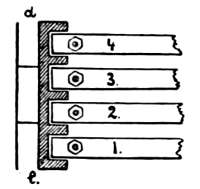
Fig. CXXV.
Fig. CXXV. represents the top view of the “fixed guides” containing the journals. This loom is provided with ten shuttle-boxes, (seven for the revolver, three upright), for each side, and built by the Furbush Machine Company, being a combination of their older carpet loom known as the “Murkland,” and the “Duckworth Carpet Loom.”