THE JACQUARD HARNESS.
Reading edition
To the lower end of the hooks (c. in Fig. V.) the neck-cords are adjusted. The latter are passed separately through one of the corresponding holes of the perforated bottom board (Fig. II.) To these neck-cords are fastened the leashes of the Jacquard harness about 1/2 to 1 inch above the frame containing the rods which guide the neck-cords vertically as the hooks are raised and lowered. The different harness-cords are threaded through the comber-board in various ways called “Tie-ups,” which will be explained later.
The Comber-board and Methods of Figuring for it.
There are two kinds of comber-boards used upon Jacquard looms:
1st. Comber-boards made of a solid piece of material, either wood or porcelain.
2d. Comber-boards made in strips of either of the materials above named, and adjusted afterwards in a wooden frame.
Comber-boards Made of a Solid Piece of Material.
Before ordering a comber-board, it is necessary to know the texture of the fabric in the loom, and also the number or size of the machine to be used; for the number of holes per inch in the comber-board is regulated by this. Afterwards, we may, if we choose, arrange the number of holes in depth of the comber-board, according to the number of griffe-bars in the machine, (guided by the fabric to be made). We may have eight griffe-bars in the machine, and arrange the comber-board 4, 6, 8, 10, 12 rows deep; or we may have 12 griffe-bars in the machine, and arrange the comber-board 12, 10, 8, 6, 4 rows deep.
Rule: The number of holes to one inch in the comber-board must equal the texture of the fabric to one inch in loom.
Example: Suppose a fabric with a texture in the loom of 100 threads, and we are to use a 600 Jacquard machine, with 12 rows. The width of the fabric in the loom is to be 36 inches.
Required: The number of holes in the width of the comber-board.
Answer: 100 × 36 = 3600 holes in the comber-board.
3600 ÷ 12 = 300, the number of holes in width.
The width and depth of the comber-board are regulated by the width of the cloth required and by the design to be used.
The greater the number of rows in depth the closer they must be; the same is true of the width.
It is necessary to take care not to have the comber-board too deep, as the consequence would be a bad shed; furthermore, we must not have the holes too close together, as in a high texture this would make trouble in the weaving through the catching of the heddles with the warp, and also cause useless chafing of the warp-threads and the heddles.
The Changing of Solid Comber-boards for Different Textures.
In Jacquard work we generally use the same texture, or as near as possible, as the loom is tied up for; but changes are sometimes unavoidable. If we reduce the texture of the fabric in a Jacquard loom tied-up for a solid comber-board, we must reduce proportionally the number of hooks and needles used in designing, and hence the number of heddles used per inch. These heddles will thus be left empty when drawing in the warp. To accomplish this lift the full machine and throw the hooks not to be used from the knives, lowering in this way every mail which is not to be used. Sometimes there may be only one, two, three, or four hooks to be thrown off, on account of the design. At other times it may be necessary that one-eighth, or one-fourth, or even one-half of the whole number shall be dropped for this purpose. For instance, suppose we have a dressgoods design of 596 threads and a 600 machine. These four ends left off the 600, if in 6, 7, 8, or more inches in width, would not affect the fabric nor the cost to any great extent; hence we may leave out the first or last four needles of the 600.
Suppose we have a texture of 100 in the comber-board, to lower to 66 ends per inch. 66 ends, or the nearest even part of 100 (66-2/3) is 2/3 of 100; hence, we only need two-thirds of our machine; and as the same is supposed to be arranged 12 rows deep, we need 2/3 of 12 rows, or 8 rows. The four rows thus found necessary to drop may be dropped from the ends, or alternately, as follows:
Every alternate 2 rows taken, 1 row missed, 4 times over, = 12 rows. Or, 2 rows missed, 8 rows taken, 2 rows missed, = 12 rows.
Comber-boards made in Strips and Adjusted afterwards in a Frame.
By these comber-boards which are used to a great advantage on narrow loom work up to 36 inch fabrics, we can change the texture for the fabric; for the strips composing the comber-board may be drawn apart, thus changing the higher texture to lower; whereas in a solid comber-board this could only be done by re-tying the harness or changing the number of needles used in the machine. To give a clear understanding Figs. XVIII., XIX., XX. are needed.
Fig. XVIII. represents an 8-row deep comber-board, a, b, c, d, composed of 10 strips which are set close together. By examining each strip 5 cross-rows of holes will be found, making the whole number of holes 400.
Suppose the comber-board as represented in Fig. XVIII. is intended for a texture of 100 ends per inch; this will give for the width of the fabric (i, k, to l, m,) 4 inches.
Fig. XIX.
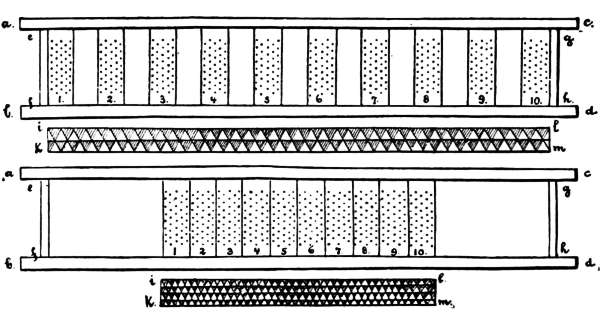
Fig. XVIII.
In Fig. XIX. the comber-board is arranged for a texture of half as many ends, or 50 holes per inch, and the 10 strips are arranged accordingly; the empty places between the strips are of same size as the strips themselves, and the fabric design below the comber-board is arranged to correspond.
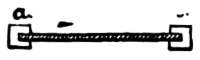
Fig. XX.
Fig. XX. illustrates the sectional cut of the comber-board used in drawings, Figs. XVIII. and XIX., and the letters indicating the different parts of these figures which correspond.
Divisions of the Comber-board.
Under this heading we classify one repeat of the arrangement of threading harness-cords in the comber-board, and therefore one repeat of the design of the fabric. We find fabrics in which are used one or more divisions of one system of threading harness-cords in the comber-board; again, there are others in which one or more divisions of one system are combined with one or more divisions of another, or even of two or three other systems.
Heddles for the Jacquard Harness.

Fig. XXI.
After the harness-cords are threaded through the comber-board the heddles are adjusted. Of these there are two kinds:
A. The twine heddle, containing the mail for holding the warp-thread.
B. The wire heddle, similar in its construction to the regular heddle, used in the common harness-loom. These are very little used, and only in fabrics of a low texture.
Fig. XXI. illustrates a regular twine heddle one-fourth of its actual size.
b represents the mail, through the eye of which the warp-threads are passed.
a, the adjustment of the heddle to the harness-cord.
c indicates part of the lingo for weighting the heddle.
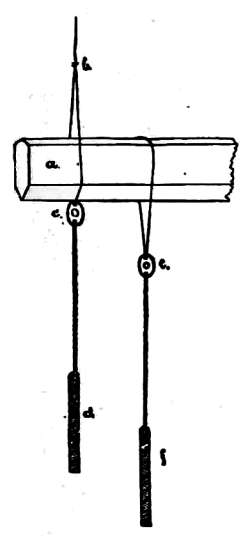
Fig. XXII.
Fig. XXII. illustrates the method observed for combining heddle and harness-cords. a, the guide-board, to get the mails regular in height; b, the knot combining heddle and harness-cord. [See a in Fig. XXI.] c, the mail. d, the lingo.
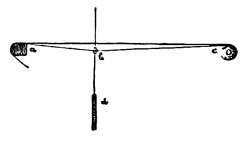
Fig. XXIII.
Fig. XXIII. illustrates the average position of the mail in a loom. a, breast-beam of the loom. c, the warp-beam or guide-beam over which the warp runs on its way towards the harness. b, the position of the heddle. d, the lingo.
The “Leasing” of the Harness.
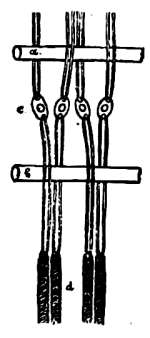
Fig. XXIV.
This requires a clear conception of the rotation in which the different heddles are threaded, according to the tie-up employed. Two methods are in use: 1st. The heddle nearest the weaver is the first to be threaded, and the heddle of the same row in rear of the comber-board is the last. 2d. This principle reversed, thus arranging the leasing from rear to front.
The latter method is the one most generally observed. Every row in depth of comber-board is leased separately, and in rotation secured to the lease-twines, a and b, in Fig. XXIV., thus forming an uninterrupted line of heddles through the entire Jacquard harness. Through these heddles the warp is afterwards drawn in rotation.