Squared Designing Paper for the Different Textile Fabrics Executed on the Jacquard Machine.
Reading edition
The classifying of the □ designing paper is done by enclosing a number of small rectangles, horizontal and vertical, within a certain distance by a heavy line. Such enclosures are known in practice as “squares.” The spaces between the vertical lines indicate the warp-threads, and those between the horizontal lines the filling threads. As a rule the warp dimension is indicated first; and a design paper having five rectangles vertical with ten horizontal, is variously read and indicated as 5 by 10, 5 × 10, or 5/10.
Figs. 46 to 68 represent some of the styles of □ designing paper most frequently used. The size of the square may vary in each kind of paper, and must be selected according to the fabric to be sketched. For example: There are three styles of 8 × 8 □ designing paper in general use: One forming 1/2 inch heavy squares, (Fig. 48), one forming 3/4 inch heavy squares, (Fig. 64), and the other forming 1 inch heavy squares. These sizes may still be varied.
The principle of these three kinds of □ designing paper is identical, the size preferred being left to the pleasure of the designer. If a design is to be made for a great number of needles, say 600, 900, 1200, etc., it will be best to use the smallest size; whereas in a design for only 100 to 200 needles the larger sizes may be employed.
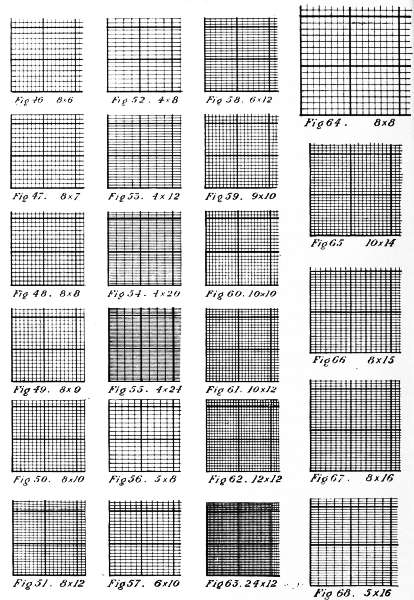
Practical Use of the Heavy Square in Designing Paper.
The heavy square serves as a unit of measurement, as well as a means of calculation, and shows readily and exactly the size of the design. The eye becomes accustomed to grasping the meaning of this large square, and comprehends at a glance the situation. For instance:
On 8 × 8 paper, 25 squares means 8 × 25, or 200 rectangles each way. 10 × 10 paper, 10 × 25, or 250 rectangles each way. 10 by 12 paper, 10 × 25, or 250 rectangles one way, and 12 × 25, 300 rectangles the other way.
These rectangles in actual work represent threads or ends, thus:
200 ends on 8 × 8 paper require 25 squares. 300 ends on 10 × 10 paper require 30 squares. 450 ends on 10 × 12 paper require 45 squares one way, and 450 ÷ 12, or 37 squares + 6 lines the other way.
The squares will also assist in putting the weave in a design. For example: Suppose a design for a damask table-cover is required, having for weaves the 8-leaf satin. By using the 8 by 8 paper the “risers” or “sinkers” of the 8-leaf satin are found in the same place in each square, thus any error in forming the weave is at once detected. Sometimes more than one square is required for ascertaining this fact; suppose in the preceding example the □ paper to be 10 by 10, then the number of threads represented by four successive squares = 4 times 10, or 40, being five repeats of the 8-leaf satin, as 5 times 8 = 40.
Selection of Designing Paper for Single Cloth.
For single cloth the character of the designing paper is ascertained by the number of warp and filling threads required per inch in the finished fabric. For example: A damask fabric with a texture, when finished, of 80/120 (80 ends warp and 120 picks filling per inch) will require a designing paper of corresponding proportion, or as 80 is to 120, = 8 × 12.
In stripes, checks, etc., the texture in part of the fabric is changed; such changes require separate designs. If the difference is only slight, one kind of paper is used. Select the paper derived through the proportion of the two as required. For example: A dressgoods fabric forming two distinct effects in one repeat of 400 warp-threads (200 successive ends required for each effect).
The first effect made on a texture 60/80. The second effect made on a texture 80/80.
Two distinct designs (one for each effect) are required:
For the first effect use a paper proportioned as 60 to 80, or 6 × 8. For the second effect use a paper proportioned as 80 to 80, or 8 × 8.
If only one kind of □ designing paper be used for both effects, find the average of the warp, thus: 6 + 8 = 14, and 14 ÷ 2 = 7, showing that paper 7 × 8 is the substitute. If using a designing paper under similar circumstances the sketch must be squared to correspond.
Selection of Designing Paper For Double Cloth.
In fabrics where one line (visible across the face) is produced by two or more different colored threads, (each pick forming part face, part body or back of the fabric), the designing paper to be used is shown by the proportion of the line effects to the warp-threads (figure) per inch. Example: Take a dress-goods fabric, extra figured in the filling, having the following texture: Warp, 60 ends per inch; filling, 100 picks per inch, double system, 1 pick for ground, 1 pick for figure. The paper required is as 60:(100 ÷ 2) or as 60:50 = 12 × 10, or 6 × 5.
The figure is painted upon the paper in various colors and by the card-stamping when cutting the ground cards. The extra colors are treated as if they were ground. When cutting for the extra figure, deal with it alone.
If a fabric has the double-cloth system applied to the warp, only using one filling for both kinds of warp, and the Jacquard-harness is tied-up for “single sections,” the squared designing paper required is found from the proportion of the number of face and back warp-threads per inch, to the number of picks per inch. Example: Take a dressgoods fabric constructed on the following texture: 80 ends warp, 1 end ground, 1 end figure, and 60 picks to 1 inch. The proportion for the paper is as 80:60, or 8 × 6 designing paper.
If the tie-up in the loom is for double sections, (Fig. LIV. or LVI.), the fabric in the previous example requires the comparison of the face-warp with the filling, and the answer is: 80 ÷ 2 or 40 ends of face-warp per inch, 60 picks filling per inch, giving the proportion of 40 to 60, requiring 8 × 12, or 4 × 6 designing paper for the figure. The ground part of the design is executed separately on the same kind of paper; or if the weave is of a short repeat, stamped without design.
In selecting the □ designing paper for double cloth, such as cloakings, coatings, etc., made with a back-warp, and executed on any of the single section tie-ups, use the lines between the squares to indicate the back-warp and back-filling. The proportion of ends of face-warp to face-filling in one inch of the finished fabric indicates the kind of paper needed.
Example: If a fabric has the following texture:
Warp, 2 ends face, 1 end back, 90 ends per inch. Filling, 3 ends face, 1 end back, 132 picks "
The kind of designing paper needed is found by dividing 90 by 3, and multiplying by 2, thus: 90 ÷ 3 × 2 = 60, number of ends of face-warp per inch, and 132 ÷ 4 × 3 = 99, number of picks filling per inch, giving a 60 × 99 paper, or its equivalent, 6 × 10.
Face cards for these fabrics must be stamped twice, first for the face weave, and afterward for the binder. If using a 12-row machine, use punches 1, 2, 4, 5, 7, 8, 10, and 11, for face; 3, 6, 9, and 12, for the back of the fabric.
Selection of Designing Paper for Two-ply Ingrain Carpets.
Always observe the proportion existing between the number of warp and filling-threads. For instance, take a carpet having 1072 ends warp (536 ground and 536 filling) per yard, with 30 picks per inch (1 pick ground and 1 pick filling, or 15 pair). Then, 1072 ÷ 36 = 29-28/36 ends of warp per inch. The proposition is as 29-28/36: 30; or, what is practically the same, 30: 30, showing that the paper must be equally divided, and 8 × 8 may be used, as is usually done.
Again, take a carpet having 832 ends warp (416 ground, 416 figure) per yard with 20 picks per inch (1 pick ground, 1 pick figure, or 10 pair). Then 832 ÷ 36 = 23-4/36, and the proportion is as 23-1/9: 20, or as 7-19/27: 6-2/3, practically 8: 7; and 8 × 7 paper may be used.
Note.—It will always be advantageous for the card stamping if the designing paper be selected so that the number of warp-ends in one square equals the number of griffe-bars used in the Jacquard machine.
Selection of the Proper Brush for the Different □ Designing Papers.
The brush used by the designer must be clipped according to the size of the rectangles of the paper. It should cover the rectangle in warp direction at one sweep of the hand; hence each size of the squared paper requires a specially prepared brush for quick, good, and perfect work.
Colors used For Painting Textile Designs.
For this purpose take common colors (in powder), and mix with water and mucilage to avoid rubbing off after application. Use no more mucilage than necessary, as too much will be followed by slow and imperfect work. Colors mixed in this manner must be kept moist by adding a few drops of water daily. The colors most generally used for painting textile designs are:
Vermilion. Lamp Black. White Lead. Emerald Green. Chrome Yellow. Burnt Umber. Cobalt Blue. Carmine, etc.
A few drops of alcohol will greatly assist the mixing of vermilion, umber, and similar colors which have no affinity for water. Chloride of lime is used on colors having a vegetable basis (as carmine, etc.,) for correcting imperfections, applying weaves or changes in the colored part of a design.
If the designing paper becomes greasy, the colors will not adhere. To cure this take a moist sponge and wipe off the paper.
Preservation of Textile Designs.
To prevent textile designs (painted on the □ designing paper) from being soiled, apply a thin solution of white shellac varnish, which dries almost instantaneously. A design preserved in this manner can be cleaned off at any time with a wet sponge, and after years have passed will appear bright and distinct.