Modifications of the Single Lift Jacquard Machine.
Reading edition
Having thoroughly described the construction and action of the regular Jacquard machine, it now remains to illustrate and explain its modifications. Among the most prominent are:
1st. The Double Lift Single Cylinder Jacquard Machine.
2d. The Double Lift Double Cylinder Jacquard Machine.
3d. The Arrangement of Substituting “Tail-cords” in place of the Hooks, etc.
I. Double Lift Single Cylinder Jacquard Machine.
The principle of this machine consists in raising the warp-threads any number of times in succession without allowing the shed to close, thus performing the work in nearly half the time, and with less wear and tear on the warp.
Fig. XCVI. represents the sectional cut of one row across all the griffe-bars. The machine selected for the illustration is of the 12-row type. Jacquard machines of this description have two hooks to one needle; therefore in the drawing twenty-four hooks are represented. Two griffes are provided, each working every alternate hook.
Fig. XCVI.
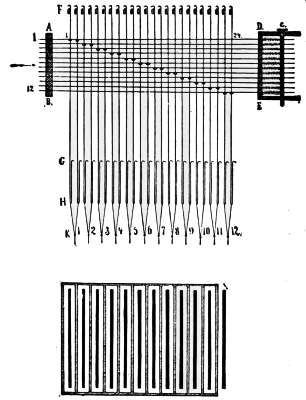
Fig. XCVII.
In Fig. XCVI. the sectional cut of both griffes is shown, and in Fig. XCVII. the top view of both griffes; the first set is represented shaded, the second black. The former requires hooks Nos. 1, 3, 5, 7, 9, 11, 13, 15, 17, 19, 21, 23, and the latter Nos. 2, 4, 6, 8, 10, 12, 14, 16, 18, 20, 22, 24.
This arrangement permits either hook to be lifted separately by the griffes, and a corresponding elevation of the leash. As these griffes work in opposition, one descends while the other ascends; this motion prevents the leash from dropping the entire length of the cords, since the ascending griffe catches it at half distance as the two griffes pass each other. In this operation the shed is never entirely closed, and a corresponding gain in speed is attained. It will thus be seen that the “double lift” single cylinder has great advantages over the ordinary machine. Of course, the warp-thread must make its complete journeys up and down when called for by the design; but when once up, it need not be brought down until absolutely required by the pattern. The warp is thus subjected to less friction in working, and it is possible to use yarns with less twist and obtain good results.
The advantages arising from not closing the shed may be seen in the following example of a warp-thread working on an 8-leaf satin, in which seven picks are up in succession.
By the single lift machine this warp-thread must travel seven times up and seven times down, thus closing the shed absolutely seven times, with a corresponding wear and tear. The double lift single cylinder arrangement does not require the warp-thread to make these seven complete journeys to the “race-board” of the lay, but instead it makes seven half trips. The saving may be shown by the following analysis: Single lift machine, warp-thread, seven picks up in succession, in 8-leaf satin (warp-face) requiring fourteen complete movements.
Double lift single cylinder machine requiring for the same effect:
Up the first time, = one complete movement.
Six times down, Six times up,} half movements, = six complete movements.
Down the last time, Or eight complete movements. = one complete movement.
Showing the utility of the two machines to be to each other as 8 to 14, or 4 to 7.
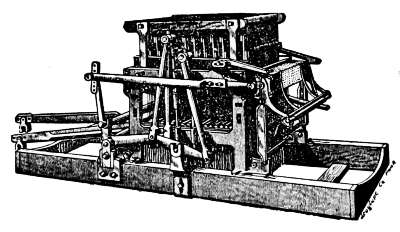
Fig. XCVIII.
Fig. XCVIII. illustrates the complete double lift single cylinder Jacquard machine, as built by W. P. Uhlinger, Philadelphia. In this drawing both griffes are distinctly visible; also their mode of operation by means of the double-acting lever. This machine has the set of hooks for each griffe-bar protected by a plate of sheet iron, thus steadying the hooks in their motion, and enabling smaller crooks to be used for the latter.
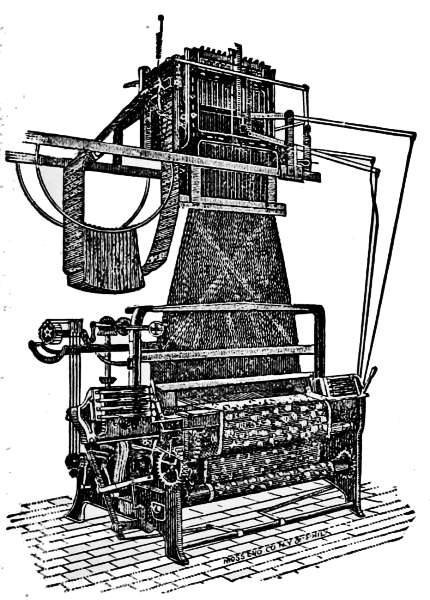
Fig. IC.
Fig. IC. represents a double lift single cylinder Jacquard machine as built by Thomas Halton, Philadelphia, attached to a regular broad loom, (Knowles or Crompton), and tied-up for upholstery work. The griffe-bars in this Jacquard machine are constructed of such height that when lifted they never rise above the crooks of the hooks, which are thrown out of operation by the descent of the other griffe.
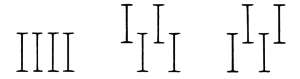
Fig. C. Fig. CI. Fig. CII.
Fig. C., hooks at rest.
Fig. CI., hooks 1 and 3, etc., raised, = 2 and 4, etc., at rest.
Fig. CII., hooks 2 and 4, etc., raised, = 1 and 3, etc., at rest.
II. Double Lift Double Cylinder Jacquard Machine.
The principle of this machine consists in the combination of two separate Jacquard machines. Two hooks (one of each machine) are connected to one leash of the Jacquard harness, and as each machine is operated alternately, a high speed is attained, which is the purpose of the machine. For example: 140 picks per minute (speed of loom) only requires 70 picks per minute from each part of the double lift double cylinder.
In Fig. CIII. this is clearly illustrated. It shows two 12-row machines (E and F) combined, thus giving 24 griffe-bars for the complete double machine, as the griffes work within each other. As explained for double lift single cylinder, every alternate bar is connected with a separate griffe, and these two griffes are worked alternately on the same double lever arrangement.
O to P and O´ to P´, represent the two needle-boards; P to R and P´ to R´, represent the two corresponding needle-boxes.
These double lift double cylinder Jacquard machines are mostly used in the manufacture of turkey-red goods and similar table-cover fabrics, using tie-ups similar to the one illustrated below, which is a combination of the straight-through and point tie-up, which may be alluded to once more by way of explanation in this particular case.
The illustration represents a double lift double cylinder machine containing two 600 machines, which equals an ordinary 600 machine for the tie-up.
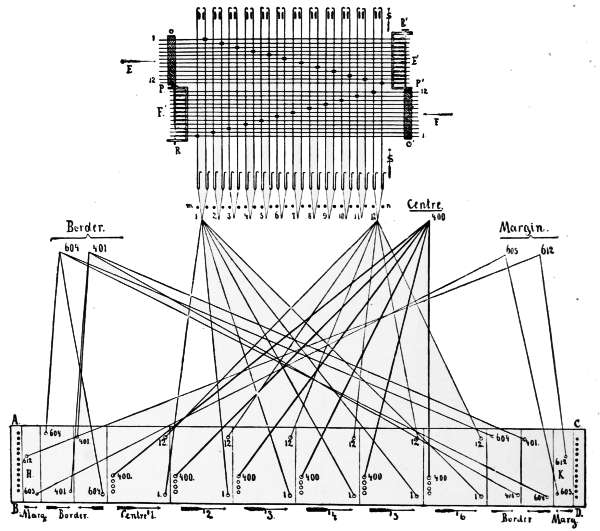
Fig. CIII.
This tie-up contains six divisions for the centre straight-through, and requiring leashes 1 to 400 from each part of the double machine. Leashes 1, 12, and 400 (heavy lines) only are illustrated in drawing.
The borders are constructed on the point tie-up, and require leashes 401 to 604 from each part of the double machine. The first and last leash only are illustrated. The margins between border and selvedge are worked by leashes 605 to 612. Centre and border are 12 rows deep, arranged in the comber-board; the margin 8 rows deep, on account of working it (as is generally done) on an 8-leaf satin. One complete row in machine, (both parts), as well as in the comber-board, (illustrated on each side in drawing), is left for the selvedge.
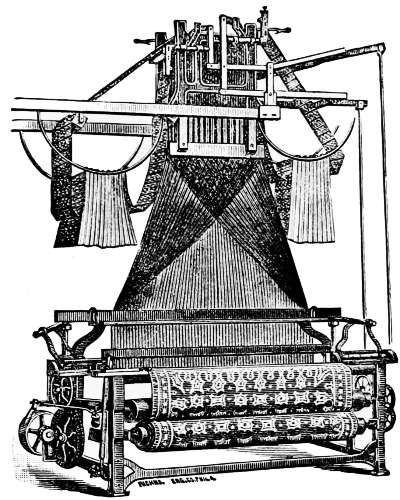
Fig. CIV.
Fig. CIV. represents this machine (built by Thomas Halton, Philadelphia,) attached to a Clipper loom. In this drawing both sets of cards (one to contain the even numbers, and the other the uneven numbers) are clearly visible, and also the double lever arrangement for working every cylinder alternately. As the cylinders run at only half speed, the wear on the cards is reduced to a minimum.
III. The Substitution of Tail-cords for Hooks.
Jacquard machines having this construction are generally employed in the manufacture of ingrain carpets.
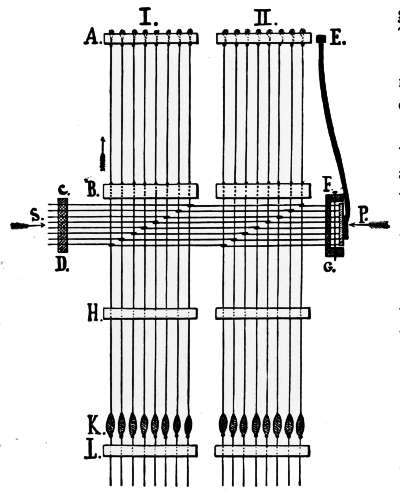
Fig. CV.
Fig. CV. represents the sectional cut of one row of needles across the machine; also the necessary boards for guiding and operating the tail-cords. This machine consists of two divisions (I. and II.,) which are worked alternately for the common 2-ply ingrain carpet.
A, represents the top board, to which the tail-cords are fastened around a wire by knot shown below the boards. Each board is 6-1/4 by 3/4 inches, with a distance of 1-1/4 inches between them.
B, represents the “Lifter-boards” (trap-boards) which are shown in top view in the special article devoted to the manufacture of ingrain carpets. (Fig. CIX., p. 74.) Its dimensions are 6-1/4 inches by 1 inch. Distance from top-boards to lifter-boards, 9-1/4 inches. C to D, needle-board. Arrow, S, the direction of working the cylinder towards the needles. F to G, the needle-box with its pin for holding the needles in position. Each needle is connected to two tail-cords, as indicated in the drawing, one for figure and one for ground. H and L are the two guide-boards for the tail-cords. Distance from B to H, 7-1/4 inches, from H to L, 8-1/2 inches. Dimensions of each guide-board, 6-1/4 inches by 3/4 inch. Each tail-cord is weighted by a small lead weight, as shown at K in drawing.
In this machine the springs for the needles are omitted, and a board large enough to cover the ends of all the needles, substituted. [See arrow, P.]
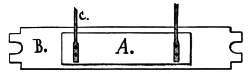
Fig. CVI.
Fig. CVI. illustrates the rear view of the needle-box, B, and the board for pressing the needles, A. C shows the hanger, which is attached (movable) to the top of the machine. [See E, in Fig. CV.]