THE WAR OF THE SAINTS.
Reading edition
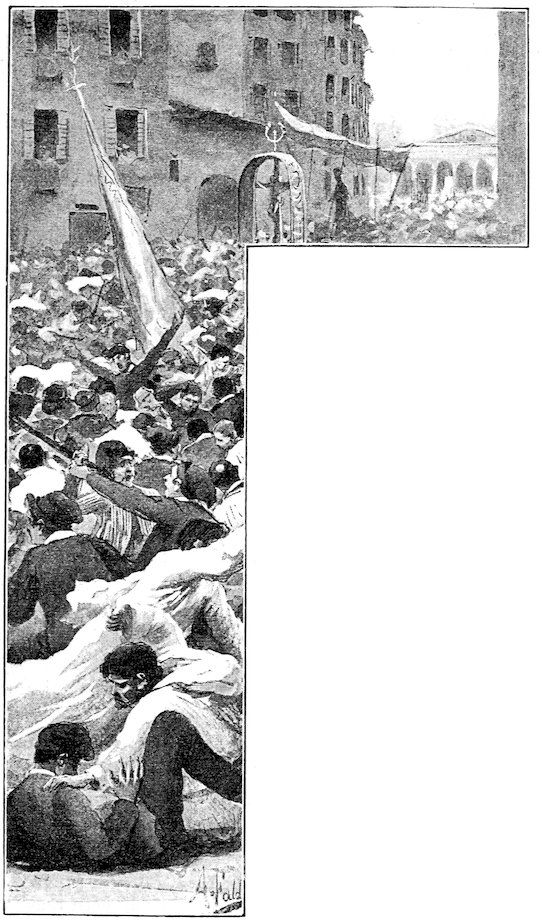
All of a sudden, while San Rocco was quietly proceeding on his way, under his baldachin, with a number of wax candles lit all round him, and the band, and the procession, and the crowd of devout people—there came to pass a general helter-skelter, tumult, and confusion worse confounded. There were priests running away, with the skirts of their cassocks flying wildly, drummers and fifers upset on their faces, women screaming, blood flowing in streams, and cudgels playing even under the very nose of the blessed San Rocco. The Prætor, the Syndic, the Carbineers all hastened to the spot;—the 138broken bones were carried off to the hospital,—a few of the more riotous members of the community were marched off to pass the night in prison,—the saint returned to his church at a run rather than a processional step,—and the festival ended like the comedies of Pulcinella.
And all this through the spite of the people in the parish of San Pasquale. That year the pious souls of San Rocco had been spending the very eyes out of their heads in order to do things in grand style;—they had sent for the band from town,—they had let off more than two thousand squibs,—and they had now got a new banner, all embroidered with gold, which, it was said, weighed over a quintal, and tossed up and down in the midst of the crowd, like a wave crested with golden foam. Which thing, by sheer contrivance of the Evil One, was a thorn in the sides of the followers of S. Pasquale,—so that one of the latter at last lost patience, and began, pale as death, to yell at the top of his voice, “Viva San Pasquale!” Then it was that the cudgels began to fly.
Because, after all, to go and cry “Viva San Pasquale” in the very face of San Rocco, is really a good, sound, indisputable provocation;—it is just like going and spitting in a man’s house, or amusing yourself by pinching the girl who is walking arm in arm with him. In such a case there is no longer any sense of right and wrong,—and that slight amount of respect which people still have for the other saints—who, after all, are all related to each other—is trampled under foot. If it happens in church, seats are flung into the air,—if during a procession, there are showers of torch stumps like swarms of bats, and at table the dishes fly.
“Santo diavolone!” cried Compare Nino, panting, heated, and dishevelled. “I’d like to know who has the face to cry Viva San Pasquale again!”
“I!” yelled Turi the tanner, who looked forward to being his brother-in-law, quite beside himself with rage, and 139nearly blinded by a chance blow received in the mêlée. “Viva San Pasquale till death!”
“For the love of Heaven! for the love of Heaven!” shrieked his sister Saridda, throwing herself between her brother and her betrothed. All three had been going for a walk in all love and good fellowship up to that moment.
Compare Nino, the expectant bridegroom, kept crying in derision, “Long live my boots—viva San Stivale!”
“Take that!” howled Turi, foaming at the mouth, his eyes swollen and his face like a tomato. “Take that for San Rocco, you and your boots! There!”
In this way they exchanged blows which would have felled an ox, till their friends succeeded in separating them by dint of cuffs and kicks. Saridda, who by this time had grown excited on her own account, now cried Viva San Pasquale, and was very nearly coming to blows with her lover, as if they had already been husband and wife.
At such times parents quarrel most desperately with their sons and daughters, and wives separate from their husbands, if by misfortune a woman of the parish of San Pasquale has married a man from San Rocco.
“I won’t hear another word about that man!” cried Saridda, standing with her hands on her hips, to the neighbours, when they asked her how it happened that the marriage had not come off. “I won’t have him, if they give him to me dressed in gold and silver from head to foot! Do you hear?”
“Saridda may stay where she is till she turns mouldy, for all I care!” said Compare Nino, in his turn, as he was getting the blood washed from his face at the public-house. “A parcel of beggars and cowards, over in the tanner’s quarter! I must have been drunk when it came into my head to look for a sweetheart over there!”
“Since it is this way,” had been the Syndic’s conclusion, “and they can’t carry a saint out into the square without 140sticks and fighting, so that it’s perfectly beastly,—I will have no more festivals, nor processions, nor services; and if they bring out so much as one single candle—what you may call a candle—I’ll have them every one in gaol.”
In time, the matter became important; for the bishop of the diocese had granted to the priests of San Pasquale the privilege of wearing copes. The parishioners of San Rocco, whose priests had no copes, had even gone to Rome to raise an outcry at the foot of the Holy Father, carrying with them documents on stamped paper, and everything else; but all had been in vain, for their adversaries of the lower town—who, as every one remembered, had once been without shoes to their feet—had now grown as rich as Jews, through this new industry of tanning. And, in this world, one knows that justice is bought and sold like the soul of Judas.
At San Pasquale they were awaiting Monsignor’s delegate, who was a person of importance, and had silver buckles on his shoes weighing half a pound apiece—and a fine sight they were to see—and he was coming to bring the copes to the canons. And for this reason, they, in their turn, had now sent for the band, and they were going to meet Monsignor’s delegate three miles outside the town; and it was said that in the evening there were to be fireworks in the square, with Viva San Pasquale over and over again, in letters as big as those on a shop-front.
The inhabitants of the upper town were therefore in a great ferment; and some, more excited than others, were trimming certain staves of pear and cherry wood, as big as clothes-props, and muttering—
“If there is to be music, we shall want to beat time!”
The Bishop’s delegate ran a great risk of coming out of his triumphal entry with broken bones. But the reverend gentleman was cunning enough to leave the band waiting for him outside the town, while he, taking a short cut, 141quietly walked to the parish priest’s house, whither he summoned the principal men of the two parties.
When these gentlemen found themselves face to face—after all this time that the feud had lasted—each man began to look into the whites of his neighbour’s eyes, as if he could scarcely keep his nails out of them; and it required all the authority of his Reverence—who had put on his new cloth soutane for the occasion—to get the ices and the other refreshments served without accidents.
“That’s right!” said the Syndic approvingly, with his nose in his glass. “When you want me for the cause of peace, you’ll always find me on the spot.”
The delegate, in fact, said that he had come for the sake of conciliation, with the olive-branch in his mouth, like Noah’s dove, and made his exhortation, distributing smiles and hand-clasps all round, and saying, “Gentlemen, will you do me the favour of coming into the sacristy to take a cup of chocolate on the day of the festival?”
“Do leave the festival alone!” said the Vice-Prætor; “if not, more mischief will come of it.”
“Mischief will come of it if this tyranny is to be allowed—if a man is not to be free to amuse himself as he likes, and pay for it with his own money!” exclaimed Bruno, the carter.
“I wash my hands of the matter. The orders of the Government are explicit. If you celebrate the festival I shall send for the Carbineers. I am for order.”
“I will answer for order!” said the Syndic, tapping the ground for emphasis with his umbrella, and looking slowly around.
“Bravo! as if we did not know that it is your brother-in-law Bruno who blows the bellows for you in the Town Council!” retorted the Vice-Prætor.
“And you have joined the opposition party only on account of that bye-law about the washing, which you can’t get over!”
142“Gentlemen! gentlemen!” entreated the delegate. “We shall do nothing if we go on in this way.”
“We’ll have a revolution, that we will!” shouted Bruno, gesticulating with his hands in the air.
Fortunately the parish priest had quietly put away the cups and glasses, and the sacristan had rushed off at the top of his speed to dismiss the band, who, having heard of the delegate’s arrival, were already hastening up to welcome him, blowing their cornets and clarionets.
“In this way we shall do nothing at all!” muttered the delegate, worried to death by the thought that the harvest was already ripe for cutting in his own village, while he was wasting his time here talking to Compare Bruno and the Vice-Prætor, who were ready to tear one another’s souls out. “What is this story about the prohibition of the washing?”
“The usual interference. Nowadays one can’t hang a handkerchief out of the window to dry without getting fined for it. The Vice-Prætor’s wife—feeling safe because her husband was in a position of trust, for till now people always had some little regard for the authorities—used to hang out the whole week’s washing—it was not much to boast of—on the terrace.... But now, under the new law, that’s a mortal sin; and now even the dogs and fowls are prohibited, and the other animals[12]—saving your presence—that used to do the scavenging in the streets; and now the first rain that comes it will be Heaven’s mercy if we don’t all get smothered in the filth. The real truth is that Bruno, the assessor, has a grudge against the Vice-Prætor, on account of a certain decision he has given against him.”
The delegate, in order to conciliate the local mind, used to sit boxed up in his confessional, like an owl in its nest, from morning till evening, and all the women were eager to be shriven by the Bishop’s representative, who had powers 143of plenary absolution for all sorts of sins, just as though he had been Monsignor in person.
“Your Reverence,” said Saridda, with her nose at the grating, “Compare Nino makes me commit sin every Sunday in church.”
“In what way, my daughter?”
“He was to have married me, before there was all this talk in the place; but now that the marriage is broken off, he goes and stands near the high altar, and stares at me, and laughs with his friends, all the time holy mass is going on.”
And when his Reverence tried to touch Nino’s heart the countryman replied—
“No, it is she who turns her back on me whenever she sees me—just as if I were a beggar!”
He, on the other hand, if Gnà Saridda passed across the square on Sundays, gave himself airs as if he had been the brigadier, or some other great personage, and did not even seem to see her. Saridda was exceedingly busy preparing little coloured paper-lanterns, and put them out in a row on the window-sill, in his very face, under the pretext of hanging them out to dry. Once they found themselves together in church, at a christening, and took no notice of each other, just as though they had never met before; nay, Saridda even Went so far as to flirt with the godfather.
“A poor sort of a godfather!” sneered Nino. “Why the child’s a girl! And when a girl is born, even the beams of the roof break down!”
Saridda turned away, and pretended to be talking to the baby’s mother.
“What’s bad does not always come to do harm. Sometimes, when you think you’ve lost a treasure, you ought to thank God and St. Pasquale; for you can never say you know a person till you have eaten seven measures of salt.”
“After all, one must take troubles as they come, and the 144worst possible way is to worry one’s self about things which are not worth the trouble. When one Pope’s dead they make another.”
“It’s fore-ordained what sort of natures children are to be born with, and it’s just like that with marriages. It’s far better to marry a man who really cares for you and has no other ends to serve, even though he has no money or fields, or mules or anything.”...
On the square the drum was beating to give notice of the festival.
“The Syndic says we shall have the festival,” was the murmur that went through the crowd.
“I’ll go to law till doomsday, if it should leave me as poor as holy Job, with nothing left but my shirt; but that five francs’ fine I will not pay! not if I had to leave directions about it in my will!”
“Confound it all!” exclaimed Nino. “What sort of a festival are they going to have, if we are all to die of hunger this year?”
Since March not a drop of rain had fallen, and the yellow corn, which crackled like tinder, was “dying of thirst.” Bruno, the carter, however, said that when San Pasquale was carried out in procession it would rain for certain. But what did he care about rain? or all the tanners of his neighbourhood either? In fact they carried San Pasquale in procession to east and to west, and set him upon a hill to bless the country on a stifling May day, when the sky was covered with clouds,—one of those days when the farmers are ready to tear their hair before the burnt-up fields, and the ears of corn droop as if they were dying.
“A curse on San Pasquale!” cried Nino, spitting in the air, and rushing about among his crops like a madman. “You have ruined me, San Pasquale; you’ve left me nothing but the reaping-hook to cut my throat with!”
The upper town was a desolate place enough. It was one 145of those long years when the hunger begins in June, and the women stand at their doors with their hair hanging about their shoulders—doing nothing—staring with fixed eyes. Gnà Saridda, hearing that Compare Nino’s mule was to be sold in the public square, to pay the rent of his farm, felt her anger melt away in an instant, and sent her brother Turi in hot haste, with the few soldi they had put aside, to help him.
Nino was in one corner of the square, with his eyes averted and his hands in his pockets, while they were selling his mule, with all its ornaments and the new headstall.
“I don’t want anything,” he replied sullenly. “My arms are still left me, please God. A fine saint that San Pasquale of yours, eh?”
Turi turned his back on him, to avoid unpleasantness, and went on his way. But the truth is that people’s minds were thoroughly exasperated, now that they had carried San Pasquale in procession to east and west, with no more result than that. The worst of it was that many from the parish of San Rocco had been induced to walk with the procession too, thrashing themselves like asses, and with crowns of thorns on their heads, for the sake of their crops. Now they relieved their feelings in exceedingly bad language; and the Bishop’s delegate was obliged to leave the town, as he entered it, on foot, and without the band.
The vice-prætor, by way of retaliation on his opponent, telegraphed that people’s minds were excited, and the public peace compromised; so that one fine day a report went through the town, that the soldiers had arrived, and every one could go and see them.
“They have come on account of the cholera,” others; said, however. “Down in the city, they say, the people are dying like flies.”
The chemist put up the chain of his shop door, and the 146doctor left the place as speedily as possible, to escape being knocked on the head.[13]
“It will not come to anything,” said the few who had remained in the place, having been unable to fly into the country like the rest. “The blessed San Rocco will watch over his own town.”
Even the lower town folks had begun to go barefoot to San Rocco’s church. But not long after that, deaths began to come thick and fast. They said of one man that he was a glutton, and died of eating too many prickly pears, and of another, that he had come in from the country after nightfall.[14] But, in short, there was the cholera, there was no disguising it,—in spite of the soldiers, and in the very teeth of San Rocco,—notwithstanding the fact that an old woman in the odour of sanctity had dreamed that the saint himself had said to her—
“Have no fear of the cholera, for I am looking after that. I am not like that useless old ass of a San Pasquale.”
Nino and Turi had not met since the mule was sold; but scarcely had the former heard that the brother and sister were both ill, than he hastened to their house, and found Saridda, black in the face, and her features all distorted, in a corner of the room. Her brother, who was with her, was recovering, but could not tell what to do for her, and was nearly beside himself with despair.
“Ah! thief of a San Rocco,” groaned Nino. “I never expected this. Gnà Saridda, don’t you know me any more? Nino, your old friend Nino.”
Saridda looked at him with eyes so sunken that one had to hold a lantern to her face before one could see them, and Nino felt his own running over.
“Ah! San Rocco,” said he, “this is a worse trick than the one San Pasquale played me!”
147However, Saridda in time got better, and as she was standing at the door, with her head tied up in a handkerchief, and her face yellow as new wax, she said to Nino—
“San Rocco has worked a miracle for me, and you ought to come too, and carry a candle at his festival.”
Nino’s heart was too full to speak, and he nodded assent. But before the festival came round, he too was taken with the pestilence, and lay at the point of death. Saridda tore her face with her nails, and said that she wanted to die with him, and she would cut off her hair and have it buried with him, and no one should ever look her in the face again as long as she lived.
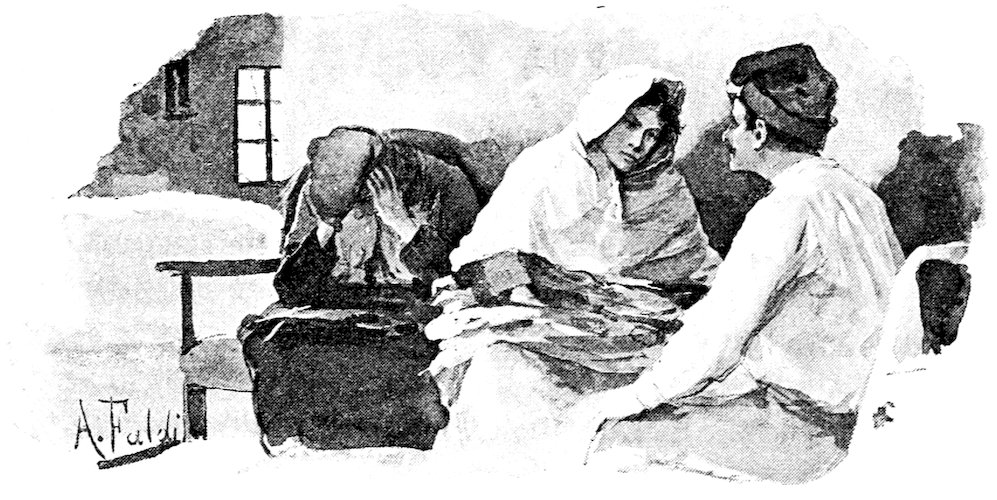
“No, no,” replied Nino, his face all drawn with agony. “Your hair will grow again, but it will be I that will never see you again, for I shall be dead.”
“A fine miracle that San Rocco has worked for you!” said Turi, by way of comforting him.
Both of them slowly recovered; and when they sat sunning themselves, with their backs to the wall and very long faces, kept throwing San Rocco and San Pasquale in each other’s teeth.
One day Bruno, the carter, coming back from the 148country after the cholera was over, passed by them, and said—
“We’re going to have a grand festival to thank San Pasquale for having saved us from the cholera. We shall have no more demagogues and no more opposition, now, that the vice-prætor is dead. He has left the quarrel behind him in his will.”
“All very well; a festival for the dead!” sneered Nino.
“Perhaps it was San Rocco that kept you alive?”
“There!—do have done with it!” cried Saridda. “If you don’t, we shall need another cholera to make peace between you!”
Giovanni Verga.