MASTRO PEPPE’S MAGIC.
Reading edition
Mastro Peppe La Bravetta was a stout, stupid, good-natured man, living in Pescara, who sold pots and pans, and was terribly in awe of his wife, the severe and miserly Donna Pelagia, who ruled him with a rod of iron. Besides the income derived from his business, he possessed a piece of land on the other side of the river which produced enough to keep a pig. To this property the couple were wont to repair every January, to preside over the killing and salting of the pig which had been fattening through the year.
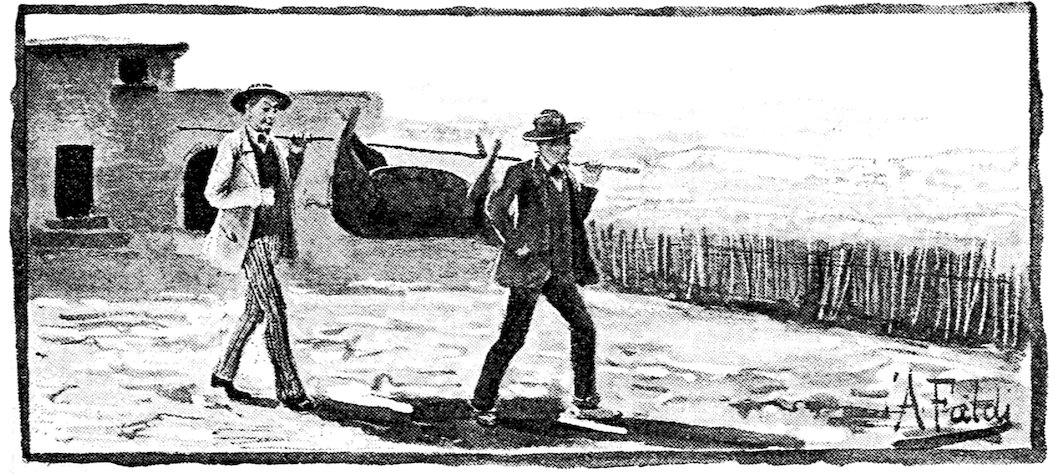
156Now one year it so happened that Pelagia was not very well, and La Bravetta went to attend the execution alone. And to him, in the course of the afternoon, came two of his friends, graceless vagabonds, Matteo Puriello, nicknamed Ciávola, who was a poacher, and Biagio Quaglia, better known as Il Ristabilito, whose most serious occupation was that of playing the guitar at weddings and on other festive occasions.
When he saw these two approaching he welcomed them enthusiastically, and then, leading them into the building where the wonderful pig was laid out on the table, asked—
“What do you say to this, now? Isn’t he a beauty? What do you think of him?”
The two friends contemplated the pig in silent wonder, and Ristabilito clicked his tongue appreciatively against his palate. Ciávola asked, “What are you going to do with it?”
“Salt it down,” replied La Bravetta, in a voice which trembled with greedy delight of future banquets.
“Going to salt it?” cried Ristabilito suddenly. “Going to salt it? But, Ciá, did you ever see any man so stupid as this fellow? To let such a chance slip!”
La Bravetta, quite dumfoundered, stared first at one and then at the other with his calf-like eyes.
“Donna Pelagge has always kept you under her thumb,” continued Ristabilito. “This time she can’t see you; why shouldn’t you sell the pig, and then we’ll feast on the money.”
“But Pelagge?” stammered La Bravetta, who was filled with an immense consternation by the image of his wrathful wife presented to his mind’s eye.
“Tell her that the pig was stolen,” said Ciávola, with a gesture of impatience.
La Bravetta shuddered.
“How am I to go home and tell her that? Pelagge won’t believe me—she’ll drive me—she’ll ... You don’t know what Pelagge is!”
157
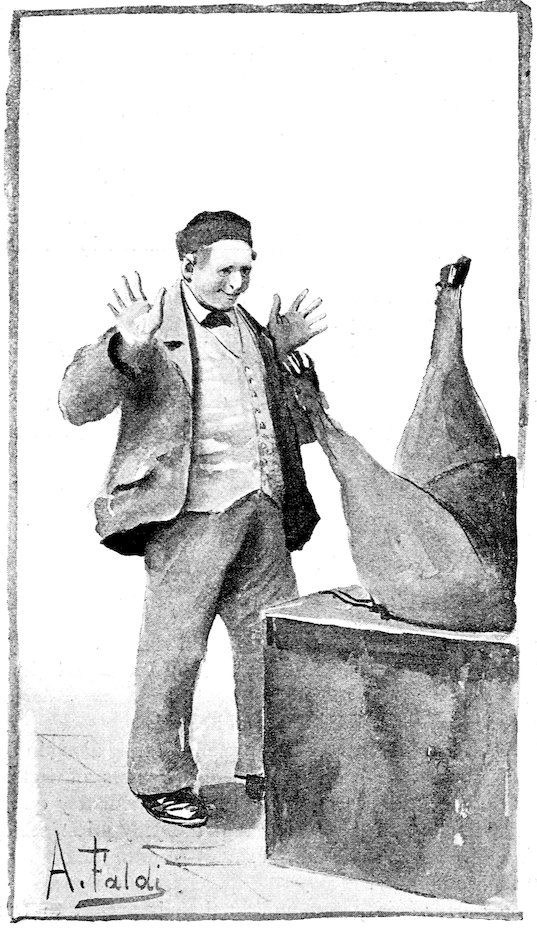
158“Uh! Pelagge! uh! uh! Donna Pelagge!” jeered the two arch-plotters in chorus. And then Ristabilito, imitating Peppe’s whining voice, and his wife’s sharp and strident one, acted a comic scene in which Peppe was utterly routed, scolded, and finally cuffed like a naughty boy.
Ciávola walked round the pig, scarcely able to move for laughing. The unfortunate butt, seized with a violent fit of sneezing, waved his arms helplessly, trying to interrupt the dramatic representation. All the window-panes trembled with the noise. The flaming sunset streamed in on three very different human faces.
When Ristabilito stopped, Ciávola said—
“Well, let’s go away!”
“If you’ll stay to have supper——” began Mastro Peppe, somewhat constrainedly.
“No, no, my dear boy,” interrupted Ciávola, as he turned towards the door, “you do as Pelagge tells you, and salt the pig.”
As the two friends walked along the road Ristabilito said to Ciávola—
“Compare, shall we steal that pig to-night?”
“How?” said Ciávola.
“I know how, if they leave it where it was when we saw it.”
“Well, let’s do it. But, then?” said Ciávola.
The other’s whole face lit up, and fairly vibrated with a grin of delight.
“Never mind—I know,” was all he said.
They saw Don Bergamino Camplone coming along in the moonlight—a black figure between the rows of leafless poplars with their silvery trunks. They immediately quickened their pace to meet him; and the jolly priest, seeing their festive looks, asked with a smile—
“What’s up now?”
The friends briefly communicated their project to Don 159Bergamino, who assented with much cheerfulness. And Ristabilito added, in a low voice—
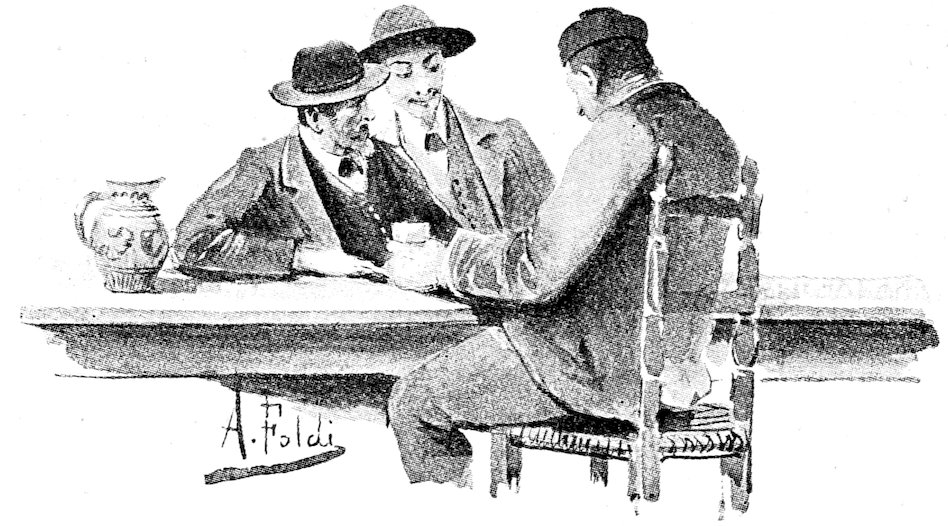
“Here we shall have to manage things cunningly. You know that Peppe, ever since he took up with that ugly old hag of a Donna Pelagge, has been getting very stingy, and at the same time he’s very fond of wine. Now we must go and fetch him and take him to Assaù’s tavern. You, Don Bergamino, must treat us all round. Peppe will drink as much as ever he can, seeing it costs him nothing, and will get as drunk as a pig; and then——”
The others agreed, and they went to Peppe’s house, which was about two rifle-shots distant. When they were near enough Ciávola lifted up his voice—
“Ohé! La Bravetta-a-a! Are you coming to Assaù’s? The priest is here, and he’s going to pay for a bottle of wine for us. Ohé-é-é!”
La Bravetta was not long in descending, and all four set off in a row, joking and laughing in the moonlight. In the stillness the caterwauling of a distant cat was heard at intervals, and Ristabilito remarked—
“Oh! Pé! don’t you hear Pelagge calling you to come back?”
They crossed the ferry, reached the tavern, and sat till late over Assaù’s wine, which Mastro Peppe found so good that he was at last discovered to be incapable of walking home. They assisted him back to the house and left him to go upstairs alone, which he did with some difficulty, talking disconnectedly all the time about Lepruccio the butcher and the quantity of salt needed for the pig, and quite oblivious of the fact that he had left the door unfastened. They waited a while, and then, entering softly, found the pig on the table, and carried it off between them, shaking with suppressed laughter. It was very heavy, and they were quite out of breath when they reached the priest’s house.
160In the morning, Mastro Peppe having slept off his wine, awoke, and lay still a little while on his bed, stretching his limbs and listening to the bells as they rang for the Eve of St. Anthony. Even in the confusion of his first awakening he felt a contented sense of possession steal through his mind, and tasted by anticipation the delight of seeing Lepruccio cutting up and covering with salt the plump joints of pork.
Under the impulse of this idea, he rose, and hurried out, rubbing his eyes the while to get a better view. Nothing was to be seen on the table but a stain of blood, with the morning sun shining on it.
“The pig! Where is the pig?” cried the bereaved one hoarsely.
A furious excitement seized upon him. He rushed downstairs, saw the open door, struck his forehead with his fists, and burst into the open air yelling aloud—calling all his farm labourers round him, and asking them if they had seen the pig—if they had taken it. He multiplied his complaints, raising his voice more and more; and at last the doleful sound, echoing along the river-bank, reached the ears of Ciávola and Il Ristabilito.
They therefore repaired to the spot at their ease, fully 161agreed to enjoy the sight and keep up the joke. When they came in sight, Mastro Peppe turned to them, all afflicted and in tears, and exclaimed, “Oh! poor me! They have stolen the pig! Oh! poor me! What shall I do?—what shall I do?”
Biagio Quaglia stood for a while, looking at this most unhappy man out of his half-shut eyes, with an expression midway between derision and admiration, and his head inclined to one shoulder, as if critically judging of some dramatic effort. Then he came closer and said—
“Ah! yes, yes—one can’t deny it.... You play your part well.”
Peppe, not understanding, lifted his face all furrowed with the tracks of tears....
“To tell the truth, I never thought you would have been so cute,” Ristabilito went on. “Well done! Bravo! I’m delighted!”
“What’s that you’re saying?” asked La Bravetta between his sobs. “What’s that you’re saying? Oh! poor me! How can I ever go home again?”
“Bravo! bravo! that’s right!” insisted Ristabilito. “Go on! Yell harder!—cry!—tear your hair! Make them hear! That’s it! Make them believe it!”
And Peppe, still weeping—
“But I say they have really and truly stolen it! Oh, dear! oh, dear!”
“That’s it! Go on! Don’t stop! Again!”
Peppe, quite beside himself with exasperation and grief, redoubled his asseverations.
“I’m telling the truth! May I die now, at once, if they haven’t stolen that pig from me!”
“Oh, poor innocent!” jeered Ciávola. “Put your finger in your eye! How can we believe you, when we saw the pig here yesterday evening? Has St. Anthony given him wings to fly away with?”
162“Oh, blessed St. Anthony! It is just as I say!”
“It’s not so!”
“It is.”
“No!”
“Oh! oh! oh! It is! it is! I’m a dead man! I don’t know how in the world I am to go home. Pelagge won’t believe me, and if she does, I shall never hear the end of it.... Oh! I’m dead!...”
At last they pretended to be convinced, and proposed a remedy for the misfortune.
“Listen here,” said Biagio Quaglia; “it must have been one of the people hereabouts; for it is certain that no one would have come from India to steal your pig, would they, Pé?”
“Of course, of course,” assented Peppe.
“Well then—attend to me now,” continued Ristabilito, delighted at the devout attention accorded to his words; “if no one came from India to rob you, it is certain that one of the people hereabouts must have been the thief; don’t you think so?”
“Yes, yes.”
“Well, what have we to do? We must get all these labourers together, and try some charm to discover the thief. And if we find the thief, we’ve found the pig.”
Mastro Peppe’s eyes brightened with eagerness, and he came closer, for the hint at a charm had awakened all his innate superstition.
“Now, you know, there are three kinds of magic—the black, the red, and the white. And you know there are three women in the village skilled in the art: Rosa Schiavona, Rosaria Pajara, and Ciniscia. You have only to choose.”
Peppe remained a moment in doubt. Then he decided for Rosaria Pajara, who enjoyed great fame as a sorceress, and had in past times performed several marvellous feats.
“Very well,” concluded Ristabilito; “there is no time to 163be lost. Now, just for your sake, and only to do you a pleasure, I am going to the town to get everything that will be wanted. I will talk to Rosaria, get her to give me everything, and come back before noon. Give me the money.”
Peppe took three carlini from his waistcoat pocket, and held them out hesitatingly.
“Three carlini?” shouted the other, putting back his hand. “Three carlini! She’ll want ten at least!”
On hearing this Pelagge’s husband was almost struck dumb.
“What? Ten carlini for a charm?” he stammered, feeling with trembling fingers in his pocket. “Here are eight for you. I have no more.”
“Well, well,” said Quaglia dryly; “we’ll see what we can do. Are you coming along, Ciá?”
The two companions set off at a smart pace for Pescara, along the poplar-bordered path, in Indian file, Ciávola demonstrating his delight by mighty thumps on Ristabilito’s back. When they reached the town, they entered the shop of a certain Don Daniele Pacentro, a chemist of their acquaintance. Here they purchased certain drugs and spices, and got him to make them up into little balls the size of walnuts, which were then well coated with sugar and baked. Biagio Quaglia (who had disappeared in the meantime) then returned with a paper full of dirt swept up in the road, of which he insisted on having two pills made, in appearance exactly similar to the others, but mixed with bitter aloes, and only very slightly coated with sugar. The chemist did as he was desired, putting a mark on the two bitter pills, at Ristabilito’s suggestion.
The two jokers now returned to Peppe’s farm, and reached it about noon. La Bravetta was awaiting them with great anxiety, and as soon as he saw them shouted, “Well?”
“Everything is in order!” replied Ristabilito triumphantly, showing the little box of magic confectionery. “Now, 164seeing to-day is the Eve of St. Anthony, and the peasants are taking a holiday, you must call them all together, out here in the open air, and give them a drink. You have some casks of Montepulciano; you might as well have some of that out for once. And when they are all assembled it will be my business to do and say all that has to be said and done.”
Two hours later, the afternoon being very warm, bright, and clear, and La Bravetta having spread the report, all the farmers of the neighbourhood and their labourers came in response to the invitation. A great flock of geese went waddling about among the heaps of straw in the yard; the smell of the stable came in puffs on the air. They stood there, quietly laughing and joking with one another, as they waited for the wine,—these rustics, with their bow-legs, bent by heavy labour,—some of them with faces wrinkled and ruddy as old apples, and eyes that had been made gentle by long patience, or quick with years of cunning; others young and limber, with beards just coming, and home care evidenced in their patched and mended clothes.
Ciávola and Ristabilito did not keep them waiting long. The latter, holding the box in his hand, directed them to make a circle round him, and then, standing in the middle, addressed them in a short oration, not without a certain gravity of voice and gesture.
“Neighbours,” he began, “none of you, I am sure, knows the real reason why Mastro Peppe de’ Sieri has summoned you here....”
A movement of astonishment at this strange preamble passed round the circle, and the joy at the promised wine gave place to uneasy expectations of various kinds. The orator continued—
“But, as something disagreeable might happen, and you might afterwards complain of me, I will tell you what it is all about before we make the experiment.”
The listeners looked into one another’s eyes with a 165bewildered air, and then cast curious and uncertain glances at the little box which the orator held in his hand. One of them, as Ristabilito paused to consider the effect of his words, exclaimed impatiently—
“Well?”
“Presently, presently, neighbours. Last night there was stolen from Mastro Peppe a fine pig which was going to be salted down. No one knows who the thief is; but it is quite certain that he will be found among you, because no one would come from India to steal Mastro Peppe’s pig.”
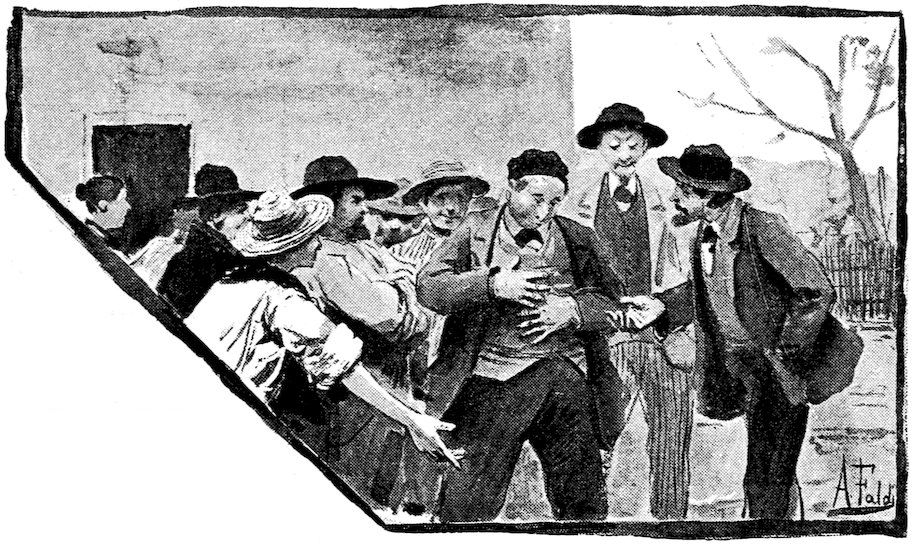
Whether it was a happy effect of the strange argument from India, or the action of the mild winter sun, La Bravetta began to sneeze. The rustics took a step backward, the whole flock of geese scattered in terror, and seven consecutive sneezes resounded freely in the air, disturbing the rural stillness of the spot. The noise restored some cheerfulness to the minds of the assembly, who in a little while regained their composure, and Ristabilito continued as gravely as ever—
“To find out the thief Mastro Peppe intends to give you to eat of certain good confetti, and to drink of a certain old Montepulciano, which he has tapped to-day on purpose. 166But I must tell you one thing first. The thief, as soon as he puts the sweets into his mouth, will find them bitter—so bitter that he will be forced to spit them out. Now, are you willing to try? Or perhaps the thief, rather than be found out in this way, would like to go and confess himself to the priest? Answer, neighbours.”
“We are willing to eat and drink,” replied the assembly, almost with one voice. And a wave of suppressed emotion passed through all these guileless folk. Each one looked at his neighbour with a point of interrogation in his eyes; and each one naturally tried to put a certain ostentatious spontaneity into his laughter.
Said Ciávola: “You must all stand in a row, so that no one can hide himself.”
When they were all ready he took the bottle and glasses, preparing to pour out the wine. Ristabilito went to one end of the row, and began quietly to distribute the confetti, which crunched and disappeared in a moment under the splendid teeth of the rustics. When he reached Mastro Peppe he handed him one of the pills prepared with aloes, and passed on without giving any sign.
Mastro Peppe, who till then had been standing staring with his eyes wide open, intent on surprising the culprit, put the pill into his mouth almost with gluttonous eagerness and began to chew. Suddenly his cheeks rose with a sudden movement towards his eyes, the corners of his mouth and his temples were filled with wrinkles, the skin of his nose was drawn up into folds, his lower jaw was twisted awry; all his features formed a pantomimic expression of horror, and a sort of visible shudder ran down the back of his neck and over his shoulders. Then, suddenly, since the tongue could not endure the bitterness of the aloes, and a lump rising in his throat made it simply impossible for him to swallow, the miserable man was forced to spit.
“Ohé, Mastro Pé, what are you doing?” exclaimed the 167sharp, harsh voice of Tulespre dei Passeri, an old goatherd, greenish and shaggy as a swamp tortoise.
Hearing this, Ristabilito, who had not yet finished distributing the pills, turned suddenly round. Seeing that La Bravetta was contorting his features and limbs in agony, he said, with an air of the greatest benevolence—
“Well, perhaps that one was too much done! Here is another! swallow it, Peppe!”
And with his finger and thumb he crammed the second aloe-pill into Peppe’s mouth.
The poor man took it, and, feeling the goatherd’s sharp, malignant eyes fixed on him, made a supreme effort to overcome his disgust; he neither chewed nor swallowed the pill, but kept his tongue motionless against his teeth. But when the aloes began to dissolve, he could bear it no longer; his lips began to writhe as before, his eyes filled with tears, which soon overflowed and ran down his cheeks. At last he had to spit the thing out.
“Ohé, Mastro Pé, and what are you doing now?” cried the goatherd again, with a grin which showed his toothless, whitish gums. “Oh! and indeed, now, what does this mean?”
All the peasants broke from their ranks and surrounded La Bravetta, some with laughing derision, others with angry words. The sudden and brutal revulsions of pride to which the sense of honour of the rustic population is subject—the implacable rigidity of superstition—now suddenly exploded in a tempest of abuse.
“What did you make us come here for? To try and lay the blame on us with a false charm? To cheat us? What for? Thief! liar! son of a dog! etc., etc. Would you cheat us? You scoundrel! you thief, you! We are going to break all your pots and dishes! Thief! son of a dog!” etc., etc., da capo.
Having smashed the bottle and glasses, they went their 168ways, shouting back their concluding imprecations from among the poplars.
There remained on the threshing-floor Ciávola, Ristabilito, the geese, and La Bravetta. The latter, filled with shame, rage, and confusion, and with his mouth still sore from the bitterness of the aloes, could not utter a word. Ristabilito, with a refinement of cruelty, stood looking at him, shaking his head ironically, and tapping the ground with his foot. Ciávola crowed, with an indescribable mockery in his voice—
“Ah! ah! ah! ah! Bravo, La Bravetta! Now do tell us—how much did you make by it? Ten ducats?”
Gabriele d’Annunzio.