PROVERBS, FOLK-LORE, AND TRADITIONAL ANECDOTES.
Reading edition
Don’t lend your knife in pumpkin-time.
Do not ask the host whether his wine is good.
All the brains are not in one head.
Pride went out on horseback, and came home afoot.
Heaven keep you from a bad neighbour, and from a man who is learning the violin.
Better to be a lizard’s head than a dragon’s tail.
Drink wine, and let water go to drive the mill.
If I sleep, I sleep for myself; if I work, I don’t know whom I work for.
Let us have florins, and we shall find cousins.
Peel the fig for your friend and the peach for your enemy.[34]
285In buying a horse and taking a wife, shut your eyes and trust God for your life.
Women are saints in church, angels in the street, devils in the house, owls (civette, i.e. coquettes) at the window, and magpies at the door.
Women always tell the truth, but never the whole truth.
Maids weep with one eye, wives with two, and nuns with four.
When God gives flour, the devil takes away the sack.
Have nothing to do with an innkeeper’s daughter or a miller’s horse.
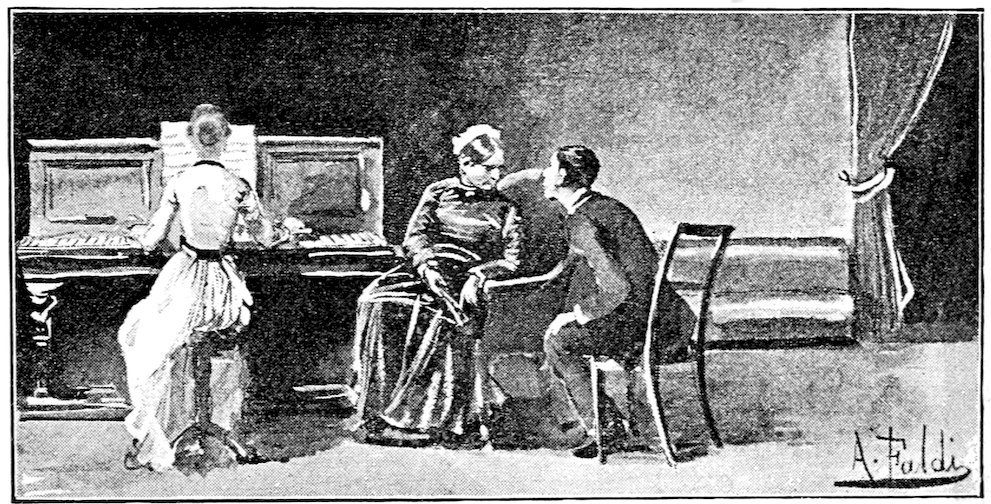
He who wants canes should go to the cane-brake; and he who would court the daughter should be polite to the mother.
For the buyer a hundred eyes are too few, for the seller one is enough.
If you want to have your hands full buy a watch, take a wife, or beat a friar.
God keep thee from the fury of the wind, from a monk outside his monastery, from a woman who can speak Latin, and from a man who cannot hold up his head.
Brother Modestus was never made Prior.
286Tie up the ass where his owner tells you, and if he breaks his neck the blame is not yours.
You cannot drink and whistle at the same time; you cannot both carry the cross and sing with the choir.
An unfrocked monk and warmed-up cabbage were never yet good for anything.
There are no pockets in the shroud.
Where there are many cocks crowing it never gets light.
He carries both yes and no in his pocket.
Three are powerful—the Pope, the king, and the man who has nothing.
Make me your steward for one year, and I shall be a rich man.
Never give a woman as much as she wants—unless it be of flax to spin.
All the seven deadly sins are feminine.
Lies have short legs.
With time and straw medlars get ripe.
Beware of fire, of water, of dogs, and of the man who speaks under his breath.
The poor man’s commandments are these—Thou shalt not eat meat on Friday, nor on Saturday, nor yet on Sunday.
He who seeks better bread than is made of wheat must be either a fool or a knave.
He who sleeps with dogs will get up with fleas.
He who eats a bone chokes himself.
Bread and kicks will get no thanks, even from a dog.
Make haste and get rich—and then I am your uncle.
You call on St. Paul without having seen the viper. (You cry out before you are hurt.)
When two have set their minds on each other, a hundred cannot keep them apart.
On a fool’s beard the barber learns to shave.
287A man who was pleading asked a judge whether the lawyer or the physician had the precedence in any judicial affair. Says the judge, “Pray, who goes first, the criminal or the executioner?” “The criminal,” replied the pleader. “Then,” says the judge, “the lawyer may go first as the thief, and the physician follow after as the executioner.”
A certain person who had squandered away all his patrimony being at an entertainment, one of the guests said, “The earth used to swallow up men, but this man has swallowed up the earth.”
A poor man, presenting himself before the King of Spain, asked his charity, telling him that he was his brother. The king desiring to know how he claimed kindred to him, the poor fellow replied, “We are all descended from one common father and mother—viz., Adam and Eve.” Upon which the king gave him a little copper piece of money. The poor man began to bemoan himself, saying, “Is it possible that your Majesty should give no more than this to your brother?” “Away, away,” replies the king; “if all the brothers you have in the world give you as much as I have done, you’ll be richer than I am.”
A certain man reading a book that treated of the secrets of nature, fell upon a chapter in which ’twas said that a man who has a long beard wears the badge of a fool. Upon which our reader takes up the candle in his hand, for ’twas in the night-time, and views himself in the glass, and inconsiderately burns above half his beard off; whereupon he immediately takes up the pen and writes in the margin of the book, “Probatum est,”—that is, I know him to be a fool.
A certain person who was to engage with swords against 288another, knowing that his antagonist was a braver man than himself, would not stand the trial, but made off as fast as possible. Now it happened, as he was discoursing one day with some of his acquaintance, they reproached him for having run away in so scandalous a manner. “Pooh!” replied he, “I had much rather the world should say that in such a place a coward had been put to flight, than that a brave man had been killed.”
A soldier selling a horse, his captain asked him why he did so. He replied that ’twas in order to fly from the tumult of arms. Says the captain, “I wonder you should sell it for the very same reason for which I imagined you had bought it.”
Tesetto was very angry with Zerbo the physician, when Zerbo saying to him, “Hold your tongue, you scoundrel; don’t I know that your father was a bricklayer?” Tesetto immediately replied, “No one could have told you that but your own father, who carried the lime and the stones to mine.”
A criminal being carried to prison, and hearing his process read, confessed that every article in it was true, and said, “I have done still worse.” Being asked in what, he replied with a sigh, “In suffering myself to be brought hither.”
A certain person, who was desirous to be thought young, said that he was but thirty, when a friend of his who had been his schoolfellow replied, “So, I warrant you, you were not born when we studied logic together.”
A thief going with a trunk full of valuable things from a citizen’s house in the dusk of the evening, was met by some persons who asked him how he came by them. The thief replied, “A man is dead in this house, and I am carrying this trunk, with other things, to another house where I am 289going to live.” “But if that man be lately dead,” said they, “why don’t they weep and take on?” “You’ll hear them weep to-morrow morning,” says the thief.
A man bemoaning himself to another for the great scarcity of corn, and saying he believed that if it did not rain all the beasts would die, the other replied to him, “Heaven preserve your worship!”
A physician, who had a son of his under cure, gave him no remedy, and prescribed nothing, but only that he should observe a regular course of diet. His daughter-in-law complained, and asked him why he did not treat him like other sick people; and the physician replied, “Daughter, we physicians have medicaments in order to sell them, and not to make use of them ourselves.”
A certain lazzarone once came to confess himself to a missionary priest who was confined to his bed with the gout, with the intention of stealing a pair of new shoes which he had seen under the good father’s bed. The priest having called him up to the bed, as he could not rise, the man knelt down, and while reciting the Confiteor got hold of the shoes, and put them into the wallet which he had under his cloak. Having finished the Confiteor, the first and last sin which he confessed was that of having stolen a pair of shoes. The confessor replied, “Ah! my son, you ought to restore them!” The penitent replied, “Father, do you want them?” “No,” said the priest, “no, my son; but they ought to be restored to the rightful owner, otherwise I cannot give you absolution.” “But, father,” replied the man, “the owner says he does not want them; what, then, shall I do?” The confessor answered, “Since that is so, keep them for yourself,” and giving him absolution, he dismissed him, and the penitent carried off the shoes.
290Dante, meditating apart one day in the church of Santa Maria Novella, was accosted by a bore, who asked him many foolish questions. After vainly endeavouring to get rid of him, Dante at last said, “Before I reply to thee do thou tell me the answer to a certain question,” and then asked him, “Which is the greatest of all beasts?” The gentleman replied that “on the authority of Pliny he believed it to be the elephant.” Then said Dante, “O elephant, leave me in peace!” and so saying, he turned and left him.
Domenico da Cigoli having gone to Rome, news was brought him a few days after that his wife was dead; upon which he, in the utmost transports of joy, immediately became priest and undertook the cure of souls in his own village, when who should be the very first person that he meets but his wife, who was not dead but living, which greatly afflicted him.
A certain rich man had a son who had but little sense, and wishing to get him a wife, found a fair and gentle damsel; and her parents being willing to overlook the defects of the man for the sake of his riches, the marriage was concluded. Then the father, in order to hide as much as he could the imbecile foolishness of his son, admonished him to speak little, that his folly and light-mindedness might not be made manifest. The son obeyed; and when they were seated at the wedding-feast it happened that not only he but all the others kept silence, till at last a lady of more courage than the rest said, looking round at the guests, “Surely there must be a fool at this table, since no one ventures to speak!” Then said the bridegroom, turning to his father, “Father, now that they have found me out, pray give me permission to talk!”
291
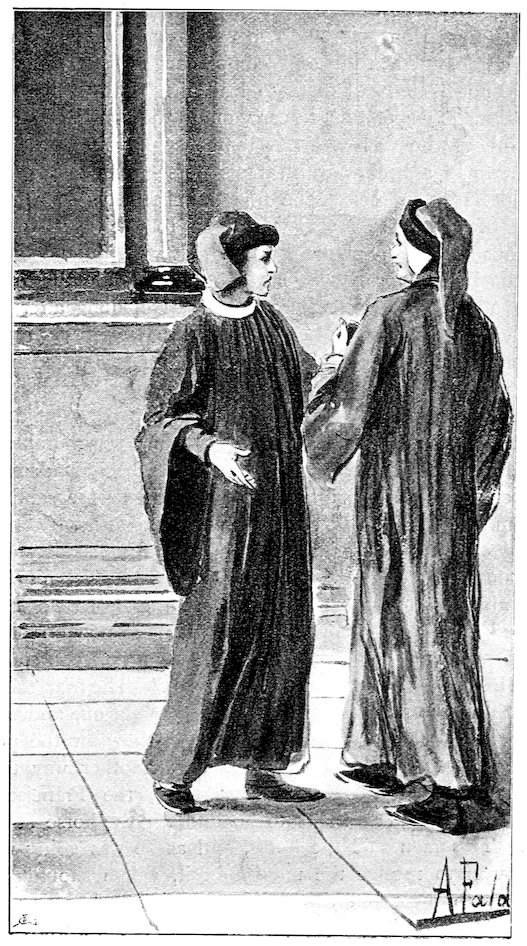
292A countryman, benumbed with cold, alighted from his horse to walk on foot, and two Franciscan friars observing this, one of them said to his companion, “Had I a horse I would not be such a fool as to lead him by the bridle, but would make use of him to carry me to the convent.” Says the other, who was of a gay temper, “I would play this countryman a trick, and steal his horse from him, if you would but help me.” The friar immediately consenting, both of them stole very softly up to the countryman, without his perceiving it; and one, slyly taking the bridle off the horse, put it over his own head, while the other with a halter led the horse aside. Not long after this the countryman, intending to get on horseback again, turned himself about, but had like to have died with fear when he saw the change; and, uttering terrible cries for help, he was stopped by the Franciscan, who went down on his knees before him, and begged him very humbly to give him his liberty, telling him that he had been condemned to such a metamorphosis because of his irregularities, and the enormities of his sins; and that the time of his penance being expired, he was returned to his first shape. The peasant, recovering himself a little, not only let him go, but also, not smelling the trick in the least, foolishly replied, “Get you gone in Heaven’s name; I now no longer wonder if, after having led so disorderly a life, you should have been changed into so vile an animal.” The friar, telling him that he was greatly obliged to him, made off, and went to look after his companion, and when they saw the poor silly fellow at a good distance, went another way to a neighbouring town. A few days after, the Franciscans desired a friend of theirs to go and sell the horse at the fair. This man sold the horse, and as he was going with the buyer to receive the money for it, whom should they happen to meet but the countryman, who, knowing the horse again, desired the buyer to let him speak a word with 293him in private; and having asked him whom the horse belonged to, the other replied that he had just bargained for it, but had not yet paid for it. “For goodness’ sake,” said the countryman, “return it to him again; don’t pay for it, for I assure you that ’tis not a horse, but the soul of a cordelier, who is returned to his dissolute way of life. Don’t buy him, I tell you, for he’s the most wretched animal in the whole world, and has put me into a fury an hundred thousand times.”
How Piovano Arlotto got his Place by the Fire.
Piovano Arlotto, returning from Casentino one Sunday evening, worn out and wet through (for it was raining heavily), dismounted before the inn at Pontassieve and went in, to dry himself at the fire. But, as it happened, there were over thirty villagers present, drinking and playing cards, and they were crowded so closely about the fire that he could not get near it, nor would they make room for him, though he asked them. At last, mine host, who knew him for a fellow of infinite jest, said to him, “Sir priest, why are ye so sad this evening, quite contrary to your nature? If there be aught troubling ye, tell us, for there is nothing we would not do for ye.” The priest said, “I am in evil case, for I have lost, from this wallet, fourteen lire of small change, and eighteen gold florins. Yet I have hope of finding them again; for I think ’tis but within the last five miles I dropped them, and the weather is so bad, there is none will travel that road after me to-night. And if ye will do me a service, then, to-morrow morning if it rain not, do thou come, or send a man back along the road with me to find it.” Scarcely had the priest finished speaking, when those countrymen went out softly, by twos and fours, so that at the last there was none left, and went back along the road in the rain, hoping to find the money, leaving the priest to take the best place by the fire.
294
Fagiuoli and the Thieves.
One evening Fagiuoli was going home, and when he came to his door he saw some men bringing out his furniture, for they were thieves who were stealing his things. He said nothing, but remained quiet, wishing to see where they would take the things. When they had brought them all down, they put them on barrows and took them away, Fagiuoli walking after them. When the thieves saw a gentleman following them, they stopped and asked him what he wanted. Then he answered, “I am coming to see where I am going to live, as you have moved my furniture.” Then the thieves threw themselves down on their knees, and carried back his things; but he did not bring the matter before the magistrates.
The Three Words.
There was once a husband and wife, and they had three sons who did not know how to talk. The time came when their parents died, and, when they were both dead, the eldest boy said, “Do you know what I have thought of? We will go and travel about the world, and so we shall hear people talk, and learn to talk ourselves.” So they set out, and they came to three roads. “Let us each go a different way, and the first who has learnt anything come back here; and then we will seek service with some one.”
The eldest took the middle road, and came to a churchyard, and as he passed it he saw two men talking together. He came up with them and heard one of them say “Yes.” “Ah! I have learnt enough—I have learnt to talk; now I will go back!” He went back to the place where the roads met and found no one there. There was an inn near by, and he went in to have something to eat.
The second brother went on till he came to two peasants carrying a bundle of hay, who were talking. He listened to them, and heard one say, “It is true.” “I have learnt enough—I will go back;” and he went back to the cross-roads as his brother had done.
295The youngest went on till evening, when he saw a herd-lassie getting her sheep together, and heard her say, “That’s right.” “I’ve learnt enough,” he said; “I’m going back.”
He came to the cross-roads, and found his brothers there. “What have you learnt?” “I know Yes.” “And you?” “It is true. And you?” “That’s right.” “Now we can go to the king’s palace to take service, now that we know these words.” So they all three started by the same road. When they had gone some distance they found a dog-kennel, got into it all three, and slept soundly. At midnight the dog wanted to go to bed,—he barked and barked, but they would not let him in, so that he had to sleep outside. “See,” said they, “to-night we have a dog to guard us, like other people, but to-morrow morning we shall have to go away quietly, without waking him.”
They got up in the morning, but the dog was asleep, and did them no harm. Further on along the road they found a dead man. “Look at this poor man!—he ought to be taken into the city—we must let the police know.”
One of them went on to the city, and gave notice, and the police came out. “Who killed him? Did you do it?” The eldest answered “Yes,” for he could say nothing else; and the second said, “It is true.” “Then you will have to come to prison.” And the youngest said, “That’s right.”
So they seized them, and took them away to the town along with the dead man. In the town all the people cried out, “They ought to be torn to pieces! They have said it themselves! the villains!” And they could answer nothing but Yes, It is true, and That’s right.
So, after asking them a great many questions, and getting nothing else out of them, they put them in prison; and after they had kept them there some time, they let them go, because they found out that they were only fools. So the three brothers went home again.
296
Giucca.
One day Giucca’s mother said to him, “I want this cloth sold, but if I let you take it to the market you will be at your old tricks again.”
“No, mother; you shall see I will do it all right. Tell me how much you want for it.”
“Ten crowns; and mind you sell it to a person who does not talk much.”
Giucca took the cloth, and went away. He met a peasant, who said to him, “Giucca, are you going to sell this cloth? How much do you want for it?”
“Ten crowns.”
“No, that is too much.”
“Now, look here—I can’t let you have it at all, because you talk too much.”
“Why, do you want to sell your goods without people’s saying anything?”
297“Oh! I can’t let you have it.”
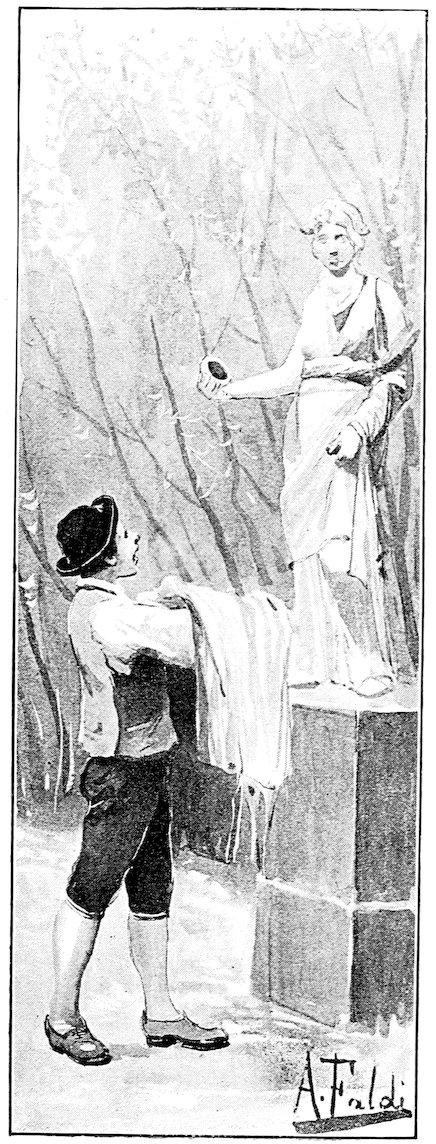
Giucca went on. When he had gone a little further, he came to a statue of plaster of Paris.
“Oh! good woman, do you want to buy some cloth?”
The statue said nothing.
Said Giucca: “This is just right. Mother told me to sell the cloth to some one who does not talk. I couldn’t do better than this. I say, good woman! I want ten crowns for it”—and he threw the cloth at her; “to-morrow I will come and fetch them.”
And he went home, well pleased. His mother said, “Giucca, have you sold the cloth?”
“Yes,” said Giucca; “they told me I was to come and fetch the money to-morrow.”
“But tell me—did you give it to a trustworthy person?”
“I think so. She was a good sort of woman, you may believe that!”
Let us leave Giucca, and go back to the statue, which was hollow, and was the place where some robbers hid their money. In the evening they came with some more money to put away inside the image.
“Look,” they said, “some one has left this cloth; let us keep it.” They hid the money and carried off the cloth.
In the morning, when Giucca got up, he said, “Mother, I am going to fetch that money.”
“Very good; be quick about it, and mind they give you the whole of it.”
Giucca went to the statue. “Hallo, mistress, I’ve come for the money!”
The statue said nothing.
“Oh! look here! It must not be the same as yesterday; to-day I want the money. I see you have used the cloth. Give me the money, or let me have the cloth back.”
298
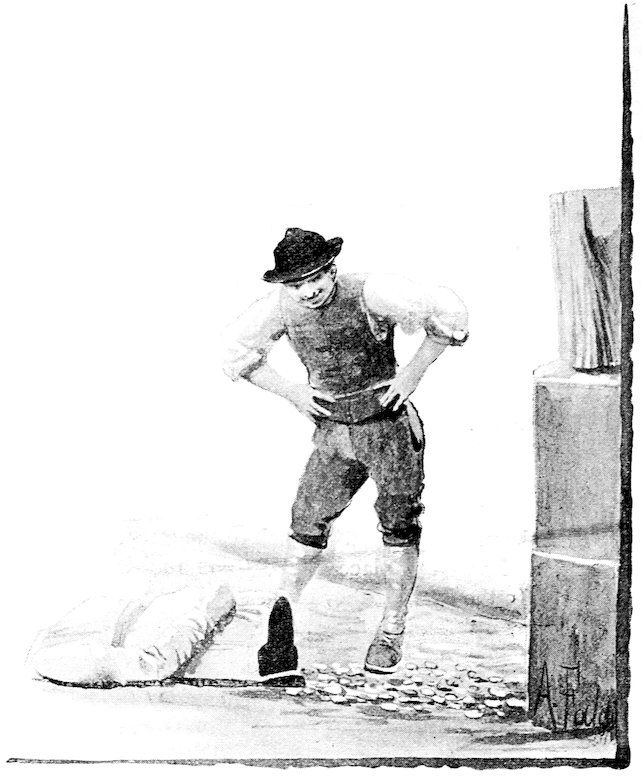
So he picked up a stone and threw it at her. And then the statue was broken, and all the money began to fall out. Giucca was well pleased; he picked up the money and went home.
“Look, mother, how much money I have brought you! I told you she was a good sort of woman. First she did not want to give it me, but then I threw stones at her, and she gave me all this.”
“But tell me, Giucca, what have you done?”
“Why, don’t you know her?—the creature who has been standing there bolt upright for ever so long!”
“Oh! you rascal! what have you done? Dear me! dear me! With all this money I had better find you a wife to look after you!”
The Hermit and the Thieves.
... Once, she said, there was a hermit, a poor sort of priest, who lived all alone, and had no society but his pig, with whom he used to eat at the same table as a sort of 299penance for his sins. Besides the pig he had a box of money, which he had collected in little sums given in charity till it amounted to a good large sum, and this he kept hidden away under his bed. Now it happened that there were two bad men, two robbers, who heard of this box, and desired very much to get possession of it. So they put their heads together to construct a plan to deceive the poor old hermit. At last they hit upon one, and it was this: Having first got a good strong rope and a large basket, they went one night to his house, and climbed upon the roof without his knowledge, and let down the basket until it hung before the sill of his window. Both of them then began to sing—
“Arise, arise, O hermit,
And come up in the basket, O;
The saints in glory ask it, O,
Waiting in Paradise!”
The poor hermit, hearing these words, thought that the angels had come from heaven to bring him his reward. So up he jumped and opened the window, and when he saw the basket his joy was very great at the expectation of going in it up to Paradise. So after crossing himself devoutly, in he jumped, murmuring—
“Lord, Lord! I am not so good
That I should get into a basket of wood.”[35]
Up the robbers then pulled him, until he was half-way to the roof, and then, fastening the rope round the chimney, down they ran, got into his room, plundered him of his money-box, and made off with themselves.
Meantime for a long space the hermit hung there, waiting and wondering why he had stopped, and praying with shut eyes; but at last he grew impatient, for he did not go up, 300and the voices had ceased, and he wriggled about so much that the rope broke, and down he came to the ground, not without some severe bruises. But what was his indignation upon dragging himself up to his room to find his money-box gone, and only the pig remaining! However, he put the best face on it, said “Pazienza!” and prayed still more earnestly. Now the same two robbers, after having got possession of the box, began to think that they had been very great fools not to have taken the pig too, which they could sell at a good price at the fair. So they determined to try the same trick again in order to get the pig. Up they got therefore on the roof, and let down the basket as before, singing the same song, “Arise, O hermit,” etc. But this time the hermit was not to be taken in; and he answered to the robbers, whom he still thought to be angels, in verse which may thus be Englished—
“Go back, you blessed Angels,
And let the good saints know
That once they’ve come it over me,
But a second time’s no go!”
301