QUACQUARÀ.
Reading edition
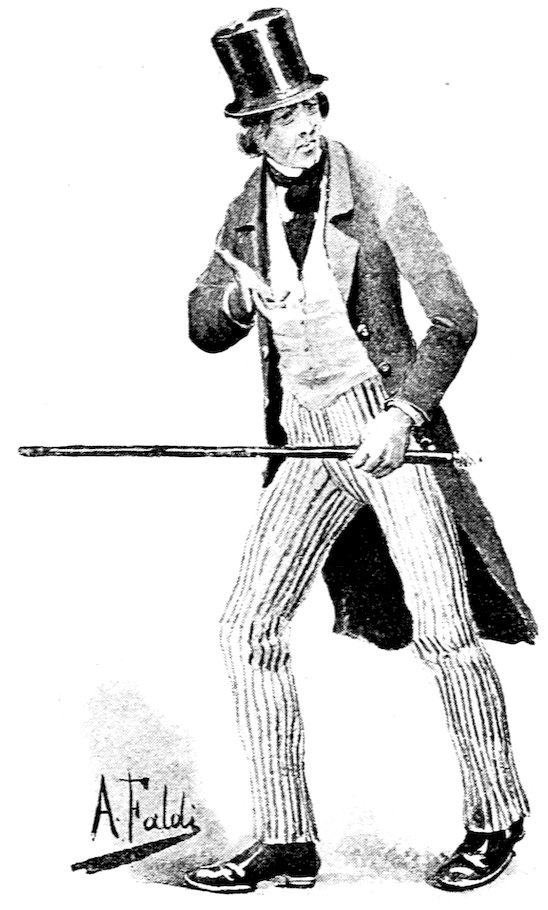
Poor Don Mario! No sooner was he seen coming round the corner with his rusty, narrow-brimmed, stove-pipe hat, nearly a foot high, and his overcoat with long tails fluttering in the wind, than every one—first the boys, then the men, the loafers on Piazza Buglio, and even the gentlemen at the Casino—began to salute him, on every side, with the cry of the quail, “Quacquarà! Quacquarà!” just because they knew that it enraged him.
He stopped and stood at bay, staring round, brandishing his great cudgel, and shaking his head threateningly. Then he would take two or three steps forward, looking fixedly at them, in order to discover one or other of the impudent wretches who so far forgot the respect due to him, the son and grandson of lawyers—to him who stood a hundred times higher than all those gentlemen of the Casino.... But in vain! On the right hand and the left, before and behind, rose the shouts and whistles, “Quacquarà! Quacquarà!”
122“Don’t excite yourself! Let them shout!”
“If I do not kill some one, they will never be quiet!”
“Do you want to go to the convict prison for nothing?”
“I will send them there!”
He became red as a turkey-cock, raving and gesticulating and foaming at the mouth.
“They would be quiet enough, if you did not get angry.”
“They are cowards! Why don’t they come out like men, and say it to my face?”
“Quacquarà!”——
“Ah! would you hit a child?” This time, if they had not stopped him, he would have broken the head of the barber’s boy, who had boldly approached him near enough to utter the objectionable cry under his very nose. There was trouble enough before Don Mario would let himself be dragged away into the chemist’s shop, which was filled with a laughing crowd. Vito, the chemist’s young man, came forward, very seriously, and said to him—
“What does it matter if they do say Quacquarà to you? You don’t happen to be a quail, do you?”
Don Mario turned furious eyes on him.
“Well; it’s not as if they called you a thief!”
“I am a gentleman, and the son of a gentleman.”
“Well? What does Quacquarà mean? Nothing at all. Quacquarà let it be!”
The chemist and the others present were writhing in convulsions of suppressed laughter at the serious countenance of Vito, who, under the pretext of lecturing Don Mario for his folly, kept on repeating the quail’s cry to his very face, without his perceiving that it was done on purpose.
“Now I,” said he, “if a man were to cry Quacquarà after me, I would give him a halfpenny every time. Quacquarà! Quacquarà! Shout yourselves hoarse, if you like!”
“And, meanwhile, you scoundrel, you’re repeating it to my face,” yelled Don Mario, as he raised his cudgel, perceiving 123at last that he had been made a fool of. At this point the chemist, who was terrified for the safety of his plate-glass windows, thought it time to interfere; and, taking his arm, drew him out of the shop, condoling with his grievances, and soothing his ruffled feelings as well as he could.
“Come out this way; no one will see you.”
“Am I to hide myself? To please those louts? I am a gentleman, and the son of a gentleman!”
True—very true! The Majori had always been respectable people, son succeeding father in the notary’s office from generation to generation, up to the year 1819; in which year there issued forth from the infernal regions that judgment of Heaven called the Code Napoléon, specially created for the despair of the notary Majori, Don Mario’s father, who never could understand it, and was forced to retire from his profession.
“What? No more Latin formulas?... And documents to be headed ‘In the King’s Name’! But what has his Majesty the King to do with private contracts?”
And he relieved his conscience by having no more to do with the whole business. And so the ink had dried up in the great brass inkstand in his office, and the quill pens were all worn out; and the quiet in the house contrasted strangely with the bustle there had been formerly, when every one came to consult him, for he was honesty in person, and never set down on the papers a single word more or less than the interested parties wished. And thus, Don Mario, who had hitherto acted as clerk in his father’s office, and knew by heart all the Latin formulas, without understanding a syllable thereof, found his occupation gone. So did his brother Don Ignazio, who was not much more capable than himself; and after the old notary had died of a broken heart, on account of that unholy Code which had no Latin formulas, and insisted 124on having documents headed In the King’s Name, the two brothers eked out a sordid livelihood on the little they inherited from him. But they were proud in their honourable poverty, and rigidly faithful to the past, even in their dress, continuing for a time to wear their old clothes, carefully brushed and mended, regardless of the fact that they were out of fashion and excited ridicule.
Don Ignazio, however, could not stand it long. When his beaver hat seemed to him quite useless, and his overcoat too threadbare, he bought a second-hand hat for a few pence from Don Saverio, the old-clothes dealer, and a coat which had also been worn already, but presented a better appearance than his old one. Don Mario, on the other hand, stood firm, and went about in his rusty tall hat and long coat of half a century ago, shabby and darned, but without a spot. He was not going to derogate from his past—he, the son and grandson of notaries.
Then came hard times,—bad harvests,—the epidemic of 1837,—the cholera,—the revolution of ’48;—and the two brothers passed disagreeable days and still more unpleasant nights, racking their brains for the means of procuring a glass of wine for the morrow, or a little oil for the salad or the soup.
“To-morrow I will go to So-and-so,” Don Mario would say. “Meanwhile we must sweep out the house.”
They did everything themselves; and while Don Ignazio cut up an onion to put into the evening’s salad, Don Mario, in his father’s indoor coat, all faded and mended, began carefully to sweep the rooms like a housemaid. He dusted the rickety tables and the old ragged, leather-covered arm-chairs; and then, having gathered up all the dirt into a basket, he would cautiously open the door, to make sure there was no one within sight, and, late at night, carried it out and deposited it behind the wall of a ruined house which had become the dust-bin of the neighbourhood.
125And on the way he would pick up stones, cabbage-stumps, bits of orange or pumpkin-peel, so as to clean up the street also, seeing that no one troubled about it, every one being too much occupied with his or her own business to pay any attention to cleanliness. Cleanliness was his fixed idea—indoors and out. It often happened that Don Ignazio, finding that he was late in coming home, was forced to go out and call him in to supper.
“You are not the public scavenger, are you?”
“Cleanliness is a commandment of the Lord!” Don Mario would reply.
And, having washed his hands, he sat down to the meagre supper of onion salad and bread as if it had been the daintiest of dishes.
“This is Donna Rosa’s oil; and do you know there is no more left?” said Don Ignazio one evening between two mouthfuls.
“To-morrow I will go to the Cavaliere!”
“But his father was a peasant farmer!”
“His grandfather was a day labourer!”
“And now he is made of money!”
“His grandfather became the Prince’s agent—and made his fortune.”
“Let us go to bed; the light is going out.”
They had to economise even their candles. But afterwards, in the dark, the interrupted conversation was continued—not very consecutively—from one bed to another.
“Have you seen the band in their new uniforms?”
“Yes.... Farmer Cola has got in a hundred bushels of grain this year.”
“Who knows if it is true? Much good may it do him!”
“To-morrow I will go to the Cavaliere for some oil.”...
“The wine is all gone, too.”
“I will go for the wine as well.... Ave Maria!”
“Pater Noster!” And so they went to sleep.
126In the morning, after carefully brushing his shabby and much-mended coat and his rusty hat, Don Mario dressed hastily and began his day by going to mass at San Francesco.... This ceremony over, he proceeded on his errand, hugging the oil-flask tightly under his coat.
He presented himself with humble and ceremonious courtesy.
“Is the Cavaliere at home?”
“No, but his lady is.”
“Announce me to the lady.”
Now all the domestics in the place knew perfectly well the meaning of a visit from Don Mario, and at most houses they would leave him to wait in the anteroom, or say to him without more ado—
“Give me the bottle, Don Mario.”
It often happened that while they were filling it for him he could not control himself at the sight of the disorder in the room where they left him. He would mount a chair in order to remove, with the end of his stick, the cobwebs clustering on the ceiling; and if he found a broom within reach of his hand—what was to be done? he could not resist!—he began to sweep the floor, to dust the pictures, or to pick up the scraps of paper or stuff scattered about.
“What are you doing, Don Mario?”
“The Lord has commanded us to be clean.... Thank the lady for me!”
Donna Rosa, who was amused with him and his ways, always had him shown up to the drawing-room, and asked him to sit down.
“How are you, dear Don Mario?”
“Well, thank God. And how is your Excellency?”
“As well as most old women, dear Don Mario!”
“None are old but those that die. Your Excellency is so charitable, that you ought to be spared for a hundred years to come.”
127Donna Rosa kept up the conversation as though she had no idea of the real object of this visit; and Don Mario, still hugging his bottle, awaited the favourable moment for presenting his request without appearing troublesome. From time to time, after wriggling on his chair, as if in pain, for a few minutes, he would rise, and with “Excuse me, my lady!” wipe the dust from a table, or stoop to pick up a flake of wool, or bit of thread from the floor, and throw it out of the window,—as though the sight of these things actually made him feel ill.
“Oh! never mind, Don Mario!”
“The Lord has commanded us to be clean.... I had come....”
“How does your brother like his new employment?” Donna Rosa interrupted him, one day.
“Very much indeed.”
“You ought to try and get appointed inspector of weights yourself. There is one wanted at the Archi mill.”
“But the addition, madam! the addition! Ignazio knows how to do it!”
He turned up his eyes, with a sigh—as if this arithmetical process were a most complicated calculation.
“Poor Ignazio!” he went on. “He comes back from the mill so tired! Just imagine, madam—four miles uphill, on foot!... I had come for this....”
And he produced the flask.
“With pleasure!” Who was there that could say “No” to Don Mario?
But when that unfortunate addition was mentioned, not even the gift of a bottle of wine could restore him to good humour. He had tried so many times to do an addition sum. The tens were the difficulty.
“Nine and one are ten.... Very good!... But ... put down nought and carry one.... Why carry one if there are ten?”
128He had found it utterly impossible to understand this. And yet he was no fool. You should have heard him read, quite correctly, all those old legal documents, with their strange Latin abbreviations, which the modern notaries and advocates could not succeed in deciphering. It is true that he recited them parrot-fashion, without understanding them; but all the same he could earn half a franc at a time when required for this service; and this meant two litres of wine and half a kilo of lamb—quite a festive meal, although, nowadays, with Don Ignazio’s position, the two brothers were not quite so badly off as before.
They would even have been happy if it had not been for the irritating behaviour of the street boys. One day matters reached a crisis. Don Mario, administering a cuff to an ill-conditioned fellow who assaulted him with the cry of Quacquarà, received the same back with interest, and got his coat torn into the bargain. The magistrate, before whom the case was brought, kept the vagabond under arrest for a couple of hours, and got up a subscription at the Casino, to present Don Mario with a new coat and hat. But the latter would never consent to be measured for it, and when the coat—cut out by guess-work—was sent him, together with the most spick and span of hats, he thanked the donors politely, and sent the whole back.
“You have been a fool!” said his brother, who, on his return from the mill that evening, found him intent on repairing his ancient garment. “You can’t go out again in that.”
“I shall stay at home,” replied Don Mario loftily.
And he was no longer seen about the town.
He passed his days sitting on the front doorstep, talking to the neighbours, or wandering through the many empty rooms of the dilapidated house. No repairs had been undertaken for years past; the shutters were loose on their hinges. Two floors had given way, and had to be passed 129by means of planks, laid like bridges from one room to another; and the tiles were off the roof in many places, so that some of the upper rooms were flooded when it rained.
“Sell half the house,” said one of the neighbours; “it is much too large for you two alone!”
But that evening, discussing the matter at supper, Don Mario and Don Ignazio found themselves greatly embarrassed.
“Sell! Easily said.... But what? The room that had been their father’s office?”
“Oh!” exclaimed Don Mario indignantly.
It is true that the big volumes, bound in dark leather, were no longer in the shelves all round the walls. The government had taken possession of them, as though they had been its property, and not that of the notaries, who had drawn up all those documents. But what matter? The shelves, moth-eaten and rickety, reduced to receptacles for dishes, frying-pans, and utensils of all sorts, remained, to their eyes, living witnesses, as it were, to past glories. The two brothers looked at one another.
“Was it possible?... Well.... What should they sell? Their grandmother’s room?”
A mysterious chamber, which had been kept locked for seventy years, and of which now even the key was lost. Their grandfather’s wife—a saint on earth—had died there, and the widower had ordered it to be shut up, in sign of perpetual mourning. Every night the mice kept up a terrible racket there. But what matter? A master notary—one of the Majori—had willed that no one should open it and no one had done so. Were they to profane it? They were both agreed ... it was impossible!
“What then? The portrait-room?”
There were arranged on its walls half-a-dozen canvases, blackened with years and smoke, on which you could make out—here, the severe profile of Don Gasparo Majori, 1592; there, the grey eyes, white moustache, and pointed beard 130of Don Carlo, 1690; beside it, the wig and round shaven face of Don Paolo, 1687; and further on, the lean and narrow head of Don Antonio, 1805, framed in an enormous collar, with white neckcloth, and showy waistcoat with watch-chain and seals dangling from its pockets. Don Mario knew by heart the life, death, and miracles of each one, and so did Don Ignazio.
Could they turn them out of their own house? No; it was impossible. Better let the whole fall into ruins.
They went to bed and put out the light.
“Well, it will last our time. We are old, Mario!”
“You are two years older than I!”
“... To-morrow, Notary Patrizio is coming to get an old deed read out to him.”
“So we shall be able to buy half a kilo of meat.”
“Saverio the butcher cheats in his weights. I shall keep my eyes open.”
“I have lent the rolling-pin to Comare Nina.”
“I will get the wine from Scatá.... Vittoria wine this time.... Pater Noster!”
“Ave Maria!”
So they went to sleep.
They were growing old. Ignazio was right.
Don Mario sometimes wondered which of the two would die first, and the thought left him sad and depressed.
“I am the younger.... But, after me, the house will go to distant relatives, ... they will divide it up and sell it.... But, after all, what does it matter to us? We shall both be gone then.... We are the real Majori; when we are dead, the world is dead!”
Yet he went on sweeping out the tumble-down old house with the same tenderness and care as ever, removing the cobwebs from the walls, and dusting the moth-eaten and ragged remnants of furniture; driving a nail into the back 131of a chair or the leg of a table; pasting a sheet of oiled paper in the place of a missing window-pane, and carrying out the dust and rubbish as usual, late at night.
Moreover, since he now frequently went to sleep in the daytime—with the loneliness, and having nothing to do—he sometimes passed the night out of doors, sweeping the whole length and breadth of the street, and pleased to hear the wonder of the neighbourhood next morning, and have people say to him—
“The angel passed by last night. Is it so, Don Mario?”
He would smile, without replying. He was now quite resigned to his voluntary imprisonment, as he could no longer wear his old coat and hat, which were still there, quite spotless and free from dust, though perfectly useless.
One day, however, Don Mario lost all his peace of mind.
Standing at a window in the portrait-room, he had been looking along the street at Reina’s house, with its fantastically-sculptured gateway and the twisted stone monsters.
“A fine palace—quite a royal one,” said Don Mario, who had never seen anything richer or more beautiful in his life.
“Yet, how was it the proprietor had never noticed those tufts of pellitory growing between the carvings over the arch of the great gateway, quite spoiling the building? It was a sin and a shame!”
Scarcely had Don Ignazio come home from the mill that evening, tired and out of breath, when his brother said to him—
“Look here; you ought to go to Signor Reina. He is letting nasty weeds grow between the carvings of the gateway, under the middle balcony. It quite worries one to see them.”
“Well?”
132“You ought to tell him of it—at least when you meet him again.”
“I will tell him.”
Don Ignazio, quite worn out with his long walk, had other matters to think of; he wanted to have his supper and go to bed.
But from that day he too got no peace. Every evening, when he came home, Don Mario never failed to ask him, even before he had laid aside his stick: “Have you spoken to Reina?”
“No.”
“Go and tell him at once. It is a pity; those weeds are spoiling the building.”
They were quite an eyesore to him; he could not make out how Reina could put up with such a sacrilege. And several times a day he would go to the attic window, mounting a pair of steps at the risk of his neck, in order to look out. Those weeds were always there! They grew from day to day; they made great bushes that waved in the wind. If they had been fungous growths in the interior of his own system, he could not have suffered more from them.
“Have you told Reina about them?”
“Yes.”
“What did he say?”
“He swore at me.”
That night Don Mario never closed his eyes. As soon as he found that his brother was snoring, then he lit the lamp, dressed himself, took the steps on his shoulder, which they nearly dislocated, and made his way to Reina’s house, keeping in the shadow of the wall, and avoiding the moonlight, as if he had been a burglar.
As indeed the gendarmes thought him when they came upon him, perched on the top of the gateway, pulling away for dear life at the parasitic herbs, in spite of the proprietor, who did not care whether they grew there or not.
133“What are you doing up there?”
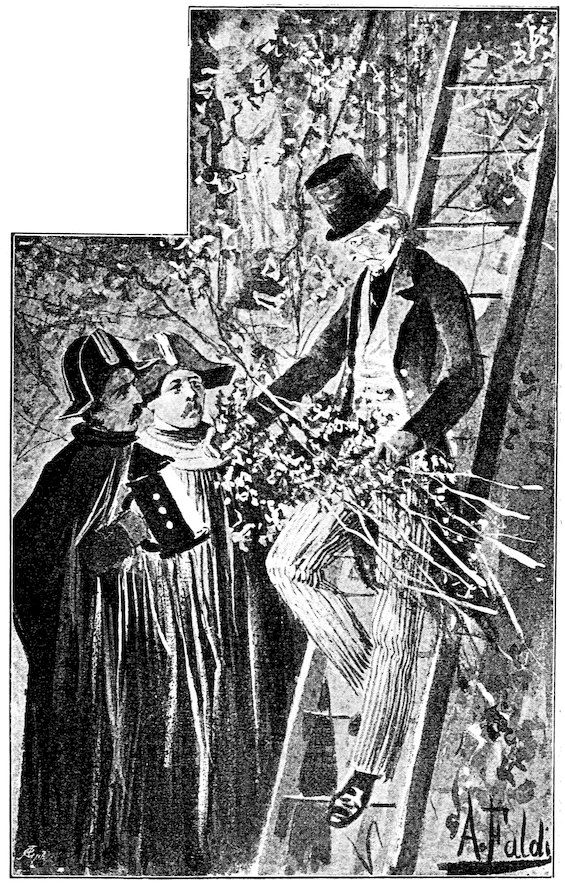
“I am pulling out these weeds.”
“Come down.”
“Let me finish.”
“Come down, I tell you!”
At this unceremonious summons poor Don 134Mario had to descend, leaving several bushes of pellitory to spoil the beautiful building unchecked....
They were nearly taking him off to the police station!... And all for a good action! He died within three months, with the nightmare of those weeds weighing on his heart.... Poor old Don Mario!
Luigi Capuana.