THE FIRST HOUR AND THE SUN.
Reading edition
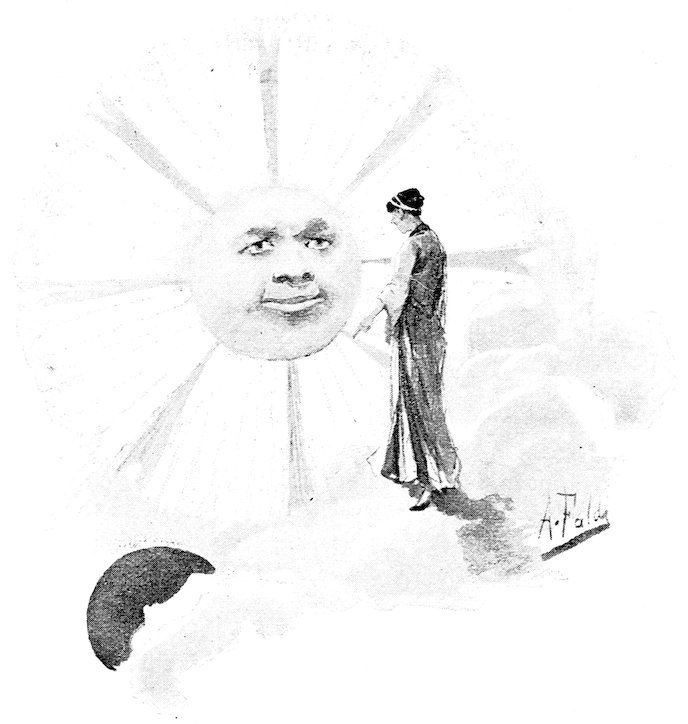
First Hour. Good morning, your Excellency.
Sun. Yes, or rather good-night.
First Hour. The horses are ready.
Sun. Very good.
First Hour. The morning star has been out some time.
Sun. Very good—let her come or go as it suits her.
First Hour. What does your Excellency mean?
Sun. I mean that I want you to leave me alone.
First Hour. But, your Excellency, the night has already lasted so long that it cannot last any longer,—and if we were to wait, you see, your Excellency, it might give rise to some disorder.
Sun. Let come of it what will—I shall not move.
First Hour. Oh! your Excellency, what is this? don’t you feel well?
Sun. No, no—I don’t feel anything, except that I don’t want to move, so you may go about your business.
First Hour. How can I go, if you do not come?—for I am the first hour of the day. And how can there be any day at all if your Excellency does not deign to come out as usual?
Sun. If you are not the first hour of the day, you can be the first hour of the night; or else the night hours can go 64on double duty, and you and your companions may take it easy. Because—I tell you what it is: I am tired of this continual going round and round in order to give light to a few wretched little animals living on a handful of mud, so small that I, though I have pretty good sight, cannot manage to see it. So this night I have made up my mind that I can’t be bothered any more; and if men want light, let them keep their fires burning, or provide it in some other way.
First Hour. But how does your Excellency expect the poor wretches to manage it? And then it will be an enormous expense for them to keep up their lamps and provide candles 65enough to burn all day long. If they had already discovered that kind of air which will burn, and could use it to light up their streets, and rooms, and shops, and cellars, and everything else—and all at a small expense—why, then I should say that the thing was not so bad. But the fact is, that it will be three hundred years, more or less, till men find out that expedient; and in the meantime they will get to the end of all the oil, and wax, and pitch, and tallow, and have nothing more to burn.
Sun. Let them go and catch fireflies, or those little worms which shine in the dark.
First Hour. And how will they provide against the cold?—for without the help they have had from you the wood of all the forests will never be enough to warm them. Besides which they will also die of hunger; for the earth will no longer yield its fruits. And so, at the end of a few years, the race of those poor animals will be entirely lost. They will crawl about for a time, groping in the dark after something to eat and warm themselves at; and, in the end, when the last spark of fire has died out, and they have eaten everything that a human being could possibly swallow, they will all die in the dark, frozen hard like bits of rock crystal.
Sun. And if they do, what business is that of mine? Am I the nurse of the human race?—or perhaps their cook, who has to provide and prepare their food for them? What is it to me that a certain small quantity of invisible animalcules, thousands of miles distant from me, cannot see, or bear the cold, without my light? Besides, even though it were my duty to serve as stove or hearth, so to speak, to this human family, it is surely reasonable that, if the family want to warm themselves, they should come and stand round the stove—not that the stove should walk round the house. And so, if the earth has need of my presence, let her bestir herself, and see that she gets it; for, as far as I am concerned, I want nothing of her, and there is no reason why I should go after her.
66First Hour. Your Excellency means, if I understand aright, that what you did formerly is now to be done by the Earth.
Sun. Yes, now—and henceforward for ever.
Giacomo Leopardi (1798–1837).
Note.—This dialogue is supposed to take place at the date of Galileo’s discovery of the real relations of the Solar System.