Chapter XXXII · GRADUAL PACIFICATION IN THE AUTUMN.
Reading edition

If the events of the three months—July, August, and September, 1858—be estimated without due consideration, it might appear that the progress made in India was hardly such as could fairly be called ‘pacification.’ When it is found how frequently the Jugdispore rebels are mentioned in connection with the affairs of Behar; how numerous were the thalookdars of Oude still in arms; how large an insurgent force the Begum held under her command; how fruitless were all the attempts to capture the miscreant Nena Sahib; how severely the friendly thalookdars and zemindars of Oude were treated by those in the rebel ranks, as a means of deterring others from joining the English; how active was Tanteea Topee in escaping from Roberts and Napier, Smith and Michel, with his treasure plundered from the Maharajah Scindia; how many petty chieftains in the Bundelcund and Mahratta territories were endeavouring to raise themselves in power, during a period of disorder, by violence and plunder—there may be some justification for regarding the state of India as far from peaceful during those three months. But notwithstanding these appearances, the pacification of the empire was unquestionably in progress. The Bengal sepoys, the real mutineers, were becoming lessened in number every week, by the sword, the bullet, the gallows, and privation. The insurgent bands, though many and apparently strong, consisted more and more exclusively of rabble ruffians, whose chief motive for action was plunder, and who seldom ventured to stand a contest even with one-twentieth part their number of English troops. The regiments and drafts sent out from England, both to the Queen’s and the Company’s armies, were regularly continued, so as to render it possible to supply a few British troops to all the points attacked or troubled. There was a steady increase in the number of Jâts, Goorkhas, Bheels, Scindians, Beloochees, &c., enlisted in British service, having little or no sympathy with the high-caste Hindustani Oudians who had been the authors of so much mischief. There was a re-establishment of civil government in all the provinces, and (excepting Oude) in nearly all the districts of each 538province; attended by a renewal of the revenue arrangements, and by the maintenance of police bodies who aided in putting down rebels and marauders. There was an almost total absence of anything like nationality in the motions of the insurgents, or unity of purpose in their proceedings; the decrepit Emperor of Delhi, and the half-witted King of Oude, both of them prisoners, had almost gone out of the thoughts of the natives—who, so far as they rebelled at all, looked out for new leaders, new paymasters, new plunder. In short, the British government had gained the upper hand in every province throughout India; and preparations were everywhere made to maintain this hold so firmly, that the discomfiture of the rebels became a matter almost of moral certainty. Much remained to be done, and much time would be needed for doing it; but the ‘beginning of the end’ was come, and men could speak without impropriety of the gradual pacification of India.
The events of these three months will not require any lengthened treatment; of new mutinies there was only one; and the military and other operations will admit of rapid recital.
Calcutta saw nothing of Viscount Canning during the spring, summer, and autumn. His lordship, as governor-general, appreciated the importance of being near Sir Colin Campbell, to consult with him daily on various matters affecting the military operations in the disturbed districts. Both were at Allahabad throughout the period to which this chapter relates. The supreme council, however, remained at the presidential capital, giving effect to numerous legislative measures, and carrying on the regular government of the presidency. Calcutta was now almost entirely free from those panics which so frequently disturbed it during the early months of the mutiny; rapine and bloodshed did not approach the city, and the English residents gradually sobered down. Although the violent and often absurd opposition to the governor-general had not quite ceased, it had greatly lessened; the dignified firmness of Lord Canning made a gradual conquest. Some of the newspapers, here as at Bombay, invented proclamations and narratives, crimes and accusations, with a disregard of truth which would hardly have been shewn by any journals in the mother-country; and those effusions which were not actually invented, too often received a colour ill calculated to convey a correct idea of their nature. Many of the journalists never forgot or forgave the restrictions which the governor-general deemed it prudent to place on the press in the summer of 1857; the amount of anonymous slander heaped on him was immense. One circumstance which enabled his lordship to live down the calumnies, was the discovery, made by the journalists in the following summer, that Lord Derby’s government was not more disposed than that of Lord Palmerston to expel Viscount Canning from office—a matter which will have to be noticed more fully in another chapter. The more moderate journalists of the Anglo-Indian press, it must in fairness be stated, did their part towards bringing about a more healthy state of feeling.
That the authorities at Calcutta were not insensible to the value of newspapers and journals, in a region so far away from England, was shewn by an arrangement made in the month of August—which afforded at the same time a quiet but significant proof of an improved attention towards the well-being of soldiers. An order was issued that a supply of newspapers and periodicals should be forwarded to the different military hospitals in Calcutta at the public expense. Those for the officers’ hospital[184] comprised some magazines of a higher class than were included in the list for the men’s hospitals; but such were to be sent afterwards to the men’s hospitals, when the officers had perused them.
In connection with military matters, in and near the presidential city, it may be mentioned that the neighbourhood of Calcutta was the scene of a settlement or colonisation very novel, and as unsatisfactory as it was novel. It has been the custom to send over a small number of soldiers’ wives with every British regiment sent to our colonies or foreign territories. During the course of twelve months so many regiments arrived at Calcutta, that these soldiers’ wives accumulated to eighteen hundred in number. They were consigned to the station at Dumdum, a few miles north of Calcutta; and were attended by three or four surgeons and one Protestant chaplain. The accommodation provided for them was sufficient for the women themselves, but not for the children, who added greatly to their number. Many of these women, being of that ignorant and ill-regulated class from which soldiers too frequently choose their wives, brought with them dirty habits and drinking tendencies; and these, when the fierce heat of an Indian summer came, engendered dysentery and diarrhœa, from which diseases a large number of women and children died. Other irregularities of conduct appeared, among a mass of women so strangely separated from all home-ties; and arrangements were gradually made for breaking up this singular colony.
The details given in former chapters, especially in the ‘notes,’ will have shewn how large was the number of regiments conveyed from the United Kingdom and the colonies to India; and when it is remembered that far more of these landed at Calcutta than at Madras, Bombay, or Kurachee, it will easily be understood how military an aspect they gave to the first-named city. Still, numerous as they were, they were never equal to the demand. Without making any long stay at Calcutta, they 539marched to the scenes of action in the northwest. In the scarcity of regular troops, the Bengal government derived much valuable services from naval and marine brigades—men occupying a middle position between soldiers and sailors. Captain Sir William Peel’s naval brigade has been often mentioned, in connection with gallant achievements in Oude; and Captain Sotheby’s naval brigade also won a good name, in the provinces eastward of Oude. But besides these, there were about a dozen different bodies in Bengal, each consisting of a commandant, two under-officers, a hundred men, and two light field-guns. Being well drilled, and accustomed to active movements, these parties were held in readiness to march off at short notice to any districts where a few resolute disciplined men could overawe turbulent towns-people; and thus they held the eastern districts in quietness without drawing on the regular military strength of the presidency. The Shannon naval brigade acquired great fame; the heroic Peel had made himself a universal favourite, and the brigade became a noted body, not only for their own services, but for their connection with their late gallant commander. When the brigade returned down the Ganges, the residents of Calcutta gave them a public reception and a grand dinner. Sir James Outram was present at the dinner, and, in a graceful and appropriate way, told of his own experience of the services of the brigade at Lucknow in the memorable days of the previous winter. ‘Almost the first white faces I saw, when the lamented Havelock and I rushed out of our prison to greet Sir Colin at the head of our deliverers, were the hearty, jolly, smiling faces of some of you Shannon men, who were pounding away with two big guns at the palace; and I then, for the first time in my life, had the opportunity of seeing and admiring the coolness of British sailors under fire. There you were, working in the open plains, without cover, or screen, or rampart of any kind, your guns within musket-range of the enemy, as coolly as if you were practising at the Woolwich target. And that it was a hot fire you were exposed to, was proved by three of the small staff that accompanied us (Napier, young Havelock, and Sitwell) being knocked over by musket-balls in passing to the rear of those guns, consequently further from the enemy than yourselves.’ Such a speech from such a man was about the most acceptable compliment that the brigade could receive, and was well calculated to produce a healthy emulation in other quarters.
The authorities at all the stations were on the watch for any symptoms which, though trivial in themselves, might indicate the state of feeling among the soldiery or the natives generally. Thus, on the 10th of July, at Barrackpore, a chuprassee happening to go down to a tank near the lines, saw a bayonet half in and half out of the water. A search was thereupon ordered; when about a hundred weapons—muskets, sabres, and bayonets—with balls and other ammunition—were discovered at the bottom of the tank. These warlike materials were rendered almost valueless by the action of the water; but their presence in the tank was not the less a mystery needing to be investigated. The authorities, in this as in many similar cases, thought it prudent not to divulge the results of their investigation.
The great jails of India were a source of much trouble and anxiety during the mutiny. All the large towns contained such places of incarceration, which were usually full of very desperate characters; and these men were rejoiced at any opportunity of revenging themselves on the authorities. Such opportunities were often afforded; for, as we have many times had occasion to narrate, the mutineers frequently broke open the jails as a means of strengthening their power by the aid of hundreds or thousands of budmashes ready for any atrocities. So late as the 31st of July, at Mymensing, in the eastern part of Bengal, the prisoners in the jail, six hundred in number, having overpowered the guard, escaped, seized many tulwars and muskets, and marched off towards Jumalpore. The Europeans at this place made hurried preparations for defence, and sent out such town-guards and police as they could muster, to attack the escaped prisoners outside the station. About half of the number were killed or recaptured, and the rest escaped to work mischief elsewhere. It is believed, however, that in this particular case, the prisoners had no immediate connection with rebels or mutinous sepoys; certain prison arrangements concerning food excited their anger, and under the influence of this anger they broke forth.
So far as concerns actual mutiny, the whole province of Bengal was nearly exempt from that infliction during the period now under consideration; regular government was maintained, and very few rebels troubled the course of peaceful industry.
Behar, however, was not so fortunate. Situated between Bengal and Oude, it was nearer to the scenes of anarchy, and shared in them more fully. Sir Edward Lugard, as we have seen, was employed there during the spring months; but having brought the Jugdispore rebels, as he believed, to the condition of mere bandits and marauders, he did not think it well to keep his force in active service during the rainy season, when they would probably suffer more from inclement weather than from the enemy. He resigned command, on account of his shattered health, and his Azimghur field-force was broken up. The 10th foot, and the Madras artillery, went to Dinapoor; the 84th foot and the military train, under Brigadier Douglas, departed for Benares; the royal artillery were summoned to Allahabad; the Sikh cavalry and the Madras rifles went to Sasseram; and the Madras cavalry to Ghazeepore. Captain Rattray, with his Sikhs, was left at Jugdispore, whence he made frequent excursions to dislodge small parties of rebels.
540A series of minor occurrences took place in this part of Behar, during July, sufficient to require the notice of a few active officers at the head of small bodies of reliable troops, but tending on the other hand to shew that the military power of the rebels was nearly broken down—to be followed by the predatory excursions of ruffian bands whose chief or only motive was plunder. On the 8th a body of rebels entered Arrah, fired some shot, and burnt Mr Victor’s bungalow; the troops at that station being too few to effectually dislodge them, a reinforcement was sent from Patna, which drove them away. Brigadier Douglas was placed in command of the whole of this disturbed portion of Behar, from Dinapoor to Ghazeepore, including the Arrah and Jugdispore districts; and he so marshalled and organised the troops placed at his disposal as to enable him to bring small bodies to act promptly upon any disturbed spots. He established strong posts at moderate distances in all directions. The rebels in this quarter having few or no guns left, Douglas felt that their virtual extinction, though slow, would be certain. He was constantly on the alert; insomuch that the miscreants could never remain long to work mischief in one place. Meghur Singh, Joodhur Singh, and many other ‘Singhs,’ headed small bands at this time. On the 17th, Captain Rattray had a smart encounter with some of these people at Dehree, or rather, it was a capture, with scarcely any encounter at all. His telegram to Allahabad described it very pithily: ‘Sangram Singh having committed some murders in the neighbourhood of Rotas, and the road being completely closed by him, I sent out a party of eight picked men from my regiment, with orders to kill or bring in Sangram Singh. This party succeeded most signally. They disguised themselves as mutinous sepoys, brought in Sangram Singh last night, and killed his brother (the man who committed the late murders by Sangram Singh’s orders), his sons, nephew, and grandsons, amounting in all to nine persons—bringing in their heads. At this capture, all the people of the south [of the district?] are much rejoiced. The hills for the present are clear from rebels. I shall try Sangram Singh to-morrow.’ The trunk-road from Calcutta to the upper provinces, about Sasseram, Jehanabad, Karumnassa, and other places, was frequently blocked by small parties of rebels or marauders; and then it became necessary to send out detachments to disperse them. As it was of immense importance to maintain this road open for traffic, military and commercial, the authorities, at Patna, Benares, and elsewhere, were on the alert to hunt down any predatory bands that might make their appearance.
Although Douglas commanded the district in which Jugdispore is situated, he did not hold Jugdispore itself. That place had changed hands more than once, since the day when Koer Singh headed the Dinapoor mutineers; and it was at the beginning of August held by Ummer Singh, with the chief body of the Behar rebels. Brigadier Douglas gradually organised arrangements for another attack on this place. His object was, if possible, so to surround Ummer Singh that he should only have one outlet of escape, towards Benares and Mirzapore, where there were sufficient English troops to bring him to bay. The rebels, however, made so many separate attacks at various places in the Shahabad district, and moved about with such surprising celerity, that Douglas was forced to postpone his main attack for a time, seeing that Jugdispore could not be invested unless he had most of his troops near that spot. All through the month of August we hear of partial engagements between small parties of rebels and much smaller parties of the English—ending, in almost every case, in the flight of the former, but not the less harassing to the latter. At one time we read of an appearance of these ubiquitous insurgents at Rasserah; at another at Arrah; at others at Belowtee, Nowadda, Jugragunje, Masseegunje, Roopsauguty, Doomraon, Burrarpore, Chowpore, Pah, Nurreehurgunje, Kuseea, Nissreegunje, and other towns and villages—mostly south of the Ganges and west of the Sone.
It is unnecessary to trace the operations in this province during September. There was no rebel army, properly so called; but there were small bands in various directions—plundering villages, burning indigo-works, molesting opium-grounds, murdering unprotected persons known or supposed to be friendly to the British, and committing atrocities from motives either of personal vengeance or of plunder. Of patriotism there was nothing; for the peaceful villages suffered as much from these ruffians as the servants of the state. The state of matters was well described by an eye-witness, who said that Shahabad (the district which contains Arrah and Jugdispore) ‘is one of the richest districts in Behar, and is pillaged from end to end; it is what an Irish county would be with the Rockites masters of the opportunity.’ It was a riot rather than a rebellion; a series of disorders produced by ruffians, rather than a manifestation of patriotism or national independence. To restore tranquillity, required more troops than Brigadier Douglas could command at that time; but everything foretold a gradual suppression of this state of disorder, when October brought him more troops and cooler weather.
We now pass on to the turbulent province of Oude—that region which, from the very beginning of the mutiny, was the most difficult to deal with. It will be remembered, from the details given in the former chapters, that Lucknow was entirely reconquered by the British; that the line of communication between that city and Cawnpore was safely in their hands; that after Sir Colin Campbell, Sir James Outram, and other generals had taken their departure to other provinces, Sir Hope Grant remained in military command of Oude; and that Mr Montgomery, who had been Lawrence’s coadjutor in the Punjaub, undertook, as 541chief-commissioner of Oude, the difficult task of re-establishing civil government in that distracted country.
It may be well here to take some notice of an important state document relating to Oude and its government, its thalookdars and its zemindars.
During the spring and summer,[185] the two Houses of Parliament were hotly engaged in a contest concerning Viscount Canning and the Earl of Ellenborough, which branched off into a contest between Whigs and Conservatives, marked by great bitterness on both sides. The immediate cause was a proclamation intended to have been issued (but never actually issued) by Viscount Canning in Oude, announcing the forfeiture of all estates belonging to thalookdars and zemindars who had been guilty of complicity with the rebels. The Earl of Ellenborough, during his brief tenure of office as president of the Board of Control, wrote the celebrated ‘secret dispatch’ (dated April 19th),[186] in which he condemned the proposed proclamation, and haughtily reproved the governor-general himself. It was a dispatch, of which the following words were disapproved even by the earl’s own party: ‘We must admit that, under these circumstances, the hostilities which have been carried on in Oude have rather the character of legitimate war than that of rebellion, and that the people of Oude should rather be regarded with indulgent consideration, than made the objects of a penalty exceeding in extent and in severity almost any which has been recorded in history as inflicted upon a subdued nation. Other conquerors, when they have succeeded in overcoming resistance, have excepted a few persons as still deserving of punishment, but have, with a generous policy, extended their clemency to the great body of the people. You have acted upon a different principle. You have reserved a few as deserving of special favour, and you have struck with what they will feel as the severest of punishment the mass of the inhabitants of the country. We cannot but think that the precedents from which you have departed will appear to have been conceived in a spirit of wisdom superior to that which appears in the precedent you have made.’
It was not until the month of October that the English public were made acquainted with Viscount Canning’s reply to this dispatch. During the interval of five or six months, speculation was active as to the mode in which he would view it, and the course he would adopt in relation to it. His reply was dated ‘Allahabad, June 17th,’ and, when at length publicly known, attracted general attention for its dignified tone. Even those who continued to believe that the much-canvassed proclamation would not have been a just one to issue, admitted (in most instances) the cogency of the governor-general’s arguments against the Ellenborough dispatch—especially in relation to the unfairness of making public a professedly ‘secret’ dispatch. The reply was not addressed to the earl, whose name was not mentioned in it throughout; its address was to ‘the Secret Committee of the Court of Directors,’ in accordance with official rule; but the earl was responsible, and alone responsible, for the dispatch and the severe language it contained. The personal part of Viscount Canning’s reply, the calm but indignant allusion to the ungenerous treatment he had received, was comprised in the first six clauses, which we give in a foot-note.[187] He proceeded to notice the strange way in which the Ellenborough dispatch almost justified the Oudians, as if they were fighting for a righteous cause—quite legitimate in a member of the legislature, proposing a reconsideration of the annexation of Oude; but quite unjustifiable in a minister serving Queen Victoria, who was at that moment, rightly or wrongly, the real Queen of Oude. Viscount Canning declined to discuss the policy which, two years earlier, had dictated the annexation; it was not his performance, nor was he 542empowered to undo it when once done. But he felt it incumbent on him to point out the disastrous effects which might follow, if the Oudians were encouraged by such reasonings as those contained in the Ellenborough dispatch. Speaking of the Begum, the Moulvie, the Nazim, and other rebel leaders in Oude, he stated that there was scarcely any unity of plan or sympathy of purpose among them; ‘but,’ he added, ‘I cannot think this want of unity will long continue. If it shall once become manifest that the British government hesitates to declare its right to possess Oude, and that it regards itself as a wrongful intruder into the place of the dynasty which the Begum claims to represent, I believe that this would draw to the side of the Begum many who have hitherto shewn no sympathy with the late ruling family, and that it is just what is wanting to give a national character to her cause. An uncompromising assertion of our authority in Oude is perfectly compatible with a merciful exercise of it; and I respectfully submit that if the government of India is not supported in making this assertion, and in declaring that the recent acts of the people of Oude are acts of rebellion, and that they may in strict right be treated as such, a powerful temptation will be offered to them to maintain their present struggle or to renew it.’
The governor-general’s defence of the proclamation itself we need not notice at any length; the proclamation was never issued in its original form—the subject being left generally to the discretion of Mr Montgomery. The tenor of his reply may be thus briefly indicated—That he went to Allahabad to reside, chiefly that he might be able personally to investigate the state of Oude; that he soon decided to make a difference between mutinied sepoys and Oudian rebels; that the latter should not be put to death for appearing in arms against the authorities, unless they had committed actual murder; that the general punishment for Oudian rebellion should be confiscation of estates, a punishment frequently enforced against rebels in past years, both by the British and by the native governments; that it is a punishment which in no way affects the honour of the most sensitive Rajpoot or Brahmin; that it admits of every gradation, according to the severity or lightness of the offence; that it would enable the government to reward friendly thalookdars and zemindars with estates taken from those who had rebelled; that most of the thalookdars had acquired their estates by spoliation of the village communities, at a time when they (the thalookdars) were acting under the native government as ‘nazims’ (governors) or ‘chuckladars’ (collectors of government rents); that, as a matter of abstract right, it would be just to give these estates back again to the village communities; but that, as there would be insuperable difficulties to this course, it would be better to take the forfeited estates of rebellious thalookdars as government property, out of which faithful villages and individuals might be rewarded.
Another reply, written by Viscount Canning on the 7th of July, was to the dispatch of the Court of Directors dated the 18th of May. In that dispatch the directors, while expressing full confidence in the governor-general, courteously requested him to furnish an explanation of the circumstances and motives which led him to frame the proclamation. This explanation he most readily gave, in terms equivalent to those above indicated. He expressed, too, his thankfulness for the tone in which the directors had written to him. ‘Such an expression of the sentiments of your honourable court would be to me a source of gratification and just pride under any circumstances; but the generous and timely promptitude with which you have been pleased to issue it, and the fact that it contains approval of the past, as well as trust for the future, has greatly enhanced its value. Your honourable court have rightly judged, that in the midst of difficulties no support is so cheering to a public servant, or so strengthening, as that which is derived from a declared approval of the spirit by which his past acts have been guided.’
It may be here remarked that some of the European inhabitants of Calcutta, who had from the first placed themselves in antagonism with Viscount Canning, prepared an address to the Earl of Ellenborough, thanking him for the ‘secret’ dispatch, denouncing the principles and the policy acted on by the governor-general, lamenting the earl’s retirement after so brief a tenure of office, denouncing the Whigs, and expressing a hope that the earl, whether in or out of office, would long live to ‘uphold the honour and interests of British India.’
We now proceed to a brief narrative of the course of events in Oude during July, August, and September.
The province, in the first of these three months, was in a remarkable condition. Mr Montgomery, as chief-commissioner, intrusted with large powers, gradually felt his way towards a re-establishment of British influence. Most of the dependants and adherents of the deposed royal family belonged to Lucknow; and it was hence in that city that they required most carefully to be watched. In the provinces, the late king’s power and the present British power were regarded with about equal indifference or dislike. A sort of feudalism prevailed, inimical to the recognition of any central authority, except in merely nominal matters. There were rebel forces under different leaders at different spots; but it is doubtful whether any of them were fighting for the deposed king; each leader had an eye to the assumption of power by or for himself. Even the Begum, one of the king’s wives, was influenced by motives very far removed from affection to her lord. Great as Montgomery’s difficulties were, therefore, they were less than would have been occasioned by a concentration of action, a unity of purpose, among the malcontents. He reorganised civil tribunals 543and offices in such districts as were within his power, and waited for favourable opportunities to do the like in other districts.
General Sir Hope Grant was Mr Montgomery’s coadjutor in these labours, bringing military power to bear where civil power was insufficient. In the early part of the month he remained at Lucknow, keeping together a small but efficient army, and watching the course of events around him. Later in the month, however, he deemed it necessary to take the field, and endeavour to chastise a large body of rebels who were setting up the Begum in authority at Fyzabad. On the 21st he started off in that direction, taking with him a force comprising the 1st Madras Europeans, the 2d battalion of the Rifle Brigade, the 1st Punjaub infantry, the 7th Hussars, Hodson’s Horse, twelve light guns, and a heavy train. It was considered probable that, on his way, Grant would relieve Maun Singh, the powerful thalookdar so often mentioned, who was besieged in his fort at Shahgunje by many thousand rebels. This cunning time-server had drawn suspicion upon his acts and motives on many former occasions; but as it was more desirable to have him as a friend than an enemy, and as he had unquestionably earned the enmity of the rebels by his refusal to act openly against the British, it was considered prudent to pay some attention to his present applications for aid. Grant and Montgomery, the one as general and the other as commissioner, held possession of the road from Cawnpore to Lucknow, and the road from Lucknow to Nawabgunge; it was hoped that Grant’s expedition would obtain command likewise of the road from Nawabgunge to Fyzabad. These are the three components of one main road which nearly intersects Oude from west to east; the possession of it would render practicable the gradual crushing of the rebel bands in different forts north and south of the road. The rebel leaders, about the middle of the month, were believed to comprise the Begum of Oude, her paramour Mummoo Khan, Beni Madhoo, Baboo Rambuksh, Bihonath Singh, Chandabuksh, Gholab Singh, Nurput Singh, the Shahzada Feroze Shah, Bhopal Singh, and others of less note; they had under their command sixty or seventy thousand armed men of various grades, and forty or fifty guns. More than half of the whole number were supposed to be with the Begum and Mummoo Khan, at Chowka-Ghât, beyond the river Gogra; and to these Sir Hope Grant directed his chief attention. Where Nena Sahib was hiding, the British authorities could never definitely learn; although it was known that he was near the northern or Nepaul frontier of Oude. It was believed that he, as well as the Begum, was becoming straitened for want of funds—appliances without which they could never hope to keep their rebel forces together.
The general, with his force from Lucknow, experienced no obstruction in his march towards Fyzabad. He arrived at a point within fourteen miles of that city by the 28th of July, having passed on his way through Nawabgunge—leaving the Rajah of Kupoorthulla to keep open his communications. His advance alarmed the rebel army which was at that time engaged in besieging Maun Singh in Shahgunje (twelve miles south of Fyzabad); it broke up into three divisions—one of which fled towards Gonda; a second marched for Sultanpore on the Goomtee; while a third made for Tanda on the Gogra. This precipitate flight shewed in a striking way the dread felt by the insurgents of an encounter with Sir Hope Grant; for their numbers are supposed to have been at least ten times as great as his. On the 29th, Grant entered Fyzabad, and there heard that a large body of rebels were escaping across the Gogra a mile or two ahead; he pushed on with cavalry and horse-artillery, but was only in time to send a few round-shot into their rear. On the following day, Maun Singh, now delivered from beleaguerment, had an interview with him. On the 2d of August, two of the three divisions of the rebel army contrived to join in the vicinity of Sultanpore, where they again formed a compact army of eighteen thousand men, with eleven guns. Notwithstanding the escape of the rebels, Grant’s undisputed occupation of Fyzabad made a great impression in the whole province. This place was a centre of Mohammedan influence; while near it was the very ancient though decayed city of Ayodha or Oude, one of the most sacred of Hindoo cities. Religious quarrels had often broken out between the two communities; and now the British shewed themselves masters alike over the Mohammedan and the Hindoo cities.
It was a great advantage at this time that Hurdeo Buksh, a powerful zemindar of Oude, was enabled to give practical efficiency to the friendly feeling with which he had regarded the English throughout the mutiny. At his estate of Dhurrenpore, not far from Nawabgunge, he organised a small force of retainers, which, with two guns, he employed in fighting against some of the neighbouring thalookdars and zemindars who were hostile to British interests. Such instances were few in number, but they were gradually increasing; and to such agency the ultimate pacification of Oude would necessarily be in considerable part due.
While Grant was encamped at Fyzabad, he made arrangements for routing some of the rebel bodies stationed in places to the east and southeast, whither they had fled on his approach. He made up a column—comprising the 1st Madras Europeans, the 5th Punjaub Rifles, a detachment of Madras Sappers, a detachment of the 7th Hussars, 300 of Hodson’s Horse, and a troop of horse-artillery. With this force, Brigadier Horsford was directed to proceed to Sultanpore, whither an important section of the rebels had retreated. Heavy rains prevented the departure of the brigadier so soon as had been intended; but he set forth on the 9th of August, and was joined on 544the way by a small force from Lucknow, comprising Brasyer’s Sikhs and two horse-artillery guns. On the 13th, Horsford took possession of Sultanpore, after a tough opposition from sixteen or eighteen thousand rebels; he not only drove the enemy across the river Goomtee, but shelled them out of the cantonments on the opposite banks. The most determined of the combatants among the rebels were believed to be those regiments of mutinied sepoys which had been known as the Nuseerabad brigade; they had established three posts to guard the ghâts or ferries across the river, and held these ghâts for a time with such obstinacy as to occasion them a severe loss.
Sultanpore occupied an important position in relation to the rest of Oude; being on the same river (the Goomtee) as Lucknow, and on the high road from Allahabad to Fyzabad. It was evident that this place, from the relative positions of the opposing forces, could not long remain at peace. The rebels endeavoured to regain possession of it after their defeat; while Sir Hope Grant resolved to prevent them. They returned to the Goomtee, and occupied many villages nearly opposite the city. On the 24th of August, Grant made preparations for crossing the river and attacking them. This plan he put in execution on the following day; when twelve hundred foot and two guns effected the passage, and seized three villages immediately in front. The rebels, however, maintained a position from which they could send over shot into the British camp; this lasted until the 29th, when they were driven from their position, and compelled to retire towards Sassenpore, where they reassembled about seven thousand of their number, with eight guns.
The first days of September found this body of rebels separating and recombining, lessening and augmenting, in a manner that renders it difficult to trace the actual movements. The real mutinous sepoys, the ‘Pandies’ of the once mighty Bengal army, were now few among them; and the fluctuating numbers were made up chiefly of the adherents of the rebellious thalookdars and zemindars of Oude—the vassals of those feudal barons—together with felons and scoundrels of various kinds. On one day they appeared likely to retire to Amethee, the stronghold of a rebel named Lall Madhoo Singh; on another, they shewed symptoms of marching to Mozuffernugger, a place about ten miles from Sultanpore; while on a third, some of them made their appearance at a town about twenty miles from Sultanpore on the Lucknow road.
At this time (September) the position of the British in Oude, so far as concerned the possession of actual governing power, was very singular. They held a belt of country right across the centre of the province from east to west; while the districts north and south of that belt were either in the possession of rebels, or were greatly troubled by them. The position was thus clearly described by the Lucknow correspondent of the Bombay Gazette: ‘The districts in our possession lie in a large ellipse, of which Lucknow and Durriabad are foci, the ends of one diameter being Cawnpore and Fyzabad. These cities are situated almost due east and west. Our civil jurisdiction extends, on the average, twenty-five miles all round Lucknow, and not much less round Durriabad. Our line of communication is uninterrupted from Cawnpore to Fyzabad, which latter borders on the Goruckpore district.’ North of this belt or ellipse were various bodies of rebels under the Begum, Mummoo Khan, Feroze Shah, Hurdut Singh, and other leaders; while south of the belt were other bodies under Beni Madhoo, Hunmunt Singh, the Rajah of Gonda, &c. Irrespective of these, were Nena Sahib and some of his relations who, though not to be encountered, were known to be still in the northeast of Oude, near the Nepaul frontier. Sir Hope Grant had immediate control over both banks of the Goomtee, near Sultanpore, and was preparing for a decisive advance against the rebels as soon as he was joined by Brigadier Berkeley, who was sent from Allahabad on an expedition presently to be noticed.
The portion of Oude nearest to Rohilcund, where the energetic Moulvie had lately lost his life, was kept for a long time in a state of anarchy by a combination of rebel chieftains, who declared hostility against the Rajah of Powayne for having betrayed and killed the Moulvie. They at first quarrelled a good deal concerning the possession of the effects of the deceased leader; but the Begum put in a claim, which seems to have been acceded to. Although the authorities at Lucknow could not at this time spare a force to rout out the insurgents on this side of Oude, the service was rendered from Rohilcund, as will be shewn shortly.
In a district of Oude between Lucknow and the Rohilcund frontier, a gallant affair was achieved by Mr Cavanagh, who had gained so much renown by carrying the message from Sir James Outram at Lucknow to Sir Colin Campbell’s camp. Being appointed chief civil officer of the Muhiabad district, he arranged with Captain Dawson and Lieutenant French to defend the district from rebels as well as they could, by the aid of a few native police and sowars. On the 30th of July a body of 1500 insurgents, with one gun, made a sudden attack on a small out-station defended only by about 70 men. The place was gallantly held until Cavanagh and French reached it. One bold charge sent the rebels fleeing in all directions; and the district was soon pacified. Mr Cavanagh had the tact to win over several small zemindars to the British cause, by threatening to punish them if insubordinate, and by undertaking to aid them if they were attacked by rebel bands; they combined to maintain four hundred matchlockmen at their own expense in the British cause. Many of the petty rajahs and zemindars had themselves been more than suspected; but the civil authorities were empowered to win them over, by an indulgent forgetfulness of their past conduct.
545
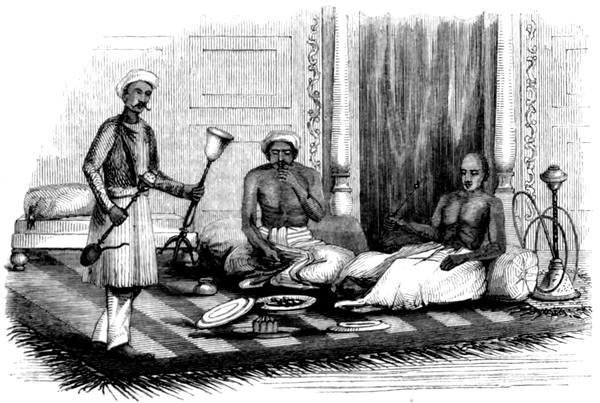
Interior of Hindoo Rajah’s House.
On another side of Oude, near Allahabad and the apex of the Doab, there were many bold and reckless thalookdars, who held out threats to all of their class who dared to profess friendship to the English. A loyal thalookdar, Baboo Rampursand Singh, was attacked by a number of these confederated chieftains with their retainers at Soraon; they took him and his family prisoners, destroyed his house, and sacked the village. As this course of proceeding would have deterred friendly thalookdars from a persistence in their loyalty, and still more certainly deterred waverers from making a choice adverse to the rebel cause, means were taken to check it. Brigadier Berkeley was placed in command of a ‘Soraon Field-force,’ hastily collected, comprising 200 of H.M. 32d foot, the 7th Punjaub infantry, about 150 other infantry, two troops of Lahore light horse, a detachment of Madras cavalry, detachments of horse and foot artillery, and nine guns and mortars. The brigadier set out for Allahabad, where the force had been collected, crossed the Ganges, marched to the Oude frontier, and came in sight of a body of rebels on the 14th of July, at the fort and village of Dehaign—one of the small forts in which Oude abounded. The rebels retired into the fort on his approach, allowing his skirmishers to take easy possession of the village. He encircled the fort with cavalry, and placed horse-artillery to watch any outlets of escape. A firing by heavy guns was not satisfactory to him, owing to the fort being completely hidden by trees and thick scrubby jungle; and he therefore resolved on storming the place by his infantry. The assault was speedily and thoroughly successful. About 250 of the rebels were killed in the fort and ditch; and about as many more were chased through the jungle and cut down by the cavalry and horse-artillery. The place was not properly a fort; it was a large area of jungle surrounded by a dilapidated earthen wall and ditch, and fenced with a thorny abattis, having a brick house in the centre. The rebels being driven out, Brigadier Berkeley caused the jungle to be cut, the walls to be levelled, and the house destroyed. After resting on the 15th, Berkeley proceeded on the 16th to the fort of Tiroul, seven miles north of Soraon. He found this fort in the middle of an impenetrable thorny jungle, through which a few paths were cut in directions known only to the natives; it was surrounded by a very thick thorny abattis; and it had walls, bastions, ditches, escarps, like a miniature fortress, with a stronghold in the centre to which the garrison could retire when closely pressed. There were only three guns on the bastions, but the walls were loopholed for musketry. So thick was the belt of trees and jungle around, that the brigadier could scarcely obtain a sight of the fort; he therefore deemed it prudent to employ his mortars and a 24-pounder howitzer before sending in his infantry to assault. This succeeded; the enemy evacuated the place during the night, leaving behind them their three guns and gun-ammunition. The infantry were on the alert to assist, but the enemy left them nothing to do. Fort Tiroul was then destroyed, as fort Soraon had been. The former was rather a superior example of an Oudian fort; although the walls and bastions were only of earth, they 546were of such considerable thickness, and were aided so greatly by loopholed parapets, ditches, breastworks, rifle-pits, thorny abattis, zigzag intrenchments, and thick jungle—that the enemy might have made a tough resistance to an infantry attack, if they had not been frightened out by shells and balls. By a somewhat similar train of operations, Brigadier Berkeley captured and destroyed a fort at Bhyspoor; and having thus finished the work intrusted to him, he returned with his temporary ‘Soraon Field-force’ to Allahabad. After a brief interval, he was again sent forth, to demolish other Oudian forts at places accessible from Allahabad, of which one was at Pertabghur; and then to advance to Sultanpore, to aid Sir Hope Grant. The two generals would then command a semicircle of country, within which most of the rebels in the eastern half of Oude would be enclosed; and an advance of other columns from Lucknow would completely hem them in. There were many symptoms, at the end of the month, that numerous zemindars and thalookdars were only waiting for a decent pretext, a decisive success of the British, to give in their adhesion.
The banks of the Ganges nearest to the province of Oude, even so low down as Allahabad, where the governor-general and the commander-in-chief were residing, required close watching; they were infested by bands of rebels, some of whom devastated the villages, while others sought to cross the Ganges into the Doab; and carry mischief into new districts. Towards the close of July—to cite one among many instances—it became known that the rebels had collected many boats on the Oude side of the river, ready to cross over into the Doab if the fortune of war should render this desirable. The authorities at once sent up the Jumna steamer, with a party of 130 Sikhs and two guns. At Manickpore and Kunkur, some distance up the river, they found more than twenty boats, which they succeeded in destroying; but the two forts were well armed with guns and rebels, and could not be safely attacked at that time—another and stronger expeditionary force was required to effect this. In August, and again in September, small forces were sent up from Allahabad by river, which had the desired effect of checking these insurgents.
Viscount Canning and Sir Colin Campbell both remained at Allahabad throughout the period to which this chapter relates—where, indeed, they had long been located. It was convenient for each in his special capacity, owing to its central situation. Sir Colin needed to be informed daily of the proceedings of all the brigades, columns, forces, and detachments which were out on active service. Gladly would he have kept them all under cover until the rainy season had passed; but the exigencies of the service prevented this: some troops were necessarily in the field—in Behar, in Oude, in Rohilcund, in Bundelcund, in the Mahratta states, in Rajpootana; and these, whether their number were few or many, were all working to one common end. At no other city could Sir Colin receive news from all those regions more promptly than at Allahabad. Again, Viscount Canning found it necessary to be in intimate communication with the commander-in-chief, in relation to all projects and arrangements involving military operations, on which the ultimate pacification of India so much depended. It was desirable, also, that he should be near Oude, the affairs of which were far more delicate than those of any other Indian province. Many events were likely to arise, concerning which the electric telegraph, though instantaneous, might be too curt and enigmatical, and which would be much better settled by a personal conference with the chief to whom the government of the Anglo-Indian empire was consigned.
Orders and dispatches, military and political, were issued in great number from Allahabad, which was the substitute for Calcutta at that time. Much progress had been made towards the construction of a new English town, with houses, hotels, offices, and shops; and much also in the building of new barracks, for the English troops which must necessarily continue to be stationed at this important place. The governor-general and the commander-in-chief were each surrounded with his staff of officials, for the transaction of business; and both worked untiringly for the public benefit.
From time to time Viscount Canning gave effect to several recommendations made by the generals and brigadiers for an acknowledgment of the fidelity and bravery of native soldiers. At a period when the treachery of the ‘Pandies’ of the Bengal army had been productive of such bitter fruit, it was doubly desirable to praise and reward such native troops as bore up well against the temptations to which they were exposed. On one day he issued orders for the promotion of certain officers and men of the Hyderabad Contingent, for conspicuous gallantry in the action at Banda; and in orders of subsequent dates, other well-deserving native troops were singled out for reward. Ressaldars were promoted to be ressaldar-majors, duffadars to be ressaldars or jemadars, bargheers and silladars to be duffadars, naiks to be havildars, and so on—these being some of the many designations of native military officers in India. One of the higher grade of native officers in the Hyderabad Contingent, Ressaldar-major Meer Dilawar Hossein, was made a member of the First Class of ‘the Order of British India,’ with the title of ‘Sirdar Bahadoor.’ Sometimes towns themselves were complimented, as a mode of gratifying the inhabitants, when good service had been rendered. Thus Sasseram became the subject of the following order: ‘As a special mark of the consideration of government for the loyal services rendered by Shah Koobeeroodeen Ahmed of Sasseram, and his fellow towns-people, in repelling the mutineers, the Right Hon. the 547Governor-general is pleased to confer upon Sasseram the name of Nasirool Hook-Kusbah, “Sasseram the aider or supporter of the rulers.”’
Sir Colin Campbell’s[188] daily duties of course bore relation chiefly to military matters. On one occasion, while at Allahabad, he reviewed the camel-corps as one of the reinforcements which from time to time arrived at that place. This was towards the close of July. It was a curious sight to see four hundred camels going through their military evolutions on the maîdan or plain outside the city. These ungainly beasts performed almost all the usual cavalry movements. Besides an armed native driver, each camel carried an English soldier, who occupied the back seat, and was in a position to use his rifle. The camels had been trained to the word of command. On a recognised touch of the guiding-string, they dropped on their knees, the riflemen descended quickly, went on for a distance in skirmishing order, remounted on the recall being signalled, and the camels then rose in their wonted clumsy manner. This corps was likely to render very valuable service, by rapidly conveying a few skilled riflemen to distances and over tracts which would be beyond the reach of infantry.
The commander-in-chief, a man indefatigable in the performance of his duties, acquired for himself the reputation of being a general who insisted on all the duties of regimental service being properly attended to by the officers; to the effect that all alike should work for the common cause, in camps and barracks, as well as in the field. The following order, issued about the close of August, will shew how numerous were the duties thus marked out: ‘The commander-in-chief begs that general officers commanding divisions and brigades will urge commanding-officers of her Majesty’s regiments, troops, and batteries, to give their most particular attention to all points of interior economy; to examine and correct regimental books; to re-enlist soldiers of limited service willing to renew their engagements; to complete soldiers’ clothing and necessaries, examine soldiers’ accounts, soldiers’ claims, and small account-books; to close, and render to the proper departments, the accounts of deceased officers and soldiers; to examine arms, accoutrements, and ammunition, and repair deficiencies; to continue judging-distance drills and musketry-instruction, as far as the climate will permit; to provide occupation for soldiers without harassing them by mere routine drills; to consider their comforts, diet, and amusements; to re-establish the regimental school, and encourage by every means the study of the Hindustani language, both by officers and soldiers disposed to study it; to ascertain by inquiry what means exist in the neighbourhood of their quarters, both in materials and workmen, to furnish their regiments with boots and clothing, in the event of failure of the usual supply; finally, to maintain the most exact discipline, the strict performance of all duties, and proper marks of respect to officers; which will be much assisted by a proper example on the part of officers, in dress and deportment, regularity in their duties, and treatment of native servants and followers.’
This last clause, ‘treatment of native servants and followers,’ related to a serious matter. Many of the younger officers, chiefly those whose knowledge of India had extended only over a few months, had acquired the habit of speaking and writing of the natives as if they were all fiends alike, to sabre and hang whom was a pleasurable duty. The atrocities of some were visited on all. The ‘Pandies’ who had begun the mutiny were now mixed up with others in the common designations of ‘niggers’ and ‘devils;’ and the officers above alluded to were far too prone to use the stick or the whip on the shoulders of natives, simply because they were natives, even when inoffensively employed. The observant correspondents of some of the London journals were too much struck with this dangerous tendency to allow it to pass unnoticed; they commented on it with severity. The letters from officers, made public in the journals published in India, furnished abundant proof of the feelings and language adverted to, conveyed in their own terms. Unless the mutiny were to end with general enmity on both sides, it was essential that an improved tone should prevail in this matter; and to this end, many hints were given by the authorities, in England as well as in India.
A few words will suffice to say all that need be said concerning the Doab and Rohilcund, the regions in which the mutiny really commenced.
Rohilcund was troubled with nothing beyond trifling disturbances during the month of July; and these came chiefly from Oude. Rebel leaders, with small bands of depredators, crossed the frontier, and harried some of the neighbouring villages. So little, however, was there of an organised rebel army in the province, that the predatory irruptions were easily quelled by means of small detachments of troops. At one period in the month a body of Oudians crossed into the northern part of Rohilcund, and combined with a rabble under one Nizam Ali in the wild Roodurpore tract of country. As it was considered possible that an attack on Pileebheet might be contemplated, the authorities at Bareilly sent a small force—comprising the Rohilcund Horse, a troop or two of Punjaub cavalry, and three companies of the Kumaon levies—to Pileebheet; this movement caused the insurgents to retire quickly. In the neighbourhood of Mohumdee, where much fighting had taken place during Sir Colin Campbell’s campaign in the spring, bands of rebels still hovered about, looking for 548any chances of success, and requiring to be carefully watched. One, of about four thousand men, was under Khan Bahadoor Khan of Bareilly; a second, under Khan Ali Nazim of Oude, numbered five thousand; and a third, under Wilayut Shah, mustered three thousand. These, with twenty or thirty guns, might have wrought much mischief if combined with the Oude rebels; but they were so placed on the frontier of the two provinces as to be nearly isolated, and afraid of any bold movements. The authorities, however, were on their guard. A force, including De Kantzow’s Horse, was sent for the protection of Powayne; and Rajah Juggernath Singh, of that place, had about two thousand men who could be depended upon to oppose the rebels. In August, the town and station of Pileebheet were frequently threatened by one Kala Khan, who had three thousand budmashes at his beck, with four guns. As it was deemed necessary to defend Noria, a station about ten miles distant, a small force was sent out from Pileebheet to effect this. Kala Khan attacked the force at Sersown, and brought on an engagement in which his three thousand were opposed to about five hundred. He received a severe defeat, and lost his guns, three elephants, and a number of bullocks. This occurred during the last week in August. In September, matters remained nearly in the same state; the authorities in Rohilcund could not at once spare troops in sufficient number to put down the insurgents thoroughly; but the successes of Sir Hope Grant, in the central parts of Oude, would gradually but necessarily weaken the isolated bands of rebels on the frontier of the two provinces.
Meerut and Delhi had long been at peace. No symptoms of rebel armies appeared near those cities. Sir John Lawrence, having had the province of Delhi attached to his government of the Punjaub, was ruling it with the same vigour as his other provinces. All the natives, Hindoo and Mohammedan, saw that he was a man not to be trifled with. Many of the antiquated usages of the East India Company, in force in other provinces, he abrogated, and introduced a system more suitable to the actual condition of the country and its inhabitants. The ‘regulations,’ as they are called, he abolished altogether; and established in their place a system of government in which summary trial by vivâ voce examination was adopted. A military police was organised; and every village compelled to pay compensation for any damage done within its boundaries.
The district around Etawah was occasionally disturbed by a dacoit leader named Roop Singh, who collected a band of adherents, comprising a few of the Gwalior Contingent, a few of the mutinied troops from Scindia’s own army, and numerous matchlockmen from the ravines of the Jumna. With this motley force he levied contributions from such of the villages as were not strong enough to resist him. He made his appearance at Ajeetmul and other places early in July; but was speedily routed out by a small detachment sent in pursuit. During August, this part of India was infested by men of the same class as those who troubled so many other provinces—reckless adventurers and escaped felons, who took advantage of the state of public affairs to plunder villages, and make exactions on every side. Some of them were headed by chieftains who could boast of a few hundred retainers, and who, with retainers and rabble together, gave more organisation to the plunderers. The principal among them was Roop Singh, mentioned above, who kept armed possession of a fort at Burhee, Bhurree, or Burhay, at the junction of the Chumbul with the Jumna, and occasioned great annoyance by attacking boats and levying toll as they passed. To keep these several mischief-makers in subjection required much activity on the part of the troops belonging to the district. Towards the close of the month, a force was sent out from Etawah purposely to take this fort and disperse the rebels. This was effectually accomplished on the 28th. Suspecting what was intended, the rebels attempted to check the progress of the boats carrying the detachment, at a place called Gurha Koodor, a fortified village three miles higher up. So long as the troops were in the boats, the rebels made a show of determination on shore; but a landing soon scattered them in all directions. The troops then re-embarked, floated down to Burhee, landed, took possession of the fort, and compelled Roop Singh to make a hasty retreat. This done, they collected and secured all the boats in the neighbouring parts of the rivers Jumna, Chumbul, and Kooraree, as a measure of precaution, clearing all the rebels from the vicinity of Dholpore. They then proceeded against the chief of Chuckernuggur, another leader of rebel bands whom it was necessary to put down. In September, Etawah, like the other districts around it, was very little troubled by warlike or mutinous proceedings.
Agra found no difficulty in maintaining order in and near the city. When, in June, the temporary success of Tanteea Topee and the Gwalior mutineers gave some cause for alarm, the authorities of Agra sent out troops to escort Scindia back to the capital of his dominions; and when, at a later date, those mutineers were fleeing from Gwalior, and were believed to be on the way to Bhurtpore or Odeypore, a detachment was sent out to check their approach. This detachment consisted of the 3d Bengal Europeans and a battery of guns, and was placed in aid of Brigadier Showers’s force. The demonstration took effect; for (as we shall see more in detail presently), Tanteea Topee bent his steps southward, away from the threatened assault; and Showers was enabled to send back the detachment through Futtehpore Sikri to Agra. From that time, during the summer and autumn months, Agra and its neighbourhood were at peace.
Directing attention next to the Punjaub, we may remark that those who had the keenest sense of the value of loyal integrity in times of trouble, 549were anxious to see the day when some recognition should be shewn of the services of three native rajahs, without whose co-operation it would scarcely have been possible for Sir John Lawrence to have sent those troops from the Punjaub which enabled Sir Archdale Wilson to recapture Delhi. These were the Rajahs of Putialah, Jheend, and Nabah—three small states which were at one time included within Sirhind, then among the ‘Sikh protected states,’ and then among the ‘Cis-Sutlej states.’ The rajahs were semi-independent, having most of the privileges of independent rulers, but being at the same time under certain engagements to the British government. If they had swelled the ranks of the insurgents, it is difficult to see how Hindostan could have been recovered; for these states intervene between Lahore and Umritsir on the one side, and Delhi on the other. From first to last the rajahs not only fulfilled their engagements, but more; and the government had abundant reason to be glad that these three territories had not been ‘annexed;’ for annexation, if not the cause, was unquestionably one of the aggravations to mutiny. Viscount Canning, in July, rewarded these three Sikh chiefs (for they were Sikhs, though not exactly Punjaubees) with estates and honours. The Rajah—or rather Maharajah, for he was of higher grade than the other two—of Putialah received certain territories in Jhujjur and Bhudour, on a certain military tenure in return for the revenues. He also received the gift of a house at Delhi which, once belonging to one of the begums of the imperial family, had been confiscated on account of her complicity in the mutiny. Lastly, his honorary titles were increased by the following: ‘Furzund Khan, Munsoor Zuman, Ameer-ool-Omrah, Maharajah Dhurraj Rajahshur Sree Maharajah Rajgan, Nirundur Singh Mahundur Bahadoor’—an accumulation, the weight of which would be oppressive to any but an oriental prince. The translation is said to be: ‘Special Son, Conqueror of the World, Chief of the Chiefs, Maharajah of Rajahs’—and so on. The Rajah of Jheend received the Dadree territory, thirteen villages in the Koolran Pergunnah, and a confiscated royal house at Delhi. The additions were: That he be allowed a salute of eleven guns; that his presents be increased from eleven to fifteen trays; that his state visits to the governor-general be returned by the secretary; and that his honorary titles be thus increased: ‘Most cherished Son of true Faith, Rajah Surroop Singh Walee Jheend.’ The Rajah of Nabah received similar presents, and the honorary appellations of—‘Noble Son of good Faith, Berar Bunsee Sirmoor Rajah Bhurpoor Singh Malindur Bahadoor.’ The revenues made over to these rajahs amounted—to the first, about £20,000 per annum; to the second, £12,000; to the third, £11,000.
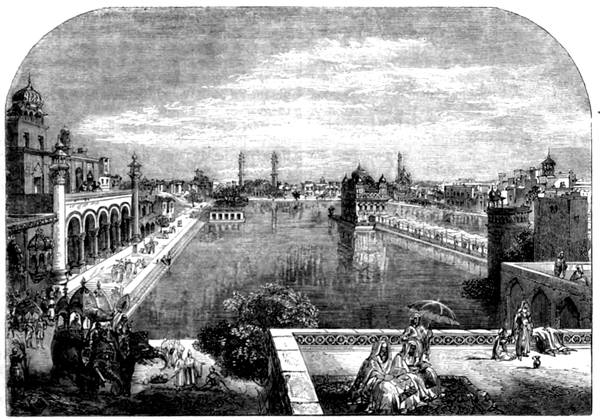
Umritsir.
We may smile at these extravagances of 550compliment, but the services rendered deserved a solid reward as well as an addition to honorary titles. For, it must be remembered, the Rajah of Putialah maintained a contingent of 5000 troops—protected the stations of Umballa and Kurnaul at the outbreak of the mutiny—guarded the grand trunk-road from Kurnaul to Phillour, keeping it open for the passage of British and Punjaub troops—co-operated with General Van Cortlandt in Hissar—lent money when Sir John Lawrence’s coffers were running low—and encouraged others by his own unswerving loyalty. Again: the Rajah of Jheend, whose contingent was very small, did not hesitate to leave his own territory undefended, and march towards Delhi—assisting to defend most of the stations between that city and Kurnaul, and to keep open the communication across the Jumna. Again: the Rajah of Nabah, at the very outset of the disturbances, proceeded to aid Mr Commissioner Barnes in maintaining Loodianah—supplied an escort for the siege-train—gallantly opposed the Jullundur mutineers—provided carriage for stores—and made loans to the Punjaub government in a time of monetary need. The districts given to these rajahs, at the suggestion of Sir John Lawrence, were so chosen as to furnish a prudent barrier of Sikhs between turbulent Mohammedans on the one side and equally turbulent Rajpoots on the other.
Nor did the authorities neglect to recognise the services of humbler persons, although, principally from the proverbial slowness of official movements, the recognition was often delayed to an unreasonable extent. Occasion has more than once presented itself, in former chapters, for noticing the bestowal of the much-prized Victoria Cross on officers and soldiers who had distinguished themselves by acts of personal valour. Owing to the dilatory official routine just adverted to, it was not until the 27th of July that Sergeant Smith and Bugler Hawthorne received the Victoria Cross for their intrepid services at the siege of Delhi ten months before. Their regiment, the 52d foot, was at Sealkote in the Punjaub on that date; and Brigadier Stisted had the pleasure of giving the honouring insignia to them. He told them that the Victoria Cross is in reality more honourable than the Order of the Bath, seeing that no one can obtain it except by virtue of well-authenticated acts of heroism. He gracefully admitted that his own Order of the Bath was due more to the pluck and bravery of his men than to his own individual services; and in reference to the Victoria Cross he added: ‘I only wish I had it myself.’ Another bestowal of this honour we will briefly mention, to shew what kind of spirit is to be found within the breasts of British troops. The award of the Cross, in this instance, was delayed no less than fourteen months after the achievement for which it was given; and the soldier may well have doubted whether he would ever receive it. The instance was that of Gunner William Connolly, of the Bengal horse-artillery; and the conduct for which his officer, Lieutenant Cookes, recommended him for this distinction, was recorded in a dispatch from which an extract is here given in a foot-note.[189]
A very unexpected event, in July, was the revolt of a regiment, or a portion of a regiment, in that region of India which was believed to be more vigorously governed and in better hands than any other—the Punjaub. The facts, as they afterwards came out (mostly, however, on hearsay evidence), appear to have been nearly as follow: The 18th Punjaub infantry, stationed at Dera Ismael Khan, on the western side of the Indus, contained among its numbers about a hundred Malwaie Sikhs, a peculiar tribe different from the other Sikhs of the Punjaub. These Malwaies planned a mutiny. On a particular night, some of them were to murder the officers of the station; the fort was to be seized; and the 39th Bengal native infantry, which had been disarmed some time previously, was to be re-armed from the magazines and stores of the fort. The two regiments of mutineers, perhaps joined by the Sikhs of Renny’s regiment at Bunnoo, were then to embark in boats on the Indus, taking with them the guns, ammunition, and treasure, and were to float down to Dera Ghazee Khan; here they expected to be joined by the native garrison, with whom they would cross the Indus to Moultan; and lastly, with two regiments from the last-named place, they hoped to march upon Lahore. Such was the account, probably magnified in some of its particulars, obtained of the plans of the mutineers. So far as concerned the actual facts, the plot was discovered in time to prevent its execution. On the evening of the 20th, Major Gardiner of the 10th Punjaub infantry, and Captain Smith of the artillery, having received from some quarter a hint of what was intended, went down to the lines at ten o’clock at night, and summoned two of the 551men to appear. One, a sepoy, came first; he was ordered at once to be confined; but no sooner did he hear the order, than he ran off. Just as the guard were about re-capturing this man, a jemadar rushed out, cut down one of them, and wounded another. The sepoy and the jemadar, who were the ringleaders in the plot, escaped for a time, but were captured a few days afterwards. As soon as Sir John Lawrence heard of this occurrence, he ordered the disarmed 39th to be sent to Sealkote, where their movements could be more carefully watched.
Still more serious, in its nature if not in its intention, was the outbreak of the 62d and 69th Bengal native infantry, with a native troop of horse-artillery, at Moultan. These disarmed regiments, like many others in similar plight, were a source of embarrassment to the authorities. They could not safely be re-armed, for their Hindustani sympathies caused them to be suspected; while it was a waste of power to employ English soldiers to watch these unarmed men in their lines. At length it was determined to disband the two regiments, and let the men depart, a few at a time, and under necessary precautions, to their own homes. When this order was read out to them, they appeared satisfied; but a rumour or suspicion spread that there was an intention of destroying them piecemeal on the way. Whether this or any other motive actuated them, is not fully known; but they broke out into rebellion on the 31st of August. There were at Moultan at the time about 170 of the royal artillery, a wing of the 1st Bengal Europeans, the 11th Punjaub infantry, and the 1st Bengal irregular cavalry. Just as the mid-day gun fired, the two disarmed mutinous regiments rose in mutiny, seized anything they could find as weapons, and made a desperate assault on the troops at the station not in their plot. The 62d made their attack on the artillery stables and the European barracks; the 69th went at the guns and the artillery barracks. As these mutineers had few weapons but sticks, their attack appeared so strange, and was so wholly unexpected, that the loyal troops at the station were at first hardly prepared to resist them, and a few Europeans lost their lives; but when once the real nature of the mad attempt was clearly seen, the result was fearful. The misguided men were shot or cut down by all parties and in all quarters. Of thirteen hundred mutineers, few lived to return to their own Hindostan; three or four hundred were laid low in and near Moultan, others were shot by villagers, others were captured and brought in for military execution. It was the nearest approach to the utter annihilation of two regiments, perhaps, that occurred throughout the wars of the mutiny. The sepoys sometimes behaved more like madmen, at others more like children, than rational beings. In the present case they had scarcely a chance of success; for the Sikhs and Punjaubees around them displayed no affection for Hindustanis; the soldiery shot and cut them down, while the peasantry captured them for the sake of the reward offered. They possibly reckoned on the support of the 1st Bengal irregular cavalry; but this regiment remained loyal, and assisted in cutting down the sepoys instead of befriending them.
This occurrence strongly attracted the attention of the government. The disarmed sepoys, as has been more than once mentioned, were a source of much perplexity; it was not decided in what way best to set them free; and on the other hand, such an outbreak as this shewed that it would not be safe to re-arm them. There was at the same time a necessity for watching the Sikh and Punjaubee troops—now nearly 70,000 in number. Hitherto they had behaved admirably, fighting manfully for the government at times and places where the Hindustanis had been treacherous. That they had done so, afforded a justification for the confidence which Sir John Lawrence had placed in them; but that sagacious man saw that recruiting had gone quite far enough in this direction. It was just possible that the Punjaub army might become too strong, and rejoice in its strength by means of insubordination.
One of the incidents in the Punjaub during the month of August related to a physical rather than a moral outbreak—the overwhelming of a military station by a river torrent. The Indus, when about to enter the Punjaub from the Himalaya, passes through a narrow ravine in the Irhagan Hills. The rocks on either side here, undermined by the action of the water through unknown centuries, broke away and fell into the river. Half the water of the stream still continued to find its way onward; but the other half became dammed up, and accumulated into a vast lake. When the pressure of this body of water had augmented to an irresistible degree (which it did in fifteen days), it burst its barrier and rushed down with indescribable force, sweeping away villages on its banks. At Attock the level of the river rose fifty feet in one hour, carrying away the bridge of boats which constituted the only roadway over the Indus, and destroying workshops and timber-stores on the banks. The Cabool river, coming from Afghanistan, and joining the Indus at Attock, had its stream driven backwards or upwards with fearful rapidity; it speedily overflowed its banks, and destroyed nearly all the houses at the military station of Nowsherah. ‘The officers,’ said an eye-witness, ‘not knowing when it would stop, but hoping the flood would soon subside, put all their things on the tops of their houses; but the water still continued rising, and house after house went down before it.... The barracks were flooded and vacated by the troops; and all, gentle and simple, had to pass the night on some sand-hills.’ The barracks, being ‘pucka-built’ (burnt bricks and mortar), were not destroyed, although flooded; the other buildings, being ‘rutcha-built’ (unburnt bricks and mud), were destroyed. The troops were at once removed to Peshawur; but the destruction 552of the boat-bridge at Attock threatened a serious interruption to military movements.
Nothing occurred in the Punjaub during September to need record here; nor did Sinde depart from its usual peaceful condition. Both of these large provinces, filling up the western belt of India from the Himalaya to the ocean, were held well in hand by the civil and military authorities.
Attention must now be transferred to those regions which, during many months, had been disturbed by anarchy and rebellion—Bundelcund, the Mahratta States, and Rajpootana. These large territories contained many petty chieftains, among whom a considerable number were prone to seize this opportunity to strengthen themselves by plundering their neighbours. Of patriotism, there was little enough; men appeared in arms for their own interests, or what they deemed their own interests, rather than for any common cause involving nationality or affection to native princes.
Bundelcund and the Saugor provinces were chiefly under the military control of General Whitlock, who had advanced from Madras with a force consisting chiefly of Madras troops, and had gradually established regular government in districts long troubled by violence and confusion. At the end of June, as the last chapter shewed, Whitlock’s force was divided into a great many detachments, which overawed the turbulent at as many different stations; and the same state of matters continued, with slight variations, during the next three months. It must, however, be mentioned here, in relation to military commands, that—as one mode of facilitating the thorough discomfiture of the rebels—Viscount Canning made a new arrangement affecting the Saugor and Gwalior territories. That portion of India having been much disturbed during a period of more than twelve months, it was determined to establish there two military divisions instead of one, and to place in command of those divisions two of the generals who by hard fighting had become accustomed to the district and the class of inhabitants. General Whitlock was appointed to the Saugor division, which was made to extend to the Jumna, and to include the districts of Saugor, Jubbulpoor, Banda, Humeerpoor, and Calpee, with Saugor as the military head-quarters. General Napier was appointed to the Gwalior division, which was made to include Gwalior, Sepree, Goonah, and Jhansi. This arrangement, organised about the end of July, was to hold good whether any rebels should make a sudden outbreak, or whether the troops were fortunate enough to have a period of repose during the rainy season. Whitlock’s force, consisting of H.M. 43d foot, the 1st and 19th Madras native infantry, with a proportion of cavalry and artillery—was mainly in two brigades, under Brigadiers Macduff and Rice.
Brief mention was made in the last chapter of a large capture of treasure by General Whitlock. This matter must here be noticed a little more fully, on account of its connection with the intricacies of Mahratta dynastic changes. During the general’s operations in Bundelcund, he marched from Banda towards Kirwee in two brigades, intending to attack Narain Rao at the last-named place. This chieftain, a descendant of the Peishwa of the Mahrattas, possessed a rabble army, with which for a time he attempted to block up the roads of approach to Kirwee. The resistance made, however, was very slight; and shortly before Whitlock entered the place, Radha Govind, an adherent of Narain Rao, escaped from the town in the opposite direction, taking with him most of the armed men, and a large quantity of money and jewels, but no guns. Narain Rao, and another Mahratta leader named Madhoo Rao, remained at Kirwee. Their fears having been roused, they now resolved to surrender as a means of obtaining forgiveness for their rebellious proceedings. They came out to meet Whitlock, at a camping-ground a few miles from Kirwee. Delivering up their swords, they were kept securely for a time. Whitlock took possession of the town and palace, and found that the rebels had been busily engaged in casting cannon, making gunpowder, and enlisting men. In the palace and its precincts were discovered forty pieces of cannon, an immense supply of shot and powder, two thousand stands of arms, numerous swords and matchlocks, accoutrements of many of the rebel sepoy regiments, elephants and horses, and a vast store of wealth in cash and jewels. It was conjectured that the jewels might possibly be those which, half a century earlier, had mysteriously disappeared from Poonah, and were supposed to be in possession either of Scindia or Holkar, the most powerful of the Mahratta chiefs in those days; but the discovery now led to an opinion that the jewels had been stolen or appropriated by Bajee Rao, father of Narain Rao, and hidden by that family for half a century. As to the quantity and value of cash and jewels captured, it will be prudent to venture on no estimate. Some of the Anglo-Indian journals spoke of ‘a hundred and forty cart-loads of gold ingots and nuggets, and forty lacs of rupees,’ besides the jewels; but to whatever degree this estimate may have been exaggerated, the largeness of the sum gave rise to many inquiries concerning the history of the family to which it had belonged, and of which Nena Sahib was an ‘adopted’ member. It then transpired, that the first Peishwa of the Mahrattas, who died in 1720, was succeeded by Balajee Rao Sahib; one of Balajee’s sons, Ragoba Dada, died in 1784; and from him were descended Narain Rao and Madhoo Rao, by one branch, and Nena Sahib by another—or rather, all these three individuals were adopted sons of Ragoba’s descendants. According to the loose principles of oriental heirship, therefore, it was not difficult for any one among several Mahratta princes to set up a claim to the enormous wealth which, at a time of discord at the Peishwa’s court, somehow disappeared from the treasury at Poonah.
553Throughout India, there was no province which more strikingly illustrated than Bundelcund the misery which some of the villages must have suffered during many months of anarchy, when predatory bands were passing to and fro, and rebel leaders were forcing contributions from all who had anything to lose. Writing early in July concerning the Banda district, a British officer said: ‘This district has suffered very extensively in the long interval of disorder to which it was abandoned; the various bands of mutineers passing up from Dinapoor did great mischief; various powerful villages preyed considerably upon their weaker neighbours; and, lastly, the Nawab and Narain Rao’s officials extracted by torture every farthing they could get. Many villages are completely deserted, and many more have been burned to the ground, and the people plundered of all the grain and cattle and other property which they possessed. They have gained a very fair idea of what they are to expect under a native government; and I firmly believe they generally hail our return with delight.’
The difficulty of supplying English troops, or reliable native troops, to the numerous points where insurgents were known to be lurking, led occasionally to rebel successes little looked for by the authorities. Thus, on the first of August, a party of mutinous sepoys, headed by a subadar, took possession of the town of Jaloun, near the frontier of Scindia’s territory; this they were enabled to do by the connivance of some of the inhabitants, who opened the gates for them. They were, however, speedily driven out by a small force from Calpee, under Brigadier Macduff. A slight but brilliant cavalry affair occurred about the middle of August, in a district of the Saugor territory placed under General Whitlock’s care. A body of a thousand rebels, under Indur Goshun and other chiefs, had for some time been committing great havoc in the district, plundering the villages, and ill-using all the inhabitants who would not yield to their demands. After having thus treated Shahpoor, they advanced to Garrakotah with similar intent. To prevent this, a small force was sent from Saugor under Captain Finch. He made a forced march; and when within a few miles of them, seeing his infantry were tired out, he rushed forward with only sixty-seven troopers. So impetuous was the charge made by these horsemen on the rebels, that they killed a hundred and fifty, took many wounded prisoners, and brought away three hundred matchlocks and swords. The leader of the rebels, Indur Goshun, was among the slain. In another part of Bundelcund, between Banda and Rewah, about the middle of August, were three groups of rebels—one under Baboo Radha Govind and Gulabraee, a second under Runmunt Singh, and a third under Punjah Singh and Dere Singh. They were supposed to amount, in all, to six thousand men; but only three hundred of these were regular sepoys, and two hundred horsemen, the rest being adventurers and rabble. After ravaging many villages, they approached the station of Kirwee on the 13th. Brigadier Carpenter at once went out to meet them with a small force from Kirwee; he found Runmunt Singh’s band drawn up as if for battle, but a few shots sent them fleeing. About the same time Punjab Singh and Dere Singh were defeated by a small force under Captain Griffin. Early in August, Captain Ashburner set out from Jhansi with five hundred men, on the duty of dispersing a few Bundela chiefs who had been engaged in rebellious machinations. The weather being very heavy, and the rebels swift of foot, a long period elapsed before anything decisive could be effected; but on the 1st of September, he came up with a body of rebels, occupying Mahoni and Mow Mahoni, two villages on the opposite banks of the small river Pooj, both surrounded by deep and difficult ravines, which rendered them strong places. After a little skirmishing, the rebels were driven by shot and shell out of Mahoni, and Ashburner crossed to attack a fort at Mow Mahoni. Symptoms soon appeared that the rebels were making off. Ashburner despatched fifty cavalry, all he had to spare at the moment, under Lieutenant Moore, to gallop after and cut them up in retreat. Moore effected this in dashing style.
We now turn to a region further west, in which the operations were more important than those of Bundelcund.
Referring to former chapters for the details of Sir Hugh Rose’s victory over the Gwalior mutineers, and of his retirement to Bombay after a long season of incessant activity; we proceed to notice the operations of the troops after he parted company from them. His small but famous army, the ‘Central India Field-force,’ was broken up into detachments about the middle of July. The hope entertained was, that the fatigued soldiers might be able to go into quarters during the rainy season, as a means of recruiting their strength for any operations that might be necessary when the cooler and more tranquil weather of the autumn arrived. To understand this, it may be well to bear in mind that the rains of Britain furnish no adequate test of those of India, which fall in enormous abundance at certain seasons, rendering field-operations, whether for industry or war, very difficult. The detachments above adverted to could only in part obtain cessation of duties during the rainy season of 1858. At Jhansi were General Napier and Colonel Liddell; with a squadron of the 14th Light Dragoons, a wing of the 3d Bombay cavalry, the 3d Bombay Europeans, the 24th Bombay native infantry, a company of Bombay Sappers, and three guns of the late Bhopal Contingent. At Gwalior, under Brigadier Stuart, were three squadrons of the 14th Light Dragoons, Meade’s Horse, a wing of the 71st Highlanders, the 86th foot, the 95th foot, the 25th Bombay native infantry, a company of Bombay artillery, a 554company of royal engineers, and a light field-battery. At Seepree, under Brigadier Smith, were two squadrons of the 8th Hussars, two of the 1st Bombay Lancers, the 10th Bombay native infantry, and a troop of Bombay horse-artillery. Lastly, at Goonah, were Mayne’s irregular horse. Sir Hugh Rose himself was at that time at Bombay receiving the well-won congratulations of all classes, and resting for a while from his exhausting labours.
At Gwalior, where the rainy season soon began to shew symptoms, General Napier made preparations for the comfortable housing of his troops. The Maharajah, now more firmly knit than ever in bonds of amity with the British, lent his aid in this matter. Sir Robert Hamilton again took up his permanent residence in the city, gradually re-establishing political relations with the various petty states around. During July there was scarcely any fighting in Scindia’s territory; and the component elements of the now-dissolved Central India Field-force were allowed to remain pretty well at peace.
Before tracing the Central India operations of August, it may be well to see what was doing in Rajpootana during July.
After the siege and capture of Gwalior by Sir Hugh Rose, as we have already narrated, the rebels made a hasty flight northwestward, across the river Chumbul, into Rajpootana; where a victory was gained over them by General Napier, who had been despatched after them for that purpose by Sir Hugh Rose. They appear to have separated, after that, into three bodies. The most important section, under Tanteea Topee and Rao Sahib, received the especial watchfulness of General Roberts, as comprising some of the best of the mutinied troops, and possessing a large amount of Scindia’s property. Roberts took up the work which Rose had laid down. His ‘Rajpootana Field-force,’ now that detachments had been separated from it for service in various quarters, was by no means a large one. It comprised H.M. 83d foot, a wing of the 72d Highlanders, wings of the 12th and 13th Bombay native infantry, a few squadrons of the 8th Hussars and 1st Bombay Lancers, 400 Belooch horse, a light field-battery, and a siege-train of six pieces. The chief body of rebels, under Tanteea Topee and Rao Sahib, made their appearance, a few days after their defeat at Gwalior, at a point more than a hundred miles to the northwest, threatening Jeypoor. Roberts at once marched from Nuseerabad, to check these fugitives. He reached Jeypoor without opposition on the 2d of July; and there he learned news of Tanteea’s miscellaneous force of about ten thousand men. The rebel leader was reported to have with him Scindia’s crown-jewels and treasure, the former estimated at one million sterling value, and the latter at two millions. The treasure, being mostly in silver, was of enormous weight; and Tanteea had been endeavouring to exchange it for gold, on terms that would have tempted any money-changer in more peaceful times: seeing that fifty shillings’ worth of silver was offered for gold mohurs worth only thirty shillings each. On the 5th Tanteea and his troops were at Dowlutpore, thirty-four miles south of Jeypoor; and it thereupon became a problem whether Roberts could overtake them before they reached the more southern states of Rajpootana; for he was on that day at Sanganeer, near Jeypoor. During the next few days, large bodies of rebels were seen, or reported to have been seen, at places whose names are not familiar to English readers—such as Chatsoo, Lalsoont, Tongha, Gureasa, Karier, Madhopore, Jullanee, Tonk, Bursoonie, Bhoomgurh, &c.—all situated in the northeast part of Rajpootana, and separated from the Gwalior region by the river Chumbul. We also find that General Roberts marched through or halted at many places whose names are equally unfamiliar—Sherdoss, Gurbroassa, Glooloussee, Donghur, Kukkor, Rumpore, and Bhugree. In fact, the rebels marched wherever they thought they could capture a stronghold which might serve them as a citadel; while Roberts tried every means to intercept them in their progress. On the 9th, the rebels took possession of the town of Tonk—situated on the river Bunnas, nearly due east of Nuseerabad, and about one-third of the distance from that station to Gwalior; they plundered it, captured three brass guns and a little ammunition, and besieged the Nawab in the neighbouring fort of Bhoomgurh. Roberts immediately sent on a detachment under Major Holmes, in advance of his main force; and the enemy hastily departed as soon as they heard of this. To enable him to keep up the pursuit more effectually, the general sent to Seepree for Colonel Smith’s brigade. There was strong reason to suspect that the rebels wished to penetrate into Mewar and Malwah, provinces far to the south of Gwalior and Jeypoor, and in which the Mahrattas and Rajpoots counted many leaders who were ripe for mischief. To prevent this southward progress was one of the objects which General Roberts held well in view; this was the more necessary, because the country here indicated affords many mountain fastnesses from which it would be difficult to expel insurgent bands. Roberts was disappointed in not being able to come up with the Gwalior rebels at Tonk; but a few days’ sojourn at that town greatly relieved his troops, who had suffered severely during a fortnight’s marching in sultry weather, losing many of their number by sun-stroke.
By the 23d of the month, when Major Holmes was still in pursuit of the enemy, who were reported to be approaching the fortress of Mandulghur in Mewar, Roberts broke up his temporary camp at Tonk, and recrossed the river Bunnas—his movements being greatly retarded by the swollen state of the stream and the swampy condition of the fields and roads. After wading for a whole week through an almost continuous slimy swamp, he came within twenty-four miles of Nuseerabad 555on the 1st of August. Sending all his sick to that station, he prepared to continue a pursuit of Tanteea Topee towards the south, with as great a rapidity as the state of the country would permit.
We now turn again to the Gwalior territory, to trace such operations as took place in the month of August.
About the middle of the month, there were no fewer than five detachments of the late Central India Field-force marching about the country on and near the confines of Scindia’s Gwalior territory. Sir Hugh Rose’s wish and expectation, that his exhausted troops would be able to remain quietly at quarters during the rainy season, were not realised; the state of affairs rendered active service still necessary. One detachment, under General Napier, had set out from Gwalior, and was on the way to Paoree, on an expedition presently to be mentioned; a second was at Burwa Saugor, on the river Betwah; a third at Nota, sixty miles from Jhansi, on the Calpee road; a fourth at Fyzabad (one of many places of that name), fifty miles from Jhansi on the Saugor road; and a fifth, consisting of Sappers and Miners, were preparing a bridge over the Betwah, ten miles from Jhansi. Colonel Liddell, at that period commandant of the Jhansi district, was on the alert to supply small detachments of troops to such places in the vicinity as appeared to need protection; and he himself started off to Burwa Saugor, near which place a rebel chieftain was marching about with three thousand men and two or three guns.
A circumstance occurred, early in August, which led to an expedition in a new direction, and to an eventual co-operation of General Napier with General Roberts in a pursuit of the rebels. This occurrence was an outbreak which required immediate attention. A petty Mahratta chieftain, Man Singh (not Maun Singh of Oude), who had conceived himself aggrieved by Scindia, put himself at the head of 2000 men, and on the 3d of the month, attacked and captured the strong fort of Paoree, southwest of Gwalior, and about eighteen miles from Seepree. Brigadier Smith, on hearing of this, started off on the 5th from the last-named station, with a force consisting of four squadrons of the 8th Hussars, the 1st Bombay Lancers, a wing of H.M. 95th foot, and three field-guns. On nearing Paoree, Man Singh sent a messenger to inquire what was the purpose of the brigadier, seeing that the quarrel was with Scindia and not with the English; he obtained an interview, and stated that his grievance arose from the refusal of Scindia to recognise his (Man Singh’s) right to succeed his father in the principality of Nerwar and the country adjacent; and he further declared that he had no connection with the mutineers and rebels who were fighting against the English. Brigadier Smith, responsible for a time for the peace of that district, could not admit such a plea in justification of the maintenance of an armed force against the sovereign of the country; it would have been dangerous. Man Singh, thereupon, increasing the number of his retainers within the fort of Paoree to three or four thousand, prepared to defend himself. Scindia had some time before stored the fort with six months’ provisions, in case he should deem it at any time necessary to defend the place from the rebels; but this proved to be an unlucky precaution, for Man Singh captured the place in a single night, and then had the six months’ supplies to count upon. Brigadier Smith, finding his eleven hundred men too few to capture the fort, sent to Gwalior for a reinforcement and for a few siege-guns. In accordance with this requisition, a force of about 600 horse and foot, with five guns and four mortars, set out from Gwalior on the 11th. General Napier, feeling the importance of settling this matter quickly, resolved to attend to it in person; he started from Gwalior, reached Mahona on the 14th, and Seepree on the 17th, and joined Smith on the 19th. On the 23d, this demonstration had its effect on Man Singh, who, with another chieftain, Ajheet Singh, had been holding Paoree. Napier poured a vertical fire into the fort for twenty-four hours, and then commenced using his breaching-batteries. But the enemy did not await the result; they evacuated the place, and fled through a jungle country towards the south. Napier entered Paoree, garrisoned it, and hastily made up a column, with which Colonel Robertson started off in pursuit of the rebels. Robertson, after many days’ rapid march, came up nearly to the rear of Man Singh’s fleeing force; but that active leader, scenting the danger, made his rebels separate into three parties, with instructions to recombine at an appointed place; and for the present pursuit was unavailable. When August closed, Man Singh was at Sirsee, north of Goonah, with (it was supposed) about sixteen hundred men, but no guns. General Napier, having destroyed the fortifications at Paoree, and burst the guns, retired to Seepree, where he was encamped at the end of the month, making arrangements for a further pursuit of Man Singh in September.