Chapter XIX · THE STORY OF THE LUCKNOW RESIDENCY.
Reading edition

There were events that made a deeper impression on the minds of the English public; military exploits more grand and comprehensive; episodes more fatal, more harrowing; trains of operation in which well-known heroic names more frequently found place—but there was nothing in the whole history of the Indian mutiny more admirable or worthy of study than the defence of Lucknow by Brigadier Inglis and the British who were shut up with him in the Residency. Such a triumph over difficulties has not often been placed upon record. Nothing but the most resolute determination, the most complete soldierly obedience, the most untiring watchfulness, the most gentle care of those who from sex or age were unable to defend themselves, the most thorough reliance on himself and on those around him, could have enabled that gallant man to bear up against the overwhelming difficulties which pressed upon him throughout the months of July, August, and September. He occupied one corner of an enormous city, every other part of which was swarming with deadly enemies. No companion could leave him, without danger of instant death at the hands of the rebel sepoys and the Lucknow rabble; no friends could succour him, seeing that anything less than a considerable military force would have been cut off ere it reached the gates of the Residency; no food or drink, no medicines or 317comforts, no clothing, no ammunition, in addition to that which was actually within the place at the beginning of July, could be brought in. Great beyond expression were the responsibilities and anxieties of one placed in command during eighty-seven of such days—but there was also a moral grandeur in the situation, never to be forgotten.
In former chapters of this work,[94] much has been said concerning Lucknow, its relations towards the British government on the one hand, and the court of Oude on the other, and the operations which enabled Havelock and Neill to bring a small reinforcement to its British garrison towards the close of September; but what the garrison did and suffered during the three months before this succour could reach them, has yet to be told. The eventful story may be given conveniently in this place, as one among certain intermediate subjects between the military operations of Sir Henry Havelock and those of Sir Colin Campbell.
Let us endeavour, by recapitulating a few facts, to realise in some degree the position of the British at Lucknow when July commenced. The city is a little over fifty miles from Cawnpore—exactly fifty to the Alum Bagh, fifty-three to the Residency, and fifty-seven to the cantonment. Most of its principal buildings, including the Residency, were on the right or southwest bank of the river Goomtee. There was a cantonment Residency, and also a city Residency, at both of which, according to his daily duties, it was the custom of the lamented Sir Henry Lawrence to dwell, before the troubles of the mutiny began; but it is the city Residency which has acquired a notoriety that will never die. It is also necessary to bear in mind that the mere official mansion called the Residency bore but a small ratio to the area and the buildings now known to English readers by that name. This ambiguity is not without its inconveniences, for it denotes a Residency within a Residency. Understanding the Residency to mean English Lucknow, the part of the city containing the offices and dwellings of most of the official English residents, then it may be described as an irregular quadrangle a few hundred yards square, jutting out at the north corner, and indented or contracted at the west. Within that limit were numerous residences and other buildings, some military, some political or civil, some private. The word ‘garrison’ was applied after the defence began, to buildings which had previously been private or official residences; if, therefore, the reader meets in one map with ‘Fayrer’s House,’ and in another with ‘Fayrer’s Garrison,’ he must infer that a private residence was fortified as a stronghold when the troubles began. In this chapter we shall in most instances denominate the whole area as the intrenchment or enclosure, with the Residency itself as one of the buildings; and we shall furthermore retain the original designation of house, rather than garrison, for each of the minor residences. The northeast side of the whole enclosure was nearly parallel with the river; and the north corner was in near proximity to an iron bridge carrying a road over the river to the cantonment.
How the British became cooped up within that enclosure, the reader already knows; a few words will bring to recollection the facts fully treated in the chapters lately cited. We have there seen that there were burnings of bungalows, and cartridge troubles, as early as April, in the cantonment of Lucknow; that on the 3d of May some of the native troops became insubordinate at the Moosa Bagh, a military post three or four miles northwest of the Residency; that the 3d Oude infantry was broken into fragments by this mutiny and its consequences; that Sir Henry Lawrence sought to restore a healthy feeling by munificently rewarding certain native soldiers who had remained faithful under temptation; that towards the close of the month he attended very sedulously to various magazines and military posts in and near the city; that he fortified the English quarter by placing defence-works on and near the walls by which it was already three-fourths surrounded, and by setting up other defences on the remaining fourth side; that he brought all the women and children, and all the sick, of the English community, into the space thus enclosed and guarded; that on the last two days of the month he had the vexation of seeing most of the native troops in Lucknow and at the cantonment, belonging to the 13th, 48th, and 71st infantry, and the 7th cavalry, march off in mutiny towards Seetapoor; and that of the seven hundred who remained behind, he did not know how many he could trust even for a single hour. Next, under the month of June, we have seen that nearly all the districts of Oude fell one by one into the hands of the insurgents, increasing at every stage the difficulties which beset Sir Henry as civil and military chief of the province; that he knew the mutineers were approaching Lucknow as a hostile army, and that he looked around in vain for reinforcements; that he paid off most of the sepoys still remaining with him, glad to get rid of men whose continuance in fidelity could not be relied on; that he greatly strengthened the Residency, and also the Muchee Bhowan, a castellated structure northwest of it, formerly inhabited by the dependents of the King of Oude; that all his letters and messages to other places became gradually cut off, leaving him without news of the occurrences in other parts of India; that he stored the Residency with six months’ provisions for a thousand persons as a means of preparing for the worst; and that on the last day of the month he fought a most disastrous battle with the mutineers at Chinhut, seven or eight miles out of Lucknow. Then, when July opened, we have seen the British in a critical and painful situation. Lawrence having lost many of his most valued troops, could no longer garrison the Muchee Bhowan, the cantonment, the dâk bungalow, or any place beyond 318the Residency. No European was safe except within the Residency enclosure; and how little safety was found there was miserably shewn on the 2d of the month, when a shell from the insurgents wounded the great and good Sir Henry Lawrence, causing his death on the 4th, after he had made over the military command of Lucknow to Brigadier Inglis, and the civil command to Major Banks.
The Europeans, then, become prisoners within the walls of the Residency enclosure at Lucknow—officers, soldiers, revenue-collectors, judges, magistrates, chaplains, merchants, ladies, children. And with them were such native soldiers and native servants as still remained faithful to the British ‘raj.’ What was the exact number of persons thus thrown into involuntary companionship at the beginning of July appears somewhat uncertain; but an exact enumeration has been given of those who took up their quarters within the Residency on the 30th of May, when the symptoms of mutiny rendered it no longer safe that the women and children should remain in the city or at the cantonment. The number was 794.[95] The principal persons belonging to the European community at Lucknow were the following: Sir Henry Lawrence, chief-commissioner; Captain Hayes, military secretary; Major Anderson, chief-engineer; Brigadier Inglis, commandant of the garrison; Brigadier Handscomb, commandant of the Oude brigade; Captain Carnegie, provost-marshal; Captain Simons, chief artillery officer; Colonel Master, 7th native cavalry; Colonel Case and Major Low, H.M. 32d foot; Major Bruyère, 13th native infantry; Major Apthorp, 41st native infantry; Colonel Palmer and Major Bird, 48th native infantry; Colonel Halford, 71st native infantry; Brigadier Gray, Oude Irregulars; Mr Gubbins, finance commissioner; Mr Ommaney, judicial commissioner; Mr Cooper, chief-secretary. Some of these died between the 30th of May and the 4th of July, but a few only. When the whole of the Europeans, officers and privates, had been hastily driven by the mutiny from the cantonment to the Residency; when all the native troops who remained faithful had been in like manner removed to the same place; and when the Muchee Bhowan and all the other buildings in Lucknow had been abandoned by the British and their adherents—the intrenched position at and around the Residency became necessarily the home of a very much larger number of persons; comprising, in addition to the eight hundred or so just adverted to, many hundred British soldiers, and such of the sepoys as remained ‘true to their salt.’
In one sense, the Europeans were not taken by surprise. They had watched the energetic exertions of Sir Henry during the month of June, in which he exhibited so sagacious a foresight of troubles about to come. They had seen him accumulate a vast store of provisions; procure tents and firewood for the Residency; arm it gradually with twenty-four guns and ten mortars; order in vast quantities of shot, shell, and gunpowder, from the Muchee Bhowan and the magazines; make arrangements for blowing up all the warlike matériel which he could not bring in; bury his barrels of powder beneath the earth in certain open spots in the enclosure; bury, in like manner, twenty-three lacs of the Company’s money, until more peaceful days should arrive; destroy many outlying buildings which commanded or overtopped the Residency; organise all the males in the place as component elements in a defensive force; bring in everything useful from the cantonment; build up, in front of the chief structures in the enclosure, huge stacks of firewood, covered with earth and pierced for guns; bring the royal jewels and other valuables from the king’s palace into the Residency for safety; and disarm—much to their chagrin—the servants and dependents of the late royal family. All this the Europeans had seen the gallant Lawrence effect during the five weeks which preceded his death. Of the non-military men suddenly converted into soldiers, Captain Anderson says: ‘Sir Henry Lawrence deemed it expedient to enrol all the European and Eurasian writers in the public offices as volunteers, and he directed arms and ammunition to be served out to them. Some of these men were taken into the volunteer cavalry—which also comprised officers civil and military—and the remainder were drilled as infantry. At the commencement, when these men were first brought together, to be regularly drilled by sergeants from Her Majesty’s 32d regiment, the chance of ever making them act in a body seemed almost hopeless. There were men of all ages, sizes, and figures. Here stood a tall athletic Englishman; there came a fat and heavy Eurasian, with more width about the waist than across the chest; next to the Eurasian came another of the same class, who looked like a porter-barrel, short and squat, and the belt round his waist very closely resembled a hoop; not far off you observed an old, bent-double man, who seemed too weak to support the weight of his musket and pouch.... We must not always judge by appearances. Amongst this 319awkward-looking body there sprang up, during the siege, bold, intrepid, and daring men!’
Notwithstanding these preparations, however, the calamity fell upon the inmates too suddenly. The fatal result of the battle of Chinhut compelled every one to take refuge within the Residency enclosure; even those who had hitherto lived in the city, rushed in, without preparation, many leaving all their property behind them except a few trifling articles. No one was, or ever could be, bitter against Sir Henry Lawrence; yet were there many criticisms, many expressions of regret, at the policy which led to the battle; and it is unquestionable that much of the misery subsequently borne arose from the precipitate arrangements rendered inevitable on the 30th of June and the following day. When they saw the rebels march into Lucknow, invest the Residency, set up a howitzer-battery in front of it, and loophole the walls of houses for musketry, the Europeans could no longer wait to provide for domestic and personal comforts, or even conveniences: they hastened to their prison-house with such resources as could be hastily provided.
Here, then, was a British community thrown most unexpectedly into close companionship, under circumstances trying to all. It is no wonder that some among the number kept diaries of the strange scenes they witnessed, the sad distresses they bore; nor could there be other than a strong yearning on the part of the English public for a perusal of such diaries or narratives. Hence the publication of several small but deeply interesting volumes relating to the defence of Lucknow—one by Mr Rees, a Calcutta merchant, who happened, unluckily for himself, to be at Lucknow when the troubles began; another by the wife of one of the two English chaplains; a third by Captain Anderson; a fourth by a staff-officer.[96] Such diaries, when used in illustration and correction one of another, are and must ever be the best sources of information concerning the inner life of Lucknow during that extraordinary period.
Terrible was the confusion within the Residency enclosure for the first few days. Those who had hastened into the place from other spots were endeavouring to find or make something which they could call ‘home;’ those who had been wounded at Chinhut were suffering in agony within the walls of a building hastily fitted up for them; while the military men looked anxiously around at the defences of the place, to see what could be done to keep the enemy out. When the officers, civil or military, went on the roofs of the houses, they had the mortification of seeing the mutineers gradually concentrating their forces towards the Residency; they saw, also, that the prisoners had escaped from the jails, to join the ranks of those who hated or at any rate opposed the Feringhees.
Arrangements had for some time been in progress, and were now hastily completed, to fortify the principal buildings within the enclosure. If we imagine this English Lucknow to be an irregular diamond-shaped enclosure, with the acute angles very nearly north and south; then it may be said that the south angle was the nearest point to the Cawnpore road, and the north angle the nearest to the iron bridge over the Goomtee towards the cantonment. Near the south point was the house of Captain Anderson, standing in the middle of a garden or open court surrounded by a wall; the house was defended by barricades, and loopholed for musketry; while the garden was strengthened by a trench and rows of palisades. Next to this house, and communicating with it by a hole in the wall, was a newly constructed defence-work that received the name of the Cawnpore Battery, mounted with guns, and intended to command some of the houses and streets adjacent to the Cawnpore road. Mr Deprat’s house had a verandah which, for defensive purposes, was blocked up with a mud-wall six feet high and two feet and a half thick; this wall was continued in a straight line to that of the next house, and carried up to a height of nine feet, with loopholes for musketry. Next to this was a house occupied as a school for boys of the Martinière College,[97] strengthened by a stockade of beams placed before it; and adjacent was a street or road defended by stockades, barricades, and a trench. Further towards the western angle of the enclosure was a building formerly known as the Daroo Shuffa or King’s Hospital, but now called the Brigade Mess-house, having a well-protected and lofty terrace which commanded an exterior building called Johannes’ house. In its rear was a parallelogram, divided by buildings into two squares or courts, occupied in various ways by officers and their families. Then came groups of low brick buildings around two quadrangles called the Sikh Squares, on the tops of which erections were thrown up to enable the troops to fire out upon the town. Separated from these by a narrow lane was the house of Mr Gubbins, the financial commissioner; the lane was barricaded by earth, beams, and brambles; the buildings were strengthened in every way; while the extreme western point was a battery formed by Mr 320Gubbins himself. Then, passing along the northwest side were seen in turn the racket-court, the slaughter-house, the sheep-pen, and the butcher-yard, all near the boundary of the fortified position, and separated one from another by wide open spaces; there was a storehouse for bhoosa (cut chaff for cattle-food), and a guardhouse for Europeans; and all the buildings were loopholed for musketry. In the rear of the Bhoosa Intrenchment, as this post was called, was Mr Ommaney’s house, guarded by a deep ditch and a cactus-hedge, and provided with two pieces of ordnance. North of the slaughter-house a mortar-battery was formed. The English church was the next important building towards the north; it was speedily converted into a granary; and in the church-yard was formed a mortar-battery capable of shelling all the portion of the city between it and the iron bridge. This church-yard was destined afterwards to present melancholy proofs of the large number of deaths among the English defenders of the place. Beyond the church-yard was Lieutenant Innes’s house, in dangerous proximity to many buildings held by the rebels, and bounded on two sides by a garden; it was a difficult but most important duty to strengthen this house as much as possible. The extreme northern part of the whole enclosure, not five hundred yards from the iron bridge, was scarcely susceptible of defence in itself; but it was fully protected by the Redan Battery, constructed by Captain Fulton: this was decidedly the best battery in the whole place, commanding a wide sweep of city and country on both banks of the river. Along the northeast side, connected at one end with the Redan, was a series of earthworks, fascines, and sand-bags, loopholed for musketry, and mounted with guns. A long range of sloping garden-ground was turned into a glacis in front of the line of intrenchment just named. In the centre of the northern half of the whole place was the Residency proper, the official home of the chief-commissioner; this was a large and beautiful brick building, which was speedily made to accommodate many hundred persons; and as it was on high ground, the terrace-roof commanded a view of the whole city—to whoever would incur the peril of standing there.[98] The hospital, a very large building near the eastern angle of the whole enclosure, had once been the banqueting-room for the British resident at the King of Oude’s court; but it was now occupied as a hospital, a dispensary, officers’ quarters, and a laboratory for making fuses and cartridges; it was defended by mortars and guns in various directions. The Ballee or Bailey guard was near the hospital, but on a lower level; various parts of it were occupied as a store-room, a treasury, and barracks; the portion really constituting the Bailey guard gate, the station of the sepoys formerly guarding the Residency, was unluckily beyond the limits of the enclosure, and was productive of more harm than good to the garrison; as a means of security, the gateway was blocked up with earth, and defended by guns. Dr Fayrer’s house, south of the hospital, had a terrace-roof whence rifles were frequently brought to bear on the insurgents, and near it a gun or two were placed in position. Southward again was the civil dispensary; and near this the post-office, a building which, from its position and construction, was one of the most important in the whole place; soldiers were barracked in the interior, a shell and fuse room was set apart, the engineers made it their head-quarters, several families resided in it, and guns and mortars were planted in and around it. The financial-office, and the house of Mrs Sago (mistress of a charity-school), were on the southeast side of the enclosure, and were with great difficulty brought into a defensive state. The judicial office, near Sago’s house, could only be protected from an open lane by a wall of fascines and earth. The jail, near the Cawnpore Gate, was converted into barracks; and the native hospital became a tolerably sheltered place. The Begum’s Kothee, or ‘lady’s house’ (formerly belonging to a native lady of rank), was in the centre of the whole enclosure; it comprised many buildings, which were afterwards parcelled off as commissariat store-rooms, cooking-rooms, and dwellings for officers’ families.
It will thus be seen that the Residency at Lucknow, so often mentioned in connection with the history of the mutiny, was a small town rather than a single building. But it will also be seen that this small town was most dangerously placed, in juxtaposition to a large city full of hostile inhabitants and revolted sepoys. Before Sir Henry Lawrence took it in hand in June, it could be approached and entered from all sides; and at the beginning of July only a part of the defence-works above described were completed. The officers had to fight and build, to suffer and work, to watch and fortify, day after day, under privations difficult for others to appreciate. The various houses, more frequently designated garrisons by those engaged in the siege, did really deserve that title in a military sense; for they were gradually transformed into little forts or strongholds, each placed under one commander, and each defended indomitably against all attacks from the enemy. To give one as an example of many—Captain Anderson, who had resided at Lucknow, as assistant-commissioner, ever since the annexation of Oude, made his own house one of these fortified posts; he had under him eighteen men and one subaltern officer, with whose aid he withstood a five months’ siege, notwithstanding the enemy had nine 9-pounder guns playing on his house. The wall of the compound around the house was levelled, and a stockade put in its place; within the stockade was a ditch, then an earthwork five feet high, and then another ditch with pointed bamboos, forming a chevaux-de-frise. It was, in truth, a small citadel, and one very important for the safety of the whole place.
321
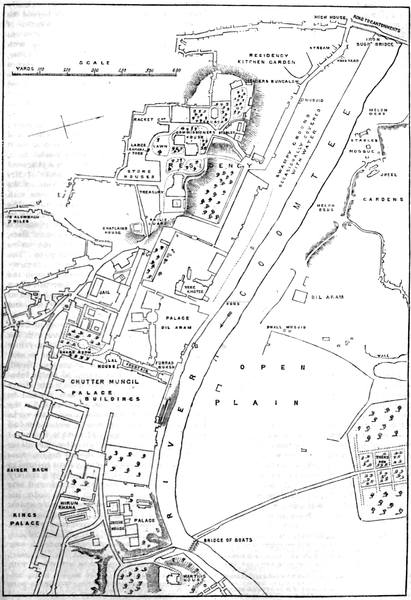
Plan of Residency and part of the City of Lucknow.
322The siege began on the 1st of July, the day following the disastrous battle of Chinhut. It was indeed a siege, even more so than that to which Sir Hugh Wheeler had been exposed at Cawnpore; for there was not only constant firing of musketry, cannon, and mortars, by the mutineers against the Residency; but there were also subterranean mines or galleries dug from the outer streets under the enclosing wall, to blow up the defenders and their defence-works. At every hour of the day, at every corner of the Residency enclosure, was it necessary to keep strict watch. A telegraph, worked at the top of one of the buildings, gave signals to the officers at the Muchee Bhowan, directing them to blow up that fort, and retire to the Residency with the treasure and the guns. This was a most perilous enterprise, but under the skilful superintendence of Captain Francis and Lieutenant Huxhain it succeeded; 240 barrels of gunpowder, and 600,000 rounds of ammunition, were blown into the air, to prevent them from falling into the hands of the enemy; and then the few officers and soldiers marched from the Muchee Bhowan to the Residency, where they helped to strengthen the wofully small number of efficient fighting-men.[99] All this was done by midnight on the 1st. On the 2d, while resting on a couch after his exhausting and anxious labours, Sir Henry Lawrence was struck by the shell which took away his valuable life; for it was a day on which ten thousand rebels were firing shells, balls, and bullets into or at the Residency. Miss Palmer, daughter of Colonel Palmer of the 48th, had her thigh shattered by a ball which entered one of the buildings; and Mr Ommaney was among the wounded. On the 3d dire confusion was everywhere visible; for all felt that their great leader would die of his wound: none had yet fully realised the appalling difficulties of their position; yet were they distracted by family anxieties on the one hand, and public duty on the other. On the 4th, Lawrence descended to the grave; on that day his nephew, Mr G. H. Lawrence, was wounded; and on that day, also, all order or legitimate trade ceased in the city, for marauders and budmashes plundered the shops. No military honours marked the funeral of Sir Henry; there was neither time nor opportunity for any display; a hurried prayer was repeated amid the booming of the enemy’s cannon, and a few spadefuls of earth speedily covered the mortal remains of one whose good name was not likely soon to die.[100] On or about the 5th, the enemy seized the building known as Johannes’ house, from which they were able to keep up a deadly fire of musketry against Anderson’s house, the jail barracks, the post-office, and the Begum’s Kothee; it was afterwards much regretted that this house had not been included among those demolished by Sir Henry. On the 6th and 7th, the harassing fire continued from various points. Some of the bhoosa, or chopped straw for bullocks’ fodder, had been left in an ill-defended place; it was fired by the enemy, and totally consumed, placing in imminent danger a powder-magazine at no great distance. Major Francis had both his legs cut off by a cannon-ball, while quietly sitting in the mess-room; Mr Marshall, an opium-merchant, was killed, and the Rev. Mr Polehampton was wounded, about this time. It was a cruel vexation to the garrison to see and feel how much they were suffering through the skilful gunnery which the British had taught to the miscreants now in the insurgent army. The enemy’s artillerymen displayed great rapidity, ingenuity, and perseverance, in planting batteries in positions totally unlooked for; some even on house-tops, and others in spots where the garrison could not respond to their fire. It was more than suspected that Europeans were among them; indeed one reckless member of an otherwise worthy English family was recognised among the number, bringing discredit upon brothers and cousins who were at that very time gallantly serving the Company elsewhere. Many of the enemy’s batteries were not more than fifty or a hundred yards distant from the marginal buildings of the Residency enclosure; the balls knocked down pillars and verandahs with fearful accuracy. Most of the deaths, however, from ten to twenty a day, were caused by musket-bullets; the enemy had many good marksmen—especially a rebel African, who used his musket with deadly effect from Johannes’ house. If Sir Henry Lawrence had been a sterner soldier, if he had not been influenced by such considerate feelings for the opinions and prejudices of others, the British would have lost fewer lives than they did in Lucknow. 323We have already said that many of the houses around the Residency were destroyed by orders of Sir Henry, to prevent the enemy from converting them into strongholds; but it was afterwards known that the military officers under him urged the necessity for a still greater demolition. Brigadier Inglis, when at a later date he made a military report of the siege and the defence, adverted to this point in very decisive language. ‘When the blockade commenced,’ he said, ‘only two of our batteries were completed, part of the defences were yet in an unfinished condition, and the buildings in the immediate vicinity, which gave cover to the enemy, were only very partially cleared away. Indeed, our heaviest losses have been caused by the fire from the enemy’s sharpshooters, stationed in the adjoining mosques and houses of the native nobility, to the necessity of destroying which the attention of Sir Henry had been repeatedly drawn by the staff of engineers; but his invariable reply was: “Spare the holy places, and private property too, as far as possible;” and we have consequently suffered severely from our very tenderness to the religious prejudices and respect to the rights of our rebellious citizens and soldiery. As soon as the enemy had thoroughly completed the investment of the Residency, they occupied these houses, some of which were within easy pistol-shot of our barricades, in immense force, and rapidly made loopholes on those sides which bore on our post, from which they kept up a terrific and incessant fire day and night.’
The second week of the siege began, bringing with it an augmentation of the troubles already bitterly tasted. One day the Bailey guard would be fiercely attacked, another day the Cawnpore Battery, demanding incessant watchfulness on the part of the officers and men posted at those outworks. Brigadier Inglis sent off letters and messages to Cawnpore and Allahabad; but none reached their destination, the messengers being all intercepted on the way. He did not know how his missives fared; he only knew that no aid, no intelligence, reached him, and he measured his resources with an anxious heart. Sometimes a few officers would retire to snatch a little rest just before midnight, and then would be roused at one or two o’clock in the morning by a message that Gubbins’s house—or ‘garrison,’ as most of the houses within the enclosure were now called—or the Bailey guard, or some other important post, was closely attacked. Sleep, food, everything was forgotten at such moments, except the one paramount duty of repelling the enemy at the attacked point. One day a rebel musketeer pushed forward to such a spot as enabled him to shoot Lieutenant Charlton within side the very door of the church. The enemy sometimes fired logs of wood from their cannon and mortars, as if deficient in shot and shell; but they did not slacken from this or any other cause; they sent shots which set the commissioner’s house on fire, causing much danger and difficulty in extinguishing the flames; and it became perilous for any one within the enclosure to be seen for an instant by the enemy—so deadly accurate were their marksmen. Once now and then the officers with a few men, longing for a dash that would inspirit them in the midst of their troubles, would astonish the enemy by making a sortie beyond the defences, spiking a gun or two, despatching a few of the rebels, and hastening back to the enclosure. Lives being, however, too valuable to be risked for advantages so small as these, the brigadier sought rather to discourage than encourage such acts of heroism. Mr Bryson and Lieutenant Baxter were among the many who fell at this time. The officers did men’s duty, the civilians did military duty; for there were not hands enough to guard properly the numerous threatened points. One night all spare hands would be called upon to cover with tarpaulin the bhoosa stacks in the racket-court; on another, civilians who never before did labourers’ work were called up to dig earth and to carry sand-bags for batteries or breastworks; or they would stand sentinels all night in drenching rains. And then, perhaps on returning to their houses or ‘garrisons’ in the morning, they would find them untenable by reason of the torrent of balls and bullets to which they had been exposed. The open spots between the several buildings became gradually more and more dangerous. ‘A man could not shew his nose,’ says Captain Anderson, ‘without hearing the whiz of bullets close to his head. The shot, too, came from every direction; and when a poor fellow had nearly jerked his head off his shoulders in making humble salutations to passing bullets, he would have his penance disagreeably changed into a sudden and severe contortion of the whole body to avoid a round shot or shell. So soon as a man left his post he had no time for meditation; his only plan was to proceed rapidly. In fact, to walk slow was in some places very, very dangerous; and many a poor fellow was shot, who was too proud to run past places where bullets danced on the walls like a handful of pease in a frying-pan.’
The third week arrived. Now were the gallant defenders still more distressed and indignant than they had hitherto been; for the enemy commenced firing at the Brigade Mess, where large numbers of ladies and children had taken refuge; attacks were thus made on those who could not defend themselves, and the officers and soldiers found their attention distracted from necessary duties at other points. Anderson’s house had by this time become so riddled with shot, that the stores were removed from it; and Deprat’s house, similarly battered by the enemy, in like manner became uninhabitable. The buildings near the boundary naturally suffered most; and, as a consequence, those nearer the centre became more and more crowded with inmates. Day by day did officers and men work hard to strengthen the defences. Mortars were placed behind the earthwork at the post-office, to jet forth shells upon 324the troublesome Johannes’ house; stockades and traverses were made, to screen the entrance to the Residency, within which so many persons were domiciled. Nevertheless the attack increased in vigour quite as rapidly as the defence; for the insurgents appear to have received large reinforcements. Their custom was to fire all night, so as to afford the garrison no rest, and thus tire them out; they so pointed a mortar as to send two shells directly into the Residency itself; they commenced a new battery, to bear upon Gubbins’s house; their cannon-balls—of which there were indications of a new supply—fell upon and into Fayrer’s and Gubbins’s houses, the post-office and the Brigade Mess; a shot burst through a room in which many of the principal officers were breakfasting; a mine was sprung inside the Water Gate, intended to blow up the Redan Battery; and at the same time vigorous attacks were made with guns and musketry on almost every part of the enclosure, as if to bewilder the garrison with crushing onslaughts on every side. The pen cannot describe the state of incessant anxiety into which these daily proceedings threw the forlorn inmates of the place: no one could look forward to a night of sleep after a harassing day; for the booming of cannon, and the anticipated visit of a cannon-ball or a mortar-shell, drove away sleep from most eyelids. It was on the 20th that the specially vigorous attack, just adverted to, was made; so general and energetic, that it almost partook of the character of a storming or assault of a beleaguered city. Nothing but the most untiring assiduity could have saved the garrison from destruction. Every one who could handle a musket or load a cannon, did so; others helped to construct stockades and earthen barriers; and even many of the sick and wounded rose from their pallets, staggered along to the points most attacked, sought to aid in the general cause, and in some instances dropped dead while so doing. Almost every building was the object of a distinct attack. The Redan Battery was fortunately not blown up, the enemy having miscalculated the distance of their mine; but the explosion was followed by a desperate struggle on the glacis outside, in which the insurgents were mowed down by grape-shot before they would abandon their attempt to enter at that point. At Innes’s house, Lieutenant Loughnan maintained a long and fierce contest against a body of insurgents twentyfold more numerous than the little band who aided him; before they desisted, no less than a hundred dead and wounded were carried off by the rebels. The financial office and Sago’s house, entirely defended by non-military men, bore up bravely against the torrent brought against them. The judicial office, under Captain Germon, and Anderson’s house, under Captain Anderson, were not only successfully defended, but the handful of troops aided other points where there were no military men. The Brigade Mess, Gubbins’s house, the houses near the Cawnpore Battery—all were attacked with vigour, but every attack was repelled.
When the muster-roll was called after these exciting scenes, it was found that many valuable lives had been lost. Yet is it truly remarkable that less than thirty persons of all classes in the garrison were killed or wounded on the 20th. No officer was killed; among the wounded were Captains Lowe and Forbes, Lieutenants Edmonstone and M’Farlane, and Adjutant Smith. Mr Rees asserts that the loss of the enemy, during seven hours of incessant fighting, could hardly have been less than a thousand men. It was the grape-shot poured forth from the garrison that worked this terrible destruction. The week had been attended with its usual list of isolated losses within the enclosure. On one day Lieutenant Lester was killed; on another, Lieutenants Bryce and O’Brien were wounded; and on another, Lieutenant Harmer was laid low.
The arrival of the fourth week of the siege found Brigadier Inglis and his companions stout in heart, but yet depressed in spirits; proud of what they had achieved on the 20th, but fearful that many more such dangers would beset them. The detachment of the 32d foot was that on which Inglis most relied in a military point of view, and in that the casualties had been 150 in three weeks. He had sent out repeated messengers, but had hitherto obtained not a word of news from any quarter; shut out from the world of India, he knew of nothing but his own cares and responsibilities. On the 23d, however, a gleam of joy shot through the garrison; a messenger, amid imminent peril, had been to Cawnpore, and brought back news of Havelock’s victories in the Doab. Inglis immediately sent him off again, with an urgent request to the gallant general to advance with his column to Lucknow as quickly as possible. The English residents began to count the days that must elapse before Havelock could arrive—a hopeful thing at the time, but bitterly disappointing afterwards; for they knew not how or why it was that succour did not arrive. Whatever might be the hopes or fears for the future, there was an ever-present danger which demanded daily and hourly attention. Although mortified by their late defeat, the enemy did not on that account give up their attacks. On narrowly watching, the engineers detected the enemy forming a mine beneath the ground from Johannes’ house to the Sikh Square and the Brigade Mess; they could hear the miners at their subterraneous work, and they did what military engineers are accustomed to in such cases—run out a countermine, and destroy the enemy’s handiwork by an explosion. Above ground the attack was maintained chiefly by artillery, the hurling of balls, shells, shrapnels, and those abominable compounds of pitchy and sulphureous substances which artillerymen call ‘stinkpots.’ The breakfast-table of the officers at the post-office was one morning visited by an 325eight-inch shell, which fell on it without exploding. On the 25th a letter arrived from Colonel Tytler at Cawnpore, the first received from any quarter throughout July; for the former messenger had brought rumours concerning Havelock, not a letter or a message. Great was the joy at learning that Havelock intended to advance to Lucknow; and Inglis at once sent off to him a plan of the city, to aid his proceedings—offering the messenger five thousand rupees if he safely brought back an answer. An anxious time indeed was it for all, and well might they look out for succour. Major Banks, the civil commissioner appointed by Sir Henry Lawrence, was shot dead while reconnoitring from the top of an outhouse; he was an officer who had served nearly thirty years in India, and who, both as a soldier and a linguist, had won a good name. Dr Brydon was wounded; the Rev. Mr Polehampton was killed, as were Lieutenants Lewin, Shepherd, and Archer, and many others whose lives were valuable, not only to their families, but to all in the garrison. The death of Major Banks increased the cares and responsibilities of Brigadier Inglis, who, now that there was no chief-commissioner, felt the necessity of placing the whole community under strict military-garrison rules.
In the official dispatch afterwards prepared by Inglis, full justice was done to the ingenuity and perseverance of the besiegers. Speaking of the large guns placed in batteries on every side of the enclosure, he said: ‘These were planted all round our post at small distances, some being actually within fifty yards of our defences, but in places where our own heavy guns could not reply to them; while the perseverance and ingenuity of the enemy in erecting barricades in front of and around their guns, in a very short time rendered all attempts to silence them by musketry entirely unavailing. Neither could they be effectually silenced by shells, by reason of their extreme proximity to our position, and because, moreover, the enemy had recourse to digging very narrow trenches about eight feet in depth in rear of each gun, in which the men lay while our shells were flying, and which so effectually concealed them, even while working the gun, that our baffled sharpshooters could only see their hands while in the act of loading.’
And now, the reader may ask, what were the ladies and children doing during this terrible month of July; and how did the officers and men fare in their domestic and personal matters? It is a sad tale, full of trouble and misery; and yet it is a heroic tale. No one flinched, no one dreamed for an instant of succumbing to the enemy. It must be remembered, as a beginning of all the privations, that the Europeans went into the Residency very scantily supplied with personal necessaries. When the cantonment was burned during the mutiny of the 31st of May, much property belonging to the officers was destroyed; and when every one hurried in for shelter after the disastrous 30th of June, no time was allowed for making purchases in the city, or bringing in property from bungalows or storehouses outside the official stronghold. Hence every one was driven to make the best of such commodities as had been secured by the last day of June. Even during the greater part of that month the troubles were many; the enclosure Residency was full of officers and men, all hard at work; the heat was excessive; cholera, dysentery, and small-pox were at their deadly work; the church being full of grain, those who sought religious aid in time of need met for divine service in any available spot; most of the native servants ran away when the troubles began; and many of them ended their service by robbing their masters.
How July opened for the British, may faintly be imagined. The commissariat chief was ill; no one could promptly organise that office under the sudden emergency; the food and draught bullocks, unattended to, roamed about the place; and many of them were shot, or tumbled into wells. Terrible work was it for the officers to bury the killed bullocks, lest their decaying carcasses should taint the air in excessively hot weather. Some of the artillery horses were driven mad for want of food and water. Day after day, after working hard in the trenches, the officers had to employ themselves at night in burying dead bullocks and horses—officers, be it understood; for the men were all employed as sentries or in other duties. It was not until after many days that they could turn out of the enclosure all the spare horses, and secure the rest. As the heat continued, and as the dead bodies of animals increased in number, the stench became overpowering, and was one of the greatest grievances to which the garrison were exposed; the temperature at night was often less patiently borne than that by day, and the officers and men were troubled by painful boils. Even when wet days occurred, matters were not much improved; for the hot vapours from stagnant pools engendered fever, cholera, dysentery, and diarrhœa. The children died rapidly, and the hospital-rooms were always full; the sick and wounded could not be carried to upper apartments, because the enemy’s shot and shell rendered all such places untenable. The officers were put on half-rations early in the month; and even those rations they in many cases had to cook for themselves, owing to the disappearance of the native servants. The English ladies suffered unnumbered privations and inconveniences. The clergyman’s wife, in her Diary, told of the very first day of the siege in these words: ‘No sooner was the first gun fired, than the ladies and children—congregated in large numbers in Dr Fayrer’s house—were all hurried down stairs into an underground room called the Tye Khana, damp, dark, and gloomy as a vault, and excessively dirty. Here we sat all day, feeling too miserable, anxious, and terrified to speak, the gentlemen occasionally coming down to reassure us and tell us how things were going on. —— was nearly all the day in 326the hospital, where the scene was terrible; the place so crowded with wounded and dying men that there was no room to pass between them, and everything in a state of indescribable misery, discomfort, and confusion.’ In the preceding month it had been a hardship for the ladies to be deprived of the luxuries of Anglo-Indian life; but they were now driven to measure comforts by a different standard. They were called upon to sweep their own rooms, draw water from the wells, wash their own clothes, and perform all the menial duties of a household; while their husbands or fathers were cramped up in little outhouses or stables, or anywhere that might afford temporary shelter at night. When food became scanty and disease prevalent, these troubles were of course augmented, and difference of rank became almost obliterated where all had to suffer alike. Many families were huddled together in one large room, and all privacy was destroyed. The sick and wounded were, as may be supposed, in sad plight; for, kind as the rest were, there were too many harassing duties to permit them to help adequately those who were too weak to help themselves. Officers and men were lying about in the hospital rooms, covered with blood and often with vermin; the dhobees or washermen were too weak-handed for the preservation of cleanliness, and few of the British had the luxury of a change of linen; the windows being kept closed and barricaded, to prevent the entrance of shot from without, the pestilential atmosphere carried off almost as many unfortunates as the enemy’s missiles. The writer of the Lady’s Diary, whose narrative is seldom relieved by one gleam of cheerfulness, departs from her habitual sadness when describing the mode in which eleven ladies and seven children slept on the floor in the Tye Khana or cellar, ‘fitting into each other like bits into a puzzle.’ Chairs being few in number, most of the ladies sat on the floor, and at meal-times placed their plates on their knees. The cellar being perfectly dark, candles were lighted at meal-times. The reason for keeping so many persons in this subterranean abode was to lessen the chance of their being shot in any upper apartment. Of one torment, the flies, every person complained bitterly who was shut up in the Residency enclosure on those fearfully hot days. Mr Rees says: ‘They daily increased to such an extent that we at last began to feel life irksome, more on their account than from any other of our numerous troubles. In the day, flies; at night, mosquitoes. But the latter were bearable; the former intolerable. Lucknow had always been noted for its flies; but at no time had they been known to be so troublesome. The mass of putrid matter that was allowed to accumulate, the rains, the commissariat stores, the hospital, had attracted these insects in incredible numbers. The Egyptians could not possibly have been more molested than we were by this pest. They swarmed in millions, and though we blew daily some hundreds of thousands into the air, this seemed to make no diminution in their numbers; the ground was still black with them, and the tables were literally covered with these cursed flies. We could not sleep in the day on account of them. We could scarcely eat. Our beef, of which we got a tolerably small quantity every day, was usually studded with them; and when I ate my miserable boiled lentil-soup and unleavened bread, a number of scamps flew into my mouth, or tumbled into and floated about in my plate.’
Let us proceed, and watch the military operations of the month of August.
The fifth week of the siege opened with the same scenes as before, deepened in intensity. The enemy, it is true, did not attack with more vigour, but the defenders were gradually weakened in every one of their resources—except courage, and the resolution to bear all rather than yield to the enemy. Colonel Tytler’s letter had afforded hope that the relieving column under Havelock would arrive at Lucknow before the end of July; but when the 30th and 31st had passed, and the 1st and 2d of August had passed also, then were their hopes cruelly dashed. It required all the energy of Brigadier Inglis to keep up the spirits of himself and his companions under the disappointment. He did not know, and was destined to remain for some time in ignorance, that Havelock had been forced to return to Cawnpore, owing to the losses suffered by his heroic little band. About the beginning of the month, great numbers of additional rebel sepoys entered Lucknow, increasing the phalanx opposed to the British. They began a new mine near Sago’s house, and another near the Brigade Mess, in which many of the ladies and children were sheltered; and it required all the activity of the officers to frustrate these underground enemies. The rebels planted a 24-pounder near the iron bridge, to batter the church and the Residency. On one day a shell burst in a room of the Begum’s Kothee, where Lieutenant James and Mr Lawrence were ill in bed, but without injuring them; and on another a soldier was shot dead by a cannon-ball in the very centre room of the hospital. Inglis tried, but tried in vain, to get any one to take a letter, even so small as to go into a quill, to Havelock; the enterprise was so perilous, that the offer of a great reward fell powerless. Thus reduced to his own resources, he began anxiously to count up his stores and supplies: he protected the powder-magazine with heavy beams, laden with a great thickness of earth; and he got the civilians to labour at the earthworks, and to watch the batteries, for nearly all his engineers were ill. One engineer-officer, Captain Fulton, was happily spared from illness longer than most of the others; and he laboured unremittingly and most skilfully to baffle the enemy’s mining by countermining: he organised a body of sappers from among the humbler members of the garrison, and begged every one who did sentry-duty at night to listen for and give information concerning any 327underground sounds that denoted the driving of galleries or mines by the enemy. One of the ladies, Mrs Dorin, was among the number who this week fell from the shots of the enemy. An event of this kind was peculiarly distressing to all; an officer learns to brave death, but he is inexpressibly saddened when he sees tender women falling near him by bullets.
The sixth week arrived. The brigadier, by redoubling his offers, did at length succeed in obtaining the aid of a native, who started on the dangerous duty of conveying a small note to General Havelock at Cawnpore. This done, he renewed his anxious superintendence of matters within the enclosure. The enemy mounted on the top of Johannes’ house, and thence kept up a very annoying fire on the Brigade Mess. They also recommenced mining near the Redan. On the 8th of August the garrison could hear and see much marching and countermarching of troops within the city, without being able to divine its cause; they fondly hoped, when the booming of guns was heard, that Havelock was approaching. This hope was, however, speedily and bitterly dashed; for on the following day a great force of rebels was seen to approach from the direction of the cantonment, cross the river, and join the main body of the insurgents within Lucknow. This was a bad omen, for it prefigured an increase in the number, frequency, and varieties of attack. On the 10th the enemy succeeded in exploding one of their mines opposite Johannes’ house; it blew up sixty feet of palisades and earthen defences. Under cover of this surprise, and of a tremendous firing of guns, the enemy pushed forward into all the buildings near the Cawnpore Battery and Johannes’ house; but they encountered so steady and determined a resistance that they were beaten at all points. Near Sago’s house, too, they fired another mine, which blew up two soldiers; but here, in like manner, they were repulsed after a fierce contest. This explosion was accompanied or attended by an incident almost as strange as that connected with the soldier at Muchee Bhowan; the two men were blown into the air, but both escaped with their lives; one fell within the enclosure, slightly bruised, but not seriously injured; the other, falling into an open road between the enclosure and the enemy, jumped up when he found himself unhurt, and clambered over a wall or through the breach, untouched by the storm of bullets sent after him. On the same day there were other attacks on Innes’s, Anderson’s, and Gubbins’s houses or garrisons. Of the attacks on the Brigade Mess, the Cawnpore Battery, and Anderson’s house, Brigadier Inglis afterwards thus spoke in his dispatch: ‘The enemy sprang a mine close to the Brigade Mess, which entirely destroyed our defences for the space of twenty feet, and blew in a great portion of the outside wall of the house occupied by Mr Schilling’s garrison. On the dust clearing away, a breach appeared through which a regiment could have advanced in perfect order, and a few of the enemy came on with the utmost determination; but they were met with such a withering flank-fire of musketry from the officers and men holding the top of the Brigade Mess, that they beat a speedy retreat, leaving the more adventurous of their numbers lying on the crest of the breach. While this operation was going on, another large body advanced on the Cawnpore Battery, and succeeded in locating themselves for a few minutes in the ditch. They were, however, dislodged by hand-grenades. At Captain Anderson’s post, they also came boldly forward with scaling-ladders, which they planted against the wall; but here, as elsewhere, they were met with the most indomitable resolution; and the leaders being slain, the rest fled, leaving the ladders, and retreated to their batteries and loopholed defences, whence they kept up for the rest of the day an unusually heavy cannonade and musketry fire.’ All the attacks, it is true, were frustrated, but only by fearful labour on the part of the defenders; every man was worn down by exhaustion on this terrible day. A message or rather a rumour was received, obscure in its purport, but conveying the impression that Havelock had been baffled in his attempt to reach Lucknow: news that produced very great despondency in the garrison, among those who had become sick at heart as well as in body. When a cannon-ball rushed along and demolished the verandah of the Residency or chief-commissioner’s house, it could not do less than add to the trepidation of the numerous families domiciled within the walls of that building, already brought into a state of nervous agitation by the incessant noises and dangers. Death and wounds were as rife as ever during this week. A shot broke the leg of Ensign Studdy while breakfasting in the Residency; Captain Waterman was wounded; Lieutenant Bryce died of a wound received some days earlier; Major Anderson, chief-engineer, died of dysentery and over-fatigue, bringing grief to the whole garrison for the loss of a most valuable and intrepid officer. These were the chief names: those of humbler rank who fell to rise no more were too many to be officially recorded; they were hastily buried in the church-yard, and soon driven from the memories of those who had no time to dwell on the past.
Up to the day when the seventh week of the siege opened, there had been twenty letters sent for succour, first by Sir Henry Lawrence, and then by Brigadier Inglis; and to only one of these had a direct reply been received. Only a few of them, indeed, had reached their destinations; and of these few, a reply from one alone safely passed through all the perils between Cawnpore and Lucknow. As has been already said, this reply was not such as to comfort the British residents; they had to rouse themselves to a continuance of the same kind of exertions as before. The enemy did not give them one day, scarcely one hour, of rest. On the 12th of August so fierce an 328attack was made on the Cawnpore Battery, that all the defenders were forced to shield themselves from the balls and bullets—still remaining at hand, however, in case a closer assault were attempted. It being found, too, that a mine was being run by the enemy in the direction of Sago’s house, some of the officers made a daring sortie to examine this mine, much to their own peril. Then commenced, as before, a system of countermining, each party of miners being able to hear the other working in an adjoining gallery; it became a struggle which should blow the other up; the British succeeded, and shattered all the works of the enemy at that spot. Nothing in the whole progress of the siege was more extraordinary than this perpetual mining and countermining. While the infantry and artillery on both sides were at their usual deadly work in the open air, the Sappers and Miners were converting the ground beneath into a honey-comb of dark galleries and passages—the enemy attempting to blow up the defence-works, and the defenders attempting to anticipate this by blowing up the enemy. Whenever the firing by the mutineers slackened in any material degree, the defenders took advantage of the opportunity to make new sand-bags for batteries and earthworks, in place of the old ones which had been destroyed. The 15th of August was a white day within the enclosure; no burial took place. It was also rendered notable by the receipt of a letter from General Havelock—a letter telling of inability to afford present succour, and therefore a mournful letter; but still it was better than none, seeing that it pointed out to all the necessity for continued exertions in the common cause. Now came the time when a great increase of discomfort was in store for the numerous persons who had been accommodated in the Residency, the official house of the chief-commissioner. The building had been so shaken by shells and balls that it was no longer secure; and the inmates were removed to other quarters. On the 18th a terrible commotion took place; the enemy exploded a mine under the Sikh Square or barrack, and made a breach of thirty feet in the defence-boundary of the enclosure. Instantly all hands were set to work; boxes, planks, doors, beams, were brought from various quarters to stop up the gap; while muskets and pistols were brought to bear upon the assailants. Not only did the gallant fellows within the enclosure repel the enemy, but they made a sortie, and blew up some of the exterior buildings which were in inconvenient proximity. By the explosion on this day, Captain Orr, Lieutenant Meecham, and other officers and men, were hurled into the air, but with less serious results than might have been expected; several, however, were suffocated by the débris which fell upon them.
By the eighth week the garrison had become in a strange way accustomed to bullets and balls; that is, though always in misery of some kind or other, the report of firearms had been rendered so thoroughly familiar to them, through every day and night’s experience, that it was a matter of course to hear missiles whiz past the ear. Mr Rees, speaking of his daily movements from building to building in the enclosure, says: ‘At one time a bullet passed through my hat; at another I escaped being shot dead by one of the enemy’s best riflemen, by an unfortunate soldier passing unexpectedly before me, and receiving the wound through the temples instead; at another I moved off from a place where in less than a twinkling of an eye afterwards a musket-bullet stuck in the wall; at another, again, I was covered with dust and pieces of brick by a round-shot that struck the wall not two inches away from me; at another, again, a shell burst a couple of yards away from me, killing an old woman, and wounding a native boy and a native cook.’ Every day was marked by some vicissitudes. On the 20th, the enemy opened a tremendous cannonading, which knocked down a guard-room over the Mess-house, and lessened the number of places from which the garrison could obtain a look-out. The enemy were also on that day detected in the attempt to run new mines under the Cawnpore Battery and the Bailey guard. This led to a brilliant sortie, headed by Captain M’Cabe and Lieutenant Browne, which resulted not only in the spiking of two of the enemy’s guns, but also in the blowing up of Johannes’ house, which had been such a perpetual source of annoyance to the garrison. It was one of the best day’s work yet accomplished, and cheered the poor, hard-worked fellows for a time. Yet they had enough to trouble them; the Cawnpore and Redan batteries were almost knocked to pieces, and needed constant repair; the judicial office became so riddled with shot that the women and children had to be removed from it; the enemy’s sharpshooters were deadly accurate in their aim; their miners began new mines as fast as the old ones were destroyed or rendered innoxious; and Inglis’s little band was rapidly thinning.
Another week arrived, the last in August, and the ninth of this perilous life in the fortified enclosure. The days exhibited variations in the degree of danger, but not one really bright gleam cheered the hearts of the garrison. An advantage had been gained by the successful mining and blowing up of Johannes’ house, once the residence of a merchant of that name; it had been a post from which an African eunuch belonging to the late king’s court had kept up a most fatal and accurate fire into the enclosure, bringing down more Europeans than any other person in the enemy’s ranks. An advantage was thus gained, it is certain; but there were miseries in abundance in other quarters. Gubbins’s house had become so shot-riddled, that the ladies and children domiciled there were too much imperiled to remain longer; they were removed to other buildings, adding to the number of inmates in 329rooms already sadly overcrowded. Among the natives in the enclosure, desertions frequently took place; a fact at which no one could reasonably be surprised, but which nevertheless greatly added to the labours of those on whom devolved the defence of the place. Distressingly severe as those labours had all along been, they were now doubly so; for the enemy erected a new battery opposite the Bailey guard, and commenced new mines in all directions. As the defenders could seldom venture on a sortie to examine the enemy’s works of attack, they were driven to the construction of ‘listening-galleries’—underground passages where the sound of the enemy’s mining picks and shovels could be heard. And then would be renewed the digging of countermines, and a struggle to determine which party should be the first to blow up the other. The Mohurrum or Mohammedan festival commenced this week; a period in which fanatical Mussulmans are so fierce against all who dissent from their faith, that the garrison apprehended a new onslaught with more force than ever; this fear passed away, however, for though there was much ‘tom-tom’ processioning and buffalo-horn bugling in the city, the attacks on the enclosure did not differ much from their usual character. Another letter was received from Havelock, which gave joy to men who found that they were not wholly forgotten by friends in the outer world; but when they heard that a period of at least three weeks longer must elapse before he could possibly reach them, their overcharged hearts sank again, and deep despondency existed for a time among them.
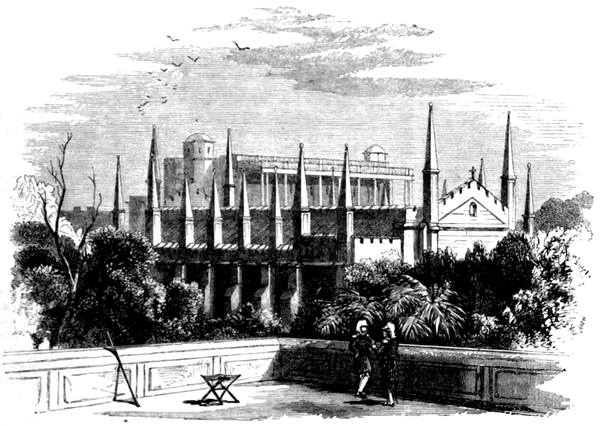
English Church and Residency at Lucknow—from Officers’ Quarters.
During this month of August, the women and children, the sick and wounded, of course suffered much more terribly than in the previous month of July. Every kind of peril and discomfort had increased in severity; every means of succour and solace had diminished in quantity. Death struck down many; disease and wounds laid low a still greater number; and those who remained were a prey to carking cares, which wore down both mind and body. Those who, in a Christian country, are accustomed to pay the last token of respect to departed friends by decent funeral ceremonies, were often pained by their disability to do so in the Lucknow enclosure, under the straitened circumstances of their position. The Rev. Mr Polehampton, after working day and night in his kindly offices among the sick and wounded, was at length himself struck down by cholera; and then came the mournful question, whether he could have a coffin and a separate grave. The writer of the Diary, wife of the clergyman who succeeded Mr Polehampton in his duties as a pastor, says that her husband read the funeral-service over the dead body in presence of the 330mourning widow, on the day and in the room where the death took place, before removal for instant interment. ‘She (the widow) was extremely anxious he should have a coffin, a wish it seemed impossible to gratify; but —— instituted a search, and found one stored away with some old boxes under the staircase in the hospital; and he also had a separate grave dug for him. Since the siege, the bodies have hitherto always been buried several in the same grave, and sewn up in their bedding, as there are no people and no time to make coffins.’ In their troubled state of feeling, vexations affected the different members of the imprisoned community more acutely than would have been the case at other times. The plague of flies can be adverted to in a half-laughing manner by a man in health; but in the Lucknow enclosure it was a real plague, a source of exquisite misery, against which more complaints were uttered than almost anything else. There were also troublesome and painful boils on the person, brought on by high temperature and insufficient diet and medicines. Whatever might be the amount of care taken, bullocks were frequently killed by the shot of the enemy; and as animals so dying were not fit for human food, it became necessary to bury the carcasses at once. A frightful duty this was, mostly performed (as has already been stated) at night by officers, whose few hours of possible sleep were cut short by this revolting sort of labour. No one could leave the enclosure, except native servants determined on escape; not an inch of ground belonged to the British beyond the limits of the intrenched position; and therefore whatever had to be put out of sight—dead bodies of human beings, carcasses of bullocks and horses, garbage and refuse of every kind—could only so be treated by being buried underground in the few open spots between the buildings. And this, too, in the August of an Indian climate, when even the best sanitary arrangements fail to remove offensive odours. The officers, in all their letters and diaries, spoke of this portion of their labours as being most distressing; while the poor women, cabined by dozens together in single rooms, yearned, but yearned in vain, for the breathing of a little air free from impurities. They dared not move out, for the balls and bullets of the enemy were whizzing across and into every open spot. Sometimes an 18-pounder shot would burst into a room where two or three of them were dressing, or where a larger number were at meals. In some of the houses or ‘garrisons,’ where many ladies formed one community, they used to take it in turn to keep awake for hourly watches during the night; one of them said in a letter: ‘I don’t exactly know what is gained by these night-watchings—except that we are all very nervous, and are expecting some dreadful catastrophe to happen.’ The little children died off rapidly, their maladies being more than could be met by the resources at hand; and those who bore up against the afflictions were much emaciated. The husbands and fathers, worn out with daily fatigue and nightly watching, had little solace to afford their families; and thus the women and children were left to pass the weary hours as best they could. A few little creatures, ‘siege-babies,’ as their poor mothers called them, came into the world during this stormy period; and with them each day was a struggle for life. When the native servants one by one escaped, the discomforts of the English women of course underwent much aggravation; and when the house or bungalow of Mr Gubbins became untenable through shot and bullet, the difficulty was immense of finding shelter elsewhere; every place was already overcrowded. Much additional misery befell the officers and men from this fact—that the commissariat quarter, offensive to every sense on account of the organic accumulations inseparable from the slaughtering and cutting up of animals—was one of the weakest parts in the whole enclosure, and required to be guarded at all hours by armed men, who loathed the spot for the reason just mentioned. The chaplain, too, found the church-yard getting into such a horrible state that he dared not go near the graves to read the funeral-service. Mr Rees mentions an instance to illustrate the anxieties of those who, willing to suffer themselves, were almost crushed by witnessing the privations of those dear to them. ‘He’ (mentioning one of the officers) ‘had at first told me of his wife being feverish and quite overcome with the abominable life she had to lead. And then he talked to me of his boy Herbert; how he was attacked with cholera, and feared he was very ill; and how, instead of being able to watch by his bedside, he had been all night digging at Captain Fulton’s mine; and then how his child next night was convulsed, and what little hope of his darling being spared to them—how heart-rending the boy’s sufferings were to his parents’ feelings—how even his (the father’s) iron constitution was at last giving way—how he had neither medicine, nor attendance, nor proper food for the child—and how the blowing up of the mine so close to his sick child had frightened him. And then to-day he told me, with tears in his eyes, that yesterday—the anniversary of his birthday—his poor child was called away. “God’s will be done,” said he; “but it is terrible to think of. At night we dug a hole in the garden, and there, wrapped in a blanket, we laid him.”’ This case is not singular; many another poor parent’s heart was thus torn.
The provisioning of the garrison was of course a perpetual source of anxiety to Brigadier Inglis and the other officers; or rather, the distribution of the food already possessed, and rapidly becoming exhausted, without any prospect of replenishing. Fresh meat was in store for the garrison as long as any healthy bullocks remained; but in other articles of food the deficiency became serious as the month advanced. An immense store of attah—the coarse meal from which chupatties or cakes were made—had been provided by Sir Henry 331Lawrence; but this was now nearly exhausted, and the garrison had to grind corn daily, from the store kept in the impromptu granaries. The women and the elder children were much employed in this corn-grinding, by means of hand-mills. To economise the meal thus laboriously ground, rice and unground wheat were served out to the natives. The animal food was likely to be limited, by the want not of bullocks, but of bhoosa or fodder to feed them; and the commissariat-officers saw clearly before them the approach of a time when the poor animals must die for want of food. The tea and sugar were exhausted, except a little store kept for invalids. The tobacco was all gone; and the soldiers, yearning for a pipe after a hard day’s work, smoked dried leaves as the only obtainable substitute. A few casks of porter still remained, to be guarded as a precious treasure. Once now and then, when an officer was struck down to death, an auction would be held of the few trifling comforts which he had been able to bring with him into the enclosure; and then the prices given by those who possessed means plainly told how eager was the desire for some little change in the poor and insufficient daily food. A few effects left by Sir Henry Lawrence were sold; among them, £16 was given for a dozen bottles of brandy, £7 for a dozen of beer, the same amount for a dozen of sherry, £7 for a ham, £4 for a quart bottle of honey, £5 for two small tins of preserved soup, and £3 for a cake of chocolate. Sugar was the luxury for which most craving was exhibited.
We pass on now to another month, September, whose early days ushered in the tenth week of the captivity.
New mines were everywhere discovered. The British, officers and men, attended sedulously to the underground listening-galleries adverted to in a former paragraph, and there obtained unmistakable evidence that the enemy were running mines towards Sago’s house, the Brigade Mess, the Bailey guard, and other buildings, with the customary intent of blowing them up, and making a forcible entry into the enclosure. Untiring exertions at countermining alone frustrated these terrible operations. On one day, the upper part of the Brigade Mess was smashed in by a shot; on another, a breach was made in the wall of the Martinière temporary school, requiring very speedy stockading and barricading to prevent the entrance of the enemy; on another, a few engineers made a gallant sortie from Innes’s house, and succeeded in blowing up a building from which the enemy had maintained an annoying fire of musketry; and on another day, an officer had the curiosity to count the cannon-balls, varying from 3 to 24 pounds each, which had fallen on the roof of one building alone, the Brigade Mess—they were no less than 280 in number! On the 5th of the month, the enemy made a more than usually impetuous attack; there were 5000 of them in sight from the Residency; they had formed a battery on the other side of the river; they exploded two mines near the Bailey guard and the mess-house; they advanced to Gubbins’s house and to the Sikh Square, bringing with them long ladders to effect an escalade—in short, they seemed determined to carry their point on this occasion. All was in vain, however; the garrison, though worked almost to death, gallantly rushed to every endangered spot and repelled the enemy, hastily reconstructing such defence-works as had been destroyed or damaged. Fortunately, the two exploded mines were short of their intended distance: they wrought but little damage. Much marching and countermarching were occasionally visible among the troops in the city: vague rumours reached the Residency that Havelock had a second time vanquished Nena Sahib’s troops at Cawnpore or Bithoor; but to what extent these movements and rumours would influence the garrison was left painfully undecided. The nights were more terrible than the days; for the enemy, as if to destroy all chance of sleep, kept up a torrent of musketry, accompanied by much shouting and screaming. Many of the officers worked with almost superhuman energy at this time. Captains Fulton and Anderson, Lieutenants Aitken, Clery, Innes, Hutchinson, Tulloch, Birch, Hay, and others, were constantly on the watch for mines, and sedulously digging countermines to foil them.
The eleventh week found the garrison more than ever exposed to hourly peril. The officers, driven from place to place for their few hours of repast and repose, had latterly messed in one of the buildings of the Begum’s Kothee; this fact seemed to be well known to the rebels, who were from the first better acquainted with what transpired inside the fort than the garrison were with external affairs; they directed their shells and balls so thickly on that spot, that ingress and egress were equally difficult. Two sides of Innes’s house were blown in, and the whole structure made little else than a heap of ruins; the Residency, too, became so tottering, that renewed precautions had to be taken in that quarter; new mines were perpetually discovered, directed to points underneath the various buildings; and the enemy sought to increase their means of annoyance by booming forth shells filled with abominable and filthy compositions. Perhaps the most harassing troubles were owing to the uncertainty of the time and place when active services would be needed. The officers could not reckon upon a single minute of peace. ‘In the midst of all these miseries,’ says Captain Anderson, ‘you would hear the cry of “Turn out;” and you had to seize your musket and rush to your post. Then there was a constant state of anxiety as to whether we were mined or not; and we were not quite sure, whilst we were at a loophole, that we might not suddenly see the ground open, or observe the whole materials of the house fly into the air by the explosion of a mine. Shells came smashing into our rooms, and dashed our property to pieces; then followed round-shot, and down tumbled huge 332pieces of masonry, while hits of wood and brick flew in all directions. I have seen beds literally blown to atoms, and trunks and boxes completely smashed into little bits.’ Nevertheless, there was no flinching in the garrison; if a mine were discovered, a countermine was run out to frustrate it; if a wall or a verandah were knocked down by shot, the débris was instantly used to form a rampart, barricade, or stockade. On the 14th of the month, a loss was incurred which caused grief throughout the garrison. Captain Fulton, whose indomitable energy had won the admiration of all in his duties as engineer, and whose kindness of manner had rendered him a general favourite, was struck by a cannon-ball which took his head completely off. Brigadier Inglis felt this loss sensitively, for Fulton had been to him an invaluable aid in all his trials and difficulties. Fulton, who was especially marked by his skill and promptness in countermining, had succeeded Major Anderson as chief-engineer, and was himself now succeeded by Captain Anderson.
The twelfth week, the last which the beleaguered English were destined to suffer before the one which was to bring Havelock and Neill to Lucknow, found them in great despondency. They had lately lost a number of valuable officers. Lieutenant Birch fell; then M. Deprat, a merchant who worked and fought most valiantly at the defences; then Captain Cunliffe; and then Lieutenant Graham, whose mental firmness gave way under privation, grief, and wounds, leading him to commit suicide. As a natural consequence of these and similar losses, harder work than ever pressed on those who remained alive. Never for a moment was the look-out neglected. At all hours of the day and night, officers were posted on the roofs of the Residency and the post-office, finding such shelter as they could while watching intently the river, the bridges, the roads, and the buildings in and around the city; every fact they observed, serious in its apparent import, was at once reported to Brigadier Inglis, who made such defensive arrangements as the circumstances made desirable, and as his gradually lessened means rendered possible. What were the sleepless nights thus added to harassing days for the responsible guardian of the forlorn band, may to some extent be conceived. The enemy’s batteries were now more numerous than ever. They were constructed near the iron bridge; in a piece of open ground that formerly comprised the Residency kitchen-garden; near a mosque by the swampy ground on the river’s bank; in front of a range of buildings called the Captan Bazaar; in the Taree Kothee opposite the Bailey guard; near the clock-tower opposite the financial office; in a garden and buildings opposite the judicial office and Anderson’s house; in numerous buildings that bore upon the Cawnpore Battery and the Brigade Mess; in fields and buildings that commanded Gubbins’s house; and in positions on the northwest of the enclosure—in other words, the whole place was surrounded by batteries bristling with mortars and great guns, some or other of which were almost incessantly firing shot and shell into it.
And what, the reader may anxiously ask, was the domestic or personal life of the inmates of the enclosure during these three weeks of September? It was sad indeed—beyond the former sadness. If the men toiled and watched in sultry dry weather, they were nearly overcome by heat and noisome odours; if they slept in the trenches in damp nights after great heat, they suffered terribly in their limbs and bones, for they had neither tents nor change of clothing. Such was the state to which the whole of the ground was brought, by refuse of every kind, that a pool resulting from a shower of rain soon became an insupportable nuisance; sanitary cleansings were unattainable by a community who had neither surplus labour nor efficient drains at command. Half the officers were ill at one time, from disease, over-fatigue, and insufficient diet; and when they were thus laid prostrate, they had neither medicines nor surgeons sufficient for their need. There was not a sound roof in the whole place. On one day a cannon-ball entered at one end of the largest room in the hospital, traversed the whole length, and went out at the other—but, singular to relate, it did not hurt one human being in the whole crowded apartment. In the commissariat department, some of the bullocks yet remaining fell sick through privations, others were shot; thereby lessening the reserve store, and adding to the repulsive night-duties of the officers already adverted to. Of the few native servants still remaining, hardly one now could be retained; and the saving of their simple food was an inadequate counterbalance for the loss of their assistance in drudgery labours. There were not, however, wanting proofs of a fact abundantly illustrated in many walks of life—the moral healthiness of useful employment. One of the ladies, whose early weeks in the Residency had been weeks of misery, afterwards wrote thus: ‘I now find every hour of the day fully occupied. It is a great comfort to have so much to do, and to feel one’s self of some little use; it helps one to keep up one’s spirits much better than would otherwise be possible under the circumstances.’ The live-stock, the rum, the porter, were all getting low; tea, sugar, coffee, and chocolate had long disappeared from the rations. Such officers and civilians as had money in their pockets, were willing to give almost any prices for the few luxuries still remaining in private hands, in order that they might in some degree alleviate the sufferings of their wives and children. Forty shillings were eagerly given for a bottle of brandy; thirty-two for a bottle of curaçoa; forty for a small fowl; sixteen shillings per pound were offered, but offered in vain, for sugar; two shillings a pound for coarse flour; ten shillings a pound for a little half-rancid butter or ghee; tobacco, four shillings a leaf; a bottle of pickles, forty shillings. Mr 333Rees sold a gold watch to a companion who had money to spare, and with it purchased the luxury of smoking cigars at two shillings each; but when those bits of rolled tobacco-leaf commanded three rupees or six shillings each, he bade adieu to his last remaining source of personal enjoyment. What any one gave, he gave out of kind sympathy to his suffering companions; but what he sold, he sold in the usual commercial spirit to the highest bidder. The attire was reduced to the most piteous condition. Many of the officers had found much of their clothing burned nearly four months earlier, during the mutiny at the cantonment; and the troubles of June had prevented them from making purchases in the city before the arrival of the day when they were all alike to be shut up in the enclosure. As a consequence, their remaining clothes wore away to rags, or something worse. There was scarcely a vestige of a military uniform visible throughout the place. Officers worked and fought, dined and slept, in shirt, trousers, and slippers; one made himself a coat out of a billiard table-cloth; and another contrived a sort of shirt out of a piece of floor-cloth. When the trifling effects of one of the deceased officers came to be examined and sold, a little underclothing was sought for with an eagerness which sumptuous garments would not have excited; four pounds sterling were given for a new flannel-shirt, and twelve pounds for five others which had already rendered much service.
Joy, joy beyond expression rang through the enclosure when, on the 21st of September, the rumour ran round that a messenger had arrived with good news. Inglis had, a few days before, sent off a spy on the often-tried but generally unsuccessful attempt to carry a small note (enclosed in a quill); the peril had been great, but the man safely returned with a small written reply from Havelock, announcing that Outram and himself were on the road from Cawnpore, and expected to reach Lucknow in three or four days. Hearts were filled to overflowing with this announcement. Many wept for joy, some laughed and shouted, more sank on their knees in thanksgiving, while the sick and wounded rose from their pallets, as if wondrously strengthened by the glad tidings. All worked hard and vigorously, in their respective ways, to prepare for the struggle inevitable on any attempt of the two generals to penetrate through the streets of the city; the inmates of the garrison could not, it is true, leave their stronghold to join in the fight, but they might possibly aid when the forlorn-hope was approaching the Bailey guard, the probable place of entrance. The 22d passed over in hopes and fears, expectations and preparations. On the 23d, musketry was heard on the Cawnpore road, and much agitation was visible within the city. On the next day, cannonading and musketry were again heard; and then were the garrison rejoiced at seeing multitudes escaping out of the city, and over the bridge to the other side of the river—rejoiced, because this movement denoted success on the part of the advancing British.
The 25th arrived—the day of deliverance! Prodigious agitation and alarm had marked the city all night: movements of men and horses, and all the indications of a city in commotion. At noon, the increasing sounds told that street-fighting was going on; those who went on the top of the Residency for a look-out could see the smoke of musketry, but nothing else. As the afternoon advanced, the sounds came nearer and nearer;[101] then was heard the sharp crack of rifles; then was gradually perceived the flash of musketry; and then the well-known uniforms of a friendly hand. Outram and Havelock, when they had fought their way over the canal by the Char Bagh Bridge (bridge of the ‘four gardens’), intended to have taken the straight road to the Residency; but this road had been blocked up by the enemy with guns, palisades, stockades, barricades, concealed pits and trenches, and other obstacles. The two generals therefore diverged to the right, marched along a by-road to the eastern part of the city, and there fought their way through a continuous line of streets to the Bailey guard entrance of the Residency enclosure, suffering terribly as they went.[102] Great was the shout with which they were welcomed, and warm the grasp with which Inglis thanked his deliverers. ‘The immense enthusiasm,’ says Mr Rees, ‘with which they were greeted defies description. As their hurrah and ours rang in my ears, I was nigh bursting with joy.... We felt not only happy, happy beyond imagination, and grateful to that God of mercy who, by our noble deliverers, Havelock and Outram, and their gallant troops, had thus snatched us from imminent death; but we also felt proud of the defence we had made, and the success with which, with such fearful odds to contend against, we had preserved, not only our own lives, but the honour and lives of the women and children intrusted to our keeping. As our deliverers poured in, they continued to greet us with loud hurrahs.... We ran up to them, officers 334and men without distinction, and shook them by the hands—how cordially, who can describe? The shrill notes of the Highlanders’ bagpipes now pierced our ears. Not the most beautiful music ever was more welcome, more joy-bringing. And these brave men themselves, many of them bloody and exhausted, forgot the loss of their comrades, the pain of their wounds, the fatigue of overcoming the fearful obstacles they had combated for our sakes, in the pleasure of having accomplished our relief.’ What the women felt on this day, the Lady’s Diary will tell us. ‘Never shall I forget the moment to the latest day I live. It was most overpowering. We had no idea they were so near, and were breathing air in the portico as usual at that hour, speculating when they might be in—not expecting they could reach us for several days longer; when suddenly, just at dark, we heard a very sharp fire of musketry close by, and then a tremendous cheering. An instant after, the sound of bagpipes, then soldiers running up the road, our compound and verandah filled with our deliverers, and all of us shaking hands franticly, and exchanging fervent “God bless you’s!” with the gallant men and officers of the 78th Highlanders. Sir James Outram and staff were the next to come in, and the state of joyful confusion and excitement was beyond all description. The big, rough-bearded soldiers were seizing the little children out of our arms, kissing them with tears rolling down their cheeks, and thanking God they had come in time to save them from the fate of those at Cawnpore. We were all rushing about to give the poor fellows drinks of water, for they were perfectly exhausted; and tea was made down in the Tye Khana, of which a large party of tired, thirsty officers partook, without milk or sugar; we had nothing to give them to eat. Every one’s tongue seemed going at once with so much to ask and to tell; and the faces of utter strangers beamed upon each other like those of dearest friends and brothers.’
After a night, in which joy kept many awake whom fatigue would have else sent into a deep sleep, the dawn of the 26th ushered in a day in which there was again to be much severe fighting; for some of Havelock’s heroic little band had been left in palatial buildings outside the Residency enclosure, which they managed to hold during the night. To succour these comrades, to bring in the guns which they had guarded, and to obtain firm possession of the buildings, were objects that required great exertion and daring courage. The attempt succeeded. The palaces of Fureed Buksh and Taree Kothee were conquered from the enemy, and formed into new intrenched positions, which greatly relieved the overcrowded Residency. When the further conquest of the Chuttur Munzil palace and other buildings near the river-side had been effected, the position held by the British was thrice as large in area as that which Brigadier Inglis had so long and so gallantly defended. It lay along the river-bank for a considerable distance; while on the other side it was bounded by a dense mass of the streets constituting the main portion of the city.
One of the results of Havelock and Outram’s advance was the capture of an important outpost. At a spot three or four miles out of Lucknow, near the new road from Cawnpore, was the Alum Bagh, the ‘garden of the Lady Alum or beauty of the world.’ It comprised several buildings, including a palace, a mosque, and an emambarra or private temple, bounded by a beautiful garden, which was itself in the middle of a park, and the park enclosed in a wall with corner towers. There was abundant space within it for a large military force, and it was susceptible of being made a stronghold if the defences were well maintained. Havelock, on his advance from Cawnpore, found the enemy drawn up in considerable strength, within and without the wall of the Alum Bagh; and it was only after a hot and fierce contest that he could capture the place. He encamped there on the night of the 23d, and had to bear many attacks from the enemy near the same spot on the 24th. On the 25th he advanced to Lucknow, and maintained the sanguinary street-fight already noticed. The Alum Bagh was too important a place to be abandoned when once conquered. Havelock left there the baggage, ammunition, sick, and wounded, of his relieving force; with 300 men to protect them, and an immense array of elephants, camels, horses, camp-followers, and laden carts; and with four guns to aid in the defence. No one for an instant supposed that that detachment would be left there without further aid. Havelock and his men fully expected, that, Lucknow once conquered, the Alum Bagh would simply be one of the strongholds of his position with which he could communicate when he pleased. Little did he look forward to the state of things actually produced, when the occupants of the Alum Bagh were so completely isolated from the British in the city, that they could not send even a message, unless by good-fortune a kossid or native messenger succeeded in conveying, in a quill or in the sole of his shoe, a brief letter from the one place to the other.