Part 1 / Book 2 — CHAPTER IX. BABYLONIAN AND ASSYRIAN CULTURE
Reading edition
Of all the revelations regarding the Mesopotamian civilisation which the researches of Botta and Layard and their followers have brought to light, none perhaps are more interesting than those that showed the position which art had attained in those far-off and forgotten times. It had all along been remembered that powerful political empires had risen and fallen here, however vaguely the details of the history may have been preserved. It was recalled, too, that these peoples possessed religions with the same fundamental elements as the Jewish creeds; but that they had developed an artistic spirit and artistic craftsmanship far beyond that of any other people of their time, had been entirely forgotten. Yet, as we have seen, the most striking and conspicuous of the monuments restored by the explorations were works of art. We have obtained many glimpses of these in the preceding pages, and it will not be necessary here to treat them in very great detail; indeed, it would be quite impossible to do so within the necessary bounds of space. Our concern is with the historic relations of the Mesopotamian art development rather than with the details of the art itself. Nevertheless, something more than incidental references will be made to some features of the subject.a
The origin of Babylonian-Assyrian civilisation is lost in the darkness of prehistoric times, like that of the Egyptians and Chinese. We shall see that even their oldest monuments display a high grade of artistic ability and presuppose a long development. The texts on the oldest monuments are already written in cuneiform; the picture writing in which this must have originated was already out of use, which shows a great progress in civilisation. As to the origin of this culture various suppositions have been made. According to the one which has made most headway, it was borrowed by the Babylonians from a non-Semitic race who inhabited the country before them, and then spread gradually from the Persian Gulf, where it originated or whither it was brought from without, towards the north.
It is pure supposition to say that civilisation in Babylonia started out from the shores of the Persian Gulf and spread from there towards the north, but it is a supposition which has a high degree of probability. In this direction points the old legend of the Babylonians, as Berossus relates it, which describes the origin of civilisation—the legend of the divine fish-man Oannes, who came up in the morning from the Erythræan Sea, instructed the inhabitants of Chaldea, who were still living like animals, in the arts and sciences, and then in the evening disappeared again under the waves. This fish-god has long since been recognised as the god who is so frequently depicted on Babylonian and Assyrian monuments, and it can now hardly be longer doubted that he, the god of the waters, or rather the source of light and fire in the waters, is the god Ea. This god with his circle is without doubt indigenous to southern Chaldea. The oldest and most important centre of his cult is Eridu, situated close to the sea. His son Marduk, and the god connected with him whom the Semites call Nabu, is especially honoured on the islands and coast of the Persian Gulf. Thus if legend traces the culture of the Chaldeans from the instruction of this god, this is the origin of the tradition that his worshippers, who must have been mariners and dwellers on the sea coast, introduced this civilisation into Chaldea.
In agreement with this is the fact that the decrees of Ea and the magic formulæ of Eridu, his chief city situated near the sea, are repeatedly designated as being very holy and powerful, and as very ancient; also that the oldest sayings and traditions which are known to us in the Gisdubas (Gilgamesh) epic, are located precisely in places on the sea coast or not far distant from it. These were also the centres of powerful states, as also of the kingdom of Ur, and the oldest monuments of Chaldean civilisation which have yet become known to us were found in southern Babylonia at Telloh.
However, wherever its origin may have been, the great age of Babylonian culture, of which the Assyrian is only a later branch, stands beyond doubt. The cylinders of Sargon I as well as the statues found at Telloh show a high grade of development and presuppose an art which already has a long past behind it. That the Egyptian culture is younger and even derived from the Babylonian, and that the latter is thus the oldest in the world, and at the same time was the mother of all other civilisations of antiquity, as has been claimed (Hommel), can naturally not be proved and is still doubtful; but it is not impossible. And the most remarkable fact is, that at least the plastic art could never again reach the heights it had already attained in such a gray antiquity.
This does not mean to imply that the Babylonians did not further develop the civilisation, the elements of which they had received from their predecessors. They assimilated it and developed it independently; it may even be assumed that they improved on it in more than one respect, and applied it to higher ends. They also introduced into it much that was peculiar to them. How far this was the case—what with them was borrowed and what original, cannot yet be determined in detail. At any rate we are not justified in attributing to their non-Semitic teachers, as often happens, everything barbaric, cruel, and repulsive that still characterises their customs, nor all the superstitions still connected with their religion.
The original inhabitants excelled the Semites in artistic spirit and ability, perhaps also as traders and mariners, and the latter probably imitated the former, but seldom reached them and never surpassed them. The Semites, on the other hand, put more depth and earnestness into their religious life; energetically carried out the monarchic principle in this, as also in the life of the state; simplified the writing; enriched the literature, which was thus rendered more practical, by highly remarkable epic narrations, especially with epic poems, and even made an attempt to write history. Furthermore, by the organisation of a capable army, by the warlike talents of their kings and generals, as also by their unbending character and persevering will, they established states which endured the most violent upheavals and changes, and ruled all their neighbours for centuries. If they were behind their predecessors in some points, they far surpassed them in others. The conception that one people takes on the culture of another, quite as one puts on a borrowed dress, is just as foolish as the conception that a nation relinquishes its own individuality and originality as soon as it learns something from another. The Greeks of whom it has now been proved that they owed much to oriental peoples, the Persians of whom everyone knows that they borrowed most of their civilisation from Babylon, prove the contrary. The people who brought its culture to the southern coasts of Babylonia and probably also to the coasts of Elan and communicated it to the still uncultured races living there, seems to have belonged to that peaceful, commercial race which the Hebrews designated as the “sons of Kush,” which was not unlike the Phœnicians and was placed in the same category; a race which, while jealous of its independence, was not aggressive, although inclined to colonisation and to making distant journeys. These dwellers on the coasts, together with the inland tribes, were then conquered by the Semites, perhaps after long battles. If, however, they became in this way, as always, the teachers of their conquerors, the culture which grew under their influence was none the less a creation, and thus the inalienable property of the Babylonians.
LITERATURE AND SCIENCE
How high a state of civilisation the Babylonians had reached is shown by the fact that the invention of writing was a long-accomplished fact with them. The oldest inscriptions known to us, and which certainly date as far back as 4000 B.C., are already written in a species of character which from similarity to the second Egyptian style of writing has been called hieratic, and it has been proved that this hieratic style of writing has been evolved from older hieroglyphics, long since fallen into disuse.
It is not known whether any other material than stone or clay was used to write upon, and whether in such case syllabic writing was used or not. It has been surmised that the Babylonians and Assyrians also used, and perhaps exclusively at first, papyrus, leather, and other soft materials to write upon, and engraved upon stone or clay only such matter as they wished to preserve. This is not improbable, even though we do not possess any such manuscripts. For as a matter of course the first named materials could not withstand the Babylonian climate as well as the Egyptian, and only the last named are proof against fire and water. It is a fact, however, that the bas-reliefs show the scribes recording the number of the slain on soft material, probably leather, as well as upon hard tablets. Whether they also wrote books or letters on papyrus or leather has not been definitely established.
However much the writing of the Babylonians and Assyrians may have been an inheritance from very ancient times, and how much they may be indebted to the early Chaldeans for the single form and the structure of the whole system, the cuneiform writing in which they represented their language was their own invention in more than one respect, since they did not thoughtlessly use what was ready to hand, but modified and altered it with deliberation.
Writing was also used by the Babylonians and Assyrians for purely literary purposes. The narratives, legends, or poems were inscribed on tablets of clay, and if in case of a work of greater size, the two sides covered with microscopic characters did not suffice, a series of such was used, which were clearly designated and numbered, so that they were in fact leaves of a book. Generally the title of the whole, as usual with the Hebrews, the first words and the first words of the following tablet were inscribed on every tablet. This literature even if limited to the productions of the imagination, is comparatively abundant. Although in this respect it may not equal the literature of some races still living, such as the Chinese, Arabian, Persian, and Indian, nor that of the ancient times of Greece and India, which in the last named country grows as luxuriantly as its vegetation, yet on the other hand, it excels in this respect that of the other Semitic races, the Hebrews not excepted. This is proved not only by the writings so far discovered but also by the catalogues of books in Babylonian libraries or of similar works elsewhere. However, enough has been brought to light, and in a fair state of preservation, to enable us to form an opinion of the literary talent of the Babylonians, and to prove to us what great varieties of it they cultivated.
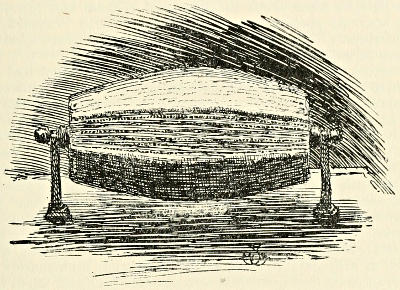
Baked Clay Cylinder of Sargon II, King of Assyria, B.C. 722-705, inscribed with a Chronicle of his Expedition
The Assyrians stand, in a literary sense, in about the same relation to the Babylonians as the Romans to the Greeks, disciples who never equalled their masters, although as far as can be seen, even relatively considered, Roman literature stands higher in relation to Greek than Assyrian stands in relation to Babylonian. The tendency of the Assyrians was warlike, and directed to practical ideas: to found a mighty empire, and to maintain their supremacy was the end for which they strove. Therefore they were more interested in history than in creations of the imagination; purely literary work had little charm for them. Only much later, a desire is awakened in them to become acquainted with the productions of the Babylonians in this field, and to acquire as much as possible of it for themselves. And perhaps even here interest in the ancient religions and national traditions played a greater rôle than love for poetry.
The Assyrians seem to have had more taste for what may be designated the science of the period, than for literature. Here also, they were following the lead of the Babylonians, and accomplished little beyond taking possession of the treasures of the Babylonian libraries. The prestige which attached to the Babylonians in antiquity as the earliest cultivators of science is well known, although some thought that they had borrowed it from the Egyptians. Without doubt they reached the greatest eminence in antiquity in the knowledge of astronomy. Kalisthenes sent Aristotle astronomical observations from Babylon, which, according to the most moderate statement, reach back to 1903 before Alexander, i.e., 2324 B.C.; and there is nothing improbable in this. The number of eclipses mentioned on the astronomical tablets would lead to a conclusion that there was an even longer period of recorded calculations. It may be that the Ziggurat of the temples, which originally had a religious significance, might, in Assyria at least, have been used as observatories. It has even been surmised that the Babylonians had some sort of a telescope, and this surmise rests upon the finding of a lens in the ruins, and upon the fact that they were acquainted with the planet Saturn, which is invisible to the naked eye; but this doss not seem probable. One thing is certain, they gave names to the constellations, especially to the signs of the Zodiac, which have in part remained in use. They were acquainted with five planets, and distinguished them very exactly from the other heavenly bodies. They observed, and with great accuracy, the eclipses of the sun and moon, perhaps also the sun spots, the comets, the orbit of Venus, and the position of the Polar star; but they had some very childish ideas about the causes of eclipses and the character of the other heavenly phenomena. Naturally the Milky Way did not escape their observation. They even calculated the regular recurrence of eclipses of the moon as well as its phases.
A few of the mathematical tablets extant prove that they had made great progress in arithmetic and higher mathematics, so indispensable to the study of astronomy. The prevalent system was the sexagesimal, with the 60 as the unit, but the decimal system seems to have been known and used. However in spite of the recognition of the high value of these researches, they hardly deserve the name of science. These researches were certainly not undertaken from a love of science. The prime object, no doubt, was to discover the will of the gods in regard to the future. The science of mathematics itself was made subservient to the art of divination. Astronomy was a secondary object, astrology the principal one. Knowledge was sought of what must happen when there should be a recurrence of certain phases of stars and heavenly bodies. All observations of planets, comets, and other stars, of eclipses and other phenomena, were immediately connected with occurrences on earth, which at some former time had fallen in conjunction with them and consequently must be expected again.
No more were other branches of science besides astronomy cultivated for their own sakes. Their science of medicine was based almost entirely upon magic, and appears to have stood on a lower plane than that of the Egyptians, at least in so far as the still existing inscriptions will permit us to judge. They indeed used as did the Vedic Indians external and internal remedies, but they probably regarded them as charms; whatever progress they may have made in the science of medicine, the records of it in the ancient inscriptions prove that it was somewhat less than what we know of the Vedic physicians and their cures. Thus it is rather an exaggeration to speak of physical, geographical, grammatical, and mythological writings of the Babylonians and Assyrians, unless the myths and legends belonging to literature already discussed are meant.
There are various reasons for the supposition that each of the Babylonian libraries according to the studies of the several religious and scientific schools had a distinctive character. The Assyrian libraries, on the other hand, being all of later date, had more general and more varied contents.
The idea that these libraries were for the use of the general public, is not well founded, and rather improbable. They were probably designed in the first place, for the learned men and scribes of the king, as well as for his own use, for the instruction of his sons, and future officials, as well as for archives of the state. They do not in the least prove that culture, learning, and erudition were the property of all classes in Assyria.h
Epistolary Literature
At the same time the large number of written private documents which have been unearthed—the letters and contract tablets—show that writing was not an unusual thing among the people as a whole.
From one point of view these old letters are the most interesting form of Babylonian literature because they show better than anything else the real life of the nation. At first thought it may seem that a correspondence on clay must have been cumbersome, but most of these little letters were not so large as an ordinary envelope and some of them were only two or three inches long, and could easily be carried in the pocket. Some of them were enclosed in an outer envelope of clay which frequently contained a copy of the real document within.
In connection with the code of Khammurabi, his correspondence with one of his officials, Sin-idinnam, is particularly interesting because in these letters we find references to the same subjects which are treated of in the laws. In them all, we see Khammurabi attending to the minutest affairs of his kingdom, taking a personal interest in everything. It seems to have been a comparatively easy matter to get the king’s ear. He received letters complaining of things we should perhaps consider beneath the notice of a powerful king, and he seems to have devoted careful thought to all.
The letters of Khammurabi have been edited and translated by Mr. L. W. King, of the British Museum. They have been also translated by Dr. G. Nageli for a doctor’s dissertation, at Berlin, and published in the Beiträge zur Assyriologie, vol. IV. Some of the latter’s translations are given below.a
To Sin-idinnam say: Thus saith Khammurabi. Naram-Sin the keeper of flocks hath said: “To the leaders of the troops have our shepherd lads been given.” Thus did he say. The shepherd lads of Apil-Shamash and of Naram-Sin must not be given to the troopers. Now send to Etil-hi-Marduk and his fellows that they give back the shepherd lads of Apil-Shamash and of Naram-Sin which they have taken.
To Sin-idinnam say: Thus saith Khammurabi. The whole canal was dug, but it was not dug clear into Erech, so that water does not come into the city. Also … on the bank of the Duru canal has fallen in. This labour is not too much for the people at thy command to do in three days. Directly upon receipt of this writing dig the canal with all the people at thy command, clear into the city of Erech, within three days. As soon as thou hast dug the canal, do the work which I have commanded thee.
To Sin-idinnam say: Thus saith Khammurabi. Tummumu of Nippur has announced to me as follows: “In the place Unaburu (?) I deposited seventy tons of grain in a granary (?). Avel-ilu has opened the granary and taken the grain.” Thus did he tell me. See, I am sending Tummumu to thee with this. Let Avel-ilu be brought before thee. Examine their dispute. The grain belonging to Tummumu which Avel-ilu took, he shall give back to Tummumu.
To Sin-idinnam say: Thus saith Khammurabi. See, I have ordered and sent Sin-aiaba-iddina, Guzalu and Shatammu to the war. They will reach thee on the 12th day of Marshewan. When they have reached thee, do thou proceed with them. The cows and flocks of thy province, put into safe keeping. Also Nabu-malik, Ilu-naditum, Shamash-mushalim, Sin-usili, Taribum, and Idin-Ninshah shall go with thee and take part in the war.
To Sin-idinnam say: Thus saith Khammurabi. Immediately upon receipt of this letter, have all the keepers of thy temple and Ardi-Shamash, the son of Eriban, the shepherd of the Shamash temple come before thee, together with their complete account. Send them to Babylon to give their account. Let them ride day and night. Within two days they should be in Babylon.i
We also have examples of the private correspondence of the same period, showing the style of letter one Babylonian wrote to another. The following remarks and translations of letters are taken from a dissertation giving letters from the time of Khammurabi.a
The insignificant contents of some of these letters show that letter writing at that time was a general custom and the theory again and again thrusts itself forward that a comparatively regular postal service was already in existence. These letters also show how far Babylonian commerce extended in the second half of the third century before Christ. Every letter throws new light upon that far distant past and helps us to form an ever surer picture of the daily life of the old Babylonian people. Following are a few examples to give an idea of the epistolary style.
To my father say: Thus speaks Elmeshu. May Shamash and Marduk keep my father alive forever. Mayest thou, my father, be in health, mayest thou live. May the protecting deity of my father lift up the head of my father in favour. To greet my father have I written. May the prosperity of my father before Shamash and Marduk endure forever. After Sin and Ramman had spoken thy name, my father,[33] thou, my father, didst speak as follows: “As soon as I come to Der-Ammizadaduga on the Sharku canal, I will send thee, within a short space, a lamb with five mina of silver.” This didst thou say, my father. My father made me expectant, but thou hast sent nothing. Now after thou, my father, hadst started out to Taribu, the queen, I sent a letter to my father. Thou, my father, hast never voluntarily sent anyone who brought (even) a silver shekel. In accordance with the … of Sin and Ramman who have blessed my father, may my father send me that for which I am eager, so will my heart not be grieved, and I will pray for my father to Shamash and Marduk.
To my lord, say: Thus speaketh Belshunu, thy slave. Since I have been confined in prison thou, my lord, hast kept me alive. What is the reason that for five months my lord has neglected me? The house in which I am confined is a house of want. Now I have sent the Mar-abulli (gate-keeper[?]) to you with a letter. I am also ill. May my lord have pity on me, send me corn and vegetables so that I may not die. Send me also a dress to cover my nakedness. Either a half shekel of silver or two mina of wool let him (Mar-abulli) bring, for my service let him bring it. Let not Mar-abulli be sent empty away. If he cometh empty, the dogs will devour me. As thou, my lord, so also every inhabitant of Sippar and Babylon knows that I am confined without guilt; not because of a bilshu, I have been imprisoned. Thou, my lord, didst send me beyond the river to carry oil, but the Sutu people met me and took me captive. Speak a favourable word to the servant of the king’s grand vizir. Send, that I die not in the house of need. Send one ka of oil and five ka of salt. What thou didst send a short time ago was not delivered. Whatever thou sendest, send it well guarded.
To my father say: Thus saith Zimri-erah. May Shamash and Marduk give my father everlasting life. Ibi-Ninshah the younger brother of Nur-ilishu has fallen upon Nabu-atpalam and beaten him; he has also spoken insults concerning me which are not to be endured. I shall beat the young man! Wherefore has he cursed me? I have as yet said nothing to the person. I thought to myself: “I will send to my father, let him send his decision about the matter, and then I will speak to the person.” Now I have sent a tablet to Nabu-atpalam, for information in this matter. Up! make a decision in this matter, send your judgment, give (?) a word.
To the secretary of the merchants of Sippar, Iahruru speak: Thus saith Ammidatitana. The wool dealer has informed me as follows: “I have written to the secretary of the merchants of Sippar, Iahruru to send his spun wool to Babylon, but he has not sent his spun wool.” Thus has he informed me. Why hast thou not sent thy spun wool to Babylon? Since thou hast not feared to do this thing, so send—as soon as thou seest this tablet—thy spun wool to Babylon.[34]
To Appa speak: Thus saith Gimil-Marduk. May Shamash keep thee alive. I have spoken in thy behalf to the person in question and he said; “Let him come so that he may speak.” And the tablets which thou didst take to examine, take them according to thy examination and come quickly.
To Etil-Shamash-iddina speak: Thus saith Avel-Ruhati. May Shamash and Ishtar keep thee alive; I am well. Humtani has given for Amti-Shamash 8⅚ kat and 15 she of silver. To Musalimma, I will give the money wherever he commands. I am going into the service of the king’s daughter. I will quickly send thy desire. Send an answer to my tablet.j
Among the large number of letters which have been preserved it has been possible to find more than one written by the same person, and, by putting these together, to get some idea of the life and character of the writer. The letters of a certain Bel-Ibni are prominent among these. They contain allusions to historical events mentioned on the monuments, thus contributing valuable details to these rather barren records of events. Bel-Ibni himself was a general in the army of Ashurbanapal. Below is a translation of one of these letters made by Dr. C. Johnston,k in the Epistolary literature of the Assyrians and Babylonians in the Journal of the American Oriental Society, vol. XVIII.a
To the lord of kings, my lord, thy servant Bel-Ibni! May Ashur, Shamash and Marduk decree length of days, health of mind and body for the lord of kings, my lord! Shuma, the son of Sham-iddina, son of Gakhal, son of Tammaritu’s sister, fleeing from Elam, reached the (country of the) Dakkha. I took him under my protection and transferred him from Dakkha (hither). He is ill. As soon as he completely recovers his health, I shall send him to the king, my lord.
A messenger has come to him (with the news) that Nadan and the Pukudeans of Til … had a meeting with Nabu-bel-shumate at the city of Targibati, and they took a neutral oath to this effect: “According to agreement we shall send you whatever news we may hear.” To bind the bargain (?) they purchased from him fifty head of cattle, and also said to him: “Our sheep shall come and graze in the pasture (?) among the Ubanateans, in order that you may have confidence in us.” Now (I should advise that) a messenger of my lord, the king, come, and give Nadan plainly to understand as follows: “If thou sendest anything to Elam for sale, or if a single sheep gets over to the Elamite pasture (?) I will not let thee live.” The king, my lord, may thoroughly rely upon my report.k
Professor Delitzsch in an article in the Beiträge zur Assyriologie, vol. I. entitled Beiträge zur Erklärung der babylonisch-assyrischen Brieflitteratur, has given a translation of a letter from the king to this same Bel-Ibni:
The word of the king to Bel-Ibni: May my greeting make glad thy heart! Concerning thy communication about the Pukudeans on the river Charru—In the future, whoever loves the house of his lords, shall communicate whatever he sees and hears to his lords. See! whilst thou inform me concerning the cause of thy communication.l
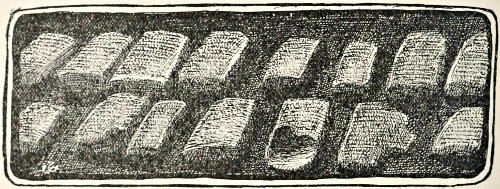
Baked Clay Tablets from the Library of Asshurbanapal at Nineveh
Some of the letters throw light on religious ceremonies, others are communications from astrologers telling whether or not the signs of the heavens are propitious for certain undertakings. There are still others from physicians telling of patients under their care. The following is translated by Dr. Johnston:a
To the king, my lord, thy servant, Arad-Nana! Greeting most heartily to my lord, the king! May Adar and Gula grant health of mind and body to my lord, the king. A hearty greeting to the son of the king.… With regard to the patient who has a bleeding from his nose, the Rab-mugi reports: “Yesterday, towards evening, there was much hemorrhage.” Those dressings are not scientifically applied. They are placed on the alæ of the nose, oppress the breathing, and come off when there is hemorrhage. Let them be placed within the nostrils, and then the air will be kept away and the hemorrhage restrained. If it is agreeable to my lord, the king, I will go to-morrow and give instructions; (meantime) let me hear how he does.k
Several letters have been preserved of a certain Ishtar-duri, who appears to have lived during the reign of Sargon (722-705 B.C.), and was perhaps identical with the eponym of the same name in the year 714. Dr. Johnston has translated a communication of his to the king:a
To the king, my lord, thy servant Ishtar-duri! Greeting to the king, my lord! I send forthwith to my lord, the king, in company with my messenger, the physicians Nabu-shum-iddina and Nabu-erba, of whom I spoke to the king, my lord. Let them be admitted to the presence of the king, my lord, and let the king, my lord, converse with them. I have not disclosed (to them) the true facts, but have told them nothing. As the king, my lord, commands, (so) has it been done.
Shamash-bel-uçur sends word from Der: “We have no inscriptions to place upon the temple walls.” I send therefore to the king, my lord, (to ask) that one inscription be written out and sent immediately, (and that) the rest be speedily written, so that they may place them upon the temple walls.
There has been a great deal of rain, (but) the harvest is gathered. May the heart of the king, my lord, be of good cheer!k
ART
Art occupies too prominent a position in the life of the Babylonians and Assyrians, and they have produced too much that is original and peculiar to them, for this history to pass over the question in silence. Even a mere sketch of their culture would be incomplete without it. At the same time great precaution is necessary. In the determination of the chronological succession of undated monuments so much depends on subjective valuation and æsthetic judgment that, without a long and conscientious study of the history of art, one is liable to serious error. And the determination of dates largely influences one’s conception of the progress of Babylonian-Assyrian art; æsthetic judgment, one’s decision concerning the character, independence, and value of this artistic effort.
Here again, as in the language, religion, and in the whole civilisation of this people the unity of the Babylonian-Assyrian race comes clearly to light. Whatever differences may exist between Babylonian and Assyrian art in the conception of detail, in certain peculiarities of technique, in the choice of subjects, at bottom they are one. It has ever been characterised as a national school in which one and the same character prevails, so that a work of art, be it from Telloh, Babylon, Nineveh, or Kalah, at once shows its connection with it. All the differences are merely shades, changes caused by time. This is especially noticeable when one considers what material for example was used for building. In Babylonia it is difficult to obtain stone; there are no rocks there. Consequently this material, which had to be brought from a distance, and was therefore expensive, was kept like precious and other metals for the decoration of the whole, for pillars, bas-reliefs, dedicatory inscriptions, etc., or for making a firm foundation, while dried and burnt bricks were used for the buildings themselves. Among the Assyrians this difficulty did not exist. Excellent stone, which was easily worked, was found in close proximity, and the Assyrians understood how to hew and shape it. In spite of this, they imitated the Babylonian custom and used mainly bricks for their buildings. They preferred continually to repair these temples and palaces, which soon fell into ruin, or else to replace them by others, rather than to depart from the traditional mode of building of their ancestors.
The question has been raised as to whether Babylonian-Assyrian art may not perhaps have been a daughter of the Egyptian. Without doubt Assyrian art was at least influenced by it. All the ivory objects which have yet been found are plainly imitations of Egyptian motives, although they were certainly not made by Egyptians, and some of them date from the time of Asshurnazirpal. The lotus ornament also, which is so often used as a temple decoration, points to an Egyptian origin. Perhaps, however, the models were not borrowed directly from the Egyptians. Certain dishes and cups for drink-offering, which occur in Mesopotamia, as well as in western Asia and southern Europe, are plainly ornamented with Egyptian cartouches, hieroglyphics, and symbols, but in such a divergent form that no Egyptian could have made them; and these objects have the name of the artificer in Aramaic characters on the border or back. It is thus plainly to be seen that this Egyptian fashion wandered into Assyria through the influence of Aramäen artists.
When it is acknowledged, however, that Egyptian patterns were imitated by the Assyrians at a comparatively late date, and that Egyptian motives were borrowed from her artists, it does not by any means follow that Babylonian-Assyrian art as a whole was of Egyptian origin. This could be proved only from the oldest monuments to be found in Babylonia. It was in fact believed, when the art works of Telloh first became known, that they showed a great similarity to the products of Egyptian art. They displayed the same simplicity and naïveness, the same clean-shorn heads and faces, and many other coincidences. The connoisseurs of art, however, believe differently. The similarity is great; nevertheless a careful examination shows the independence of Babylonian art in respect to Egyptian. Thus in the oldest monuments the same peculiarities, truth and strength, appear, which in the later development of art among the Assyrians were so greatly exaggerated, whereas they are wholly lacking in Egyptian figures.
A further similarity is found between the oldest pyramids in the Nile valley and the Babylonian-Assyrian Ziggurat. In the first place, however, the pyramids had a wholly different object from the Ziggurat, and, in the second place, it must not be forgotten that the Babylonian temple architecture varies greatly from the Egyptian. If there is any dependence it is not on the side of the Chaldeans; they did not borrow their art from the Egyptians. At the same time the similarities are so remarkable, especially between the old Chaldaic statues and the oldest productions of Egyptian sculpture, such as the statues of Shafra, Chufu, and Ra-em-ke, that we are compelled here, as in the case of the writing, to suppose a common stock out of which both branches grew independently and in a way peculiar to each.
The important discoveries made by the French consul, De Sarsac, at Telloh have first thrown some light on the old Chaldean art in which the whole Babylonian-Assyrian art has taken its origin. The question as to whether the works of art found there are Semitic or non-Semitic does not concern us here. It is more probably the latter. At any rate we are here confronted with a civilisation preceding the flourishing period of the known Semitic dominion in Babylonia.[35] A temple was found there 53 by 31 metres square which shows the same fundamental plan as the later Chaldean architecture, that is, a structure of burnt on a foundation of dried brick, the corners exactly facing the points of the compass (not the side as in Egypt), a Ziggurat in the centre, the whole, as is seen from stamps on the stones, dating from the time of the priest-prince Gudra, who is known from other sources, and who rebuilt or founded this temple. Besides, a large number of larger and smaller works of art were discovered, cylinders, reliefs, bronze objects, especially statues, which had been collected either by the ruler already mentioned or by other priestly princes or kings.h
Before building a temple or palace, a religious ceremony took place corresponding to what we call to-day laying the corner-stone. Nabuna’id relates that in the ruins of the oldest Chaldean temples he looked for the foundation stone, the temen which the original kings had placed there, and that he had the good fortune to find this corner-stone, whereas several of his predecessors had excavated only in vain. In our days such cylindrical tubes have been found covered with close writing difficult to decipher, which had been placed in little niches at the corners of the foundation facing the four points of the compass. Thus at Nimrod, Rawlinson caused excavations to be carried on in one of the corners of the tower, feeling sure that he would find objects similar to those which had been met with elsewhere. He relates his discovery as follows: “At the end of half an hour a small cavity was found. ‘Bring me,’” said Rawlinson to the man in charge of the digging, “‘bring me the dedicatory cylinder.’ The workman put his hand into the hole and showed the cylinder; those present could not believe their eyes and looked at each other in amazement. The cylinder, covered with inscriptions, then came out of the hiding-place where it had been placed probably by the hands of Nebuchadrezzar himself, and where it had lain for twenty-nine centuries.” In the fruitful excavations which he undertook at Telloh, De Sarsac made similar discoveries. “I found,” said he, “at a depth of scarcely thirty centimeters under the original soil, four cubes of masonry of large bricks and bitumen, measuring eighty centimeters on each side. In the centre of these cubes was a cavity of twenty-seven centimeters by twelve and by thirty-five of depth. This cavity filled with yellow sand enclosed a statuette of bronze, representing now a man kneeling, again a woman standing, sometimes also a bull. At the foot of each statue, usually embedded in the bitumen which lined the cavity, were found two stone tablets, one white, the other black. It was the black one which usually bore an inscription in cuneiform characters, like or almost like the one carved on the figure of bronze.” Moreover De Sarsac in place of statuettes found cones of clay in the shape of large nails with hemispherical heads, and having an inscription around the stem.m
It has been believed that three stages of development may be detected in this ancient art. To the first belong the reliefs, which represent scenes of war and burial which have not yet been satisfactorily explained, drawn very awkwardly and comparatively rough and primitive. This stage represents the infancy of art. To the second stage are counted the eight statues of Gudea and the one of Ur-ba-’u which are carved with great skill and fine artistic feeling out of hard stone, as it appears of diorite.
The strength which characterises the sculptural efforts of the Babylonians and especially of the Assyrians, is already manifest, although without that exaggeration of the muscles and joints which is so pronounced with the latter. Hands and feet in particular are most carefully executed. The heads are totally different from the hairy and bearded Assyrian, or even early Babylonian heads. They are perfectly clean shaven, but sometimes seemingly decked with an artificial hair arrangement or something of that sort; all just as in Egypt. In addition, an attempt to suggest the folds of draperies is seen, which we do not find among the Babylonians and Assyrians nor the Egyptians, but only later among the Persians and Greeks. In the third so-called classic period are placed works of art of most finished execution, which show a decided advance, among which are pictures, in which beard and hair are worked out with the greatest care.
It would be exaggerated scepticism to deny that these art productions exceed in antiquity, nearly everything found in Babylonia until now. The only exception could be the beautiful cylinder of the time of Sargon I, if we assume that this monarch reigned about 3800 B.C., and that this work of art is of his time. But this is by no means established as a fact.
It can also not be denied that these creations of early Chaldaic art, although in some instances only feeble attempts, in others, however, are of such finished perfection, that in succeeding periods they were never excelled and seldom equalled.
We have here a similar case to one in Egypt, where, for instance, under the kings of the fourth dynasty, sculpture reached an eminence, which nothing of later date ever approached, and where the oldest works of art have a value which none of the Egyptian sculptures of the following centuries can claim. In both these countries therefore there is an early, surprisingly rapid development, followed by a speedy decline; where even in succeeding brilliant epochs no successful attempts to equal the results of the first florescence were ever made. Such a phenomenon is all the more striking when it is considered that these later epochs, whether in Egypt, in Babel, or in Asshur, were by no means periods of degeneration, but show, although with continual fluctuations, marked progress in literature, science, government, and general culture. It seems probable that the cause lies in the difference of race. The artists who carved the statues of King Schafra, were no more Semites than, judging from all appearances and from the facial types of the monarchs, pictured, were the sculptors who immortalised King Gudea. Later on the Egyptian population became more and more affected by Semitic elements, and under the increasing influence of the Semites, art declined.
Not until under the Saits, who certainly were not descended from a race intermixed with Semitic blood, did art rise again to a height which recalled the palmy days of the ancient realm. Thus early Chaldaic art was the mother of that of Babylonia and Assyria, and the Semites of Babylon and Asshur proved themselves diligent students, gifted imitators, who gave to their works also the stamp of their own genius; but they were never more than students and imitators, they never produced anything original which might stand in equality by the side of early Chaldaic art. The Semitic race occupies one of the foremost positions in the history of civilisation, and is highly talented. But in architecture and sculpture it has always worked in close connection with foreign masters, and never produced anything really great by itself.[36] The further it goes from the ancient centres, where the great tradition of the former so highly developed art still lived on, the more unskilful become its productions in this field. Assyria where the Semitic blood was purer than in Babylonia, and which was certainly surpassed in art by the latter, Phœnicia, Palestine, and Arabia, are proofs of this. Only when the Semites have handed down the old tradition which they have at least preserved, to the Aryans, the Persians, and Greeks, is there an independent higher development of plastic art. Be that as it may, considered as artists, the Babylonians and Assyrians stand foremost among the Semites, but they are indebted for this to the early Chaldeans.
The character of the Babylonian-Assyrian building has remained in general about the same, from the earliest times, until the destruction of the nation. The architect, more than any other artist, is dependent upon the nature of the material at his disposal; and this in Babylonia was almost exclusively in the form of tiles of clay, either dried in the sun, or baked in the fire. The former, which were made most skilfully in Babylonia, were generally used for foundations, either by simply placing them in layers, or cementing them with wet clay or pitch, or, as in the substructures of the Assyrian palaces, by using them while still in a moist condition, in order that under the pressure of the superstructure they might be united in one solid mass. For the covering of the walls, baked tiles were used. Enamelled or glazed bricks were used in those parts of the building which were most exposed to moisture or the changes of the weather. In Assyria where stone was not expensive this was also used as the outer coating of walls. This, however, is the only important variation which the Assyrian architects allowed themselves. Although it would have been easier for them to erect more beautiful, more pleasing, and certainly more durable buildings of stone, they were not able to rise to the attempt, although they had only to carry out and use in larger measure what had already been found in Chaldea. A short step was indeed taken in this direction.
The Babylonians already knew how to make wooden pillars or columns, probably covered with metal, and made use of them in lighter architecture, as for instance the Naos, or canopy over the figures of the gods. The Assyrians not only copied this, but built columns of stone, and a certain originality and gracefulness in the capitals and bases of their pillars is not to be denied. However, the column never played the same important rôle in their architecture as it does, for instance, in the Græco-Roman and even in the Egyptian. In their great buildings they clung almost servilely to the designs handed down during centuries. The question as to whether the buildings had more than one story, was formerly almost generally admitted as a fact, but it is generally denied now, and can really hardly be determined. The ruins give no positive support to either theory; but a few reliefs give representations of two-storied buildings.
Tile construction presents necessarily a certain monotony which is here accentuated by the absence of windows. To relieve this monotony, glazing, colouring, or woodwork were resorted to, in case the use of columns was excluded; sometimes more artistic measures were used, such as projecting pilasters, which in Chaldea were somewhat crude, but richly ornamented in Assyria; also mosaics of conical form, or decorations of vases on the walls. The upper stones of the walls were decorated with battlements. The inner, as well as the outer walls, had a stone covering up to a certain height, and higher up a polychromatic layer of stucco. Ivory, and particularly bronze decorations, were much employed. In spite of all this, the impression given by Babylonian and Assyrian buildings is one of massiveness, almost clumsiness, and the decorations seem childish, paltry, and commonplace. Hence also the disproportion of length and breadth, in other words the elongated form of the rooms, whose roof not being supported by columns, had to rest on the side walls, and whose breadth depended on the length of the roof beams.
On the other hand, the almost exclusive use of tiles had this advantageous result, that it was almost imperative to make prodigal use of arch and vault construction. That the Chaldaic architects were the inventors of these constructions, with which the Etruscans were formerly erroneously credited, cannot be positively affirmed, for they are also found in Egypt, although seldom made use of there. Without doubt, however, the Babylonians and Assyrians developed them greatly and knew how to make use of them with great skill. From the false arch, which is formed by allowing each succeeding layer of stone to project over the foregoing one, to the finished arch, all kinds are represented by them. Not only were all underground canals and sewers, vaults of masonry, but all gateways ended in arches, and even the ceilings of some apartments, particularly those in the part of the palaces which seems to have been the harem were wholly or partially vaulted.
The Babylonians and Assyrians have built extensively many and great cities enclosed within mighty walls, extended palaces and peculiar temples. They cannot be enumerated here or even described in general terms.
A few important points, however, may be touched upon. In the first place it must be noticed that, while in Egypt the monumental buildings were tombs and temples, in Babylon and Asshur they were mainly palaces. Although no pains nor expense were spared in the erection of the temples, they were smaller than the palaces, of which they were in some cases certainly annexes.
The tombs were constructed with great care, in order to guard against the rapid decay of the corpses, yet the inhabitants of Mesopotamia never reached the same degree of perfection in the embalming of bodies as the Egyptians: they were also fitted out with everything that, according to their faith, was necessary for the dead, but they were piled upon each other, and thus excluded from view. Art was not expended upon them; on the other hand, however, all known means of art were used to decorate the residences of the kings and the earthly habitations of the gods in the most splendid and sumptuous manner. Their size increased continually. The early Chaldaic palace discovered at Telloh, had an area of only 53 meters long by 31 broad; the so-called Wasevas at Warka (Erech) was 200 meters long by 150 broad; the palace of Sargon II at Dur-Sharrukin covered an area of about 10 hectares, and contained 30 open courts and more than 200 apartments. Under the Sargonids the rooms also became larger. One in the palace of Sennacherib was almost as long as the entire palace at Telloh, i.e., 46 meters long by 12 wide. Another in the palace of Esarhaddon, which was intended to be 15 meters by 12 meters, remained unfinished, probably on account of the difficulty of construction. The palace of Asshurbanapal was of somewhat smaller, though still magnificent proportions. The great palace of Nebuchadrezzar II, consisting of the old palace of his father and a new one constructed by him and joined to the old, has not yet been sufficiently explored, but according to the descriptions, must have surpassed in splendour, if not in size, all those of his predecessors. All palaces were constructed on the same plan, and contained separate living apartments for the king and his court, for his wives, for the lower court officials, and, as it appears, also a temple with various sanctuaries and a tower.
Too little is as yet known of the Babylonian-Assyrian temples to judge with any certainty of their style of architecture. Here and there, remains of temples have been found, but it has not yet been proved that the buildings designated as temples were really devoted to religious purposes. Most of the temples seem to have been small, at any rate not intended for large assemblages. The altar stood outside and consequently the religious services must usually have taken place there.
Every large town had many temples but always only one Ziggurat. This constituted only one part of the principal temple, albeit the most prominent one. There were various kinds of such towers, of three or more, sometimes seven stories, which were attainable by a single inclined plane encircling the whole building, or a double one rising on two sides of it. The ground plan was a perfect square in some, in others a parallelogram; all rested, however, on a massive substructure, and seem to have been crowned with a small sanctuary.
Although these principal temples, including the Ziggurat, were not of equal extent with the royal palaces, they were nevertheless imposing buildings, and the towers in particular were erected with much care and at great expense. It would be wrong to conclude from this ratio of temples and palaces that the Assyrians were less religious and more servile than the Egyptians, who, entirely dominated as they were by the dogma of immortality, lavished more care on the tombs of the dead kings than on the habitations of the living ones. The valuable decorations and sculptures which the Assyrians and Babylonians gave to their gods prove their pious tendency. In reality the whole palace was a sacred edifice in which the representative of the deity lived on earth with and beside his god.
The aid which architecture received from other arts has already been briefly mentioned. There are still a few particulars to be noticed in regard to this point. The Assyrians as well as the Babylonians were skilful workers in bronze. Proofs of this are the bronze door-sill 1½ meters long, found at Borsippa, whose decorations of rosettes and squares are in very good taste, and particularly the bronze gates at Balawat, belonging to the 9th century B.C., which are masterpieces of their kind, and a great number of other remains.
Painting was also employed to decorate the exterior as well as the interior of walls. Ornaments and figures were painted with great skill on stucco, al fresco in such a case, or on tiles which were afterwards glazed. These tiles were sometimes joined to make one picture. In what remains of such work it is shown that painting had attained quite an eminence in Babylon and Asshur. Drawing and grouping are often very successful, and the treatment has often a certain breadth. These paintings are also important because it is seen from them how much conventionality prevailed in Assyrian sculpture. In painting there is nothing of that exaggerated muscularity nor of the almost clumsy strength of the sculptured figures. Beard and hair are not as stiffly curled as in the sculptures, but hang more loosely and naturally.h A beautiful example of glazed tiling has recently been excavated by the Deutsche Orient Gesellschaft at Babylon. It is in the so-called Procession street leading from Babylon to Borsippa; on either side of the street were walls faced with coloured tiles representing a stately procession of lions and other animals, very artistically drawn.a
Sculpture, more than painting, was employed in decorating buildings, the works of which covered the greater part of the palace walls, and ornamented the gateways, courts, terraces, and apartments. The material which the sculptor used in Chaldea was usually valuable stone difficult to procure, such as basalt, dolorite, diorite; in Assyria, generally a commoner, more easily worked species, such as alabaster and sandstone. The difference of material naturally influenced the work itself. Figures of cast bronze are also often found.
The inscriptions of the Babylonian kings often speak of columns erected in honour of the gods, of which some were made of solid gold or silver, others only coated with precious metal, and the Assyrian kings also mention such dedications. Naturally the columns of precious metal have not survived, but a great number of stone pillars have been found. It may be chance, that the greater number of statues in the round are from Babylon, the greater number of bas-reliefs from Assyria. The objects of these surviving sculptures are mainly of a religious or historical character. But rarely does a representation of the domestic life of the monarch or other social circles appear.
Only once is a banquet pictured, that of king Asshurbanapal and his queen. Otherwise no women, except captives, appear in the reliefs. On the whole little tendency is shown to represent female beauty and grace, as compared with the Egyptians and especially with the Greeks. The nude female figure is seldom pictured, and if so, in a repulsively realistic form, as in the small figures of the mother goddess. Cheerful or comic scenes, which are not wanting even in Egyptian reliefs and vignettes, are never found here. Hasty conclusions, however, should not be drawn from this, and it should not be forgotten, that most of the surviving reliefs are from the palaces, few from the temples, still fewer from the tombs, and none at all from private residences. This is doubtless one of the reasons why representations of domestic or private life are so scarce. In fact, in a few of the tombs reliefs have been found whose subjects recall favourite representations in those of Egypt. Most prevalent certainly, are those scenes relating to religious and public life.
In the treatment of these objects, truth is often sacrificed to certain conventionalities. Thus for instance the Lamassi and Shedi, the man-headed lions and bulls have five legs, in order that they may always present four to the eye, whether viewed from the front or the side; the heads are usually represented in profile with the eyes in full face, but sometimes in full face, although the image presents a side view to the beholder, which was also customary in Egypt; so also, the stiff curling of the hair and beard is unnatural. Apparently no attempt had ever been made in Egypt to make portraits of historical personages, and the individual differences of rank and condition can only be recognised by objects of secondary importance. There is, however, still some doubt upon this point. There is indeed a great uniformity, but an attempt at least to differentiate facial traits cannot be overlooked. Ignoring all accessories, the features differ among kings and higher courtiers on the one hand, and lower men-at-arms on the other, among men and eunuchs, among adults and youths. Wherever the artists of Mesopotamia were not limited by conventionality,—notably in the representation of animals,—they have surpassed in accuracy, in truth and strength of representation all other nations of antiquity, the Greeks hardly excepted. This is particularly true of the representation of native animals, yet foreign ones were treated with great skill, although the delineation of these betrays less practice. Even in the picturing of therianthropic deities, they remain as true to nature as possible, and with much taste and tact allow the human attributes of the figure to predominate. Wherever it is possible to partially or wholly break away from tradition, their talent is displayed in a manner truly marvellous. Their only prominent fault is their exaggerated realism, which shows itself not only in the monstrous drawing of muscles and joints, but also in the disgusting details of the nude figures of Astarte.
Too little of the sculpture of the new Babylonian realm has been preserved to allow judgment of the state of art during this period. The well known carving of Nebuchadrezzar II on a cameo would force us to have a very high opinion of it, if convincing reasons did not argue that, although genuine, it is the work of a foreign, probably a Cyprian, artist.
There is no doubt that the art of music was cultivated among the Babylonians and Assyrians, since the reliefs show musicians very frequently, at religious festivals, at triumphal greetings of the victorious king and at festivities. They play singly or in concert, and also accompany singing. The musical instruments are of various kinds, and the musicians, who are sometimes very daintily attired, are not always eunuchs, and are of different ages.
On the whole it must be conceded, that the Assyrio-Babylonian nation was artistically inclined and that it cultivated various branches of art with talent and success. If they, the Assyrians in particular, had been able to free themselves from tradition, they might have surpassed their predecessors and teachers. They practised art, however, not for itself alone, but as a means of glorifying the gods or the kings, and the historical reliefs at least, are for the greater part nothing more than illustrations to the inscriptions, a sort of war-report in pictures. They were not an artistic people like the Greeks. Still they have produced more and better results in this respect, than all other nations of their race put together. And although in some special instances they may have been excelled by the Egyptians, in others they are far in advance of them. The Assyrians, following the example of the Babylonians, showed their artistic talents also in the productions of their industries; art and industry were with them closely related.
Among the productions to be considered here are primarily the hundreds of seals, which are still in preservation, and whose number will not seem so surprising when it is remembered that every Babylonian and Assyrian of quality had his private seal. In early times these were always, and in later times generally, cylinders, pierced through the centre, to be worn around the neck suspended from a cord. The impression was made by rolling them over moist clay. After the eighth century conical and half-spherical seals appear. These cylinders are made of many different materials, at first, of easily carved, later of harder, material, such as porphyry, basalt, ferruginous marble, serpentine, syenite and hematite. After that, semi-precious stones were used, jasper, agate, onyx, chalcedony, rock-crystal, garnet, etc. In the oldest stones the pictured objects were rather suggested by indentations and strokes, than actually executed and carved; but gradually a great skilfulness was attained, and there are beautiful cuttings in the hard stones also. The execution varied greatly of course, not only in proportion to the talent of the artist, but also according to the rank and wealth of the person who gave the commission. The subjects chosen are mostly of a religious nature, the adoration of a goddess, an offering of sacrifice, various emblems such as winged animals, sun, moon, and stars, and very frequently the tree of life, in whose shadow stand two persons, or which is guarded by two genii. Under the new Babylonian dominion and under the Achamenides, glyptics as an art declined rapidly.
Ceramic art seems not to have occupied a very lofty position in Babylonia at first. Clay vases and utensils, during a long period made by hand, are crude and inartistic in earliest times. Gradually with the introduction of the potter’s wheel, however, they become more graceful in form, and towards the end of the Assyrian period are enamelled and decorated with patterns painted in colours. However, Babylonian ceramic art cannot compete with that of Greece, although it surpasses that of Egypt. Glass has not been found in large quantities, to be sure, but quite advanced progress had been made in its manufacture. The Assyrians and Babylonians showed particular skill in the working of metals. Bronze, a mixture of copper and tin, was known to them in the earliest times. They had a knowledge of iron earlier than the Egyptians, and certainly made much greater use of it. Gold objects are commoner than those of silver, and lead is seldom used. Ornaments, such as bracelets, ear-rings, and necklaces are usually cast of precious metal and often inlaid with pearls. It may be taken as a proof of highly advanced culture that they used not only spoons, but forks, a luxury introduced into Europe only at the close of the Middle Ages, and that toilet articles, such as combs, pins, etc., were ornamented with the greatest care and skill.
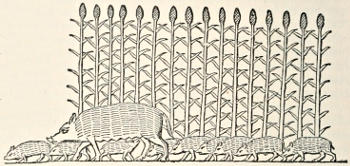
Bas-relief of Wild Sow and Young among Reeds
(Layard)
The Assyrians were also more skilled in mechanics than the Egyptians and were not inferior to them in agriculture. Two reliefs, one Assyrian, the other Egyptian, give us an opportunity to compare how each nation overcame the difficulties attending the moving and putting in place of their enormous collossi of stone. It is shown that the Assyrians knew the use of the lever, which the Egyptians did not, and that they took much greater precautions against upsetting the collossi. How the Babylonians and Assyrians, like the Egyptians and Chinese, made use of irrigation is well known. On the same tablets with the records of their deeds of war, the rulers often spoke of the laying out of canals, the regulating and deepening of the river beds “enduring waters for the enduring use of town and country,” and associated their own names with them. On account of the higher altitude of their country than that of their southern brethren, the Assyrians had to surmount greater difficulties in achieving such works, but this did not deter them from rivalry with them. One canal leading from the Upper Zab and one of its tributaries, irrigated the region between this river and the Tigris, and also supplied the capital, Kalah, with drinking water.
Sennacherib did something similar for Nineveh, which together with its environs was completely dependent upon rain. He had a network of canals constructed, which were fed, partly by the Khushur, and partly by the small mountain brooks of the Accad and Tash mountains. Here also two objects were attained, to furnish Nineveh with good drinking water, and to make the surrounding country fruitful; for the king had it all planted with many kinds of plants, among which was the vine. Floriculture was also much encouraged by the kings of Babylon and Asshur. They admired beautiful parks in which strange foreign animals were bred and nurtured. Marduk-bel-iddin, king of Bit-Yakin, apparently the same who at one time overcame Babylon, owned sixty-seven vegetable gardens and six parks of which a catalogue still exists, although he was constantly at war or guarding against the vengeance of the Assyrians.h
ASSYRIAN ART
But the world-historic relations of Mesopotamian art are best brought out by a study of the later and more perfectly preserved examples of Assyrian craftsmanship. It was the Assyrian who borrowed more directly from the Egyptian in developing his art, and who passed on artistic impulses to the Persians on the one hand, and to the Greeks on the other. The question to what extent the Assyrians were themselves influenced by the Mycenæan art of early Greece is one regarding which students of the subject are not agreed, and which we need not enter upon here.a
It is impossible to examine the monuments of Assyria without being convinced that the people who raised them had acquired a skill in sculpture and painting, and a knowledge of design and even composition, indicating an advanced state of civilisation. It is very remarkable that the most ancient ruins show this knowledge in the greatest perfection attained by the Assyrians. The bas-relief representing the lion hunt, now in the British Museum, is a good illustration of the earliest school of Assyrian art yet known. It far exceeds the sculptures of Khorsabad, Kuyunjik, or the later palaces of Nimrud, in the vigour of the treatment, the elegance of the forms, and in what the French aptly term mouvement. At the same time it is eminently distinguished from them by the evident attempt at composition—by the artistical arrangement of the groups. The sculptors who worked at Khorsabad and Kuyunjik had perhaps acquired more skill in handling their tools. Their work is frequently superior to that of the earlier artists in delicacy of execution—in the details of the features, for instance—and in the boldness of the relief; but the slightest acquaintance with Assyrian monuments will show that they were greatly inferior to their ancestors in the higher branches of art—in the treatment of a subject and in beauty and variety of form. This decline of art, after suddenly attaining its greatest perfection in its earliest stage, is a fact presented by almost every people, ancient and modern, with which we are acquainted. In Egypt the most ancient monuments display the purest forms and the most elegant decorations. A rapid retrogression, after a certain period, is apparent, and the state of art serves to indicate approximately the epoch of most of her remains. In the history of Greek and Roman art this sudden rise and rapid fall are equally well known. Even changes in royal dynasties have had an influence upon art, as a glance at monuments of that part of the East of which we are specially treating will show. Thus the sculpture of Persia, as that of Assyria, was in its best state at the time of the earliest monarchs, and gradually declined until the fall of the empire. After the Greek invasion it revived under the first kings of the Arsacid branch, Greek taste still exercising an influence over the Iranian provinces. How rapidly art degenerated to the most barbarous forms, the medals and monuments of the later Arsacids abundantly prove. When the Sassanians restored the old Persian monarchy and introduced the ancient religion and sacred ceremonies of the empire, art again appears to have received a momentary impulse. The coins, gems, and rock sculptures of the first kings of this dynasty are distinguished by considerable elegance, and spirit of design, and beauty of form. But the decay was as rapid under them as it had been under their predecessors. Even before the Chosroes raised the glory and power of the empire to its highest pitch, art was fast degenerating. By the time of Yezdigird it had become even more rude and barbarous than in the last days of the Arsacids.
This decline in art may be accounted for by supposing that, in the infancy of a people, or after the occurrence of any great event having a very decided influence upon their manners, their religion, or their political state, nature was the chief, if not the only, object of study. When a certain proficiency had been attained, and no violent changes took place to shake the established order of things, the artist, instead of endeavouring to imitate that which he saw in nature, received as correct delineations the works of his predecessors, and made them his types and his models. In some countries, as in Egypt, religion may have contributed to this result. Whilst the imagination, as well as the hand, was fettered by prejudices, and even by laws, or whilst indolence or ignorance led to the mere servile copying of what had been done before, it may easily be conceived how rapidly a deviation from correctness of form would take place. As each transmitted the errors of those who had preceded him, and added to them himself, it is not wonderful if, ere long, the whole became one great error. It is to be feared that this prescriptive love of imitation has exercised no less influence on modern art than it did upon the arts of the ancients.
As the earliest specimens of Assyrian art which we possess are the best, it is natural to conclude that either there are other monuments still undiscovered which would tend to show a gradual progression, or that such monuments did once exist, but have long since perished; otherwise it must be inferred that those who raised the most ancient Assyrian edifice derived their knowledge directly from another people, or merely imitated what they had seen in a foreign land. Some are inclined to look upon the style and character of these early sculptures as purely Egyptian. But there is such a disparity in the mode of treatment and in the execution, that the Egyptian origin of Assyrian art appears to me to be a question open to considerable doubt. That which they have in common would mark the first efforts of any people of a certain intellectual order to imitate nature. The want of relative proportions in the figures and the ignorance of perspective—the full eye in the side face and the bodies of the dead scattered above or below the principal figures—are as characteristic of all early productions of art as they are of the rude attempts at delineation of children. It is only in the later monuments of Nineveh that we find evident and direct traces of Egyptian influence: as in the sitting sphinxes and ivories of Nimrud, and in the lotus-shaped ornaments of Khorsabad and Kuyunjik; perhaps also in the custom which then prevailed of inserting the name of the king, or of the castle, upon or immediately above their sculptured representations. Neither the ornaments of the earliest palace of Nimrud, nor the costumes, nor the elaborate nature of the embroideries upon the robes, with the groups of human figures and animals, nor the mythological symbols, are of an Egyptian character; they show a very different taste and style.
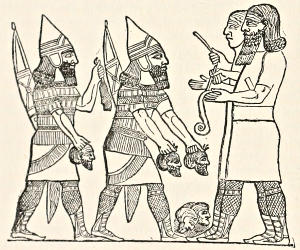
Bas-relief of Scribes writing down the Number of Heads of the Slain
(Layard)
The principal distinction between Assyrian and Egyptian art appears to be that in the one conventional forms were much more strictly adhered to than in the other. The angular mode of treatment, so conspicuous in Egyptian monuments, even in the delineation of every object, is not perceivable in those of Assyria. Had the arts of the two countries been derived from the same source—or had one been imitated from the other—they would both surely have displayed the same striking peculiarity. The Assyrians, less fettered, sought to imitate nature more closely, however rude and unsuccessful their attempts may have been; and this is proved by the constant endeavour to show the muscles, veins, and anatomical proportions of the human figure.
We must not lose sight of the assertion of Moses of Chorene—derived no doubt from ancient traditions, if not from direct historical evidence—that when Ninus founded the Assyrian Empire, a people far advanced in civilisation and in the knowledge of the arts and sciences, whose works the conquerors endeavoured to destroy, were already in possession of the country. Who that people may have been, we cannot now even conjecture. The same mystery hangs over the origin of the arts in Egypt and in Assyria. They may have been derived, before the introduction of any conventional forms, from a common source—from a people whose very name, and the proofs of whose former existence, may have perished even before tradition begins.
The monuments of Assyria furnish us with very important data, as to the origin of many branches of art, subsequently brought to the highest perfection in Asia Minor and Greece. I conceive the Assyrian influence on Asia Minor to have been twofold. In the first place, direct, during the time of the greatest prosperity of the Assyrian monarchy or empire, when, as it has been shown, the power of its kings extended over that country; in the second, indirect, through Persia, after the destruction of Nineveh. Of the influence exercised upon the arts of western Asia, during the early occupation of the Assyrians, few traces have hitherto been discovered, unless the remarkable monuments on the site of ancient Pteria, or Pterium, belong to this period. The evident connection between the divinities and sacred emblems worshipped in various parts of Asia Minor, and those of Assyria will be hereafter particularly pointed out. The Assyrian origin of these monuments, and of these religious symbols, once admitted, we shall have no difficulty in recognising the influence of Assyria on the arts and customs of Asia Minor. The antiquities of that country, prior to a well-known period, the Persian occupation, have been but little investigated. Few remains of an earlier epoch have yet been discovered. That such remains do exist, perhaps buried under ground, I have little doubt. It is most probable that, as we have additional materials for inquiry, we shall be still more convinced of this Assyrian influence, pointed out by Herodotus, when he declares the founder of the kingdom of Lydia to have been a descendant of Ninus, and by other authors, who mention the Syrian, or Assyrian, descent of many nations of Asia Minor.
But the second, or indirect, period of this influence is very fully and completely illustrated by the monuments of Asia Minor, of the time of the Persian domination. The known connection between these monuments and the archaic forms of Greek art renders this part of the inquiry both important and interesting. The Xanthian marbles, acquired for England by Sir Charles Fellows, and now in the British Museum, are remarkable illustrations of the threefold connection between Assyria and Persia, Persia and Asia Minor, and Asia Minor and Greece. Were those marbles properly arranged, and placed in chronological order, they would afford a most useful lesson, and would enable even a superficial observer to trace the gradual progress of art from its primitive rudeness to the most classic conceptions of the Greek sculptor. Not that he would find either style, the pure Assyrian or the Greek, in its greatest perfection; but he would be able to see how a closer imitation of nature, a gradual refinement of taste and additional study, had converted the hard and rigid lines of the Assyrians into the flowing draperies and classic forms of the highest order of art.
I have termed this second period that of indirect influence, because the arts did not then penetrate directly into Asia Minor from Assyria, but were conveyed thither through the Persians. The Assyrian Empire had already existed for centuries, and had exercised the supreme power over Asia, before it was disputed by the kingdoms of Persia and Media, united under one monarch. The Persians were probably a rude people, possessing neither a literature nor arts of their own, but deriving what they had from their civilised neighbours. We have no earlier specimen of Persian writing than the inscription containing the name of Cyrus, on the ruins supposed to be those of his tomb, at Murghaub [Pasargarda]; nor any earlier remains of Persian art than the buildings and sculptures of Persepolis, and other monuments to be attributed beyond a question to the kings of the Achæmenian dynasty. It has already been shown that the writing of the Persians was imitated from the Assyrians, and it can as easily be proved that their sculptures were derived from the same source. The monuments of Persepolis establish this beyond a doubt. They exhibit precisely the same mode of treatment, the same forms, the same peculiarities in the arrangement of the bas-reliefs against the walls, the same entrances formed by gigantic winged animals with human heads, and, finally, the same religious emblems. Had this identity been displayed in one instance alone, we might have attributed it to chance, or to mere casual intercourse; but when it pervades the whole system, we can scarcely doubt that one was a close copy, an imitation, of the other. That the peculiar characteristics of the Persepolitan sculptures were derived from the monuments of the second Assyrian dynasty—that is, from those of the latest Assyrian period—can be proved by the similarity of shape in the ornaments and in the costume of many of the figures. Thus, the head-dress of the winged monsters forming the portals is lofty, squared, and richly ornamented at the top, resembling those of Khorsabad and Kuyunjik, and differing from the round, unornamented cap of the older figures at Nimrud.
The processions of warriors, captives, and tribute-bearers at Persepolis are in every respect similar to those on the walls of Nimrud and Khorsabad; we have the same mode of treatment in the figures, the same way of portraying the eyes and hair. The Persian artist introduced folds into the draperies; but, with this exception, he certainly did not improve upon his Assyrian model. On the contrary, his work is greatly inferior to it in the general arrangement of the groups and in the elegance of the details.
From whence the Persians obtained the column and other architectural ornaments used at Persepolis, it may be more difficult to determine. We have seen that the column was not unknown to the later Assyrians, although it does not appear to have been employed in the construction of their palaces. The Persians, therefore, may have partly derived their knowledge from them; and partly, perhaps principally, from the Egyptians, whom, before the foundation of Persepolis, they had already conquered. It will be observed that the capitals of their columns frequently assume the shape of Assyrian religious types, the bull for instance; whilst other portions of them nearly resemble in the form of their ornaments, though not in their proportions, those of Egypt.
The Persians introduced into Asia Minor the arts and religion which they received from the Assyrians. Thus the Harpy Tomb and the monument usually attributed to Harpagus at Xanthus, and other still earlier remains, show all the peculiarities of the sculpture of Persepolis, and at the same time that gradual progress in the mode of treatment—the introduction of action and sentiment, and a knowledge of anatomy—which marks the distinction between Asiatic and Greek art. Whilst there was a manifest improvement in the disposition of the draperies and in the delineation of the human form, we still remark, even in the latest works of the Persian period in Asia Minor, the absence of all attempt to impart sentiment to the features, or even to give more than the side view of the human face.
Many architectural ornaments, known to the Assyrians, passed from them, directly or indirectly, into Greece. The Ionic column is an instance. We have, moreover, in the earliest monuments of Nineveh that graceful ornament, commonly called the honeysuckle, which was so extensively used in Greece, and is to this day more generally employed than any other moulding. In Assyria, as I have pointed out, it was invested with sacred properties, and was either a symbol or an object of worship. That the similarity between the Assyrian and Greek ornament is not accidental, seems to be proved, beyond a question, by the alternation of the lotus or tulip, whichever this flower may be, with the honeysuckle, by the number of leaves or petals of the flower, and by their proceeding in both from a semicircle, supported by two tendrils or scrolls. The same ornament occurs, even in India, on a lath erected by Asoka at Allahabad (about B.C. 250); but whether introduced by the Greeks—which, from the date of the erection of the monument, shortly after the Macedonian invasion, is not improbable—or whether derived directly from another source, I cannot venture to decide.
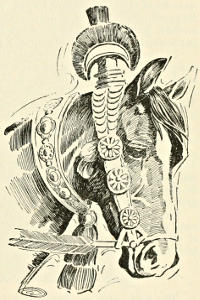
Assyrian Harness
That the Assyrians possessed a highly refined taste can hardly be questioned when we find them inventing an ornament which the Greeks afterwards, with few additions and improvements, so generally adopted in their most classic monuments. Others, no less beautiful, continually occur in the most ancient bas-reliefs of Nimrud. The sacred bull, with expanded wings, and the wild goat are introduced, kneeling before the mystic flower which is the principal feature in the border just described. The same animals are occasionally represented supporting disks, or flowers, and rosettes. A bird, or human figure, frequently takes the place of the bull and goat; and the simple flower becomes a tree, bearing many flowers of the same shape. This tree, evidently a sacred symbol, is elaborately and tastefully formed; and is one of the most conspicuous ornaments of Assyrian sculpture.
The flowers at the ends of the branches are frequently replaced in later Assyrian monuments and on cylinders by the fir or pine cone, and sometimes by a fruit or ornament resembling the pomegranate.
The guilloche, or intertwining bands, continually found on Greek monuments, and still in common use, was also well known to the Assyrians, and was one of their most favourite ornaments. It was embroidered on their robes, embossed on their arms and chariots, and painted on their walls. This purity and elegance of taste was equally displayed in the garments, arms, furniture, and trappings of the Assyrians. The robes of the king were most elaborately embroidered. The part covering his breast was generally adorned, not only with flowers and scroll-work, but with groups of figures, animals, and even hunting and battle scenes. In other parts of his dress similar designs were introduced, and rows of tassels or fringes were carried round the borders. The ear-rings, necklaces, armlets, and bracelets were all of the most elegant forms. The clasps and ends of the bracelets were frequently in the shape of the heads of rams and bulls, resembling our modern jewellery. The ear-rings have generally on the later monuments, particularly in the bas-reliefs of Khorsabad, the form of a cross.
In their arms the Assyrians rivalled even the Greeks in elegance of design. The hilt of the sword was frequently ornamented with four lions’ heads; two, with part of the neck and shoulders, made the cross-bar or defence, and two more with extended jaws were introduced into the handle. The end of the sheath was formed by two entire lions, clasped together, their heads turned outward and their mouths open. Sometimes the whole of the sheath was engraved or embossed, with groups of human figures, animals, and flowers. The handles of the daggers were no less highly ornamented, being sometimes in the form of the head of a horse, bull, or ram. The sheath frequently terminated in the head of a bird, to which a tassel was suspended. The part of the bow to which the string was attached was in the shape of an eagle’s head. The quiver was richly decorated with groups of figures and fanciful designs.
Ornaments in the form of the heads of animals, chiefly the lion, bull, and ram, were very generally introduced even in parts of the chariot, the harness of the horses, and domestic furniture. In this respect the Assyrians resembled the Egyptians.b
ASSYRIAN SCULPTURE AND THE EVOLUTION OF ART
The study of a country’s art is interesting, primarily of course purely as a study in the expression of beauty or in the portraiture of national types and ideals. The study should not, however, stop here, but one should consider also the effect each school has had upon the evolution of the world-art. This phase of Assyrian art has been examined by the Editor in a paper called “The Influence of Modern Research on the Scope of World History,” a Prefatory Essay to Vol. III of the New Volumes of the Ninth Edition of the Encyclopædia Britannica, from which a quotation may be permitted here.a
Whoever would see the story of the evolution of Greek art illustrated, should go to the British Museum and pass from the Egyptian hall, with its grotesque colossi, to the Assyrian rooms, with their marvellous bas-reliefs, and then on to the Elgin marbles from the Parthenon. In particular, the art treasures of the Assyrian collection should demand the closest scrutiny. In the Nineveh gallery, for example, where one finds collections of strange Assyrian books, the walls are flanked everywhere with bas-reliefs that come from some buried palace that once stored the literary treasures.
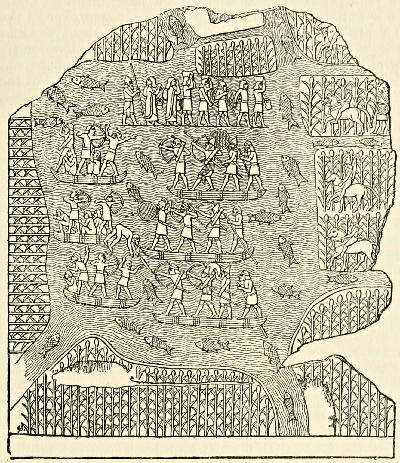
Battle in a Marsh in Southern Mesopotamia
(Layard)
It appears that the kings of that far-off time and land were connoisseurs of art as well as patrons of literature; and the art treasures of their palaces certainly form the most striking, if not the most important, part of the mementoes they have left to us. The more closely these figures in low relief are examined, the more wonderful they will seem. They take the place of the Egyptian carvings in the round; and if they are less striking to first view than the great sarcophagi, the grotesque gods, and colossal animal forms of that people, they will prove infinitely more expressive and incomparably more artistic on closer inspection. For these flat sculptures depict, not alone gods and sacerdotal scenes, but everyday affairs and the events of Assyrian history. The bas-relief was clearly the focal point of Assyrian art. Even the great bulls and lions that guarded the palace entrances were only partially detached from their background, and a frescoed statue of King Asshurnazirpal shows the same tendency. The full rounded statue was not indeed unknown to them, as several examples testify; but their real forte lay in mural decoration in low relief. And the particular walls on which the artists mainly expended their skill, if we may judge from what the ruins have revealed to us, were not the walls of temples, but the palaces of kings. It is quite clear that these great conquerors of antiquity were very human, very like their successors of after times. They loved to have their heroic deeds, real or alleged, heralded to the world, and recalled incessantly to their own memories. So one finds whole histories epitomised on these walls—wars, conquests, victories; the storming of cities, the slaughter of the enemy, the leading of captives, and bringing of tribute by subject people—everything, in short, but Assyrian reverses; the court artist, true to his colours then as now, never made the mistake of depicting those.
As historical records these sculptures are of priceless value, both for what they tell of political history and for the light they throw on the powers and limitations of antique art. But before you venture to judge the Assyrian artist in the latter regard, you must pass on to the room of Asshurnazirpal, and from that to the adjacent room, where the mural decorations of the dining-hall of the last of the great Assyrian kings, Asshurbanapal, have been placed in situ, reproducing an effect which they first made in the palace of Nineveh in the seventh century B.C. Here you may see at once both another phase of royal life in Assyria and another stage of Assyrian art. Not war, but the chase is now the theme. King Asshurbanapal is seen in pursuit of the goat, the wild ass, the lion. The king, of course, towers above his attendants, though not in the grotesque disproportion of the Egyptian paintings. To the oriental mind such excessive stature seemed indissoluble from royal station. One recalls how the mother of Darius, made captive at Issus, mistook Hephæstion for the king, because he was taller than Alexander; and how Agesilaus, when he went to Egypt as an ally of the Egyptians, was held in contempt, despite his renown, because of his diminutive stature; and one cannot help wondering what would have been the real aspect of the Assyrian and Egyptian monarchs could they have been subjected to the camera. Be that as it may, there was apparently no doubt in the mind of the court artist as to what his chisel should reveal in this respect, and the king may always be distinguished by his stature, without regard to his royal robes. Still, it is notable, as a distinction between Egyptian and Assyrian art, that the realistic eye of the Assyrian sculptor never let him depict the king as a Brobdingnag among the pigmies, after the Egyptian fashion. At the most he is a head taller than those about him.
The royal hunter pursues his quarry sometimes on foot, more usually standing in his chariot. His weapon is usually the bow, sometimes the spear; on one occasion he grapples with the lion, hand to jowl, and stabs the quarry to the heart with a short sword. The quiet dignity and royal calm with which the feat is achieved must have insured the artist a high and enduring place in the royal favour. The action, however, of the human figures in these sculptures is always sedate and reposeful, suggestive of reserved strength perhaps, or possibly of the artist’s limitations. Whichever it is, the real power of the artist is not shown in the human figures. These, to be sure, are in part strongly anatomised; in the main, they are fairly proportioned, and, unlike the Egyptian figures, they have the shoulders drawn in proper perspective. But the faces are fixed, impassive; the eyes are not in perspective, and, as a whole, they cannot claim high merit as works of art, viewed from an abstract modern standpoint. Considered in relation to their time, they are wonderful enough, so far ahead are they of anything that we could suppose to have been accomplished in the world of that day. But they fall far short of the standard which the same artist has himself given us in animal figures of his composition. It seems as if the human figures might have been done from memory, whereas the animal forms are clearly enough from the natural model. Indeed, when we turn to these animal figures we may criticise them, not with reservation as to their age, but from the standpoint of modern art, and as individual figures they will not be found wanting. The three fundamental canons—“proportion, action, aspect”—have been successfully met. The lions skulk sullenly from their cages, spring furiously into action, or roll in death agony at the will of the depicter. The lioness, with spine broken by an arrow, dragging her palsied hind-quarters, is a veritable masterpiece. The same is true of many of the figures of goats, of running and pacing wild asses, and of dogs. As a whole, these animal frescoes are nothing less than wonderful. It is worth a visit to London from the remotest land to see these sculptures from the palace of the old Assyrian king.
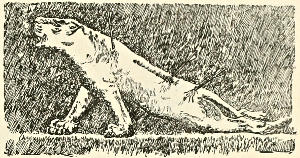
Bas-relief of a wounded Lioness
(Now in the British Museum)
Still, though these bas-reliefs have intrinsic merits as works of art, their chief value is for what they teach regarding the evolution of art in the world. Previously to their discovery it had been supposed that the stiff formalism of Egyptian sculpture represented the fullest flight of pre-Grecian art, and that Greek art itself had stepped suddenly forth, rather a new creation than an evolution. But the pick and shovel of Layard at Nineveh dispelled that illusion. For these art treasures, that had lain there under the deposits of centuries, were found to represent an enormous advance upon Egyptian models, precisely in the direction of that realism for which Greek art is distinguished.
If we would judge how direct and unequivocal was the impulse which the dying nation transferred to the adolescent one in point of art, we have but to take a few steps in the British Museum, from the Assyrian rooms to the wonderful hall that holds Lord Elgin’s trophies from the desecrated Parthenon. Look, then, upon the frieze of bas-relief that bears the magic name of Phidias. If anything can reconcile us to the act that deprived Greece of her priceless heirlooms, it is the fact that they have found lodgment here close beside their oriental prototypes, where half a million visitors each year may at least have an opportunity to learn the lesson that human progress is an accretion, a growth, a building upon foundations; and, specifically, that Greek art, no less than other forms of human culture, was an evolution, and not an isolated miracle. For what is the Parthenon frieze, as we now come to it fresh from the palaces of Nineveh, but an Assyrian fresco adapted to the needs and ideals of another race and developed by the genius of a newer civilisation? The profiled figures in low relief coursing together, are they different in conception from the profiled figures of the palaces we have just left? The horses of the Parthenon frieze might almost seem to have stepped bodily from the palaces of Asshurbanapal. They have gained something in suppleness of limb, have altered their attitude in a measure, to be sure, thanks to their new environment. But their type has not changed by so much as an actual breed of horses might be changed in as many generations. Note the head, the most typical and characteristic feature of this Grecian steed. Line for line it is the same head, trappings aside, that we have just seen at Nineveh. Even the defects of the Assyrian drawing are there—the too small and slender face, and receding lower jaw, the tiny ear, the far too full and “chuffy” neck. Possibly no horse in nature was ever like this, but the Assyrian artist so conceives it; the Greek copies that conception; and the distorted type will be transmitted down the generations to the Italian of the Renaissance, to the classical painters of Spain, the Netherlands, and Germany, and France; nay, even to the artist of the nineteenth century. The court artist of an oriental prince of the ninth or tenth century B.C. conceives a certain ideal; and, following him, a certain type of sculptured horse, such as the artist who carved it has never seen, steps before the chariot on Napoleon’s Arc de Triomphe in nineteenth-century Paris.c