Part 1 / Book 2 — CHAPTER IX. BABYLONIAN AND ASSYRIAN CULTURE (continued 2)
Reading edition
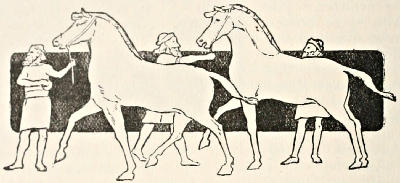
Bas-relief of Horses
If Mesopotamian art and literature had been forgotten in succeeding ages, Chaldean science had not shared the same fate. The fame of the Babylonian astrology and astronomy was still fresh in the mind of the Greeks of the day of Diodorus, as we shall see, and it is curious to reflect that even at this relatively late period after Greece had passed far beyond the culminating point of her own career the learned Greek looked upon Chaldean science as something beyond the pale of the science of his own nation. It would seem as if the cultivated Greek looked back upon the Babylonian civilisation with something of that reverence which “modern” European nations have reserved for Greece itself. It is significant, too, that the Babylonians themselves, even in the day of their decline, continued to regard the Greeks, along with the rest of the outside world, as “barbarians” in something more than the Greek sense of the word.
The older civilisation always thus regards the younger, regardless of the actual relative merits of the two. It was an Egyptian priest who lectured the famous Greek in these words: “O Solon! Solon! You Hellenes are but children, and there is never an old man who is a Hellene. In my mind you are all young. There is no old opinion handed down among you by ancient tradition, nor any science hoary with age”; but the same words might well have been pronounced by a priest of Chaldea. We have learned through Diodorus that the Egyptians guarded the secrets of their science very jealously from the Greeks, who travelled and sojourned there for the express purpose of learning them; and there is reason to suppose that much the same reception was accorded the Greek traveller in Babylonia, since Herodotus seems to have learned so little there beyond what his own direct observations taught him.
But how much ground the Babylonian had for this arrogance of intellectual attitude the modern world had little material for judging, beyond such general assertions as that of Diodorus, until the records of the libraries were revealed. Then it was made evident that as original scientific investigators the Babylonians were no whit inferior to their contemporaries of the Nile, if, indeed, they were not superior; that in short they fully merited the praise which classical tradition accorded them. A people that thus excelled in theoretical science, no less than in art and literature and in practical civilisation, has many claims to be considered the foremost nation of antiquity.a
A CLASSICAL ESTIMATE OF CHALDEAN PHILOSOPHY AND ASTROLOGY
“Here it will not be amiss to say something of the Chaldeans (as the Babylonians call them) and of their Antiquity, that nothing worth Remark may be omitted,” says Diodorus, as translated in 1700 by Booth.
“They being the most ancient Babylonians, hold the same station and dignity in the Common-wealth as the Egyptian Priests do in Egypt: For being deputed to Divine Offices, they spend all their Time in the study of Philosophy, and are especially famous for the Art of Astrology. They are mightily given to Divination, and foretel future Events, and imploy themselves either by Purifications, Sacrifices, or other Inchantments to avert Evils, or procure good Fortune and Success. They are skilful likewise in the Art of Divination, by the flying of Birds, and interpreting of Dreams and Prodigies: And are reputed as true Oracles (in declaring what will come to pass) by their exact and diligent viewing the Intrals of the Sacrifices. But they attain not to this Knowledge in the same manner as the Grecians do; for the Chaldeans learn it by Tradition from their Ancestors, the Son from the Father, who are all in the mean time free from all other publick Offices and Attendances; and because their Parents are their Tutors, they both learn every thing without Envy, and rely with more confidence upon the truth of what is taught them; and being train’d up in this Learning from their very Childhood, they become most famous Philosophers, (that Age being most capable of Learning, wherein they spend much of their time). But the Grecians for the most part come raw to this study, unfitted and unprepar’d, and are long before they attain to the Knowledge of this Philosophy: And after they have spent some small time in this Study, they are many times call’d off and forc’d to leave it, in order to get a Livelihood and Subsistence. And although some few do industriously apply themselves to Philosophy, yet for the sake of Gain, these very Men are opinionative, and ever and anon starting new and high Points, and never fix in the steps of their Ancestors. But the Barbarians keeping constantly close to the same thing, attain to a perfect and distinct Knowledge in every particular.
“But the Grecians cunningly catching at all Opportunities of Gain, make new Sects and Parties, and by their contrary Opinions wrangling and quarelling concerning the chiefest Points, lead their Scholars into a Maze; and being uncertain and doubtful what to pitch upon for certain truth, their Minds are fluctuating and in suspence all the days of their Lives, and unable to give a certain assent unto any thing. For if any Man will but examine the most eminent Sects of the Philosophers, he shall find them much differing among themselves, and even opposing one another in the most weighty parts of their Philosophy. But to return to the Chaldeans, they hold that the World is eternal, which had neither any certain Beginning, nor shall have any End; but all agree, that all things are order’d, and this beautiful Fabrick is supported by a Divine Providence, and that the Motions of the Heavens are not perform’d by chance and of their own accord, but by a certain and determinate Will and Appointment of the Gods.
“Therefore from a long observation of the Stars, and an exact Knowledge of the motions and influences of every one of them, wherein they excel all others, they fortel many things that are to come to pass.
“They say that the Five Stars which some call Planets, but they Interpreters, are most worthy of Consideration, both for their motions and their remarkable influences, especially that which the Grecians call Saturn. The brightest of them all, and which often portends many and great Events, they call Sol, the other Four they name Mars, Venus, Mercury, and Jupiter, with our own Country Astrologers. They give the Name of Interpreters to these Stars, because these only by a peculiar Motion do portend things to come, and instead of Jupiters, do declare to Men before-hand the good-will of the Gods; whereas the other Stars (not being of the number of the Planets) have a constant ordinary motion. Future Events (they say) are pointed at sometimes by their Rising, and sometimes by their Setting, and at other times by their Colour, as may be experienc’d by those that will diligently observe it; sometimes foreshewing Hurricanes, at other times Tempestuous Rains, and then again exceeding Droughts. By these, they say, are often portended the appearance of Comets, Eclipses of the Sun and Moon, Earthquakes and all other the various Changes and remarkable effects in the Air, boding good and bad, not only to Nations in general, but to Kings and Private Persons in particular. Under the Course of these Planets, they say are Thirty Stars, which they call Counselling Gods, half of whom observe what is done under the Earth, and the other half take notice of the actions of Men upon the Earth, and what is transacted in the Heavens. Once every Ten Days space (they say) one of the highest Order of these Stars descends to them that are of the lowest, like a Messenger sent from them above; and then again another ascends from those below to them above, and that this is their constant natural motion to continue for ever. The chief of these Gods, they say, are Twelve in number, to each of which they attribute a Month, and one Sign of the Twelve in the Zodiack.
“Through these Twelve Signs the Sun, Moon, and the other Five Planets run their Course. The Sun in a Years time, and the Moon in the space of a Month. To every one of the Planets they assign their own proper Courses, which are perform’d variously in lesser or shorter time according as their several motions are quicker or slower. These Stars, they say, have a great influence both as to good and bad in Mens Nativities; and from the consideration of their several Natures, may be foreknown what will befal Men afterwards. As they foretold things to come to other Kings formerly, so they did to Alexander who conquer’d Darius, and to his Successors Antigonus and Seleucus Nicator; and accordingly things fell out as they declar’d; which we shall relate particularly hereafter in a more convenient time. They tell likewise private Men their Fortunes so certainly, that those who have found the thing true by Experience, have esteem’d it a Miracle, and above the reach of Man to perform. Out of the Circle of the Zodiack they describe Four and Twenty Stars, Twelve towards the North Pole, and as many to the South.
“Those which we see, they assign to the living; and the other that do not appear, they conceive are Constellations for the Dead; and they term them Judges of all things. The Moon, they say, is in the lowest Orb; and being therefore next to the Earth (because she is so small,) she finishes her Course in a little time, not through the swiftness of her Motion, but the shortness of her Sphear. In that which they affirm (that she has but a borrow’d light, and that when she is eclips’d, it’s caus’d by the interposition of the shadow of the Earth) they agree with the Grecians.
“Their Rules and Notions concerning the Eclipses of the Sun are but weak and mean, which they dare not positively foretel, nor fix a certain time for them. They have likewise Opinions concerning the Earth peculiar to themselves, affirming it to resemble a Boat, and to be hollow, to prove which, and other things relating to the frame of the World, they abound in Arguments; but to give a particular Account of ’em, we conceive would be a thing foreign to our History. But this any Man may justly and truly say, That the Chaldeans far exceed all other Men in the Knowledge of Astrology, and have study’d it most of any other Art or Science: But the number of Years during which the Chaldeans say, those of their Profession have given themselves to the study of this natural Philosophy, is incredible; for when Alexander was in Asia, they reckon’d up Four Hundred and Seventy Thousand Years since they first began to observe the Motions of the Stars. But lest we should make too long a digression from our intended Design, let this which we have said concerning the Chaldeans suffice.”d
THE BABYLONIAN YEAR
The Babylonian year, according to Eduard Meyer, consisted of simple lunar months (twenty-nine or thirty days), which, as with the Greeks and the Mohammedans, was determined by the course of the moon itself.
To make this year coincide with the course of the sun, an extra month was intercalated; in olden times this seems to have been done after the first or the sixth month.
This year, with the names of its months, was adopted by the Jews at the time of the Exile, and is still in use with them. The commencement of their year (Nisan) falls at the time of the spring equinox. The Babylonians had no continuous chronology; they dated according to the years of the kings, or, rather, they marked the year according to any important event which took place in it. Thus we see dates like “on the 30th Adar in the Sixth year after the conquest of Nisin by King Rim-Sin.”
Later on in Babylon, and also in Assyria, they reckoned simply the years of the kings, from the day of their accession to the throne. The remainder of the year, in the course of which the predecessor had died, was therefore considered the first part of the first year of the new reign, and was very often called “the beginning of the reign” of the king in question.
Chronological calculations were reckoned from the same starting-point as in Egypt. They reckon the calendar year in which a king comes to the throne as his first year, and hence his death takes place in the first year of his successor. This is the method of the Ptolemaic canon, one of the most important chronological monuments of antiquity. It is the list beginning with Nabonassar (about 747 B.C.) of the native and Persian kings of Babylonia, to which the Egyptian rulers up to Alexander are added. It is an addition to the astronomical work of Ptolemy, and was intended to throw light on the passages relating to the Babylonian, and later on to the Alexandrian chronological methods. It is authentic, and is confirmed by the monuments. Yet, in using the same, it must be recollected that all dates of the Egyptian “vague” year (and the Egyptian months) are reduced. Therefore the first year of the Nabonassar era begins on the 1st Tehuti, the 26th February, 747 B.C.
In Assyria there is also a second and far more common form of specifying the years. Since a very early date (as far back as the fourteenth century) it was customary to name the year after some high official. The year, as such, is called limmu, “eponymic year.” Of course, they had continuous lists of these eponyms; and we have recovered several fragments. The lists for the years 893 to 666 are complete, and with fragments we can go still farther back. The kings frequently used this system, and private persons regularly used this eponym.
Some copies of the lists contain accounts of the changes of reigns, and give short statements of important internal and external events of the particular years. Thus an eclipse of the sun June 15, 763 B.C., mentioned therein can be astronomically fixed, and the dates arrived at thereby concur exactly with the accounts of the Ptolemaic canon. The chronological history of this epoch is therefore perfectly determined.e
THE BABYLONIAN DAY AND ITS DIVISION INTO HOURS
This being the Babylonian method of reckoning dates, it is interesting to note on what plan they subdivided the day. Investigations were made in this line by that indefatigable Irishman, Edward Hincks, from whose article “On the Assyrio-Babylonian Measures of Time,” in the Transactions of the Royal Irish Academy, we quote.a
I begin with the day and its divisions.
Our knowledge on this subject is mainly derived from a tablet in the British Museum, marked K. 15. A paper of mine was read before the Royal Irish Academy in 1854, and was published in the twenty-third volume of the Transactions in which this tablet was discussed. As that paper contained some slight philological errors, I will here repeat the substance of it, correcting those errors.
I now translate the inscription on the Tablet as follows, omitting the customary benedictory formula. “On the sixth day of the month Nisan the day and the night are equal; six kazabs [kashbu] are the day; six kazabs [kashbu] are the night.” It is evident that this inscription records the observation of an equinox; and I will return to the consideration of it with that view. At present I will only remark that it points to a double division of the day, or Nycthemeron; viz., the first into the day properly so called, and the night; which were in this instance equal, though not generally so; the second into twelve equal kazabs [kashbu].
I proceed to the second division of the day into twelve kazabs [kashbu]. Each of these was equivalent, putting out of sight errors of observation, to two hours of mean solar time, such as we use in ordinary life. The word kazab [kashbu] is from a Hebrew root meaning “to fail,” which is applied to streams that run dry. This suggests the primary signification, “runnings out,” namely, of the water which had been poured into a vessel with a small hole in the bottom. The Babylonians measured time by clepsydræ, which, when they had been filled, would be emptied in two hours of mean time. Such clepsydræ would maintain a sufficiently accurate division of the day into twelve kazabs [kashbu] if the first were set to run at apparent noon, the second when the first had run out, and so on till the thirteenth, which would be set to run at the next apparent noon, whether the twelfth was just running out, or had already run out, or had still a little water in it.
The kazab [kashbu] is mentioned as an ordinary measure of time in more than one passage. The distance from the mainland to an island in the Persian Gulf is said to be a voyage of thirty kazabs [kashbu] (Botta, 41. 48), just as that from Cyprus to Syria is said to be one of seven days (Botta, 38. 41). Also, in Rawlinson, 42. 13, Sennacherib speaks of slaughtering his enemies for the space of a journey or march of two kazabs [kashbu]. This use of the word seems to me a positive proof that the clepsydræ was in use among the Assyrians and Babylonians generally, and was not confined to the astronomers.
There does not appear to me any reason to suppose that a division of the day from sunrise to sunset into twelve hours, varying in length according to the season of the year, and again of the night, from sunset to sunrise into twelve similar hours, was ever known to the Babylonians. Such a division was in use among the Egyptians, and was adopted from them by the Greeks, but the Babylonians and Assyrians knew nothing of it. I may here observe that some modern writers have committed a strange mistake in supposing the clepsydræ to have been invented so late as the third century before Christ and at Alexandria. These writers have confounded two totally different things; viz., the original invention of the clepsydræ marking mean solar time, which goes back to remote antiquity, and is almost certainly due to the Babylonians, and the adaptation of the clepsydræ to the seasonable (καιρικαὶ) hours of the Egyptians and Greeks, which was accomplished at the time and place which these writers mention. I have met with no subdivisions of the kazab [kashbu], and I much doubt whether the Babylonians had any means of marking such.f
ASSYRIAN SCIENCE
The exact sciences were cultivated in Assyria from the earliest times, nor had natural sciences been neglected. Zoology, botany, mineralogy are largely represented in the library of Nineveh, and as all these tablets contain a Sumerian as well as the equivalent Assyrian text, we are justified in believing that the Ninevites, in this respect, still followed the traditions of their predecessors.
We find lists of animals arranged in a certain order which indicates an attempt at classification; thus the dog, lion, and wolf are in the same category, whilst the ox, sheep, and goat form another. In the enumeration of the different animals, there is a very evident design of establishing genera and families, and of distinguishing species. Thus we have a family comprising the great Carnivora: the dog, lion, and wolf; then we have different species in the dog family—such as the dog itself, the domestic dog, the coursing dog, the small dog, the dog of Elam, etc. The scientific side of this classification is revealed by an easily recognised circumstance; thus one finds after the common name a special nomenclature, which belongs to a scientific classification with which the Assyrians seem to have been familiar.
Among the birds similar attempts at classification are evident. Birds of rapid flight, sea-birds, or marsh birds are differentiated. Insects form a very numerous class; we see an entire family whose species are differentiated according as they attack plants, animals, clothing, or wood. Vegetables seem to be classified according to their usefulness, or the service that industry can make of them. One tablet enumerates the uses to which wood can be put, according to its adaptability, for the timber-work of palaces, the construction of vessels, the making of carts, implements of husbandry, or even furniture. Minerals occupy a long series in these tablets. They are classed according to their qualities, gold and silver forming a division apart; precious stones form still another, but there is nothing to indicate on what basis a classification would be established.
If we pass from the natural sciences to geography, we find the latter in a synthetic and fairly confused state. Nevertheless several lists give us a series of the names of towns, rivers, and mountains, arranged according to their geographical disposition, as we can easily prove. Sometimes the data are of a practical character, and names are followed by mention of natural or industrial products of localities, their revenue taxes, or tributes. But the science, par excellence, which was especially cultivated in Assyria, and which the learned men of Asshurbanapal connected with the greatest care with antique Chaldean traditions, was astronomy.
This science was not indeed born at Nineveh; the Greeks teach us that astronomical observations were first made in lower Chaldea 1903 years before Alexander, and consequently 2226 years before Christ. Whatever the value of this date may be, the tradition of this origin is found in the works of the Assyrians, who constantly refer to the observations of their predecessors. Asshurbanapal had sent these learned men to the old schools of Mesopotamia, Ur, Sippar, Agade, Babylon; there to imbibe the elements of the science which was the glory of the southern empire. In the seventh century before our era, observations were carried on at Nineveh. At this date the fixed stars had long been distinguished from the planets; the sidereal revolutions, the divisions of the year, the course of the sun in the different constellations of the zodiac, periodic return of eclipses, and even the precession of the equinoxes, had been calculated. These achievements imply long and conscientious observation, a special intelligence to undertake them, and simple methods of rigorous calculation.
We are ignorant as to the nature of the instruments with which the Assyrio-Chaldeans could observe the stars. The chances of error in observations by the naked eye are evidently very great, and errors can only be rectified by multiplied operations and the most minute calculations. It is known that the determining of the periodicity of the moon’s eclipses rests on a knowledge of the cycle of 223 lunations which bring back the same eclipses periodically. It is certain that the Assyrio-Chaldeans must have also known another cycle of 22,325 lunations equalling 1805 tropical years plus 8 days, or 1805 Julian years of 365¼ days; after which the eclipses return with still greater precision in the same order. How long did it take the human mind to observe and understand a sufficient number of lunations so as to combine the data they afforded and deduct the law that Meton formulated and to which he has given his name?
In regard to eclipses of the sun, the cycle is so very much greater that the beginnings of the observations on which the calculations of their periodicity would rest, would take us back to a period which is quite beyond the limits of the historic age. Diogenes Laertius estimates it as 48,863 years. During that time 373 eclipses of the moon and 832 eclipses of the sun had been observed. When they turned their attention to the calculations resulting from these observations the Assyrio-Chaldeans were marvellously helped by their system of notation. Their numerical system lent itself with ease to the most complicated of calculations. We must content ourselves with stating the results. As we were saying a minute ago, the observations were carried on under Asshurbanapal; the king sent astronomers to different points to study celestial phenomena, and the results of their labours were sent him. Here are the terms in which these reports were expressed:
“To the King, my Lord, his humble servant Ishtar-iddin-apal, chief astronomer of the town of Arbela writes this: Peace and happiness to the king my master and may he long prosper.
“On the 29th day, I observed the node of the moon, the clouds obscured the field of observation, and we could not see the moon.
“In the month of Sebat (January) the 1st day during the year Bel-haran-saduya (648 B.C.).”
The result of this mission was not satisfactory. The eclipse had been predicted, but although the state of the atmosphere did not allow of observation, the attesting of this failure proves the care with which every circumstance that could serve to explain the phenomenon was noted. Here is an observation which was entirely successful:
“To the director of observations my Lord, his humble servant Nabu-shum-iddin, Great Astronomer of Nineveh writes this: May Nabu and Marduk be propitious to the director of these observations, my Lord.
“The 15th day we observed the node of the moon, and the moon was eclipsed.”
Here is a more complicated observation:
“To the king, my Lord, may the Gods Nabu and Marduk be propitious, may the great gods grant to the king, my master, long life, the benefits of the flesh and satisfaction of the heart.
“The 27th day the moon disappeared; the 28th 29th and 30th day we continually observed the node of the obscuring sun. The eclipse did not take place. The 1st day (of the following month) we saw the moon during the first day of the month Tammuz (June) above the star Mercury of which I have previously sent an observation to the king my master. In its course during the day of Anu, around the shepherd star (the planet Venus), it was seen declining: on account of rain the horns were not very distinctly visible, and so it was in its whole course. The day Anu I sent the observation of its conjunction, to the king my master. It was prolonged and was visible above the star of the Chariot in its course during the day of Baal; it disappeared towards the star of the Chariot.
“To the King, my Lord, peace and happiness.”
The discovery of the precession of the equinoxes is generally attributed to Hipparchus. It was he, indeed, who taught this fact to the Greeks, and he estimated its yearly amount as from 36 to 39 seconds; but it is certain that he learned about it in Chaldea, and that he obtained the elements of his calculations from the astronomical observations made on the lower Euphrates. All the astronomical knowledge of the Ninevite savants had the same point of origin.
Two thousand years before our era, from the time of a king of Agade called Sharrukin (Shargani-shar-ali), and who is usually known as Sargon I (the Ancient), the precession of the equinoxes was an observed and calculated fact, since it had already brought sufficient disturbance into the calendar to make a corrective element necessary. Sargon had given a brilliancy to his century which the learned men of Nineveh only echoed. In his time there was a library at Agade, the importance of which we can judge by the fragments which were preserved at Nineveh. We are certain that at these remote times the great divisions of the uranographic chart were already determined upon. Fixed stars were designated according to the different groups or constellations which were known by the names they have retained to this day.
Outside these fixed stars the signs of the zodiac were perfectly determined in that portion of the celestial vault which the texts designate by the name of harranu (the way), that is to say, the way of the stars. These stars were the planets. The Chaldeans knew of seven, and they were thus known to them: Shamash, the sun; Sin, the moon; Alap-Shamash, Saturn; Rus, Jupiter; Ashbat, Venus; Sulpa-sadu, Mars; Nivit-Anu, Mercury. The Ninevite savants borrowed their astronomical knowledge from the Chaldeans; they made use of the calendar as it was transmitted to them, and as such it has been used by all nations from the remotest times up to the present day.
The Assyrian year was composed of twelve lunar months. It began with the new moon preceding the vernal equinox. A well-known tablet thus fixes the day of the equinoxes: “At the sixth day of the month of Nisan (March) the days and nights are equal (and comprise), six kashbu for the day and six kashbu for the night. May Nabu and Marduk be propitious to the King, my Lord.”
To correct the error resulting from the difference between the lunar and solar year, a supplementary month was intercalated, the length of which necessarily varied with circumstances. The Ninevite tablets offer us calendars arranged in conformity with the different exigencies of life. Some are purely scientific, and show us the divisions of the year into days, months, and seasons. Others are formed to meet the needs of religion, and tell us, by the day, the feasts consecrated to divinities invoked or honoured by special ceremonies. Others seem to take current superstitions into account; thus days are marked by a particular sign, according as they are considered propitious or disastrous. We see tables constructed to indicate the influence of the stars on each day of the year, with a mention of appropriate prayers, to propitiate favourable auguries and ward off those which are fatal.
The importance of these last documents must not be exaggerated; they are related to superstitions common to all ages and lands; and, in the ancient East, as everywhere else, these beliefs merely represent one of the most curious, but the least interesting phases of the aberrations of the human mind.g
FOOTNOTES

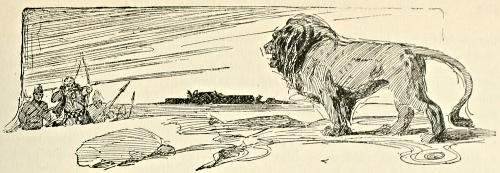
Babylonian King Lion Hunting
APPENDIX A. CLASSICAL TRADITIONS
Such is the fate of empire: Asshur rose Where elder thrones and prouder warriors stood; Before the Memphian priest his precepts chose, Men reasoned greatly of the highest good; Before Troy was, or Xanthus rolled in blood, Armies were ranged in battles’ dread array: They fought—their glory withered in its bud; They perished—with them ceased their tyrants’ sway; New wars, new heroes came—their story passed away.—James Gates Percival.
It is a curious paradox that our knowledge of this oldest civilisation should be the very newest and most novel record with which present-day history has to deal. The Chaldeans, Assyrians, and Babylonians, of whose accomplishments we speak so confidently to-day, lived out their national life, and vanished from the earth, as nations, mostly before civilisation had its dawning in Europe; and for two thousand years they were but a reminiscence.
It was reserved for nineteenth century investigators literally to dig from the earth their lost records, and to read the secrets of their forgotten history. Marvellous secrets they were, as we shall see; but before we turn to them, it will be of interest to recall the reminiscences that did service as the history of these wonderful peoples for so many centuries. In a few extracts we may set forth the substance of all that the world remembered of that marvellous civilisation from the days of Herodotus and Diodorus till the middle of the nineteenth century. A mixture of fact and fable, it still has absorbing interest, the more so that we may now compare it with the surer records brought to light in our own time. Aside from their intrinsic interest, the classical records have, in this regard, a unique importance.
As to the precise classical authorities in question, we have already become acquainted with Diodorus and Ælianus in the earlier portion of this work. Another author we shall now have occasion to quote is Berosus. As to this author and the exact status of his work, we cannot do better than quote the following critical estimate from the Babylone et la Chaldée of Joachim Menant.
“Berosus came of a priestly family and was born in Babylon, about 330 B.C. He himself is authority for the information that he was a contemporary of Alexander the Great. According to Tatian, he is the most learned of all Asiatic historians. He was deeply versed in the ancient traditions of his country and taught them to the Greeks, through whom they have come down to us. Vitruvius informs us that he left Babylon and went to live on the island of Cos, where he opened a school of astrology. He invented, or at least introduced among the Greeks, a particular kind of time-keeping. There still exist fragments of astrological works to which Berosus has attached his name, and owing to the special interests of the writers who have borrowed from his works, the fame of the astrologer perhaps outshines that of the historian. Pliny (VII. 37) declares that the Athenians erected a golden-tongued statue to him in the Gymnasium, on account of his wonderful predictions.
“He wrote in Greek, about 280 B.C., a history of ancient Chaldea and dedicated it to Antiochus Soter. The work consisted of three volumes, of which we possess now but a few excerpts preserved in the chronicles of several historiographers who have lived at different periods and whom it may be well to mention. First of all there is Flavius Josephus, the great historian of the Jews, born at Jerusalem 33 A.D.; then there are St. Clement, the Alexandrian catechist (born early in the second century A.D., died 217), Eusebius, Bishop of Cæsarea (author of the Symbol of Nice, who lived from 267 to 338), and finally, George Syncellus (so called from the office he filled under the Bishop of Constantinople, and who died about the year 800). These writers took from Berosus only just what was needed for their purposes, and none in fact seems to have been personally acquainted with the work of the learned Chaldean.
“For instance, Syncellus, whose writings show marks of haste and are by no means free from error, borrows his quotations from Eusebius, whom he often pretends to correct. Eusebius seems to be indebted to Julius Africanus, who wrote in the third century of our era, and the latter in turn mentions his obligation to Alexander Polyhistor, who flourished twenty-five years before Christ. Now Polyhistor takes his references from Apollodorus, who lived some years before. Josephus in all probability used Alexander Polyhistor as his source, although he does not say so. Clement of Alexandria had at his elbow the works of King Juba of Mauritania, who reigned about 30 B.C., and who seems to have taken his material, unfortunately too limited in amount, from the very works of Berosus, in whom he placed the utmost confidence.
“One thing is certain, the original text of Berosus in passing through so many hands and suffering condensation and mutilation must have been considerably altered.
“Berosus had free access to those famous clay-tablet libraries which Pliny describes and whose importance modern research has revealed. As at Nineveh, there were at Babylon, Borsippa, Orchoë [Erech], and in the large cities of Chaldea, archives which contained the national traditions to which the Chaldean priest was obliged to resort.
“In the days of Berosus the writings in these archives were understood not only in Babylon, but throughout western Asia. The Assyrio-Chaldean language was still written in cuneiform characters till the time of the Seleucidæ and even during the first century B.C. Berosus was thus enabled to consult these precious sources, and we know that he went to them. Already in the priceless débris of these curious archives, fragments in corroboration of Berosus have been discovered, and these acquisitions only make us regret the more what is irrevocably lost.”
We shall now take up some of the portions of Berosus’ history transcribed by later historiographers.a
THE CREATION AND THE FLOOD, DESCRIBED BY POLYHISTOR
Berosus, in the first book of his history of Babylonia, informs us that he lived in the age of Alexander, the son of Philip. And he mentions that there were written accounts, preserved at Babylon with the greatest care, comprehending a period of about fifteen myriads of years; and that these writings contained histories of the heavens and of the sea; of the birth of mankind; and of the kings, and of the memorable actions which they had achieved.
And in the first place he describes Babylonia as a country situated between the Tigris and the Euphrates; that it abounded with wheat and barley, and ocrus, and sesame; and that in the lakes were produced the roots called gongæ, which are fit for food, and in respect for nutriment similar to barley. That there were also palm trees and apples, and a variety of fruits; fish also and birds, both those which are merely of flight, and those which frequent the lakes. He adds, that those parts of the country which bordered upon Arabia were without water and barren; but that the parts which lay on the other side were both hilly and fertile.
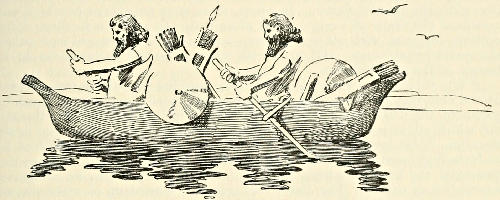
Assyrian Boat
(From the Monuments)
At Babylon there was (in these times) a great resort of people of various nations, who inhabited Chaldea, and lived in a lawless manner, like the beasts of the field.
In the first year there appeared from that part of the Erythræan Sea [the Persian Gulf] which borders upon Babylonia, an animal destitute of reason, by name Oannes [perhaps the same as Anu], whose whole body (according to the account of Apollodorus) was that of a fish; that under the fish’s head he had another head, with feet also below, similar to those of a man, subjoined to the fish’s tail. His voice, too, and language, was articulate and human; and a representation of him is preserved even to this day.
This Being was accustomed to pass the day among men; but took no food at that season; and he gave them an insight into letters and sciences, and arts of every kind. He taught them to construct cities, to found temples, to compile laws, and explained to them the principles of geometrical knowledge. He made them distinguish the seeds of the earth, and showed them how to collect the fruits; in short he instructed them in everything which could tend to soften manners and humanise their lives. From that time nothing material has been added by way of improvement to his instructions. And when the sun had set, this Being, Oannes, retired again into the sea, and passed the night in the deep; for he was amphibious. After this there appeared other animals like Oannes, of which Berosus proposes to give an account when he comes to the history of the kings. Moreover, Oannes wrote concerning the generation of mankind, and of their civil policy; and the following is the purport of what he said:
“There was a time in which there existed nothing but darkness and an abyss of waters, wherein resided most hideous beings, which were produced of a twofold principle. There appeared men, some of whom were furnished with two wings, others with four, and with two faces. They had one body but two heads: the one that of a man, the other of a woman; likewise in their several organs, they were both male and female. Other human figures were to be seen with the legs and horns of goats; some had horses’ feet; while others united the hind quarters of a horse with the body of a man, resembling in shape the hippocentaurs. Bulls likewise were bred there with the heads of men; and dogs with fourfold bodies, terminated in their extremities with the tails of fishes. In short, there were creatures in which were combined the limbs of every species of animal. In addition to these, fishes, reptiles, serpents, with other monstrous animals, which assumed each other’s shape and countenance. Of all which were preserved delineations in the temple of Belus at Babylon.
“The person who was believed to have presided over them, was a woman named Omoroca [a Greek form of the Aramaic word ’Amqia, “the ocean”]; which in the Chaldean language is Thalath; in Greek, Thalassa, the sea; but which might equally be interpreted the Moon. All things being in this situation, Belus came, and cut the woman asunder: and of one half of her he formed the earth, and of the other half the heavens; and at the same time destroyed the animals within her. All this (he says) was an allegorical description of nature. For, the whole universe consisting of moisture, and animals being continually generated therein, the deity above mentioned took off his own head: upon which the other gods mixed the blood, as it gushed out, with the earth; and from thence were formed men. On this account it is that they are rational, and partake of divine knowledge.
“This Belus, by whom they signify Jupiter, divided the darkness, and separated the Heavens from the Earth, and reduced the universe to order. But the animals, not being able to bear the prevalence of light, died. Belus, upon this, seeing a vast space unoccupied, though by nature fruitful, commanded one of the gods to take off his head, and to mix the blood with the earth; and from thence to form other men and animals, which should be capable of bearing the air. Belus formed also the stars, and the sun, and the moon, and the five planets.”
(Such, according to Alexander Polyhistor, is the account which Berosus gives in his first book. In the second book was contained the history of the ten kings of the Chaldeans, and the periods of the continuance of each reign, which consisted collectively of 120 sars, or 432,000 years; reaching to the time of the Deluge. For Alexander, enumerating the kings from the writings of the Chaldeans, after Ardates the IXth, proceeds to the Xth, who is called by them Xisuthrus, in this manner:)
After the death of Ardates, his son Xisuthrus reigned 18 sars. In his time happened a great Deluge; the history of which is thus described. The Deity, Cronus, appeared to him in a vision, and warned him that upon the fifteenth day of the month Dæsius [or Dæsia, i.e. May and June] there would be a flood, by which mankind would be destroyed. He therefore enjoined him to write a history of the beginning, procedure, and conclusion of all things; and bury it in the city of the Sun at Sippara; and to build a vessel, and to take with him into it his friends and relations; and to convey on board everything necessary to sustain life, together with all the different animals, both birds and quadrupeds, and trust himself fearlessly to the deep. Having asked the Deity, whither he was to sail, he was answered, “To the Gods”: upon which he offered up a prayer for the good of mankind. He then obeyed the divine admonition: and built a vessel five stadia in length and two in breadth. Into this he put everything which he had prepared; and last of all conveyed into it his wife, his children, and his friends.
After the flood had been upon the earth, and was in time abated, Xisuthrus sent out birds from the vessel, which, not finding any food, nor any place whereupon they might rest their feet, returned to him again. After an interval of some days he sent them forth a second time; and they now returned with their feet tinged with mud. He made a trial a third time with these birds; but they returned to him no more: from whence he judged that the surface of the earth had appeared above the waters. He therefore made an opening in the vessel, and upon looking out found that it was stranded upon the side of some mountain; upon which he immediately quitted it with his wife, his daughter, and the pilot. Xisuthrus then paid his adoration to the earth: and having constructed an altar, offered sacrifices to the gods, and, with those who had come out of the vessel with him, disappeared.
They who remained within, finding that their companions did not return, quitted the vessel with many lamentations, and called continually on the name of Xisuthrus. Him they saw no more; but they could distinguish his voice in the air, and could hear him admonish them to pay due regard to religion; and likewise informed them that it was on account of his piety that he was translated to live with the gods; that his wife and daughter, and the pilot, had obtained the same honour. To this he added, that they should return to Babylonia; and, as it was ordained, search for the writings at Sippara, which they were to make known to all mankind: moreover, that the place wherein they then were, was the land of Armenia [in the Hebrew, Ararat]. The rest having heard these words, offered sacrifices to the gods; and, taking a circuit, journeyed towards Babylonia.
The vessel being thus stranded in Armenia, some part of it yet remains in the Corcyræan [or Gordyæan] Mountains of Armenia; and the people scrape off the bitumen, with which it had been outwardly coated, and make use of it by way of an alexipharmic and amulet. And when they returned to Babylon, and had found the writings at Sippara, they built cities, and erected temples: and Babylon was thus inhabited again.
OTHER CLASSICAL FRAGMENTS
Of the Chaldean Kings
This is the history which Berosus has transmitted to us. He tells us that the first king was Alorus [or Ur, the Babylonian deity] of Babylon, a Chaldean: he reigned ten sars: and afterwards Alaparus, and Amelon, who came from Pantibiblon [Greek form of Sippara]: then Ammenon the Chaldean, in whose time appeared the Musarus Oannes, the Annedotus from the Erythræan Sea. (But Alexander Polyhistor, anticipating the event, has said that he appeared in the first year; but Apollodorus says that it was after forty sars; Abydenus, however, makes the second Annedotus appear after twenty-six sars.) Then succeeded Megalarus from the city of Pantibiblon; and he reigned eighteen sars: and after him Daonus, the shepherd from Pantibiblon, reigned ten sars; in his time (he says) appeared again from the Erythræan Sea a fourth Annedotus, having the same form with those above, the shape of a fish blended with that of a man. Then reigned Euedorachus, from Pantibiblon, for the term of eighteen sars; in his days there appeared another personage from the Erythræan Sea like the former, having the same complicated form between a fish and a man, whose name was Odacon. (All these, says Apollodorus, related particularly and circumstantially whatever Oannes had informed them of: concerning these, Abydenus has made no mention.) Then reigned Amempsinus, a Chaldean from Laranchæ [or Larissa]; and he, being the eighth in order, reigned ten sars. Then reigned Otiartes, a Chaldean, from Laranchæ; and he reigned eight sars. And upon the death of Otiartes, his son Xisuthrus reigned eighteen sars: in his time happened the great Deluge. So that the sum of all the kings is ten; and the term which they collectively reigned was a hundred and twenty sars. [From Eusebius.]
Of the Chaldean Kings and the Deluge
So much concerning the wisdom of the Chaldeans.
It is said that the first king of the country was Alorus, and that he gave out a report that God had appointed him to be the Shepherd of the people: he reigned ten sars: now a sar is esteemed to be three thousand six hundred years; a ner six hundred; and a sos sixty.
After him Alaparus reigned three sars: to him succeeded Amillarus from the city of Pantibiblon, who reigned thirteen sars: in his time came up from the sea a second Annedotus, a semi-demon very similar in his form to Oannes: after Amillarus reigned Ammenon twelve sars, who was of the city of Pantibiblon: then Megalarus of the same place reigned eighteen sars: then Daos, the shepherd, governed for the space of ten sars, he was of Pantibiblon [Sippara]; in his time four double-shaped personages came up out of the sea to land, whose names were Euedocus, Eneugamus, Eneuboulus, and Anementus: afterwards in the time of Euedoreschus appeared another Anodaphus. After these reigned other kings, and, last of all, Sisithrus [Xisuthrus]: so that in the whole the number amounted to ten kings, and the term of their reigns to an hundred and twenty sars. (And, among other things not irrelative to the subject, he continues thus concerning the Deluge): After Euedorechus some others reigned and then Sisithrus. To him the deity Cronus foretold that on the fifteenth day of the month Dæsius there would be a deluge of rain: and he commanded him to deposit all the writings whatever which were in his possession in the city of the Sun in Sippara. Sisithrus, when he had complied with these commands, sailed immediately to Armenia, and was presently inspired by God. Upon the third day after the cessation of the rain Sisithrus sent out birds, by way of experiment, that he might judge whether the flood had subsided. But the birds, passing over an unbounded sea, without finding any place of rest, returned again to Sisithrus. This he repeated with other birds. And when upon the third trial he succeeded, for the birds then returned with their feet stained with mud, the gods translated him from among men. With respect to the vessel, which yet remains in Armenia, it is a custom of the inhabitants to form bracelets and amulets of its wood. [From Eusebius.]
Of the Tower of Babel
They say that the first inhabitants of the earth, glorying in their own strength and size, and despising the gods, undertook to raise a tower whose top should reach the sky in the place in which Babylon now stands: but when it approached the heaven, the winds assisted the gods, and overthrew the work upon its contrivers: and its ruins are said to be at Babylon: and the gods introduced a diversity of tongues among men, who till that time had all spoken the same language: and a war arose between Cronus and Titan. The place in which they built the tower is now called Babylon, on account of the confusion of the tongues; for confusion is by the Hebrews called Babel.[37] [From Eusebius.]
Of Abraham [?]
After the Deluge, in the tenth generation, was a certain man among the Chaldeans renowned for his justice and great exploits, and for his skill in the celestial sciences. [From Eusebius.]
Of Nabonassar
From the reign of Nabonassar only are the Chaldeans (from whom the Greek mathematicians copy) accurately acquainted with the heavenly motions: for Nabonassar collected all the mementos of the kings prior to himself, and destroyed them, that the enumeration of the Chaldean kings might commence with him. [From Syncellus.]
Of the Destruction of the Jewish Temple
He (Nabopolassar) sent his son Nebuchadrezzar with a great army against Egypt, and against Judea, upon his being informed that they had revolted from him; and by that means he subdued them all, and set fire to the temple that was at Jerusalem; and removed our people entirely out of their own country, and transferred them to Babylon, and our city remained in a state of desolation during the interval of seventy years, until the days of Cyrus, king of Persia. (He then says, that) this Babylonian king conquered Egypt, and Syria, and Phœnicia, and Arabia, and exceeded in his exploits all that had reigned before him in Babylon and Chaldea. [From Josephus.]
Of Nebuchadrezzar
When Nabopolassar, his (Nebuchadrezzar’s) father, heard that the governor, whom he had set over Egypt and the provinces of Cœle-Syria and Phœnicia, had revolted, he was determined to punish his delinquencies, and for that purpose entrusted part of his army to his son Nebuchadrezzar, who was then of mature age, and sent him forth against the rebel: and Nebuchadrezzar engaged and overcame him, and reduced the country again under his dominion. And it came to pass that his father, Nabopolassar, was seized with a disorder which proved fatal, and he died in the city of Babylon, after he had reigned nine and twenty years.
Nebuchadrezzar, as soon as he had received intelligence of his father’s death, set in order the affairs of Egypt and the other countries, and committed to some of his faithful officers the captives he had taken from the Jews, and Phœnicians, and Syrians, and the nations belonging to Egypt, that they might conduct them with that part of the forces which had heavy armour, together with the rest of his baggage, to Babylonia: in the meantime with a few attendants he hastily crossed the desert to Babylon. When he arrived there he found that his affairs had been faithfully conducted by the Chaldeans, and that the principal person among them had preserved the kingdom for him: and he accordingly obtained possession of all his father’s dominions. And he distributed the captives in colonies in the most proper places in Babylonia: and adorned the temple of Belus, and the other temples, in a sumptuous and pious manner, out of the spoils which he had taken in this war. He also rebuilt the old city, and added another to it on the outside, and so far completed Babylon that none who might besiege it afterwards should have it in their power to divert the river so as to facilitate an entrance into it: and he effected this by building three walls about the inner city, and three about the outer. Some of these walls he built of burnt brick and bitumen, and some of brick only. When he had thus admirably fortified the city, and had magnificently adorned the gates, he added also a new palace to those in which his forefathers had dwelt, adjoining them, but exceeding them in height and splendour. Any attempt to describe it would be tedious: yet notwithstanding its prodigious size and magnificence, it was finished within fifteen days. In this palace he erected very high walks, supported by stone pillars; and by planting what was called a pensile paradise, and replenishing it with all sorts of trees, he rendered the prospect an exact resemblance of a mountainous country. This he did to gratify his queen [Amytis], because she had been brought up in Media, and was fond of a mountainous situation. [From Josephus.]
Of the Chaldean Kings after Nebuchadrezzar
Nebuchadrezzar, whilst he was engaged in building the above-mentioned wall, fell sick, and died after he had reigned forty-three years; whereupon his son Evil-merodachus succeeded him in his kingdom. His government, however, was conducted in an illegal and improper manner, and he fell a victim to a conspiracy which was formed against his life by Neriglissorus, his sister’s husband, after he had reigned about two years.
Upon his death Neriglissorus, the chief of the conspirators, obtained possession of the kingdom, and reigned four years.
He was succeeded by his son Labarosoarchodus [Labashi-Marduk], who was but a child, and reigned nine months; for his misconduct he was seized by conspirators, and put to death by torture.
After his death, the conspirators assembled, and by common consent placed the crown upon the head of Nabonidus, a man of Babylon, and one of the leaders of the insurrection. It was in this reign that the walls of the city of Babylon which defend the banks of the river were curiously built with burnt brick and bitumen.
In the seventeenth year of the reign of Nabonidus, Cyrus came out of Persia with a great army, and, having conquered all the rest of Asia, advanced hastily into the country of Babylonia. As soon as Nabonidus perceived he was advancing to attack him, he assembled his forces and opposed him, but was defeated, and fled with a few of his adherents, and was shut up in the city of Borsippus. Upon this Cyrus took Babylon, and gave orders that the outer walls should be demolished, because the city appeared of such strength as to render a siege almost impracticable. From thence he marched to Borsippus to besiege Nabonidus; but Nabonidus delivered himself into his hands without holding out the place: he was therefore kindly treated by Cyrus, who provided him with an establishment in Carmania, but sent him out of Babylonia. Nabonidus accordingly spent the remainder of his life in that country, where he died. [From Josephus.[38]]
Of the Feast of Sacea
Berosus, in the first book of his Babylonian history, says: That in the eleventh month, called Loos [July], is celebrated in Babylon the feast of Sacea for five days, in which it is the custom that the masters should obey their domestics, one of whom is led round the house, clothed in a royal garment, and him they call Zoganes. [From Athenæus.]
A Fragment of Megasthenes Concerning Nebuchadrezzar
Abydenus, in his history of the Assyrians, has preserved the following fragment of Megasthenes, who says: That Nabucodrosorus [Nebuchadrezzar], having become more powerful than Hercules, invaded Libya and Iberia [Spain], and when he had rendered them tributary, he extended his conquests over the inhabitants of the shores upon the right of the sea. It is, moreover, related by the Chaldeans that as he went up into his palace he was possessed by some god; and he cried out and said:
“Oh! Babylonians, I, Nabucodrosorus, foretell unto you a calamity which must shortly come to pass, which neither Belus, my ancestor, nor his queen Beltis, have power to persuade the Fates to turn away. A Persian mule shall come, and by the assistance of your gods shall impose upon you the yoke of slavery; the author of which shall be a Mede, the vainglory of Assyria. Before he should thus betray my subjects, O! that some sea or whirlpool might receive him, and his memory be blotted out forever; or that he might be cast out to wander through some desert where there are neither cities nor the trace of men, a solitary exile among rocks and caverns, where beasts and birds alone abide. But for me, before he shall have conceived these mischiefs in his mind a happier end will be provided.”
When he had thus prophesied, he expired, and was succeeded by his son Evilmaruchus [Evil-merodach], who was slain by his kinsman Neriglisares; and Neriglisares left Labassoarascus his son; and when he also had suffered death by violence, they crowned Nabannidochus [Nabonidus], who had no connection with the royal family; and in his reign Cyrus took Babylon, and granted him a principality in Carmania.
And concerning the rebuilding of Babylon by Nabuchodonosor, he [Megasthenes] writes thus: It is said that from the beginning all things were water, called the sea; that Belus caused this state of things to cease, and appointed to each its proper place; and he surrounded Babylon with a wall; but in process of time this wall disappeared; and Nabuchodonosor walled it in again, and it remained so with its brazen gates until the time of the Macedonian conquest. And after other things he [Megasthenes] says: Nabuchodonosor having succeeded to the kingdom, built the walls of Babylon in a triple circuit in fifteen days; and he turned the river Armacale, a branch of the Euphrates, and the Acracanus; and above the city of Sippara he dug a receptacle for the waters, whose perimeter was forty parasangs and whose depth was twenty cubits; and he placed gates at the entrance thereof, by opening which they irrigated the plains, and these they called echetognomones (sluices); and he constructed dikes against the eruptions of the Erythræan Sea, and built the city of Teredon to check the incursions of the Arabs; and he adorned the palaces with trees, calling them hanging gardens. [From Abydenus.]b
NINUS AND SEMIRAMIS
The reader, having already passed in review the chief events of Mesopotamian history, is aware that the modern historian knows nothing of a King Ninus, or of any warlike female ruler of Assyria. Nevertheless this story of Diodorus—the only long account of Assyrian affairs that has come down to us from antiquity—has true historical value, as showing the manner of tradition that may be woven about the half-remembered facts of history. The account has interest for yet another reason: it is a record that passed current as the authentic history of Assyria for some eighteen hundred years—from classical times till after the middle of the nineteenth century.a
Asia was anciently govern’d, says Diodorus, by its own Native Kings, of whom there’s no History extant, either as to any memorable Actions they perform’d, or so much as to their Names.
Ninus is the First King of Assyria that is recorded in History; he perform’d many great and noble Actions; of whom we have design’d to set forth something particularly.
He was naturally of a Warlike Disposition, and very ambitious of Honour and Glory, and therefore caus’d the strongest of his Young Men to be train’d up in Martial Discipline, and by long and continual Exercise inur’d them readily to undergo all the Toyls and Hazards of War.
Having therefore rais’d a gallant Army, he made a League with Arieus King of Arabia, that was at that time full of strong and valiant Men. For that Nation are constant Lovers of Liberty, never upon any Terms admitting of any Foreign Prince: And therefore neither the Persian, nor the Macedonian Kings after them, (though they were most powerful in Arms) were ever able to conquer them. For Arabia being partly Desert, and partly parcht up for want of Water (unless it be in some secret Wells and Pits known only to the Inhabitants) cannot be subdu’d by any Foreign Force.
Ninus therefore, the Assyrian King, with the Prince of Arabia his Assistant, with a numerous Army, invaded the Babylonians, then next bordering upon him: For the Babylon that is now, was not built at that time; but the Province of Babylon had in it then many other considerable Cities, whose Inhabitants he easily subdu’d, (being rude and unexpert in Matters of War,) and impos’d upon them a Yearly Tribute; but carried away the King with all his Children Prisoners, and after put them to Death. Afterwards he entered Armenia with a great Army, and having overthrown some Cities, he struck Terror into the rest, and thereupon their King Barzanus seeing himself unable to deal with him, met him with many rich Presents, and submitted himself; whom Ninus out of his generous disposition, courteously receiv’d, and gave him the Kingdom of Armenia, upon condition he should be his Friend for the future, and supply him with Men and Provision for his Wars as he should have occasion.
Being thus strengthen’d, he invaded Media, whose King Pharnus coming out against him with a mighty Army, was utterly routed, and lost most of his Men, and was taken Prisoner with his Wife and Seven Children, and afterwards Crucified.
Ninus being thus successful and prosperous, his Ambition rose the higher, and his desire most ardent to conquer all in Asia, which lay between Tanais and Nile; (so far does Prosperity and Excess in getting much, inflame the Desire to gain and compass more). In order hereunto, he made one of his Friends Governor of the Province of Media, and he himself in the meantime marcht against the other Provinces of Asia, and subdu’d them all in Seventeen Years time, except the Indians and Bactrians. But no Writer has given any Account of the several Battels he fought, nor of the number of those Nations he conquer’d; and therefore following Ctesias the Cnidian, we shall only briefly run over the most famous and considerable Countries. He over-ran all the Countries bordering upon the Sea, together with the adjoining Continent, as Egypt and Phenicia, Celo-Syria, Cilicia, Pamphylia, Lycia, Caria, Phrygia, Mysia, and Lydia; the Province of Troas and Phrygia upon the Hellespont, together with Propontis, Bithynia, Cappadocia, and the Barbarous Nations adjoyning upon Pontus, as far as to Tanais; he gain’d likewise the Country of the Caddusians, Tarpyrians, Hyrcanians, Dacians, Derbians, Carmanians, Choroneans, Borchanians, and Parthians. He pierc’d likewise into Persia, the Provinces of Susiana, and that call’d Caspiana, through those narrow Straits, which from thence are call’d the Caspian Gates. He subdu’d likewise many other less considerable Nations, which would be too tedious here to recount. After much toyl and labour in vain, because of the difficulty of the Passes, and the multitude of those Warlike Inhabitants, he was forc’d to put off his War against the Bactrians to another opportunity.
Having marcht back with his Army into Syria, he markt out a Place for the building of a stately City: For in as much as he had surpast all his Ancestors in the glory and success of his Arms, he was resolv’d to build one of that state and grandeur as should not only be the greatest then in the World, but such as none that ever should come after him should be able easily to exceed.
The King of Arabia he sent back with his Army into his own Country, with many rich Spoils, and noble Gifts. And he himself having got a great number of his Forces together, and provided Mony and Treasure, and other things necessary for the purpose, built a City near the River Euphrates, very famous for its Walls and Fortifications; of a long Form; for on both sides it ran out in length above an Hundred and Fifty Furlongs; but the Two lesser Angles were only Ninety Furlongs apiece; so that the Circumference of the whole was Four Hundred and Fourscore Furlongs. And the Founder was not herein deceived, for none ever after built the like, either as to the largeness of its Circumference, or the stateliness of its Walls. For the Wall was an Hundred Foot in Height, and so broad as Three Chariots might be driven together upon it in breast: There were Fifteen Hundred Turrets upon the Walls, each of them Two Hundred Foot high. He appointed the City to be inhabited chiefly by the richest Assyrians, and gave liberty to People of any other Nation (to as many as would) to dwell there, and allow’d to the Citizens a large Territory next adjoining to them, and call’d the City after his own Name, Ninus.
When he had finish’d his Work here, he marcht with an Army against the Bactrians, where he marry’d Semiramis; who being so famous above any of her Sex (as in History it is related) we cannot but say something of her here in this Place, being one advanc’d from so low a Fortune, to such a state and degree of Honour and Worldly Glory.
There’s a City in Syria, call’d Ascalon, near which is a deep Lake abounding with Fish, where not far off stands a Temple dedicated to a famous Goddess call’d by the Syrians Derceto [Dagon], she represents a Woman in her Face, and a Fish in all other parts of her Body, upon the account following, as the most Judicious among the Inhabitants report; for they say, that Venus being angry at this Goddess, caus’d her to fall into a vehement pang of Love with a beautiful Young Man, who was among others sacrificing to her, and was got with Child by him, and brought to Bed of a Daughter; and being asham’d afterwards of what she had done, she kill’d the Young Man, and expos’d the Child among Rocks in the Desert, and through Sorrow and Shame cast her self into the Lake, and was afterwards transform’d into a Fish; whence it came to pass, that at this very Day the Syrians eat no Fish, but adore them as Gods. They say that the Infant that was expos’d, was both preserv’d and nourish’d by a most wonderful Providence, by the means of a great Flock of Pigeons that nestled near to the Place where the Child lay; for with their Wings they cherish’t it, and kept it warm; and observing where the Herdsmen and other Shepherds left their Milk in the Neighbouring Cottages, took it up in their Bills, and as so many Nurses thrust their Beaks between the Infants Lips, and so instil’d the Milk: And when the Child was a Year old, and stood in need of stronger Nourishment, the Pigeons fed it with pieces of Cheese which they pickt out from the rest: When the Shepherds return’d, and found their Cheeses pickt round, they wondred (at first) at the thing; but observing afterward how it came to pass, they not only found out the cause, but likewise a very beautiful Child, which they forthwith carry’d away to their Cottages, and made a Present of it to the King’s Superintendent of his Flocks and Herds (whose Name was Simma) who (having no Children of his own) carefully bred up the Young Lady as if she had been his own Daughter, and call’d her Semiramis, a denomination in the Syrian Language deriv’d from Pigeons, which the Syrians ever after ador’d for Goddesses. And these are the Stories told of Semiramis.
Being now grown up, and exceeding all others of her Sex for the Charms of her Beauty, one of the King’s great Officers, call’d Menon, was sent to take an account of the King’s Herds and Flocks: This Man was Lord President of the King’s Council, and chief Governor of Syria, and lodging upon this occasion at Simma’s House, at the sight of Semiramis, fell in love with her, and with much intreaty obtain’d her from Simma, and carried her away with him to Nineve, where he Marry’d her, and had by her two Sons, Hypates and Hydaspes: And being a Woman of admirable Parts as well as Beauty, her Husband was altogether at her Devotion, and never would do any thing without her Advice, which was ever successful.
About this time Ninus having finish’d his City (call’d after his own Name), prepar’d for his Expedition against the Bactrians; and having had experience of the greatness of their Forces, the valour of their Souldiers, and the difficulties of passing into their Country, he rais’d an Army of the choicest Men he could pick out from all Parts of his Dominions; for because he was baffl’d in his former Expedition, he was resolv’d to invade Bactria with a far stronger Army than he did before. Bringing therefore his whole Army together at a General Randezvouz, there were numbred (as Ctesias writes) Seventeen Hundred Thousand Foot, above Two Hundred and Ten Thousand Horse, and no fewer than Ten Thousand and Six Hundred Hooked Chariots. This number at the first view seems to be very incredible; but to such as seriously consider the largeness and populousness of Asia, it cannot be judg’d impossible. For if any (not to say any thing of the Eight Hundred Thousand Men that Darius had with him in his Expedition against the Scythians, and the innumerable Army Xerxes brought over with him into Greece) will but take notice of things done lately, even as of Yesterday, he’l more easily credit what we now say. For in Sicily Dionysius led only out of that one City of Syracuse, an Hundred and Twenty Thousand Foot, and Twelve Thousand Horse; and lancht out of one Port, a Navy of Four Hundred Sail, of which some were of Three Tyre of Oars, and others of Five: And the Romans a little before the Times of Hannibal, rais’d in Italy of their own Citizens and Confederates, an Army little less than a Million of Fighting Men; and yet all Italy is not to be compar’d with one Province of Asia for number of Men. But this may sufficiently convince them that compute the ancient Populousness of the Countries by the present depopulations of the Cities at this day.
Ninus therefore marching with these Forces against the Bactrians, divided his Army into Two Bodies, because of the straitness and difficulty of the Passages. There are in Bactria many large and populous Cities, but one is more especially Famous, call’d Bactria, in which the King’s Palace, for greatness and magnificence, and the Citadel for strength, far excel all the rest.
Oxyartes reign’d there at this time, who caus’d all that were able, to bear Arms, and muster’d an Army of Four Hundred Thousand Men. With these he met the Enemy at the Straights, entering into his Country, where he suffered Ninus to enter with part of his Army: When he saw a competent number enter’d, he fell upon them in the open Plain, and fought them with that resolution, that the Bactrians put the Assyrians to flight, and pursuing them to the next Mountains, kill’d a Hundred Thousand of their Enemies; but after the whole Army enter’d, the Bactrians were overpower’d by number, and were broken, and all fled to their several Cities, in order to defend every one his own Country. Ninus easily subdu’d all the rest of the Forts and Castles; but Bactria itself was so strong and well provided, that he could not force it; which occasion’d a long and tedious Siege, so that the Husband of Semiramis (who was there in the King’s Camp) being Love-sick, impatient of being any longer without his wife, sent for her, who being both discreet and couragious, and endowed with other noble Qualifications, readily imbrac’d the opportunity of shewing to the World her own natural Valour and Resolution; and that she might with more safety perform so long a Journey, she put on such a Garment as whereby she could not be discern’d whether she were a Man or a Woman; and so made, that by it she both preserv’d her Beauty from being scorcht by the heat in her Journey, and likewise was thereby more nimble and ready for any business she pleas’d to undertake, being of her self a youthful and sprightly Lady; and this sort of Garment was in so high esteem, that the Medes afterwards when they came to be Lords of Asia, wore Semiramis’s Gown, and the Persians likewise after them.
As soon as she came to Bactria, and observ’d the manner of the Siege, how Assaults were made only in open and plain Places most likely to be enter’d, and that none dar’d to approach the Cittadel, because of its natural Strength and Fortification, and that they within took more care to defend the lower and weaker parts of the Walls, than the Castle where they neglected their Guards, she took some with her that were skilful in climbing up the Rocks, and with them with much Toyl, pass’d over a deep Trench, and possess’d her self of part of the Castle; whereupon she gave a Signal to them that were assaulting the Wall upon the Plain. Then they that were within the City being suddenly struck with a Panick Fear at the taking of the Castle, in desperation of making any further defence forsook the Walls.
The City being taken in this manner, the King greatly admir’d the Valour of the Woman, and bountifully rewarded her, and was presently so passionately affected at the sight of her Beauty, that he us’d all the Arguments imaginable to persuade her Husband to bestow his Wife upon him, promising him as a Reward of his Kindness, to give him his daughter Sosana in Marriage: But he absolutely refus’d; upon which the King threaten’d him, that if he would not consent, he would pluck out his Eyes.
Menon hereupon out of fear of the King’s Threats, and overpower’d with the Love of his Wife, fell into a distracted Rage and Madness, and forthwith hang’d himself. And this was the occasion of the advancement of Semiramis to the Regal state and dignity.
Ninus having now possess’d himself of all the Treasures of Bactria (where was abundance of Gold and Silver) and settled his Affairs throughout the whole Province of Bactria, returned with his Army to his own Country.
Afterwards he had a Son by Semiramis, call’d Ninyas, and dy’d leaving his Wife Queen Regent. She bury’d her Husband Ninus in the Royal Palace, and rais’d over him a Mount of Earth of a wonderful bigness, being Nine Furlongs in height, and ten in breadth, as Ctesias says: So that the City standing in a Plain near to the River Euphrates, the Mount (many Furlongs off) looks like a stately Cittadel. And it’s said, that it continues to this day, though Nineve was destroy’d by the Medes when they ruin’d the Assyrian Empire.
SEMIRAMIS BUILDS A GREAT CITY
Semiramis was naturally of an high aspiring Spirit, ambitious to excel all her Predecessors in glorious Actions, and therefore imploy’d all her Thoughts about the building of a City in the Province of Babylon; and to this end having provided Architects, Artists, and all other Necessaries for the Work, She got together Two Millions of Men out of all Parts of the Empire to be imploy’d in the building of the City. It was so built as that the River Euphrates ran through the middle of it, and she compass’d it round with a Wall of Three Hundred and Sixty Furlongs in Circuit, and adorn’d with many stately Turrets; and such was the state and grandeur of the Work, that the Walls were of that breadth, as that Six Chariots abreast might be driven together upon them. Their height was such as exceeded all Mens belief that heard of it (as Ctesias Cnidius relates). But Clitarchus, and those who afterwards went over with Alexander into Asia, have written that the Walls were in Circuit Three Hundred Sixty Five Furlongs; the Queen making them of that Compass, to the end that the Furlongs should be as many in number as the Days of the Year: They were of Brick cemented with Brimstone; in height as Ctesias says Fifty Orgyas; but as some of the later Writers report, but Fifty Cubits only, and that the Breadth was but a little more than what would allow two Chariots to be driven afront. There were Two Hundred and Fifty Turrets, in height and thickness proportionable to the largeness of the Wall. It is not to be wondered at, that there were so few Towers upon a Wall of so great a Circuit, being that in many Places round the City, there were deep Morasses; so that it was judg’d to no purpose to raise Turrets there where they were so naturally fortify’d: Between the Wall and the Houses, there was a Space left round the City of Two Hundred Foot.
That the Work might be the more speedily dispatcht, to each of her Friends was allotted a Furlong, with an allowance of all Expences necessary for their several Parts, and commanded all should be finish’d in a Years time; which being diligently perfected with the Queen’s Approbation, she then made a Bridge over the narrowest part of the River, Five Furlongs in length, laying the Supports and Pillars of the arches with great Art and Skill in the Bottom of the Water Twelve Foot distance from each other. That the Stones might be the more firmly joyn’d, they were bound together with Hooks of Iron, and the Joints fill’d up with melted Lead. And before the Pillars, she made and placed Defences, with sharp pointed Angles, to receive the Water before it beat upon the flat sides of the Pillars, which caus’d the Course of the Water to run round by degrees gently and moderately as far as to the broad sides of the Pillars, so that the sharp Points of the Angles cut the Stream, and gave a check to its violence, and the roundness of them by little and little giving way, abated the force of the Current. This bridge was floor’d with great Joices and Planks of Cedar, Cypress and Palm Trees, and was Thirty Foot in breadth, and for Art and Curiosity, yielded to none of the works of Semiramis. On either side of the River she rais’d a Bank, as broad as the Wall, and with great cost drew it out in length an Hundred Furlongs. She built likewise Two Palaces at each end of the Bridge upon the Bank of the River, whence she might have a Prospect over the whole City, and make her Passage as by Keys to the most convenient Places in it, as she had occasion. And whereas Euphrates runs through the middle of Babylon, making its course to the South, the Palaces lye the one on the East and the other on the West Side of the River; both built at exceeding Costs and Expence. For that on the West had an high and stately Wall, made of well burnt Brick, Sixty Furlongs in compass; within this was drawn another of a round Circumference, upon which were portray’d in the Bricks, before they were burnt, all sorts of living Creatures, as if it were to the Life, laid with great Art in curious Colours. This Wall was in Circuit Forty Furlongs, Three Hundred Bricks thick, and in height (as Ctesias says) a Hundred Yards, upon which were Turrets an Hundred and Forty Yards high.
The Third and most inward Wall immediately surrounded the Palace, Thirty Furlongs in Compass, and far surmounted the middle Wall, both in height and thickness; and on this Wall and the Towers were represented the Shapes of all sorts of Living Creatures, artificially exprest in most lively Colours. Especially was represented a General Hunting of all sorts of wild Beasts, each Four Cubits high and upwards; amongst these was to be seen Semiramis on Horseback, striking a Leopard through with a Dart, and next to her, her Husband Ninus in close Fight with a Lion, piercing him with his Lance. To this Palace she built likewise Three Gates, under which were Apartments of Brass for Entertainments, into which Passages were open’d by a certain Engin.
This Palace far excell’d that on the other side of the River, both in greatness and adornments. For the outmost Wall of that (made of well burnt Brick) was but Thirty Furlongs in compass. Instead of the curious Portraiture of Beasts, there were the Brazen Statues of Ninus and Semiramis, the Great Officers, and of Jupiter, whom the Babylonians call Belus; and likewise Armies drawn up in Battalia, and divers sorts of Hunting were there represented, to the great diversion and pleasure of the Beholders. After all these in a low Ground in Babylon, she sunk a Place for a Pond Four-square, every Square being Three Hundred Furlongs in length, lin’d with Brick, and cemented with Brimstone, and the whole Five and Thirty Foot in depth: Into this having first turn’d the River, she then made a Passage in nature of a Vault, from one Palace to another, whose Arches were built of firm and strong Brick, and plaister’d all over on both sides with Bitumen Four Cubits thick. The Walls of this Vault were Twenty Bricks in thickness, and Twelve Foot High, beside and above the Arches; and the breadth was Fifteen Foot. This Piece of Work being finish’d in Two Hundred and Sixty Days, the River was turn’d into its ancient Channel again, so that the River flowing over the whole Work, Semiramis could go from one Palace to the other, without passing over the River. She made likewise Two Brazen Gates at either end of the Vault, which continu’d to the time of the Persian Empire.
In the middle of the City, she built a Temple to Jupiter, whom the Babylonians call Belus (as we have before said) of which since Writers differ amongst themselves, and the Work is now wholly decay’d through length of Time, there’s nothing that can certainly be related concerning it: Yet it’s apparent it was of an exceeding great height, and that by the advantage of it, the Chaldean Astrologers exactly observ’d the setting and rising of the Stars. The whole was built of Brick, cemented with Brimstone, with great Art and Cost. Upon the top she plac’d Three Statues of beaten Gold of Jupiter, Juno and Rhea. That of Jupiter stood upright in the posture as if he were walking; he was Forty Foot in height, and weigh’d a Thousand Babylonish Talents. The Statue of Rhea was of the same weight sitting on a Golden Throne, having Two Lions standing on either side, one at her Knees, and near to them Two exceeding great Serpents of Silver, weighing Thirty Talents apiece. Here likewise the Image of Juno stood upright, and weighed Eight Hundred Talents, grasping a Serpent by the Head in her right Hand, and holding a Scepter adorn’d with precious Stones in her left.
For all these Deities there was plac’d a Common Table made of beaten Gold, Forty Foot long, and Fifteen broad, weighing Five Hundred Talents: Upon which stood Two Cups weighing Thirty Talents, and near to them as many Censers weighing Three Hundred Talents: There were there likewise plac’d Three Drinking Bowls of Gold, one of which dedicated to Jupiter, weigh’d Twelve Hundred Babylonish Talents, but the other Two Six Hundred apiece; but all those the Persian Kings sacrilegiously carry’d away. And length of Time has either altogether consum’d, or much defac’d the Palaces and the other Structures; so that at this day but a small part of this Babylon is inhabited, and the greatest part which lay within the Walls is turn’d into Tillage and Pasture.
There was likewise a Hanging Garden (as it’s call’d) near the Citadel, not built by Semiramis, but by a later Prince, call’d Cyrus, for the sake of a Curtesan, who being a Persian (as they say) by Birth, and coveting Meadows on Mountain Tops, desir’d the King by an Artificial Plantation to imitate the Land in Persia. This Garden was Four Hundred Foot Square, and the Ascent up to it was as to the Top of a Mountain, and had Buildings and Apartments out of one into another, like unto a Theater. Under the Steps to the Ascent, were built Arches one above another, rising gently by degrees, which supported the whole Plantation. The highest Arch upon which the Platform of the Garden was laid, was Fifty Cubits high, and the Garden itself was surrounded with Battlements and Bulwarks. The Walls were made very strong, built at no small Charge and Expence, being Two and Twenty Foot thick, and every Sally-port Ten Foot wide: Over the several Stories of this Fabrick, were laid Beams and Summers of huge Massy Stones each Sixteen Foot long, and Four broad.
The Roof over all these was first cover’d with Reeds, daub’d with abundance of Brimstone; then upon them was laid double Tiles pargeted together with a hard and durable Mortar (such as we call Plaister of Paris), and over them after all, was a Covering with Sheets of Lead, that the Wet which drencht through the Earth, might not rot the Foundation. Upon all these was laid Earth of a convenient depth, sufficient for the growth of the greatest Trees. When the Soyl was laid even and smooth, it was planted with all sorts of Trees, which both for Greatness and Beauty, might delight the Spectators. The Arches (which stood one above another, and by that means darted light sufficient one into another) had in them many stately Rooms of all Kinds, and for all purposes. But there was one that had in it certain Engins, whereby it drew plenty of Water out of the River through certain Conduits and Conveyances from the Platform of the Garden, and no body without was the wiser, or knew what was done. This Garden (as we said before) was built in later Ages.
But Semiramis built likewise other Cities upon the Banks of Euphrates and Tigris, where she establish’d Marts for the vending of Merchandize brought from Media and Paretacena, and other Neighbouring Countries. For next to Nile and Ganges, Euphrates and Tigris are the noblest Rivers of all Asia, and have their Spring-heads in the Mountains of Arabia, and are distant one from another Fifteen Hundred Furlongs. They run through Media and Paretacena into Mesopotamia, which from its lying in the middle between these Two Rivers, has gain’d from them that Name; thence passing through the Province of Babylon, they empty themselves into the Red Sea. These being very large Rivers, and passing through divers Countries, greatly inrich the Merchants that traffick in those Parts; so that the Neighbouring Places are full of Wealthy Mart Towns, and greatly advanc’d the glory and majesty of Babylon.
Semiramis likewise caus’d a great Stone to be cut out of the Mountains of Armenia, an Hundred and Twenty Five Foot in length, and Five in breadth and thickness; this she convey’d to the River by the help of many Yokes of Oxen and Asses, and there put it Aboard a Ship, and brought it safe by Water to Babylon, and set it up in the most remarkable High-way as a wonderful Spectacle to all Beholders. From its shape it’s call’d an Obelisk (Obelos in Greek signifies a Spit) and is accounted one of the Seven Wonders of the World. There are indeed many remarkable and wonderful things to be seen in Babylon; but amongst these, the great quantity of Brimstone that there flows out of the Ground, is not to be the least admir’d, which is so much, that it not only supply’d all their occasions in building such great and mighty Works, but the common People profusely gather it, and when it’s dry, burn it instead of Fewel; and though it be drawn out by an innumerable Company of People, as from a great Fountain, yet it’s as plentiful as ever it was before. Near this Fountain there’s a Spring not big, but very fierce and violent, for it casts forth a Sulphureous and gross Vapour, which suddenly kills every living Creature that comes near to it; for the Breath being stopt a long time, and all power of Respiration taken away by the force of the Exhalation, the Body presently swells so, that the Parts about the Lungs are all in a Flame.
Beyond the River there is a Morass, about which is a crusty Earth; if any unacquainted with the Place get into it, at first he floats upon the Top, when he comes into the Middle he’s violently hal’d away, and striving to help himself, seems to be held so fast by something or other, that all his Labour to get loose is in vain. And first his Feet, then his Legs and Thighs to his Loyns are benumm’d, at length his whole Body is stupify’d, and then down he sinks to the Bottom, and presently after is cast up dead to the Surface. And thus much for the Wonders of Babylon.
SEMIRAMIS BEGINS A CAREER OF CONQUEST
When Semiramis had finish’d all her Works, she marcht with a great Army into Media, and encamp’d near to a Mountain call’d Bagistan; there she made a Garden twelve Furlongs in Compass: It was in a plain Champain Country, and had a great Fountain in it, which water’d the whole Garden. Mount Bagistan is dedicated to Jupiter, and towards one side of the Garden has steep Rocks seventeen Furlongs from the Top to the Bottom. She cut out a Piece of the lower Part of the Rock, and caus’d her own Image to be carv’d upon it, and a Hundred of her Guard that were Launceteers standing round about her. She wrote likewise in Syriac Letters upon the Rock, That Semiramis ascended from the Plain to the Top of the Mountain by laying the Packs and Fardles of the Beasts that follow’d her one upon another.
Marching away from hence, she came to Chaone, a City of Media, where she incamp’d upon a rising Ground, from whence she took notice of an exceeding great and high Rock, where she made another very great Garden in the very Middle of the Rock, and built upon it stately Houses of Pleasure, whence she might both have a delightful Prospect into the Garden, and view the Army as they lay incamp’d below in the Plain; being much delighted with this Place she stay’d here a considerable Time, giving up her self to all kinds of Pleasures and Delights, for she forbore marrying lest she should then be depos’d from the Government, and in the mean time she made Choice of the handsomest Commanders to be her Gallants; but after they had layn with her she cut off their Heads.
From hence she march’d towards Ecbatana, and arriv’d at the Mountain Zarcheum, which being many Furlongs in Extent, and full of steep Precipices and craggy Rocks, there was no passing but by long and tedious Windings and Turnings. To leave therefore behind her an Eternal Monument of her Name, and to make a short Cut for her Passage, she caus’d the Rocks to be hew’d down, and the Valleys to be fill’d up with Earth, and so in a short time at a vast Expence laid the Way open and plain, which to this day is call’d Semiramis’s Way.
When she came to Ecbatana, which is situated in a low and even Plain, she built there a stately Palace, and bestow’d more of her Care and Pains here than she had done at any other Place. For the City wanting Water (there being no Spring near) she plentifully supply’d it with good and wholesom Water, brought thither with a great deal of Toyl and Expence, after this manner: There’s a Mountain call’d Orontes, twelve Furlongs distant from the City, exceeding high and steep for the Space of five and twenty Furlongs up to the Top; on the other side of this Mount there’s a great Mear which empties it self into the River. At the Foot of this Mountain she dug a Canal fifteen Foot in Breadth and Forty in Depth, through which she convey’d Water in great Abundance into the City. And these are the Things which she did in Media.
Afterwards she made a Progress through Persia and all the rest of her Dominions in Asia, and all along as she went she plain’d all the Way before her, levelling both Rocks and Mountains. On the other hand in Champain Countries she would raise Eminences on which she would sometimes build Sepulchres for her Officers and Commanders, and at other times Towns and Cities. Throughout her whole Expeditions she always us’d to raise an Ascent, upon which she pitcht her own Pavilion, that from thence she might have a View of her whole Army. Many Things which she perform’d in Asia remain to this day, and are call’d Semiramis’s Works.
Afterwards she pass’d through all Egypt, and having conquer’d the greatest Part of Lybia, she went to the Temple of Jupiter Hammon, and there inquir’d of the Oracle how long she should live; which return’d her this Answer, That she should leave this World and afterwards be for ever honour’d by some Nations in Asia, when Ninyas her Son should be plotting against her.
When she had perform’d these things, she marcht into Ethiopia, and having subdu’d many Places in it, she had an Opportunity to see what was there very remarkable and wonderful. For they say there’s a foursquare Lake, a hundred and sixty Foot in Circuit, the Water of which is in Colour like unto Vermilion, and of an extraordinary sweet Flavour, much like unto old Wine; yet of such wonderful Operation, that whosoever drinks of it goes presently mad, and confesses all the faults that ever he had been before guilty of; but some will scarce believe this Relation.