Part 1 / Book 2 — CHAPTER IX. BABYLONIAN AND ASSYRIAN CULTURE (continued 3)
Reading edition
The Ethiopians have a peculiar way of burying their Dead; for after they have embalm’d the Body they pour round about it melted Glass, and then place it upon a Pillar, so that the Corps may be plainly seen through the Glass, as Herodotus has reported the thing. But Ctesias of Cnidus affirms that he tells a Winter-tale, and says that it’s true indeed that the Body is embalm’d, but that Glass is not pour’d upon the naked Body, for the Bodies thereby would be so scorch’d and defac’d that they could not possibly retain any likeness to the dead: And that therefore they make an hollow Statue of Gold, and put the Body within it and then pour the melted Glass round upon this Statue, which they set upon some high Place, and so the Statue which resembles the dead is seen through the Glass, and thus he says they used to bury those of the richer Sort; But those of meaner Fortunes they put into Statues of Silver; and for the poor they make Statues of Potter’s Clay, every one having Glass enough, for there’s Abundance to be got in Ethiopia, and ready at hand for all the Inhabitants. But we shall speak more fully of the Customs and Laws of the Ethiopians and the Product of the Land and other things worthy of Remark presently when we come to relate their Antiquities and old Fables and Stories.
SEMIRAMIS INVADES INDIA
Semiramis having settl’d her affairs in Egypt and Ethiopia, return’d with her Army into Asia to Bactria: And now having a great Army, and enjoying a long Peace, she had a longing Desire to perform some notable Exploit by her Arms. Hearing therefore that the Indians were the greatest Nation in the whole World, and had the largest and richest Tract of Land of all others, she resolv’d to make War upon them. Stabrobates was at that time King, who had innumerable Forces, and many Elephants bravely accoutred and fitted to strike Terror into the Hearts of his Enemies. For India for the Pleasantness of the Country excell’d all others, being water’d in every Place with many Rivers, so that the Land yielded every year a double Crop; and by that Means was so rich and so abounded with Plenty of all things necessary for the Sustenance of Man’s Life, that it supply’d the Inhabitants continually with such things as made them excessively rich, insomuch as it was never known that there was ever any Famine amongst them, the Climate being so happy and favourable; and upon that account likewise there’s an incredible Number of Elephants, which for Courage and Strength of Body far excel those in Africa. Moreover this country abounds in Gold, Silver, Brass, Iron and pretious Stones of all sorts, both for Profit and Pleasure.
All which being nois’d abroad, so stirr’d up the Spirit of Semiramis, that (tho’ she had no Provocation given her), yet she was resolv’d upon the War against the Indians. But knowing that she had need of great Forces, she sent Dispatches to all the Provinces, with Command to the Governors to list the choicest young Men they could find, ordering the Proportion of Souldiers every Province and Country should send forth according to the largeness of it; and commanded that all should furnish themselves with new Arms and Armour, and all appear in three years time at a general Randezvouz in Bactria bravely arm’d and accoutred in all Points. And having sent the Shipwrights out to Phœnicia, Syria, Cyprus, and other Places bordering upon the Sea-costs, she prepar’d Timber for them fit for the Purpose, and order’d them to build Vessels that might be taken asunder and convey’d from place to place wherever she pleas’d. For the River Indus bordering upon that Kingdom being the greatest in those parts, she stood in need of many River-boats to pass it in Order to repress the Indians. But being there was no Timber near that River she was necessitated to convey the Boats thither by Land from Bactria.
She further consider’d that she was much inferior to the Indians for Elephants (which were absolutely necessary for her to make use of) she therefore contriv’d to have Beasts that should resemble them, hoping by this Means to strike a Terror into the Indians, who believ’d there were no Elephants in any place but India.
To this End she provided three hundred thousand black Oxen, and distributed the Flesh amongst a Company of ordinary Mechanicks and such Fellows as she had to play the Coblers for her, and ordered them by stitching the Skins together and stuffing them with Straw to imitate the Shape of an Elephant, and in every one of them she put a Man to govern them, and a Camel to carry them, so that at a distance they appear’d to all that saw them as if they were really such Beasts.
They that were imploy’d in this Work wrought at it night and day in a Place which was wall’d round for the Purpose, and Guards set at every Gate, that none might be admitted either to go in or out, to the end that none might see what they were doing, lest it should be nois’d abroad and come to the Ears of the Indians.
Having therefore provided Shipping and Elephants in the space of two years, in the third she randezvouz’d all her Forces in Bactria. Her Army consisted (as Ctesias says) of three Millions of Foot, two hundred Thousand Horse, and a hundred Thousand Chariots, and a hundred Thousand Men mounted upon Camels with Swords four Cubits long. The Boats that might be taken asunder were two Thousand; which the Camels carry’d by Land as they did the Mock-Elephants, as we have before declar’d. The Souldiers made their Horses familiar with these feign’d Beasts by bringing them often to them, lest they should be terrify’d at the Sight of them; which Perseus imitated many Ages after when he was to fight with the Romans, who had Elephants in their Army out of Africa. However this contrivance prov’d to be of no Advantage either to him or her, as will appear in the Issue herein a little after related.
When Stabrobates the Indian King heard of these great Armies and the mighty Preparations made against him, he did all he could to excel Semiramis in everything. And first he built of great Canes four Thousand River-boats: For abundance of these Canes grow in India about the Rivers and Fenns, so thick as a Man can scarce fathom: And Vessels made of these Reeds (they say) are exceeding useful, because they’l never rot or be worm-eaten.
He was very diligent likewise in preparing of Arms and going from Place to Place throughout all India, and so rais’d a far greater Army than that of Semiramis. To his former Number of Elephants he added more, which he took by hunting, and furnish’d them all with everything that might make them look terrible in the Face of their Enemies, so that by their Multitude and the Compleatness of their Armour in all Points it seem’d above the Strength and Power of Man to bear up against the violent Shock of these Creatures.
Having therefore made all these Preparations, he sent Embassadours to Semiramis (as she was on her March towards him) to complain and upbraid her for beginning a War without any Provocation or Injury offer’d her; and by his private Letters taxed her with her whorish Course of Life, and vow’d (calling the Gods to witness) that if he conquer’d her he would nail her to the Cross. When she read the Letters, she smil’d, and said, the Indian should presently have a Trial of her Valour by her Actions. When she came up with her Army to the River Indus she found the Enemies Fleet drawn up in a Line of Battle; whereupon she forthwith drew up her own, and having mann’d it with the stoutest Souldiers, joyn’d Battle, yet so ordering the Matter as to have her Land-forces ready upon the Shoar to be assisting as there should be Occasion. After a long and sharp Fight with Marks of Valour on both sides, Semiramis was at length victorious, and sunk a Thousand of the Enemies Vessels, and took a great number of Prisoners. Puffed up with this Success she took in all the Cities and Islands that lay in the River, and carry’d away a hundred Thousand Captives. After this the Indian King drew off his Army (as if he fled for Fear) but in Truth to decoy his Enemies to pass the River.
Semiramis therefore (seeing things fall out according to her wish) laid a broad Bridge of Boats (at a vast Charge) over the River, and thereby passed over all her Forces, leaving only threescore Thousand to guard the Bridge, and with the rest of her Army pursu’d the Indians. She plac’d the Mock-Elephants in the Front that the Enemies Scouts might presently inform the King what Multitudes of Elephants she had in her Army: And she was not deceiv’d in her hopes; for when the Spies gave an Account to the Indians what a great Multitude of these Creatures were advancing towards them, they were all in amaze, inquiring among themselves, whence the Assyrians should be supply’d with such a vast number of Elephants: But the Cheat could not be long conceal’d, for some of Semiramis’s Souldiers being laid by the Heels for their Carelessness upon the Guard (through Fear of further Punishment) made their Escape and fled to the Enemy, and undeceiv’d them as to the Elephants; upon which the Indian King was mightily encourag’d, and caus’d Notice of the Delusion to be spread through the whole Army, and then forthwith march’d with all his Force against the Assyrians, Semiramis on the other hand doing the like.
When they approach’d near one to another, Stabrobates the Indian King plac’d his Horse and Chariots in the Van-guard at a good distance before the main Body of his Army. The Queen having plac’d her Mock-Elephants at the like distance from her main Body, valiantly receiv’d her Enemies Charge; but the Indian Horse were most strangely terrify’d; for in Regard the Phantasms at a distance seem’d to be real Elephants, the Horses of the Indians (being inur’d to those Creatures) prest boldly and undauntedly forward; but when they came near and saw another sort of Beast than usual, and the smell and every thing else almost being strange and new to them, they broke in with great Terror and Confusion, one upon another, so that they cast some of their Riders headlong to the Ground, and ran away with others (as the Lot happen’d) into the midst of their Enemies.
Whereupon Semiramis readily making use of her Advantage, with a Body of choice Men fell in upon them, and routed them, forcing them back to their main Body: And though Stabrobates was something astonish’d at this unexpected Defeat, yet he brought up his Foot against the Enemy with his Elephants in the Front: He himself was in the right Wing, mounted upon a stately Elephant, and made a fierce Charge upon the Queen her self, who happen’d then to be opposite to him in the left.
And tho’ the Mock-Elephants in Semiramis’s Army did the like, yet they stood the violent shock of the other but a little while, for the Indian Beasts being both exceeding strong and stout, easily bore down and destroy’d all that oppos’d them, so that there was a great Slaughter; for some they trampl’d under foot, others they rent in pieces with their Teeth, and toss’d up others with their Trunks into the Air. The Ground therefore being cover’d with Heaps of dead Carcases and nothing but Death and Destruction to be seen on every hand, so that all were full of Horror and Amazement, none durst keep their Order or Ranks any longer.
Upon which the whole Assyrian Army fled outright, and the Indian King encountered with Semiramis, and first wounded her with an Arrow in the Arm, and afterwards with a Dart (in wheeling about) in the Shoulder, whereupon the Queen (her Wounds not being mortal) fled, and by the Swiftness of her Horse (which far exceeded the other that pursu’d her) she got off. But all making one way to the Bridge of Boats, and such a vast Multitude of Men thronging together in one strait and narrow Passage, the Queen’s Souldiers miserably perish’d by treading down one another under foot, and (which was strange and unusual) Horse and Foot lay tumbling promiscuously one over another.
When they came at length to the Bridge, and the Indians at their Heels, the consternation was so great that many on both sides the Bridge were tumbled over into the River. But when the greatest part of those that remain’d had got over, Semiramis caus’d the Cords and Tenons of the Bridge to be cut, which done, the Boats (which were before joyn’d together, and upon which was a great Number of Indians not in the Pursuit) being now divided into many Parts, and carry’d here and there by the force of the Current, Multitudes of the Indians were drown’d, and Semiramis was now safe and secure, having such a Barrier as the River betwixt her and her Enemies. Whereupon the Indian King being forewarn’d by Prodigies from Heaven and the Opinions of the Soothsayers, forbore all further pursuit. And Semiramis making Exchange of Prisoners in Bactria return’d with scarce a third part of her Army.
A little time after, Semiramis being assaulted by an Eunuch through the treacherous Contrivance of her Son, remembred the former Answer given her by the Oracle at the Temple of Hammon, and therefore pass’d the Business over without punishing of him who was chiefly concern’d in the Plot: But surrendring the Crown to him, commanded all to obey him as their lawful King, and forthwith disappear’d as if she had been translated to the Gods, according to the Words of the Oracle. There are some which fabulously say she was metamorphos’d into a Pigeon; and that she flew away with a Flock of those Birds that lighted upon her Palace: And hence it is that the Assyrians adore a Dove, believing that Semiramis was enthron’d amongst the Gods. And this was the End of Semiramis Queen of all Asia, except India, after she had liv’d Sixty two years, and reign’d Forty two. And these are the Things which Ctesias the Cnidian reports of her in his History.
ANOTHER VIEW OF SEMIRAMIS
Athenæus, and some other Writers, affirm that she was a most beautiful Strumpet, and upon that account the King of Assyria fell in Love with her, and at first was taken into his Favour, and at length becoming his lawful Wife she prevail’d with her Husband to grant her the sole and absolute Authority of the regal Government for the space of five days. Taking therefore upon her the Scepter and royal Mantle of the Kingdom, the first day she made a sumptuous Banquet and magnificent Entertainments, to which she invited the Generals of the Army and all the Nobility, in order to be observant to all her Commands.
The next day having both great and small at her beck, she committed her Husband to the Gaol: And in Regard she was of a bold and daring Spirit, apt and ready to undertake any great Matters, she easily gain’d the Kingdom, which she held to the time of her old Age, and became famous for her many great and wonderful Acts: And these are the Things which Historians variously relate concerning her.c
The second account of Semiramis which Diodorus summarises in the concluding paragraph above from “Athenæus and some other writers” would appear to have been widely accepted in classical times. The same story is told by Ælianus, and is worth quoting, if for nothing else, for the quaintness of diction of Fleming’s sixteenth century translation.
“Of Semiramis some say this, and some set downe that, and amonge all other thinges this (as deserving a monument of sempeternall memorye) is recorded that shee was the moste bewtifull, the most amiable Lady and Queene throughout the universall worlde, albeit shee dyd litle regarde her fine proporcion, her excellent comlynesse, her angelicall grace: and had no respect to the trymming and decking of her body with gorgeous garments, and robes of royalty. It fortuned that this Semiramis, by reason of the rumor and fame of her surpassing beauty, was sent for into Assiria, that the king of that region might satisfie himselfe with the sight of her peerelesse majestie, before whose presence she came according to the tennor of the message.
“The King of Assiria, had no sooner cast his wanton eye upon her, but was forthwith inflamed with the fire of affection towardes her. After certaine circumstances over passed, she required of the King a rich rewarde, namely, a robe of estate, the government of Asia for five dayes continuaunce, and the absolute authorytie in all thinges that were done in the kingdome. Which peticion of the Queene was granted unto by the King, no deniall made to the contrary. In conclusion when she was set and established in the throne of majesty, and had gotten all things (without exception) in the gripes of her aspiryng minde she commanded the King to be slayne, whereby he was dispossessed of his dominion, and she presently thereupon enjoyed the scepter and crowne imperiall over Assiria universall.”d
REIGN OF NINYAS TO SARDANAPALUS
To complete our view of the classical traditions regarding Assyria, we must hear what Diodorus has to tell us of the successors of Semiramis. Comparison of his account with the lists of Assyrian monarchs, as now known to us, will show how greatly the perspective of Assyrian history was foreshortened as viewed by the classical eye, and how vague appeared the outline of the historical picture. Not even the names of the greatest of oriental monarchs were remembered, though the reminiscences of their deeds had not quite been forgotten. We shall see in subsequent chapters how the names and the accurate records of the deeds were restored to history. It may be added, however, that no authentic account of the destruction of Nineveh has been as yet recovered. For aught that is known to the contrary, the picturesque story of Sardanapalus, as narrated by Diodorus, may be true in its essentials, though it is improbable that the name of the last ruler of Nineveh is correctly given. Still, the rather theatrical character of the Greek conception of oriental customs is not to be forgotten.
It should be added that modern historians are not quite agreed as to the exact period of Assyrian history to which the Sardanapalus stories were applied. Lenormant was disposed to believe that the Greek tradition was based upon reminiscences of a relatively early destruction of Nineveh. It is known that the Assyrian Empire suffered a partial eclipse after its first period of greatness, and it is possible that some unknown king of about the tenth century B.C. was the original of the Sardanapalus fable. Most recent historians, however, are disposed to think that the Greek story really applies to the final destruction of Nineveh, and that Asshurbanapal was the historical monarch whose vaguely remembered deeds gave foundation to the chief features of the story. The fact that Asshurbanapal was so great a connoisseur of literature and art, lends a certain colour to this supposition. It is of course understood that Asshurbanapal was not the last ruler of Nineveh, and that the Greek myth, if based upon his life, erred in associating him with the final catastrophe.a Here is the story as Diodorus tells it:
Ninyas the Son of Ninus and Semiramis, succeeded, and reign’d peaceably, nothing at all like his Mother for Valour and martial Affairs. For he spent all his Time shut up in his Palace, insomuch as he was never seen of any but of his Concubines and Eunuchs; for being given up wholly to his Pleasures, he shook off all Cares and everything that might be irksome and troublesome, placing all the Happiness of a King in a Sordid Indulgence of all sorts of Voluptuousness. But that he might reign the more securely, and be fear’d of all his Subjects, every year he rais’d out of every Province a certain number of Souldiers, under their several Generals, and having brought them in the City, over every Country appointed such a Governor as he could most confide in, and were most at his Devotion. At the end of the year he rais’d as many more out of the Provinces, and sent the former home, taking first of them an Oath of Fidelity. And this he did, that his Subjects observing how he always had a great Army ready in the Field, those of them who were inclin’d to be refractory or rebel (out of fear of Punishment) might continue firm in their due Obedience. And the further Ground likewise of this Yearly Change was, that the Officers and Souldiers might from time to time be disbanded before they could have time to be well acquainted one with another. For length of Time in martial Imployments so improves the Skill and advances the Courage and Resolution of the Commanders, that many times they conspire against their Princes, and wholly fall off from their Allegiance.
His living thus close and unseen, was a covert to the Voluptuous Course of his Life, and in the meantime (as if he had been a God) none durst in the least mutter anything against him. And in this manner (creating Commanders of his Army, constituting of Governors in Provinces, appointing the Chamberlains and Officers of his Houshold, placing of Judges in their several Countries, and the ordering and disposing of all other Matters as he thought fit most for his own Advantage) he spent his Days in Nineve.
After the same manner almost liv’d all the rest of the Kings for the space of Thirty Generations, in a continu’d Line of Succession from Father to Son, to the very Reign of Sardanapalus; in whose time the Empire of the Assyrians devolv’d upon the Medes, after it had continu’d above Thirteen Hundred and Sixty Years, as Ctesias the Cnidian says in his Second Book. But it’s needless to recite their Names, or how long each of them reign’d, in regard none of them did any thing worth remembring, save only that it may deserve an Account how the Assyrians assisted the Trojans, by sending them some Forces under the Command of Memnon the Son of Tithon.
For when Teutamus reign’d in Asia, who was the Twentieth from Ninyas the Son of Semiramis, it’s said the Grecians under their General Agamemnon, made War upon the Trojans, at which time the Assyrians had been Lords of Asia above a Thousand Years. For Priam the King of Troy (being a Prince under the Assyrian Empire, when War was made upon him) sent Ambassadors to crave aid of Teutamus, who sent him Ten Thousand Ethiopians, and as many out of the Province of Susiana, with Two Hundred Chariots under the Conduct of Memnon the Son of Tithon. For this Tithon at that time was Governor of Persia, and in special Favour with the King above all the rest of the Princes: And Memnon was in the Flower of his Age, strong and couragious, and had built a Pallace in the Cittadel of Susa, which retain’d the Name of Memnonia to the time of the Persian Empire. He pav’d also there a Common High-way, which is call’d Memnon’s Way to this day. But the Ethiopians of Egypt question this, and say that Memnon was their Countryman, and shew several antient Palaces which (they say) retain his Name at this day, being call’d Memnon’s Palaces.
Notwithstanding, however it be as to this matter, yet it has been generally and constantly held for a certain Truth, that Memnon led to Troy Twenty Thousand Foot, and Two Hundred Chariots, and signaliz’d his Valour with great Honour and Reputation, with the Death and Destruction of many of the Greeks, till at length he was slain by an Ambuscade laid for him by the Thessalians. But the Ethiopians recover’d his Body, and burnt it, and brought back his Bones to Tithon. And these things the Barbarians say are recorded of Memnon in the Histories of their Kings.
Sardanapalus, the Thirtieth from Ninus, and the last King of the Assyrians, exceeded all his Predecessors in Sloth and Luxury; for besides that, he was seen of none out of his Family, he led a most effeminate Life: For wallowing in pleasure and wanton Dalliances, he cloathed himself in Womens Attire, and spun fine Wool and Purple amongst the throngs of his Concubines. He painted likewise his Face, and deckt his whole Body with other Allurements and proceeded to such a degree of Voluptuousness and sordid Uncleanness, that he compos’d Verses for his Epitaph, with a Command to his Successors to have them inscrib’d upon his Tomb after his Death, which were thus Translated by a Grecian out of the Barbarian Language (An Epitaph fitter for an Ox than a Man, says Aristotle),
What once I gorg’d I now enjoy, And wanton Lusts me still imploy. All other things by Mortals priz’d, Are left as Dirt by me despis’d.
Being thus corrupt in his Morals, he not only came to a miserable end himself, but utterly overturn’d the Assyrian Monarchy, which had continu’d longer than any we read of.
For Arbaces a Mede, a Valiant and Prudent Man, and General of the Forces which were sent every Year out of Media to Nineve, was stir’d up by the Governor of Babylon (his Fellow Soldier, and with whom he had contracted an intimate familiarity) to overthrow the Assyrian Empire. This Captain’s Name was Belesis, a most Famous Babylonian Priest, one of those call’d Caldeans, expert in Astrology and Divinations; of great Reputation upon the account of foretelling future Events, which happen’d accordingly. Amongst others, he told his Friend, the Median General, that he should depose Sardanapalus, and be Lord of all his Dominions. Arbaces hereupon hearkning to what he said, promis’d him, that if he succeeded in his Attempt, Belesis should be chief Governor of the Province of Babylon: Being therefore fully persuaded of the truth of what was foretold, as if he had receiv’d it from an Oracle, he enter’d into an Association with the Governors of the rest of the Provinces, and by feasting and caressing of them, gain’d all their Hearts and Affections. He made it likewise his great business to get a sight of the King, that he might observe the Course and manner of his Life; to this end he bestow’d a Cup of Gold upon an Eunuch, by whom being introduc’d into the King’s Presence, he perfectly came to understand his Lasciviousness, and Effeminate course of Life. Upon sight of him, he contemn’d and despis’d him as a Vile and Worthless Wretch, and thereupon was much more earnest to accomplish what the Chaldean had before declar’d to him. At length he conspir’d with Belesis so far, as that he himself persuaded the Medes and Persians to a defection, and the other brought the Babylonians into the Confederacy. He imparted likewise his Design to the King of Arabia, who was at this time his special Friend.
And now the Years attendance of the Army being at an end, new Troops succeeded, and came into their Place, and the former were sent every one here and there, into their several Countries. Hereupon Arbaces prevail’d with the Medes to invade the Assyrian Empire, and drew in the Persians in hopes of Liberty, to join in the Confederacy. Belesis in like manner persuaded the Babylonians to stand up for their Liberties. He sent Messengers also into Arabia, and gain’d that Prince (who was both his Friend, and had been his Guest) for a Confederate.
When therefore the Yearly Course was run out, all these with a great number of forces flockt together to Nineve, in shew to serve their Turn according to custom, but in truth to overturn the Assyrian Empire. The whole number of Soldiers now got together out of those Four Provinces, amounted to Four Hundred Thousand Men. All these (being now in one Camp) call’d a Council of War in order to consult what was to be done.
Sardanapalus being inform’d of the Revolt, led forth the Forces of the rest of the Provinces against them; whereupon a Battel being fought, the Rebels were totally routed, and with a great Slaughter were forc’d to the Mountains Seventy Furlongs from Nineve.
Being drawn up a Second time in Battalia to try their Fortune in the Field, and now fac’d by the Enemy, Sardanapalus caus’d a Proclamation to be made by the Heralds, that whosoever kill’d Arbaces the Mede, should receive as a Reward, Two Hundred Talents of Gold, and double the Sum to him (together with the Government of Media,) who should take him alive. The like Sum he promis’d to such as should kill Belesis, or take him alive. But not being wrought upon by these Promises, he fought them again, and destroy’d many of the Rebels, and forc’d the rest to fly to their Camp upon the Hills.
Arbaces being disheartn’d with these Misfortunes, call’d a Council of War to consider what was fit further to be done: The greater part were for returning into their own Countries, and possess themselves of the strongest Places, in order to fit and furnish themselves with all things further necessary for the War. But when Belesis the Babylonian assur’d them that the Gods promis’d, that after many Toyls and Labours they should have good success, and all should end well, and had us’d several other Arguments (such as he thought best) he prevail’d with them to resolve to run through all the hazards of the War.
Another Battle therefore was fought, wherein the King gain’d a third Victory, and pursu’d the Revolters as far as to the Mountains of Babylon. In this Fight Arbaces himself was wounded, though he fought stoutly, and slew many of the Assyrians with his own Hand.
After so many Defeats and Misfortunes one upon the neck of another, the Conspirators altogether despair’d of Victory, and therefore the Commanders resolv’d every one to return to their own Country. But Belesis, who lay all that Night Star-gazing in the open Field, prognosticated to them the next day, that if they would but continue together Five Days, unexpected Help would come, and they would see a mighty change, and that Affairs would have a contrary aspect to what they then had; for he affirm’d, that through his Knowledge in Astrology, he understood that the Gods portended so much by the Stars; therefore he intreated them to stay so many days, and make trial of his Art, and wait so long to have an Experiment of the Goodness of the Gods.
All being thus brought back, and waiting till the time appointed, News on a sudden was brought that mighty Forces were at hand, sent to the King out of Bactria. Hereupon Arbaces resolv’d with the stoutest and swiftest Soldiers of the Army, forthwith to make out against the Captains that were advancing, and either by fair words to perswade them to a defection, or by Blows to force them to join with them in their Design. But Liberty being sweet to every one of them, first the Captains and Commanders were easily wrought upon, and presently after the whole Army join’d, and made up one intire Camp together. It happen’d at that time, that the King of Assiria not knowing any thing of the Revolt of the Bactrians, and puft up by his former Successes, was indulging his Sloath and Idleness, and preparing Beasts for Sacrifice, plenty of Wine, and other things necessary in order to feast and entertain his Soldiers.
While his whole Army was now feasting and revelling, Arbaces (receiving intelligence by some Deserters of the Security and Intemperance of the Enemy) fell in upon them on the sudden in the Night; and being in due order and discipline, and setting upon such as were in confusion, he being before prepar’d, and the other altogether unprovided, they easily broke into their Camp, and made a great Slaughter of some, forcing the rest into the City.
THE DESTRUCTION OF NINEVEH
Hereupon Sardanapalus committed the charge of the whole Army to Salemenus his Wife’s Brother, and took upon himself the defence of the City. But the Rebels twice defeated the King’s Forces, once in the open Field, and the Second time before the Walls of the City; in which last ingagement Salemenus was kill’d, and almost all his Army lost, some being cut off in the pursuit, and the rest (save a very few) being intercepted, and prevented from entring into the City, were driven headlong into the River Euphrates; and the number of the Slain was so great, that the River was dy’d over with Blood, and retain’d that Colour for a great distance, and a long course together.
The King being afterwards besieg’d, many of the Nations (through desire of Liberty) revolted to the Confederates; so that Sardanapalus now perceiving that the Kingdom was like to be lost, sent away his Three Sons and Two Daughters, with a great deal of Treasure into Paphlagonia, to Cotta, the Governor there, his most intire friend; and sent posts into all the Provinces of the Kingdom, in order to raise Souldiers, and make all other Preparations necessary to indure a siege. And he was the more incouraged to this, for that he was acquainted with an ancient Prophesy, That Nineve could never be taken by force, till the River became the City’s Enemy; which the more incourag’d him to hold out, because he conceiv’d that was never like to be; therefore he resolv’d to indure the Siege till the Aids which he expected out of the Provinces came up to him.
The Enemy on the other hand grown more couragious by their Successes, eagerly urg’d on the Siege, but made little impression on the Besieg’d by reason of the strength of the Walls; for Ballistes to cast Stones, Testudos to cast up Mounts, and Battering Rams were not known in those Ages. And besides (to say truth) the King had been very careful (as to what concern’d the defence of the place) plentifully to furnish the Inhabitants with every thing necessary. The Siege continu’d Two Years, during which time nothing was done to any purpose, save that the Walls were sometimes assaulted, and the Besieg’d pen’d up in the City. The Third Year it happened that Euphrates overflowing with continual Rains, came up into a part of the City, and tore down the Wall Twenty Furlongs in length.
The King hereupon conceiving that the Oracle was accomplish’d, in that the River was an apparent Enemy to the City, utterly despair’d, and therefore that he might not fall into the Hands of his Enemies, he caus’d a huge Pile of Wood to be made in his Palace Court, and heapt together upon it all his Gold, Silver, and Royal Apparel, and enclosing his Eunuchs and Concubines in an Apartment within the Pile, caus’d it to be set on Fire, and burnt himself and them together, which when the Revolters came to understand, they enter’d through the Breach of the Walls, and took the City; and cloath’d Arbaces with a Royal Robe, and committed to him the sole Authority, proclaiming him King.
When he had rewarded his followers, every one according to their demerit, and appointed Governors over the several Provinces, Belesis the Babylonian, who had foretold his advancement to the Throne, put him in mind of his Services, and demanded the Government of Babylon, which he had before promis’d him. He told him likewise of a Vow that he himself had made to Belus, in the heat of the War, that when Sardanapalus was conquer’d, and the Palace consum’d, he would carry the Ashes to Babylon, and there raise a Mount near to his Temple, which should be an eternal Monument to all that sailed through Euphrates, in memory of him that overturn’d the Assyrian Empire.
But that which in truth induc’d him to make this Request was, that he had been inform’d of the Gold and Silver by an Eunuch (that was a Deserter) whom he had hid and conceal’d: Arbaces therefore being ignorant of the Contrivance (because all the rest beside this Eunuch, were consum’d with the King) granted to him liberty both to carry away the Ashes, and likewise the absolute Government of Babylon without paying any Tribute. Whereupon Belesis forthwith prepar’d Shipping, and together with the Ashes carry’d away most of the Gold and Silver to Babylon. But when the King came plainly to understand the Cheat, he committed the Examination and Decision of this Theft to the other Captains who were his Assistants in the deposing of Sardanapalus. Belesis upon his Trial confess’d the Fact, and thereupon they condemn’d him to lose his Head.
But the King being a Man of a noble and generous Spirit, and willing to adorn the beginning of his Reign with the Marks of his Grace and Mercy, not only pardon’d him, but freely gave him all the Gold and Silver which had been carry’d away; neither did he deprive him of the Government of Babylon, which at the first he conferr’d upon him, saying, That his former good Services did overballance the Injuries afterwards. This gracious Disposition of the King being nois’d abroad, he thereby not only gain’d the Hearts of his People, but was highly honour’d, and his Name famous among all the Provinces, and all judg’d him worthy of the Kingdom, who was so compassionate and gracious to offenders.
The like Clemency he shew’d to the Inhabitants of Nineve; for though he dispers’d them into several Country Villages, yet he restor’d to every one of them their Estates, but raz’d the City to the ground.
The rest of the Silver and Gold that could be found in the Pile (of which there were many Talents) he convey’d to Echatana the Seat Royal of Media.
And thus was the Assyrian Empire overturn’d by the Medes after it had continu’d Thirty Generations: from Ninus above Fourteen Hundred Years.c
FOOTNOTES
APPENDIX B. EXCAVATIONS IN MESOPOTAMIA, AND THEIR RESULTS
The consecrated metals found And ivory tablets, underground, Winged seraphim, and creatures crown’d When air and daylight filled the mound, Fell into dust immediately. And even as these, the images Of awe and worship—even as these— So, smitten with the sun’s increase, Her glory mouldered and did cease From immemorial Nineveh.—Rossetti.
A wish expressed by Herder early in the nineteenth century, that explorations might be made in the region of the buried cities of Babylonia and Assyria, was destined to meet with early realisation. The exact sites of various of these cities, long utterly forgotten, were discovered; excavations were made, and a harvest of buried records brought to light, surpassing in interest and importance the wildest dreams of anticipation. Not merely the ruins of city walls and of fallen palaces were exhumed, but with them wonderfully preserved sculptures and ornaments of surprising artistic excellence; and, more important still, voluminous written records, historical and literary, imprinted on slabs and cylinders of brick—the books of the period—in strange wedge-shaped characters of unknown import, which modern scholarship soon sufficed to decipher. How these marvellous feats were accomplished had best be explained before we turn to the historical records which they brought to light. It is a thrilling record, which has no exact counterpart elsewhere in history.a The story of how the work was begun is told by that pioneer in the field of Assyriology, Sir A. H. Layard:
THE RUINS OF NINEVEH AND M. BOTTA’S FIRST DISCOVERY
Were the traveller to cross the Euphrates to seek for such ruins in Mesopotamia and Chaldea as he had left behind him in Asia Minor or Syria, his search would be vain. The graceful column rising above the thick foliage of the myrtle, ilex, and oleander; the gradines of the amphitheatre covering a gentle slope, and overlooking the dark blue waters of a lake-like bay; the richly carved cornice or capital half hidden by the luxuriant herbage, are replaced by the stern, shapeless mound rising like a hill from the scorched plain, the fragments of pottery, and the stupendous mass of brickwork occasionally laid bare by the winter rains. He has left the land where nature is still lovely, where, in his mind’s eye, he can rebuild the temple or the theatre, half doubting whether they would have made a more grateful impression upon the senses than the ruin before him. He is now at a loss to give any form to the rude heaps upon which he is gazing. Those of whose works they are the remains, unlike the Roman and the Greek, have left no visible traces of their civilisation, or of their arts: their influence has long since passed away. The more he conjectures, the more vague the results appear. The scene around is worthy of the ruin he is contemplating; desolation meets desolation: a feeling of awe succeeds to wonder; for there is nothing to relieve the mind, to lead to hope, or to tell of what has gone by. These huge mounds of Assyria made a deeper impression upon me, gave rise to more serious thoughts and more earnest reflection, than the temples of Baalbec and the theatres of Ionia.
In the middle of April I left Mosul for Baghdad. As I descended the Tigris on a raft, I again saw the ruins of Nimrud, and had a better opportunity of examining them. It was evening as we approached the spot. The spring rains had clothed the mound with the richest verdure, and the fertile meadows, which stretched around it, were covered with flowers of every hue. Amidst this luxuriant vegetation were partly concealed a few fragments of bricks, pottery, and alabaster, upon which might be traced the well-defined wedges of the cuneiform character. Did not these remains mark the nature of the ruin, it might have been confounded with a natural eminence. A long line of consecutive narrow mounds, still retaining the appearance of walls or ramparts, stretched from its base, and formed a vast quadrangle. The river flowed at some distance from them: its waters, swollen by the melting of the snows on the Armenian hills, were broken into a thousand foaming whirlpools by an artificial barrier, built across the stream. On the eastern bank the soil had been washed away by the current; but a solid mass of masonry still withstood its impetuosity. The Arab, who guided my small raft, gave himself up to religious ejaculations as we approached this formidable cataract, over which we were carried with some violence. Once safely through the danger, he explained to me that this unusual change in the quiet face of the river was caused by a great dam which had been built by Nimrod, and that in the autumn, before the winter rains, the huge stones of which it was constructed, squared, and united by cramps of iron, were frequently visible above the surface of the stream.[39] It was, in fact, one of those monuments of a great people, to be found in all the rivers of Mesopotamia, which were undertaken to ensure a constant supply of water to the innumerable canals, spreading like network over the surrounding country, and which, even in the days of Alexander, were looked upon as the works of an ancient nation. No wonder that the traditions of the present inhabitants of the land should assign them to one of the founders of the human race! The Arab explained the connection between the dam and the city built by Athur, the lieutenant of Nimrod, the vast ruins of which were then before us, and of its purpose as a causeway for the mighty hunter to cross to the opposite palace, now represented by the mound of Hammum Ali. He was telling me of the histories and fate of the kings of a primitive race, still the favourite theme of the inhabitants of the plains of Shinar, when the last glow of twilight faded away, and I fell asleep as we glided onward to Baghdad.
My curiosity had been greatly excited, and from that time I formed the design of thoroughly examining, whenever it might be in my power, these singular ruins.
It was not until the summer of 1842 that I again passed through Mosul on my way to Constantinople. I was then anxious to reach the Turkish capital, and, travelling Tatar, had no time to explore ruins. I had not, however, forgotten Nimrud. I had frequently spoken to others on the subject of excavations in this and another mound, to which a peculiar interest also attached; and at one time had reason to hope that some persons in England might have been induced to aid in the undertaking. I had even proposed an examination of the ruins to M. Coste, an architect who had been sent by the French government, with its embassy to Persia, to draw and describe the monuments of that country.
On my arrival at Mosul, I found that M. Botta had, since my first visit, been named French consul there; and had already commenced excavations on the opposite side of the river, in the large mound called Kuyunjik. These excavations were on a very small scale, and, at the time of my passage, only fragments of brick and alabaster, upon which were engraved a few letters in the cuneiform character, had been discovered.
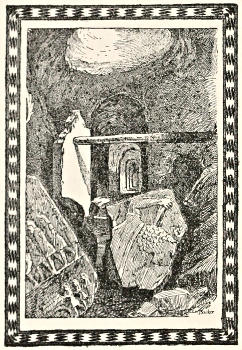
Excavations at Kuyunjik
(Layard)
Whilst detained by unexpected circumstances at Constantinople, I entered into correspondence with a gentleman in England on the subject of excavations; but, with this exception, no one seemed inclined to assist or take any interest in such an undertaking. I also wrote to M. Botta, encouraging him to proceed, notwithstanding the apparent paucity of results, and particularly calling his attention to the mound of Nimrud, which, however, he declined to explore on account of its distance from Mosul and its inconvenient position. I was soon called away from the Turkish capital to the provinces; and for some months numerous occupations prevented me turning my attention to the ruins and antiquities of Assyria.
In the meanwhile M. Botta, not discouraged by the want of success which had attended his first essay, continued his excavations in the mound of Kuyunjik: and to him is due the honour of having found the first Assyrian monument. This remarkable discovery owed its origin to the following circumstances. The small party employed by M. Botta were at work on Kuyunjik, when a peasant from a distant village chanced to visit the spot. Seeing that every fragment of brick and alabaster uncovered by the workmen was carefully preserved, he asked the reason of this, to him, strange proceeding. On being informed that they were in search of sculptured stones, he advised them to try the mound on which his village was built, and in which, he declared, many such things as they wanted had been exposed on digging for the foundations of new houses. M. Botta, having been frequently deceived by similar stories, was not at first inclined to follow the peasant’s advice, but subsequently sent an agent and one or two workmen to the place.
After a little opposition from the inhabitants, they were permitted to sink a well in the mound; and at a small distance from the surface they came to the top of a wall which, on digging deeper, they found to be built of sculptured slabs of gypsum. M. Botta, on receiving information of this discovery, went at once to the village, which was called Khorsabad. He directed a wider trench to be formed, and to be carried in the direction of the wall. He soon found that he had opened a chamber, which was connected with others, and constructed of slabs of gypsum covered with sculptured representations of battles, sieges, and similar events. His wonder may be easily imagined.
A new history had been suddenly opened to him—the records of an unknown people were before him. He was equally at a loss to account for the age and the nature of the monument. The art shown in the sculptures, the dresses of the figures, the mythic forms on the walls, were all new to him, and afforded no clew to the epoch of the erection of the edifice, and to the people who were its founders. Numerous inscriptions, accompanying the bas-reliefs, evidently contained the explanation of the events thus recorded in sculpture. They were in the cuneiform, or arrow-headed, character. The nature of these inscriptions was at least evidence that the building belonged to a period preceding the conquest of Alexander; for it was generally admitted that after the subjugation of the west of Asia by the Macedonians, the cuneiform writing ceased to be employed. But too little was then known of this character to enable M. Botta to draw any inference from the peculiar arrangement of the wedges, which distinguishes the varieties used in different countries. However, it was evident that the monument appertained to a very ancient and very civilised people; and it was natural from its position to refer it to the inhabitants of Nineveh—a city, which, although it could not have occupied a site so distant from the Tigris, must have been in the vicinity of the place. M. Botta had discovered an Assyrian edifice, the first, probably, which had been exposed to the view of man since the fall of the Assyrian Empire.
M. Botta was not long in perceiving that the building which had been thus partly excavated, unfortunately owed its destruction to fire; and that the gypsum slabs, reduced to lime, were rapidly falling to pieces on exposure to the air. No precaution could arrest this rapid decay; and it was to be feared that this wonderful monument had only been uncovered to complete its ruin. The records of victories and triumphs, which had long attested the power and swelled the pride of the Assyrian kings, and had resisted the ravages of ages, were now passing away forever. They could scarcely be held together until an inexperienced pencil could secure an imperfect evidence of their former existence.
Almost all that was first discovered thus speedily disappeared; and the same fate has befallen nearly everything subsequently found at Khorsabad. A regret is almost felt that so precious a memorial of a great nation should have been thus exposed to destruction, when no precaution could keep entire or secure the greater part of it; but as far as the object of the monument is concerned, the intention of its founders will be amply fulfilled, and the records of their might will be more widely spread, and more effectually preserved, by modern art, than the most exalted ambition could have contemplated.
M. Botta lost no time in communicating his remarkable discovery to the principal scientific body in France. Knowing the interest I felt in his labours, he allowed me to see his letters and drawings as they passed through Constantinople; and I was amongst the first who were made acquainted with his success. And here I gladly avail myself of the opportunity of mentioning, with the acknowledgment and praise which they deserve, his disinterestedness and liberality, so honourable to one engaged in the pursuit of knowledge. During the entire period of his excavations, M. Botta regularly sent me not only his descriptions, but copies of the inscriptions, without exacting any promise as to the use I might make of them. That there are few who would have acted thus liberally, those who have been engaged in a search after antiquities in the East will not be inclined to deny.
M. Botta’s communications were laid before the “Académie,” by M. Mohl; and that body, perceiving at once the importance of the discovery, lost no time in applying to the Minister of Public Instruction for means to carry on the researches. The recommendation was attended to with that readiness and munificence which almost invariably distinguished the French government in undertakings of this nature. Ample funds to meet the cost of extensive excavations were at once assigned to M. Botta, and an artist of acknowledged skill was placed under his orders to draw such parts of the monument discovered as could not be preserved or removed.
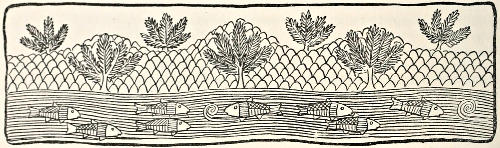
Bas-relief of Fish, Hills, and Trees
With the exception of a few interruptions on the part of the local authorities, who were suspicious of the objects of the excavations, the work was carried on with activity and success, and by the beginning of 1845 the monument had been completely uncovered. The researches of M. Botta were not extended beyond Khorsabad; and having secured many fine specimens of Assyrian sculpture for his country, he returned to Europe with a rich collection of inscriptions, the most important result of his discovery.b
LAYARD’S DISCOVERIES AT NINEVEH
It is indeed a matter for regret there is not the space to continue Layard’s own account of his discoveries. Professor Hommel has summarised this, however, in an exceedingly satisfactory manner, and his account is here given.
Brilliant as Botta’s achievements had been, they were quite cast into the shade by what the English statesman, Sir (then Mr.) A. H. Layard, the sole discoverer of Nineveh, had accomplished for all branches of investigation and knowledge of Assyrian antiquity, by means of the excavations, principally in Kuyunjik and Nimrud, but also in Neby Yunus, Kalah Shergat, and other mounds of ruins in the neighbourhood of Nineveh; these excavations were made with the assistance of Hormuzd Rassam, who subsequently continued them. We remember how, from as far back as the year 1840, it was Layard’s ardent desire to be able to undertake some excavations. He had hailed Botta’s lucky find without envy, and was indeed the first who, in some letters in the Malta Times which afterwards went the rounds of many European newspapers, directed public attention to the newly discovered Assyrian royal palace, which Botta at first assigned to the Sassanian period. Then, in the autumn of 1845, the eagerly-looked-for funds were at last obtained by the munificence of the English ambassador at Constantinople, Sir Stratford Canning (afterwards Lord Stratford de Redcliffe), to whom the British Museum already owed the acquisition of the costly marbles of Halicarnassus. Thus, towards the end of the year 1845, Layard was able to begin the excavations. He set to work on the Nimrud pile of ruins, which lies a distance of five hours to the south of Mosul, and had previously attracted his attention when Botta was still in Mosul. He laboured under the greatest difficulties, far greater than those which Botta had to overcome—to see how far this statement is from exaggeration, Layard’s own account should be perused—the work having at first to be carried on in profound secrecy so as to excite as little suspicion as possible in the Turkish authorities and in the population.
It was not to be long before Layard’s efforts were crowned with success. By the end of November several bas-reliefs were laid bare, whose execution appeared to surpass even those of the sculptures of Khorsabad, and which were accompanied by cuneiform inscriptions. In spite of many interruptions the work proceeded rigorously, and manifold were the discoveries thus brought to light. One deserving of special interest was that of the gigantic head of one of the colossal winged lions, with men’s heads, which the Assyrians placed at the entrance of their palaces for the sake of spreading terror amongst the inhabitants of surrounding districts. For it was everywhere whispered and believed that none other than Nimrod in person had risen from the earth. All this had occurred in the spring of the year 1846. The funds for the excavations lasted till the middle of June 1847; and when Layard returned to Europe he had laid bare in Nimrud no less than three great Assyrian royal palaces, namely: the grand northwestern palace, which Asshurnazirpal had built (884-861 B.C.) on the ruins of an ancient structure (dating from Shalmaneser I, the founder of Calah, circa 1300 B.C.?); the central palace, probably built by Asshurnazirpal’s successor, Shalmaneser II (a predecessor of the biblical Shalmaneser), where was found the famous black obelisk; and lastly, Esarhaddon’s once magnificent southwestern palace (681-669 B.C.). The northwestern palace yielded the richest spoil: it was also far better preserved than the contents of Sargon’s palace at Khorsabad, where Botta had made his excavations. As Sir Stratford Canning had presented the British Museum with everything moveable which Layard had discovered and brought to light, even at the end of this first expedition of Layard’s, a collection of Assyrian antiquities (principally bas-reliefs and inscriptions), such as existed nowhere else, was despatched to London. The unwearied energy of the discoverer of Nineveh succeeded in taking it unhurt, first to Bassorah, from whence the valuable freight was forwarded to the ship—truly not the smallest part of the task he had begun so gloriously, and now still more gloriously accomplished.
The period which followed was employed by Layard in summarising the results obtained in a vigorous narrative, furnished with many illustrations, the work called Nineveh and its Remains, which was published just as Layard was on the point of going to Assyria for the second time—on this occasion at the expense of the British Museum. The sensation which the book created in England was enormous, and its most important result was that henceforth the government turned its attention to the excavations. So in 1849 Layard was given leave of absence from his diplomatic post at Constantinople for the purpose of making new discoveries on Assyrian soil, and Hormuzd Rassam, who had already been his assistant and happened just then to be in London, was sent after him (also officially).
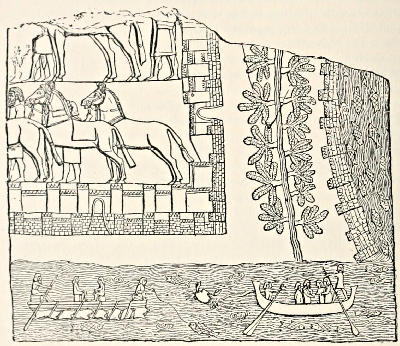
Bas-relief representing a Fortified City, a River with a Boat and Raft, and a Canal
(Found at Kuyunjik.—Layard)
If on the first expedition Layard had done little more than explore Nimrud (the ancient Calah), the labours of the second (1849-1851), were on the contrary practically limited to the mounds of ruins of Kuyunjik with Neby Yunus, the site of Nineveh itself. Here Botta had first begun his excavations, but entirely without success, for he had merely caused diggings to be made to the depth of a few feet, and without any method, instead of making his chief object the remains of the platform, on which the buildings he was seeking had been erected. And it was here that Layard, at the end of his first expedition, and after having been obliged to dig twenty feet down, had discovered Sennacherib’s southwestern palace (705-682 B.C.). But the real fruits of this discovery were now the object of the second undertaking. For if in this Layard was still occupied with Nimrud, the work there was only a species of gleaning, the excavations and discoveries in Arban, on the Khabur and in Bavian were, in comparison with the rest, only a short trial-trip, and the main thing still remained the minute investigation and laying bare of the great southwestern palace in Kuyunjik. It was not till this was finished that he employed the rest of his time and money in a visit to Babylonia (at the end of 1850), of which, however, Layard himself says “that they (i.e. the discoveries amongst the ruins of ancient Babylon) were far fewer and of far less importance than he had expected”; he also gave the first exact description of the mounds of Niffer, the ancient Nippur, southeast of Babylon. All his experiences and all the results of this second expedition were set down by Layard in the Discoveries in the Ruins of Nineveh and Babylon, a work, seven hundred pages in length and with many illustrations, besides plans and maps, which appeared in London as early as the beginning of the year 1853.
This popular book had, like the former one, a prodigious success, and was shortly after translated into German; as a supplement to it Layard’s great publications were announced, namely, that magnificent work, the Monuments of Nineveh, and a volume of inscriptions which was the forerunner to the great work on inscriptions published by the British Museum in five volumes (1861-1884).
But to return to Layard’s excavations which he resumed in the middle of October, 1849, at the place where he had interrupted them two years before. It is simply impossible within a short space to give a clear idea of what Layard and his workmen, assisted by Hormuzd Rassam, brought to light before the middle of the year 1850 in that southwestern palace of Sennacherib which Asshurbanapal restored. Any one who would form a clear idea of it must peruse Layard’s magnificent descriptions of it for himself. Assyrian antiquity rose from the earth and grew more and more distinct, and so intelligible was the language of the hundreds of bas-reliefs, that, even without understanding the inscriptions, every one was in a position to construct for himself a tolerably clear picture of the manners and customs, the life and occupations, in short, the whole civilisation of the ancient Assyrians, and this merely from the illustrations in Layard’s two popular books. But the most important discovery made in this palace, indeed the most important in its results of all the Assyrian excavations, was the remains of a regular library of thousands of clay tablets, which were heaped up in two chambers, covering the floor a foot thick. These the restorer of the palace, the accomplished king Asshurbanapal (668 B.C., the Sardanapalus of the Greeks, and Asnapper of the Bible) had had collected, and had deposited them, partly here, partly (probably in duplicate) in other palaces, as in particular in the northern palace, which was also in Kuyunjik, and was discovered by Rassam. The tablets of gray and yellow clay found in the so-called Lion Room of Asshurbanapal’s northern palace, were in most cases broken into smaller or larger fragments, probably because in the general ruin they had fallen down from the upper story into the space in which they covered the ground; many, however, were still whole. Of course only later investigation could succeed in bringing the broken fragments together again, and then only partially; one of these tablets, restored by piecing together sixteen fragments, gives the Babylonian story of the Flood, which George Smith successfully recognised from amongst the thousands of scattered fragments; the reader will appreciate the condition in which most of these clay book-pages (to use a paradoxical expression) have come down to us. The size of the tablets seldom exceeds nine by six and a half inches; but many, especially tablets containing contracts, were considerably smaller. The greater number bore the inscription, “Series of tablets …, tablet number …; Palace of Asshurbanapal, king of the universe, king of Assyria …,” after which came a series of phrases, mostly stereotyped, which indicates the tablet in question as belonging to the library of Asshurbanapal, the great collector of ancient Babylonian literature in Assyrian character. In the restored tablet of the Flood, the place of the signature is clearly recognisable on the first of the columns; it is the last of the columns, for they are always to be counted from right to left (instead of from left to right). But especially clear to the eye of a layman is the addition to the signature, which represents a kind of library mark, unlike that of the specially prized Ishtar hymn in two languages (S. M. 954, British Museum); the latter differs somewhat from the ordinary tenor of these signatures, inasmuch as a whole genealogy is put, instead of the sentence usual elsewhere; translated literally it runs:
“(series:) ir shimma dimmir Ninna.”—Complaint to the goddess Ishtar.
(The usual number of the tablet is not placed here.)
He has written and engraved it like its original.
“Palace of Asshurbanapal, king of Assyria, Son of Esarhaddon, king of the universe, king of Assyria, ruler of Babylon, King of Sumer and Accad, king of the kings of Ethiopia and Egypt, King of the four regions, son of Sennacherib, King of the universe, king of Assyria, who puts his trust in the god Asshur and the goddess Ninlil, in Nabu and Tashmit. May the god Nabu be thy guide!”
In general, however, these signatures ran as follows:
(The first word of the tablet following.)
“Xth tablet (of the series beginning thus:).…
“Palace of Asshurbanapal, the king of the universe, the king of Assyria, to whom Nabu and Tashmit had given ear, who took clear eyes for the preparation (?) of the writing of tablets, whilst under the kings my predecessors nothing of the kind (nin shipru shu’ atu) was attempted—the wisdom of Nabu, (tikip santakki), a fullness of beauty, did I write, arrange, and engrave on tablets; to see and read it I placed it in my palace.”
After which, in some examples, there follows:
“May the light of Asshur, the king of the gods, be thy guide! Whosoever shall write his name by my name, May Asshur and Ninlil (Beltis) destroy him and root his name and his seed out of the land!”
The contents of the tablets in which Asshurbanapal caused the wisdom of the god Nabu (identified by the ancients with Mercury) to be written of in this fashion, were varied to an extent scarcely conceivable. They contained the primitive spells and formulas for oaths of the people of Sumer, as well as the somewhat later hymns to the gods, and penitential psalms of the Accadian population of northern Babylonia, almost all of them with interlinear translations into the Semitic language of ancient Babylon; also legends of Semitic character and epic poems almost as old as the Accadian hymns; astronomical and astrological texts; historical inscriptions (as, for instance, those of Agum-kakrime and the ancient Sargon); chronological lists, calendars, and a great deal besides; all of which was collected by Asshurbanapal and by him handed down to posterity. It is hard to say in what direction the literary pieces thus preserved fail to cast a light on the ancient Babylonians into whose cultivation the Assyrians were, indeed, once initiated, and to whom they were in all essentials indebted for their own; it is certain that we should now be acquainted with no single one of those primitive magic verses, had not Asshurbanapal had them written out afresh. And what should we know of the Sumerians and Accadians without these songs? But this is not enough. A great part of the Asshurbanapal library consists of philosophical aids to the knowledge and acquisition of the Sumerio-Accadian language, as well as of the Semitic Assyrio-Babylonian, and to the writing (the so-called syllabary) as well as to the spoken language; these aids include vocabularies, grammatical paradigms, and even collections of phrases in two languages.
Whilst Layard was exploring the southwestern palace at Kuyunjik, adding undreamt-of treasures to those acquired in his first expedition to the country, and finding quantities of new cuneiform texts of the so-called third species of the Assyrian genus, so that he seemed to have been the first to gather the materials for the deciphering of this kind of cuneiform writing, it had been already completed, at least in the main, by the labours of Saulcy (1849) and, above all, by those of Henry Rawlinson (1847-1851). Layard’s book, Nineveh and its Remains, which appeared in 1849, had already introduced us into the midst of Assyrian antiquity, although the inscriptions which accompanied the sculptures could not yet give us any further information elucidating them. But in the Discoveries in the Ruins of Nineveh and Babylon, which appeared in the beginning of 1853, we already find the correct interpretation of several Assyrian names of kings, countries, towns, and gods, and even the correct rendering of the substance of connected historical inscriptions, which Layard owed to the information communicated in the interval by Henry Rawlinson and the Irishman, E. Hincks, who had also brought great acuteness to bear on this department of study. The numerous fresh historical documents which Layard brought with him could not have appeared at a more favourable time; above all, the first of the chests containing Asshurbanapal’s library could not have entered London at a better moment. For, once a basis was established for the reading of the cuneiform writing of the Babylonian and Assyrian languages, all that was needed to advance along the path so successfully entered upon was new texts, and these now began to flow in, in abundance.c
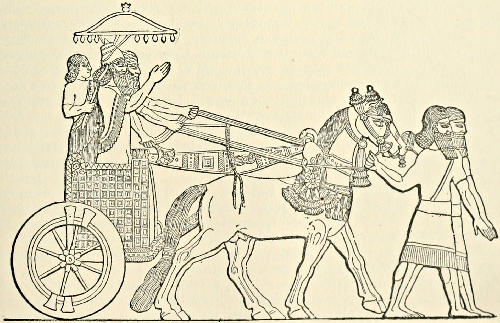
Bas-relief representing Tiglathpileser III
(Found at Nimrud.—Layard)
LATER DISCOVERIES IN BABYLONIA AND ASSYRIA
The work of exploration rested entirely between the years 1855 and 1872. Great progress was made, however, in the decipherment of inscriptions and the popularisation of the results, and the mind of the public was prepared to appreciate the greatness of the work that was to follow.
The importance of George Smith’s decipherment in 1872 of the Babylonian story of the Deluge was at once recognised, and led to his being sent to Nineveh in January, 1873, under the auspices of the Daily Telegraph. As soon as he had discovered some further fragments of the deluge story, however, the newspaper was satisfied, and he was recalled. On a second expedition, sent out in the same year by the British Museum, Smith made no startling discoveries. Smith’s work, while small in amount when compared with that of the early explorers, brought to light much valuable material, and aroused great enthusiasm in England. The British Museum sent him on a third expedition in 1876; but he was prevented from making any excavations, and died of fever on his way back.
The next expedition, that of Hormuzd Rassam in 1877, resulted, among other things, in the identification of the site of Sippar, and the discovery of numerous interesting inscriptions and of some beautifully ornamented inscribed bronze plates that had adorned the gates of the palace of Shalmaneser II.
In this same year, 1877, M. Ernest de Sarzec, then just appointed French consul at Bassorah on the Persian Gulf, began that series of brilliant explorations which he has carried on more or less continuously ever since. His enthusiasm for archæological research was backed by an extensive knowledge of the conditions of the country, and his efforts were rewarded with an unusual degree of success from the very start.
The first four years were devoted to an extensive and systematic excavation of Telloh, a great mound about five miles from the Shatt-el-khai, in southern Babylonia, and now identified with the ancient Shirpurla. The first season was marked by the discovery of two large terra-cotta cylinders, twenty-four inches long and twelve in diameter. The inscriptions on these cylinders, which contained fully two thousand lines each, were the longest then known from an early period. By the end of the four seasons of work a great temple had been uncovered, one hundred and seventy-five by one hundred feet in dimensions, and built on a mound from sixteen to twenty feet high. The bricks of the outer wall, which was five feet thick, were one foot square and bore the name Gudea. The objects found in the interior of the temple have proved very important to early Babylonian history. One room contained eight statues of an early period, all headless, however, having been mutilated by barbarians of a later time.
Scarcely less important was De Sarzec’s discovery in 1894 of a chamber in which were found thirty thousand tablets. While a considerable proportion of them were religious documents, most of these tablets were commercial, agricultural, and industrial archives.
The Louvre has profited greatly by the work of De Sarzec, for a large part of his discoveries has found its way thither.
The American expeditions have been among the most successful ones in this field. The Wolfe expedition of 1884-1885—so called from Miss Catherine Lorillard Wolfe, who defrayed its expenses—confined its work to a thorough exploration of the whole field, not only visiting the sites of previous excavations, but examining many new mounds as well. The succeeding expeditions have been sent out under the auspices of the University of Pennsylvania. The first one, in 1888-1889, under the direction of Dr. John P. Peters, with Professors H. V. Hilprecht and R. F. Harper as Assyriologists, began excavations at Niffer, the site of ancient Nippur. They had many difficulties with native tribes and Turkish officials, but succeeded in making a trigonometrical survey of all the mounds and obtaining a great number of antiquities of all sorts. Dr. Peters, however, modestly characterises the expedition as “more or less of a failure.”
In 1890 work was begun again. Thousands of tablets and various kinds of objects were obtained, and were all sent to the Imperial Museum at Constantinople. Professor Hilprecht was sent to Constantinople to catalogue the finds. He did the work with great skill and tact, and the Sultan repaid the University of Pennsylvania for his services by the gift of a large part of the collection.
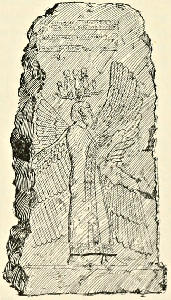
Assyrian Stele
The third expedition was sent out in 1893 under the direction of Mr. J. H. Haynes, who had been the business manager of the first two. With a single brief interruption of two months in 1894 he carried on the work steadily until 1896, accomplishing what no European had ever ventured to attempt before. This expedition and the fourth one, which set out under Haynes in 1899 and was joined by Hilprecht in 1900, procured many thousands of tablets and antiquities of other kinds. These finds have enriched the store of Babylonian literature with vast quantities of texts, religious, commercial, and historical.
The first German expedition, in 1897, like the first American, simply explored Babylonia and Assyria. Then in 1899 Dr. Robert Koldewey, who had been a member of the first expedition, accompanied by Dr. Bruno Meissner, went out under the auspices of the German Orient Society. They went to work at the mound of El-Kasr, Babylon, which covers the remains of the palace of Nebuchadrezzar. Their first success was in the finding of a new Hittite inscription and many tablets of the Neo-Babylonian period. Great results may be expected from their future work.
The Turks, themselves, have naturally the best opportunity for carrying on the work of exploration, for they can count upon the support instead of the opposition of the officials, and can keep the natives under control. Thus far one expedition has been sent out. It was under the direction of Father Scheil, a distinguished Assyriologist, a French Dominican. Its complete success shows that if the Turkish government can once be aroused to the importance of the work, greater discoveries may be expected.
One of the most important discoveries of cuneiform inscriptions was made at Tel-el-Amarna in Egypt in 1888. From these tablets, which are letters and despatches of Amenhotep III and Amenhotep IV and of many monarchs of western Asia, much valuable chronological material has been obtained, as well as much light upon social relations.
The great discoveries of the past thirty years are but an inspiration to further exploration. The work is bound to be carried on until the buried cities have been completely brought to light again.ad
THE RESULTS OF THE EXCAVATIONS
We have followed the story of the excavations in Babylonia and Assyria with some detail because of the unique character of the record. It remains now to examine the results of these excavations in their bearings upon the story of history. For, of course, it is the material supplied by the workers in this field rather than the work itself which has pertinence in the present connection.
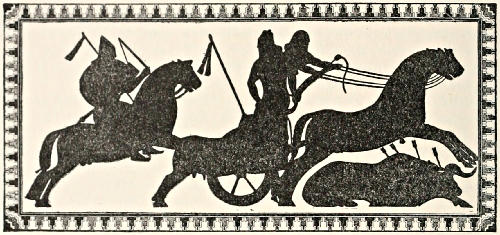
Hunting Scene from a Bas-relief in the Palace of Asshurnazirpal
Great numbers of historical documents have been restored to us, sufficing, as has already been suggested, to rebuild the history of the all but forgotten nations. Such historical documents as are not to be found in connection with Greece or Rome, or even of the civilisation of the Middle Ages down to about the tenth century A.D., are supplied us from the ruins of the Babylonian and Assyrian cities. These documents, as already pointed out, are in the form of inscriptions on fragments of brick. These inscriptions, in an altogether unknown character, were at first enigmatic, but oriental scholarship soon availed to decipher them. The story of this decipherment must be outlined here for comparison with the account of the decipherment of the Egyptian hieroglyphics, which has already been presented. In no other cases except these two has the historian been called upon to deal with a great mass of documents written in an absolutely dead language. It must be remembered that the so-called dead languages of the classical world were never really forgotten. All through the Middle Ages there were numberless scholars who had an expert knowledge of Greek and Latin. Indeed, these languages were the current medium of scholarly intercourse throughout the dark ages. But the Babylonian and Assyrian languages, like the Egyptian, were dead in the fullest significance of the term; that is to say, they were utterly unknown to any human being for a period of more than two thousand years. Their restoration was one of the marvels of nineteenth-century scholarship; and while the details of this feat of scholarship do not properly come within the province of the historian in the narrower sense, they have such universal interest that we shall do well to present at least their outline here.
Before turning to the story of decipherment, however, it will be well to gain an idea as to the number and the variety and character of the historical documents in question. And perhaps the best way to do this will be to take a glance at the contents of the Assyrian collections in the British Museum, giving particular attention to the marvellous library of King Asshurbanapal, one of the last of the great rulers of Assyria—a remarkable collection of books, the discovery of which has been already referred to in the previous section. Nothing could give one a more vivid realisation of the character of this ancient oriental civilisation than the most casual glance at the sample books from this old library. Having inspected, however casually, this marvellous set of documents, one is prepared to take up the chronological history of the Babylonians and the Assyrians with a fresh interest based upon the comprehension that this people, so long regarded as scarcely more than mythical, possessed a civilisation strangely comparable in many essential features to the civilisation of our own time.a
TREASURES FROM NINEVEH
The most casual wanderer in the British Museum can hardly fail to notice two pairs of massive sculptures, in the one case winged bulls, in the other, winged lions, both human-headed, which guard the entrance to the Egyptian hall, close to the Rosetta stone. Each pair of these weird creatures once guarded an entrance to the palace of a king in the famous city of Nineveh. As one stands before them his mind is carried back over some twenty-seven intervening centuries, to the days when the “Cedar of Lebanon” was “fair in his greatness” and the scourge of Israel. A wave of emotion sweeps over one when he first sees them, and Byron’s stirring lines, reminiscent of school-day oratory, ring in the memory:
The Assyrian came down like the wolf on the fold, And his cohorts were gleaming in purple and gold, And the sheen of their spears was like stars on the sea, When the blue wave rolls nightly on deep Galilee.
The Assyrian! The ruler of Nineveh! For two thousand five hundred years he was only a name and a memory; yet here stand great monuments to testify to the reality of his sometime greatness.
These huge lions are pertinent in the present connection because of the inscriptions that are graven across their pedestals. A glance reveals the strange characters in which these records are written, graven neatly in straight lines across the stone, and looking, to casual inspection, like nothing else so much as random flights of arrow-heads. The resemblance is so striking that this is sometimes called the arrow-headed character, though it is more generally known as the wedge or cuneiform character. A strange writing this. It seems almost incredible that it can really be susceptible of interpretation and translation into a modern language. And, indeed, the feat of interpreting it was one of the greatest achievements of nineteenth-century scholarship; but of this we shall have more to say in a moment.
But importance aside, what an interest must now attach to objects with such a history as belongs to these! The very sculptures before us, for example, were perhaps seen by Jonah when he made that famous voyage to Nineveh some seven or eight hundred years B.C. A little later the Babylonian and the Mede revolted from Assyrian tyranny, and descended upon the fair city of Nineveh, and almost literally levelled it to the ground. But these great sculptures, among other things, escaped destruction, and at once hidden and preserved by the accumulating débris of the centuries, they stood there age after age, their very existence quite forgotten. When Xenophon marched past their site with the ill-starred Expedition of the Ten Thousand, in the year 400 B.C., he saw only a mound which seemed to mark the site of some ancient ruin; but so ephemeral is fame that the Greek did not suspect that he looked upon the site of that city which only two centuries before had been the mistress of the world.
So ephemeral is fame! And yet the moral scarcely holds in the sequel; for we of to-day, in this new, undreamed-of Western world, behold these mementoes of Assyrian greatness, fresh from their twenty-five hundred years of entombment, and with them records which restore to us the history of that long-forgotten people in such detail as it was not known to any previous generation since the fall of Nineveh. For two thousand five hundred years no one saw these treasures or knew that they existed. One hundred generations of men came and went without once pronouncing the names of Kings Asshurnazirpal or Asshurbanapal. And to-day, after centuries of oblivion, these names are restored to history, and, thanks to the character of their monuments, are assured a permanency of fame that can almost defy time itself. It would be nothing strange, but rather in keeping with their previous mutations of fortune, if the names of Asshurnazirpal and Asshurbanapal should be familiar household words to future generations that have forgotten the existence of an Alexander, a Cæsar, and a Napoleon. For when Macaulay’s prospective New Zealander explores the ruins of the British Museum, the records of the ancient Assyrians will presumably be there unscathed, to tell their story as they have told it to our generation, although every manuscript and printed book may have gone the way of fragile textures.
But the past of the Assyrian sculptures is quite necromantic enough without conjuring for them a necromantic future. The story of their restoration is like a brilliant romance of history. Prior to the middle of the nineteenth century the inquiring student could learn in an hour or so all that was known in fact and in fable of the renowned city of Nineveh. He had but to read a few chapters of the Bible and a few pages of Diodorus to exhaust the important literature of the subject. If he turned also to the pages of Herodotus and Xenophon, of Justin and Ælianus, these served chiefly to confirm the suspicion that the Greeks themselves knew almost nothing more of the history of their famed oriental forerunners.
The current fables told of a first king Ninus and his wonderful queen, Semiramis; of Sennacherib, the conqueror; of the effeminate Sardanapalus, who neglected the warlike ways of his ancestors, but perished gloriously at the last, with Nineveh itself, in a self-imposed holocaust. And that was all. How much of this was history, how much myth, no man could say; and for all any one suspected to the contrary, no man could ever know. And to-day the contemporary records of the city are before us in such profusion as no other nation of antiquity, save Egypt alone, can at all rival. Whole libraries of Babylonian documents are at hand that were written twenty or even thirty centuries before our era. These, be it understood, are the original books themselves, not copies. The author of that remote time speaks to us directly, hand to eye, without intermediary transcriber. And there is not a line of any Hebrew or Greek inscriptions of a like age that has been preserved to us; there is little enough that can match these ancient books by a thousand years. When one reads of Moses or Isaiah, Homer, Hesiod, or Herodotus, he is but following the transcription—often unquestionably faulty, and probably never in all parts perfect—of successive copyists of later generations. The oldest known copy of the Bible, for example, dates from the fourth century A.D.—1000 years after the last Assyrian records were made, and read, and buried, and forgotten.
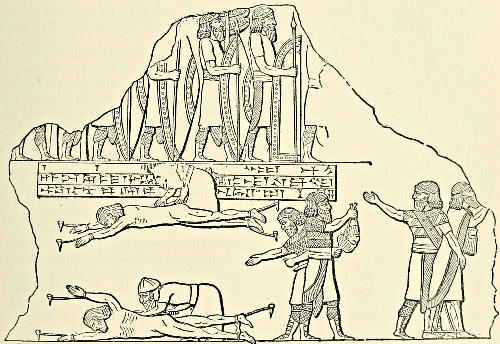
Bas-relief from an Assyrian Palace, showing Assyrian Soldiers, Prisoners being flayed alive, Cuneiform Inscriptions, etc.
As to the earlier Mesopotamian records, they date back some 5000—perhaps 7000—years B.C.: at least 1000 years before the period assigned by Archbishop Usher’s long-accepted Chronology for the creation of the world itself. Solomon, who lived about 1000 B.C., is accredited with the declaration that “of the making of many books there is no end.” Modern exegesists tell us that it was not Solomon, but a later Alexandrian interloper, who actually coined the phrase; but nevertheless it appears that the saying would have been perfectly intelligible, in Mesopotamia, not merely to Solomon’s contemporaries, but to generations that lived long before the Jewish nation, as such, came into existence. At all events, there was at least one king of Assyria—namely, Asshurbanapal—who lived only a few generations after Solomon, and whose palace boasted a library of some 10,000 volumes—a library, if you please, in which the books were numbered and shelved systematically, and classified, and cared for by an official librarian. From this library, records have come to us during the past half-century that have reconstructed the history of Asiatic antiquity.
If you would care to see some of these strange documents, you have but a little way to go from the site of the winged lion here in the British Museum. Meantime, there are other sculptures here which you can hardly pass unnoticed. As we pass the human-headed lions and enter the hall of Asshurnazirpal, we shall see other evidences of Assyrian greatness that might easily lead our thoughts astray from the writing. Here, forming the wall, are bas-reliefs on which the famous scene of the lion hunt is shown; a little farther on are all manner of war scenes; and there some domestic incidents, the making of bread or a like comestible, and its baking in an oven; and there again is the interior of a stable with a man gravely grooming a horse much as it might be done in any stable to-day.
All these must not be allowed to distract our attention, for these graphic illustrations have nothing directly to do with writing. Here, however, at the end of the hall, are some other bas-reliefs more pertinent to our present inquiry. That winged god, for example, carrying a fawn, has a fine flight of arrows across the background and figures alike, differing in the latter regard from the lion we have just left. In the hall just beyond are some illustrations of a different combination of picture and text. Here is the famous obelisk of Shalmaneser, which, like all the things thus far noted in the Assyrian collection, was found by Sir Henry Layard at Nineveh. It is virtually an illustrated book, telling in word and text of the conquest of many countries by King Shalmaneser II.
The figures of the upper row report the payment of tribute by “Sua of Gilzani, who brought silver, gold, lead, vessels of copper, horses, and dromedaries.” It will be observed, of course, that only one side of the obelisk is here shown. The other three sides in each case depict other phases of the payment of the tribute by the same conquered enemy. The second tier of figures is of peculiar interest, because it shows the payment of tribute by “Yaua, the son of Khumri.” This is, as the Bible student interprets it, “Jehu, the son of Omri.” The conquered Israelite brings “silver and gold, lead and bowls, dishes, cups, and other vessels of gold,” and the forms of these vessels, as well as the costumes of the Hebrews themselves, are well shown in the illustrations. The third row of figures represents the “payment of the tribute of the land of Musri, consisting of dromedaries, buffaloes, elephants, apes, and other animals.” The grotesque figures of the alleged apes, with their altogether human heads, are suggestive as showing how these strange foreign animals appealed to the imagination of the Assyrian artist, causing him to depart from that fine realism which he brought to bear upon the delineation of more familiar animals. The fourth set of pictures shows the payment of tribute of the land of Sukhi, and the fifth a not dissimilar tribute from the country of Patin. The inscriptions at the top and base of the obelisk give details of the conquests, recording among other things how Shalmaneser captured 1121 chariots and 470 battle horses and the whole camp of Hazael, king of Damascus.
Perhaps the most curious example of economy of material in a makeshift book that the Assyrian collection at the British Museum has to show, is illustrated in the figure of the god Nabu, which forms part of the Nineveh collection, and which stands in the hall just beyond the obelisk of Shalmaneser. Here, as a glance at the illustration will show, the skirt of the robe of the human figure is used as a ground for an elaborate inscription. The effect is rather decorative and distinctly unique. This figure has the further interest of affording an illustration of what the Assyrian artist could do when he adopted the expedient, for him unusual, of working in the round. The great masterpieces of Assyrian art were modelled in bas-relief. Occasionally, however, the artist attempted the full figure, as in the present case; but it can hardly be claimed that the success of this is at all comparable with that attained by the other method. There are low reliefs in the hunting scenes contained in the dining-hall of Asshurbanapal, as represented here in the British Museum, that are real works of art. The wounded lioness dragging her haunches, the hunted goats, the pacing wild asses, are veritable masterpieces. No such claim can be made for the god Nabu or for any other full statue that the excavations of Nineveh have revealed. But on the other hand the texture of the skirt of this god gives it an abiding interest of a unique character.
A further interest attaches to this statue, as to many others of the Assyrian monuments, because of its bearing upon the religion of that famous people. Until the discovery of these long-buried monuments, practically all that was known of the religion of the Babylonians and Assyrians was contained in the pages of Herodotus. Strange tales he tells of what he saw in the temples of Babylon, where, as he alleges, all the women of the city, of whatever class or rank, were obliged at least once in a lifetime to prostitute themselves for hire. The inscriptions on the monuments tell us nothing of such practical phases of worship as this, but they do show that the Assyrians were an intensely religious people, closely comparable in that regard to their cousins the Hebrews. Their religion, too, it would appear, was of that firmly grasped self-sufficient kind which puts aside all doubt; which assumes as a primordial fact that one’s own view is right; that one’s gods are the only true gods, and that all the outside world must be regarded as one’s proper prey. A further illustration of this phase of the subject will claim our attention when we come to examine the religious writings of the Assyrians a little more in detail.
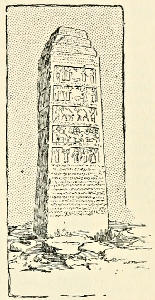
Obelisk of Shalmaneser II
(Now in the British Museum)
Another illustration of a curiously Assyrian combination of art and letters is shown in the sculptured lion that guards the entrance to the next hall. This lion is a memento of the same reign as that human-headed one at the other doorway, but it is very different in workmanship, and clearly the product of another artist. For one thing it is a veritable lion, not a mythical compound beast, except, indeed, that it shares with the other the peculiarity of a fifth leg. Assyrian tastes seem to have required that four legs should be visible from whatever point of view the statue of an animal was regarded; hence the anomaly. For the rest, this gigantic beast shows many points of realistic delineation, and it is artistically full of interest. The head in particular expresses feeling in a most unequivocal way.
But the most curious characteristic of this sculpture is the way in which the writing is carried from the slab right across the body of the animal itself, and also across its front legs. Perhaps this was done at the command of the king, merely as a convenient expedient that all the desired records of the conquest might be given a place, but the effect at a little distance is curiously as if the artist had striven to get the feeling of hair in a stiff and formal manner, in keeping with the conventional rendering of the mane. Again it has been suggested that the writing has been carried across the body of the lion to safeguard it. There was a not unusual custom among ancient monarchs of scraping out the inscription of a predecessor and supplanting it with one’s own. So great a monarch as Ramses II, in Egypt, did not scruple to do this, and a remarkable case is shown on an Arabian temple where the conscienceless monarch actually substitutes his own name for the correct one of the builder, in a tablet claiming authorship of the temple of which the tablet is a part. That the kings of Assyria had occasion to fear such jugglery is shown by the inscriptions on the book tablets in the royal library at Nineveh, where Asshurbanapal, after telling that the books are of his library, calls a curse upon any one who shall ever put another name beside his own. Perhaps, then, King Asshurnazirpal thought to transmit a record of his deeds more securely to posterity by inscribing them across the back of this lion, for doubtless the sculpture was considered a masterpiece, and the king felt, we may suppose, that artistic taste might prevent a sacrilege which mere conscience would not interdict.
THE LIBRARY OF A KING OF NINEVEH
We come now to the place in the British Museum in which some of these treasures of the old Assyrian king are guarded. They occupy part of the series of cases placed down the centre of the room known as the Nineveh Gallery. Perhaps it is not too much to speak of these collections as forming the most extraordinary set of documents of all the rare treasures of the British Museum, for it includes not books alone, but public and private letters, business announcements, marriage contracts—in a word, all the species of written records that enter into the everyday life of an intelligent and cultured community.