Part 1 / Book 2 — CHAPTER IV. FOUR GENERATIONS OF ASSYRIAN GREATNESS (722-626 B.C.)
Reading edition
After the death of Shalmaneser IV, the throne of Assyria was taken by a man of doubtful antecedents, who became the founder of a very powerful dynasty. This king, like some previous usurpers, adopted a name famous in Assyrian history. He became known to the world as Sargon II, and Rogers says he was not of royal blood; Tiele, however, from whom we shall quote, thinks differently.a
[722-716 B.C.]
In the year 722 B.C. Sargon became king in Asshur. He was an Assyrian of royal blood, who seems, however, to have belonged to another branch than that of the dynasty which had ruled before Tiglathpileser III, nor does he appear to have been closely related to the latter and his successor. He boasts that he restored to the ancient seat of government, the city of Asshur, her long usurped rights, and to Kharran, the object of his especial favour, her former liberties, which had also long been curtailed. Evidently, therefore, he appeared to a certain extent in the character of an innovator, or rather as the restorer of the ancient order.
Samaria fell shortly after his accession, and a part of its inhabitants were led away into banishment, to be replaced later on by others. Whether or no Sargon was present in person is not clear, but it is certain that he could not long devote his attention to the western portion of the empire. Scarcely was Shalmaneser IV dead before the Chaldeans revenged themselves for the humiliation they had suffered at the hands of Tiglathpileser. Marduk-baliddin [Merodach-baladan] of Bit-Yakin, at that time the most powerful amongst them, since through his timely submission to the Assyrians his country had been preserved from the miseries of war, had made himself master of the city of Babylon, and now ruled as king over the whole Babylonian country. Sargon marched south, perhaps in the hope of recovering what was lost. But in this he was unsuccessful. He did not venture to attack Babylon itself, but turned his arms against an Aramæan tribe, the Tu’mun, who had surrendered their chief to the Chaldean king. The tribe was subjugated and carried to Syria. Sargon now pressed on as far as the town of Dur-ilu in whose suburb he sustained with Babylon’s ally, the Elamite king Khumbanigash, a hotly contested fight, from which he asserts that he came off victor. This campaign, however, yielded no further advantages. Elam retained its independence and Merodach-baladan possession of Babylon. An indirect result was that the South had learned to know Sargon as a military commander, and, for the future, good care was taken not to molest him.
The danger threatened from another quarter. Syria was up in arms. At the head of the rising was Hamath, where a man of mean origin, Ya-ubidi or Il-ubidi, had seized the government. Arpad, Simirra, Damascus, and Samaria followed his example. He found a support in Hanno (Khanunu) of Gaza, who had resumed his throne, and even in Shabak,[25] the Ethiopian king of Egypt, whom Hoshea’s unhappy fate does not seem to have frightened from endeavouring to measure his strength with the imperial might of Assyria. Even before the allies could unite their forces, Sargon, who probably received early intelligence of what was going on in the countries of the Mediterranean coast, encamped before Qarqar, where Ya-ubidi had fixed his headquarters, stormed and burnt the city, had the ringleader flayed alive and his principal adherents put to death, increased his host with three hundred warriors who fought in chariots, and six hundred horsemen from amongst the conquered, and then marched south against the allied armies of Hanno and Shabak. At Raphia on the Egyptian frontier was fought the decisive battle, which turned out a brilliant victory for the Assyrians. Hanno was taken and carried off to Assyria with nine thousand of his subjects, and Shabak owed his safety only to his precipitate flight in which he was accompanied only by his chief herdsman. Hezekiah seems to have thought it wise not to defy the victor; perhaps he even sent Sargon a present. Tyre also must have been pacified in this year (720).
Meantime the other enemies of the empire were not yet cowed. The whole north, northeast and northwest, longed impatiently to shake off the Assyrian yoke. In this they were supported by Mitatti of Zikirtu, Rusas of Urartu and Mita of Muskhe, who had secretly formed a league over which Sargon was to triumph only after a long and fierce struggle. In the year 719 Mitatti contrived to persuade some towns of the loyal Iranzu of Man to revolt, whilst Rusas brought several other towns under his sway. Sargon proceeded against them with so much energy that the instigators themselves held cautiously aloof, while they beheld their country laid waste and most of its inhabitants carried into the west, especially to Damascus. In the year 718 unrest revealed itself in Tabal, where Kiakki, prince of Sinukhtu, refused to pay his tribute. But he, too, was soon led away captive to Assyria, together with seven thousand of his subjects, and Matti of Atun, a faithful vassal, was invested with Kiakki’s province. In the year 717 Sargon had to suppress a dangerous rising. Pisiris, the Hittite prince of Carchemish, which was one of the keys of the West, attempted, with the support of Mita of Muskhe, to make himself independent. But his city was taken, the majority of his subjects carried off, and an enormous booty stored in Asshurnazirpal’s palace at Calah, which Sargon had restored for himself.
[716-715 B.C.]
These disturbances were nothing compared with the war which now, in the year 716, broke out against Sargon and lasted several years. Rusas of Urartu had persuaded the chief men of the Assyrian provinces of Karalla and Man to secede, in which he was supported by Zikirtu and by the mountain region of Umildish, which was governed by a certain Bagdatti. It appears that the rebellion had spread all over the eastern frontier, and the princes of western Media also took arms. Sargon boldly attacked his enemies. He began with the country of Man, which lay nearest, soon got Bagdatti into his power, and had him flayed. The chief men of Man raised Ullusunu, the brother of Aza, whom Bagdatti had murdered, to the throne and compelled him to join Rusas’s party, to which the princes of the Nairi states, Karalla and Allabra, whose names, Asshurli and Itti, denote them as Assyrian deserters, also went over. But scarcely had Sargon set out against them before Ullusunu and his nobles found themselves obliged to offer their submission. Sargon confirmed the former in his kingdom, and compelled his two allies with other petty chiefs to return to their allegiance. The territory of the city of Kisheshim was ruled by a governor, Bel-shar-usur, probably a Babylonian. Sargon gave it the name of Kar-Nergal and made it into an Assyrian province. A like fate befell the west Median town of Kharkhar, which had expelled its sovereign, Kibaba, and solicited support from Dalta of Ellipi; henceforth it was called Kar-Sharrukin [City of Sargon]. On this the governors of other Median towns made their submission.
[715-711 B.C.]
But after these isolated successes it was still long before the eastern states were quieted. In the following year (715) Rusas wrested twenty-two towns from Ullusunu, and a certain Daiukku, who is called viceregent of Man, was involved in the affair. Khubushkia, a state of Nairi, and the neighbouring districts, became refractory, and the territory of Kar-Sharrukin, incorporated only the year before, again seceded. At the same time in the west Mita of Muskhe made an invasion into the Assyrian district of Que [in eastern Cilicia] with considerable success. Nevertheless, Sargon succeeded in maintaining the upper hand at all points. He reconquered Kar-Sharrukin, fortified it more strongly than before, and received the homage of the governors of twenty-two Median cities. His general in the west was not content with reconquering the towns taken by Mita, but even pressed southward as far as the Arabian Desert, and transferred the tribes subdued there to Samaria.
Secure of the west, Sargon now felt in a condition to strike at the real authors of all the trouble in the east. After Man and some Median districts had paid their tributes, the next thing was to proceed against Mitatti of Zikirtu. So complete was the overthrow of this prince that, after the burning of his capital, Parda, and the desolation of his country, he with his whole people sought another home. It was a harder task to subdue Rusas, the soul of the confederacy. But this, too, was accomplished by the warlike king. Rusas was defeated among his high hills. His whole royal house, amounting to some 250 persons, fell with his horsemen into the victor’s hands, and he himself only escaped with much difficulty and hid in the mountains. Rusas still built hopes on one of his allies; if he would make a stand all was not yet lost. This was Urzana of Muzazir, a former vassal of Asshur, who had, however, joined Rusas as the chief of a kindred tribe. In his mountain country, protected by its natural strength and almost impenetrable, he believed himself entirely safe. But the dauntless spirit of the ancient Assyrian warriors was not extinct in Sargon. He piously commended himself to the protection of the gods, assembled a carefully selected body of troops, and ventured with them on the almost impossible enterprise. When Urzana understood that the valiant hero was actually approaching with his veterans, he fled, according to the praiseworthy custom of Asiatic despots, with all speed into the higher mountains, leaving his capital and his own family to the mercy of the enemy. Muzazir’s fate was now soon decided; with a large number of prisoners, and an extraordinarily rich booty, including the two great gods of the country, Sargon returned to his own country. This was the death-blow for Rusas. The whole structure so laboriously prepared lay in ruins, and filled with despair he fell upon his sword.
When Sargon had thus secured his empire against the danger threatening from the half-savage barbarians of the north, he re-established order in the northwest and west. Next he turned, not against the chief author of the trouble, Mita of Muskhe himself, but against Tabal, which lay not far and somewhat to the south of Muskhe. Ambaris of Tabal, to whom previously, while his father Khulle was still alive, Sargon had amongst other tokens of favour given one of his daughters to wife, and whose kingdom he had increased by the grant of Cilicia, had been ungrateful enough to join with Rusas and Mita. In the year 713 Sargon punished him as he had deserved, and made his country into an Assyrian province. The same thing happened to Khamman and Melid in the following year. Sargon peopled the country with foreign prisoners of war, and endeavoured by the erection of ten fortresses to secure it against Urartu and Muskhe. Continuing its southward march, the Assyrian army remained for a time in the region of the Amanus, and then, in the year 711, attacked Gurgum in the neighbourhood of Kummukh, which became an Assyrian province.
[711-709 B.C.]
It is very doubtful whether Sargon took a personal share in these expeditions. It was during just these years that he was occupied with the construction of his new residence of Dur-Sharrukin. It is certain that the devastation of Ashdod, which concluded the campaign of 711, was effected not under the king’s superintendence, but under that of the king, Akhimiti, whom Sargon had installed there, but who had been expelled, and Yaman, a man of mean origin, raised to the throne by the people. On the approach of the Assyrian army this hero fled to Egypt, but the king of Melukhkha (Egypt), fearing the vengeance of Assyria, sent him back loaded with iron bands. The population of Ashdod was also carried away and replaced by other tribes. Fortified by these triumphs, Sargon could now collect his forces in order to undertake a war which should set the crown to all his achievements. This was the conquest of Babylon, which had been for the last twelve years in the possession of the Chaldean king, Merodach-baladan.
Two years were required for this undertaking, in which Sargon proceeded with great caution. Merodach-baladan was ready for the attack. He had not neglected to make the necessary dispositions and to strengthen his fortresses. In one of them, Dur-Atkhara, which was probably the nearest to Assyria, and whose defensive works he had caused to be raised, he had concentrated the whole military power of the Aramæan tribe of Gambuli, and had sent to their assistance a portion of his own choicest troops, six hundred horsemen and four thousand foot. Sargon directed himself against this fortress, and whilst he was besieging it, it is probable that another division of his army won several successes in the east, where it had to keep the Elamite king, Shutur-nakhundi, occupied, and prevent him from joining hands with his ally. Dur-Atkhara fell; more than eighteen thousand prisoners and a great booty became the spoil of the conqueror, and the rest of the defenders hastily took to flight. The Assyrian king made the town his headquarters; he subsequently gave it the name of Dur-Nabu, and placed it under an Assyrian governor. The Khamarani tribe which dwelt on the banks of the Euphrates, in their terror at the approach of his army, had already taken refuge in the town of Sippar. At the news of the surrender of Dur-Atkhara, and the defeat of the Gambuli, the Aramæan tribes of Rubu, Khindaru, Yatburu, and Puqudu, who dwelt east of the Tigris, and relied on the protection of Babylon and Elam, withdrew behind the river Ukni. The Assyrians threw a bridge across the Umlias, a river to the north of Elam, and took several strongholds there, whereupon some chiefs of the Aramæans did homage to the king at Dur-Atkhara. They were assigned to the new government of Gambuli. The remainder were attacked and defeated in the territory of the Ukni, so that of them also many submitted, and were made subject to Gambuli. Now the army of Assyria operating east of the Tigris attacked Elam from Yatburu, subdued all the surrounding country, the seven principalities of Yatburu, with which two fortresses conquered from Elam were incorporated, and a part of the Elamite territory itself. It compelled the forces of the land of Rash, which belonged to Elam, to retire to a fortress, and the Elamite king to seek refuge in the high mountains of his country. Secured against any surprise from this quarter, Sargon himself with the main body now crossed the Euphrates into the Chaldaic-Babylonian state of Bit-Dakkuri, whose capital, Dur-Ladinna, henceforth became his headquarters.
There was now no room for Merodach-baladan in Babylon. Threatened on three sides, and in danger of being cut off by Sargon from his own principality, he and his troops left the city during the night and directed their steps to the Elamite part of Yatburu, whence they might advance against the enemy in co-operation with Shutur-nakhundi. But, although he offered the latter the most costly presents, the Elamite had not yet forgotten the lesson he had received. He declined to expose himself to new defeats, and so, perhaps, lose both land and people. Merodach-baladan left Yatburu, having gained nothing, and collected his army in a stronghold of his own country, called Iqbi-Bel.
Meantime, at Dur-Ladinna, in Bit-Dakkuri, not only did Sargon receive the submission of the inhabitants and the neighbouring Bit-Amukkani, but the authorities of Babylon also came in solemn embassy, bringing an invitation to enter the holy city, with which he immediately complied. At the great festival of the lord of the gods in the month of Shabat (January) he was permitted “to clasp the hands” of that great Bel-Marduk and Nabu, the king of the universe.
But still the south of Babylonia was not yet subjugated, for there Merodach-baladan was still in arms. He collected all his forces in the immediate neighbourhood of his capital, and at the same time, for fear of treachery, led thither the population of the ancient cities of Ur, Larsa, Kishik, etc. Strong defences were set up and special canals dug, behind which he entrenched himself with his allies. But the great king did not shrink before all these obstacles. Scarcely was the campaign of the year 709 begun, before he marched south, distributed his troops along the enemy’s whole line of defence, and inflicted on the latter so terrible a defeat that the trenches appeared as though full of blood, and the Suti, who had marched from Bit-Yakin to the rescue, did not venture an attack, but hurriedly retreated. Then Sargon fell on the auxiliaries and slaughtered them like sheep. Terror now seized on the Chaldeans’ main army; Merodach-baladan left his camp with all speed and retreated to his city. But it, too, was soon taken after a short siege, and with this the power of Merodach-baladan was broken. It is uncertain whether he himself fell into his enemy’s hands or saved himself by flight; but probably the latter was the case, for immediately after Sargon’s death he is again in a position to take action, at least if the Merodach-baladan, who then revolted against Sennacherib, is the same who was conquered by Sargon and his son. But for the time Babylonia was freed from the Aramaic-Chaldean domination, and breathed again. Sargon restored the ancient rights of the natives which the oppressors had curtailed in favour of the foreigners. To the towns of southern Babylonia he gave back their stolen gods; he everywhere showed himself extremely liberal to the temples and the ancient religion of the country. In all directions he appeared as deliverer, avenger of the insulted gods, restorer of the ancestral religion, protector of the priests and of all the natives of the country. His triumph did not signalise the commencement of foreign rule, but, on the contrary, it was he who put an end to it.
[709-708 B.C.]
Sargon’s rejoicings over his victory were still further increased by the embassies and reports which he received one after the other. Uperi, the king of the island of Dilmun, in the Persian Sea, did homage to him while he was still at Bit-Yakin, and gave costly presents. When he had marched from southern Babylonia to consolidate his dominion in the conquered countries, still more welcome tidings reached him at Irma’i. Even his great enemy in the northwest, Mita of Muskhe, who had stood with Rusas at the head of the confederacy against Asshur, but who had been overcome by the governor of Que, now sent ambassadors to Sargon with presents and protestations of homage and devotion. When, finally, the king had again returned to Babylon, there came envoys from seven districts of Cyprus, “whose names had never been known to the kings, his fathers, since the rule of the god Sin,” and who offered him valuable gifts and kissed his feet. Thus the empire of the mighty conqueror stretched from the island of Dilmun, in the Persian Gulf, to the Isle of Cyprus, in the Mediterranean.
Sargon returned to Calah in the beginning of 708, his fourteenth year as king of Assyria, and third as king of Babylon, after spending some time in the latter city. Whilst he was at Calah, resting on his laurels—he did not again, himself, take the field—and from thence prosecuting the construction of his new residence of Dur-Sharrukin, not far from Nineveh, his armies had still to conduct two wars, one in the year 708, the other, perhaps, in the same, but probably in the following year. Urartu had to a certain extent recovered from the blows it had suffered in the defeats and death of its king, Rusas; and the new king, Argistis, began to grow restless, and persuaded Prince Mutallu of Kummukh to a revolt against the Assyrian domination. Sargon sent a high official with a powerful army and full royal authority, who put Mutallu to flight, taking the capital of the province, and so restoring the Assyrian dominion. The rich booty was sent to Calah to the king, and the latter placed a very strong garrison at the disposal of the new viceroy, to prevent any further attempts at risings, and at the same time to constitute a defence against Argistis. But it was once more apparent that the Assyrian Empire, as a purely military power, rested on a tottering foundation, and could only be sustained by continued wars and victories.
The other war was that for the succession in Ellipi to the north of Elam. There, after the death of Dalta, who after some resistance had become a loyal vassal of Assyria, a dispute over the inheritance broke out between his two sons, Nibe and Ishpabara. The first applied for help to Shutur-nankhundi of Elam; the second to Sargon. The latter sent seven of his commanders, who succeeded in defeating Nibe, taking his capital, Marubishti, and there installing Ishpabara as king.
[708-705 B.C.]
Sargon, who, even in the early years of his reign, in the midst of his most terrible wars, had not neglected the reconstruction of palaces and temples at Nineveh and Calah, now devoted himself entirely to the realisation of a long cherished plan, whose execution he had begun long ago. A new suburb of Nineveh, called by his name, was to come into existence as a permanent memorial of his fame and piety, and at the same time serve as a summer residence. This was Dur-Sharrukin with its temples to various gods, with its palaces and gardens, whose walls and gates, like those of a sacred city, looked to the four quarters of the heavens and were named after the high gods, and whose inhabitants, selected from the prisoners of war of all the nations whom the king had conquered and placed under Assyrian magistrates, afforded a living testimony to his mighty deeds. On the 22nd Tasrit (September) 707, the gods were solemnly introduced into their temples, and on the 6th Airu (April) of the following year, the king took possession of the new residence. He was not permitted to enjoy it long. In the year 705 he fell by an assassin’s hand. [This is doubted by some authorities, who believe that he died a natural death.]
Sargon was, without doubt, one of the greatest princes who sat on the throne of Assyria and Babylon. He was no mere conqueror, who thought merely of increasing the size of his empire, but also a true king who occupied himself for its welfare. What chiefly strikes us in him is the comparative moderation by which he was distinguished from his predecessors and in particular from his son and successor. The horrors and devastations of war were the inevitable accompaniment of the forcible subjugation of the whole of western Asia, and some obstinate rebels were punished according to the barbarous custom of his age and race. But in general he contented himself with expelling the conquered prince or making him prisoner. He also remained faithful to the policy first pursued by Tiglathpileser III, namely that of furthering the unity of the empire by transplanting whole populations to other districts. But in his records it is only now and then that we encounter the refined cruelties perpetrated by the other Assyrian kings, and he never dwells on them with so much complacency as they display.b
SENNACHERIB
[705-681 B.C.]
Sargon II was succeeded by his son Sin-akhe-erba, the Sennacherib of the Bible, who reigned long and gloriously. The period now in question has a double interest. It is a time when Assyria is at the height of its power; and the interest that attaches to any strong empire is enhanced by the fact that the Assyrians of this period came in contact with the people of Israel. Sennacherib, in particular, bears a name familiar to all succeeding generations because of the repeated mention of this ruler in the Hebrew scriptures. Until the records of the Assyrian monuments were brought to light, nothing was known of him, except what referred to his disastrous campaign against Jerusalem, together with the brief reference to his murder by his son. Now, however, an abundance of material is at hand telling of the deeds of Sennacherib. The most important of these records are contained on large cylinders of the type which many Assyrian kings employed. These cylinders tell of various campaigns of the great conqueror, including several attacks upon Israel. Two or three brief excerpts from the chronicles of Sennacherib will serve to give an idea of the phraseology in which these royal documents are couched. The first two excerpts here selected were translated by George Smith from a cylinder now in the British Museum.
Column I of this cylinder begins as follows:
“Sennacherib the great king, the powerful king, king of Assyria, king of the four regions, the appointed ruler, worshipper of the great gods, guardian of right, lover of justice, maker of peace, going the right way, preserver of good. The powerful prince, the warlike hero, leader among kings, giant devouring the enemy, breaker of bonds. Asshur, the great mountain, an empire unequalled, has committed to me, and over all who dwell in palaces has exalted my servants. From the upper sea of the setting sun to the lower sea of the rising sun all the dark races he has subdued to my feet, and stubborn kings avoided war, their countries abandoned, and, like Sudinni birds, … fled to desert places.”[26]
Column II contains a record of the campaign against the Hittites:
“In my third expedition to the land of the Hittites I went. Elulæus king of Sidon, fear of the might of my dominion overwhelmed him, and to a distance in the midst of the sea he fled, and his country I took. Great Sidon, Lesser Sidon, Bit-Sitte, Sarepta Machalliba, Ushu Alhzibu, and Akko his strong cities, fortresses, walled and enclosed, his castles; the might of the soldiers of Asshur my lord overwhelmed them, and they submitted to my feet. Tubahal in the throne of the kingdom over them I seated, and taxes and tribute to my dominion yearly, unceasing, I fixed upon him. Of Menahem of Samsimuruna, Tubahal of Sidon, Abdilihiti of Arvad, Urumilki of Gubal (Byblos), Mitinti of Ashdod, Buduilu of Beth-Ammon, Kammusunadab of Moab, Malikrammu of Edom, kings of the Hittites, all of them of the coast, the whole, their presents and furniture, to my presence they carried, and kissed my feet, and Zidqa, king of Askalon, who did not submit to my yoke; the gods of the house of his father, himself, his wife, his sons, his daughters, and his brothers, the seed of the house of his father I removed, and to Assyria I sent him. Sharruludari, son of Rukipti their former king, over the people of Askalon I appointed, and the gifts of taxes due to my dominion I fixed on him, and he performed my pleasure.”
Full of interest is the record of an invasion of Palestine. Sennacherib, it will be recalled, was the Assyrian that came down like a wolf on the fold, as recorded in Byron’s stirring lines. The Hebrew account is from 2 Kings xix. 35:
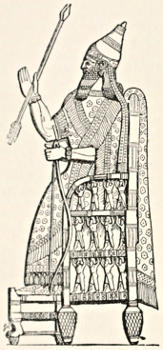
Sennacherib on his Throne
(Layard)
“And it came to pass that night, that the angel of the Lord went out, and smote in the camp of the Assyrians an hundred fourscore and five thousand; and when they arose early in the morning, behold, they were all dead corpses. So Sennacherib king of Assyria departed, and went and returned, and dwelt at Nineveh. And it came to pass, as he was worshipping in the house of Nisroch his god, that Adrammelech and Sharezer his sons smote him with the sword; and they escaped into the land of Armenia. And Esarhaddon his son reigned in his stead.”a
It is hardly necessary to state that no such record as this is to be found on the cylinder before us. The oriental scribe, whether of Egypt, Assyria, or Persia, rarely made the mistake of putting details of unfortunate expeditions on record. Doubtless Sennacherib once invaded western Asia unsuccessfully, and quite likely a plague may have decimated his hosts, but that particular invasion is not likely to furnish a favourable theme for the court chronicler.
An invasion of Palestine is, indeed, recorded on the present cylinder, but it is an invasion with very different results. Listen to the official account of the conquest of Jerusalem furnished by this cylinder of Sennacherib, as translated by Dr. Budge. The scribe reports the king as speaking in the first person:
“I drew nigh to Ekron and I slew the governors and princes who had transgressed, and I hung upon poles round about the city their dead bodies; the people of the city who had done wickedly and had committed offences I counted as spoil, but those who had not done these things I pardoned. I brought their king, Padi, forth from Jerusalem and I stablished him upon the throne of dominion over them, and I laid tribute upon him.
“I then besieged Hezekiah of Judah who had not submitted to my yoke, and I captured forty-six of his strong cities and fortresses and innumerable small cities which were round about them, with the battering of rams and the assault of engines, and the attack of foot-soldiers, and by mines and breaches (made in the walls). I brought out therefrom 200,150 people, both small and great, male and female, and horses, and mules, and asses, and camels, and oxen, and innumerable sheep I counted as spoil. (Hezekiah) himself, like a caged bird, I shut up within Jerusalem his royal city. I threw up mounds against him, and I took vengeance upon any man who came forth from his city. His cities which I had captured I took from him and gave to Mitinti, king of Ashdod, and Padi, king of Ekron, and Silli-bel, king of Gaza, and I reduced his land. I added to their former yearly tribute, and increased the gifts which they paid unto me. The fear of the majesty of my sovereignty overwhelmed Hezekiah, and the Urbi and his trusty warriors, whom he had brought into his royal city of Jerusalem to protect it, deserted. And he despatched after me his messenger to my royal city Nineveh to pay tribute and to make submission with thirty talents of gold, eight hundred talents of silver, precious stones, eye paint … ivory couches and thrones, hides and tusks, precious woods, and divers objects, a heavy treasure, together with his daughters, and the women of his palace, and male and female musicians.”
It must not be supposed, however, that either this record of a successful invasion or the Hebrew account of that other disastrous one is altogether false, however much the facts may have been exaggerated, or however poetical the guise in which they are presented. It is merely to be understood that the two records refer to different campaigns or to different portions of the same campaign, as explained later by Professor Tiele. It is supposed by some modern interpreters that the destruction of Sennacherib’s hosts actually occurred through the plague. The king himself, however, escaped to return to Nineveh and there to continue his rule for many years. He was finally killed by his own sons, as is recorded on a contemporary Babylonian document. What would not the Hebrew scholar give, could he find contemporary documents of these events from the Hebrew standpoint, instead of being obliged to depend on records handed down, perhaps, by tradition for many generations, or at best, copied from one hand to another for centuries?
The value of contemporary documents as records of fact may, indeed, be overestimated, for it is possible to pervert, exaggerate, or understate the facts even in the day of their occurrence; but in any event the contemporary document has obvious advantage over documents of subsequent generations, which can be nothing more than copies, variously distorted, of earlier records. As for such mere matters of fact as the dates of ancient kings, and the particular details of campaigns and conquests, the historic importance of the contemporary record cannot be questioned; hence the enormous value of these tablets of Assyria and Babylon. But, questions of historical value aside, a peculiar charm attaches to whatever is old, and it is nothing less than fascinating to look at such a document as this cylinder, and feel that the very lines you scan were once read by Sennacherib himself before he met his untimely end “on the 20th day of the month Tebet” some twenty-five centuries ago.
[705-702 B.C.]
It was in the year 705 B.C. that Sennacherib, who was not, perhaps, entirely guiltless of Sargon’s death, mounted the throne and became the supreme king both in Babylon and Assyria. To Merodach-baladan, who may have been either the recognised king of the Sea Lands, or the son or namesake of the latter, the occasion now seemed favourable for recovering the throne lost to Sargon. Sennacherib and his army marched up in all haste, and though it appears that Merodach-baladan had all the Aramæan and Chaldean tribes on his side, and was moreover supported by Elamite auxiliaries, he suffered a defeat and so lost his kingdom. According to the Assyrian narrator, this defeat was so complete that the Chaldean was forced to take flight in the greatest haste, leaving behind him his whole baggage-train, as well as his family and court. He had reigned nine months. The land was heavily scourged, great and small towns were taken and laid waste, and the inhabitants dragged into exile. The same fate was meted out to all Arabians, Aramæans, and Chaldeans who were living in the Babylonian towns.
When the campaign in Chaldea was at an end, the troops were sent against the Aramæan tribes, which dwelt on the banks of the Tigris and Euphrates. Here, too, there was devastation and plundering. A considerable booty, as was to be expected from these nomads, consisting chiefly of cattle, but also including camels, fell into the hands of the conquerors, and no less than two hundred thousand men and women were carried off to Assyria as slaves. It fared still worse with one small, heroic tribe, the Hirimmi, who offered an obstinate resistance to the Assyrians. When, finally, the latter succeeded in overcoming them, of all the rebels they left no prisoner of war alive, and hanged the corpses on poles upon the wall surrounding the town. Sennacherib annexed the whole territory to his realm, while he laid on it a very moderate tax for the benefit of the Assyrian god.
We may assume it as probably certain that the king did not personally take part in the campaign, but occupied himself the while with the adjustment of Babylonian state affairs. His policy may be distinctly followed. It was only toward the Chaldeans and their allies that he appeared in the character of an enemy. They alone were punished or carried off. The actual citizens of Babylon, Erech, Nippur, Kish, and Kharsag-kalama he left unmolested, and to propitiate them still further, he even gave them a king belonging to the ruling Babylonian house—namely, the young Bel-ibni, whose father held an important office, and who had himself been brought up from childhood at the Assyrian court. Of him Sennacherib might hope that he would be faithful to Assyria and at the same time not unfriendly to the Babylonians, and therefore he now bestowed on him the title of “King of Sumer and Accad.”
The establishment of order in Babylon was turned to account by Sennacherib for the purpose of averting the danger with which his eastern frontier was threatened by the nomads who wandered there, and by the mountain people, and also for extending his empire in every direction. He now attacked the Kasshu and Yasubigallu, by which names we doubtless have to understand those barbarous Kossæans, and their allies, whose successors, centuries later, according to Diodorus, still made the Mesopotamian frontier insecure, and who were related to those Kassites who had so long reigned over Babylon. Their surest protection was the inaccessible nature of the country. Steep mountain paths and thick forests made it difficult for an Assyrian army to advance, while for vehicles it was impossible.
The king himself led the march, and thus showed himself a worthy successor of the undaunted heroes who in earlier centuries had founded the Assyrian power. His chariot had frequently to be carried behind him, and then he mounted on horseback or performed the journey on foot at the head of his troops. Sennacherib succeeded in taking their three strongholds. The smaller places he laid in ashes and the nomads’ tents were burnt. But for greater security he desired to bring the wild tribes under Assyrian rule, and to force them to settle in fixed abodes. He selected Bit-Kilamzakh as a centre, fortified it far more effectually than before, making it a formidable fortress to keep the inhabitants of the country in check, and peopled it with captives whom he had carried off in former warlike expeditions. He caused a tablet inscribed with the history of this campaign to be set up in the capital, in order that the terror of the Assyrian arms might be kept perpetually alive. As soon as he had subdued the Kasshu he marched against Ellipi. Sennacherib fell on the country like a tempest. The two royal seats Marubishti and Accudu, with all the smaller towns, were taken by him and given up to be plundered and burnt, whilst all crops were destroyed and even the cornfields delivered over to the fire. It was with a certain satisfaction that Sennacherib boasted of having transformed Ellipi into a desert, and led away the whole population with its goods and chattels. When these successes became known, a number of Median princes, dwelling at a more remote distance, hastened to offer their submission.
Meantime the king’s attention was directed to events in the west. The elevation of the young and high-spirited Tirhaqa to the throne of Egypt, probably as husband of King Shabak’s widow, and guardian of his son who was a minor, had aroused in some princes of the strips of land along the Mediterranean coast the hope that by an alliance with him they might shake off the Assyrian yoke. To these belonged Elulæus (Luli) king of Tyre and Sidon, Zedekiah, (Zidga) king of Askalon, and above all Hezekiah, the king of Judah. The latter took on himself the leadership, at least in the southwest.
Sennacherib’s third campaign was directed against this coalition, and is probably to be assigned to the year 702 B.C. With its usual promptitude, the Assyrian army marched on Phœnicia, and thus attacked one of the allies before the rest had a chance to unite their forces. Elulæus fled in haste to Cyprus, where Citium still belonged to him; and all his towns on the continent, within a short space of time, fell into the hands of the Assyrian. All the princes of the other petty Phœnician states came that they might offer their submission.
[701 B.C.]
Sennacherib immediately starts along the seacoast for Askalon, southernmost of the revolted states, and soon overpowers it. Zedekiah, the king, suffers the usual fate; with the hereditary gods of his house, his wife, his sons, daughters, brothers, and his whole family he is dragged away to Assyria.
Now that the whole coast-line had submitted, Sennacherib turned to Ekron, which lay farther to the north, but more inland. But in Altaku [Eltekeh], which lay south of Ekron and belonged to it, he encountered some resistance, and was at the same time caught by an Egyptian army, which at last appeared to the rescue of the Philistine towns. According to the Assyrian account it was very numerous and was composed of the troops of the king of Musuri, and of the bowmen, chariots, and horses of the king of Melukhkha. Still, whatever these two names may mean here, it is certain that neither Tirhaqa himself nor any other Egyptian king was leading the army, but that it was merely commanded by Egyptian princes and two generals belonging to the horsemen. These did not show themselves a match for the powerful Assyrian conqueror. In spite of the number of their followers they suffered a total defeat, and it does not say much for their skill and courage that they all, princes and commanders, fell alive into the enemy’s hands. In consequence of this, the relieving army appears to have retraced its march to Egypt, so that nothing now stood in the way of Sennacherib continuing his conquests in Philistia and Canaan. The ruling high priest and the princes who had stirred up the rebellion, he caused to be put to death and their corpses displayed on stakes on the town walls; such of the inhabitants as had made common cause with the rebels were led away captive; the innocent, on the contrary, went free.
Now at last came the turn of Hezekiah. The following is the main outline of what the Assyrians relate concerning the campaign against Judah. When it became apparent that even after the overthrow of his allies, Hezekiah was not inclined to give himself up readily to the mercy of his powerful enemy, the latter marched into his country. Forty strong towns besides the citadels and countless smaller places were beleaguered, taken by storm, razed to the ground or burned, and more than two hundred thousand prisoners, with a great number of horses, asses, and camels were carried away from them. Hezekiah himself, Sennacherib shut up in his capital, Jerusalem (Ursalimmu), like “a bird in its cage.” But the town was in a strong position and provided with a good garrison. Hezekiah had not only assembled his faithful warriors, but had also enlisted a number of Arabian soldiers. When these, however, required pay, and in case of refusal threatened to withdraw, Hezekiah—the Assyrian says from dread of the glory of Asshur—paid the heavy tribute which Sennacherib demanded of him—namely, thirty talents of gold [about £9000 or $45,000] and three hundred talents of silver, besides precious stones, woods, and other articles, and also sent to Nineveh his daughters and the women of the palace, accompanied by male and female slaves together with an envoy, who was at the same time commissioned to proffer his master’s homage.
From this narrative no one who did not know the official style of the Assyrian historical writers would guess that Jerusalem was not taken, and that Sennacherib, with the remainder of his army, was obliged to quit Judah with all possible speed. But it was not their business to report failures of this kind. Doubtless in this account of the course of Sennacherib’s campaign, the main features are correct and also described in the right chronological order. It is certain that, after the overthrow of Phœnicia, the king found it advisable first to reduce the small Philistine states on the seacoast to obedience that he might then attack the Jewish king, who at last, when he had been deprived of everything save his capital, and when his own soldiers were deserting him, saw himself compelled to produce the war-tax demanded. The assertion that he sent it by an envoy to Nineveh cannot possibly be correct, and must have been invented for the purpose of rounding off the narrative without relating the true issue of the affair.
We possess two traditions concerning the close of the war which, though they may differ from one another in other respects, agree in this, that an extraordinary event unexpectedly compelled Sennacherib to return with some precipitation to Assyria. One is the biblical tradition; the other is the account of Herodotus.b
The biblical account, as found in 2 Kings, we have already quoted. The account of Herodotus relates to a certain king Sethos, a priest of Vulcan (believed to represent Shabak of the XXVth Dynasty). This king, says Herodotus, treated the military of Egypt with extreme contempt, and as if he had no occasion for their services. Among other indignities he deprived them of their aruræ, or fields of fifty feet square, which, by way of reward, his predecessors had given to each soldier; the result was that, when Sennacherib, king of Arabia and Assyria, attacked Egypt with a mighty army, the warriors whom he had thus treated refused to assist him. In this perplexity the priest retired to the shrine of his god, before which he lamented his danger and misfortunes; here he sunk into a profound sleep, and his deity promised him, in a dream, that if he marched to meet the Assyrians, he should experience no injury, for that he would furnish him with assistance. The vision inspired him with confidence; he put himself at the head of his adherents and marched to Pelusium, the entrance of Egypt: not a soldier accompanied the party, which was entirely composed of tradesmen and artisans. On their arrival at Pelusium, so immense a number of mice infested by night the enemy’s camp that their quivers and bows, together with what secured their shields to their arms, were gnawed in pieces. In the morning the Arabians, finding themselves without arms, fled in confusion, and lost great numbers of their men. There is now to be seen in the temple of Vulcan a marble statue of this king, having a mouse in his hand, and with this inscription, “Whoever thou art, learn, from my fortune, to reverence the gods.”c
Taking together all the circumstances in which the somewhat contradictory reports are agreed, we may picture the course of events as follows: On the advance of the Assyrian king, Hezekiah collects his picked men, who are reinforced by foreign soldiers, in his capital, and resolves to defend it. Meantime the Assyrian army overruns the whole of Judah, takes one fortified town after another, and all the citadels and smaller places, and Sennacherib has penetrated as far as Libnah, a small town lying in the southwest of the Jewish territory. There he learns that Tirhaqa is approaching with an Egyptian army, to fight against him and liberate Judah. So long as the capital is not yet in his power, and Judah consequently not wholly subdued, he cannot go out against him without losing all the advantages gained. He will therefore try whether he cannot, by threatening Hezekiah, induce him to deliver up the town of his own accord; and he sends him messengers with letters peremptorily calling on him to submit. But with prophetic fire Isaiah pours out his wrath at the insults offered to Jehovah by this servant of Asshur, and vehemently urges steadfast resistance.
[701-696 B.C.]
Sennacherib meantime continues his victorious march, and now that he is master of all Judah with the sole exception of the capital, he can detach a part of his army. If Hezekiah will not yield of his own free will he must be compelled to do so. A strong body of troops under the leadership of the Rabshakeh, or generalissimo, marched against the strong fortress and closely beset it on all sides. But it is the Rabshakeh who chiefly figures in the foreground of the affair. The Hebrews tell of his efforts to induce the people and the garrison of Jerusalem to desert their king. He sought to attain this end by means of scornful speeches on the helplessness of Judah.
Hezekiah, perhaps again spurred on by Isaiah, who still continues to trust in a miraculous deliverance, does not give way at once, but defends the city against a superior foe for some time, though it was the only town that remained to him and was as isolated and forsaken “as a cottage in a vineyard, as a lodge in a garden of cucumbers.” But at last, when famine in the town has reached its highest pitch and signs of impatience and discontent manifest themselves among the garrison, he makes up his mind to submission, and sends a messenger to Lachish to inquire the terms of surrender. They are very hard. But there is no longer any choice, and he tenders the Assyrian conquerors the amount required at the hand of the envoy, who subsequently accompanied it to Nineveh. Whether the siege was thereupon immediately raised, or whether it was thought well to keep the town still under observation until the contest with Egypt was decided, we cannot say positively. But, as a great misfortune, either pestilence or some other natural phenomenon, actually did soon after smite the Assyrian army, and the whole of the conqueror’s force, reduced to a miserable handful, quitted Judah and the West, the true believers among the Egyptians and Israelites saw in it a miraculous deliverance which the gods had sent them, and the latter at the same time regarded it as a fulfilment of the prophecies of Isaiah, which at first did not seem to be coming true.
Of course the event had not in reality the importance which the grateful Egyptians and Israelites attributed to it. Although it secured them relief, and Sennacherib’s army was so weakened that he thought it advisable to beat a hasty retreat, yet his supremacy over Phœnicia and Canaan remained for a long time unshaken, and in the following year he was again in the field with a powerful army. Subsequently he appears again to have marched westward and to have made a particular fight against Arabia and Edom. But it does not appear that in this campaign he also made war against Phœnicia, Philistia, and Judah, as he certainly would not have failed to do had traces of insubordination showed themselves. The chastisement had been too severe, and the country was too greatly exhausted.
In the year 700 B.C. Sennacherib’s presence was again required in Babylonia. It was the third and last year of Bel-ibni’s rule at Babylon. Sennacherib had him brought to Assyria, together with his whole family. He had proved unequal to the task which Sennacherib had assigned him.
After the victories, which intimidated even Elam, Sennacherib went to Babylon, and there in place of Bel-ibni, set up his own eldest son Asshur-nadin-shum on the throne as king of Sumer and Accad. His six years’ reign began in the year 700 B.C., and now Sennacherib thought himself safe from the machinations of Chaldean pretenders.
For some years he had really had his hands free in the south. He employed the time in bringing into subjection some of the northwestern neighbours of his empire. This campaign, which the Assyrians reckon as the fifth, and which must have taken place somewhere between 699 and 696, ended with a war in Cilicia. According to Berosus it was occasioned by a Greek invasion, and the Assyrian army obtained the victory only after suffering great loss. Abydenus even speaks of a sea-fight on the Cilician coast, in which the Greek fleet was worsted. Both historians agree in this, that Sennacherib immortalised his famous deeds by the erection of his statue or the setting up of bronze pillars with inscriptions, and that he built the town of Tarsus, which he called Tharsin, so that the Cydnus flowed through it as the Arazanes (Aralshtu) through Babylon. Strange as it may seem, the Assyrians themselves make no mention of the foundation of this important town, but Berosus is too credible a witness for his statement to be rejected.
Even before 694 Sennacherib had busied himself in the preparations of a great plan. Merodach-baladan had sought and found in Nagitu, on the coast of Elam, a refuge and place of security where he believed his deadly enemy could not reach him. After the latter’s expedition against Bit-Yakin in the year 700, the remainder of the population of that territory had found it expedient to take ships with their gods, as their master had done, and cross to the region where the latter had taken up his abode. Sennacherib apparently feared that this new state would prove a source of danger to the province entrusted to his son; all the more since Merodach-baladan had now become a vassal of Elam, Asshur’s ancient and hereditary enemy. The difficulty was great, particularly as Nagitu was not accessible from the land side, without passing through Elamite territory. He had among his captives shipbuilders from Khatti, and he set them to work at Nineveh on the Tigris and Tel-Barsip on the Euphrates. The ships were towed down the Euphrates and the Tigris [or they may have been transported overland by camels]. They were manned by Tyrian, Sidonian, and Ionic seamen, who were also prisoners of war. He, himself, had meantime marched to the Persian Gulf with his army, and had fixed his camp close to the ships. From the description of the voyage it is evident what a deep impression this very unusual expedition made on the Assyrians. Even before they set sail they made an unexpected acquaintance with the sea, which they believed four hours’ distance away; they may perhaps have been aware that, even so far up as Bab-Salimeti, the river was subject to the ebb and flow; but a spring flood, which suddenly laid the camp under water, and even made its way into the royal tent, took them by surprise. They had to seek refuge on the ships and remain on them five days and nights, “as in a great bird-cage,” says Sennacherib. Whether this experience of life on shipboard was enough for the bold monarch, or whether he had no intention of taking part in the maritime expedition, it is certain that he did not leave the shore. The transports were taken to the mouth of the Euphrates; costly sacrifices to Ea, the sea god, among which were a golden ship and a golden fish, were thrown into the rivers to obtain his protection for the fleet, and then it set sail. It is not told how long the voyage lasted, but merely that the country whither they went lay at the mouth of the Eulæus (Ulai), the chief river of Elam. There the great battle was fought, and of course the Assyrians came off the victors. They took possession of various Elamite towns, and carried off the Chaldeans and all the goods from Bit-Yakin, together with a number of Aramæans and captured ships, to Bab-Salimeti, where the king awaited them. Of Merodach-baladan not a word is said. Therefore he did not fall into the hands of the Assyrians, and was not robbed of his sovereignty by the defeat. Thus far, at least, the victory was of no lasting significance for the Assyrians. It appears simply to have destroyed the prosperity of the Chaldean colony for some time, and to have deterred the indefatigable adversary from direct attacks. But this extraordinary and costly expedition shows how greatly he was dreaded and with what implacable hatred his house was pursued by that of Sargon.
[696-692 B.C.]
While the Assyrian king was engaged in the seacoast war, Khallus, the king of Elam, instigated by the Babylonians who had left the town in good time with Merodach-baladan and had sought refuge with him, invaded Accad with his army, penetrated as far as Sippar, where he instituted a massacre, and brought Asshur-nadin-shum prisoner to Elam. On the Babylonian throne he set up a Babylonian, Suzub, son of Gakhul. It is a characteristic trait that the Assyrian account is silent as to the unhappy fate which overtook Sennacherib’s oldest son. Suzub, on his accession to the throne, took the name of Negal-ushezib. He is the Regebelos of the Ptolemaic Canon, and must be carefully distinguished from the Chaldean Suzub who did not reign over Babylon till a later date (692) and under another name.
But the new king was lord over only part of the country. The whole South was still in the hands of the Assyrians and had to be conquered by him.
About June, 694 or 693, he succeeded in getting possession of Nippur, but his farther advance was checked by the tidings that the Assyrians had meantime marched as far as Erech. Sennacherib immediately despatched a large force against the king of Elam, whom he rightly regarded as the chief author of all the trouble. Erech fell and was sacked, and, laden with rich booty, including even the chief gods of the sacred city, the Assyrians marched forward. At Nippur, Nergal-ushezib awaited them, and in the battle which followed he remained victor. But his rule was of short duration. As to the end of his reign the Babylonian and Assyrian records are agreed. The former asserts that, after the Assyrians had carried away the gods and inhabitants of Erech, Nergal-ushezib was taken prisoner in the battle at Nippur and conducted to Assyria. According to the second, he was thrown from his horse in the battle, taken prisoner and brought in chains before Sennacherib, who then shut him up in prison at the gate of Nineveh. The two accounts seem to make the story complete.
After the misfortune that had overtaken their king, the Babylonians bestowed the crown on Suzub the Chaldean, who had also fled to Elam. He reigned independently for four years, under the name of Mushezib-Marduk. The Assyrians consequently content themselves with mentioning several advantages won by them over the Elamites, and also relating that they took Suzub prisoner on their march from Erech to Asshur. They themselves practically acknowledged that Babylon did not fall into their hands, when they inform us that, after Suzub’s capture, the Babylonians closed their city gates against the Assyrians and offered an obstinate resistance.
So far as we may judge, the whole of this campaign of Sennacherib’s was a political blunder, which does not speak well for his sagacity. There was in fact nothing to be feared from Merodach-baladan; the real peril, which threatened from Elam, escaped the Assyrian king. The maritime expedition undertaken at so much labour and expense, was more adventurous than glorious, and failed in its main object: the arch enemy, at whom it was aimed, retained his liberty and his kingdom. And meantime Babylon was left without protection, and Sennacherib’s own son was bereft of throne and freedom. He had not even provided himself with sufficient forces to avenge the descent of the Elamites and reconquer the lost territory. The sole fruit of the campaign (exclusive of booty and prisoners) was the carrying away of a Babylonian king, whose place was at once taken by another prince, not less hostile. A poor compensation for the loss of the capital, the whole territory belonging to it and of his own son! Under Sennacherib’s government it was continually apparent that only under compulsion had the Babylonians submitted to the yoke of the Assyrians, and that they preferred to unite with Elam rather than again obey a Sargonid.
[692-689 B.C.]
In Elam, meantime, a rising took place against Khallus, possibly because he had been unsuccessful in his war against Assyria. [He was killed in the uprising.] Kudur-nankhundi became king in his stead. Sennacherib thought this a favourable opportunity to attack his old enemies, the Elamites. It was in 692, probably, that he took advantage of Elam’s disordered condition to inflict a heavy punishment on that country. From Rasa to Bit-Burnaki he ravaged and plundered to his heart’s content. He introduced Assyrian garrisons and placed the territory under the care of a governor. Besides this, he took thirty-five fortified towns. Such was the devastation “that the smoke of the flames covered the face of the wide heaven like a heavy storm,” and so great was the terror he spread that Kudur-nankhundi left his residence at Madaktu in all haste, and fled to a town called Khaidala, which lay far up in the mountains. But nature saved him from the hands of the Assyrians. Sennacherib did indeed give orders to march to Madaktu, but he could not carry his intention into effect. It was winter, and in (Tebet) December an earthquake, coupled with storms of rain and snow, compelled him to retreat. The mountain streams were so swollen that no army could now cross them with safety. Only three months afterwards Kudur-nankhundi died “suddenly, before his time,” and his own brother Umman-minanu mounted the throne. Scarcely had Umman-minanu assumed the sceptre of Elam than he allowed himself to be beguiled into an alliance with Babylon against Asshur. At Babylon now reigned Suzub II, the Chaldean, Mushezib-Marduk. After his flight from Sennacherib, in the year 700 or 699, he had returned to Babylon, where, after the misfortunes that overtook his namesake, he was made king, no doubt to the great chagrin of the Assyrians. When he sent gold and silver from the treasury of E-sagila, the great temple of Marduk and Zarpanit, to the Elamite king, he found the latter prepared to collect an army at once and march with it to Babylon for a joint attack upon Asshur. Sennacherib was astounded that the lesson he had imparted to Elam in the previous year had borne no better fruit. But the Chaldeans and Elamites had good ground to hope for success. The Assyrian’s latest victories had not been rich in lasting results. He had not succeeded in conquering Babylon. He had been obliged to retreat hastily from Elam. He had not been able to defend Chaldea. Moreover, the kings of Babylon and Elam could now count on a number of allies. The number of the enemy impressed the Assyrians, who likened them to a swarm of locusts. “Like a violent gale which drives the rain-clouds across the firmament, so rose the cloud of dust at their approach.” But calling on the gods, his heavenly protectors, Sennacherib ventures an attack.
It was a fierce battle; both sides fought with the greatest fury. Sennacherib, himself, was distinguished by his personal courage. With helm and mail, spear and bow, Asshur’s sacred bow, which none but the kings of Assyria carried, he stands in his war chariot like an angry lion, and like a heavy storm from Adad, the god of tempests, he rushes on the enemy, covering the plain with corpses as with grass. His horses wallow in blood; blood and fragments of the slain cleave to the pole of his war chariot. A choice troop of Elamite nobles, equipped with golden daggers and bracelets, are slaughtered like sheep, and the Elamite commander and grand vizier, Khumbanundash, a man of great ability, also falls. Others are taken prisoners. Yet the kings of Elam and Babylon and the Chaldean chiefs got away, according to the Assyrian writer, who delights in depicting their sufferings in a very imaginative fashion, with a loss of tents and baggage and of one hundred and fifty thousand dead left on the battle-field. They were pursued for a distance of some miles, but their capture was not effected. There is something loathsome in the lively colours in which the scene is painted; the pitiless slaughter and horrible mutilation of the slain are described with bloodthirsty complacency. The writer of the Assyrian tablet knew well that his savage, revengeful master based his renown on such inhuman acts. And yet it was no victory for the Assyrians. They may have remained in possession of the field, but the murderous battle was so undecisive that the Elamites and Babylonians could claim the victory as well. The losses on both sides must have been so great that neither of the two parties ventured to continue the war. Both sides assumed the attitude of waiting for a more favourable opportunity. The prevalent idea that after the battle of Khalule Sennacherib immediately conquered Babylon is decidedly false and is contradicted by the true reading of both Assyrian and Babylonian records.
Not till the year 690 or 689 did Sennacherib find a favourable opportunity to risk another attack on Babylon. From Elam there was now nothing more to fear. The power of Umman-minanu was much weakened and he was soon to lose it altogether. The Assyrian king marched on Babylon with the impetuousity which distinguished all his warlike expeditions, and was at times disadvantageous to him; and on this occasion his effort was crowned with the desired success. Now he directed his arms against Mushezib-Marduk’s town, not as his predecessors, including his own father, had done, as a rescuer bringing deliverance from a usurper and therefore striking at the latter and his dependents, and sparing the inhabitants: upon the town which had so long withstood him, so repeatedly and obstinately lifted its head against him, a fearful vengeance was to be taken. It was literally wiped out; nothing was spared; corpses lay piled up in the streets; all its treasures were pillaged and divided amongst the soldiers; the temples were desecrated, and the gods torn from their sanctuaries. Then the whole town was delivered up to the flames; the walls and ramparts, the temples and the ziggurat, (probably the two towers of Babylon and Borsippa), were thrown down and hurled into the Arakhtu or other canals, and the water from the river and the canals was turned on the ruins that they might be flooded. The very place where the sacred town had stood became unrecognisable and was changed into a marsh. Mushezib-Marduk escaped and sought refuge in Elam, but Umman-minanu, fearing Assyrian vengeance, surrendered his ally, and the latter and his family were brought prisoners to Nineveh.
Such a deed may well have spread fear and horror even in Assyria itself. Sennacherib had done what none had even ventured before. Towards the town which many an Assyrian king had treated with respect and which had never been sacked, he had behaved with a relentlessness which hitherto had only been exhibited to foreign rebels. He was now master of Babylon. For the remaining eight years of his life, he was called King of Babylon, even according to the Babylonian list of kings, although the Ptolemaic canon mentions this period as an interim. King Ummanaldash [Khumba-Khaldashu] who (the 7th of Adar 690 or 689?) succeeded Umman-minanu on the throne of Elam, and who reigned eight years, left the Assyrian king in peaceful possession. There are sufficient grounds for the assumption that this supremacy over Babylon of a tyrant embittered by earlier reverses was a reign of terror.
For the last years of Sennacherib’s reign authentic accounts are almost entirely wanting. An expedition to Arabia, against a certain king Hazael (Khazailu), in which the capital of Edom is stormed and the deity of the place falls into his hands, certainly belongs to this period of his reign.
[695-681 B.C.]
Like most of the Assyrian princes, Sennacherib, in spite of his unsettled existence, was a great builder. But he bestowed the most care on the re-establishment and embellishment of his beloved Nineveh. In the earlier part of his reign he had also strengthened this town with an outer wall and an inner rampart (duru and shalkhu), and in the year 695 he had built a great palace by the northwest wall, after pulling down a small palace which stood there. The latter had fallen into decay, partly as a result of the overflowings of the canal on which it stood, partly from the heat of the sun. The canal was now diverted, and on its margin was built a new and loftier palace, in which ivory and costly woods were not spared. There the king had a park laid out and irrigated by the waters of the Khushur (Khosr) which were made to flow through it, and it was planted with trees from the Amanus Mountains. At the same time the town was extended and embellished.
Scarcely was this structure completed when Sennacherib caused another palace, which lay farther south of the same wall, to be pulled down. It had served former kings as armoury, magazine, and stables, and had now become not only too small but also decayed. Some fields were added to it and earth brought to raise them, and upon this now rose a palace, not of tiles, but of hewn stone after the fashion of the land of Khatti (Aram). For this also cedars from Amanus and great lion and animal colossi, which had been hewn out of stone in the town of Baladai and then cased in bronze, were employed, and cunning architects disposed them with great care and magnificence. The purpose of the building remained the same; horses and every sort of cattle found stabling, stuffs and weapons were laid up there, but it had now also to serve as a barrack for the national troops. The king’s name is displayed on every wall.
Immediately after the completion of this building on the 20th day of Adar, 691, that is, in the same year in which the battle of Khalule took place, Sennacherib began another and not less important work, which was only completed and inaugurated after the sack of Babylon. This was an undertaking intended to provide the city of Nineveh with good drinking water. A number of canals had to be dug, which served at the same time to fertilise some uncultivated strips of land. In the capital which was thus, as it were, born again, the old warrior now probably rested on his laurels for a few years longer.
In the latter period of his life, Sennacherib appears to have handed over a part of his royal functions to his son Esarhaddon (Asshur-akhe-iddin), if he did not actually make him co-ruler. The latter was not his eldest son, for his name, “Asshur grants brothers, or, a brother,” shows the contrary, but he was perhaps, the second, and therefore direct heir to the throne after the death, or at least in the absence of, the king’s eldest son, Asshur-nadin-shum, who had been carried off by the Elamites. Esarhaddon was certainly destined to the succession by his father, and was the latter’s favourite. Sennacherib issued a decree by which the whole of his booty brought from the Babylonio-Chaldean district of Bit-Amukkani was assigned to him, and his name was at the same time changed to Asshur-etilli-ukinnibal (Asshur, the lord has lent a son)—a name which was more appropriate for one who now took the place of eldest son, but which Esarhaddon himself does not appear to have adopted. His brothers, whether younger or older, were not pleased at this. Two of them at least, Sharezer, whose full name was probably Nergal-shar-usur (or the Nergilus of Berosus), and Adarmalik, disputed the succession, taking advantage of the circumstance that Esarhaddon, at the head of the army, was absent in the northwest, most probably in a war with Armenia. Whilst Sennacherib was praying in a temple, they fell on him and slew him, and Nergal-shar-usur took possession of the throne, [but was at once superseded. Some histories deny his accession]. Thus died Sennacherib, on the 20th Tebet (about December) 681, by the hands of his own sons.
From the official sources, which are the only ones we possess, it is difficult to obtain an idea of the character of the Assyrian sovereign, but the records of Sennacherib’s reign certainly make a far more unfavourable impression than those which Sargon left behind. Both were conquerors, but the one shows more respect for law and justice. Stern, at times to harshness, against uncompromising adversaries, Sargon yet gives place to mildness where mercy can be made to harmonise with the interests of the empire. Sennacherib, on the other hand, takes an obvious delight in scenes of blood and desolation, in inflicting punishments which only awaken disgust at their brutish cruelty. The destruction of Babylon, the burning and blotting out of a town venerable from its age and importance, and so sacred to the pious Assyrians, was indeed a blind vengeance which fixes an indelible blot on the name of the author of the crime. Not less courageous and warlike than his predecessors, he was rash and presumptuous rather than bold, and his plans were rather venturesome than well calculated. Impetuous in attack, he neglected the needful precautions, and attained the immediate goal, often only to lose more than he gained. Whether he was concerned in his father’s murder cannot be determined; that he was, as his name indicates, a younger son, is no certain evidence of this, but it is a suspicious circumstance that he nowhere mentions his celebrated father’s name. If he was guilty, Nemesis overtook him. As a king he was far inferior to Sargon. Nineveh alone had much to thank him for. Babylon, on the contrary, which had called in Sargon as her deliverer, sought to secure her independence of him, and preferred to his yoke the dearly bought protection of Elam. After he died, having reigned something like twenty-four years, it was a long time before the empire was as powerful and flourishing as at the commencement of his rule. In thinking of Sargon and Sennacherib we are involuntarily reminded of Cyrus and Cambyses, who differed from one another in the same way.b
ESARHADDON AND ASSHURBANAPAL
[681-668 B.C.]
Sennacherib, as we have seen, was murdered by his sons. It appears that this event did not occur at once after the return from the disastrous campaign against the Israelites, as might be inferred from the Hebrew record, but a good many years later. Esarhaddon, who succeeded his father, was obliged to win back the kingdom from the regicides before he could securely occupy the throne of Assyria. He seems to have had no great difficulty in this, however, and for many years he continued in undisputed sway, not merely sustaining but extending the influence that his father had wielded. The greatest glory of his reign was his successful invasion of Egypt. Opinions have differed considerably as to the character of Esarhaddon. Professor Tiele’s verdict, which we give in extenso later, is somewhat less favourable than that of various other authorities. The opinion of Professor Maspero is perhaps worth quoting in some detail. He says:
“Esarhaddon is one of the finest and most attractive characters of Assyrian history. He was as active and resolute as Asshurnazirpal or Tiglathpileser, without being hard on his subjects or cruel to those he conquered, as they were. He delighted in being merciful as much as his predecessors had rejoiced in being merciless, and the accounts of his wars no longer make constant mention of captives being burnt alive, kings impaled on the gates of their cities, or whole populations being burnt out by fire. He took pleasure in restoring the ruins with which his father and grandfather had covered the land, and in the first year of his reign he gave orders for the rebuilding of Babylon, which was commenced on a grand scale.
“All the Chaldean prisoners were set free, and those who liked to work under the architects could do so for payment in oil, wine, honey, and other commodities of life; and when laying the foundation stones of different edifices, he himself wore the special dress of the masons. The temple of Bit-Zaggaton, the seat of Marduk, the protector of the town, issued from the ruins and the walls, and royal castles were raised beyond their former height. Beyond Babylon Esarhaddon consecrated thirty-six temples at Asshur and Agade; and they were lined with shining sheets of gold and silver.
“The palace which he built at Nineveh on the site of an old building surpassed all that had hitherto been seen. The quarries of alabaster in the mountains of Gordyene and the forests of Phœnicia furnished material for the halls; thirty-two Hittite kings on the Mediterranean coast sent great beams of pines, cedars, and cypresses. The roof was made of carved cedar wood, supported by columns of cypress encircled with gold and silver; stone lions and bulls stood at the doorways; the panels of the doors were made of ebony and cypress, encrusted with iron, silver, and ivory. The palace of Babylon was entirely destroyed, and the one commenced at Calah with Egyptian booty was never finished. The conquerors had been much impressed by the long avenues of sphinxes at the entrance of the Memphite temples, and in imitation of the idea Esarhaddon had sphinxes, lions, and bulls at the entrances of his buildings. The construction lasted three years (671-669), and it was only just far enough completed for the decoration to be started, when he fell seriously ill in 669.” Two years later he died.
It will probably be felt by most readers of the records left by Esarhaddon himself—which are, of course, our sole authority in the matter, save for a few chance biblical references—that Professor Maspero’s verdict as just quoted is over-enthusiastic. Nevertheless, it can hardly be doubted that Esarhaddon was in many ways a much more admirable character than his father. The following excerpt from one of Esarhaddon’s inscriptions, contained on a hexagonal prism of baked clay found near Nineveh, and now in the British Museum, will suggest something as to the precise interpretation one should place upon the words “attractive” and “merciful” as applied to an Assyrian conqueror:
“Esarhaddon, king of Sumer and Accad, (son of Sennacherib, king of) Assyria, (son of Sargon) king of Assyria, (who in the name of Asshur, Bel,) the Moon, the Sun, Nabu Marduk, Ishtar of Nineveh, and Ishtar of Arbela, the great gods his lords from the rising of the sun to the setting of the sun marched victorious without a rival.
“Conqueror of the city of Sidon, which is on the sea, sweeper away of all its villages; its citadel and residence I rooted up, and into the sea I flung them. Its place of justice I destroyed. Abd-milkot its king who away from my arms into the middle of the sea had fled; like a fish from out of the sea I caught him, and cut off his head. His treasure, his goods, gold and silver and precious stones, skins of elephants, teeth of elephants, dan wood, ku wood, cloths, dyed purple and yellow, of every description, and the regalia of his palace I carried off as my spoil. Men and women without number, oxen and sheep and mules, I swept them all off to Assyria. I assembled the kings of Syria and the seacoast, all of them. (The city of Sidon) I built anew, and I called it ‘The City of Esarhaddon.’ Men, captured by my arms, natives of the lands and seas of the East, within it I placed to dwell, and I set my own officers in authority over them.
“And Sanduarri king of Kundu and Sizu, an enemy and heretic, not honouring my majesty, who had abandoned the worship of the gods trusted to his rocky stronghold and Abd-milkot king of Sidon took for his ally. The names of the great gods side by side he wrote and to their power he trusted; but I trusted to Asshur, my lord. Like a bird from out of the mountains I took him, and I cut off his head. I wrought the judgment of Asshur my lord on the men who were criminals. The heads of Sanduarri and Abd-milkot by the side of those of their chiefs I hung up: and with captives young and old, male and female, to the gate of Nineveh I marched.
“Trampler on the heads of the men of Khilakki and Duhuka, who dwell in the mountains, which front the land of Tabal, who trusted to their mountains and from days of old never submitted to my yoke: twenty-one of their strong cities and smaller towns in their neighbourhood I attacked, captured, and carried off the spoil; I ruined, destroyed, and burnt them with fire. The rest of the men, who crimes and murders had not committed, I only placed the yoke of my empire heavily upon them.”
It is notable that the successor of Esarhaddon, his son Asshurbanapal, seems to have placed the same favourable opinion upon the character of his father, as compared with his grandfather Sennacherib, that moderns are disposed to adjudge. This is suggested by the fact that Asshurbanapal in various inscriptions refers to “Esarhaddon, king of Assyria, the father, my begetter,” and never to his grandfather, whom he probably would have mentioned, following custom, had he held him in any particular regard. Asshurbanapal himself was, at least in his earlier years, a warrior of no mean quality; but he was, it would appear, primarily a lover of the arts of peace. There is a marked difference in the tone of his inscriptions, as compared with those of his predecessors, even when describing his conquests. Many times they suggest one who loves the pleasures of life rather than one who gloats over the infliction of death. The following are the words in which he describes the expedition against Egypt and Ethiopia, and against Tyre, as recorded on a cylinder now preserved in the British Museum:
“In my second expedition to Egypt and Ethiopia I directed the march. Tandamani [Tanut-Amen] of the progress of my expedition heard, and that I had crossed over the borders of Egypt. Memphis he abandoned, and to save his life he fled into Thebes. The kings, prefects, and governors, whom in Egypt I had set up, to my presence came, and kissed my feet. After Tandamani the road I took, I went to Thebes the strong city. The approach of my powerful army he saw, and Thebes he abandoned, and fled to Kipkip. That city (Thebes) the whole of it, in the service of Asshur and Ishtar, my hands took; silver, gold, precious stones, the furniture of his palace, all there was, garments of wool and linen, great horses, people male and female, two lofty obelisks covered with beautiful carving, two thousand five hundred talents (over ninety tons) their weight, standing before the gate of a temple, from their places I removed and brought to Assyria. The spoil great and unnumbered, I carried off from the midst of Thebes. Over Egypt and Ethiopia, my soldiers I caused to march, and I acquired glory. With a full hand peacefully I returned to Nineveh, the city of my dominion.
“In my third expedition against Baal, king of Tyre, dwelling in the midst of the sea, I went; who my royal will disregarded, and did not hear the words of my lips. Towers round him I raised, on sea and land his roads I took, their spirits I humbled and caused to melt away, to my yoke I made them submissive. The daughter proceeding from his body and the daughters of his brothers, for concubines he brought to my presence. Yahimelek his son, the glory of the country, of unsurpassed renown, at once he sent forward to make obeisance to me. His daughter and the daughters of his brothers with their great dowries I received. Favour I granted him, and the son proceeding from his body, I restored and gave him. Yakinlu, king of Arvad, dwelling in the midst of the sea, who to the kings my fathers was not submissive, submitted to my yoke. His daughter with many gifts, for a concubine to Nineveh he brought, and kissed my feet. Mukallu, king of Tabal, who against the kings my fathers made attacks, the daughter proceeding from his body, and her great dowry, for a concubine to Nineveh he brought, and kissed my feet. Over Mukallu great horses an annual tribute I fixed upon him. Sandasharme of Cilicia, who to the kings my fathers did not submit, and did not perform their pleasure, the daughter proceeding from his body, with many gifts, for a concubine to Nineveh he brought, and kissed my feet.”
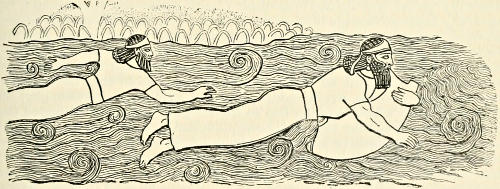
Assyrians crossing River by Means of Air Bags
Of Asshurbanapal as patron of art and literature we shall have occasion to speak more fully in a later chapter, in referring to the contents of his famous library. Not less noteworthy than this library was the gallery of art constituting the walls of the great king’s dining room. We turn now to the more detailed consideration of the life-histories of Esarhaddon and Asshurbanapal, as interpreted by a modern authority.a
ESARHADDON’S REIGN (681-668 B.C.)
[681 B.C.]
Sennacherib’s murderers did not stand alone, but had a considerable following. Asshur-akhe-iddin (Asshur is brother), Esarhaddon, as the Hebrews call him, who had been already destined to the throne by his father, had therefore to conquer the crown assigned him at the point of the sword. Although it was (Tebet) December—Sennacherib, as we have seen, had fallen on the 20th of this month—and consequently the time favourable for warlike operations had gone by, yet he perceived that this was a case for prompt action. He lay with his army in the northwest, but without waiting a single day, without stopping to collect men, horses, chariots, or material, without even supplying himself with provisions, and in spite of snow and tempest, which might be feared at that season, he hurried straight to Nineveh; “like a bird of prey with outstretched wings.” At Khanigalbat, a neighbourhood the position of which is unknown to us, but which must be sought in or near North Aramæa [probably near Melid], the army of the rebels intercepted him. But these were soon defeated and scattered. A great part very probably went over to Esarhaddon. The two chiefs of the rebellion, his brothers, sought safety in flight and were received in Urartu. That one of them, as Abydenus would have us believe, fell in the battle, is not very probable. Still it is certain that they never again attempted to get possession of the government. On the 2nd of Adar (February) the rising was extinguished, and five weeks later, on the 8th of Nisan, that is, the beginning of the year 681 B.C. [Professor Rogers gives the month of Siran, 680, for this date], Esarhaddon mounted the throne of his father.
When his brothers’ rebellion was suppressed, Esarhaddon was indeed in safe possession of the Assyrian throne, but by no means in undisputed enjoyment of the sovereignty over the whole of his father’s empire. He was continually obliged to engage in wars and to quell risings.
The son of that arch-enemy of the Assyrians, Merodach-baladan, who is generally called Nabu-ziru-kinish-lishir (Nabu, guide the true scion!), had naturally taken advantage of the confusion resulting from the murder of Sennacherib and the war of the succession, to repudiate his allegiance, and may perhaps have already thought of reconquering Babylon. From Esarhaddon’s accession he had ceased to send the presents required from a vassal, and had also omitted to appoint an envoy to offer his homage to the new king, and thus to recognise his overlordship. He had evidently overestimated the difficulties with which the king had to contend, and had not anticipated that the latter would so soon repress the rebellion and be in a position to proceed against him with decisive energy. It is uncertain whether he himself risked the attack; it appears, however, that he had already penetrated as far as Ur. Esarhaddon, who was at Nineveh when he received the news of his defection, could certainly not now be spared there. But he ordered the governors of the province bordering on the maritime country to go out against the rebellious Chaldean at the head of an army which was despatched to them, and this proved sufficient. According to the Assyrian accounts Nabu-ziru-kinish-lishir did not await the attack, but fled to Elam. But this realm was no longer what it once had been. Ummanaldash II, who now reigned there, was not inclined to endanger the peace of his kingdom and involve himself in a war with Assyria for a stranger’s sake; the fugitive was seized and put to death. Na’id-Marduk, who accompanied him on his expedition to Elam, feared a like fate. He chose the wiser course; he hastened to Assyria, made his submission, and in reward was invested with the sovereignty of his brother’s kingdom, that is, of the whole seacoast. Henceforth he faithfully paid the annual tribute.
[677-676 B.C.]
It was not so easy to put down another movement at another end of the empire. Very soon after Esarhaddon’s accession, perhaps even before, certain kings of the west country planned an attempt to free themselves from the Assyrian yoke. These were the kings of Sidon and of two other cities whose position is uncertain, but is certainly to be sought east of Sidon, namely Kundu and Sizu. Over the two last ruled Sanduarri, whose name proclaims him as one of the Hittites or related to them, and over Sidon, Abd-milkot. They had to bind themselves by an oath to recover their independence with their united forces, and fought with great persistence. This is shown by the fact that they were not subdued till the fourth year of Esarhaddon, and also of the fearful vengeance of the Assyrians, so little in accordance with this king’s customary procedure. In the year 677 Sidon succumbed to the besieging force. The city was plundered, wasted, and depopulated. Town and citadel were “thrown into the sea” and the place where they had stood made unrecognisable. The population was brought to Assyria, with all its goods and cattle and all the treasures of that rich commercial city. But Esarhaddon did not, like his father, take pleasure in mere destruction. A new town rose in the place where the former had stood. He called it by his own name [Kar-Asshur-akhe-iddin], and allowed conquered mountain peoples and inhabitants of the coast of the Persian Gulf to settle there—the old means, devised by Tiglathpileser, for absorbing sentiments of nationality and independence into the unity of the great empire. Abd-milkot had meantime fled, probably to Cyprus; for Esarhaddon says that he “took him out of the sea like a fish.” He was overtaken, made prisoner, and put to death, and in the month Tasrit of the following year, 676, his severed head reached Assyria. It was some time before Sanduarri was conquered in his mountain country, but in the month Adar of the same year he suffered a like fate to that which had overtaken his ally. Then the barbarous triumph took place in Nineveh. All the captured subjects of the defeated kings, with the great and distinguished men at their head, were led through the broad streets of the capital, and two of the noblest carried the severed heads of the rulers round their necks. Revolt against the supreme king, which meant sin against Asshur, the god of the gods, when conducted with much obstinacy as was displayed by these two men, could not be severely enough punished.
If Esarhaddon intended by these severities to spread terror among the kings of the west country, he attained his object. Although according to the wont of the Assyrian annalists, the scribe places the narrative of the war in the king’s own mouth, he took no personal part in it, but remained quietly at Nineveh. Thither now came the ambassadors of some twelve kings, whom the Assyrians called simply Khatti-kings and kings of the seacoast, and with them those of ten kings who ruled in Cyprus, to offer him their homage and presents.
When the ten Cypriote rulers, whose names have for the most part a Greek sound, joined in the homage of the Assyrian, Phœnician, and Canaanite kings, it is obvious that Esarhaddon’s army, when it pursued the flying king to Cyprus, had there re-established the Assyrian rule which had not been exercised since the time of Sargon.
All these princes had to bring him costly material for the building of his great palace at Nineveh. There is an inclination to credit Esarhaddon with a special preference for Babylon, and to assume that he had made that town his headquarters, at least towards the end of his life. Our knowledge of the building he erected is, however, not favourable to this view. He certainly governed directly and not merely by vassal-kings that part of his realm of which Babylon was the capital, and there are good grounds for the assumption that he actually cherished the intention of establishing himself at Babylon; but it is none the less certain that for him, as for his fathers, until the nomination of Asshurbanapal as vassal-king of Assyria, the centre of the dominion was Assyria, and the Assyrian capital was his chief home.
[676-673 B.C.]
Although Esarhaddon now imitated his father in his care for the decoration of the Assyrian capital, he did not limit himself to this so exclusively as his predecessors. On the contrary he boasts of having built the temples of the town of Asshur and Accad, and of having adorned them with silver and gold. That he did not neglect Accad or Babylonia is shown by the work, which surpassed all other undertakings, completed in his reign and for which he gave orders in his early years,—the reconstruction of the ruined capital itself.
In Elam it was with disapproving eyes that men regarded this renovation of Babylon by an Assyrian king and with it the re-establishment of the Assyrian rule in that territory. The king of Elam, Ummanaldash II, therefore decided to attack Esarhaddon in this part of the country. In 675, the sixth year of Esarhaddon’s reign, he invaded Babylon with an army, we know not on what pretext, and penetrated as far as Sippar. The misfortune was not, however, a lasting one. In that very year Ummanaldash died in his palace. Perhaps there is some connection between these Elamite disturbances and Esarhaddon’s campaign against the (to us) unknown country of Ruriza which he conquered in Tebet of the year 673. This may be said with certainty of the measures which he took against the Gambuli. That warlike Aramaic-Chaldean race, which had once constituted the vanguard of Merodach-baladan’s army, had then, at least, dwelt in a swampy tract of country where they lived “like fish in the midst of the rivers.” At this time their king was Belbasha (En-basha?), the son of Bananu, and in his impracticable country he had been able to preserve his independence. It was not he and his Gambulians that Esarhaddon now feared, but rather that he might easily be won over to ally himself with his neighbour Elam. Belbasha is pressed to choose and Esarhaddon makes ready to convince him by the unanswerable argument of his arms. But the Aramæan does not wait for the struggle. Knowing well that he has now no help from Elam to look to, he decides of his own accord to attest his submission to Assyria and sends the required presents. Thus Esarhaddon gains his object. The submission is accepted, the country spared, the capital, Shapi-Bel, extraordinarily fortified, the command laid on the prince to furnish it with bowmen and to defend it as “the door which unlocks Elam.” How well Esarhaddon had judged was to be shown later, when his heir had to punish the son and successor of Bel-basha for his intrigues with Elam.
[673-672 B.C.]
These few facts, with the circumstance that, in the same year, 673, probably while the court was at Babylon, the queen died, are all that we know concerning the history of the southern realm under the reign of Esarhaddon.
More is known of the king’s warlike expeditions, or at least those of his army, for it is not likely that he himself took part in them all. Some of them are of little importance to history, or were directed against tribes whose locality we can no longer determine. We pass them over in silence here. Attention may, however, be called to an expedition against Teushpa, the king of the Kimmirri or Cimmerians, or more accurately against the Umman-manda, who dwelt at a great distance, and who were afterwards to be the cause of so much trouble to Asshur and Babylon. The Cimmerians are also referred to in other records as the enemies of Assyria in Esarhaddon’s day. According to these they joined in a great coalition which was formed against Asshur; at its head stood Kashtariti of Kar-Kasshi, a Median prince, who evidently dwelt on the borders of Elam, and Mamitiarsu, governor of the Medes, and to which the Manneans also belonged. At the outset, at least, they were successful, took several towns now unknown to us (Khartam, Kishassu, and five others), and so great was the fear which they thus spread through Assyria, that in order to propitiate the gods, the priest (amelu khalti) was commanded to perform sacred rites and celebrate festivals in their honour from 3rd Airu to the 15th Abu—that is, during one hundred days. The issue of the struggle is not given in the Assyrian records, but it appears that the Babylonian chronicle told of the invasion of Assyria by the Kimmirri and of their defeat.