Part 1 / Book 2 — CHAPTER VII. MANNERS AND CUSTOMS OF BABYLONIA-ASSYRIA (continued 2)
Reading edition
Babylonian garments were not less esteemed; those in particular called sindones were in very high repute. It appears that they were usually of cotton, and the most costly were so highly valued for their brilliancy of colour and fineness of texture, as to be compared to those of Media, and set apart for royal use; they were even to be found at the tomb of Cyrus, which was profusely decorated with every description of furniture in use amongst the Persian kings during their lives. The superiority of Babylonian robes and carpets will not be a matter of surprise, when we consider how near Babylon was to Carmania on the one side, and to Arabia and Syria on the other, and that in these countries the finest cotton was produced.
Large weaving establishments were not confined to the capital, but existed likewise in other cities and inferior towns of Babylonia, which Semiramis is said to have built on the banks of the Euphrates and Tigris, and which she appointed as marts for those who imported Median and Persian goods. These manufacturing towns also were, as will soon be shown in respect to Opis, staples for land traffic. The most famous of them was Borsippa, situated on the Euphrates, fifteen miles below Babylon, and mentioned in history before the time of Cyrus. These were the principal linen and cotton manufactories, and they still existed in the age of Strabo.
Besides these, the Babylonians appear to have made all kinds of apparel, and every article of luxury: such as sweet waters, which were in common use, and probably necessary, from the heat of the climate; walking-sticks delicately chased with figures of animals and other objects, and also elegantly engraved stones, were in general use amongst the Babylonians.
These stones begin to form a particular class, since the curiosities called Babylonian cylinders have become less rare. Many of them have undoubtedly served for seal rings; for in the East the seal supplies the place of a signature, or at any rate makes it valid, as we still see on specimens of Babylonian documents. The same may be said of the cylinders. We have a striking illustration of the perfection to which the Babylonians had brought the art of cutting precious stones in the collection of M. Dorow, which contains a cylinder, formed from a jasper, bearing a cuneiform inscription, and an image of a winged Ized, or Genius, in a flowing Babylonian dress, represented in the act of crushing with each hand an ostrich, the bird of Ahriman. These various manufactures and works of art presuppose an extensive commerce, because the necessary materials must have been imported from foreign countries.
From what has been already adduced, no doubt can be entertained that Babylon enjoyed a lively commerce with the principal countries of the Persian Empire. Not only did the Persian and Median lords decorate their houses with the productions of Babylonian skill, but the kings of Persia spent a great part of the year in that city with all their numerous attendants, added to which the satraps exhibited in the same capital a pomp but little inferior to royal magnificence. Owing to this intimate connection between the chief provinces of Persia and Babylonia, the country lying between this and Susa became the most populous and cultivated in Asia; and a highway was made from Babylon to Susa, which was twenty days’ journey distant, sufficiently commodious for the baggage of an army to be conveyed on it without difficulty. The investigation, however, is involved in greater difficulties as we proceed towards the east beyond Persia, though a principal country to which they traded, that is to say, Persian India, or the present Belur-land, and with the parts adjacent, whence the Babylonians imported many of their most highly prized commodities, afford a clear proof of the direction and extent of this commerce.
The first article which we may confidently assert the Babylonians to have obtained, at least in part, from these countries, were precious stones, the use of which for seal rings was very general amongst them. Ctesias says expressly, that these stones came from India; and that onyxes, sardines, and the other stones used for seals were obtained in the mountains bordering on the sandy desert. The testimonies of modern travellers have proved that the account of this author is entitled to full credit; and that even at the present time the lapis-lazuli is found there in its greatest perfection; and if it be added to this that what Ctesias relates of India undoubtedly refers for the most part to these northern countries, we must consider it probable that the stones in question were found in the mountains of which we are speaking; while with regard to the sapphire of the ancients, that is to say, our lapis-lazuli, I have no doubt that it is a native of this country. A decisive proof is furnished by Theophrastus, a more recent author, but worthy of credit. “Emeralds and jaspers,” says he, “which are used as objects of decoration, come from the desert of Bactria (of Cobi). They are sought for by persons who go thither on horseback at the time of the north wind, which blows away the sand, and so discovers them.” “The largest of the emeralds called Bactrian,” says he, in another place, “is at Tyre, in the temple of Hercules. It forms a tolerably large pillar.” The passage, however, of Ctesias, to which we have referred, as a modern author has justly remarked, contains some indications, which, relatively to onyxes, appear to refer to the Ghat Mountains; since he speaks of a hot country not far from the sea.
The circumstance of large quantities of onyxes coming out of these mountains at the present day, viz., the mountains near Cambaya and Beroach, the ancient Barygaza, must render this opinion so much the more probable, as it was this very part of the Indian coast with which the ancients were most acquainted; and their navigation from the Persian Gulf to these regions, as will be shown hereafter, admits of no doubt. This opinion, however, must not lead us to conclude, that the commerce of Babylon was confined to those countries; for that they were acquainted with the above-mentioned northern districts is equally certain.
Hence also the Babylonians imported Indian dogs. This breed is asserted to be the largest and strongest that exist, and on that account the best suited for hunting wild beasts, even lions, which they will very readily attack. The great fondness felt by the Persians for the pleasures of the chase, by whom it was regarded as a chivalrous exercise, must have increased the value and use of these animals, which soon became even an object of luxury. The Persian nobles were obliged to keep a great number of them, as they formed a necessary part of their domestic economy, and their train; and they were also accustomed to take them with them on their journeys and military expeditions. Thus Xerxes, as we are assured by Herodotus, was followed by an innumerable quantity of dogs, when he marched against Greece; and an example taken from the same writer shows to what a pitch the Persian lords and satraps had carried their luxury in this particular. Tritantæchmes, satrap of Babylon, devoted to the maintenance of these Indian dogs no less than four towns of his government, which were exempted from all other taxes. It is easy to settle the extent of this branch of commerce, admitting, as is reasonable, that they were propagated in the country.
The native country of these animals, according to Ctesias, was that whence precious stones were obtained. And this account of the ancient author has been confirmed by a modern traveller; for Marco Polo, in his account of these regions, has not forgotten to mention large dogs, which were even able to overcome lions.
A third, and no less certain class of productions, which the Persians and Babylonians obtained from this part of the world, were dyes, and amongst them the cochineal, or rather Indian lacca. The most ancient, though not quite accurate description of this insect, and of the tree upon which it settles, is also found in Ctesias. According to him, it is a native of the country near the sources of the Indus, and produces a red, resembling cinnabar. The Indians themselves use it for the purpose of dyeing their garments, to which it gives a colour even surpassing in beauty the dyes of the Persians.
Strabo has preserved to us from Eratosthenes a knowledge of the roads by which the commodities of the Indian districts, bordering on the Persian Empire, were conveyed to its principal cities, and especially to Babylon. The usual high-road, through populous and cultivated regions, first ran in a northerly direction, in order to avoid the predatory tribes which infested the desert between Persia and Media. It continued along the southern part of this desert, as far as one of the most celebrated defiles in Asia, called the Caspian gates, through which it proceeded to Hyrcania and Aria. In this latter country, taking its course along the foot of the high and woody Hyrcanian and Parthian Mountains, the road thence turned northward towards Bactra. This is the same which Alexander followed in his expedition against the Bactrians; and though he left it occasionally to attack the inhabitants of the neighbouring mountains, he always returned to it. In Arrian it bears the name of the great military road.
The great commercial route to India was the same as this as far as Aria. Here, however, it took a different, that is to say, an easterly direction, while the other proceeded northward towards Bactra. Thence it ran to Prophthasia, Arachotus, and Ortospana, where it divided itself into three branches. One of these went due east to the borders of India; perhaps the second had a similar direction, with a little inclination to the south; and the third turned northward towards Bactria and formed the great road through which India had communication with this country and its capital, Bactra. The city must then be regarded as the commercial staple of eastern Asia. Its name belongs to a people who never cease to afford matter for historical details from the time they are first mentioned.
We cannot entertain any doubt as to the persons through whose hands the commodities of India came to Bactra. It is evident, from what has been said before, that the natives of the countries bordering on Little Thibet and others, or the northern Indians of Herodotus and Ctesias, formed the caravans which travelled into the gold desert, and that it was the same people from whom western Asia obtained ingredients for dyeing, and also the finest wool.
“The country where gold is found, and which the griffins infest,” says Ctesias, “is exceedingly desolate. The Bactrians, who dwell in the neighbourhood of the Indians, assert that the griffins watch over the gold, though the Indians themselves deny that they do anything of the kind, as they have no need of the metal; but (say they) the griffins are only apprehensive on account of their young, and these are the objects of their protection. The Indians go armed into the desert, in troops of a thousand or two thousand men. But we are assured that they do not return from these expeditions till the third or fourth year.”
It is clear, from the foregoing statement, that the Indians here mentioned were no other than the natives of northern India; and by the desert where they found gold, must be understood the sandy desert of Cobi, bounding Tangut on the west and China on the north. With regard, however, to the account of Ctesias, that caravans of a thousand or two thousand men travelled into this desert, and returned after three or four years laden with gold—what other direction could this journey have had than to the rich countries in the most remote and eastern part of Asia? I willingly leave it to the reader to judge what degree of probability there is to support this conjecture. This distant obscurity indeed prevents our having a clear view, yet this very obscurity possesses a certain charm.
We are indebted to Strabo for an account of the road by which the wares of Babylon were conveyed to the shores of the Mediterranean. It ran in a due northern direction through the midst of Mesopotamia, and reached the Euphrates near Anthemusia, five and twenty days’ journey distant, where it turned off towards the west to the Mediterranean. This could have been only a caravan road, because a numerous company of merchants would be necessary for mutual defence against the predatory nomad tribes, the Scenites, who infested the desert; or indeed for procuring a safe passage by the payment of a ransom. I cannot advance it as certain that this road was generally used under the Persian dynasty; yet it appears in the highest degree probable from the circumstance that roads were seldom or never altered by the ancients.
Another great military road, described by Herodotus, from station to station, and leading to Sardis and other Greek commercial towns in Asia Minor, was made by the Persian kings at a vast expense. It is not, indeed, to be doubted that political reasons were a principal inducement to the formation of this road, because the Persians, when they were engaged in war with the Greeks, scarcely set so high a value upon any of their provinces as they did upon Asia Minor, with which they were very desirous to further and maintain an uninterrupted communication. But we moreover learn from the description of Herodotus, that it was a commercial road, upon which caravans travelled from the chief cities of Persia into Asia Minor. According to him the road began from Susa, and not from Babylon; yet the vicinity of these two cities and their intimate connection, which has been remarked above, renders this a circumstance of no importance.
This principal road of Asia, once so famous, having undergone no other alteration than that occasioned by its different limits, is now commonly used by caravans from Ispahan to Smyrna; Tavernier has given us a full description of it. Its present course is from Smyrna to Tokat, and thence to Erivan. Only the last half has varied; for, in order to be in the direction of Ispahan, the traveller now proceeds northeast, beyond the lake of Urumiyeh; whereas the ancients, on the contrary, without going so far east, inclined more to the south, and followed the course of the Tigris.
On the whole, however, the ancient and modern roads agree in one particular, the reason of which we are told by Herodotus; that is to say, they chose the longer in preference to the shorter way, that they might travel through inhabited countries, and in security. The direct road would have led them through the midst of the steppes of Mesopotamia, where security would have been quite out of the question, on account of the roving predatory hordes. Therefore in ancient times, as well as the present, they chose the northern route along the foot of the Armenian Mountains, where the traveller enjoyed security from molestation.
As to the rest, the division into stations was evidently adopted for the advantage of the caravans. According to Herodotus, the distance between each station was five parasangs, a journey of seven or eight hours; and this we learn from Tavernier is exactly the space which caravans consisting of loaded camels are accustomed to traverse in the course of a day; but those of horses travel much faster. As this road, however, was perfectly safe, there can be no doubt that single merchants and travellers performed the journey alone.
A third branch of Babylonian commerce in the interior of Asia had a northern direction, particularly to Armenia. The Armenians had the advantage of the Euphrates to convey their wares to Babylon, and amongst these wine, which the soil of Babylonia did not produce, was the principal. Herodotus has described this navigation; and we learn from him that the ships or floats of the Armenians were constructed similarly to those which are at present seen on the Tigris, under the appellation of kilets. The skeleton only was of wood; this had a covering of skins overlaid with reeds; and an oval form was given to the whole, so that there was no difference between the stern and prow. They were filled with goods, especially large casks of wine, and then guided down the stream by two oars. The size of these barks varied considerably; Herodotus observed some which were rated at more than five thousand talents’ burthen [i.e. about 12,000 tons by the least estimate]. On their arrival at Babylon, the conductors sold not only the cargo, but also the skeleton; the skins, however, were carried back by land on asses, which they brought with them for the purpose; since, as the historian has remarked, the force of the stream rendered it impossible for them to return up the river: thus, in Germany, the market boats which go down the Danube to Vienna never return, but are sold with the commodities which they convey.
We shall be led to conclude, that the navigation of the Euphrates must have been very important, if we recollect the great works which were performed in order to secure it. Herodotus speaks of it as extraordinary; and, truly, if we believe, as there is great probability for doing, that this trade was confined to the consumption of Babylon, it must necessarily have been very considerable, from the immense population of the city, and from the peculiarity of its soil, which, as it yielded a superfluity of some things, was necessarily quite deficient in others. Hence the Babylonians were obliged to import from the northern regions those necessaries of life which their own soil failed to produce; and we shall have more distinct notions respecting this trade if we recollect that Herodotus includes under the name of Armenia, in addition to the mountainous district which may be termed Armenia proper, also the whole of that rich and fruitful country, northern Mesopotamia.e
SHIPS AMONG THE ASSYRIANS
One does not think of the Assyrians as a naval people, yet that they also went down to the sea in ships, we may learn from Layard’s researches.
Although the Assyrians were properly an inland people, yet their conquests and expeditions, particularly at a later period, brought them into contact with maritime nations. We consequently find, on the monuments of Khorsabad and Kuyunjik, frequent representations of naval engagements and operations on the seacoast. In the most ancient palace of Nimrud only bas-reliefs with a river have been discovered; they furnish us, however, with the forms of vessels, evidently of Assyrian construction—all those in the sculptures of Khorsabad and Kuyunjik belonging probably to allies or to the enemy. It may be presumed that the rivers navigated by the early Assyrians, and represented in their bas-reliefs, were the Tigris, Euphrates, and Khabur.
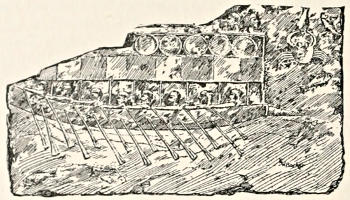
Bas-relief of an Assyrian Galley
Herodotus thus describes the Babylonian vessels of a later period: “The boats used by those who come to the city (Babylon) are of a circular form, and made of skins. They are constructed in Armenia, in the parts above Assyria. The ribs of the vessels are formed of willow boughs and branches, and covered externally with skins. They are round like a shield, there being no distinction between the head and stern. They line the bottoms of their boats with reeds (or straw), and, taking on board merchandise, principally palm wine, float down the stream. The boats have two oars, one man to each; one pulls to him, the other pushes from him. These vessels are of different dimensions; some of them are so large that they bear freight to the value of five thousand talents [£1,000,000 or $5,000,000]. The smaller have one ass on board, the larger several. On their arrival at Babylon the boatmen dispose of their goods, and also offer for sale the ribs and the reeds (or straw). They then load their asses with the skins, and return with them to Armenia, where they construct new vessels.”
I was, at one time, inclined to believe that the description of Herodotus applied to the rafts still constructed on the rivers of Mesopotamia, and used, it will be remembered, for the conveyance of the sculptures from Nimrud to Bassorah. The materials of which they are made are precisely those mentioned by the Greek historian, and they are still disposed of at Baghdad in the same way as they were in his day at Babylon. But the boats which excited the wonder of Herodotus seem to have been more solidly built, and were capable of bearing animals, to which purpose the modern raft could not be applied. They were probably more like the circular vessels now used at Baghdad, built of boughs, and sometimes covered with skins, over which bitumen is smeared, to render the whole waterproof. The boats commonly employed for the conveyance of goods and animals, on the lower part of the Tigris and Euphrates, and for ferries on all parts of those rivers, are constructed of planks of poplar wood, rudely joined together by iron nails or wooden pins, and coated with bitumen.
In a bas-relief, from the most ancient palace of Nimrud, two kinds of boats are introduced. The larger vessel contains the king in his chariot, with his attendants and eunuchs. It is both impelled by oars and towed by men. The smaller resembles that described by Herodotus. The head does not differ in form from the stern, and two men sit face to face at the oars.
In this bas-relief are also represented men supporting themselves upon inflated skins—a manner of crossing rivers still generally practised in Mesopotamia.
The larger boats were steered by a long oar, to the end of which was attached a square or oval board. This oar was held in its place by a rope fastened to a wooden pin at the stern. By this contrivance the steersman had considerable control over the vessel, and could impel it or turn the head at pleasure. This mode of steering and propelling boats still prevails on the Mesopotamian rivers.
The vessels of the Khorsabad sculptures show a considerable advance in the knowledge of ship-building. That they did not belong to the Assyrians, but to some allied nation, appears to be indicated by the peculiar costume of the figures in them.[30] The form of the vessel is not inelegant; it is that of a sea monster, the prow being in the shape of the head of a horse, and the stern in that of the tail of a fish. Several men stand at the oars. The mast, supported by two ropes, appears to be surmounted by a box, or what is technically called a crow’s nest, which, in the galleys of the Egyptians, frequently held an archer.
But it was in the sculptures of Kuyunjik that vessels were found represented in the greatest perfection. From their position in the bas-reliefs, with reference to the besieging army, it would seem that they did not belong to the Assyrians themselves, but to a people with whom they were at war, and whom they appear to have conquered. The sea was also here indicated by the nature of the fish and marine animals; such as the star or jelly fish and a kind of shark. A castle stood on the shore; and the inhabitants, attacked on the land side, were deserting the city and taking refuge in their vessels.
The larger galleys of these bas-reliefs were of peculiar form, and may, I think, be identified with the vessels used to a comparatively late period by the inhabitants of the great maritime cities of the Syrian coast—by the people of Tyre and Sidon. Their height out of the water, when compared with the depth of keel, was very considerable. The fore part rose perpendicularly from a low sharp prow, which resembled a ploughshare, and was probably of iron or some other metal, being intended, like that of the Roman galley, to sink or disable the enemy’s ships. The stern was curved from the keel, and ended in a point high above the upper deck. There were two tiers of rowers; but whether they were divided by a deck or merely sat upon benches placed at different elevations in the hold, does not appear from the sculptures. Above the rowers was a deck, on which stood the armed men. These vessels had only one mast, to the top of which was attached a very long yard, held by ropes. In the sculptures the sails were represented as furled. The number of rowers in the bas-reliefs was generally eight on a side. Only the heads of the upper tier of men were visible; the lower tier was completely concealed, the oars passing through small apertures, or portholes, in the sides of the vessel.
Besides the vessel I have described, a smaller is represented in the same bas-reliefs. It has also a double tier of rowers; but the head and stern are differently constructed from those of the larger galley, and both being of the same shape, are not to be distinguished one from the other except by the position of the rowers. They rise high above the water, and are flat at the top, with a beak projecting outward. This vessel had no mast, and was impelled entirely by oars. On the upper deck are seen warriors armed with spears, and women.
It is impossible to determine from the sculptures the size of the vessels, as the relative proportions between them and the figures they contain are not preserved. It is most probable that the four rowers in each tier are merely a conventional number, and we cannot, therefore, conjecture the length of the ship from them. No representations of naval engagements, as on the monuments of Egypt, have yet been found in the Assyrian edifices. It is most probable that, not being a maritime people, the Assyrians—as the Persians did afterwards—made use of the fleets of their allies in their expeditions by sea, furnishing warriors to man the ships.b
LAWS OF THE BABYLONIANS AND ASSYRIANS
The sense of justice and its administration play a large part in the history of any nation; and we are so fortunate as to possess certain light on the courts and customs of Assyria.
Asshurbanapal opened his library, not only to the documents emanating from the kings, but also as a depository for collections on law, juridicial decisions, and contracts between private individuals.
The Assyrio-Chaldean legislation rested on laws and customs which were already in force under the Sumerian civilisation. A great number of tablets written in both languages give us the primitive text of the law and the corresponding Assyrian translation. Others, written in Assyrian, are full of citations from Sumerian texts.
First of all, there is a long fragment of laws relating to the family, written in Assyrian and Sumerian. They read as follows:
“It has thus been decided by the sentence of the judge: ‘If a son (is authorised) to say to his father: “Thou art not my father,” he (the son) can sell him, treat him as a forfeit, and give him in payment like money.
“‘If a son (is authorised) to say to his mother: “Thou art not my mother,” he will cut her hair off, assemble the people, and make her go out of his house.
“‘If a father (is authorised) to say to his son: “Thou art not my son,” he (the father) can shut him up in his dwelling and in the cellar.
“‘If a mother (is authorised) to say to her son: “Thou art not my son,” she can shut him up in her dwelling and in the upper chambers.
“‘If a wife (is authorised) to repudiate her husband, and to say to him: “Thou art not my husband,” she can have him thrown into the river.
“‘If a man (is authorised) to say to his wife: “Thou art not my wife,” he can have half a mina of silver paid to him.
“‘If the intendant lets a slave escape, if he dies (the slave), if he becomes infirm, if in consequence of bad treatment he becomes ill, he (the intendant) shall pay half a hin of corn a day (to the master of the slave).’”
In these ancient records we likewise find laws concerning property. One tablet seems to pertain to the observations made by a Sumerian agriculturist, which were proposed to the Assyrian agriculturists of the seventh century B.C. First of all are indicated the best conditions of crop-growing, the time for sowing, the calculating of the income, the tillage, irrigation, and the injurious animals which must be destroyed.
It is evident that, in spite of the difference in property or wealth, the interest is always the same, the calculation of interest on different sums in contracts showing that the figures bear a relation to one another.
Loans could be made with or without interest; they could be made with or without security, and these securities were of different natures:
“For the interest of one’s money.… He has given as security.… A house, a field, an orchard, a female slave, a male slave.”
Exchanges were frequent, and from the data on the tablets, the principal things exchanged are known:
“They exchanged a house for money. They exchanged a field for money. They exchanged an orchard for money. They exchanged a female slave for money. They exchanged a male slave for money.”
Trials are inherent to human nature and to all epochs. Pleading took place in Nineveh, Assyria, and Chaldea. On this subject the following axiom used by the judges and the pleaders, holds perfectly to-day:
“He who listeneth not to his conscience, the judge will not listen to his right.”
There must have been a fairly complicated code of procedure, for traces are found of an appellative jurisdiction in which the sovereign was the final judge.
The Sumerian laws likewise fixed the form of individual contracts. The signature, “qatatu,” was the essential feature of the contract.
Signature took place by affixing the seal. One fragment of these tablets bears witness to this custom so perpetuated in the East from remotest times to the present. Herodotus mentions the existence of seals as a peculiarity of the Babylonians.
“Every Babylonian,” said he, “had his seal for his personal use.” The Assyrian “kunuk” answers, like our word “seal,” both to the instrument and the mark it left on the plastic earth.
A large number of contracts of private business concerning all the ordinary transactions of life, between individuals, on which figures the mark of a seal, has been found: contracts of sale or exchange; contracts of loan or hire; acknowledgments of debts, carrying the guaranty of a mortgage or of chattels. They read like the records of a notary’s office. These contracts, like all the documents of the palace library, are written on the traditional bricks. These are easily distinguished from other documents by their outer appearance. After a few lines given up to the names of the contracting parties, we see the imprints of their seals, or sometimes the imprint of three finger nails.
The general drift of their contracts is easy to understand; the clauses are worded in formal language which proceeds from the nature of the relations of the two parties according to the object of their agreement. As a usual thing, these contracts are very simply drawn. They begin by stating the names and qualifications of the parties who are going to enter into agreement by the affixment of their seal or by the nail mark, its substitute.
All contracting parties are not called upon to fulfil this formality; it is only those who have the title of “dominus negotii” the vendor, the lessor, the lender, those who “hold the pen” as the modern expression is.
A place reserved in the text for the fixing of seal or imprint reveals to us that their seals had different shapes. As many of these jewels have descended to us, and as there are a great number in our public and private collections, it is not without interest to describe them in more detail.
Generally they are hard stones, cut and polished in different ways. Some are conical or like a truncated pyramid, on the base of which the design is sunk. Sometimes the seal is in the shape of a spheroid or an ellipsoid. Many are cylindrical, the design being engraved on the surface of the cylinder, and the imprint is obtained by rolling it on plastic earth. Every variety of precious stones has been cut for this purpose; the study of these jewels and their designs is of the greatest interest to the student of art.
After the imprint of the seals, the object of the contract is stated, then its nature and its amount, which is sometimes paid down, sometimes at quarter-day; in certain cases a security is stipulated.
As to money loans, the interest is generally fixed upon by the contracting parties. Where the contract is silent on this subject it seems as if a general law were referred to, probably that which is mentioned above.
Measurements, capacities, estimates, and prices are expressed with great precision, and thus one may determine the importance of the matter discussed in the contract. The form of drawing up, indicates that the agreement passed before a magistrate who gave, if I may thus express myself, authenticity to the stipulations agreed on between the parties, from which they could not release themselves without penalty of a fine or damages. Generally the fine was paid into the treasury of Ishtar either at Arbela or Nineveh; then the judge decreed the restitution of the sum paid over, with a certain sum for damages. The contract often contained a more or less extended prayer formula and thus placed the execution of the agreement under the protection of the gods. The contract ends with the names of witnesses and their status, and is dated on the day, month, and year of its drawing up.
The contract thus perfected was delivered to a special functionary, who registered it in the public depository, the superintendence of which was confided to him.
Here are some contracts which help us to understand the methods of drawing up, and inform us as to the nature of the most usual transactions of that epoch. We give first a contract relating to the sale of a slave; it is thus worded:
Sale of a Slave
Seal of Nabu-rikhtav-usur, son of Akhardisu, man of Hasaï, workman of Zikkar Ishtar, of the city of …
Seal of Tebetai, his son, seal of Silim Bin his son, owners of the slave sold.
The girl Tavat-khasina, slave of Nabu-rikhtav-usur.… And Nitocris obtained her for the price of sixteen drachmas of silver … for Takhu her son, on account of his marriage. She will be slave to Takhu. The price has been definitely fixed. Whoever in days to come and at no matter what epoch shall contest this before me, be it Nabu-rikhtav-usur, his sons, his sons’ sons, his brother, his brother’s sons, or any other, or his attorney, should wish to annul the bargain between Nitocris, her sons, or her sons’ sons, shall pay ten minas of silver for the revocation of this contract, it shall not be sold. Shapimayu, shepherd, Bel-shum-usur, son of Yudanani Rimbel, son of Atu, are the three men, heirs of the woman because of the binding of her hands (her first marriage) and of the interest on the wage of Karmeon who was to inherit (if he lived).
Witnesses: Akhardisu, Zikkar-nipika, Mutumhisu, Khasba.
In the month of Ulul (August) the last day of the year of Asshur-sadu-sakil.
As before Yum-shamash, Putainpaïte, Atu, Nabu-iddin-akhe, presiding.
This document is one of the most curious that we have. First of all, it contains the name of an Egyptian woman, Nitocris (Nitit-eqar), then that of Takhu her son, who bears equally an Egyptian name.
The vendor is the daughter of Nabu-rikhtav-usur; his sons intervene in their quality of kinsmen for the sale of their slave, that is to say, the servant of their house. The money is not to be paid to Nitocris or direct descendants, but to third persons who are also designated; there are the three heirs of one named Karmeon, who would be the heir if he lived.
Here is another of the same kind:
Sale of a Slave
Seal of Khataï owner of the slave. Lu-akhi is the slave offered up. And Dannaï obtained him from Khataï for the price of twenty drachmas of silver. The price has been definitely fixed, the slave has been paid for and delivered; no annulment of the bargain can now take place. Whosoever in the future shall claim before me (the nullity of the agreement, shall pay the fine). Witnesses: Shamash, Khimar, Zabda, Kharaman, Mannuakhi, Zikkar, Shamash.
In the month of Ulul (August) the fifth day in the year of Nabu-bel-iddin. In the presence of Zikkar Shamash, the officer.
Contracts of this nature are numerous, and they raise a question on a point of the history of ancient slavery, which it would be interesting to have cleared up. What was the origin of these slaves who were at that time trafficked in, and who do not seem to have had to undergo the law of the vanquished, and who were so easily carried off after the seizure of a town? We have no information on this subject, and we must limit ourselves to register that which is given us in the above-mentioned texts.
The proprietor of the slave, Khataï, is a Syrian, whilst the slave, Lu-akhe, is an Assyrian sold to another Assyrian, Dannaï, for a sum of money equal to £3 [$15].
Sometimes the contract is not so simple. Complications may arise as to titles of the property or in its manner of transmission. It is also interesting to study the status of the contracting parties. One fact seems to be universal, it is that the stranger—Phœnician, Jew, or Egyptian—had the same civil rights of contracting, selling, or buying as Assyrian subjects.
Here is a contract of another kind. It concerns the sale of a house. Instead of their seal the parties affixed marks by pressing their thumb-nails into the clay.
Sale of a House
Nail of Sharludari, nail of Ahasshuru, nail of the woman Amat-Sula, wife of Belduru head of three legions, proprietors of the house to be sold. A house in course of construction with its beams, columns, materials, situate in the city of Nineveh, bounded by the house of Mannuki-akhe, bounded by the house of Ankia, bounded by the market-place. And Sil-asshur, the Egyptian officer, has acquired it by means of a mina of the king’s money, from Sharladuri, Ahasshuru, and the woman Amat-sula, wife of her husband. The price has been definitely fixed, the house paid for and bought, the annulment of the contract cannot be allowed.
No matter who, whoever he may be, in days to come, and no matter at what epoch, even among these persons, contests the right and contract of Sil-asshur shall pay ten minas of silver. Witnesses: Shushankhu, officer of the king, Kharmaza, head of three legions, Razu, captain of a vessel, Nabu-dur, officer, Kharmaza, captain of a vessel, Sin-shar-usur, Zidka.
The sixteenth day of the month Sivan (May) of the year of Zaza, prefect of the town of Arpad (1692 B.C.).
Before Shamash-ukin-akhe, Litturu, Nabu-shum-iddin.
This act is, above all, remarkable for the names of the contracting parties, from which we can now recognise that people of different nationalities were allowed to make contracts in Nineveh with the same rights as the Assyrians. Thus the names of the witnesses Shushankhu and Kharmaza are Egyptian, and their original form could easily be restituted. The name of the woman Amat-Sula is Phœnician and reveals the name of an unknown divinity; literally it means servant of Sula.f
THE CODE OF KHAMMURABI
We have purposely approached the subject of Mesopotamian law from the Assyrian side, because the Assyrian laws represent the later forms of elaboration of the old Babylonian codes on which they are based. In conclusion, however, we shall present in its entirety the oldest known, and at present the most famous, of these ancient codes, that of king Khammurabi, that the reader may judge for himself as to the character of the judicial and feudal system that was in vogue in Babylonia in the third millennium before our era. This extraordinary document will repay the closest study on the part of anyone who takes the slightest interest in the evolution of human society. Until a comparatively recent date the name of Khammurabi, the ruler who first united the states of the Euphrates valley under one rule, and thus founded the Babylonian empire, was scarcely known, whereas now we have a large mass of material dating from his reign—his inscriptions, his letters, and lastly, most important of all, his code of laws. It is difficult to obtain more than a vague idea of a country merely from its name, or from the lists of its kings and their military exploits, which is all that we possess of most Assyrian and Babylonian kings. The real life of the people wholly escapes us. This reason alone would make this code inexpressibly valuable, because, by giving the laws which controlled the social and commercial life of the people, even to minute details, it gives a picture of the actual condition of the country.
Aside from its bearing on Babylonian civilisation, however, this code is one of the most important monuments in the history of the human race. It is the oldest known legal code in existence, antedating the Mosaic code by at least a thousand years, and older than the laws of Manu. It formed the basis of Babylonian legislation until the fall of the empire, and was compiled by a king living about 2300 B.C., whose rule extended from the Tigris to the Mediterranean. Khammurabi is generally identified with Amraphel, the contemporary of Abraham; and it cannot be questioned that these laws formed a part of the traditions which the Hebrews brought with them to their new home.
The Discovery of the Code
The monument containing these laws was not found at Babylon, as might have been expected, but at Susa (Shushan) in the so-called Acropolis. The discovery is due to the French excavating expedition under M. de Morgan, and was made in December and January of 1901-1902. The monument is a block of black diorite nearly eight feet high. It has been photographed and published with transcription and translation by Father V. Scheil, the Assyriologist of the expedition, in the Mémoires de la Délégation en Perse, tome IV, Textes Élamites Sémitiques. The whole inscription has since been translated by Dr. H. Winckler in Der Alte Orient, 4 Jahrgang, Heft 4, 1902, and the code alone by Rev. C. H. W. Johns, The Oldest Code of Laws in the World, Edinburgh, 1903.
The obverse of the stone contains a representation in bas-relief of Khammurabi receiving the laws inscribed beneath, from Shamash, the sun-god and god of right, who is pictured seated on a throne. The king stands in a respectful attitude before him. The inscription several times mentions the fact that the laws were given by Shamash; so the very interesting theory in The Times, London, of April 14th, 1903, that the god in the picture is Bel has not much foundation. This theory would connect the code more closely with the Biblical narrative. To quote from The Times, “The old Bel was the god who dwelt on the mountain of the world and gave laws to men and wore on his breast the tablets of destiny. So here we have a curious proof of the existence of the tradition of the mountain-given law long before the Mosaic reception on Sinai.”
Below the bas-relief on the obverse are sixteen columns of writing with 1,114 lines, and on the reverse there are twenty-eight columns with 2,510 lines. Five columns of the obverse have been erased and the stone repolished, probably to make room for an inscription of the conquering Elamite king who carried the stone away from Babylon to Susa. Possibly one of the dire calamities which Khammurabi, in the inscription, invokes the gods to send on anyone who should deface his monument, befell the unfortunate Elamite.
The writing is in a beautifully clear archaic script often used for royal inscriptions, even after the cursive writing came into use. There are a great many tablets dating from the same period written in the cursive, some of them bearing the impression of seals in the archaic. Some seven hundred lines of the inscription are devoted to proclaiming the titles of the king, his care for his subjects, his reason for erecting the monument, his maledictions on anyone who shall interfere with it. Some passages in it remind one of the majesty of portions of the Psalms. It begins:
“When Anu the supreme, king of the Anunnaki, and Bel, lord of heaven and earth, who determines the fate of the universe, to Marduk the eldest son of Ea, god of right, earthly power had assigned, among the Igigi had made him great, Babylon with his august name had named, in all the world had exalted him, in the heart (of that city) an eternal kingdom, whose foundations are firm as heaven and earth, had established,—then did Anu and Bel call me by name, Khammurabi, the great prince, who fears god, to establish justice in the land, to destroy the wicked and base, so that the strong oppress not the weak, to go forth like Shamash (the sun) over the black heads (i.e., men) to give light to the world, to promote the prosperity of the people.…”
Immediately following the code Khammurabi resumes: “The just decrees which Khammurabi, the wise king, has established; for the land a sure law and a happy reign he has procured. Khammurabi, the protecting king, I am. From the black heads, which Bel gave me, to be a shepherd over whom Marduk appointed me, I have not held aloof, have not rested; places of peace I have provided for them; I opened up a way through steep passes and sent them aid. With the powerful arms which Zamama and Ishtar endowed me, with the clear glance that Ea granted me, with the bravery which Marduk gave me, the enemy above and below I have rooted out, the deeps I have conquered, established the prosperity of the country, the dwellers in houses have I made to live in safety; a cause for fear I have not suffered to exist. The great gods have chosen me. I am the peace-bringing shepherd whose staff is straight (i.e., sceptre is just), the good shadow which is spread over my city; to my heart the people of Sumer and Accad I have taken, under my protection have I caused them to live in peace, sheltered them in my wisdom, so that the strong may not oppress the weak; to counsel the orphan and the widow, their head have I raised in Babylon, the city of Anu and Bel; in E-sagila, the temple whose foundations are firm as heaven and earth, to speak justice to the land, to decide disputed questions, to remedy evil, have I written my precious words on my monument; before my picture, as of a king of justice I have placed them.… At the command of Shamash, the great judge of heaven and earth, shall justice reign in the land; by the order of Marduk my lord no destruction shall touch my statue. In E-sagila, that I love, shall my name be remembered forever; the oppressed man who has a cause for complaint shall come before my picture of the king of justice, shall read the inscription, shall apprehend my precious words, the writing shall explain to him his case, he shall see his right, his heart shall become glad, (and he shall say) ‘Khammurabi is a lord who is like a father to his subjects, he has made the word of Marduk to be feared.’ … Khammurabi, the king of righteousness, to whom Shamash gave the law, I am.”
The inscription contains also many references to public works and historical events which make it one of the most important historical records ever discovered. One reference to Asshur (Assyria) is particularly important. It occurs in the introduction to the code and records the restoration of “its protecting god to the city of Asshur.” The name Asshur occurs again in a letter written by Khammurabi to Sin-idinnam, and also in a private letter of the period, the former published by Mr. L. W. King in 1901.
We now turn to the code proper, and the following points are especially noticeable throughout. The idea of responsibility is very clearly fixed,—a man who hired an animal was responsible for that animal,—if a boat he was responsible for the boat,—if he stored anything for another, or carried anything to another, he was responsible so long as the object was in his hands. Also of builders,—if a man built a house he was responsible for its solidity; a physician was held responsible for the life of his patient.
Secondly, we notice the importance of putting everything in writing—a marriage without a written contract was invalid; a man who took goods on deposit, an agent who obtained goods from a merchant, if he had no document to show for it, could claim no legal aid in case of disagreement. We have countless contract tablets from this period, containing the seals and names of witnesses to just such transactions as are provided for in the code, which show how well this principle was observed.
The law of retaliation or jus talionis is another important feature, as it is prominent also in the Mosaic code. This is expressed by the familiar phrase “an eye for an eye, and a tooth for a tooth.” The attempt to make the punishment balance the crime exactly is carried to such an extent that if a house fell and killed the owner, the builder was to be put to death, if the owner’s son died, the builder’s son was killed. In several of the laws we notice peculiarly humane provisions, showing that the king really had the interests of his subjects at heart, and that his words on the inscription and his desire to be a father to his people were not a vain boast. This is especially noticeable in a regulation concerning debtors (clause 45), in the provisions for inheritance, and particularly in the clause concerning the sick wife (148).
It is not to be supposed that all of the laws found in Khammurabi’s code date from his reign. Some of them were much older, as is shown by a difference in the grades of culture represented. Some even assign different penalties for the same crime (see clauses 6 and 8). As Prof. Jastrow has pointed out, the ordeal by water cannot have been invented in the same period as the minute provisions for the inheritance of property.
The so-called Sumerian domestic laws which are very similar to those before us were known prior to the discovery of Khammurabi’s code, and are known to have been already in use at that time. The code contains something like 280 clauses, and is arranged in comparatively systematic order. Space has not permitted the giving of all the provisions in detail. The plan has been to deal with each class of laws as a whole, in some cases giving merely the synopsis of a class.[31]
Miscellaneous Regulations
1. If a man weaves a spell about another man (i.e., accuses him), and throws a curse on him, and cannot prove it, the one who wove the spell shall be put to death.
2. If a man weaves a spell about another man, and has not proved it, he on whom suspicion was thrown shall go to the river, shall plunge into the river. If the river seizes hold of him, he who wove the spell shall take his house. If the river shows him to be innocent, and he is uninjured, he who threw suspicion on him shall be put to death. He who plunged into the river shall take the house of him who wove the spell on him.
3. If a man has accused the witnesses in a lawsuit of malice and has not proved what he said; if the suit was one of life (and death), that man shall be put to death.
4. If he has sent corn and silver to the witnesses, he shall bear the penalty of the suit.
5. If a judge has delivered a sentence, has made a decision and fixed it in writing, and if afterwards he has annulled his sentence, that judge for having altered his decision shall be brought to judgment; for the penalty inflicted in his decision, twelve-fold shall he pay it, and publicly shall they remove him from his judgment seat. He shall not come back and shall not sit in judgment with the other judges.
6. If a man has stolen property from the god or palace, that man shall be put to death; and he who received the stolen goods from his hands shall be put to death.
7. If a man has bought or received in deposit, silver, gold, a man or woman slave, an ox, a sheep, an ass, or whatever it may be, from the hands of a son of another or a slave of another, without witness or contract, that man shall be put to death as a thief.
8. If anyone has stolen an ox, a sheep, an ass, a pig, or a boat, if it belongs to the god or to the palace, he shall return it thirty-fold; if it belongs to a noble he shall return it ten-fold; if the thief has nothing with which to repay, he shall be put to death.
9. If anyone who has lost something, finds his something that was lost in the hand (possession) of another; if the man in whose hand the lost object was found says: “A trader sold it to me, before witnesses I paid for it,” and if the owner of the lost object says: “Witnesses who know my lost object I will bring,” then shall the purchaser bring the seller who sold it to him, and the witnesses before whom he bought it, and the owner of the lost object shall bring witnesses who know his lost goods: the judge shall consider their words, and the witnesses before whom the purchase was made, and the witnesses who know the object shall bear testimony before God. The seller is a thief and shall be put to death. The owner of the lost object shall receive the object; the buyer shall get back the money he paid from the house of the seller.
10. If the buyer does not bring the seller who sold it to him and the witnesses before whom he bought it; if the owner of the lost object brings the witnesses who know his object, the buyer is a thief and shall be killed; the owner shall get his lost object.
11. If the owner of the lost object does not bring his expert witnesses, then he is a miscreant; he has accused falsely, he shall die.
12. If the seller has gone to his fate, the buyer shall receive from the house of the seller five times the costs of the suit.
13. If that man has not his witnesses at hand, the judge shall give him a respite of six months. If in six months his witnesses do not come, that man is a miscreant and shall bear the costs of the suit.
14. If anyone steals the minor son of a man, he shall be put to death.
Regulations concerning Slaves
15. If anyone has caused a male slave of the palace or a female slave of the palace, the male slave of a noble or the female slave of a noble, to go out of the gate, he shall be put to death.
16. If anyone harbours in his house a runaway male or female slave from the palace or the house of a noble, and does not bring them out at the command of the majordomo, the master of the house shall be put to death.
17. If anyone has caught a runaway male or female slave in the field, and brings him back to his master, the master of the slave shall give him two shekels of silver.
18. If that slave will not name his owner, to the palace he shall bring him; his case shall be investigated; to his owner one shall bring him.
19. If he retains that slave in his house, and if, later, the slave is found in his hands, that man shall be put to death.
20. If the slave escapes from the house of the one who caught him, that man shall swear to the owner of the slave in the name of God and he shall be quit.
Provisions concerning Robbery
21. If anyone has broken a hole in a house, in front of that hole one shall kill him and bury him.
22. If anyone has committed a robbery and is caught, he shall be killed.
23. If the robber is not caught, the man who has been robbed shall make claim before God to everything stolen from him, and the town and its governor within the territory and limits of which the robbery took place shall give back to him everything he has lost.
24. If it was a life, the city and governor shall pay one mina of silver to his people.
25. If a fire breaks out in the house of a man, and some one who has gone thither to put it out raise his eyes to the goods of the master of the house, and take the goods of the master of the house, that man shall be thrown into that fire.
Concerning Leases and Tillage
Special rules governed the estates of officers or constables in the king’s employ. They seem to have had land given them by the state, which was inalienable; they might not sell it, deed it to wife or daughter, or give it in return for a debt. In the absence of the proprietor he might give the land into the keeping of another to manage it for him. This was usually done by a son or wife. Three years’ absence or neglect forfeited his claim to the land. No man could send a substitute in his place on pain of death for both himself and the substitute. The king’s officers could buy land in their own right which they were free to dispose of at pleasure, and they could also sell the land which was theirs by official right to another officer.
42. If anyone has taken a field to cultivate, and has not made grain to grow in the field, he shall be charged with not having done his duty in the field; he shall give grain equal to that yielded by the neighbouring field to the owner of the field.
43. If he has not tilled the field, has let it lie, he shall give to the owner of the field grain equal to the yield of the neighbouring field; and the field which he left untilled, he shall harrow, sow, and return it to its owner.
44. If anyone has hired an unreclaimed field for three years, to open (cultivate) it, but has neglected it, has not opened the field, in the fourth year he shall harrow the field, hoe it, and plant it and return it to the owner of the field, and 10 GUR of grain for every 10 GAN he shall measure out.
45. If a man has rented his field to a cultivator for the produce and he has received his produce, and then a storm has come and destroyed the harvest, the loss is the cultivator’s.
46. If he has not received the produce from his field, but has given his field on a half or a third share, the grain which is in the field shall the owner and cultivator share according to their contract.
47. If the cultivator, because in the first year he did not obtain his living (?), had the field cultivated by another, the owner of the field shall not blame this cultivator, his field has been cultivated; at the time of harvest he shall receive grain according to his contract.
48. If a man has a debt and a storm has devastated his field and carried off the harvest, or if the grain has not grown on account of a lack of water, in that year he shall give no grain to the creditor; he shall soak his tablet (in water, i.e., alter it), and shall pay no interest for that year.
49. If anyone has borrowed money from a merchant and given a ploughed field sown with grain or sesame to the merchant and said to him: “Cultivate the field, harvest and take the grain or sesame which is thereon;” when the cultivator has raised grain or sesame in the field, at the time of harvest the owner of the field shall take the grain or sesame which is in the field, and shall give to the merchant grain in return for the money with its interest, which he took from the merchant, and for the support of the cultivator.
50. If he has given him an (already) cultivated field (of grain) or a field of sesame, the grain or sesame which is in the field shall the owner of the field receive; money and interest to the merchant he shall give.
51. If he has no money with which to pay him, he shall give to the merchant sesame equal to the value of the money which he received from the merchant, with interest according to the king’s tariff.
52. If the cultivator has not raised grain or sesame in the field, his contract is not altered.
Concerning Canals
The canals built by Khammurabi are frequently referred to in his inscriptions so that we expect to find them mentioned in his laws. Clauses 53-56 are in connection with this subject:
53. If anyone is too lazy to keep his dikes in order and fails to do so, and if a breach is made in his dike and the fields have been flooded with water, the man in whose dike the breach was opened shall replace the grain which he has destroyed.
54. If he is not able to replace the grain, he and his property shall be sold, and the people whose grain the water carried off shall share (the proceeds).
55. If anyone opens his irrigation canals to let in water, but is careless and the water floods the field of his neighbour, he shall measure out grain to the latter in proportion to the yield of the neighbouring field.
56. If anyone lets in the water and it floods the growth of his neighbour’s field, he shall measure out to him 10 GUR of grain for every 10 GAN (of land).
Each cultivator had an intricate system of small water-ways covering his land, into which he let water from the main canal at certain times. When he had watered his field he dammed up the connection again, but if he neglected to do so the water would keep on coming in and eventually flood his neighbour’s land.
If a shepherd let his flock pasture in a field without permission, he was compelled to return a definite amount of grain to the owner. Anyone cutting down a tree without permission had to pay one-half of a mina of silver.
About thirty-five clauses, from 65 to 100, have been erased. This gap has been partly filled in from some old fragments of another supposed copy of this code in the British Museum. One of these supplementary fragments speaks of house rent: if a tenant has paid his rent for a whole year, and the landlord turns him out before the end of his term, the landlord shall pay back to the tenant a proportionate amount of the money which the tenant gave him.
Commerce, Debt
The reverse of the stele begins with a continuation of the laws regulating commercial relations, which are extremely important as showing a highly developed system. If an agent found no opening where he went, he was to return the capital to the merchant; also if any mishap befell him in the place to which he went. If he were robbed by the way, he was to swear before God that the loss was through no fault of his and could then go free. The agent was to make out a written statement of the goods received, and received also a receipt for the money paid to the merchant. Without this receipt he could lay no claim to his money in case of disagreement.
Curiously enough the wine sellers appear to have been women. We read in clause 109: If a wine merchant when rebels meet in her house does not arrest them and take them to the palace, that wine merchant shall be put to death. 110. If a votary who does not live in the temple shall open a tavern or enter a tavern to drink, she shall be burned.
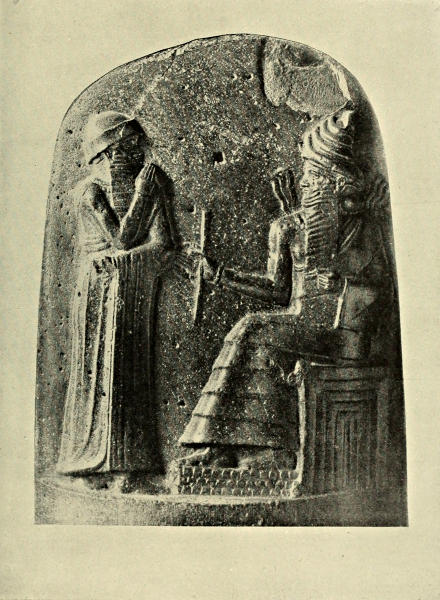
THE GOD SHAMASH DICTATING THE CODE OF LAWS TO KING KHAMMURABI
Laws concerning debt are treated of in clauses 113-119. A man might be imprisoned for debt, or, as in the Mosaic code, he might sell his wife and children into bondage for debt, but only for three years. We have a peculiarly doleful picture of a prison of this period, in a letter dating from the reign of Khammurabi. It is written by an imprisoned man to his master. He describes his place of confinement as a “house of want,” and begs for food and clothing, to keep him from death and being devoured by dogs. If the debtor died a natural death in his confinement, the case was at an end, but:
116. If the confined man has died in the house of his confinement as a result of blows or ill-treatment, the owner of the prisoner shall call his merchant to account. If the man was free-born, his son (of the merchant) one shall kill; if he was a slave, he shall pay one-third of a mina of silver, and shall lose possession of everything which he gave him.
117. If anyone has an indebtedness, sells wife, son, or daughter for gold or gives them into bondage, three years in the house of their buyer or their taskmaster shall they labour; in the fourth year shall he let them go free.
118. If he gives away a man or woman slave into servitude, and if the merchant passes them on, sells them for money, there is no protest.
119. If anyone has contracted a debt and sells a slave who has borne him children, the money which the merchant paid, the owner of the slave shall pay back to him and buy back his slave.
Clauses 120-126 are in regard to depositing grain and other property in another’s keeping. A written document was necessary and the person who received the deposit made responsible for what had been intrusted to him.
120. If anyone has stored his grain in the house of another for keeping, and a disaster has happened in the granary, or the owner of the house has opened the granary and taken out grain, or if he disputes as to the whole amount which was deposited with him, the owner of the grain shall pursue (claim) his grain before God, and the master of the house shall return undiminished to its owner the grain which he took.
Domestic Legislation, Divorce, Inheritance
The laws referring to domestic legislation are especially interesting as showing the position of women. We know from other documents of the period that they could hold property in their own name and carry on business, and we see here that their position was respected.
127. If anyone has caused a finger to be pointed at a votary or the wife of a man and has not proved (his accusation against) that man, one shall bring him before the judge and brand his forehead.
A contract was necessary for legal marriage:
128. If anyone has married a wife but has not drawn up a contract with her, that woman is not a wife.
If a man was taken captive and if, during his absence, his wife married some one else while there was means of subsistence in the house, she was drowned. But if she had no means of support, her action was considered justifiable. If, in the latter case, the husband returned, his wife was to return to him; but the children of her second marriage remained with their father. If the man was a fugitive and had abandoned his native city, but returned after a time and wanted his wife again, she was not to return to him.
The laws concerning divorce were much like those existing in Mohammedan countries to-day. If a woman were childless and her husband wished to divorce her, she received her dowry and marriage portion and returned to her father’s house. If she had borne children and her husband still wanted to divorce her, she received besides her marriage portion sufficient means to bring up her children; and after they were grown, of whatever they received they were to give her a son’s share. She was also free to marry again. If the woman were divorced through a fault of her own, she received nothing.
141. If a man’s wife, who lives in his house, sets her face to go out, causes discord, wastes her house, neglects her husband, to justice one shall bring her. If her husband says, “I repudiate her,” he shall let her go her way, he shall give her nothing for her divorce. If her husband says, “I do not repudiate her,” her husband may take another wife; that (first) wife shall stay in the house of her husband as a slave.
A woman who wanted a divorce, if she could show fault in her husband for it, might take her marriage portion and go home; but if the fault were hers she was thrown into the water.
A peculiarly humane provision is the following:
148. If anyone has taken a wife and a sickness has seized her, and if his face is set towards taking another wife, he may take (her), but his wife whom the sickness has seized he may not repudiate her, she shall live in the house he has built, and as long as she lives he shall support her.
149. If that woman does not desire to live in the house of her husband, he shall give her the marriage portion she brought from her father’s house, and she shall go.
150. If anyone has given his wife, field, garden, house, or property, and has left her a sealed tablet; after (the death of) her husband, her children shall contest nothing with her. The mother shall leave her inheritance to the child whom she loves; to a brother she shall not give it.
Laws of inheritance are more particularly dealt with in clauses 162-184:
162. If anyone has married a wife, and she has borne him children; if that woman has gone to her fate, of her marriage portion her father shall claim nothing; her marriage portion belongs to her children.
163. If anyone has married a wife and she has borne him no children; if that woman has gone to her fate, if the dowry which that man took from the house of his father-in-law his father-in-law has returned; on the marriage portion of that woman the husband shall make no claim, it belongs to the house of her father.
164. If his father-in-law has not returned him the dowry, from her marriage portion he shall deduct all her dowry; and her marriage portion he shall return to the house of her father.
165. If any man to his son, the first in his eyes, has given a field, garden, and house, and has written a tablet for him; if afterwards the father has gone to his fate, when the brothers make a division, the present which the father gave him he shall keep; in addition, the goods of their father’s house in equal parts they shall share (with him).
166. If a man has taken wives for his sons, for his little son a wife has not taken, if afterwards the father has gone to his fate, when the brothers divide the goods of their father’s house, to their little brother, who has not taken a wife, besides his portion, money for a dowry they shall give him, and a wife they shall cause him to take.
167. If a man has married a woman, if she has borne him children, if that woman has gone to her fate; if afterwards he has taken another wife, who has borne him children, and if afterwards the father has gone to his fate: the children shall not divide the property according to their mothers; they shall take the marriage portion of their mother; their father’s property they shall share in equal parts.
168. If anyone has set his face to cut off his son and says to the judge, “I cut off my son,” the judge shall inquire into the matter; and if the son has no grievous offence, which would lead to being cut off from sonship, the father shall not cut off his son from sonship.
169. If he has a grievous crime against his father to the extent of cutting him off from sonship, for the first time he (the father) shall turn away his face; but if he commit a grievous crime a second time, the father shall cut off his son from sonship.
170. If to a man his wife has borne children, and if his servant has borne him children; if the father during his life has said: “You are my children,” to the children which his servant bore him, and has counted them with his wife’s children: afterwards if that father has gone to his fate, the goods of the father’s house shall the children of the wife and the children of the servant share on equal terms. In the division the children of the wife shall choose (first) and take.
171. And if the father, during his life to the children which his slave bore him has not said, “You are my children,” afterwards when the father has gone to his fate, the property of the father’s house the children of the servant shall not share with the children of the wife. The freedom of the servant and her children shall be assured. The children of the wife cannot claim the children of the servant for servitude. The wife shall take her marriage portion and the gift which her husband gave her and wrote on a tablet for her, and shall remain in the house of her husband. As long as she lives she shall keep them, and for money shall not give them; after her they belong to her children.
172. If her husband has not given her a gift, her marriage portion she shall receive entire; and of the property of her husband’s house, a portion like a son she shall take. If her children force her to go out of the house, the judge shall inquire into the matter, and if a fault is imputed to the children, that woman shall not go out of the house of her husband. If that woman has set her face to go, the gift which her husband gave her she shall leave to her children. The marriage portion which came from her father’s house she shall keep, and the husband of her choice she shall take.
173. If that woman, there where she has entered, to her second husband has borne children, and if afterward that woman dies, her marriage portion shall her earlier and her later children divide between them.
174. If to her second husband she has borne no children, her marriage portion shall the children of her first husband take.
175. If a free-born woman has married a palace slave or the slave of a noble, and has borne children; the owner of the slave on the children of the free-born woman shall make no claim for servitude.
176. And if a free-born woman marries a slave of the palace or the slave of a noble, and if when he married her she entered the house of the palace slave or of the nobleman’s slave with a marriage portion from the house of her father, and from the time that they set up their house together have acquired property; if afterward either the slave of the palace or the slave of the nobleman has gone to his fate, the free-born woman shall take her marriage portion, and whatever her husband and she since they began housekeeping have made, into two parts they shall divide; one-half the owner of the slave shall take, one-half the free-born woman shall take for her children.
176 a. If the free-born woman had no marriage portion, everything which her husband and she had acquired since they kept house together, into two parts they shall divide. The owner of the slave one-half shall take: one-half shall the free-born woman take for her children.
177. If a widow, whose children are still young, has set her face to enter the house of another without consulting the judge, she shall not enter. When she enters another house the judge shall inquire into that which was left from the house of her former husband; and the goods of her former husband’s house to her later husband and to that woman (herself) one shall confide, and a tablet one shall make them deliver. They shall keep the house and bring up the little ones; no utensil shall they give for money. The buyer who shall buy a utensil belonging to the children of the widow, shall lose his money; the property shall return to its owner.
178. If a votary or a vowed woman to whom her father has given a marriage portion, a tablet has written, and on the tablet he wrote for her did not write, “After her she may give to whom she pleases,” has not permitted her all the wish of her heart; afterwards when the father has gone to his fate, her field and garden shall her brothers take, and according to the value of her portion they shall give her grain, oil, and wool, and her heart they shall content. If her brothers have not given her grain, oil, and wool according to the value of her portion, and have not contented her heart, she shall give her field and garden to a cultivator who is pleasing to her, and her cultivator shall sustain her. The field, garden, and whatever her father gave her she shall keep as long as she lives, but for money she shall not give it, to another she shall not part with it; her sonship (inheritance) belongs to her brother.
179. If a votary or a vowed woman to whom her father has given a marriage portion, and has written her a tablet, and on the tablet which he wrote her has written, “property where (to whom) it seems good to her to give (let her give),” has allowed her the fulness of her heart’s desire: afterwards when the father has gone to his fate, her property after her death to whomever it pleases her she shall give; her brothers shall not strive with her.
180. If a father to his daughter, a bride or vowed woman, a marriage portion has not given; after the father has gone to his fate, she shall receive of the possession of the father’s house a share like one son. As long as she lives she shall keep it; her property after her death shall belong to her brothers.
181. If a father has vowed to God a hierodule or a temple virgin, and has gone to his fate, she shall have a share in the possession of the father’s house equal to one-third her portion as one of his children. As long as she lives she shall keep it. Her property after her death shall belong to her brothers.
182. If a father to his daughter, a votary of Marduk of Babylon, has not given a marriage portion, a tablet has not written; after the father has gone to his fate she shall share with her brothers in the possession of her father’s house; a third of her share as his child (she shall receive). Control over it shall not go from her. The votary of Marduk shall give her property after her death to whomever it pleases her.
183. If a father to his daughter by a concubine has given a marriage portion, and has given her to a husband and has written her a tablet; after the father has gone to his fate, in the goods of the father’s house, she shall not share.
184. If a man to his daughter by a concubine a marriage portion has not provided, to a husband has not given her; after the father has gone to his fate her brothers shall provide her a marriage portion according to the value of the father’s house, and to a husband they shall give her.
Laws concerning Adoption
185. If a man has taken a small child as a son in his own name and has brought him up, that foster child shall not be reclaimed.
186. If a man has taken a small child for his son, and if when he took him his father and his mother he offended, that foster child shall return to the house of his father.
187. The son of a familiar slave in the palace service, or the son of a vowed woman, cannot be reclaimed.
188. If an artisan has taken a child to bring up, and has taught him his handicraft, no one can make a complaint.
189. If he has not taught him his handicraft, that foster child shall return to the house of his father.
190. If a man, a small child whom he took for his son and brought him up, with his own sons has not counted, that foster son shall return to his father’s house.
191. If a man who has taken a small child for his son and has brought him up, has afterwards made a home for himself and acquired children, if he sets his face to cut off the foster child; that child shall not go his way. His adoptive father shall give him of his goods one-third a son’s share, and then he shall go. Of the field, garden, and house he shall not give him.
192. If the son of a favourite slave or the son of a vowed woman to the father who brought him up and to the mother who brought him up say, “Thou art not my father, thou art not my mother,” one shall cut out his tongue.
193. If the son of a palace favourite or the son of a vowed woman has known the house of his father and has hated the father who brought him up and the mother who brought him up, and has gone to the house of his father, one shall tear out his eyes.
194. If a man has given his son to a nurse and if his son has died in the hand of the nurse, and if the nurse, without the consent of his father or mother, another child has nourished, she shall be brought to account and because she nourished another child, without the consent of the father and mother, one shall cut off her breasts.
Laws of Recompense
195. If a son has struck his father, one shall cut off his hands.
196. If one destroys the eye of a free-born man, his eye one shall destroy.
197. If anyone breaks the limb of a free-born man, his limb one shall break.
198. If the eye of a nobleman he has destroyed, or the limb of a nobleman he has broken, one mina of silver he shall pay.
199. If he has destroyed the eye of the slave of a free-born man or has broken the limb of the slave of a free-born man, he shall pay the half of its price.
200. If he knocks out the teeth of a man who is his equal, his teeth one shall knock out.
201. If the teeth of a freedman he has made to fall out, he shall pay one-third of a mina of silver.
202. If anyone has injured the strength of a man who is high above him, he shall publicly be struck with sixty strokes of a cowhide whip.
203. If he has injured the strength of a man who is his equal, he shall pay one mina of silver.
204. If he has injured the strength of a freedman, one shall cut off his ear.
205. If the slave of a man has injured the strength of a free-born man, one shall cut off his ear.
206. If a man has struck another in a quarrel and has wounded him, and that man shall swear, “I did not strike him wittingly,” he shall pay the doctor.
207. If he dies of the blows, he shall swear again, and if it was a free-born man, he shall pay one-half a mina of silver.
208. If it was a freedman, he shall pay one-third a mina of silver.
209. If anyone has struck a free-born woman and caused her to let fall what was in her womb, he shall pay ten shekels of silver for what was in her womb.
210. If that woman dies, one shall put his daughter to death.
211. If it was a freedwoman whom he caused to let fall that which was in her womb, through his blows, he shall pay five shekels of silver.
212. If that woman dies, he shall pay one-half a mina of silver.
213. If he has struck a man’s maid-servant and caused her to drop what was in her womb, he shall pay two shekels of silver.
214. If that maid-servant dies he shall pay one-third a mina of silver.
Regulations concerning Physicians and Veterinary Surgeons
215. If a doctor has treated a man for a severe wound with a lancet of bronze and has cured the man, or has opened a tumour with a bronze lancet and has cured the man’s eye; he shall receive ten shekels of silver.
216. If it was a freedman, he shall receive five shekels of silver.
217. If it was a man’s slave, the owner of the slave shall give the doctor two shekels of silver.
218. If a physician has treated a free-born man for a severe wound with a lancet of bronze and has caused the man to die, or has opened a tumour of the man with a lancet of bronze and has destroyed his eye, his hands one shall cut off.
219. If a doctor has treated the slave of a freedman for a severe wound with a bronze lancet and has caused him to die, he shall give back slave for slave.
220. If he has opened his tumour with a bronze lancet and has ruined his eye, he shall pay the half of his price in money.
221. If a doctor has cured the broken limb of a man, or has healed his sick body, the patient shall pay the doctor five shekels of silver.
222. If it was a freedman, he shall give three shekels of silver.
223. If it was a man’s slave, the owner of the slave shall give two shekels of silver to the doctor.
224. If the doctor of oxen and asses has treated an ox or an ass for a grave wound and has cured it, the owner of the ox or the ass shall give to the doctor as his pay one-sixth of a shekel of silver.
225. If he has treated an ox or an ass for a severe wound and has caused its death, he shall pay one-fourth of its price to the owner of the ox or the ass.
Illegal Branding of Slaves
226. If a barber-surgeon, without consent of the owner of a slave, has branded the slave with an indelible mark, one shall cut off the hands of that barber.
227. If anyone deceives the barber-surgeon and makes him brand a slave with an indelible mark, one shall kill that man and bury him in his house. The barber shall swear, “I did not mark him wittingly,” and he shall be guiltless.
Regulations concerning Builders
228. If a builder has built a house for some one and has finished it, for every SAR of house he shall give him two shekels of silver as his fee.
229. If a builder has built a house for some one and has not made his work firm, and if the house he built has fallen and has killed the owner of the house, that builder shall be put to death.
230. If it has killed the son of the house-owner, one shall kill the son of that builder.
231. If it has killed the slave of the house-owner, he (the builder) shall give to the owner of the house slave for slave.
232. If it has destroyed property, he shall restore everything he destroyed; and because the house he built was not firm and fell in, out of his own funds he shall rebuild the house that fell.
233. If a builder has built a house for some one and has not made its foundations solid, and a wall falls, that builder out of his own money shall make firm that wall.
Regulations concerning Shipping
234. If a boatman has caulked (?) a boat of 60 GUR for a man, he shall give him two shekels of silver as his fee.
235. If a boatman has caulked a boat for a man, and has not made firm his work; if in that year that ship is put into use and it suffers an injury, the boatman shall alter that boat and shall make it firm out of his own funds; and he shall give the strengthened boat to the owner of the boat.
236. If a man has given his boat to a boatman on hire, if the boatman has been careless, has grounded the boat or destroyed it, the boatman shall give a boat to the owner of the boat in compensation.
237. If a man has hired a boatman and a boat, and has loaded it with grain, wool, oil, dates, or whatever the cargo was; if that boatman has been careless, has grounded the ship and destroyed all that was in it, the boatman shall make good the ship which he grounded and whatever he destroyed of what was in it.
238. If a man has grounded a boat and has refloated it, he shall pay the half of its price in silver.
239. If a man has hired a boatman, he shall give 6 GUR of grain a year.
240. If a freight boat has struck a ferry-boat, and grounded it, the owner of the grounded boat shall make a statement before God of everything that was destroyed in the boat and (the owner of) the freight boat which grounded the ferry-boat shall make good the boat and whatever was destroyed.
Regulations concerning the Hiring of Animals, Farming, Wages, etc.
241. If a man has forced an ox to too hard labour, he shall pay one-third a mina of silver.
242. If a man hires (the ox) for one year, he shall pay 4 GUR of grain as the hire of a working ox.
243. For the hire of an ox to carry burdens (?) he shall give 3 GUR of grain to its owner.
244. If anyone has hired an ox or an ass, and if in the field a lion has killed it, the loss is its master’s.
245. If anyone has hired an ox and has caused it to die through ill-treatment or blows, he shall return ox for ox to the owner of the ox.
246. If a man has hired an ox and has broken his leg or has cut its nape, he shall return ox for ox to the owner of the ox.
247. If a man has hired an ox and has knocked out its eye, he shall give one-half its value in silver to the owner of the ox.
248. If anyone has hired an ox and has broken its horn, cut off its tail, or has injured its nostrils, he shall pay one-fourth of its price in silver.
249. If anyone has hired an ox and God (an accident) has struck him and he has died, he who hired the ox shall swear by the name of God and be guiltless.
250. If a furious ox in his charge gores a man and kills him, that case cannot be brought to judgment.
251. If an ox has pushed a man (with his horns) and in pushing showed him his vice, and if he has not blunted his horns, has not shut up his ox: if that ox gores a free-born man and kills him, he shall pay one-half a mina of silver.
252. If it is the slave of a man he shall give one-third of a mina of silver.
253. If a man has hired a man to live in his field and has furnished him seed grain (?) and oxen, and has bound him to cultivate the field; if that man has stolen grain or plants and they are seized in his possession, one shall cut off his hands.
254. If he has taken the seed grain (?), for himself exhausted the oxen; he shall make restitution according to the amount of the grain which he took.
255. If he has given out the man’s oxen on hire or has stolen the grain, has not caused it to grow in the field; one shall bring that man to judgment, for 100 GAN of land he shall measure out 60 GUR of grain.
256. If his community (clan) will not take up his cause, one shall leave him in the field among the oxen. (?)
257. If a man has hired a harvester, he shall give him 8 GUR of grain for one year.
258. If a man has hired an ox driver (?), he shall give him 6 GUR of grain for one year.
259. If a man has stolen a watering wheel (Gis-Apin) from the field, he shall pay 5 shekels of silver to the owner of the wheel.
260. If he has stolen a watering bucket[32] or a plough, he shall pay three shekels of silver.