Part 1 / Book 2 — CHAPTER VII. MANNERS AND CUSTOMS OF BABYLONIA-ASSYRIA
Reading edition
WAR METHODS
The horseman lifteth up both the bright sword and the glittering spear: and there is a multitude of slain, and a great number of carcases; and there is none end of their corpses; they stumble upon their corpses.—Nahum iii. 3.
In following the political fortunes of Babylonia and Assyria we have necessarily caught glimpses from time to time of the conditions of civilisation which form everywhere the background of the picture. But it is desirable to view some phases of this civilisation more in detail, and an attempt will be made in the present book to summarise these conditions as a whole, and to elaborate certain details in reference to the more interesting or more important themes. Such an attempt within the spacial limits necessarily imposed cannot hope to be altogether satisfactory. In particular it must be borne in mind that we are dealing, or attempting to deal, with a period of time not less than three thousand years in extent, even if we consider only the minimum epoch covered by a tolerably sure chronology.
It is obvious that in such a sweep of time numerous changes must take place in the manners and customs of the people, and multiform alterations must be developed in the various phases of civilisation. This would necessarily be true even if the history of a single people were involved. But, in point of fact, as we have seen, we have here to do with four tolerably distinct peoples—the Sumerians, the Babylonians, the Assyrians, and the Chaldeans. To attempt a brief exposition of the varied civilisations of these four peoples during a period of several millenniums within brief bounds, would clearly be a presumptuous task were full details accessible as to all the periods involved. But we have already seen that such details are not accessible. Meagre details have come down to us from the Sumerians, and only less meagre ones Babylonians; and the reminiscences of the Chaldeans, notwithstanding their later period in history, are but slightly less vague. It is the Assyrians that must be looked to chiefly for data that can afford us, at best, an inferential knowledge of their predecessors; and we must all along remember that we are to a certain extent seeing with Assyrian eyes in attempting to view the Babylonian civilisation. Still, it should be recalled that important changes in the manners and customs of any people are usually of slow development everywhere, and that they were perhaps particularly so here, because we have to do with the most conservative of races. The Babylonians and Assyrians were own cousins to the Hebrews, and no doubt partook in full measure of what Goethe styles the “obstinate persistency” of that race. The main outline of their civilisation, therefore, probably remained unchanged generation after generation.
On the other hand, it must be understood that the Sumerians, whatever their precise racial affinities, were a very different people from the Semitic races that superseded them. There is reason to believe that they were essentially a creative race, whereas the Semites, and in particular the Assyrians, were pre-eminently copyists and adapters rather than originators. It would appear that all the chief features of the later Assyrian civilisation were adumbrated, if not indeed fully elaborated, in that early day when the Sumerians were dominant in southern Babylonia. Even the cuneiform system of writing, with all its extraordinary complexities, is believed by philologists to give unequivocal evidence of Sumerian origin. But however correct this view may be, we are constrained to view the Sumerians solely in the light of their successors. The monumental remains exhumed from amid the ruins of the palace of Asshurbanapal supply us with the chief documents for the interpretation of a civilisation that had passed away something like three thousand years before this palace itself or its documentary treasures came into being.
This is somewhat as if one were to study the manners and customs of the Italians of to-day in order to gain a knowledge of the civilisation of Rome in the time of the Tarquinians. The parallel is really not quite so complete as it might at first sight appear, for in many respects practical civilisation changed more in the nineteenth century than in all the previous centuries of recorded history. Beyond cavil, the civilisation of the time of Sargon I had far greater resemblance to the time of Asshurbanapal than the Rome of the early kings bears to the Rome of King Victor Emmanuel. Nevertheless, we should bear this corrective view in mind in the alleged attempt to deal with Mesopotamian civilisation as a whole.
OUR SOURCES
The sources of our knowledge of Mesopotamian history have been pretty fully discussed in previous chapters. Beyond the classical traditions, our sole reliance must be placed upon the monuments. And of these the sculptures are by far the most important in their bearings upon the civilisation of the people.
Very little is said, except inferentially, by the written inscriptions, that throws any definite light upon the manners and customs of the people. But fortunately the Assyrians in particular were much given to pictorial presentation of the scenes of at least certain features of their everyday life; their bas-reliefs, therefore, furnish us with the clearest index as to their life customs. The interpretation of these bas-reliefs in this light was first taken up in detail by Sir Henry Layard, and his expositions remain to this day the most complete and satisfactory. We shall have occasion to turn frequently to his pages in the present book, supplementing his accounts with certain elaborations, in particular with reference to the religious and legal documents, based on the more recent readings of the inscriptions.
However much the customs of the Babylonians and Assyrians may have changed in the course of ages, there was one important regard in which there was probably no conspicuous alteration from first to last. This was the character of the government. Like other orientals, the Mesopotamians had no conception of any government except a thoroughly despotic one. They were ruled by kings whose authority was absolute, and whose will was accepted as the sole law. A change of government meant merely the overthrow of one king by some one who, attaining supreme authority, was himself to be recognised as king.
But the assumption and retention of exclusive power in a body politic by one individual presupposes a triumph of physical force. Kingship in its oriental manifestation has its foundation in military power. We find, therefore, that the Babylonian or Assyrian monarch is able to make himself felt and remembered just in proportion as he is a competent military leader. To be a great king he must be a great conqueror. A record of conquests is substantially the whole story of the royal annals. It is a very sanguinary and inhuman story as we have seen.
The texts of the inscriptions deal with results rather than with methods. We are told the names of peoples against whom warfare was waged; lists of captives and booty are not forgotten, the idea being of course to perpetuate the glory of the conqueror. To that end the name of the conqueror himself is always given, the narrative being usually told in the first person; but one never hears so much as the name of a subordinate. It is the king alone to whom credit is to be given.
What the inscriptions lack in the way of reference to details of the art of warfare is supplied by the Assyrian bas-reliefs. These represent armies in action and enable us to form a very clear picture of the war costumes, the weapons, and to a certain extent of the battle methods of the Assyrians. In particular the details are given of the methods of assault by which the Assyrians were accustomed to break down the walls of a rebellious city. Battering-rams and scaling-towers are depicted in the most realistic manner, and are a favourite subject of the artist—partly, no doubt, because they lend themselves to pictorial presentation; partly, perhaps, because the Assyrians excelled in this particular phase of warfare. But other phases of warfare are by no means overlooked. Even such details as the beheading or flaying alive of captives are presented with gruesome realism.
For the reason already stated, our text will have to do chiefly with the art of war as practised by the Assyrians, rather than by their predecessors. Whether any of the implements or methods employed in this relatively late period originated with the Assyrians themselves, we have no present means of deciding. The presumption is, however, that the Assyrian king pursued the art of war in much the same way it had been practised by the old Babylonian kings from time immemorial.a
As the Assyrians possessed disciplined and organised troops, it is probable that they were also acquainted, to a certain extent, with military tactics, and that their battles were fought upon some kind of system. We know that such was the case with the Egyptians; and their monuments show that amongst their enemies, also, there were nations not unacquainted with the military science. They had bodies of troops in reserve; they advanced and retreated in rank, and performed various manœuvres. Although, in the Assyrian sculptures, we have no attempt at an actual representation of the general plan of a battle, as in some Egyptian bas-reliefs, yet from the order in which the soldiers are drawn up before the castle walls, and from the phalanx which they then appear to form, it seems highly probable that similar means were adopted, to resist the assaults of the enemy in the open field.
The king himself, attended by his vizier, his eunuchs, and principal officers of state, was present in battle, and not only commanded, but took an active part in the affray. Even [the traditional] Sardanapalus, when called upon to place himself at the head of his armies to meet the invading [traditional] Medes, showed, a courage equal to the occasion, and repulsed his enemies. Like the Persian monarchs who succeeded, him in the dominion of Asia, the Assyrian king was accompanied to the war, however distant his seat might be, by his wives, his concubines, and his children, and by an enormous retinue of servants. Even his nobles were similarly attended. Their couches were of gold and silver, and the hangings of the richest materials. Vessels of the same precious metals were used at their tables; their tents were made of the most costly stuffs, and were even adorned with precious stones. The canopy or tent of Holofernes was of purple, gold, and emeralds and precious stones; and every man had gold and silver (vessels) out of the king’s house. (Judith ii. 18.) This book contains an interesting account of the luxurious manner of living of the great Assyrian warriors, confirming what has been said in the text, and showing that the Persians were, in this respect, as almost in every other, imitators of the Assyrians. Herodotus (Lib. IX., c. 82 and 83) describes the equipage, furnished with gold and silver, and with various coloured hangings, and the gold and silver couches and tables, found in the tents of Mardonius after the defeat of the Persian army. They had been left by Xerxes when he fled from Greece. They were also accompanied by musicians, who are represented in the sculptures as walking before the warriors, on their triumphant return from battle.
The army was followed by a crowd of sutlers, servants, and grooms; who, whilst adding to its bulk, acted as an impediment upon its movements, and carried ruin and desolation into the countries through which it passed. As this multitude could not depend entirely for supplies upon the inhabitants, whom they unmercifully pillaged, provisions in great abundance, as well as live-stock, were carried with them. Holofernes, in marching from Nineveh with his army, took with him “camels and asses for their carriage, a very great number, and sheep, and oxen, and goats without number, for their provision; and plenty of victuals for every man.”
Quintus Curtius thus describes the march of a Persian army: The signal was given from the tent of the king, on the top of which, so as to be seen by all, was placed an image of the sun, in crystal. The holy fire was borne on altars of silver, surrounded by the priests, chanting their sacred hymns. They were followed by three hundred and sixty-five youths, according to the number of the days in the year, dressed in purple garments. The chariot, dedicated to the supreme deity, or to the sun, was drawn by snow-white horses, led by grooms wearing white garments, and carrying golden wands. The horse especially consecrated to the sun was chosen from its size. It was followed by ten chariots, embossed with gold and silver, and by the cavalry of twelve nations, dressed in their various costumes, and carrying their peculiar arms. Then came the Persian immortals, ten thousand in number, adorned with golden chains, and wearing robes embroidered with gold, and long-sleeved tunics, all glittering with precious stones. At a short interval fifteen thousand nobles, who bore the honourable title of relations of the king, walked in garments which, in magnificence and luxury, more resembled those of women than of men. The doryphori (a chosen company of spearmen) preceded the chariot in which the king himself sat, high above the surrounding multitude. On either side of this chariot were effigies of the gods in gold and silver. The yoke was inlaid with the rarest jewels. From it projected two golden figures of Ninus and Belus, each a cubit in length. A golden eagle with outspread wings was placed between them. The king was distinguished, from all those who surrounded him, by the magnificence of his robes, and by the cidaris, or mitre, upon his head. By his side walked two hundred of the most noble of his relations. Ten thousand warriors, bearing spears whose staffs were of silver and heads of gold, followed the royal chariot. The king’s led horses, forty in number, and thirty thousand footmen, concluded the procession. At the distance of one stadium followed the mother and wife of the king, in chariots. A crowd of women, the handmaidens and ladies of the queens, accompanied them on horseback. Fifteen cars, called armamaxæ, carried the children of the king, their tutors and nurses, and the eunuchs. The king’s three hundred and sixty concubines, who accompanied him, were adorned with royal splendour. Six hundred mules and three hundred camels bore the royal treasury, guarded by the archers. The friends and relations of the ladies were mingled with a crowd of cooks and servants of all kinds. The procession was closed by the light-armed troops.
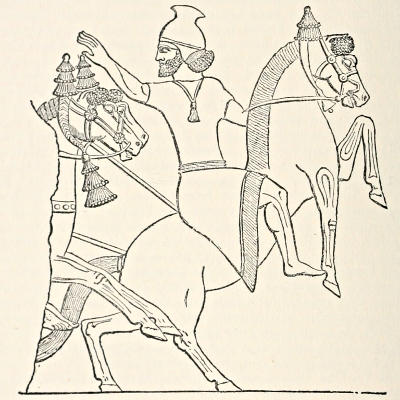
The Enemy asking Quarter of Assyrian Horsemen
The armies were provided with the engines and materials necessary for the siege of the cities they might meet with in their expedition. If any natural obstructions impeded the approach to a castle, such as a forest or a river, they were, if possible, removed. Rivers were turned out of their courses, if they impeded the operations of the army; and warriors are frequently represented in the sculptures cutting down trees which surround a hostile city.
The first step in a siege was probably to advance the battering-ram. If the castle was built, as in the plains of Assyria and Babylonia, upon an artificial eminence, an inclined plane, reaching to the summit of the mound, was formed of earth, stones, or trees, and the besiegers were then able to bring their engines to the foot of the walls. This road was not unfrequently covered with bricks, forming a kind of paved way, up which the ponderous machines could be drawn without much difficulty.
This mode of reaching the walls of a city is frequently alluded to by the prophets, and is described by Isaiah: “Thus saith the Lord, concerning the king of Assyria, he shall not come into this city, nor shoot an arrow there, nor come before it with shields, nor cast a bank against it.” Similar approaches were used by the Egyptians. They not only enabled the besiegers to push their battering-rams up to the castle, but at the same time to escalade the walls, the summit of which might otherwise have been beyond the reach of their ladders.
The battering-rams were of several kinds. Some were joined to movable towers which held warriors and armed men. The whole then formed one great temporary building, the top of which is represented in the sculptures, as on a level with the walls, and even turrets, of the besieged city. In some bas-reliefs the battering-ram is without wheels; it was then perhaps constructed on the spot, and was not intended to be moved. The movable tower was probably sometimes unprovided with the ram; but I have not met with it so represented in the sculptures. When Nebuchadrezzar, king of Babylon, besieged Jerusalem, he “built forts against it round about.” These forts or towers, if stationary, were solidly constructed of wood; if movable, they consisted of a light frame covered with wickerwork. The Jews were forbidden to cut down and employ, for this purpose, trees which afford sustenance to man. “Only the trees which thou knowest that they be not trees for meat, thou shalt destroy and cut them down: and thou shalt build bulwarks against the city that maketh war with thee until it be subdued.”
When the machine containing the battering-ram consisted of a simple framework, not forming an artificial tower, a cloth of some kind of drapery edged with fringes and otherwise ornamented appears to have been occasionally thrown over it. Sometimes it may have been covered with hides. It moved either on four or on six wheels, and was provided with one ram or with two. The mode of working the rams cannot be determined from the Assyrian sculptures. It may be presumed, from the representations in the bas-reliefs, that they were partly suspended by a rope fastened to the outside of the machine, and that men directed and impelled them from within. Such was the plan adopted by the Egyptians, in whose paintings the warriors, working the ram, may be seen through the frame. Sometimes this engine was ornamented by a carved or painted figure of the presiding divinity, kneeling on one knee and drawing a bow. The artificial tower was usually occupied by two warriors: one discharged his arrows against the besieged, whom he was able from his lofty position to harass more effectually than if he had been below; the other held up a shield for his companion’s defence. Warriors are not unfrequently represented as stepping from the machine to the battlements.
Ezekiel alludes to all these modes of attack. “Lay siege against it,” he exclaims, speaking of the city of Jerusalem, “and build a fort against it, and cast a mount against it; set the camp also against it, and set battering-rams against it round about.”
Archers on the walls hurled stones from slings, and discharged their arrows against the warriors in the artificial towers; whilst the rest of the besieged were no less active in endeavouring to frustrate the attempts of the assailants to make breaches in their walls. By dropping a doubled chain or rope from the battlements, they caught the ram, and could either destroy its efficacy altogether or break the force of its blows. Those below, however, by placing hooks over the engine, and throwing their whole weight upon them, struggled to retain it in its place.
The besieged, if unable to displace the battering-ram, sought to destroy it by fire and threw lighted torches or firebrands upon it. But water was poured upon the flames, through pipes attached to the artificial tower. Other engines and instruments of war were employed by the besiegers. With a kind of catapult, apparently consisting of a light wooden frame covered with canvas or hides, they threw large stones and darts against the besieged, who, in their turn, endeavoured to set fire to it by torches. A long staff with an iron head, resembling a spear, was used to force stones out of the walls. Mines were also opened, and the assailants sought to enter the castle through concealed passages. Those who worked on them, or advanced to the attack, were perhaps protected by the testudo, as represented in the Egyptian paintings; but this defence is not seen in the Assyrian sculptures. Attempts were made to set fire to the gates of the city by placing torches against them, or to break them open with axes.
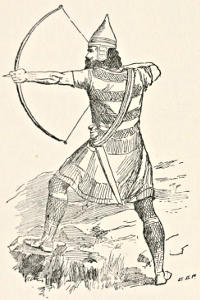
An Assyrian Archer
Mounting to the assault by ladders was constantly practised, and appears to have been the most general mode of attacking a castle; for ladders are found on those bas-reliefs in which neither the battering-ram nor other engines are introduced. It is remarkable that the battering-ram is not introduced in the sculptures hitherto discovered at Kuyunjik, nor, as far as I am aware, in those of Khorsabad. It would appear, therefore, that at the period of the building of those edifices it had fallen into disuse. Scaling-ladders appear in Egyptian sculptures as early as the XIXth Dynasty. Ramses III is seen taking a city, by their means, at Medinet Habu. They reached to the top of the battlements, and several persons could ascend them at the same time. Whilst warriors, armed with the sword and spear, scaled the walls, archers posted at the foot of the ladders kept the enemy in check and drove them from the walls.
The troops of the besieging army were ranged in ranks below. The king was frequently present during the attack. Descending from his chariot, which remained stationary at a short distance behind him, he discharged his arrows against the enemy. He was attended by his shield bearer and eunuchs, one of whom generally held over him the emblem of royalty, the umbrella, whilst the others bore his arms. He is sometimes represented in his chariots, superintending the operations, or repulsing a sally. Warriors of high rank likewise came in chariots, accompanied by their shield bearers and charioteers. The vizier and the chief of the eunuchs are frequently seen in the midst of the combatants.
The besieging warriors were protected, as I have already mentioned, by large shields of wickerwork, sometimes covered with hides, which concealed the entire person. Three men frequently formed a group; one held the shield, a second drew the bow, and a third stood ready with a sword to defend the archer and shield bearer, in case the enemy should sally from the castle. The besieged manned the battlements with archers and slingers, who discharged their missiles against the assailants. Large stones and hot water were also thrown upon those below. A woman from the battlement of Thebez cast a millstone upon Abimelech’s head, and broke his skull (Judges ix. 53).
When the battering-ram had made a breach, and the assault had commenced, the women appeared upon the walls; and, tearing their hair or stretching out their hands, implored mercy. The men are not unfrequently represented as joining in asking for quarter. When the assailants were once masters of the place, an indiscriminate slaughter appears to have succeeded, and the city was generally given over to the flames. In the bas-reliefs warriors are seen decapitating the conquered and plunging swords or daggers into their hearts, holding them by the hair of their heads. The prisoners were either impaled and subjected to horrible torments or carried away as slaves. The manner of impaling, adopted by the Assyrians, appears to have differed from that still in use in the East. A stake was driven into the body immediately under the ribs. When Darius took Babylon he impaled three thousand prisoners (Herod, iii. 159). In a bas-relief discovered at Khorsabad, a man was represented flaying a prisoner with a semicircular knife. The Scythians scalped and flayed their enemies, and used their skins as horse-trappings (Herod, iv. 64).
The women, children, and cattle were led away by the conquerors; and that it was frequently the custom of the Assyrians to remove the whole population of the conquered country to some distant part of their dominions, and to replace it by colonies of their own, we learn from the treatment of the people of Samaria. Eunuchs and scribes were appointed to take an inventory of the spoil. They appear to have stood near the gates, and wrote down with a pen, probably upon rolls of leather, the number of prisoners, sheep, and oxen, and the amount of the booty, which issued from the city. The women were sometimes taken away in bullock carts, and are usually seen in the bas-reliefs bearing a part of their property with them—either a vase or a sack perhaps filled with household stuff. They were sometimes accompanied by their children, and are generally represented as tearing their hair, throwing dust upon their heads, and bewailing their lot.
After the city had been taken, a throne for the king appears to have been placed in some conspicuous spot within the walls. He is represented in the sculptures as sitting upon it, attended by his eunuchs and principal officers, and receiving the prisoners brought bound into his presence. The chiefs prostrate themselves before him, whilst he places his foot upon their necks, as Joshua commanded the captains of Israel to put their feet upon the necks of the captive kings. This custom long prevailed in the East. In the rock sculpture of Behistun, Darius is seen with his foot upon the neck of Gometes, the rebellious Magian, who declared himself to be Bardius, the son of Cyrus. When inferior prisoners were captured, their hands were tied behind, or their arms and feet were bound by iron manacles.
They were urged onward by blows from the spears or swords of the warriors to whom they were entrusted. In a bas-relief from Khorsabad, captives are led before the king by a rope fastened to rings passed through the lip and nose. This sculpture illustrates the passage in 2 Kings xix. 28: “I will put my hook in thy nose, and my bridle in thy lips.” The king is represented in the bas-relief as holding a rope fastened to a ring, which passes through the lips of a prisoner, one of whose eyes he appears to be piercing with his spear.
In the sculptures of Khorsabad and Kuyunjik, captives are seen bringing small models of their cities to the victorious king, as a token of their subjection. Similar models are borne in triumphal processions.
The heads of the slain were generally collected, and brought either to the king or to an officer appointed to take account of their number. When Ahab’s seventy sons were killed, their heads were cut off, and brought in baskets to Jezreel. They were afterwards, laid “in two heaps at the entering in of the gate” (2 Kings x. 8). The Egyptians generally counted by hands. This mode of reckoning the loss of the enemy was long resorted to in the East.
As soon as the soldiers entered the captured city, they began to plunder, and then hurried away with the spoil. They led off the horses, carried forth on their shoulders furniture and vessels of gold, silver, and other metals, and made prisoners of the inhabitants, who, probably, became the property of those who seized them. The Assyrian warriors are seen in the sculptures bearing away in triumph the idols of the conquered nations, or breaking them into pieces, weighing them in scales, and dividing the fragments. Thus Hosea prophesied that the calf, the idol of Samaria, should be carried away by the Assyrians.
When the city had been sacked it was usually given up to the flames and utterly destroyed. The surrounding country was also laid waste. If it had been a capital—a place of strength and renown—it was seldom rebuilt on the same spot, which was avoided as unfortunate by those who survived the catastrophe and returned to the ruins.
ASSYRIAN WAR COSTUMES AND WAR METHODS
The costume of the warriors differed according to their rank and the nature of the service they had to perform. Those who fought in chariots, and held the shield for the defence of the king, are generally seen in coats of scale armour, which descend either to the knees or to the ankles. A large number of the scales were discovered in the earliest palace of Nimrud. They were generally of iron, slightly embossed or raised in the centre, and some were inlaid with copper. They were probably fastened to a shirt of felt or coarse linen. Such is the armour always represented in the most ancient sculptures. At a later period other kinds were used; the scales were larger, and appear to have been fastened to bands of iron or copper. The armour was frequently embossed with groups of figures and fanciful ornaments; but there is no reason to believe that the rich designs on the breasts of the kings were on metal.
The warriors were frequently dressed in an embroidered tunic, which was probably made of felt or leather, sufficiently thick to resist the weapons then in use. On the sculptures of Kuyunjik they are generally seen in this attire. Their arms were bare from above the elbow, and their legs from the knees downward, except when they wore shirts of mail which descended to the ankles. They had sandals on their feet. The warriors on the later Assyrian monuments, particularly on those of Khorsabad, are distinguished by a peculiar ornament, somewhat resembling the Highland phillibeg. It appears to be fastened to the girdle, and falls below the short tunic.
In the sculptures of Kuyunjik and of monuments of the same period, the dress of the soldiers appears to vary, according to the manner in which they are armed. Those with spear and shield wear pointed or crested helmets, and plain or embroidered tunics, confined at the waist by a broad girdle. A kind of cross belt passes over the shoulders, and is ornamented in the centre of the breast by a circular disk, probably of metal. The slingers are attired in the embroidered tunic, which I conjecture to be of felt or leather; and wear a pointed helmet, with metal lappets falling over the ears. Both the spearmen and slingers have greaves, which appear to have been laced in front.
The archers are dressed in very short embroidered tunics, which scarcely cover half the thigh, the rest of the leg being left completely bare. They are chiefly distinguished from other warriors by the absence of the helmet. A simple band round the temples confines the hair, which is drawn up in a bunch behind.
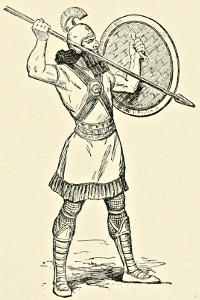
Costume of an Assyrian Spearman
It is probable that these various costumes indicate people of different countries, auxiliaries in the Assyrian armies, who used the weapons most familiar to them, and formed different corps or divisions. Thus, in the army of Xerxes were marshalled men of many nations, each armed according to the fashion of his country, and fighting in his own peculiar way. We may, perhaps, identify, in the Assyrian sculptures, several of the costumes described by the Greek historian as worn by those who formed the vast army of the Persian king.
The arms of the early Assyrians were the spear, the bow, the sword, and the dagger. The sling is not represented in the most ancient monuments as an Assyrian weapon, although used by a conquered nation; it was, perhaps, introduced at a later period. The bows were of two kinds: one long and slightly curved, the other short and almost angular; the two appear to have been carried at the same time by those who fought in chariots.
The arrows were probably made of reeds, and were kept in a quiver slung over the back. The king, however, and the great officers of the state were followed by attendants, who carried the quivers and supplied their masters with arrows. The bow was drawn to the cheek or to the ear, as by the Saxons, and not to the breast, after the fashion of the Greeks. The barbs were of iron and copper, several of both materials having been found in the ruins. When in battle it was customary for the archer to hold two arrows in reserve in his right hand; they were placed between the fingers, and did not interfere with the motion of the arm whilst drawing the bow. When marching he usually carried the larger bow over his shoulders, having first passed his head through it. The bow of the king was borne by an attendant. The smaller bows were frequently placed in the quiver, particularly by those who fought in chariots. A leather or linen guard was fastened by straps to the inside of the left arm to protect it when the arrow was discharged. The swords were worn on the left side, and suspended by belts passing over the shoulders or round the middle; some were short and others long. I have already alluded to the beauty of the ornaments on the hilt and sheath.
The dagger appears to have been carried by all, both in time of peace and war; even the priests and divinities are represented with them. They were worn indifferently on the left and right side, or perhaps on both at the same time. Generally two, or sometimes three, were inserted into one sheath, which was passed through the girdle. The handles, as I have already mentioned, were most elaborately adorned, and were frequently in the shape of the head of a ram, bull, or horse, being made of ivory or rare stones. A small chain was sometimes fastened to the hilt or to the sheath, probably to retain it in its place. A dagger, resembling in form those of the sculptures, was found amongst the ruins of Nimrud; it is of copper. The handle is hollowed, either to receive precious stones, ivory, or enamel.
The spear of the Assyrian footman was short, scarcely exceeding the height of a man; that of the horseman appears to have been considerably longer. The iron head of a spear from Nimrud is in the British Museum. The shaft was probably of some strong wood, and did not consist of a reed, like that of the modern Arab lance. The large club pointed with iron, mentioned by Herodotus amongst the weapons carried by the Assyrians, is not represented in the sculptures; unless, indeed, the description of the historian applies to the mace, a weapon in very general use amongst them, and frequently seen in the bas-reliefs. This weapon consisted of a short handle, probably of wood, to which was fixed a head, evidently of metal, in the shape of a flower, rosette, lion, or bull. To the end of the handle was attached a thong, apparently of leather, through which the hand was passed. I have not found any representation of warriors using the hatchet, except when cutting down trees, to clear the country preparatory to a siege. It is, however, generally seen amongst the weapons of those who fought in chariots, and was carried in the quiver, with the arrows and short angular bow.
In the bas-reliefs of Kuyunjik, slingers are frequently represented amongst the Assyrian troops. The sling appears to have consisted of a double rope, with a thong, probably of leather, to receive the stone; it was swung round the head. The slinger held a second stone in his left hand, and at his feet is generally seen a heap of pebbles ready for use. That the Persian slingers were exceedingly expert, used very large stones, and could annoy their enemies whilst out of the reach of their darts or arrows, we learn from several passages in Xenophon.
The javelin is frequently included amongst the weapons of the Assyrian charioteers; but the warriors are not represented as using it in battle. It was carried in the quiver amongst the arrows.
The shields of the Assyrians were of various forms and materials. In the more ancient bas-reliefs a circular buckler, either of hide or metal, perhaps in some instances of gold and silver, is most frequently introduced. King Solomon made three hundred shields of beaten gold, three pounds of gold to each shield (1 Kings x. 17). The servants of Hadad-ezer, king of Zobah, carried shields of gold (2 Samuel viii. 7). The shield of Goliath was of brass. It was held by a handle fixed to the centre. Light oblong shields of wickerwork, carried in a similar manner, are also found in the early sculptures; but those of a circular form appear to have been generally used by the charioteers.
Suspended to the backs of the chariots, and also carried by warriors, are frequently seen shields in the shape of a crescent, narrow and curved outwards at the extremities. The face is ornamented by a row of angular bosses, or teeth, in the centre of which is the head of a lion. In the sculptures of Khorsabad the round shield is often highly ornamented. It resembles, both in shape and in the devices upon it, the bucklers now carried by the Kurds and Arabs, which are made of the hide of the hippopotamus. In the bas-reliefs of Kuyunjik some warriors bear oval shields, very convex, and sufficiently large to cover the greater part of the body. The centre and outer rim are decorated with bosses.
The shield used during a siege concealed the whole person of the warrior, and completely defended him from the arrows of the enemy. It was made either of wickerwork or of hides, and was furnished at the top with a curved point, or with a square projection, like a roof, at right angles to the body of the shield, which may have served to defend the heads of the combatants against missiles discharged from the walls and towers. Such were probably the shields used by the Persian archers at the battle of Platæa. The archers, whether fighting on foot or in chariots, were accompanied by shield bearers, whose office it was to protect them from the shafts of the enemy. Sometimes one shield covered two archers. The shield bearer was usually provided with a sword, which he held ready drawn for defence. The king was always attended in his wars by this officer, and even in peace one of his eunuchs usually carried a circular shield for his use. This shield bearer was probably a person of rank, as in Egypt. On some monuments of the later Assyrian period he is represented carrying two shields, one in each hand.
A great part of the strength of the Assyrian armies consisted in chariots and horsemen, to which we have frequent allusion in the inspired writings. The chariots appear to have been used by the king and the highest officers of state, who are never seen in battle on horseback nor, except in sieges, on foot. They contained either two or three persons. The king was always accompanied by two attendants—the warrior protecting him with a shield (who was replaced during peace by the eunuch bearing the parasol), and the charioteer. The principal warriors were also frequently attended by their shield bearers, though more generally by the driver alone.
The chariot was used during a siege, as well as in open battle. The king and his warriors are frequently represented as fighting in chariots with the enemy beneath the walls of a castle, or as having dismounted from their cars, to discharge their arrows against the besieged. In the latter case, grooms on foot hold the horses. When the king in his chariot formed part of a triumphal procession, armed men led the horses. The chariot was also preceded and followed by men on foot.
The horsemen formed a no less important part of the Assyrian army than the charioteers.—“Assyrians clothed in blue, captains and rulers, all of them desirable young men, horsemen riding upon horses” (Ezekiel xxiii. 6). Horsemen are seen in the most ancient sculptures of Nimrud. It is singular, as observes Sir Gardner Wilkinson (Ancient Egyptians, Vol. I, p. 288), that horsemen are nowhere represented on the monuments of Egypt, although there can be no doubt, from numerous passages in the sacred writings, that cavalry formed an important part of the Egyptian armies. I have already mentioned that disciplined bodies of cavalry were represented in the bas-reliefs of Kuyunjik. We learn from the Book of Judith that Holofernes had twelve thousand archers on horseback (Judith ii. 15). Solomon had twelve thousand horsemen (1 Kings x. 26). The king himself is never represented on horseback, although a horse richly caparisoned, apparently for his use,—perhaps to enable him to fly, should his chariot horses be killed,—is frequently seen led by a warrior, and following his chariot.
In the earliest sculptures the horses, except such as are led behind the king’s chariot, are unprovided with cloths or saddles. The rider is seated on the naked back of the animal. At a later period, however, a kind of pad appears to have been introduced; and in a sculpture at Kuyunjik was represented a high saddle not unlike that now in use in the East.b
THE ARTS OF PEACE IN BABYLONIA-ASSYRIA
Nothing else, perhaps, is so vitally important in the life-history of a nation as its contact with other nations. Such contact alone, it would seem, can enable a nation in some measure to ward off the lethargy of age, or to overcome the incubus of custom and superstition.
The isolated nation does not get beyond a certain stage of evolution. It learns a few secrets, and seems powerless to learn others of itself. Only through contact with another community can it improve its customs, get new ideas, acquire better habits of thought and action. We have already pointed out how Egypt profited in this regard through the foreign associations that came with the inroad of conquering tribes from the south and east.
Babylon, however, occupied a far more favourable position than Egypt for contact with other nations, not alone through such warlike channels, but also through the yet more beneficent channels of peaceful commerce. A glance at the map shows that Mesopotamia occupies the very centre of the world of ancient civilisation. By reaching out its hand, so to speak, this way or that, it came in contact with every civilised nation of the period except China. It was the connecting link between Persia and India on the one hand, and Lydia, Syria, and Egypt on the other. Even Chinese ideas were to some extent accessible through the mediation of India. No other great nation of antiquity compares with Babylonia in this regard; and perhaps this was the most important reason why this little strip of fertile land between the two great rivers supported a continuous civilisation, on the whole ever advancing, millennium after millennium.
If one would correctly understand the development of that Mesopotamian civilisation, of which our own culture is the direct outgrowth, one must give heed to the commercial relations which were so important a factor of national growth, without which, indeed, no such civilisation as that of Babylon and Nineveh could have come into existence.
But, of course, commerce builds up local industries. A nation must be a producer of useful commodities before it can hope to secure, by peaceful means, the commodities produced by other nations. In connection with the commercial relations of a nation we must study also its home industries, that is to say, broadly speaking, its agricultural and manufacturing conditions. We must see something also of the social customs that grow out of, and rest upon these industrial conditions; and of the laws that are the official expression of the communal intelligence—the index of the communal conscience of the epoch.a And first we have the privilege of quoting from one who himself saw Babylon, that is, of course, Herodotus.
BABYLON AND ITS CUSTOMS DESCRIBED BY AN EYE-WITNESS
The Assyrians are masters of many capital towns; but their place of greatest strength and fame is Babylon, which, after the destruction of Nineveh, was the royal residence. It is situated on a large plain, and is a perfect square; each side, by every approach, is 120 furlongs in length; the space, therefore, occupied by the whole is 480 furlongs. [The different reports of the extent of the walls of Babylon are given as follows: By Herodotus at 120 stadia each side, or 480 in circumference. By Pliny and Solinus at 60 Roman miles, which, at eight stadia to a mile, agrees with Herodotus. By Strabo at 385 stadia. By Diodorus, from Ctesias, 360; but from Clitarchus, who accompanied Alexander, 365; and, lastly, by Curtius, 368. It appears highly probable that 360 or 365 was the true statement of the circumference.]
So extensive is the ground which Babylon occupies, its internal beauty and magnificence exceeds whatever has come within my knowledge. It is surrounded by a trench, very wide, deep, and full of water; the wall beyond this is two hundred royal cubits high, and fifty wide; the royal exceeds the common cubit by three digits. [These measures, being taken from the proportions of the human body, are more permanent than any other. The foot of a moderate-sized man and the cubit, that is the space from the end of the fingers to the elbow, have always been near twelve and eighteen inches respectively.—Beloe.]
I here think it right to describe the use to which the earth dug out of the trench was converted, as well as the particular manner in which they constructed the wall. The earth of the trench was first of all laid in heaps, and, when a sufficient quantity was obtained, made into square bricks and baked in a furnace. They used as cement a composition of heated bitumen, which, mixed with tops of reeds, was placed betwixt every thirtieth course of bricks. Having thus lined the sides of the trench, they proceeded to build the wall in the same manner, on the summit of which, and fronting each other, they erected small watch-towers of one story, leaving a space betwixt them, through which a chariot and four horses might pass and turn. In the circumference of the wall, at different distances, were an hundred massy gates of brass, whose hinges and frames were of the same metal. Within an eight days’ journey from Babylon is a city called Is [Hit], near which flows a river of the same name, which empties itself into the Euphrates. With the current of this river, particles of bitumen descend towards Babylon, by the means of which its walls were constructed. The great river Euphrates, which, with its deep and rapid streams, rises in the Armenian Mountains, and pours itself into the Red Sea, divides Babylon into two parts. The walls meet and form an angle with the river at each extremity of the town, where a breastwork of burnt bricks begins, and is continued along each bank. The city, which abounds in houses from three to four stories in height, is regularly divided into streets. Through these, which are parallel, there are transverse avenues to the river, opened through the wall and breastwork, and secured by an equal number of little gates of brass.
The first wall is regularly fortified; the interior one, though less in substance, is of almost equal strength. Besides these, in the centre of each division of the city, there is a circular space surrounded by a wall. In one of these stands the royal palace, which fills a large and strongly defended space. The temple of Jupiter Belus occupies the other, whose huge gates of brass may still be seen. It is a square building, each side of which is of the length of two furlongs. In the midst a tower rises, of the solid depth and height of one furlong, upon which, resting as a base, seven other turrets are built in regular succession. The ascent is on the outside, which, winding from the ground, is continued to the highest tower; and in the middle of the whole structure there is a convenient resting-place. In the last tower is a large chapel, in which is placed a couch magnificently adorned, and near it a table of solid gold; but there is no statue in the place. No man is suffered to sleep here; but the apartment is occupied by a female, who, as the Chaldean priests affirm, is selected by their deity from the whole nation as the object of his pleasures.
They themselves have a tradition, which cannot easily obtain credit, that their deity enters this temple and reposes by night on this couch. A similar assertion is also made by the Egyptians of Thebes; for, in the interior part of the temple of the Theban Jupiter, a woman in like manner sleeps. Of these two women, it is presumed that neither of them has any communication with the other sex. In which predicament the priestess of the temple of Pataræ in Lycia is also placed. Here is no regular oracle; but whenever a divine communication is expected, the priestess is obliged to pass the preceding night in the temple.
In this temple there is also a small chapel, lower in the building, which contains a figure of Jupiter in a sitting posture, with a large table before him; these, with the base of the table and the seat of the throne, are all of the purest gold, and are estimated by the Chaldeans to be worth eight hundred talents. On the outside of this chapel there are two altars: one is of gold, the other is of immense size, and appropriated to the sacrifice of full-grown animals; those only which have not left their dams may be offered on the altar of gold. Upon the larger altar, at the time of the anniversary festival in honour of their god, the Chaldeans regularly consume incense, to the amount of a thousand talents. There was formerly in this temple a statue of gold, twelve cubits high; this, however, I mention from the information of the Chaldeans, and not from my own knowledge. Darius, the son of Hystaspes, endeavoured by sinister means to get possession of this, not daring openly to take it; but his son Xerxes afterwards seized it, putting the priest to death who endeavoured to prevent its removal. The temple, besides those ornaments which I have described, contains many offerings of individuals.
Among the various sovereigns of Babylon, who contributed to the strength of its walls, and the decoration of its temples, and of whom I shall make mention when I treat of the Assyrians, there were two females; the former of these was named Semiramis, who preceded the other by an interval of five generations. This queen raised certain mounds, which are indeed admirable works. Till then the whole plain was subject to violent inundations from the river. The other queen was called Nitocris. She being a woman of superior understanding, not only left many permanent works, which I shall hereafter describe, but also having observed the increasing power and restless spirit of the Medes, and that Nineveh, with other cities, had fallen a prey to their ambition, put her dominions in the strongest posture of defence. To effect this she sunk a number of canals above Babylon, which by their disposition rendered the Euphrates, which before flowed to the sea in an almost even line, so complicated by its windings that in its passage to Babylon it arrives three times at Ardericca, an Assyrian village; and to this hour they who wish to go from the sea up the Euphrates to Babylon are compelled to touch at Ardericca three times on three different days. The banks also, which she raised to restrain the river on each side, are really wonderful from their enormous height and substance. At a considerable distance above Babylon, turning aside a little from the stream, she ordered an immense lake to be dug, sinking it till they came to the water. Its circumference was no less than four hundred and twenty furlongs. The earth of this was applied to the embankments of the river, and the sides of the trench or lake were strengthened and lined with stones brought thither for that purpose. She had in view by these works, first of all to break the violence of the current by the number of circumflexions and also to render the navigation to Babylon as difficult and tedious as possible. These things were done in that part of her dominions which was most accessible to the Medes, and with the further view of keeping them in ignorance of her affairs by giving them no commercial encouragement. Having rendered both of these works strong and secure, she proceeded to execute the following project. The city being divided by the river into two distinct parts, whoever wanted to go from one side to the other was obliged in the time of the former kings to pass the water in a boat. For this, which was a matter of general inconvenience, she provided this remedy, and the immense lake which she had before sunk became the further means of extending her fame. Having procured a number of large stones, she changed the course of the river, directing it into the canal prepared for its reception. When this was full the natural bed of the river became dry, and the embankments on each side, near those smaller gates which led to the water, were lined with bricks hardened by fire, similar to those which had been used in the construction of the wall. She afterwards, nearly in the centre of the city, with the stones above-mentioned, strongly compacted with iron and with lead, erected a bridge. Over this the inhabitants passed in the daytime by a square platform, which was removed in the evening to prevent acts of mutual depredation. When the above canal was thoroughly filled with water, and the bridge completely finished and adorned, the Euphrates was suffered to return to its original bed; thus both the canal and the bridge were confessedly of the greatest utility to the public. The above queen was also celebrated for another instance of ingenuity. She caused her tomb to be erected over one of the principal gates of the city, and so situated as to be obvious to universal inspection. It was thus inscribed: “If any of the sovereigns, my successors, shall be in extreme want of money let him open my tomb and take what money he may think proper; if his necessity be not great, let him forbear; the experiment will perhaps be dangerous.” The tomb remained without injury till the time and reign of Darius. He was equally offended at the gate’s being rendered useless, and that the invitation thus held out to become affluent should have been so long neglected. The gate, it is to be observed, was of no use, from the general aversion to pass through a place over which a dead body was laid. Darius opened the tomb; but instead of finding riches, he saw only a dead body, with a label of this import: “If your avarice had not been equally base and insatiable, you would not have disturbed the repose of the dead.” Such are the traditions concerning this queen.
The following exists amongst many other proofs which I shall hereafter produce of the power and greatness of Babylon. Independent of those subsidies which are paid monthly to the Persian monarch, the whole of his dominions are obliged throughout the year to provide subsistence for him and for his army. Babylon alone raises a supply for four months, eight being proportioned to all the rest of Asia, so that the resources of this region are considered as adequate to a third part of Asia. The government also of this country, which the Persians call a satrapy, is deemed by much the noblest in the empire. When Tritantæchmes, son of Artabazus, was appointed to this principality by the king, he received every day an artaby of silver. The artaby is a Persian measure which exceeds the Attic medimnus by about three chænices. Besides his horses for military service this province maintained for the sovereign’s use a stud of eight hundred stallions and sixteen thousand mares, one horse being allotted to twenty mares. He had, moreover, so immense a number of Indian dogs that four great towns in the vicinity of Babylon were exempted from every other tax but that of maintaining them.
The Assyrians have but little rain; the lands, however, are fertilised and the fruits of the earth nourished by means of the river. This does not, like the Egyptian Nile, enrich the country by overflowing its banks, but is dispersed by manual labour or by hydraulic engines. The Babylonian district, like Egypt, is intersected by a number of canals, the largest of which, continued with a southeast course from the Euphrates to that part of the Tigris where Nineveh stands, is capable of receiving vessels of burden. Of all countries which have come within my observation this is far the most fruitful in corn. Fruit trees, such as the vine, the olive, and the fig, they do not even attempt to cultivate; but the soil is so particularly well adapted for corn, that it never produces less than two hundredfold. In seasons which are remarkably favourable it will sometimes rise to three hundred. The ear of their wheat as well as barley is four digits in size. The immense height to which millet and sesamum will grow, although I have witnessed it myself, I know not how to mention. I am well aware that they who have not visited this country will deem whatever I may say on this subject a violation of probability. They have no oil but what they extract from the sesamum. The palm is a very common plant in this country and generally fruitful. This they cultivate like fig trees, and it produces them bread, wine, and honey. The process observed is this: they fasten the fruit of that which the Greeks term the male tree to the one which produces the date; by this means the worm which is contained in the former entering the fruit ripens and prevents it from dropping immaturely. The male palms bear insects in their fruit in the same manner as the wild fig trees. Of all that I saw in this country, next to Babylon itself, what to me appeared the greatest curiosity were the boats. These which are used by those who come to the city are of a circular form and made of skins. They are constructed in Armenia, in the parts above Assyria, where the sides of the vessels being formed of willow are covered externally with skins, and having no distinction of head or stern, are modelled in the shape of a shield. Lining the bottom of the boats with reeds, they take on board their merchandise, and thus commit themselves to the stream. The principal article of their commerce is palm wine, which they carry in casks. The boats have two oars, one man to each; one pulls to him, the other pushes from him. These boats are of very different dimensions; some of them are so large as to bear freights to the value of five thousand talents; the smaller of them has one ass on board, the larger several. On their arrival at Babylon they dispose of all their cargo, selling the ribs of their boats, the matting, and everything but the skins which cover them; these they lay upon their asses and with them return to Armenia. The rapidity of the stream is too great to render their return by water practicable. This is perhaps the reason which induces them to make their boats of skin rather than of wood. On their return with their asses to Armenia they make other vessels in the manner we have before described.
Their clothing is of this kind: they have two vests, one of linen which falls to the feet, another over this which is made of wool, a white sash connects the whole. The fashion of their shoes is peculiar to themselves, though somewhat resembling those worn by the Thebans. They wear their hair long, and covered with a turban, and are lavish in their use of perfumes. Each person has a seal ring, and a cane, or walking-stick, upon the top of which is carved an apple, a rose, a lily, an eagle, or some figure or other, for to have a stick without a device is unlawful.
In my description of their laws I have to mention one, the wisdom of which I must admire, and which, if I am not misinformed, the Eneti, who are of Illyrian origin, use also. In each of their several districts this custom was every year observed: such of their virgins as were marriageable were, at an appointed time and place, assembled together. Here the men also came, and some public officer sold by auction the young women one by one, beginning with the most beautiful. When she was disposed of, and, as may be supposed, for a considerable sum, he proceeded to sell the one who was next in beauty, taking it for granted that each man married the maid he purchased. [Herodotus here omits one circumstance of consequence, in my opinion, to prove that this ceremony was conducted with decency. It passed under the inspection of the magistrates, and the tribunal superintended the marriage of the young women. Three men, respectable for their virtue, and who were at the head of their several tribes, conducted the young women that were marriageable to the place of assembly, and there sold them by the voice of the public crier.—Larcher. If the custom of disposing of the young women to the best bidder was peculiar to the Babylonians, that of purchasing the person intended for a wife, and of giving the father a sum to obtain her, was much more general. It was practised amongst the Greeks, the Trojans and their allies, and even amongst the deities.—Bellanger.]
The more affluent of the Babylonian youths contended with much ardour and emulation to obtain the most beautiful; those of the common people who were desirous of marrying, as if they had but little occasion for personal accomplishments, were content to receive the more homely maidens, with a portion annexed to them. For the crier, when he had sold the fairest, selected next the most ugly, or one that was deformed; she also was put up to sale, and assigned to whoever would take her with the least money. This money was what the sale of the beautiful maidens produced, who were thus obliged to portion out those who were deformed, or less lovely than themselves. No man was permitted to provide a match for his daughter, nor could any one take away the woman whom he purchased without first giving security to make her his wife. To this, if he did not assent, his money was returned to him. There were no restrictions with respect to residence; those of another village might also become purchasers. This, although the most wise of all their institutions, has not been preserved to our time. One of their later ordinances was made to punish violence offered to women, and to prevent their being carried away to other parts; for after the city had been taken, and the inhabitants plundered, the lower people were reduced to such extremities that they prostituted their daughters for hire.
They have also another institution, the good tendency of which claims applause. Such as are diseased among them they carry into some public square; they have no professors of medicine, but the passengers in general interrogate the sick person concerning his malady, that if any person has either been afflicted with a similar disease himself, or seen its operation on another, he may communicate the process by which his own recovery was effected, or by which, in any other instance, he knew the disease to be removed. No one may pass by the afflicted person in silence, or without inquiry into the nature of his complaint.
Previous to their interment, their dead are anointed with honey, and, like the Egyptians, they are fond of funeral lamentations. Whenever a man has had communication with his wife, he sits over a consecrated vessel, containing burning perfumes; the woman does the same. In the morning both of them go into the bath; till they have done this they will neither of them touch any domestic utensil. This custom is also observed in Arabia.
The Babylonians have one custom in the highest degree abominable. Every woman who is a native of the country is obliged once in her life to attend at the temple of Venus, and prostitute herself to a stranger. Such women as are of superior rank do not omit even this opportunity of separating themselves from their inferiors; these go to the temple in splendid chariots, accompanied by a numerous train of domestics, and place themselves near the entrance. This is the practice with many, whilst the greater part, crowned with garlands, seat themselves in the vestibule, and there are always numbers coming and going. The seats have all of them a rope or string annexed to them, by which the stranger may determine his choice. A woman, having once taken this situation, is not allowed to return home till some stranger throws her a piece of money, and leading her to a distance from the temple, enjoys her person. It is usual for the man, when he gives the money, to say, “May the goddess Mylitta be auspicious to thee!” Mylitta being the Assyrian name of Venus. The money given is applied to sacred uses, and must not be refused, however small it may be. The woman is not suffered to make any distinction, but is obliged to accompany whoever offers her money. She afterwards makes some conciliatory oblation to the goddess, and returns to her house, never afterwards to be obtained on similar or on any terms. Such as are eminent for their elegance and beauty do not continue long, but those who are of less engaging appearance have sometimes been known to remain from three to four years unable to accomplish the terms of the law. It is to be remarked that the inhabitants of Cyprus have a similar observance.
In addition to the foregoing account of Babylonian manners, we may observe that there are three tribes of this people whose only food is fish. They prepare it thus: having dried it in the sun, they beat it very small in a mortar, and afterwards sift it through a piece of fine cloth; they then form it into cakes, or bake it as bread.c
The foregoing description by Herodotus refers to the condition of Babylon in the early part of the fifth century B.C., something like fifty years after the overthrow of the new Babylonian empire by Cyrus. The city still remained under Persian influence, Babylon being one of the capitals of the “Great King.” The account given has a peculiar value because it is the only description given by an eye-witness from the Western world that has come down to us from so early a period.
Herodotus saw with the eyes of a Greek of the age of Pericles, and it is now admitted that when he describes his personal experiences, he is altogether dependable. His account, therefore, still has full value as supplementing the records of the monuments. It is greatly to be regretted that the Greek historian remained ignorant of the monumental records themselves, though it would have been strange had he been able to decipher them, since the Greeks were notoriously unfamiliar with any language but their own.
The account of Babylon given by the great geographer, Strabo, which will be presented in the next chapter, relates to a period not far from the beginning of the Christian era, and hence carries us ahead of the political story as told in the preceding books. At this time Babylon had ceased to be the capital city, though still important. Since Herodotus wrote, some five hundred years have passed. Alexander has overthrown the Persians, and Alexander’s empire in turn has been overthrown. Yet we may suppose that the old city of Babylon—the most ancient city retaining influence at that day—has not very greatly changed, except that its ancient monuments are falling into ruins. A peculiar interest attaches to this description of the last stages in the life-history of a city that has seen so many rotations of fortune, and has lived on through so many shiftings of the political kaleidoscope.
It is probable that Strabo, like Herodotus, writes as an eye-witness. In any event his account has full authority, coming from one of the greatest and most scientific of ancient geographers, who in addition to his geographical learning had a keen historical sense.a
A LATER CLASSICAL ACCOUNT OF BABYLON
Babylon is situated in a plain. The wall is 385 stadia in circumference and 32 feet in thickness. The height of the space between the towers is 50, and of the towers, 60 cubits. The roadway upon the walls will allow chariots with four horses when they meet to pass each other with ease. Whence, among the seven wonders of the world, are reckoned this wall and the hanging garden; the shape of the garden is a square, and each side of it measures four plethra. It consists of vaulted terraces, raised one above another, and resting upon cube-shaped pillars. These are hollow and filled with earth, to allow trees of the largest size to be planted. The pillars, the vaults, and the terraces are constructed of baked bricks and asphalt.
The ascent to the highest story is by stairs, and at their side are water-engines, by means of which persons, appointed expressly for the purpose, are continually employed in raising water from the Euphrates into the garden; for the river, which is a stadium in breadth, flows through the middle of the city, and the garden is on the side of the river. The tomb, also, of Belus is there. At present it is in ruins, having been demolished, it is said, by Xerxes. It was a quadrangular pyramid of baked brick, a stadium in height, and each of the sides a stadium in length. Alexander intended to repair it. It was a great undertaking, and required a long time for its completion (for ten thousand men were occupied two months in clearing away the mound of earth), so that he was not able to execute what he had attempted before disease hurried him rapidly to his end. None of the persons who succeeded him attended to this undertaking; other works also were neglected, and the city was dilapidated, partly by the Persians, partly by time, and through the indifference of the Macedonians to things of this kind, particularly after Seleucus Nicator had fortified Seleucia, on the Tigris, near Babylon, at the distance of about three hundred stadia.
Both this prince and all his successors directed their care to that city, and transferred to it the seat of empire. At present it is larger than Babylon; the other is in great part deserted, so that no one would hesitate to apply to it what one of the comic writers said of Megalopolitæ in Arcadia:
“The great city is a great desert.”
On account of the scarcity of timber, the beams and pillars of the houses were made of palm wood. They wind ropes of twisted reed round the pillars, paint them over with colours, and draw designs upon them; they cover the doors with a coat of asphaltus. These are lofty, and all the houses are vaulted on account of the want of timber. For the country is bare, a great part of it is covered with shrubs, and produces nothing but the palm. This tree grows in the greatest abundance in Babylonia. It is found in Susiana; also, in great quantity, on the Persian coast, and in Carmania.
They do not use tiles for their houses, because there are no great rains. The case is the same in Susiana and in Sitacene. In Babylon a residence was set apart for the native philosophers called Chaldeans, who are chiefly devoted to the study of astronomy. Some, who are not approved of by the rest, profess to understand genethlialogy, or the casting of nativities. There is also a tribe of Chaldeans who inhabit a district of Babylonia in the neighbourhood of the Arabians and of the sea called the Persian Sea. There are several classes of the Chaldean astronomers. Some have the name of Orcheni, some Borsippeni, and many others, as if divided into sects, who disseminate different tenets on the same subjects. The mathematicians make mention of some individuals among them, as Cidenas, Naburianus, and Sudinus. Seleucus, also, of Seleucia, is a Chaldean, and many other remarkable men. Borsippa is a city sacred to Diana and Apollo. Here is a large linen manufactory. Bats of much larger size than those in other parts abound in it. They are caught and salted for food.
The country of the Babylonians is surrounded on the east by the Susans, Elymæi, and Parætaceni; on the south by the Persian Gulf, and the Chaldeans as far as the Arabian Messeni; on the west by the Arabian Scenitæ as far as Adiabene and Gordyæa; on the north by the Armenians and Medes as far as the Zagros, and the nations about that river.
The country is intersected by many rivers, the largest of which are the Euphrates and the Tigris; next to the Indian rivers, the rivers in the southern parts of Asia are said to hold the second place. The Tigris is navigable upward from its mouth to Opis and to the present Seleucia. Opis is a village and a mart for the surrounding places. The Euphrates also is navigable up to Babylon, a distance of more than three thousand stadia. The Persians, through fear of incursions from without and for the purpose of preventing vessels from ascending these rivers, constructed artificial cataracts. Alexander, on arriving there, destroyed as many of them as he could, those particularly (on the Tigris from the sea) to Opis. But he bestowed great care upon the canals, for the Euphrates, at the commencement of summer, overflows. It begins to fill in the spring, when the snow in Armenia melts; the ploughed land, therefore, would be covered with water and be submerged, unless the overflow of the superabundant water of the Nile is diverted. Hence the origin of canals. Great labour is requisite for their maintenance, for the soil is deep, soft, and yielding, so that it would easily be swept away by the stream; the fields would be laid bare, the canals filled, and the accumulation of mud would soon obstruct their mouths. Then again, the excess of water discharging itself into the plains near the sea forms lakes and marshes and reed grounds, supplying the reeds with which all kinds of platted vessels are woven; some of these vessels are capable of holding water when covered over with asphaltus; others are used with the material in its natural state. Sails are also made of reeds; these resemble mats or hurdles.
It is not, perhaps, possible to prevent inundations of this kind altogether, but it is the duty of good princes to afford all possible assistance. The assistance required is to prevent excessive overflow by the construction of dams, and to obviate the filling of rivers produced by the accumulation of mud, by cleansing the canals and removing stoppages at their mouths. The cleansing of the canals is easily performed, but the construction of dams requires the labour of numerous workmen. For the earth being soft and yielding does not support the superincumbent mass, which sinks, and is itself carried away, and thus a difficulty arises in making dams at the mouth. Expedition is necessary in closing the canals to prevent all the water flowing out. When the canals dry up in the summer-time they cause the river to dry up also; and if the river is low (before the canals are closed) it cannot supply the canals in time with water, of which the country, burnt up and scorched, requires a very large quantity, for there is no difference, whether the crops are flooded by an excess or perish by drought and a failure of water. The navigation up the rivers (a source of many advantages) is continually obstructed by both the above-mentioned causes, and it is not possible to remedy this unless the mouths of the canals were quickly opened and quickly closed, and the canals were made to contain and preserve a mean between excess and deficiency of water.
Aristobulus relates that Alexander himself, when he was sailing up the river and directing the course of the boat, inspected the canals, and ordered them to be cleared by his multitude of followers; he likewise stopped up some of the mouths, and opened others. He observed that one of these canals, which took a direction more immediately to the marshes and to the lakes in front of Arabia, had a mouth very difficult to be dealt with, and which could not be easily closed on account of the soft and yielding nature of the soil; he (therefore) opened a new mouth at the distance of thirty stadia, selecting a place with a rocky bottom, and to this the current was diverted. But in doing this he was taking precautions that Arabia should not become entirely inaccessible in consequence of the lakes and marshes, as it was already almost an island from the quantity of water (which surrounded it). For he contemplated making himself master of this country, and he had already provided a fleet and places of rendezvous, and had built vessels in Phœnicia and at Cyprus, some of which were in separate pieces, others were in parts, fastened together by bolts. These, after being conveyed to Thapsacus in seven distances of a day’s march, were then to be transported down the river to Babylon. He constructed other boats in Babylonia, from cypress trees in the groves and parks, for there is a scarcity of timber in Babylonia. Among the Cossæi [Kossæans] and some other tribes the supply of timber is not great.
The pretext for the war, says Aristobulus, was that the Arabians were the only people who did not send their ambassadors to Alexander; but the true reason was his ambition to be lord of all.
When he was informed that they worshipped two deities only, Jupiter and Bacchus, who supply what is most requisite for the subsistence of mankind, he supposed that, after his conquests, they would worship him as a third, if he permitted them to enjoy their former national independence. Thus was Alexander employed in clearing the canals, and in examining minutely the sepulchres of the kings, most of which are situated among the lakes.
Eratosthenes, when he is speaking of the lakes near Arabia, says, that the water, when it cannot find an outlet, opens passages underground, and is conveyed through these as far as the Cœle-Syrians, it is also compressed and forced into the parts near Rhinocolura and Mount Casius, and there forms lakes and deep pits. But I know not whether this is probable. For the overflowings of the water of the Euphrates, which form the lakes and marshes near Arabia, are near the Persian Sea. But the isthmus which separates them is neither large nor rocky, so that it was more probable that the water forced its way in this direction into the sea, either under the ground, or across the surface, than that it traversed so dry and parched a soil for more than six thousand stadia: particularly, when we observe, situated midway in this course, Libanus, Antilibanus, and Mount Casius.
Such, then, are the accounts of Eratosthenes and Aristobulus.
But Polycleitus says, that the Euphrates does not overflow its banks, because its course is through large plains; that of the mountains (from which it is supplied) some are distant two thousand, and the Kossæan Mountains scarcely one thousand stadia, that they are not very high, nor covered with snow to a great depth, and therefore do not occasion the snow to melt in great masses, for the most elevated mountains are in the northern parts above Ecbatana; towards the south they are divided, spread out, and are much lower; the Tigris also receives the greater part of the water (which comes down from them) and thus overflows its banks.
The last assertion is evidently absurd, because the Tigris descends into the same plains (as the Euphrates); and the above-mentioned mountains are not of the same height, the northern being more elevated, the southern extending in breadth, but are of a lower altitude. The quantity of snow is not, however, to be estimated by altitude only, but by aspect. The same mountain has more snow on the northern than on the southern side, and the snow continues longer on the former than on the latter. As the Tigris therefore receives from the most southern parts of Armenia, which are near Babylon, the water of the melted snow, of which there is no great quantity, since it comes from the southern side, it should overflow in a less degree than the Euphrates, which receives the water from both parts (northern and southern), and not from a single mountain only, but from many, as I have mentioned in the description of Armenia. To this we must add the length of the river, the large tract of country which it traverses in the Greater and in the Lesser Armenia, the large space it takes in its course in passing out of the Lesser Armenia and Cappadocia, after issuing out of the Taurus in its way to Thapsacus (forming the boundary between Syria below and Mesopotamia), and the large remaining portion of country as far as Babylon and to its mouth, a course in all of thirty-six thousand stadia.
This, then, on the subject of the canals (of Babylonia).
Babylonia produces barley in larger quantity than any other country, for a produce of three hundredfold is spoken of. The palm tree furnishes everything else—bread, wine, vinegar, and meal; all kinds of woven articles are also procured from it. Braziers use the stones of the fruit instead of charcoal. When softened by being soaked in water, they are food for fattening oxen and sheep.
It is said that there is a Persian song in which are reckoned up three hundred and sixty useful properties of the palm.
They employ for the most part the oil of sesamum, a plant which is rare in other places.
Asphaltus is found in great abundance in Babylonia. Eratosthenes describes it as follows:
The liquid asphaltus, which is called naphtha, is found in Susiana; the dry kind, which can be made solid, in Babylonia. There is a spring of it near the Euphrates. When this river overflows at the time of the melting of the snow, the spring also of asphaltus is filled and overflows into the river, where large clods are consolidated, fit for buildings constructed of baked bricks. Others say that the liquid kind also is found in Babylonia. With respect to the solid kind, I have described its great utility in the construction of buildings. They say that boats (of reeds) are woven, which, when besmeared with asphaltus, are firmly compacted. The liquid kind, called naphtha, is of a singular nature. When it is brought near the fire, the fire catches it; and if a body smeared over with it is brought near the fire, it burns with a flame, which it is impossible to extinguish, except with a large quantity of water; with a small quantity it burns more violently, but it may be smothered and extinguished by mud, vinegar, alum, and glue. It is said that Alexander, as an experiment, ordered naphtha to be poured over a boy in a bath, and a lamp to be brought near his body. The boy became enveloped in flames, and would have perished if the bystanders had not mastered the fire by pouring upon him a great quantity of water, and thus saved his life.
Poseidonius says that there are springs of naphtha in Babylonia, some of which produce white, others black, naphtha; the first of these, I mean the white naphtha, which attracts flame, is liquid sulphur; the second, or black naphtha, is liquid asphaltus, and is burnt in lamps instead of oil.
In former times the capital of Assyria was Babylon; it is now called Seleucia upon the Tigris. Near it is a large village called Ctesiphon. This the Parthian kings usually made their winter residence, with a view to spare the Seleucians the burden of furnishing quarters for the Scythian soldiery. In consequence of the power of Parthia, Ctesiphon may be considered as a city rather than a village; from its size it is capable of lodging a great multitude of people; it has been adorned with public buildings by the Parthians, and has furnished merchandise, and given rise to arts profitable to its masters.
The kings usually passed the winter there, on account of the salubrity of the air, and the summer at Ecbatana and in Hyrcania, induced by the ancient renown of these places.
As we call the country Babylonia, so we call the people Babylonians, not from the name of the city, but of the country; the case is not precisely the same, however, as regards even natives of Seleucia, as, for instance, Diogenes, the stoic philosopher [who had the appellation of the Babylonian, and not the Seleucian].d
We turn now from the classical accounts having to do with the manners and customs of the Mesopotamians to more modern interpretations. The account of the commercial relations of the Babylonians given in the succeeding section still has full authority, notwithstanding it was written before modern excavations had created the new science of Assyriology. No later writer has so profoundly studied the conditions of commerce and trade in antiquity as Heeren, and his accounts are still the most illuminative accessible. The monumental pictures and inscriptions, much as they have told us of the political history, and of the art, literature, and science of the Mesopotamians, have added singularly little to our knowledge of the peaceful relations of oriental nations as evidenced by their commercial dealings. The chance references of classical writers still furnish us the foundation of our knowledge of this subject, and the Assyrian monuments, where they have thrown any light on the subject at all, have chiefly served to substantiate our previous inferences. Thus, to cite a single example, the pictures on the black obelisk of Shalmaneser II show us such beasts as apes and elephants being brought as tribute to the conqueror, confirming in the most unequivocal way the belief, based on Ctesias and Strabo, that the Assyrians held commercial relations with India.
The narrative of Heeren will be supplemented, however, by accounts of the manners and customs of the people in question based upon a more recent study of the monuments, both pictorial and documentary. We have already noted that the sculptures rather than the written documents furnish us a view of the everyday life of the people. Certain matters, however, such as those pertaining to legal transactions, could not possibly be known to us except through the medium of inscriptions.a
THE COMMERCE OF THE BABYLONIANS
As the European steps into a new world as soon as he has crossed the Alps, says Heeren, so is the contrast equally striking to the Asiatic traveller upon descending from the mountainous country of Persia and Media, or Irak Ajemi, into the plain of ancient Babylon and modern Baghdad, the capital of Irak Arabi. The connection, frequently so mysterious and inexplicable, which exists between climates and countries, and even between climates and inhabitants, is here most remarkably exemplified. The manners of the people, their habitations, their dress, are all different. While in Persia and Media the garments, though long, were closely fitted to the person, they are here, on the contrary, loose and flowing. The black sheepskin cap which covered the head gives way to the lofty and proud folds of the turban, and the girdle, with its single knife, is replaced with the costly shawl and rich poniard. “On my entrance into the city of the Caliphs,” says a modern traveller (Porter, ii, 243, et seq.), “I found the streets crowded with men in every variety of dress, and of every shade of complexion. Instead of the low dwellings peculiar to Persia, the houses were several stories high, with lattice windows closely shut. The great Bazaar was full of people, and I saw on all sides innumerable shops and coffee-houses. The sound of voices and the rustling of silks reminded one of the buzzing of a swarm of bees. For even now, though but the shadow of its former splendour, Baghdad is still the grand caravanserai of Asia.” But what a change has taken place in manners and modes of life! The rigid etiquette of the Persian court has disappeared; the tone of society, the relation of the sexes, is under less constraint, and everything betokens pleasure and voluptuousness. Though in the hot season the glowing sky forces the inhabitants during the day into their underground vaults, yet they enjoy the balmy coolness of night in the open air on their house tops. The delightful temperature of the winter months, from the middle of November to that of February, compensates for the inconveniences of summer, though at the same time it offers irresistible incentives to all manner of sensual enjoyments.
It must surely have been the same in former times. Can it be supposed that those who came down the Euphrates from the royal cities of Persia and Media to the great city of traffic had not the same spectacle before their eyes? But what is modern Baghdad compared with the ancient capital of the East? What crowds must have once thronged the streets and squares of that city when the caravans of the East and West, with the crews of ships trading to the south, were there collected together; when the Chaldean and Persian sovereigns, with their numberless attendants, made it their residence; when it was the emporium of the world, and the great centre of attraction to all nations! How bustling and animated must not these desolate places have been formerly, where all now is still, save the call of the Bedouin or the roaring of the lion!
The accounts of ancient Babylon given by Jewish and Grecian writers set before us a picture of wealth, magnificence, and pomp, though at the same time a less pleasing representation of luxury and licentiousness. Their banquets were carried to a disgusting excess, and the pleasures of the table degenerated into debauchery; nay, at the very time when the victorious Persians rushed into the city, the princes of Babylon were engaged in festivities; and Belshazzar was given up to intoxication in company with thousands of his lords when the hand which wrote on the wall of the royal banqueting house, and predicted his approaching fate, aroused him to the dreadful reality of his condition. But this total degeneracy of manners was above all conspicuous in the other sex, amongst whom were no traces of that reserve which usually prevails in an eastern harem. The prophet, therefore, when he denounces the fall of Babylon, describes it under the image of a luxurious and lascivious woman, who is cast headlong into slavery from the seat where she sits so effeminately. Moreover, at these orgies the women appeared, where they proceeded so far as to lay aside their garments, and with them every feeling of shame; nay, there was even a religious enactment, as we are informed by Herodotus, according to which every woman was obliged to prostitute herself to strangers in the temple of Mylitta once in her life, and was not allowed to reject any person who presented himself.
The principal cause of this profligacy of manners was the riches and luxury consequent upon extended commerce, which Babylon owed to its geographical position. Climate and religion effected the rest.
I have already had occasion to notice this advantageous situation of Babylonia, in which respect it was probably superior to every other country in Asia. While this afforded admirable facilities for traffic by land, it was equally convenient for maritime and river navigation. The two large rivers which flowed on each side of it seemed the natural channels of commercial intercourse with the interior of Asia, and the Persian Gulf by no means presented the same difficulties and dangers to the navigator as that of Arabia.
If we add to this the accounts which ancient authors have given us of the industry, manners, and civil institutions of Babylon, it will be evident that it owed its splendour and wealth to the same causes which in latter times have been the occasion of an extensive commerce to the cities of Baghdad and Bassorah. They unanimously describe the Babylonians as a people fond of magnificence, and accustomed to a multitude of artificial wants, which they could not have supplied except by commercial relations with many countries, some of them very remote. In their private life, especially in their dress, costliness appears to have been more their object than either convenience or utility. Their public festivals and sacrifices were attended with immense expense, particularly in precious perfumes, with which they could not have been provided but from foreign countries. The raw materials, too, required for their celebrated manufactures—flax, cotton, and wool, and perhaps silk—were either not the produce of their soil, or certainly not in sufficient quantities for their consumption. Lastly, many of their civil institutions were of such a nature as only to be calculated for a city into which there was a continual influx of strangers. On this principle alone can be explained, not only their custom of exposing sick persons in the market-place, that they might meet with some one competent to prescribe for them, but also, and more particularly, the above-mentioned law, which obliged their women to prostitute themselves in the temple of Mylitta, and the public auction of marriageable virgins. It has been already observed that the relations of the sexes are formed in a peculiar manner in large commercial cities, and this will serve to explain many remarkable institutions of several nations in Asia.
However certain may be the evidence drawn from these principles, and the accounts of antiquity in general, viz., that Babylon was the great centre where all nations assembled, and whence they departed to their several destinations, yet it is difficult to enter in detail on the commerce of the Babylonians, and to settle with any degree of accuracy its nature and its course. The obscure traces of it which yet remain must be laboriously sought for in the works of Greek and Hebrew writers alone; the labour, however, will not be without its recompense, and the general result of this investigation will be a picture, which, though not complete in its subordinate details, will yet present a generally faithful outline.
As a preliminary step, however, let us take a glance at the products of Babylonian skill and industry, amongst which weaving of various kinds deserves our first notice. The peculiar dress of the Babylonians consisted partly of woollen, and partly of linen, or probably cotton stuffs. “They wear,” says Herodotus, “a gown of linen (or cotton) flowing down to the feet, over this, an upper woollen garment, and a white (woollen) tunic covering the whole.” This garb, which must have been too much for so warm a climate, seems to have been assumed rather for ostentation, than to meet their actual wants, and probably some alteration was made in it as the weather became warmer. Their woven stuffs, however, were not confined to domestic use, but were exported into foreign countries. Carpets, one of the principal objects of luxury in the East, the floors of the rich being generally covered with them, were nowhere so finely woven, and in such splendid colours, as at Babylon. Particular representations were seen on them, of those wonderful Indian animals, the griffin and others, with which we have become acquainted by the ruins of Persepolis, whence the knowledge of them was brought to the West. Foreign nations made use of these carpets in the decoration of their harems and royal saloons; indeed, this species of luxury appears nowhere to have been carried farther than among the Persians. With them, not only the floors, but even beds and sofas in the houses of the nobles were covered with two or three of these carpets; nay, the oldest of their sacred edifices, the tomb of Cyrus at Pasargada, was ornamented with a purple one of Babylonian workmanship.