Part 1 / Book 2 — CHAPTER III. THE RISE OF ASSYRIA (continued 2)
Reading edition
The three following years (737-735) he was occupied with expeditions in the east and northeast. Some districts of Media were then under the Babylonian rule, and now passed to that of the Assyrians. But the most important event of this year was the march to Turushpa, the capital of Urartu [Chaldia], the residence of Sarduris, on the Lake of Van. No Assyrian conqueror had penetrated so far as this, nor did Tiglathpileser succeed in taking the town in which Sarduris had fortified himself after his first defeat; but the power of this dangerous rival was broken for a long time.
[732-731 B.C.]
Tiglathpileser now determined to bring the west under his yoke, and did not rest until he had brought all the Hittite and Semitic countries to the coast of the Mediterranean and the frontiers of Egypt, except some Arabian districts, under his sway. This took him three years, from 734-732. The immediate inducement to this expedition was probably that Ahaz of Judah, threatened by Rezin of Damascus and Pekah of Israel, called in the aid of Assyria. Moreover, the last two had probably paid no tribute, and, generally speaking, Assyria needed little persuasion to fish in troubled waters. The first attack was directed against Rezin. Beaten in the open field, he was compelled to retreat to his capital. Here Tiglathpileser shut him in “like a bird in its cage”; he conquered all the towns round about, including the important city of Sam’ala, and marched on, after having destroyed, according to his wont, all crops around Damascus, and thus increased the difficulty of transporting the means of existence. He marched into Israel (Bit-Khumri), wasting whole districts, some of which he added to his empire,—for the present, however, leaving the capital undisturbed. The immediate goal was now the Philistine Gaza, whose king, Hanno (Khanunu), probably trusting in Damascus and Israel, had at first renounced his allegiance, but now on the approach of the Assyrian army fled to Egypt. The town was taken, and a rich booty fell into the hands of the victors. Askalon, whose prince Mitinti had made an attempt at rebellion, was punished—though probably not till later—and Rukipti, Mitinti’s son, raised to the throne. Shamshi, “the queen of Arabia in the land of Sheba,” also offered resistance, but was likewise utterly defeated and with difficulty escaped with bare life. Her country, which is certainly not to be confounded with the Sheba of the South, became an Assyrian province. Other Arab tribes submitted voluntarily, and amongst them the well-known Tema; and Tiglathpileser appointed the powerful tribe of the Idibi’il, as being nearest to Egypt, to be wardens of the marches at the gates of that still mighty empire. Now came the turn of Samaria, the only city of Israel which the conqueror had not yet reduced. He appears, indeed, to have visited it, but not to have besieged and taken it, yet he raised Hoshea, who had meantime slain Pekah, to the throne, or confirmed him in its possession. It was longer before Damascus fell. It continued to hold out for two years more. That it was then taken is probable.
Of all the kingdoms of the West there now remained only Tyre and Tabal, which latter lay much farther north. The king did not go in person against either of these towns, but he sent Rabshakeh, who subdued them and changed the government in Tabal, while on Tyre he imposed a tax of not less than one hundred and fifty talents [about £60,000, or $300,000]. Whether this took place now or later, cannot be said with certainty.
[731-726 B.C.]
Victorious over all rebellious subjects in his colossal empire, and dreaded by all his neighbours, Tiglathpileser now felt himself strong enough to make a direct attack on the Aramæans and Chaldeans of Babylonia, and to conquer the holy city itself. In the year 731 he ventured and accomplished this act of daring. In Babylonia itself no one seems to have resisted him, and the population seem rather to have received him as a deliverer. He entered Sippar, Nippur, Babylon, Borsippa, Kutha, Kish, Dilbat, and Erech, each in their turn, and received the protection of the great gods, by offering them sacrifices. Then he fell on the Aramaic-Chaldean tribe of Pekud (Pekod), subdued it as far as the frontiers of Elam, continued his victorious march through the Chaldean states of Bit-Silani and Bit-Sha’alli, which soon succumbed to his arms. Nabu-ushabshi, the king of the former state, was impaled before the gate of his capital, Sarrabani, and the town levelled with the ground; Zakiru of Sha’alli was sent to Assyria in chains, and the capital, which still offered resistance, was starved into surrender. Bit-Amukkani, whose king, Ukinzer (Chinziros), who appears to have been at that time the leading chief of the Chaldeans, and consequently regarded as king of Babylon, was not so easily overcome. It is true that the whole country was ravaged and the king shut up in his capital of Sapia; that a sortie of the garrison miscarried; that in fear of the overwhelming strength of Assyria, Balasu of Bit-Dakkuri, Nadin of Larak (Bit-Shala), and even Marduk-bal-iddin [Merodoch-baladan] of Bit-Yakin on the seacoast, the man who was later to become so terrible an enemy to Assyria, came here to offer their costly gifts and their submission; but Sapia was not taken and Ukinzer not conquered, so that nominally he shared the rule over Babylon for yet another year. Still, from this time forward it was not without reason that Tiglathpileser styled himself king or overlord of Babylon, king of Sumer and Accad; he might boast that he ruled from the Persian Gulf to the far East, over the coasts of the Mediterranean as far as Egypt, and that he had extended his kingdom farther than any of his predecessors. He reigned for three years more, for the most part in peace, as far as we know. Of his last two years it is reported that he clasped the hands of Bel; that is, that he received the highest religious consecration as king of Babylon. In the year 727 Shalmaneser IV succeeded him on the throne. The latter only ruled for five years, and of his short reign little is known.
SHALMANESER IV
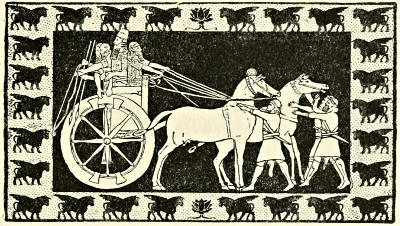
Assyrian King in his War Chariot
In the list of the Babylonian kings for these five years, there stands, not his name, but that of Ulule, who was neither, as has been believed hitherto, an independent prince nor a viceroy appointed by Shalmaneser, but none other than Shalmaneser himself, who also probably resided at Babylon. Perhaps his expedition against Phœnicia and Israel falls as early as the year of his accession. The occasion of the war against Tyre, whose king, Elulæus, at that time stood at the head of the Phœnician towns, is said to have been an expedition undertaken by the latter against the Khittim of Cyprus. It is more probable that the Tyrian king, like Hoshea of Israel, had taken advantage of Tiglathpileser’s death to renounce his allegiance to Assyria. Shalmaneser again subdued Hoshea and raised tribute from him. At the same time he sent into Phœnicia a part of his army, which devastated the whole country, and once more made it tributary. After this the whole empire seems to have quieted down, for the following year (726) was a year of peace. But the calm was not of long duration. Scarcely had the Assyrian troops marched away, when Hoshea turned to the Egyptian king, in the hope that with his aid he might free himself from the yoke of Assyria, and from thenceforward once more refused the tribute.
We have here probably a great conspiracy, in which Elulæus was also concerned, for Shalmaneser now marched against both kings. He took Hoshea prisoner, evidently after a struggle, wasted the whole land of Israel, but at Samaria, whose population may very likely have incited the king to revolt, he encountered an obstinate resistance. Meantime the whole Phœnician mainland, either from fear or under pressure from the superior force of Assyria, hastened to desert from Elulæus and to submit to Shalmaneser. The Tyrian king found himself under the necessity of retreating to his fortress on the island of Tyre, where he was at once besieged. It was only under Shalmaneser’s successor that Samaria was taken after a three years’ siege, and Tyre after one of five years. We cannot but experience a feeling of respect for these two cities, which ventured unaided—for the help from Egypt failed, as usual, to appear—to defy the gigantic power of Assyria.
[It is by no means undisputed that Shalmaneser marched against both Elulæus and Hoshea, as Professor Tiele states. Some of the historians believe that no action was taken against the king of Tyre, and that since there are no allusions to the five years’ siege in any of the inscriptions, Josephus, the sole authority, made a mistake in attributing to Shalmaneser an attack on Tyre that was really made by Sennacherib.]
The scanty records of Shalmaneser’s reign bear witness to material prosperity. That he was, as has been thought, a feeble ruler, under whose administration the empire declined, is entirely unproved. His early death prevented him from acquiring the same glory as his predecessor, and if, immediately after his decease, the vassals of the empire raised the standards of rebellion in every direction, this speaks rather for than against the influence of his personality.e
FOOTNOTES