III THE LAST CENTURY OF THE REPUBLIC (continued 2)
Reading edition
Into this dangerous arena steps the nineteen-year-old Octavian. His guardian advised him to have nothing to do with his perilous inheritance. Historians have often dubbed him a coward. But alone and unfriended this youth left his tutors at Apollonia and came to Rome to take up his trust. It meant, first, revenge upon the conspirators; and secondly, a quarrel with Antony. It meant, in fact, two more civil wars, and Octavian had seen nothing of warfare. He set to work coolly and warily. There was still a magic in the name of Cæsar, and the veterans rallied to him and besought him to march against Brutus and Cassius. Part of his duties as executor was to pay a million sterling in donations to the Roman people. He sold his property and began to distribute the largess, man by man, tribe by tribe, until the sum was paid. He gave magnificent games in his “father’s” honour, with the lucky star of Julius publicly exhibited. He bought an army of 10,000 men with borrowed money. Two of Antony’s legions deserted to him bodily, and the very veterans of Antony’s bodyguard offered to murder their general if young Cæsar would give the signal.
But there was no haste in his method. Antony was to be used first and then destroyed. Octavian tried for a time to work with the senate, and even marched against Antony under their orders, but the incredible folly of the senate, who were persuaded by Cicero that “the boy” was negligible, drove him into the famous triple alliance of Antony, Octavian, and Lepidus. These three were appointed under threat of their armies to a kind of dictatorship in commission, “a triumvirate to reorganise the state.” Revenge was the explicit motive of this league. They began with the usual horrid proscription of all the senatorial aristocrats to be found in Rome. This was mainly Antony’s work. His creditors, his enemies and his wife’s enemies were slain wholesale, and, among them, Cicero. Eighteen towns of Italy were destroyed to provide lands for the veterans.
Meanwhile the tyrannicides had gathered in the East, and now Antony and the young Cæsar set out in pursuit of them. In the two battles of Philippi the luck of Octavian and the skill of Antony triumphed over their dispirited adversaries. Brutus and Cassius fell. A few of the “patriots” survived and joined Sextus Pompeius who was still at large in the Mediterranean. In the warfare at Philippi Octavian’s inexperience and real want of talent for generalship had been very apparent in contrast to Antony. Lepidus was already a nonentity. Antony went off to the East; and while he was holding his court of justice in Cilicia there sailed into harbour the splendid royal yacht of Cleopatra. The people left the judgment seat to see the famous Queen, and Antony too was soon at her feet. Signor Ferrero would have us believe, relying partly on the mature age of Cleopatra, that it was policy, not love, which made Antony dally at Alexandria. Policy no doubt was there, but everything that we know of Antony leads us to believe that he was just the man to be captured by a celebrated courtesan, particularly if she were also a queen. Certainly his sojourn in the East lowered his character both as a politician and as a soldier.
Octavian had to face Rome and the West. His task was full of perils but also full of possibilities. The soldiers were mutinous, he himself was grievously sick, and the redoubtable Fulvia, who was her husband’s real agent at Rome, very soon perceived that he was an enemy to be fought. Octavian had to fight another small civil war at Perugia before he could call himself master even of Italy, and then fight Sextus Pompeius in the Sicilian waters. Luckily he had at his side a splendid soldier—general and admiral by turns as were all good Roman fighting-men—Marcus Vipsanius Agrippa.[19] He had also as his agent at Rome Mæcenas, an astute diplomatist and man of business. So though he himself often displayed feebleness and was often in danger he accomplished his task and became master of the West. Thus the lordship of the world was reduced to a plain duel.
Antony had actually married Cleopatra after Fulvia’s death and Octavia’s divorce, and as consort of the Egyptian queen reigned in Oriental majesty. He had marched against the Parthians and failed ignominiously. He was assigning provinces and princedoms to Cleopatra and her dubious offspring. It was easy for Octavian to represent Antony as a renegade Roman threatening to introduce Oriental monarchy into Rome. When at last it came to the final civil war Octavian appeared as fighting in the public cause of Rome against Egypt, with Antony as a mere deserter on the Egyptian side. The great naval battle of Actium (31 B.C.), which decided the mastery of the world for Octavian, was thus a triumph for the Roman arms over the barbarians. Actually it was a degenerate Antony who sailed away at the crisis of the battle in the wake of the queen’s yacht. The glory of the day was Agrippa’s. The luck as usual was the young Cæsar’s. He was able to inaugurate his reign at Rome by presenting her with Egypt, the richest country in the world. In 29 B.C. he came home to celebrate a glorious triple triumph and to open a new era as the first Roman Emperor.
Late Republican Civilisation
Such is a brief sketch of the hundred and four years from the day when Tiberius Gracchus first arose to challenge the senatorial oligarchy to the day when the Empire was established upon the ruins of the Republic. It is perhaps the most terrible century in the history of the world. Rome had become the centre of the world, the only hope for civilisation, and Rome was filled with bloodshed and corruption. For the provinces there was no decent government, only a succession of licensed plunderers. In the city itself there was a long series of personal struggles for the mastery; politics meant organised rioting by gangs of roughs, questions were solved by the dagger or by the swords of senators. At intervals there came from each side alternately the murderous proscriptions, in which every man of spirit or eminence on the opposing side was marked down for destruction. Often their sons and grandsons perished with them, and in any case their fortunes were destroyed. Besides the proscriptions there had been of late a series of civil wars on a great scale in which thousands of the bravest Romans perished by each other’s swords. A successful foreign war may have some compensating effect in stiffening the moral fibre of a nation and exalting its spirit. But civil war is disastrous in every way. It is only the meanest who survive and the evil passions which it arouses have no compensation.
In such a period it is wonderful that civilisation should have been able to make any advances at all. But in spite of the public turmoil private citizens were amassing enormous fortunes out of the plunder of the world, and living, though always on the edge of a volcano, in state and luxury like kings. It is now our task to see something of private life and culture in the Rome of the expiring Republic.
Money was easily made in those days and lavishly spent. Even an honest man like Cicero, governing a comparatively poor province like Cilicia, made at least £20,000 by his year of office while he remitted to the provincials a million, which, as he says, any governor of average morality would have retained. Legacies were a very frequent source of revenue especially to pleaders, and it was customary for a rich testator at Rome to make large bequests to his friends. Cicero gained £200,000 by such legacies. Foreign kings and states paid handsomely for legal advice or support. Although a barrister was supposed to give his services for nothing yet gifts and legacies were not refused. For the financier or business man there were many channels to affluence. There were mines all over the empire to be financed and exploited. Although there was little genuine industry at Rome, yet the training and use of slaves for various undertakings was a lucrative business. Crassus trained a salvage brigade for Rome and went about to fires with them in order to make bids for the purchase of the burning property. Atticus trained a company of copying clerks and made money by the sale of books. He also kept gladiators and hired them out to magistrates for the games. Fortunes were made, as in the case of Crassus, by buying up the confiscated property of the proscribed. Land speculation was rendered extremely profitable by the frequent assignation of farm-lands to veteran soldiers who were generally glad to sell them at once. The extravagance of the Roman nobles led to a very brisk traffic in loans at high interest. There was a great deal of genuine commercial speculation in ships and cargoes, generally by companies, and Cato advises the investor to put his money in fifty different enterprises rather than in one at a time. Commerce overseas was, however, forbidden to the senators by the Claudian law, and these speculated chiefly in land, on which they made a profit by slave-labour. But the most profitable business of all was tax-farming, in which the equestrian classes joined together in capitalist rings. In these and other ways prodigious fortunes were accumulated. The stored-up capital of the Roman world is astounding in its magnitude compared even to that of modern times. The real property of Pompeius sold for £700,000. Æsopus, the popular actor, left £200,000. After the most lavish donations to the public Crassus left nearly two millions sterling by will. On the death of Cæsar the treasury contained eight millions in bullion of which a million was the dictator’s own property.
But all the wealth of the Roman empire was shared by a very narrow circle. The gulf between rich and poor was far deeper than it is to-day. We hear of poor nobles and rich upstarts, but of a respectable middle class with traditions of its own there is little trace. There is an aristocracy of a few thousand families, and nothing else but a vast proletariat, silent and hungry, dependent on their bounty, bribed with money, bribed with free corn, and bribed with bloody spectacles. They lived miserably in huge tenement blocks or in hovels on the outskirts of the city. The only career open to them was in the army, and that was chiefly filled by the stronger rustics. They had nothing to do but lounge in the streets, gape at gladiators and actors and shout for the most generous politicians of the day. No doubt there were honest citizen cobblers, but Roman history is silent about them.
That section of the city which is to be styled Society was as proud and reckless as the French aristocracy before the Revolution. The senate had now become almost literally a hereditary rank. A child born into one of these princely houses was tended by a multitude of slaves. By this time there was some attempt at a liberal education. Attended by a slave pedagogue the boy would go daily to the school of some starved Greek, who would teach him his letters and his figures. The staple of education was the delivery of artificial declamation on the model of Isocrates or Demosthenes. After this stage a young man would commonly be sent abroad to Athens or Rhodes to finish his education with a little philosophy or mathematics, but chiefly with oratory. Returned to Rome, his destiny placed him in a circle of foppish youths, who devoted their principal attention to dress and manicure. Bejewelled and scented, they practised every vice, natural and unnatural. In due course, with no effort but a few bribes from the parental purse, they became priests and augurs, thus entering what were in reality aristocratic dining-clubs. Dining was now the principal art of Rome. Macrobius has preserved the menu of one of these priestly dinners of the Republic, at which the priests and vestals were present. The party began with a prolusion like the Russian or Swedish system of hors d’œuvres, in which seventeen dishes of fish and game were presented. The dinner itself contained ten more courses, “sow’s udder, boar’s head, fish-pasties, boar-pasties, ducks, boiled teals, hares, roasted fowls, starch-pastry, Pontic-pastry.” Such was the State religion of Rome in the first century before Christ. At intervals the young noble’s father’s friends would invite him to join their staff on foreign service. If he had the good fortune to serve with Pompeius or Lucullus in the East or with Cæsar in Gaul, he might get a taste of real manliness, and serve his country as tribune of the soldiers. But more often in a peaceful province like Sicily or Africa he was merely initiated into the arts of extortion, and enjoyed all the vicious opportunities of the younger sons of princes. Thus fortified by experience he would return to Rome to seek the suffrages of his fellow-citizens for the quæstorship, the first rung on the ladder of office. Votes were to be won by bribery, direct or indirect. One candidate would spread a banquet for a whole tribe; another would seek to outshine his rivals by providing strange beasts from Africa—among Cicero’s correspondence there is an urgent appeal for Cilician panthers to be slain in the arena—or by dressing his gladiators in silver armour. Similar requirements accompanied his progress through all the stages of office on a progressively lavish scale. As quæstor he would be a judge or a comptroller of the treasury for a single year. Then as ædile he would conduct the public festivals, preside in the ædile’s court, control the markets and streets of Rome. So he rose to be consul, commander of legions and president of the state, and then in due course governor of an enormous province. From his quæstorship onwards his seat in the senate was assured.
In his home the noble Roman lived like a king, waited upon by an enormous retinue. There was much luxury and little comfort. The houses of the Romans were on a far more luxurious scale than those of the Greeks. The only genuine Roman taste that can be called liberal was the hobby of collecting beautiful town houses and country seats. Cicero, who was a man of modest income and tastes, seems to have possessed about eighteen different estates, and gave nearly £30,000 for his town house. The qualities prized in the choice of a mansion were space and coolness, and the Romans of this age were by no means insensible to the charms of scenery. The coast round Naples and Baiæ was dotted with sumptuous villas, and the gay world spent its summer there in much the same way as the cosmopolitan crowds at Biarritz. Besides his great town house and his family mansion at Arpinum, and his country houses at Tusculum and elsewhere, Cicero had marine villas all along the coast at Antium, Formiæ, Cumæ, Puteoli, and Pompeii, and all along the Campanian road were his private “inns,” where he lodged on his journeys. His favourite villa was the one at Tusculum, the scene of many of his literary labours, and among others of the famous Tusculan Disputations. It had previously belonged to Sulla, and was adorned with paintings in commemoration of Sulla’s victories. It was situated on the top of a hill along with many other villas of the aristocracy, and commanded a delightful view of the city about twelve miles away. The park attached to it was extensive, and through it there ran a broad canal. He had books everywhere, but his principal library was deposited at Antium. At Puteoli he constructed a cloister and a grove on the model of Plato’s Academy.
The principal feature of the Roman house was its large colonnaded hall, with a roof open in the middle to admit light and air. This roof sloped inwards, and allowed the rain to fall into a central tank, delightful for coolness, no doubt, but probably very unwholesome. In old days the atrium had been the common room of the Roman family. It still retained a symbolical marriage-bed, a symbolical spinning-wheel, the portraits of the ancestors, and the ceremonial altar to the family gods, who were now stored away in a cupboard close at hand. Most of the rooms opened directly out of the atrium. As they are seen in the ruins of Roman villas, they appear to have been comparatively small and ill-lighted. The larger houses themselves were generally built of local limestone with facings of stucco, though the greater part of Rome was still in this first century b.c. constructed of sun-baked bricks. It was considered unheard-of luxury when Mamurra faced his walls with marble slabs. The floors were generally tessellated. It was an innovation of the Roman architect to build houses of three or more stories, but it was probably only a starveling poet who would live on the fourth floor. A noble’s house would spread over the ground regardless of space, but the bedrooms and sometimes the dining-room were upstairs. Externally the Roman house was a little finer than the Greek, being fronted with a pillared forecourt and a dwelling for the concierge. At the back the atrium opened into a colonnaded garden with a fountain, flower-beds, and shrubbery.
As the Roman’s house was built mainly with a view to coolness, so his daily life was that of a southerner. Rome was never a healthy city in the summer, and all who could afford it fled to the country or the sea-side. Almost every Roman known to us in literature was either an invalid or a valetudinarian. Malarial fever in its periodic form was very widely spread, and most of our distinguished friends pursued a medical regimen. Cæsar was subject to fits of epilepsy, Cicero was of weak constitution, Horace was a martyr to ophthalmia as well as malaria, Augustus was always ailing and often at death’s door. The Roman’s most amiable idiosyncrasy was his devotion to the bath. Every considerable house had an elaborate bathing department with at least a hot room built over a furnace, and a cold room with a swimming-tank. But there were also public baths, on an ever-increasing scale of magnificence. Agrippa alone built 170 of them at Rome. Rich and poor alike made it their daily practice to bathe after exercise, just before their principal meal in the early afternoon. The custom of the noon-tide siesta was universal, except with prodigies of industry like Cicero. A great deal of time was spent in lounging abroad through the streets or under shady colonnades. The streets of Rome, as of all ancient cities, were extremely narrow, but in the busy parts of the city all wheeled traffic was forbidden.
The wealthy Romans have a name for abominable luxury and gluttony. As to the general question of its influence in destroying the morality of Rome I have already ventured to express disbelief in the popular view. From all that we read, it does not appear that the ordinary Roman was naturally addicted to intemperance either in eating or drinking. The praise of wine is with Horace a literary pose; personally he had a poor head and a poor stomach. The Italian is not, and probably never was a great natural eater or drinker judged by northern standards. But rhetoricians and satirists have delighted to dwell upon the immensity of Roman dinner-parties which often lasted all day and included a hideous series of curious and exotic dainties. This was the form which, in default of any nobler ideals, wealth at Rome had chosen for its display. Time hung heavily on this slave-tended aristocracy: to dine from dawn to daylight was one of the ways of killing it. So the guests reclined on their couches, dancers jigged before them, musicians played, occasionally a tumbler or a tight-rope walker would appear, in literary households a slave would read philosophy; and all the time the soft-footed slaves were coming and going with dishes of strange morsels gathered from the ends of the earth, and rare wines from the four corners of the globe. A dish of nightingales’ tongues is not the sort of thing to please one who is a gourmet by conviction or natural taste. Eating was for most of these poor starved imaginations the only form of culture they understood. It was, however, conducted with tremendous ceremony. There was a “tricliniarch” to marshal his “decuries” of slaves as each dish came into the room. There was a special “structor” to arrange the dishes, a special “analecta” to pick up the fragments that the diners dropped. Carving was a science with various branches, as in old England, and the skilful carver had his scheme of gesticulations for each kind of dish. There was another slave specially appointed to cry out the name and quality of each plat. In addition to these every guest had his own footman standing behind his couch. The most characteristic and the most unpleasant feature of a Roman banquet was the manner in which the diners assisted nature to provide them with an appetite. Even Julius Cæsar “took his vomit” both before and after his dinner-party with Cicero.
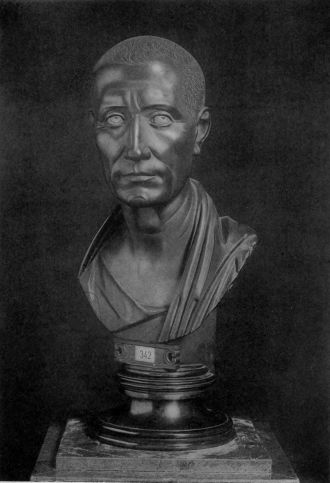
Plate XIX JULIUS CÆSAR
The public shows, which formed the chief recreation of rich and poor alike, grew yearly more brutal and bloody. As they were the means by which ambitious candidates for office sought to canvass popularity, the principal aim was to present something novel and startling. No doubt the more refined spectators regarded the butchery of wild beasts or paid gladiators with disgust, but the populace at large only shouted for more blood. Five hundred lions were slaughtered on one day at the triumphal games given by Pompeius. Cicero writes that the wholesale destruction of elephants in the arena actually moved the people to pity. There were still some real theatrical performances in Rome. Actors and mimics, indeed, if they were handsome and graceful, made large fortunes. Most Roman nobles of a literary bent amused themselves with writing tragedies. Cicero’s soldier brother composed four on a fortnight’s journey to Gaul. But these were only employed to bore one’s friends at dinner. Original literary dramas were even less often staged at Rome than they are in London. Plautus and Terence for comedy, and Pacuvius, Attius, and Ennius for tragedy, had already become classics and were still regularly performed. The drama died stillborn at Rome.
Historians of Rome, fortified by Juvenal and Petronius, love to depict the vices of the emperors and the imperial period. The later Republic can show us a morality no more exalted. The fragments of Varro’s satires written in the heyday of the Republic are in precisely the same strain of despondency as are the satires of Juvenal. For him, too, virtue is a thing of the past. Sober fact compels us to see that the aristocratic society of Republican Rome was hideously immoral. Voluntary celibacy and “race-suicide” were already rife. The family was a decaying institution, divorce was common, and the sterility of wickedness had long been at work to sap the ranks of the nobility. Even Cicero divorced his wife Terentia upon a trivial pretext after a long period of happy conjugal life in order to marry an heiress. Cæsar had four wives of his own, not to mention Cleopatra, without begetting a single legitimate son. Cato, the strict censor of morals, having been jilted in his youth, married a wife, divorced her for adultery after she had borne him two sons, married another, lent her for six years to the orator Hortensius, and on his death resumed her again. Mark Antony married Fadia, then Antonia, then divorced her and lived publicly with Cytheris the actress, then married Fulvia, who had already been twice a widow, then married Octavia, then Cleopatra. These marriages were made and dissolved freely for political reasons. A large part of Roman politics was carried on in the salons of the Roman ladies, and if half of what Cicero alleges be true Messalina herself had her republican prototypes in women like Clodia and Fulvia. Beside almost promiscuous relations between the sexes, the darker forms of Oriental vice were extremely fashionable among the gilded youth of Rome.
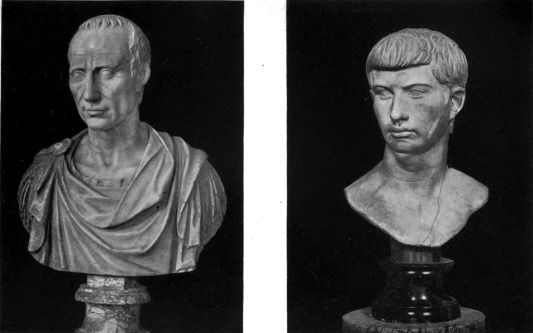
FIG 1. BUST OF JULIUS CÆSAR FIG 2. BUST OF BRUTUS
Plate XX
Religion was almost purely formal or political. Augurships and priesthoods still existed as the perquisite of aristocratic families. People still uttered the formulæ of oaths and vows. There was still some belief in omens and prodigies, the altars still smoked with sacrifice when triumphant generals went up to the capitol, but few prayers ascended to Jupiter in sincerity. Instead the importation of strange deities continued. Again and again in this first century before Christ the senate tried to expel the worship of Isis from the precincts of Rome, but it always returned, and eventually the triumvirs built a temple to Isis and Serapis as a measure to court popular favour. The Magna Mater of the Phrygian corybants had long been firmly established at Rome.
I think it was general materialism and immorality which killed the old State religion at Rome. Greek philosophy had generally been able to exist amicably by the side of religion. It now came in to fill up the gap left by the absence of real religious feeling. But at Rome, though Stoicism afterwards became a powerful force of inspiration to the noblest minds, philosophy was in the main a form of literary activity for dilettantists. Cato of Utica was a Stoic by temperament before he became one by doctrine. Cicero amused his leisure by recasting and combining the doctrines of the leading Greek schools in a Roman form of dialogue, in imitation of Plato; but with him it was more of a literary exercise than anything else, and Cicero has added little or nothing to the world’s stock of philosophical ideas. Only in the poet Lucretius does the fire of philosophy burn with genuine ardour. Lucretius had before him the task of proselytising at Rome for the doctrines of Epicurus and Democritus. People accustomed to the modern associations of the word “epicure” may wonder what there was to arouse the enthusiasm of a poet in the philosophy of Epicurus. That creed offered a rational explanation of the universe. With its theory of spontaneous atomic creation, and its surprising foreknowledge of some at least of the ideas of natural selection and evolution, it claimed to satisfy the intellect of mankind and to drive out all the grovelling superstition and empty rites which had usurped at Rome, as they tend to do always and everywhere, the throne of religion. All the enthusiasm with which the nineteenth century approached the new discoveries of science glowed in the heart of this rugged poet of the first century before Christ. “Voluptas” was his only goddess, but it was no vulgar pleasure of the body upon earth. It was the spirit soaring to freedom and knowledge. This atheist Epicurean is, in the true sense of the word, the most religious of all poets. He explains the nature of lightning in order that his fellow-creatures may not live in fear of thunderbolts. He explains with the same confident logic the nature of death in order that they may not fear the natural resolution of body and soul into their primordial atoms. He is moved almost to tears by the folly and sorrow of his brother-men, and he pleads with them to suffer the sacred lamp of philosophy to shine upon their darkened minds:
at nisi purgatum est pectus, quæ prælia nobis atque pericula sunt ingratis insinuandum? quantæ tum scindunt hominem cupedinis acres sollicitum curæ? quantique perinde timores? quidue superbia, spurcitia ac petulantia, quantas efficiunt cladeis? quid luxus, desidiæque? hæc igitur qui cuncta subegerit, ex animoque expulerit dictis, non armis, nonne decebit hunc hominem numero diuom dignarier esse?[20]
His doctrine is medicine for the feverish unrest of the day:
exit sæpe foras magnis ex ædibus ille esse domi quem pertæsum est, subitoque reuentat; quippe foris nihilo melius qui sentiat esse. currit agens mannos ad uillam præcipitanter auxilium tectis quasi ferre ardentibus instans: oscitat extemplo tetigit quom limina uillæ aut abit in somnum grauis, atque obliuia quærit, aut etiam properans urbem petit atque reuisit. hoc se quisque modo fugit ...[21]
He has a compassionate scorn for the mourner:
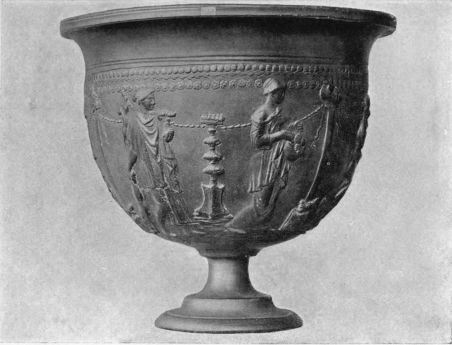
Plate XXI ARRETINE POTTERY
aufer abhinc lacrumas, barathre, et compesce querelas ... cedit enim rerum nouitate extrusa uetustas semper et ex aliis aliud reparare necesse est; nec quisquam in barathrum, nec Tartara deditur alta. materies opus est ut crescant postera sæcla; quæ tamen omnia te, uita perfuncta, sequentur: nec minus ergo ante hæc quam tu cecidere cadentque. sic alid ex alio nunquam desistet oriri; uitaque manciplo nulli datur, omnibus usu.[22]
Death has no sting for him:
num quid ibi horribile apparet? num triste uidetur quidquam? non omni somno securius exstat?[23]
Lucretius was, of course, set down by Cicero, as was Shakespeare by Dryden, as being rude and unpolished. His poem is indeed sheer didactic argument with occasional digressions, and he strings his points together with the bald transitional words and phrases of argumentative prose. But in virility of thought and expression, even in majesty of sound and force of vivid imagery, he is, when he cares to be, on a plane quite above and away from the ordinary sphere of classic Latin poetry. Almost alone among Roman writers he has a message of his own to deliver. His fellow-countrymen thought little of him, and failed to preserve any details of his biography. The monks of the Middle Ages consigned him to the hell he had flouted, and Jerome provided him, five hundred years after his death, with an end edifying to piety, but quite incredible to any one who has read his work with sympathy. He was said to have died of a love potion, and to have composed his poem in the intervals of delirium. He appears to have lived between 100 and 50 B.C.
In addition to the tragedies and epics which noblemen threw off as an elegant pastime for their superfluous leisure hours, love-poetry, pasquinades, and vers de société travelled merrily from salon to salon. If Lucretius carries the heaviest metal of Latin poets, Catullus has by far the lightest touch. He writes with an ease which makes Horace seem laboured, and with a simplicity which makes Propertius and even Ovid look like pedants, though Catullus himself, like all Romans, thought fit occasionally to adopt the classical pose, and fill his verses with learned allusions. If it were not for the influence of the schoolroom, to which most of Catullus’s work is for the best of reasons unknown, he would be recognised as possessing far more of the vital spark of poetry than Horace. Roman culture, being mainly second-hand, is almost entirely lacking in the quality of fresh youth which we enjoy in such writers as Chaucer and the early Elizabethan singers. Catullus, therefore, the earliest important lyric poet of Rome, is by no means unsophisticated. On the contrary, he is a clever son of the forum—a boulevardier, one might say—with a pretty but savage wit in reviling democrats like Cæsar and Mamurra. But, with his truly Italian scurrility, he combines the quintessence of Italian charm. When the inspiration takes him he is simple, direct, and natural. Indeed, the shorter poems of Catullus seem to me to reveal more of the
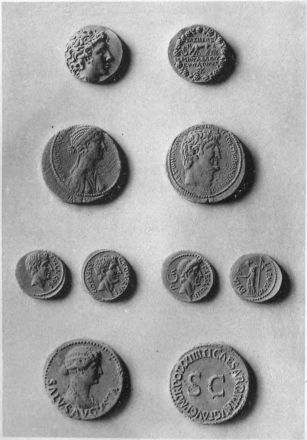
Plate XXII COIN PLATE I
essential Roman than all the rest of Roman literature put together. We have the innocent pleading of the April lover in:
soles occidere et redire possunt: nobis cum semel occidit breuis lux nox est perpetua una dormienda. da mi basia mille, deinde centum, dein mille altera, dein secunda centum, deinde usque altera mille, deinde centum.[24]
and the awful simplicity of his wrath at betrayal:
Cæli, Lesbia nostra, Lesbia illa, illa Lesbia, quam Catullus unam plus quam se atque suos amavit omnes, nunc in quadriuiis et angiportis glubit magnanimi Remi nepotes.
We have a more genuine-sounding love of nature in his praises of Sirmio, and a more natural pathos in the famous lament for his brother, than any other Latin poet can give us. In one species of composition, the Epithalamium, he is supreme. For example:
flere desine, non tibi Au- runculeia, periculum est nequa femina pulchrior clarum ab Oceano diem uiderit uenientem. talis in uario solet diuitis domini hortulo stare flos hyacinthinus. sed moraris, abit dies: prodeas, noua nupta. prodeas, noua nupta, si iam uidetur, et audias nostra uerba. uiden? faces aureas quatiunt comas: prodeas noua nupta.[25]
The music of this, with its beautiful imagery and refrains, is no doubt based upon an Alexandrian foundation. There is a distinct echo of Theocritus. But it is also distinctively Italian, and the greatest of modern Italian poets, Carducci, writes like a legitimate descendant of Catullus. Catullus has as little biography as Lucretius. He must have died at an early age in the fifties B.C. He was a poor man. He had only a town house and two villas, one on the Lago di Garda and one at Tivoli. He hated Cæsar and loved Cicero. That his “Lesbia” was the infamous Clodia is generally asserted. I do not believe it.
These two poets, Lucretius and Catullus, then, stand almost alone as representatives of Republican Roman literature on the poetical side. Both are Romanising various Alexandrian Greek modes, but both have something genuinely Roman, a quality which we may best describe as virility, to add to their originals. This was the point from which a genuine Roman literature might have taken its departure. Instead of that, the next era is that of a courtly school of classicists, largely writing to order, who gave to Latin its distinctively classical bent.
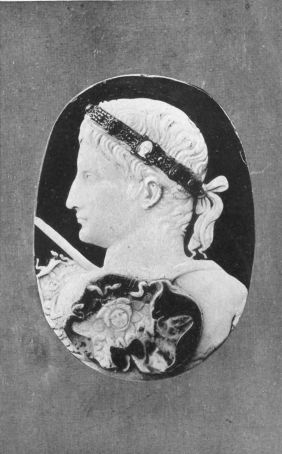
Plate XXIII. AUGUSTUS: THE BLACAS CAMEO
Cicero, the most classical of all classics, is, however, far the greatest literary product of the Republic. He is, indeed, far too vast a figure for these modest pages. By his colossal industry and immense fertility of genius his influence dominates the whole field of Latin prose literature. He is not only the greatest of all orators, but he stands as the type of the orator in life as in literature. We of this generation, who live in the eclipse of rhetoric, do not find it easy to be just to him. With such gifts of eloquence, such a power of uttering tremendous phrases about duty and patriotism, we cannot but feel affronted at his political incapacity. Mommsen, who is all for action, peppers him with contemptuous expressions—“a statesman without insight, opinion or purpose”; “a short-sighted egoist”; “a journalist of the worst description”; “his lawyer’s talent of finding excuses—or, at any rate, words—for everything.” And, indeed, among men like Cæsar with legions at their backs, or creatures like Clodius with their packs of hooligans, a man of golden words and honest principles does cut a sorry figure on the pages of history—so much the worse for history! He had, as we have seen, a policy, his talents made him a leader among the moderates of the senate, and his character made him genuinely popular among all the more respectable classes of society. But Rhetoric is one of the feminine Muses, and Cicero’s nature was as soft and sympathetic as a woman’s. So he turns his coat at a word from Pompeius, utters brave words one day and eats them on the next, publishes magnificent denunciations which he has not had the courage to deliver. Moreover, we see his intimate thoughts revealed in all the frankness of an unexpurgated private correspondence—and there are few statesmen, certainly very few orators, whose reputations can sustain that test. Thus the golden words often ring hollow. His vanity is often ludicrous, as when he writes to Lucceius, to beseech a conspicuous place in his history, even if the truth has to be distorted for the purpose; or when he loiters at Brundisium, with his lictors’ rods continually wreathed in laurel for the futile hope of a triumph. Certainly he was an egoist. Probably in their private correspondence all men are. But he was also a gentleman, one of the few Romans of his day with whom one would care to shake hands in Elysium.
To Mommsen, Cæsar is the “sole creative genius” of Roman history. We may well ask what he created. Certainly not the empire, for that fell to pieces at his death, and had to be re-created on a new plan by his successor. Not even the Gallic province, for though he conquered it, he left the problem of its organisation to Augustus. Possibly the Lex Julia municipalis. But Cicero[26] created Latin prose out of next to nothing and left it to the world as its grandest form of literary expression. The splendid Latin period, with its clear logical order, its chain of dependent clauses each in its place with absolute precision, a thought built of words as a temple is built of marble, is the best expression of Roman grandeur, as typical and as enduring as a Roman road or wall. It was not mere art. It was the natural expression of a Roman mind trained in law and rhetoric. It was perhaps the finest thing the Romans ever made, and the Latin period is the true justification for retaining Latin in its place for the education of young barbarians accustomed to string their random ideas together like dish-clouts on a line. Although it was the result of long training under all the most distinguished masters of Rome and Greece, and was perfected with infinite labour, Cicero’s style, when once achieved, was extraordinarily rapid and fluent, as the number of his works can testify. It is true that, like many great stylists—Dryden, for example—he came to believe that style was everything. He was prepared to write a geography of the world or a history of Rome. He only wanted a few notes from his brother Quintus to write an account of Britain. His multitudinous philosophical works were, as we have seen, more style than philosophy, thrown off in a few months to while away the time at his Tusculan villa at intervals when the temperature of Rome, literally or politically, was too high to suit his health. In such work he may fairly be called a journalist, though a very great one. When he writes of a subject he really understands, such as rhetoric, he is at his best. Again, in his forensic speeches or writings he is much better as an advocate than as a lawyer. His mind is not capable of juristic precision, he is neither deep nor subtle, and so far his influence is wholly detrimental in the history of Roman law. He would probably infuriate a trained judge; but give him a jury, and, if possible, a large Italian one, and he is irresistible, now with translucent rapid narrative, now with clever mystification, breaking off into thundering appeals to conscience or heaven, or again with passionate denunciation of his opponent or majestic encomium for his client. In the senate he is not at his best. We are told that a few blunt words from Cato had more power to move that assembly of practical men than all the Catilinarian orations. But if Rome had been governed as Greece was, by orations in the market-place, Cicero would have been in Cæsar’s place as dictator of the world. Imagine the Roman mob assembling in 63 B.C. to hear their consul’s account of Catiline’s flight—
tandem aliquando, Quirites, L. Catilinam, furentem audacia, scelus anhelantem, pestem patriæ nefarie molientem, uobis atque huic urbi ferrum flammamque minitantem, ex urbe uel eiecimus, uel emisimus, uel ipsum egredientem uerbis prosecuti sumus. abiit, excessit, euasit, erupit. nulla iam pernicius a monstro illo atque prodigio mœnibus ipsis intra mœnia comparabitur. non enim iam inter latera nostra sica illa uersabitur: non in Campo, non in foro, non in Curia, non denique intra domesticas parietes, pertimescemus[27]
—his voice screams with passion, or sinks into pathos; presently he drops into the tones of calm reason or fluent narrative; as he nears his peroration his eyes flash, his hands gesticulate, his body sways from side to side, his foot stamps the ground, he seems to foam at the mouth:
dolebam, dolebam, patres conscripti, rempublicam uestris quondam meisque consiliis conseruatam, breui tempore esse perituram ... audite, audite, patres conscripti, et cognoscite reipublicæ uolnera....[28]
“Why, you did not even stamp your foot!” he exclaims in rebuking the coolness of an opposing counsel. It is true that there were purists of the severer school of Roman oratory who thought such vehemence meretricious and undignified. The true Roman eloquence of the old school is to be found in that ambassador who came to the Carthaginian senate with “peace or war,” gathered in the folds of his mantle and briefly commanded them to choose; or that other who drew a circle in the dust round the Great King and demanded an answer before he left the circle. Cicero had studied his art both in the flowery Asiatic and the severer Attic schools. There was still, his critics complained, too much Asia in his style. But that was part of the tendency of his age. The austerity of Cato, with his simple formulæ, was gone for ever. The Romans of this age are more emotional, more sentimental, more characteristically Southern.
If we reproach Cicero with weakness and cowardice in his political life, the story of his end may atone for it. After Cæsar’s murder, when Antony was master of Rome, a man utterly unscrupulous and wedded to a still more unscrupulous wife, Cicero flung away all his timidity and hesitation. Convinced that the consul was trying to re-establish a monarchy, the old orator came down to the senate and launched at him the series of ferocious but most eloquent philippics. Some were spoken, some merely written and published. It was courting death in the cause of liberty. Cicero was not blind to the danger he was running. But he is probably sincere when he says that life has no more attractions for him.
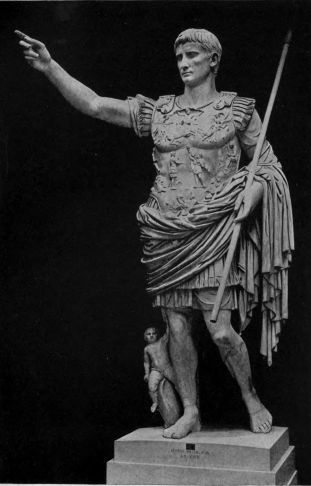
Plate XXIV. AUGUSTUS: THE “PRIMAPORTA” STATUE
defendi rempublicam adolescens; non deseram senex: contempsi Catilinæ gladios; non pertimescam tuos. quin etiam corpus libenter obtulerim, si repræsentari morte mea libertas ciuitatis potest; ut aliquando dolor populi Romani pariat quod iamdiu parturit. etenim si, abhinc prope annos uiginti, hoc ipso in templo, negaui posse mortem immaturam esse consulari, quanto uerius nunc negabo seni! mihi uero, iam etiam optanda mors est, perfuncto rebus iis quas adeptus sum quasque gessi. duo modo hæc opto: unum, ut moriens populum Romanum liberum relinquam; hoc mihi maius a dis immortalibus dari nihil potest: alterum ui ita cuique eueniat, ut de republica quisque mereatur.[29]
As he foresaw so plainly, the philippics caused his doom. When the triumvirate drew up its proscription-lists, Octavian is said to have pleaded for his life. But Antony’s wrath was implacable. Cicero’s head and his hands were nailed to the rostra from which he had so often poured out his rhetoric, and the virago Fulvia, so the story goes, thrust her needle through his eloquent, venomous tongue.
Julius Cæsar, that miracle of energy, beside being a competent grammarian and no mean poet, was reputed the second of Roman orators. Of that we have little means of judging. Certainly he could quell a mutiny by a speech, and his Commentaries were not the least wonderful of his achievements. Professedly they are mere notes for a real historian—by “historian” the Romans always meant “orator”—to dress up for literature. They are mere despatches intended to inform the senate and the world of the progress of his campaigns. They were written at odd moments in a prodigiously active life. Their style is so simple and so correct that we cast them as pearls before the fourth-form schoolboy. Yet they are in reality a triumphant product of the rhetorical art; so simple, they must be honest; so modest, they must be candid. You would scarcely think that they are a defence or a vindication. In the same easy flow of narrative breathless escapes are concealed. Who remembers from his schooldays Cæsar’s description of that moment, so pregnant with human destiny, when the eagle first alighted on our shores in the hands of the gallant centurion of the Tenth Legion? Cæsar seems more like a Greek than a Roman in his directness as in his reticence. Fortunately for history Cæsar had far more natural curiosity than most of the Romans. It is surprising how little Cicero really tells us of Roman or Cilician life in all his voluminous correspondence. But Cæsar went out to explore as well as to conquer. It may even be true that his visit to Britain was, as he asserts, partly due to curiosity. He notes our little insular peculiarities—our custom of sharing wives, our habit of keeping the hare, the hen, and the goose as pets because our religion forbids us to eat them. He sees the superior civilisation of Kent. He observes our clothing of skins, our dyeing ourselves blue with woad, our long hair and moustaches, our horsemen and charioteers, our innumerable population and crowded buildings, our plenteous store of cattle, our metals—bronze, iron, and tin. He is equally observant in Gaul and Germany. The debt that history owes to him for these records is incalculable.
Lesser lights such as Sallust and Nepos dabbled in history and have had the good fortune to survive. Livy, though he wrote under Augustus, is a true Republican in mind and sympathy. His majestic history of Rome is the work of a rhetorician setting out to extol the glories of the Republic. Although he sometimes displays a rudimentary critical instinct in comparing his authorities, his main task was to Latinise Polybius and to embellish with first-century style the dry annals of Fabius Pictor and Licinius Macer. It is not the least of our many grievances against the monks that they allowed so much of Livy to disappear.
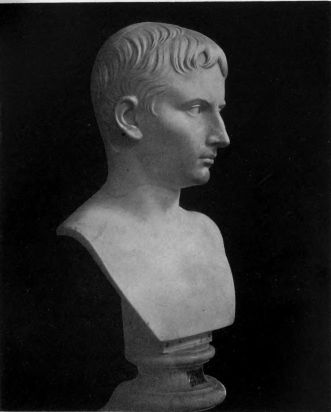
Plate XXV. AUGUSTUS AS A YOUTH
The golden age of classical literature covers this last half-century of the Republic and the first half-century of the Empire. There is, on the whole, little trace of division between the general character of Republican and Imperial letters except that with Augustus the principal writers are definitely engaged under the Emperor’s banner of reform. The main characteristic of both is rhetoric and convention. It is to Alexandria and its state-fostered writing-club that the world owes convention in literature. The Romans drew their inspiration from Greece but mainly from Alexandria, and as literature at Rome was now chiefly in the hands of a clique of nobles it was possible for a classical style to grow strong there. Cicero and his friends evolved a style, not only of literature but even of thought, which could pronounce itself as “urbane,” and all else as barbarian or rustic. Roman literature of the first centuries before and after Christ was as much under the domination of epithets like “urbane” and “humane” as was the literature of the eighteenth century under “elegant” and “ingenious.” Even Livy as an outsider was suspected of mingling “Patavinity” with his Latinity. It is the aristocracies of literature, such as the court of Louis XIV. or of Charles II., or such as the coffee-house cliques of Addison’s day or the Johnsonian clubs, which create and maintain our periods of classical convention.
Literature, as we have already seen occasion to remark, since it works in the most plastic medium, is generally the first of the arts to develop; and literature is only yet beginning. But then Rome borrowed her arts wholesale from Greece, and thus her culture has no true infancy. The burning problem of Roman originality in Art must be reserved until we reach the Augustan age. For the present we must still deny the existence of any really spontaneous art growth at Rome during the Republic. Where native art may be looked for with the highest probability of finding it is in architecture, portrait-sculpture, and painting; in architecture, partly because the Romans had a natural passion for building and partly because their religious and social habits called for quite distinct types of construction in palaces, halls, amphitheatres, triumphal arches, fora, and other secular buildings upon which the Greeks had wasted little of their attention; in portraiture because it was a peculiar custom at Rome to make and display images of their ancestors, whereas the Greeks in their love of the ideal had until latterly shrunk from the presentation of casual human lineaments and still idealised them as far as possible, and also because the Etruscans, who were the first nurses of Roman culture, had developed portraiture for themselves; and in painting, partly owing to the same Etruscan influence and partly because the Romans, using inferior building materials such as brick, limestone, and terra-cotta covered with stucco, were naturally drawn to mural painting for the sake of ornament. But if we look for originality here we are disappointed. Undoubtedly hundreds of magnificent villas were being run up all over Italy from Como to Sorrento, but a Roman villa was more an affair of landscape gardening than of architecture. It consisted mainly of a series of courts and colonnades sprawling at large over the ground. The walls were built of coarse tufa or peperino; they were only just beginning to be incrusted with marble slabs. As a city Rome was still contemptible—a huddled mass of narrow, tortuous alleys. Augustus swept away as much of it as he could afford to demolish, and his historians remark that “he found Rome built of brick and left it built of marble.” There were of course ancient temples, venerable with dignity, and no doubt to us they would have seemed beautiful with the picturesqueness of antiquity. But with Gracchans and Marians and Clodians rioting at large through the city, many of these venerable shrines were destroyed by fire. The Roman ruins as seen by the modern traveller are almost all of Imperial times. The great Temple of Jupiter on the Capitol was rebuilt four times. The round temple of Vesta was frequently destroyed and restored. Although for religious reasons the plan of the original was generally preserved in these rebuildings, the details were in accordance with the style of the day. Nevertheless the plans are interesting. The round shrines of Vesta and Mater Matuta[30] are clearly an architectural development from a round hut constructed of wood with a thatched roof. Indeed the Temple of Vesta is said to have been modelled on the hut of Romulus. It was perhaps originally the king’s house in which the princesses tended the sacred fire. The Temple of Jupiter Capitolinus also was, if we may trust the coins, built on an un-Greek plan with three naves instead of a single nave with aisles.
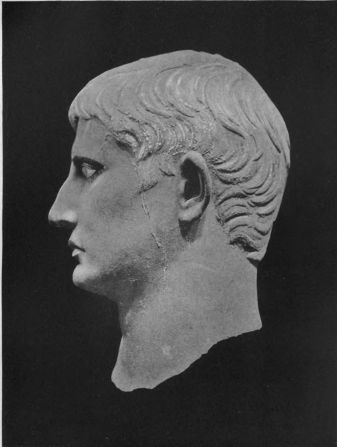
Plate XXVI AUGUSTUS: BRONZE HEAD, FROM MEROË
The only two considerable relics of Republican architecture are the Tabularium and the Temple of Fortuna Virilis, both dating from the period of Sulla. In that period, when Rome had just discovered Greek culture, when the armies of Sulla and Lucullus came home laden with Greek spoil, there was a temporary outburst of artistic activity at Rome. It was, however, entirely in the hands of foreign artists. In 143, Metellus, the victor of Macedonia, built the first marble temple at Rome in the Campus Martius. Sulla himself carried off the huge columns of the unfinished temple of Olympian Zeus at Athens to adorn the Roman Capitol. The Cyprian Greek Hermodorus was employed to construct temples and docks. The Romans had indeed their native principles of building, which from a merely constructive point of view were in advance of anything that the Greeks had evolved for themselves. Greek architecture of the best period had been almost exclusively devoted to the service of religion. Their efforts were almost limited to the perfecting of the Doric and Ionic temple, and when they had to build a secular building like the gate of the Acropolis, they were still content with a mere adaptation of Doric temple to their new purpose. Their building material was marble, and with their peculiar artistic discretion the Greeks saw that marble was at its best in the austere lines of pediment and columns. But the Romans, before they imported marble, had made a beginning with brick and cement, which require quite different methods of architecture. In prehistoric “Servian” days they had discovered or learnt from the Etruscans the use of the vault and arch, at any rate for tunnels, but it is characteristic of their artistic poverty that they had made little architectural use of these important principles. The triumphal arch seems to have been a Roman invention, and several triumphal arches were built in republican days, but unfortunately we have no information as to their style. The Sullan revival of art was purely an importation of foreign models. In the Temple of Fortuna Virilis built in 78 B.C. we see how the Romans used their imported architecture.[31] The graceful Ionic columns support nothing. They are used for ornament as the West African native uses his European clothes. The Greeks had indeed used engaged columns, as in the Erechtheum, to complete the design where there was no space for a free colonnade, but the Romans built them into their walls for the sake of ornament. This is typical. Culture was to the Greeks a vital part of their existence, to the Romans it was an embellishment.
But Roman architecture, having made this effort, had relapsed again until the days of the Cæsars. There was more destroying than building in the evil days of Cicero’s prime. The selfish plutocrats were too busy building their villas to give a thought to the gods’ or the city’s adornment.
It was much the same with the other arts. Take the coins, for example. The clumsy copper As, with the head of Janus on the obverse and the prow of a ship on the reverse,[32] had of old weighed 12 ounces. All through republican history it was gradually shrinking; in 217 B.C. it was fixed at one ounce, in 89 B.C. at half an ounce. Long before that, however, silver had taken its place. As we have remarked, silver was not coined, though no doubt it circulated, at Rome before 268 B.C.. From 217 onwards silver became the real standard of value, and about 80 B.C. the copper coinage ceased altogether for a time. Not only were the original designs of the “heavy copper” borrowed from Greece, but there is not the least sign in the Roman coinage of any artistic development as time progresses. Simply, as Head remarks, “the degree of excellence attained in any particular district depended upon the closeness of its relations, direct or indirect, with some Greek city, or at least with a population imbued with the spirit of Greek art.” There are coins of Sulla, both silver and gold, doubtless of Greek workmanship, which display fairly artistic designs.[33] But the coins of Antony and Cleopatra, interesting as they are historically, and designed, of course, in the Hellenised East, are much inferior.[33] We notice an attempt at portraiture, but the striking resemblance between the Roman triumvir and the Egyptian queen suggests the question which of the pair was the original.
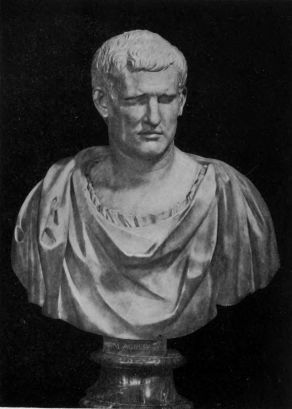
Plate XXVII. M. VIPSANIUS AGRIPPA
In sculpture, too, the most ardent supporters of Roman originality can find little to comfort them in the closing century of the Republic. We have seen how the victories of Mummius and his successors had created a taste and a market for Greek works of art. With those of Sulla and Lucullus immense quantities of loot had crossed the Adriatic, and Rome began to be what New York is now, the home of connoisseurs and collectors. As connoisseurs are wont to do, the Roman millionaires studied commercial values rather than artistic qualities. No doubt in time their taste improved from the days when Mummius had warned his men that any of the Greek masterpieces destroyed in transit would have to be replaced by new ones. But they still went very largely by the names of the artists: a genuine Praxiteles or Scopas was worth immense sums. Every villa now required statues for its adornment—Greek originals, if possible; if not, copies. For the most part they were reckoned purely as objects of value along with handsome tables, vases, bowls, and signet-rings. When Cicero buys Greek statues he prefers Muses to Bacchantes as being more appropriate to his studies. The question of artistic value scarcely enters his mind. The most famous named sculptor of this period is the Italian-Greek Pasiteles, who visited Rome about 90 B.C. and there made original statues for Roman temples. Pasiteles, of course, was of the Hellenic decline. He was a metal-worker by training, and his work is like that of Cellini, more decorative than creative. It is jewellery on a large scale. He evolved no new style of his own, but set himself to copy and elaborate ancient types to meet the artificial demand for antiquities. Many of the “archaistic” works in our museums belong to this period of production, and as decoration many of them are extremely charming. We have other names of the Pasitelean school, all Greek, such as Stephanus and Menelaus, but there is very little originality or interest in them. The Venus Genetrix in the Louvre is undoubtedly a fine statue, and is probably a faithful copy of the original by Arcesilaus of the first century B.C.[34] But the face, at any rate, quite visibly goes back to the Greek sculpture of the fifth century, and perhaps, as has been suggested, to Alcamenes. It is in the treatment of the transparent drapery that the present artist shows his skill. Skill there was in abundance in those Greek chisels of the first century; even the Farnese Hercules of Glycon and the Medici Venus[35] are astonishing as efforts of chisel-craft, utterly debased and debasing as they are.
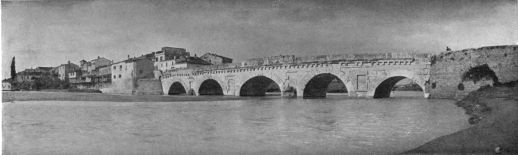
FIG. 1. ROMAN BRIDGE AT RIMINI
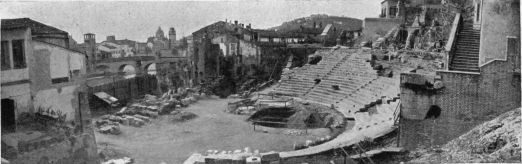
FIG. 2. ROMAN AMPHITHEATRE AT VERONA
Plate XXVIII.
We know from history that portrait statues had long been common at Rome. The forum was full of them. We saw in an earlier chapter how the old Etruscans had placed terra-cotta portraits of the deceased upon their tombs, and how the old Romans preserved wax images of their forefathers for use at funerals. Most primitive peoples have an instinctive dread of portraiture as a sort of blasphemy. Perhaps the early growth of facial portraiture at Rome was helped by the worship of a man’s genius, his luck, his spirit, his guardian angel. The genius naturally was depicted in the likeness of the man himself. So the imagines in a Roman atrium were no mere portraits of defunct ancestors. Rather they were visible presentments of invisible presences. Unfortunately very few unquestionably genuine examples of republican portraiture have survived. Portraits of ancient celebrities were freely constructed at all times, and it is not easy to date them. We have not at Rome as we have in Greece a clear line of artistic development which enables the trained archæologist to date any casual work of art to within half a century almost at a glance. It is now a question of employing more or less skilful Greeks. It is probable that most of the portraits already illustrated in this book were executed under the Cæsars, but they may well go back to earlier if ruder likenesses, and in any case the portraits are interesting for their own sake. The portraits of Julius Cæsar, both the white marble bust in the Vatican Museum[36] and the still more striking example in black basalt in the Barracco Museum at Rome, are, however, almost certainly of contemporary or, at the latest, Augustan date, so real and vivid is the portraiture. There is another very fine black basalt head of Julius in Berlin,[37] but its authenticity has been questioned. It certainly corresponds very closely with the profile of the dictator on his coins.[38] The bust of M. Brutus may also be identified by comparison with the coins. That of Cicero is probable but not so certain.
This art of realistic portraiture, then, is claimed as the great contribution of ancient Rome to artistic progress. It yet remains to be shown that any part of the work was done by native artists. At present the evidence is all in favour of Greek authorship. But the Romans may claim the credit of demanding or even inspiring realism. Roman archæologists, especially those who, like Wickhoff and Mrs. Strong, are concerned to plead the cause of Roman originality in art, often seem to assume that the Greeks of the best period could not express individuality, in fact that the ideal tendency of their statues, portraits included, is due to convention if not to the sheer limitations of their craftsmanship. Elsewhere we have seen that much of the apparent simplicity of Greek work of the best period is really elaborate self-restraint. All their religious ideas forbade them to express divinity with any marks of time or place upon face or feature. So when it came—as it came slowly—to portraying a statesman like Pericles, or a monarch like Alexander, they deliberately honoured them by idealising them and smoothing away the accidentals. Thus they concealed the inordinately long skull of Pericles by depicting him in a helmet. They could be realistic enough when they chose to be, but that was never in the adornment of temples except just so far as to indicate the barbarity of Centaurs or Giants in contrast to the perfection of the Greek. Myron’s Cow has perished without offspring, but the slave-boys on the tombstones are realistic enough—to say nothing of the Ludovisi Reliefs. Realism was no new discovery of the Romans. On the contrary, so far as it was an innovation it was an act of indulgence, a breaking down of self-imposed barriers. Even then, was it inspired by any abstract passion for the naked truth, such as moved Cromwell to command his portrait-painter to include the warts? Not entirely. The Romans were a rhetorical, not a realistic people. I believe that Roman realism in portraiture is chiefly due to the national custom of preserving the imagines taken from the death-masks of the illustrious dead. On Greek soil the Greek artists were still idealising their portraits—witness the fine head of Mithradates on the coins of Pontus;[39] but when their Roman sitters asked for realism they gave it—gave it sometimes with the unexpected thoroughness of Mr. Sargent. Besides coins and statues there are very fine portraits on the gems of the first century B.C.
Towards painting too we saw that the Romans had inherited some traditional bent. We hear of Greek painters highly esteemed at Rome in this period as well as of imported Greek pictures fetching enormous prices. The Romans loved colour, and their villa walls were commonly stuccoed and painted, if not incrusted with marble, while their floors began to be inlaid with pictorial mosaic. But we have little or nothing of this date to show. It should, however, be noted that the graphic taste of the Romans together with their habit of treating art as mere decoration was now leading to a new phase of pictorial sculpture which will have important effects in the bas-relief work of the Augustan period. In revenge Italy was now turning out a system of plastic decoration for vases in the Aretine pottery[40] which was new and full of possibilities.
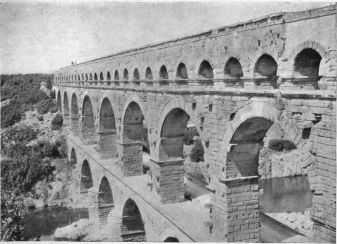
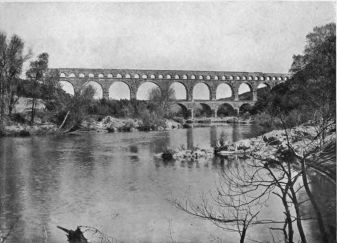
Plate XXIX. TWO VIEWS OF THE PONT DU GARD
On the whole the verdict must go against Rome—at any rate republican Rome—as regards artistic originality. The Rome of Cicero’s day was amazingly rich and dreadfully poor. It had a high culture in some respects, but it was too corrupt, morally and politically, to produce good work of its own. If there had been any possible rival in the field, Rome would assuredly have perished in the course of that distracted century. If she had perished then, what would she have left to the world? A few second-hand comedies, Lucretius, Catullus, and Cicero; a small equivalent for all the blood that she had shed, and all the groans of her provincials.