IV AUGUSTUS
Reading edition
ultima Cumæi uenit iam carminis ætas; magnus ab integro sæclorum nascitur ordo. iam redit et Virgo, redeunt Saturnia regna, iam noua progenies cælo demittitur alto. Vergil.
ERGIL’S Fourth Eclogue, from which my text is quoted, is often called the “Messianic Eclogue.” It is a strange poem. In the midst of a book of pastoral eclogues very closely modelled on the Idylls of Theocritus, the young poet from Mantua inserts one in which he invites the Sicilian Muses, that is, the Muses of Theocritus, to assist him in a loftier strain than usual. His poem is a vision, a prophecy of a return of the golden age to accompany the birth of a child. It is not easy to determine what child. The poem was written for the consulship of Pollio, who had helped Vergil to recover his paternal farm. Thus it is very probable that the poem was really a piece of very gross flattery directed to a patron. Nevertheless the prophecies of peace on earth which it foreshadows chime so strangely with the Messianic language of Isaiah that the scholars of the Middle Ages alternatively placed Vergil among the prophets or condemned him as a wizard. But apart from that approaching event to be witnessed in an obscure village of the client-princedom of Judæa there was even in secular history a general expectation of better days to come. The Virgin Justice did in sober fact return to the Roman world when Octavian, in 29 B.C., came home to celebrate his triumph over the three continents.

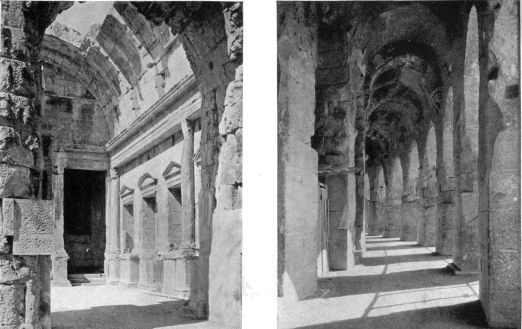
FIG. 1. INTERIOR OF ROMAN TEMPLE, NISMES FIG 2. LOWER CORRIDOR OF ARENA, NISMES
Plate XXX.
I make high claims for Octavian[41]—or as he may now be called by anticipation “Augustus”—in history. Julius Cæsar has usurped the credit of inventing that wonderful system the Roman Empire. The credit really belongs to Augustus. Monarchy, indeed, had for two generations at the least become inevitable at Rome, as everybody, from Catiline to Cicero, was bound to admit. In the scramble to realise it Julius Cæsar had won the day and had thereupon proceeded to introduce his conception of its proper form. He died before his plans were perfected and we have no means of knowing his inner purpose. But we know that he had spurned the dignity of the senate, had taken some of the paraphernalia of royalty and set up his statue alongside of the old kings of Rome. His plan of a naked despotism had failed, because he had not reckoned with the tyrannicide sentiment of the Roman nobles. His assassination was no mere episode or accident. It was impossible to live like an oriental despot in the republican city without an oriental bodyguard. Julius Cæsar had failed through pride. When he fell, the whole dreary round of proscriptions, triumvirate, and civil wars had to begin again. The inevitable monarchy had to be devised afresh on a different basis: that was the task of Augustus. He devised it in such a manner that it lasted in the West for just five centuries and in the East for nearly fifteen. Indeed it can hardly be said to be totally extinct now in the twentieth. Judged by results then, the work of Augustus was clearly a consummate piece of statesmanship. When we consider the methods by which that result was obtained we shall, I think, esteem Augustus as the greatest statesman in the history of the world.
Augustus has never been a popular hero. The pure statesman who has no dashing feats of arms to his credit, and who has left us no records of impassioned eloquence, does not lend himself to idealisation. Augustus had no contemporary biographer, nor even any very great historian ancient or modern. The early Empire is in the gap between the end of Mommsen and the beginning of Gibbon. Dr. Gardthausen has collected all the available material about Augustus but has scarcely succeeded in making him clear or real to us as a man. Tacitus touched him off in a few satirical epigrams as the crafty tyrant who “bribed the army with gifts, the populace with cheap corn, and the world with the blessings of peace, and so grew greater by degrees while he concentrated in his own hands the functions of the senate, the magistrates, and the laws.” For biographical particulars we have to go to Suetonius’s Lives of the Twelve Cæsars, a most unsatisfactory source. Suetonius’s pages teem with human interest, but for purposes of history they are provoking and baffling. He is a patient bookworm who compiles systematic little biographies without a glimmer of the biographical sense. As imperial librarian he had access to most valuable sources of information but he had no critical instinct in using them. He simply collected scraps from various sources and grouped them under headings. For a list of virtues he would go to a courtier’s panegyrics and then turn to a seditious pamphlet for a catalogue of vices. His own instinctive preference being for scandal, he has touched nothing which he has not defiled. It is chiefly due to Suetonius that Augustus appears as a selfish hypocrite, Tiberius as a libidinous tyrant, Gaius as a maniac, Claudius as a pedantic clown, and Nero as a monster of wickedness. And yet under these five reigns the Empire was growing steadily in peace and prosperity. The rulers who were omnipotent cannot have been altogether such as they are described. The factious senators who still dreamed of unreal republican glories and still treasured the memories of Cato as a saint and Brutus as a martyr were not, of course, allowed free criticism of their monarchs. They revenged themselves by writing secret libels, many but not all of which logic and common sense can easily disprove. When it came to popular reigns like those of Vespasian or Hadrian the censorship of the press was removed for a time, and then the senatorial Republicans like Tacitus and Juvenal took ample revenge upon the dead. The scurrilous pamphlets were unearthed and exalted into historical documents and so passed down to our historians as history. It is a suspicious and thankless task to attempt the rehabilitation of these emperors. The world is rightly sceptical of the process which it calls “whitewashing.” Moreover the necessary data are wanting. We can only allow our imaginations to suggest how different the story would look if it had been told from a sympathetic point of view.
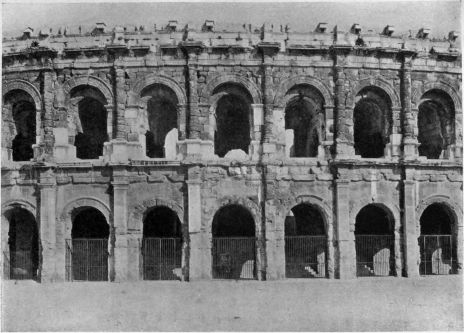
Plate XXXI. THE ARENA, NISMES
It is very difficult to form any complete idea of the character of Augustus as a man. He had shown daring and ambition when as an obscure lad he had crossed to Italy in 44 B.C. to take up his perilous inheritance as Cæsar’s heir. He had been cool and diplomatic even in those earliest days in the way he intrigued with the senate against Antony, and then with Antony and Lepidus against the senate. He had had extraordinary luck when both the consuls died in the engagements round Modena, and left him, the prætor, in charge of a great army. Then we have the infamous acts of the triumvirate, when the unfortunate senators and knights were proscribed in hundreds, and Cicero, with whom the young Cæsar had been on intimate terms, was handed over without apparent compunction to Antony’s vengeance. Admirers said that in this he was overborne by his older colleague, and yielded reluctantly to a stern necessity for destroying the tyrannicide party. Enemies declared that even if he had been reluctant to begin the bloodshed he was the most cruel of persecutors when it started. In the fourteen years of civil war that followed, he had succeeded in winning his way through to victory more by coolness and luck than by any display of generalship. I do not think that we can fairly accuse him of cowardice. It was a bold act when he rode alone and unarmed into the camp of the rebellious and hostile Lepidus, and took his legions away from him without a blow. He had not the dashing gallantry of Antony, or the fiery vigour of Julius, but he must have had the gift of nerve and coolness. He had certainly come through the most terrible difficulties and dangers from open enemies and rebellious armies by land and sea. In the last duel with Antony luck had been with him once more. Like the rake and gambler that he was, Antony had thrown away his game for the sake of Eastern ambitions and Eastern dalliance. Then there was that last scene of Cleopatra’s tragedy, when the conqueror came to her palace after Antony had committed suicide. She tried to win him by the same arts that had won his “father” and his rival. Dressed in her finest robes she came weeping to him, and displayed the picture and the letters of Julius wet with her tears. He judged her splendour coldly as a future ornament for his triumph at Rome, and when she disappointed him of that by a suicide staged as all her life had been for theatrical effect, he hunted down her two elder children with the same cold ferocity as before. Policy forbade them to survive. That was all he thought of.
And now at the age of thirty-four, with this record behind him, he had come back to Rome to celebrate his many triumphs. No doubt the few remaining nobles at Rome trembled at his coming. Remembering the proscriptions some of them might well tremble, especially those who had sided with his enemies, with Sextus Pompeius, or with L. Antonius, or with Marcus. On the other hand, some might remember the clemency which Julius Cæsar had displayed in his hour of triumph.
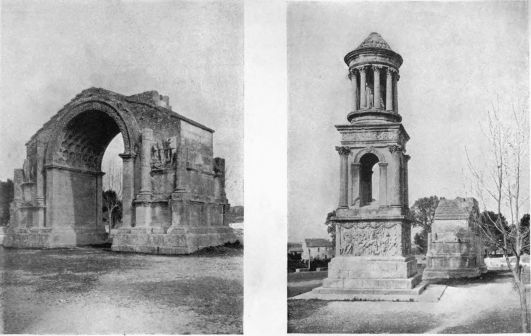
FIG. 1. TRIUMPHANT ARCH, ST. REMY, ARLES FIG 2. MAUSOLEUM OF JULIUS, ST. REMY, ARLES
Plate XXXII.
Augustus had to restore confidence and order in a shattered world. He had to deal with provinces ruined and desolate, a form of government quite visibly obsolete, an aristocracy with immense traditions of pride and power now thoroughly corrupt and effete, a Roman mob which still called itself lord of the world, but which was in a political sense hopeless, armies which were dangerous to the state, conscious of their power and destitute of real patriotism. He had at his side a trusty general in Agrippa,[42] who had won many battles for him, though that in itself was generally a dangerous circumstance, and an astute diplomat in Mæcenas, who for the past ten years had been governing Rome in Cæsar’s name without holding any clear official position. But beyond these two it was hard to know where to turn for support. The civil wars and proscriptions had almost destroyed the race of Brutus, but all that was left of the aristocracy was still jealous and hostile under a cover of abject sycophancy, ready to stab him with their tongues if they had not the courage to use the stiletto. Nevertheless, Augustus had one great asset. The Roman world, exhausted with a whole generation’s civil war, was longing for repose. It was ready to fall down and worship the man who would give it that. Thus the broad outlines of his policy were clear before him. He must undertake a work of healing. The fall of Julius warned him that he must not be openly a monarch, but the failure of Sulla and the actual state of Rome were equally eloquent to prove that he must retain the power in his own hands. In the lassitude following upon grave illness—for the dangers and exposure of the civil wars had shattered his health—he may have cherished occasional thoughts of a real abdication. But in his brain he must have known that it was impossible. It was, of course, equally impossible for him to govern the whole world directly without help. For that purpose the machinery of the whole constitution with its senate and magistracies had to be preserved, at any rate for the present. These were the broad lines upon which his policy was shaped.
The splendour of Cæsar’s triumph must have confirmed the Romans’ impression that they had now a king. For three days they saw a constant procession of prisoners, emblems of captured cities and conquered princes. Some of Cleopatra’s surviving children were among his train. The three days were apportioned to the three continents, the first for the Illyrian war of 34, the second for Actium, and the third for Egypt. Cartloads of money from the Egyptian treasury rolled up the streets, and the bank rate at Rome fell instantly from eleven to four. There was one significant change. In old republican days the victor had been led into the city by his colleague and the senators, now they followed humbly in the rear. Lavish triumphal gifts were distributed: about £11 to every soldier, and about £4 to every citizen. Even the boys got a present in the name of Cæsar’s dear young nephew Marcellus. Thus Cæsar passed in his gold-embroidered purple toga, with a laurel branch in his hand, while a slave stood behind holding a golden crown of victory over his head. Of the horses that drew the chariot one was mounted by the fourteen-year-old Marcellus, famous for his early death, and for Vergil’s beautiful lines about him, and the other by his still younger stepson, Tiberius. Thus he was drawn up to the Capitol to deposit his laurels and his costly offerings at the feet of Jupiter.
There were festivities on many a day to follow. Temples were dedicated, one to the deified Julius and one to Venus, the goddess mother of the Julian house. There were games in which the foreign captives fought to the death. On another day the boys of the nobility fought a Battle of Troy in the circus. On another there was a great beast-hunt of strange animals from Egypt when the rhinoceros and hippopotamus made their first appearance in Europe. And then for the first time for nearly two hundred years, that is, for the first time since the Punic Wars, the temple of the war-god Janus was solemnly closed. L’Empire c’est la paix. There are many signs of the earnest longing for Peace in the Roman world. “Pax” and “Irene” became common names in the West and East; “Pax” was the legend on coins. This was a new thing at Rome. Hitherto war had been the desired as well as the normal condition. But even the Romans had now drunk their fill of bloodshed in those dreary civil wars. It was upon this new condition of things that Augustus had the wisdom to build his monarchy. The army was greatly reduced at once. Fortunately the treasury of Egypt enabled them to be dismissed without dissatisfaction. The foreign hirelings who had served as a bodyguard were replaced by native soldiers. A change in the imperator’s form of address to his troops indicated that they were now subject to the civil rule of a constitutional state: henceforth they were not “fellow-soldiers” but “soldiers.”
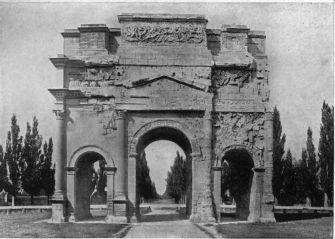
FIG. 1. ARCH OF MARIUS, ORANGE
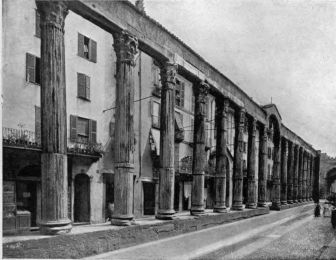
FIG. 2. S. LORENZO, MILAN
Plate XXXIII.
And now the work of reconstruction began in earnest. Acting merely as one of the two consuls and in obedience to a law passed through the senate and comitia, Augustus restored the depleted ranks of the patrician order. It is true that the patricians had no political privileges but they still had great significance in the domain of religion and their restoration as the first official act of the new regime marked a deliberate desire to conciliate the aristocracy and enlist its services in support of order. Then a census of the Roman citizens was taken for the first time in forty years. The number found was 4,063,000 heads, which was to be increased by 170,000 in the next twenty years. The census and purification of the people was accompanied by a revision of the senate-roll. Here Augustus already showed his intention to break away from the policy of Julius. Whereas Julius had aroused the most bitter resentment by introducing provincials and common soldiers into the ranks of the senate, and Antony also had secured the appointment of all sorts of disreputable friends of his own, Augustus with infinite caution and tact reduced, strengthened, and purified the roll. Then since the numbers had been reduced and it was necessary to secure a respectable quorum for the transaction of business, the senate was induced to pass a standing order that its members must not go abroad even to the provinces without permission of its president. As Cæsar was the president it meant a concentration of all the possible leaders of opposition at Rome and under his eyes. During this same year, 28 B.C., the other side of Augustan rule came into prominence, the splendid liberality which turned Rome from a decaying and ruinous city of brick into a city of marble and made this epoch to stand out next to that of Pericles as an age of brilliant culture. No fewer than eighty-two temples were built or restored in that year. Among the rest a magnificent marble temple to Apollo with a public library annexed to it was erected on the Palatine. Libraries were new and significant things at Rome. The first had been built by Vergil’s patron Asinius Pollio only nine years earlier.
The time was now ripe for the all-important settlement of the constitution which historians have agreed to call the establishment of the Empire. It is important to narrate the actual proceedings, at this point, somewhat more minutely than the scope of this work generally allows. The establishment of the Empire was such a delicate and equivocal act that it has been open to various interpretations ever since. Probably in the clever brain of Augustus it was intended to be equivocal from the first, so that republican aristocrats at Rome might still believe themselves to be free, while the populace had a prince to whom they might look for their patron, and the provincials, particularly those of the orient, might have a splendid monarch for their instincts of adulation.
Towards the close of the year 28 Augustus had issued a proclamation formally reversing all the illegal acts of himself and his colleagues during the Triumvirate. It would not call the dead back to life, it would not restore Cicero to the senate, it did not even give back the land to the burghers of those eighteen confiscated townships. But it marked contrition, and restitution of some sort was to follow. At the beginning of his seventh consulship on January 13, 27 B.C., Cæsar convened a meeting of the senate and made them a long speech in which he spoke with pride of his own and his “deified father’s” benefactions to the state. At the end, with a true Italian instinct for the theatre he turned to the astonished fathers and exclaimed: “And now I give back the Republic into your keeping. The laws, the troops, the treasury, the provinces are all restored to you. May you guard them worthily.” Dio Cassius, who has given us a long speech certainly of his own composition, paints the mingled feelings of the audience, the
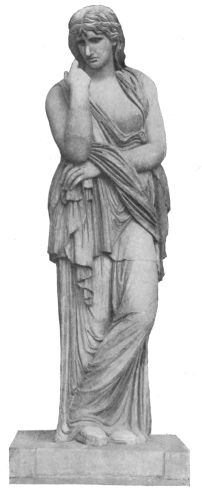
Plate XXXIV. BARBARIAN WOMAN, KNOWN AS “THUSNELDA”
indifference of those who were in the secret, the uneasiness of those who feared that it was another trap to catch the unwary and the joy of those who believed and hoped. The immediate reply of the senate was, it appears, to grant him further honours—the “civic crown” of oak leaves awarded to one who had saved the life of a fellow-citizen, in token that Augustus had saved the lives of all his countrymen, and laurel-trees to be planted at his gate in sign of perpetual victory.[43] Then they conducted a long and solemn debate upon the proper cognomen to be conferred upon their saviour and at length decided upon the name “Augustus.” In these proceedings we have the measure of the Augustan senate. Already they had the instinct of courtiers. Augustus knew it, and therefore knew what he was about in this dramatic “restoration of the Republic.” Coins of the period bear the legend “Respublica restituta,” and Ovid, though a courtier, was free to say
redditaque est omnis populo prouincia nostro et tuus Augusto nomine dictus auus.
Augustus himself records this occurrence in the great inscription, in which he afterwards described his achievements: “In my sixth and seventh consulship, when by universal consent I had acquired complete dominion over everything both by land and sea, I restored the State from my own control into the hands of the Senate and People.”
A few sessions later, but still in the beginning of the year 27, the senate decided upon its real answer, no doubt concocted at the suggestion of Augustus. The senate accepted the restitution of most of the provinces, and undertook to govern them for the future by means of senatorial magistrates very much as they had been governed of old. But three provinces which were still unsettled, and required soldiers, and money, and a general, called for special treatment. Cæsar was therefore entreated to take for his province Syria, Gaul, and Spain. Gaul was not yet completely organised; besides Julius had publicly imposed the task of adding Britain to it upon his successor. Syria was of the utmost importance, because the Parthians were still “riding unavenged” flushed with fresh victories over Antony. This was another of the legacies of Julius. Spain was still largely unconquered and in great disorder. I think, in opposition to Ferrero, that military needs were more powerful than economic motives in the selection of these provinces. It is to be noted that there was no question of the restitution of Egypt. Cæsar had never completely given this kingdom to the state. He still kept it for the sake of its treasures, as a private domain, and governed it through an agent, a mere knight, not even a senator. Over these three great provinces Augustus received consular authority—much as Pompeius had received it for the war against the pirates—for ten years. But at the same time he promised to restore these provinces also, as soon as they should be completely pacified. The ingenious nature of the whole compromise will be manifest when it is perceived that this arrangement of provinces left the senate with scarcely a single legion under its command, while the bulk of the Roman army was concentrated in Cæsar’s provinces.
Now let us consider the constitutional position of Augustus in these years from 27 to 23, when a slight rearrangement was effected. Augustus continued each year to be elected consul with a colleague for one year, until he had far outstripped even the record of Marius. In addition to this he had “consular power” over his enormous province, which included all the armies of the state. That power was ostensibly granted for ten years, but as a matter of fact it was renewed with some ceremony at intervals of ten or five years throughout the reign. Constitutionally he was by no means master of the world although, of course, he was so in reality. He says himself: “I excelled all in prestige, but of authority I had no more than my colleagues in each office.” For the maintenance of his domestic dignity, he had in addition to the consulship various privileges of tribunician authority. His person was protected by the sanctity of that office, and it is probable that all prosecutions for treason were taken on that point. He was also chief priest. He was also president of the senate, princeps senatus, but that simply meant that his name came first on the roll, so that he had the right to speak first. Only when Cæsar said “aye” it would be a bold man who would say “no.”
For the lawyer this exhausts his titles to power, but in reality he was something very much more than consul with tribunician powers. The one word that embraces all his authority, constitutional and real alike, is the word “princeps.” “Princeps” is not the title of any office, it merely expresses dignity. He is “the chief,” he is “Cæsar the August, the son of the God Julius, ten times hailed as general.” It is historically misleading to speak of these early principes as “Emperors,” for that word implies notions of purple and crowns really foreign to their position. Any stout republican who chose to be deceived could still boast that he was governed by senate and comitia, by consuls, prætors, ædiles, tribunes, and the rest of them. It is even historically false to believe that the senate and magistrates had ceased to exist for practical purposes. They had, as we shall presently see, a very real function in the state, especially when Cæsar was abroad, as in the earlier years of his rule he constantly was. It was impossible for one man to govern the whole empire. Little by little when a complete imperial bureaucracy was evolved, the senate really sank into insignificance, but for the present Cæsar and the senate were to some extent colleagues in the government of the empire.
It is equally unhistorical to assert, as does the foremost of living historians in Germany, Dr. Eduard Meyer, that this “Restoration” was a genuine abdication, and that Cæsar only continued to act as the senate’s executive officer. Sometimes he did act in that capacity, often he made a pretence of so acting. Especially when there was anything disagreeable to be done, he liked to get it authorised by a decree of the senate. But no intelligent Roman can have failed to perceive that there was no real equilibrium between Cæsar and Senate. Cæsar had not only the control of nearly all the legions; but at the very gate of Rome he had the only troops in Italy, the prætorian guard, at his beck and call. Roman generals had always had their life-guards. The law forbade the presence of an army at Rome, but Cæsar had shown his usual ingenuity in circumventing the spirit of the law, while respecting its letter. An army meant a legion, and a legion consisted of ten cohorts generally of three hundred men each. Very well, Cæsar would only have nine cohorts. But as each consisted of a thousand men, he found himself in command of a force equal to three legions in permanent quarters at the gates of Rome. If he thus had the men, he had the money too. The senatorial provinces were now, thanks to a long regime of senatorial governors, mostly the poor ones. Cæsar had the enormous treasury of Egypt in his pocket, Spain was rich in undeveloped mines, and Gaul had great possibilities as yet unexploited. Moreover, Augustus had inherited an immense patrimony from Julius, and the legacies of admiring friends also increased his wealth. Thus it came about that the senatorial treasury simply could not exist without help from the imperial purse. His private wealth, too, enabled him to keep the Roman mob happy with cheap or free corn, public shows, and handsome buildings, and to satisfy the troops with lavish bounties. There was no real equilibrium.
On the other hand, Augustus was very careful not to wound republican sensibilities. He was himself of a distinctly historical and antiquarian turn of mind. He never performed a function or assumed an office without assuring himself that it was not new to the constitution. Thus when he was asked to undertake censorial duties he declined the “censorial authority,” which the senate conferred upon him, but carried out the duties by virtue of his power as consul, having assured himself that in the olden times consuls had performed the duties of the censor. He was also most punctilious in his use of forms. We shall see later something of the republican simplicity of his mode of life. He never failed, as his “divine father” Julius had done, to treat the senate with outward marks of respect. Call him a “crafty tyrant” if you will. It is much more just to call him a diplomatic reformer engaged in a necessary work of repair, working it with infinite patience, tact, and subtlety, by the most ingenious system of compromises known to history.
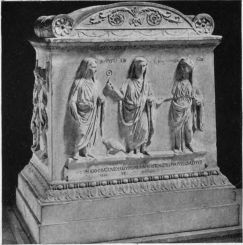
FIG. 1. ALTAR OF THE LARES OF AUGUSTUS
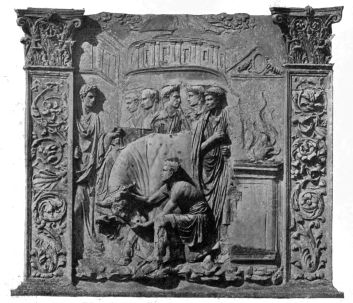
FIG. 2. SACRIFICIAL SCENE, FROM THE “ARA PACIS”
Plate XXXV.
In the year 23 B.C. there was a slight and not very important readjustment of the constitutional situation. After his return from a troublesome war in Spain, and after a very serious illness which had brought him to the brink of death, he formally abdicated the consulship, alleging his ill-health as the motive. It was, indeed, more than a pretence. The continual tenure of the consulship involved a continual series of ceremonial duties, which added to the immense burdens of his position. But there were political motives as well. He was now in his eleventh consulship, and for a nation of antiquarians it was distinctly unpleasant that any man should compile a list of this magnitude. Moreover, the consul had to have an apparently equal colleague, and there was no longer at Rome an unlimited supply of nobles fit to be Cæsar’s colleagues. Besides, it blocked the road to honour, it was difficult to find men of consular rank for the consular provinces. More than all, it was unnecessary. Therefore in order that he might not be molested with reproaches, he retired to his Alban Villa, and sent a letter to the senate not only renouncing the consulship, but suggesting as his successor a notorious republican, who had fought for Brutus against him, and still honoured the memory of Brutus as a martyr in the cause of liberty.
That this was another solemn farce, or rather another deep stroke of statecraft, is quite clear. The senate replied by offering him the very powers he needed to maintain his real position unimpaired. The consular power over the provinces was continued without any new enactment as “proconsular.” He received certain additional powers inherent in the tribunate, and henceforth dates his years of rule not by consulships, but years of tribunician power. His imperium over the provinces was defined as “superior” to that of other magistrates, and he received the special right which belonged to the consuls of proposing a motion at any meeting of the senate. Practically, then, he was relieved of some tiresome duties, his position was made to look more republican, and at the same time he had increased rather than diminished his authority.
By this time the principate had taken its permanent form. Its powers vary considerably with the varying force of the individual emperors, and it tends by mere prescription as well as by the development of an administrative hierarchy of officials to grow more absolute as the years advance. But constitutionally very little change was made in the course of the next three centuries. It always remained a compromise, and something of illegitimacy always clung to it. From time to time the senate actually remembered that it was a governing council. It had always to be reckoned with. As for the comitia of the Populus Romanus, they continued to exist both for legislation and elections as long as Augustus was alive. But in reality the princeps had taken the place of the people in the government of Rome. Tiberius, the next successor of Augustus, suppressed the comitia as unnecessary, and though once or twice in later times an antiquarian emperor might get a plebiscite passed for the sake of old times, the Populus Romanus was extinct. It perished without a groan.
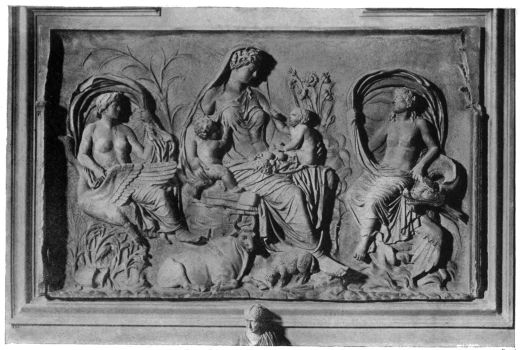
Plate XXXVI. THE “TELLUS” GROUP; ARA PACIS
The personality of a monarch had been thrust almost surreptitiously into the frame of a republican constitution. Skilfully as it had been done, the illegitimacy of the proceedings entailed certain awkward consequences. There could be no open talk of a succession. Thus when Augustus recovered from his grave illness in 23 B.C. he offered to read his will to the senate to prove that he had nominated no successor. On the contrary, he had formally handed to Piso, the other consul, a written statement of the disposition of the forces and the moneys in the treasury. That was true enough, but he had handed his signet ring, the ring by virtue of which Mæcenas had governed Rome for ten years, to Agrippa, the man who would certainly have taken his place if he had died at that time. In reality there is little doubt that in his own mind Augustus had planned to make young Marcellus, the brilliant child of his beloved sister Octavia, his heir and successor. That this ultimate intention was plain to Agrippa when Cæsar recovered is shown by Agrippa’s sulky retirement into private life. Although Augustus could not directly or legally nominate a successor, he could train a young prince for the succession, and in his own lifetime raise him to such a point of honour that he would naturally step into the vacant place. The newly born Empire had the great good fortune that Augustus, in spite of his feeble health, lived to a ripe age and held the principate for forty-one years. But it had the misfortune to be governed by a sterile race. Not for a hundred years until Titus, did a son succeed his father. Augustus had nephews, stepchildren, and grandchildren, but he had only one child by his three wives, and she was the immoral Julia. All his life long he was vexed with tiresome dynastic problems, and each youth whom he selected for his successor seemed to be destined to a premature death. At the last he was driven sorely against his will to nominate his stepson Tiberius. This fact is mentioned here because it is surely a vital fact in determining the future of the principate. If each of the first half-dozen holders of that office had been surrounded by a blooming family on the scale of modern royalty, it is very likely that the principate would have settled down quietly into a hereditary monarchy. As it was, the whole system was upset by continual intrigues for the succession, often leading to actual civil warfare. Thus the army and the prætorian guard came to acquire its fatal domination over Roman politics.
The Senate
For all his moderation Augustus had successfully gathered all the strings of policy into his own hands. In his three revisions of the senate-list he succeeded in securing a body absolutely subservient to his wishes, and the only trouble it caused him was by its excess of zeal for his dignity. As a rule it merely registered his decrees, conferred honours on the kinsmen he delighted to honour, and sometimes shouldered the responsibility for an unpopular proposal. It was to some extent a safety-valve for the expression of public opinion, but the more tyrannical emperors (and Augustus undoubtedly became more absolute as his system developed) kept a very tight hand upon it. When an embassy came from an independent foreign power, such as Parthia, it went first to a powerful senator, just as in republican days to seek a patronus or champion. Now that champion was, of course, none other than the princeps. By him the ambassadors were introduced to the senate, who heard their case and deliberated upon it. As of old, they would necessarily entrust the settlement of the matter to a commissioner chosen from their own body. Again, the commissioner was of course the princeps. The senate sometimes undertook state impeachments as a high court of justice, but now it was only Cæsar’s enemies whom they impeached, and in one case—that of the prefect of Egypt—they displayed an excess of zeal in Cæsar’s cause which brought down a rebuke upon their heads. The senate was used often as a medium of publication. Cæsar would go down to the house and read a speech to them when he intended to reach a wider public. When he was abroad, he would send regular reports and despatches to them. Cæsar, like all Roman magistrates, had his consilium or board of advisers. This was now organised to consist of so many representative senators, who sat in conjunction with the young princes of the imperial house, and any other important people whom Cæsar might select for his privy council. Towards the end, when Augustus grew old and infirm, a committee of senators sitting in the palace was competent to transact business. But as a rule he was very careful to respect the senatorial traditions. Decrees of the senate and laws were passed with all the old formalities, but now they were all in reality Cæsar’s laws and Cæsar’s decrees. On the whole, however, we may well believe that the senate’s decline into impotence was largely its own fault. So far as the records show, the Augustan senate never displayed the least trace of spirit or, if that is too much to expect, even of initiative or efficiency. There was grumbling and a little feeble plotting, but if the senate had chosen to take Augustus at his word whenever he spoke of abdication, they might easily have recovered real power, though indeed they could not have done without a princeps. For one thing the mob would not have suffered it. Cæsar was, and remained, the patron of the inarticulate commons, and that was not only the origin of the principate but the main support of its power throughout. When we speak of unpopular emperors such as Nero or Domitian we generally mean only that they were unpopular with the notables of the senate. If they failed to retain the regard of the common people and the common soldiers their reigns speedily came to an end. Cæsar’s pretended abdication in 23 B.C. was shortly afterwards followed by a famine at Rome and the populace besieged the senate-house, threatening it with fire unless fresh powers were conferred upon their champion.
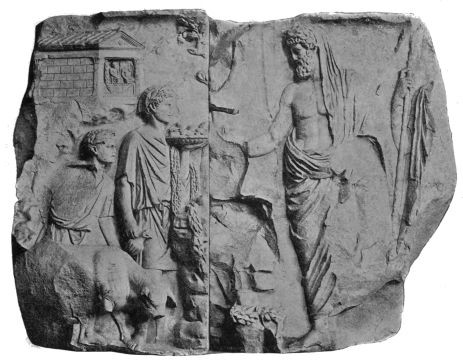
Plate XXXVII. RELIEF, FROM THE “ARA PACIS”
German historians have invented the term Dyarchy to describe the balance of power between Cæsar and senate. The government of Rome had always been to some extent a Dyarchy of senate and people as its title shows—“Senatus Populusque Romanus.” In many respects the princeps had taken the place of the people. But such a description loses sight of reality. You cannot in this whole period show an army set in motion by a senatorial governor without authority from Augustus, save in the single case of M. Primus when it was instantly followed by a prosecution; nor a single tax imposed, nor a law so much as proposed without Cæsar’s authority, nor a candidate elected without his concurrence, nor a treaty made otherwise than in accordance with his suggestion. The true relation between them is practically that of a monarch and his council. Three times Cæsar revised the roll of the senate, reducing it from over one thousand members to six hundred, and for all his tact and ingenuity arousing the fiercest resentment. There were violent scenes in the house, Augustus wore a shirt of mail, and went accompanied by ten stalwart senators. It is clear that he was purging the house of his opponents just as Cromwell did. On other occasions he would present his friends with the amount of property needed to complete their qualification for the senate. Thus it is no exaggeration to call the senate his council of state. If it is objected that the senate still governed rich and important provinces, that is more apparent than true. No longer did the governor of a senatorial province go out girt with the sword that signifies imperium or wearing the military cloak. Now he goes in his toga as a mere civilian functionary. That little change must have been bitterly galling to the proud aristocracy. Augustus had persuaded them to pass an ordinance forbidding them to go abroad without his permission. He made them fine their members for non-attendence, and it is highly significant that it was difficult to keep a quorum of the senate for public business. He chose his own order for asking their opinions and thus promoted them in honour or degraded them as he pleased. It was mainly the poor and unimportant provinces which had fallen to their share. Asia was the richest and most important, but almost throughout the period there is some scion of the imperial house with a general control over the affairs of the East. There is an inscription in Cyprus which proves that even when that island was under senatorial government a proconsul was sent out “by the authority of Cæsar and a decree of the senate” to restore order. Finally by the end of the reign the senate had become so feeble and unreal that twenty of its members sitting in Cæsar’s house were able to pass decrees which had the full validity of the old sovereign council of Rome.
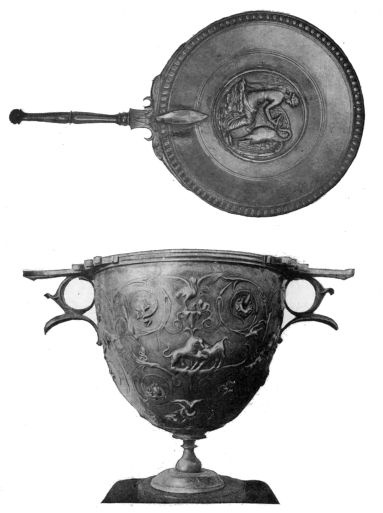
Plate XXXVIII. SILVER PLATE FROM BOSCOREALE
These considerations are enough to prove that Monarchy is the only term which can properly describe the real nature of the new government. Nevertheless, here as elsewhere in this system of compromise and half-way houses, we must walk warily between two fallacies. The senate is there and will always be there. When Constantine made a new Rome he made a new senate. As we study the subsequent progress of the Empire we shall sometimes find the senate really supreme. It chose Galba and Nerva. It dared to depose Maximin. It really governed through Tacitus and Probus. It was its constant aim to get its members declared immune from prosecution and sometimes it succeeded; but more often it served as a whipping-stock when Cæsar was in a bad temper. Only in this sense is there any meaning in the term Dyarchy: if we take the whole period of the principate from Augustus to Diocletian there is some trace of equilibrium, faint though it be. And we must not fall into the error of despising the letter of a constitution for the sake of its spirit. Though a king of England never refuses a bill in practice, it nevertheless remains important that he may. The letter is always there for reference, if not for use, and the spirit is always liable to be brought up for trial before it. The practice depends upon personal forces which are transitory, the theory is always there awaiting its opportunity.
The People and the Magistrates
Nevertheless, if it is to the letter of the constitution that one appeals, we must not forget the existence of a third element in the constitution of Augustus—the People. As we have seen, the plebiscite and the lex still passed formally through the comitia. The plebiscite had of late republican years become a weapon of opposition to the senate. Yet even under Augustus we can point to a few measures passed in this form. None were of much importance—one was merely the conferring of the new title of “Father of his Country” upon Cæsar. Another concerned aqueducts. The judicial functions of the populus were entirely abrogated by Augustus, and there only remained that which, after all, had always been its most important function, the elections. Popular election in the comitia was still under Augustus, the only path to the senate and the magistracies. It is true that the magistracies had all paled into insignificance before the new and mighty office of the princeps. For this reason, perhaps, Augustus did not deprive them of what they regarded not only as an ancient right, but still more as a source of income. Here also there might have been effective opposition. The populus might have returned to office, and so to the senate, a series of champions of freedom. But except Egnatius Rufus, there were no such champions. The patron of the people, the man whose munificence fed them and gave them the shows they lived for, was Cæsar. No one could bribe against his purse. He had, moreover, two direct methods of securing the return of his nominees. In virtue of his tribunician powers he had the right to draw up the list of candidates, and in the second place it had always been the practice for candidates to put forward the names of their principal supporters. Augustus in his early days of strict deference to constitutional etiquette used to go down to the forum and personally canvass for his friends, afterwards, however, he reverted to the brusquer methods of Julius, and merely issued a fly-sheet to the electors bearing the names of his nominees. Thus the elections became more and more a form, and Tiberius transferred them to the senate without arousing much opposition. In the whole period of Augustus we have only one instance of his failure to pass a law which he desired and then it was due to the organised opposition of the knights who demanded its rejection publicly in the theatre.
The equestrian order still remained the stronghold of the wealthy bourgeoisie. Owing to their wealth and their want of political recognition, they had always been somewhat of a danger to the republican constitution. It is typical of the skilful statesmanship of Augustus that he saw this and provided an honourable outlet for their ambitions as well as utilising their services on behalf of the state. He had begun his period of rule by putting a mere eques into the seat of the Ptolemies as his prefect of Egypt. Subsequently the imperial legates and procurators who administered the imperial provinces for him were often chosen from this order. In finance he made great use of them, and along with a certain number of clever Greek freedmen they filled the greater part of the new bureaucracy which he gradually created. Mæcenas himself, who was probably at the head of the whole great system, and who acted almost as prime minister to Augustus until he fell out of favour, was content with equestrian rank. Social honours such as rich men love were freely bestowed upon them. The young princes of the imperial house rode at the head of the knights with silver lances as “Princes of the Youth.” Sometimes Augustus treated the equestrian order as if it were a third limb of the constitution on an equality with the senate and people.
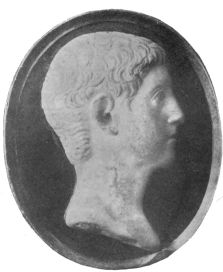
FIG. 1. GERMANICUS: CAMEO
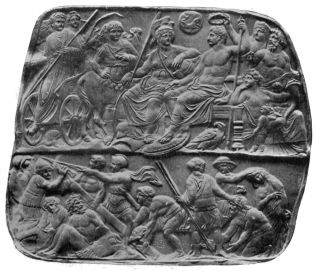
FIG. 2. GEM OF AUGUSTUS
Plate XXXIX.
Thus it was part of the system of Augustus to provide careers for talent in every class. Even the slaves and freedmen had immense opportunities in Cæsar’s bureaux. For the freedmen in the country towns, where they were often the richest inhabitants, he invented the special titular distinction of “Augustals,” their principal duty being to give dinners and festivals in his honour, precisely the sort of duty to flatter their pride without doing any harm.
As for the ancient magistracies of the Roman people, while they were strictly preserved, they were utterly disarmed. Consulships remain important only as leading to a subsequent proconsulship over a province. The prætors still sat in their courts of justice but really important cases came up to Cæsar on appeal. The tribunes were of no account beside their mighty colleague. Magistracies were bestowed as marks of imperial favour. Often there would be two or three successive consuls in a single year. Cæsar himself would sometimes deign to take a consulship when he wished to honour a colleague or a relative. Here again, however, the impotence of the magistracies was very largely due to the intellectual bankruptcy of the Roman nobility. They could not perform the simplest task such as the charge of the corn-supply without bungling and requiring the assistance of Cæsar. But on one occasion when a certain ædile organised a fire-brigade of his own and became very zealous in extinguishing fires, he received a hint that his zeal was unwelcome in the highest quarters. Thus the magistracies declined little by little into mere decorations, or became once more what they had been in the beginning, municipal officers for the city of Rome. But even there they were superseded by the organising activity of the princeps. He resuscitated the ancient office of city prefect and put him in charge of the new police and the new fire-brigade while two other new prefects commanded the prætorian guards. These two officers soon began to overshadow the old magistracies.
Army and Treasury
Dio Cassius rightly asserts that the real power of Augustus rested upon two things—the control of the army and of the finances. We have already seen that in the so-called abdications of Augustus there was no surrender of these and no suggestion of their surrender. In view of the present tendency among historians to attach real importance to the restoration of the Republic in 27 B.C. and again in 23 B.C. it is all the more important to remember that the twenty-three legions which with their auxiliaries and reserves formed the entire military force of the Roman Empire took their oath solely to Augustus and were with one exception stationed exclusively in his provinces, fought under his auspices and took their orders from no other but Cæsar and his legates. Beyond these he had a prætorian corps of 9000 men in permanent cantonments within striking distance of Rome, as well as a drilled bodyguard of slaves in his own house. In view of these facts it is absurd to limit our conception of the power of Cæsar to a survey of the constitutional offices which he held. It is only in the language of lawyers and pedants that his authority rested upon consular and tribunician powers. Everybody knew that a letter sealed with Cæsar’s sphinx was backed by the swords of 140,000 legionaries. The military situation of Augustus is therefore of the utmost importance.
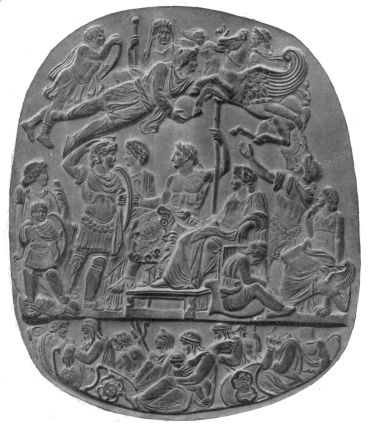
Plate XL. AUGUSTUS AND FAMILY OF CÆSARS CAMEO
Augustus was, as we have seen, a statesman and not a soldier. The stories of his cowardice, repeated by Suetonius, are confessedly drawn from the venomous letters of his enemy, Antony. Augustus had emerged successfully through five civil wars, had crossed tempestuous seas in small boats, had faced mutinous armies and every sort of hardship. But all his instincts were for peace and statecraft. We have seen that it was the need of a standing army at Rome which led to the need of permanent generals, and this to the downfall of the old Roman constitution. When Cæsar built his throne on the ruins of the Republic the plain fact was that the general had become monarch. Thus, in spite of the fact that Augustus was not of a military character, and in spite of all his efforts to prevent it, the monarchy of the Roman Empire was eventually revealed as a military despotism. It was the irony of fate that such a man as Augustus should have founded such a monarchy.
But for the present the ugly fact that the army had bestowed the purple was decently concealed. Augustus from the very beginning of his power did his best to reduce the military element in the state. During the civil wars, and indeed for fifty years before they began, the troops had made and unmade consuls, there had been constant mutinies and blackmail in the army. Cæsar’s own first consulship had been obtained in this way. A centurion had marched into the senate-house and cried, “If you will not make him consul, this”—and he tapped the hilt of his sword—“this shall.” But now the older discipline was revived. Agrippa in particular was a stern disciplinarian of the old school. The soldiers were flattered no longer. No more legionary coins were issued. For an honour a legion was allowed to call itself Augusta, for a punishment the title was revoked. The highest military distinction, the triumph, was gradually reserved for the princeps and the members of his house alone. Even when the title of Imperator was earned by a victorious general it was transferred to him. But it was his aim to see that no private citizen should have the opportunity of securing the high military honours. Agrippa might have been dangerous and accordingly he was brought into the family by marriage with Cæsar’s daughter. But for the rest the conduct of important operations was almost always confided to one of the young princes—to Tiberius, or Drusus, or Germanicus. And they were always victorious. When Quintilius Varus, a general of humbler birth, was allowed to lead a great army he conveniently pointed the moral by a signal failure. No senatorial governor might now levy troops or declare war on his own account.
The only hand that the senate still had in military affairs was that a “senatus consultum” was generally asked for a new levy of troops. This was probably because it concerned the state treasury, but partly also because it served to shift an unpleasant responsibility off the shoulders of the princeps. It is not likely that Augustus had forgone the right to levy.
It still remained the legal duty of every Roman citizen to serve in the army. But since the days of Marius that duty had become obsolete, no one wanted the city riff-raff in the legions. Soldiering had become a profession, and there was never now any general levy of the kind involved in modern conscription. There must have been some compulsion upon the upper classes to serve as officers, for Suetonius tells of a Roman knight who was sold into slavery because he had chopped off his son’s thumbs in order to evade military service. There had been a “City Legion” fighting at Actium, but the army was now mainly recruited from Italy and the imperial provinces. Allied princes like Herod the Great had their own militias, but were also liable to be asked for contributions of trained auxiliaries to the imperial army. From the provinces troops were demanded in proportion to their warlike activity. The Dutch horsemen were famous, and the Batavians supplied large contributions of cavalry. The only people in the East who were enrolled in the legions were the Galatians, who were, of course, Gauls by ancestry. Augustus himself had a bodyguard of German slaves. As a rule only freemen were enrolled in the legions, but at the crisis of the great Pannonian and German revolts,
FIG. 1 STUCCO RELIEF VICTORY FIG. 2 DECORATIVE ORNAMENT, “ARA PACIS”
FIG. 3. STUCCO RELIEF: BACCHIC FESTIVAL
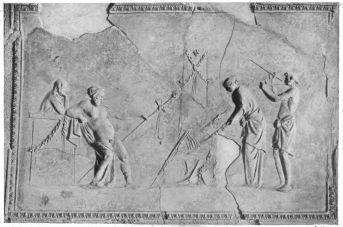
Plate XLI.
the duty was laid upon rich citizens of equipping and maintaining for six months a certain number of freedmen and slaves who were promised their liberty and citizenship at the end of six months. These would probably consist very largely of gladiators. This fact is evidence of serious military weakness in the Roman Empire. Although there were over four million full Roman citizens, there were only about 140,000 men in the ranks of the legions, and as there was a very long period of service, twenty-five years and more, it follows that only a small number of recruits would be wanted every year. It seems a dangerously small army to hold such vast frontiers.
Augustus was successful in reducing the enormous rate of pay which had prevailed during the civil wars. After the death of Augustus the troops mutinied and demanded an increase of their pay to a denarius (less than a franc) a day. Augustus established a special military chest to provide pensions for his veterans in place of the farms which they were still accustomed to expect.
How greatly—how dangerously—Augustus had reduced the size of the army may be seen from the fact that there were at least fifty legions during the civil wars, and only twenty-five at the death of Augustus. These troops were for the most part stationed along the northern and eastern frontiers.
In Spain3 legions
Lower Germany 4”
Upper Germany4”
Pannonia3”
Dalmatia2”
Mœsia2”
Syria3”
Egypt3”
Africa1”
To these must be added the 9000 men of the prætorian guard, who enjoyed shorter service (sixteen years) and double pay. The prætorians had to be genuine Italians, and when inside the walls of Rome wore civilian dress. There were also three “urban cohorts” as police—a new and most salutary invention—and a “cohort of watchmen” for the prevention of fire. Obviously with a service of twenty-five years there could be no reserve. But some of the veterans of the prætorian guard were used as paymasters or engineers. There were also colonies of time-expired soldiers planted as garrisons in dangerous country.
The legions themselves were stationed in great fortified camps along the frontiers of their various provinces. There were thus huge spaces of country totally without military forces. For warfare on the shores of the Black Sea troops had to be summoned from Syria. There was no such thing as a readily mobilised striking force in Italy. This was an inconvenience and a danger, but Augustus did not mean to organise a military monarchy. Professor Gardthausen has a clever comparison of the problems before the Roman army with those that face the British Empire. The problems were remarkably similar, for greater speed of transport counteracts the greater distances. Both peoples made great use of the system of drilling native troops and expecting provinces to guard themselves. But the Romans would have been saved much trouble if they had been able to adopt our system of a compact and highly trained expeditionary force backed by a citizen army for home defence. To be sure, the Romans now lived in a state of peace far more profound than any that the world has enjoyed before or since. Their wars were of their own making. Within the circle of the armed frontiers Pax Romana reigned supreme. The Roman citizens hung up their swords for ever.
The creation of a standing fleet was not the least of Cæsar’s achievements. The Mediterranean was now properly policed and commerce was free to circulate. The Italian navy was divided into two flotillas, one for the Western Mediterranean and one for the Adriatic. Great artificial docks were constructed for them, one for the Mediterranean fleet at Misenum by opening up a connection between the Avernian and Lucrine lakes and the sea and thus creating a small land-locked harbour which was used for exercising the rowers in rough weather. The construction of this Portus Julius, which was carried out by Agrippa with a lofty disregard both of the gastronomic fame of the Lucrine oysters and of the mythological celebrity of the lake of Avernus as the gateway to the underworld, excited a wonder which has been reflected both by Horace and Vergil.
Similarly a base for the Adriatic fleet was constructed by great engineering works at Ravenna. A third harbour was created on the coast of Gaul at Fréjus (Forum Julii). The Tiber was dredged and restored to navigation. Flotillas of small vessels were maintained on the Rhine.
The navy, however, did not even in these days attain to anything like the status of the army. It was “my fleet”—the private property of the emperor, equipped and maintained out of his own pocket, and manned chiefly by his slaves. Even the “prefects of the fleet” were generally freedmen and foreigners. A Roman admiral, as Mommsen remarks, ranked below a procurator or a tax-collecter. Thus the Romans never to the end of their days realised the meaning or importance of sea-power. Their navy was only for police work and on several occasions, as for example in the Dalmatian War, they failed to perceive that naval operations might have been of the greatest assistance to their army. It is true that there were no hostile navies in the world, but the empire was so distributed that marine communication might have been of very great value.
The control of finance was a necessary corollary to the control of the troops. The Republic had been shipwrecked on finance almost as much as on the military system, and there is some truth in Mommsen’s epigram: “the Romans had bartered their liberty for the corn-ships of Egypt.” Perhaps the most sinister light in which we can regard the statesmanship of Augustus is that suggested by Tacitus. He was buying the support of all classes in the state systematically. But to that the Republic had already accustomed them.
We must clear our minds of the modern idea of a budget and a coherent public system of finance. The Romans had never paid taxes and their financial administration had rested in the hands of young men just beginning their public career as quæstors. This was because finance was a comparatively recent idea at Rome. It was not part of the mos maiorum at Rome to have a financial policy, and Rome had always been a military and not a commercial state. Even now it was a cheap empire. If we except the corn-supply, the pay of the army was the only large head of expenditure. On the whole, one with another, the provinces were more than self-supporting, and as time went on a prudent policy of development made them extremely profitable. As we shall see later, the encouragement of natural resources and the exploitation of minerals all over the Empire added enormously to the Roman wealth. Officials and magistrates had generally been expected not only to give their services for nothing but even to pay for their honours handsomely with public works and entertainments. Public works undertaken by the state were generally carried out by slaves or soldiers. When marble was needed it was usually requisitioned from Greece or Numidia. But it was inevitable that the man who controlled the army should also possess the revenues. Julius Cæsar had simply appropriated the treasury. Augustus as usual reached the same end by a more devious path.
The enormous treasures which he disbursed were his favourite weapons of statecraft. If he had a friend to get into the senate he would simply make him a present of the necessary income. To retain the goodwill of the commons he scattered those immense largesses which he has recorded on the Ancyran monument. To the Roman plebs he distributed over six millions sterling in eight donations. On another occasion of financial stress he lent more than half a million without interest. When the soldiers had to be rewarded after Actium he was able to save himself from the unpopular necessity of confiscation by finding six millions in cash to buy them land. There was scarcely a town in the empire which had not some splendid building to bear witness of its debt to Cæsar’s generosity, and we shall see how he transformed the whole aspect of the metropolis. In addition to all this he often replenished the state treasury out of his own pocket. Over a million and a half was thus transferred. No wonder that a man who could thus pour his gold into the treasury should come to regard it as his own.
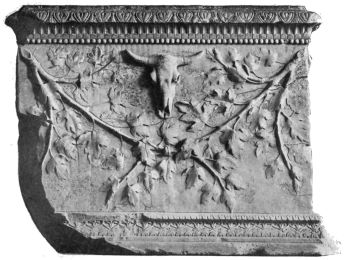
FIG. 1. FRAGMENT OF AUGUSTAN ALTAR
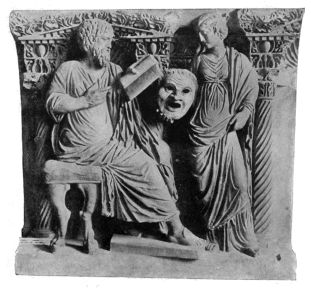
FIG. 2. ROMAN RELIEF
Plate XLII.
To the Roman mind it was unbecoming to a free gentleman to be asked to pay taxes in a free country. They held that a tributum was only for slaves to pay. Moreover it was one of the limitations of the power of Augustus that he had no constitutional right to impose taxation on Italy. Twice indeed he proposed to inflict a property-tax on Roman citizens. In A.D. 4 and 13 he took a census of all properties above £2000 as a preliminary measure, but on the second occasion at least it is explained by the historian as a shrewd stroke of diplomacy to make people acquiesce in the existing death-duties. The serious financial embarrassment of these years was caused by the expense of the gratuities paid to time-expired soldiers. The soldier’s daily pay of about sixpence was only pocket-money, he had always expected a farm on his discharge. Under Augustus this allowance of land was commuted for a bounty of about £125 for the legionary, or £185 for the prætorian guard. Of course, with a service of over twenty years and constant fighting, the number of veterans discharged each year must have fallen considerably below the 20,000 recruits enrolled, but still it was a heavy expense. In some cases the veterans were retained under the colours and in some cases land in new countries was still given. But this burden led to the establishment of a new military chest in A.D. 6. This was filled in the first instance by a donation of nearly two millions from Augustus and Tiberius, but it was maintained by two indirect taxes which fell upon the Roman citizens—very much to their annoyance. One was a tax of one per cent. on all objects bought and sold, the other a five per cent. tax on legacies. The latter was not imposed purely for revenue. It was intended, along with other laws, to discourage celibacy, since it only fell upon those who died without heirs of kin. What appears to be a distinct tax is another upon the sale of slaves.
The other large head of expenditure was that of the Roman corn-supply. Two hundred thousand people received free corn and the rest of the citizens always expected to buy it very cheaply. Most of this corn came from Egypt and Sicily as taxation paid in kind. The control of the supply was in the hands of a new department, cura annonæ, but owing to its mismanagement there were several periods of famine, on which occasions either Augustus himself or some member of his family had to step in and put things straight.
The general expenses of administering the Empire were not as great as modern analogies would lead us to suppose. No doubt the imperial legates and procurators received wages out of the imperial fiscus. It is commonly stated that all provincial magistrates now received a fixed salary instead of being left to plunder the provincials. The truth is that the higher magistrates of Rome never had received and did not for a long time yet receive a salary. But they had always claimed an allowance for their travelling expenses technically called “mule and tent money,” and this had been fixed on a generous scale which really amounted in practice to a salary. The only change was that instead of allowing these fees to be subject to contract on the regular contract system of the republican treasury, the governors now received a fixed grant calculated according to the necessary scale of expenses in the various provinces. For the provinces an immense saving was effected in this manner but it must have been more expensive to the central treasury.
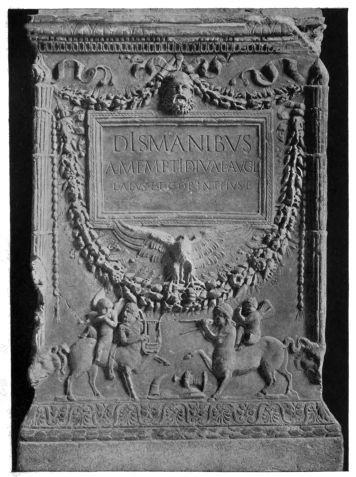
Plate XLIII. ALTAR OF AMEMPTUS
The finances of the provinces were gradually brought into order and arranged with consummate skill. The little information that we possess tends to show that nowhere was the Augustan reformation more beneficent or more brilliantly successful. In Gaul the land-tax and property-tax were fixed in 26 on a fairly high scale, it is true, but the development of commerce and agriculture fostered by the Romans made their incidence a light burden in comparison with the rapidly increasing wealth of the province. By this time the state had accepted the theory of tribute which the Roman lawyers had developed upon false principles. Tribute was now regarded, not as a commutation of the liability to military service, which was its real origin, but as a rent paid to Rome for the continued enjoyment of lands which had passed to her by right of conquest. The tribute was everywhere reassessed upon a new valuation systematically conducted. Generally it represented a tithe of the corn harvest and 20 per cent. of liquid products, such as oil and wine. In the senatorial provinces the old system of tax-farming by contractors survived for a time, but in his own provinces Augustus instituted an imperial board of revenue administered by Roman knights or Greek slaves and freedmen as his fiscal procurators. We have, indeed, three known cases of embezzlement by native agents. One, Eros, had advertised his insolent rapacity in Egypt by purchasing a celebrated fighting quail for an immense sum of money, and then cooking it for his dinner. Another, Licinius, a native Gaul set to collect taxes in his own country, disarmed Cæsar’s wrath like the servant in the parable by showing rooms full of silver and gold, which he professed to have stored up in his master’s interest. In this case it is zealous extortion which is charged against him. One of his methods was to extort fourteen months’ taxes in the year by pointing out to the innocent natives that since December was by its very name the tenth month, they had two more monthly contributions to pay before the end of the year. A paymaster, also a slave, who died in Tiberius’s reign, was notorious for the retinue of fourteen persons who attended him on his travels. He had his private cooks and physicians. But these are isolated cases. On the whole it is clear that the provinces were rejoicing at their deliverance from the oppression of the Republic. They were always anxious to be transferred from the senate to Cæsar. If the tax-gatherer was still at their door, he was now a man under independent authority with a master who would listen to petitions and appeals. Moreover, they now had a government which assisted them to pay by intelligently developing their resources.
The public treasury of the senate was no longer entrusted to mere quæstors. Augustus at first instituted prefects for this also. But the dearth of administrative capacity at Rome compelled him to transfer the charge to the prætors. However, he kept an eye upon its administration himself, as is shown by the fact that when he died he left to the state an account of the condition of the treasury.
It is still too early to speak of a definite system of division between the public “ærarium” and the emperor’s private “fiscus.” But the budget of the senate would include:
Revenue Expenditure
5% legacy duty.Army and police.
2% or 4% duty on sale of slaves.Religion.
1% on merchandise.Corn-supply.
Customs and harbour dues.Water-supply.
Confiscations from state offenders. Fire brigade.
Intestate estates.Administration.
Public lands.
Provincial tribute.
State mines and works.
Mintage of copper.
The budget of the fiscus would include:
Revenue Expenditure
Tribute of Cæsar’s provinces, especially Egypt and Gaul. Provincial administration and salaries.
Legacies (£15,000,000 in the last twenty years).Largess and bounties.
Private domains.Temples and public buildings.
Family inheritance.
Aurum coronarium (a complimentary gift on accession).Loans and gifts.
Private mines and works.The fleets.
Mintage of silver and gold.Games and shows.
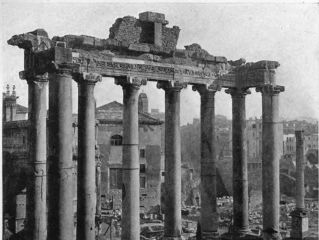
FIG. 1. THE TEMPLE OF SATURN, FORUM, ROME
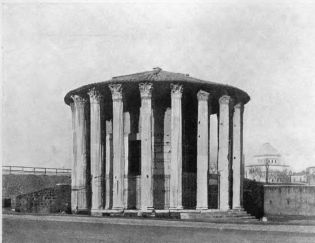
FIG. 2. THE TEMPLE OF MATER MATUTA, ROME
Plate XLIV.
The Provinces
Turning now to a rapid survey of the Roman world from a geographical point of view we shall see the work of restoration and repair, proceeding with the same methodical thoroughness which makes this regime one of the most beneficent in the history of civilisation. We have already seen something of the provincial system as it was reorganised in 27 B.C. The provinces which fell to the share of the senate were these:
Asia.
Africa.
Gallia Narbonensis (transferred to the senate in 22 B.C.)
Hispania Bætica.
Crete with the Cyrenaica.
Macedonia with Achaia.
Bithynia with Pontus.
Cyprus (also transferred to the senate in 22 B.C.).
Dalmatia (until the revolt of 11 B.C.).
Sardinia with Corsica.
Sicily.
These were governed by annual magistrates, chosen by lot from a list selected by the senate—the first two by proconsuls of consular rank, the others also by governors termed proconsuls but actually only of prætorian rank, that is, ex-prætors. Africa was the only one of these provinces which contained troops and the senatorial governors went out in civilian dress as administrators only. Cæsar’s provinces were:
Spain.
Gaul.
Syria with Cilicia and, until 22 B.C., Cyprus.
To these were gradually added:
Germania.
Illyricum, including Dalmatia and Pannonia.
Galatia, including Lycaonia, Pamphylia, Pisidia, and part of Cilicia, with Paphlagonia added in 5 B.C.
These were all governed by legates of Cæsar, commonly chosen from the ranks of the senate, with the title of proprætor. They held office for as long as Cæsar desired, and were provided with a staff, chosen by him, of trained financiers. In addition to these, other districts under prefects were gradually accumulated:
Egypt.
Mœsia and Triballia.
Alpes Cottiæ.
Alpes Maritimæ.
And others again under procurators:
Judæa (after A.D. 6).
Rhætia.
Noricum.
Further, there were a large number of “allied” or “client” kingdoms and republics:
Thrace.Abitene.
Pontus with Bosphorus. Emesa.
Judæa (till A.D. 6).Galilæa and Peræa.
Commagene.Nabatæa.
Cappadocia.Batanæa.
Armenia.Mauretania.
Arabia.
And the allied states:
Lycia.
Athens, Sparta, Rhodes, and other Greek cities.
In his own provinces Cæsar was supreme in all things; he had the right of making peace, war, and alliance, without consulting the senate. Though he governed through legates or procurators, the Roman law had always granted a right of appeal from a lower magistrate to his superior. This was the source of Paul’s “appeal unto Cæsar” from the procurator of Judæa. In the senatorial provinces his imperium, which had been specially defined as “superior” (maius), gave him precedence when he was actually present. And we have many cases of his interference in senatorial provinces. Cæsar’s legates, such as Agrippa, Tiberius, and Gaius, constantly act as overlords in Asia, though a decree of the senate is required for this. We hear of Augustus founding colonies in Sicily. Moreover, the princeps had sole authority over the army, and for any military operations it would be necessary to borrow troops of him.
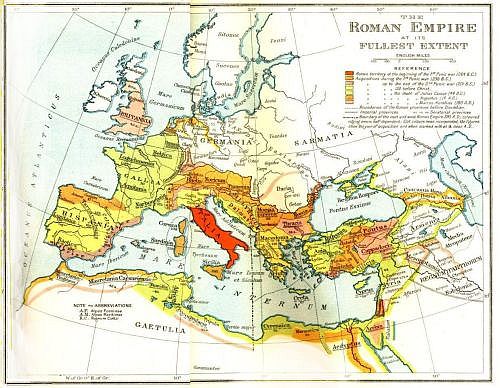
The Roman Empire at Its Fullest Extent
The foundations of this great empire were not hastily or carelessly laid. Although of feeble constitution and by nature a man of peace, Augustus spent the first half of his long reign more abroad than at home, in fighting rebels and organising or reforming with unwearied energy. To this part of his work we are unable to devote sufficient attention through lack of material. The ancient historians prefer to record small victories over barbarian tribes, or the petty gossip of the Roman streets, while they have little to say about the tireless administration which in one generation transformed the Roman world from a horrible chaos into that scene of peace and prosperity shown to us in the pages of Strabo and Pliny. So while our eyes are fixed upon the sins and follies of Roman emperors and courtiers, until we get an impression of rotten tyranny conducted according to the caprice of monsters and fools, all the time the greater part of Europe was advancing in peace to a state of general culture and civilisation such as it had never known before, and such as it never knew again until the nineteenth century. A casual glance over the inscriptions of a provincial town probably gives us a truer impression than all the rhetoric of the historians. In Pompeii, for example, a small and unimportant suburb of Naples which scarcely comes into the view of history, we see a busy and useful municipal life carried on in absolute security. There were the ten councillors (decuriones), who corresponded to the Roman senate, and there were two local consuls bearing the title of “duumviri.” In most cases a small municipality would have its “patronus” also, a local squire, perhaps, who in some measure corresponded to the princeps, and who would represent the interests of the town at Rome, or with the Roman prætor. His main business, however, was to equip his town with baths, temples, and colonnades, or to provide it with public banquets. For the rich freedmen, in whose hands was much of the trade of the place, Augustus had provided the new office of Seviri Augustales, which we have already described. There were no rates, for private munificence took their place. There was no direct taxation in Italy, and the indirect taxes were inconsiderable. Internal trade was free. The obligation to military service was so widely distributed that it fell very lightly on Italy, and the natives accordingly became less and less warlike. All the Italian peoples were now Roman citizens. Trade was greatly assisted by the improvement of communications which took place during this period. The care of roads properly devolved upon the senate, but as they showed their usual incompetence in this department the princeps had to step in and organise a special Board of Roads with a curator for each of the trunk lines of communication. Augustus also established an imperial post with a system of stages and relays, which lasted on until the coming of railways. The vehicles and horses were maintained by the roadside communities, and imperial messengers who carried a diploma or passport were allowed to travel express by this means. The great road to Rimini, the Flaminian Way, was the first to be repaired, and Augustus adorned its terminal city with a handsome marble bridge[44] and triumphal arch, possibly as a compensation for the trouble which he himself had inflicted upon the town during the civil wars. Flourishing historic cities like Turin and Brescia owe their origin to colonies founded by Augustus. Towns like Perugia which had been almost destroyed in the civil wars now grew up again and flourished. In all, Augustus founded twenty-eight colonies in Italy, and supplied 90,000 veterans of the civil wars with land which he had bought and paid for. That the sea was now safe for trade and fishery must have meant a great deal to the coast towns. Augustus himself wrote an account of the condition of Italy, and Pliny confesses to using it as his authority. In all the long and important history of Italy it is doubtful whether she has ever enjoyed such peace and prosperity as began for her in the reign of Augustus.
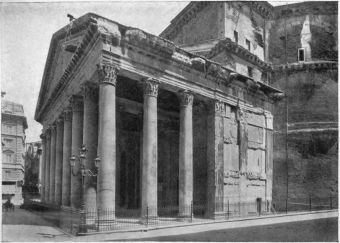
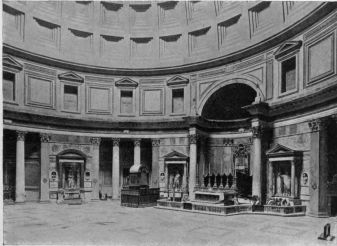
Plate XLV. PORCH AND INTERIOR OF THE PANTHEON, ROME
A broad view of foreign politics showed Augustus two vital points of danger—the North and East. To the north the fierce and warlike barbarians of Germany had been checked indeed by Julius, but also exasperated. Tribes more or less akin to them extended southwards across the Danube and even to the Austrian Tyrol, where they were little more than a week’s march from the gates of Rome. A strong frontier policy was needed here. In the East there were the Parthians, the only possible rival power to Rome. The Romans at Carrhæ noticed that while the chiefs wore their hair parted and curled and their faces painted in the Persian fashion, the warriors had the unkempt locks of barbarian Thrace. It is likely enough that these Parthian bowmen had come in round the shores of the Black Sea from Thrace or South Russia. They had all the characteristics of northern nomads, but their kings had a good deal of Hellenic culture. They could boast of a choice collection of Roman eagles captured not only from Crassus at Carrhæ, but from two armies sent against them by Antony. Thousands of Roman prisoners were still working as slaves on the banks of the Euphrates. The task of punishing them had been definitely laid upon Augustus as a legacy from Julius, who had been slain at the moment when he was about to undertake it himself. Moreover, the Romans felt the loss of those standards very acutely, and not the least motive for their acquiescence in monarchy had been the hope that a monarch would retrieve their honour in this quarter. The earlier poems of Horace constantly express hopes of vengeance.
The manner in which Augustus satisfied these ardent aspirations of national pride is characteristic of him. Instead of the armies and bloody battles which historians demand of their favourites, Augustus achieved his object by luck and strategy. When he was organising the affairs of the East in 29 B.C., after the conquest of Egypt, he had left the Parthian question unsolved. For this, Mommsen takes him to task, but there is little doubt that it would have been folly to undertake a great and perilous war at that moment while the affairs of Rome were still in disorder. Moreover the attitude of the army compelled him to return home. Instead of fighting, he was content to set up rival powers on the Parthian frontier. The Parthians hated their king Phraates and there was a deposed rival in the field, Tiridates, to whom Augustus now gave shelter in the province of Syria, hoping, as indeed happened, that his presence in the neighbourhood would keep Phraates civil. At the same time Augustus set up a buffer kingdom of Lesser Armenia on the Parthian border and in the south strengthened and reinstated Herod the Great. Four or five legions were left to guard Syria.
In 23 B.C. it chanced that Tiridates had managed to kidnap the child of Phraates and was keeping him in custody in the Roman province. It is significant of the changed relations between Parthia and Rome that, instead of marching into Syria to recover the child, Phraates sent an embassy to Rome, whither also Tiridates came in person. Of course the senate made the restoration of the child conditional upon the return of the standards and prisoners. Phraates consented, but there was some delay in carrying out the contract and this may have been secretly arranged to enable Augustus to conduct the affair in a more striking fashion. Augustus marched out with an army and at his mere approach the standards and captives were given up with due formalities. It was really a Roman triumph, almost as great as if it had been attained by bloodshed, for all the world could see the humiliation of Parthia. Augustus, that astute tactician, took care that the event should not be allowed to lose its impressiveness for the mere lack of bloodshed. The return of the standards was treated as a Roman triumph. They were placed with every solemnity in the temple of Mars the Avenger. Coins were struck representing the suppliant Parthian on his knees and the same scene is depicted in relief on the centre of Cæsar’s breastplate on the famous statue. The poets broke out into dutiful pæans.
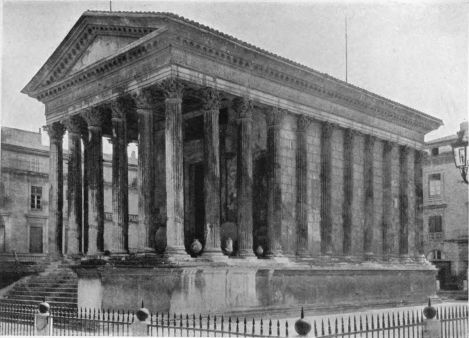
Plate XLVI. MAISON CARRÉE, NISMES
nunc petit Armenius pacem, nunc porrigit arcum Parthus eques timida captaque signa manu
cries Ovid. Vergil, after his manner, speaks of the Euphrates flowing more quietly in future. The odes of Horace and the elegies of Propertius contain similar loyal allusions. Ferrero, who regards Augustus as a feeble trickster just as he regards Julius as a shabby adventurer, has nothing but contempt for this episode. But seeing that the Parthians were now utterly weakened by their internal feuds and quite submissive to Rome it would have been folly to embark upon their conquest. That they gave much trouble in the future is true enough, but that might fairly be left for the future to deal with. Extermination might have quieted them for ever, but Augustus had really no excuse for making war upon them.

Surrender of the Standards
On the same visit to the East a still more elaborate system of buffer states forming a double semicircle round Parthia was organised. Armenia yielded to Rome and received at the hands of Tiberius a new king who had been educated at Rome. Augustus himself explains that although he might have made Armenia into a Roman province he preferred to follow the example of “our ancestors” and give the crown to a native king. Augustus never pretended to be a world-conqueror. Similarly Media Atropatene received a new king of Roman education, so did Commagene and Emesa. These formed the outer ring of buffer states.
The central state behind them was Galatia, an arid highland district inhabited by the descendants of those Gauls who had burst into the Greek world under Brennus. Though they had acquired some tincture of Greek civilisation and had a capital of some importance at Ancyra, they still spoke the Gaulish language and were still a warlike race. For these reasons, on the death of their king, Augustus preferred to turn their country into a province. To the north was the very friendly kingdom of Polemo in Pontus, and to the south other friendly princedoms as well as the Roman provinces of Cilicia, Syria, and Cyprus.
For all this elaborate bulwark, the Parthian question was not really settled. They continued to exercise an undue influence in Armenia, and in A.D. 1 there was another solemn mission to the East and a conference between Phraates the Parthian king and Gaius the grandson of Augustus. Once more the Parthian professed submission, and once more the court poets struck their obsequious lyres. When Phraates died, his uncle Orodes who succeeded ruled with such cruelty that he was assassinated. Thereupon the Parthians sent to Rome for a king and Augustus gave them a nephew of the murdered tyrant, a youth also of Roman education. We note this proceeding as common in the foreign policy of Augustus. He must have had something like a school for young barbarian princes at Rome, but whether the lessons that they learnt in Roman society were altogether salutary is doubtful.
Behind this wall the great provinces of Asia, Syria, and Bithynia were wrapped in profound security. Here Greek culture continued to flourish with periodical incursions of oriental religion and philosophy. In every considerable town the Jews formed a great and growing section of the population but even they were half Greek in their ways of life. The country was rich and lazy and utterly unwarlike. Civilisation had risen to a high pitch and it was probably this part of the world which sent to Rome those artists who contributed to the revival of sculpture. Pretty little epigrams in Greek elegiacs seem to have been their principal literary accomplishment. These provinces have very little history—happily for them—at this period. We know them best from the Acts of the Apostles, where we get a glimpse of their superstitions, their eagerness to embrace new religions. We see the fanaticism of Ephesus with its magnificent temple of Diana and stately worship, a religion of oriental character overlaid with Greek culture, and only rivalled in its attractions by the Roman amphitheatre. For these people as for the rest of the world Augustus had his policy. Since worship was their instructive need and Euhemerism had accustomed them to worship men, he set up an elaborate cult of himself, or rather, by a subtle distinction without a difference, a cult of “the genius of Augustus.” Temples were built to “Rome and Augustus” and an elaborate hierarchy of “High Priests,” “Asiarchs,” and “Bithyniarchs,” which became the highest social distinctions in the society of the day. This was his method of securing the allegiance of nations devoted to religion and flattery. Here in the near future was to be the field of that momentous conflict between this State religion and Christianity, with other oriental faiths, such as Mithraism, also claiming their proselytes.
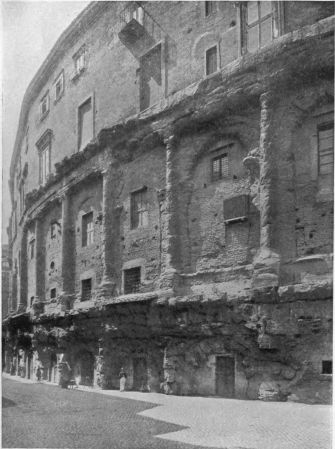
Plate XLVII. THEATRE OF MARCELLUS, ROME
As for old Greece, the Romans never denied their spiritual debt to her, and accordingly they regarded Greece with something of the veneration which a man feels for his university. Augustus himself had been educated at Apollonia, he sent his heirs to various Greek cities for their education. It would have seemed sacrilege to educated Romans to put a legate in charge of Athens. Hence we find Greece enjoying quite an exceptional position in the empire, indeed without exception the freest and most favoured part of it. Towns such as Athens, Lacedæmon, Thespiæ, Tanagra, Platæa, Delphi, and Olympia were free and almost sovereign. Athens continued to coin her silver drachms with the old design of Pallas and the owl, elected her own archons and generals, held assemblies and even had a sort of empire extending over all Attica, part of Bocotia and five islands of the Cyclades. One Julius Nicanor, her “new Themistocles,” purchased the island of Salamis and presented it to his city in the civilised manner of empire-building. Sparta, too, though now shrunken to the size of a village, bore rule over Northern Laconia, while in the south there was a free confederacy to keep her in order. Beside these cities of ancient renown stood the new and splendid creation of Augustus—Nicopolis, the city of victory founded on the promontory of Actium in commemoration of the great victory of 31. Nicopolis had its great athletic festival like Olympia and ruled over a considerable territory. In addition to these free cities there were some Roman colonies. Corinth rose again from her ashes as an important commercial city founded by Julius Cæsar. Patras, on the Corinthian Gulf, a new foundation of Augustus, became one of the most important cities of Greece, as it is to-day. The rest of Southern Greece, consisting mainly of obscure villages, formed the new senatorial province of Achaia and was governed by a proconsul at Corinth. It was a poor unmilitary province. The northern part formed the senatorial province of Macedonia. Thessalonica and Apollonia were the principal centres of government and civilisation in this region. In Greece, as elsewhere, Augustus made it his aim to focus a national unity upon religion. The old Achæan league was revived as a religious gathering with Argos for its centre, and the Delphic Amphictyony, the oldest surviving institution in Europe, became the basis of a Panhellenic confederacy which met annually for religious purposes under Roman patronage, a sort of Eisteddfod combining religion with culture. It sacrificed to Cæsar, and here, too, we find a president called “Helladarch.” But although Greece had liberty and peace, something was amiss with her. Her shrunken population continued to decline. In Strabo’s Geography, Thebes is a mere village.
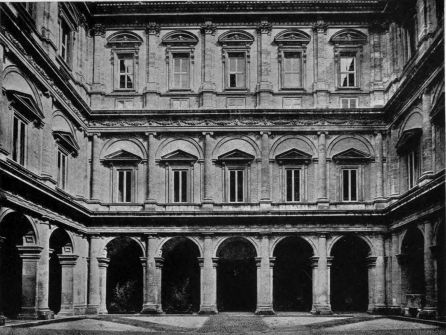
Plate XLVIII. INNER COURT, FARNESE PALACE, ROME
Crossing the water we find that the newly conquered kingdom of Egypt was the key to the whole position of Augustus. It was the wealth of Egypt which had reconciled Rome to monarchy and it was by means of that wealth that he continued to hold the allegiance of his subjects. Like Greece it had an ancient civilisation which impressed the Romans as something beyond their comprehension. Alexandria, in particular, as the gateway to the wealth of Egypt, and as the greatest existing centre of Greek culture, not to mention its huge population and commercial advantages, seemed to the Romans a really dangerous rival. The fear of that rivalry had been felt very acutely at Rome when news came of the ambitious schemes of Cleopatra and the subservience of Antony. Augustus was really heading something like a national crusade when he declared war upon them. The same fears now actuated him in settling the treatment of Egypt as a province. Though he writes “I added Egypt to the Roman empire,” he treated it rather as an imperial domain under a prefect or viceroy closely attached to his interests. Its first prefect was Cornelius Gallus, a knight from the Gallic colony of Fréjus, a poet himself and a friend of Vergil. Cornelius Gallus was in fact the hero of the famous eclogue: neget quis carmina Gallo? It was specially ordained that no senator might visit Egypt without the express permission of Cæsar. The native Egyptians were already overridden by a Greek aristocracy dating from Alexander’s conquest. They had no rights, and no nationality was designed for them as it had been elsewhere. Augustus accepted the elaborate bureaucratic system which he had found in existence when he came. The Greek aristocracy lived almost exclusively in Alexandria, possessing a municipal constitution, magistracy, and priesthood of their own. The ecclesia was stopped but otherwise there was no attempt to Romanise Egypt. The old Egyptian worship of Isis and Osiris had conquered all its conquerors and continued to make inroads even into Rome itself where Augustus was forced to accept it as irresistible. All that had happened in Egypt was that Augustus had taken the place of the Ptolemies in the official religion. It was the motive of fear which led to the appointment of a mere knight as viceroy, though he had three legions under his command. The officials under him were knights or freedmen. The taxes remained very heavy, as was necessary, but now the Egyptians were placed in a better position to pay them. Even before the civil war was quite ended in 29 B.C. Augustus had employed his soldiers to clear the canals and raise the level of the dams which ensure the Egyptian harvests. This process continued, and Egypt never had such prosperity again until Lord Cromer came to resume the work of Augustus. The harvest depended simply on the height to which the Nile rose. The ancient Nilometer at Elephantine records that the Nile rose to an unprecedented height in the latter days of Augustus. Formerly a level of eight ells had meant famine, now it ensured a tolerable harvest. Another inscription found at Coptos gives us the names of the Roman soldiers who built reservoirs of water along the great roads. Then the trade with India along the Red Sea first began to grow great. Whereas in the time of Cleopatra hardly twenty ships sailed to India in a year, there was already in Strabo’s day (about A.D. 18) a great fleet of Indiamen. Taxes on exports and imports returned a huge revenue to the imperial purse.
The prefect who represented his master on the throne of the Ptolemies was in a difficult position. To Rome he was a mere servant, to the Egyptians something like a god. Against these flattering influences Gallus the poet had not strength to resist. He allowed statues to be erected to him and even had his own achievements engraved upon the pyramids. A traitorous friend reported these indiscretions at Rome. Augustus was content to recall him and forbid him to live in the provinces or to enter his presence. But the officious senate voted his condemnation to banishment, and confiscated all his property to Augustus, whereby Gallus was driven to suicide. Then Augustus was sorry and complained that it was hard not to be able to scold one’s friends like a private man. This was the first case of that disease known as delatio (informing) which was afterwards to become such a pest under the Empire. It is satisfactory to learn that the informer was very rudely treated in Roman society. From Egypt, as a base, expeditions were made in the time of Augustus to Arabia and the Soudan. Arabia Felix was to the Romans a kind of Eldorado of boundless wealth, as Horace writes to a friend who was joining the campaign. The Arabs brought their incense into the Syrian markets and already traded with India from Aden, but the national wealth of the country was exaggerated and its difficulties unknown. This expedition of 25 B.C., which was on a very large scale and included contingents from Judæa, was one of the few deliberate wars of conquest ever planned by Augustus. He learnt a lesson by its failure in the burning and trackless deserts. The other campaign against the black Æthiopians of the Soudan under their warlike but one-eyed queen Candace was more successful. Petronius the legate penetrated as far as the Second Cataract and sent a thousand prisoners to Rome, but Augustus seems to have been content to make the First Cataract his southern frontier.
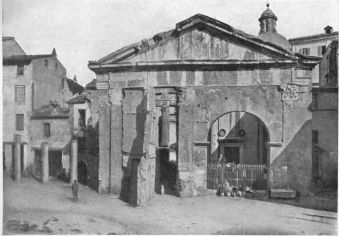
FIG. 1. COLONNADE OF OCTAVIA
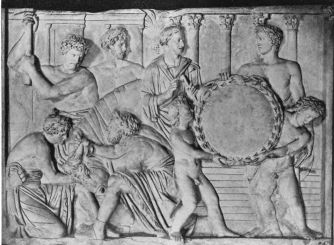
FIG. 2. ROMAN BAS-RELIEF
Plate XLIX.
The neighbouring client kingdom of Judæa is of importance not only because the days of Augustus saw the birth of that Child in Bethlehem who was destined to conquer Rome and through Rome the world, but because its throne was occupied by the ablest and most remarkable man, next to Augustus, in the whole Empire. Herod the Great, an Edomite Arab by birth, had succeeded to the throne of the Maccabees in 37 B.C. He was not only a daring warrior but a singularly skilful diplomat who was always able to cover up his crimes by adroit flattery and a fascinating manner. He was very successful in trimming between the rivals throughout the civil wars and even shared the favours of Cleopatra with his Roman masters. In these ways he increased his domains by the addition of Gadara, Samaria, and the Philistine coast towns. In compliment to Augustus he refounded Samaria with great splendour as the Greek city of Sebaste and built Greek theatres, Roman amphitheatres, and baths in Jerusalem itself. He even instituted quinquennial games there, wherein naked athletes performed to the infinite disgust of the Jews. He took his sons to Rome for their education and there he met and fascinated both Augustus and Agrippa. He even persuaded Agrippa to visit Jerusalem for the opening of his magnificent new temple in 15 B.C. Agrippa came and sacrificed a whole hecatomb to Jehovah to the apparent delight of the people. Later on Herod made a grand tour of Asia Minor, scattering lavish gifts everywhere and receiving complimentary inscriptions in return. He succeeded in obtaining valuable privileges for his fellow-Jews scattered abroad in those regions. Henceforth they were not forced to render military service and had special permission to keep the Sabbath.