VI THE GROWTH OF THE EMPIRE (continued 2)
Reading edition
The Romans may have added little to abstract philosophy or to metaphysics, but they made the somewhat barren abstractions of Zeno the Stoic into something more than a philosophy, into a faith which had a power to influence conduct far beyond the power of the State system of half-Greek Olympian Gods. If the power and the sincerity of a religion may be tested rather by its martyrs than by its proselytes, Stoicism had a worthy record. Men like Thrasea Pætus, Helvidius Priscus, and Barea Soranus were facing the tyrant’s frown for the sake of their Stoic sense of duty, just as truly as Peter and Polycarp.
The attitude of the Roman Government towards Christianity has been too often explained to need more than a brief recapitulation. At first Christianity was confounded with Judaism, which had already begun to make converts at Rome without seeking for them. The Roman government was extraordinarily tolerant towards creed, but it demanded an external compliance with the Cæsar-worship, which it was imposing on the provinces as a test of loyalty. But the Christians did not take the divine command “render unto
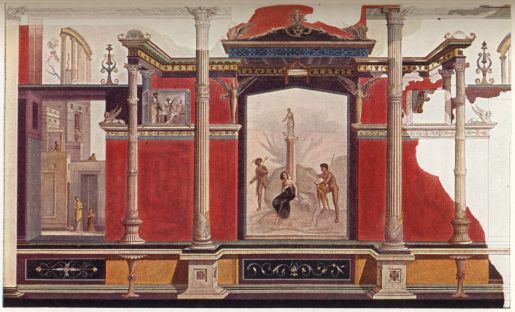
Plate LXXXIX—HOUSE OF LIVIA: INTERIOR DECORATION
Cæsar the things that are Cæsar’s” to include scattering incense on his altars. Too many of them had been brought up in the punctilious exclusiveness of the Jewish tradition for them to display on such points the laxity which is sometimes called broad-mindedness. Even in the private intercourse of social life the Christians were unpleasantly apt to insist upon their scruples. The meat in the butchers’ shops had often been slain in sacrifice, and the Christian conscience revolted at “meat offered to idols.” The libation with which the wine-cup started on its rounds was another offence to the tender monotheistic conscience. These things made the Christians unpopular. Their close associations, their secret meetings and love-feasts, the communism which they practised, all aroused the suspicions which are begotten of mystery. Lastly, their conviction that the Second Coming and the Day of Judgment were at hand made them ardent proselytes. It made them utter prognostications of death and damnation to all around them, and to see apocalyptic visions of the fall of the kingdoms of this earth. Such prophecies were sometimes misunderstood as involving treasonable designs. The first persecution under Nero was largely the result of such suspicions.
But the official attitude of the permanent Roman Government is probably revealed in the famous correspondence between Pliny and his emperor, Trajan. Imperial Rome is not to set up an inquisition. No man is to be punished for his faith, but if he is accused to the governor and is obstinate in refusing to pay the obeisance demanded by the state he is to be punished for his contumacy. That is precisely the attitude which the most humane and enlightened Christian states have adopted towards heresy. Later, when the Faith grew in importance, and when it even reached the point of soldiers refusing the military oaths, occasional emperors, often the better emperors, strove to fight against it. Then there were sometimes inquisitions and wholesale martyrdoms as under Decius and Diocletian. But no martyrdom, however public or agonising, could quench the faith of those who saw the heavens opening and the Angels of God descending with their crowns of glory. The publicity of the scenes and the constancy of the victims increased, as usual, the number of the converts. Foolish magistrates sought to encounter obstinacy with further severity, and the Faith only grew the more abundantly. It was not so much his personal conversion—for that was tardy and half-hearted—as the motive of policy to secure an advantage over Maxentius, which induced Constantine to promulgate the Edict of Milan in 313, by which toleration was extended to the Christian faith throughout the Roman Empire.
We must not be surprised that the best emperors, including the philosopher and saint, Marcus Aurelius, were the most bitterly hostile to Christianity. That is human nature. Stoic philosophers were teaching very much in common with Christian philosophy, but that renders it all the less likely that Stoic philosophers should be among the converts. Nevertheless Christian doctrine, especially in the Græco-Jewish communities of Asia Minor, was falling on prepared soil. The Stoic paradoxes had undoubtedly prepared the way for the Christian paradoxes. The doctrines of humility and asceticism were a commonplace of the Cynics. “No Cross, no Crown,” “He who would save his life must lose it”—such sayings as these would gain immediate assent from thoughtful Romans. Epictetus, a heathen slave of Domitian’s day, wrote his answer to the tyrant: “No man hath power over me. I have been set free by God. I know His Commandments; henceforth no man can lead me captive.” The Stoics were daily teaching that it is hard for a rich man to enter into the Kingdom of God. This is the creed of Marcus Aurelius: “To venerate the gods and bless them, and to do good to men, and to practise tolerance and self-restraint.” The horrors of the amphitheatre are one side of imperial society. But on the other side Musonius Rufus, a Stoic who stood high in the favour of Vespasian and Titus, went among the soldiers to preach against militarism. Slave-drivers as the Romans were, they were beginning to feel a sense of the brotherhood of man.
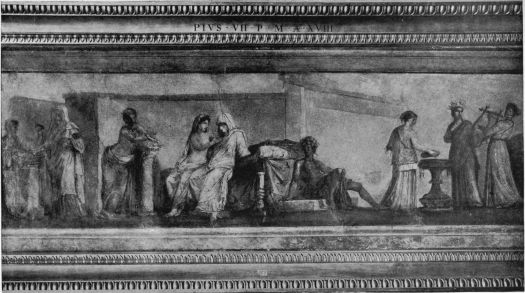
Plate XC. THE ALDOBRANDINI MARRIAGE: VATICAN, ROME
Seneca was calling the slaves “humble friends.” “Man is a holy thing to man,” he says; and such teaching was reflected even in the legislation of the day. Juvenal pleads passionately for kindness to slaves and for moral purity in the home. Seneca not only feels that men are brothers, but that God is the Father of us all. We have seen how public charity was finding expression in the alimenta and the free schools. “Love them that hate you” would not strike the Romans of the second century as anything more than a strong expression of the truth they had already begun to recognise. Thus the practical side of Christian ethics found its harmonies in the conduct as well as the theory of the more enlightened pagans. Peace and humanitarianism were in the air of the Antonine Age.
As for religious dogma the whole tendency of thought was towards monotheism. “God is a Spirit” would find an instant acquiescence among educated Romans, even though they frequented the temples of a hundred different gods. Philosophy among Greeks and Romans alike had always been monotheistic. On the subject of immortality the philosophers were divided. Marcus Aurelius and Seneca are on the whole not hopeful. Probably the beliefs of the common folk—as testified in the epitaphs of their cemeteries—were equally divided. The laconic epitaph: “I was not, I was: I am not, I care not,” is common. But other epitaphs equally common express the hope of reunions in the other world or even of being “received among the number of the gods.” But on the whole the commonest view of Death was as a happy release and an unending sleep. It was the immediate hope of eternal bliss, which was the greatest thing that Christianity had to offer to the pagan world.
Rome, then, was in many ways prepared for the reception of Christianity, whose doctrines found an echo in the aspirations of the day. She did much to give to Christian theology its Western form, and of course the ritual and practice of the Roman Church was in many ways merely a continuation of old pagan rites and ceremonies. Ancient deities became Christian saints without change of rite or cult; images were often adapted and even names scarcely altered. But, in fact, the whole conception of that mighty Church which conquered the world, including the barbarian invaders, was the offspring of the Roman political system. It was her genius for statecraft which made Rome the Eternal City. In one form or another she has governed the world for twenty centuries.
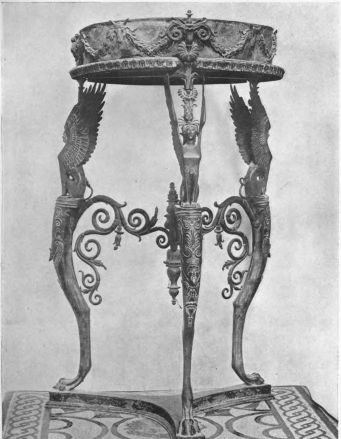
Plate XCI. BRONZE SACRIFICIAL TRIPOD