IV AUGUSTUS (continued 2)
Reading edition
In 9 and 8 B.C., however, he got into trouble with Augustus for conducting a military expedition against the Arabs without permission. This was the greatest offence that a client king could commit, and Augustus declared that henceforth he would treat Herod not as a friend, but as a subject. But in the next year a humble embassy was sent to Rome with the historian Nicolaus as its spokesman. Herod received the gracious permission to deal with his rebellious sons as he thought fit, and accordingly strangled two of them. Herod’s family history is a deplorable record of crimes and intrigues. He seems to have had ten wives, and on his death in 4 B.C., he left three wills among which Augustus had to decide. Seeing that Judæa was so rich and powerful as to be a possible source of danger, he decided to split it up into three. Then began a whole series of troubles, in the course of which the Jews of Jerusalem actually attacked a Roman legion. In revenge the legate of Syria, Quintilius Varus, crucified 2000 of the inhabitants. In the final award Judæa fell to Archelaus, Galilee to Herod Antipas. Ten years later, however, the infamous Archelaus was deposed at the petition of his subjects, and Judæa was made subject to the province of Syria with a procurator of its own. Herod Antipas continued to rule his petty kingdom until about A.D. 34, when it also was united to the province. He is the Herod whom Christ denounced as “that fox,” and he is the Herod of Christ’s Judgment, when he happened to be at Jerusalem on a visit to Pontius Pilatus, the Roman procurator. Pilate was a Roman knight, but Felix, one of his successors, was only a freedman. The seat of the Roman government was not at Jerusalem, but at Cæsarea, so that the prætorium in which the trial of Jesus took place must have been the temporary head-quarters of Pilate in the palace built by Herod the Great.
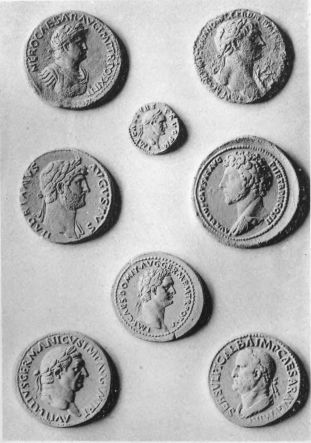
Plate L. COIN PLATE II
The procurator only commanded auxiliary troops, and nearly all the “Roman soldiers” mentioned in the Gospels must have been of Jewish birth. As soon as it was a province, but not before, Judæa had to pay tribute to Cæsar. Hence the existence of a “chief of the publicans” like Zacchæus. As usual, the Romans preserved what they could of native institutions, and the Sanhedrin continued to act as a national council, so far as could be permitted. Thus it might try Jesus, but it could not pronounce the death sentence. On the other hand, another procurator, Festus, committed Paul to the Sanhedrin for judgment. The fact is that the Jewish law was so peculiarly national that a bewildered and well-intentioned Roman knight like Pilate might often say “take ye Him and judge Him according to your law.” The Roman government was so tolerant of the religion of its subjects that even a Roman citizen who ventured to enter the Holy of Holies was punished with death. The Jewish religion was expressly under Roman protection. Agrippa, as we have seen, had sacrificed to Jehovah, but later on we find Augustus commending his grandson Gaius for not having worshipped Jehovah. As a matter of fact, with the spread of the newer forms of Hellenic philosophy the religious feeling of the world, which had long ago given up its faith in the Olympian mythology, was turning more and more towards monotheism and a mystical system of ethics. The higher Pharisaism, which Paul had learnt at the feet of Gamaliel, was decidedly influenced by Stoicism. Hence the Jewish religion even before its Christian development was extremely fascinating to the Roman mind, and it had to be forbidden in the capital. Even at Jerusalem the Jews were expected to sacrifice, not to but for “Cæsar and the Roman People” every day. Augustus paid for this ritual out of his own pocket. In deference to the feeling of the Jews, the coins struck for Judæa bore no portrait of Cæsar, and even the standards, because they bore portraits, were ordered not to be carried into the Holy City. It is true that the silver denarius of Syria circulated in Judæa to some extent, and it is of such a coin that Christ was speaking when He asked: “Whose image and superscription is this?”
The province of Africa with Numidia was handed over to the senate as peaceful in 27 B.C., and it was one of the only two Roman provinces which Augustus never visited. Nominally it stretched from the boundary of the kingdom of Mauretania at the river Ampsaga on the west to the borders of the Cyrenaica on the east. But actually it consisted of the islands of fertility on the Tunisian coast. Carthage had been colonised by Julius Cæsar and was now refounded by Augustus. There was no inland frontier. In the desert behind the mountains there still flourished the wild Gætulian nomads who occasionally descended upon the peaceful province and provided a Roman triumph. This was the reason why a legion was still kept in Africa. The neighbouring kingdom of Mauretania was assigned to an interesting young royal couple. The husband was Juba, a descendant of Masinissa, who had been educated as a Roman, had served in the Roman army and was so complete a Greek scholar that he wrote among many other works a history of the Drama. The wife was a daughter of Cleopatra by Antony, who had ridden in Cæsar’s triumph at Rome. Both Mauretania and its eastern neighbour Numidia, which had been added to the Roman province, now settled down to wealth and happiness under the Roman rule. The splendid ruins which still survive indicate a prosperity which has not as yet been completely recovered.
Cyrene, where the descendants of the Romans are now carving out a province for themselves, though geographically a part of the African continent, was historically regarded as a Greek island, and united in one province with Crete. It consisted of a group of five Greek cities with a large intermixture of Jews. Cyrene has no history in this period, but after the siege of Jerusalem there was a terrible outburst of Jewish fanaticism. Thousands of Roman citizens were tortured and slain.
Perhaps no country in the world has had such a chequered and miserable history as the pleasant island of Sicily with its rich volcanic soil. For four hundred years it had been mainly Greek. The eastern end, at least, had been scattered with important city-states which, under the leadership of Syracuse, had waged incessant conflict with the Carthaginian invaders in their western strongholds. We have seen how the Romans finally drove out the Semitic element and conquered the Greeks. During the latter part of republican history the island had been of vital importance to Rome as supplying through its tribute the chief part of the corn-supply. At the same time it had been cruelly exploited and oppressed by Roman governors like Verres. Then during the civil wars Sextus Pompeius had made it his head-quarters, and it had been laid under heavy contributions by both sides. Messina, its richest town, had been the scene of a sack and massacre. No country had more to hope from the Pax Augusta, and it now began to enjoy one of its brief periods of rest. Augustus spent the winter of 22 in Sicily at the beginning of his tour in Greece. He founded colonies at six famous cities of old. While he was in the island the Sicilians offered him a kind of round-robin of complaint against the extortion of his procurator. Augustus instantly dismissed the offender and replaced him by his own valued tutor, the philosopher Areus. It was thoroughly in accordance with his policy to put a Greek philosopher in charge of a Greek island.
So far we have been surveying the treatment of that part of the Roman world which was already quite civilised and mainly Greek. We now turn to the barbarian West and North, mainly consisting of newly conquered Cæsarian provinces. In these quarters, the nearer parts of Spain and the Narbonensian province of Gaul were the only regions which could be called civilised. As soon as the provisional settlement of 27 b.c. was effected Augustus hurried away to Gaul. It was generally thought that he was on his way to conquer Britain, for that was the second of the two tasks which Julius had left to his successor. Accordingly the loyal Horace dutifully prays:
serues iturum Cæsarem in ultimos orbis Britannos.[45]
But this was not the time, and Augustus was not the man, for dazzling conquests. “Hasten slowly” was his favourite motto, and his empire policy was founded on the same principle. For the present the Ocean, then called British, was boundary enough. Augustus was reducing the army and Britain would have taken at least a legion to keep it quiet. So Britain had to delay its prospects of civilisation until Gaul and Spain were organised and the German frontier settled. We have the record of British chiefs coming to Rome with unknown petitions during the period, but beyond that there is silence on our island. As for Gaul, Julius had done the work of conquest thoroughly enough, and the Gauls as an adaptable people were taking to Roman civilisation with avidity. There were indeed corners of it not yet enlightened and the whole government required organisation. Augustus went straight to the capital of the old province, Narbonne, and there he arranged a census and a land register, not, as Ferrero observes, out of mere statistical curiosity. Probably no tribute had come in from Gaul during the civil wars, and Augustus was much concerned with finance. For the moment an outbreak in Spain called the emperor away, but five years later he returned to complete his work. The old province, which has passed into history as Provence, was now handed back to the senate as completely pacified, and the rest of Gaul was eventually divided into three parts: Aquitania, the half-Spanish south-west; Lugdunensis (the east and centre stretching right across France with its capital Lyons or Lugdunum on its eastern border); and Belgica (the northern part with Trier—Augusta Treverorum, not yet founded—and Rheims as its chief towns). This division was mainly, though not entirely, based on racial considerations. Together the three formed one of Cæsar’s provinces as Gallia Comata.
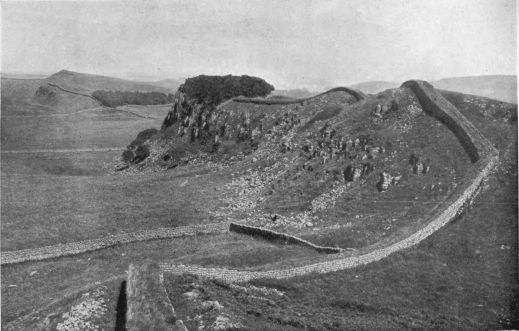
Plate LI. HADRIAN’S WALL: NEAR HOUSESTEADS, NORTHUMBERLAND
The treatment of the conquered land was wise and humane. Druidical religion, already a waning force, was permitted to exist, though it included human sacrifice and was hostile to the Romans. In the reign of Claudius it was forbidden. But other native deities were actually encouraged by the state, and Augustus himself built an altar to some strange Gallic spirits. But side by side with the native religion he fostered the new cult, as in Asia, of “Rome and Augustus.” There had always been tribal councils which culminated in a great national gathering at Lugdunum once a year. Apparently the presiding priests had been elected from the well-born natives and were in opposition to the Druids. Augustus made skilful use of this organisation and fostered it in order to make it a centre for Roman patriotism. He set up a great altar at Lugdunum inscribed “to Rome and Augustus.” It was constructed in a sacred grove, and was surrounded by statues emblematic of the sixty Gallic tribes. The elected priest had to be a Roman citizen of Gallic birth. It soon became a distinction coveted by the grandsons of those who had fought against Julius. This is very characteristic of the systematic empire-building which went on in the days of Augustus. Lugdunum rose to be a great imperial city, the only city in Gaul which possessed full Roman citizenship and had a mint of its own. From it a great and elaborate road system radiated to all parts of France very much in the same directions as the modern railways. Schools were founded and the study of Latin encouraged though not enforced. The Gauls took very ardently to their new studies, displaying in particular a remarkable faculty for rhetoric. The principle came into force that when a town or district could show that it spoke Latin it received important rights of citizenship, including that great privilege, the use of Roman law. The land system of Gaul differed essentially from that of Italy in that it was based on tribes and cantons instead of cities. Already the towns were growing as centres for the tribes, but to this day many of the names of French cities are those of tribes rather than towns: thus Lutetia of the Parisii is Paris, Durocortorum of the Remi is Rheims, Divodurum of the Mediomatrici is Metz, and Agedincum of the Senones is Sens. The tribute ultimately fixed was a high one but on the whole justly regulated. It is probable that the ugly story of Licinius and his extortions is told as an exceptional occurrence. In any case Gaul was taught how to grow rich and prosperous. Mines of silver and gold were successfully exploited, the culture of flax was encouraged, and the soil was found to be admirably suited to cereal crops. Gaul became a hive of industry and a source of ever-increasing wealth. She purchased oil and wine from Italy as well as the articles of Eastern luxury which passed through the hands of Roman merchants. A 2½ per cent. duty was charged at the frontier both on imports and exports. Such were some of the methods by which the Romanisation of Gaul was effected, and the foundations so well and truly laid that through all the invasions of Franks and Burgundians, Gaul remained Roman in speech and thought, and remains so to this day.[46]
Of all the momentous problems which Augustus had to face, the delimitation of the northern frontier was the weightiest. It has always been one of the disputed questions of Roman history, why Augustus, who was generally so cautious and so unwilling to embark upon adventures, deliberately chose to cross the Rhine and plunge into those impenetrable forests of whose dangers and difficulties Julius Cæsar had left so clear a warning. Was it his aim to forestall the danger of a German invasion of Gaul? On the other hand, the Rhine might well seem a sufficient frontier, as indeed for many centuries it was. Was it his aim to exercise his troops in difficult warfare and perhaps secure military renown for the young men whom he had destined for the succession? These are scarcely adequate motives for a man like Augustus. Did he hope to acquire wealth out of Germany as he had done out of Gaul? He must have known that the virgin forests and undrained morasses of Germany would scarcely balance the difficulties and dangers of a campaign there, and that the Germans were far behind their Gallic cousins in civilisation. The problem seems to me insoluble unless we accept the theory that the whole scheme was part of the search for a natural strategic frontier undertaken with false notions of geography. It is certain that many of the ancients believed that they would find the Ocean again where Russia is, and that the Caspian Sea was part of it. In that case the Romans may have hoped to round off their empire satisfactorily in this direction. It would explain the curious tactics by which Roman expeditions crossing the Rhine and plunging into the heart of Germany ordered their fleets to coast along the Dutch and Danish shores.
From whatever motives it was undertaken, this penetration of Germany and its ultimate failure was a fact of vast consequence in the history of Europe. From one point of view the history of Europe may be described as a record of the various relations between the Roman and the German elements, with occasional incursions from the Celtic or Turanian fringes. It is one long contest between Latin and Teutonic race, religion, language, law, and ideas political and economic. Hence it is impossible to overrate the importance of the moment when the first round of that age-long contest was fought out and settled. Hidden among the forests in those mysterious wildernesses beyond the Rhine were the numerous tribes who were destined one day to form the nations of Europe. Here were the Saxons of Saxony and England, the Swabians, the Franks, the Vandals, the Burgundians, the Goths, the Lombards, and many others, yet unnamed, the germs of the nations.
It was by no means their first entrance on the stage of history. We believe that the dominant races of historical Greece, and perhaps of historical Rome, traced back their ancestry to the central regions of Europe. Since then history had recorded several alarming incursions of northern barbarians, and in a general sense the story of the Mediterranean peoples shows how wave after wave of strong warriors from the North descended upon the fertile peninsulas of the South, which always absorbed and assimilated them, until finally they became a prey to the enervating influences of climate, melted into the native strain, and had to make room for a fresh wave of untamed northerners. Read in this light, extraordinary interest attaches to the moment when all-conquering Rome attempted to conquer the wilds which sheltered these mighty tribes. If she had succeeded in taming and Romanising the Germans also, as she had done with the Spaniards and Gauls, the course of history might have been very different. But even then, though she knew it not, behind the Teutonic peoples lay the Slavs, and behind them the Tartars and the Huns. The task of civilising the world from a single centre was impossible. Augustus would have been wiser to choose a strong frontier first and then proceed gradually by peaceful penetration. Probably Augustus judged that the policy of buffer states which he had applied in the East was not applicable to barbarians. As it was, conquest was the method he selected, contrary to his usual custom and contrary to his natural inclination. Herein success led to over-confidence and so to disaster.
We always term the people over the wall “barbarians,” but the Germans had their various political and social systems and some of their tribes were more civilised than others. By comparing the Commentaries of Cæsar with the Germania of Tacitus we get a fairly comprehensive notion of German institutions, which, it must be remembered, were those of our own ancestors. They had no cities. Like the Gauls they were grouped in tribes and the tribes were subdivided into cantons, the cantons into villages. They lived on the produce of their flocks and herds, on the chase, and on a primitive type of “extensive” agriculture, which involved fresh ploughlands every year and thus caused continual unrest and jostling of tribe against tribe. This was what made them such troublesome neighbours to the Gauls, and led to those gigantic “treks” which meet us from time to time in history. Their only political system was a fighting organisation; hereditary chiefs and princes led them in battle and the general in a large movement was elected from amongst the princes by the freemen of the tribe. In peace there was no general magistracy, but the elders and priests administered justice in the villages. Among the warriors there was a rough freedom and equality. The free warrior had very considerable rights, but only as a warrior. Among the Suevi, according to Cæsar, there were a hundred cantons, each of which furnished a thousand men to the army for a year’s service while the rest stayed at home to carry on agriculture and hunting. But this seems, if it is accurate, to be an exceptional degree of organisation. The chastity, the patriotism, the honesty of these barbarians as well as their courage and gigantic stature were favourite themes for Roman eloquence. It is likely enough that Tacitus heightened their virtues with his satirical instinct in order to point a moral to his fellow-countrymen.
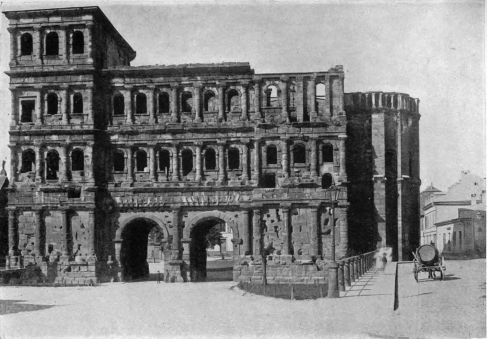
Plate LII. PORTA NIGRA, TRIER, GERMANY
Julius Cæsar had left the Rhine as the frontier of his Gallic provinces, though he had crossed it twice by way of reconnaissance. Quite at the beginning of Augustus’s presidency, the Suevi had had to be chased back across the Rhine, and the Treveri across the Moselle. At this time, Germany was still for administrative purposes a part of the Gallic provinces, and as a rule there was some high officer in charge of both. The Rhine was not impassable to the barbarians, and moreover there were Germanic tribes on both sides of it, such as the Treveri of Trier and the Ubii of Cologne, who were in frequent intercourse with their neighbours on the other side. This made the river a somewhat insufficient boundary. There were inroads of German barbarians in 29, 25, 20 and 16 B.C. In the latter case a Roman legate was surprised and defeated, and the eagle of the Fifth Legion carried off in triumph.
This brought Augustus to the spot, and he spent two years in studying the problems of Gaul and Germany. In 12 B.C. the first campaign was undertaken under the command of Drusus, his younger stepson. Drusus, who was not yet twenty-five, was the most brilliant figure of his day, brave, handsome, virtuous, adored by the soldiers, and a thoroughly capable general. On this occasion he crossed the Rhine and descended into Dutch territory, laying waste the lands of the Sygambri and the other hostile tribes who had provoked these punitive measures. He accepted the submission of the Frisians who lived on the coast of North Holland. During the winter his troops seem to have been employed in cutting a canal from the Rhine to the Zuyder Zee. Next year he crossed again, marched on, and threw a bridge across the Lippe, crossed the territory of the Cherusci—the most warlike of all the tribes—and halted on the banks of the Weser. He built a great fort at the junction of the Lippe and the Alme or Ems, and cut a highway along the banks of the Lippe to join the new fort Aliso with a great camp on the Rhine near Xanten. In the next year there was more building and settling, and in 9 B.C. came the great effort. Drusus marched out into Suabia and Cheruscia, crossed the Weser, ravaging everywhere, and reached the Elbe. This river he essayed to cross, but he could not, and, as the historians put it, omens appeared to forbid further progress. This then was the Roman limit. Somewhere between the Saale and the Weser, Drusus fell from his horse and sustained injuries which resulted in his death. Augustus, though greatly grieved, determined to continue his operations. Tiberius was sent to continue the work, and 40,000 Sygambrians were transported into Roman territory.
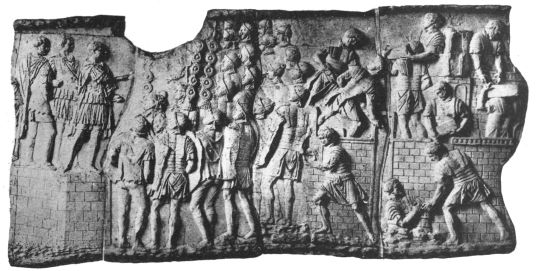
Plate LIII. RELIEF FROM TRAJAN’S COLUMN. I.
We know little of the work of the next dozen years. Another legate reached the Elbe. A great viaduct was constructed between the Ems and the Rhine. During this period the pacification was apparently proceeding with rapidity. Many of the young Germans came into the Roman camp and learnt Roman ways and Latin speech. The head-quarters were still at Vetera Castra near Xanten and at Mogontiacum (Mainz), with summer quarters at Aliso. In A.D. 4 fresh campaigns were undertaken by Tiberius. For many of these expeditions the Roman historians offer no excuse or justification. They record with pride the immense slaughter and devastation that accompanied them. It is hard to resist the conclusion that much of this fighting was undertaken for its own sake, or to exercise the legions. In A.D. 5 the greatest expedition of all was undertaken. There was a great “durbar” at which the wild Chauci and Cherusci handed in their weapons and did obeisance to the Roman general. The Langobardi—later known as the Lombards—submitted, and Tiberius crossed the Elbe itself, while the fleet which had “circumnavigated the recesses of the Ocean” sailed up the river to meet the army with supplies. All seemed to be going well: Germany was nearly conquered. There only remained the powerful kingdom of the Marcomanni under King Marbod, who dwelt in the fastnesses of Bohemia. Marbod was an able ruler who alone in Germany had succeeded in establishing a strong throne, and had drilled a powerful army of 70,000 foot and 4000 horse. As the historian Velleius observes, his Alpine boundaries were only two hundred miles from Italy, and this formidable power was a real menace to the safety of the empire. Accordingly elaborate plans were made for his destruction by an invasion from three sides at once. Unfortunately just at the moment when the armies were converging upon their prey, there broke out the great Pannonian and Illyrian revolt of A.D. 6, which brought all the tribes of Austria down upon the Romans. It was one of the most dangerous moments in Roman history. Fifteen legions were employed against them, and the military resources of the Empire strained almost to breaking-point. Luckily for Rome, Marbod made no attempt to join the revolt, and the barbarians were under divided leadership. Germanicus, the son of Drusus, helped Tiberius to crush them, but it took three or four years to accomplish it.
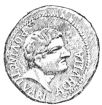
Portrait of Varus
Meanwhile Germany itself had to be content with inferior legates. Quintilius Varus was one of those amiable men who cause mutinies by kindness. He fancied that Germany was tranquil. He went about founding cities, holding assizes, collecting tribute and giving justice according to Roman law precisely “as if he had been a city prætor in the Forum at Rome and not a general in the German forests.” Accordingly in A.D. 9 a plot was hatched against him. He was enticed away into the recesses of the Saltus Teutoburgiensis and slaughtered. Then the Cheruscan army swept down upon the three Roman legions and destroyed them.
In itself the disaster was not overwhelming. Three legions had perished, but fifteen more, flushed with their recent victory over the Illyrians, were at hand to avenge them. The Cheruscans immediately submitted and Germanicus found no serious opposition when he penetrated Germany on an errand of chastisement. But for Augustus the reverse was decisive. He was now an old enfeebled man. When he heard of the disaster he beat his head against the wall and was often heard to cry: “Varus, give me back my legions.” He saw that there was no end to these adventures in the forest and no profit in them. As a frontier the Elbe was no better than the Rhine. Therefore he had the supremely good sense to accept the Rhine as his frontier. Henceforth Rhine and Danube with roads and forts along them, and with special arrangements to strengthen the angle where the rivers run small—that should be bulwark enough for the present. And so it was.
The patriotism of German historians has made of this defeat of Varus rather more than it deserves. Arminius the young Cheruscan who led the attack was a patriot though a traitor. He had been, says Velleius, a faithful ally in previous campaigns and had even attained Roman citizenship and equestrian rank. He spoke Latin fluently. His very name is most probably a Latin cognomen, though the patriotism of the Germans will call him “Hermann.” So the German student of to-day sings over his beer:
Dann zieh’n wir aus zur Hermannschlacht Und wollen Rache haben.
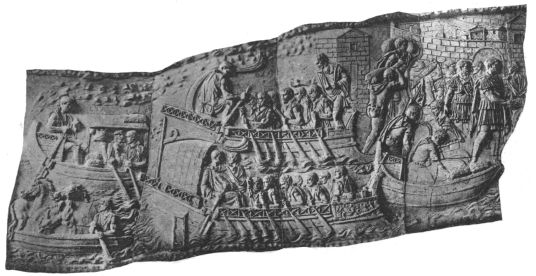
Plate LIV. RELIEF FROM TRAJAN’S COLUMN. II.
It was not half so gallant an act of revolt as that of our British lady, Boadicea, but it had the merit of success. The Germans were able to develop their strength behind the artificial ramparts of the Rhine and Danube until the time came for them to burst through in conquest.
It is commonly said that Augustus immediately after A.D. 9 formed two provinces called Upper and Lower Germany along the Rhine as if to conceal his loss of the real Germany. This is not exact. In the warfare of Tiberius’s days the historians speak only of the Upper or the Lower Army in Germany, and Augustus in his monument speaks of Germany in the singular. Under Tiberius ample revenge was taken for the defeat and Germanicus again and again traversed Germany. The Varus disaster was only one of the episodes which decided the Romans to halt at the Rhine. Aliso was long retained as an outpost, and colonies of Roman veterans were planted on German soil. The Cheruscans and Arminius were defeated in a tremendous battle at Idistavisus near Minden on the Weser in A.D. 16. But on the way back the Roman fleet was shipwrecked and a great many prisoners fell into the hands of the Germans. Some of these were sold as slaves to the Britons and many eventually returned to Rome bringing back marvellous stories of their adventures. As for Marbod, he was defeated in a battle with the Cheruscans and took refuge on Roman soil, where he lived for eighteen years at Ravenna. Arminius, his conqueror, began to play the tyrant in his native tribe and was slain by the treachery of his kinsmen at the age of thirty-seven. His wife Thusnelda and his son had long ago fallen into the hands of the Romans and the boy grew up as a Roman citizen.
The headquarters of the Rhine legions continued to be at Mainz and Xanten with summer quarters at the new Colonia which became Cologne. Four legions of the Upper Army were stationed at the former, and four of the Lower Army at the latter. In due course, we cannot say when, these became the centres of two separate provinces. On the Danube there were three legions in Pannonia, the great new Austrian province. Along this frontier there was now a double line of Cæsarian provinces. Rhætia and Noricum were conquered in 15 B.C. Then there were tedious and unprofitable campaigns in the southern Swiss valleys as the result of which a row of little Alpine prefectures was established. There is still a fine monument to Augustus on the heights above Monaco enumerating forty-six Alpine tribes made subject to Rome. It was erected by the gratitude of the Italian farmers, for the Alpine tribes had always scourged the plains. Roads were constructed here and there over the Alps. The principal pass to Germany lay by way of Turin and the St. Bernard with Augusta (Aosta) to guard it. In Pannonia the old route from Aquilegia over the Julian Alps was restored and a new Via Claudia constructed up the valley of the Adige from Tridentum (Trent) to Augusta (Augsburg). To round off the Danube frontier Mœsia or Mysia was conquered quite at the beginning of the period and added as an Imperial province, probably in A.D. 6, under a prefect. It stretched along the south bank of the Danube, down to the Black Sea, and embraced part of the Balkan high lands. Thus with strong legions posted in permanent encampments all along the Rhine and Danube, Rome had now a satisfactory northern frontier which only required guarding to keep Rome and Italy in security.
Spain had never been entirely subjugated though it had been in the possession of the Republic for nearly two centuries. Parts of it indeed were almost as Roman as Rome. Gades and Corduba, for example, were centres of learning and literature, soon to produce citizens of renown in Lucan, Seneca, Martial, Quintilian, and an emperor in Trajan—a most distinguished galaxy. But a great part of Spain was still in the hands of wild and chivalrous barbarians. Particularly in the north-west the Cantabrians and Asturians were a menace to the peaceful province. For eight years and more the Romans continued to fight them with brief intervals termed “victories.” Augustus himself came over in 26 B.C. and directed operations comfortably from Tarraco. The leader of the rebels was a hero-chief called Corocotta who so exasperated the Romans that
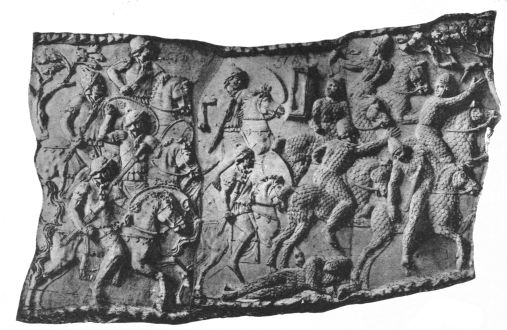
Plate LV. RELIEF FROM TRAJAN’S COLUMN. III.
Augustus offered £10,000 for his capture. This sum the brigand earned by walking into the Roman camp to surrender, and Augustus, charmed at the idea, gave him his liberty as well as the reward. He married a Roman wife and died a Roman citizen as Gaius Julius Caracuttus. Cæsar himself fell seriously ill in the course of the long campaign. Both sides increased in ferocity. The Romans crucified their prisoners and the Spaniards mocked them from the cross. Finally Augustus had to send for Agrippa to finish the business, which he did in 19 B.C. Now Spain was really conquered for ever and even the northern highlanders laid down their arms and accepted civilisation. Bætica, the southern part of the peninsula, was given to the senate to govern, and the northern half divided into the two imperial provinces, Tarraconensis and Lusitania, the latter corresponding roughly to modern Portugal. In Spain also altars were erected to Rome and Augustus. Roads radiated out from Tarraco. Many towns were founded, such as Cæsar Augusta (Saragossa), Augusta Emerita (Merida), Pax Julia (Beja), Legiones (Leon), Asturica Augusta (Astorga). The Celtic religion and probably the very language quickly became extinct. Even in the time of Augustus there were fifty communities with full Roman citizenship. New mines were discovered and vigorously worked, new industries, especially in metal, carefully fostered.
This brief and imperfect sketch of the Roman Empire, as it took shape under the all-seeing eye of Augustus, should indicate, more than all the triumphs she won in battle, more, even, than the story of the Punic Wars, the real “Grandeur that was Rome.” The true greatness of the Roman lies in his indomitable energy and his practical good sense, not to be obscured by the surface of rhetorical culture which had come to overlay it in these latter generations. Now that Rome had at last secured for herself a reasonably secure and sensible form of government, she was able to exercise her natural capacity for affairs and to play the part which destiny had assigned to her of propagating civilisation throughout Europe. If the historians would allow us, we should gladly turn away from the wars and proscriptions to study the quiet useful work which she was performing now and henceforth in every corner of her empire. The motive was, no doubt, self-interest, but it was that broad and far-seeing selfishness which in the realm of public affairs is the nearest approach to altruism. The Republic that sucked the blood of her provinces is detestable to all right-thinking men. The autocracy that cleared out the canals in Egypt, planted flax and encouraged pottery in Gaul, irrigated Africa and taught agriculture to the Moorish nomads, set the wild Iberians to mining and weaving, built aqueducts and roads everywhere, established a postal system and policed land and sea so effectively that a man might fare from York to Palmyra, or from Trier to Morocco “with his bosom full of gold,” may be tyranny governing in its own interests, but it is an institution for which the world has every reason to be grateful.
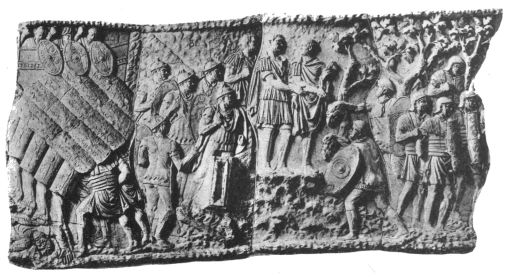
Plate LVI. RELIEF FROM TRAJAN’S COLUMN. IV.