V THE FOURTH CENTURY
Reading edition
But Greece and her foundations are Built below the tide of war, Throned on the crystalline sea Of thought and its eternity. Shelley.
Athens
HE pre-eminence of Thucydides among Greek historians has, I venture to think, somewhat distorted the true perspective of Greek history. The absorbing interest with which we follow his account of the Peloponnesian War to its close in the downfall of Athens leads us to regard all the rest of Greek history with that slackening of interest with which we commonly regard a sequel. The truth is that Athens rose from her knees after an interval, much chastened, considerably exhausted, certainly poorer, but with as much intellectual vigour and power of artistic creation as before. The Athens that we know intimately is the Athens of the Restoration. Really we know almost nothing of fifth-century Athens but her external politics and the remains of her monuments. The restored Athens is the city of Plato, of Demosthenes, and of Praxiteles. She has still to be the mother of philosophy, ethics, oratory, political science, comedy of manners, logic, grammar, and the essay and the dialogue as forms of literature. This is the only Athens which we know at all intimately from within.
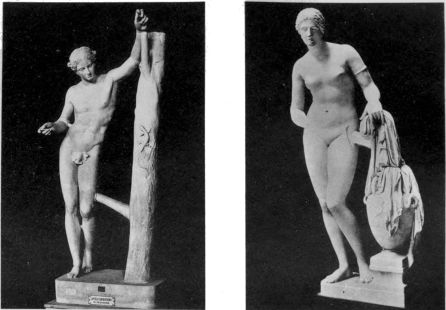
Fig. 1.—Apollo Sauroctonos. Fig. 2.—The Cnidian Aphrodite.
Plate 61.
The Long Walls were to be pulled down in order that Athens might be separated from her harbours and become in fact an inland city like Sparta herself. Down they came to the music of flutes, and Athens consented to become the “ally” (euphemism for “humble servant”) of Sparta. The moral of it all for imperial cities would seem to be: (1) the precarious nature of sea-power unless backed very strongly by purse-power; (2) the danger of having unwilling allies or dependents; and (3) the impossibility of conducting war by means of public debate in a democratic assembly. On two occasions near the end of the war and the century the Athenians had tried experiments in constitutional revolution. For, indeed, during the closing stages of the war even the citizens of Athens could see, what was painfully obvious to the rest of the world, that she was not well governed for the purposes of external politics. Popular institutions exist for the sake of popular liberties. There are better ways of maintaining order, if that is your prime object, and much better ways of securing “efficiency.” Democracy may “reign”; it cannot “govern”—not, at any rate, without the help of a trained bureaucracy. Above all, in the conduct of a war a meeting of citizens in the market-place is the clumsiest deliberative body that can be conceived. We have seen how ignorant they were when they embarked on the Sicilian expedition without knowing anything more than interested parties chose to tell them of the resources of their allies and the disposition of the other Sicilian Greeks. Besides ignorance, they had shown hasty passion in condemning the whole male population of Mitylene to death; they had been ferociously unjust in sentencing their admirals to death for not stopping to pick up the shipwrecked survivors after the victory of Arginusæ. They had made childish blunders in strategy, as when they chose three hostile generals to conduct the Sicilian expedition, and in statecraft when they refused peace and drove their cleverest citizen, Alcibiades, over to the side of the enemy. But the most effective argument of the oligarchic party was based on finance. With the cessation of the tribute from the allies it became simply impossible to maintain the host of state functionaries which democracy developed and demanded. Further, democracy was, as we have seen, identified with anti-Spartan policy; Sparta would make no terms with democracy. And, lastly, when the brilliant Alcibiades had been banished by the democracy, he professed to have the Persian satrap, the universal paymaster, in his pocket, and he demanded a revolution as the price of his return. Such were the arguments insinuated by the oligarchs. This party was working incessantly in clubs and secret societies about whose methods of organisation we are woefully ignorant. In 411—that is, two years after the failure of the Sicilian expedition—these intriguers had their way, and Athens consented to try the experiment of oligarchy “until the end of the war.” Government henceforth was to be in the hands of a council of 400, for government by council is the prevailing feature of oligarchy. But, like most Greek oligarchies, Athens was also to have a sort of select Assembly, consisting of 5000 of the well-to-do citizens. The number of 5000 seems to represent the hoplite body of the Athenian army. Thus Athens was imitating Sparta in limiting citizen rights to her fully equipped land warriors, and excluding the “naval mob” who were her real strength in war. As usual in oligarchies, even this purged Assembly seems to have been for show rather than for use. The government was, in fact, what it is generally called, a Government of the Four Hundred. Fortunately for human liberty the experiment was not a success. It only lasted for three months. The Four Hundred had, it is true, come rather late upon the stage if they were to bring the war to a successful conclusion. But they failed to do anything useful, and their accession to power was marked by a failure at sea and the loss of Eubœa. Assassination, a pleasantly rare weapon in Greek politics, removed the leader of the oligarchs, and Athens reverted to democracy.
Once more, however, at the very end of the war, when the city surrendered, Athens had perforce, at the bidding of
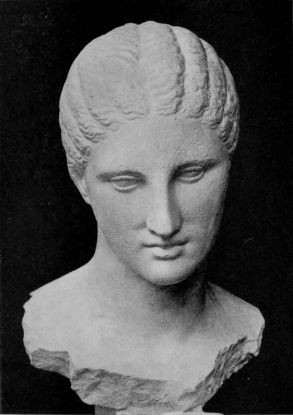
Plate LXII. GIRL’S HEAD
Eruckmann
Lysander, her conqueror, to revise her constitution in an oligarchic direction. Once more the sacred laws were thrown into the melting-pot, and there were elaborate programmes, and discussions as to the precise form of oligarchy which should be adopted. But while the preliminaries were going on the administration fell into the hands of a board of so-called commissioners charged, like Oliver Cromwell, with the revision of the constitution. Like Oliver these men soon found themselves in a position of power too good to be lost. They were called the Thirty Tyrants, and they deserved the name. They ruled with a strong hand, banished their enemies, disarmed the citizen army, and began a system of private plunder, with the spears of the Spartan garrison to enforce their commands. Athens never forgot and never forgave this nightmare of the Thirty. Most of them were men of talent, some of them were philosophers and literary men who had sat at the feet of Socrates. Critias, the Robespierre of the party, quarrelled with Theramenes, its philosophical Danton, an advocate of the “moderate Constitution,” and sent him to execution. Before very long, one is glad to know, honest men (by which term one means, in this instance, democrats) were gathering on the borders of Attica, and under the leadership of Thrasybulus won their way home and crushed the “gentle Critias” and his gang for ever.
The year 402 is the year of restored democracy. It is called the archonship of Eucleides, who is not our Euclid, but another man of the same name. We hear no more of oligarchy at Athens. Henceforth she is a democracy, as before and more so. Where Athenians had formerly got cheap corn they now got it for nothing. Where they had formerly received a fee of threepence for public duties they now got fourpence-halfpenny. According to Aristotle more than 20,000 persons were in receipt of State payment. However much business the company might transact, the shareholders were determined upon one thing—to pay dividends to one another, with a bonus in exceptional years. It is hard to say where the dividends came from. No doubt there was a good deal of commerce and banking business at the Peiræus, mostly in the hands of half-naturalised foreigners. The rich were bled unmercifully, so that they tended to emigrate or grow poor. And yet in the fourth century Athens was steadily rising in the political scale. A glad day came when her admiral Conon, with Persian help, was able to rebuild her Long Walls. She started a new maritime league, under better safeguards, this time, for the allies. She even recovered something of an empire. She could not afford statues in ivory and gold, but she built her theatre with stone, laid out a stadium, and produced many charming works of art. In short, though her ambitions were curtailed, life was very free and full, and, I believe, very pleasant, in fourth-century Athens. Her statesmen had to be content with smaller schemes; they were a good deal concerned with finance: indeed, it was hard work to make both ends meet. Generals complained that they got no pay; and now that hired troops were in vogue warfare was an expensive pastime. The Athenians were rather more hysterical than before, even more apt to make Byngs of their unsuccessful admirals. They talked more than ever, and did rather less. But on the whole they were well governed, and they played a not unimportant part in the warfare and diplomacy of Greece. The restored democracy was a success.
While Athens is recuperating her strength we may turn aside for a moment to watch two other States make their successive attempts to hold the overlordship of Hellas; remembering all the time that the northern horizon is already dark with the storm that is going to sweep the whole of ancient Greece into political insignificance.
Sparta and Thebes
The first episode of Greek international history in the fourth century is a Spartan domination, lasting less than thirty years, but generally considered as one of the imperial experiments of Greece. In addition to her own permanent hegemony over the
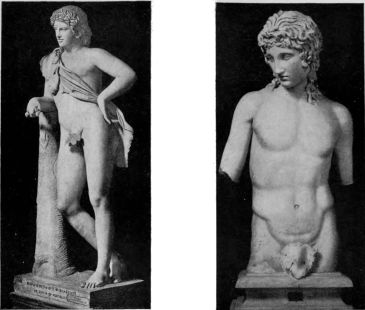
FIG. 1. THE MARBLE FAUN, AFTER PRAXITELES FIG. 2. THE EROS OF CENTOCELLE
Plate LXIII
greater part of Southern and Central Greece, Sparta had now stepped into the uncomfortable shoes of Athens, and found herself the mistress of more than a hundred island or seaport “cities.” Now Sparta, as she was frequently reminded, had gone into the Peloponnesian War as champion of the liberty of Hellas against a tyrant city. She had gained the day partly through the virtue of that charming phrase, but I doubt whether anybody seriously expected her to set the Ionian cities and islands at liberty. They were not used to liberty, and would not have known what to do with it. They had utterly lost the habit of fighting or doing anything but pay for their own safety. They were too lazy and broad-minded to care very much where their tribute went. None of them had been enthusiastic about its previous destination. We hear of no bitter lamentations when they discovered that Sparta was selling them wholesale back to the Persians. Pharnabazus and Tissaphernes, the western satraps of the Great King, seem to have been easygoing gentlemen of normal Eastern calm and duplicity. They were not of the stamp of conquerors or despots, but they had heaps of money and were adepts at making and breaking treaties. Sparta both by geography and by habit was an inland power. She never produced more than one competent admiral, and that was the man now at the zenith of his power, Lysander. As Sparta had now inherited a maritime empire, and as she was unable and unwilling to embark definitely upon a naval career, it became necessary to organise a system of garrisons and governors in every city under her sway. This work of organisation fell to Lysander—the nearest equivalent to a Cæsar that Greece ever produced. The Spartan empire, such as it was, was Lysander’s handiwork. Of course every state that came into Spartan hands was forcibly converted to oligarchy. This has often been represented as another example of Sparta’s tyranny. But a survey of Greece will soon convince us that oligarchy, and not democracy, is the normal condition of the Greek polis; and, in fact, with a few rare exceptions, it is only Athens and the states directly under her influence which are democracies. But Lysander was corrupt, and he entrusted the government in each town to a group of local aristocrats who had won or purchased his interest. Thus the states of the Spartan empire were generally governed by a Council of Ten, working hand in glove with a Spartan captain and a Spartan garrison. Athens, as we have seen, was also accustomed to send garrisons where she conquered. But all that we know of the Spartan temper assures us that the little finger of Sparta was thicker than the loins of Athens.
Like Pausanias before him, Admiral Lysander became intoxicated with success. A very little liberty and luxury was enough to bring giddiness to the ascetic heads of Sparta. Lysander began to think revolutionary thoughts of a Sparta where men could be rich and free like the rest of the world. And the infection spread. Sparta was now earning a thousand talents a year from her empire, and though money was still forbidden at home, and though Sparta had as yet absolutely no coinage of her own, private Spartans were unquestionably getting rich quickly. A rich Spartan was a horrid anomaly: there was nothing that money could buy in Laconia except land. Hence family estates began to change hands faster, and the class of landless, therefore voteless, men of Spartan blood rapidly multiplied. It was Sparta’s boast that she alone in all Greece had never suffered a revolution. She never came so near it as on the present occasion, when Lysander with his riches was trying to subvert the Lycurgean constitution by bribing the Delphic oracle, and the discontented Inferiors at home were planning a secret rebellion. Both failed: the conspiracy of Cinadon was detected by the vigilant Ephors and ruthlessly crushed, while Lysander in playing the part of king-maker unwittingly made a king who was his equal in ability. Very soon the conqueror of Athens found himself unnecessary to Sparta, and had to submit to the indignity of being tried and pardoned.
The new king was Agesilaus, whose long and important career was the subject of many biographies. He it was who pointed the path of glory to Alexander by revealing the utter incapacity of the Persians to guard their treasures. For Sparta had quickly fallen out with the satraps, and Agesilaus marched about the Phrygian and Lydian coasts gathering plunder with very little difficulty. One of the biographers of Agesilaus was his friend and admirer Xenophon, who was concerned in a great adventure which likewise served to betray the weakness of the Persian empire.
The British schoolboy, fleshing his young teeth upon the “Anabasis” of Xenophon, struggling in a wilderness of parasangs and paradigms and puzzling out what Cheirisophos said and where they pitched camp that night, seldom realises the romantic nature of the enterprise. There was a dynastic struggle in Persia. Cyrus, a bold and able prince, was disputing the succession to the throne with the rightful successor, Artaxerxes. Knowing the weakness of his native troops, Cyrus conceived the idea of stiffening them with ten thousand hired Greeks, for by now the use of mercenaries was growing more frequent in the Greek world. These troops were mostly Spartans, their leader was Clearchus, a Spartan, and Xenophon of Athens was a volunteer under his command. They were recruited without knowing the full nature of the enterprise, and it was only when they found themselves in the heart of Asia that they learnt to their horror that the objective was the far-distant capital. At length they reached Cunaxa, near Babylon, where a mighty host opposed their advance. In the battle Cyrus was killed and the native portion of his troops fled or surrendered or were slain. But the Greeks had fought so valiantly that the victorious army of Artaxerxes did not care to attempt their capture, though the crafty Tissaphernes succeeded in assassinating their leaders and leading the army astray into the wilderness. Thus the Ten Thousand found themselves stranded in a hostile country, without generals and without guides, nearly two thousand miles from home. But being Greeks, with a proper contempt for the barbarian, they scorned to lose heart, though the chance of a safe return must have seemed hopeless. The strong political instinct of the city-state was their salvation. They resolved themselves into a wandering polis, held assemblies, made speeches, elected generals, with Xenophon among them, and preserved perfect self-control and discipline. So began the Catabasis, an immense and dangerous march north-westward, through the passes of the Taurus and the uplands of Armenia, fighting the wild Kurds of the hills, struggling with cold and hunger, utterly ignorant of geography except for the belief that if they went on long enough in the same direction they would some day reach the sea. Their glad cry of “Thalassa! Thalassa!” when at last they saw the shining waters of the Euxine is a cry that has echoed through the ages. Henceforth they were passing through the series of Greek colonies that fringed the south coast of the Black Sea. Though many more adventures awaited them and they were seldom very welcome visitors, yet no fewer than 6000 reached home, and, we trust, lived happily ever afterwards. Not so much the fighting as the courage of the march and the sense of discipline make this one of the finest exploits in Greek history.
As for Xenophon, he retired to spend his leisure and his money close to his beloved Sparta. Purchasing an estate near Olympia, he devoted his veteran days to literature and sport. His life in Triphylia is a picture of the retired sporting colonel of religious and aristocratic tendencies. He regards his estate as a stewardship for the goddess Artemis. He builds her a shrine, an altar with a statue of cypress-wood modelled on the temple and golden statue of Ephesus. Hard by was a river full of fish, and an orchard, with pasture-lands and upland game preserves, abounding in wild boars, gazelles, and deer. Every year he gave a sacrifice to the goddess, and invited his neighbours to the feast. There would be barley porridge, wheaten loaves, and sweetmeats. Game had previously been supplied by a day’s hunting on a large scale, in which Xenophon’s sons conducted the operations and all the neighbours took part if they liked.
Xenophon is one of the most accomplished and versatile of
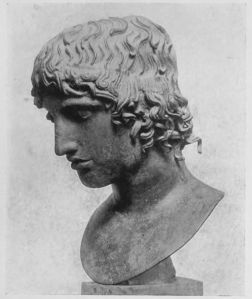
FIG. 1. HEAD OF A YOUTH
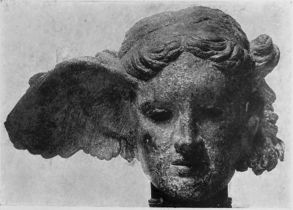
FIG. 2. WINGED HEAD OF HYPNOS
Plate LXIV
minor writers. He wrote, besides his “Anabasis,” a treatise on hunting, with valuable information on the breeding of horses and hounds; he wrote memoirs of his beloved but little comprehended master in philosophy, Socrates, who had been put to death at Athens while Xenophon was on his expedition; he wrote also perhaps the earliest European work of prose fiction, in which he sketched the proper training of a prince and a gentleman, under the title of “The Education of Cyrus”; he wrote a history of Greece beginning where Thucydides left off and ending with the downfall of Sparta; among his minor works are treatises on finance, on the duties of a captain of horse, and a glowing panegyric on the Spartan constitution. An equally warm indictment of the Athenian democracy is falsely ascribed to his pen. He was an aristocrat and philo-Laconian by sympathy, and the democracy of Athens had earned his displeasure by slaying Socrates and by banishing himself. That was only natural, seeing that he had taken Spartan service in the field against her, and she seems very generously to have allowed him to return home before the end of his life. In his versatile intelligence, his cosmopolitan habits as a soldier of fortune, in his youthful enthusiasm for philosophy, and in the journalistic spirit which prompted him to write pamphlets on any topic which interested him, no less than in his dislike of democracy, Xenophon is perhaps the most characteristic figure of the fourth century, though he is too military and too conservative to be a typical Athenian of any age.
Greece did not, of course, enjoy peace during the thirty years of Spartan predominance. It could never be said at any point of Greek history that the land had rest forty years. There was fighting in Asia Minor against the Persians, and fighting in Greece round the Isthmus, a tiresome and lengthy struggle with discontented allies, generally called the Corinthian War. We cannot get a clear conception of the life of a Greek state unless we realise that peace was an abnormal condition.
During the period of which we are speaking there had been some important developments in the art of war. As the soldier is the most conservative of men with the exception of the priest, so next to religion warfare is the most conservative of human activities. Field tactics had altered little since the Persian wars. A Greek battle still depended on the shock of two lines of hoplites, largely a question of weight in impact. If you could once cut your opponent’s line the victory was yours, because then you found his right or shieldless side open to your spear. A Greek soldier with his heavy shield on his left arm could only defend his front and left. For this purpose the men stood shoulder to shoulder in a line made as deep as possible, for the sake of weight in the scrimmage, and, I fear, to prevent the Greek disorder of running away.
It was the secret of Spartan pre-eminence in war that a Spartan hoplite never thought of running away. But now in this fourth century we enter upon a scientific age when men are beginning to apply their reason logically to all the activities of life instead of trusting to habit. Soldiering, as in the case of the Ten Thousand, is passing over from amateur patriots to mercenary professionals. It is clear that if new ideas are to revolutionise the art of war, the supremacy of Sparta is doomed. Strong arms and thick skulls flourished in the vale of Eurotas. Sparta had a rude shock when an Athenian condottiere named Iphicrates cut up a Spartan company of hoplites with a newfangled battalion of his own training, a body of drilled light infantry. And now in the fullness of time Bœotia was to produce its man of genius—Epaminondas the Theban.
In 378 Sparta had sold the Ionian cities back to the Great King, who sent down from Susa a beautiful treaty saying, “King Artaxerxes thinks it just that Asia Minor and the Ionian islands shall belong to him, and that the rest of the cities of Greece, both great and small, shall be independent.” That was really the end of Sparta’s dream of an oversea empire. She had found it too fatiguing for a land power. Armed with this treaty, she began to run amuck among her neighbours. She assailed the Arcadian city of Mantinea and tore it up into villages. One of her captains marching past Athens made a
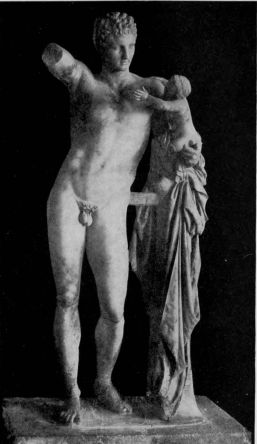
Plate LXV. THE HERMES OF PRAXITELES
English Photo Co., Athens
dash for Peiræus, but was fortunately foiled. Another had played the same trick on Thebes, this time successfully, for he seized and garrisoned the citadel. His outrageous performance was approved at home, but it seems at last to have roused the sluggish spirit of the dwellers in the Bœotian marshes. There was a delightfully romantic conspiracy organised from Athens, and a body of Theban patriots liberated their city. Among the patriots was Pelopidas, a brave and skilful soldier, and his friend was Epaminondas, one of the greatest men in all history.
Two qualities, in addition to the ordinary human virtues of courage and wisdom, seem to distinguish Epaminondas: he showed originality even in the art of war, and he had the broad mental vision which we demand from statesmen but seldom find in Greeks. I do not see any proof that he possessed the full spirit of Panhellenism; he was emphatically a Theban first, whatever he might be afterwards. But he had, it seems, an eye for an international situation. It is the measure at once of his success and of his failure that the rise and fall of Thebes is exactly conterminous with the rise and death of Epaminondas.
Thebes and Athens had both suffered from the wanton aggression of Sparta. They now made common cause to avenge it, and at the battle of Leuctra (371) Sparta suffered defeat in a pitched land battle on a great scale for the first time in her history. The victory of Thebes was wholly due to the new tactics of Epaminondas. He had formed a Theban corps d’élite, composed, in a fashion strikingly characteristic of the Greek mind, of 150 pairs of lovers sworn to conquer or die together. Thus he pressed into his service the only romantic feeling which the Greeks understood, the relation between David and Jonathan or between Achilles and Patroclus. This Sacred Band formed the front of the left wing. Further, whereas the whole Spartan line was drawn up as usual with a uniform depth of twelve spears, Epaminondas made his left fifty deep and flung it forward in the attack. The extra weight of this deep wing broke the Spartan right. King Cleombrotus and a thousand Spartans were slain. The loss of men was serious for a little state like Sparta, but the loss in prestige was even worse. This, in Xenophon’s story, is how the news came to Sparta: “It chanced to be the last day of the Boys’ Gymnastic Festival, and the choir of men were therefore at home. When the Ephors heard of the disaster they were sorely grieved, as in my opinion was bound to be the case, but they did not send the men’s choir out or stop the games. They communicated the names of the fallen to their relatives, but they warned the women to bear their loss in silence and not to make lamentation. So next day you could see the families of the slain going about in public with cheerful, smiling faces, but as for those whose menfolk had been announced as living, they went about in gloom and shame.” So Lacedæmon set itself with dogged resolution to endure what the gods might send.
Epaminondas with true insight determined to raise up a counterbalancing power in the Peloponnesus to hang upon the flank of Sparta if she should ever again try to tyrannise over Greece. His plan was to form city-states among the Arcadians and Messenians, those backward children of Nature who had always preferred a village life among their hills. Mantinea was restored to the rank of a state, Messenia was given a new capital, and a new and splendid city was specially constructed to unite several scattered Arcadian villages in one interesting federal constitution. But the Great City, as she was proudly named, was not a great success. Perhaps the Arcadians were too arcadian in their habits to fulfil the scheme of Epaminondas. It is very characteristic of the Greek mind that the news of Theban triumph was very ill received in the city of her ally Athens. Athens might cherish a respectable hereditary feud with Sparta, but Thebes she had always detested. Thebes was her next-door neighbour. Though you might have to fight a Spartan, you couldn’t help liking him. Once again the orators drew upon that inexhaustible precedent of the Persian wars, when Sparta and Athens had stood together against Thebes and Persia. So Athens was persuaded to draw away from
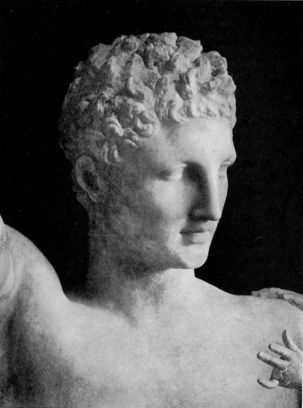
Plate LXVI. THE HERMES OF PRAXITELES: HEAD
English Photo Co., Athens
Thebes and form an alliance upon equal terms with Sparta. But her action was not very vigorous.
The nine years between the battles of Leuctra and Mantinea are commonly described by historians as a period of Theban hegemony. It is true that Thebes was probably on land the most powerful state in Greece, and that Epaminondas played the foremost part in the diplomacy of that period, but she had no great following of states, and as Athens, Sparta, and Corinth were among those who declined to follow she can hardly be said to have led Greece. Also it is interesting to notice that the liberal-minded Epaminondas found it just as impossible as Athens and Sparta had done to hold a Greek alliance together without the use of garrisons. He sent harmosts into Achaia and Sicyon. Thebes also was as ready as Sparta to interfere with constitutions. We can understand Sparta, with her aristocratic habits, showing a prejudice for oligarchy, or Athens, the city of liberty and free speech, encouraging democracy, but that Thebes, herself oligarchically constituted, should now enforce democracy upon her allies can only be a piece of cold-blooded diplomacy due to the knowledge that oligarchies were generally committed to the Spartan side. Nor can Thebes be acquitted of trafficking with the enemy. For Pelopidas was sent to Susa to plead the ancient alliance of Thebes and Persia at the battle of Platæa! In these three respects all the hegemonies of Greece are alike, all tarred with the same brush.
Thebes tried to kill the snake she had scotched at Leuctra. Several times she started to smoke out the Spartan nest. Twice she penetrated the inviolable precincts of Sparta, but each time when she looked into the streets of the unwalled city and saw the Spartan warriors standing at arms before their temples and hearths, she only looked—and found more pressing business elsewhere. Let one chronicler at least decline to quit that sinking ship. The foolish Arcadians might brag of their ancient descent as children of the soil; but the Spartans, under their old lion Agesilaus, could still scatter Arcadians with the wind of their spears in a “Tearless Battle,” wherein not a single Spartan perished.
So we come to the last great fight of this epoch—that of Mantinea. Here Spartans and Athenians fought on the same side against Thebes. The Theban tactics were the same precisely as at Leuctra, and the Spartans had learnt nothing by the experience. They saw the line advancing en échelon, they saw the deepened left wing, and they took no steps to counteract it. As before, they were broken and routed. But in the hour of defeat a chance spear found its billet in the body of Epaminondas, and, like Wolfe on the Heights of Abraham, that hero fell in the hour of victory. When he heard that the two men he had hoped for as his successors had also fallen he cried to his followers to make peace with Sparta, and so expired. The star of Thebes waned with his death; and, indeed, all the fires of the Greek firmament soon paled before the rising sun of Macedonia—and Philip had learnt warfare from Epaminondas.
Fourth-century Culture
In the fourth century—or rather in that earlier half of it which forms the theme of the present chapter—Greek art pursues its inevitable course of development. Perhaps the wasting influence of the Peloponnesian War, that most wasteful and unsatisfactory contest, had brought a touch of disillusionment upon the high ideals and youthful hopes with which the Grand Century had set forth. Perhaps there may be something in the racial theory, which holds that the vigorous Northern strain was beginning to succumb to the influence of a Southern climate, while the artistic temperament native to the South was reasserting itself and disturbing the equilibrium between clever and brave. But it may have been simply the working of some law of Nature that all arts pass from the phase of earnest endeavour to that sense of triumphant mastery which so fatally entices into luxuriance. In sculpture I think we shall see that it was thus with Greece. There is unquestionably in
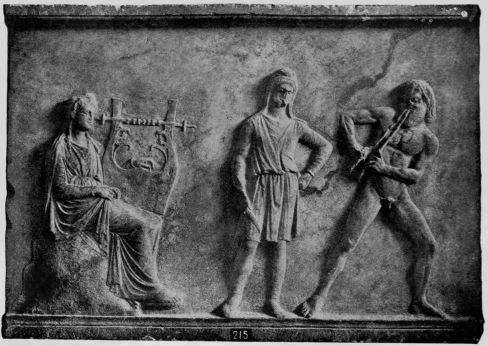
Plate LXVII. APOLLO AND MARSYAS
English Photo Co., Athens
the fourth century some slackening of purpose, some loss of ideals, some tendency in the direction of prettiness and languor.
But we must not yet begin to speak of degeneration. The Hermes of Praxiteles and the “Republic” of Plato are not works of decadence. Some modern historians are rather vulture-like in their scent for decay. They show an unseemly gusto in tracing the causes of decline and fall of states, so that they begin the post-mortem long before the breath is out of their patient. Greece of the fourth century is still very active and vigorous, still improving the old arts and inventing new ones. Fourth-century Athens is far too like twentieth-century England for an Englishman to feel quite comfortable in using the term “degeneration” of her.
In politics, for example, she was beginning to make things much less comfortable for the rich. With taxes upon unearned increment she was beginning to drive capital out of the country, so that millionaires could no longer be found to undertake single-handed the “liturgy” of equipping a battleship, but had to be grouped in companies for the purpose. Statesmen, too, were throwing off the dignified reticence of the old regime, to parade the most sordid financial considerations, and to set class against class, by reminding the poor how much nicer it would be if they were rich. Even more was done for the poor now than formerly; they were taught to look to the State for cheap food, and even free education. The principle of payment of members was introduced. Conservatives were alarmed by the growing numbers of state functionaries openly drawing salaries from the Treasury for the duties which they performed, instead of leaving those duties to be neglected, or expecting the rich to perform them in their spare time and recoup themselves in less odiously public fashions. In international relations there was some abatement of nationalist frenzy; in colonial systems there was a marked advance in the direction of federalism, accompanied by a devolutionary process towards local government. In the theatre there was a movement towards lighter entertainments and highly elaborate musical comedies, with lavish display in the matter of dress and scenery. Favourite chorus-girls made large incomes, and sometimes married very respectably indeed. In sport, too, there was a growing tendency to professionalism, much deplored by old-fashioned people. Boxers and wrestlers no longer considered the grace of their movements, because they found that victory was apt to follow more consistently upon hard training and an animal diet. In literature, as we shall presently see more fully, poetry was beginning to yield to prose, and prose was becoming more businesslike and scientific. In social life thinkers were beginning to raise the problem of sex, and even women themselves may have joined in the agitation for some measure of justice for their sex. Euripides, indeed, who is rather apt to go further than modern delicacy permits in his treatment of social problems, had actually made his Medea utter these audacious words: “I would rather stand thrice in the line of battle than bear a child once.”
If we had to sum up the new characteristic of the fourth century under a single phrase, we should perhaps be justified in saying that the professional spirit was making itself felt in all directions. We see it in the military art, where the citizen hoplites, with their extremely simple tactics and strategy, are yielding to trained bands under professional captains. The statesmen are now no longer the famous generals of the day, nor men marked out by birth and wealth for high position, but trained speakers, and often professional pleaders. Literature is no longer in the hands of men like Æschylus and Sophocles, who were soldiers or generals as well, though Xenophon is of course a notable example of the writer who takes literature among his other activities. But now there are professional sophists teaching oratory and various literary arts. Books circulate freely, schools of professional philosophers arise, as in Plato’s garden of the Academy. This specialisation naturally involves an increased attention to technical processes, a more scientific and less human outlook, and a growth of self-consciousness. For example, it is now that constitutional histories begin to be written. While people are young and
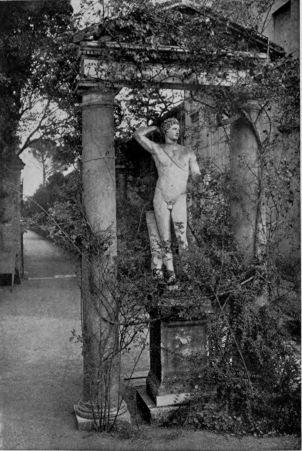
Plate LXVIII. MELEAGER: HEAD AFTER SCOPAS
Anderson
strong they are apt to take their constitutions for granted. Greece is now grown to full stature, and beginning to grow introspective and emotional.
The public taste has changed somewhat in matters of art. The impoverished States of the fourth century no longer lavish their wealth upon glorious temples, and sumptuous statues in ivory and gold. Private dedications occupy more of the artist’s time, and though the subjects are still of a religious and ideal character, yet the gods have become a great deal more human. Herein we may probably see the influence of Euripides. The heroes of the epic cycle no longer possessed much interest for their own sake. Jason and Medea only raised for Euripides an absorbing problem in matrimonial relations. So the Apollos and Aphrodites of the fourth century are as human as the Madonnas and St. Sebastians of the sixteenth. Psychology intrudes upon art. Allegorical impersonations begin to be popular among the subjects of statuary. Human portraiture also begins, though slowly, to be practised with some realism. Nudity in sculpture, which had hitherto been mainly confined to athletic works, where it is obviously appropriate and necessary, is now extended even to images of deities, and under the chisel of Praxiteles Aphrodite uncovers her loveliness and modesty. Eros, too, her son and tormentor, becomes a popular type, not yet as the chubby babe of Græco-Roman times, but as an “ephebus,” almost full-grown, with long wings upon his shoulders. Hermes, as we have already remarked, begins to replace the more vigorous Apollo as the youthful type of celestial beauty. Nevertheless this growing worship of human grace has not yet suffered any visible taint of sensuality. Whether or not it leads that way is a question for the future to decide, but Greek art has not yet lost its reticence and dignity.
Sculpture
Meanwhile the artist has improved enormously in the technical details of craftsmanship. It was now only a foreign potentate who could give commissions for statues in such splendid materials as were at the disposal of Pheidias. Bronze was still the ordinary material for important works, but marble, which had formerly been chiefly used for ornament in architecture, was now commonly employed for statues even by the great masters. With more serviceable tools for drilling, sawing, and pointing (where that rather mechanical process was employed), the great artists of the fourth century could play upon marble as if it were wax or clay. They could represent textures and surfaces by the degree of their finish, so that the leather of the shoe is of a surface distinct from the skin of the foot in the Hermes of Praxiteles. There is an extremely subtle contrast between the leopard-skin and the flesh of the young Satyr by the same artist in the admirable torso copy which is in the Louvre. Whereas earlier artists had tried to represent hair by grooves gouged out upon the surface of the head or by rendering each tress as a separate thread, Praxiteles discovered the marvellous impression of curls that could be produced by roughly blocking out several masses and leaving the play of light and deep shadow to indicate a surface movable and alive. New secrets of sculptural anatomy were now at command. Praxiteles discovered the value of that groove which runs vertically down the front of the body between the pectoral and abdominal muscles on each side. He discovered also the anatomical distinction between the male and female brow in that ridge of flesh, known to artists as the bar of Michelangelo, which overhangs the eyebrows. By setting the eyeballs deeper under the brow, and emphasising the long drooping curve of the upper eyelid, the fourth-century artists greatly enhanced their command of expression and emotion, transient qualities after which the fifth century had not greatly cared to strive. Scopas, indeed, carried this discovery to the verge of the legitimate, for the few incomplete fragments of his work which survive are almost theatrical in the intensity of their gaze. Marble, of course, demands methods of its own distinct from those of metal. It is due to the material, in a large measure, that various
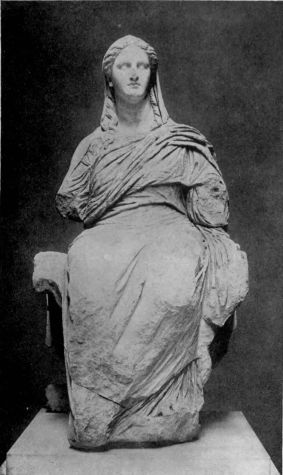
Plate LXIX. THE DEMETER OF CNIDOS
Mansell & Co.
supports, such as tree-trunks, pillars, and urns, have to be introduced into marble statues in the round. Thus it became inevitable to make the figure lean frankly upon his support, and thus we get those graceful reclining attitudes which are often cast in the teeth of Praxiteles as symptomatic of decadence.
Pheidias and Praxiteles are as pre-eminent among the names of ancient sculptors as are Polygnotus, Zeuxis, and Apelles among the painters. Of the two, Praxiteles was the most praised, and his works had the highest value in the Roman market. This being so, it is remarkable how little we know of his personality—practically nothing except that he was an Athenian, and was the son or brother of another famous sculptor called Cephisodotus. Plausible stories are told of his relations with Phryne, who is said to have been his model for the Cnidian Aphrodite. She is said further to have cajoled him into giving her the Eros dedicated at Thespiæ, by first making him promise her the best of all his statues, and then discovering which he thought the best by raising a false report of fire at his studio. His period of activity seems to have extended from about 370 to 330 B.C.
His three masterpieces were the Cnidian Aphrodite, the young Satyr, and the Eros of Thespiæ, but we have a long list of his other works. Of the first, Pliny tells us that it was the finest statue not only of Praxiteles, but of the whole world, and that many had made the voyage to Cnidos expressly to see it. He adds a story that Praxiteles had made two figures of Venus and offered them to the people of Cos at the same price. One was draped, the other nude, and the Coans preferred the former, “thinking it austere and modest.” We must remember that naked goddesses were novelties. The other was purchased by Cnidos, and there were bitter regrets at Cos when they found how much more celebrated was the naked Aphrodite. King Nicomedes of Bithynia subsequently offered to liquidate the entire national debt of Cnidos, “which was immense,” if they would only sell him the statue, but one is glad to learn that the little island preferred to keep both its debts and its goddess. Apparently it was in her capacity as a marine goddess, a “Notre Dame de Bon Secours” (Euploia), that these islanders chose Aphrodite, the foam-born, for their patroness.
Coins of Cnidos indicate the pose of the statue with sufficient clearness for us to identify a Venus in the Vatican as a copy of the Cnidian Aphrodite.[79] Papal decency has seen fit to encase her legs, beginning just below the hips, with drapery constructed of tin. This would, if anything could, impair the aspect of perfect modesty which shows in every line of her pose and expression. She is not aware of human spectators; there is no self-conscious prudery, as in the abominable Medici Venus, which was an attempt by a later and baser generation to imitate the same type. She has left her robe to hang over the tall water-jar, and is stepping from or towards the bath, not without shrinking, and not in ignorance of her beauty. Even in this imperfect copy we recognise the qualities which made Lucian admire the statue—“the design of the scalp and forehead, the finely pencilled eyebrows, and the look of the eyes, so tender, yet so bright and joyful.” He adds elsewhere that “a proud smile plays over her lips.” A lovely girl’s head in Parian marble, now in the Glyptothek at Munich, appears to me so clearly to resemble a younger sister of the same goddess that it must bear some relation to an original by Praxiteles.[80]
The Capitoline Gallery also possesses a copy of the “Young Satyr” of Praxiteles, “called by the Greeks περιβοητός”—that is, world-famed.[81] Readers of Hawthorne will remember his eloquent description of the “Marble Faun,” and though we, better supplied with ancient originals, can recognise that this is only after (and not very near) Praxiteles, yet even as it stands the statue has a peculiar charm and fascination. The sculptor has conveyed the impression of a young creature of the woods, only half human, shy and wild as an animal, and as
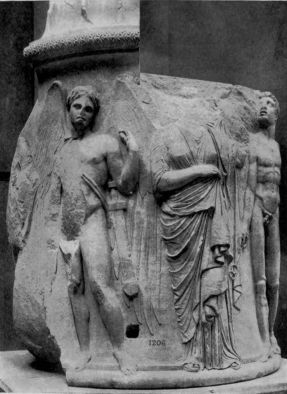
Plate LXX. SCULPTURED COLUMN FROM THE TEMPLE OF ARTEMIS AT EPHESUS
Mansell & Co.
careless and happy. His smile is as lazy as his attitude. Yet we notice the reserve with which his animal characteristics are indicated merely in the shape of his pointed ear and the “unclassical” profile of his face. Not only is his weight thrown upon one leg, as in all the statues by Praxiteles, but the other foot is gracefully curled round it. This is the only complete ancient copy of the Satyr, but there is a mutilated torso in the Louvre, so fine in its finish and texture that some critics suppose it to be original.
Of the Eros which Phryne dedicated at Thespiæ we have no certain copies. But it is evident that many of the Erotes in our galleries were inspired by that masterpiece, and the prettiest is the Eros of Centocelle, a three-quarters figure of admirable design, though of rather slack execution.[82] I believe also that the bronze head of a youth at Naples might well trace its parentage to an Eros by Praxiteles, though the languishing craft of the eyes and the sensuous fullness of the lips are certainly exaggerated.[83]
But of course if we want to know the real Praxiteles we have only to take our ticket to Olympia and worship there at the shrine of Hermes. Here for the first time we have an unquestionable original work by the hand of a great master. This Hermes was found more than thirty years ago by the German excavators in the very temple of Hera where Pausanias had seen him. No copy or cast or photograph can do more than faintly shadow the incomparable beauty of the marble. From the photograph we may appreciate the delicacy of the whole design, in which dignity so marvellously blends with grace and strength with charm.[84] It is Hermes the young Arcadian shepherd’s patron deity, Hermes the musician of the tortoise-lyre, the weaver of guile, the bringer of luck, and the kindly escort of souls on their last ferrying. He is playing in careless indulgence with a baby boy, the infant god of wine, but his eyes and his gentle smile are for some one farther off—not the human spectator. It may be noted, as proving that the technical triumphs of Greek art were gained, not by inspiration, but by hard work at established types, that the child is not very successfully rendered. Greek sculptors could not even yet sufficiently detach themselves from convention to copy the round contours of a baby’s face. Critics are divided in their attempts to reconstruct the motive of the raised right shoulder. Evidently the right hand held some object charming to the infant Dionysus, a bunch of grapes, perhaps, or the serpent-wreathed wand proper to Hermes. As it stands in the photograph we can recognise the loveliest statue in existence, but we cannot see the craft with which the surfaces and textures are rendered. We do not know for certain whether Greek sculptors of the fourth century habitually worked their own statues from start to finish with their own hands. We do know that the surface-finish was regarded as a very important part of the work, and that there were various devices, such as wax-polishing, employed to get the fullest value out of the grain of the marble for flesh parts. Praxiteles is especially named as employing a colourist to tint his marble.
In addition to the Hermes, we have direct literary evidence as to a great group of Artemis and Apollo, the work of Praxiteles, at Mantinea. We are told also the subject of certain reliefs on the architectural base of it, and reliefs of very fine workmanship corresponding in subject have been excavated at Mantinea. There is thus a very fair presumption that these panels were designed, if not executed, by the master who made the group. One slab, here illustrated,[85] shows the contest between Apollo the harper and Marsyas the semi-bestial player of that barbarous instrument the flute. Marsyas had challenged Apollo to a contest, and being quite inevitably defeated was flayed alive as a punishment for his presumption. The penalty is delicately indicated by the Phrygian slave who holds the knife in the centre. The fourth-century artists seldom missed a psychological point, and Praxiteles has emphasised the contrast between the dignified god in his majestic harper’s robes
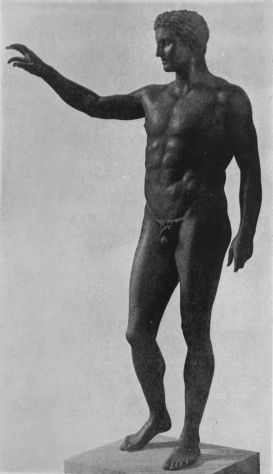
Plate LXXI. FIGURE OF A YOUTH: FROM CERIGO
English Photo Co., Athens
and the naked, violent Satyr distending his cheeks as flute-playing barbarians were not ashamed to do. It is evident that the Marsyas is a quotation by Praxiteles of the celebrated figure by Myron. We note, as a technical point in the history of relief sculpture, the effect produced by the wide spacing of the figures. On the other slabs are beautiful though mutilated figures of the Muses, who acted as umpires in the contest.
We have copies also of another Praxitelean original, Apollo Sauroctonos (the Lizard-slayer),[86] but the copyist has evidently exaggerated almost to caricature the elegant slimness of the young god. But on the basis of our knowledge of the Hermes I think we can reconstruct in imagination an exquisite statue even out of the effeminate Vatican copy. The true Apollo would not lean all his weight upon the tree; consequently the tilt of his hips would be less violent. His face would be much more carefully modelled, with less of that womanish smoothness of contour. But the copyist has noted and tried to express the lovely brow which Praxiteles gave to all his heads. The careless grace, the impression of youth and playful strength belong to the original, and are highly characteristic of the artist. The motive of the statue seems to have been a new and rather bold invention; we know of no cult of a lizard-slaying Apollo. It is true that Apollo was the deity commonly invoked in cases of natural plagues, such as invasions of field-mice or locusts, but it seems more probable that Praxiteles, desiring to represent Apollo in a new guise, deliberately chose to portray him as a boy at play. It is clear that Praxiteles was a strongly original and inventive genius, who was not afraid to give his own impression of established types. He was the first who dared to portray Aphrodite naked; out of the gross and bestial Satyr he made a delightful elf of the woods, and he turned the vigorous athlete Apollo into a slender stripling.
Of Scopas the Parian, the second great sculptor of the fourth century, we have no important remains. Two mutilated heads found on the site of the temple at Tegea, where he made his great pedimental scene of the Calydonian boar-hunt, indicate the new note of pathos and emotion which he introduced into the carving of the human head. We know that Scopas was engaged on the Mausoleum and on one of the thirty-six sculptured columns of the great temple at Ephesus, but nothing that remains from either of those buildings can be ascribed to him with certainty. Perhaps his most famous work was the Palatine Apollo at Rome. We may get the best notion of his style by studying the head, not the body, of a beautiful statue of Meleager[87] at Rome, which is considered by the most competent archæologists to be a copy of the work of Scopas.
The third is Lysippus of Sicyon, an extraordinarily prolific artist, of whose style we may form a very clear conception, although we have no originals. Athletic types were his favourite work, and his favourite technique was bronze-casting. His discovery was the added grace and beauty which could result from decreasing the proportion of the head to the body. Wherever we find small curly heads very lightly poised upon a strong, vigorous body we may trace the influence of Lysippus. His most famous statue was the young athlete scraping off the oil from his arm with the strigil. The emperor Tiberius fell in love with this “Apoxyomenus,” as it is called, and removed it from the front of the baths of Agrippa to his own bed-chamber, but the people of Rome raised such an outcry that he had to restore it. Modern critics have shown that our “Apoxyomenus”[88] is not a faithful copy of this statue. On the other hand, the “Agias” recently discovered at Delphi[89] is a contemporary marble copy of a bronze by Lysippus, and gives us a very fine example of his style. Lysippus was also the sculptor-in-ordinary to Alexander the Great, and we may trace to Lysippean originals all the numerous portraits of the Macedonian conqueror. Lysippus was a theorist as well as a practical sculptor, and, like Polycleitus, produced his own theoretical “Canon” of sculptural proportions. He was (with
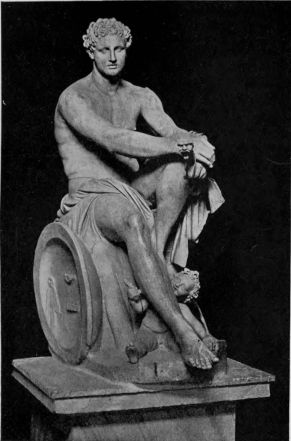
Plate LXXII. THE “LUDOVISI” ARES
Anderson
the possible exception of the Devil) the first professed impressionist, for Pliny records a saying of his: “Other sculptors had represented men as they were, while he portrayed them as they appeared to be.”
We have many fine works of the fourth century of unknown authorship. Foremost of all—surely one of the six greatest statues in the world[90]—is the Demeter of Cnidos, in the British Museum, a statue so instinct with the spirit of Greek tragedy that but for certain technical points it ought to belong to the fifth century.[91] This is Mother Earth, Our Lady of Sorrows, mourning with sad eyes, but not in despair, for her daughter Persephone. The influence of Praxiteles may be traced in her brow and lips. The workmanship of this statue, as being, with the exception of temple reliefs, the finest Greek original in our Museum, deserves careful study. Very beautiful also is that sculptured drum from one of the thirty-six columns of the great temple of “Diana of the Ephesians,” another of the treasures of our Museum.[92] It is scarcely probable that time should have spared the one column which Scopas himself designed, but we may trace some of his influence in the emotional character of the faces, and much of Praxiteles in the grace of the attitudes and the poetry of the concept. The application of relief to a rounded surface is in itself a work of great difficulty, and we have seen how boldly it had been attempted in the same temple by artists of a much earlier day. This is a funeral scene such as might be represented on an Attic tombstone. In the centre is a matronly figure, headless, alas! fastening her mantle on her shoulder preparatory to the journey; on her left is Hermes, very young and boyish, extending his caduceus as if pointing downwards, but looking upwards to a point above the woman’s head. On her right is another figure, whom from his long wings and boyish form we should take, perhaps, for Love, were it not that his sad eyes and heavy sword mark him out as Death—a beautiful conception found also on the new Ludovisi relief and on some of the Athenian lecythi. Some think that the woman is Alcestis, and it is scarcely likely that any but a heroine, at the least, would occupy such a place in such a building. To make both these emissaries of death so young and charming is an idea typical of the fourth century, and especially of Praxiteles.
In many of the bronzes of our museums we can trace very clearly the new influence of Lysippus. A fine example is provided by the figure of a youth[93] recently dredged up under romantic circumstances off the island of Cythera (Cerigo), which lies at the extreme southerly point of Laconia, This was part of a cargo of spoils from Greece looted by the Roman general Sulla and shipwrecked off Cape Matapan. No satisfactory guess has yet been made as to the name of the statue or the motive of its attitude. In my opinion the upstretched arm in readiness to grasp seems to indicate an athlete playing a game of “catch.” “The Praying Boy,” one of the treasures of Berlin, is a singularly perfect bronze, full of grace, probably the work of Boethos, a famous sculptor of the early part of the third century.[94] The Ludovisi Ares[95] is a marble copy of an original which shows unmistakable influence of Lysippus, and the restful attitude of the handsome war-god, so free from any trace of ferocity, is characteristic of the manner in which the fourth century civilised and humanised all its topics. So is the Rondanini Medusa,[96] a Gorgon’s head translated into terms of decorative beauty—it might be a design for a door-knocker. The snakes are there, and the chilly glance, but there is nothing terrible in the face. The lovely winged head, which originally belonged to a full-length statue of Hypnos (Sleep), is one of the most striking bronzes in the British Museum.[97] It is clearly related to the period which produced that figure of Death, “the brother of Sleep,” on the Ephesian column. This example has been covered by exposure to the air with a beautiful green patina,
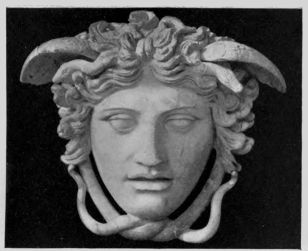
FIG. 1. THE “RONDANINI” MEDUSA
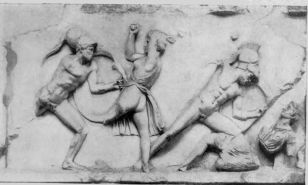
FIG. 2. RELIEF FROM THE MAUSOLEUM
Plate LXXIII
often imitated with the application of acids by modern bronze-workers. But the Herculaneum bronzes, which had been preserved for eighteen centuries in an airproof casing of lava, are to-day in much the same condition as when they left the studio. Though they were made, no doubt, in Roman times, Lysippus is again the artist whose influence is most clearly visible, as, for example, in the vivid Pair of Wrestlers, or the Seated Hermes.
I have already said that the old cities of Greece were mostly too impoverished to undertake great architectural works in this period. Ephesus, however, had her great temple of Artemis burned down by an enterprising individual with the very modern ambition of getting his name before the public. For fear of increasing his success I will not repeat it here, but when Alexander the Great offered to rebuild the temple out of his own pocket the Ephesians declined, possibly on the ground that their temple had already advertised a malefactor and they did not desire it to be a further advertisement for a benefactor. So they rebuilt it themselves with such splendour that it became one of the Seven Wonders of the world.
Advertisement, you see, was in the air. The almost extreme self-repression of the individual was passing, and in the same spirit a wealthy ruler of Caria who in Greek eyes was a tyrant and in Persian eyes a satrap determined to raise a tomb for himself and his wife which should also be a wonder of the world. His name was Mausolus, and the Mausoleum he built consisted of a columned shrine raised upon a lofty pedestal and surmounted with a pyramidal structure of ever-narrowing square courses of masonry, the whole crowned by a colossal portrait statue of Mausolus and his wife Artemisia in a chariot. Considerable remains were found by Sir Charles Newton at Halicarnassus, and are now in the British Museum. We know that Scopas and other famous artists were employed upon the work. The most important relic is the colossal statue of Mausolus, which, considering its situation, is in remarkably fine preservation.[98] Here we have perhaps for the first time in all the history of art a realistic portrait. The face of the prince is not in the least conventional, has, in fact, a distinctly barbarian profile, yet preserves a dignity and worth of its own, and visibly suggests a foreign plutocrat. The reliefs[99] which adorned the pedestal are also distinctive and interesting. We observe, as on the Mantinean basis, that the figures are widely spaced. Their poses are visibly contrived for decorative effect on a system of correspondences much less subtle, and therefore much less effective, than on the Parthenon frieze. The designer, who may have been Scopas himself, has not shrunk from portraying violent action in the battle of Amazons, which is his subject. Yet there is beauty in every figure, and remarkable technical skill.
Another famous work of decorative sculpture belonging to this period is the colossal group of the Niobids. It was brought to Rome from somewhere in Asia Minor, probably Cilicia, and apparently copied by several Græco-Roman artists of very various powers. The original dates, no doubt, from the fourth century. It seems to have formed a group of detached statues set up on a pedestal either in the open air or in a colonnade. The general arrangement of the figures resembles that of a pedimental composition, for the whole group would be pyramidal, with Niobe herself as the apex figure. Niobe’s tragedy is an example of divine jealousy aroused by excessive human felicity and pride, for Niobe was so proud of the beauty of her large family that she exulted over Leto, who had but two children, Apollo and Artemis. Accordingly she and all her brood were shot down by the painless arrows of the two gods. The “plot” of the group is a study in psychology, typical of the fourth century, showing how the various members of the doomed family met their deaths. Here again the technique is wonderful; every figure is designed in a broad architectural spirit. The actual figures, as we have them, mostly at Florence, are of varying merit. Probably the best is the most recently discovered, which is here illustrated.[100] But all are of rather frigid perfection in workmanship.
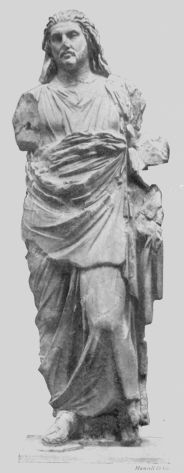
Plate LXXIV. STATUE OF MAUSOLUS, FROM THE MAUSOLEUM
Mansell & Co.
The Other Arts
Nothing has been said here about painting, because Greek painting is essentially a matter for the professional archæologist who can study what Pliny and others said about it and try to find some intelligent meaning in it by reference to pottery and sculpture. Of course the influence of Polygnotus, Parrhasios, Zeuxis, and Apelles should be traceable even in the humble decorators of pitcher, pot, and pipkin. But we have no relics of the original work of any of those artists, and the ancient art critic is an obscure and uncertain guide. He seems to have had the most ridiculous canons of art, and to have considered it the greatest triumph of painting when birds came to peck at the grapes in a picture. The only Greek pictures that we have are the mural frescoes and mosaics of Pompeii, which belong properly to the Roman department, and a few Egyptian mummy-cases painted by Greek artists. Therefore, if you please, we will leave Greek painting to the connoisseurs, with the remark that Apelles of the fourth century was considered the greatest of all Greek masters.
Nor can the ordinary student of culture get much satisfaction out of Greek music. It is rather cheering to reflect that after all they did not know everything down in Athens, but left one or two things for us to discover. One of them was harmony. We have heard accomplished savants give curious and not wholly unpleasant renderings of Greek music, and distinguished composers like Sir Hubert Parry have written very beautiful airs which are said to be Greek. Broadly speaking, we may divide modern reproductions of Greek music into two classes: those that are Greek, and those that are music. It is certain that the Greeks attached very great importance to music, far more, in fact, than we do. It was the foremost instrument of ancient education, and philosophers from Pythagoras to Plato insisted very seriously upon its moral and spiritual efficacy. The Greeks divided music into three principal modes, according to the key employed. The Dorian
Mode was the lowest in pitch. It was the music of the seven- or eight-stringed cithara used in martial songs and dances. The Spartans were so conservative in matters of music, as in all else, that when the famous Timotheus of Miletus appeared in their city with his new twelve-stringed harp the Ephors ordered the strings to be broken. The Phrygian Mode was based on the major scale with a flat seventh (G to G), and the Lydian on the major with a sharp fourth (F to F). The Lydian was the music of the “soft, complaining flute,” and its high-pitched sounds were condemned by the austere critics of the mainland as too sensuous and emotional. Wind music was, as we have seen on the monuments, originally regarded as a barbarian monstrosity, but a fourth-century dinner-party would scarcely have been complete without at least one turn on the double pipe by a pretty aulētris. A sort of double pipe is still used by Greek shepherd-boys, and in the modern example which I have seen one pipe was used as a “drone,” as in the bagpipes. This instrument is probably a humble survivor of the “syrinx” played by Arcadian shepherds in antiquity and by the modern impresario of Punch and Judy shows—in fact, the Pan-pipes. The superior instrument played by the aulētris would be really a double clarinet. The flute, as we have it, was not known in antiquity.
The Greek potter never made any legitimate advance beyond the Red-figured Style of the fifth century. In the early part of the fourth century there is no appreciable change of style; the technique is a little more perfect, the aim is a little less vigorous. The series of Panathenaic amphoræ[101] (those large jars painted with figures of Athena and athletic subjects intended for prizes at the Panathenaic games) continues unbroken, and their design changes little because they have to correspond with a conventional type. The custom was that they should have their figures in black, and accordingly the painter obeyed the custom by leaving parts of his vase in the natural red of the burnt clay, and treating those parts as
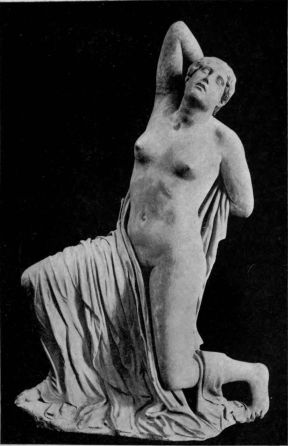
Plate LXXV. A NIOBID
Anderson
panels on which he painted his figures in black.[102] One change we notice: vases are no longer signed by the artist. We conclude from this that pottery is no longer assigned to known masters like Hieron and Douris for decoration, but more mechanically produced in large numbers by humble craftsmen in factories. This would correspond with the increased professionalism which characterises this period in all departments of life. Towards the end of the century—that is, in the days of Alexander—it appears that vases were more frequently made in metal; not that we have any metal vases surviving, but the earthenware takes forms which can only be explained as imitation of metal. Thus the surface is often raised in relief, and vases are apparently cast in moulds.
Coins and gems[103] exhibit increased technical mastery. It must not be forgotten that coin types, being generally of religious significance, are apt to be very slow in responding to the artistic fashions of the day. This is especially the case with Athenian coinage. The Athena type with owl and olive-branch on the reverse is always of a conventional and somewhat archaic character. Elsewhere the coins and gems of the fourth century reach their highest point of perfection, and that is a point which has never been surpassed. As usual, Syracuse is in the forefront for beauty of design, and her new series of tyrants, Dionysius I. and II., revive the glorious types of Gelo and Hiero and improve them. The decadrachms of this period representing the head of the nymph Arethusa surrounded with dolphins and bearing on the reverse a four-horse chariot at full gallop are regarded by numismatists as the most beautiful coins in existence. The best of these bear the signature of their engraver, Euænetus. A gold coinage began here about the time of the repulse of the Athenian Armada. Corinthian coins with the flying Pegasus on the obverse and a head of Athena in a Corinthian helmet on the reverse also attain the summit of their beauty in this century. But even out-of-the-way places like Panticapæum, the corn depot of Southern Russia, and the little island of Tenedos, which to the historian est in conspectu and little more, employed engravers of consummate art. Just before the beginning of the century three cities of the island of Rhodes united to form one republic, which rapidly rose to wealth by way of commerce and good government. It produced a gold coinage of great excellence, the figure of the sun-god Helios on the obverse and a rose (Rhodes) as a punning emblem on the reverse. It is only with Alexander the Great and his successors that the portraiture of mortal rulers begins to appear on Greek coinage. It is then rapidly developed, and some of the barbarian monarchs of the East are portrayed by Greek artists with great vigour and realism.
Lastly, architecture exhibits similar tendencies towards technical facility and a less austere spirit in the use of ornament. To this period belong the new temple at Ephesus and the Mausoleum already mentioned, and the kindred sepulchral monument from Lycia known as the Nereid Monument, from the graceful figures of sea-nymphs set between the columns on the tall basis of the shrine. In Athens we have the new stone theatre of Dionysus, the new stadium for athletic contests, the little choragic monument of Lysicrates, and the new walls to the Peiræus constructed by Conon with Persian help. The luxurious Corinthian order is now more popular than the staid Doric. The invention of this beautiful type, with its curling acanthus leaves embowering the original volutes of the Ionic capital, is attributed to the Athenian sculptor Callimachus, a versatile artist of Periclean days.[104] It was the discovery of a new drill for stone-cutting which made it possible. A legendary explanation of its origin was naturally provided. Callimachus had been struck with the beauty of a column on which a woman had placed a basket of flowers in memory of the maiden whose tomb it marked, and a live acanthus had sprung from the cracked stone below the basket. The earliest appearance of the Corinthian capital is, so far as we know, to be found in the
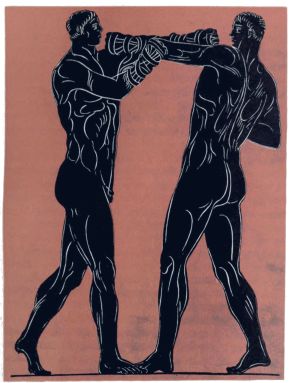
Plate LXXVI. ATHLETES BOXING. FROM A PANATHENAIC AMPHORA
temple at Bassæ. It became increasingly popular, especially in Roman times. Owing to its slenderer shaft, Vitruvius compares the Corinthian order to a young girl, while he likens the Ionic to a matron and the Doric to a man.
In the terra-cotta statuettes which have been found in such large numbers at Tanagra and elsewhere we have some of the most delightful as well as the most characteristic examples of fourth-century art.[105] They are generally found in tombs, and seem to have been made for the purpose. They seldom represent deities, though we have several examples of Eros, and perhaps Aphrodite. Far the commonest subject is a young girl draped in a mantle. Indeed, the maker of such ware is called in Greek Koroplastes—“Girl-modeller.” Domestic scenes are common, girls talking, dancers, animals, and so forth. Some are jointed, and many of them were obviously designed as toys. Sometimes they were glazed, but far more often the colours were applied directly to the clay after it came from the mould. The colours have therefore in many cases entirely disappeared. Apart from their singular grace and charm, they give us extremely interesting examples of Greek costume. The British Museum has a very fine collection, which well deserves study. A few of them appear to be modelled from famous statues of the period.
Literature and Philosophy
This is, as we have noticed, an age of Prose. Poetry is for the time being almost extinct, partly, perhaps, because the Athenian theatre was already so well supplied with material by the great masters of the previous generation, and partly because public recitation was no longer the sole means of publication for literature. It is true that Agathon, a member of the literary circle which included Socrates and Plato, was esteemed almost on a level with the three great tragedians, but all his work has been allowed to perish. The fourth century is the era of the “Middle Comedy,” a stage of transition in which political references were being abandoned and the delineation of manners and social life was taking its place. But no great names attach to this stage, and no relics survive. The New Comedy of manners, in which the great master was Menander, begins towards the end of the fourth century and fills the first half of the third.
Prose would naturally fall into three categories—History, including political and economic writings, Oratory, and Philosophy.
The fifth century had produced the two great historians Herodotus and Thucydides, both of whom treated their subject from a lofty standpoint with a distinctly ethical purpose. The typical historian of the fourth century has a much more restricted outlook. Instead of seeking to point a moral or to illustrate the larger aspects of life, he is contented with investigating and narrating the facts of the past for their own sake or for any purpose to which the reader may care to put them. Such were Ephorus and Theopompus, whose work, though lost to us, formed the base upon which such writers as Plutarch built their narratives. Undoubtedly, however, these historians often had causes of their own to serve. The constitutional history of Greece, which was originally compiled by various writers of this period, is full of contradictions which distinctly point to theories constructed under the influence of interested motives and in accordance with certain political tendencies. The venerable figures of Solon and Lycurgus, many biographical details concerning Miltiades and Themistocles, have been composed by persons whose motives seldom included any disinterested love of truth. On the other hand, fourth-century historians now approach their work with much more distinct ideas as to the rules of evidence. Xenophon I have already described as one of the characteristic figures of the day. He always betrays a strong tendency in favour of Sparta, and especially his friend King Agesilaus.
Oratory as a branch of literature resting upon formal rules of rhetoric is a creation of this period. The Greeks had
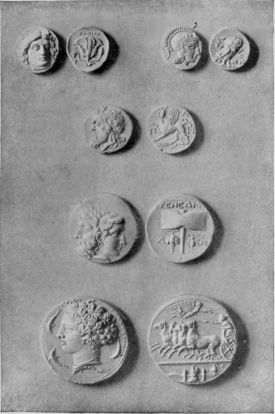
Plate LXXVII. COINS OF THE FOURTH CENTURY B.C.
1. RHODES. 2. ATHENS. 3. PANTICAPÆUM. 4. TENEDOS. 5. SICILIAN DECADRACHM.
always been a rhetorical people. We have noted how, even in Homer, persuasion by the power of speech was a god-given attribute of kings and elders. The Greeks, and the Romans too, went into battle under the influence of oratory as our Highlanders are aroused to martial frenzy by the eloquence of the pibroch. No one doubts that all the speeches in Thucydides’ history are of his own invention, but if they bear any resemblance to the real thing we must believe that the Greek soldier was encouraged, in the fifth century, to fight by a very sober and logical style of speech, including a categorical estimate of the chances in his favour. The modern reader is frequently lulled to sleep by the words of Brasidas or Nikias encouraging his men to battle. Thucydides had, it seems, learnt his peculiarly artificial style of rhetoric from Antiphon, who was the first professional rhetorician to engage in politics. But even Antiphon was content to direct operations through his pupils. In the fourth century the trained professional orator comes forward on the Pnyx as a public statesman, is elected general, and gives orders to the professional soldiers who now command armies and fleets. The profession of the pleader had grown inevitably out of the legal system in vogue at Athens. Where suits were decided by juries numbering hundreds, a rather violent style of pleading had naturally arisen. Although it was necessary by law for the litigants to conduct their own case, it became customary for them to apply to speech-writers like Lysias, Isæus, and Demosthenes for a speech to be learnt and recited as dramatically as possible. We should expect such performances to be highly emotional and to consist largely of oratorical claptrap. That, on the contrary, they are for the most part severely logical, that purple passages are carefully eschewed and references to national feeling kept within limits is the clearest possible proof of the high intellectual standard of the average Athenian citizen who sat upon the jury. It is true that defendants did dress in mourning and produce wives and families in rags and tears to move the sympathies of their judges, but their arguments must be sensible and must include copious reference to the letter of the law. From the so-called “Private Orations” of Demosthenes we obtain rare glimpses of social life at Athens in the fourth century, the banker Phormio who rises to affluence from slavery, who is liberated and marries his master’s daughter, the elegant hooliganism of rich young men who quarrel in camp and assault one another in the Athenian market-place, the extraordinary luxury of Meidias, who rode on a silver-plated saddle, or the quarrels of neighbours in the country about watercourses and rights of way. In a later chapter we shall have to consider the public orations of Demosthenes as the opponent of the Macedonian conquerors. He is unquestionably for European literature the father of oratory. Cicero learnt his art from Demosthenes, and Burke from Cicero. Cleverness is the distinguishing mark of Demosthenes; his style is restrained and logical. I do not think he was morally great, or even more than tolerably honest, but he was so subtle a pleader that I for one always have an instinctive desire to take the other side.
Isocrates, “the old man eloquent,” who died about 338 B.C., is an interesting figure, very typical of his day. He became a professor of rhetoric, and kept a school in which he had a hundred pupils, each of whom paid him 1000 drachmæ for the course. He received as much as thirty talents for writing a single speech. But he was a pure theorist; he scarcely ever delivered his orations, which were written for private reading, and carefully polished for that purpose. Some modern historians discern in him a statesman of wide and lofty views. It is true that he advocated peace, retrenchment, and reform for Athens. It is true also that he spoke in his great Panegyric Oration, a work which had taken him ten years to write, in favour of concerted action by Hellas against the Persians. But I fear that Isocrates as a Panhellenist is a fraud. Panhellenic orations on the text of the Persian wars were a standing dish at the Olympic festival. Gorgias of Leontini, among others, had delivered a similar oration in
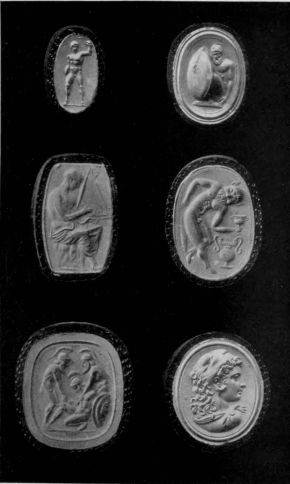
Plate LXXVIII. GREEK GEMS
Mansell & Co.
past years. It is surely a proof of the deadness of Panhellenic feeling in Greece that the assembled States could periodically applaud such orations and then go home and sign the peace which the Great King had sent down from Susa. Moreover, the Panegyric itself is written in a very curious tone for a genuine internationalist. He begins very happily: “Athens and Sparta united, shoulder to shoulder, as they stood at Platæa, Athens and Sparta ... yes, but in that order, mind you.... Athens must come first.... Sparta is, and always has been, a bully and a sneak ... don’t you remember ...?” That is the spirit of the Panegyric. Nor is the style really comparable to that of Demosthenes. Carefully constructed as it is, it smells of the lamp; there is a wearisome mellifluousness in its cadences, and a horrid odour of self-consciousness and self-righteousness in its tone.
Turning now to philosophy, we are confronted at once with the problem of Socrates and his real personality.[106] The sage himself wrote nothing, but he has been written of by two immediate disciples, Xenophon and Plato. Between the two we must form our idea of the man. It is likely that Xenophon missed a great deal of the inner meaning of his master’s teaching, but it is certain that Plato used Socrates as a peg for his own ideas with a freedom which could only be tolerated in a country where portraiture was seldom as yet practised as an art. Socrates may be shortly described as a man who went about asking “Why?” It is a habit that we are too apt to repress in children: the Athenians put Socrates to death for it. Remember that it was the age when sophistry—that is, formal profession of superior wisdom—was beginning to be rife, when professors of this, that, and the other were abroad in the streets of Athens. You may reduce any professor to tears by asking him “Why?” with sufficient persistence, especially if you are followed by a train of admiring young men of good family. Socrates was very pertinacious and absolutely fearless. So a jury of Athenian citizens condemned him to drink hemlock on the charge of corrupting the youth with atheistical doctrines. He was certainly not an atheist. He was deeply religious in the highest sense. He objected, or at least Plato did, to the theology of Homer as undignified, in that it exhibited gods laughing and weeping. But he used constantly to speak of “the God,” “the divine principle,” and even of a “Daimonion,” or divine spirit in his own breast. Moreover, Apollo, speaking by the mouth of the Delphic oracle, had declared him to be the wisest of mankind.
In the main, there is no doubt but that the condemnation of Socrates was, like that of Christ, a political move. Both Critias and Theramenes, the foremost leaders of the oligarchic revolution, were among the disciples of Socrates. Both Anytus and Melitus, his accusers, belonged to the democratic reactionaries who had overthrown them. If we may judge by Plato and Xenophon, Socrates was unquestionably a keen critic of the innumerable sophistries upon which democracy was built. With all that, Socrates was a good citizen and patriot. He had fought in many Athenian battles, the soldiers marvelled at his contempt for cold and danger, he had done his best to prevent the unjust sentence upon the generals of Arginusæ, he had incurred the hostility of the Thirty Tyrants.
The trial and death of Socrates present a scene which for pathos and nobility stands, with one other, alone in history. At the first trial he was condemned only by a majority of six. Athenian law permitted him under such circumstances to propose an alternative penalty. He proposed, accordingly, that he should be entertained for the rest of his life at public expense, along with the officers and benefactors of the State, in the Presidential Hall. This Socratic irony was treated by the judges as contumacy, and at the second hearing he was condemned to death by a large plurality of votes. Plato has written of his end in three great dialogues—“The Apology,” “The Phædo,” and “The Crito.” In “The Apology” Socrates concludes his address to the jury with these words: “This only I ask of you. When my sons grow up, gentlemen, if they seem to
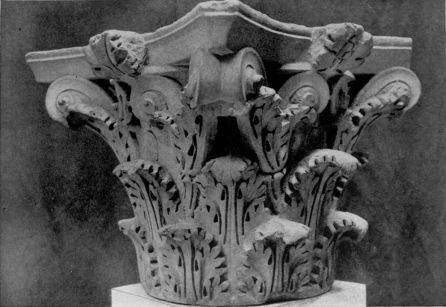
Plate LXXIX. CORINTHIAN CAPITAL
Mansell & Co.
you to be concerned about wealth or anything rather than virtue, punish them, I pray you, with the same affliction as that with which I have afflicted you, and if they pretend to be something when they are nothing, make it a reproach to them, as I have made it to you. If you will do that, we shall have received justice at your hands, I and my sons. Ah, I see it is now time for us all to go hence, me to my death, you to your life. But which of us is going on a better errand—that none can say, but only God alone.”
The dialogue of “Phædo” is perhaps the sublimest thing in literature. It purports to be the last discourse of Socrates to the friends who have come to share his last moments. He preaches the immortality of the soul, the unimportance of death, nay, the urgent necessity of that release from the hampering and deluding trammels of the body, if a philosopher is to see things as they are and enjoy the knowledge of reality. He puts it as a “myth,” using the current Greek mythology of Styx and Hades and Tartarus to enforce his doctrine of Hell, Paradise, and Purgatory. His friend Crito asks for instructions as to his burial.
“‘Bury me any way you like,’ answered Socrates, ‘if you get hold of me and I don’t escape you.’ He looked at us with a quiet smile and proceeded: ‘No, sirs, I can’t convince Crito that I am this Socrates who is now conversing with you. He thinks I am that one whom he will presently see dead, and he asks, if you please, how he is to bury me. I have been making a long speech to prove that when I have drunk the poison I shall not be with you any more, but shall have gone away to enjoy whatever blessings await the departed; only I am afraid it is all lost upon Crito, with all my consolations for myself and you. So you must be my sureties with Crito in a pledge just contrary to that which he gave to my judges. He went bail that I would remain here. You must go bail that I shall certainly not remain, but abscond and vanish. Then Crito will be less afflicted, and when he sees my body being burnt or buried he won’t grieve for me as if something unpleasant was happening to me, and he won’t say at the funeral that it is Socrates he is laying out or burying.’”
Then the story of his painful and courageous death is told in language of extraordinary simplicity and dignified restraint. “Such, Echecrates, was the last end of our companion, as we should say, the best, the wisest, and the justest man of all we had ever known.”
Socrates had done much towards giving Greek philosophy its new trend. The earlier philosophers had been chiefly concerned with the physical universe, trying to discover its origin, and thereby its “principle”; this had been apt to degenerate into that paltry inquisitiveness about mere phenomena which many people are still apt to dignify with the name of “natural science.” Socrates sought not so much the origin as the end of things; he made philosophy concern herself with the nature of reality, and incidentally with ethics and conduct.
The development of ideal philosophy may probably be ascribed, in the main, to Plato rather than Socrates. Perhaps the general English reader will find the simplest exposition of the Platonic theory of Ideas in Wordsworth’s “Ode on Intimations of Immortality.” Put very briefly, it is that the material world apprehended by the human senses is only a copy or pale reflection of the realities “laid up in heaven.” The soul comes into this world
“Not in entire forgetfulness And not in utter nakedness.”
We recognise the forms of things by their likeness to the patterns apprehended by the soul elsewhere. Thus, as Plato says in the “Meno,” all learning is a process of recollection. The words of St. Paul to the Corinthians are almost a verbal echo of this teaching of Socrates: “For now we see in a mirror darkly, but then face to face: now I know in part; but then shall I know even as I am known.”
The doctrines of Plato about Love have been strangely perverted in the popular mind by a singular freak of language in the use of the word “platonic.” They are expounded in two very different dialogues, the almost boisterous “Symposium,”
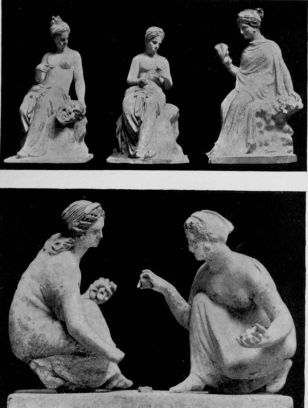
Plate LXXX. FIVE TANAGRA STATUETTES
Mansell & Co.
where Socrates and his friends agree to diversify the drinking with a series of discourses on Love, and that most exquisite composition called the “Phædrus,” in which Socrates and his friend converse on the same topic as they lie in the shade of a spreading plane-tree upon the grassy banks of the Ilissus.
The human soul, coming from eternity into life, has not forgotten altogether “the sea of beauty” of which it had once enjoyed the vision. All beautiful things remind us of it, and (once more to quote Wordsworth):
“Hence in a season of calm weather, Though inland far we be, Our souls have sight of that immortal sea Which brought us hither.”
Thus all men possess a natural yearning for beauty, however much their glimpses of it may have been darkened and distorted by their earthly experiences, and in their beloved they are seeing the reflection of the reality of beauty. The procreant impulse is part of man’s yearning for immortality; it is out of goodness and beauty that the immortal is to be begotten.
With Plato’s political views as expressed especially in the “Republic” we shall be able to deal more fully in the next chapter, when we come to consider the political theories which arose out of the conditions of the city-state. It is clear that in the hands of men like Socrates and Plato philosophy was usurping the place which according to our notions religion ought to occupy in the minds of men. Greek religion, or at least the official Olympian worship as defined by Homer, Hesiod, and the Tragic Poets, had never attained much influence over the morality of its worshippers. But now philosophy was definitely claiming to teach virtue. Not only sophists like Protagoras and Hippias, but even philosophers like Socrates and Plato, claimed to put right conduct on a basis of reason, and therefore of education. Hence followed the deplorable consequence that virtue was to be for the rich and well-born. Philosophy was snobbish from the start; it finished by excluding all but the select few from any chance of salvation, and, if it had had its way, would have excluded them from any political rights whatever. Socrates seldom discriminates between wise and learned, nor between wise and good. The strength of Greek philosophy is in its earnest opposition to materialism, its proper scorn of base, trivial, and temporary pursuits. But therewith it felt and inculcated a contempt of honest labour, and thereby it drifted farther and farther apart from practical life. For that, of course, the institution of slavery is largely responsible.
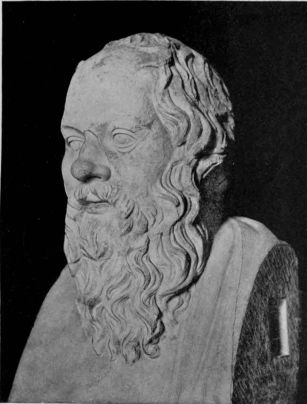
Plate LXXXI. BUST OF “SOCRATES”
Mansell & Co.