IV THE GRAND CENTURY
Reading edition
ὅθι παῖδες Ἀθαναίων ἐβάλοντο φαεννὰν κρηπῖδ’ ἐλευθερίας. Pindar.
The Rise of Athens
EVER in all the world’s history was there such a leap of civilisation as in Greece of the fifth century. In one town of about thirty thousand citizens during the lifetime of a man and his father these things occurred: a world-conquering Power was shattered for ever, a naval empire was built up, the drama was developed to full stature, sculpture grew from crude infancy to a height it has never yet surpassed, painting became a fine art, architecture rose from clumsiness to the limit of its possibilities in one direction, history was consummated as a scientific art, the most influential of all philosophies was begotten. And all this under no fostering despot, but in the extreme human limit of liberty, equality, and fraternity. One Athenian family might have known Miltiades, Themistocles, Æschylus, Sophocles, Euripides, Socrates, Pheidias, Pericles, Anaxagoras, Aristophanes, Herodotus, Thucydides, Polygnotus, and Ictinus.
No historical cause will account for genius, no historian can predict its coming. Some say that great literature is produced by outbursts of national emotion, as Shakespeare was “produced” by the defeat of the Spanish Armada (though he
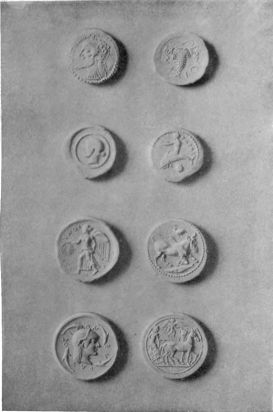
Plate XXXV. EARLY COINS OF SICILY AND MAGNA GRÆCIA
1. NAXOS. 2. TARENTUM. 3. CATANA. 4. SYRACUSE.
was twenty-four when it happened) and Milton by the Puritan rebellion (though he wrote “Comus” in 1634). Others maintain that art is the blossom of decay. It is vain to look to politics for the real cause of the uprising of genius. But when a whole state rises simultaneously to an intellectual heat, at which masterpieces are thrown off almost daily, in almost every department of human activity, we may, and must, look for some historical and political explanation.
Peisistratus, as I have argued, had laid the foundations of Athenian civilisation, partly by making it into a real city-state, partly by direct encouragement of art and literature, partly by promoting commerce, and thus opening the way to foreign influences. Then in 507 Cleisthenes and the Spartans had given Athens a free republic, with distinctly democratic tendencies. Thus the cold domination of the conservative, uncultured aristocracy, who had mainly been occupied in agricultural pursuits, had lost ground, although, no doubt, the Areopagus, which still “directed most things,” maintained its influence to a considerable extent. What now grew into the most powerful element in the state was the seafaring commercial population, who lived mainly on the sea-coast. These were the restless, eager brains which were beginning to think things out, and to find their bearings in the big world outside Attica. They would be in constant business relations with their Ionian kinsmen across the sea, and thus catch a tincture of their cosmopolitan culture. Accordingly, when at the close of the sixth century the Ionians rose in revolt against their Persian masters, Athens, with Eretria, another commercial city of Eastern connections, alone responded to their cry for help. It was only a raid, but it singed the Great King’s beard by burning one of his capitals, Sardis. For this revenge was promised. The Great King of those days was no effeminate, luxurious Oriental, such as those whom Alexander chased about Asia in later days. The Medes and Persians were then invincible conquerors, who had just devoured all the great empires and ancient civilisations of the East. They were out to conquer the world, and now nothing but a narrow sea lay between them and the presumptuous Greeks. Accordingly, ambassadors were sent in the usual fashion to Greece, to demand earth and water in token of submission. The Athenians are said to have thrown their envoys into the barathron where the bodies of felons were flung for burial, there to collect what earth they could. The Spartans, with whom originality was never a strong point, threw theirs into a well, indicating thereby that the answer was in the negative. So Darius collected a very great host from all his vassals, and sent it round by land, with the ships coasting alongside. Fortunately for Greece, the fleet met with fearful shipwreck off the dangerous Chalcidian promontory of Mount Athos. In 490 Darius tried again. This time it was a much smaller force, designed, not to conquer Greece, but merely to punish Athens and Eretria. It was a naval expedition only, but room was provided in the ships to bring back the Athenians in chains for summary judgment. Datis and Artaphernes were the leaders, but the ex-tyrant Hippias was there to show them the way to the Acropolis, where it seems he already had some friends awaiting his return. But Athens also had an ex-tyrant of the Chersonese among her generals, one who knew the Persian method of fighting and had the strongest motives for resisting them. That tyrant was Miltiades. Hippias’ plan was to cross over the strait from Eubœa, where the Persians had succeeded in enslaving Eretria, land on the north coast of Attica with a large force, and while the land army of Athens was engaged there, slip round with the fleet to Peiræus and catch Athens undefended. His plans miscarried, for the Athenian line swept down the hill at Marathon[45] upon the Persian archers before they were fully deployed, and with their lightning charge hurled them back into the sea with great slaughter, then marched back at full speed to the city, in time.
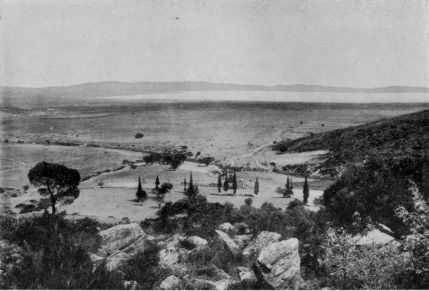
Plate XXXVI. THE PLAIN OF MARATHON
English Photo Co., Athens
This was the triumph of the Athenian hoplite—his only really great feat in history—led by aristocrats and governed by an aristocratic council. The hoplite himself was a comfortable burgess who could afford a full suit of armour. It was not a victory for democracy, and the clamorous proletariat of the Peiræus had little, if any, share in it. But it was a purely Athenian triumph. Alone—with the help of her little Bœotian friend Platæa—alone she had done it. The great Dorian city had been urgently entreated by the runner Philippides to send aid. But Sparta was busy with a festival and had to wait until the moon came right for marching. Athens now, by virtue of this supreme achievement, stepped up into the second rank of Greek Powers.
A few years later some slaves working in the Athenian silver-mines at Laurium chanced to strike a rich vein of metal. All Athenian citizens were shareholders in all the state’s property, and naturally expected to divide the profits, which would amount to about ten francs a head. Then stood up a certain Themistocles—not an aristocrat, but a persuasive speaker with the supplest brain that Zeus had ever created since Hermes stole the cows—and proposed to spend the whole bonus on ships. This is the turning-point of Athenian history. The stout hoplites who had won the day at Marathon stood aghast at the proposal. They pointed out that the strength of Pallas lay in her spear, that to create a navy would be to encourage those turbulent radicals at the Peiræus. Besides, what was it for? The Persians had gone home again. Themistocles, in reply, drew attention to a little war then on hand with Ægina, an island obviously not to be conquered by hoplites only. Doubtless a Greek neighbour was the more persuasive bogey, but Themistocles must have known that Persia was the enemy. Athens did not require a hundred new ships to fight Ægina, which had not a score for use in battle. No doubt Themistocles had the support of the “nautical rabble,” for he gained a majority for his proposal, and soon afterwards got rid of his chief opponent, Aristeides, by ostracism. Thus Athens acquired a fleet beyond all comparison the most powerful in Greek waters. It was needed.
Persia had spent the interval in suppressing Egypt; Darius was dead, and Xerxes reigned in his stead. But still the slave stood behind the royal chair to whisper every day at dinner, “Master, remember the Athenians.” In 480 he had time to remember them. This time there were to be no miscalculations; no mere raid this time, but the hugest armament in history. No shipwrecks this time: where the army had to cross the sea at the Dardanelles a bridge was constructed; where the fleet had to round the promontory a canal was dug.
The host was on the same scale. Herodotus and Æschylus alike delight to parade the outlandish names of the Oriental leaders, to display the numbers of that mighty host of all the nations of the earth, how they drank the rivers dry as they marched, to dwell on the strange equipment of the remote barbarians of Thrace, India, and the Soudan, the wealth and magnificence of the Great King, how he lashed the sea when it broke his bridge, how he questioned the exiled Spartan king Demaratus, unable to believe that these little people should dare to stand up against him. Even more than the life and death of Crœsus, this immortal story of the Persian monarch’s great Armada and its fall, with the tragic contrast between his glorious setting out and miserable return, stirred the imagination of the Greeks for ever afterwards. Did it not illustrate their favourite philosophy of “No excess” and “Know thyself”? All their art was based on this motive: “Know thyself; practise Reverence, because Wealth and Prosperity lead to Insolence, and that arouses Envy in gods and men. Wrath (Nemesis) follows on the heels of Insolence, beguiling with false Hope, and finally leading into Ruin.” That is the doctrine of all Greek tragedy; both Herodotus and Thucydides illustrated it in history, the former taking Persia and the latter Athens for its examples and victims. But it governed their art also; it is the secret of the self-restraint that characterises all the best of their work. That virtue of Aidôs ruled their spirits. That is why it is so absurd to think of the Greeks as happy pagans. They walked in the fear of the Lord, in the shadow of tragedy.
The news of that marshalling of the host found Greece in a state of disunion and terror. Some states submitted at the first summons. All sent for advice to the Delphic oracle. Apollo, I regret to say, was panic-stricken. He told the Cretans not to interfere, he told the Argives to guard their own head; to Athens in particular he sent the most terrible menaces: “O wretched men, why sit ye here? Fly to the ends of the earth, leaving your houses and the high citadel of your wheel-shaped city.... For fire and swift Ares, driving the Syrian chariot, destroyeth it. And he will destroy many other castles, and not yours alone; and he will deliver many temples of the immortals to devouring fire, which now stand dripping with sweat and shaken with terror; black blood trickles from the topmost roofs, foretelling inevitable ruin. Go from the sanctuary, and steel your hearts to meet misfortunes.” Conceive the effect of such an oracle at such a time, and conceive the courage of Athens in preparing to resist! Thessaly submitted; Gelo of Syracuse, the most powerful Greek ally they could have, had declined to help, being in reality fully occupied with the Carthaginian invasion of Sicily; Corcyra was sitting on the fence. Thebes was supposed to be traitorous, but there is little doubt that history has been unfair to Thebes. Nevertheless, the Persian was invited to do his worst. The Spartan plan was to draw strong lines across the Isthmus of Corinth and to fight there in defence of the Peloponnese, which was all the Greece that Sparta cared about. This meant the desertion of all the northern parts. Eventually she was persuaded to try resistance at the northern passes, but she did so half-heartedly. Tempe was found to be indefensible, for the invaders were pouring over another pass to the west of it. The first resistance was therefore made at Thermopylæ, where the mountains left only a narrow track along the shore.
The battle of Thermopylæ and the death of Leonidas with his three hundred Spartans are often represented as a forlorn hope and a gallant suicide. It was, on the contrary, a reasonable plan of defence, though intended only as a first line of resistance. Six thousand Greek hoplites marched with Leonidas, and they should have been sufficient to hold that narrow pass, and the mountain track, which alone could turn it, against a great force. Of course, the Persians were coming by land and sea, but Themistocles, with the Greek fleet, was to hold their fleet in check at a parallel point. The plan failed, because the Phocians, who were guarding the mountain track, were caught napping and fled. The Peloponnesian allies who were then sent back by Leonidas were not being dismissed because the case was hopeless, but despatched to defend the point where the mountain track debouches into the main pass. This they failed to do. Leonidas was caught between two fires, and perished valiantly with all his men. It was not the less glorious because it was reasonable. Meanwhile a great storm had inflicted serious loss on the Persian fleet.
Now the strategy of defending the isthmus seemed the only hope, and that, of course, meant the abandonment of Athens. Sadly the Athenians saw the necessity; they removed their wives and children to the island of Salamis, and put all their fighting men on board their fleet, which amounted to nearly two hundred vessels. Dr. G. B. Grundy, the modern investigator of these wars, believes that the defence of the Acropolis was a serious attempt, rather than a fanatical misinterpretation of that second oracle which bade Athens trust to wooden walls. The Persians swept on irresistibly, wrecked and ruined Attica, and burnt the city of Athens and her citadel—not, however, so completely as to destroy all the old sculptures there.
The great sea-fight of Salamis[46] needs no describing here
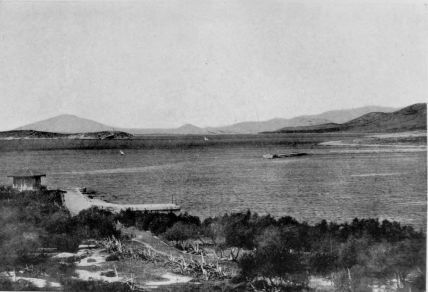
Plate XXXVII. THE BAY OF SALAMIS
English Photo Co., Athens
It was Themistocles’ victory. He had cajoled, threatened, and finally deceived the Spartan admiral into remaining there instead of retiring to the isthmus. He craftily persuaded the Persian monarch to attack the Greeks in narrow waters where numbers were only an obstacle; the fleet which won the day was his creation. The battle has gained its deathless glamour from the picture of Xerxes sitting on the hill above, enthroned on marble, to watch the engagement taking place at his feet. In that narrow strait between Salamis and the mainland, and in that lucid atmosphere, every detail of the fight must have been visible to the monarch, and his courtiers, his eunuchs, and his concubines. There was no smoke or dust; the manœuvre was simply “full speed ahead and ram,” steering, if you could, so that the metal prow of your ship struck the enemy obliquely, and sheared off the whole row of protruding oars on one side. Then, unless the enemy sank under the impact, it was a case of hand-to-hand fighting with spear and shield against arrows and scimitars.
Thus there was no need of the lines at the isthmus. Athens had conquered at sea as she had conquered on land at Marathon. Xerxes fled home with the bulk of his army in mighty dread lest his bridge over the Hellespont should be broken.
He left behind him a great force under Mardonius, a force of picked Persian cavalry and infantry, which for some time devastated Northern Greece and perpetrated a second sack of Athens. At last it came to the great campaign of Platæa (479). Here the Spartan infantry got its opportunity and proved worthy of it, though the Athenian hoplites slew their thousands also. So at length the Persian peril rolled away and Greece was able to breathe again.
This whole episode was the great achievement of the Greeks in the field of action. It passed into the realm of heroic history. It is almost the only historical episode which the drama, usually devoted to heroic and epic subjects, was permitted to use. No public oration was complete without a reference to it. Vase-painters also depicted the story of Darius and Xerxes as they did that of Hector and Priam. It remained on the border-line of the permissible, however, for when temple sculptors wished to allude to it they generally did so under cover of Homeric contests between Greeks and Trojans or mythological battles between gods and giants or Lapithæ and Centaurs. The memory of this united action had some influence in counteracting the local separatism of the Greeks.
The side of this great contest which chiefly concerns us is its effect in promoting Athenian civilisation. Salamis and Platæa had pushed Athens forward into the front rank of Greece, to a position almost on a level with Sparta herself. It is true that she still had to ask Sparta’s permission, or to trick her into acquiescence, before she could build the walls she desired. But above all it was a triumphant vindication of the policy of Themistocles. Even Aristeides, who had come home to help his country in her hour of trial, had to admit that. Henceforth he seems to be working with Themistocles on the democratic side. For Salamis had outshone even Marathon. The “nautical rabble” had justified itself. The party of cautious hoplites, who feared democracy, no longer controlled the policy of the state. Instead, they remained on their devastated farms, grumbling at the “demagogues,” and issuing forth to support conservative politicians like Kimon and Nikias. Their great champion in literature is Aristophanes, who loves to depict the old Marathon men as the real bulwark of the state. When Athens was rebuilt Themistocles saw to it that the Peiræus should henceforth be part of the city, connected with it by long walls. The Peiræus stood for naval interests and naval empire, for commerce (though not for peace), and for democracy. It was not so far off but that the voters could flock up to Athens when an Assembly was to be held. It contained a large population of resident foreigners.
This was how Athens became a democratic city-state.
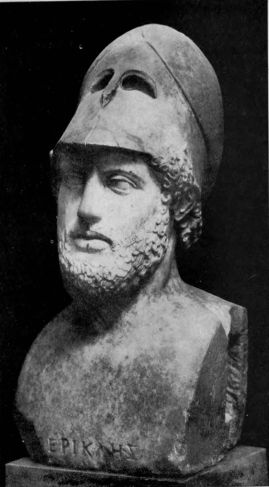
Plate XXXVIII. PERICLES
Mansell & Co.
Democracy advanced in various stages: the poorest were made eligible for the magistracies; the encroaching power of the Areopagus was reduced; the magistrates (archons) and the Councillors were no longer leaders elected for merit, but ordinary burgesses chosen by lot; the Assembly became actually sovereign over administration within the terms of the constitution. Themistocles himself was presently ostracised, being far too great and clever to be a comfortable companion in a democratic city-state. Curiously enough, time has spared one of the very “ostraka,” or potsherds, bearing his name by which he was condemned to banishment.
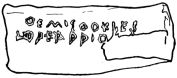
Ostrakon of Themistocles
Then an empire fell into their lap. It began, as most ancient empires did begin, with an alliance gradually transformed into a tyranny. Most Ionian cities had already won their freedom on the defeat of the Persian navy, but some had still to be liberated, and all needed protection for the future. The year after Platæa was spent by the Greek fleets in cruising about the Ægean, doing the work of liberation. At first Spartan admirals were in command, but the Ionians disliked Dorian discipline, and Pausanias, the victor of Platæa, was puffed up with pride and power. So they turned to Athens, whose commanders were Kimon, the rich and generous son of Miltiades, Aristeides the Just, and Xanthippus, the father of Pericles, all men of the aristocracy, but loyal servants of Athens and capable seamen. Thus they formed the Confederacy of Delos, a league of maritime states, Ionians who worshipped the Delian Apollo. On his sacred island was to be the treasury of the league, and there the common synods were to meet. This league Athens soon transformed into an empire. From the first some of its members were too poor to supply the normal unit of subscription, the trireme galley. These, then, contributed money on the assessment of Aristeides. Athens built the ships for them in her own dockyards and sent her collectors round for the money. Soon, with true Ionian slackness, all the states except Chios, Samos, and Lesbos converted their naval contribution into a money payment. States were coerced into joining the league, garrisons and magistrates were sent from Athens to hold them in subjection. Often colonies of Athenian citizens were planted on their territory. When the Persian danger was finally removed by the destruction of the Phœnician fleet at Eurymedon the allies began to contemplate withdrawal. They were very soon taught that membership was not a voluntary privilege. Now the empire of Athens was a naked despotism, only mitigated by the fact that many of the states were permitted to manage their own internal affairs. The treasury of the league was removed from Delos to Athens, and the money was spent at her discretion. Meanwhile the ambitions of Athens had extended with success. She was no longer content with a naval empire. She began to cherish plans of a great colonial dominion in the west; she wanted to eat up her shrunken neighbour, Megara, in order to have an outlet to the Corinthian Gulf; she took Naupactus on those waters as a base, and sent reconnoitring expeditions to Sicily and planned a great Panhellenic colony at Thurii, in South Italy. Moreover, she mixed in the affairs of great foreign Powers like Egypt. She attacked Cyprus and overran Bœotia.
In all this imperial policy from about 460 onwards the leader of the democracy, who by his personal ascendancy was almost as powerful as a monarch at Athens, was Pericles.[47] He was one of those aristocrats who succeed in securing the allegiance of the masses, like Tiberius Gracchus, or Pitt, or Salisbury, by their very aloofness. His single aim was to make Athens free, powerful, and glorious. In Greece imperialism was allied, as it is not with us, with radicalism. At home Pericles had swept away the last vestiges of power from the Areopagus; he had introduced payment of jurymen,
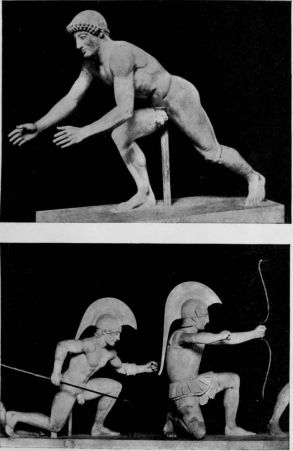
Plate XXXIX. PEDIMENTAL FIGURES FROM THE TEMPLE OF APHAIA AT ÆGINA
Bruckmann
payment of soldiers and sailors, payment to enable the poor to attend the theatre. He was, in short, what we should now call a Socialist. Abroad he was the advocate of imperial expansion by land as well as sea. He was for keeping a tight hold over the “allies,” and he justified the appropriation of their subscriptions to the private purposes of Athens. He had apparently come into power over Kimon’s shoulders as the advocate of hostility to Sparta. The Peloponnesian War was of his making. There is much in this sketch of his policy which displeases us. But there was something in the personality of Pericles which made even critics like Thucydides venerate his name, while they execrated the men who carried on precisely the same line of policy after his death. This was his idealistic patriotism, free from all sordid and selfish motives. He believed in Athenian liberty, and he was prepared to extend it by force if necessary. This illogical and paradoxical state of mind is common to idealists; we ourselves have our pugnacious “pacifists,” our churches prepared to extend the Gospel of Peace by the sword.
Conflict with Sparta was inevitable. Athens was constantly treading on her toes in various parts of Greece. She was an upstart rival aspiring openly to the foremost place in Hellas. That being so, we have no need to inquire closely into the occasion of the great war which filled the latter quarter of the century from 431 to 404, and ended in the humiliating defeat of Athens. In any case the causes of it must be sought much earlier in the century, since Athens and Sparta had long been subsisting on terms of truce only.
The main features of the Peloponnesian War, which forms the theme of the great history of Thucydides, may be briefly stated. Almost before it began Athens had to surrender all her claims to land empire. That had been a mistake from the first, for Athens could never turn out a hoplite line fit to stand against the Spartan charge. The strategy of Pericles, dictated by necessity, was to retire within the walls of the city, relying upon the fleet to keep communications open and effect reprisals on the enemy. The weakness of this strategy lay in the fact that no fleet could touch Sparta, and that it put a very serious strain on the rural population of Attica, who had to desert their homes and see their crops ravaged in yearly forays from Sparta. That state of affairs led to a disastrous plague at Athens, and to a feeling of bitterness against Pericles which darkened his closing years. He died two years after the war began, and his place was taken by Cleon, who walked in his footsteps as democrat and imperialist, but, lacking his lofty personality and high birth, has come very badly out of the hands of history and literature. Aristophanes’ perpetual appellation of “tanner” directed against him probably has its point in the fact that he openly represented commercial interests. He was responsible for the shocking decree which condemned all the male inhabitants of Mitylene to death in punishment of their revolt, a decree which was repented and repealed at the eleventh hour, and he was a frequent obstacle to peace. But there is no ground for charging him with selfishness or dishonesty, and he was certainly not devoid of talent. He should be credited with the most brilliant achievement of the Athenian campaign, the taking of Sphacteria and its Spartan garrison.
It would seem that the war might have gone on for ever, but for the insane ambition of the Athenian democracy, which led her to despatch a huge fleet in 415 to Sicily for the subjugation of that island. It was the hare-brained scheme of that good-looking rascal Alcibiades. No one except Socrates could refuse him anything, much less the mass meetings on the Athenian Pnyx. So Athens squandered two great expeditions on an enterprise undertaken in ignorance and entrusted to inefficient commanders. With all her reserves, she just managed to fit out a new fleet and gain a few more sea-fights, but the end could not be long delayed. At last an Athenian admiral was caught napping at Ægospotami. There were no more ships, no more money in the treasury. After a brief siege Athens capitulated to Lysander in 404.
Such in briefest outline is the historical content of the Great Century, and such is the story of the first of European empires. What bearing has it upon our original inquiry as to the causes of the artistic and intellectual brilliance of the fifth century? We have, to start with, a people singularly endowed by Nature with quick intelligence and a marvellous sense of form. The Persian wars and the rise of Athens had added to these natural advantages a passion of pride in their city and an almost fanatical belief in her mission. Thus all her citizens were eager to do their utmost to increase the beauty and honour of the violet-crowned city and her virgin goddess. A city-state makes a much more direct appeal to the emotion of patriotism than the large modern territorial state. Lastly, there was freedom in Athens such as no state in history has ever enjoyed, freedom in thought as well as in politics. This has been denied, but the attacks made upon Pheidias and Pericles, and upon the philosophers Anaxagoras and Socrates, may all be explained on political grounds. We have only to look at the plays of Aristophanes to see what amazing liberty of speech prevailed at Athens. Moreover, it was a privileged and educated equality. We must never forget the thousands of slaves whose cruel toil in mine and factory rendered this brilliant society possible at such an early stage in history. It must not be forgotten that Greek liberty and communism was that of an aristocracy, however democratic might be the relations between its members. Thus you have at Athens a large citizen body lifted by the state above all sordid cares and interests, living a very full social life in the open air, with everything to stimulate intellectual interests—the daily speeches and debates in law-court and Assembly, the continual festivals and dramatic exhibitions, the endless conversations in the agora, the palæstra, and the various colonnades, the daily coming and going of ships from all quarters, constant embassies from the cities of the League, visits from all the talent of Greece, just sufficient intercourse with Egypt and the East—everything to stimulate the intelligence, and yet a dominant religious or moral conviction which tended inevitably to the austerest self-restraint and abhorrence of all extravagance.
Pheidias
In the great oration over the bodies of the dead Athenian soldiers which Thucydides ascribes to Pericles the statesman is made to express his ideal of Athens. She was “the instructress of Greece.” She alone, he said, followed “culture without extravagance, and philosophy without softness.” She alone combined daring with reflection. She alone welcomed strangers, and, while reverencing the gods and the laws, permitted freedom of speech and conscience to all men. He congratulated her upon the happiness of life at Athens, the public displays and sacrificial banquets which afforded daily delight to her inhabitants. He did not lay much stress upon the outward magnificence of the city, for that, in a large measure, was his own work. But it is that aspect of his policy which we can all appreciate, whether we are democrats or imperialists or neither or both.
Pericles himself set the example which Athens followed of encouraging talent from all quarters to devote its abilities to the service of Athens. Aspasia seems to have maintained a salon which was frequented by most of the men of genius of the day. She herself was of Miletus, and being an Ionian, was accustomed to a freedom of intellectual intercourse denied to the cloistered women of Attica. Pericles had separated by mutual consent from his wife, and though the laws did not allow him to marry a foreigner, he lived with Aspasia through most of his public career. She was a wit as well as a beauty. At her house you would meet Pheidias the sculptor, Damon the musician, Anaxagoras the philosopher, Alcibiades, and Socrates. There, we may presume, the plans for the beautification of Athens were freely discussed.
It was a rare opportunity for the artists. Here was an imperial city to be rebuilt, and plenty of money to build with.
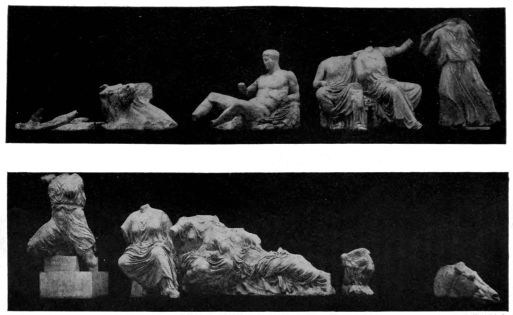
Plate XL. SCULPTURES OF THE EASTERN PEDIMENT OF THE PARTHENON
Mansell & Co.
The directors of the work were Pheidias the sculptor and Ictinus the architect. Pheidias had learnt his craft under Agelâdas of Argos. Thus he stands at the very beginning of the period of fine art. Technical mastery over stone and bronze was by no means complete when he began to work. The “archaic smile” still hovered over the lips of contemporary sculptures, the eyes were too prominent, the eyelids were still cut to meet at the corners instead of overlapping, hair was still conventionally rendered by parallel grooves, or spirals, or roughly blocked out for coloration.
The body, however, thanks to athletic models, was already much more successfully delineated than the head. Perhaps the best examples of fifth-century sculpture before Pheidias are the pedimental figures from Ægina. These figures from the temple of Aphaia at Ægina were discovered by the English architect Cockerell in 1811; they were acquired by the King of Bavaria, restored by Thorwaldsen, and are now at the Glyptothek in Munich. Our illustration[48] will depict their style in all its archaic vigour. All but the face is highly successful; the naked muscular forms of the warriors follow even the poses of athletics, especially the figure in the attitude of a wrestler making his hold stooping forward to drag away the body of Patroclus. The reader should also notice how cleverly the pose is designed to fit that very difficult angle of the pediment where the roof slopes down. It taxed the ingenuity of artists to compose scenes to fit these triangular spaces. The ordinary rule is that the east pediments should depict a scene of divine peace and grandeur, that being the end at which the worshippers entered the temple. The west pediments, on the contrary, generally display a struggle. In this early Æginetan temple both ends are filled with scenes of warfare from the epic glories of Ægina, one of Ajax, and one of his father, Telamon. These Æginetan sculptures are assigned to the period between Marathon (490) and Salamis (480). The Harmodius group of which I have already spoken belongs clearly to the same phase.
If we turn from this to the Parthenon sculptures, we shall see the amazing swiftness of the blossoming of Greek art. With Pheidias, and largely no doubt owing to his genius, the plastic art has conquered its stubborn material, but it has not yet attained that fatal fluency which induces carelessness or conscious elaboration and extravagant striving for effect. This is the stage at which the arts and crafts produce their masterpieces. In our days, thanks to mechanical appliances, stone is as easy to work as clay. The sculptor produces his model, foreign underlings do the heavy chiselling, and the artist finishes it off. This is perhaps why Rodin produces such an effect of strength by leaving much of his work in the rough. We may be sure that Pheidias executed the whole process with loving care and diligence from first to last.
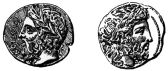
Head of Zeus, on Coin of Elis Head of Zeus, on Coin of Philip II. of Macedon
Here, alas! it must be confessed that we have not a single work which we can ascribe with certainty to the hand of the master himself. His great masterpieces, the Zeus of Olympia and the Parthenos of the Parthenon, were of ivory and gold. Of course they have perished utterly. We have to content ourselves with descriptions—and the ancient art critic was singularly inept even for an art critic—and casual attempts at copying on coins or statuettes. The coins of Elis do indeed give us a Zeus of considerable dignity which may impart some faint notion of the glorious original, but of the Athena Parthenos we have not even this relic. I decline to follow the text-books on Greek architecture by presenting the woolly-headed “Jove of Otricoli” or the well-groomed but fatuous old senator known as the “Dresden Zeus” for the work of Pheidias. Nor will I insult him by depicting the Parthenos by means of the stumpy “Varvakeion” or the inchoate “Lenormant” statuettes. Such
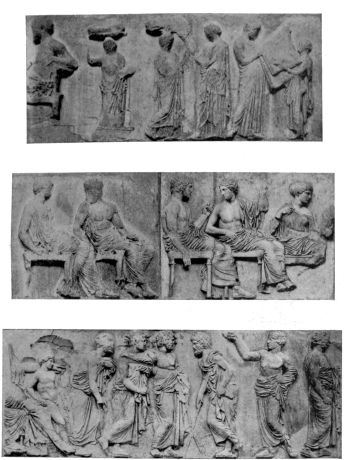
Plate XLI. PORTIONS OF THE EAST FRIEZE OF THE PARTHENON
Mansell & Co.
caricatures only disturb our judgment. For these statues we had better trust our imaginations, working upon what Pliny tells us: “The beauty of the Olympian Zeus seems to have added something to the received religion, so thoroughly does the majesty of the work suit the deity.”
But can you, after all, imagine the splendour of these two statues made by the greatest sculptor who has ever lived? The flesh parts were of ivory, the clothing of solid gold on a core of wood or stone. Zeus was of colossal size, forty feet high. On his head was a green garland of branched olive; in his right hand he bore a Victory of ivory and gold, in his left a sceptre inlaid with every kind of metal. On the golden robe figures and lilies were chased. The throne was adorned with gold and precious stones and ebony and ivory, with figures painted and sculptured upon it. Even the legs and bars of the throne were adorned with reliefs. Round it were low screens, blue enamel in front, and paintings by the sculptor’s brother, Panainos, at the back and sides. The stool on which the god’s feet were resting was adorned with figures in gold; the base, on which the throne rested, likewise. We must not picture ancient Greek art as cold and colourless like the marble statues by which it is represented in our museums. The Greeks loved colour, and used it everywhere. We have grown so accustomed to plain white statues that some of us are offended by the idea of colour in statuary and architecture. In this matter we may safely trust the good taste of the artists who could design and carve so wonderfully. The two favourite Greek marbles, the Parian and the Pentelic, are both of themselves very beautiful fabrics, far more lovely, with their glistening coarse grain and the intermixture of iron which gives them a warm yellowish glow, than the favourite modern marble of Carrara, which is so coldly white and so fine of texture as to dazzle and fatigue the eye and to blur all the delicate outlines. But the Greeks of that day looked upon even their lovely marbles as we do upon brick, good enough for building temples, but not worthy of the high gods. Ivory and gold for the gods, if the worshippers could afford it, otherwise bronze.
Regretfully, therefore, we must seek the genius of Pheidias in works which were probably constructed according to his designs, minor works, mere decorative reliefs applied to architecture, much defaced by accident and time, but still bearing the stamp of grandeur and dignity. It seems from the latest evidence that the execution of the Parthenon sculptures did not begin until after the banishment of Pheidias. But we may well believe that they had been designed by the master. In any case they are originals of the great period, and thus far better guides than any copies, however skilfully executed. Plutarch tells us that as the buildings of Periclean Athens rose “majestic in size and inimitable in symmetry and grace, the workmen rivalled one another in the artistic beauty of their workmanship. Especially wonderful was their speed. Pheidias was the overseer.” The surviving relics of the Parthenon sculptures fall into three groups, according to their place on the temple—the Pediments, the Metopes, and the Frieze.
Of these the Pediments are the most important for their size and prominence in the building. For example, they are the only external sculptures noticed by the traveller Pausanias. Moreover, each figure is a separate statue carved in the round, and perfectly finished back and front alike, though by no possibility could they be visible except from the front. Ruskin would inform us that this is evidence of the moral excellence of the artist. But the Greeks were a practical people who disliked waste in any form, and Professor Ernest Gardner is probably right in suggesting that the sculptor finished his statues in order that he might be sure they were rightly made. Such fidelity to his religious duty is evidence, after all, of moral excellence. Time has wrought cruel havoc with the sculptures. The central figures had gone even before Carrey made his drawings for the Marquis de Nointel in 1674. In 1687 a great explosion occurred, when a Venetian gunner (with the good old Venetian name of Schwartz) dropped a bomb into the
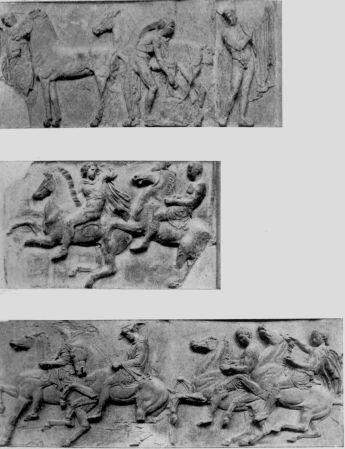
PLATE XLII. PORTIONS OF THE WEST FRIEZE OF THE PARTHENON
Mansell & Co.
Turkish powder magazine stored in the temple, and wrought further havoc. Then the victorious General Morosini tried to remove some of the figures, and broke them in the effort. In 1801 Lord Elgin, armed with a firman authorising him to remove a few blocks of stone, carried off the greater part of the surviving sculptures. From him they were purchased by the British Government for the British Museum. Whatever the morality of this capture, it was a blessing in effect, for the Parthenon suffered further damage during the War of Liberation, and those stones which remain in situ have deteriorated far more than those which were removed. Besides, the Greeks have still plenty of ancient marble to write their names on. Forlorn as they stand in the Elgin Room, battered and bruised as they are, all headless but one, and he much defaced, they still convey an impression of unsurpassed beauty and perfection of art.
The subject of the front or eastern pediment[49] was the birth of Athena. The central scene had gone when Carrey sketched it. It is probable that the armed figure of the goddess rising from the head of Zeus would fill the apex. Close by would stand the goddess of childbirth (Eilithuia), and Hephæstus, who set Athena free with a blow of his hammer, would be near the centre. In the angles the figures have been better preserved, and are mostly among the Elgin Marbles. Various interpretations of their motive have been suggested, but the only one that deserves consideration is Brunn’s theory that they are scenic impersonations rather than mythological characters. It is difficult, as Furtwängler has argued, to find any other example of this sort of personification in the art or literature of the fifth century. But some of the attributions are too plausible to be avoided. At one angle the Sun is just rising in his chariot, of which the horses’ heads are visible above the cornice; at the other the Moon is just sinking in hers. That depicts the time of the great event. Next to these are figures to indicate locality. Facing Helios, with his back to the central scene, is that glorious reclining youth who used to be called “Theseus” in our Museum. According to Brunn he is really Mount Olympus. A mountain he may well be, but would not Pheidias have meant him for the Athenian Mount Hymettus? At the other side artists have sighed over the perfection of those three seated female figures, headless, alas! but wonderful in the perfection of craft which renders the elaborate folds of the soft Ionic draperies without impairing the massive grandeur of the bodies beneath. We used to call them “The Three Fates.” But it is probable that they are not a group of three; one reclines in the lap of her sister, the third sits alone. If the geographical interpretation is to hold good, we cannot improve Professor Waldstein’s suggestion that the sisterly pair is Thalassa (Sea) in the lap of Gaia (Earth). That, however, leaves us without a clue to the third. Would not the moon set beyond land and sea over the island of Salamis? Of the remaining figures the swiftly moving goddess with the windswept draperies can be none other than Iris, the messenger of the gods.
The back or west pediment denotes a contest always, but here, as befits Athena, a contest moral rather than physical, the strife between Athena and Poseidon for the tutelage of Athens. The high angle in the centre would be filled with the olive-tree, and the two contestant deities may be seen in Carrey’s drawing. Poseidon is starting back in affright at the sight of Athena’s gift, and she is advancing triumphantly; a winged Victory would be at hand to place the crown upon her head. The only considerable relic of this gable is another nude male form in the British Museum, reclining like the “Theseus,” but headless and armless, the “Ilissus.”
Not only the execution of the figures, but the composition of the two scenes, with their subtle correspondences and distinctions, their intricate rhythm (notice in detail the arrangement of the drapery folds on “The Three Fates”), and yet their simple, broad dignity, is typical of what the fifth century was
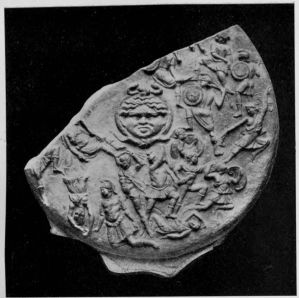
FIG. 1. THE “STRANGFORD” SHIELD
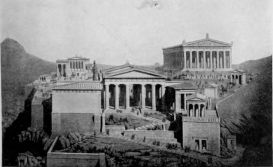
FIG 2. THE RECONSTRUCTION OF THE ACROPOLIS
Mansell & Co.
Plate XLIII
striving for. We might at first glance take the almost severe simplicity of fifth-century art, as we see it, for example, in the dramas of Sophocles or the history of Thucydides or the lines of Doric architecture, for the result of immaturity. But the more we study these things the more we find to study. The apparent simplicity has been produced with infinite labour and loving care.
The metopes of the Parthenon, originally ninety-two in number, consist of separate panels, almost square, adorned with figures in the highest possible relief, often quite free from the back wall. Each one represents a single combat, Gods against Giants, Lapithæ against Centaurs, Greeks against Amazons, Greeks against Trojans, on the various sides. These subjects, with the contests of Theseus and the labours of Heracles, are the regular themes of sculpture on Greek temples. They all represented to the Greek mind the everlasting moral contest between Hellenism and Barbarism, or between culture and savagery. Heracles destroying monsters like the Hydra snake, Theseus slaying robbers and oppressors of mankind, are symbolical of the conflict between light and darkness. They also, no doubt, bear historical reference to the Persian wars. The best of these metope sculptures are high upon the walls of the Elgin Room. They were the work of subordinate artists, and they vary greatly in excellence. In some we can see the handiwork of old sculptors trained in the archaic school of athletic sculpture, still making their drapery stiff and mechanical. In the best there is great vigour and fine drawing. All are remarkable for the ingenuity of the composition. It was no easy matter to fill ninety-two square panels with struggling figures without monotony or iteration. Nevertheless, I do not think that the Greek artists ever took much pleasure in their metope work.
Lastly, we come to the frieze. To judge it rightly, the spectator must remember its position on the temple, for its character is entirely changed when it is seen at the level of the eyes on the walls of our Museum. It ran round the top of the cella wall, 39 feet above the floor, inside the colonnade of the Parthenon. It could be examined by mounting the stylobate and craning your neck uncomfortably, but in an ordinary case you would merely catch glimpses of it between the columns as you passed along outside. Moreover, it was in the shadow of the roof, lighted, as Professor Gardner reminds us, from below by reflection from the white marble pavement. This the artist has foreseen and provided for by making the relief of the upper part deeper than below, so that the heads lean forward from the panels. Where deep shadows are required below they are often secured by cutting into the background. Here is another proof of the advantage Art gains when her ministers are practical craftsmen rather than luxurious gentlemen who spend their time between the studio and the drawing-room. The designer of this frieze—and surely the designer was no less than the master himself—had a free hand here, with no laws of tradition to bind him, for such a frieze is without previous example. He had to cover an uninterrupted space of 524 feet with ornament. He chose for his subject the great procession representing the people of Athens which went up every year at the Panathenaic festival to offer a new saffron robe to the goddess. Observe how he has conceived it. Over the front[50] he placed the immortal gods and goddesses, not in the awful majesty of Olympus, but down on earth in their beloved city of Athens. He depicted them at ease; only their added dignity of countenance and their greater stature (their heads reach the cornice, though they are seated) indicates their divinity. They are not overladen with attributive emblems. They are at home in Athens. They sit, they almost lounge, in comfortable attitudes. Dionysus leans on the shoulder of young Hermes. Ares, the dreadful Thracian warrior, has left his armour at home; he rests pleasantly with his right knee clasped in his hands. Hera unveils her head, turning to say a word to her royal husband, who sits a little apart in his simple dignity. Athena, the heroine of the hour, is marked by no pomp; she is
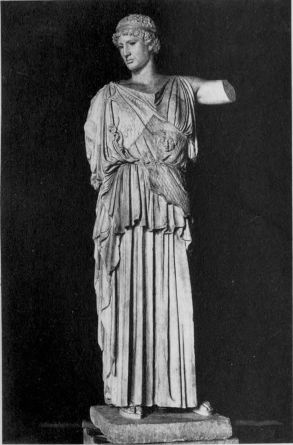
Plate 44.—The Lemnian Athena.
Tamme.
conversing in friendly fashion with Hephæstus. Apollo turns his beautiful head to say a word to the grave Poseidon. Eros is a naked human boy leaning at the knee of Aphrodite; she is fully draped, and even veiled, as becomes the deity of Heavenly Love. It is a warm, peaceful day: the gods have flung back their tunics from their shoulders, the goddesses are clad in soft Ionic robes. The sculptor has not chosen to represent the ceremony at its crisis. The procession is on its way, the music can be heard in the streets below. Close by Athena, separated by no extra space, a priest is handing a folded garment, the old peplos, no doubt, to a lad. It cannot be the offering of the new one, for Athena has her back to the scene. Groups of grave elders converse together, leaning on their staves. Attendant maidens stand near with baskets on their heads. This eastern end shows us the peace and happiness of a heaven not far removed from earth at its best.
Turning the corners, we have on each side the approaching procession, advancing towards the front at a slow pace. As the passing visitor glances up between the columns the procession actually moves. First come the young men leading the sacrificial beasts, oxen and sheep, with attendants bearing the trays and water-jars. The flute-players and harpers follow at the head of the warriors, the war-chariots, men with branches of victory, and the hoplites with shield and spear. And then, most brilliant of all, the young knights,[51] scions of the best families of Athens, sitting their fiery horses barebacked with charming ease and grace, some wearing the broad hat and short chlamys, some in chitons, some with mantles flying in the wind, some in armour. Here and there you see the marshals ordering the procession. Farther back it is just forming; the young knights are mounting their horses and attendants are holding them ready. We must supply to the frieze a coloured background and bronze fittings such as spears and bridles.
But why in the world has he left out the sacred robe itself? Well, he might have chosen to put Athena on her throne in full panoply, and to have made the whole scene far more devotional and impressive to the religious sense. Instead, he has slackened the tension everywhere. The soldiers might have marched in disciplined ranks of Doric precision. The animals might have walked in two by two, as well-behaved beasts going to sacrifice should. The whole thing might have been formal and grand. Pheidias preferred to make it charm by its simplicity and grace. His procession glows with youth and beauty, modest but unembarrassed. The young knight lacing up his military boot is quite unconscious that you and I are looking at him. It would not have done for the solemn pediments, it would have been out of place on the violent metopes, but here, just to glance at between the pillars, as a piece of light, supererogatory ornament, the artist felt at liberty to express the joy of living.
If you needed to look upon divinity in its awful grandeur, you had only to enter the shrine and worship before the temple statue. This was the chryselephantine Athena Parthenos, 39 feet high, with £150,000 worth of refined gold upon her raiment, with her triple-crested helmet, her shield and Victory, her ægis and her serpent. Like the Olympian Zeus, she was to be as splendid as art could make her; there was colour and ornament everywhere. I do not suppose that even here she was very terribly militant. Loose tresses of her hair escaped to mitigate the ferocity of the helmet, with its fierce sphinx and monsters. Her pet owl was perched somewhere on her helmet. The “Strangford Shield” in the British Museum[52] is of great interest, because it seems to copy the design of the original shield with some fidelity, and it belongs to an interesting anecdote told about the sculptor. In 432, when Pericles was being attacked through his friends, they charged Pheidias with embezzling some of the gold entrusted to him for this statue, and with blasphemous impropriety in putting his own portrait, together with the portrait of Pericles, on the goddess’s
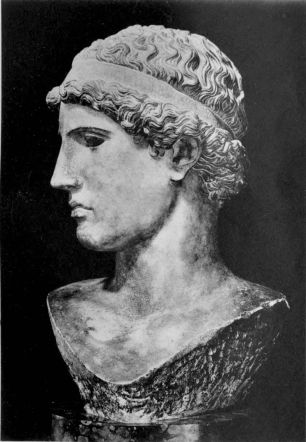
Plate 45.—Head of the Lemnian Athena.
Alinari.
shield. The first charge he could answer, because Pericles had warned him to make all the gold detachable so that it could be weighed. The latter bears a family resemblance to the whole class of sacristan’s tales which attach to every artistic monument in Europe. There was, and there is, on the shield an old man’s head which looks so realistic that it might be a portrait. Near him there is a warrior with his arm across his face, and that is said to have been the artist’s device for concealing from common view a speaking likeness of Pericles. Nevertheless Pheidias was condemned by the angry people, as Aristophanes, his contemporary, tells us:
“Pheidias began the mischief, he was first to come to grief.”
Few other details of the sculptor’s life are worth repeating. Many are given, but their contradictions involve us in hopeless difficulties. Neither portraits nor biographies belong to the fifth century, so wholly was the individual merged in the community. Later centuries had to provide them, and invent them.
The number of works credibly assigned to Pheidias amounts to twenty-four. He was specially famed for his divine statues. He was able to practise for his chryselephantine work on what is termed an acrolithic image—that is, of gilt wood and marble—for little Platæa. He worked also in bronze. At Olympia he made a statue of the boy victor Pantarkes, whom he loved. For the Athenian Acropolis he made two other statues of Athena, one the colossal bronze figure which faced the visitor as he passed through the Propylæa on to the sacred citadel. Her spear was visible above the roofs to the sailors at sea, and it is so represented on the coins of the city. It was a work of his early years, executed for Kimon. It was removed to Constantinople, and the historian Nicetas tells us of its destruction by a drunken mob in A.D. 1203. There was also the Lemnian Athena,[53] dedicated by the colonists of that island about 450 B.C. Here she was represented in a peaceful aspect without her helmet, “with a blush upon her cheek instead of a helmet to veil her beauty.” The beautiful statue which Furtwängler has compiled by setting a head from Bologna[54] upon a body at Dresden forms a brilliant and to my mind triumphant reproduction of this statue. Of course it is only a copy. If it be true that Pheidias made dedicatory offerings for the Athenians at Delphi immediately after the Persian wars he must have had an artistic career of fifty years. In that time he had brought the art of sculpture from infancy to the prime of manhood.
Ictinus and the Temple-builders
One of the characteristics of Greek art is the subordination of the artist to his work, as of the art itself to its purpose. This is but a part of the general subordination of the individual to society in Greek life. Hence it follows that we seldom have to think of isolated genius, and never of the genius of Greek artists as of some fitful and inexplicable freak of nature. For this reason it is not as incredible that there should have been several different Homers all men of genius as that two Vergils should have arisen at Rome, or two Shakespeares in England. Sappho is one among a group of superlative lyric poets. Sophocles is one of four. Demosthenes is the greatest of a group of great orators. This remains a remarkable fact, in view of the natural tendency of time to sharpen the outline of peaks in the ranges of culture, and the national tendency of the Greeks to personify all processes and movements.
Great as Pheidias is, he is nevertheless surrounded by a circle of sculptors and architects, engravers and painters, who are all great. In execution they may be ranked in grades of ability, and their individualities are clearly discernible, but they are all inspired by the same nobility of artistic character, so that the spirit of fifth-century art is a thing that the eye can easily perceive. Reserve and dignity are its most prominent characteristics. It shares with all Greek art the
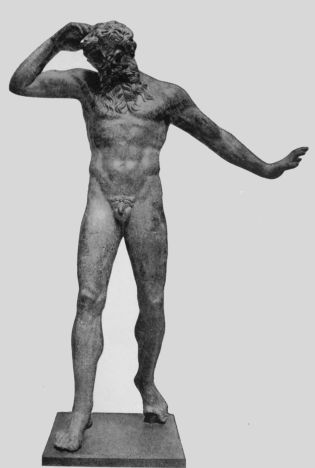
Plate XLVI. STATUE OF MARSYAS. AFTER MYRON
Mansell & Co.
qualities of grace and directness, by which we mean a vivid and logical intelligence which knows its aim and pursues it unswervingly.
Pheidias had Myron for a fellow-student. Of Myron’s athletic work I have already spoken. He was as original as it was possible to be in the fifth century. As he was chiefly engaged in minor works of a private and occasional nature, he has naturally caught the attention of the epigrammatists. We hear much of the animal statues he carved and of their extraordinary realism, for that was the thing that appealed to the ancient art critic. He seems to have been a master of bronze technique and a skilful goldsmith. The marble copy of his Marsyas in the Lateran and the bronze in the British Museum[55] show the satyr advancing in amazement to pick up the flute which Apollo has just discarded. As in the “Discobolus,” we see the love of distorted poses which enabled Myron to exhibit his fine draughtsmanship and anatomy. Herein, indeed, he is peu cinquième siècle; but we must remember that this figure is one of a dramatic group. I have spoken of Polycleitus too as an athletic sculptor. It is rather remarkable that this youthful art should already in the fifth century be producing its “Canon” and its technical treatises. Though the “Doryphorus” is the most famous of his works, the head of his “Diadumenus” from Rome is probably the most faithful rendering of a Polycleitan original. Other names are mentioned by ancient writers as being worthy to be classed with Pheidias; Calamis, for example; but they are mere names to us, and the ingenious attempts of modern archæology to fit them with appropriate works on the score of qualities attributed to them by ancient critics are hazardous, and for the most part unsatisfactory. Considering the few facts so recorded and the multitude of difficulties they raise, we cannot put much faith in the ancient art critic. Alcamenes and Pæonius, for example, are said to have been the sculptors of the two pediments at Olympia, and yet Alcamenes is described as a pupil of Pheidias, which to any one comparing the Apollo of the west pediment with the pedimental sculptures of the Parthenon is absurd. The other name is also doubtful, for Pæonius was the author of the famous Victory at Olympia,[56] with its superb study of flying drapery. The inscription testifies that it was set up by the Messenians of Naupactus from the spoil of the enemy—presumably the Spartan garrison captured by Cleon at Sphacteria. If, therefore, Pausanias is right in his account of the authorship of the Olympian pediments, both these sculptors must have made extraordinarily rapid progress in their art or have adopted a consciously archaic style for the pediments.
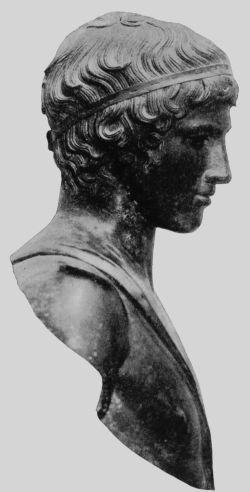
Plate 46A. BOY VICTOR BRONZE, FIFTH CENTURY B.C.
So much for the named sculptors of the period. We have several other works which obviously belong to the same date. The fine portrait bust of Pericles[57] is, no doubt, a copy from the statue by Cresilas. I have said above that portraiture is rare in the fifth century. The extraordinary significance of Pericles in the art of the period is one reason for this exception. Moreover, it is, after all, scarcely a portrait in the Cromwellian sense, but rather an idealised type of the soldier statesman: so far from breaking, it notably illustrates the rule of idealism in the fifth century. It was said that all the portraits of Pericles represented him in a helmet to conceal his inordinately long head, which is a frequent subject of wit to Aristophanes. Typical of the period too are the Eleusinian relief,[58] the Ludovisi reliefs,[59] and the Mourning Athena.[60] The glorious bronze bust of a Boy Victor depicted in our photogravure is one of the rare original bronzes of the great period. It is part of a full-length statue, the bust being a modern restoration, and it is of great value to students of ancient bronze workmanship. The eyeballs, when the statue was first found at Naples in 1730, were inlaid with silver and the pupils with granite. The lips are gilded, and there was silver and gold on the diadem. The boy pulling a thorn out of his foot (the “Spinario”) belongs to a slightly earlier period and is closely akin to the Running Girl in style. It is a charmingly graceful and boyish figure, quite free from self-consciousness. We notice that though the body is skilfully wrought, the head is obviously wrong, for the long hair of the bent head would hang about his face.[61] Natural and pleasant as the pose is, it is no mere genre study, done to please the artist’s fancy because his eye had caught the pretty attitude of the child in the gymnasium. That was not how artists worked at this early period. The “Spinario” must, I think, have a story behind him: some one had won the boys’ foot-race in spite of a thorn in his foot, and this is the record of his pluck.
From sculpture we pass to the sister art of architecture. Here we can safely affirm that Periclean Athens reached perfection within the limits it had set for itself—namely, the Doric style. For temple architecture the religious feeling of the day had prescribed a definite programme which it would have been almost blasphemy to outstep. That is to say, the outline of the temple was bound to correspond to the norm of Doric architecture, laid down more than a century before. The artist’s originality was therefore confined to the task of improving its details in a manner which would pass unnoticed by the general public, who would but vaguely feel a heightened sense of rhythm and harmony. Here we find proof that Greek simplicity is the outcome of extreme subtlety. Until Penrose every one had imagined the lines of the Parthenon to be straight. On the contrary, the apparently flat stylobate or floor rises 1 in 450 towards the centre over a length of 228 and a breadth of 101 feet. The columns do not only taper, as they seem to do, but they swell in the middle in order to counteract the diminishing effect of light behind them, although in pure Greek work the diameter of the shaft is never greater than that of the base. The axis of the outside columns slopes inwards 1 in 106; the inner columns have a slightly smaller inclination, 1 in 150. Even the fluting is studied; the fine shadow effect is produced by diminishing the width but not the depth of the grooves as they approach the echinus. Nor are the columns all exactly the same thickness, for the corner pillars are made a little higher and thicker than their neighbours, because a fiercer light beats on them. Like the stylobate, the entablature also curves upward in the centre, but still more slightly—2 inches in 100 feet. The planes of the moulding are sometimes inclined forwards to prevent foreshortening. Thus to secure the effect of straightness Ictinus cut every stone of this great building on a slant measured to a hair’s breadth. To my lay mind these facts throw a revealing light upon the nature of Greek art and the true meaning of Greek simplicity. Judge of the self-restraint shown by Ictinus (and of course entasis is not confined to the Parthenon) in expending this infinite trouble in a matter which would escape the eye of nine out of ten spectators. Nine out of ten? Yes, but the tenth might be a brother architect—or it might be Pallas Athena. Now that the measuring-tape has proved how subtle is Greek simplicity in one art, we must be prepared for it in other arts where we cannot measure so accurately—in literature, for example, when Euripides seems commonplace or Socrates illogical.
While the white marble columns and the white marble roof presented this appearance of simple strength and purity, the decorative mouldings between were enriched not only with the sculpture we have described, but with brilliant colour. The background behind the sculpture of the pediment was red, the ground of the metopes probably red, and that of the frieze probably blue. The simple echinus and abacus mouldings of the capitals were enriched with leaf patterns in red, blue, and gold. The architrave, has holes which once held bronze pegs for a row of gilt shields and wreaths. The grooves of the triglyphs were painted blue. A bright key-pattern ran along the upper edge of the triglyph. The guttæ, or “drops,” were probably gilt. On each corner of the roof-angle stood a golden oil-jar, and at the apex of the gable an acroterion carved and coloured.
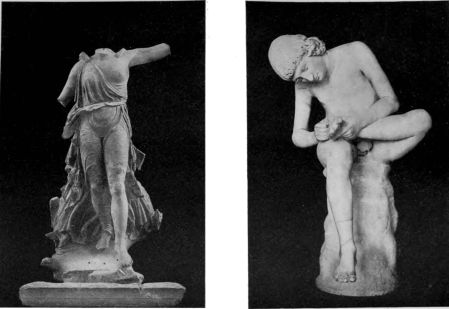
FIG. 1. THE VICTORY OF PÆONIUS
FIG. 2. THE “SPINARIO”
Plate XLVII
Inside the colonnade is the cella, 194 feet long, with six columns of its own within the peristyle at each end. The interior was divided into two main parts—the Hekatompedos, exactly 100 Attic feet in length, where the great gold and ivory statue stood in solitary grandeur, with a couch near at hand for the goddess to recline on when she was tired; and the Opisthodomos, to the west of it, strictly called the Parthenon, which was a sort of museum or bank for handsome offerings. The interior seems to have been lighted only from the doors. Ionic columns were used to carry the ceiling of the Parthenon proper. The wooden ceiling itself was adorned with sunken panels brightly painted. Battered and decayed as this marble building is to-day after its centuries of use as a temple, as a church, as a mosque, as a powder magazine, and as an archæological bear-garden, it is still most wonderful in its majesty.[62] We can hardly imagine the impression it produced when it glowed with life and colour on the day of the Panathenaic festival in 438 B.C., when it was opened to the public after fifteen years of building. The sculpture seems to have been applied after the opening of the temple.
Let us glance at the principal buildings beside the Parthenon which crowned the flat-topped citadel. I suspect that most modern spectators feel a secret sense of discontent when they see a reconstruction of the Acropolis.[63] The unregenerate Goth in our bosoms cries out for spires and pinnacles upon such a splendid site, for domes and towers and battlements to fret the sky above it. Would any relics of them have stood for twenty-three centuries in that land of earthquakes?
When the Long Walls of Athens were completed there was no longer any need of fortifications to the Acropolis, though the architectural conception of the whole mass remained that of a shrine and citadel combined. The prehistoric Pelasgians had levelled the top, fortified it on the west, its only accessible end, and surrounded it with a wall. The whole plateau rises to a height of 200 feet. Approaching it from the agora to the west, the pilgrim passes up a flight of low steps to the porch, or propylæa. This was completed in 432 by Mnesicles on the site of an older and much humbler gateway of Kimon’s day. Modern investigators have shown that it was planned on a far more extensive scale than the actual execution, and that room was left for subsequent completion. It is believed that the outbreak of the Peloponnesian War was the cause of this limitation of the original scheme. Even so it was celebrated in antiquity, and is far the most impressive building erected by the Greeks for secular purposes. It consists of a gateway formed by a wall with five openings and fronted by a Doric colonnade, with gable roof and pediment, flanked on each side in the original plan by two colonnaded halls, a smaller one in front and a larger behind. This plan is clearly a development of the gateways of prehistoric citadels like Tiryns and Troy II. One of the wing chambers was used as a picture gallery, the walls being frescoed by Polygnotus and other celebrated painters. This hall is still in excellent preservation, due to its use by the Franks as a council chamber and by the Turks as the palace of their pashas. Some of the stone beams are as long as 20 feet.
The front chamber of each wing rested on an artificial stone bastion, and as that on the south was never completed the platform remained free for the erection of a lovely miniature shrine, the temple of the Wingless Victory.[64] This, though its stones were totally scattered and built into a Turkish bastion, was reconstructed in 1835 by European architects with such success that it is one of the most charming things in Athens. It must have been built soon after the abandonment of the original plan for the propylæa. It has four columns of the Ionic order at each end, surmounted with a sculptured frieze, of which four panels are in the Elgin collection. The whole shrine, which is only 18 feet by 27 feet, was surrounded by a railing supported on a marble balustrade carved with Victories in low relief. Though they are mostly headless,
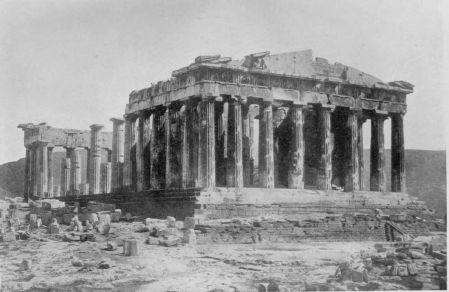
Plate XLVIII. THE PARTHENON. MODERN VIEW FROM NORTH-WEST
English Photo Co., Athens
the outlines are in a good state and reveal very fine workmanship, especially in the treatment of drapery. They clearly belong to the next period after the Parthenon frieze. From the platform in front of the shrine there is a lovely view over the Attic plain towards Eleusis. Beyond it, over Salamis and the blue Saronic gulf you can see the citadel of Corinth and the distant mountains of the Argolid and the Peloponnese. It was here that old Ægeus stood watching for the sails of his dear son from Crete.
Pass through the wide portals of the propylæa. On your right was the marble terrace where the little girls of Athens dressed up as bears to dance in honour of Brauronian Artemis. Here was the group of Athena and Marsyas, and here Praxiteles was to make his statue of Brauronian Artemis. Beyond the Brauronian precinct was one of Athena the Craftswoman. At this point the colossal bronze Athena “Promachos” of Pheidias towered above you, 36 feet high. We have visited the Parthenon already; to the left of it, just behind the foundations of the old temple of Athena Polias, is the wonderful Erechtheum. This building, though begun soon after the Persians had burnt the old “house of Erechtheus,” and the adjoining temple of Athena built by Peisistratus, was delayed by the Peloponnesian War, and not completed till the end of the century. Here the task set to the architects was a peculiar one. To begin with, the building was not a temple, but a house—the house of an old Pelasgian hero; obviously it must not be of the Doric order. Also it had to include a number of immovable sacred objects, such as the salt spring which gushed up when Poseidon struck the rock with his trident and the sacred olive-tree with which Athena defeated him. This patriotic tree had sprung up into new life after the Persians destroyed it, and had to be treated kindly. The illustration will show how the architect overcame these problems with an unconventional building of extraordinary grace and charm. The main building has a colonnade of six Ionic columns in front, and a north porch of six Ionic columns projecting from one side; at the west end a precinct of Pandrosos (daughter of Cecrops), enclosing the sacred olive-tree, adjoined it, and on the south side the lovely little portico of the Maidens.[65] This is its most celebrated feature, from the figures of the six Athenian girls who carry the graceful Ionic entablature. One of the Caryatids was taken to London by Lord Elgin, and has been replaced by a terra-cotta copy. The capitals on their heads are designed like baskets. I have already spoken of this use of sculpture for columns in connection with the Telamones of Acragas. The name Caryatids given to these figures in later times was derived from the town of Karuæ, in Arcadia.
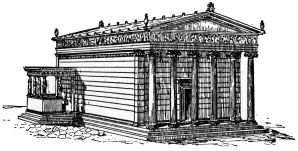
The Erechtheum: Modern Reconstruction
Besides the objects already mentioned, the Erechtheum contained a number of very ancient relics. There you were shown the marks of Poseidon’s trident on the rock; there were spoils taken from the Persians; an old wooden Hermes dedicated by Cecrops, a chariot by Dædalus, a lamp by Callimachus kept perpetually burning, and above all the ancient wooden image of Athena Polias.
Dörpfeld maintains that the old temple of Athena Polias was left standing even after the Erechtheum was completed. If that were true we should have to believe that the architect deliberately projected his unnecessary Caryatid porch right into
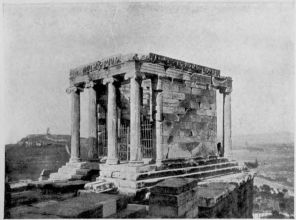
FIG. 1. THE TEMPLE OF NIKÉ APTEROS [THE WINGLESS VICTORY
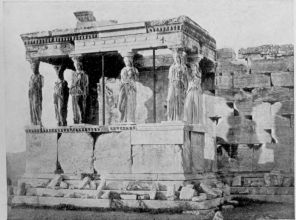
FIG. 2. THE CARYATID PORCH OF THE ERECHTHEUM
English Photo Co., Athens
Plate XLIX
the blank wall of the older temple, where it could not be seen and could scarcely be passed, for it encroaches right over the stylobate of the old colonnade.
I have only mentioned some of the wonderful objects on the sacred rock. When Pausanias saw it, it was crowded from end to end with works of art, sacred or commemorative. No profane person inhabited it.
It was to the Acropolis that the attention of Pericles and his artists was first directed when the time came to beautify Athens. In the city below you would be struck with the plainness of the private houses, presenting no decorative aspect whatever to the narrow and tortuous streets. They were all of one story, with a roof sloping inwards to an open colonnade, round which the rooms were grouped. The agora was the centre of commercial and social life. Close by were some famous porticoes or cloisters, shady and cool to lounge in. In the Royal Portico the “king archon” sat to do his business, mostly connected with religion. Here the Council of the Areopagus met in later days. Here Socrates conversed, and here he was tried for impiety. Ancient laws were inscribed upon the walls of it. The Portico of Freedom contained statues and celebrated frescoes painted by Euphranor in the fourth century. The Decorated Portico (Stoa Poikilē) in the agora was even more famous for its historical and mythological pictures, including one of the battle of Marathon by Panainos, and one by the master Polygnotus of the taking of Troy. It was in this Stoa that Zeno developed in later times his Stoic philosophy. All these pictures have perished utterly, but we can still see reflections of them in the vase-paintings of the day.
Close by upon a low hill stands a Doric temple of the fifth century in almost perfect preservation. This is commonly called the Theseum, but it is undoubtedly the temple of Hephæstus mentioned by Pausanias.[66] The temple is of Pentelic marble, surrounded on all sides by columns, with six at each end. It is of a slightly earlier date than the Parthenon, and it has very little of the subtle system of optical corrections employed there. It was not a very important building in ancient Athens; in fact, it is scarcely mentioned in antiquity; but as the best-preserved building in all Greece it is of great architectural interest to us. The metopes were not all carved; the rest were probably painted. There is also a sculptured frieze. The subject of the metopes was the Labours of Heracles and Theseus. They are rather badly weathered, and in their present condition not very attractive. Not far away is the Dipylon Gate, with its ancient burial-ground, of which we shall see more in a later section. At the opposite end of the city the visitor in the fifth century B.C. would have been struck by the immense columns of the temple of Olympian Zeus begun by Peisistratus, but never finished. Close under the Acropolis rock was the Theatre of Dionysus, where the tragedies and comedies were performed, and a music hall, or Odeion, erected by Pericles. There was a Cave of Pan on the precipitous slope of the rock. The public meetings of the Athenian Assembly were held on the hill of Pnyx, to the west of the Acropolis. Here there was a sort of open-air theatre. We can still see the platform where Pericles addressed the people, and the seats for the presiding committee behind it.
So entirely does Athens focus upon herself the culture of the fifth century, we are apt to forget that Athens was not Greece. The Temple of Zeus at Olympia was the most celebrated temple in all Greece, but chiefly for the wealth of the dedications there and the number of athletic statues. Delphi too was enriched with countless artistic offerings sent, in spite of the Pythian’s faint-hearted counsels, from the spoil of the war. There was a famous tripod with a stand of twisted serpents, on whose coils were inscribed the names of those cities which had taken part in the battle of Platæa. A forlorn remnant of it still exists at Constantinople. Both Olympia and Delphi have been recently excavated, the former by the Germans and the latter by the French. But neither site has quite realised expectations. The greatest finds at Olympia
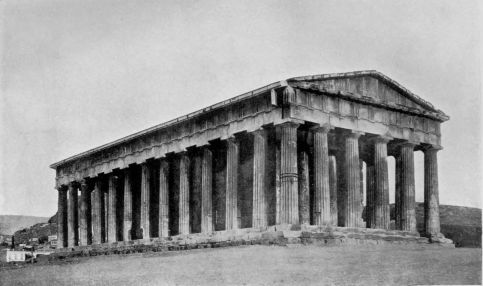
Plate L. THE “THESEUM,” ATHENS
English Photo Co., Athens
were the Hermes of Praxiteles, which belongs to the next epoch, and the temple pediments which I have already mentioned. At Delphi the long-robed charioteer, one of the noblest fifth-century bronzes, was the most conspicuous treasure, but one very fine athletic statue is worthy of mention. This is the Agias, an athletic portrait in marble, executed by Lysippus, fourth of the great masters of Greek sculpture.[67] Traces were found of a great number of small shrines which acted as the treasuries of the various states and were grouped round the great temple of Apollo, and some of these, notably the Cnidian, Siphnian, and Athenian treasuries, have yielded important relics of sculpture. The holy precinct was crowded with treasuries, shrines, votive groups, and colonnades. It included a theatre, a circular dancing-floor, and a colossal statue of Apollo. The Altis at Olympia was similarly filled with treasuries; round it just outside were the stadium, the hippodrome, the palæstra, and the gymnasium.
Hidden away in a remote mountain glen of Arcadia there was a masterpiece of Ictinus, which is now a lovely ruin amid the most solitary and romantic scenery. This is the temple of Phigaleia, the modern Bassæ.[68] It was dedicated by the Phigaleians to Apollo the Helper in consequence of an epidemic. They sent for the most famous architect in Greece soon after the completion of the Parthenon. Ictinus used, since his clients were poor mountaineers, the local limestone for the building, but the roof and sculptures were of imported marble. He had also to modify the normal Doric plan in accordance with local religious conventions of sun-worship. In the cella of the temple the interior Ionic columns are joined to the wall by short stone partitions, thus forming a row of five chapels on each side. A door was made in the east side to shed the light of the rising sun full on the statue of the sun-god; for the main building is unique among Greek temples in running north and south. The narrow frieze which ran round the interior of the cella represented, as usual, contests of Greeks and Amazons, Centaurs and Lapithæ.[69] It is now in the British Museum. It is of the very finest workmanship, and here we see a system of design hardly less subtle than that of the Parthenon frieze applied to scenes of vigour and violence. The frieze was removed bodily by Baron von Stackelberg and bought at auction by the British Government for £15,000.
We find another example of the versatile genius of Ictinus at Eleusis. Eleusis was the most important town of Attica except Athens, and had long been independent. It formed an agricultural centre for the plain around it. Its famous mysteries were of agricultural significance to start with, and were chiefly concerned with the worship of Demeter and Persephone in their characters as grain-givers. It was no doubt a later development when the Greeks began to graft the deepest religious and metaphysical doctrines relating to immortality upon them. We can easily see how rustic rites celebrating the death and rebirth of the cornfields should come to bear this exalted meaning for reflective people. Every year on the fifth night of the Greater Eleusinian festival in spring the Athenian people trooped out along the Sacred Way in a torchlight procession. Only the initiated, the Mystæ, were allowed to witness the secret ceremony, which seems to have consisted of a ritual marriage. For most illuminating suggestions as to its real nature I would refer the reader to Mr. J. C. Lawson’s recent book on “Modern Greek Folklore and Ancient Greek Religion.”
The Great Temple of the Mysteries was designed, but not completed, by Ictinus, for the Peloponnesian War put a stop to the Eleusinian worshippers from Athens—not the least of their deprivations. But they were resumed when Alcibiades came home, and continued until Alaric the Goth destroyed the temple. The peculiarity of this building is that it cuts into the living rock. The interior somewhat resembled a theatre, with eight stone tiers all round it, and an upper story supported on columns. The building itself was square, with a portico in
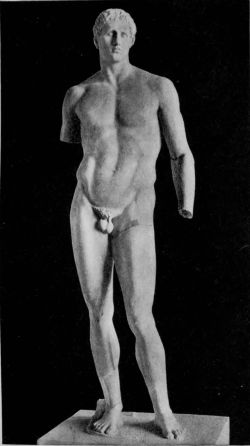
Plate LI. THE “AGIAS” OF LYSIPPUS
English Photo Co., Athens
front only. The upper story was reached by a rock-terrace cut out of the hill-side at the back. The whole temple, with out-buildings, was enclosed by a wall.
Summing up the architectural character of the period, we should say that it was severely limited by the conservatism of religion to the austerest outlines and the simplest plans. Such laws it loyally obeyed, and yet found scope for exquisite workmanship and subtle varieties within them. Ictinus and Mnesicles were quite capable of adapting themselves to any local peculiarities, but the strict Doric style still reigned supreme. Finally we note that fine architecture is almost entirely confined to the service of religion and patriotism, while private and secular buildings are still on the most unpretentious scale. The only architectural work of a strictly utilitarian character that we can mention is the planning of the Peiræus, which was as orderly, as regular and as dull as “town-planned” towns generally are.
Tragedy and Comedy
It was the policy of Pericles, when he trusted his fellow-citizens with so much power, to train them to be fit to wield it. Fond as the Athenian was of political and social equality within his own circle of citizenship, his tone and temper were, I think, like those of all the other Greeks, inherently aristocratic. The Greeks were a chosen people. They stood aloof, with slaves and helots beneath them, and with barbarians all round them. Few Greeks would have disputed the doctrine by which Aristotle justified slavery: the Greek is by nature superior; set him down in a barbarian city, and in a short time the Greek would be king. They would have laughed sweetly at Lafayette’s “Rights of Man.” Man only gets his rights as a member of a partnership, a corporate community—to wit, a city. This community he entered, when he was acknowledged as a citizen, not without a strict scrutiny into his claims, as formally as we enter a club. Having once joined partnership with such a state as Athens, his rights became precise and important. Among other rights, a democracy offered him that of taking his turn in the government if the lot or the votes of his fellow-citizens designated him for office. Political philosophy maintains as an axiom that the better people ought to rule over the worse, condemning all democracy, and Athens in particular, because there the many ruled over the few, and therefore necessarily the worse over the better. Pericles would not have denied the doctrine, but only its applicability to Athens. He would have claimed that the whole Athenian citizen body possessed “virtue” in the political philosopher’s sense of the word; they were all aristoi, for he had seen to it that the Athenian citizens should all receive a training, which, though utterly different from the Spartan in its aims and methods, was even more capable of turning the masses into an aristocracy of manners and intelligence.
It was a liberal education even to walk in the streets of that wonderful city, to worship in her splendid shrines, to sail the Mediterranean in her fleets, to lounge in her colonnades and listen to the wisdom of the wise. The temple services, the festivals, and the banquets were intended with solemn symbolism to uplift the minds of the worshippers. There was actual practice in public business for every one, whether in the Assembly or the Council Hall or the large Jury Courts. Thus it was hoped that any man whom the lot might appoint to be archon or president would be fit for his duties.
But of all instruments of public education perhaps the most important was the Drama. This word, which we associate with entertainment after dinner, with tinsel and bad ventilation, meant to the Greeks a religious solemnity destined to the praise of gods and the edification of men. During the fifth century at Athens the stage was far the most powerful form of literary and artistic expression—so much so that as Greek literature in this period is almost entirely absorbed by Athens, all the other voices of poetry are for a time reduced to silence. The amazingly rapid development of this form of expression was largely due to the concentration with which the literary
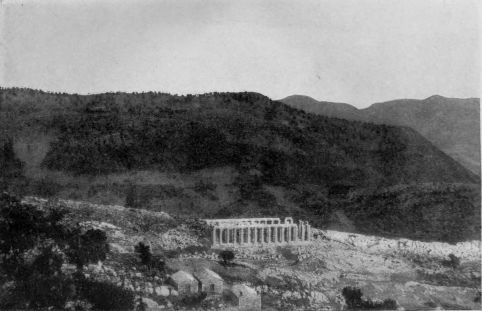
Plate LII. THE TEMPLE OF APOLLO AT PHIGALEIA [BASSÆ
English Photo Co., Athens
genius of Greece pursued it. Athenian drama, Tragic, Comic, and Satyric, was produced at the festivals of Dionysus, and it has generally been supposed to have taken its rise from rude choruses in honour of the wine-god, developed by Arion and others into the Dithyramb. This is an ancient and respectable theory. The Satyric Drama is obviously connected with wine and the wine-god’s goatish followers, the Satyrs. Comedy was derived from kōmē, a village, being originally the rustic form of the same species of mimetic worship. As for Tragedy, that was traced etymologically to the Greek for a goat, and of course the goat has a family relationship with Dionysus. But it has recently been argued that Tragedy was certainly the earliest form of the drama to be developed, and though we may wind up an evening’s jollification by going to see “Othello,” yet ancient Tragedy has, as was often remarked by the ancients themselves, nothing to do with wine or Dionysus, and is scarcely of the festive character that we should associate with that cheerful deity. Professor Ridgeway has shown some reason to believe that the drama took its rise in quite a different manner—namely, from the funeral ceremonies held at the tomb of a dead hero. He shows the frequent appearance of tombs in the scenery of Tragedy, and adduces evidence to prove that the Greeks did include mimetic representations of the dead hero and his deeds among the ceremonies performed in his honour. This would account not only for the character of Tragedy, with its sombre musings upon Death and Fate, but also for the milieu in which its scenes invariably moved—namely, the Epic circle of heroes. Professor Ridgeway further points out that the worship of Dionysus was itself not a very ancient nor a strictly Greek cult. Theatres and dancing-floors are, however, as old as Cnossos.
But this very plausible and suggestive theory has scarcely yet had time to stand its trial. What is certain and most important for the understanding of Tragedy is that the Drama was evolved from the song and dance of the Chorus. First one and then two members of the corps de ballet were brought out from the ranks to perform solo impersonations, to narrate an episode in descriptive rhapsody, or to exchange information by rapid question and answer. Important stages in this evolutionary process were attributed in antiquity to Thespis, the so-called “inventor” of Tragedy, and to Phrynichus and Æschylus, all Athenians of the late sixth and early fifth centuries. Then the part played by the “Answerers” (hypocrites), as the actors were called, gradually gained in magnitude and importance. In Æschylus the choric passages are still the main feature of the play. In Sophocles they form a kind of lyric commentary on the action of the drama, in which the interest now begins to centre. In the later work of Euripides the Chorus is largely a superfluous concession to dramatic conventions. Already by the end of Sophocles’ career there were as many as four actors, and since each performed numerous impersonations, the range of character was considerable. Grand as Athenian drama is, even regarded as a vehicle of literary composition, the mere writing of the “book” was a subordinate part of the work of producing a play. In fact Greek tragedy is far more closely akin to the modern oratorio than to the modern stage-play. The task of providing, equipping, and training a chorus was one of the “liturgies” or public duties laid by the Athenian state upon her richer citizens. It lay in the archon’s discretion to “grant a chorus” to a poet.
The stage consisted originally of a circular dancing-floor (orchestra) with an altar in the middle. Here the fifteen members of the chorus marched in, headed by a single flute-player, chanting in unison. As soon as they had arrived in position they formed line three deep, the coryphæus in the middle of the front row, with the leader of each semichorus on his right and left. While they sang they performed simple rhythmic movements of a solemn character. At first the individual actors simply stepped out from the ranks to deliver their lines, but in later times (when precisely, is a matter of burning controversy) they appeared behind the orchestra on a raised stage. The performance was, of course, always given
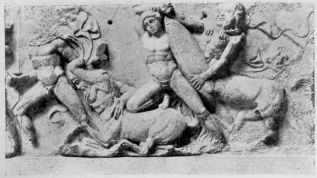
COMBAT BETWEEN CENTAURS AND LAPITHÆ [WEST SIDE, SLAB 528
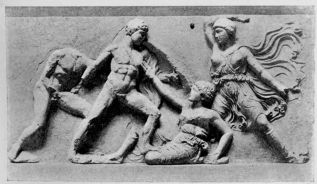
COMBAT BETWEEN GREEKS AND AMAZONS [EAST SIDE, SLAB 537
Mansell & Co.
Plate LIII. PORTIONS OF THE PHIGALEIAN FRIEZE
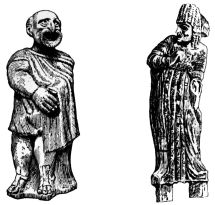
Theatrical Figures, Comic and Tragic
in the open air.[70] In the fifth century there was no regular theatre; only a flat circular orchestra where the dramas were produced in the “Place of the Wine-press” to the west of the Acropolis, and the spectators sat round on wooden benches. It was not until late in the fourth century that the great Theatre of Dionysus, with its tiers of stone seats resting on the living rock, was constructed under the south cliff of the citadel. It has been remarked that the Greek stage was not, as ours is, pictorial, but rather plastic, giving the effect of figures in relief against a background. This was one reason why the actors wore high boots which gave them superhuman stature, and padded garments and trailing skirts. The masks they wore were part of the traditional convention of Greek drama. The mask would, of course, preclude any facial expression whatsoever. The Greek actor showed his skill in the grace of his movements, the expressiveness of his gestures, and the clearness and force of his articulation. Dramatic declamation was his main business. Under these circumstances it is clear that we must not expect subtle nuances of meaning to be conveyed by the actors in Greek tragedy, though modern interpreters are always on the look-out for them. Conceive Henry Irving with an immovable eyebrow, or Coquelin with his mouth fixed open in a perpetual grimace. It is obvious that the whole character of the representation is transformed. The female parts, too, were, as on our own Elizabethan stage, invariably taken by men or boys. The scenery was of the simplest. The costume was one conventional to the tragic stage; there was only the slightest attempt to dress the parts. The plays thus had the simplicity and breadth of treatment which we have seen in the statuary and architecture of the period. The art of Pheidias is the most illuminating commentary upon that of Sophocles. As we saw in Cresilas’ portrait of Pericles, idealistic treatment is maintained so faithfully as a principle that realistic characterisation is only admitted so far as it does not conflict with the ideal. In both arts the heroes and heroines must have the profile and contours of physical and moral perfection. It is only within these limits that Deianira can be soft and womanly, Antigone stern and faithful unto death, Ajax bluff and bold, Neoptolemus young and generous. There are broader strokes of character-drawing in the minor characters. Messengers, slaves, and sentinels are sometimes permitted the homely sententiousness of Juliet’s Nurse. But there is nothing that can truly be called relief from the stern shadows that encompass the world of Greek tragedy.
It must not be forgotten that the themes upon which Tragedy drew were, almost exclusively, the heroic or epic legends. One or two exceptions there are; the “Persæ” of Æschylus is one such, for reasons which I have already explained. Phrynichus also wrote a tragedy founded on contemporary history, “The Sack of Miletus,” an episode of the Ionian revolt. But such a theme came too near home, touched too closely on politics, and the poet was punished with a fine. Otherwise the dramatist had no scope for originality or for the element of the unexpected in the choice of his plot. It is as if
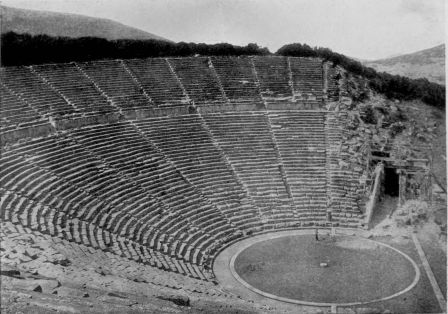
Plate LIV. THEATRE AT EPIDAURUS
English Photo Co., Athens
our dramatists were restricted to the Bible for their choice of subjects instead of being entirely debarred from it. The audience knew the main outline of the story as soon as the play began. Thus the audience was often in the secret while the characters on the stage were not, and this fact gave scope for dramatic irony, which is especially connected with the name of Sophocles.
Sophocles is for literature the supreme embodiment of the Athenian spirit at this its purest and highest period. The tragedies of Æschylus have the grandeur and incompleteness of archaic art. He wrestles with the most awful problems of human destiny and divine purpose. His style matches his themes; it is a whirlpool of foaming imagery in which great masses of poetry in phrase and metaphor appear and disappear continually. He continually baffles the transcriber and the modern interpreter, and it is only the most reverential spirit that can refrain from occasional sensations of ludicrous bathos. Euripides, on the other hand, is so fluent and easy in his craftsmanship that he often seems by contrast commonplace. He is probably the cleverest of all dramatists, and he often dealt with his religious themes in the spirit of an unabashed sceptic. Like Plato, he saw that the gods of anthropomorphic creation were very far from ideal; and he used all the craft and subtlety of the rationalist to exhibit them at their weakest. Æschylus is the poet of the religious men of Marathon; Euripides, “the human,” is the prophet of the New Age of the fourth century, liberal, cosmopolitan, restless and fearless in inquiry. Sophocles is the true exponent of Periclean Athens in the realm of literature.
With his inflexible idealism, the poetry of Sophocles is sublimated almost beyond human ken. Moderns sometimes find him too perfect, too statuesque to be interesting. It is both their misfortune and their fault. The appreciation of Sophocles is a test of refined scholarship and an ear sensitive to the inner voices of poetry. This makes translation almost impossible, but Mr. Whitelaw, of Rugby, has come so near to achieving that impossible that I would venture, through his medium, to present a specimen of this poet’s exquisite art. This is the famous choric ode on Love from the “Antigone.”