II THE HEROIC AGE
Reading edition
ἀνδρῶν ἡρώων θεῖον γένος, οἳ καλέονται ἡμίθεοι Hesiod.
The Northern Invaders
N stepping out of Crete into Homer we are leaving a material world of artists for a literary world of heroes. Incidentally it may be mentioned that we are stepping over three or four centuries without any history. These have rightly been called the Dark Ages, for the analogy between these prehistoric Dark Ages and those of history is singularly close. The Cnossian empire fell before the barbarians, though in this case the last scenes must have taken place at sea. Thus the stability and order of life in the Ægean was broken up and the lamp of culture flickered out. Some sparks of it struggled on, to burn up again with even greater brilliance in the classical period. But some of the crafts perished entirely, such as the faience and the gypsum or stucco reliefs. The writing seems to have perished and been reinvented or reimported later on. The use of weights and money perished for a time out of the Greek world. These things were closely bound up with a flourishing commerce, and now the sea became unsafe for commerce. Sculpture had to begin again from the beginning, and though the shapes of pottery in some cases seem to survive right through, yet the designs suffer an extraordinary degradation and barbarisation before they begin again to be admirable. The same cause operated here as after the fall of Rome. The world was being remade, new peoples were coming upon the scene; there was a long period of Wandering of the Nations, with no Christian missionaries to mitigate their barbarism—or to chronicle their progress. It is a period without any history, and not all the imaginative reconstructions of poetical professors can really throw much light upon it. The Egyptians of about 1200 B.C. observed that there was unrest among the Isles of the Sea, and that is all, so far as we can read the stones.
The invaders are not to be thought of as a single tribe or a single movement. More like our early Danish invaders, they began gradually and continued slowly. The culture of the Ægean declined rather than ceased, surviving longer in the hill-fortresses of the mainland than in unfortified Cnossos. But sooner or later destruction came to Mycenæ and Tiryns and Troy, so that people of alien civilisation came and built inferior houses among the ruins of the palaces or sheltered themselves like the jackals and owls of Isaiah among the Cyclopean masses. In one case they plastered over an old Mycenæan gravestone and drew their own clumsy picture upon it (see p. 37). No wonder that legends arose about the magical race of Cyclopes who built so amazingly, and no wonder that the Greeks of later time put their Golden Age into the past instead of the future. The poet Hesiod, writing probably in the seventh century B.C., divided the history of the world into five ages of deterioration. First come the Golden and Silver Ages of virtue, both, of course, purely ideal. Then comes the Bronze Age, mighty and strong. “Of bronze were their vessels, of bronze their houses, with tools of bronze they worked: dark iron was not yet.” At last they passed away, and then came a fourth generation on the procreant earth, “a generation juster and better, the divine race of Heroes, who are called demigods. Cruel war and the stern cry of battle destroyed them, some as they strove for the flocks of Œdipus at Thebes, and some when they had been led on shipboard over the great gulf of the sea to Troy for the sake of Helen with her lovely tresses.” Then these too went hence “to dwell in the Isles of the Blessed by the deep-surging Ocean, like happy heroes, and the fertile earth yields them honey-sweet harvest thrice a year.” But, alas for the poet, he is doomed to live among the fifth race, the Men of Iron.
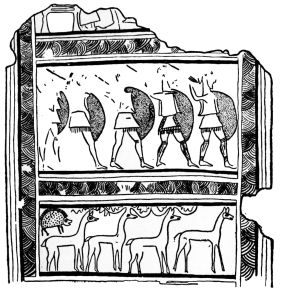
Warrior Stelé from Mycenæ
This is not all fancy: the Bronze Age is history, as we have seen; so is the Iron Age. What then of the age between, the Age of Heroes? It comes in awkwardly, for it disturbs the poet’s picture of degeneration. But it has to be inserted in deference to the beliefs of Hesiod’s audience. Hesiod is more or less consciously writing a Bible for the Greeks—that is, putting their religious customs into literary form. This is his concession to hero-worship or ancestor-worship. The Heroic Age of Demigods, the milieu of Homeric poems and Attic tragedy, is not historical, and it is vain to make it so.
The men of Iron came in from the North in wave after wave of conquest. There were Achæans, Thessalians, and finally Dorians. The process began in earnest, perhaps, with the fall of the Minoan empire, which Professor Burrows assigns to a date between 1414 and 1380 B.C. The Dorians, who were the last-comers, are generally supposed to have been coming in between 1100 and 1000 B.C. Dr. Ridgeway has proved the Northern origin of these various invaders by consideration of their remains, which he has traced back to Central Europe. They were armed with long iron swords, iron-pointed spears, they carried round shields with a central boss, and were dressed in a full panoply of bronze armour, helmet with crest and plume, hauberk of mail, greaves on their legs, and a studded belt of bronze and leather. Underneath they wore a tunic or chiton, which they fastened on the shoulder with a fibula, or safety-pin brooch. They rode to battle in chariots. Thus they differ in every essential from the people of the Ægean culture, whose warriors wore nothing but a loin-cloth or short breeches, and had no armour but a huge figure-of-eight or oblong shield made of wicker and leather, who fought mainly with slings and arrows, who scarcely knew the horse, whose women were dressed in petticoats with flounces and sometimes in tight-fitting bodices narrow at the waist, needing no pin or brooch to fasten them. The Ægean warriors are so depicted on their monuments.[12] Some hints as to their religious beliefs we can gather from their different customs of disposing of the dead. For whereas the Ægean race had preserved their dead carefully underground in shafts and domes, pouring in libations of wine or blood to feed their hungry ghosts in a dark lower world, crowded with powerful
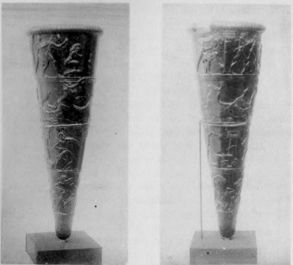
Fig. 1.—Warrior Vase in black steatite.
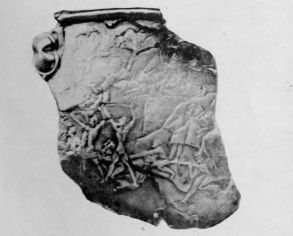
Fig. 2.—Fragment of Silver Vase.
Plate 11.
spirits, these Northerners looked up to a heaven above, where a Zeus very much like Odin ruled the skies with his thunderbolt amid a family of warlike gods and goddesses, who delighted in the smoke of burnt offerings. When their heroes died their bodies were burnt on the pyre and their souls departed to the Isles of the Blessed, an earthly Valhalla of feasting and fighting. The Ægean race had at the same time worshipped the powers of reproductive Nature in female guise, and inheritance went through females. The Northerners were brave and strong, chaste and law-abiding. With them the father was unquestioned head of the household, but the mother was free and honoured. The Northman was an infantry soldier, free in his right as a warrior, the Southerner a sailor with a quick intelligence, a gift for commerce, and a passion for art and beauty. The Northman had one art only, the music of the harp. The Southerner was more truly religious—that is to say, he felt the mystery of the unseen and the thrills of devotion; the natural world that appealed to him so strongly showed itself to his mind under the forms of mysticism. The Northerner was far too much of a moralist and theologian to be an ecstatic devotee. The Southerner had fire and genius, the Northerner had caution and self-control. The Northman was fair-haired, tall, and short-headed, the Southron dark-haired, short of stature, and long in the skull.
In the fusion of these two streams, each of which had so much to give and so much to receive, lies one secret of the Hellenic people. It would seem that the Northmen came as invaders, not merely as immigrants, into the desirable southern peninsulas. They came as warriors, and took wives of the old race, so that the resulting mixture partook of the qualities of both. But, as usual in such cases, climate and environment gradually told, and the type reverted in long course of time to its original characteristics. For a little while in the fifth century there was a perfect amalgam, and we have a people bold in arms, clean in morality, and skilful in high idealistic art. But soon the virile element decays, vigour declines into indolence, idealism into mere sensuous grace and charm, so that while the Greeks never ceased to be incomparable craftsmen and subtle thinkers, the nobler elements which made them artists and originators in all departments of intellect gradually failed them.
These generalisations are supported by the history of their two foremost peoples. The Athenians and Ionians always claimed to be sons of the soil—that is, to have received but a slight intermixture of Northern blood; hence they provide the artists, the traders, and the sailors of Greece. The Spartans, on the other hand, belonged to the Dorian race, the last-comers, and probably the farthest-comers, or the most northerly, of all the invading peoples. They show us the power of discipline, they are the land-warriors, they honour old age, and they do not seclude their women. But as foreigners in an alien land they are the first to decay, and their fall is far more sudden and complete. They give us no art but music and lyric song. From this fact too we get light upon the political conditions of Greece. We see why the prevailing polity of Greece, except in Athens and the Ionian States, was aristocracy or oligarchy. It explains the religion of Greece, the strange mixture of celestial anthropomorphism with chthonic animism. In a sense, too, some such fusion of races represents the whole history of Europe. Again and again in history the vigorous races have descended upon the cultured ones, and the fusion has generally produced great results until the native element prevailed. Such was very probably the secret of Roman greatness. We ourselves in our fusion of Celt and Saxon have a similar ethnic history.
Homer and the Achæans
One of these Northern tribes, the Achæans, are the people commemorated in the epics which go under the name of Homer. Although, as I have said, they had an Olympian hierarchy of gods, their real devotion was given to heroes—that is, to deified ancestors of the tribe, whose graves, real or imaginary, were the scene of sacrifices and libations. One such hero was Agamemnon, who was worshipped at Sparta and elsewhere. Another was Achilles, who had the centre of his cult in Phthiotis. Their valorous deeds were doubtless commemorated in ancient lays. But our Homer is not a collection of ballads or folk-songs. It is a literary product of such finish and perfection as to postulate centuries of experiment in the literary art and the intervention of individual genius of the very highest order. We are forced to believe in the existence of a real Homer who set himself, as Hesiod did in a different sphere, to collect the praises of the heroes and to fashion them into immortal verse, grouping the various heroes into one Panhellenic army under the leadership of Agamemnon in a great expedition, probably an echo of real history, against the city of Troy. But it is equally certain that our Iliad and Odyssey are not the untouched composition of a single brain. Not only is the story of the Iliad far too incoherent—warriors killed in one book, fighting cheerfully in the next, a huge wall and fosse round the Greek camp appearing and disappearing unaccountably; not only is the original plot of the Wrath of Achilles forgotten and obscured in later books; not only is the Odyssey in style and diction visibly later than the main part of the Iliad; but it is possible to trace a progressive variation in customs and ideas, with subsequent interpolation and expurgation, throughout. Both epics seem to have been translated out of an original Æolic version into Ionic Greek. And it must not be forgotten that the ancients applied the term “Homer” to a vast body of epic matter of which our Iliad and Odyssey are only a part. We are forced to conclude that many successive generations of bards had worked over the original nucleus. These Homeridæ, or “sons of Homer,” must have included several men of genius among their number, but they were all trained in a noble school. They were, as has been said, hymning the praises of their patrons’ heroic ancestors—that is, they were Æolians telling the story of traditional Achæan heroes, for the Achæans when driven out of their homes by the Dorian invaders bore the name of Æolians when they migrated to the northern coasts of Asia Minor. Probably the earliest Homer was writing in a consciously antiquarian spirit about heroes long ago; certainly the later writers were deliberately archaising and submitting to an epic convention. Thus the Dorians, except for a single oversight, are studiously ignored; writing, coined money, and sculpture are avoided. Habits of ancient barbarism like human sacrifice, poisoned arrows, and the ill-treatment of the dead have been carefully expunged, though the sharp eye of modern criticism can detect the traces of expurgation. Although the heroes certainly belonged to the Iron Age, they are conventionally represented as “smiting with the bronze,” though iron is often mentioned also. All the named heroes, being somebody’s tribal god and somebody’s ancestor, have to receive the title of king, although in the Iliad they are but captains in Agamemnon’s army. Possibly the earliest Homer lived under a patriarchal monarchy; certainly, as we shall see, the authors of the later parts were familiar with oligarchy or aristocracy. The tradition is probably true which says that Homer was not edited in our “authorised” version until the tyranny of Peisistratus at Athens in the sixth century.
It follows that we are not to take the epic story as representing a chapter of the real history of the Achæans in Greece. If we attempted to do so we should constantly be betrayed by the deliberate archaisms of the epic convention. The utmost use to which historians can put their Homer is to take the unconscious background of the poems as picturing the sort of civilisation with which writers of the ninth, eighth, and seventh centuries were familiar. It is almost our only evidence for that period.
The Shield of Achilles
The description of the shield of Achilles in the eighteenth book of the Iliad may be selected as a typical piece of
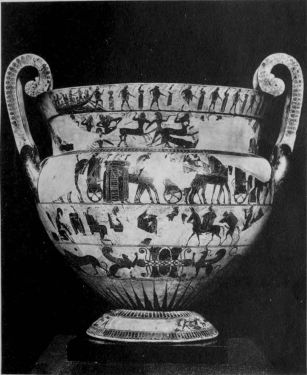
Plate 12.—The François Vase.
Alinari.
unconscious background. It gives us a picture of Greek life which must be natural, since neither dramatic nor religious motives interfere to distort it. The writer is clearly describing a round shield with parallel bands of ornament such as we see in the “geometric” style of art (cf. p. 56). The pictures are conceived as inlaid in various metals, gold, tin, silver, and “kuanos,” or blue glass. For the style in which the ornamentation is conceived we may compare the François Vase[13] or the Chest of Kypselus as it is described by Pausanias. But obviously an idealising poet in describing such objects of art permits his imagination to excel anything that he has ever seen or heard of. Besides, it was wrought by the lame god Hephæstus, and the gods do not make armour such as you can buy at the shop.
“First he made a shield great and mighty, decorating it in every part, and round it he threw a bright, threefold, gleaming rim, and a silver baldric therefrom. There were five folds of the shield, and on it he set many designs with skilful craftsmanship.
“On it he wrought earth and sky and sea, and an unwearied sun and a waxing moon, and on it were all the signs wherewith heaven is crowned, the Pleiades and the Hyades and the might of Orion, and the Bear, which they surname the Wain, which revolves in the same place and watches Orion, and alone has no part in the baths of Ocean.
“And on it he put two cities of mortal men, two fair cities. In one there were marriages and feasts. They were carrying the brides from their chambers through the city with gleaming torches, and loud rose the marriage-songs. The musicians were playing, and among them the flutes and lyres made their music. The women stood admiring, every one at her porch; and the people were crowded in the market-place. There a strife had arisen: two suitors were striving about the price of a man slain. One claimed to have paid in full, and he was appealing to the people, but the other refused to take anything. So both had hurried to have trial before an umpire. Crowds of backers stood around each to cheer them on, and there were the heralds keeping the crowd in order. The old men sat upon polished stones in a holy circle with staves of loud-voiced heralds in their hands. With these they would arise in turn to give their judgments. There in the midst lay two talents of gold to give to the man who should speak the most righteous sentence of them all.
“But round the other city two armies of warriors bright in mail were set. And there was a division of counsel among them whether to destroy it utterly or to divide up into two shares all the store that the lovely citadel contained. The besieged would not yet yield, but were arming in secret for an ambush. Their dear wives and innocent children stood upon the wall to guard it, and in their company were the men of age. So the warriors were marching out, and there were their leaders, Ares and Pallas Athene, golden both with golden raiment, both fair and tall, armed like gods, a conspicuous pair, for the hosts about them were smaller. But when they came to the place where they had decided to make the ambush, in a riverbed, where there was a watering-place for every beast, they sat down there wrapped in their shiny bronze. Then some way off two scouts of the army were posted to watch when they might see sheep and oxen with curling horns. And there were beasts moving along, with two herdsmen following that took their pleasure with pan-pipes, for they suspected no guile. But their enemy who had watched them leapt upon them, and swiftly began to hew about the herds of kine and fair fleeces of white sheep, and they slew the shepherds also. But the besiegers, when they heard the din of battle rising among the kine, from their seats before the tribunes leapt upon high-stepping horses to pursue, and swiftly they approached. Taking rank there by the banks of the river, they fought and smote one another with bronze-tipped spears, and Strife mingled with them, and Kudoimos the lover of groaning, and ruinous Fate was there taking one man freshly wounded and another without a wound and another already dead and dragging them away by the feet in the noise of battle, and her robe about her shoulders was dappled with the blood of men. So living men also mingled and fought and dragged away the bodies of their dead comrades.
“Also he wrought thereon a soft fallow, a fat ploughland, a broad field of three ploughings. Many ploughmen were driving their teams up and down in it. And whenever they came to the baulk of the field at the end of their turn a man came forward with a cup of honey-sweet wine in his hands and proffered it. So they kept wheeling among the ridges, anxious to reach the baulk of the deep fallow, which grew dark behind them, and, gold though it was, looked as if it had been ploughed, so very wondrous was the craft.
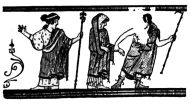
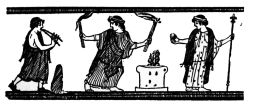
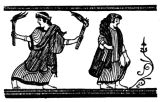
Marriage Procession. From a Pyxis in the British Museum
“There too he put a princely demesne, wherein hired labourers were reaping with sharp sickles in their hands, some swathes were falling thick and fast to earth along the furrow, and the binders were tying others in bands. There stood the three binders close at hand, and behind ran the gleaner-boys carrying the corn in armfuls and busy in attendance. A king with his sceptre stood in silence among them on the furrow rejoicing in his heart. Some way off heralds were laying a feast under an oak-tree. They had sacrificed a great ox and were busy with it, while the women were scattering white barley meal in plenty for the harvesters’ supper.
“On it also he wrought a vineyard heavy-laden with grapes, beautifully wrought in gold. Up above were the black bunches, and the vineyard was set with silver poles throughout; round it he drove a trench of kuanos and a wall of tin; a single causeway led to it whereby the pickers walked when they gathered in the vintage. Maids and merry bachelors were carrying the honey-sweet fruit in woven baskets, and in the midst a boy played a lovely tune on a high-pitched lyre, singing thereto with his dainty voice a sweet dirge of Linus, while the rest kept time with stamping of feet and leaping and song and shrieking.
“On it he made a herd of straight-horned oxen. The cows were fashioned of gold and tin; lowing they passed from the midden to the pasture by a plashing river by a shivering reed-bed. Four cowherds of gold marched along with the kine, and nine white-footed dogs followed them. But among the foremost kine two dreadful lions were holding a deep-voiced bull. He was being dragged away bellowing loudly, but the dogs and the hinds were after him. The two lions had torn the hide of the great bull, and were greedily devouring the entrails and the dark blood, while the cowherds vainly spurred on the swift hounds. But they, forsooth, instead of biting the lions, kept turning back; they would run up close to bark at them and then flee away.
“On it the far-famed Cripple made a sheepfold in a fair valley, a big fold of white sheep, and steadings and huts and roofed-in pens.
“On it the far-famed Cripple fashioned a dance like that which Dædalus of old wrought in broad Cnossos for Ariadne of the lovely tresses. Therein youths and maidens costly to woo were dancing, holding one another by the wrist. Some of the maids had fine linen veils, and some had well-woven tunics with faint gloss of oil. Yea, they had fair garlands on their heads, and the men had golden swords hanging from silver baldrics. Sometimes they would trip it lightly on tiptoes, as when a potter sits and tries the wheel that fits between his hands to see whether it will run. But sometimes they advanced in lines towards one another, and a great company stood round the lovely dance delighted, and among them a holy bard sang to his lyre, and among the dancers two tumblers led the measure, twirling in the midst.
“And on it he put the great might of the River Ocean along the edge of the rim of the closely wrought shield.
“So then when he had fashioned a great and mighty shield he fashioned also a hauberk brighter than the beam of fire, and he fashioned him a strong helmet, fitting the temples, richly dight, and on it put a crest, and he made him greaves of pliant tin.”
I trust that the reader may be able to catch some glimpse of the picture even through the bald prose of translation. We are now in Europe for certain. It might be in Dorsetshire or Bavaria or Auvergne or Tuscany that these women come to their doors to watch the weddings go past, these honest ploughmen drain their beakers, and these weary harvesters look forward to the harvest supper. To this day you may see the peasants of Greece dancing in rings and lines, with agile acrobats to lead them, just as they danced on the shield of Achilles. History goes on its pompous way, leaving the peasant unaltered and the ways of country life unchanged.
Kings and Gods
The poet even here, not wholly oblivious of the courtly circles to whom he was singing, has, indeed, brought in a “king.” But it is a poor sort of Basileus who stands there among the clods rejoicing in his heart. He and his ancestral sceptre cut rather a foolish figure among
“The reapers, reaping early In among the bearded barley.”
The truth is, of course, that he’s a king in buckram. He is only a country squire with a pedigree, dressed up as a Basileus to suit the convention of the epic. Such too are the “kings” of the Odyssey. There the story requires that Odysseus shall be King of Ithaca and that his faithful wife shall be maintaining his throne in his absence. But the poet or poets were so little accustomed to the ways of kings that they constantly forget the political importance of Penelope and speak as if it were only a question of the jointure of a comely widow. Eumæus the swineherd extols the wealth of Odysseus by saying that no other in Ithaca had so much. They were already in the habit of regarding the market-place as the political focus of the State. So in the town of Scheria “King” Alcinous goes forth daily to the council with the twelve other “renowned kings.” Odysseus their visitor prays that this “king” and his “queen” may be so blessed by the gods that they may leave to their children “the substance in their halls, and whatever dues of honour the people have rendered unto him.” And the “princess” goes out in a mule-cart with the washing. On the stage of the epic the king is, of course, a great and mighty ruler. We are often reminded how fearful is the wrath of kings. The king says, according to a quotation of Aristotle’s, that he has power of life and death. He gives away cities that do not belong to him. He inherits “his sceptre and his dooms” from Zeus and a long line of ancestors. But he cannot live up to these exalted pretensions. He debates policy in the market-place with the other kings (who are often called elders by mistake, though they are young and lusty as an eagle), and matters are settled by the acclamation of the masses. It is the orator who sways the crowds. By occasional slips of the tongue these divine kings are spoken of as a greedy class, just as they are in Hesiod. As for the “dooms” that they receive by inspiration from Zeus, they make no practical use of them. Justice, as we saw on our Shield, is really administered by the elders in the agora. A careless line of the Odyssey tells of “the hour when a man rises from the assembly and goes home to supper, a man who judges the many quarrels of the young men that go to him for judgment.” There is no single example of a king acting as judge in Homer, and though the king pretends to give away cities he sometimes humbly accepts the gift of an acre or two from the citizens for services rendered. There is, indeed, one celebrated passage of the Iliad where monarchy is apparently extolled; but the attentive reader will discern that it is in the language not of primitive patriarchal conditions, but of a partisan of aristocracy or tyranny rebuking the presumption of radical demagogy. It is in the second book of the Iliad. Agamemnon had bidden the Greeks prepare for flight from Troy. It was only a ruse to try their temper, but it succeeded all too well, for the people hastily took him at his word. Now Odysseus is bidden by the goddess Athena to hurry down and stop them.
“He went to meet Agamemnon, son of Atreus, and took from him his ancestral sceptre, ever indestructible, wherewith he went down to the ships of the brazen-shirted Achæans. Whensoever he met a king or man of mark, him he would approach and check with soft words. ‘Sir, it befits not to terrify thee like a coward; nay, sit thee down, and make the rest of the host sit also, for thou knowest not yet the mind of the son of Atreus. Now he is but trying the sons of the Achæans; soon he will smite them, and mighty is the wrath of god-nurtured kings. Honour is his from Zeus, the Zeus of counsel loves him.’
“But when he saw a man of the people shouting, him he would smite with his sceptre and chide with a word. ‘Sir, sit quiet and hear the speech of others, who are better than thou. Thou art unwarlike and cowardly, thou art of no account in war or in council. We cannot all be kings here, we Achæans; many-lordship is not good. Let one be lord, one king, to whomsoever the son of Kronos of crooked counsel has given the sceptre and the dooms that he may be king among them.’
“Thus he went through the host, lording it; and they hurried back to the meeting-place from their ships and tents with a noise as when a wave of the thundering sea crasheth on the mighty shore and the deep resounds.
“The others then sat down and took place on the benches, but Thersites alone still brawled with unmeasured words. He who was full of disorderly speech for idle and unseemly striving against kings.
“He was the ugliest man that came to Troy. He was bandy-legged and lame, and his two shoulders were humped and cramped upon his breast. Above, his head was peaked, and a scanty stubble sprouted upon it. He was the bitterest foe to Achilles and to Odysseus, and ever they were chiding him. Then too he cried out shrill words of reproach against divine Agamemnon. But the Achæans were horribly wroth with him, and hated him in their hearts....
“Thus he spake reviling Agamemnon, the shepherd of the people. But divine Odysseus quickly stood beside him, and scowling rebuked him with a grievous word. ‘Thersites, heedless of speech, shrill ranter that thou art, be still and dare not alone to strive with kings, for I say that there is no creature worse than thou, of all that came with the sons of Atreus to Ilium.’ ...
“Thus he spake, and smote him with his sceptre on the midriff and the shoulders. But he hunched himself up and a big tear fell from him, and a blood-red weal rose up from his back under the golden sceptre. So he sat down and trembled, looked helpless, and wiped away a tear in his pain, and they, for all their anger, laughed sweetly at him. And thus a man would say, looking at his neighbour, ‘Lo, now! Verily Odysseus hath done a thousand good deeds both in discovering good counsel and in leading the battle, but now this is far his best deed among the Argives, in that he hath checked this word-spattering maker of mischief from his rantings. Never again, I ween, will his ambitious heart stir him up to revile kings with words of reproof.’”
Thersites is not a product of simple undeveloped monarchy; the poet who drew this portrait had seen the mob-orator in his native agora. Thersites, it has been said, is the only private in the army. He is the only man who is named without a patronymic. And yet modern research has shown that even Thersites had an ancient cultus as a demigod in Sparta. So true is it that all the figures of the epic stage are figures of tribal ancestor-worship.
That is why the real gods come so badly out of the epics. They are the only immoral people in Homer; they cheat and lie, they smack and squabble. Perhaps we do not expect much decency from Zeus or Aphrodite, but even the stately Hera herself alternates between the crafty courtesan and the scolding fish-wife. And yet Homer is the “Bible of the Greeks”! Herodotus said, and said truly, that it was Hesiod and Homer who assigned to the gods their names, distributed their honours and functions, and settled their appearance and characteristics. In after-times Homer was the universal primer of education. It is extremely probable that Homer and Hesiod selected certain deities out of a vast number for special honour as members of the Olympian family. Why in the world, then, did not Homer honour them? Various explanations have been given. The old explanation was that this is the naive expression of primitive anthropomorphism, which makes gods in the likeness of men, enlarging the human vices as well as the virtues. But no one who really studies Homer can believe in a theory which makes him simple and childlike. Homer’s ridicule of the gods is not the unsophisticated laughter of a child or a savage. It is to be noticed that it is only some of the gods who come badly out of the Homeric theology. No figure could be lovelier than that of the sea-goddess, Thetis, or more dignified than Pallas Athene, or more ethereal than Iris, the ambassadress of heaven. Professor Ridgeway’s belief that Homer was written by a bard of the old race honouring his Achæan masters might explain the mordant raillery of Northern gods like Zeus and Hera. But then Aphrodite, who is the worst treated of all, would seem to be actually the Nature-goddess of Crete, ever accompanied with doves in Cretan art. It is just the Ægean naturalism which is excluded from Homeric religion. There is nothing to connect even Iris with the rainbow. My own explanation would be that hero-worship is Homer’s main concern. So many of his heroes claim descent from Zeus by so many mothers that Zeus cannot be endowed with monogamic morality. The gods can look after themselves; it is the heroes who require the assistance of the bard. I believe, too, in Professor Gilbert Murray’s suggestion that in these passages of impiety we have the intervention of the later Ionic spirit of rationalism. As such passages are widely diffused over the Iliad we should have to place the composition of a considerable part of it so late as the eighth and seventh century before Christ. But as we have seen that the political background of Homer is in the main a scene of aristocracy, precisely such as we have in the seventh-century poet Hesiod, there is no real objection to a late dating.
Once you abandon the absurd belief in Homer’s “primitive simplicity” and admit, what is now certain, that the epic poets could consciously archaise their story, omitting all reference to events and customs which seemed to them too modern to fit in with the divine race of heroes, just as Malory does with the Arthurian knights, there is no objection to believing that large parts of Homer were written in the eighth century. Of course, there are much older traditions and older fragments of epic poetry embedded in our Iliad and Odyssey. No real violence is done to ancient tradition by bringing these poems down to the verge of historical times, for Homer and Hesiod were generally regarded as contemporaries in antiquity. All the civilisation depicted in Homer is far closer to that of historical Greece than to that of the Ægean excavations. Take the armour for another example. Although, as has been said, the heroes generally “smite with the bronze” and their shields are sometimes “like a tower” and “reaching to the feet” and “girding the body,” as on the monuments of Mycenæ and Crete, yet in the ordinary thought of the poets the swords are undoubtedly of iron, since the cut is commoner than the thrust and you do not cut with a sword of bronze, and the shields are “circular,” “equal every way,” “bossed,” and “like the moon.” Sometimes, as in the case of the shield of Achilles, or the shield of Agamemnon, they are adorned with a blazon. In fact, the Homeric warrior is dressed and equipped exactly like the hoplite of Greek history. As regards his methods of fighting, the epic convention naturally requires a series of duels in order to show the individual prowess of the heroes; and, indeed, the various episodes of the Iliad are labelled as “The Prowess of Diomede,” “The Prowess of Menelaus,” and so forth. But at the back of the poet’s mind there constantly appears an ordinary Greek combat between two lines of warriors. Agamemnon once divides the host up into companies, tribe with tribe and brotherhood with brotherhood. Finally, by placing Homer late, in the flourishing culture of Æolis and Ionia, we avoid the absurdity of supposing that a literary form so exquisite and elaborate as the epic should have sprung out of nothing in times of violent unrest, of invasions, migrations, and ceaseless strife. A priori any one would say that lyric poetry must precede epic, as it has done in England. Greek tradition places Orpheus, the father of lyric song, before Homer. There would be nothing surprising in placing the early elegiac poetry on the same chronological level as the earliest hexameters. That the ordinary forms of lyric verse already existed in Homeric times we can see, if we read the poems attentively. The boy sings his vintage song of the death of Linus. At the burial of Hector there are bards to sing dirges. There is reference to the Hymenæus, or wedding-song. There were banquet songs too: in the First Iliad they sing all day long over their cups. Bards like Demodocus sing of the loves of the gods. Thus there is ample evidence that all the common forms of Greek lyric poetry preceded the epic, and that Homer did not spring into existence ready-made out of the void. Still less did the Achæan invaders from the cold North import a finished literary form of composition into the civilised peninsulas of the Mediterranean.
Art of the Epic Period
And now the question arises as to what sort of art we are to match with the poetry of Homer. It was the desire to give some literary equivalent for the glorious art of Mycenæ and Cnossos which led Schliemann and his school to equate it with Homer. Doubtless prehistoric Crete had its literature. But that has all perished, unless the undecipherable written tablets should chance to yield us something. We must realise that great literature can coexist with crude art. There is no great art in England to correspond with Shakespeare, Milton, or Shelley. Language being the easiest medium of artistic expression, literature commonly develops earlier than the graphic or plastic arts. We must therefore be prepared for the shock of finding that Homer belongs to the same period as a very ugly and inartistic decorative style on the vases and most rudimentary and primitive forms of statuary. The pages of Homer do not really lead us to expect anything else. Sculpture is scarcely mentioned in Homer. There is only one temple statue, and that is the statue of Athena at Troy, of which we are told that the Trojan women used to lay a richly embroidered robe upon its knees. We are probably, then, to conceive a rude seated figure of wood or stone such as we find at the earliest stages of Greek sculpture. Their roughness and rudeness might be mitigated by coverings of embroidery. At Branchidæ, near Miletus, a whole series of such figures was discovered, dedicated with writing of about 550 B.C.; but we can easily believe that such a type might persist for more than a century. It is believed that this type of statue has been evolved from the throne, for it appears certain that empty thrones were worshipped before iconic deities were carved. One can see also that it is only lately derived from a technique of wood, so flat are the planes of its surface. The goddess belongs to the chair rather than the chair to the goddess.
Beyond this there are some obviously imaginary figures in Homer, such as the golden torch-bearers in the fairyland of Phæacia, but nothing that we can call sculpture. Also there are many minor “objects of virtue,” such as the drinking-cup of Nestor and the brooch of Odysseus, some of which may be matched by the relics of the Mycenæan tombs; but of course cups and jewels of gold were still preserved from the older civilisation, and notably enough such objects are always accounted for: either Hephæstus has wrought them, or they have been handed down as heirlooms, or brought by the Sidonians over the sea. Homer does not take his art for granted. He uses the potter’s wheel in similes, but the only
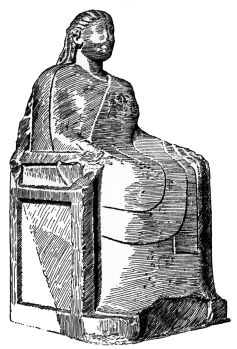
Seated Statue from Branchidæ
art he really describes is that of tapestry-weaving, the domestic art carried on by all his ladies. Thus Helen employs herself at Troy in weaving figures of warriors into her web, and Andromache weaves flowers into hers. What pattern Penelope wove into her everlasting shroud is known only to those who know what song the sirens sang. Appropriate to this prominence of the textile art is the style of ornamentation described, as we have read, upon the shield of Achilles. For these parallel bands of picture-writing
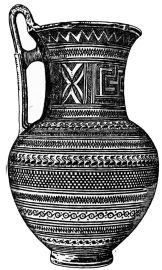
Geometric Vase
which were in the poet’s mind when he depicted the shield are known to us in the pottery of the seventh and sixth centuries. It is called by modern archæologists the Geometric style, because the whole body of the vase is divided into bands and panels by strips of zigzag ornament. An early phase of the Geometric style is specially named after the Dipylon Gate at Athens, because huge vases of a certain type were found in great numbers in the ancient cemetery of Athens in that neighbourhood. The subject of these vases is generally funereal. We see the body laid out upon the bier and the mourners indicating their grief by laying their hands upon their heads. The figures are rendered in conventional diagrams. To my taste they are almost repulsive. Not only is the drawing of the figures careless and clumsy, but the spirit of the whole thing is ugly. The fidgety nerves of the artist trying to fill every corner with some sort of scrawl, scraping meaningless emblems even between the legs of his horses, wearies the eye of the spectator. His designs have no sort of correspondence with the form of his material, any more than the modern house-decorator’s friezes and dados properly belong to the four flat surfaces of his walls. The vital qualities of good Greek art are self-control, the subordination of the artist to his work, and the perfect adaptation of the artistic form to the subject under treatment. The Dipylon Style does violence to all these canons of good taste. There must be an explanation.
It is easy to see that the ornamentation of a Dipylon vase is borrowed from an alien technique. Pottery never required the artist to divide his field up into parallel bands with borders and fringes. It is clearly from needlework, embroidery, or tapestry that this style is borrowed. You can see the stitches and the threads in many of the patterns. Primitive tapestry is necessarily linear, geometrical, and rectangular.
Now the whole thing becomes clear. Greece is dominated by a masculine race of warriors inartistic by ancestral tradition. Music they have always loved. They are generous patrons to the bard who sings the praises of their ancestors. They like a prettily designed brooch or golden cup. But there are no patrons for the other arts. While their lords are fighting hard and drinking deep the women are perpetually at their looms. The only arts that flourish are the textile arts, and they are largely modelled on Asiatic imported fabrics. The potter is a wretched, despised slave, probably of the old race. He has lost all his manhood and most of his taste, he gets no encouragement to make his cheap pots beautiful, and he has no models for design except the patterns of tapestry or metalwork. All the beautiful earthenware of Cnossos and Kamàres is broken or buried under the ground.
Yet even the Dipylon style gradually improved. While still retaining its Geometric character, vase-painting improves in drawing and colour, until in early Attic work like the famous François vase[14] we reach designs of considerable beauty. Here the horse becomes the favourite animal type. When the potters advance far enough they begin to deal with scenes of heroic legend and mythology, carefully labelling their heroes with their names. The Gorgon, which often figures in Homer, as on the shield of Agamemnon and the ægis of Athene, begins to be an art type in the Dipylon period; so do the sphinx and griffin, which, curiously enough, do not appear in our Homer.
The Hero’s Home
In Crete art dwelt in palaces; in classical Greece it haunted the market-place and the temple. For the present art is confined to the home. If we may judge by the charming “interior” pictures which Homer most skilfully introduces as a counterfoil to the everlasting clash of arms in the Iliad, domestic life was at its richest and best in the age of the epics. Every one has been struck with the dignified and important part played by women in Homer, contrasted with their seclusion and neglect in historical Greece. No one but Shakespeare has given us so charming a series of feminine portraits as Andromache, Helen, Penelope, Nausicaa, Thetis, and Calypso. The ingenious Samuel Butler actually attempted to prove that the Odyssey was written by a woman, so sympathetic is the poet’s insight into the feminine point of view. But the same is equally true of the Iliad; and, indeed, the respect for women becomes part of the heroic tradition even in Attic tragedy, so that the audience in the theatre of Athens must have seen the heroines on their stage acting with a freedom and treated with a deference which was quite alien to their own homes.
But even at this, its highest point, the domesticity of Greek life falls far short of modern ideas, and the dignity of the heroes’ wives is somewhat illusory. Possibly the inconsistencies are due once more to the many hands and many successive generations which have had their part in building up the epic. Certainly, for monogamists, the matrimonial ideas of the heroes are far from exclusive. Agamemnon announces his intention of taking Chryseis home, for he likes her better than his dear wife Clytæmnestra, and makes no secret of the position she is to occupy. He does actually take Cassandra home to his wife. In the Odyssey, too, we get a hint of arrangements decidedly Oriental in what Penelope says about her son and the fifty handmaidens. Again, there is a singular contrast between the tender conjugal devotion of Hector and Andromache, or Odysseus and Penelope, and the extraordinary callousness sometimes indicated with regard to feminine charms. It is often remarked as an instance of Homer’s subtlety that he nowhere describes the beauty of Helen, whose face
“Launched a thousand ships And shook the topmost towers of Ilium,”
only indicating it by making the old men of Troy look at her as she walks past and say to one another, “No wonder that the Greeks and Trojans should suffer pain so long for such a woman. Her countenance is wondrous like the immortal goddesses.” These traditions of the power of love and beauty must belong to the original epic story; for the whole plot of the Iliad, so far as it has a plot, turns on the beauty of Helen, as the whole plot of the Odyssey depends on the love of Odysseus for his wife and the constancy of Penelope. Thus both epics have a basis which might be the foundation of modern romantic fiction. Nevertheless, the spirit of romance is as completely absent from Homer as it is from all true Greek art and literature. Though Agamemnon is very angry at losing Chryseis he has no love for her. Odysseus simply gets tired of the lovely nymph Calypso, and parts from the charming Nausicaa without a pang. Such shocks as these are constantly in store for the modern reader, who is fed upon romance in the nursery.
If we look at the houses in which the domestic scenes of Homer are set we shall find that they are of a simplicity in strong contrast with the elaborate palaces of Crete or Tiryns; and this in spite of the obvious intention of the bard to depict them on a scale of heroic magnificence. They are mainly built of wood. The palace of Paris consists of three parts—thalamos, dōma, and aule. The thalamos is the private part of the house, and contains the marriage-bed of the royal couple. The dōma, or megaron, is the public hall for meals and receptions. The aule is the court with colonnades surrounding it. Priam had a large family: fifty sons slept with their wives in fifty thalamoi of polished stone built outside his court, while his daughters slept with their husbands in twelve roofed chambers within the court. The palace of Odysseus is more elaborate, and is so intended, for the disguised wanderer says: “Verily, this is the fair house of Odysseus, and easily may it be known and distinguished even among many. For there is building beyond building, and the court of the house is cunningly wrought with a wall and copings, and there are well-fitting double doors.” Standing outside the front door he can perceive by the smell of roast meat that there is a banquet going on. No great magnificence here. In front of the “well-fitting doors” there is a heap of manure, with an aged hound asleep upon it (a similar dung-heap, it may be remarked, graces the court of the palace of Priam in Troy City). Inside the doors there is the megaron, where the banquet is going on. Odysseus sits down on the ashen threshold, leaning against a pillar of cypress wood, specially commended for its straightness. Telemachus takes a lump of meat, “as much as his two hands can grasp,” and a whole loaf out of the fair basket, and Odysseus (who is disguised as a beggar) devours it on his dirty wallet as he sits on the threshold. This threshold under the portico of the hall is the regular meeting-place of beggars, and it is there that strangers are put to sleep. Within the hall there is an upper chamber where Penelope sleeps and lives with her maidens. The wooers set up three braziers in the hall to give them light, and heap them with wood and pine-brands; consequently the hall is so full of smoke that the weapons have to be removed to a storeroom to keep them useful. Odysseus, sleeping in the “prodomos” of the hall, can hear a remark made by one of the twelve grinding-women who have their hand-mills in the house next door. Under the same echoing colonnade where Odysseus sleeps goats and cattle are tethered by day. The walls of the hall itself are of wood, the ceiling is of wood, and the floor is of stamped earth, for it is cleaned with a spade, and fires are raked out of the braziers on to the floor. As for the bridal chamber, Odysseus had built it himself with stone, and it contained a marvellous bed wrought by the hero out of a living olive-tree. Finally, there was a rather obscure postern-gate set high in the wall of the hall above a stone threshold, and opening on to an open gallery. Thus the feature of the house of Odysseus is that it is of two stories; otherwise it consists, as usual, of three parts—hall, court, and chamber.
Our learned archæologists have been setting their intellects to the task of making these Homeric houses fit in with the palaces of Mycenæ and Tiryns, but they have found it hard work. They have had to admit that the palace of Odysseus is a good deal simpler than the meanest of the Ægean palaces. And yet our poet has deliberately advertised it as something out of the common. Does not that betray singular poverty of imagination? He could not even make his heroic domiciles as splendid as the actual buildings in which he sang his lays. What should we think of a novelist who professed to write about duchesses and described them as sitting in sumptuous front parlours? Of course we know the explanation. It is hopeless to attempt to synchronise the Homeric age with the ages of Ægean palaces. Homer lived in an altogether lower civilisation as regards wealth and comfort. Just as we saw that his “kings” were only country squires, so his “palaces” are no more than farmhouses, with all their picturesque squalor and simplicity. Dirt and magnificence may go hand in hand, as in our own mediæval halls, but in the Homeric civilisation the magnificence is only in the poet’s heart. His material surroundings are fitly typified by the Dipylon vases.
Hesiod’s World
Hesiod is the Cinderella of Greek poets, neglected alike by editors and schoolboys. And yet once he stood on a level with Homer. He is in reality the complement of Homer, and no picture of the Greek Middle Ages can be complete without him. The Parian Marble sets Hesiod thirty years earlier than Homer, Herodotus places them both about 850-800 B.C. Hesiod’s principal works are two, the “Works and Days” and the “Generations of Gods” or “Theogony.” The “Works and Days” is generally supposed to be a treatise on husbandry, but it seems to be in origin a letter of remonstrance to a wicked brother, Persis, who had ousted Hesiod from his property. The letter is embroidered freely with morals, maxims, and examples from mythology. Persis is exhorted to practise industry and good farming, for which some proverbial hints are given. But the main purport of this curious jumble is the reiteration of complaints against the “bribe-devouring kings”—always in the plural—who have given a corrupt judgment against the poet on his brother’s lawsuit. No one pretends to see real monarchy or anything but oligarchy in Hesiod, yet his rulers are called βασιλεῖς, just as are Homer’s. The “Works and Days” contains also the earliest versions of two most famous legends which together make up the Greek story of creation, the story of how Prometheus stole fire from heaven and the story of Pandora, the Eve of Greek mythology. The chief interest for modern readers lies in a very quaint and curious list of taboos and some personal reminiscences which form, I suppose, the oldest piece of autobiography in existence. He has already described seafaring as a very disagreeable business, to be avoided if possible; he now advises his brother to “wait for a seasonable sailing day, and when it comes, then drag down thy swift ship to the sea, and have a fit cargo stowed away on it, that thou mayest return home with profit; even as my father and thine, most witless Persis, used to make voyages for an honest living. Once he came even to this country, after a long voyage in a black ship from Cyme, in Æolis, turning not from rich resources and prosperity, but from dire poverty, which Zeus gives to men. And he dwelt near Helicon in this beggarly hamlet of Ascra—Ascra, vile in winter, uncomfortable in summer, and good never at all. But do thou, my Persis, be seasonable in all thy doings, but above all in seafaring praise a small ship, but put thy cargo in a great one. The freight will be greater and the profit greater if the winds keep off their dreadful storms. Whenever thou turnest thy rash heart to trade, wishing to escape debt and joyless famine, I will show thee the limits of the thundering main without being skilled at all in seafaring or in ships, for I have never sailed the broad sea in a ship except when I crossed to Eubœa from Aulis, where the Achæans in times long past were storm-bound when they gathered a mighty host from holy Hellas for Troy of the fair women. There did I take passage for Chalcis to try for the prizes of wise Amphidamas” (i.e. prizes offered at his funeral games), “the many well-prepared prizes which his lordly sons offered. There I boast to have won the prize for the hymn, and brought home a tripod with handles which I set up to the Muses of Helicon where first they taught me to be a clear-voiced bard. So little trial have I made of well-caulked ships, but still I shall declare the mind of Zeus who bears the ægis, for the Muses have taught me to sing a hymn without bounds.”
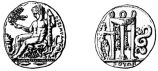
Coin of Croton, showing Tripod
Quaint old Hesiod! How like the literary man of all ages! He has never been to sea except on the channel ferry, but in virtue of his literary gifts he is competent to instruct other landsmen in navigation. So by help of the Muses he declares the mind of Zeus—“Never put to sea in a storm!”
Well, this is the reverse of Homer’s medal: the god-nurtured kings frankly revealed as corrupt nobles, the unrelenting toil on the stony farm, the perilous commercial enterprises in small unseaworthy ships, the emigrant returning home to Bœotia in poverty from his Eldorado in Æolis, the superstition, and the pessimism.
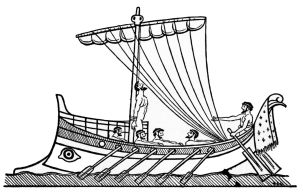
Ship of Odysseus. From a Vase