I ÆGEAN CIVILISATION
Reading edition
Vixere fortes ante Agamemnona. Horace.
A New Chapter of History
T is the misfortune of historians to be liable to attacks at both extremities. On the one hand time is continually adding postscripts to their “Finis,” and on the other hand the archæologist is constantly making them tear up and rewrite their first chapters. In Greek history especially the spade has proved mightier than the pen. We are now only certain that the first page of any Greek history written ten years ago must be defective; we are not yet quite sure what to put in its place. Any moment, it seems, the explorer may turn up something which will make a difference of a thousand years or so in our earliest chronology. There are in the Cretan museum scores of clay tablets inscribed with an unknown writing which only await an interpreter to confound and illuminate us all. Forty years ago eminent writers like Gladstone and Freeman were still looking to Homer for their ideas of the primitive European and his civilisation. Strange indeed were the results that followed. In politics we were to believe that the earliest Greeks settled their affairs at a public meeting where elders and princes made persuasive speeches, and radicalism, though not unknown, was sternly discouraged. A benevolent monarchy, hereditary in the male line, was supposed by Sir Henry Maine to be the form of government common to primitive Europe and modern England. Literature was believed to have begun with elaborate epic poems written in hexameters of exquisite variety and extreme subtlety. The primitive woman was believed to have been the object of chivalrous and romantic esteem. Strangest of all, religion in this primitive world was held to have included the cheerful bantering of anthropomorphic gods and goddesses. We were to suppose that the European began by laughing at his gods and ended by worshipping them.
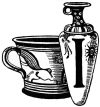
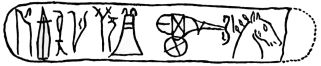
Tablet of Cretan Linear Script, from Cnossos
Then in the seventies came the redoubtable Dr. Schliemann, most erudite of sappers, and dug into the hill at Hissarlik to see if he could find the bones of Hector and the ruins of Troy. Troy he found in abundance, five Troys, at least, one on the top of another. He called the second from the bottom the city of Priam, and then he crossed over with his spades and picks to look for what might be left of Agamemnon at Mycenæ. Sure enough, he presently startled the learned world by a telegram to the King of Greece saying that he had found the tomb of Agamemnon. Quite certainly he had found some very important things—things, as we shall soon see, far more interesting and valuable to history than if they had belonged, as Schliemann thought, to the King of all the Greeks. But the point is that for many years to come all the excavators who worked on Greek soil started with the false belief that Homer was the beginning of all things and that their discoveries were illustrating Homer. We now know that the excavations at Mycenæ and the poems of Homer represent two entirely different civilisations, neither of them primitive. We are now in a position to throw the beginnings of European culture in the Mediterranean basin centuries—nay, whole millenniums—farther back than our fathers’ wildest dreams could carry them. The history of European civilisation is no longer a traceable progression from Homer to Tennyson or from Odysseus to Captain Peary, but a long cycle of rising and decaying cultures with periods of darkness intervening. For this revolution in our ideas the responsible weapon is the humble but veracious spade.
Crete, the Doorstep of Europe
We are to picture the primitive tribes of the world as continually moving under the double pressure of the wolf in their bellies and the enemy at their backs—moving, in the main, north and west, as climatic conditions relented before them. So long as they were in this nomadic stage little progress could be made in civilisation; tents must form their houses, and their goods could be only such trifles of necessary pots and pans as they could carry. But when the moving tribe reached the sea it was compelled to halt and settle. Thus it is that civilisation begins in the oases of the desert, on the north coasts of Africa, and in the isles of Greece. Settled by force, and to some degree protected by nature, they could begin to accumulate possessions, and to improve them with art. They could begin to build houses, and develop morals and polities.
Thus geography has made it exceedingly probable that Crete will play a momentous part in the earliest history of Europe. That island lies like a doorstep at the threshold of Europe. If civilisation was to rise with the sun in the East, out of the extremely ancient civilisations of Egypt and Babylon, by way of those earliest carriers to the world’s markets, the Phœnicians of Tyre and Sidon, clearly this island of Crete would be their stepping-stone to Europe. Thus we reason, knowing it to be the truth. But we should never have learnt the truth from literature. In Homer, for example, Crete is of little importance. It was famous for its “ninety cities” and its mixed nationalities, and it was known as the former realm of Minos. There, too, the father of all craftsmen, Dædalus, had fashioned a wondrous dancing-place. But we might almost gather from the pages of Homer that it was a land whose glory had departed already. And that is the truth. Outside Homer, Crete, though insignificant in history, takes a much more important place in mythology and legend. For religion Crete was the birthplace of Zeus, the king of the gods. In the history of law-making it plays a very important part, for Minos of Crete was said to be the first law-giver, and he was placed as the judge of the dead by later mythology. In religion it produced Epimenides, the early exorcist, and in music Thaletas. Then many ancient historians give us a tradition of early naval empires in Greek waters. Thalassocracies they were called, and that of Crete stands at the head of the list. Finally, those fortunate Englishmen whose introduction to Greece has come through the wonderful “Heroes” of Charles Kingsley know the story of the Cretan labyrinth and that fearsome beast the Minotaur. They know the story of Theseus: how the Athenians of the earliest times had to send tribute every year of their fairest youths and maidens to King Minos of Crete, until one year the prince Theseus besought old Ægeus, his royal father, to let him go among the number in order to stop this cruel sacrifice; how he went at last, and how the Cretan princess, Ariadne, loved him and gave him a weapon and a clue to the labyrinth, and how he slew the dreadful monster and deserted his princess and returned home; but how he forgot also to hoist the signal of his safety, so that the old king, seeing black sails to his ship, cast himself headlong from the rock in his misery, and gave a name to the Ægean Sea. In old days we read it as a beautiful Greek romance; now we think it very likely that the Athenians in early days did have to pay tribute—
septena quotannis corpora natorum
—to the empire of Minos. Sir Arthur Evans, the explorer of Cnossos, thinks that he has discovered the labyrinth, and perhaps even the Minotaur, in his excavations at Cnossos. Anyhow, he has discovered a civilisation previously almost unknown to history. As these new discoveries centre in Crete, the excavators have naturally taken Crete as the fount and origin of it all, and call their new old world “Minoan,” just as the followers of Dr. Schliemann called their discoveries “Mycenæan.” The two cultures are not distinct; Mycenæan objects mainly represent one or two of the later stages of Minoan culture. But as similar objects have been found in many parts of the Eastern Mediterranean, and as it is just possible (though not very probable) that even more wonderful discoveries of a similar kind may be made elsewhere, and as the relation of Minos to these earliest periods is by no means established, we had better be cautious and adopt the most general name of those which have been applied to this culture and call it “Ægean,” or “Pre-Achæan,” or “Bronze Age.” We may quite fairly use one name for all this world of prehistoric civilisation before Homer, although it covers an enormous space of time and may be divided into many distinct chapters or phases; because, after all, there is a clear line of ancestry between the earliest of the art forms and the latest, indicating that the artists were of the same blood, however many times their cities might be destroyed and their works buried under the soil. It is so distinct, so continuous, and so widely distributed that we are safe in believing that it was the work of one people spread all over the islands and coasts of the Mediterranean. Ægean civilisation has been found in Crete, on the coasts of Asia Minor, on the mainland of Greece, in Egyptian tombs, in Sicily, on the coast of Italy, at Torcello near Venice, at Bologna, and in Spain. Etruscan art seems to be essentially akin to it. Cyprus has long been known as a centre of Ægean civilisation, and is at the present moment yielding fresh treasures to the archæologist. But nowhere has it been discovered in such perfect continuity and splendour as in Crete.
It is the custom among archæologists to divide early culture into periods, according to the weapons in use. Accordingly we say that the Ægean periods extend from the Neolithic to the Late Bronze Age, meaning that the earliest of these Ægean potsherds are found in conjunction with polished flint weapons and tools, while along with the latest we find a few rare pieces of iron, but mostly bronze of a very high finish and workmanship. Such finds are dated very roughly by the level at which they lie, because it is a curious but certain fact that the level of ground once built over is constantly rising through accretions of dust and débris. Anyhow, it will be clear to every one that when, as at Troy and Cnossos, we find a series of buildings each superimposed upon the ruins of another, we can trace the history of such a site from early to late with certainty. Sometimes it is possible also to get a date by examining foreign objects found on the same site, such as gems bearing the cartouche or sign-royal of Egyptian kings. Only we must bear in mind that such little objects are easily displaced and often preserved for many centuries, so that great care must be used in taking them as evidence. Also, serious conflicts are still going on between the Egyptologists, and their dates are by no means ascertained facts at present.
Progress of Ægean Culture
I have said that the prehistoric culture revealed by the excavations in Crete and elsewhere forms a continuous and progressive history from the Stone Age to the Iron Age. Sir Arthur Evans, indeed, has divided his discoveries into nine periods, from “Early Minoan I.” to “Late Minoan III.” Without being quite so precise, let us attempt to sketch a history of “prehistoric” civilisation on Greek soil, taking Crete as the centre of influence.
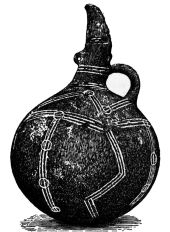
Black Vase from Cyprus
“Neolithic man” in Crete, though his weapons and tools were but polished stones, and far as he was behind his Neolithic brothers of Central Europe, had already begun to design patterns upon his pottery. Like Nature abhorring a vacuum, he traced zigzags, triangles, and chevrons upon the plastic clay, scratching or pricking lines and dots with a point of bone or stone, and sometimes filling the holes and scratches with white gypsum to show up the pattern. The body of his vases was generally black and shiny. Bucchero nero, as the Italian archæologists call it, is found in the Neolithic strata all over Southern Europe.
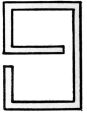
Plan of Neolithic House
His house was generally of mud and wattles, but there are some examples of stone-built houses on a rectangular plan. In Thessaly, where Neolithic culture survived right through the flourishing periods of art in Crete and Mycenæ, they have even found Neolithic houses with three rooms and the sockets for wooden pillars. Caves were still used as dwellings, and there is also a round type of hut, derived, no doubt, from the still more primitive tent of skin and wickerwork. Of the religion of the Late Stone Age we know nothing, except that they buried their dead with care in tombs resembling their
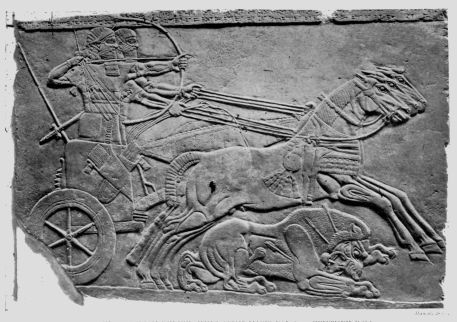
Plate IV.—ASSYRIAN RELIEF: KING ASSUR-NASIR-PAL (9TH CENTURY B.C.) Mansell & Co.
dwelling-places. Archæology has a rough method of assigning dates by allowing about a thousand years for every three feet of deposited earth; on this reckoning we may date the Neolithic period in Crete anywhere before 4000 B.C.
Then gradually comes the beginning of the Bronze Age. All civilisation may be regarded as a progress in tools and weapons. Nowhere is the history of Europe traced with a clearer pen than in its armouries. As the guns of Crécy foretold the passing of chivalry, so the discovery of that alloy of copper and tin, which produced a metal soft enough to mould and hard enough to work with, meant a step forward for civilisation. At first, of course, bronze is rare and costly; it is confined to short dagger-blades and spear-points. Along with the earliest bronze we find an advance in the pottery, paint used to trace the patterns, though the designs are still those of dot and line; experiments are being made with colours and glazes. In experiment is the germ of progress; the conventional artists of the East imitate and sometimes improve their models, but they seldom make experiments. In Assyria and Egypt they have produced wonderful and beautiful works of art.[4] But with them art is ornament; there is no ideal, no striving to get nearer to the truth of things. The Oriental sculptor soon loses touch with Nature, and as his technique advances learns only the language of convention.
So in the forms and designs of the pottery we watch a steady upward march, the progress growing faster as the standard of achievement rises. Curves and circles take the place of zigzags and triangles. The potter plays tricks with the colour of his clay, daubs it with red, burns it in patches. In these strata we begin to find imitations of the human form, rude images or “idols,” possibly the votive offerings which represent the worshipper in substitution for human sacrifice. These become conventionalised, as everything connected with religion tends to do, into queer fiddle-shaped, goggle-eyed figures. All the Cretan artists insisted on the waist to a degree which would seem to the modern shop-girl an exaggeration. Even in Egypt the small waist was regarded as a characteristic of the Keftiu—the men from the Isles of the Sea. The broad shoulders of the men no doubt are intended to symbolise strength. Along with vases and “idols” are found seals whose emblems show traces of the influence of Egypt under the Sixth Dynasty (? 2540 B.C.).
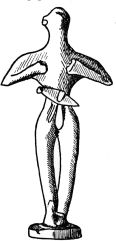
Terra-cotta Figure, from Petsofà
Now we take a great upward leap into the “Middle Minoan” periods of Sir Arthur Evans. Here we find the earliest writing of Europe, clay tablets inscribed with a pictographic script. The clay figures are extremely elaborate presentments of the costume of the day; and a highly elaborate costume it is. Colour is freely employed on idols and pottery. The patterns pass into spirals, and occasionally there is direct imitation of Nature—goats, beetles, and (as the classical Greeks would say) other birds.
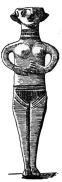
Terra-cotta Idol, from Troy
Now we are among the earlier palaces of Cnossos. Each period now seems to have ended with a disaster, after which art rose again triumphantly above the ruins, to begin where it had left off before the invader came to destroy the palace and shrines of its patrons. Here we find the “Kamáres” ware, a style of pottery to which we can perhaps for the first time apply honest expressions of admiration. It is often as thin as eggshell china. Its shapes are extremely varied and graceful; among them the precise form of the modern tea-cup is common, and beautiful dishes for
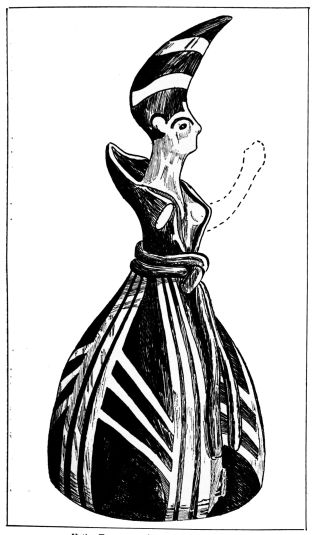
Votive Terra-cotta, from Petsofà. (Full size)
offerings which resemble the modern épergne. A lustrous black glaze generally forms the background; on it designs are painted in matt colours, white, red, and sometimes yellow. The designs are still chiefly conventional patterns of stripes and spirals. The potter’s wheel is by now in common use, as we see from the greater symmetry and accuracy of the lines. It is suggested that this ware in its thinness and its patterns was inspired by metalwork. It must not be forgotten that the archæologist only finds what the looting pirate has despised. The gold and the bronze have been taken and only the humble potsherds left.

Kamáres Cup
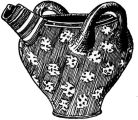
Kamáres “Hole-mouthed” Jar
In the stage we have been describing the general colour effect of the vase was the artist’s first consideration. Presently (after another catastrophe) a new spirit begins to appear, the desire to imitate the forms of Nature. With increasing naturalism the potter reverts to simpler colours, despairing, it would seem, of the attempt to reproduce the colours of his models. Neither greens nor blues could be managed in earthenware. Fortunately, however, a new material is discovered which serves the purpose. This is a kind of faience or porcelain. The idea was imported from Egypt, but a native factory was set up in the palace of Cnossos, and we even find the steatite moulds by which the patterns were impressed. The naturalism is extremely skilful and effective. One of the most beautiful examples is illustrated.[5] It is the favourite motive of an animal suckling her young, constantly found as a heraldic type on coins and seals. Here it is evidently drawn from a direct study of Nature, so living is the pose, so faithful is the expression of
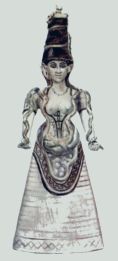
Fig. 1. Snake Goddess.
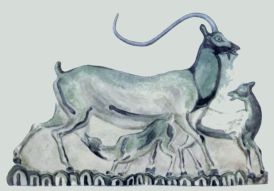
Fig. 2. Wild Goat and Young.
Plate 5. FAÏENCE FROM THE TEMPLE REPOSITORY OF THE SECOND PALACE, CNOSSOS, CRETE.
the muscles. It is probably a failing of archæologists to see religion everywhere they go. It is certain that the suckling motive was in after times associated with the worship of maternal deities such as Hera. It is certain also that the prehistoric Cretan did worship powers of fecundity in human and animal form. But we need not transform this she-goat into a goddess. I much prefer to be sure that this prehistoric Cretan loved and studied the wild creatures of his native hills and his native blue sea. Art and Nature are hand in hand now on vases and gems also. We have seal types bearing wolves’ heads, owls and shells, scenes from the boxing-ring and the bull-ring. The writing has progressed from mere pictographs to a linear script. It is astonishing to find the Cretan of 1911 B.C. writing, as we write to-day, with pen and ink.
We pass on to the “Late Minoan” periods, the ages of masterpiece. Here Mycenæ enters the story, for though much earlier objects dating from the Stone Ages have been found both at Mycenæ and Troy, the best Mycenæan work is contemporary with the “Late Minoan” of Crete. The weapons now are swords of bronze. As for the designs of pottery, whereas in the last period they were generally drawn in white upon a dark ground, they are now drawn in red or brown upon a light ground. They are still naturalistic, and in the best specimens the artists have achieved the highest triumph of vase-painting, namely, to apply the artistic forms of Nature to serve their purpose, subordinating her as she ought (being a female) to be subordinated. Observe how the murex shells are used along with conventional patterns and how the light and shade are massed à la Beardsley. It seems probable that the early painter selected those natural forms, such as the octopus, the shell, and the star-fish, which most nearly resembled the geometric patterns used by his predecessors.
The shapes are now extremely graceful. These pointed pitchers were used as we see in the famous frieze of the Cupbearer, to serve the wine. There is generally a hole in the base to strain it. Drinking vessels were often of that fairest of Attic shapes known as the kylix. We notice how marine objects predominate in the natural forms selected. That alone might have given us a hint to look for an island as the centre of this art.
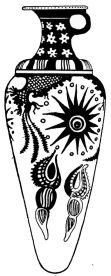
Cretan Filler
Now comes the great period of prehistoric architecture, of which we find examples in the palaces of Cnossos, Mycenæ, and Tiryns. What cranes were used to hoist these great masses into position we do not know. We cannot guess what tools were used for cutting and boring the solid stone as it was cut into the gigantic steatite wine-casks or the monolithic columns or the limestone reliefs. We can only marvel at them as we marvel at the Sphinx and the Pyramids. At Cnossos there were magnificent halls, decorated with painted frescoes of wonderful craftsmanship or stone carvings in high and low relief. There was a great hall of audience in particular, shaped like a Roman basilica or an early Christian church, a building so utterly out of its age that architects are amazed when it is placed in the second millennium before Christ. There is a throne, of what every one would have called Gothic design. Of the rest of the architectural marvels of these “Minoan” palaces, their upper stories, their light-wells, their double staircases, of the bull-ring and wrestling-ring, with its royal box, of the water-gate, and the engineering skill which overcame the slope down to the river, of the magazines and store-rooms, with their Aladdin’s jars still standing where King Minos’ storekeepers placed them, of the Queen’s Chamber and the Hall of the Distaffs and of the Royal Villa—of these things let the architects and Sir Arthur Evans relate. It would need pages of ground-plans to exhibit them, for after
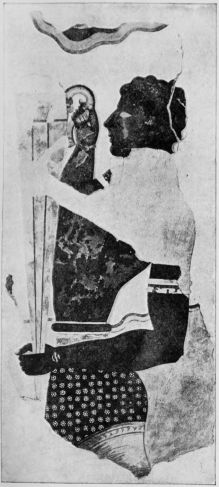
Plate VI. THE “CUP-BEARER” FRESCO
all the palaces of Crete are little more than ground-plans to the layman, and ground-plans are dreary things. Sir Arthur Evans, indeed, believes that it was the intricacy of these miles of ruined foundations which provided the later Greeks with their legend of the Labyrinth. The frescoes are truly marvellous, whether we consider the glorious youth called the Cupbearer,[6] with his dark curly head and perfect Greek profile, or the vividly natural bull’s head in stucco.[7] Among the wonders is the veritable board on which King Minos played backgammon according to the prehistoric rules of that respectable game. It is of gold and silver, of ivory and crystal and “kuanos”—a board fit for a thalassocrat.
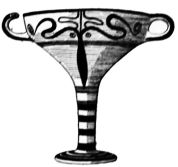
Cuttle-fish Kylix
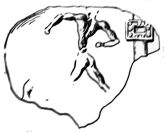
Clay Seal Impression: Pugilist
There is something here for every one. The sportsman will observe the methods of pugilism indicated on the gems, admiring the muscular development and the free action of the Cnossian prize-fighter. He seems to have neglected his “guard,” but then he was separated by a barrier from his opponent. Or we may study the laws of bull-baiting as practised at Cnossos, noting the agility with which toreadors, male and female, leap over the animal’s head. The milliner may study the latest modes of to-day on the fashion-plates of the eighteenth century before Christ. She will find the flounced petticoat of yesterday, the narrow waist, the bodice cut extremely décolletée, the high coiffure of to-morrow, the Medici collar, the zouave jacket. She will see hats which Mr. Myres considers “unparalleled,” some flat like the mode of 1902, others with turned-up brims and roses underneath like that of to-day.
The plumber too will find a paradise in Cnossos. There are lavatories, sinks, sewers, and man-holes. Let me quote Professor Burrows: “The main drain, which had its sides coated with cement, was over 3 feet high, and nearly 2 feet broad, so that a man could easily move along it; and the smaller stone shafts that discharged into it are still in position. Farther north we have preserved to us some of the terra-cotta pipes that served for connections. Each of them was about 2½ feet long, with a diameter that was about 6 inches at the broad end, and narrowed to less than 4 inches at the mouth, where it fitted into the broad end of the next pipe. Jamming was carefully prevented by a stop-ridge that ran round the outside of each narrow end a few inches from the mouth, while the inside of the butt, or broader end, was provided with a raised collar that enabled it to bear the pressure of the next pipe’s stop-ridge, and gave an extra hold for the cement that bound the two pipes together.” Let no cultivated reader despise these details. There is no truer sign of civilisation and culture than good sanitation. It goes with refined senses and orderly habits. A good drain implies as much as a beautiful statue. And let it be remembered that the world did not reach the Minoan standard of cleanliness again until the great English sanitary movement of the late nineteenth century.
The Mainland Palaces
Though there is so much to interest the architect in Cnossos, and though the finest ashlar masonry is to be found there, the ordinary student of ancient building will probably prefer to go for his examples, as of old, to the contemporary
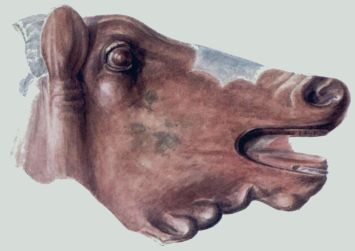
Plate 7. BULL’S HEAD: LIFE-SIZE RELIEF IN PAINTED STUCCO. CNOSSOS, CRETE.
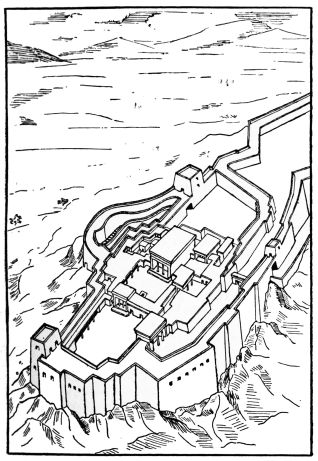
Citadel of Tiryns
palaces of Mycenæ and Tiryns. In Cnossos there was little or no fortification—another proof that the Minoan empire rested safe behind wooden walls. But on the mainland we have two magnificent fortresses and citadels, so well preserved and so cleverly excavated by Schliemann and Tsountas that the untrained eye can take in at a glance the essential features of the architecture. At Tiryns the builder has taken the fullest advantage of the natural strength of his position. The top of the hill has been levelled and the summit encircled with a gigantic wall seldom less than fifteen feet thick. In the wall there are galleries opening internally upon a series of magazines. Along it at intervals there are massive watch-towers. One such screens each of the gateways. The main gate on the east side is approached by a long ascending ramp, which is exposed all the way to attack from the wall that towers above. To reach the postern-gate on the west you had also to climb a long flight of steps. The hill-top, which is more than 900 feet long, consists of a lower plateau to the north, on which no traces of building have been found, possibly because there were only wooden erections there for the soldiers, or possibly because it was left bare as a place of refuge for the cattle. The higher plateau to the south contains the palace, with its great pillared megaron, or hall. In this there is a circular central hearth. Close behind is the hall of the women, with sleeping-chambers at hand, and a strong treasury partly built into the wall. There is an elaborate bathroom, with drain-pipes and water-supply, hot and cold, a little to the west of the megaron. The three inner courts are sumptuously paved with mosaic, and the walls were covered with frescoes. It appears that the buildings on the summit of the hill were all of a palatial description, and the conclusion is that the commons lived in the plain below, governed and protected by their citadel. Tiryns lies on the flank of the plain of Argos, and within a few miles of the sea. As this one small plain included also the other ancient fortresses of Mycenæ and Argos, the dominions of this king must have been very small. It has been plausibly suggested that these citadels principally existed to command the highways leading to the Isthmus of Corinth.
At Mycenæ the fortification work is similar. Our view of the Lion Gate[8] will give some idea of the massive, Cyclopean masonry. The great relief itself is clearly a heraldic device; some such grouping of animals is constantly seen upon seals and gems, and the lion (or lioness?) has always been a royal beast. But, heraldic though it be, this enormous group is far from lifeless conventionality. Some scholars believe that the pillar between the animals is a proof of the much-discussed pillar-worship of prehistoric Greece.
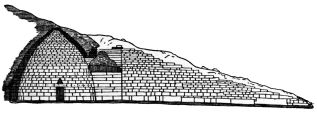
Beehive Tomb: Section
But the most interesting of the Mycenæan remains are undoubtedly the tombs. In the city itself there is a circular enclosure surrounded by a double series of paving-stones set into the ground on edge, thus forming a ring of shaft graves whose purpose was plainly shown by the objects and bones found in them. Down in the plain below were found other burying-places, also circular, but of a later date and much more striking. These subterranean “beehive” tombs have been found elsewhere in Greece, but nowhere of such splendour. It was one of these which Schliemann proclaimed to be the tomb of Agamemnon. Like the pyramids in Egypt, it contains an inner chamber, which forms the actual grave, outside it a circular “tholos,” probably a shrine for the cult of the departed, and a long “dromos,” or inclined approach. The tholos is of great interest to architects as providing a forerunner of the dome. But it is not built on the principle of the arch, with wedge-shaped masses and a keystone. This dome is contrived by laying ever-narrowing circles of masonry one upon the other concentrically, the interior being smoothed, plastered, and richly decorated. It is thought that the bee-hive shape reproduces the primitive bell-tent, for the tombs of the dead are generally copied from the abodes of the living. Such splendour in the tomb, such careful concealing of the dead underground in an inner chamber, unquestionably proves ancestor-worship.
The sixth city at Troy was of much the same style and date as these; larger, indeed, than all, and with its houses radiating from the centre like the spokes of a wheel. On the Athenian Acropolis too there are traces of a similar prehistoric settlement. We are probably to imagine the face of the Greek world in the second millennium B.C. as dotted with these citadel palaces.
Mycenæ has yielded many interesting treasures of a minor sort. It was especially rich in gold, and we notice with great interest the masks of thin gold laid upon the faces of the dead. Nor has Crete yet produced any object in gold to rival the famous pair of cups[9] found at Vaphio, in Laconia. These are of gold repoussé, and their designs of wild and tame cattle are incomparably living and natural. But Sir Arthur Evans is probably justified both on grounds of style and subject in claiming these superb treasures as exports from Crete. The palm-tree betrays a Southern origin. In Mycenæ, too, were found the finely inlaid dagger-blades[10] which give us a picture of the men and weapons of the Mycenæan or Late Minoan ages of Ægean culture. The men, we observe, are armed with long spears and huge figure-of-eight shields composed of wickerwork covered with bull’s hide and pinched in at the “waist” so as to encircle the body and provide a hand-grip. The warriors wear no clothing but
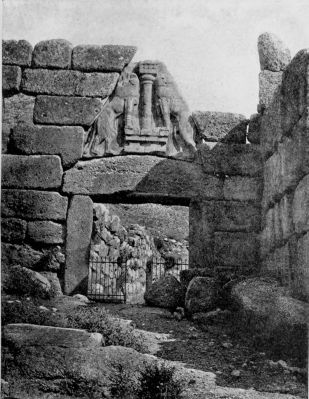
Plate VIII. THE LION GATE, MYCENÆ
English Photo Co., Athens
breeches or loin-cloths, and in this they resemble the men of the Cretan frescoes and gems.
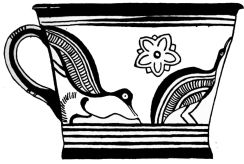
Cretan Cup of Degenerate Style.
And what came of it all? Somewhere, it would seem, about 1400 B.C. Cnossos underwent its final catastrophe. The palace was sacked and burnt, the ateliers of its brilliant artists were destroyed, and the artists themselves slain or scattered. So the centre of illumination was darkened for the whole Ægean world. Elsewhere Ægean civilisation continued perhaps for two centuries more, and in Cnossos itself there is yet another period when the palace sites were partially reoccupied by a few stragglers of the old artistic race. But with the fall of his patron the inspiration of the craftsman vanishes, degeneration rapidly sets in. Even in the designs of the vases the bold, naturalistic drawing deteriorates into lazy formulæ, the brilliance of the glaze grows dull, the colours are flat and muddy. A good deal of Mycenæan art is of this decadent type, and a good deal more of it has been found in the neighbouring sites of Crete.
Among the relics of this period are objects which betray the cause of the downfall—weapons of iron. The Bronze Ages are passing away before the superior metal, as the Stone Ages had yielded to the Bronze.
The Makers of Ægean Art
It now becomes our duty to sum up this wonderful world of archæology and to consider its bearings on the history and art of later Greece. Unfortunately many problems arise at this point for which at present the archæologists cannot agree to offer a solution. Who were these Ægean folk? Were they of Indo-European stock and language? We have already agreed, I think, that they represent a primitive stratum of population which originally spread all over the south of Europe and the basin of the Mediterranean. The Cupbearer may indicate their physique, black curly hair, straight nose, long skull; and I, for one, decline to believe that this fine fellow is a Semite or Phœnician, as has been suggested. We know that these people were extraordinarily gifted, especially in the sense of form, and that they were capable of very rapid development. May we not believe that one and the same stock has lain at the base of the peoples of the Eastern Mediterranean from prehistoric times until to-day, much as it has been crossed and conquered and oppressed? And was their language Greek? That is a question that we cannot answer for certain, since no one has yet been able to interpret their handwriting. I see no reason to dispute Professor Ridgeway’s argument that as the stock prevailed through several waves of conquest from the north, so the language survived without material change, just as Italian prevailed through the Lombard conquest of North Italy. Of course nationalities were more mixed in Crete and Cyprus than on the mainland of Greece. It can but be an opinion delivered in the consciousness of many counteracting arguments, but I believe that the people whose culture we have been describing were essentially the same as we know in historic times, and of course Indo-Europeans.
From the historian’s point of view it is important to observe that civilisation in Europe began, as in Asia, under the fostering care of autocracy in palace workshops. It was bound
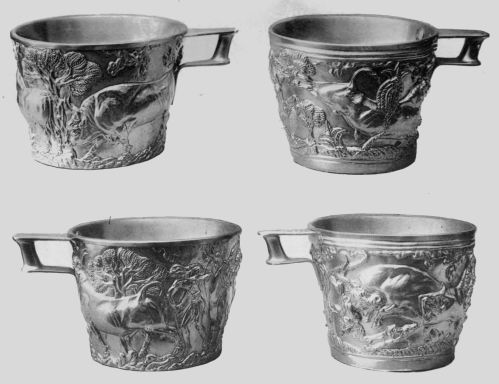
Plate 9.—Vaphio Cups.
to be so. All the archæological indications point to a strong and tyrannical form of monarchy of the Oriental type. Those Cyclopean walls were built by slave labour. The common folk and soldiers are represented as almost naked. It was a commercial empire too. Those rows and rows of store-rooms, with their huge jars, formed the bank and treasury. Very probably the clay tablets will be found to contain, not prehistoric sonnets, but merely lists and inventories of stores and tribute.
We must not be carried too far by our wonder at this unexpected revelation of prehistoric culture. The later Greeks never reached such a standard as these people in writing or in engineering or in fortification or in many of the handicrafts. They could never have represented the forms of Nature with the same realism. That is true, but there is something wanting in the prehistoric Ægean art which only classical Greece could give to the world. There is little ἢθος in Ægean art, little nobility, though much beauty, no ethical ideal. How that missing something was supplied and whence it came we shall see in the next chapter.
Another question arises: How far was this culture original? How much does it owe to Assyria, Egypt, and Phœnicia? Much, but not everything. The drainage system of the palace has its original in Assyria, and some think that the laws of Minos were derived from the code of Khammurabi. The faience comes from Egypt; so do many of the lotus and lily patterns of the vases. Crete was bound to be greatly indebted to Egypt. As for Phœnicians, they are carriers and traders, but no one has yet proved that they could initiate in anything—except, perhaps, religion. But what Crete borrowed it transformed, and, as I believe, Europeanised; it rejected deliberately the Oriental tendencies to conventional stylistic imitation.
A word remains to be said about religion. In classical Greece, as everybody knows, there was a prevailing cult of state gods and goddesses, an anthropomorphic Olympian family, Zeus, Hera, Athena, Artemis, Apollo, and the rest of them. But recent students of religion have pointed out that side by side with the public worship of celestial deities there was a more mysterious but more real devotion to a quite different form of religion, a cult of Nature goddesses, with mystical rites whose origin was more than half forgotten. To this class belong the Mysteries of Eleusis, to name the most famous example, and it is seen in the many-breasted “Diana of the Ephesians.” Now Professor Ridgeway has long taught that this naturalistic worship was probably a survival from the prehistoric ages of Greece. It is at its strongest in Arcadia, the untouched primitive part of Greece. He calls it the religion of the Southern mother, retained in spite of the Northern father who would have his Zeus-Odin worshipped in public. The discoveries in Crete have confirmed this theory, and thrown some light on the naturalistic worship of later times. The principal deity of Crete was a Nature goddess, generally represented as adorned with snakes.[11] She was worshipped with orgiastic rites, ecstatic dances, shaking of rattles, ornately robed priests, and emblematical processions. Along with this worship, and probably older, as the aniconic precedes the iconic stage of religion, there are many signs of aniconic fetishes, pillar-worship, axe-worship, tree-worship, and even cross-worship. The monster forms of bull-men, dog-men, snake-men may be only heraldic signs, or they may indicate a worship of monsters such as prevailed in Egypt. Certainly there was worship of the entombed ancestor. We can see that the artistic people of prehistoric Greece were very near to the earth after all.
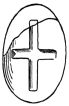
Clay Seal Impression with Cruciform Symbol, from Temple Repository, Cnossos
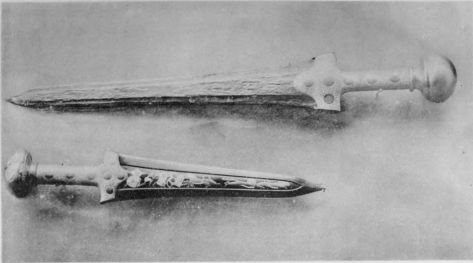
Plate 10.—Inlaid Dagger Blades.