IV THE GRAND CENTURY (continued 2)
Reading edition
Strophe “O Love, our conqueror, matchless in might, Thou prevailest, O Love, thou dividest the prey: In damask cheeks of a maiden Thy watch through the night is set. Thou roamest over the sea; On the hills, in the shepherd’s huts, thou art; Nor of deathless gods, nor of shortlived men, From thy madness any escapeth. Antistrophe “Unjust, through thee, are the thoughts of the just; Thou dost bend them, O Love, to thy will, to thy spite. Unkindly strife thou hast kindled, This wrangling of son with sire. For great laws, throned in the heart, To the sway of a rival power give place, To the love-light flashed from a fair bride’s eyes: In her triumph laughs Aphrodite. Me, even now, me also, Seeing these things, a sudden pity Beyond all governance transports: The fountains of my tears I can refrain no more, Seeing Antigone here to the bridal chamber Come, to the all-receiving chamber of Death.”
In this ode we have the Greek tragic view of the passion of Love, as the destroyer and distractor of man’s peace and sanity. Love is one of the means whereby tragic fate fulfils its purposes of vengeance. The circumstances of this particular case are these: Of Antigone’s two brothers one had marched against his native city, and the other had taken arms in its defence. Both had fallen on the field of battle. Creon, the city’s tyrant, forbade any one, under pain of death, to give burial to the slain enemy. In this, of course, he was violating one of the most sacred laws of Greek religion. Now Antigone was betrothed to Creon’s own son, Hæmon; nevertheless her duty was to brave the tyrant’s decree and give the honours of formal burial to her dead brother. She did so. Creon thereupon pronounced her doom, and Hæmon in his despair slew himself upon the tomb in which she was immured. The whole story is but an episode in the doom of the house of Œdipus, father of Antigone. The Greek view of Love, then, is the antithesis of the romantic view of it. Where Love conflicts with duty it must be rigorously suppressed, as a source of folly, weakness, and wickedness. So much is this the case that Sophocles puts into the mouth of Antigone words which he had probably borrowed from Herodotus, and which give a view of the Great Passion so painfully unromantic that the modern commentator, who for all his prosiness is a thoroughly romantic person, is tempted to use the shears by which he commonly cuts his knots and call it an interpolation. “My duty,” says Antigone, “is to my brother first. You speak of my duty to my future husband, and my future children. I reply that a brother is more than a husband or children; they can be replaced, a brother cannot.”
An even more disconcerting display of common sense in a presumably romantic situation is seen in that amazing play the “Alcestis” of Euripides—surely the most conspicuous failure in all dramatic literature. Every one knows the tale, how Admetus was allowed as a boon from Apollo to get some one else as a substitute in his place when Death came to fetch him. His faithful wife, Alcestis, took his place, being consoled by Admetus with the promise of a handsome funeral. Then the king’s old father appears upon the scene to offer his condolences to the widower, but is immediately assailed with the most vehement reproaches for not having himself, as an old man with one foot in the grave already, shown sufficient pluck to volunteer death. He not unnaturally retorts that if it is a question of daring to die, Admetus himself had not been remarkable for courage. The point is one that pleases Euripides; it is a nice point of casuistry; he lets the speakers dispute it at some length. I think these two passages are significant of much. When we think of the Greeks as a race of poetic and artistic genius we must not forget that practical, unsentimental common sense is among their most prominent characteristics. They habitually exposed weakly infants to death. Their comedy is singularly merciless to disease and deformity. Plato’s treatment of the sex problem in his ideal republic is strikingly cold-blooded, but hardly more so than the actual treatment of the same problem in the real republic of Sparta. Before we leave this question of the romantic in the Greek character two things should be observed. The romantic element unquestionably grows stronger as Greek civilisation approaches its decline: there is a good deal of it in Menander and Theocritus, still more in Heliodorus; Alexander the Great is romantic to the finger-tips. Secondly, although there is so little of it in Tragedy, or generally in the relations between the two sexes, it is found in a degree of almost modern intensity in the relations between Heracles and Hylas, between Theseus and Peirithous, between Harmodius and Aristogeiton. It was not foolishness to the Greeks for a man to face death for the youth he loved. Indeed, upon that theory Epaminondas the Theban organised that Sacred Band which for a time revolutionised Greek history.
Another characteristic excellence of Greek drama, and especially of Sophocles, is its extraordinary power of narrative. With its severe scenic limitations, the Attic stage wisely refrained from attempting to reproduce realistically exciting spectacular incidents. The actual “tragedies” seldom occur in the sight of the audience. Far more often the hero or heroine leaves the stage in despair, the chorus intervenes with a mournful ode, and then a messenger arrives with a narrative of the fatal occurrence. Shakespeare, with scarcely less severe limitations, faced the impossible, and courted ridicule by representing battles in full detail on the stage by means of a handful of overworked “supers.” What they could not represent the Greeks narrated; and Horace, indeed, exalts it into a principle of dramatic art that “Medea must not butcher her babes in public.” That the Greek dramatists so refrained was probably due to dramatic tradition as well as to the practical necessities of the case. When there was only one speaking actor in addition to the chorus his part must have been chiefly what our composers of oratorios call “recitative.” For these two reasons, and perhaps also in obedience to the Greek spirit of self-restraint, narrative declamation by “messengers” is a striking feature of all Greek tragedy.
We have seen already the religious theory upon which tragedy is generally based, the logical succession of Success, Pride, Vengeance, and Ruin. The tragedians deal largely with stories of the doom which had pursued certain of the heroic houses like that of Labdacus or Atreus. In such cases a prophetic curse rests upon the entire dynasty: Atreus slays his brother’s children and bequeaths doom for Agamemnon. Agamemnon is slain by his guilty wife Clytæmnestra, whereby a duty of vengeance devolves upon their son Orestes, who must slay his mother, and therefore must incur the celestial doom of the matricide, unless Apollo himself can intervene to release him from the vengeance of the Furies. Such stories were pursued by all three great tragedians, often in sequences of three tragedies called trilogies. They have no “moral,” except that sin breeds suffering to the third and fourth generation, but the sin is often an involuntary one. The purpose of the tragedian is to show the struggles of man against fate. According to Aristotle’s oft-quoted theory, the purpose of Tragedy is to act as a “purgative of the emotions by means of pity and terror.” As the surgeon lets blood in order to reduce fever, so the drama enables the spectator to acquire peace of soul through the vicarious sorrows of its heroes and heroines. Aristotle declares every tragedy to consist of two parts, the tying of the knot and the loosing of it. The “loosing” commonly involves a peripeteia, or sudden reversal of fortune, as when Agamemnon’s triumphant return is changed to death and mourning; often it is brought about by an anagnōrĭsis, or recognition, as when the stranger in the palace is found to be Orestes come home for revenge. The so-called Aristotelian “unities,” which have loomed so bulkily in the history of dramatic criticism, and under the fear of which the classical dramatists of France were imprisoned, are not to be found in Aristotle. He does, indeed, advocate unity of subject, but unity of time and place are nowhere demanded. The natural limitations and the consequent simplicity of the Greek stage generally imposed these unities as a practical necessity.
Greek simplicity is often, as we have seen, a studiously contrived impression and the result of elaborate concealment of art. That it is not entirely so in the case of the drama is proved by the astonishing fertility of the principal dramatists. Æschylus wrote more than 70 plays, Sophocles 113, Euripides 92, and another tragic poet whose work has not survived 240. They were written and produced in competition. In 468 B.C. Sophocles began his public career by competing against Æschylus for the prize of tragedy. As the house seemed equally divided, the presiding archon left the decision to the ten generals who had just come back victorious from their warfare in Thrace. The prize was awarded to Sophocles, who, it is significant to notice, had been specially trained under a famous musician. Euripides only won the prize five times in a poetical career of fifty years. A prize was likewise awarded to the choregus who produced and trained the best chorus. It was the custom for the successful choregus, who was always, of course, a rich man, to dedicate his prize—a tripod—in a certain street in Athens. One such monument of the fourth century by a certain Lysicrates is still standing in fair preservation. It was a pretty example of the luxurious Corinthian order of architecture.[71]
Tragedies were performed three times a year at the three festivals of Dionysus. The poet had an audience of 13,000,
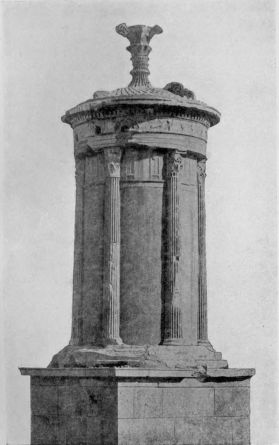
Plate LV. MONUMENT OF LYSICRATES AT ATHENS
English Photo Co., Athens
including strangers from all parts of Greece. At first, it would seem, admission was free, but so great was the crush that a small entrance fee was charged. It was one of the really popular measures of Pericles to start a fund not only for enabling the poorer citizens to enter free, but actually to compensate them for their loss of employment while engaged in this public duty. After all, why should the privileges of free education be lost by the citizen merely because he is over fourteen years of age? Why should we have to pay to enter the theatre, when the doors of the National Gallery are opened to us for nothing?
I find it much more difficult to speak of Athenian Comedy with candour and discrimination. Scholars of unblemished reputation and unimpeachable sense of humour do unquestionably find the plays of Aristophanes, even when produced by English schoolboys on speech-day, excessively diverting. There is, it is true, in Aristophanes a good deal of simple honest fun of the type represented by Mr. Punch or Mr. Pickwick and his spectacles in the wheelbarrow. When the wrong man gets a thwacking or when an ignorant amateur told to sit to the oar proceeds to sit on it, it is, I suppose, no less funny in the twentieth century anno Domini than it was in the fifth century before Christ. But there I must leave the humour of Aristophanes to those who can appreciate it and still laugh even when they have laboriously picked out the point of the joke from the notes at the end of their text-book. Most of the humour is of this type. It was written to burlesque the well-known figures of the day, and no doubt served its purpose extremely well. Indeed, there is no more certain proof of the liberty of speech which prevailed in Athens than the fact that Aristophanes was permitted to represent Cleon the Prime Minister in successive plays in the most ludicrous and offensive situations. The Old Comedy of Athens rested largely upon a basis of venomous personal slander and libel without self-restraint, without even common decency. It must be added that all ancient humour was corrupted at the source with obscenity. Anthropology, no doubt, explains this satisfactorily for the anthropologist. Comedy took its rise from obscene representations of the power of fecundity. Women and children were properly forbidden to be present at comic representations. It is not only thus with literature; the comic vase-paintings of Athens and the comic frescoes of Pompeii are not suitable to modern taste.
Aristophanes as a poet is in a very different category. Every now and then in a parabasis he turns to talk to his audience, so to speak, in his own person, dropping for the moment into serious vein. In such passages he is often superb.
In the following dialogue from “The Frogs” we have an interesting and characteristic piece of literary criticism. Aristophanes is, as we have seen, a Tory. The Athenian he loves is remarkably like the John Bull of our national ideal. Here Æschylus as the poet of the old order is at issue with Euripides, and Dionysus himself is there to umpire, disguised as an irrelevant Philistine. The spirited and very free translation is by Hookham Frere. Euripides has already expounded his principles, and Æschylus now takes his turn.
Æschylus “Observe then, and mark, what our citizens were, When first from my care they were trusted to you; Not scoundrel informers, or paltry buffoons, Evading the services due to the State; But with hearts all on fire, for adventure and war, Distinguished for hardiness, stature, and strength, Breathing forth nothing but lances and darts, Arms, and equipment, and battle array, Bucklers, and shields, and habergeons, and hauberks, Helmets, and plumes, and heroic attire. Euripides “But how did you manage to make ’em so manly? What was the method, the means that you took? Dionysus “Speak, Æschylus, speak, and behave yourself better, And don’t, in your rage, stand so silent and stern.
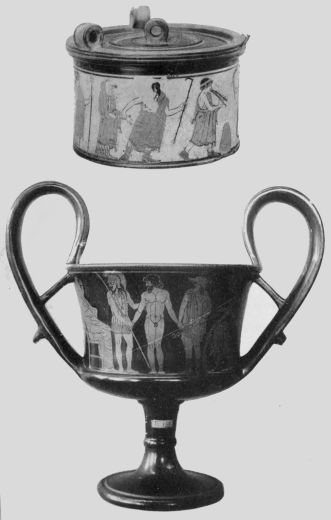
Plate 56.—Red-figured Vase; and Pyxis
Æschylus “A drama, brimful with heroical spirit. Euripides “What did you call it? Æschylus “‘The Chiefs against Thebes,’ That inspired each spectator with martial ambition, Courage, and ardour, and prowess, and pride. Dionysus “But you did very wrong to encourage the Thebans. Indeed you deserve to be punished, you do, For the Thebans are grown to be capital soldiers. You’ve done us a mischief by that very thing. Æschylus “The fault was your own, if you took other courses; The lesson I taught was directed to you; Then I gave you the glorious theme of ‘The Persians,’ Replete with sublime patriotical strains, The record and example of noble achievement, The delight of the city, the pride of the stage. Dionysus “I rejoiced, I confess, when the tidings were carried To old King Darius, so long dead and buried, And the chorus in concert kept wringing their hands, Weeping and wailing, and crying, Alas! Æschylus “Such is the duty, the task of a poet, Fulfilling in honour his office and trust. Look to traditional history, look To antiquity, primitive, early, remote: See there what a blessing illustrious poets Conferr’d on mankind, in the centuries past. Orpheus instructed mankind in religion, Reclaimed them from bloodshed and barbarous rites; Musæus delivered the doctrine of medicine, And warnings prophetic for ages to come. Next came old Hesiod, teaching us husbandry, Ploughing, and sowing, and rural affairs, Rural economy, rural astronomy, Homely morality, labour and thrift: Homer himself, our adorable Homer, What was his title to praise and renown? What but the worth of the lessons he taught us, Discipline, arms, and endurance of war?”
All Greek literature and art is judged by critics of all sorts from a standard almost exclusively moral. “Did he teach well?” “Did his art make people better?” Such are the questions constantly applied. The doctrine of Art for Art’s sake would have seemed to the Greeks monstrous and wicked. The actual charges made against Euripides in these scenes are (1) that he was an innovator; (2) that he was a realist, introducing lame people and beggars in rags on the idealist tragic stage; (3) that he was fond of casuistry, and thereby cultivated dishonesty; (4) that he chose immoral subjects dealing with such revolting topics as women in love! Sophocles is evidently regarded by our irrepressible bard as a personage too sacred to be brought upon his stage. That gentle spirit would have no part in such a strife either here or in the underworld.
I look upon Greek Comedy as a Saturnalian product. A people accustomed to a strict, self-imposed discipline in the rest of its art and morals deliberately throws off its restraints and lets itself go on occasions, like a Scotchman at Hogmanay. The Greeks were not in the least shocked by occasional and seasonable ebullitions of high spirits. If you had an enemy or an opponent in politics, the production of a comedy was the time when you might reasonably assert that his deceased mother had been a greengrocer, or that his wife had eloped with a Thracian footman, or that his face was ugly and his person offensive to the senses. You were expected to include some references to Melanthius, a tragic poet who was notoriously and most laughably afflicted with leprosy, or Opuntius, who provoked great mirth by having only one eye, or Cleonymus, who lost his shield on the field of battle, or Patroclides, who
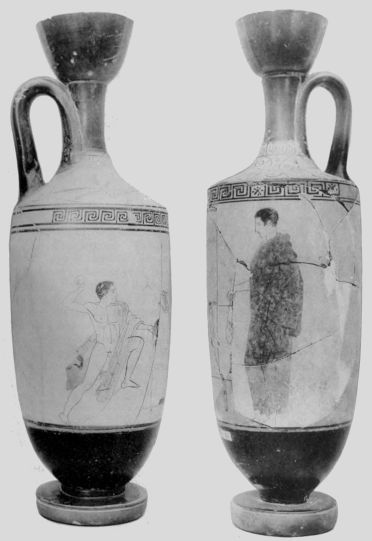
Plate 57.—White Polychrome Vases (“Lecythi”)
suffered a celebrated accident in the theatre. Any reference to leather was sure of a hearty laugh, for Cleon was interested in the leather-market. Anything about crabs tickled the audience, because they all knew Carcinus, the tragic poet. Impudent personalities are generally amusing for the moment, and they were the mainstay of old comedy. May it rest in peace!
Aidôs
Almost to weariness the chronicler of Greek culture has to reiterate this virtue of Moderation, Self-knowledge, Self-restraint, as the secret of all that is highest in the great period. It is a very remarkable phenomenon after all. There was nothing in the Greek temperament to account for it: on the contrary, they were excitable and hot-blooded people of the South. There was nothing at all in their religion to preach asceticism. It was not a product of reaction, a result of surfeit from extravagance, because it belongs to the earlier phases of culture only. I think it was due in a large measure to the force of historical circumstances. The same influences of external barbarism which forced them to fence their states behind a ring-wall on a rocky citadel also led them to enclose their souls within a wall of reserve. The West was not yet awake; it was against the East that they had to fight, spiritually as well as bodily. Eastern “barbarism,” which was really civilisation, ancient and splendid, visibly exhibited all the lusts of the flesh, all the pomps and vanities of this wicked world. Notably the Ionian philosophers, who saw the East close at hand, were the first to preach “Know thyself” and “Nothing too much!” And the Athenians, who had personally inflicted the Nemesis that attends pride, were the first to practise it.
But they seem to have had some congenital craving for perfection. Some have attributed it to their perfect physical health. Aristophanes, as we have just seen, laughs scornfully at disease and deformity. Euripides is arraigned for getting dramatic pathos out of rags and tatters. When Pericles delivers his oration over the dead soldiers he never once alludes to an individual’s prowess or fate. When Pheidias designs his long frieze, though there is infinite variety in the poses of his people, though every fold of drapery, every limb of man and beast is separately arranged with an eye to its own value in the design, the faces are not allowed to express any transient or personal emotion. A monster, such as a Centaur, or a Giant, or a Barbarian, may be allowed a wrinkled forehead to express age, or a twisted mouth to express pain or emotion, but a Greek must be perfect and serene.
This principle may be studied in detail upon the tombstones of Athens. You may often get much illumination about the character of people from their attitude in presence of death. The Turk plants cypresses in his cemeteries, carves a turban on a shaft over his graves, and then leaves the dead to keep their own graveyards tidy. The Frenchman adorns his tombs with conventional wreaths of tin flowers. The Englishman advertises the virtues of the wealthy deceased and the emotions of the survivors in Biblical texts or rather insincere epitaphs. The Italian, when he can afford it, erects florid monuments in Carrara marble. The nomad barbarian burns his dead, the jungle savage leaves the corpse in a tree for sepulture by the birds of heaven. The Egyptian preserves the body in balms and spices for the great awakening. The Roman generally used the pyre and stored the ashes methodically in tombs and catacombs.
We have seen that a divergence in funeral practice probably marks the difference between the two races which went to make up the population of ancient Greece. The aboriginal Southerners seem to have preserved their dead in shaft-graves and dome-graves, when their means allowed, sometimes only in earthenware jars. Rock-tombs of a similar character are found in great numbers all over Asia Minor, especially in Phrygia and Lycia. Sometimes in more civilised times they are replaced by large sarcophagi of stone, wood, or earthenware. Such is the Harpy Tomb at Xanthus, and the sculptures upon
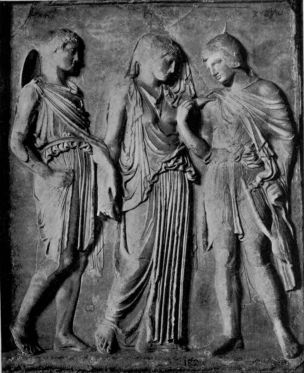
Plate LVIII. ORPHEUS AND EURYDICE. [TOMBSTONE RELIEF
it indicate the religious beliefs which accompany that form of burial—the winged angels which carry the soul away after death, whether called Fates or Harpies. Then the soul itself is often represented as a tiny winged figure, sometimes issuing from the mouth of the dead. It was thus that the Greek word Psyche came to mean both “soul” and “butterfly.” Tombs of this architectural character were obviously intended as houses for the dead, and, indeed, their design often follows the character of the houses occupied by the living. In accordance with the same idea, objects dear to the living are buried with the dead, such as the weapons and accoutrements of a warrior, the jewels and personal belongings of a woman, the toys of a child. Sometimes economical motives lead to a mere conventional copying of the real object, and many of the axes and swords found in the old tombs are far too weak ever to have been made for practical use. Blood and libations were sometimes poured into the graves, and vessels containing oil, or even food and drink, were often placed in the tomb, and when money came into use as much of that as could conveniently be spared. That too was conventionalised into the penny due to Charon, who ferried souls across the Styx. The “sop to Cerberus” was also a mythological explanation of the food buried with the body.
But Charon and Cerberus seem to belong to a different series of ideas about the dead. The Northerners, such as the Achæans of Homer, burned their dead upon the funeral pyre, collecting their ashes in jars and urns, and in the case of a great man raising a barrow over the spot. They believed that the soul of the happy warrior departed to a Valhalla or Paradise in the Isles of the Blessed, where he lived thenceforth as he had lived on earth at his best, in continual feasting and athletic exercise. The soul could not attain to this blessed relief until it had received the rites of burial, and to deny burial was an awful crime against Greek morality. After a battle one side generally had to acknowledge its defeat by asking for a truce in order that it might bury its dead.
Historical Athens practised both burial and cremation, after a period of lying in state. Burial would seem to have been the older custom, for it was assumed that the bones of Theseus must still be in existence somewhere, until they were eventually discovered in the island of Scyros. The Blessed Isles and the Heroic Valhalla doubtless survived as a literary tradition, but the “Hades” of ordinary Greek religion was the “grisly home” of Pluto and Persephone, a place of darkness and lamentation. We have seen that Pythagoras taught the immortality of the soul; but then, as now, it was not philosophy which created the popular ideas about death. The belief in immortality which undoubtedly prevailed generally in Greece seems to have been connected rather with the oldest religion of agricultural days. Such was the mystical hope given to the initiated in the secret nocturnal rites of Eleusis. It was intimately connected with the agricultural deities, Demeter the Earth Mother, Persephone the Maiden, her daughter, Triptolemus, the boy-god, and Eubouleus, the divine swineherd. The beautiful mythological representation of the doctrine in the story of Persephone, who was carried off by Hades to be his bride in the underworld while she was gathering flowers, and then at her mother’s powerful intercession was granted as a compromise the liberty to return to earth for half the year, is visibly a parable of summer and winter. It seems that current Greek theology so far as it related to Death was founded on naturalistic observation of the revival of the seasons and the rebirth of the crops. This theology was strongest across the water in Asia Minor, in its connection with the worship of Adonis.
Nevertheless, belief in immortality was not in Greece any more than it is with us strong enough to assuage the sting of Death or to enable the Greeks to dispense with the formalities of funerals. The Athenians practised the usual rites of mourning with professional musicians and dirge-singers, black clothes, women tearing their hair and beating their breasts. All this was and is inevitable, but the public sense of Greece continually demanded decency and reserve in the presence of
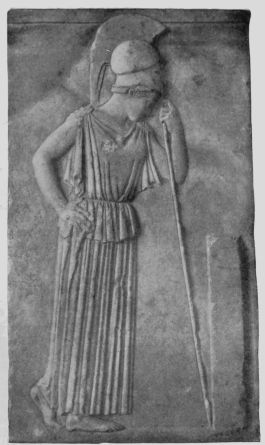
Plate LIX. THE MOURNING ATHENA
English Photo Co., Athens
Death. Solon’s old laws attempt to limit funeral displays. The Spartan system was very rigorous on the point, and there the women were held in such discipline that the death of a warrior on the field of battle was sometimes even actually received with patriotic rejoicing by the women of his family.
Our archæological museums are much indebted to the practice of burying with the deceased the objects of his use in life. An athlete would have the strigil, with which he scraped off the dust and oil of the arena, buried in his tomb; a lady would have her mirror, in its chiselled copper case, or her “pyxis” (jewel-box).[72] Most of the little terra-cotta figures in our museums come from the tombs. Some of them were children’s toys: often the figures seem to have been deliberately broken before interment. Among the most beautiful of such relics of the tomb are the funeral oil-jars, or lecythi, of the fifth and early fourth centuries. They were specially painted for the purpose, as we can perceive by their choice of funereal subjects, and they are of a distinct type of pottery. The usual vase technique of the best period has its background painted with a rich black glaze and its figures left plain in the natural colour of the terra-cotta.[73] But these funeral lecythi have the body of the vase covered with a slip of white or cream colour, and upon it the figures and scenes are painted in polychrome. In this way we have surviving very rare and beautiful effects of colour-drawing in this the noblest period of Greek art. The work of the great artists Polygnotus and Zeuxis has, of course, perished utterly, and we must rely on these little oil-jars, probably the work of quite obscure craftsmen, for our nearest representation of it.[74] Here again we are amazed at the effect produced by simple means. Even where the colours have faded we trace a delicacy and precision of line in the drawing which is simply astonishing. No artists have ever done so much with a single stroke of the brush. It implies a wonderful confidence and mastery of technique.
Our museums also contain a great number of the marble slabs, decorated in high relief, which formed the ordinary tombstone of the Athenians buried in the cemetery of Cerameikos, outside the Dipylon Gate at Athens. A few of them are still in situ, and present a remarkable picture as they stand. One of the most famous is the tomb of Hegeso, in the Athenian Museum. But there are a great many more, less known but equally beautiful, both there and elsewhere. None of them are, so far as we know, the work of named artists. The great works constructed under Pericles and Pheidias on the Acropolis must have collected dozens of competent minor craftsmen to Athens, and given them a noble training in their craft. Some show the round contours and delicate drapery of the Pheidian style, some the heavy muscularity of Polycleitus, and some show the small, finely poised heads of the school of Lysippus.
The subjects represented on the lecythi generally depict some part of the funeral rites, and the sepulchral slabs generally exhibit a scene of departure, which is always treated with extraordinary dignity and reserve. Not a lamentation is uttered, not a tear falls. Perhaps the gaze of our athlete’s father is more searching and intense than if it were a mere earthly separation from his stalwart son. There is, I think, no portraiture even here. If it is a woman who has gone to her long home, she is sometimes shown putting away her jewels for the journey. On one archaic relief now at Rome, a mother, with a smile upon her face, is placing her child on the knees of Persephone. A very beautiful one, also at Rome, bears the mythological scene of the parting between those types of married love and constancy, Orpheus and Eurydice. The head of Orpheus is bent a little, but Eurydice is smiling farewell, and the hand of Hermes, the Escort of Souls, is very light upon her wrist.[75] Most typical of all, perhaps, is the Mourning Athena,[76] which was probably a public memorial of soldiers fallen in the wars, since it was found built into a wall on the
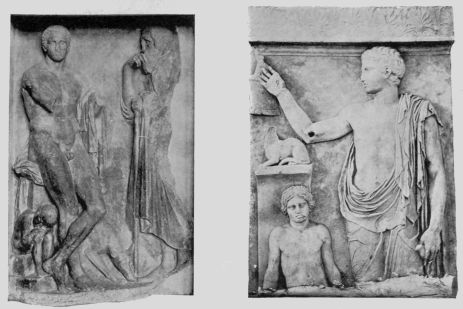
FIG. 1 FIG. 2
Plate LX. TWO TOMBSTONE RELIEFS, FROM THE CERAMEIKOS, ATHENS
Acropolis. It is strangely simple and restrained. The goddess, clad in her helmet, leans upon her spear, with head bent down, to read the names once painted on a short pillar which is part of the relief. The severe lines of her drapery indicate the austerity of the unknown artist’s treatment of his patriotic theme. This is the speech of Pericles in stone. I have chosen also two less-known monuments from the Athenian Museum to show the Athenian view of death more clearly. The dead hero does not mourn, but his humbler friends, like the Giants and Barbarians of the friezes, may express their emotion visibly and indecently. Young men nearly always have their hounds to accompany them upon their tombstones. They are big animals, perhaps of the famed Molossian breed, akin to our pointers. Their descendants may be seen (and felt, unless the traveller knows the local artifice of sitting down and pretending not to be afraid) on any upland farm in Greece to-day. Girls are often accompanied by small pet dogs, curly and excitable. The big hounds clearly show dejection in every line.[77] Commentators tell us that the cat (Felis domesticus) was not kept as a pet in Greece, but that when the ancient writers talk of the “wavy-tail” who catches mice they mean the weasel. Would any one but a commentator keep a weasel for a pet? And what is that headless animal upon the shelf, if not the primeval cat imported from Egypt? The young man in this relief[78] is letting his doves go free. And, as you see, the little slave-boys may look sorry when their masters go. They are not Greeks; they may express human emotions.